Artificial Intelligence · arXiv:2608.23911 v1 · submitted 24 Aug 2026 · 20 references
PROOF-Gen: From Optimized Data to Better Distillation
The paper says
“Supervised fine-tuning on teacher-generated trajectories is the standard first stage for distilling tool-calling capabilities into deployable models.”
more of the abstract
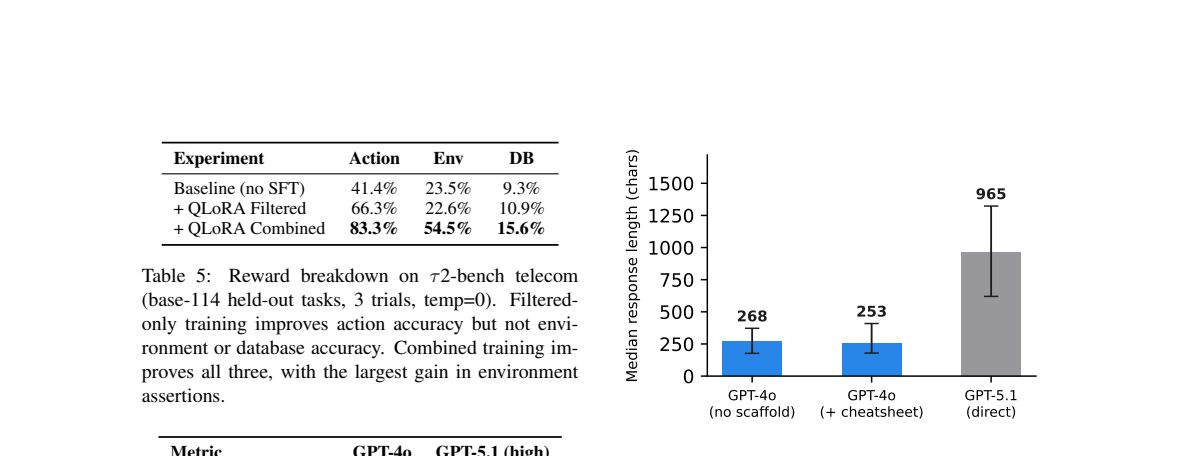
Post-training pipelines that drive shipped tool-calling agents re-run this stage on a daily or weekly cadence, paying the frontier-teacher cost each cycle, yet the mechanism is generate-and-filter (keep the teacher's passing trajectories, discard the rest) and each cycle leaves behind the same hard scenarios because failures supply no signal. On {\tau}2-bench, 57% of teacher trials fail, two-thirds of them near-misses (most tool calls correct, undone by one decisive error). We introduce PROOF-Gen (Per-scenario Reflective Optimization to Overcome FailedGeneration), which recovers golden trajectories from these failures via per-scenario prompt optimization. For each failed task, a reflector analyzes the execution trace and evaluation feedback, then writes corrective guidance that steers the teacher to a passing trajectory. The guidance is stripped before training, so the student learns from clean demonstrations with no task-specific scaffold. On {\tau}2-bench, per-scenario optimization recovers 93% of failed scenarios. Fine-tuned on the combined data, Qwen3-4B-Instruct-2507 improves from Pass^1=0.132 to 0.529 and Gemma 4 E4B-it gains +7.2pp on BFCL v4 multi-turn. In a deployed pipeline, the method lifts trajectory quality by +6.3pp goal completion and transfers to a deployed on-device model (+1.5pp goal completion; +1.7 to +5.0pp across response-quality metrics), with positive transfer in every locale (non-English average +1.48pp).
from the abstract
Pith says
Machine review · deepseek-v4-flash · 28 Aug 2026 · what was read was not recorded · not checked by a person
It can be wrong. Challenge this review or reply to it.
Holds up, with conditions. Clever recasting of prompt optimization as disposable data recovery; the recovery mechanism holds up, but the downstream gain needs a size-matched control and a template-disjoint eval before the headline numbers are trustworthy. This line is wrong
3 major objections · 5 minor
How often objections from reviews like this one are right: not yet measured
Not checked: figures, code, what the 20 references say.
The paper says, at Section 4, Table 2, Appendix J Table 11
The review did not quote this passage.
Pith says: Objection 1 of 3 · major
The central RQ2 comparison is confounded by training-set size and task coverage. The combined condition has 437 trajectories (6,863 unrolled examples) versus 158 trajectories (2,049 examples) for filtered-only, roughly a 2.8x/3.4x increase. Because the recovered trajectories also cover the previously failed tasks, the comparison conflates (a) more data, (b) broader task coverage, and (c) higher trajectory quality.
more of objection 1
A size-matched control is needed: for example, add the same number of teacher-passing trajectories sampled from the same distribution, or upsample the filtered set to the same unrolled-example count. Without such a control, the observed Pass^1 gain (0.132 to 0.529 for Qwen) cannot be attributed to recovery quality rather than data quantity.
The paper says, at Section 3, Appendix J, Figure 11
The review did not quote this passage.
Pith says: Objection 2 of 3 · major
The τ2-bench train/eval split is task-instance disjoint but not template-disjoint, as the paper explicitly acknowledges in Appendix J. Because the cheatsheets encode procedural recipes such as tool-call ordering, conditional branches, and state-tracking rules (Figure 11), and because the recovered trajectories are exact demonstrations of those procedures, a held-out task that instantiates the same template can be solved by recognizing a familiar procedure rather than by generalizing tool-calling behavior.
more of objection 2
This is load-bearing for the claim that the method improves distillation, not just performance on tasks resembling the training templates. The authors should either construct a template-disjoint held-out split and re-run the RQ2 comparisons, or provide a quantitative analysis of template overlap between recovered training tasks and eval tasks and show that gains persist on eval tasks whose templates were unseen.
The paper says, at Section 4, Abstract
The review did not quote this passage.
Pith says: Objection 3 of 3 · major
The paper repeatedly states that partial-credit or turn-level signals fail to lift end-to-end completion, but the 'partial-credit baseline' is actually the filtered-only condition, which trains exclusively on teacher-passing trajectories and never trains on failed trajectories with turn-level supervision. The empirical confirmation in Section 4 (filtered-only improves action accuracy by 25pp without improving task completion) therefore does not test the partial-credit hypothesis; it tests the effect of adding a small number of easy, passing demonstrations.
more of objection 3
The authors should either add a genuine partial-credit training condition (e.g., SFT on failed trajectories with action-level labels or reward-weighted sampling) or soften the claim in the abstract and introduction that partial-credit signals saturate.
5 minor objections
The paper says, at Abstract, Table 2
Pith says: minor objection 1 of 5
The abstract states that PROOF-Gen 'recovers 93% of failed scenarios,' but the recovery rate is measured on a fixed sample of 300 failures out of 2,013 (Table 2); please state 'sampled failures' to avoid overstating the rate.
The paper says, at Section 4, RQ3
Pith says: minor objection 2 of 5
The production evidence is reported with no absolute values, no confidence intervals, and a single run, so it cannot be independently assessed; the authors should either provide additional detail or explicitly present it as anecdotal and avoid using it in the headline claims.
show 3 more
The paper says, at Appendix J
Pith says: minor objection 3 of 5
The template-level overlap caveat is a first-order threat to generalization and should be moved to the Limitations section rather than appearing only in an appendix.
The paper says, at Table 13, Appendix L
Pith says: minor objection 4 of 5
Per-category BFCL results at n=60 vary by up to 3.3pp across evaluation runs, so the text should be careful not to overinterpret mixed category-level effects.
The paper says, at General
Pith says: minor objection 5 of 5
The paper does not state whether code or training data will be released; a reproducibility statement would strengthen the contribution.
What would settle it
Use τ2-bench template metadata to split the telecom tasks so that no template family appears in both the training pool (2,171 non-base tasks) and the evaluation set (114 base tasks). Retrain Qwen3-4B-Instruct-2507 with the identical PROOF-Gen pipeline and QLoRA hyperparameters on the template-disjoint training pool, then evaluate only on template-disjoint held-out tasks. Compare Pass^1 with the reported 0.529 and with the filtered-only condition (~0.111). If the combined-model gain collapses toward the filtered-only level, the headline result is template memorization; if it remains well above both controls, template leakage is not the driver. Report the number of distinct templates in the train and eval splits to bound the power of the test.
from the skeptic's reading
How the review went
4 readings by deepseek-v4-flash · 28 Aug 2026
- Reader holds up, with conditions
- Skeptic agrees
- Editor wrote the verdict above
- Referee major revision: 3 major objections, 5 minor
Not run on this paper: the simulated authors' defence.
Pith did not check this review's objections against the paper.
The review in full
The review in brief, machine-written
Short version: the core idea is genuinely fresh — invert prompt optimization to overfit a single failed scenario, strip the prompt, and keep only the recovered trajectory as training signal. That reframing is what makes the paper worth reading, and the recovery mechanism itself is well supported: 93% recovery on telecom failures, a clean reflector-capability ablation, fast convergence, and a careful audit showing the cheatsheets don't leak hardcoded values into trajectories. The voice-preservation observation is also a real plus for production distillation, and the authors are appropriately honest about several limitations.
The soft spots are real but not fatal. Biggest one is the confounded comparison: filtered-only training sees 158 trajectories while combined training sees 437, so part of the gain could simply be data quantity. There is no control with an equal number of non-optimized extra trajectories. Second, the paper acknowledges in Appendix J that train and eval share templates on τ2-bench; the recovered cheatsheets encode exactly those template procedures, so the Pass1 jump may be template familiarity rather than generalizable tool-calling behavior. A template-disjoint re-split, or at least a per-template breakdown, would cleanly separate those. The stress-test note is on the right track here, just overstated as a knockout. Third, the label "partial-credit baseline" is misleading, and there is a numeric inconsistency in Gemma's baseline between the text (0.231) and what Figure 4 seems to show (0.111). Those should be fixed before publication.
The production case study is interesting but unverifiable as reported — absolute values withheld, single run, no independent check. It works as anecdotal corroboration, not as evidence. The citation pattern looks fine, though the comparison to direct generation from a stronger teacher (GPT-5.1) is present as a recovery-rate ablation, not as a training-data comparison, which is a missed opportunity.
Who is this for? Anyone working on post-training data generation, tool-calling distillation, or agent training pipelines that routinely discard near-miss failures. It deserves a serious referee. I'd recommend sending it out with a request for the size-matched control, the template-disjoint evaluation, and cleanup of the Gemma baseline inconsistency.
The strongest objection
The central claim is that PROOF-Gen improves distillation, not just performance on tasks resembling the training templates. The public-benchmark evidence for this claim rests on a train/eval split that is only task-instance disjoint. Appendix J states: 'Because τ2-bench tasks are parameterized from templates, train and eval may instantiate shared templates with different parameters; we do not enforce template-level disjointness.' This is not a minor caveat: the recovered cheatsheets encode procedural recipes (tool-call ordering, conditional branches, state-tracking rules, as in Figure 11), and the recovered trajectories are exact demonstrations of those procedures. If a held-out task is a different parameter instantiation of a training template, the student can succeed by recognizing the familiar procedural pattern rather than by generalizing tool-calling behavior. The effect is magnified exactly where the method claims its largest win: combined training adds demonstrations for the hard, previously failed templates that filtered-only training lacks, so the comparison between filtered-only and combined is also entangled with which templates are covered in training. The production case study cannot substitute for a clean split because absolute values are withheld and the run is a single unverifiable deployment. The recovery mechanism itself is well supported by the reflector ablation and convergence data, but the downstream generalization claim is not, until a template-disjoint evaluation is reported.
The Reader's weakest_assumption names exactly the condition I find most load-bearing: the absence of template-level disjointness between training and evaluation on τ2-bench. The paper's strongest public result, Qwen3-4B-Instruct-2507 improving from Pass^1=0.132 to 0.529, is measured on an evaluation set that may contain the same template families as the training set, and the recovered trajectories are precisely the demonstrations that could teach template-specific procedures. Because the cheatsheet guidance is procedural rather than value-specific, the resulting trajectories are effective at instantiating the full recipe for a template, which is exactly what would let a student perform well on a same-template held-out task without learning general tool-calling competence. This concern does not require assuming bad faith; the paper discloses the limitation, but it does not quantify its effect, and the reported gains cannot be interpreted until it is quantified. The recovery-rate evidence (93% recovery, reflector-capability ablation, convergence behavior) is strong and independently supports RQ1. The stability checks in Appendix N and the repeated BFCL evaluations also support the reproducibility of the numbers as reported. What is missing is evidence that the downstream improvement transfers to genuinely unseen templates. A template-disjoint re-split is a concrete, feasible check that would settle whether the central claim holds. Since the Reader already conditioned acceptance on additional controls, my stress-test does not move the verdict; it strengthens the justification for the condition.
The referee's report
If the downstream gains hold, PROOF-Gen is a practical contribution that converts previously discarded failures into training signal, and the reflector/executor decoupling with scaffold stripping is a clean design. The reflector ablation (Figure 3), convergence analysis (Figure 6), integrity audit (Table 4), and independent retraining check (Appendix N) are valuable and thoughtfully executed. However, the headline distillation claim is currently supported by a confounded comparison and an acknowledged template-level overlap between train and eval; both issues must be resolved before the central claim can be accepted. The production case study, while suggestive, is not independently verifiable as reported.
Pith's reading of the paper (a machine's summary, not the authors')
Standard distillation of tool-calling agents is generate-and-filter: run a frontier teacher, keep the trajectories that pass, discard the rest. On the τ2-bench telecom domain, 57% of teacher trials fail, and most failures are near-misses in which the teacher gets most tool calls right but misses one decisive action. This paper claims those failures are a usable resource: a per-scenario reflective optimization loop writes corrective guidance that steers the teacher to a passing trajectory, the guidance is stripped away, and the student is fine-tuned on the union of filtered and recovered trajectories. The empirical claim is that this recovered data is what produces downstream gains, whereas filtered-only or partial-credit training improves intermediate accuracy but not end-to-end task completion.
What carries the argument. The central mechanism is the per-scenario cheatsheet: a block of natural-language corrective guidance, appended to the teacher's system prompt for one failed task, that a reflector iteratively revises after reading the failed execution trace and the verifier's feedback. It does the work of diagnosing the single decisive error and instructing the teacher how to navigate past it; the teacher re-executes the task from scratch until all evaluators pass, up to ten iterations. The cheatsheet is then deleted before fine-tuning, so the recovered trajectory is indistinguishable from a filtered one. This inverts the usual goal of prompt optimization — instead of finding one prompt that generalizes across tasks, the loop overfits a prompt to one scenario and throws it away, keeping only the passing trajectory.
Core claim. The central discovery is that a teacher's failed trajectories, which generate-and-filter pipelines discard, can be converted into golden demonstrations by optimizing a disposable per-scenario prompt rather than a general prompt. On τ2-bench, the procedure recovered 93% of the 300 sampled telecom failures (279 of 300, 88% attributable to the cheatsheet), and the recovered trajectories made up 64% of the combined training set. Fine-tuning on combined data lifted Qwen3-4B-Instruct-2507 from $\mathrm{Pass}^1=0.132$ to $0.529$ on τ2-bench and Gemma 4 E4B-it by +7.2pp on BFCL v4 multi-turn, the only condition that improved end-to-end completion in all four model–benchmark pairs. Because the cheatsheet is stripped before training, the authors argue the gains come from what the recovered trajectories demonstrate, not from the scaffold; the executor's interaction style is preserved even though the reflector supplies additional problem-solving capability. In a production deployment, trajectory quality rose +6.3pp in goal completion and the downstream on-device model gained +1.5pp with positive transfer in every locale.
The premise it rests on. The load-bearing premise is that the held-out tests are genuinely new situations, not just the same training situations with different numbers; if they are the same situations in disguise, the recovered trajectories may have taught pattern-matching rather than generally useful tool calling.
If the paper is right (Pith's inferences, not the authors')
Generate-and-filter pipelines can be retrofitted without changing the training algorithm: adding per-scenario recovery to an existing SFT stage is a drop-in data-generation step.
Failure analysis becomes actionable: near-miss trajectories that were previously discarded can be converted into demonstrations of the exact decision point where the teacher erred.
Task coverage and interaction style can be decoupled: using a stronger reflector with the original executor preserves the product's voice while adding capability.
Every retraining cycle no longer has to re-pay the same hard scenarios; once recovered, those trajectories persist in the training pool.
Recovered trajectories are compatible with preference-based methods as paired data, so they can feed offline preference optimization as well as SFT.
Beyond the paper: recovery rate should track verifier informativeness; if the evaluator returns only a binary score with no diagnostic detail, the reflector has little to revise against, and the method's 93% recovery is unlikely to hold. This predicts a testable drop on benchmarks with black-box judges.
Beyond the paper: because BFCL recovery is only 33.7% versus 93% on telecom, the method's benefit is concentrated where the teacher fails often and fails identifiably; as teacher pass rate rises, remaining failures are harder and recovery becomes less economical.
Beyond the paper: a direct test of the self-distillation ceiling would run the frontier-written cheatsheets through a 4B student executor; the share of failures recovered then measures whether the method can bootstrap the student's own coverage without a frontier executor.
Beyond the paper: if template-level overlap is the true source of the τ2-bench gains, the method's value shifts from generalization to data augmentation for known task families; enforcing template-disjoint evaluation would settle which.
Check this review
Pith stored no record of this review's passes and took no fingerprint of it. Reviews made by code from 13 Nov 2026 on carry both.
How often reviews like this one are right
Reviews like this one: written by deepseek-v4-flash, where what was read was not recorded.
How often objections from reviews like this one are right: not yet measured
Reviews by people
This review was written by a machine. No person has reviewed this paper on Pith yet. A scientist listed on Pith can review it for a fee, and their review is published here whatever it concludes.
The paper
Abstract
Supervised fine-tuning on teacher-generated trajectories is the standard first stage for distilling tool-calling capabilities into deployable models. Post-training pipelines that drive shipped tool-calling agents re-run this stage on a daily or weekly cadence, paying the frontier-teacher cost each cycle, yet the mechanism is generate-and-filter (keep the teacher's passing trajectories, discard the rest) and each cycle leaves behind the same hard scenarios because failures supply no signal. On {\tau}2-bench, 57% of teacher trials fail, two-thirds of them near-misses (most tool calls correct, undone by one decisive error). We introduce PROOF-Gen (Per-scenario Reflective Optimization to Overcome FailedGeneration), which recovers golden trajectories from these failures via per-scenario prompt optimization. For each failed task, a reflector analyzes the execution trace and evaluation feedback, then writes corrective guidance that steers the teacher to a passing trajectory. The guidance is stripped before training, so the student learns from clean demonstrations with no task-specific scaffold. On {\tau}2-bench, per-scenario optimization recovers 93% of failed scenarios. Fine-tuned on the combined data, Qwen3-4B-Instruct-2507 improves from Pass^1=0.132 to 0.529 and Gemma 4 E4B-it gains +7.2pp on BFCL v4 multi-turn. In a deployed pipeline, the method lifts trajectory quality by +6.3pp goal completion and transfers to a deployed on-device model (+1.5pp goal completion; +1.7 to +5.0pp across response-quality metrics), with positive transfer in every locale (non-English average +1.48pp).
The paper's own sentences, arranged, kept beside the review and separate from it. Each label is drawn from a closed vocabulary; the number beside it is the probability the classifier gave that label. No sentence in this record was written by a model.
abstract compiled · 2026-09-23
The authors' main claim, as the classifier picked it out 0.84
“In a deployed pipeline, the method lifts trajectory quality by +6.3pp goal completion and transfers to a deployed on-device model (+1.5pp goal completion; +1.7 to +5.0pp across response-quality metrics), with positive transfer in every locale (non-English average +1.48pp).”
How the main claim is stated: asserted 1.00
What the abstract itself states, as probabilities: claims first 0.09 · states limitation 0.14 · human participants 0.03 · controlled comparison 0.83 · randomized assignment 0.02 · states quantitative result 0.99 · compares with prior results 0.90 · mentions code or data availability 0.04
The abstract, sentence by sentence
This table labels the abstract only (arXiv listing abstract v1). The number is the probability the classifier gave the label.
| Sentence | Role | The authors' own work | States the main conclusion | Strength |
|---|---|---|---|---|
| Supervised fine-tuning on teacher-generated trajectories is the standard first stage for distilling tool-calling capabilities into deployable models. | background 1.00 | 0.05 | 0.02 | asserted 1.00 |
| Post-training pipelines that drive shipped tool-calling agents re-run this stage on a daily or weekly cadence, paying the frontier-teacher cost each cycle, yet the mechanism is generate-and-filter (keep the teacher's passing trajectories, discard the rest) and each cycle leaves behind the same hard scenarios because failures supply no signal. | background 0.50 | 0.17 | 0.04 | asserted 1.00 |
| On {\tau}2-bench, 57% of teacher trials fail, two-thirds of them near-misses (most tool calls correct, undone by one decisive error). | result 0.71 | 0.81 | 0.03 | asserted 1.00 |
| We introduce PROOF-Gen (Per-scenario Reflective Optimization to Overcome FailedGeneration), which recovers golden trajectories from these failures via per-scenario prompt optimization. | contribution 0.97 | 0.91 | 0.19 | asserted 1.00 |
| For each failed task, a reflector analyzes the execution trace and evaluation feedback, then writes corrective guidance that steers the teacher to a passing trajectory. | method 1.00 | 0.88 | 0.05 | asserted 1.00 |
| The guidance is stripped before training, so the student learns from clean demonstrations with no task-specific scaffold. | method 0.99 | 0.83 | 0.04 | asserted 1.00 |
| On {\tau}2-bench, per-scenario optimization recovers 93% of failed scenarios. | result 1.00 | 0.95 | 0.17 | asserted 1.00 |
| Fine-tuned on the combined data, Qwen3-4B-Instruct-2507 improves from Pass^1=0.132 to 0.529 and Gemma 4 E4B-it gains +7.2pp on BFCL v4 multi-turn. | result 1.00 | 0.94 | 0.26 | asserted 1.00 |
| In a deployed pipeline, the method lifts trajectory quality by +6.3pp goal completion and transfers to a deployed on-device model (+1.5pp goal completion; +1.7 to +5.0pp across response-quality metrics), with positive transfer in every locale (non-English average +1.48pp). | result 1.00 | 0.92 | 0.39 | asserted 1.00 |
What kind of paper the classifier reports this is: method or tool 1.00 · evidence from observation or experiment 0.98
What was examined, and what was not
Sources read
- arXiv listing abstract v1
Not examined
- full text
- figures and tables
- references and citing sentences
- relations to other papers
Levels run
- P abstract
Not run
- S sections
- T body sentences
- C citations
- R cross-paper relations
How the labels were made
Compiled by classifier-1.13.0 via TypeSafe API, question bank abstract-p1-20260923, 2026-09-23: 1 request, 7,215 input tokens.
Every quoted sentence on this record is the authors'. Every label is from Pith's closed vocabulary, with the probability shown beside it. This record as JSON
Figures (12)




Showing 11 of the paper's 12 figures. Figures are the authors', reproduced from the paper.
References (20)
- [1] No hardcoded values: all argument values sourced from user request, prior tool returns, or schema defaults? "no" ONLY if a value could not have been obtained without reading the cheatsheet on Pith
- [2] Reinforced self-training (ReST) for language modeling.Preprint, arXiv:2308.08998. Arian Hosseini, Xingdi Yuan, Nikolay Malkin, Aaron Courville, Alessandro Sordoni, and Rishabh Agar- wal. 2024. V-STaR: Training verifiers for self-taught reasoners. InProceedings of the 2024 Conf... on PithPith's reviewarXiv
- [3] No future information: each tool call uses information available at call time? "no" ONLY if a tool call uses a value not yet returned by any prior call. Verdict: TRANSFERABLE or HAS_SHORTCUT. Figure 9: Exact prompt template given to both LLM judges. Placeholders[task definitio... on Pith
- [4] For tire pressure: call check_tire_pressure({}). - Healthy only if every tire is between 32 and 35 inclusive on Pith
- [5] For tweet: post_tweet({"content":"healthy"|"not healthy", "tags":["#CarMaintenance"],"mentions":["@VehicleGuru"]}) on Pith
- [6] For retweet: use the tweet id returned by post_tweet. </steps> </guidance> Figure 12: Abbreviated BFCL cheatsheet (GPT-5.4 teacher,miss paramcategory). The cheatsheet teaches API prerequisite sequencing (lock doors before engine start) and evaluation-specific rules (tire healt... on Pith
- [7] No magic numbers: computed values justified by prior steps? "no" if the trajectory uses a number that only makes sense if you read the cheatsheet on Pith
- [9] Turn off Wi-Fi completely Swipe down from the top and tap the Wi-Fi icon so it’s OFF. ## TASK CHEATSHEET <failures> - The model tried to start the engine immediately after converting liters to gallons, but VehicleControlAPI required prerequisite state changes. - The model miss... on Pith
- [10] If the user does not provide the liter amount, ask for it first on Pith
- [11] Once provided, call liter_to_gallon({"liter": <number>}) on Pith
- [12] For VehicleControlAPI, perform the required setup sequence: - lockDoors({"unlock": false, "door": ["driver","passenger","rear_left","rear_right"]}) - pressBrakePedal({"pedalPosition": 1}) - startEngine({"ignitionMode": "START"}) on Pith
- [16] Make sure Mobile Data is ON In the same quick settings area, make sure “Mo- bile data” is turned ON on Pith
- [17] Test mobile data With Wi-Fi still OFF, open your browser and try to load any website on Pith
- [18] Tell me: Does the website load or not? When you try to send a picture message right now (with Wi-Fi still OFF and mobile data ON), does it stay stuck on “sending,” show a specific error message, or fail immediately? Once you tell me what happens in steps 3 and 4, I’ll guide yo... on Pith
- [19] Turn off Wi-Fi firstso we’re only testing mo- bile data on Pith
- [20] Then, in this order, tell me what happens for each: • Regular call: Try calling any number. Does it connect and stay connected? • Regular SMS text (no picture): Send a plain text to someone. Does it send? • Internet over mobile data: With Wi-Fi still OFF, open a browser. Does ... on Pith
- [2023] FireAct: Toward language agent fine-tuning. Preprint, arXiv:2310.05915. Tianzhe Chu, Yuexiang Zhai, Jihan Yang, Shengbang Tong, Saining Xie, Dale Schuurmans, Quoc V Le, Sergey Levine, and Yi Ma. 2025. SFT memorizes, RL generalizes: A comparative study of foundation model post-... on PithPith's reviewarXiv
- [2024] Large language models as optimizers. In International Conference on Learning Representa- tions, volume 2024, pages 12028–12068. Fan Yin, Zifeng Wang, I-Hung Hsu, Jun Yan, Ke Jiang, Yanfei Chen, Jindong Gu, Long Le, Kai-Wei Chang, Chen-Yu Lee, Hamid Palangi, and Tomas Pfister on Pith
- [2025] Magnet: Multi-turn tool-use data synthesis and distillation via graph translation. InProceed- ings of the 63rd Annual Meeting of the Association for Computational Linguistics (Volume 1: Long Pa- pers), pages 32600–32616, Vienna, Austria. Associ- ation for Computational Linguis... on PithPith's reviewarXiv
- [2026] Agentic context engineering: Evolving con- texts for self-improving language models.Preprint, arXiv:2510.04618. A Detailed Benchmark Results This appendix expands the per-question summary in Section 4 with the full breakdowns it refers to: the failure analysis the method targe... on PithPith's reviewarXiv
Cited by 1 Pith paper
Reviewed papers on Pith that cite this one. The full citation record
How the literature uses it
What this paper does with the arXiv papers it cites
What it cites · 7 sentences without a confident label
Uses the method or tool of 2 papers
-
Using GEPA [ref] , an iterative prompt optimizer, we analyze each failed execution trace and evaluation feedback, then add corrective instructions to a per-scenario cheatsheet appended to the teacher's system prompt.
GEPA: Reflective Prompt Evolution Can Outperform Reinforcement Learning · Introduction · 0.94
-
Sampling robustness is tested at temperature 1 on flip tasks [ref] .
Does RL Expand the Capability Boundary of LLM Agents? A PASS@(k,T) Analysis · Experimental Setup · 0.97
Compares with 1 paper
-
ACE [ref] is the closest analog, accumulating task-specific “playbooks” from execution feedback like our cheatsheets, but deploys them as persistent inference-time context.
Agentic Context Engineering: Evolving Contexts for Self-Improving Language Models · Related Work · 0.95
Cites as background 5 papers
-
In settings with execution-based verification, the standard pipeline [ref] is generate-and-filter: execute the teacher, score with a verifier, and keep passing trajectories (rejection sampling; [ref] ; STaR; [ref] ; ReST; [ref] ).
Scaling Relationship on Learning Mathematical Reasoning with Large Language Models · Introduction · 0.81
-
In settings with execution-based verification, the standard pipeline [ref] is generate-and-filter: execute the teacher, score with a verifier, and keep passing trajectories (rejection sampling; [ref] ; STaR; [ref] ; ReST; [ref] ).
Reinforced Self-Training (ReST) for Language Modeling · Introduction · 0.81
-
In settings with execution-based verification, the standard pipeline [ref] is generate-and-filter: execute the teacher, score with a verifier, and keep passing trajectories (rejection sampling; [ref] ; STaR; [ref] ; ReST; [ref] ).
FireAct: Toward Language Agent Fine-tuning · Introduction · 0.81
Challenges and discussion
Disagree with the review, or know something it missed? Leave a comment, or challenge this review formally: a challenge becomes a permanent entry in this paper's record, and its decision is published here.
Come back by email
A short list of the week's newly reviewed papers. Nothing is sent until you confirm from your inbox, and every email has a link that stops it. No account.
No comments yet.
Sign in to comment