Artificial Intelligence · arXiv:2609.04749 v1 · submitted 4 Sep 2026 · 29 references
DCFA: Dual-view Causal-inspired Attribution for Failure Reasoning in LLM-based Multi-agent Systems
The paper says
“Large language model (LLM)-based multi-agent systems have experienced rapid growth in recent years. Despite their promise, such systems remain fragile, frequently exhibiting reasoning and coordination errors that can lead to system-level failures.”
more of the abstract
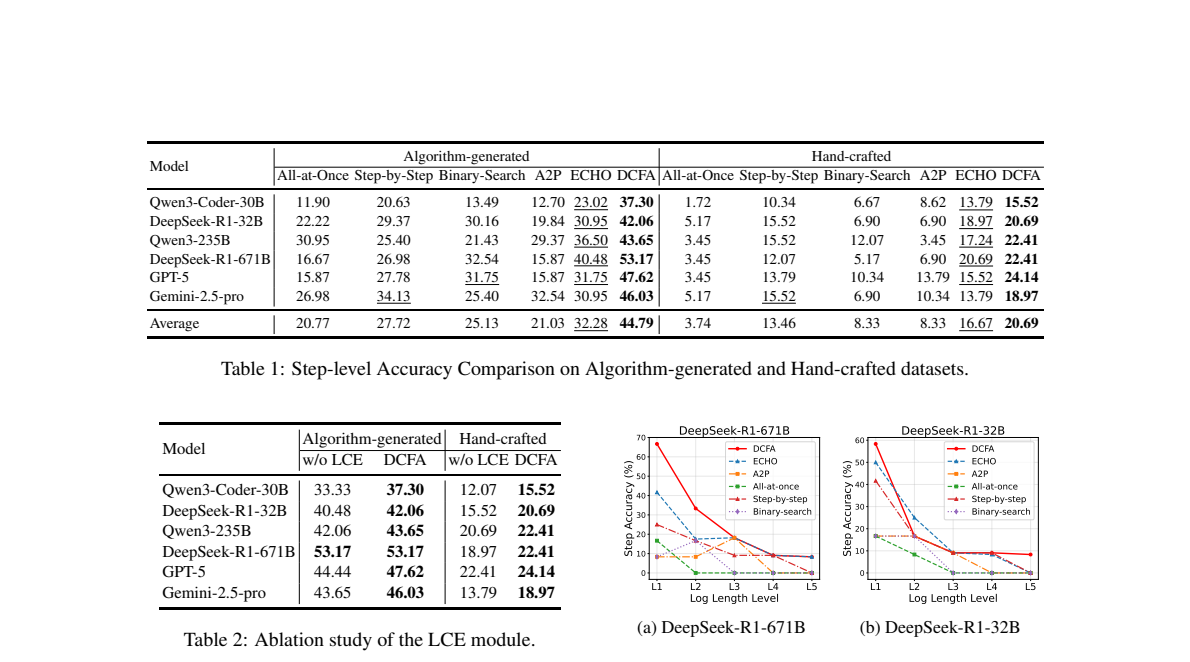
Failure attribution in such systems relies on tracing natural language interactions among agents to identify the decisive error, which refers to the earliest action whose correction can reverse system failure. There are two key challenges: 1) Shallow attribution: Existing methods often capture only minor deviations, such as incomplete retrievals or formatting errors, which verification mechanisms can correct, while missing the decisive cause of system failure. 2) Contextual degradation: As the length of the system traces increases, the model's reasoning ability rapidly deteriorates. To address these challenges, we propose DCFA, a training-free framework for failure attribution. DCFA integrates a global module that constructs structured causal-inspired dependency graphs from system traces to identify the initial decisive error, and a local module that applies local counterfactual-inspired reasoning to refine causal-inspired attribution. Experiments on the Who&When benchmark across six LLMs show that DCFA improves step-level accuracy by up to 8.27% over state-of-the-art baselines.
from the abstract
Pith says
Machine review · deepseek-v4-flash · 8 Sep 2026 · what was read was not recorded · not checked by a person
It can be wrong. Challenge this review or reply to it.
Holds up, with conditions. Promising two-stage failure attribution method for multi-agent LLMs, but the central claim is undermined by label leakage in the prompts (GROUND_TRUTH appears in hypothesis generation, correction, and decision steps) — results may reflect answer-conditioned selection, not genuine causal reasoning. This line is wrong
3 major objections · 4 minor
How often objections from reviews like this one are right: not yet measured
Not checked: figures, code, what the 29 references say.
The paper says, at Eq. (1), §4.2.1, Figs. 10, 11, 13
The review did not quote this passage.
Pith says: Objection 1 of 3 · major
The paper formulates the attribution task as M: (T, Y_hat) -> τ* (Eq. 1), where the input is the trace and the generated output only. However, the implemented prompts for GCA hypothesis generation (Fig. 10), corrected-trace construction (Fig. 11), and decisive-error decision (Fig. 13) all pass a GROUND_TRUTH field to the LLM.
more of objection 1
Eq. (8) likewise states that the correction function Correct(·) is 'conditioned on the ground-truth outcome.' This means the method has access to the correct answer during both global reasoning and local counterfactual simulation, which is not allowed under the problem definition. The reported gains may reflect label-conditioned search rather than genuine causal attribution. The ablation in Table 2 (w/o LCE) is also affected because Fig. 10 includes GROUND_TRUTH. The authors must either (a) revise the prompts to remove GROUND_TRUTH from all stages, or (b) explicitly acknowledge and justify this as a different problem setting, and then re-evaluate baselines under the same condition.
The paper says, at Table 1, §5.1
The review did not quote this passage.
Pith says: Objection 2 of 3 · major
The evaluation is conducted on a single benchmark (Who&When) with 184 traces total (126 algorithm-generated, 58 hand-crafted). While the hand-crafted traces are more challenging, conclusions drawn from 58 examples are tentative. Moreover, the benchmark's Step-level Accuracy metric may exhibit high variance; the paper reports only point estimates without confidence intervals or error bars in the main tables.
more of objection 2
Table 4 in the appendix shows very low variance over three runs, but the three runs share the same prompt template and may not capture systematic variability. A larger-scale evaluation or statistical significance tests would strengthen the claims.
The paper says, at §4.1.2, Limitations
The review did not quote this passage.
Pith says: Objection 3 of 3 · major
The dependency graph construction relies on LLM judgments of temporality, necessity, and sufficiency (Eqs. 3–5). The paper's own Limitations section acknowledges that LLMs may struggle with very long traces, and the necessity/sufficiency judgments are made without formal causal inference. The analysis in Appendix F shows that different LLMs produce significantly different graph densities (e.g., 68.90 edges for Qwen3-Coder-30B vs. 46.39 for DeepSeek-R1-32B on the hand-crafted set), which suggests high variability in graph quality.
more of objection 3
The authors should discuss how errors in graph construction propagate to the final attribution and whether there exists a minimum model capability below which DCFA degrades to baseline levels.
4 minor objections
The paper says, at Table 3
Pith says: minor objection 1 of 4
The accuracy column for DCFA reports '32.74' without a percent sign; for consistency with Table 1, it should read '32.74%.' Also, the row label 'Search-by-Step' in Table 3 should likely be 'Step-by-Step' to match the earlier usage.
The paper says, at §5.4.2, Table 2
Pith says: minor objection 2 of 4
The ablation study would benefit from also reporting the performance of a variant where LCE is applied but without the causal-inspired dependency graph (i.e., using only the raw trace), to isolate the contribution of the graph structure.
show 2 more
The paper says, at Appendix L, Fig. 10
Pith says: minor objection 3 of 4
The prompt in Fig. 10 instructs the model to 'Identify the single decisive root-cause event.' However, the problem definition allows for cases where no single correction fully recovers the correct outcome (§3). The instruction may bias the model toward always selecting one step; a note on how the model handles multi-error cases would be helpful.
The paper says, at General
Pith says: minor objection 4 of 4
The paper uses the term 'causal-inspired' extensively, which is appropriate given the reliance on LLM judgments rather than formal causal inference. However, several instances (e.g., abstract, line 3 of §1) drop the qualifier and simply say 'causal,' which overclaims. Please ensure consistent phrasing throughout.
What would settle it
Run a blind-field ablation on Who&When: remove GROUND_TRUTH from the Fig. 10, Fig. 11, and Fig. 13 prompts, replace it with the system's actual generated output, and forbid Correct(·) from introducing content taken from the correct answer. Recompute Table 1 and Table 2 across the six LLMs. If DCFA's advantage over ECHO shrinks to GCA-only or baseline levels, the reported 4–8 point gains are label-conditioned; if the advantage persists under the blind setting, the concern is resolved. Also inspect the ECHO and A2P prompts to confirm whether they receive the same GROUND_TRUTH field.
from the skeptic's reading
How the review went
4 readings by deepseek-v4-flash · 8 Sep 2026
- Reader holds up, with conditions
- Skeptic partly agrees
- Editor wrote the verdict above
- Referee major revision: 3 major objections, 4 minor
Not run on this paper: the simulated authors' defence.
Pith did not check this review's objections against the paper.
The review in full
The review in brief, machine-written
Here’s my take on the DCFA paper.
What’s actually new: DCFA combines global causal-inspired graph reasoning with local counterfactual refinement, both done via LLM prompts, to identify which step in a multi-agent trace caused the failure. That two-stage design is novel relative to the baselines, and the ablation shows the local module adds ~2-3% on the hand-crafted dataset. The method is training-free, code is released, and the paper is clearly written.
Now the problem. The stress-test note is correct: the GCA hypothesis generation prompt (Fig. 10), the correction prompt (Fig. 11), and the decisive-error decision prompt (Fig. 13) all include GROUND_TRUTH. The problem formulation (Eq. 1) says the model gets only the trace and the generated output. Supplying the correct answer to the LLM during hypothesis generation and correction means the reported step-level accuracy gains may partly reflect label-conditioned selection, not causal attribution. The ablation of LCE is also contaminated because the GCA-only column uses the same label-conditioned prompts. This is not a minor oversight — it directly threatens the paper’s central claim.
The benchmark is small (184 traces) and improvements vary (4-12% on algorithm-generated, 2-4% on hand-crafted). The paper’s own limitations section notes LLM dependence but does not flag this label issue. On the plus side, the graph construction and local search strategy are still interesting design ideas, and the case study gives some qualitative evidence.
Who this is for: people working on LLM-based multi-agent debugging. The paper has clever components but the evaluation is unreliable. I would not cite or trust the numbers without a clean rerun. A serious referee should request that the authors re-run experiments without passing GROUND_TRUTH into any prompt. If reproducible gains hold, the paper is solid and should be accepted. As is, it cannot be taken at face value.
Bottom line: the core problem is real and load-bearing. The paper needs revision before it merits publication.
The strongest objection
The headline claim rests on the full DCFA pipeline's step-accuracy advantage. Section 4.2.1 defines the correction function Correct(·) as conditioned on the 'ground-truth outcome' (Eq. 8), and the implemented prompts pass GROUND_TRUTH into GCA hypothesis generation (Fig. 10), corrected-trace construction (Fig. 11), and the decisive-error decision DED (Fig. 13). Under the paper's own problem formulation (Eq. 1), the attribution model receives only the trace and the generated final output, not the correct answer. If GROUND_TRUTH is the correct outcome, then the corrected trace is built by editing mistake events toward the label, and the marginal score ΔS(τ_i) in Eqs. 9–11 measures how well a prefix corrected with the answer aligns with the answer. This can select the step that most improves answer-alignment even if no genuine causal attribution is performed. The Table 2 ablation therefore does not separate local counterfactual reasoning from label-conditioned correction, and the w/o-LCE column is also affected because Fig. 10 includes GROUND_TRUTH. If the baselines do not receive the same field, the comparison is not identically prompted. The Limitations section's acknowledged dependence on LLM capability is real but secondary; the label-conditioning issue directly threatens the central claim.
The Reader's weakest assumption was that LLM judgments of temporality, necessity, and sufficiency in dependency graph construction may be unreliable. That is a genuine risk and is acknowledged in the paper's Limitations section, but it is not the most load-bearing point: even if those judgments are perfect, the reported gains could still be inflated because GROUND_TRUTH is threaded through the global hypothesis prompt, the corrected-trace construction, and the decisive-error decision. This is an internal consistency issue with Eq. 1 as much as an experimental-design issue: the formal attribution model is stated to receive only (T, generated output), yet the implemented prompts appear to consume the correct answer. I do not claim this is definitely leakage, because the field named GROUND_TRUTH might in the released code be the generated final output, or the baselines might receive the same information; the concrete blind-ablation test settles that ambiguity. The paper has real independent support: released code, deterministic temperature-zero inference, robustness runs in Appendix D, and a clear ablation structure. Those do not, however, establish that the LCE gain is causal rather than label-driven. The verdict label should remain conditional, but the condition should be sharpened from 'validate LLM judgment quality' to 'verify that the reported gains survive a blind ablation without GROUND_TRUTH in the correction and decision prompts.'
The referee's report
If the claimed results hold, DCFA would represent a useful step toward interpretable failure diagnosis in LLM-based multi-agent systems, addressing the known problems of shallow attribution and contextual degradation. The framework is training-free, which is attractive for practical use. However, the experimental validation is limited to a single, moderately sized benchmark, and the central methodological concern identified below weakens confidence in the current results.
Pith's reading of the paper (a machine's summary, not the authors')
When a large-language-model multi-agent system fails, the diagnosis that helps is not "some step went wrong" but which single interaction, if corrected, would reverse the failure; the paper calls this the decisive error. It argues that existing attribution methods settle for shallow, recoverable deviations such as incomplete retrievals or formatting slips, and that their accuracy collapses as traces grow long. To fix both problems it proposes DCFA, a training-free framework with two views: a global module that turns the raw interaction log into a step-level causal-inspired dependency graph and reasons over it to hypothesize the decisive error, and a local module that refines that hypothesis by simulating counterfactual traces in which a corrected prefix is followed by the original suffix, scoring each step by how much its correction moves the simulated outcome toward the ground-truth answer. On the Who&When benchmark across six LLMs, DCFA reports step-level accuracy gains of up to 8.27% over state-of-the-art baselines, with the local module contributing its largest gains on the long traces. If the claim holds, it is a training-free, inspectable way to turn unstructured agent logs into a concrete repair target.
What carries the argument. Two objects carry the argument. The first is the causal-inspired dependency graph $G = (V, E)$ over trace steps, defined so that an edge $\tau_p \to \tau_q$ exists only when an LLM judgment function $J$ confirms temporality, necessity (under the counterfactual intervention $\mathrm{do}(\neg\tau_p)$ the downstream step would not occur), and sufficiency (under $\mathrm{do}(\tau_p)$ it would); this triple filter is what separates causal-looking dependency from mere correlation. The second is the counterfactual-inspired scoring loop: a corrected trace $\hat{T}$ is produced with the ground-truth outcome in view, each prefix-counterfactual $\hat{T}(i) = (\hat{\tau}_1, \dots, \hat{\tau}_i, \tau_{i+1}, \dots, \tau_N)$ is simulated to an outcome $Y(i)$, cosine alignment $S(\tau_i)$ between the encoded $Y(i)$ and the encoded ground-truth answer is computed, and the marginal impact $\triangle S(\tau_i) = S(\tau_i) - S(\tau_{i-1})$ becomes the currency for a greedy bidirectional search that expands forward and backward from the global hypothesis while $\triangle S$ stays positive. The graph supplies structure and the marginal score supplies evidence, so that choosing which step to fix becomes a measurable comparison instead of an open-ended reading of a long log.
Core claim. The paper claims that the decisive error in a failed multi-agent run — the earliest interaction whose correction restores the correct outcome, or maximally reduces failure when several errors jointly contribute — can be identified by combining two views of the trace. The global view converts the interaction log into a directed causal-inspired dependency graph whose edges are admitted only if three conditions hold: temporality (the cause precedes the effect), necessity (removing the cause makes the effect fail to occur), and sufficiency (enforcing the cause induces the effect), with the judgments made by prompting an LLM. Reasoning over this graph produces an initial hypothesis of the decisive error. The local view tests that hypothesis with counterfactual-inspired experiments: it builds a fully corrected trace, forms prefix-counterfactual traces where the first $i$ steps are corrected and the remaining steps stay as recorded, simulates each variant's outcome, and measures its alignment to the ground-truth answer as cosine similarity in an embedding space; the marginal impact $ riangle S(\tau_i) = S(\tau_i) - S(\tau_{i-1})$ is then used by a bidirectional greedy search — forward to propagated effects, backward to upstream causes — that terminates when no neighbor yields a positive marginal gain. The step isolated by this procedure is the paper's attribution, and on the Who&When benchmark it reports step-level accuracy gains of up to 8.27% over the strongest baselines across six LLMs.
The premise it rests on. The whole pipeline rests on the assumption that an LLM reading plain text can judge, reliably, whether removing one interaction would prevent a later one from occurring and whether enforcing one would bring the later one about; systematic errors in those necessity and sufficiency judgments corrupt the dependency graph, and the attribution inherits the corruption, a dependence the paper's own Limitations section acknowledges.
If the paper is right (Pith's inferences, not the authors')
Attribution moves past minor, recoverable deviations: DCFA separates shallow errors that downstream verification could fix from the decisive error whose correction actually changes the final outcome, redirecting repair effort to the actionable step.
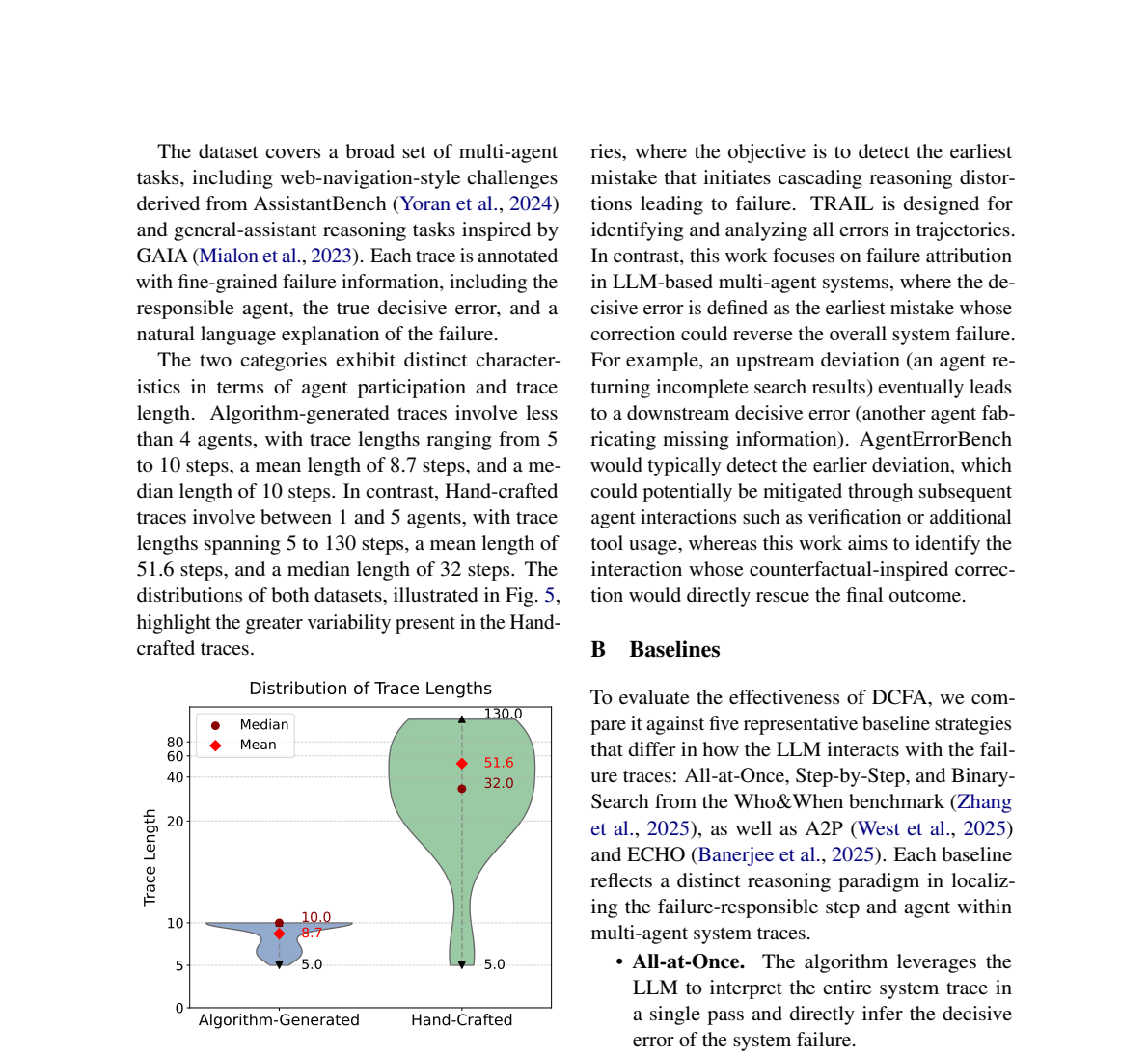
Long-trace degradation is mitigated: where baselines fall toward near-zero step-level accuracy as traces approach length 100, DCFA holds up by restricting counterfactual reasoning to a compact dependency neighborhood, with its largest gains on the longer hand-crafted traces (average length 51.6 steps).
The gains transfer across backends: step-level accuracy improves consistently for Qwen3-Coder-30B, Qwen3-235B, DeepSeek-R1-32B, DeepSeek-R1-671B, GPT-5, and Gemini-2.5-pro, and no fine-tuning or annotation is needed to apply DCFA to a new agent architecture.
The global module alone already beats the strongest baseline at matched call count: GCA uses two full-context LLM calls, the same as ECHO, and improves on it by 10.58 points on Algorithm-generated traces, suggesting the structured graph reasoning drives most of the gain.
In multi-error traces the method picks the step whose correction best reduces failure: the case study distinguishes contributory errors (incomplete retrieval at $\tau_8$, unverified propagation at $\tau_9$) from the decisive error (fabricated content at $\tau_{12}$).
The prefix-correction score $\triangle S$ is a general interpretability primitive: the same corrected-prefix, simulated-suffix construction could rank every step of a failed run by its sole corrective effect, producing a full repair map instead of a single verdict.
The graph's contribution is directly testable: compare full DCFA against a stripped version that takes the argmax of $\triangle S$ over every step with no graph and no search; equal accuracy would show the graph is scaffolding, worse accuracy would show it is load-bearing.
The paper's near-linear edge counts (roughly 8.95 edges for 8.7-step traces and 56.61 edges for 51.6-step traces) suggest the LLM-built graphs are implicitly local, so the sliding-window and graph-pruning variants the paper sketches could be benchmarked against the full procedure on much longer logs.
Because one LLM both constructs the dependency graph and judges the counterfactuals, checking whether edge sets and attribution survive paraphrase or reordering of trace content would separate genuine causal signal from the model's textual biases.
Check this review
Pith stored no record of this review's passes and took no fingerprint of it. Reviews made by code from 13 Nov 2026 on carry both.
How often reviews like this one are right
Reviews like this one: written by deepseek-v4-flash, where what was read was not recorded.
How often objections from reviews like this one are right: not yet measured
Reviews by people
This review was written by a machine. No person has reviewed this paper on Pith yet. A scientist listed on Pith can review it for a fee, and their review is published here whatever it concludes.
The paper
Abstract
Large language model (LLM)-based multi-agent systems have experienced rapid growth in recent years. Despite their promise, such systems remain fragile, frequently exhibiting reasoning and coordination errors that can lead to system-level failures. Failure attribution in such systems relies on tracing natural language interactions among agents to identify the decisive error, which refers to the earliest action whose correction can reverse system failure. There are two key challenges: 1) Shallow attribution: Existing methods often capture only minor deviations, such as incomplete retrievals or formatting errors, which verification mechanisms can correct, while missing the decisive cause of system failure. 2) Contextual degradation: As the length of the system traces increases, the model's reasoning ability rapidly deteriorates. To address these challenges, we propose DCFA, a training-free framework for failure attribution. DCFA integrates a global module that constructs structured causal-inspired dependency graphs from system traces to identify the initial decisive error, and a local module that applies local counterfactual-inspired reasoning to refine causal-inspired attribution. Experiments on the Who&When benchmark across six LLMs show that DCFA improves step-level accuracy by up to 8.27% over state-of-the-art baselines.
The paper's own sentences, arranged, kept beside the review and separate from it. Each label is drawn from a closed vocabulary; the number beside it is the probability the classifier gave that label. No sentence in this record was written by a model.
abstract compiled · 2026-09-23
The authors' main claim, as the classifier picked it out 1.00
“Experiments on the Who&When benchmark across six LLMs show that DCFA improves step-level accuracy by up to 8.27% over state-of-the-art baselines.”
How the main claim is stated: asserted 1.00
What the abstract itself states, as probabilities: claims first 0.04 · states limitation 0.09 · human participants 0.03 · controlled comparison 0.85 · randomized assignment 0.01 · states quantitative result 0.99 · compares with prior results 0.97 · mentions code or data availability 0.03
The abstract, sentence by sentence
This table labels the abstract only (arXiv listing abstract v1). The number is the probability the classifier gave the label.
| Sentence | Role | The authors' own work | States the main conclusion | Strength |
|---|---|---|---|---|
| Large language model (LLM)-based multi-agent systems have experienced rapid growth in recent years. | background 1.00 | 0.04 | 0.01 | asserted 1.00 |
| Despite their promise, such systems remain fragile, frequently exhibiting reasoning and coordination errors that can lead to system-level failures. | background 0.97 | 0.07 | 0.02 | asserted 1.00 |
| Failure attribution in such systems relies on tracing natural language interactions among agents to identify the decisive error, which refers to the earliest action whose correction can reverse system failure. | background 0.99 | 0.07 | 0.03 | asserted 1.00 |
| There are two key challenges: 1) Shallow attribution: Existing methods often capture only minor deviations, such as incomplete retrievals or formatting errors, which verification mechanisms can correct, while missing the decisive cause of system failure. 2) Contextual degradation: As the length of the system traces increases, the model's reasoning ability rapidly deteriorates. | gap 0.83 | 0.09 | 0.02 | asserted 0.99 |
| To address these challenges, we propose DCFA, a training-free framework for failure attribution. | contribution 0.99 | 0.82 | 0.07 | asserted 0.99 |
| DCFA integrates a global module that constructs structured causal-inspired dependency graphs from system traces to identify the initial decisive error, and a local module that applies local counterfactual-inspired reasoning to refine causal-inspired attribution. | method 0.97 | 0.85 | 0.12 | asserted 1.00 |
| Experiments on the Who&When benchmark across six LLMs show that DCFA improves step-level accuracy by up to 8.27% over state-of-the-art baselines. | result 1.00 | 0.96 | 0.72 | asserted 1.00 |
What kind of paper the classifier reports this is: method or tool 1.00 · evidence from observation or experiment 1.00
What was examined, and what was not
Sources read
- arXiv listing abstract v1
Not examined
- full text
- figures and tables
- references and citing sentences
- relations to other papers
Levels run
- P abstract
Not run
- S sections
- T body sentences
- C citations
- R cross-paper relations
How the labels were made
Compiled by classifier-1.13.0 via TypeSafe API, question bank abstract-p1-20260923, 2026-09-23: 1 request, 5,674 input tokens.
Every quoted sentence on this record is the authors'. Every label is from Pith's closed vocabulary, with the probability shown beside it. This record as JSON
Figures (13)





Figures are the authors', reproduced from the paper.
References (29)
- [1] Parse all events from the interaction log on Pith
- [2] Identify potential mistake events. A mistake event is an atomic action that may cause task failure, including: -incorrect or fabricated information, -unreasonable assumptions when encountering obstacles (e.g., API failure), -technical execution failures, -unproductive or irrel... on Pith
- [3] Towards adaptive software agents for debug- ging. InProceedings of the 33rd ACM International Conference on the Foundations of Software Engineer- ing, pages 636–640. Grégoire Mialon, Clémentine Fourrier, Thomas Wolf, Yann LeCun, and Thomas Scialom. 2023. Gaia: a benchmark for ... on Pith
- [4] Construct a causal graph over all events. For each candidate causal edge (e_i→e_j), ensure: -Temporality: e_iprecedes e_jin the event sequence. -Necessity: removing e_iwould cause e_jto fail to occur under the counterfactual intervention do(¬e_i). -Sufficiency: enforcing e_iwo... on Pith
- [5] Llm-based multi-agent decision-making: Chal- lenges and future directions.IEEE Robotics and Automation Letters. Song Tong, Kai Mao, Zhen Huang, Yukun Zhao, and Kaiping Peng. 2024. Automating psychological hy- pothesis generation with ai: when large language models meet causal ... on Pith
- [6] Causal ai scientist: Facilitating causal data sci- ence with large language models. InNeurIPS 2025 AI for Science Workshop. Haoyu Wang, Fengze Liu, Jiayao Zhang, Dan Roth, and Kyle Richardson. 2024. Event causality identifica- tion with synthetic control. InProceedings of the ... on PitharXiv
- [10] For each mistake event, record its event_idand a brief mistake_reason on Pith
- [12] Determine causal relationships between earlier events and later events across all steps. Output (JSON only): { "mistake_events": { "event_<step_id>_1": "reason for mistake" }, "causal_graph": { "step_id": { "event_dict": { "event_<step_id>_1": { "cause": ["event_X"], "effect":... on Pith
- [13] Identify the Mistake Agent Using All Events JSON and Mistake Events Reasons, determine which agent initiated the incorrect causal chain or committed the most critical error on Pith
- [14] Locate Obvious Mistakes From Mistake Events Reasons, identify obvious mistakes such as tool failures, incorrect outputs, or explicit error messages on Pith
- [15] Trace the Causal Path Using the Causal Graph JSON, trace the causal chain from these mistakes to the system’s final output. Discard mistakes that are isolated or later corrected on Pith
- [16] Determine the True Root Cause Identify the decisive event that ultimately determined the incorrect final outcome. This may be: -Upstream non-obvious error (e.g., incorrect assumptions, fabricated information, wrong tool selection) -Downstream decisive error (e.g., flawed compu... on Pith
- [17] Provide Reasoning Explain the reasoning process, including: -the initially identified obvious mistake, -why it is not the true root cause, -the inferred decisive root cause along the causal chain. Output (JSON only): { "log_answer": "<string: final incorrect answer in the trac... on Pith
- [18] Identify why the root cause event leads to task failure based on the mistake reasons on Pith
- [19] Correct the mistake events and any causally affected events using the ground truth on Pith
- [20] Keep the event sequence structure unchanged on Pith
- [21] Only modify factual elements (names, numbers, labels). Do not introduce new events. Output: Return ONL Y a JSON object containing the corrected version of `All Extracted Events` with the same format as the input. Output (JSON only): { "step_id": { "agent_name": "...", "event_d... on Pith
- [22] Identify the corrected root cause event and its directly affected events on Pith
- [23] Based on these corrections, reconstruct the downstream interaction sequence and fix any remaining dependent errors on Pith
- [24] Infer the correct final answer from the corrected event sequence on Pith
show 9 more
- [25] Briefly explain how the root cause led to the original incorrect answer and how the correction resolves it. Output (JSON only): { "reason": "...", "answer": "..." } Figure 12: Prompt used for counterfactual-inspired outcome simulation. Given a partially corrected interaction t... on Pith
- [26] Examine all identified mistake events and understand how each contributes to the failure on Pith
- [27] Analyze the causal chain among these events on Pith
- [28] Identify the single event that is causally decisive for the final incorrect outcome. -This may be an upstream error (e.g., incorrect assumption, fabricated data). -Or a downstream decisive error (e.g., incorrect computation or final decision) on Pith
- [29] Provide a concise explanation of why this event is the true root cause. Output (JSON only): { "root_cause_event": "<event_id>", "reason": "<explanation of why this event is the root cause>" } Figure 13: Prompt used for decisive error identification. The model analyzes candidat... on Pith
- [2023] and AssistantBench (Yoran et al., 2024). The dataset covers a broad set of multi-agent tasks, including web-navigation-style challenges derived from AssistantBench (Yoran et al., 2024) and general-assistant reasoning tasks inspired by GAIA (Mialon et al., 2023). Each trace is ... on Pith
- [2024] A survey on llm-based multi-agent sys- tems: workflow, infrastructure, and challenges.Vici- nagearth, 1(1):9. Yanhui Li, Linghan Meng, Lin Chen, Li Yu, Di Wu, Yuming Zhou, and Baowen Xu. 2022. Training data debugging for the fairness of machine learning soft- ware. InProceedin... on Pith
- [2025] Trail: Trace reasoning and agentic issue local- ization.arXiv preprint arXiv:2505.08638. Adam Fourney, Gagan Bansal, Hussein Mozannar, Cheng Tan, Eduardo Salinas, Friederike Niedtner, Grace Proebsting, Griffin Bassman, Jack Gerrits, Ja- cob Alber, et al. 2024. Magentic-one: A ... on PithPith's reviewarXiv
- [2026] Metacognitive self-correction for multi-agent system via prototype-guided next-execution recon- struction. InFindings of the Association for Compu- tational Linguistics: ACL 2026, pages 23320–23337. Shobhit Shrotriya, N Banu, Avi Kulkarni, and Sujata Aiyangar. 2025. Navigating... on Pith
Cited by 1 Pith paper
Reviewed papers on Pith that cite this one. The full citation record
- CoEvo-RSI: When Harnesses Evolve, Which Models Should Follow? cs.LG · Oct 2026
Challenges and discussion
Disagree with the review, or know something it missed? Leave a comment, or challenge this review formally: a challenge becomes a permanent entry in this paper's record, and its decision is published here.
Come back by email
A short list of the week's newly reviewed papers. Nothing is sent until you confirm from your inbox, and every email has a link that stops it. No account.
No comments yet.
Sign in to comment