Distributed, Parallel, and Cluster Computing · arXiv:2609.06551 v1 · submitted 6 Sep 2026 · 65 references
EStream: Fast and Memory-Efficient MoE Prefill through Expert Virtualization on Mobile NPUs
The paper says
“Mobile vendors and application developers increasingly deploy LLMs on smartphones for diverse prefill-only services. Yet current systems rely mainly on dense models whose regular computation maps efficiently to mobile NPUs, leaving more capable MoEs underused.”
more of the abstract
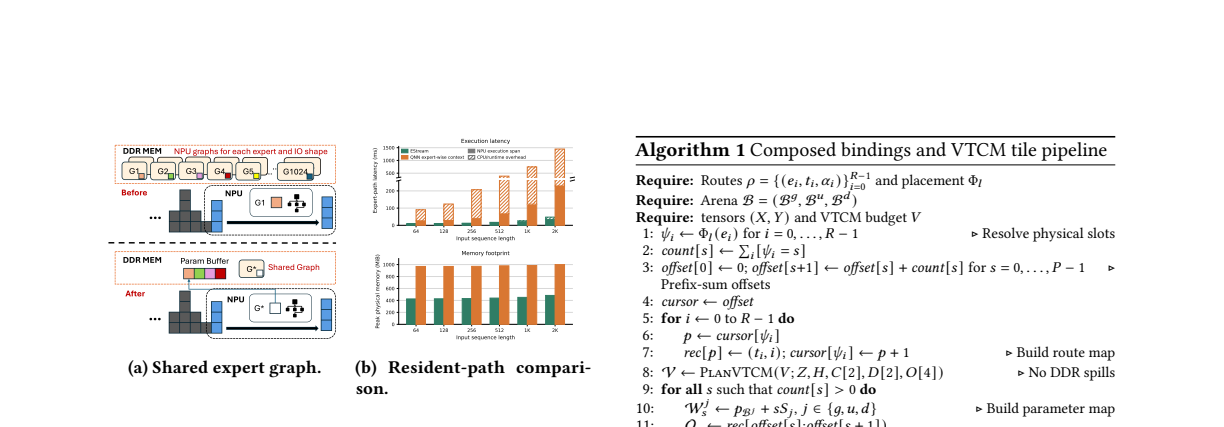
MoE prefill does not fit mobile NPUs: NPU graphs are fixed at compile time, yet MoE picks experts at runtime; and one request touches most experts, more than a phone can hold in memory. We present EStream, which resolves both by separating what the NPU must fix from what MoE decides at runtime. A single compiled expert graph serves every expert, with each expert's routed tokens and weight address bound at call time, so dynamic MoE execution runs entirely on the NPU without padding or CPU/GPU fallback. Expert virtualization keeps the expert pool in UFS flash storage and pages it through a fixed-size NPU-addressable arena, group by group, with loading hidden behind computation, so memory is bounded by the arena rather than by the model. It further introduces a hardware-aware configuration algorithm that automatically configures the UFS–NPU pipeline and maximizes loading–computation overlap. Across 18 comparative settings covering three 7B–16B MoEs and 256–4,096-token prompts, we evaluate EStream on a commercial Snapdragon smartphone. Compared to the fastest baseline at each setting, EStream achieves a 2.25–27.57X pure-prefill TTFT speedup and reduces peak physical memory by 1.19–12.29X. EStream further scales to MoE models with up to 46.7B parameters.
from the abstract
Pith says
Machine review · deepseek-v4-flash · 10 Sep 2026 · what was read was not recorded · not checked by a person
It can be wrong. Challenge this review or reply to it.
Holds up, with conditions. A strong mobile-systems result: full-NPU MoE prefill on a phone, honestly evaluated; the main caveats are single-device evidence and no released artifacts. This line is wrong
3 major objections · 5 minor
How often objections from reviews like this one are right: not yet measured
Not checked: figures, code, what the 65 references say.
The paper says, at §5.5, Eqs. (8)-(10)
The review did not quote this passage.
Pith says: Objection 1 of 3 · major
The validation of the auto-configurator may be circular. Section 3.4 states that a 1K-token C4 calibration request supplies T_ne, route vectors, L_{w,k}, and X_{w,k} used by Eq. (9), while Section 5.5 evaluates the configurator 'for an exact 1,024-token C4 prefix' against exhaustive Q/B/G sweeps.
more of objection 1
If these are the same request, the reported zero median regret and 3.45% worst-case regret measure fit to the calibration data rather than generalization to unseen inputs. Please state explicitly whether the evaluation prefix is disjoint from the profiling prefix, and if it is not, provide held-out validation across different prompts and token lengths (for example, 256, 512, 2K, and 4K C4 prefixes) and report per-setting regret.
The paper says, at §5.2, Table 3, Figure 8
The review did not quote this passage.
Pith says: Objection 2 of 3 · major
The paper does not report which (G, Q, B) configurations were used for the headline pure-prefill latency and memory results, nor whether those configurations were selected by the auto-configurator under a stated memory budget or by the exhaustive sweep oracle of Section 5.5.
more of objection 2
If the headline numbers use oracle-selected parameters, the automatic-configuration contribution is not what produced them; if they use auto-config parameters, the held-out validation requested above is required. Please state the exact configuration and memory budget for every setting in Figure 8 and Table 3, and indicate how those configurations were chosen.
The paper says, at §5.6, Figure 11
The review did not quote this passage.
Pith says: Objection 3 of 3 · major
The claim that EStream achieves 'full-NPU prefill' rests on the implementation's division of labor between the host runtime and the HTP backend, but the paper does not directly verify the absence of host-side expert projection through profiling. The host clearly performs route-descriptor construction, bank publication, and submission, which is consistent with full-NPU expert math, but a short utilization or trace …
more of objection 3
… analysis (HTP busy time, host expert-path time, DMA/HMX/HVX overlap) would make the claim machine-checkable and would also quantify the residual host overhead that the short-prompt results in Figure 7 suggest. This is not a correctness objection to the design, but it would strengthen the central claim.
5 minor objections
The paper says, at §5.2, Figure 8, Table 3
Pith says: minor objection 1 of 5
Latency results are reported as medians of three fresh-process runs without variance or per-run values; adding error bars or run-level tables for at least the headline settings would help assess stability on a mobile device.
The paper says, at §5.4, Table 4
Pith says: minor objection 2 of 5
The accuracy evaluation uses 200 examples per task and reports no confidence intervals. Task-score differences of 0.5-3.0 points are within the range of binomial sampling noise, so the 'accuracy-preserving' conclusion would be more solid with bootstrap intervals or additional examples for the larger deviations (for example, DeepSeek ARC-C and Qwen3 overall).
show 3 more
The paper says, at §5.5
Pith says: minor objection 3 of 5
Reporting 'zero median regret' and worst-case regret is helpful, but the distribution of regret across the 12 model-budget pairs and the three misses would be clearer if the per-budget values were tabulated alongside the sweep minima.
The paper says, at §3.4, Eq. (7)
Pith says: minor objection 4 of 5
Equation (7) selects Q0 using a 95%-of-peak bandwidth threshold across layouts; since the paper notes Q0 is a device property fixed across models, a sentence clarifying that the threshold is applied per device and then reused for all deployment-time budgets would prevent misreading Q0 as a per-model fit.
The paper says, at §4, §7
Pith says: minor objection 5 of 5
The manuscript provides no artifact link or detailed deployment procedure for the approximately 23K lines of runtime code. A reproducibility appendix with build steps, profiling scripts, and the exact Q4 packing pipeline would substantially increase confidence in the measurements, even if code release is not possible.
What would settle it
Reproduce Figure 8 for one model–length pair (e.g., OLMoE-1B-7B at 1K tokens) using the authors' binary and the same phone model, comparing pure-prefill TTFT and peak memory against the fastest reported baseline; a deviation larger than 20% in the speedup ratio would warrant further investigation of measurement methodology.
from the skeptic's reading
How the review went
4 readings by deepseek-v4-flash · 10 Sep 2026
- Reader holds up, with conditions
- Skeptic agrees
- Editor wrote the verdict above
- Referee major revision: 3 major objections, 5 minor
Not run on this paper: the simulated authors' defence.
Pith did not check this review's objections against the paper.
The review in full
The review in brief, machine-written
You should know two things about this paper. First, the headline claim — first full-NPU MoE prefill on a commercial smartphone — is plausible, and its novelty is at the system level, not the concept level. Second, the evaluation is the strongest part of the paper, and it holds up.
The novelty is the integration. Expert offloading, expert caching, grouped expert graphs, and below-graph Hexagon programming all appear in the cited literature. What EStream adds is binding them into one design: a topology-invariant graph whose route extents and weight addresses are bound at call time, experts virtualized through a bounded NPU-addressable arena streamed from UFS, and a max-plus pipeline model that auto-selects group size, queue depth, and bank count. That integration is what makes the full-NPU claim work, and the ablations earn it: graph sharing vs QNN-switch (6.27–21.02X), virtualization vs a resident reference (3.73–6.36X memory), pipeline vs naive streaming (1.18–1.73X). The auto-configurator is validated against exhaustive sweeps on the same device with zero median regret and 3.45% worst-case regret, so the circularity burden is genuinely low; the headline numbers are measured latency and memory, not fitted outputs.
The paper also reports its losses. CPU stays faster at 16–23-token prompts because dispatch and pipeline fill cannot be amortized. Qwen3 shows a 5.51% PPL shift. Those admissions make me trust the measurements more, not less.
Soft spots, in proportion. The main one is reproducibility: no artifacts, one phone generation, one SoC. The speedup and memory ratios rest on the authors' own builds and baseline ports, and several baselines OOM at longer lengths, which shapes the comparison field. That is not a flaw in the design, but it bounds what a referee can independently verify. Second, the abstract's memory range (1.19–12.29X) does not match the contributions' 6.45–12.29X against the fastest non-offloading baseline; the paper should say which baseline sits behind the 1.19. Third, the PowerInfer-2 discussion is thin — 'precompiled graph variants and lacks a public mobile implementation' does not say precisely what is missing relative to this system. Minor: no run-to-run variance or thermal handling is reported. None of these are load-bearing; the design logic and the measured numbers are internally consistent.
I land close to where the reader did: conditional accept, with code release — or at minimum a precise baseline-port document — as the main condition.
The paper is for mobile and edge systems researchers, NPU compiler people, and anyone working on on-device LLM inference. It deserves a serious referee. I would bring it to the reading group and would cite it if I were working in this subfield.
The strongest objection
The paper's central claim—that EStream is the first system to run full-NPU large MoE prefill on a commercial smartphone—is well-supported by its design, implementation, and evaluation. The weakest assumption identified by the reader (reliance on Hexagon HTP programmability and UFS latency hiding) is true by construction for the targeted platform and explicitly acknowledged; the paper demonstrates that these conditions are satisfied on the Snapdragon 8 Elite Gen 5. The evaluation is thorough, reports both strengths and limitations (e.g., short-prompt regimes where CPU is faster, Qwen3 PPL shift), and includes ablations that isolate each design decision. No logical flaws, internal inconsistencies, or misrepresentations of prior work were found. The claim stands on the evidence provided, subject to the reproducibility concerns already flagged by the reader (no released artifacts, single phone generation).
The reader's verdict (CONDITIONAL, MODERATE confidence) already captures the key uncertainty: lack of artifact release and single-platform evaluation. My stress-test pass did not uncover a new load-bearing concern that would change the verdict. The weakest assumption is real but does not undercut the paper's core demonstration on the tested hardware. Therefore, the conditional acceptance recommendation remains appropriate. The concrete test I propose targets the reproducibility barrier that the reader correctly identified.
The referee's report
The central claim is substantial: if accepted, this is the first demonstration that MoE prefill can execute entirely on a commercial phone NPU without per-expert padding or CPU/GPU expert fallback, while decoupling resident expert memory from total model size. The evidence for this claim is strong and unusually honest. The paper explicitly reports regimes where CPU baselines are faster (16-23-token prompts), a Qwen3 perplexity shift in Table 4, and the platform dependence of the design on programmable HTP primitives, and it discusses decode and portability limitations in Section 7. The evaluation is internally consistent, with a careful ablation structure: Figure 11 isolates virtualization and full-NPU execution, Figure 5b isolates topology-invariant graph sharing against QNN context switching, and Figure 10 validates the pipeline configurator against an 184-point exhaustive sweep. The stress-test concern about relying on HTP programmability and UFS latency hiding is real but, on reading the paper, it is acknowledged and demonstrated on the target platform rather than being a hidden assumption.
Pith's reading of the paper (a machine's summary, not the authors')
EStream addresses two mismatches that prevent Mixture-of-Experts (MoE) language models from running efficiently on mobile NPUs: the static graph nature of NPUs conflicts with dynamic expert selection, and prefill requests touch nearly all experts, exceeding phone memory. It introduces topology-invariant expert graph sharing, which compiles one expert graph for all experts and binds routes and parameters at runtime, and expert virtualization, which streams expert weights from UFS storage through a fixed-size NPU-addressable arena. This enables full-NPU MoE prefill with no CPU/GPU fallback, no padding, and memory bounded by the arena rather than by the model. On a commercial Snapdragon smartphone, EStream achieves 2.25–27.57× time-to-first-token speedup and 1.19–12.29× peak memory reduction over baselines, scaling to 46.7B-parameter MoEs within 1.46–4.11 GiB.
What carries the argument. The central machinery is a combination of topology-invariant expert graph sharing (one compiled graph for all shape-compatible experts with runtime binding of routes and weight addresses), expert virtualization (a fixed-size NPU-addressable arena that pages experts from UFS storage, with safe slot reuse), and a UFS-NPU pipeline that overlaps loading with computation, automatically configured via a max-plus model that selects group size, queue depth, and bank count under a memory budget.
Core claim. EStream is, to our knowledge, the first system to run full-NPU large MoE prefill on a commercial smartphone. It resolves the graph mismatch by compiling a single expert graph that serves every expert of the same shape, with runtime route and parameter binding, and the memory mismatch by virtualizing the expert pool over a bounded NPU-addressable arena streamed from UFS, with loading overlapped behind computation. The paper reports that across 18 settings with three MoEs and 256–4,096-token prompts, EStream achieves a 2.25–27.57× pure-prefill TTFT speedup and 6.45–12.29× memory reduction over the fastest non-offloading baseline, and scales to Qwen3-30B-A3B (30.5B params) within 1.46 GiB and Mixtral-8×7B (46.7B params) within 4.11 GiB.
The premise it rests on. The design assumes the Qualcomm Hexagon HTP exposes programmable scalar control threads, DMA/HVX/HMX co-scheduling, and software-managed VTCM below the QNN graph abstraction, without which the runtime binding and intra-NPU pipelining cannot be implemented.
If the paper is right (Pith's inferences, not the authors')
On-device AI services can now run MoE models that were previously too large or too slow, enabling better intent recognition, content moderation, and recommendation without sending data to the cloud.
Memory footprint for MoE prefill becomes predictable and bounded by a configured arena, independent of the number of experts in the model.
Energy efficiency improves by 1.19–8.41× over baselines, extending battery life for on-device LLM tasks.
The approach does not require model modification, so it can be applied to existing MoE checkpoints off the shelf.
The design targets prefill-only workloads; decode still requires separate optimization for autoregressive steps.
The technique could be extended to decode by retaining frequently used experts in a small cache, reducing I/O for autoregressive steps.
Porting to other NPU platforms (e.g., Apple Neural Engine, MediaTek APU) would require exposing similar low-level primitives for scalar control, DMA, and on-chip memory management.
The observed latency at very short prompts (16–23 tokens) suggests NPU dispatch overhead dominates; future systems might use a CPU fallback for such cases or improve NPU startup times.
Check this review
Pith stored no record of this review's passes and took no fingerprint of it. Reviews made by code from 13 Nov 2026 on carry both.
How often reviews like this one are right
Reviews like this one: written by deepseek-v4-flash, where what was read was not recorded.
How often objections from reviews like this one are right: not yet measured
Reviews by people
This review was written by a machine. No person has reviewed this paper on Pith yet. A scientist listed on Pith can review it for a fee, and their review is published here whatever it concludes.
The paper
Abstract
Mobile vendors and application developers increasingly deploy LLMs on smartphones for diverse prefill-only services. Yet current systems rely mainly on dense models whose regular computation maps efficiently to mobile NPUs, leaving more capable MoEs underused. MoE prefill does not fit mobile NPUs: NPU graphs are fixed at compile time, yet MoE picks experts at runtime; and one request touches most experts, more than a phone can hold in memory. We present EStream, which resolves both by separating what the NPU must fix from what MoE decides at runtime. A single compiled expert graph serves every expert, with each expert's routed tokens and weight address bound at call time, so dynamic MoE execution runs entirely on the NPU without padding or CPU/GPU fallback. Expert virtualization keeps the expert pool in UFS flash storage and pages it through a fixed-size NPU-addressable arena, group by group, with loading hidden behind computation, so memory is bounded by the arena rather than by the model. It further introduces a hardware-aware configuration algorithm that automatically configures the UFS–NPU pipeline and maximizes loading–computation overlap. Across 18 comparative settings covering three 7B–16B MoEs and 256–4,096-token prompts, we evaluate EStream on a commercial Snapdragon smartphone. Compared to the fastest baseline at each setting, EStream achieves a 2.25–27.57X pure-prefill TTFT speedup and reduces peak physical memory by 1.19–12.29X. EStream further scales to MoE models with up to 46.7B parameters.
The paper's own sentences, arranged, kept beside the review and separate from it. Each label is drawn from a closed vocabulary; the number beside it is the probability the classifier gave that label. No sentence in this record was written by a model.
abstract compiled · 2026-09-23
The authors' main claim, as the classifier picked it out 0.91
“Compared to the fastest baseline at each setting, EStream achieves a 2.25--27.57X pure-prefill TTFT speedup and reduces peak physical memory by 1.19--12.29X.”
How the main claim is stated: asserted 1.00
What the abstract itself states, as probabilities: claims first 0.07 · states limitation 0.16 · human participants 0.02 · controlled comparison 0.96 · randomized assignment 0.02 · states quantitative result 0.99 · compares with prior results 0.98 · mentions code or data availability 0.03
The abstract, sentence by sentence
This table labels the abstract only (arXiv listing abstract v1). The number is the probability the classifier gave the label.
| Sentence | Role | The authors' own work | States the main conclusion | Strength |
|---|---|---|---|---|
| Mobile vendors and application developers increasingly deploy LLMs on smartphones for diverse prefill-only services. | background 1.00 | 0.06 | 0.02 | asserted 1.00 |
| Yet current systems rely mainly on dense models whose regular computation maps efficiently to mobile NPUs, leaving more capable MoEs underused. | gap 0.51 | 0.06 | 0.03 | asserted 0.99 |
| MoE prefill does not fit mobile NPUs: NPU graphs are fixed at compile time, yet MoE picks experts at runtime; and one request touches most experts, more than a phone can hold in memory. | background 0.61 | 0.15 | 0.04 | asserted 1.00 |
| We present EStream, which resolves both by separating what the NPU must fix from what MoE decides at runtime. | contribution 0.99 | 0.92 | 0.34 | asserted 1.00 |
| A single compiled expert graph serves every expert, with each expert's routed tokens and weight address bound at call time, so dynamic MoE execution runs entirely on the NPU without padding or CPU/GPU fallback. | method 0.97 | 0.90 | 0.18 | asserted 1.00 |
| Expert virtualization keeps the expert pool in UFS flash storage and pages it through a fixed-size NPU-addressable arena, group by group, with loading hidden behind computation, so memory is bounded by the arena rather than by the model. | method 0.97 | 0.90 | 0.11 | asserted 1.00 |
| It further introduces a hardware-aware configuration algorithm that automatically configures the UFS--NPU pipeline and maximizes loading--computation overlap. | method 0.81 | 0.91 | 0.05 | asserted 1.00 |
| Across 18 comparative settings covering three 7B--16B MoEs and 256--4,096-token prompts, we evaluate EStream on a commercial Snapdragon smartphone. | method 0.92 | 0.96 | 0.04 | asserted 0.97 |
| Compared to the fastest baseline at each setting, EStream achieves a 2.25--27.57X pure-prefill TTFT speedup and reduces peak physical memory by 1.19--12.29X. | result 1.00 | 0.96 | 0.54 | asserted 1.00 |
| EStream further scales to MoE models with up to 46.7B parameters. | result 0.97 | 0.87 | 0.13 | asserted 1.00 |
What kind of paper the classifier reports this is: method or tool 1.00 · evidence from observation or experiment 1.00
What was examined, and what was not
Sources read
- arXiv listing abstract v1
Not examined
- full text
- figures and tables
- references and citing sentences
- relations to other papers
Levels run
- P abstract
Not run
- S sections
- T body sentences
- C citations
- R cross-paper relations
How the labels were made
Compiled by classifier-1.13.0 via TypeSafe API, question bank abstract-p1-20260923, 2026-09-23: 1 request, 7,740 input tokens.
Every quoted sentence on this record is the authors'. Every label is from Pith's closed vocabulary, with the probability shown beside it. This record as JSON
Figures (11)




Showing 10 of the paper's 11 figures. Figures are the authors', reproduced from the paper.
References (65)
- [1] Cecilia Aas, Hisham Abdelsalam, Irina Belousova, Shruti Bhargava, Jianpeng Cheng, Robert Daland, Joris Driesen, Federico Flego, Tristan Guigue, Anders Johannsen, Partha Lal, Jiarui Lu, Joel Ruben Antony Moniz, Nathan Perkins, Dhivya Piraviperumal, Stephen Pulman, Diar- muid Ó ... on PithPith's reviewarXiv
- [2] Mohammed Javed Absar, Muthu Baskaran, Abhikrant Sharma, Ab- hilash Bhandari, Ankit Aggarwal, Arun Rangasamy, Dibyendu Das, Fateme Hosseini, Franck Slama, Iulian Brumar, Jyotsna Verma, Kr- ishnaprasad Bindumadhavan, Mitesh Kothari, Mohit Gupta, Ravis- hankar Kolachana, Richard ... on PitharXiv
- [3] Keivan Alizadeh, Seyed Iman Mirzadeh, Dmitry Belenko, S. Khatam- ifard, Minsik Cho, Carlo C. Del Mundo, Mohammad Rastegari, and Mehrdad Farajtabar. 2024. LLM in a Flash: Efficient Large Language Model Inference with Limited Memory. InProceedings of the 62nd An- nual Meeting of... on Pith
- [4] Apple Machine Learning Research. 2026. Introducing the Third Gen- eration of Apple’s Foundation Models on Pith
- [5] François Baccelli, Guy Cohen, Geert Jan Olsder, and Jean-Pierre Quadrat. 1992.Synchronization and Linearity: An Algebra for Discrete Event Systems. John Wiley & Sons, Chichester, UK on Pith
- [6] Afsara Benazir and Felix Xiaozhu Lin. 2026. Efficient Mixture-of- Experts LLM Inference with Apple Silicon NPUs. arXiv:2604.18788 on PithPith's reviewarXiv
- [7] Vera Boteva, Demian Gholipour, Artem Sokolov, and Stefan Riezler on Pith
- [8] Mingyu Cao, Gen Li, Jie Ji, Jiaqi Zhang, Ajay Jaiswal, Li Shen, Xiaolong Ma, Shiwei Liu, and Lu Yin. 2025. Condense, Don’t Just Prune: Enhanc- ing Efficiency and Performance in MoE Layer Pruning.Transactions on Machine Learning Research(2025) on Pith
- [9] Shiyi Cao, Shu Liu, Tyler Griggs, Peter Schafhalter, Xiaoxuan Liu, Ying Sheng, Joseph E. Gonzalez, Matei Zaharia, and Ion Stoica. 2025. MoE- Lightning: High-Throughput MoE Inference on Memory-Constrained GPUs. InProceedings of the 30th ACM International Conference on Ar- chite... on Pith
- [10] Hongtao Chen, Weiyu Xie, Boxin Zhang, Jingqi Tang, Jiahao Wang, Jianwei Dong, Shaoyuan Chen, Ziwei Yuan, Chen Lin, Chengyu Qiu, Yuening Zhu, Qingliang Ou, Jiaqi Liao, Xianglin Chen, Zhiyuan Ai, Yongwei Wu, and Mingxing Zhang. 2025. KTransformers: Unleashing the Full Potential ... on Pith
- [11] Le Chen, Dahu Feng, Erhu Feng, Yingrui Wang, Rong Zhao, Yubin Xia, Pinjie Xu, and Haibo Chen. 2025. Characterizing Mobile SoC for Accelerating Heterogeneous LLM Inference. InProceedings of the ACM SIGOPS 31st Symposium on Operating Systems Principles. 359–374 on Pith
- [12] Yanbei Chen, Hanxian Huang, Ernie Chang, Jacob Szwejbka, Di- gant Desai, Zechun Liu, Vikas Chandra, and Raghuraman Krish- namoorthi. 2026. MobileMoE: Scaling On-Device Mixture of Experts. arXiv:2605.27358 on PithPith's reviewarXiv
- [13] Longkai Cheng, Along He, Mulin Li, Xueshuo Xie, and Tao Li on Pith
- [14] Christopher Clark, Kenton Lee, Ming-Wei Chang, Tom Kwiatkowski, Michael Collins, and Kristina Toutanova. 2019. BoolQ: Exploring the Surprising Difficulty of Natural Yes/No Questions. InProceedings of the 2019 Conference of the North American Chapter of the Association for Comp... on Pith
- [15] Peter Clark, Isaac Cowhey, Oren Etzioni, Tushar Khot, Ashish Sabhar- wal, Carissa Schoenick, and Oyvind Tafjord. 2018. Think You Have Solved Question Answering? Try ARC, the AI2 Reasoning Challenge. arXiv:1803.05457 on PithPith's reviewarXiv
- [16] Damai Dai, Chengqi Deng, Chenggang Zhao, R. X. Xu, Huazuo Gao, Deli Chen, Jiashi Li, Wangding Zeng, Xingkai Yu, Y. Wu, Zhenda Xie, Y. K. Li, Panpan Huang, Fuli Luo, Chong Ruan, Zhifang Sui, and Wenfeng Liang. 2024. DeepSeekMoE: Towards Ultimate Expert Special- ization in Mixtu... on Pith
- [17] DeepSeek-AI. 2024. DeepSeek-V2: A Strong, Economical, and Efficient Mixture-of-Experts Language Model. arXiv:2405.04434 on PithPith's reviewarXiv
- [18] Kuntai Du, Bowen Wang, Chen Zhang, Yiming Cheng, Qing Lan, Hejian Sang, Yihua Cheng, Jiayi Yao, Xiaoxuan Liu, Yifan Qiao, Ion Stoica, and Junchen Jiang. 2025. PrefillOnly: An Inference Engine for Prefill-only Workloads in Large Language Model Applications. In Proceedings of th... on Pith
- [19] Nan Du, Yanping Huang, Andrew M. Dai, Simon Tong, Dmitry Lep- ikhin, Yuanzhong Xu, Maxim Krikun, Yanqi Zhou, Adams Wei Yu, Orhan Firat, Barret Zoph, Liam Fedus, Maarten P. Bosma, Zongwei Zhou, Tao Wang, Emma Wang, Kellie Webster, Marie Pellat, Kevin Robinson, Kathleen Meier-He... on Pith
- [20] Artyom Eliseev and Denis Mazur. 2023. Fast Inference of Mixture-of- Experts Language Models with Offloading. arXiv:2312.17238 on PithPith's reviewarXiv
show 45 more
- [21] William Fedus, Barret Zoph, and Noam Shazeer. 2022. Switch Trans- formers: Scaling to Trillion Parameter Models with Simple and Efficient Sparsity.Journal of Machine Learning Research23 (2022), 1–39 on Pith
- [22] Hamed Firooz, Maziar Sanjabi, Adrian Englhardt, Aman Gupta, Ben Levine, Dre Olgiati, Gungor Polatkan, Iuliia Melnychuk, Karthik Ram- gopal, Kirill Talanine, Kutta Srinivasan, Luke Simon, Natesh Siva- subramoniapillai, Necip Fazil Ayan, Qingquan Song, Samira Sriram, Souvik Ghos... on PitharXiv
- [23] Jack FitzGerald, Christopher Hench, Charith Peris, Scott Mackie, Kay Rottmann, Ana Sanchez, Aaron Nash, Liam Urbach, Vishesh Kakarala, Richa Singh, Swetha Ranganath, Laurie Crist, Misha Britan, Wouter 13 Leeuwis, Gokhan Tur, and Prem Natarajan. 2023. MASSIVE: A 1M- Example Mul... on Pith
- [24] Georgi Gerganov and llama.cpp contributors. 2023. llama.cpp: LLM Inference in C/C++. GitHub repository on Pith
- [25] Google. 2025. New AI-Powered Scam Detection Features to Help Protect You on Android. Google Security Blog on Pith
- [26] Jiawei Hao, Zhiwei Hao, Jianyuan Guo, Li Shen, Yong Luo, Han Hu, and Dan Zeng. 2026. LightMoE: Reducing Mixture-of-Experts Redundancy through Expert Replacing. arXiv:2603.12645 on PitharXiv
- [27] Zixu Hao, Jianyu Wei, Tuowei Wang, Minxing Huang, Huiqiang Jiang, Shiqi Jiang, Ting Cao, and Ju Ren. 2026. Scaling LLM Test-Time Com- pute with Mobile NPU on Smartphones. InProceedings of the 21st European Conference on Computer Systems. 2157–2172 on Pith
- [28] Albert Q. Jiang, Alexandre Sablayrolles, Antoine Roux, Arthur Mensch, Blanche Savary, Chris Bamford, Devendra Singh Chaplot, Diego de las Casas, Emma Bou Hanna, Florian Bressand, Gianna Lengyel, Guil- laume Bour, Guillaume Lample, Lélio Renard Lavaud, Lucile Saulnier, Marie-An... on PithPith's reviewarXiv
- [29] Xiaotang Jiang, Huan Wang, Yiliu Chen, Ziqi Wu, Lichuan Wang, Bin Zou, Yafeng Yang, Zongyang Cui, Yu Cai, Tianhang Yu, Chengfei Lv, and Zhihua Wu. 2020. MNN: A Universal and Efficient Inference Engine. InProceedings of Machine Learning and Systems on Pith
- [30] Luchang Li, Sheng Qian, Jie Lu, Lunxi Yuan, Rui Wang, and Qin Xie on Pith
- [31] Zi Lin, Zihan Wang, Yongqi Tong, Yangkun Wang, Yuxin Guo, Yujia Wang, and Jingbo Shang. 2023. ToxicChat: Unveiling Hidden Chal- lenges of Toxicity Detection in Real-World User–AI Conversation. In Findings of the Association for Computational Linguistics: EMNLP 2023. 4694–4702 on Pith
- [32] Liquid AI. 2026. LFM2.5-8B-A1B: An Even Better On-Device Mixture of Experts. Liquid AI Blog on Pith
- [33] Xudong Lu, Qi Liu, Yuhui Xu, Aojun Zhou, Siyuan Huang, Bo Zhang, Junchi Yan, and Hongsheng Li. 2024. Not All Experts Are Equal: Efficient Expert Pruning and Skipping for Mixture-of-Experts Large Language Models. InProceedings of the 62nd Annual Meeting of the Association for C... on Pith
- [34] Microsoft. 2025. ONNX Runtime GenAI: Generative AI Extensions for ONNX Runtime. GitHub repository on Pith
- [35] Niklas Muennighoff, Luca Soldaini, Dirk Groeneveld, Kyle Lo, Ja- cob Morrison, Sewon Min, Weijia Shi, Evan Pete Walsh, Oyvind Tafjord, Nathan Lambert, Yuling Gu, Shane Arora, Akshita Bhagia, Dustin Schwenk, David Wadden, Alexander Wettig, Binyuan Hui, Tim Dettmers, Douwe Kiela... on Pith
- [36] Denis Paperno, Germán Kruszewski, Angeliki Lazaridou, Ngoc Quan Pham, Raffaella Bernardi, Sandro Pezzelle, Marco Baroni, Gemma Boleda, and Raquel Fernández. 2016. The LAMBADA Dataset: Word Prediction Requiring a Broad Discourse Context. InProceedings of the 54th Annual Meeting... on Pith
- [37] Qualcomm Technologies, Inc. 2021.Qualcomm Hexagon V69 HVX Programmer’s Reference Manual. Qualcomm Technologies, Inc on Pith
- [38] Qualcomm Technologies, Inc. 2025. Snapdragon 8 Elite Gen 5 Mobile Platform Product Brief. Product brief 87-93124-1 Rev. A on Pith
- [39] Qualcomm Technologies, Inc. 2026.Qualcomm Hexagon V81 HMX Programmer’s Reference Manual. Qualcomm Technologies, Inc on Pith
- [40] Colin Raffel, Noam Shazeer, Adam Roberts, Katherine Lee, Sharan Narang, Michael Matena, Yanqi Zhou, Wei Li, and Peter J. Liu. 2020. Exploring the Limits of Transfer Learning with a Unified Text-to-Text Transformer.Journal of Machine Learning Research21 (2020), 1–67 on Pith
- [41] Keisuke Sakaguchi, Ronan Le Bras, Chandra Bhagavatula, and Yejin Choi. 2020. WinoGrande: An Adversarial Winograd Schema Challenge at Scale. InProceedings of the AAAI Conference on Artificial Intelligence. 8732–8740 on Pith
- [42] Ying Sheng, Lianmin Zheng, Binhang Yuan, Zhuohan Li, Max Ryabinin, Daniel Y. Fu, Zhiqiang Xie, Beidi Chen, Clark Barrett, Joseph E. Gon- zalez, Percy Liang, Christopher Ré, Ion Stoica, and Ce Zhang. 2023. FlexGen: High-Throughput Generative Inference of Large Language Models w... on Pith
- [43] Dinghong Song, Yuan Feng, Yiwei Wang, Shangye Chen, Cyril Guyot, Filip Blagojevic, Hyeran Jeon, Pengfei Su, and Dong Li. 2025. At- tnCache: Accelerating Self-Attention Inference for LLM Prefill via Attention Cache. arXiv:2510.25979 on PitharXiv
- [44] Xiaoniu Song, Zihang Zhong, Rong Chen, and Haibo Chen. 2024. ProMoE: Fast MoE-based LLM Serving Using Proactive Caching. arXiv:2410.22134 on PithPith's reviewarXiv
- [45] Zhaoyuan Su, Olatunji Ruwase, Karthik Ganesan, Aurick Qiao, Samyam Rajbhandari, Juncheng Yang, Yue Cheng, and Yuxiong He on Pith
- [46] Peng Tang, Jiacheng Liu, Xiaofeng Hou, Yifei Pu, Jing Wang, Pheng- Ann Heng, Chao Li, and Minyi Guo. 2024. HOBBIT: A Mixed Precision Expert Offloading System for Fast MoE Inference. arXiv:2411.01433 on PithPith's reviewarXiv
- [47] David Wadden, Shanchuan Lin, Kyle Lo, Lucy Lu Wang, Madeleine van Zuylen, Arman Cohan, and Hannaneh Hajishirzi. 2020. Fact or Fiction: Verifying Scientific Claims. InProceedings of the 2020 Conference on Empirical Methods in Natural Language Processing. 7534–7550 on Pith
- [48] Haodong Wang, Qihua Zhou, Zicong Hong, and Song Guo. 2025. 𝐷 2MoE: Dual Routing and Dynamic Scheduling for Efficient On- Device MoE-based LLM Serving. InProceedings of the 31st Annual International Conference on Mobile Computing and Networking. 574– 588 on Pith
- [49] Tuowei Wang, Yanfan Sun, and Ju Ren. 2026. Efficient On-Device Diffusion LLM Inference with Mobile NPU. arXiv:2606.13740 on PitharXiv
- [50] Zhaode Wang, Jingbang Yang, Xinyu Qian, Shiwen Xing, Xiaotang Jiang, Chengfei Lv, and Shengyu Zhang. 2024. MNN-LLM: A Generic Inference Engine for Fast Large Language Model Deployment on Mo- bile Devices. InProceedings of the 6th ACM International Conference on Multimedia in A... on Pith
- [51] Daliang Xu, Hao Zhang, Liming Yang, Ruiqi Liu, Gang Huang, Meng- wei Xu, and Xuanzhe Liu. 2025. Fast On-device LLM Inference with NPUs. InProceedings of the 30th ACM International Conference on Ar- chitectural Support for Programming Languages and Operating Systems, Volume 1. 445–462 on Pith
- [52] Leyang Xue, Yao Fu, Zhan Lu, Chuanhao Sun, Luo Mai, and Mahesh K. Marina. 2024. MoE-Infinity: Efficient MoE Inference on Personal Machines with Sparsity-Aware Expert Cache. arXiv:2401.14361 on PithPith's reviewarXiv
- [53] Zhenliang Xue, Yixin Song, Zeyu Mi, Xinrui Zheng, Yubin Xia, and Haibo Chen. 2024. PowerInfer-2: Fast Large Language Model Inference on a Smartphone. arXiv:2406.06282 on PithPith's reviewarXiv
- [54] An Yang, Anfeng Li, Baosong Yang, Beichen Zhang, Binyuan Hui, Bo Zheng, Bowen Yu, Chang Gao, Chengen Huang, Chenxu Lv, Chujie Zheng, Dayiheng Liu, Fan Zhou, et al. 2025. Qwen3 Technical Report. arXiv:2505.09388 on PithPith's reviewarXiv
- [55] Yuchen Yang, Yaru Zhao, Pu Yang, Shaowei Wang, and Zhi-Hua Zhou on Pith
- [56] Rongjie Yi, Liwei Guo, Shiyun Wei, Ao Zhou, Shangguang Wang, and Mengwei Xu. 2025. EdgeMoE: Empowering Sparse Large Language Models on Mobile Devices.IEEE Transactions on Mobile Computing24 14 (2025), 7059–7073 on Pith
- [57] Wangsong Yin, Mengwei Xu, Yuanchun Li, and Xuanzhe Liu. 2024. LLM as a System Service on Mobile Devices. arXiv:2403.11805 on PithPith's reviewarXiv
- [58] Hanfei Yu, Xingqi Cui, Hong Zhang, Hao Wang, and Hao Wang. 2026. Taming Latency-Memory Trade-Off in MoE-Based LLM Serving via Fine-Grained Expert Offloading. InProceedings of the 21st European Conference on Computer Systems. 176–191 on Pith
- [59] Rowan Zellers, Ari Holtzman, Yonatan Bisk, Ali Farhadi, and Yejin Choi. 2019. HellaSwag: Can a Machine Really Finish Your Sentence?. InProceedings of the 57th Annual Meeting of the Association for Com- putational Linguistics. 4791–4800 on Pith
- [60] ZipMoE: Efficient On-Device MoE Serving via Lossless Com- pression and Cache-Affinity Scheduling. InProceedings of the 43rd International Conference on Machine Learning on Pith
- [65] Jiahao Zhou, Chengliang Lin, Dingji Li, Mingkai Dong, and Haibo Chen. 2026. On-device Semantic Selection Made Low Latency and Memory Efficient with Monolithic Forwarding. InProceedings of the 21st European Conference on Computer Systems. 126–143. 15 on Pith
- [2016] A Full-Text Learning to Rank Dataset for Medical Information Retrieval. InProceedings of the 38th European Conference on Information Retrieval. 716–722 on Pith
- [2024] Transformer-Lite: High-efficiency Deployment of Large Lan- guage Models on Mobile Phone GPUs. arXiv:2403.20041 on PithPith's reviewarXiv
- [2025] HookMoE: A Learnable Performance Compensation Strategy of Mixture-of-Experts for LLM Inference Acceleration. InProceed- ings of the 2025 Conference on Empirical Methods in Natural Language Processing. 31594–31606 on Pith
- [2026] MoE-Prefill: Zero Redundancy Overheads in MoE Prefill Serving. arXiv:2605.02960 on PithPith's reviewarXiv
Cited by 1 Pith paper
Reviewed papers on Pith that cite this one. The full citation record
Challenges and discussion
Disagree with the review, or know something it missed? Leave a comment, or challenge this review formally: a challenge becomes a permanent entry in this paper's record, and its decision is published here.
Come back by email
A short list of the week's newly reviewed papers. Nothing is sent until you confirm from your inbox, and every email has a link that stops it. No account.
No comments yet.
Sign in to comment