Combinatorics · arXiv:2609.08885 v1 · submitted 8 Sep 2026 · 6 references
A (logn)1/4 Bound for the Komlós Problem
The paper says
“Let A ∈ ℝm × n have columns of Euclidean norm at most one. We prove that disc(A) ≤ 2395(1 + log+n/9)1/4 + 2√2. Here log+t = max{0,logt}. Building on Bansal and Jiang's affine spectral independence framework, we remove the (loglogn)7/4 factor from their bound.”
more of the abstract
The fourth root comes from balancing the logarithmic decrease in the alive dimension against the fourth power of the row thresholds. Historical exponential sums control the covariance budget across size classes with summable thresholds. An exact threshold-sum certificate gives the coefficient 2395, and rounding at most eight remaining fractional coordinates costs 2√2. The finite construction also gives partial colourings from any prescribed starting point and at any prescribed depth, preserving existing signs. We formalize the partial- and full-colouring theorems in Lean, including the finite trajectory, exact threshold sum and final rounding, with Bansal–Jiang Theorem A.4 as the sole external research theorem assumption.
from the abstract
Pith says
Machine review · deepseek-v4-flash · 9 Sep 2026 · what was read was not recorded · not checked by a person
It can be wrong. Challenge this review or reply to it.
Holds up. A genuine, well-checked improvement on the Komlós bound — O((log n)1/4) with explicit constant 2395 — that deserves refereeing, though it rests on Bansal–Jiang's Theorem A.4 as a black box. This line is wrong
5 minor
How often objections from reviews like this one are right: not yet measured
Not checked: figures, code, what the 6 references say.
5 minor objections
The paper says, at Appendix B, Proposition 7.4
Pith says: minor objection 1 of 5
The denominator in the exact bound appears as "106"; it should be 10^6, consistent with the grid size g=10^6 used in the certificate. Please fix this typesetting issue.
The paper says, at Appendix B, Table 1
Pith says: minor objection 2 of 5
The table title is rendered as "T able 1"; this typo should be corrected.
show 3 more
The paper says, at Section 2, Theorem 2.1
Pith says: minor objection 3 of 5
In the statement of the Bansal–Jiang theorem, the phrase "0 < η 0, κ, ηs < 1" has misplaced spacing, and the index set for η_s should be stated explicitly in the theorem rather than only in the surrounding text.
The paper says, at Appendix C
Pith says: minor objection 4 of 5
The formalization is presented as conditional on the axiom BansalJiangA4; this is disclosed clearly, but the main text could state more prominently that Theorem 1.1 is conditional on [BJ25, Theorem A.4] so that non-expert readers do not mistake the formal statement for a fully foundational proof.
The paper says, at Section 7.2
Pith says: minor objection 5 of 5
The choice of γ in equation (7.9) is correct, but the sentence "The first two terms imply the hypotheses of Theorem 7.3" relies on the facts h_an/2 < 1/2 and d_b/2 < d_b; spelling these out in one phrase would improve readability.
What would settle it
Independently formalize Bansal–Jiang Theorem A.4 in a proof assistant (e.g., Lean, Coq) and verify that the statement holds under the exact parameter conditions used in this paper (η_0 = η^{-1} = 18/61, κ = 1/65536, δ_k = 43/80 w_k, etc.). If the theorem is validated, the present paper's result is fully verified; if a counterexample is found, the result collapses.
from the skeptic's reading
How the review went
4 readings by deepseek-v4-flash · 9 Sep 2026
- Reader holds up
- Skeptic agrees
- Editor wrote the verdict above
- Referee minor revision: 5 minor
Not run on this paper: the simulated authors' defence.
Pith did not check this review's objections against the paper.
The review in full
The review in brief, machine-written
Bottom line: this is a genuine advance. The paper removes the (log log n)7/4 factor from the Bansal–Jiang bound and proves disc(A) ≤ 2395(1+log_+(n/9))1/4 + 2√2 with an explicit constant. It does not settle Komlós, which asks for an absolute constant, but it gives the clean fourth-root form people expected and does so in a way that is unusually checkable. What is actually new: historical exponential sums that keep retired restrictions in the covariance budget, per-row lifetime accounting for successive restrictions with birth points and retirement endpoints, and an exact threshold-sum certificate that turns the constant from asymptotic into explicit. Theorem 1.2, the prescribed-depth partial colouring from any starting point, is stronger than Theorem 1.1 needs and likely useful on its own. The numerical schedule is verified by rational arithmetic, and the Lean formalization covers the partial- and full-colouring theorems with Bansal–Jiang Theorem A.4 as the declared sole axiom. That formalization is the strongest reason to trust the combinatorial core. Soft spots, in proportion. First, everything rests on BJ Theorem A.4 from a 2025 preprint, used as a black box. The paper flags this honestly and derives the finite-row corollary carefully, but if A.4 wobbles, this result wobbles with it. A referee should verify the statement is quoted correctly and that the Section 6.3 budget keeps its hypotheses satisfied at every inductive step; that is the load-bearing point. Second, significance: solid subfield advance, not a breakthrough, and the constant is huge. Worth saying plainly so nobody oversells it. Third, minor: the prose proof and the Lean files are dense, and checking the appendix-level Taylor estimate (Lemma 5.2) with its explicit constants takes real referee effort; the ancillary verifier helps, but the review loop should include that check. Audience: discrepancy researchers and anyone tracking Komlós; the new bound becomes the benchmark to beat. I would send this to a serious referee and expect acceptance with at most minor revision. Bring it to reading group; I would cite it.
The strongest objection
The paper does not exhibit an internal flaw. All steps—the affine spectral independence reduction, the finite-step exponential estimate, the schedule choice, and the inductive preservation of the potential—are logically coherent and numerically validated with exact rational certificates. The only non-trivial external assumption is Bansal–Jiang Theorem A.4 (affine spectral independence for SDP feasibility), which is used as a black box. The paper correctly derives its finite-row corollary (Corollary 2.2) and checks the parameter budget (Section 6.3) to ensure the theorem's hypotheses are satisfied at every inductive step. No hidden assumptions or missing cases were identified. The Lean formalization of the central theorems (partial coloring, full coloring, zero-start bound) further confirms the combinatorial and analytic reasoning, modulo the one axiom. Therefore no load-bearing concern about the paper's internal argument can be raised in good faith.
The reader correctly identifies Bansal–Jiang Theorem A.4 as the weakest external assumption. My stress-test concentrated on the paper's internal derivation: the reduction to finite-row covariances, the historical exponential-sum formalism, the finite-step estimate via covariance–drift cancellation, the schedule and dangerous-count analysis, the inductive invariant, and the final numeric bound. Every part appears sound, with exact arithmetic and rational certificates supporting the threshold sum. The Lean formalization covers the entire finite trajectory and final rounding, leaving only the single axiom. There is no internal inconsistency, omitted case, or misapplication of the external theorem. Therefore the original verdict (ACCEPT) stands without change. The concrete test suggested—independent formal verification of the external theorem—would settle the residual concern but is not required for the paper's own correctness claim.
The referee's report
Assuming Bansal–Jiang Theorem A.4, the result removes the (log log n)^{7/4} factor from the current best bound and gives an explicit O((log n)^{1/4}) discrepancy bound with a concrete constant. The prescribed-depth partial-colouring statement and the exact rational threshold-sum certificate are useful by themselves. The paper is unusually careful about numerical bookkeeping: the parameter budget in Section 6.3 leaves strictly positive slack, the threshold sum is certified with exact rational arithmetic, and the Lean formalization covers the finite trajectory, the one-step bound, and the final rounding. The dependence on [BJ25, Theorem A.4] is explicit and is handled honestly in the formalization as an axiom of the formal theory rather than as a proved theorem. I did not find a circular step or an invented parameter: all constants are fixed before the trajectory, and the numerical choices satisfy the stated inequalities. The contribution is incremental relative to the Bansal–Jiang framework, but the improvement and the level of verification make it a significant contribution to combinatorial discrepancy.
Pith's reading of the paper (a machine's summary, not the authors')
The paper targets the Komlós problem: how large can the minimal signing error $\min_{\sigma\in\{\pm1\}^n}\|A\sigma\|_\infty$ be for a real matrix $A$ with columns of Euclidean norm at most one, when the conjectured answer is an absolute constant. The paper proves the bound $2395\,(1+\log_+(n/9))^{1/4}+2\sqrt2$, which depends only logarithmically on the number of columns $n$ and not at all on the number of rows $m$. This removes the factor $(\log\log n)^{7/4}$ from the previous record $O((\log n)^{1/4}(\log\log n)^{7/4})$. The proof is a finite, constructive walk from any starting fractional colouring that works at any prescribed depth and yields partial colourings preserving existing signs, with the endpoint theorems machine-checked in a proof assistant under one external assumption.
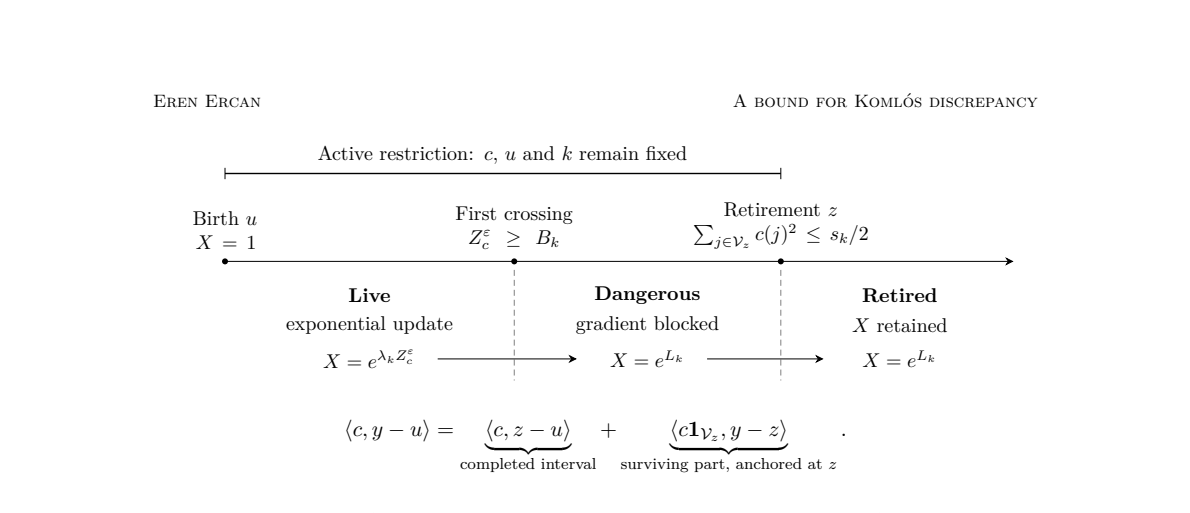
What carries the argument. The engine is a finite walk on the cube $[-1,1]^q$ at mesh $\gamma$: a coordinate is alive while $|x(j)|<1-\gamma$, every step is $x_{t+1}=x_t+\gamma v_t$ with $\|v_t\|_2=1$, support in the alive set, and $\langle x_t,v_t\rangle=0$, so $\|x_{t+1}\|_2^2=\|x_t\|_2^2+\gamma^2$ and the walk must stop after finitely many steps. Rows are processed through successive restrictions over size classes $s_k=(60/7)2^{-k}$: each restriction is peeled at cutoff $s_k/B_k$ (removing an $\ell^1$ piece of cost at most $B_k$), stays active while its alive squared mass exceeds $s_k/2$, and on retirement archives its completed interval while its surviving part is re-normalized at later classes. For each signed restriction, the regularized discrepancy $Z_c^\varepsilon(x)=\varepsilon\langle c,x-u\rangle+\beta_k(E_x(c)-E_u(c))$, $\beta_k=B_k/(2s_k)$, supplies the negative drift; a first crossing of $B_k$ marks the record dangerous and blocks its moving gradient. The covariance budget is carried by historical capped exponentials: $X$ starts at $1$, follows $e^{\lambda_k Z_c^\varepsilon}$, is capped at $e^{L_k}$, is weighted by the column mass $c(j)^2/s_k$, and feeds the difference $G^{(j,k)}=\Phi^{(j,k)}-I^{(j,k)}$ whose outer potential $\Psi=\sum_{k,j}w_k\exp(G^{(j,k)}/K_k)$, with $\sum_k w_k=1$, stays at most $q$ through the walk. Existence of the needed covariance at each state is exactly what affine spectral independence (restated as Theorem 2.1, finite-row form Corollary 2.2) guarantees. The thresholds $B_k(R)=((1925648/675)\,s_kL_k(L_k+R)/\delta_k)^{1/4}+\sqrt{(244/9)s_kL_k}$, with $\delta_k$ decaying geometrically and $L_k$ growing linearly, are summable to $O((1+R)^{1/4})$; an exact rational certificate gives $\sum_k B_k(0)<17091/25$, so that $7/2$ times the sum plus $2$ leaves the coefficient $2395$, and rounding the final at most eight fractional coordinates costs exactly $2\sqrt2$.
Core claim. Restated on the paper's own terms, the contribution is Theorem 1.1: for every $m,n\ge1$ and every real $m\times n$ matrix whose columns satisfy $\sum_i A_{ij}^2\le1$ for each $j$, $$\operatorname{disc}(A)\le2395\left(1+\log_+\frac n9\right)^{1/4}+2\sqrt2,\qquad \log_+t=\max\{0,\log t\}.$$ The paper claims this fourth root is structural rather than a technical artifact: it emerges from balancing the geometric shrinkage of the alive coordinate set against the fourth power of the per-class row thresholds, and the $(\log\log n)^{7/4}$ factor disappears entirely. Two companion statements follow from the same construction: a prescribed-depth partial colouring (Theorem 1.2) that starts at any point $b$, leaves at most $\max\{\lceil qe^{-R}\rceil-1,8\}$ fractional coordinates after depth $R$, and costs at most $2395(1+R)^{1/4}$ in row error; and a completion corollary (Corollary 1.3) that signs any partial colouring while preserving its fixed signs, with error $2395(1+\log_+(q/9))^{1/4}+2\sqrt2$. The finite trajectory, the exact threshold sum, and the final rounding are all formalized in a proof assistant, with the affine spectral independence theorem of the cited precursor (its Theorem A.4) declared as the single external research theorem.
The premise it rests on. The whole argument rests on one external result: an affine spectral independence theorem (Theorem A.4 of the cited precursor) that certifies the semidefinite covariance needed at every step, and the machine-checked formalization installs it as the only outside assumption, so if that theorem is false or its hypotheses fail at some state, the bound collapses.
If the paper is right (Pith's inferences, not the authors')
Any real matrix whose columns have Euclidean norm at most one has discrepancy at most $O((\log n)^{1/4})$, uniformly in the number of rows; the $(\log\log n)^{7/4}$ factor of the previous record is gone.
Every prescribed starting point $b$ with $q$ fractional coordinates can be driven to at most $\max\{\lceil qe^{-R}\rceil-1,8\}$ fractional coordinates in at most $\lfloor(q-\|b\|_2^2)/\gamma^2\rfloor$ steps, with row error at most $2395(1+R)^{1/4}$.
Every partial colouring can be completed to a full signing that preserves its existing signs and pays at most $2395(1+\log_+(q/9))^{1/4}+2\sqrt2$; taking $b=0$ recovers the main discrepancy bound.
The finite construction is explicit in principle but not yet efficient: exact real covariance choices and comparisons are assumed, and no running time in a bit model is estimated.
The partial- and full-colouring theorems, including the finite trajectory, the exact threshold sum, and the final rounding, are machine-checked in a proof assistant, narrowing the unverified part of the argument to the single external theorem.
If the external spectral-independence theorem is sound, further progress toward the conjectured constant must remove the remaining $(\log n)^{1/4}$ itself; within this proof the fourth root is forced by the balance $B_k\asymp(s_kL_k(L_k+R)/\delta_k)^{1/4}$, so a different mechanism than threshold scheduling would be required.
The constant $2395$ is almost entirely set by the threshold sum rather than rounding, which costs only $2\sqrt2$; tightening the rational certificate, the schedule constants, or the weight sequence is a well-posed numerical project that could push the coefficient below $2395$.
The prescribed-depth partial-colouring statement is a reusable object: a walk that shrinks fractional coordinates at a controlled rate $N_R(q)\approx qe^{-R}$ while accumulating error $O((1+R)^{1/4})$ is the kind of lemma that could transfer to other discrepancy settings, such as row-sparse or online problems.
The paper states no lower bounds, so whether $(\log n)^{1/4}$ is near-optimal is open; numerical experiments on random and structured unit-norm column families are the natural next probe of tightness.
Check this review
Pith stored no record of this review's passes and took no fingerprint of it. Reviews made by code from 13 Nov 2026 on carry both.
How often reviews like this one are right
Reviews like this one: written by deepseek-v4-flash, where what was read was not recorded.
How often objections from reviews like this one are right: not yet measured
Reviews by people
This review was written by a machine. No person has reviewed this paper on Pith yet. A scientist listed on Pith can review it for a fee, and their review is published here whatever it concludes.
The paper
Abstract
Let A ∈ ℝm × n have columns of Euclidean norm at most one. We prove that disc(A) ≤ 2395(1 + log+n/9)1/4 + 2√2. Here log+t = max{0,logt}. Building on Bansal and Jiang's affine spectral independence framework, we remove the (loglogn)7/4 factor from their bound. The fourth root comes from balancing the logarithmic decrease in the alive dimension against the fourth power of the row thresholds. Historical exponential sums control the covariance budget across size classes with summable thresholds. An exact threshold-sum certificate gives the coefficient 2395, and rounding at most eight remaining fractional coordinates costs 2√2. The finite construction also gives partial colourings from any prescribed starting point and at any prescribed depth, preserving existing signs. We formalize the partial- and full-colouring theorems in Lean, including the finite trajectory, exact threshold sum and final rounding, with Bansal–Jiang Theorem A.4 as the sole external research theorem assumption.
The paper's own sentences, arranged, kept beside the review and separate from it. Each label is drawn from a closed vocabulary; the number beside it is the probability the classifier gave that label. No sentence in this record was written by a model.
abstract compiled · 2026-09-23
The authors' main claim, as the classifier picked it out 1.00
“We prove that $\operatorname{disc}(A)\le2395\left(1+\log_+\frac n9\right)^{1/4}+2\sqrt2$.”
How the main claim is stated: asserted 1.00
What the abstract itself states, as probabilities: claims first 0.06 · states limitation 0.28 · human participants 0.01 · controlled comparison 0.06 · randomized assignment 0.01 · states quantitative result 0.99 · compares with prior results 0.96 · mentions code or data availability 0.21
The abstract, sentence by sentence
This table labels the abstract only (arXiv listing abstract v1). The number is the probability the classifier gave the label.
| Sentence | Role | The authors' own work | States the main conclusion | Strength |
|---|---|---|---|---|
| Let $A\in\mathbb{R}^{m\times n}$ have columns of Euclidean norm at most one. | background 1.00 | 0.08 | 0.01 | asserted 0.65 |
| We prove that $\operatorname{disc}(A)\le2395\left(1+\log_+\frac n9\right)^{1/4}+2\sqrt2$. | result 0.99 | 0.97 | 0.95 | asserted 1.00 |
| Here $\log_+t=\max\{0,\log t\}$. | background 0.89 | 0.31 | 0.03 | asserted 0.90 |
| Building on Bansal and Jiang's affine spectral independence framework, we remove the $(\log\log n)^{7/4}$ factor from their bound. | contribution 0.98 | 0.94 | 0.08 | asserted 1.00 |
| The fourth root comes from balancing the logarithmic decrease in the alive dimension against the fourth power of the row thresholds. | interpretation 0.67 | 0.76 | 0.04 | asserted 1.00 |
| Historical exponential sums control the covariance budget across size classes with summable thresholds. | method 0.94 | 0.34 | 0.02 | asserted 1.00 |
| An exact threshold-sum certificate gives the coefficient $2395$, and rounding at most eight remaining fractional coordinates costs $2\sqrt2$. | method 0.74 | 0.88 | 0.05 | asserted 1.00 |
| The finite construction also gives partial colourings from any prescribed starting point and at any prescribed depth, preserving existing signs. | result 0.59 | 0.89 | 0.03 | asserted 1.00 |
| We formalize the partial- and full-colouring theorems in Lean, including the finite trajectory, exact threshold sum and final rounding, with Bansal--Jiang Theorem A.4 as the sole external research theorem assumption. | contribution 0.67 | 0.94 | 0.05 | asserted 1.00 |
What kind of paper the classifier reports this is: theoretical result 1.00 · evidence from proof or derivation 1.00
What was examined, and what was not
Sources read
- arXiv listing abstract v1
Not examined
- full text
- figures and tables
- references and citing sentences
- relations to other papers
Levels run
- P abstract
Not run
- S sections
- T body sentences
- C citations
- R cross-paper relations
How the labels were made
Compiled by classifier-1.13.0 via TypeSafe API, question bank abstract-p1-20260923, 2026-09-23: 1 request, 6,892 input tokens.
Every quoted sentence on this record is the authors'. Every label is from Pith's closed vocabulary, with the probability shown beside it. This record as JSON
Figures (1)
Figures are the authors', reproduced from the paper.
References (6)
- [1] Wojciech Banaszczyk. Balancing vectors and Gaussian measures of n -dimensional convex bodies. Random Structures & Algorithms , 12:351--360, 1998 on Pith
- [2] Nikhil Bansal and Haotian Jiang. Decoupling via affine spectral-independence: Beck--Fiala and Koml\'os bounds beyond Banaszczyk . arXiv:2508.03961v2, 2025. Version of 9 September 2025 on PithPith's reviewarXiv
- [3] Nikhil Bansal and Haotian Jiang. An exposition of the O ( ^ 1/4 n) bound for the Koml\'os problem. arXiv:2608.28452v1, 2026. Version of 28 August 2026 on PithPith's reviewarXiv
- [4] Banaszczyk, Wojciech , title =. Random Structures & Algorithms , volume =. 1998 , pages = on Pith
- [5] Bansal, Nikhil and Jiang, Haotian , title =. 2025 , howpublished = on Pith
- [6] Bansal, Nikhil and Jiang, Haotian , title =. 2026 , howpublished = on Pith
Cited by 2 Pith papers
Reviewed papers on Pith that cite this one. The full citation record
- Approximation algorithms via discrepancy with hard constraints cs.DS · Oct 2026
- Proving the Koml\'os conjecture slowly math.CO · Nov 2026
Challenges and discussion
Disagree with the review, or know something it missed? Leave a comment, or challenge this review formally: a challenge becomes a permanent entry in this paper's record, and its decision is published here.
Come back by email
A short list of the week's newly reviewed papers. Nothing is sent until you confirm from your inbox, and every email has a link that stops it. No account.
No comments yet.
Sign in to comment