Combinatorics · arXiv:2611.03427 v1 · submitted 2 Nov 2026 · 47 references
Proving the Komlós conjecture slowly
The paper says
“The Komlós conjecture was a long-standing open problem in discrepancy theory until it was recently solved in a flurry of AI developments.”
more of the abstract
We give a motivated exposition of an elementary proof of the conjecture due to Karingula and Lovett, as well as a counterexample to the strong Komlós conjecture due to Kintali, aiming to introduce the ideas in a gentle and explained manner in order to ease the understanding of the proofs. We conclude with several problems which remain open.
from the abstract
Pith says
Machine review · deepseek-v4-flash · 3 Nov 2026 · what was read was not recorded · not checked by a person
It can be wrong. Challenge this review or reply to it.
Holds up. No new theorems — both are attributed to others — but this is a sound, genuinely motivated exposition of the Karingula–Lovett Komlós proof and Kintali's strong-Komlós counterexample, and it deserves a serious referee. This line is wrong
This review says the paper's mathematics is wrong. Pith did not check that against the paper's source.
5 minor
How often objections from reviews like this one are right: not yet measured
Not checked: figures, code, what the 47 references say.
5 minor objections
The paper says, at §2.2.1, proof of Lemma 2.6
Pith says: minor objection 1 of 5
The reduction to a single discrete fibre is attributed to Lemma 2.5, but the needed statement is the additivity of the shift distance over fibres; Lemma 2.5 concerns preservation of fibre masses. The reduction itself is immediate, so this is only a citation/wording slip.
The paper says, at §3.2, proof of Proposition 3.2
Pith says: minor objection 2 of 5
When the U-witness is obtained inside an interleaved W block, the phrase 'the copy of w... just after the element of u_i corresponding to position k' is ambiguous. Please state explicitly that one uses the W block whose starting prefix already carries the first-half witness, with the initial W block being the relevant one when k < M.
show 3 more
The paper says, at §2.2.4, proof of Theorem 1.2
Pith says: minor objection 3 of 5
After padding the ambient space to R^{d+n}, the set K0 is still written as (−2ac,2ac)^d with the same symbol d; the text should state that d now denotes the new ambient dimension so that the construction of P0 is unambiguous.
The paper says, at §3.2, proof of Theorem 1.3
Pith says: minor objection 4 of 5
The displayed recurrence for d_k appears garbled as d_k = 2(2^k−1); it should read d_k = 2^{2^k−1}, which agrees with the later identity log2 d_k = 2^k−1.
The paper says, at §2.2.2, proof of Lemma 2.11
Pith says: minor objection 5 of 5
In the sentence 'sending the mass at each point (x,i)∈U (for i∈{0,1})', the upper facet U consists only of points whose new discrete coordinate is 1; the range 'i∈{0,1}' should be 'i=1'.
What would settle it
Run an automatic case analysis over all 24 strict orderings of (r+, r−, s+, s−) plus the tie patterns, proving inequality (2.2) symbolically; if every case passes, the pivot step on which the lift-collapse mechanism balances is confirmed. This is the check the reader performed by hand and the one that would settle the concern if it were raised.
from the skeptic's reading
How the review went
4 readings by deepseek-v4-flash · 3 Nov 2026
- Reader holds up
- Skeptic agrees
- Editor wrote the verdict above
- Referee minor revision: 5 minor
Not run on this paper: the simulated authors' defence.
Pith did not check this review's objections against the paper.
The review in full
The review in brief, machine-written
The thing to know: this paper proves nothing new, and it doesn't pretend to. Both headline theorems are explicitly attributed — Theorem 1.2 (Komlós with C = 18√3) to Karingula and Lovett, Theorem 1.3 (strong Komlós false, √log d lower bound) to Kintali. The value is the exposition, and it is genuinely good: a self-contained, elementary treatment of two major recent results.
The author walks the Komlós proof through three times — a high-level sketch, a motivation section that makes the lift-and-collapse construction in Rd × {0,1}^n look natural, then the formal details. I checked the load-bearing steps and they hold. The pointwise rearrangement inequality in Lemma 2.6, which keeps shift distance from growing under lifts, is proved by an exhaustive case split and is valid. The starting density in Lemma 2.14 (squared product of triangular hats) computes cleanly to Δ(P,u) ≤ √3/C. The constants a = 3 and c = 3√3 satisfy Lemma 2.11's interval condition exactly rather than being fitted to a target. The Section 3 induction for the counterexample composes: the interleaving forces simultaneous large entries, the rotation gains √2, and the exp(O(d²)) and √log d bounds check out. The author acknowledges the measurability caveat for collapse functions and resolves it by mesh discretization.
Credit where due: the history section is thorough and useful as a map of a fast-moving period, the attribution is fully honest, the AI-use statement is transparent, and the open questions in Section 4 (Steinitz-type rearrangement, the H(d) growth rate) are sensible.
Soft spots are minor. There is no new theorem, so the significance is pedagogical. The proof of Lemma 2.6 starts with a mis-citation ('due to Lemma 2.5'; the fibre-wise reduction is just additivity of shift distance over fibres). The proof of Proposition 3.2 has a small slip where 'if k < M' should handle the k = 0 case. The notation is dense in places, and the paper notes the proofs are non-constructive. None of this affects the argument.
This is a paper for graduate students, people in neighboring areas, and anyone who wants the Karingula–Lovett proof without the original's compression. I'd bring it to a reading group, and I'd cite it as the accessible reference. It deserves a serious referee: judged as exposition, with correctness and accessibility as the bar, it passes, and I'd accept after minor revision.
The strongest objection
No load-bearing gap found after a full pass. The step that carries the argument is Lemma 2.6, inequality (2.2): the claim that sorting two pairs of shifted values into max/min parts does not increase the ℓ1 distance. The proof's three-case split is complete and correct, with equality in the first case and strict inequality in the others, and the surrounding factor work (4Δ(P',u) after fibre-wise decomposition) is right; the 'due to Lemma 2.5' sentence at the start of the proof is a mis-citation, but the fibre-wise reduction itself is immediate from additivity of the shift distance over fibres. The propagation chain then closes: Lemma 2.8 gives facet mass (1−Δ(P,2v))/2, Lemma 2.10 preserves facet masses through collapses, and Lemma 2.11's interval argument is valid, with condition (2.6) met exactly at a=3, c=3√3 via the hat-product density of Lemma 2.14, for which Δ(P0,2av) ≤ √3/c = 1/3. Section 3 also composes correctly: Lemma 3.3 delivers d simultaneous large entries, Lemma 3.4 forces one entry in any fixed d-set, the interleaving in Proposition 3.2 makes both events occur at a common prefix (the second-half starting vector is arbitrary, so the W-guarantee applies even after earlier W-copies), and the rotation in Lemma 3.5 gains exactly √2. Remaining soft spots are acknowledged by the author (measurability of collapse functions, handled by mesh discretization) or cosmetic (the 'if k < M' slip in the proof of Proposition 3.2 should read 'if k = 0' when the U-witness is the starting prefix).
The paper is an exposition of Karingula–Lovett [32] and Kintali [33]; both headline theorems are presented with full proofs in the text, so correctness rests on the in-paper arguments rather than on citation status. [33] is unpublished, but Section 3 gives the construction and the three lemmas in full, so the attribution is not load-bearing. I re-derived the main chain: lifts preserve the mean (Lemma 2.4); lifts do not increase shift distance (Lemma 2.6, whose pointwise inequality (2.2) checks out with equality in case 1 and strict inequality in cases 2 and 3); the upper-facet mass is (1−Δ(P,2v))/2 (Lemma 2.8); collapses preserve facet masses (Lemma 2.10); and the mean-control interval argument (Lemma 2.11) requires mass ≥ (1/2)max{1−1/a, 2/a} = 1/3, exactly provided at a=3, c=3√3 with Δ(P0,2av) ≤ √3/c = 1/3. The Section 3 construction is also internally consistent: the interleaving argument produces paired large entries at a common prefix, and the π/4 rotation yields the √2 height gain with the claimed bounds on n and on height. The author's own self-assessment matches the text: measurability of collapse functions is flagged and sketched via mesh discretization, and the only true typo found ('k < M' for 'k = 0' in the proof of Proposition 3.2) does not affect any inequality. No step depends on a non-exhibited source or uses a cited result outside its stated hypotheses. For these reasons I find no load-bearing concern, and the ACCEPT verdict with its 'exposition rather than new theorem' caveat stands.
The referee's report
If correct, the paper delivers a complete, essentially elementary route to both theorems, with explicit constants and no hidden numerical fitting. The load-bearing steps are checked from definitions: Lemma 2.6's pointwise rearrangement inequality (2.2) is proved by an exhaustive case split and is valid; Lemma 2.14 constructs a density with shift distance at most √3/C; Lemma 2.11's interval condition (2.6) is satisfied with a = 3 and c = 3√3; and the Section 3 induction composes correctly and gives the claimed exp(O(d²)) and √log d bounds. The exposition is unusually motivated, with the proof outline, the informal motivation, and the formal argument cross-referenced carefully. The author correctly attributes both proofs to other groups, does not rely on the conjecture being proved, and gives full proofs in the manuscript rather than merely citing the sources. I found no load-bearing mathematical gap; the remaining issues are local presentation slips.
Pith's reading of the paper (a machine's summary, not the authors')
This paper gives a slow, motivated exposition of two recent results in discrepancy theory: an elementary proof of the Komlós conjecture, and a counterexample showing that the strong (prefix-controlled) version of the conjecture is false. The central claim is Theorem 1.2: for any sequence of vectors in $\mathbb{R}^d$ with $\|v_i\|_2 \le 1$, signs $\varepsilon_i \in \{-1,+1\}$ can be chosen so that $\|\sum_i \varepsilon_i v_i\|_\infty \le 18\sqrt{3}$. The proof achieves this by building a probability density on a hypercube whose mean is exactly the desired signed sum, using a lift-then-collapse construction on the space $\mathbb{R}^d \times \{0,1\}^n$. The paper also presents Theorem 1.3, which shows that no constant bound is possible when all partial sums must be controlled: there are vectors forcing one prefix to escape a box of side about $\sqrt{\log d}$.
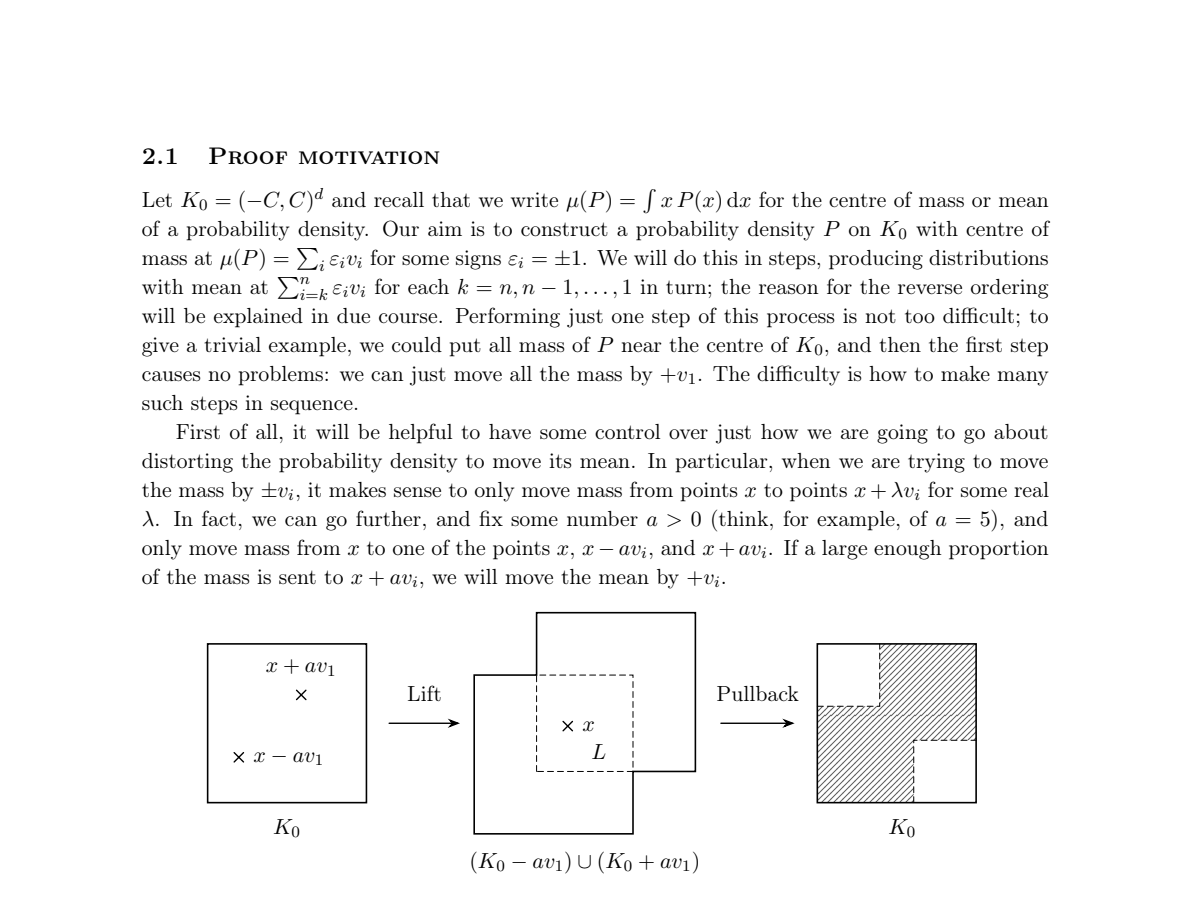
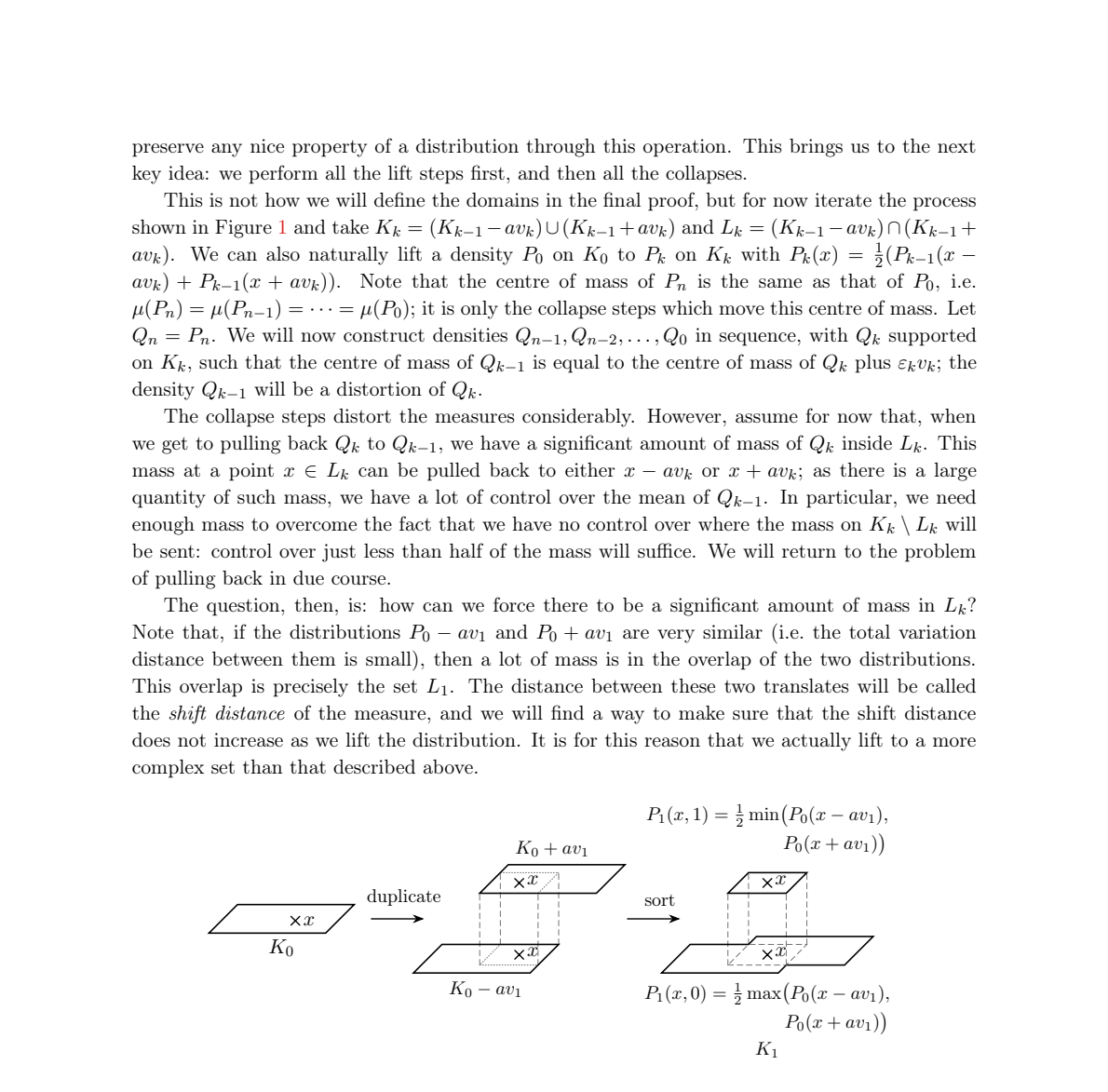
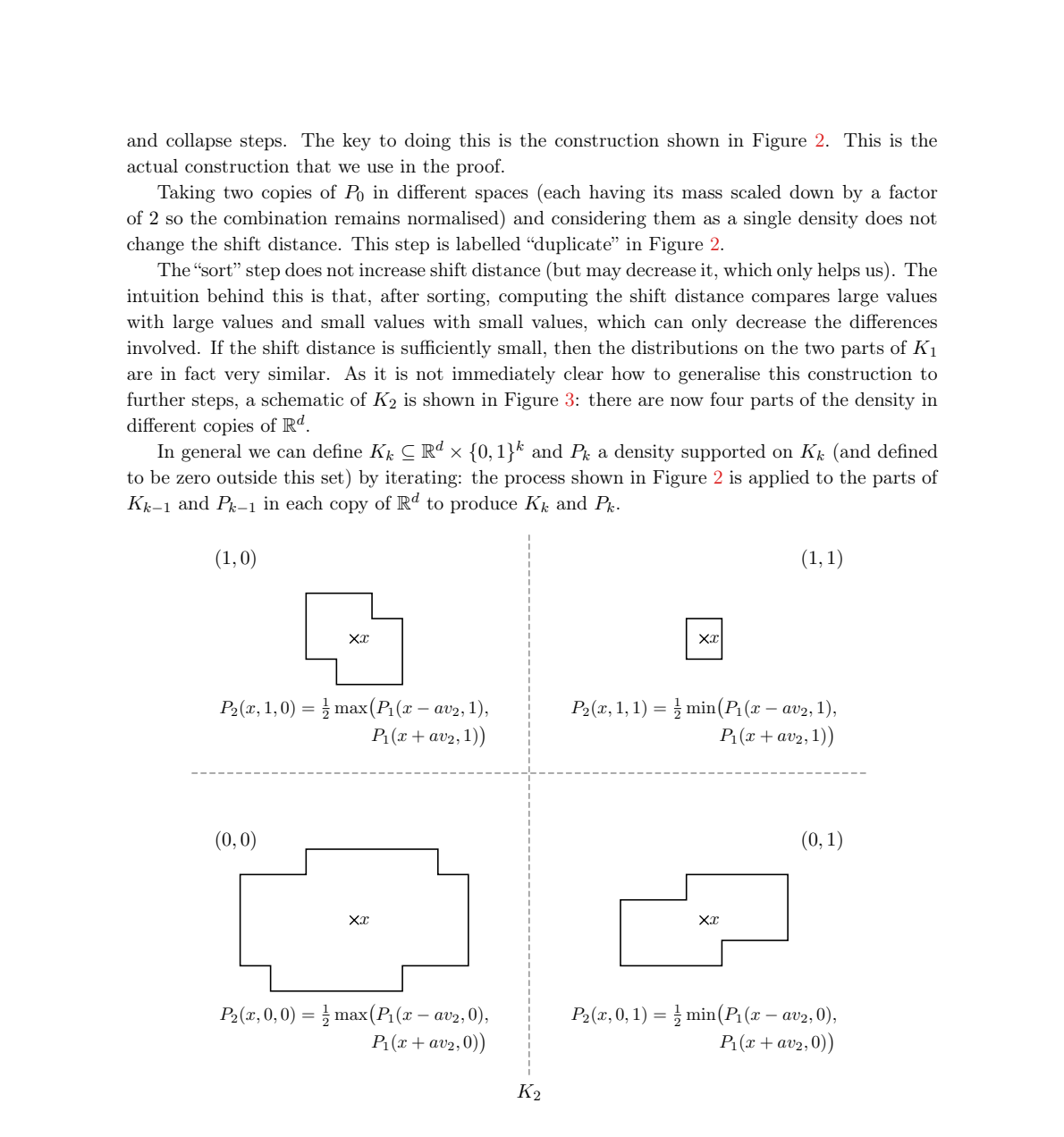
What carries the argument. The load-bearing object is the v-lift defined on a nice set $X \subseteq \mathbb{R}^d \times \{0,1\}^k$: the shifted densities $P(x-v)$ and $P(x+v)$ are split into a max part (kept in the lower discrete coordinate) and a min part (sent to the upper coordinate), scaled by $1/2$. The shift distance $\Delta(P,u) = d_{TV}(P, P+u)$ measures how much the density changes under translation. The proof rests on three lemmas: Lemma 2.6, which states that lifting never increases the shift distance and whose proof uses the pointwise rearrangement inequality (2.2) comparing the max/min of two shifted densities with the original absolute differences; Lemma 2.8, which shows the total mass in any upper facet is $1 - \Delta(P, 2v)/2$ (and is therefore close to $1/2$ when shift distance is small); and Lemma 2.11, which shows that if an upper facet carries enough mass then a collapse can move the mean by exactly $\varepsilon v/\|v\|_2$. The starting density on $K_0 = (-C,C)^d$ is a product of squared tent functions, giving $\Delta(P,u) \le \sqrt{3}/C$ in every unit direction.
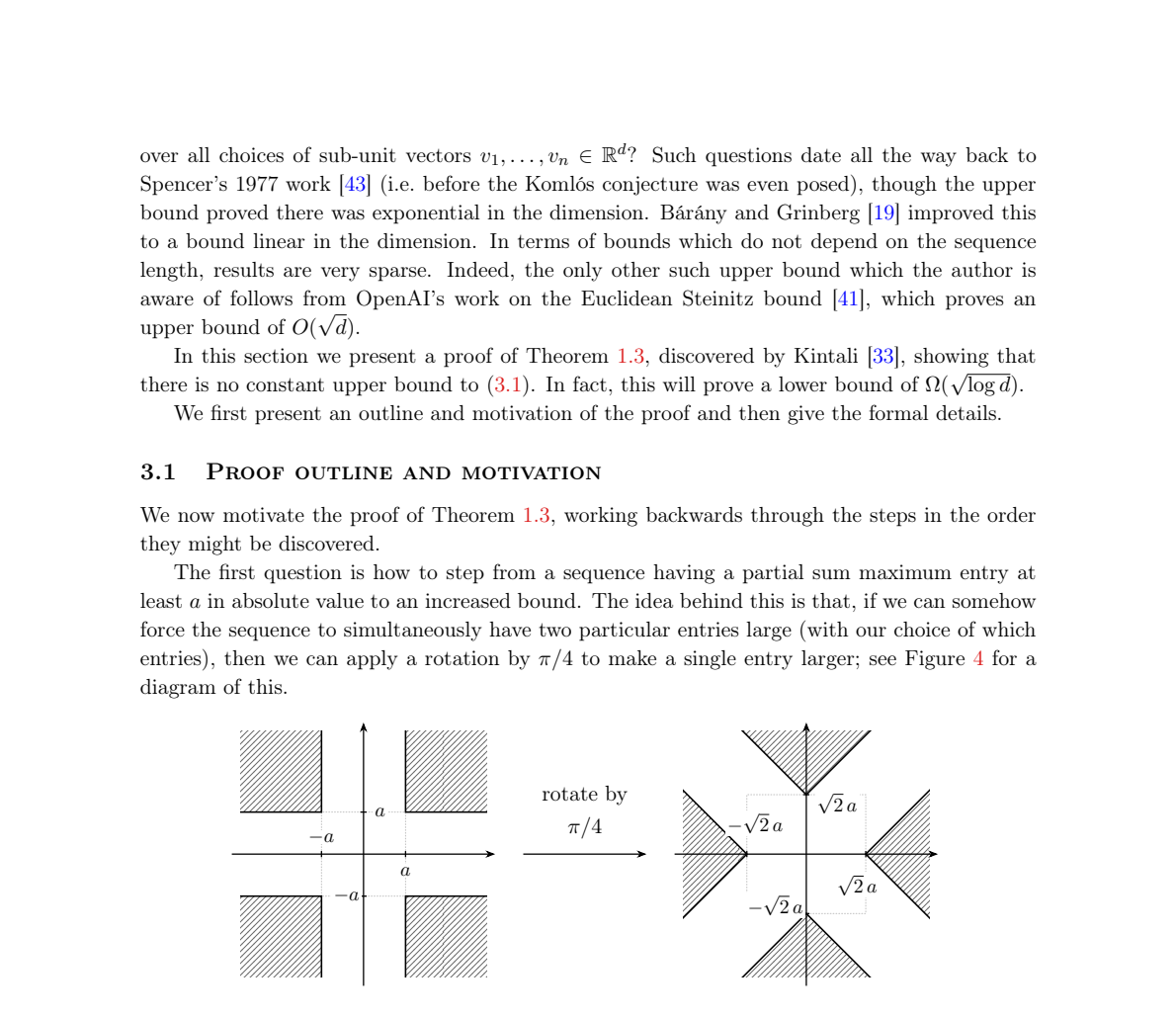
Core claim. On its own terms, the paper asserts Theorem 1.2: the Komlós conjecture holds with constant $C = 18\sqrt{3}$. The proof produces a probability density $P_0$ on $K_0 = (-18\sqrt{3}, 18\sqrt{3})^d$ whose shift distance in any unit direction is small, then performs $n$ successive 'lifts' that move the density into $\mathbb{R}^d \times \{0,1\}^k$ without increasing this shift distance or changing the projected mean. Each lift sorts shifted copies of the density into max and min parts, and the lower (min) parts carry nearly half the total mass in every upper facet of the discrete hypercube. An iterative 'collapse' then pulls the density back down, and because each upper facet holds enough mass, each collapse can steer the mean by exactly $\varepsilon_i v_i$ for a free choice of sign. The resulting mean is $\sum_i \varepsilon_i v_i$, which lies in $K_0$, proving the conjecture. For the strong version, the paper presents a proof of Theorem 1.3: an inductive construction shows that if a sequence forces height $a$, one can build a longer sequence forcing height $\sqrt{2}a$ by forcing pairs of coordinates to be simultaneously large and then rotating each pair's plane by $\pi/4$; iterating from a single unit vector in $\mathbb{R}^1$ yields vectors in $\mathbb{R}^d$ such that every signing has some prefix with infinity norm at least $c\sqrt{\log d}$, with the sequence length $n = \exp(O(d^2))$.
The premise it rests on. The whole proof balances on the pointwise rearrangement inequality (2.2) inside Lemma 2.6: after sorting two shifted densities into max and min parts, the sum of the absolute differences of the maxima and minima must be no larger than the sum of the absolute differences of the original fibre values; if that inequality failed, lifts could increase shift distance, the upper-facet mass bound would stop propagating, and the collapse step would lose the mean control that selects each sign $\varepsilon_i$.
If the paper is right (Pith's inferences, not the authors')
If the proof is correct, the Komlós conjecture is settled: the dimension-free constant bound is achieved by an elementary argument using no spectral machinery beyond Cauchy–Schwarz and a finite case split.
The infinity-norm constant $18\sqrt{3}$ is far from the best lower bound (itself only about $1+\sqrt{2}$), so the constant in the conjecture is open to improvement; the same density framework allows the constant to be tuned through the lift step size $a$ and the starting box size $c$.
The strong Komlós conjecture fails: for the prefix problem, discrepancy must grow at least like $\sqrt{\log d}$, so any constant bound on all partial sums is impossible.
The paper leaves open the exact growth rate $H(d)$ of the maximal forced prefix discrepancy, with known bounds $\Omega(\sqrt{\log d})$ and $O(\sqrt{d})$.
Because lifts preserve the projected mean and only collapses move it, the whole construction behaves like a transport scheme; any density with small shift distance in all unit directions of a target set would yield a Komlós-type statement for that set.
The lift-then-collapse method is modular: it separates the geometric step of finding a shift-distance-small density from the combinatorial step of steering mass through a hypercube of discrete coordinates, so the same mechanism could plausibly give discrepancy bounds for other centrally symmetric targets.
The $\sqrt{\log d}$ lower bound and the $O(\sqrt{d})$ upper bound on forced prefix discrepancy leave a large gap; a natural test of the strong conjecture's failure is whether the lower bound can be pushed further by a more efficient force-height-increase step than the pair-and-rotate argument.
The starting-density construction in Lemma 2.14 uses only products of tent-shaped functions, and the variance of the logarithmic derivative controls shift distance; this suggests a precise quantitative rule: shift distance is small exactly when $\mathrm{Var}(g'(Y)/g(Y))$ is finite, tying the constant to a scalar variance of the one-dimensional profile.
Because the proof has no constructive algorithm attached (it produces a density rather than a signing), a natural extension would be a randomised or discretised version that actually produces the signs in polynomial time without losing the dimension-free bound.
Check this review
Pith stored no record of this review's passes and took no fingerprint of it. Reviews made by code from 13 Nov 2026 on carry both.
How often reviews like this one are right
Reviews like this one: written by deepseek-v4-flash, where what was read was not recorded.
How often objections from reviews like this one are right: not yet measured
Reviews by people
This review was written by a machine. No person has reviewed this paper on Pith yet. A scientist listed on Pith can review it for a fee, and their review is published here whatever it concludes.
The paper
Abstract
The Komlós conjecture was a long-standing open problem in discrepancy theory until it was recently solved in a flurry of AI developments. We give a motivated exposition of an elementary proof of the conjecture due to Karingula and Lovett, as well as a counterexample to the strong Komlós conjecture due to Kintali, aiming to introduce the ideas in a gentle and explained manner in order to ease the understanding of the proofs. We conclude with several problems which remain open.
The paper's own sentences, arranged, kept beside the review and separate from it. Each label is drawn from a closed vocabulary; the number beside it is the probability the classifier gave that label. No sentence in this record was written by a model.
abstract compiled · 2026-11-04
The authors' main claim, as the classifier picked it out 0.70
“We give a motivated exposition of an elementary proof of the conjecture due to Karingula and Lovett, as well as a counterexample to the strong Koml\'os conjecture due to Kintali, aiming to introduce the ideas in a gentle and explained manner in order to ease the understanding of the proofs.”
How the main claim is stated: asserted 0.99
What the abstract itself states, as probabilities: claims first 0.05 · states limitation 0.37 · human participants 0.02 · controlled comparison 0.02 · randomized assignment 0.01 · states quantitative result 0.05 · compares with prior results 0.40 · mentions code or data availability 0.02
The abstract, sentence by sentence
This table labels the abstract only (arXiv listing abstract v1). The number is the probability the classifier gave the label.
| Sentence | Role | The authors' own work | States the main conclusion | Strength |
|---|---|---|---|---|
| The Koml\'os conjecture was a long-standing open problem in discrepancy theory until it was recently solved in a flurry of AI developments. | background 1.00 | 0.04 | 0.07 | asserted 1.00 |
| We give a motivated exposition of an elementary proof of the conjecture due to Karingula and Lovett, as well as a counterexample to the strong Koml\'os conjecture due to Kintali, aiming to introduce the ideas in a gentle and explained manner in order to ease the understanding of the proofs. | contribution 0.99 | 0.59 | 0.26 | asserted 0.99 |
| We conclude with several problems which remain open. | future work 0.94 | 0.75 | 0.17 | asserted 0.90 |
What kind of paper the classifier reports this is: review 0.74 · evidence from proof or derivation 0.75
What was examined, and what was not
Sources read
- arXiv listing abstract v1
Not examined
- full text
- figures and tables
- references and citing sentences
- relations to other papers
Levels run
- P abstract
Not run
- S sections
- T body sentences
- C citations
- R cross-paper relations
How the labels were made
Compiled by classifier-1.13.0 via TypeSafe API, question bank abstract-p1-20260923, 2026-11-04: 1 request, 2,978 input tokens.
Every quoted sentence on this record is the authors'. Every label is from Pith's closed vocabulary, with the probability shown beside it. This record as JSON
Figures (5)
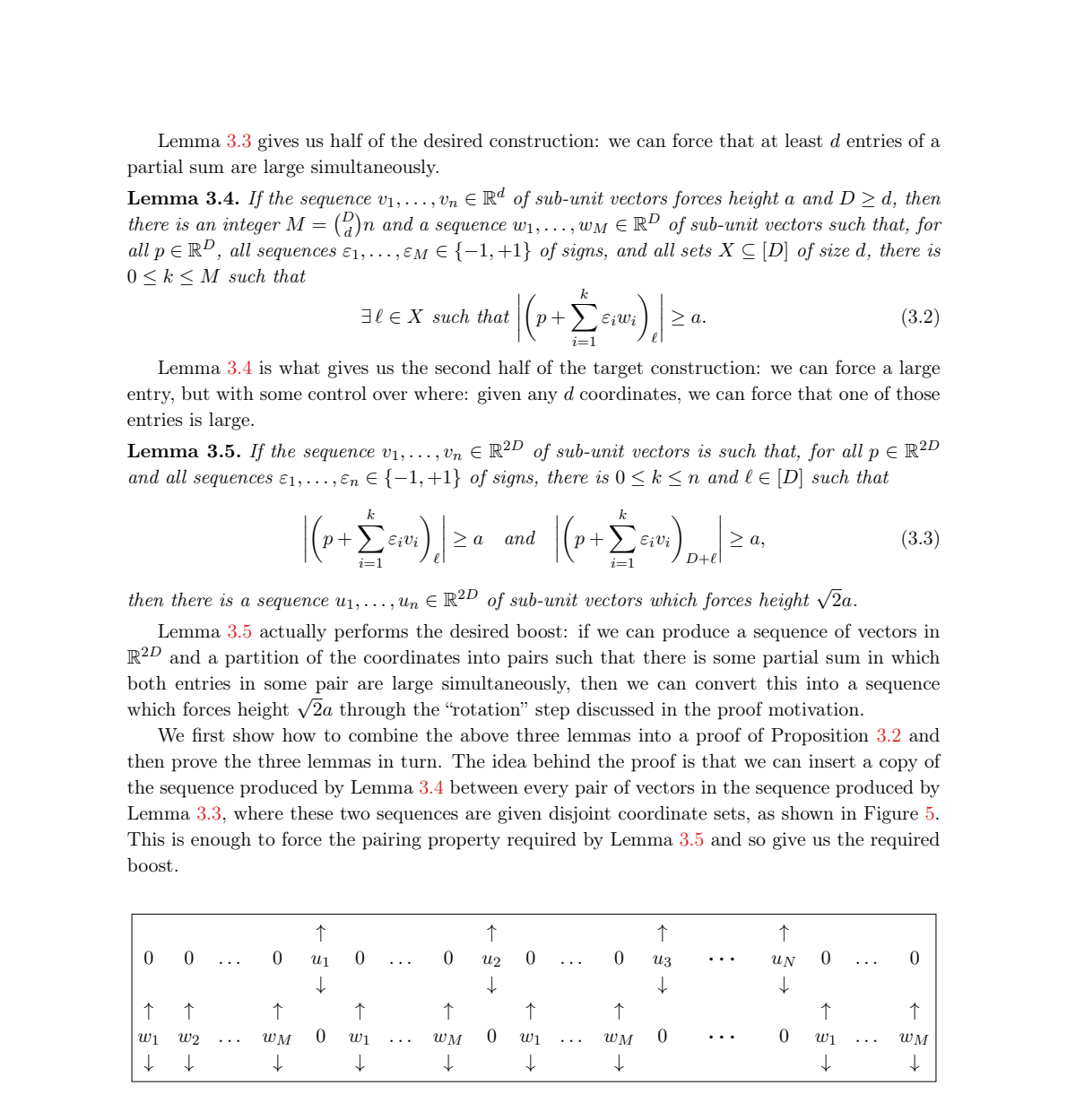
Figures are the authors', reproduced from the paper.
References (47)
- [1] E. Akbas and S. Sra. Boolean small-ball inequalities for discrepancy theory.arXiv preprint arXiv:2609.20785, 2026 on PithPith's reviewarXiv
- [2] E. Akbas and S. Sra. Tighter bounds on Komlós discrepancy: existence and algorithmic results.arXiv preprint arXiv:2609.27172, 2026 on PithPith's reviewarXiv
- [3] C. A. Akemann and J. Anderson. The continuous Beck–Fiala theorem is optimal.Discrete Mathematics, 146(1-3):1–9, 1995 on Pith
- [4] D. J. Altschuler and K. Tikhomirov. Online Beck–Fiala down to logarithmic sparsity.arXiv preprint arXiv:2607.14238, 2026 on PithPith's reviewarXiv
- [5] R. Alweiss, Y. P. Liu, and M. Sawhney. Discrepancy minimization via a self-balancing walk. InProceedings of the 53rd Annual ACM SIGACT Symposium on Theory of Computing, pages 14–20, 2021 on Pith
- [6] W. Banaszczyk. A Beck–Fiala-type theorem for Euclidean norms.European Journal of Combinatorics, 11(6):497–500, 1990 on Pith
- [7] W. Banaszczyk. Balancing vectors and Gaussian measures ofn-dimensional convex bodies.Random Structures & Algorithms, 12(4):351–360, 1998. doi: 10.1002/(SICI) 1098-2418(199807)12:4<351::AID-RSA3>3.0.CO;2-S on Pithdoi:10.1002/(sici
- [8] W. Banaszczyk. On series of signed vectors and their rearrangements.Random Structures & Algorithms, 40(3):301–316, 2012 on Pith
- [9] A. S. Bandeira. A simplification of the solution to the Komlós conjecture, Sept. 2026. URL https://randomstrasse101.math.ethz.ch/posts/komlos/. Randomstrasse 101, posted September 21, 2026 on Pith
- [10] N. Bansal. Constructive algorithms for discrepancy minimization. In51st Annual IEEE Symposium on Foundations of Computer Science, pages 3–10, 2010. doi: 10.1109/FOCS. 2010.7. 27 on Pithdoi:10.1109/focs
- [11] N. Bansal. On the Guo–Fang–Lu algorithm for Komlós discrepancy.arXiv preprint arXiv:2609.33215, 2026 on PithPith's reviewarXiv
- [12] N. Bansal and S. Garg. Algorithmic discrepancy beyond partial coloring. InProceedings of the 49th Annual ACM SIGACT Symposium on Theory of Computing, pages 914–926, 2017 on Pith
- [13] N. Bansal and H. Jiang. Decoupling via affine spectral-independence: Beck–Fiala and Komlós bounds beyond Banaszczyk. InProceedings of the 58th Annual ACM Symposium on Theory of Computing, pages 432–442, 2026 on Pith
- [14] N. Bansal and H. Jiang. An exposition of theeO(log1/4 n)bound for the Komlós problem. arXiv preprint arXiv:2608.28452, 2026 on PithPith's reviewarXiv
- [15] N. Bansal, D. Dadush, and S. Garg. An algorithm for Komlós conjecture matching Ba- naszczyk’s bound.SIAM Journal on Computing, 48(2):534–553, 2019. doi: 10.1137/ 17M1126795 on Pith
- [16] N. Bansal, D. Dadush, S. Garg, and S. Lovett. The Gram–Schmidt walk: A cure for the Banaszczyk blues.Theory of Computing, 15(21):1–27, 2019. doi: 10.4086/toc.2019. v015a021 on Pithdoi:10.4086/toc.2019
- [17] N. Bansal, H. Jiang, R. Meka, S. Singla, and M. Sinha. Prefix discrepancy, smoothed analysis, and combinatorial vector balancing. In M. Braverman, editor,13th Innovations in Theoretical Computer Science Conference (ITCS 2022), volume 215 ofLeibniz International Proceedings in ... on Pithdoi:10.4230/lipics.itcs.2022.13
- [18] N. Bansal, H. Jiang, R. Meka, S. Singla, and M. Sinha. Smoothed analysis of the Komlós conjecture. In49th International Colloquium on Automata, Languages, and Programming, volume 229 ofLeibniz International Proceedings in Informatics, pages 14:1–14:12, 2022. doi: 10.4230/LIPIc... on Pithdoi:10.4230/lipics.icalp.2022.14
- [19] I. Bárány and V. S. Grinberg. On some combinatorial questions in finite-dimensional spaces. Linear Algebra and its Applications, 41:1–9, 1981 on Pith
- [20] J. Beck. Roth’s estimate of the discrepancy of integer sequences is nearly sharp.Combina- torica, 1(4):319–325, 1981 on Pith
show 27 more
- [21] J. Beck and T. Fiala. “Integer-making” theorems.Discrete Applied Mathematics, 3(1):1–8, on Pith
- [22] D. Bednarchak and M. Helm. A note on the Beck–Fiala theorem.Combinatorica, 17(1): 147–149, 1997 on Pith
- [23] B. Bukh. An improvement of the Beck–Fiala theorem.Combinatorics, Probability and Computing, 25(3):380–398, 2016 on Pith
- [24] D. Dadush, S. Garg, S. Lovett, and A. Nikolov. Towards a constructive version of Ba- naszczyk’s vector balancing theorem.Theory of Computing, 15(15):1–58, 2019 on Pith
- [25] E. Ercan. A(logn) 1/4 bound for the Komlós problem.arXiv preprint arXiv:2609.08885, 2026 on PithPith's reviewarXiv
- [26] A. A. Giannopoulos. On some vector balancing problems.Studia Mathematica, 122:225–234, 1997. 28 on Pith
- [27] E. D. Gluskin. Extremal properties of orthogonal parallelepipeds and their applications to the geometry of Banach spaces.Mathematics of the USSR-Sbornik, 64(1):85–96, 1989 on Pith
- [28] N. Guillen and V. A. Kobzar. The Komlós conjecture for complex discrepancy.arXiv preprint arXiv:2609.15071, 2026 on PithPith's reviewarXiv
- [29] S. Guo, E. X. Fang, and J. Lu. Vector balancing via directional total variation.arXiv preprint arXiv:2609.11189, 2026 on PithPith's reviewarXiv
- [30] S. Guo, E. X. Fang, and J. Lu. Vector balancing in polynomial time.arXiv preprint arXiv:2609.23540, 2026 on PithPith's reviewarXiv
- [31] D. Hajela. On a conjecture of Komlós about signed sums of vectors inside the sphere. European Journal of Combinatorics, 9(1):33–37, 1988. doi: 10.1016/S0195-6698(88)80024-6 on Pithdoi:10.1016/s0195-6698(88)80024-6
- [32] S. R. Karingula and S. Lovett. An elementary proof of the Komlós conjecture.arXiv preprint arXiv:2609.20979, 2026 on PithPith's reviewarXiv
- [33] S. Kintali. On the fixed-order strong Komlós conjecture, Sept. 2026. URLhttps: //shivakintali.github.io/papers/StrongKomlos.pdf. Manuscript, September 15, 2026 on Pith
- [34] J. Kulkarni, V. Reis, and T. Rothvoss. Optimal online discrepancy minimization. InPro- ceedings of the 56th Annual ACM Symposium on Theory of Computing, pages 1832–1840, 2024 on Pith
- [35] D. Kunisky. The discrepancy of unsatisfiable matrices and a lower bound for the Komlós conjecture constant.SIAM Journal on Discrete Mathematics, 37(2):586–603, 2023. doi: 10.1137/22M149819X on Pithdoi:10.1137/22m149819x
- [36] A. Levy, H. Ramadas, and T. Rothvoss. Deterministic discrepancy minimization via the multiplicative weight update method. InInternational Conference on Integer Programming and Combinatorial Optimization, pages 380–391. Springer, 2017 on Pith
- [37] X. Li. Fast spectral signing for vector balancing.arXiv preprint arXiv:2609.30044, 2026 on PithPith's reviewarXiv
- [38] S. Lovett and R. Meka. Constructive discrepancy minimization by walking on the edges. SIAM Journal on Computing, 44(5):1573–1582, 2015 on Pith
- [39] J. Matoušek. AnL p version of the Beck–Fiala conjecture.European Journal of Combina- torics, 19(2):175–182, 1998 on Pith
- [40] A. Nikolov. The Komlós conjecture holds for vector colorings.arXiv preprint arXiv:1301.4039, 2013 on PithPith's reviewarXiv
- [41] OpenAI. The Euclidean Steinitz–Bergström theorem. OpenAI Math Release preprint OAI:The-Euclidean-Steinitz-Bergstrom-theorem-September-24-2026, 2026 on Pith
- [42] G. Smirnov and R. Vershynin. Discrepancy and Fisher information.arXiv preprint arXiv:2605.13107, 2026 on PithPith's reviewarXiv
- [43] J. Spencer. Balancing games.Journal of Combinatorial Theory, Series B, 23(1):68–74, 1977 on Pith
- [44] J. H. Spencer. Six standard deviations suffice.Transactions of the American Mathematical Society, 289(2):679–706, 1985. doi: 10.1090/S0002-9947-1985-0784009-0. 29 on Pithdoi:10.1090/s0002-9947-1985-0784009-0
- [45] J. H. Spencer. Balancing vectors in the max norm.Combinatorica, 6(1):55–65, 1986. doi: 10.1007/BF02579409 on Pithdoi:10.1007/bf02579409
- [46] A. Srinivasan. Improving the discrepancy bound for sparse matrices: Better approximations for sparse lattice approximation problems. InProceedings of the eighth annual ACM-SIAM symposium on Discrete algorithms, pages 692–701, 1997. 30 on Pith
- [1981] doi: 10.1016/0166-218X(81)90022-6 on Pithdoi:10.1016/0166-218x(81)90022-6
Challenges and discussion
Disagree with the review, or know something it missed? Leave a comment, or challenge this review formally: a challenge becomes a permanent entry in this paper's record, and its decision is published here.
Come back by email
A short list of the week's newly reviewed papers. Nothing is sent until you confirm from your inbox, and every email has a link that stops it. No account.
No comments yet.
Sign in to comment