Cryptography and Security · arXiv:2609.10854 v3 · submitted 9 Sep 2026
No-Box Vulnerability Analysis: Description-only Detection of Indirect Prompt Injection Vulnerabilities in MCP Servers
The paper says
“When auditing remotely hosted services or commercially gated software for vulnerabilities, third-party analysts may lack both direct system access and the ability to interact with the running system.”
more of the abstract
We call this a no-box setting, in which analysts have access only to functionality metadata that may describe the intended inputs, behaviors, and outputs of the system. Such descriptions constrain the possible implementations of a system, enabling analysts to hypothesize potential implementations and their underlying vulnerabilities. These hypotheses can subsequently guide validation when system access becomes available. To demonstrate the feasibility of conducting vulnerability analysis under no-box setting, we implemented MCPSEC, a prototype that audits Model Context Protocol (MCP) servers for indirect prompt injection vulnerabilities using only the tool metadata exposed at server registration time. Flagging vulnerable tools, MCPSEC produces hypothesized vulnerabilities and attack scenarios for later validation. We evaluated MCPSEC on 20 widely deployed MCP servers comprising 177 tools, among which human evaluators confirmed 95 as vulnerable. Using only tool metadata, MCPSEC successfully identified 94 of these confirmed vulnerable tools (98.9% recall), compared to 81 (85.3% recall) identified by an agentic baseline. Overall, we operationalize and evaluate no-box vulnerability analysis and demonstrate its practical feasibility in realistic systems.
from the abstract
Pith says
Machine review · deepseek-v4-flash · 11 Sep 2026 · of version 1 of the paper; version 3 is newer · what was read was not recorded · not checked by a person
It can be wrong. Challenge this review or reply to it.
Holds up, with conditions. A genuinely new paradigm (no-box vulnerability analysis) with a careful, staged evaluation on MCP servers, but the absolute recall claim is weakened by the stress-test concern about LLM training data leakage and the lack of released artifacts. This line is wrong
3 major objections · 6 minor
How often objections from reviews like this one are right: not yet measured
Not checked: figures, code, what the references say.
The paper says, at Section V, Section VII, Section VIII
The review did not quote this passage.
Pith says: Objection 1 of 3 · major
The paper does not address the possibility that GPT-5.4’s training data includes the source code, documentation, and discussions of the evaluated MCP servers (many of which have high GitHub star counts). If the LLM has encoded implementation-level facts (e.g., the presence or absence of sanitization, exact output shapes), then MCPSEC's data flow speculation and risk assessment may rely on memorized details rather than pure metadata reasoning.
more of objection 1
This does not invalidate the empirical recall (94/95) on the evaluated servers, but it undermines the claim that the method is truly no-box in the sense of requiring only metadata. The authors should discuss this threat, ideally by (a) testing with an LLM whose training set excludes the target servers, (b) ablating the entity-discovery calls to isolate metadata-only signals, or (c) explicitly qualifying the claim to account for possible data leakage.
The paper says, at Section VIII-C
The review did not quote this passage.
Pith says: Objection 2 of 3 · major
The paper acknowledges that MCP registration metadata are unusually standardized and that the evaluation targets high-profile servers. However, it does not discuss how the high prevalence of trivially vulnerable tools (92.3% without sanitization) inflates recall. When the majority of tools are easily detectable, even a moderately good method can achieve near-perfect recall.
more of objection 2
A complementary experiment on a set of hardened or deliberately non-vulnerable tools would strengthen the claim that MCPSEC's success is due to metadata reasoning rather than the base rate of vulnerability.
The paper says, at Section V, Section VII-E
The review did not quote this passage.
Pith says: Objection 3 of 3 · major
The pipeline relies on a single proprietary LLM (GPT-5.4) for all reasoning steps. The paper reports that the deterministic assembly step and repair loops constrain variance, but does not provide quantitative analysis of output stability across runs or across different reasoning parameters. Reproducibility and sensitivity analysis (e.g., with temperature variation, multiple seed runs) are needed, especially given that the recall claim hinges on the LLM’s consistent extraction of data flows from metadata.
6 minor objections
The paper says, at Section I
Pith says: minor objection 1 of 6
The HotCRP SQL injection example (end of page 1) is helpful, but the paper never returns to it after the introduction. A brief note connecting the example to the MCP context would improve flow.
The paper says, at Section II-B
Pith says: minor objection 2 of 6
Typo: 'It usess the fact' should be 'It uses the fact'.
show 4 more
The paper says, at Table II
Pith says: minor objection 3 of 6
The rubric labels would benefit from explicit examples of what constitutes 'partial' vs. 'none' sanitization in the MCP setting. The text briefly discusses it, but a short illustrative example in the caption would aid reproducibility.
The paper says, at Section VII-A
Pith says: minor objection 4 of 6
The inter-annotator agreement (83.3% exact) is reported before reconciliation. It would be helpful to also report Cohen’s kappa or a chance-corrected statistic to account for the number of label categories.
The paper says, at Section VII-F
Pith says: minor objection 5 of 6
The 'Black-box testing requires privileged access' case study (slack/usergroups_update) is well-chosen, but the text would benefit from clarifying whether the metadata for that tool explicitly mentions that user group descriptions are returned during update. The current description implies that MCPSEC inferred this from general domain knowledge about Slack, which is precisely the kind of LLM data leakage that needs to be discussed (see Major Comment 1).
The paper says, at Abstract and passim
Pith says: minor objection 6 of 6
The paper repeatedly states that MCPSEC 'recovers 94 of 95 confirmed vulnerabilities (98.9% recall)'. Because the 95 vulnerable tools are a subset of the 177 sampled tools, and the denominator for recall is these 95, the recall is impressive. However, the paper should explicitly state that the true negative set is not established, so precision (65.7%) is a lower bound. This is already discussed, but a clear sentence in the abstract would help readers avoid over-interpreting the recall number alone.
What would settle it
Re-run MCPSEC on the same 95 confirmed vulnerable tools but replace GPT-5.4 with a fully open-source LLM (e.g., Llama 3.1-70B, whose training cutoff predates the public release of most evaluated MCP servers) as the backbone, keeping the threat model, system prompts, and deterministic assembly step identical. If recall drops substantially (e.g., below 80%), the original 98.9% recall is partly due to GPT-5.4's prior knowledge. As an additional check, construct a set of 20 synthetic MCP-like servers with metadata mimicking real patterns but with known ground-truth implementations that were never public before the test; if recall on synthetic servers is significantly lower than on the original set, the concern is validated.
from the skeptic's reading
How the review went
4 readings by deepseek-v4-flash · 11 Sep 2026
- Reader holds up, with conditions
- Skeptic partly agrees
- Editor wrote the verdict above
- Referee major revision: 3 major objections, 6 minor
Not run on this paper: the simulated authors' defence.
Pith did not check this review's objections against the paper.
The review in full
The review in brief, machine-written
This paper introduces "no-box" vulnerability analysis—using only functionality metadata to hypothesize vulnerabilities without source code or runtime access. That’s a real conceptual contribution, and the execution is serious. They formalize irreducible data flows and Theory-of-Concepts (ToCs), build a pipeline (MCPSEC) that uses GPT-5.4 to speculate data flows and assess risk, and evaluate it on 20 MCP servers with a staged design (metadata plausibility, source-code validation, runtime reachability, PoC confirmation). The 98.9% recall (94/95 confirmed IPIs) is attention-grabbing, and the honest disclosure of 65.7% precision (many false positives) shows they understand the cost of over-approximation.
The soft spot the stress test flags is real: GPT-5.4 almost certainly trained on the GitHub repositories of these high-profile MCP servers (mean 9,479 stars). The paper does not discuss this. If the LLM memorized implementation details—sanitization choices, output shapes, even source code snippets—then MCPSEC’s "metadata-only" speculation may be informed by what the model already knows about the actual implementations. That would not invalidate the relative improvement over the baseline (both use the same model), but it weakens the claim that the method works purely from metadata. The authors should test with an LLM that has a known clean training set, or at least acknowledge this confound.
Other limitations: the evaluation is confined to IPI in MCP servers; generalizability to other vulnerability classes (SQLi, XSS) or systems (browser extensions, CI/CD) is plausible but unsubstantiated. The precision–recall tradeoff (65.7% vs 98.9%) means the tool generates many false positives, which limits practical utility as a stand-alone scanner. And artifacts are promised but not yet released—essential for reproducibility.
Who benefits: researchers in vulnerability analysis, LLM security, and software testing. Practitioners auditing closed-source systems will find the framing useful. The paper is well-written and the evaluation is thorough.
I’d send it to peer review, but I’d make acceptance conditional on (a) addressing LLM training data contamination, ideally with a controlled experiment or clear acknowledgment, and (b) releasing code and data. The core idea is solid; the execution is careful; the gaps are honest and fixable.
The strongest objection
The paper's central claim is that metadata alone suffices for vulnerability detection. However, the LLM (GPT-5.4) used for entity discovery, data flow speculation, and risk assessment is a proprietary model whose training data likely includes the very MCP server codebases and documentation used in the evaluation (e.g., GitHub repositories, blog posts, developer guides). Since some of these servers are high-profile (mean 9,479 GitHub stars), it is plausible that GPT-5.4 has encoded implementation-level facts—such as the exact shape of tool outputs, the presence or absence of sanitization, or the specific data transformations applied—that go beyond what the metadata states. If so, MCPSEC's speculative data flows are not purely derived from metadata but are informed by prior knowledge of the actual implementation. This would not invalidate the empirical result on the evaluated servers, but it would undermine the claim that the method functions in a truly no-box manner: applying it to a newly written MCP server never seen by the LLM could yield much lower recall. The paper does not discuss or test for this training data contamination, nor does it use an LLM with a known, clean training set. Given that both MCPSEC and the baseline use the same model, the relative improvement may still hold, but the absolute 98.9% recall may partly reflect memorized implementation details rather than genuine metadata-based reasoning. Section V describes the mandatory LLM calls for entity discovery and flow assembly; these could inadvertently rely on the LLM's memory of real implementations.
The reader correctly identified the assumption that metadata truthfully describes intended functionality as the weakest point (Section VIII-C). I identify a complementary, equally load-bearing assumption: the LLM used to process the metadata must not have been exposed to the actual implementations it is supposed to infer. The 98.9% recall is the headline evidence for no-box vulnerability analysis. If GPT-5.4's training data included the source code, documentation, or extensive discussion of the evaluated MCP servers, then the reasoning is not truly from metadata alone—it is augmented by prior knowledge of the 'hidden' implementation. The paper does not mention this possibility. Section V shows that MCPSEC's data flow speculation explicitly prompts the LLM to 'include entities and edges that are not stated explicitly but remain plausible given the tool's functionality'; if those entities and edges are already known to the LLM from training data, the speculation step is better characterized as retrieval from memory ather than inference from the given metadata. The concrete test—swapping to an open-source model with a verifiable training cutoff—settles this without requiring code release. If the concern is real, the absolute recall claim weakens, though the relative improvement over the baseline may still stand. If the test shows no material drop, the no-box claim strengthens. Given this unresolved but empirically testable concern, the existing CONDITIONAL verdict remains justified. The condition should ideally include a reproducibility check with a model whose training data is verifiably independent of the evaluation targets. Hence, 'UNCHANGED' is appropriate.
The referee's report
The paper makes a conceptual contribution by formalizing vulnerability hypothesis generation from metadata alone, a regime that lies outside white-box, black-box, and gray-box paradigms. The staged evaluation (metadata plausibility, source-code validation, runtime reachability, PoC confirmation) is methodologically strong and provides a template for future work. If the results generalize, the approach could serve as a low-cost, non-disruptive screening tool for large plugin/middleware ecosystems. The 98.9% recall on a curated set of open-source servers is striking and demonstrates practical feasibility in the MCP context.
Pith's reading of the paper (a machine's summary, not the authors')
This paper introduces 'no-box vulnerability analysis', a paradigm that identifies vulnerabilities using only functionality metadata (e.g., tool names and descriptions) without source code or runtime interaction. The authors argue that for some vulnerability classes, the metadata implies 'irreducible data flows' that all conforming implementations must have, and these flows can be reasoned about to hypothesize attacks. They instantiate this for indirect prompt injection in Model Context Protocol (MCP) servers, building MCPSEC, which uses LLM-based speculation to generate attack scenarios called Theory-of-Concept. On 177 tools from 20 widely deployed servers, MCPSEC recovered 94 of 95 confirmed vulnerabilities (98.9% recall), outperforming a baseline LLM prompt (84.2%). If valid, the paradigm enables third-party vulnerability screening for closed-source or ethically constrained systems at low cost.
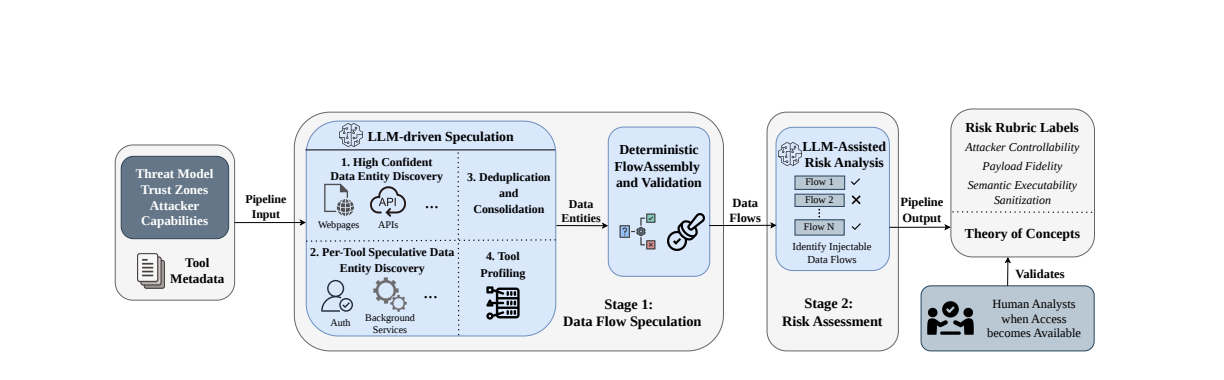
What carries the argument. The central mechanism is the concept of an 'irreducible data flow' — the minimal source-to-sink data path that every implementation consistent with the metadata must contain. MCPSEC uses a two-stage pipeline: an LLM-driven speculation stage that over-approximates data entities and edges from tool metadata, and a deterministic assembly and validation stage that structures these into candidate flows. Each flow is then assessed against a four-axis risk rubric specific to indirect prompt injection (payload fidelity, attacker controllability, semantic executability, sanitization) to produce a Theory-of-Concept (ToC) attack scenario. The deterministic assembly stage acts as a structural safeguard to reject malformed flows before risk analysis.
Core claim. The paper claims that by reasoning over irreducible data flows derived from registration-time tool metadata, an analyst can hypothesize indirect prompt injection vulnerabilities in MCP servers without ever executing or inspecting the server. The prototype MCPSEC implements this by first having an LLM speculate plausible data entities and edges from the metadata, then deterministically assembling source-to-sink data flows and assessing each against four risk axes (payload fidelity, attacker controllability, semantic executability, sanitization). In a staged evaluation with progressively stronger evidence (metadata, source code, runtime execution, and controlled PoC construction), MCPSEC generated 143 candidate flows, 75.5% of which remained at least partially plausible under source-code inspection, 76.2% were reachable at runtime, and 94 of 95 tools confirmed vulnerable were flagged. The paper positions this as the first formal demonstration of a metadata-only vulnerability analysis paradigm for a realistic software ecosystem.
The premise it rests on. The paper assumes that the metadata truthfully describes the intended functionality of the target system; if the metadata is incomplete, misleading, or deviates from the actual implementation, the speculated data flows may not correspond to any real implementation, invalidating the vulnerability hypotheses.
If the paper is right (Pith's inferences, not the authors')
No-box analysis can serve as a front-end triage layer for MCP server ecosystems, flagging potentially vulnerable tools before deployment or human review at an average cost of $1.65 per server.
The paradigm may extend to other vulnerability classes (SQL injection, cross-site scripting, server-side request forgery) whose exploitation conditions can be inferred from metadata alone, and to other metadata-rich systems such as browser extensions, CI/CD actions, and serverless functions.
Security auditors can prioritize limited white-box or runtime testing resources on the vulnerabilities surfaced by no-box analysis, reducing the need to probe every tool.
The high recall (98.9%) observed in this study suggests that current MCP servers overwhelmingly lack effective defenses against indirect prompt injection, with 92.3% of tools applying no sanitization along the data path.
The method's effectiveness is heavily dependent on the semantic richness of the metadata; ecosystems with less standardized or less informative interface descriptions may yield substantially more false positives or failed hypotheses.
Because MCPSEC models only single-tool, single-source paths, it cannot capture multi-hop attacks, cross-turn memory accumulation, or inter-server compositions that an adversary might exploit.
If indirect prompt injection defenses become widespread in MCP servers, the current near-perfect recall may degrade significantly, as the speculation stage would continue to flag flows that no longer carry exploitable content.
Adversaries could potentially craft misleading metadata to evade detection, though the deterministic assembly step limits the impact of LLM hallucination.
Check this review
Pith stored no record of this review's passes and took no fingerprint of it. Reviews made by code from 13 Nov 2026 on carry both.
How often reviews like this one are right
Reviews like this one: written by deepseek-v4-flash, where what was read was not recorded.
How often objections from reviews like this one are right: not yet measured
Reviews by people
This review was written by a machine. No person has reviewed this paper on Pith yet. A scientist listed on Pith can review it for a fee, and their review is published here whatever it concludes.
The paper
Abstract
When auditing remotely hosted services or commercially gated software for vulnerabilities, third-party analysts may lack both direct system access and the ability to interact with the running system. We call this a no-box setting, in which analysts have access only to functionality metadata that may describe the intended inputs, behaviors, and outputs of the system. Such descriptions constrain the possible implementations of a system, enabling analysts to hypothesize potential implementations and their underlying vulnerabilities. These hypotheses can subsequently guide validation when system access becomes available. To demonstrate the feasibility of conducting vulnerability analysis under no-box setting, we implemented MCPSEC, a prototype that audits Model Context Protocol (MCP) servers for indirect prompt injection vulnerabilities using only the tool metadata exposed at server registration time. Flagging vulnerable tools, MCPSEC produces hypothesized vulnerabilities and attack scenarios for later validation. We evaluated MCPSEC on 20 widely deployed MCP servers comprising 177 tools, among which human evaluators confirmed 95 as vulnerable. Using only tool metadata, MCPSEC successfully identified 94 of these confirmed vulnerable tools (98.9% recall), compared to 81 (85.3% recall) identified by an agentic baseline. Overall, we operationalize and evaluate no-box vulnerability analysis and demonstrate its practical feasibility in realistic systems.
The paper's own sentences, arranged, kept beside the review and separate from it. Each label is drawn from a closed vocabulary; the number beside it is the probability the classifier gave that label. No sentence in this record was written by a model.
abstract compiled · 2026-09-23
The authors' main claim, as the classifier picked it out 1.00
“Overall, our results introduce no-box vulnerability analysis as a new analysis paradigm and demonstrate its practical feasibility in realistic systems.”
How the main claim is stated: asserted 1.00
What the abstract itself states, as probabilities: claims first 0.24 · states limitation 0.66 · human participants 0.46 · controlled comparison 0.93 · randomized assignment 0.01 · states quantitative result 0.99 · compares with prior results 0.96 · mentions code or data availability 0.06
The abstract, sentence by sentence
This table labels the abstract only (arXiv listing abstract v2). The number is the probability the classifier gave the label.
| Sentence | Role | The authors' own work | States the main conclusion | Strength |
|---|---|---|---|---|
| Conventional vulnerability analysis relies on either system access or dynamic interaction, all of which may be unavailable to third-party analysts auditing closed-source, remotely hosted, critical in situ systems, or commercially gated software. | background 0.80 | 0.05 | 0.02 | hedged possibility 0.88 |
| Therefore, we propose a new paradigm of no-box vulnerability analysis in which neither access nor runtime interaction is available, and only functionality metadata is available. | contribution 0.94 | 0.26 | 0.10 | asserted 0.98 |
| Such metadata defines the intended behavior of the system, including its inputs, outputs, and side effects, while constraining the space of implementations consistent with that behavior. | method 0.62 | 0.12 | 0.03 | asserted 1.00 |
| We propose hypothesizing about vulnerabilities that exist across all possible implementations of a given system metadata, without observing or interacting with the target system. | method 0.65 | 0.53 | 0.08 | asserted 0.67 |
| An analyst can later validate these hypotheses when additional access is available. | future work 0.60 | 0.19 | 0.05 | hedged possibility 0.64 |
| We showcase the feasibility of no-box vulnerability analysis through implementing a prototype called MCPSEC, which audits Model Context Protocol (MCP) servers for indirect prompt injection vulnerabilities using only the tool metadata exposed at server registration time. | contribution 0.78 | 0.97 | 0.11 | asserted 1.00 |
| We evaluate MCPSEC on 20 widely deployed MCP servers comprising 177 tools, among which human evaluators confirm 95 vulnerable tools. | result 0.84 | 0.95 | 0.08 | asserted 1.00 |
| MCPSEC identified 143 tools as vulnerable, and for each vulnerable tool, it produced a hypothesized vulnerability along with exploitation technique. | result 1.00 | 0.96 | 0.08 | asserted 1.00 |
| Using metadata alone, MCPSEC predicted 94 (98.9% recall) real verified vulnerabilities, compared against an LLM baseline with 80 (84.2% recall). | result 1.00 | 0.96 | 0.12 | asserted 1.00 |
| Overall, our results introduce no-box vulnerability analysis as a new analysis paradigm and demonstrate its practical feasibility in realistic systems. | interpretation 0.53 | 0.92 | 0.90 | asserted 1.00 |
What kind of paper the classifier reports this is: method or tool 1.00 · evidence from observation or experiment 0.89
What was examined, and what was not
Sources read
- arXiv listing abstract v2
Not examined
- full text
- figures and tables
- references and citing sentences
- relations to other papers
Levels run
- P abstract
Not run
- S sections
- T body sentences
- C citations
- R cross-paper relations
How the labels were made
Compiled by classifier-1.13.0 via TypeSafe API, question bank abstract-p1-20260923, 2026-09-23: 1 request, 7,618 input tokens.
Every quoted sentence on this record is the authors'. Every label is from Pith's closed vocabulary, with the probability shown beside it. This record as JSON
Figures (1)
Figures are the authors', reproduced from the paper.
Challenges and discussion
Disagree with the review, or know something it missed? Leave a comment, or challenge this review formally: a challenge becomes a permanent entry in this paper's record, and its decision is published here.
Come back by email
A short list of the week's newly reviewed papers. Nothing is sent until you confirm from your inbox, and every email has a link that stops it. No account.
No comments yet.
Sign in to comment