Quantum Physics · arXiv:2609.12500 v1 · submitted 11 Sep 2026 · 49 references
Quantum neural network equipped with backpropagation on a qudit processor
The paper says
“Quantum neural networks (QNNs), one of the fundamental algorithms in quantum machine learning, have been widely used in classification and identification tasks.”
more of the abstract
However, the capabilities of QNNs are constrained by their size, which is determined by the dimension of the Hilbert space of the underlying quantum processor. Multi-level quantum digits (qudits) offer access to a higher-dimensional Hilbert space compared to two-level qubits, enabling the construction of more expressive QNNs. In this work, we report an experimental demonstration of qudit-based QNN using a trapped $\rm ^{40}Ca^+$ ion. We train the QNN using a hybrid quantum-classical implementation of backpropagation and achieve an experimental classification accuracy of 95.7% on a test image set. This demonstration highlights the potential of qudit-based processors to QNN architectures and provides a framework for implementing qudit-based QNNs across various quantum devices.
from the abstract
Pith says
Machine review · deepseek-v4-flash · 14 Sep 2026 · what was read was not recorded · not checked by a person
It can be wrong. Challenge this review or reply to it.
Holds up. A clean proof-of-principle of a qudit QNN with backpropagation on trapped ions, but the scale is tiny and no qudit advantage is shown. This line is wrong
8 minor
How often objections from reviews like this one are right: not yet measured
Not checked: figures, code, what the 49 references say.
8 minor objections
The paper says, at Abstract
Pith says: minor objection 1 of 8
The phrase 'highlights the potential of qudit-based processors to QNN architectures' should be revised to 'for QNN architectures' for grammatical clarity.
The paper says, at Algorithm, Eq. (4)
Pith says: minor objection 2 of 8
The term 'regular term' is slightly informal; consider changing to 'regularization term' for clarity.
show 6 more
The paper says, at Results, first paragraph
Pith says: minor objection 3 of 8
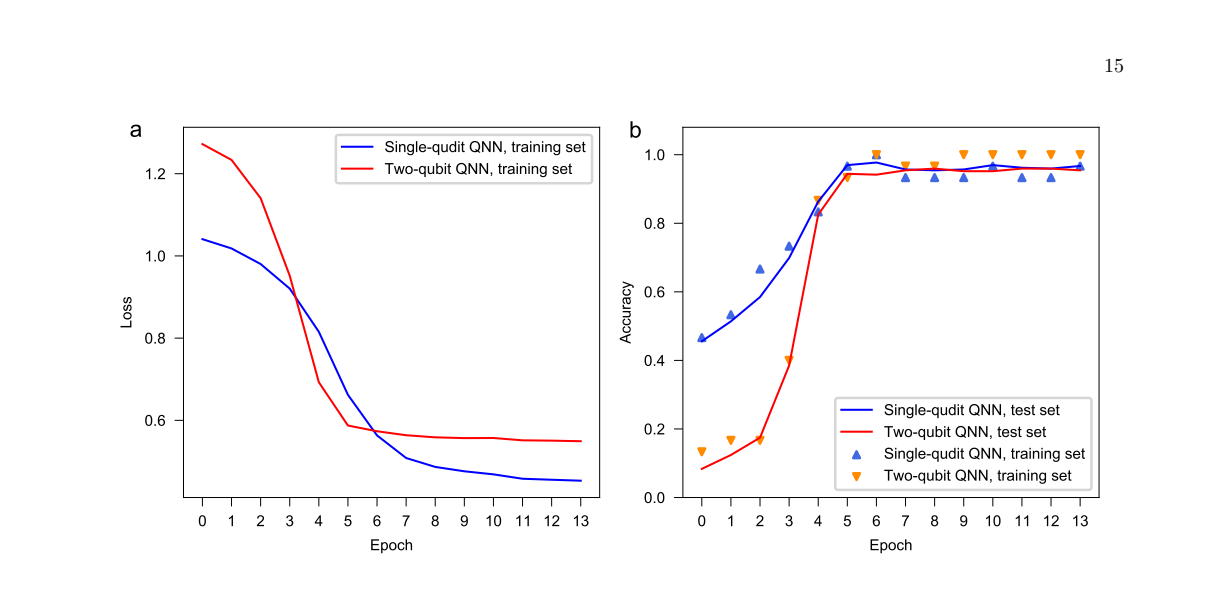
The statement 'the accuracy on the test set is close to 1 after the fifth epoch' is vague. Since the numerical test accuracy is 96.7%, it would be clearer to say 'close to 97%'.
The paper says, at Appendix A
Pith says: minor objection 4 of 8
The text contains garbled characters (e.g., '/uni00000013/...'). The authors should ensure the supplementary material is rendered correctly.
The paper says, at Appendix C
Pith says: minor objection 5 of 8
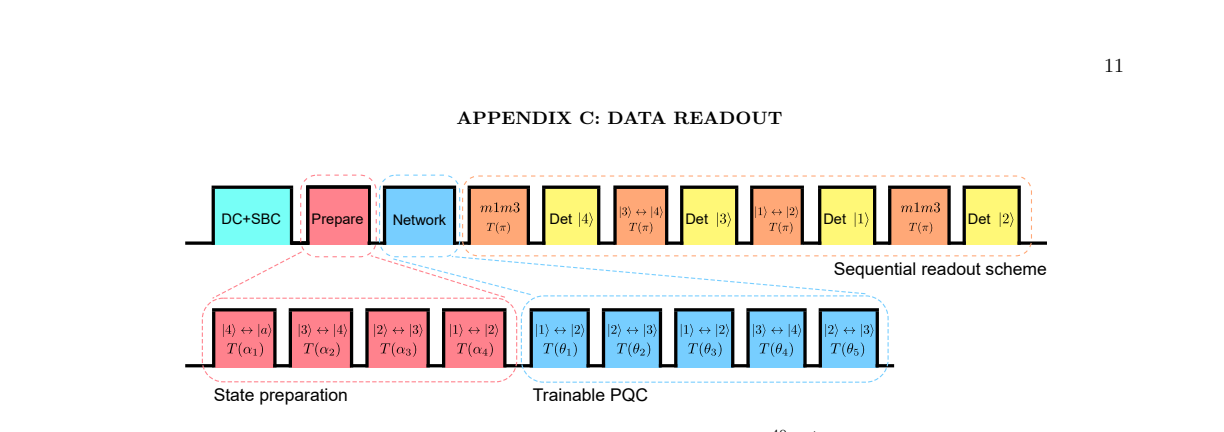
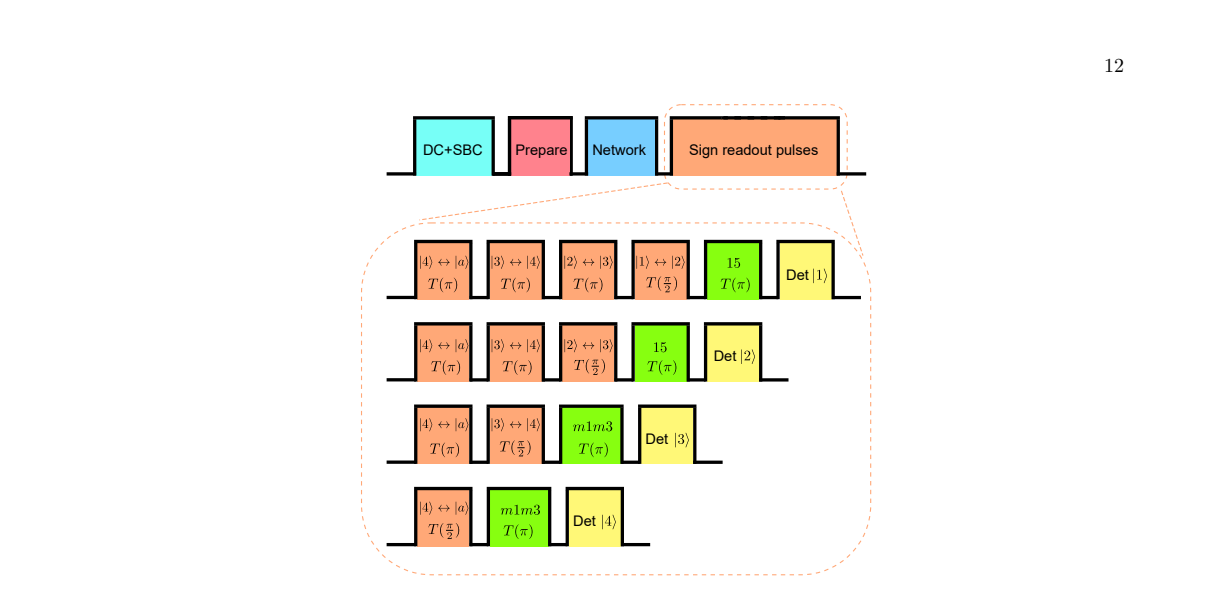
In the definition of population measurement results (ρ_i), the wildcard '*' is used but not explicitly explained. A brief explanatory note would help readers unfamiliar with sequential readout schemes.
The paper says, at Appendix E (title)
Pith says: minor objection 6 of 8
The title 'RESIDUAL ANAL YSIS' contains a typo: 'ANAL YSIS' should be 'ANALYSIS'.
The paper says, at Appendix F, Fig. 10
Pith says: minor objection 7 of 8
The y-axis label is missing; it should read 'Test Accuracy' (or similar) rather than just the axis itself.
The paper says, at Materials and Methods, Fig. 5
Pith says: minor objection 8 of 8
The caption for Fig. 5 mentions 1,000 distinct parameter initializations, but this detail is given only in the text; consider adding a note to the caption for completeness.
What would settle it
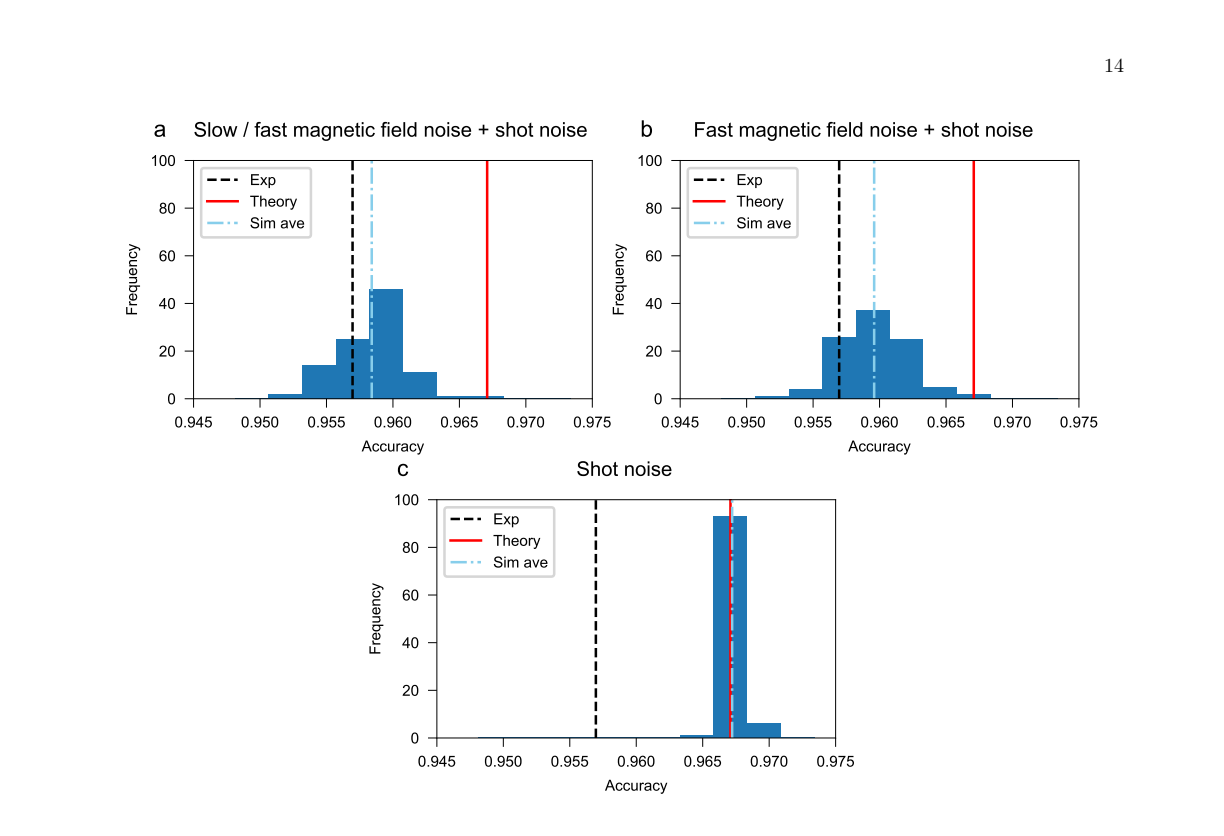
Reproduce the noise simulation of Appendix F by implementing the Lindblad master equation with the same parameters (shot noise: 1500 shots for populations, 600 for signs; slow field fluctuation: ±0.18 mGs two-point distribution; coherence times: T2 ≈ 4 ms for relevant transitions). If the mean test accuracy over 100 runs deviates from the reported ~95.9% by more than 1% (i.e., falls outside 94.9%–96.9%), the experimental claim of 95.7% would require re-examination. Otherwise, the consistency stands.
from the skeptic's reading
How the review went
4 readings by deepseek-v4-flash · 14 Sep 2026
- Reader holds up
- Skeptic agrees
- Editor wrote the verdict above
- Referee minor revision: 8 minor
Not run on this paper: the simulated authors' defence.
Pith did not check this review's objections against the paper.
The review in full
The review in brief, machine-written
The paper does what it says: demonstrate a qudit-based quantum neural network trained with backpropagation on a trapped-ion processor. That part is new. The experimental execution is careful—gate fidelities >99%, noise simulations that reproduce the measured accuracy within 0.2%, and a detailed appendices covering state preparation, readout, and error sources. The authors are honest about the limitations: 30 training samples, 4 PCA features, and baselines (SVM, two-qubit QNN) that match or slightly exceed their 95.7% test accuracy.
The soft spots are real but not hidden. The dataset is too small to say anything about generalization or about the advantage of using a qudit over a qubit. The Hilbert space of a d=4 qudit is larger than a qubit's, but the task is trivial for a linear SVM, so there is no regime where that extra capacity is needed. The paper does not claim a quantum advantage, but the abstract and title may lead casual readers to expect more than a proof-of-principle on a two-class problem with 30 training examples.
The paper is for an audience that wants to see that qudit QNNs can be built and trained on real hardware. It is not for readers looking for scaling, analysis of expressivity, or a meaningful comparison with qubit-based QNNs. The methods are sound and the experimental documentation is thorough. I would send it to peer review because the demonstration is clean and the authors have been transparent about what they did and did not show. I would expect the reviewers to flag the small scale and the lack of qudit advantage, but those are inherent to a first demonstration, not flaws in the execution.
Recommendation: read if you work on qudit hardware or QNN implementations. Otherwise, the main takeaway is that this kind of experiment is now possible.
The strongest objection
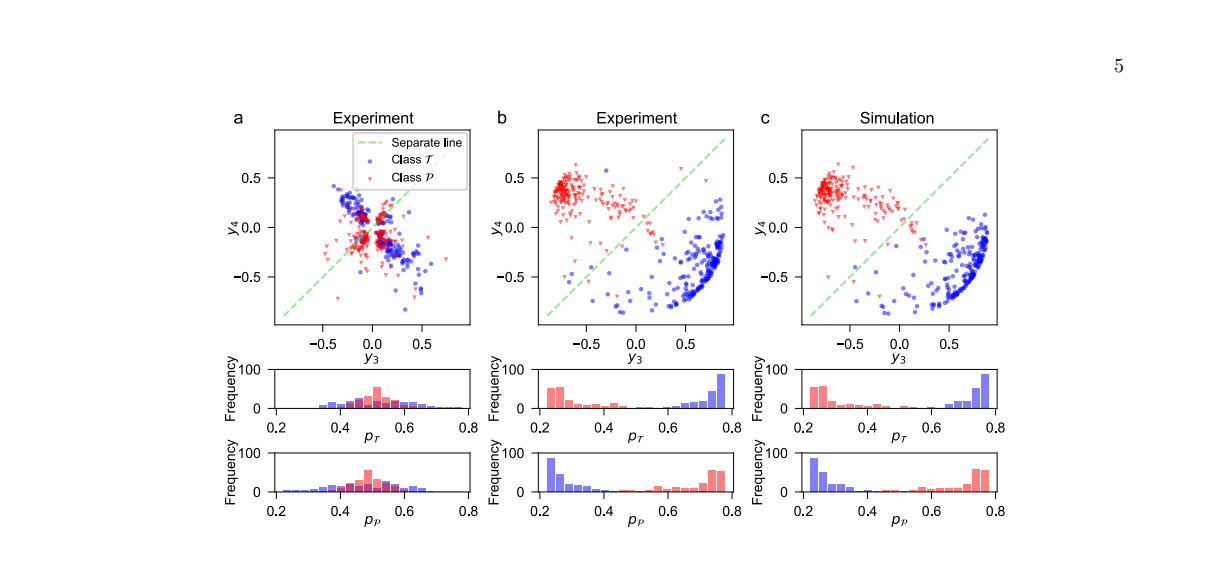
After careful review, I find no load-bearing concern that undermines the paper's central claim of demonstrating a qudit-based QNN with backpropagation achieving 95.7% test accuracy on a trapped-ion processor. The experimental accuracy is consistent with noise simulations that include shot noise and magnetic field fluctuations (Appendix F), which reproduce a mean test accuracy of ~95.9%—within 0.2% of the experimental value. The training set (30 samples) and test set (395 samples) are clearly described, with no evidence of data leakage: the PCA transform was fitted solely on the training set. Baseline comparisons (Linear SVM: 97.2%, two-qubit QNN: 95.4%) show comparable performance, but the paper does not claim a quantum advantage; it claims a feasibility demonstration, which is supported. Gate fidelities exceed 99%, and state preparation/measurement errors are ~0.2%, well within the tolerance for a proof-of-principle. The reader's weakest assumption—that the small scale and lack of qudit advantage are limitations—is accurate but does not threaten the validity of the demonstration itself. No internal inconsistency, hidden assumption, or unsupported extrapolation was identified.
The paper provides a clean experimental demonstration of a qudit QNN trained with backpropagation. The central claim—achieving 95.7% test accuracy—is directly measured and well-explained. Noise simulations closely match the experimental result, ruling out large systematic errors. The small dataset and lack of qudit advantage are inherent limitations of a proof-of-principle, not flaws. The methodology is sound, the data encoding and readout are detailed, and the error analysis (shot noise, magnetic noise) is thorough. No hidden assumptions or circular reasoning are present. The reader's verdict (ACCEPT) is appropriate, and no adjustment is needed.
The referee's report
This work provides one of the first clean experimental implementations of a qudit-based QNN with backpropagation on a well-controlled trapped-ion platform. It demonstrates that multi-level systems can be used effectively for small-scale classification tasks without increasing the number of physical qubits. The detailed error analysis—including noise simulations that reproduce the experimental accuracy—and the comparison with classical and two-qubit baselines strengthen the credibility of the results. While the scale is modest (30 training samples, 4-dimensional PCA features), the paper does not overclaim; it presents a feasibility demonstration and a practical recipe that could be extended to larger qudit processors. The methodology is sound, and the experimental control is thorough (gate fidelities >99%, SPAM errors ~0.2%).
Pith's reading of the paper (a machine's summary, not the authors')
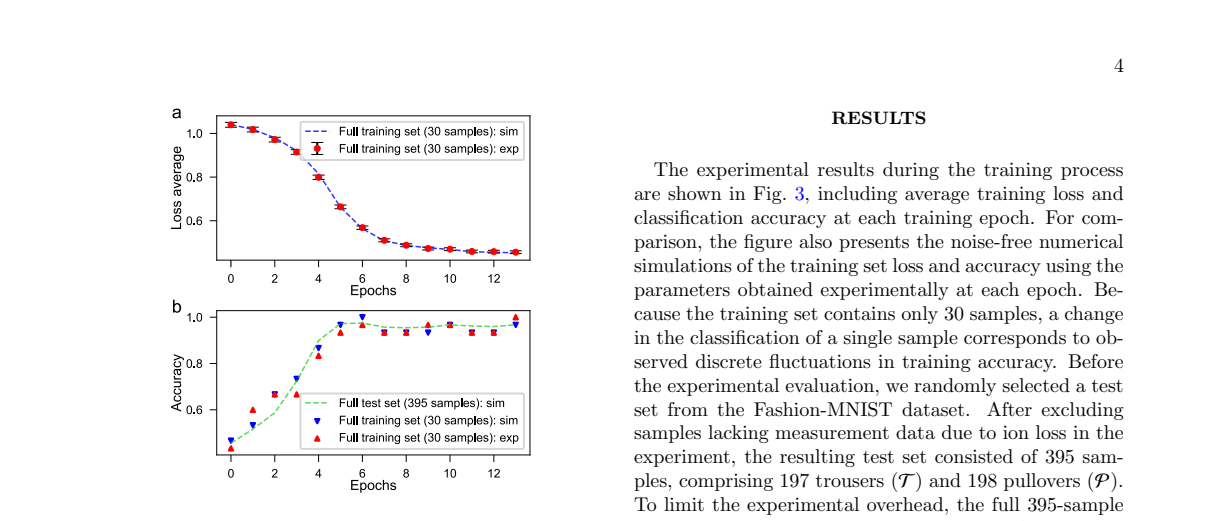
This paper demonstrates a quantum neural network built on a qudit (multi-level quantum digit) processor, using a single trapped 40Ca+ ion. The network is trained via a hybrid quantum-classical implementation of backpropagation on a reduced Fashion-MNIST binary classification task. After 13 training epochs, the experimental test accuracy reaches 95.7%, closely matching noise-free simulations. The result establishes a proof-of-principle that qudits, with their larger Hilbert space per physical unit, can serve as practical platforms for quantum machine learning.
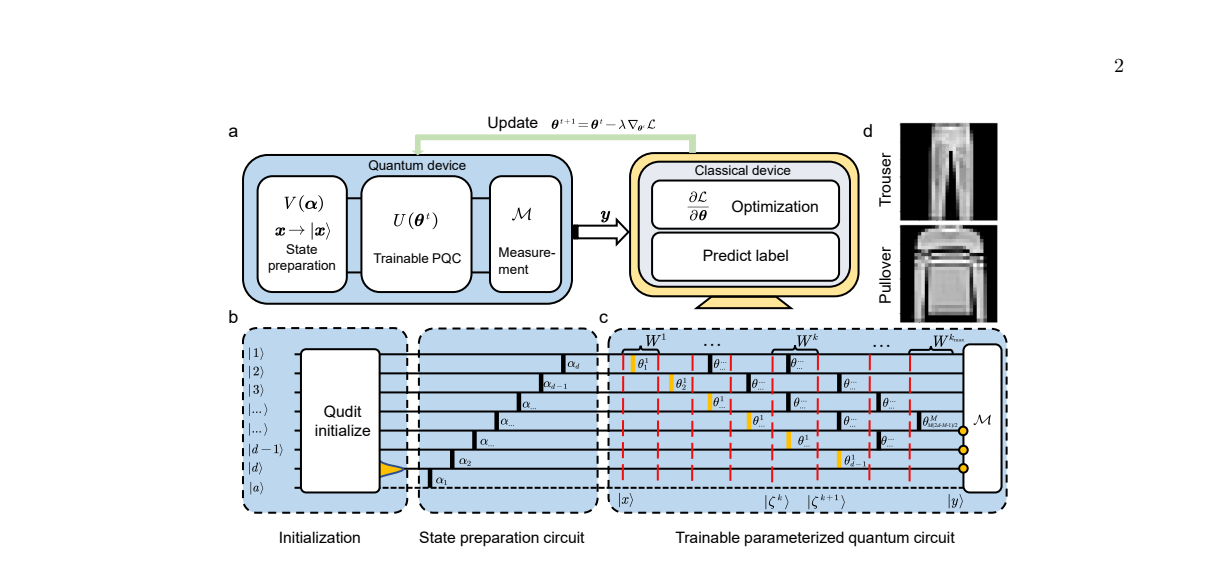
What carries the argument. The parameterized transition gate $T^{i,i+1}(\theta)$ between adjacent qudit levels, applied in a staircase structure to form the trainable circuit; the hybrid backpropagation algorithm that measures inner data vectors $\boldsymbol{\zeta}_k$ and uses the chain-rule recursion $\boldsymbol{\delta}_k = \hat{W}_k^\dagger \boldsymbol{\delta}_{k+1}$ to compute error vectors and gradients on a classical device; and the amplitude encoding scheme that maps input features onto qudit amplitudes using a sequence of rotations.
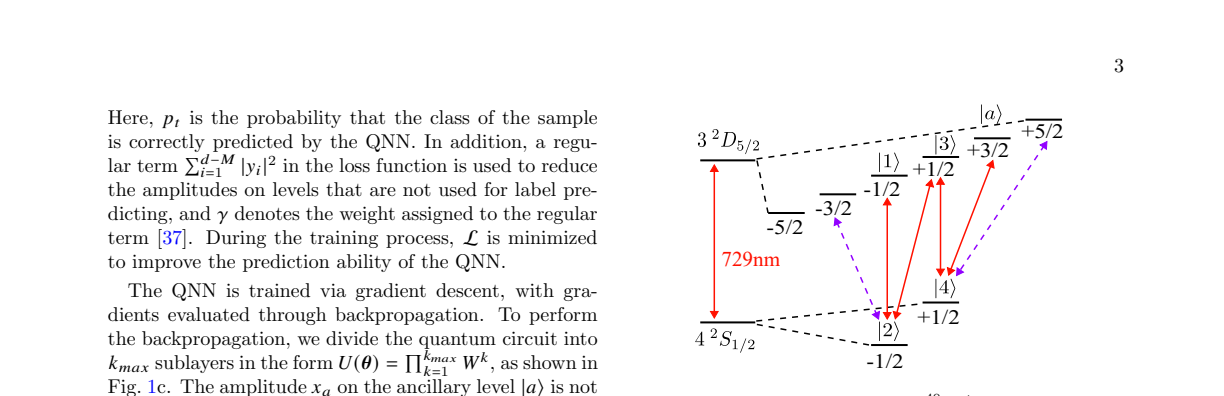
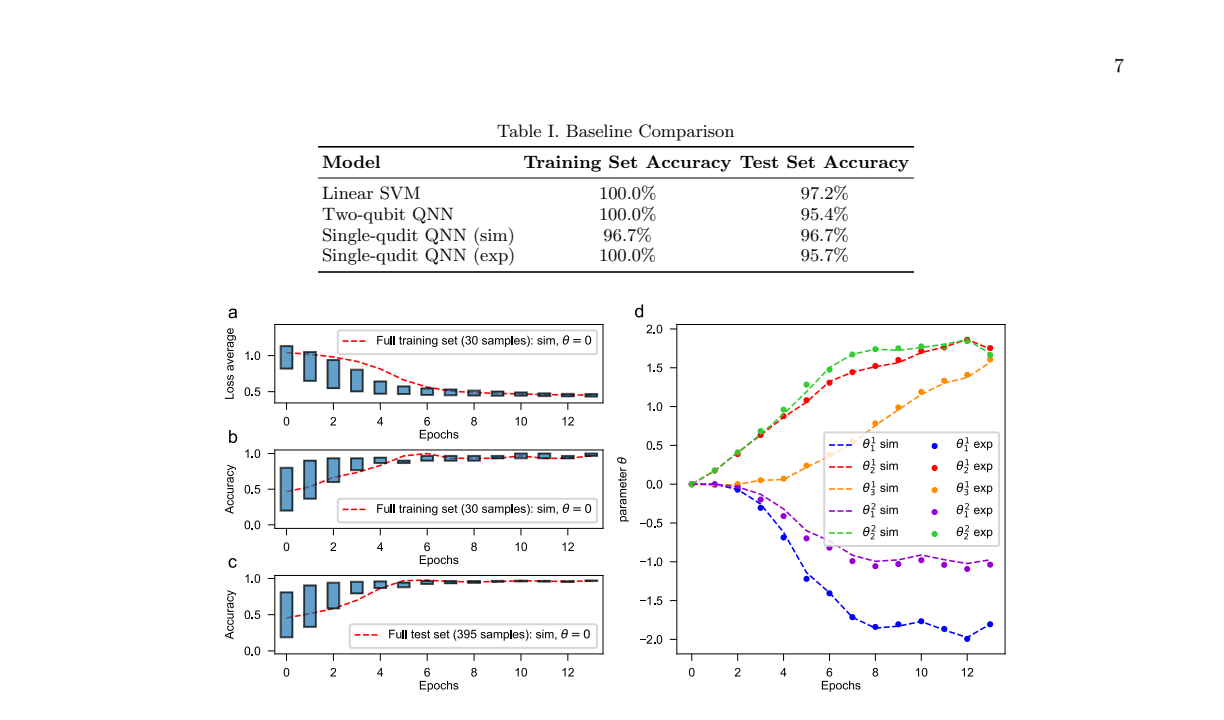
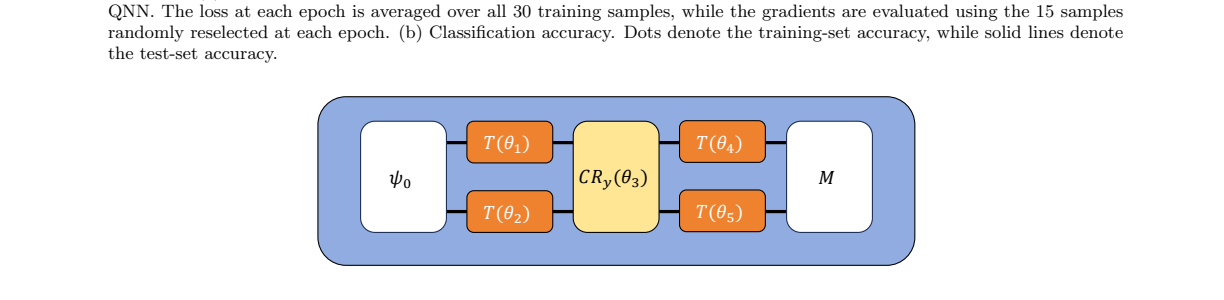
Core claim. The paper shows that a quantum neural network (QNN) can be realized on a single qudit with d=4 by encoding data amplitudes into five internal levels of a trapped ion and applying a cascade of parameterized adjacent-level rotations as the trainable circuit. The network is trained using hybrid quantum-classical backpropagation: intermediate data states are measured on the quantum processor, while the loss, error vectors, and gradients are computed classically. On the 395-sample test set, the experimentally trained QNN achieves 95.7% accuracy, compared with 96.7% in noise-free simulation. A linear SVM on the same reduced features reaches 97.2%, indicating that the task does not require the qudit's full capacity but nevertheless validates the experimental framework.
The premise it rests on. The network is trained and evaluated on a heavily reduced dataset (30 training samples, 4-dimensional PCA features) from a binary subset of Fashion-MNIST, so the demonstrated performance may not generalize to larger, more realistic tasks and does not yet reveal an advantage of the qudit's larger Hilbert space.
If the paper is right (Pith's inferences, not the authors')
Qudit-based QNNs can increase the expressivity of a quantum neural network without adding more physical quantum systems, because each qudit offers more levels than a qubit.
The hybrid backpropagation scheme demonstrated here is transferable to other multi-level quantum platforms such as photonic or superconducting qudits.
This work provides a blueprint for implementing parameterized quantum circuits on qudits with feedback-based optimization, a key component for near-term quantum machine learning.
The ability to train the network on a real trapped-ion processor with gate fidelities above 99% suggests that qudit QNNs are compatible with current NISQ hardware.
The classification task is extremely small (30 training samples, 4 PCA features), and a linear SVM achieves 97.2% test accuracy—higher than the qudit QNN's 95.7%. This suggests that the current experiment does not probe a regime where qudit capacity provides a quantum advantage; future work must use larger, higher-dimensional tasks to justify the qudit overhead.
The hybrid backpropagation requires intensive measurement of intermediate states (1500 shots per population, 600 shots per sign), which may become a practical bottleneck for deeper circuits. A fully quantum backpropagation, sketched by the authors, could reduce measurement overhead but remains to be implemented.
Because the network uses only four data levels out of the five, the fifth (ancillary) level is used solely for sign readout. In a larger qudit, more levels could be used for data, enabling richer feature maps without increasing the number of physical ions.
Check this review
Pith stored no record of this review's passes and took no fingerprint of it. Reviews made by code from 13 Nov 2026 on carry both.
How often reviews like this one are right
Reviews like this one: written by deepseek-v4-flash, where what was read was not recorded.
How often objections from reviews like this one are right: not yet measured
Reviews by people
This review was written by a machine. No person has reviewed this paper on Pith yet. A scientist listed on Pith can review it for a fee, and their review is published here whatever it concludes.
The paper
Abstract
Quantum neural networks (QNNs), one of the fundamental algorithms in quantum machine learning, have been widely used in classification and identification tasks. However, the capabilities of QNNs are constrained by their size, which is determined by the dimension of the Hilbert space of the underlying quantum processor. Multi-level quantum digits (qudits) offer access to a higher-dimensional Hilbert space compared to two-level qubits, enabling the construction of more expressive QNNs. In this work, we report an experimental demonstration of qudit-based QNN using a trapped $\rm ^{40}Ca^+$ ion. We train the QNN using a hybrid quantum-classical implementation of backpropagation and achieve an experimental classification accuracy of 95.7% on a test image set. This demonstration highlights the potential of qudit-based processors to QNN architectures and provides a framework for implementing qudit-based QNNs across various quantum devices.
The paper's own sentences, arranged, kept beside the review and separate from it. Each label is drawn from a closed vocabulary; the number beside it is the probability the classifier gave that label. No sentence in this record was written by a model.
abstract compiled · 2026-09-23
The authors' main claim, as the classifier picked it out 0.99
“This demonstration highlights the potential of qudit-based processors to QNN architectures and provides a framework for implementing qudit-based QNNs across various quantum devices.”
How the main claim is stated: asserted 0.64
What the abstract itself states, as probabilities: claims first 0.06 · states limitation 0.16 · human participants 0.03 · controlled comparison 0.04 · randomized assignment 0.02 · states quantitative result 0.99 · compares with prior results 0.10 · mentions code or data availability 0.03
The abstract, sentence by sentence
This table labels the abstract only (arXiv listing abstract v1). The number is the probability the classifier gave the label.
| Sentence | Role | The authors' own work | States the main conclusion | Strength |
|---|---|---|---|---|
| Quantum neural networks (QNNs), one of the fundamental algorithms in quantum machine learning, have been widely used in classification and identification tasks. | background 1.00 | 0.04 | 0.02 | asserted 1.00 |
| However, the capabilities of QNNs are constrained by their size, which is determined by the dimension of the Hilbert space of the underlying quantum processor. | background 0.62 | 0.07 | 0.03 | asserted 1.00 |
| Multi-level quantum digits (qudits) offer access to a higher-dimensional Hilbert space compared to two-level qubits, enabling the construction of more expressive QNNs. | background 0.99 | 0.05 | 0.06 | asserted 0.95 |
| In this work, we report an experimental demonstration of qudit-based QNN using a trapped $\rm ^{40}Ca^+$ ion. | contribution 0.96 | 0.97 | 0.07 | asserted 1.00 |
| We train the QNN using a hybrid quantum-classical implementation of backpropagation and achieve an experimental classification accuracy of $95.7\%$ on a test image set. | result 0.95 | 0.98 | 0.27 | asserted 1.00 |
| This demonstration highlights the potential of qudit-based processors to QNN architectures and provides a framework for implementing qudit-based QNNs across various quantum devices. | interpretation 0.99 | 0.58 | 0.83 | asserted 0.64 |
What kind of paper the classifier reports this is: empirical study 0.99 · evidence from observation or experiment 1.00
What was examined, and what was not
Sources read
- arXiv listing abstract v1
Not examined
- full text
- figures and tables
- references and citing sentences
- relations to other papers
Levels run
- P abstract
Not run
- S sections
- T body sentences
- C citations
- R cross-paper relations
How the labels were made
Compiled by classifier-1.13.0 via TypeSafe API, question bank abstract-p1-20260923, 2026-09-23: 1 request, 4,966 input tokens.
Every quoted sentence on this record is the authors'. Every label is from Pith's closed vocabulary, with the probability shown beside it. This record as JSON
Figures (12)
Figures are the authors', reproduced from the paper.
References (49)
- [1] N. Wiebe, D. Braun, and S. Lloyd, Phys. Rev. Lett.109, 050505 (2012) on Pith
- [2] S. Lloyd, M. Mohseni, and P. Rebentrost, Nat. Phys.10, 631 (2014) on Pith
- [3] P. Rebentrost, M. Mohseni, and S. Lloyd, Phys. Rev. Lett.113, 130503 (2014) on Pith
- [4] S. Lloyd, S. Garnerone, and P. Zanardi, Nat. Commun. 7, 10138 (2016) on Pith
- [5] J. Biamonte, P. Wittek, N. Pancotti, P. Rebentrost, N. Wiebe, and S. Lloyd, Nature549, 195 (2017) on Pith
- [6] M. Schuld and N. Killoran, Phys. Rev. Lett.122, 040504 (2019) on Pith
- [7] M. H. Gordon, M. Cerezo, L. Cincio, and P. J. Coles, PRX Quantum3, 030334 (2022) on Pith
- [8] T. Suzuki, T. Hasebe, and T. Miyazaki, Quant. Mach. Intell.6, 31 (2024) on Pith
- [9] M. S. Rudolph, N. B. Toussaint, A. Katabarwa, S. Johri, B. Peropadre, and A. Perdomo-Ortiz, Phys. Rev. X12, 031010 (2022) on Pith
- [10] T. Dutta, A. P´ erez-Salinas, J. P. S. Cheng, J. I. Latorre, and M. Mukherjee, Phys. Rev. A106, 012411 (2022) on Pith
- [11] M. Schuld, R. Sweke, and J. J. Meyer, Phys. Rev. A103, 032430 (2021) on Pith
- [12] K. Beer, D. Bondarenko, T. Farrelly, T. J. Osborne, R. Salzmann, D. Scheiermann, and R. Wolf, Nat. Com- mun.11, 1 (2020) on Pith
- [13] X. Pan, Z. Lu, W. Wang, Z. Hua, Y. Xu, W. Li, W. Cai, X. Li, H. Wang, Y.-P. Song, C.-L. Zou, D.-L. Deng, and L. Sun, Nat. Commun.14, 4006 (2023) on Pith
- [14] S. Johri, S. Debnath, A. Mocherla, A. Singk, A. Prakash, J. Kim, and I. Kerenidis, npj Quantum Inform.7, 1 (2021) on Pith
- [15] S. Lloyd and C. Weedbrook, Phys. Rev. Lett.121, 040502 (2018) on Pith
- [16] L. Hu, S.-H. Wu, W. Cai, Y. Ma, X. Mu, Y. Xu, H. Wang, Y. Song, D.-L. Deng, C.-L. Zou, and L. Sun, Sci. Adv.5, eaav2761 (2019) on Pith
- [17] I. Cong, S. Choi, and M. D. Lukin, Nat. Phys.15, 1273 (2019) on Pith
- [18] J. Landman, N. Mathur, Y. Y. Li, M. Strahm, S. Kazdaghli, A. Prakash, and I. Kerenidis, Quantum6, 881 (2022) on Pith
- [19] Y. Liu, S. Arunachalam, and K. Temme, Nat. Phys.17, 1013 (2021) on Pith
- [20] A. Abbas, D. Sutter, C. Zoufal, A. Lucchi, A. Figalli, and S. Woerner, Nat. Comput. Sci.1, 403 (2021) on Pith
show 29 more
- [21] N. L. Wach, M. S. Rudolph, F. Jendrzejewski, and S. Schmitt, Quant. Mach. Intell.5, 36 (2023) on Pith
- [22] D. H. Useche, A. Giraldo-Carvajal, H. M. Zuluaga- Bucheli, J. A. Jaramillo-Villegas, and F. A. Gonz´ alez, Quantum Inf. Process.21, 12 (2021) on Pith
- [23] A. Mandilara, B. Dellen, U. Jaekel, T. Valtinos, and D. Syvridis, Quant. Mach. Intell.6, 17 (2024) on Pith
- [24] P. J. Low, B. M. White, A. A. Cox, M. L. Day, and C. Senko, Phys. Rev. Res.2, 033128 (2020) on Pith
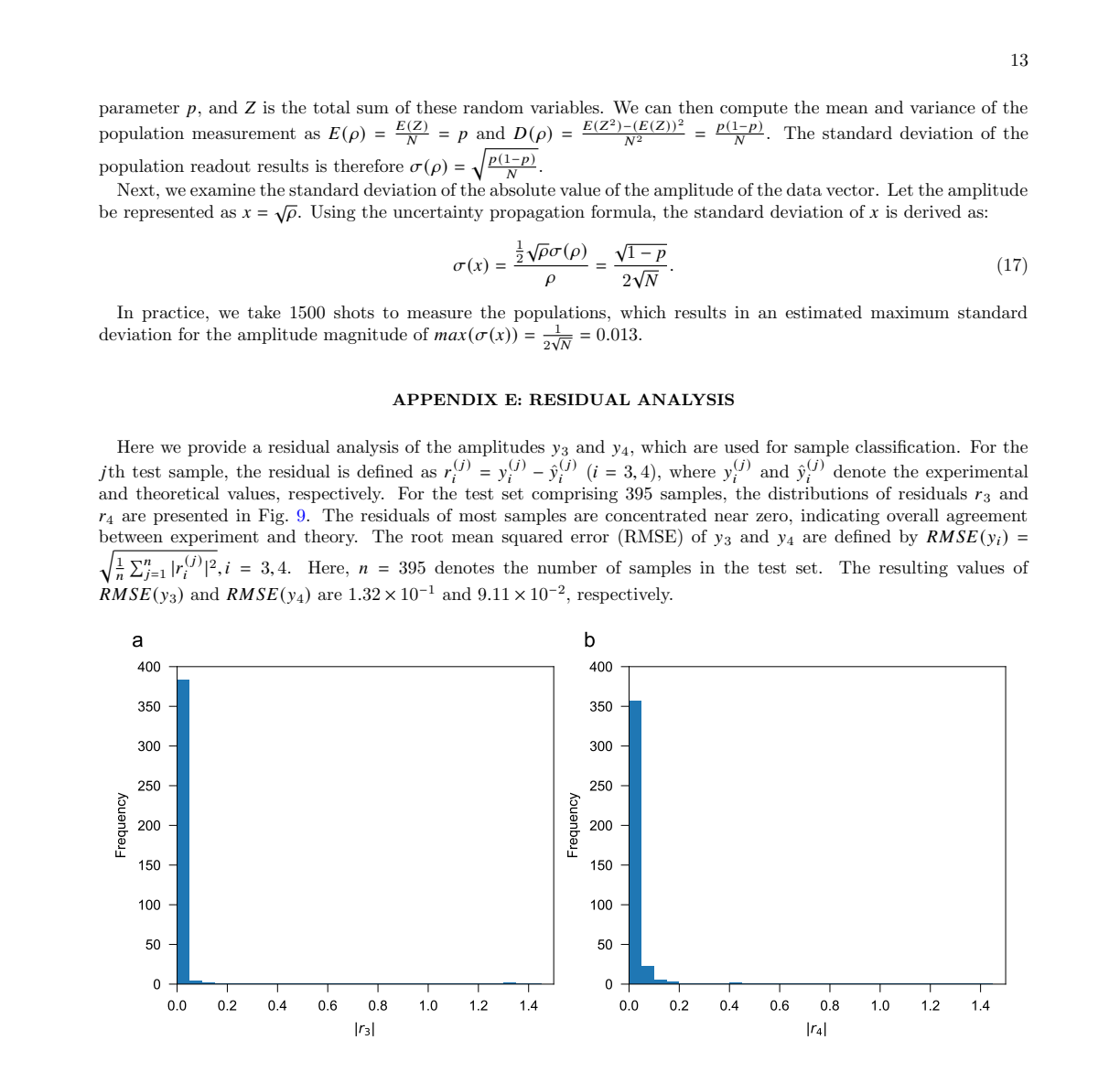
- [25] M. Ringbauer, M. Meth, L. Postler, R. Stricker, R. Blatt, P. Schindler, and T. Monz, Nat. Phys.18, 1053 (2022). 7 Table I. Baseline Comparison Model T raining Set Accuracy T est Set Accuracy Linear SVM 100.0% 97.2% Two-qubit QNN 100.0% 95.4% Single-qudit QNN (sim) 96.7% 96.7% ... on Pith
- [26] P. J. Low, B. White, and C. Senko, npj Quantum Inform. 11, 85 (2025) on Pith
- [27] I. V. Zalivako, A. S. Nikolaeva, A. S. Borisenko, A. E. Korolkov, P. L. Sidorov, K. P. Galstyan, N. V. Se- menin, V. N. Smirnov, M. A. Aksenov, K. M. Makushin, E. O. Kiktenko, A. K. Fedorov, I. A. Semerikov, K. Y. Khabarova, and N. N. Kolachevsky, Quantum Rep.7, 19 (2025) on Pith
- [28] Y. Chi, J. Huang, Z. Zhang, J. Mao, Z. Zhou, X. Chen, C. Zhai, J. Bao, T. Dai, H. Yuan, M. Zhang, D. Dai, B. Tang, Y. Yang, Z. Li, Y. Ding, L. K. Oxenløwe, M. G. Thompson, J. L. O’Brien, Y. Li, Q. Gong, and J. Wang, Nat. Commun.13, 1 (2022) on Pith
- [29] F.-F. Du, X.-M. Ren, M. Ma, and G. Fan, Opt. Lett.49, 1229 (2024) on Pith
- [30] M. Kues, C. Reimer, P. Roztocki, L. R. Cort´ es, S. Sciara, B. Wetzel, Y. Zhang, A. Cino, S. T. Chu, B. E. Little, D. J. Moss, L. Caspani, J. Aza˜ na, and R. Morandotti, Nature546, 622 (2017) on Pith
- [31] M. Kristen, A. Schneider, A. Stehli, T. Wolz, S. Danilin, H. S. Ku, J. Long, X. Wu, R. Lake, D. P. Pappas, A. V. Ustinov, and M. Weides, npj Quantum Inform. 6, 1 (2020) on Pith
- [32] X. Tan, D.-W. Zhang, W. Zheng, X. Yang, S. Song, Z. Han, Y. Dong, Z. Wang, D. Lan, H. Yan, S.-L. Zhu, and Y. Yu, Phys. Rev. Lett.126, 017702 (2021) on Pith
- [33] W. Zheng, Y. Zhang, Y. Dong, J. Xu, Z. Wang, X. Wang, Y. Li, D. Lan, J. Zhao, S. Li, X. Tan, and Y. Yu, npj Quantum Inform.8, 1 (2022) on Pith
- [34] E. O. Kiktenko, A. K. Fedorov, A. A. Strakhov, and V. I. Man’ko, Phys. Lett. A379, 1409 (2015) on Pith
- [35] I. Kerenidis, J. Landman, and N. Mathur, Classical and quantum algorithms for orthogonal neural networks (2022), arXiv:2106.07198 [quant-ph] on PithPith's reviewarXiv
- [36] S. Roca-Jerat, J. Rom´ an-Roche, and D. Zueco, Mach. Learn.-Sci. Technol.5, 015057 (2024) on Pith
- [37] C.-J. Huang, H. Ma, Q. Yin, J.-F. Tang, D. Dong, C. Chen, G.-Y. Xiang, C.-F. Li, and G.-C. Guo, Phys. Rev. A102, 032412 (2020) on Pith
- [38] C. F. Roos,Controlling the quantum state of trapped ions, Ph.D. thesis, University of Innsbruck (2000) on Pith
- [39] W. Nagourney, J. Sandberg, and H. Dehmelt, Phys. Rev. Lett.56, 2797 (1986) on Pith
- [40] F. Leupold, M. Malinowski, C. Zhang, V. Negnevitsky, A. Cabello, J. Alonso, and J. Home, Phys. Rev. Lett. 120, 180401 (2018) on Pith
- [41] H. Xiao, K. Rasul, and R. Vollgraf, Fashion-MNIST: a novel image dataset for benchmarking machine learning algorithms (2017), arXiv:1708.07747 on PithPith's reviewarXiv
- [42] E. Grant, M. Benedetti, S. Cao, A. Hallam, J. Lockhart, V. Stojevic, A. G. Green, and S. Severini, npj Quantum Inform.4, 65 (2018) on Pith
- [43] N. Guo, K. Mitarai, and K. Fujii, Phys. Rev. Res.6, 043227 (2024) on Pith
- [44] N. Guo, Z. Yu, M. Choi, A. Agrawal, K. Nakaji, A. Aspuru-Guzik, and P. Rebentrost, Quantum linear 8 algebra is all you need for Transformer architectures (2024), arXiv:2402.16714 on PitharXiv
- [45] W. Li, P.-C. Chu, G.-Z. Liu, Y.-B. Tian, T.-H. Qiu, and S.-M. Wang, Quantum Eng.2022, 5701479 (2022) on Pith
- [46] Y. Liang, W. Peng, Z.-J. Zheng, O. Silv´ en, and G. Zhao, Neural Netw.143, 133 (2021) on Pith
- [47] J. Liu, K. H. Lim, K. L. Wood, W. Huang, C. Guo, and H.-L. Huang, Sci China Phys Mech64, 290311 (2021) on Pith
- [48] C. Mao, C. Yi, and H. Zhu, Phys. Rev. Lett.134, 160801 (2025) on Pith
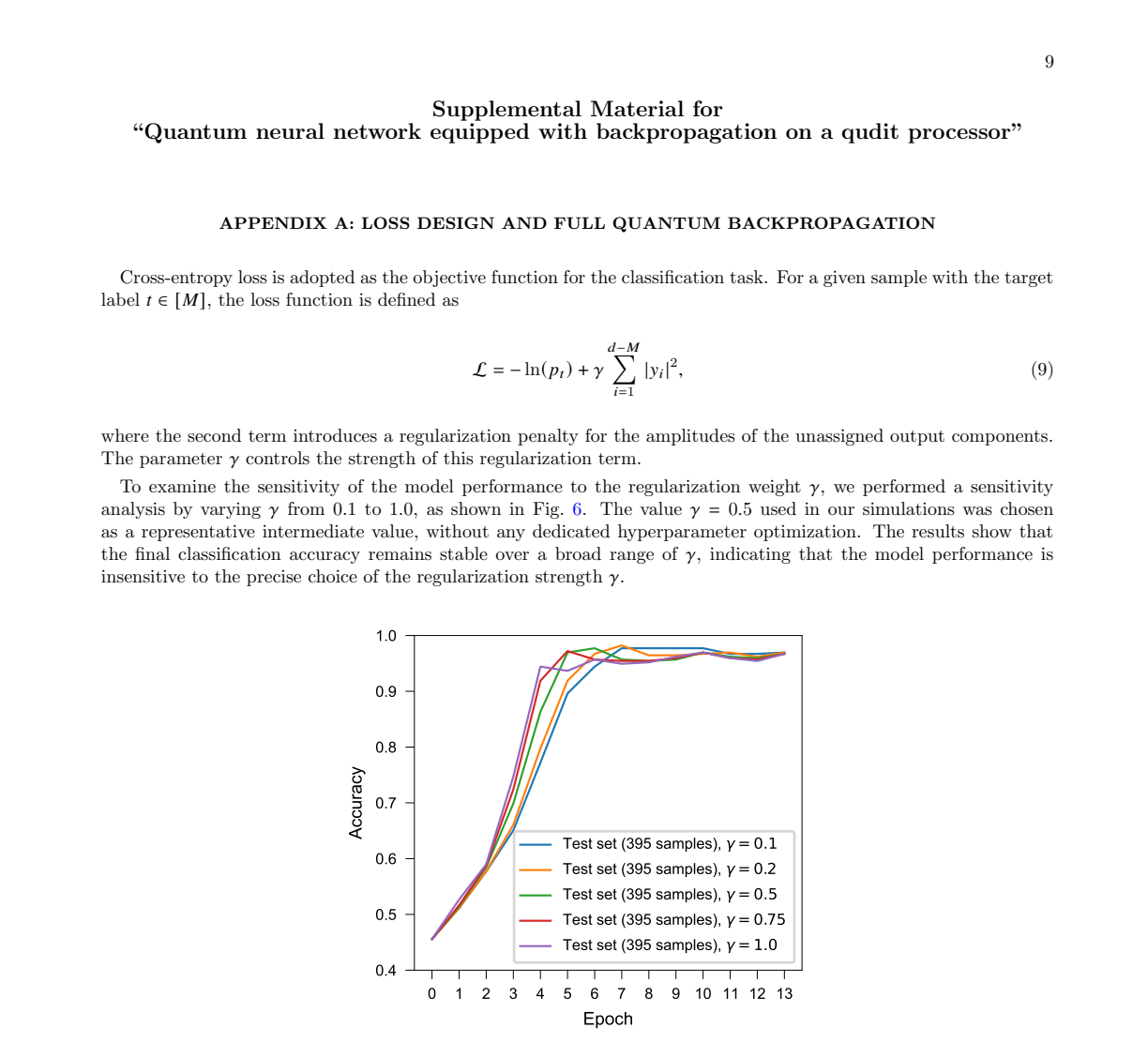
- [49] A. Abbas, R. King, H.-Y. Huang, W. J. Huggins, R. Movassagh, D. Gilboa, and J. McClean, inAdvances in Neural Information Processing Systems, Vol. 36 (2023) pp. 44792–819. 9 Supplemental Material for “Quantum neural network equipped with backpropagation on a qudit processor” AP... on Pith
Cited by 1 Pith paper
Reviewed papers on Pith that cite this one. The full citation record
- Augmenting Quantum Neural Networks with Contractive Layers quant-ph · Nov 2026
Challenges and discussion
Disagree with the review, or know something it missed? Leave a comment, or challenge this review formally: a challenge becomes a permanent entry in this paper's record, and its decision is published here.
Come back by email
A short list of the week's newly reviewed papers. Nothing is sent until you confirm from your inbox, and every email has a link that stops it. No account.
No comments yet.
Sign in to comment