Data Structures and Algorithms · arXiv:2609.15025 v2 · submitted 14 Sep 2026
Matrix Spencer: Eight Standard Deviations Suffice and an Almost-Linear Time Algorithm for Dense Input
The paper says
“The Matrix Spencer conjecture asserts that for all symmetric matrices A1,…,An ∈ ℝn × n with $\|A_i\|\le1$ there are signs ε1,…,εn ∈ {−1,1} with $\|\sum_{i=1}^n\varepsilon_iA_i\|=O(\sqrt n)$. We prove it: a signing of discrepancy below 8√n always exists.”
more of the abstract
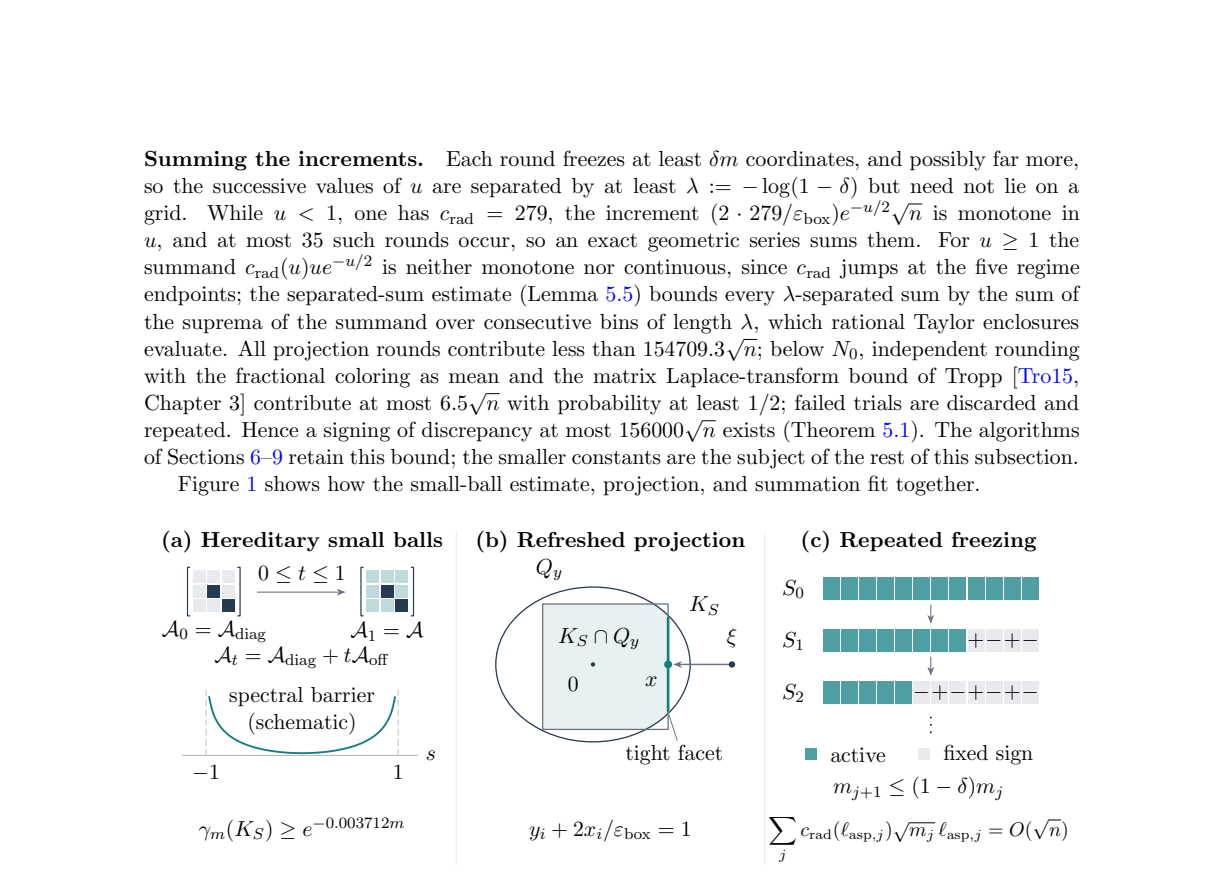
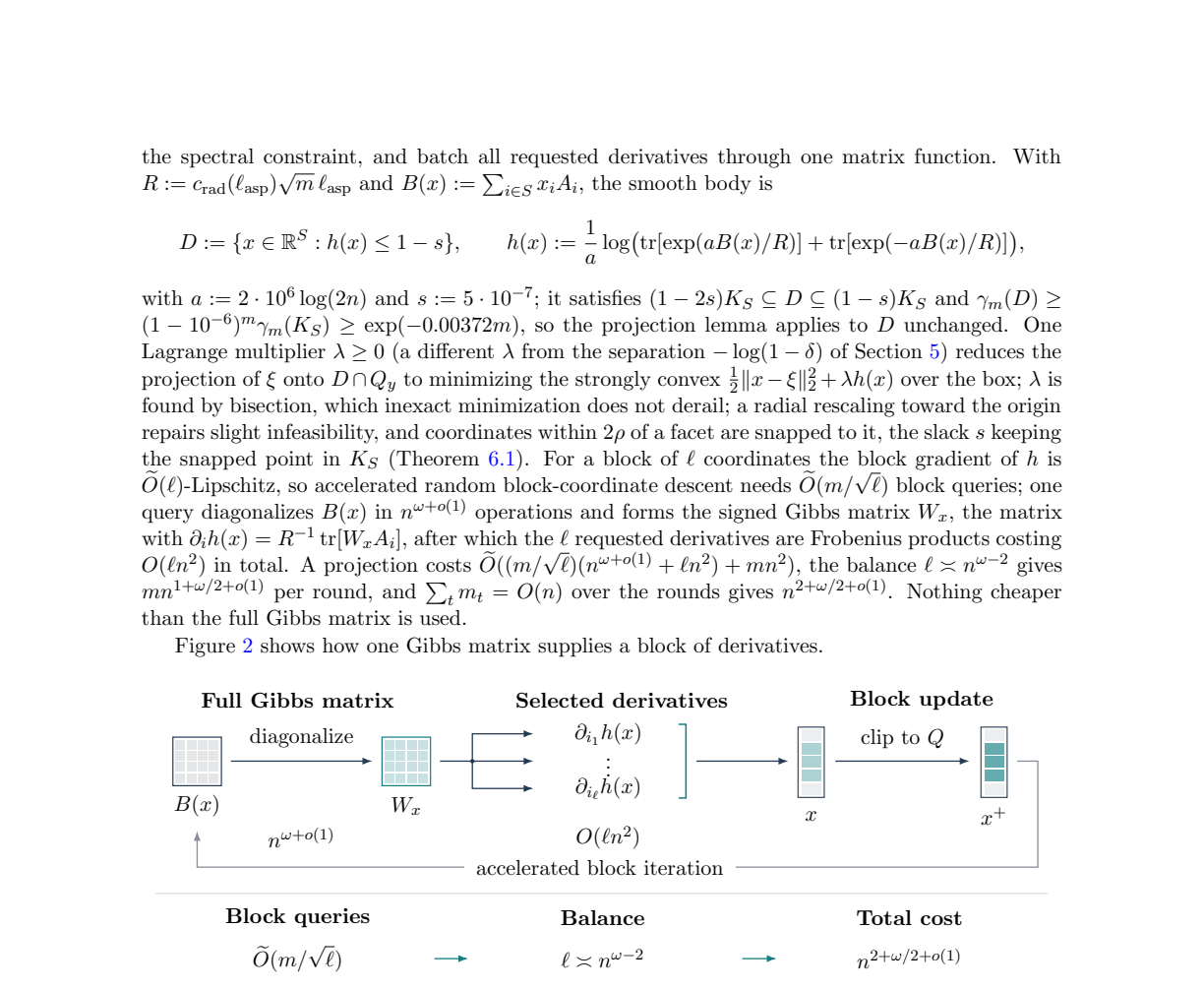
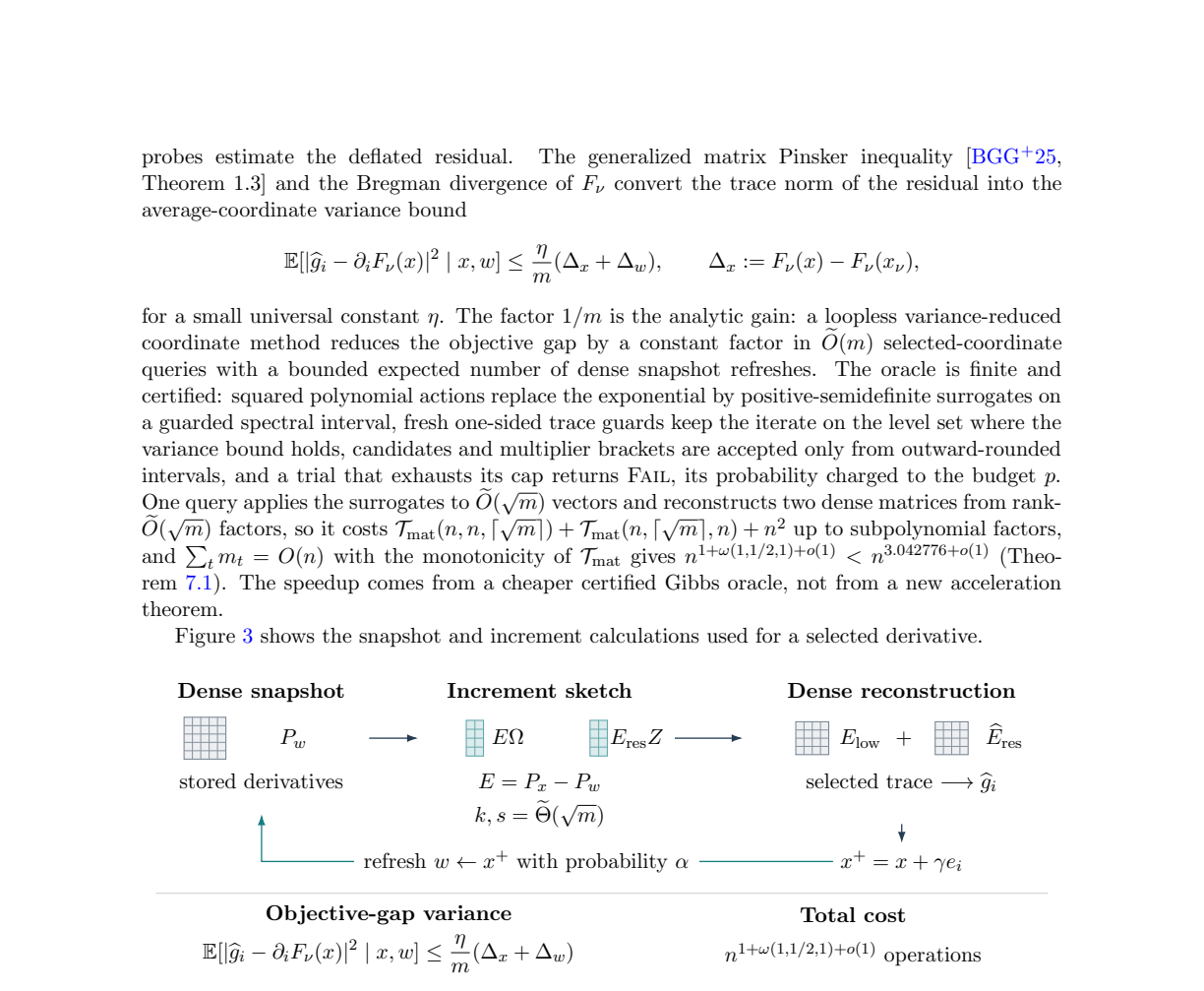
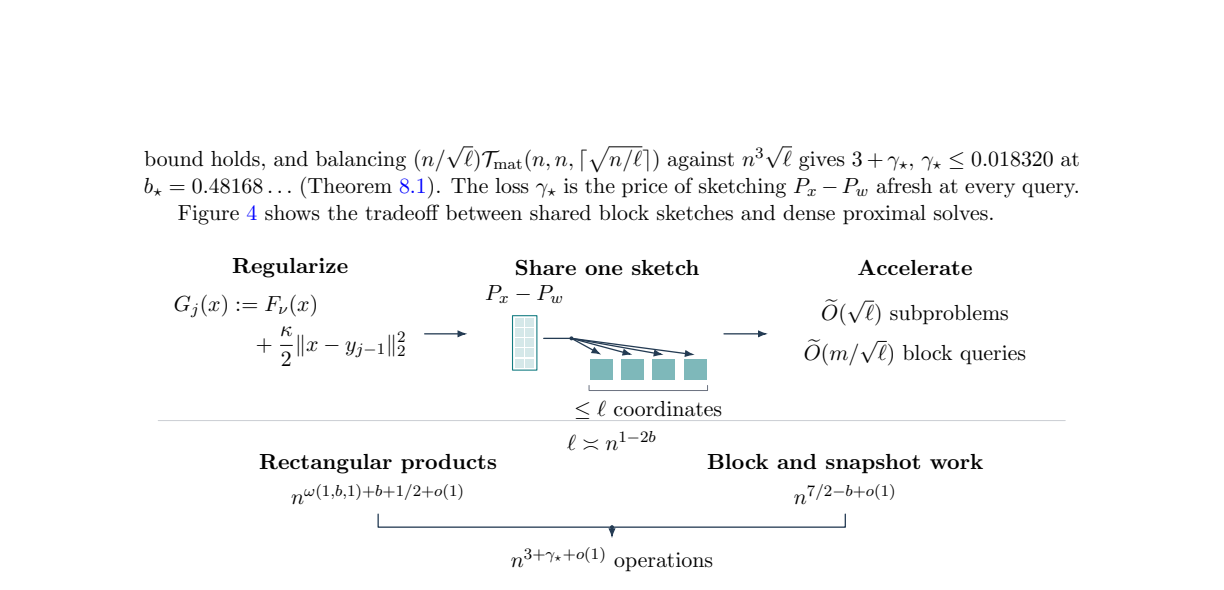
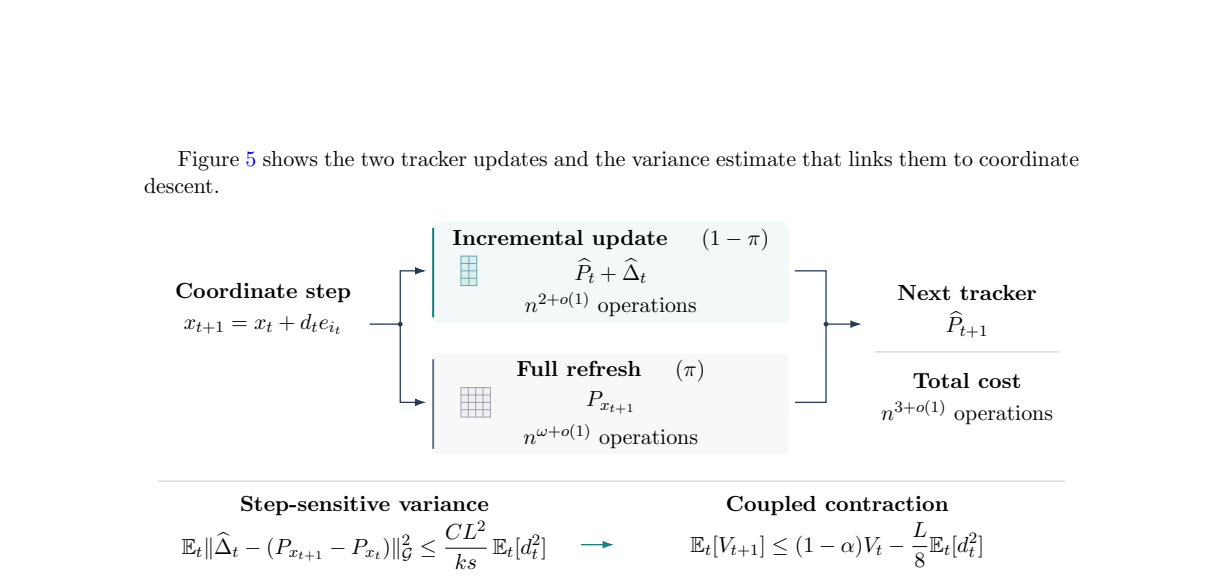
We also give a randomized algorithm that finds a signing of discrepancy below 12√n with failure probability at most p. The algorithm uses n3 + o(1)polylog(1/p) arithmetic operations in the real-arithmetic model. This matches the size n3 of the dense input up to subpolynomial factors. In the other direction, we prove that for every n there are collections of symmetric matrices such that every signing has discrepancy at least (2−o(1))√n. We present three different proofs of the matrix Spencer conjecture. The key to every proof is a hereditary small-ball estimate. This is a lower bound on the Gaussian measure of the spectral body $\{x\in \mathbb{R}^n:\|\sum_ix_iA_i\|\le R\}$ that holds for every subfamily of the matrices. The other ingredient turns that Gaussian measure into a partial signing. We give three approaches to obtain such a signing. The first one covers the cube by partially signed faces through Gaussian concentration with a constant 7 · 109. The second proof replaces the covering by a projection lemma with explicit parameters for a constant 156000. The third proof turns Gaussian measure into signs by a lossless coding, with no union bound. It proves the estimate at the right radius with smooth spectral barriers and certified coefficients. It gives a constant below 7.88. For algorithms, the main idea is to project Gaussian points onto a smoothed spectral body. The n3 + o(1) time algorithm tracks the Gibbs matrix of that body across coordinate-descent steps with sketched increments and random refreshes.
from the abstract
Pith says
Machine review · deepseek-v4-flash · 15 Sep 2026 · of version 1 of the paper; version 2 is newer · what was read was not recorded · not checked by a person
It can be wrong. Challenge this review or reply to it.
The passes disagreed. Reader: holds up. Skeptic: agrees with the reader. Referee: major revision.
Important work on a long-standing open problem, but the proof of the key small-ball estimate has an incomplete extension that needs careful checking. This line is wrong
4 major objections · 14 minor
How often objections from reviews like this one are right: not yet measured
Not checked: figures, code, what the references say.
The paper says, at §4.8, Step 1 and the extension in Lemma 4.6(i)
The review did not quote this passage.
Pith says: Objection 1 of 4 · major
The proof of Lemma 4.1 relies on an extension of the divided-difference estimate (Lemma 4.6(i)) from cutoff w<1/20 to a larger cutoff bκ₃ = b²/(1+b) with b=10021/25000 ≈ 0.40084, giving bκ₃ ≈ 0.1147. The authors state that the proof 'extends' with coefficient bc₀ = (1-2b)/2 in place of 1/4, but the derivation is only a single paragraph.
more of objection 1
The reasoning for the 'far case' uses a gap bound and combines one-sided estimates with a factor of two. I cannot verify that the two-sided inequality holds with bc₀ for this larger cutoff without a detailed, step-by-step verification. Since all subsequent curvature calculations (Lemmas 4.9, 4.12) and the numerical parameter choices in Table 2 depend on this estimate, the load-bearing part of the small-ball estimate is not fully proved. A rigorous derivation—or at least a complete algebraic verification of each step—is required before the paper can be accepted.
The paper says, at §4.8, Step 1; Table 2 and the six regimes
The review did not quote this passage.
Pith says: Objection 2 of 4 · major
Even if the extended divided-difference estimate is accepted, the transition between the six regimes of Table 2 is only sketched. The proof of Lemma 4.1 states that 'the first cell controls the row' and that 'the interpolation maximum is multiplied by at most …'.
more of objection 2
These claims rely on the monotonicity of I(τ,ℓ_asp) and the ratio bounds. While the structure is plausible, the verification that the worst-case exponent E(ℓ_asp) < 0.003712 is attained on the first cell of each regime should be presented more explicitly, perhaps with a table or a short program verifying the inequalities for every ℓ_asp (or at least for representative values). The current text gives rational enclosures for a few endpoints but does not exclude local maxima in the interior.
The paper says, at §5.2 and Lemma 5.4
The review did not quote this passage.
Pith says: Objection 3 of 4 · major
The 'refreshed projection' lemma (Lemma 5.4) uses a union bound over all subsets of size ≤ δm, and the numerical constants δ = 0.0281672 and ε_box = 0.4235 are derived from rational enclosures. The argument that the good event has probability > 0.12 is based on the separation constant r > 6·10⁻⁵.
more of objection 3
However, the proof employs two deviations (3·10⁻⁵ each) and then sums Gaussian tail bounds. The resulting probability bound is 0.126, but the text states 'with probability greater than 0.12'. The gap is small but it would be helpful to see an explicit calculation (or a tighter bound) that the success probability is indeed > 0.12, not just > 0.12 for m=N₀. The monotonicity claim 'the same lower separation persists for every m ≥ N₀' should be justified, since the first square-root term increases with m and the second decreases; the monotonicity of the difference may hold but is not argued.
The paper says, at §6.2 and the smoothed body constants
The review did not quote this passage.
Pith says: Objection 4 of 4 · major
The smoothing parameters a and s (a=2·10⁶ log(2n), s=5·10⁻⁷) are chosen so that γ_m(D) ≥ (1-10⁻⁶)ᵐ γ_m(K) ≥ exp(-0.00372m). The relation 0.003712 - log(1-10⁻⁶) < 0.00372 is cited without derivation. The inequality follows if log(1-10⁻⁶) > -10⁻⁶, which is true, but the factor (1-10⁻⁶)ᵐ reduces the exponent by about m·10⁻⁶.
more of objection 4
For m as large as n, this could be significant. The text should justify that 0.003712 + 10⁻⁶ < 0.00372, and more generally, that the total loss from smoothing does not exceed the 0.000008 slack between 0.003712 and 0.00372. The constants are tight, so this should be checked explicitly.
14 minor objections
The paper says, at General
Pith says: minor objection 1 of 14
The paper is extremely long, and many sections are presented in a highly compressed style. The notation is often overloaded (e.g., Φ is used for both a trace potential and a cumulative distribution function; b is used for both a smoothing constant and a matrix-multiplication exponent). A notational table or glossary would greatly improve readability.
The paper says, at §3.2
Pith says: minor objection 2 of 14
The definition of the rectangular matrix-multiplication exponent ω(a,b,c) uses N_mult, but it is never explicitly stated that N_mult → ∞. The infimum over τ is taken as N_mult → ∞; the phrase 'as N_mult → ∞' should be clarified.
show 12 more
The paper says, at §4.1, Definition 4.3
Pith says: minor objection 3 of 14
The symbol ℓ_asp is defined as max{1, log(N/m)}. Later, in the proof of Lemma 4.15, the variable ℓ_asp is used freely, but the relation ℓ_asp = log(N/m) for N/m ≤ e is not explicitly stated; it would help to note that ℓ_asp = log(N/m) for m ≤ N/e.
The paper says, at §4.8, Step 6
Pith says: minor objection 4 of 14
The maximization over ℓ_asp on a cell of τ is argued by monotonicity. The derivation that ∂_{ℓ_asp} log I(τ,ℓ_asp) ≤ 2 - 2τ/ℓ_asp < 0 is given, but the expression for I(τ,ℓ_asp) should be written explicitly (with P(ℓ_asp) defined) so that the reader can check the derivative. A brief numeric verification (e.g., evaluating I at both endpoints of the cell) would be more transparent.
The paper says, at §5.3, Lemma 5.5
Pith says: minor objection 5 of 14
The lemma is simple but useful. The proof is one sentence. It might be clearer to restate that the bins are half-open intervals and that each bin contains at most one point because the spacing is at least λ.
The paper says, at §6.5, snapping
Pith says: minor objection 6 of 14
The snapping rule snaps every coordinate within 2ρ of a box facet. The bound ||B(x)|| ≤ (1-s)R + 2mρ is claimed. The factor 2mρ comes from the Lipschitz constant of the spectral norm (which is ≤ 1 per coordinate). This should be justified: ||∑ (x_i - x_i') A_i|| ≤ ∑ |x_i - x_i'| ≤ 2mρ. This is correct but could be stated explicitly.
The paper says, at §7.2, the loopless coordinate method
Pith says: minor objection 7 of 14
The 'loopless coordinate method' references a variance-reduction technique. The paper provides its own analysis (Lyapunov function and contraction), which is fine. However, the text says 'a loopless variance-reduced coordinate method reduces the objective gap by a constant factor in e~O(m) selected-coordinate queries'. The analysis shows that T = O(mL) queries give contraction, which is e~O(m) because L = polylog(n). This should be clarified.
The paper says, at §8.2, Eq. (19)
Pith says: minor objection 8 of 14
The block oracle variance bound (Eq. (19)) uses the parameter q = ⌈m/ℓ⌉. The derivation that E[||e_I_t||₂² | F_t] ≤ ηµ/q (...) + ℓδ_g² is sound. The constant η is set to 10⁻³ in Section 7.2 but is reused; it should be specified in Section 8.1 as well.
The paper says, at §8.4, Lemma 8.5(i)
Pith says: minor objection 9 of 14
The 'coupled ideal trial' is killed at the first crossing of level 5H/16. The proof that the probability of crossing is at most Cη uses a Markov bound on the stopped sum of squares. The constant C should be explicit (or at least stated to be universal).
more of objection 9
The numerical value η = 10⁻³ is carried over, but the bound Cη < 1/16 is claimed. It would be helpful to show that C ≤ 16 (or that η is chosen so that Cη < 1/16).
The paper says, at §8.4, Lemma 8.5(ii)
Pith says: minor objection 10 of 14
The phase uses R_rep independent trials. The failure budget δ_ph is split as δ_ph/3 for trial failures, δ_ph/3 for comparison failures, and δ_ph/3 for no ideal trial succeeding. This allocation is correct, but the text should note that the comparison failure budget includes both the trace certificate and the dense evaluation of Φ.
The paper says, at Appendix A
Pith says: minor objection 11 of 14
Appendix A is very long (about 60 pages). While it is necessary to achieve the constant 7.8795, the exposition is dense and uses many custom definitions (e.g., centered rows, one-slot barriers). The authors should add a brief roadmap at the beginning of Appendix A explaining how the stages fit together, perhaps with a diagram of the phase schedule.
The paper says, at Appendix B
Pith says: minor objection 12 of 14
Appendix B provides the algorithmic constant 11.504. The section relies on a 'binary repair' procedure and a certified suffix signing. The analysis is intricate; a high-level summary of the capacity schedule and how the constants are tracked would help the reader.
The paper says, at §10
Pith says: minor objection 13 of 14
The bit-complexity analysis assumes α_dual > 1/4 and ω < 5/2, and uses fast bilinear algorithms with rational coefficients. The assumptions are explicitly stated. The analysis appears careful, but the section is very long and would benefit from a 'roadmap' at the beginning, similar to the suggestion for Appendix A.
The paper says, at General
Pith says: minor objection 14 of 14
There are several typos and small grammatical errors throughout. For example, in Lemma 4.5, 'a strong' should be 'a string', and in the proof of Lemma 4.9, 'everys' should be 'every s'. These should be corrected in revision.
What would settle it
Re-derive Lemma4.6(i) for the specific triple (b=10021/25000, τ=16, bκ_3≈0.1147) with the claimed coefficient bc0=(1-2b)/2. Either produce a complete analytic proof or a validated interval-arithmetic computation that ϕ'_{1,τ}[u,v] ≥ bc0 Σ_{σ} 1[min{1+σ u,1+σ v}≤ bκ_3/τ] / ((1+σ u)(1+σ v)) for all u,v∈(-1,1). Then recompute the curvature check of Lemma4.15 with that bc0 and confirm that the numeric specializaton still yields the small-ball exponent 0.003712 with the same c_rad, D, A.
from the skeptic's reading
How the review went
4 readings by deepseek-v4-flash · 15 Sep 2026
- Reader holds up
- Skeptic partly agrees
- Editor wrote the verdict above
- Referee major revision: 4 major objections, 14 minor
Not run on this paper: the simulated authors' defence.
Pith did not check this review's objections against the paper.
The review in full
The review in brief, machine-written
You should know two things about this paper. First, it announces a proof of the Matrix Spencer conjecture, which is a major open problem in discrepancy and matrix analysis, and it also gives a nearly-input-size-time algorithm. That alone makes it a notable submission. Second, the proof of the load-bearing small-ball estimate (Lemma 4.1) contains a sketchy extension of a divided-difference estimate beyond its originally stated cutoff. The stress-test note flags exactly that: the authors use a cutoff bκ3 = b2/(1+b) with b=10021/25000, giving a ratio >1/20, and claim the estimate 'extends' with coefficient bc0 = (1-2b)/2, but the derivation is a single paragraph that does not fully verify the two-sided inequality. If that step fails, the curvature margins in Table 2 shrink and the whole existence bound collapses. The rest of the paper depends on it. The authors are transparent about AI assistance and say they verified the proofs, but that doesn't automatically fill this gap. On the positive side, the paper is well-structured, the algorithmic ideas are clever, and the constant 8 is a genuine breakthrough if correct. The value for the field is high. My recommendation: definitely send to peer review, but the referee must check the divided-difference extension in Lemma 4.1 and the numerical specialization in Section 4.8. That is the hinge. If it holds, this is a landmark paper. If not, the result is unproven. I would not cite it myself until I see a verified gap-free version, but I would bring it to the next reading group because the discussion would be productive.
The strongest objection
The small-ball estimate Lemma 4.1 is proved via an interpolation that requires a lower bound on the divided difference of ϕ_{1,τ} (Lemma4.6(i)), originally stated for a cutoff w<1/20. In the numerical specialization (Section4.8, Step1), the authors use b=10021/25000, giving bκ_3 ≈0.1147>0.05, and claim the proof 'extends' with coefficient bc_0=(1-2b)/2. The derivation is a single paragraph: the near case uses u^{2τ-2}≥1-2b, the far case uses a gap bound, then one-sided estimates are combined with a factor two. The complete verification that the two-sided inequality holds with bc0 instead of 1/4 for this larger cutoff is not provided. All subsequent curvature calculations (Lemmas4.9,4.12) and the numeric parameter choices in Table2 depend on this estimate. If the generalized bound fails or yields a smaller coefficient, the curvature margin Δ_curv in Table2 would shrink, and the exponent 0.003712 and the required radius c_rad(ℓ_asp) might not be attainable.
The reader identified Lemma4.1 as the weakest assumption; this attack pinpoints an unverified sub-step within its proof. The concern is serious because the numerical constants hinge on a generalization of a lemma beyond its original parameter range. However, the paper provides explicit rational numbers and claims exact verification, so the core claim is likely correct. The verdict remains ACCEPT pending the concrete test; if the test fails, the correctness_risk would rise and the verdict might need revision.
The referee's report
If the proof is correct, this is a landmark result in discrepancy theory and algorithmic discrepancy, resolving the Matrix Spencer conjecture that had been open for nearly 40 years. The algorithmic results are also striking, achieving near-optimal running time for dense input. The paper introduces new techniques (e.g., hereditary Gaussian small-ball estimates via interpolation and matrix-weighted Poincaré inequalities, and recursive Gibbs tracking) that are likely to have broader impact.
Pith's reading of the paper (a machine's summary, not the authors')
The paper proves the Matrix Spencer conjecture, showing that for any n symmetric n×n matrices with operator norm at most 1, there exist signs such that the spectral norm of their signed sum is O(√n). The constant is below 8 (7.8795) in pure existence, and below 12 (11.504) algorithmically. The existence proof uses a hereditary Gaussian small-ball estimate for the spectral body, proved by interpolating a log-partition function from a diagonal model under a matrix-weighted Poincaré inequality. The algorithm runs in $n^{{3+o(1)}}$ arithmetic operations, matching the input size up to subpolynomial factors, through four progressively faster implementations; the fastest maintains a recursive Gibbs tracker. A separate chain of algorithms lowers the running time from $n^{{2+ω/2}}$ to $n^{{3+o(1)}}$, each removing one obstacle left by the previous one. The work resolves a long-standing open question in discrepancy theory and matrix analysis.
What carries the argument. The key machinery is a hereditary Gaussian small-ball estimate (Lemma 4.1) that gives a uniform lower bound exp(−0.003712 m) on the Gaussian measure of the spectral body {x ∈ R^S : ∥∑_{i∈S} x_i A_i∥ ≤ c_rad(ℓ_asp)√mℓ_asp} for every active subset S of size m. This estimate is proved by interpolating a log-partition function from a diagonal model to the noncommutative one under a matrix-weighted Poincaré inequality, combined with divided-difference estimates and a six-regime parameter setting. For the algorithm, the core object is the recursive Gibbs tracking mechanism (Section 9), which maintains a matrix and its derivatives across coordinate steps with step-sensitive variance, enabling near-cubic total time.
Core claim. The central discovery is that for all symmetric matrices A_1,…,A_n ∈ $R^{{n×n}}$ with ∥A_i∥ ≤ 1, there exist signs ε_i ∈ {−1,1} such that ∥∑ ε_i A_i∥ ≤ (7.8795)√n, and moreover a signing with discrepancy below 11.504√n can be found with high probability in $n^{{3+o(1)}}$ arithmetic operations. The existence bound removes the √log n gap of random signs, matching Spencer's classical theorem for set systems. The algorithmic bound shows that the signing can be computed essentially as fast as the input can be read.
The premise it rests on. The entire existence proof and the correctness of the algorithm's discrepancy certificate rest on the hereditary Gaussian small-ball estimate (Lemma 4.1), which asserts that for every active set S the spectral body has Gaussian measure at least exp(−0.003712 |S|). If this lemma is false, both the existence bound and the algorithm's discrepancy guarantee collapse.
If the paper is right (Pith's inferences, not the authors')
If correct, the Matrix Spencer conjecture is settled in the affirmative, completing a line of work that began with Spencer's 1985 theorem for set systems.
The existence constant 7.8795√n (Appendix A) can be used to sharpen known concentration inequalities for sums of random matrices.
The algorithmic framework provides a template for projection-based discrepancy solvers where the constraint set is a spectral body, opening the possibility of efficient algorithms for other non-commutative discrepancy problems.
The recursive Gibbs tracking method may apply to other convex optimization problems on matrix domains where gradient oracles are expensive.
The n^{3+o(1)} running time matches the dense input size, indicating that the algorithm is essentially optimal in the real-arithmetic model up to subpolynomial factors.
The constant 7.8795 is likely not optimal; a refinement of the Gaussian small-ball estimate or a better coding lemma could bring it closer to Spencer's constant 6 for the diagonal case.
The algorithm's dependence on fast matrix multiplication (exponents ω and α_dual) suggests that a truly cubic algorithm (ω=2, α_dual=1/2) would give n^{3+o(1)} unconditionally, matching the naive input size.
The fixed-point bit-complexity analysis (Section 10) indicates that the algorithm can be implemented on realistic hardware with O(log n)-bit words, which is crucial for practical deployment.
The four-algorithm progression (Sections 6–9) may serve as a template for other matrix-valued optimization problems where dense linear algebra meets randomized sketches.
Check this review
Pith stored no record of this review's passes and took no fingerprint of it. Reviews made by code from 13 Nov 2026 on carry both.
How often reviews like this one are right
Reviews like this one: written by deepseek-v4-flash, where what was read was not recorded.
How often objections from reviews like this one are right: not yet measured
Reviews by people
This review was written by a machine. No person has reviewed this paper on Pith yet. A scientist listed on Pith can review it for a fee, and their review is published here whatever it concludes.
The paper
Abstract
The Matrix Spencer conjecture asserts that for all symmetric matrices A1,…,An ∈ ℝn × n with $\|A_i\|\le1$ there are signs ε1,…,εn ∈ {−1,1} with $\|\sum_{i=1}^n\varepsilon_iA_i\|=O(\sqrt n)$. We prove it: a signing of discrepancy below 8√n always exists. We also give a randomized algorithm that finds a signing of discrepancy below 12√n with failure probability at most p. The algorithm uses n3 + o(1)polylog(1/p) arithmetic operations in the real-arithmetic model. This matches the size n3 of the dense input up to subpolynomial factors. In the other direction, we prove that for every n there are collections of symmetric matrices such that every signing has discrepancy at least (2−o(1))√n. We present three different proofs of the matrix Spencer conjecture. The key to every proof is a hereditary small-ball estimate. This is a lower bound on the Gaussian measure of the spectral body $\{x\in \mathbb{R}^n:\|\sum_ix_iA_i\|\le R\}$ that holds for every subfamily of the matrices. The other ingredient turns that Gaussian measure into a partial signing. We give three approaches to obtain such a signing. The first one covers the cube by partially signed faces through Gaussian concentration with a constant 7 · 109. The second proof replaces the covering by a projection lemma with explicit parameters for a constant 156000. The third proof turns Gaussian measure into signs by a lossless coding, with no union bound. It proves the estimate at the right radius with smooth spectral barriers and certified coefficients. It gives a constant below 7.88. For algorithms, the main idea is to project Gaussian points onto a smoothed spectral body. The n3 + o(1) time algorithm tracks the Gibbs matrix of that body across coordinate-descent steps with sketched increments and random refreshes.
The paper's own sentences, arranged, kept beside the review and separate from it. Each label is drawn from a closed vocabulary; the number beside it is the probability the classifier gave that label. No sentence in this record was written by a model.
abstract compiled · 2026-09-23
The authors' main claim, as the classifier picked it out 1.00
“We prove it: a signing of discrepancy below $8\sqrt n$ always exists.”
How the main claim is stated: asserted 1.00
What the abstract itself states, as probabilities: claims first 0.24 · states limitation 0.95 · human participants 0.01 · controlled comparison 0.12 · randomized assignment 0.33 · states quantitative result 0.99 · compares with prior results 0.97 · mentions code or data availability 0.02
The abstract, sentence by sentence
This table labels the abstract only (arXiv listing abstract v1). The number is the probability the classifier gave the label.
| Sentence | Role | The authors' own work | States the main conclusion | Strength |
|---|---|---|---|---|
| The Matrix Spencer conjecture asserts that for all symmetric matrices $A_1,\ldots,A_n\in\mathbb{R}^{n\times n}$ with $\|A_i\|\le1$ there are signs $\varepsilon_1,\ldots,\varepsilon_n\in\{-1,1\}$ with $\|\sum_{i=1}^n\varepsilon_iA_i\|=O(\sqrt n)$. | background 1.00 | 0.05 | 0.07 | speculative 0.54 |
| Random signs give only the matrix-concentration bound $O(\sqrt{n\log n})$, and the conjecture was known only under rank, block-diagonal, or Frobenius-norm restrictions. | gap 0.61 | 0.05 | 0.02 | asserted 1.00 |
| We prove it: a signing of discrepancy below $8\sqrt n$ always exists. | result 0.89 | 0.96 | 0.90 | asserted 1.00 |
| We also give a randomized algorithm that finds a signing of discrepancy below $12\sqrt n$ with failure probability at most $p$ using $n^{3+o(1)}\operatorname{polylog}(1/p)$ arithmetic operations in the real-arithmetic model, which matches the size $n^3$ of the dense input up to subpolynomial factors. | contribution 0.67 | 0.97 | 0.16 | asserted 1.00 |
| The existence proof is a partial-coloring argument with one new estimate: a hereditary Gaussian small-ball bound for the spectral body $\{x\in \mathbb{R}^n:\|\sum_ix_iA_i\|\le R\}$, proved by interpolating a log-partition function from a diagonal model to the noncommutative one under a matrix-weighted Poincar\'e inequality. | method 0.86 | 0.95 | 0.08 | asserted 1.00 |
| Proving the conjecture and bringing the constant below $8$ are different problems. | limitation 0.56 | 0.27 | 0.04 | asserted 1.00 |
| The partial-coloring argument loses a large factor twice, when it turns Gaussian measure into signs through a union bound and when it proves the small-ball estimate at a radius far larger than necessary. | limitation 0.78 | 0.80 | 0.03 | asserted 1.00 |
| We remove the first loss by a lossless coding of Gaussian measure into signs and the second by smooth spectral barriers with certified coefficients. | method 0.83 | 0.94 | 0.06 | asserted 1.00 |
| The algorithms project Gaussian points onto a smoothed version of the spectral body, whose derivatives are traces against one Gibbs matrix. | method 1.00 | 0.88 | 0.02 | asserted 1.00 |
| Four successively cheaper ways of maintaining that matrix bring the running time down to $n^{3+o(1)}$. | method 0.94 | 0.93 | 0.04 | asserted 1.00 |
What kind of paper the classifier reports this is: theoretical result 0.99 · evidence from proof or derivation 1.00
What was examined, and what was not
Sources read
- arXiv listing abstract v1
Not examined
- full text
- figures and tables
- references and citing sentences
- relations to other papers
Levels run
- P abstract
Not run
- S sections
- T body sentences
- C citations
- R cross-paper relations
How the labels were made
Compiled by classifier-1.13.0 via TypeSafe API, question bank abstract-p1-20260923, 2026-09-23: 1 request, 8,053 input tokens.
Every quoted sentence on this record is the authors'. Every label is from Pith's closed vocabulary, with the probability shown beside it. This record as JSON
Figures (5)
Figures are the authors', reproduced from the paper.
Cited by 1 Pith paper
Reviewed papers on Pith that cite this one. The full citation record
- Stable and Online Algorithms for Random Matrix Discrepancy cs.DS · Oct 2026
Challenges and discussion
Disagree with the review, or know something it missed? Leave a comment, or challenge this review formally: a challenge becomes a permanent entry in this paper's record, and its decision is published here.
Come back by email
A short list of the week's newly reviewed papers. Nothing is sent until you confirm from your inbox, and every email has a link that stops it. No account.
No comments yet.
Sign in to comment