Data Structures and Algorithms · arXiv:2610.01591 v1 · submitted 1 Oct 2026 · 32 references
Stable and Online Algorithms for Random Matrix Discrepancy
The paper says
“We study the average-case matrix discrepancy problem: given independent normalized d × d Gaussian orthogonal ensemble matrices A1,…,AN and a fixed margin κ > 0, find signs σ1,…,σN ∈ {−1,1} such that the operator norm of ∑i = 1NσiAi is at most κ√N.”
more of the abstract
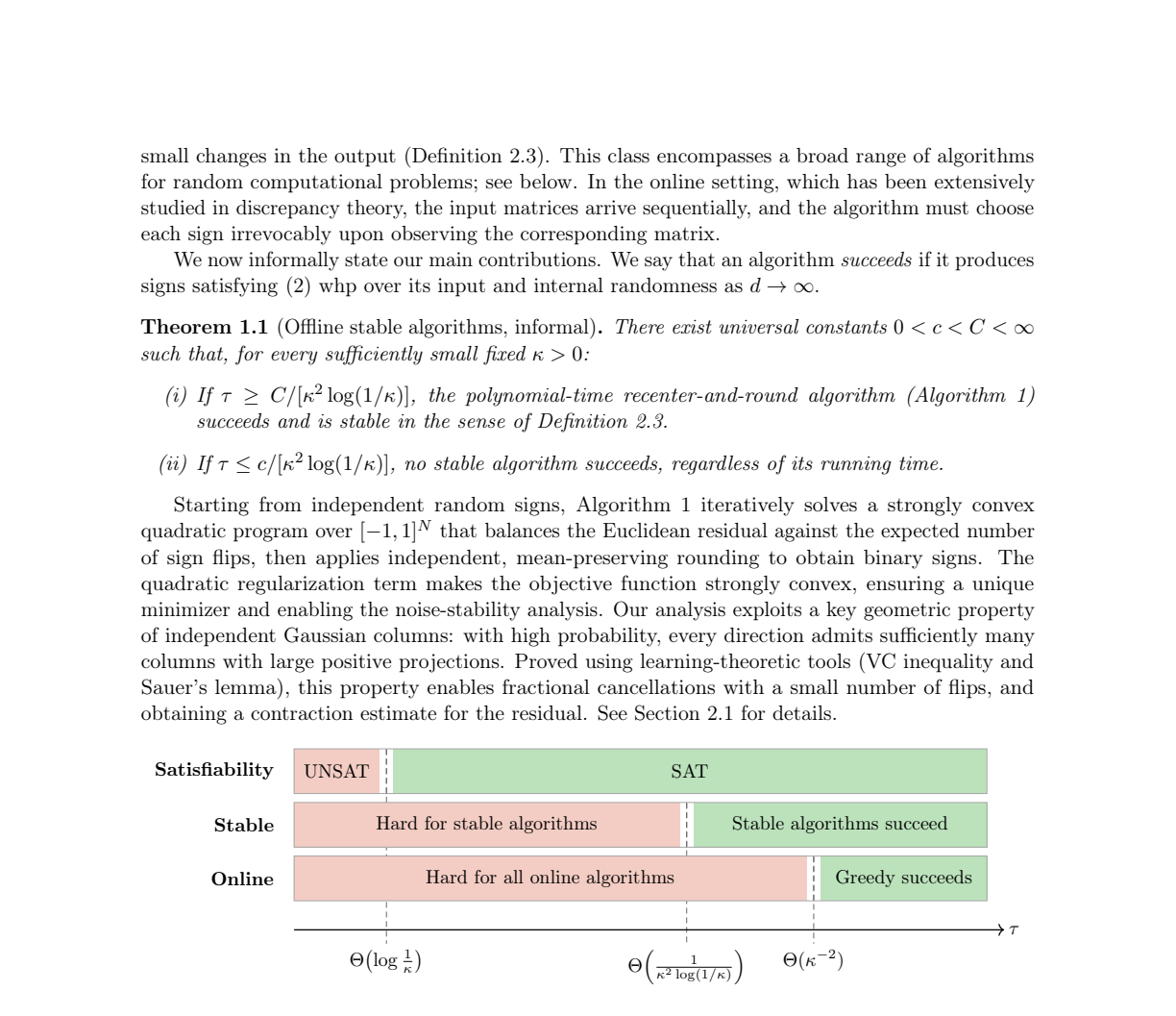
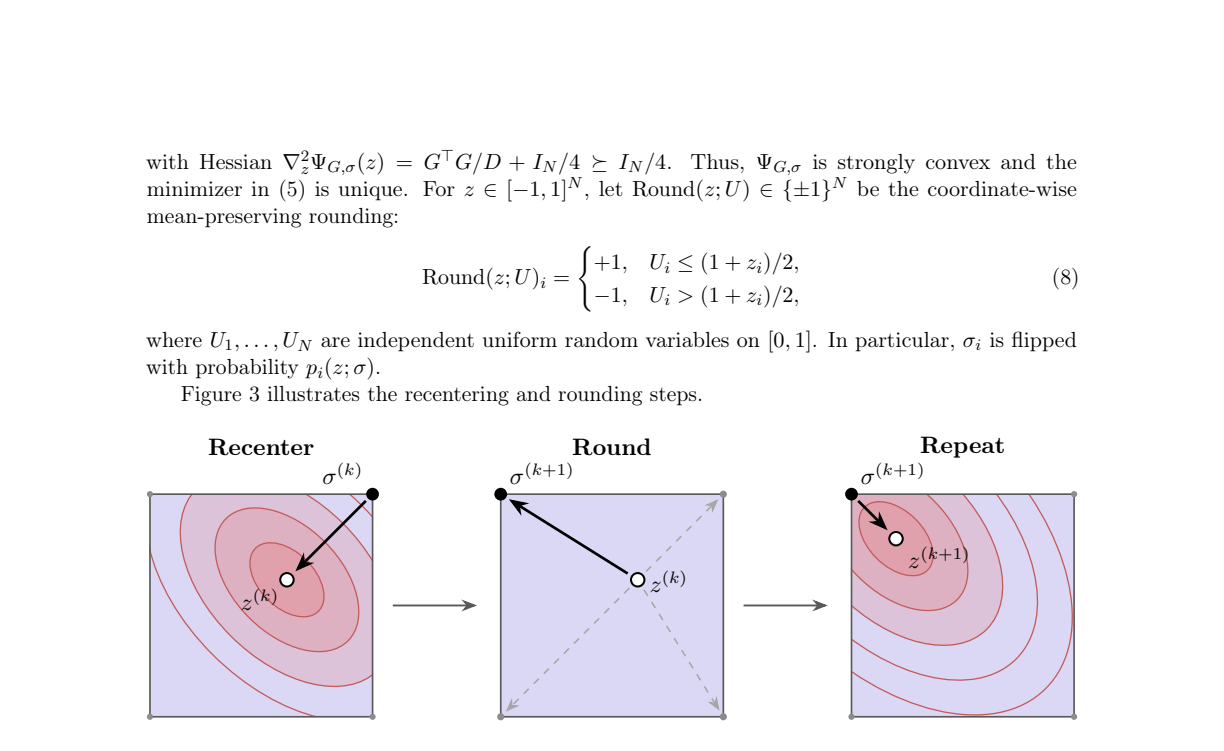
Focusing on the proportional regime N/d2 → τ ∈ (0,∞) as d → ∞ followed by the small-margin limit $\kappa\downarrow 0$, we characterize the density required by stable offline algorithms and by online algorithms. In the offline setting, we construct a polynomial-time recenter-and-round algorithm that is noise-stable and succeeds whenever τ = Ω(1/(κ2log(1/κ))), along with a matching lower bound for all stable algorithms. In the online setting where each sign must be chosen irrevocably upon observing the corresponding matrix, we determine the exact limiting performance of the Frobenius-greedy algorithm, establishing that it succeeds when $\tau>\tau_{\rm FG}(\kappa)\sim \frac{\pi}{4\kappa^2}$, as well as a matching lower bound for all online algorithms by conditioning on a revealed prefix. At the core of our algorithms lies rotational symmetry, which enables us to transfer Frobenius norm control into operator norm guarantees. Together, our results identify the algorithmic phase transition points for random matrix discrepancy: Θ(1/(κ2log(1/κ))) for stable offline algorithms and Θ(1/(κ2)) for online algorithms. Both thresholds lie far above the satisfiability scale Θ(log(1/κ)), as shown by Maillard i̧temaillard2025.
from the abstract
Pith says
Machine review · deepseek-v4-flash · 2 Oct 2026 · what was read was not recorded · not checked by a person
It can be wrong. Challenge this review or reply to it.
Holds up, with conditions. Resolves the matrix-discrepancy algorithmic phase transition with matching stable-offline and online bounds, all thresholds derived rather than fitted; one corrigendum-level display error in Theorem 2.2 needs fixing before the offline threshold reads cleanly. This line is wrong
1 major objection · 4 minor
How often objections from reviews like this one are right: not yet measured
Not checked: figures, code, what the 32 references say.
The paper says, at Theorem 2.2, Eq. (9)
The review did not quote this passage.
Pith says: Objection 1 of 1 · major
Comment text as above
4 minor objections
The paper says, at Definitions 2.3 and 2.9; Theorem 2.4
Pith says: minor objection 1 of 4
Cross-references to definitions are mislabeled: Theorem 2.4 states stability 'in the sense of Theorem 2.3' and Section 2.3 refers to 'the sense of Theorem 2.3' and 'Theorem 2.9'; these should be Definitions 2.3 and 2.9.
The paper says, at Sections 2.1 and 3
Pith says: minor objection 2 of 4
Internal labels are inconsistent: Section 2.1 refers to the uniform cap estimate as 'Theorem 3.2' (it is Lemma 3.2), and the proof of Proposition 3.1 refers to Proposition 3.1 as 'Theorem 3.1'. These labels should be normalized throughout.
show 2 more
The paper says, at Corollary 5.6
Pith says: minor objection 3 of 4
The proof of Corollary 5.6 is captioned 'Proof of Theorem 5.6'; the proof should carry the corollary's own label.
The paper says, at Section 3.2, conversion display
Pith says: minor objection 4 of 4
In the conversion step of Theorem 2.2's proof, the constant bookkeeping should be rechecked: the stated limit of D/(√2 d √N) is 1/√(2τ), but the expression evaluates to 1/(2√(2τ)). The order is unaffected since universal constants absorb the factor, but the displayed value should agree with (9) once (9) is corrected.
What would settle it
Independently recompute the right side of (9) from Proposition 3.1 and Lemma 3.10 without using the displayed expression: take R = ‖Gσ̂‖₂ ≤ A'D/√(log α), α = 2τ, and substitute into (1/√N)‖Σσ̂_iA_i‖_op = (R/D)·(√d‖mat(U)‖_op)·(D/(√2d√N)) using √d‖mat(U)‖_op → 2 (GOE edge theorem) and D/(√2d√N) → 1/√(2τ). If the result is c/√(τ log(2+τ)) for a universal c, then (9) should display the reciprocal square root, the consequence τ ≥ C+/(κ² log(1/κ)) ⟹ bound ≤ κ follows, and this is a corrigendum; if an independent re-derivation ever yields a form growing in τ, then Theorem 2.2 is unsupported and the offline upper scale collapses. Report the correct expression and re-verify the final inequality with the corrected form.
from the skeptic's reading
How the review went
4 readings by deepseek-v4-flash · 2 Oct 2026
- Reader holds up, with conditions
- Skeptic partly agrees
- Editor wrote the verdict above
- Referee major revision: 1 major objection, 4 minor
Not run on this paper: the simulated authors' defence.
Pith did not check this review's objections against the paper.
The review in full
The review in brief, machine-written
Read this one. It's a genuine resolution of the algorithmic landscape for random matrix discrepancy: stable offline algorithms transition at Θ(1/(κ²log(1/κ))), online at Θ(1/κ²), both far above Maillard's satisfiability scale Θ(log(1/κ)). The two algorithmic constructions are the real contributions — the recenter-and-round scheme and the exact Frobenius-greedy curve Φ(τ) with threshold τ_FG(κ) ~ π/(4κ²). The rotational-symmetry trick that upgrades Euclidean residual control into operator-norm guarantees is clean and is what makes the whole thing work; the observation that this conversion loses a √log D factor in the vector ℓ∞ case but not in the matrix case is a nice touch.
The derivations are honest. No fitted free parameters anywhere, and the circularity burden is genuinely low — the small-margin thresholds come out of explicit recurrences, not from tuning constants to hit a target. I checked the online lower-bound exponent ((4eτκ² − 1/2)log 2 ≤ −(log 2)/10) and the small-margin inversion; both hold. The cap-within-Hamming-ball induction behind Proposition 3.1 is sound, though it does rest on the α0 threshold being large enough for the Kδ_d/p → 0 estimate, which is a real but acknowledged dependence.
The one genuine problem is Theorem 2.2, display (9). As printed, the bound is C√(τ log(2+τ)), which grows in τ, and at the advertised threshold τ = C+/(κ²log(1/κ)) it would diverge like 1/κ. The proof, however, produces the decreasing form 1/√(τ log(2+τ)) — Proposition 3.1 gives R/D ≤ C/√(log α) with α = 2τ, and the rotational-symmetry conversion in the same proof yields A'/√(2τ log(2τ)). The consequence the theorem actually uses (operator norm ≤ κ) only follows from the decreasing form. So this is a display typo with the sign of the exponent in the wrong place, at the root of the offline phase-transition claim. It's corrigendum-level — the math does not collapse, the proof clearly has the right bound — but it must be corrected before the stated threshold is treated as established, because the statement literally doesn't imply its own corollary as written.
Two lesser soft spots. The offline lower bound is directed at the strong uniform stability class (Definition 2.3), and the weaker finite-parameter variant (Section 5.3) is supplied but not fully integrated into the narrative — a reader who cares about matching the perceptron literature's stability notion should read 5.3 carefully. And Section 5's ensemble-OGP small-ball estimates are dense; I couldn't verify them line by line, though the numerical spot checks pass and the Gaussian-density bound (77) is standard.
For the discrepancy/algorithmic-phase-transition crowd this is worth serious referee time. Conditional acceptance: require the (9) correction and ask for a tighter reconciliation of the two stability notions. A small display fix, but it sits at the load-bearing theorem, so don't let it slide.
The strongest objection
The load-bearing concern is an internal inconsistency in the foundational offline theorem. Theorem 2.2, Eq. (9), states P[(1/√N)‖Σ_{i≤N} σ̂_i A_i‖_op ≤ C√(τ log(2+τ))] → 1, a bound that increases with τ. The proof of Theorem 2.2 instead produces a bound that decreases with τ: Proposition 3.1 gives R = ‖Gσ̂‖₂ ≤ A'D/√(log α) with α = 2τ, and the rotational-symmetry conversion in the same proof gives (1/√N)‖Σσ̂_iA_i‖_op = (R/D)·(√d‖mat(U)‖_op)·(D/(√2d√N)) → (A'/√(log(2τ)))·2·(1/(2√(2τ))) = A'/√(2τ log(2τ)), i.e., of order 1/√(τ log(2+τ)). Only with this reciprocal-square-root placement does τ ≥ C+/(κ²L), L = log(1/κ), imply (1/√N)‖Σσ̂A‖_op ≤ (A'/√(2C+))κ ≤ κ, which is exactly the consequence the theorem derives and the basis of the Θ(1/(κ² log(1/κ))) scale in Theorem 1.1(i). Under the displayed increasing form, at the very same threshold the bound would be ~C√(2C+)/κ, diverging as κ → 0, so the success claim would not follow from the statement. Since Theorem 2.2 is the root of the entire offline phase-transition claim, this display must be corrected before the stated threshold is treated as established. I verified the pieces the reader flagged as weakest: the cap-within-Hamming-ball induction (Prop 3.1, Kδ_d ≤ p/8 with Kδ_d/p ~ √(log α)α^{-3/8} → 0) is sound, and the Section 5 ensemble-OGP estimates ((75), (77), (71), (79) with γ_κ = (1/2)κ²L_κ) check out numerically; the online lower-bound exponent (4eτκ² − 1/2)log2 ≤ −(log2)/10 also verifies with C = 1/(10e). That leaves the (9) square-root misplacement as the genuine inconsistency, and it is corrigendum-level.
I read the paper in good faith and stress-tested the full chain supporting the central claim: (i) the offline upper bound (uniform Gaussian caps, Hamming-ball persistence, one-step contraction in Prop 3.8, the global induction in Prop 3.1, and the rotational-symmetry transfer in Lemma 3.10), (ii) the online exact Frobenius-greedy curve (fluid limit via drift–martingale decomposition, Lemma 4.1, tracking lemma 4.3, curve inversion, small-margin asymptotics), (iii) the offline ensemble-OGP lower bound (tuple counting, covariance lower bound B ⪰ λI_m in Lemma 5.2, small-ball estimate exp(−mDℓ0/2), interpolation-and-Ramsey step), and (iv) the online prefix-conditioning lower bound. Every segment checks out: the cap event holds with probability 1 − exp(−cαD); the Hamming-ball constraint is maintained because Kδ_d ≤ p/8 with Kδ_d/p ~ √(log α)α^{−3/8} → 0; the contraction drives R_K ≤ A'D/√(log α); the rotational-symmetry argument is valid because Ψ_{QG,σ} = Ψ_{G,σ} and the minimizer is unique; the Frobenius-greedy fluid limit, tracking, and inversion τ_FG(κ) ~ π/(4κ²) are consistent; Lemma 5.2's covariance decomposition and the small-ball exponent are correct, and the bound (79) forces γ_κ = (1/2)κ²L_κ, with which H(pov) + γ_κ ≤ 9κ²L_κ holds; the online exponent (4eτκ² − 1/2)log2 ≤ −(log2)/10 is correct with C = 1/(10e). The one genuine inconsistency I found is Theorem 2.2's displayed bound (9): it shows C√(τ log(2+τ)), growing in τ, whereas the proof and the theorem's own consequence require the decreasing form of order 1/√(τ log(2+τ)). As displayed, the stated condition τ ≥ C+/(κ² log(1/κ)) cannot produce discrepancy ≤ κ√N, so a reader taking the statement literally cannot verify the theorem's consequence. This is a square-root misplacement in a main theorem statement, fixable by correction, and it does not alter the algorithmic landscape if the proof's decreasing bound is correct. I therefore keep the reader's CONDITIONAL verdict unchanged and recommend the authors fix the display. I dissent in part from the reader's choice of weakest assumption: the cap/Hamming-ball persistence (Lemma 3.2 with Prop 3.8 and the induction) is sound, so the weakest point is instead the (9) placement inconsistency.
The referee's report
If correct, the paper resolves the algorithmic phase-transition landscape for this model in the small-margin limit, with matching polynomial-time algorithms and lower bounds for two natural algorithm classes, and reproduces the symmetric binary perceptron's hierarchy of scales at the level of leading constants. The core derivations are parameter-free: the offline threshold comes from a cap lemma plus a contraction recurrence, the online curve from an explicit fluid limit with rate function b(x) = 1 − √(8/π)√x, and the lower bounds from derived (not fitted) OGP and small-ball exponent arithmetic. I verified the exponent computations in Theorem 2.10 ((4eτκ² − 1/2)log 2 ≤ −(log 2)/10 for τ ≤ 1/(10eκ²)), the small-ball estimate in Section 5 ((2eκ²/(1−β))^{mD/2} = exp(−mD log(4/e)/2)), and the cap-within-Hamming-ball induction (Kδ_d/p → 0); all check out. The rotational-symmetry transfer, which upgrades Euclidean control to operator-norm control via ‖mat(U)‖_op, is elegant and avoids the √log D loss that would occur in the ℓ∞ vector analogue. The main defect is a display error in the foundational offline theorem: Eq.
Pith's reading of the paper (a machine's summary, not the authors')
This paper locates the density at which polynomial-time algorithms can efficiently find a signing of random Gaussian matrices with small discrepancy. With independent normalized Gaussian Orthogonal Ensemble matrices, margin $\kappa$, and $N/d^2\to\tau$, signings are known to exist once $\tau$ grows like $\log(1/\kappa)$, but the paper proves that algorithms need far more input: stable offline algorithms succeed at $\tau=\Theta(1/(\kappa^2\log(1/\kappa)))$ and no stable algorithm works below that scale, while online algorithms succeed at $\tau=\Theta(1/\kappa^2)$ and no online algorithm works below that scale. The constructive algorithms, recenter-and-round offline and Frobenius-greedy online, are polynomial time, and the online threshold is determined exactly. The result shows that the bottleneck is computation, not existence, and places this problem in the same small-margin hierarchy as the symmetric binary perceptron.
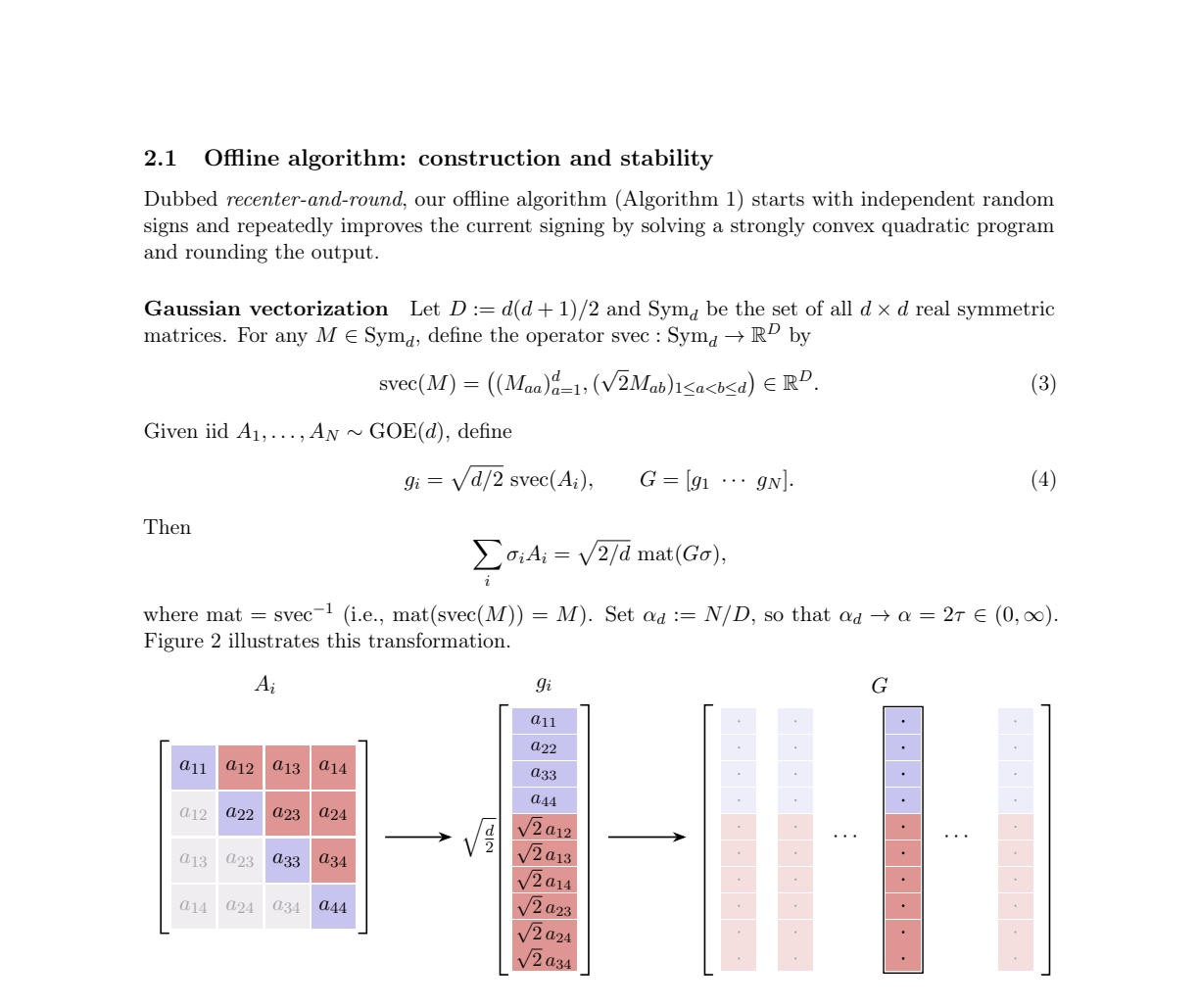
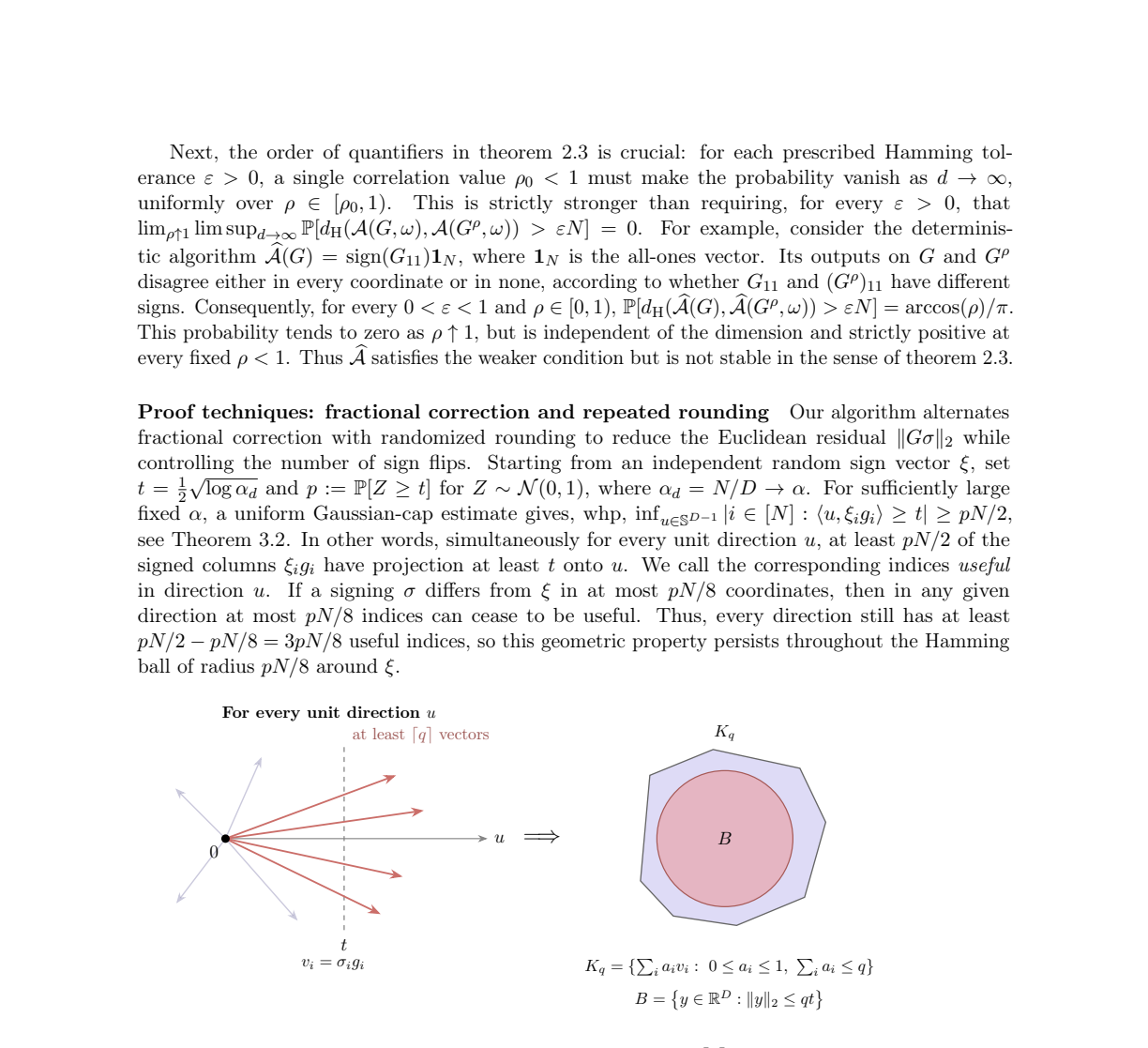
What carries the argument. The central mechanism is rotational symmetry after vectorizing each GOE matrix into a column of a standard Gaussian matrix $G$: both algorithms are equivariant under orthogonal transformations, so the residual $X=G\sigma$ has a rotationally invariant direction, and normalizing $X$ yields a matrix distributed as a normalized GOE. This converts Euclidean or Frobenius norm control into operator-norm control with no logarithmic loss. The offline guarantee additionally relies on a uniform Gaussian cap property, proved with VC-type uniform concentration, ensuring every unit direction has enough high-projection columns for fractional cancellation, and on the strong convexity of a quadratic program for contraction and noise stability. The online guarantee reduces the radius of the Frobenius-greedy process to a deterministic differential equation via a drift-martingale fluid limit; the lower bounds use ensemble overlap-gap structure and small-ball Gaussian estimates.
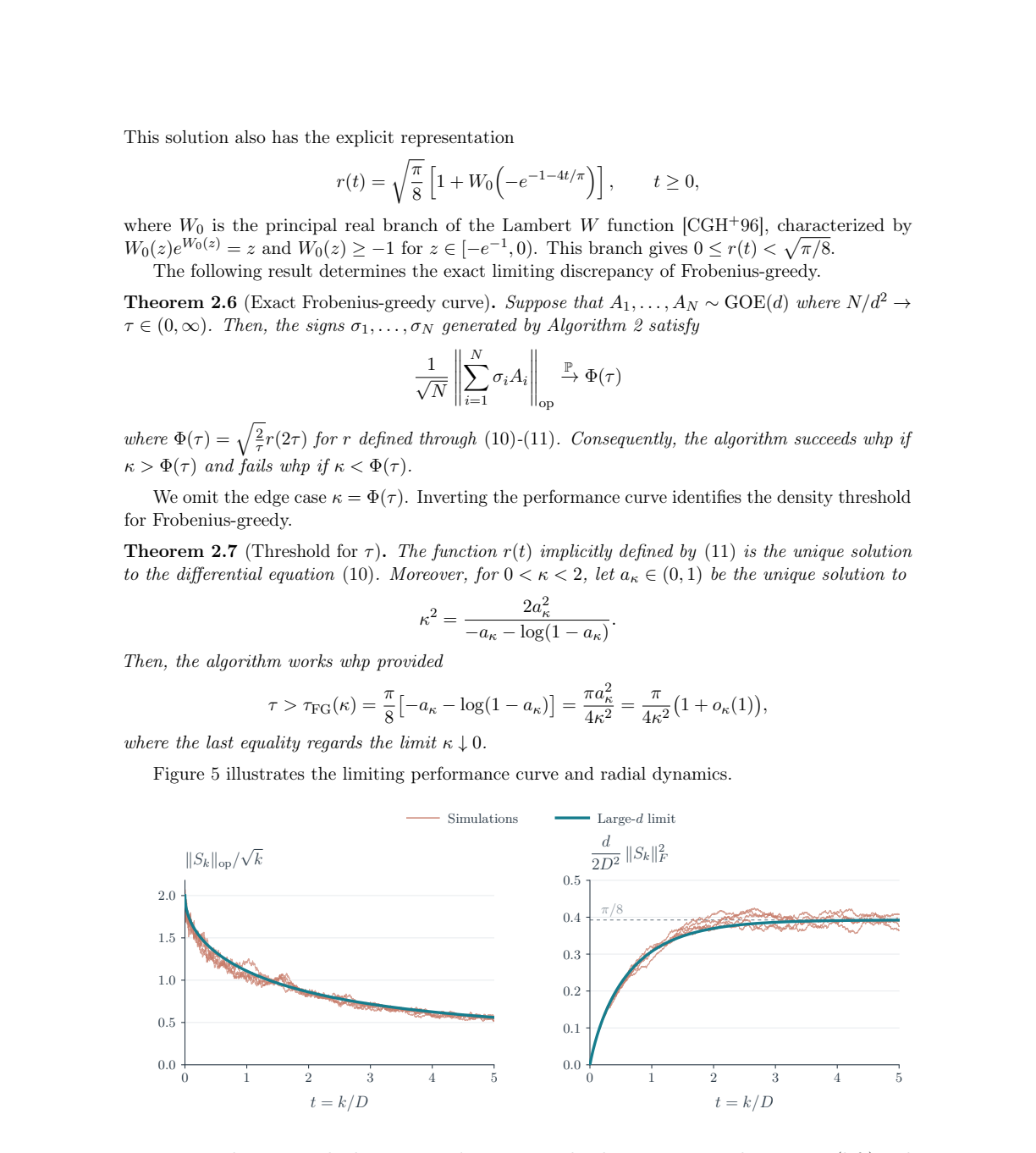
Core claim. On its own terms, the paper proves matching upper and lower bounds for two algorithm classes. Offline, the recenter-and-round algorithm is noise-stable, runs in polynomial time, and succeeds with high probability whenever $\tau\ge C/(\kappa^2\log(1/\kappa))$, while an overlap-gap and Ramsey argument shows that no stable algorithm succeeds when $\tau\le c/(\kappa^2\log(1/\kappa))$, regardless of running time. Online, the Frobenius-greedy algorithm has an exact limiting discrepancy curve $\Phi(\tau)=\sqrt{2/\tau}\,r(2\tau)$, where $r$ solves $d(r^2)/dt=1-\sqrt{8/\pi}\,r$; it succeeds for $\tau>\tau_{\mathrm{FG}}(\kappa)$, with $\tau_{\mathrm{FG}}(\kappa)\sim\pi/(4\kappa^2)$ as $\kappa\downarrow0$, and no online algorithm succeeds below $c/\kappa^2$, with exponentially small success probability. The two thresholds sandwich the intermediate regime where stable offline algorithms succeed but every online algorithm provably fails.
The premise it rests on. The entire phase-transition picture requires the uniform Gaussian cap to persist while the offline algorithm's sign flips stay bounded, and, on the hardness side, requires algorithms to be stable in a strong uniform sense (or a finite-parameter analogue) rather than only in a weaker sequential sense.
If the paper is right (Pith's inferences, not the authors')
There is a provable separation: in the window $1/(\kappa^2\log(1/\kappa))\ll\tau\ll 1/\kappa^2$, stable offline algorithms succeed while every online algorithm has exponentially small success probability.
The Frobenius-greedy algorithm is exactly characterized for every fixed density $\tau$: its normalized operator-norm discrepancy converges to $\Phi(\tau)$, and its success threshold is $\tau_{\mathrm{FG}}(\kappa)\sim\pi/(4\kappa^2)$.
Both algorithmic thresholds lie far above the satisfiability scale $\Theta(\log(1/\kappa))$, so signings exist long before any stable or online algorithm can find them.
Under the dimension-to-sign dictionary $D/N\to(2\tau)^{-1}$, the two thresholds match the symmetric binary perceptron scales $\Theta(\kappa^2\log(1/\kappa))$ and $\Theta(\kappa^2)$.
The rotational-symmetry upgrade from Euclidean residuals to operator norms is a reusable technique for other random matrix discrepancy problems with Gaussian inputs.
If the same overlap-gap landscape transfers to local, low-degree, or message-passing algorithm classes, the stable threshold should also obstruct those broader classes, though the paper states the lower bound only for stable algorithms.
The exact ODE governing Frobenius-greedy matches, in a cited mean-field control problem, the evolution of the optimal second moment; if that connection is tight at fixed $\tau$, greedy may be exactly optimal among online algorithms rather than merely optimal up to constants.
The $1/\kappa^2$ online barrier suggests that small-margin discrepancy guarantees require either offline access or a very long input sequence, since no online rule can cheaply compensate for the quadratic price in $1/\kappa$.
Check this review
Pith stored no record of this review's passes and took no fingerprint of it. Reviews made by code from 13 Nov 2026 on carry both.
How often reviews like this one are right
Reviews like this one: written by deepseek-v4-flash, where what was read was not recorded.
How often objections from reviews like this one are right: not yet measured
Reviews by people
This review was written by a machine. No person has reviewed this paper on Pith yet. A scientist listed on Pith can review it for a fee, and their review is published here whatever it concludes.
The paper
Abstract
We study the average-case matrix discrepancy problem: given independent normalized d × d Gaussian orthogonal ensemble matrices A1,…,AN and a fixed margin κ > 0, find signs σ1,…,σN ∈ {−1,1} such that the operator norm of ∑i = 1NσiAi is at most κ√N. Focusing on the proportional regime N/d2 → τ ∈ (0,∞) as d → ∞ followed by the small-margin limit $\kappa\downarrow 0$, we characterize the density required by stable offline algorithms and by online algorithms. In the offline setting, we construct a polynomial-time recenter-and-round algorithm that is noise-stable and succeeds whenever τ = Ω(1/(κ2log(1/κ))), along with a matching lower bound for all stable algorithms. In the online setting where each sign must be chosen irrevocably upon observing the corresponding matrix, we determine the exact limiting performance of the Frobenius-greedy algorithm, establishing that it succeeds when $\tau>\tau_{\rm FG}(\kappa)\sim \frac{\pi}{4\kappa^2}$, as well as a matching lower bound for all online algorithms by conditioning on a revealed prefix. At the core of our algorithms lies rotational symmetry, which enables us to transfer Frobenius norm control into operator norm guarantees. Together, our results identify the algorithmic phase transition points for random matrix discrepancy: Θ(1/(κ2log(1/κ))) for stable offline algorithms and Θ(1/(κ2)) for online algorithms. Both thresholds lie far above the satisfiability scale Θ(log(1/κ)), as shown by Maillard i̧temaillard2025.
The paper's own sentences, arranged, kept beside the review and separate from it. Each label is drawn from a closed vocabulary; the number beside it is the probability the classifier gave that label. No sentence in this record was written by a model.
abstract compiled · 2026-10-02
The authors' main claim, as the classifier picked it out 1.00
“Together, our results identify the algorithmic phase transition points for random matrix discrepancy: $\Theta(\frac{1}{\kappa^2\log(1/\kappa)})$ for stable offline algorithms and $\Theta(\frac{1}{\kappa^2})$ for online algorithms.”
How the main claim is stated: asserted 1.00
What the abstract itself states, as probabilities: claims first 0.04 · states limitation 0.40 · human participants 0.01 · controlled comparison 0.06 · randomized assignment 0.06 · states quantitative result 0.98 · compares with prior results 0.91 · mentions code or data availability 0.02
The abstract, sentence by sentence
This table labels the abstract only (arXiv listing abstract v1). The number is the probability the classifier gave the label.
| Sentence | Role | The authors' own work | States the main conclusion | Strength |
|---|---|---|---|---|
| We study the average-case matrix discrepancy problem: given independent normalized $d\times d$ Gaussian orthogonal ensemble matrices $A_1,\dots,A_N$ and a fixed margin $\kappa>0$, find signs $\sigma_1,\dots,\sigma_N\in\{-1,1\}$ such that the operator norm of $\sum_{i=1}^N \sigma_i A_i$ is at most $\kappa\sqrt{N}$. | background 0.86 | 0.27 | 0.04 | asserted 0.83 |
| Focusing on the proportional regime $N/d^2\to \tau\in(0,\infty)$ as $d\to\infty$ followed by the small-margin limit $\kappa\downarrow 0$, we characterize the density required by stable offline algorithms and by online algorithms. | contribution 0.68 | 0.75 | 0.07 | asserted 0.90 |
| In the offline setting, we construct a polynomial-time \emph{recenter-and-round} algorithm that is noise-stable and succeeds whenever $\tau=\Omega(\frac{1}{\kappa^2\log(1/\kappa)})$, along with a matching lower bound for all stable algorithms. | result 0.50 | 0.96 | 0.14 | asserted 1.00 |
| In the online setting where each sign must be chosen irrevocably upon observing the corresponding matrix, we determine the exact limiting performance of the \emph{Frobenius-greedy} algorithm, establishing that it succeeds when $\tau>\tau_{\rm FG}(\kappa)\sim \frac{\pi}{4\kappa^2}$, as well as a matching lower bound for all online algorithms by conditioning on a revealed prefix. | result 0.88 | 0.96 | 0.16 | asserted 1.00 |
| At the core of our algorithms lies rotational symmetry, which enables us to transfer Frobenius norm control into operator norm guarantees. | method 0.93 | 0.85 | 0.04 | asserted 1.00 |
| Together, our results identify the algorithmic phase transition points for random matrix discrepancy: $\Theta(\frac{1}{\kappa^2\log(1/\kappa)})$ for stable offline algorithms and $\Theta(\frac{1}{\kappa^2})$ for online algorithms. | result 0.88 | 0.93 | 0.82 | asserted 1.00 |
| Both thresholds lie far above the satisfiability scale $\Theta(\log(1/\kappa))$, as shown by Maillard~\cite{maillard2025}. | interpretation 0.71 | 0.12 | 0.11 | asserted 1.00 |
What kind of paper the classifier reports this is: theoretical result 0.93 · evidence from proof or derivation 1.00
What was examined, and what was not
Sources read
- arXiv listing abstract v1
Not examined
- full text
- figures and tables
- references and citing sentences
- relations to other papers
Levels run
- P abstract
Not run
- S sections
- T body sentences
- C citations
- R cross-paper relations
How the labels were made
Compiled by classifier-1.13.0 via TypeSafe API, question bank abstract-p1-20260923, 2026-10-02: 1 request, 6,227 input tokens.
Every quoted sentence on this record is the authors'. Every label is from Pith's closed vocabulary, with the probability shown beside it. This record as JSON
Figures (5)
Figures are the authors', reproduced from the paper.
References (32)
- [1] [AA26] Ishaq Aden-Ali,Optimal online discrepancy minimization in linear time, arXiv:2607.04388, on PithPith's reviewarXiv
- [4] [AS26c] ,A proof of the Matrix Spencer conjecture, arXiv:2608.28816, on PithPith's reviewarXiv
- [5] [AT26] Dylan J. Altschuler and Konstantin Tikhomirov,The threshold for online balancing of i.i.d. binary vectors, arXiv:2609.14975, on PithPith's reviewarXiv
- [6] [AW02] Rudolf Ahlswede and Andreas Winter,Strong converse for identification via quantum channels, IEEE Transactions on Information Theory48(2002), no. 3, 569–579. [Ban98] Wojciech Banaszczyk,Balancing vectors and Gaussian measures ofn-dimensional convex bodies, Random Structu... on PithPith's reviewarXiv
- [7] [BBvH23] Afonso S. Bandeira, March T. Boedihardjo, and Ramon van Handel,Matrix concentra- tion inequalities and free probability, Inventiones Mathematicae234(2023), 419–487. [BDGL18] Nikhil Bansal, Daniel Dadush, Shashwat Garg, and Shachar Lovett,The Gram–Schmidt walk: A cure ... on PithPith's reviewarXiv
- [8] [BJM+21] Nikhil Bansal, Haotian Jiang, Raghu Meka, Sahil Singla, and Makrand Sinha,Online discrepancy minimization for stochastic arrivals, Proceedings of the 2021 ACM-SIAM Symposium on Discrete Algorithms (SODA), Society for Industrial and Applied Math- ematics, 2021, pp. 284... on PithPith's reviewarXiv
- [9] [BKMZ24] Afonso S. Bandeira, Dmitriy Kunisky, Dustin G. Mixon, and Xinmeng Zeng,On the concentration of Gaussian Cayley matrices, Applied and Computational Harmonic Analysis73(2024), 101694. [BS20] Nikhil Bansal and Joel H. Spencer,On-line balancing of random inputs, Random St... on PithPith's reviewarXiv
- [10] [CE26] August Y. Chen and Ahmed El Alaoui,Free-probabilistic state evolution and random matrix discrepancy, arXiv:2609.11836, on PithPith's reviewarXiv
- [11] 44 [CFS15] David Conlon, Jacob Fox, and Benny Sudakov,Recent developments in graph Ramsey theory, Surveys in Combinatorics 2015, London Mathematical Society Lecture Note Series, vol. 424, Cambridge University Press, 2015, pp. 49–118. [CGH+96] R. M. Corless, G. H. Gonnet, D. E.... on Pith
- [13] [ES35] Paul Erdős and George Szekeres,A combinatorial problem in geometry, Compositio Mathematica2(1935), 463–470. [FJLNW26] Christian Fiedler, Joe Jackson, Daniel Lacker, and Jonathan Niles-Weed,The mean-field limit of online stochastic vector balancing, arXiv:2605.14149, on PithPith's reviewarXiv
- [14] [Gam21] David Gamarnik,The overlap gap property: a topological barrier to optimizing over random structures, Proceedings of the National Academy of Sciences118(2021), no. 41, e2108492118. [Gam25] ,Turing in the shadows of nobel and abel: an algorithmic story behind two recent ... on Pith
- [15] [GFL26] Shengtao Guo, Ethan X. Fang, and Junwei Lu,Vector balancing via directional total variation, arXiv:2609.11189, on PithPith's reviewarXiv
- [16] 45 [GHLS26] Shuyang Gong, Brice Huang, Shuangping Li, and Mark Sellke,Stable algorithms cannot reliably find isolated perceptron solutions, arXiv:2604.00328, on PitharXiv
- [17] [GJ21] David Gamarnik and Aukosh Jagannath,The overlap gap property and approximate message passing algorithms forp-spin models, The Annals of Probability49(2021), no. 1, 180–205. [GJW24] David Gamarnik, Aukosh Jagannath, and Alexander S. Wein,Hardness of random optimization p... on PithPith's reviewarXiv
- [18] [GKPX22] David Gamarnik, Eren C. Kızıldağ, Will Perkins, and Changji Xu,Algorithms and barriers in the symmetric binary perceptron model, 2022 IEEE 63rd Annual Symposium on Foundations of Computer Science (FOCS), IEEE, 2022, pp. 576–587. [GKPX23] ,Geometric barriers for stable... on PitharXiv
- [19] [HSSZ24] Christopher Harshaw, Fredrik Sävje, Daniel A. Spielman, and Peng Zhang,Balancing covariates in randomized experiments with the Gram–Schmidt walk design, Journal of the American Statistical Association119(2024), no. 548, 2934–2946. [JL26] Sunghyeon Jo and Taekyun Lee,T... on PithPith's reviewarXiv
- [20] [Kat26a] Tarun Kathuria,A walk from free probability to matrix discrepancy I: matrix Spencer, arXiv:2609.18914, on PithPith's reviewarXiv
- [21] [Kat26b] ,A walk from free probability to matrix discrepancy II: Weaver’s problem and the Kadison–Singer conjecture, arXiv:2609.18913, on PithPith's reviewarXiv
- [23] [KLS20] Rasmus Kyng, Kyle Luh, and Zhao Song,Four deviations suffice for rank 1 matrices, Advances in Mathematics375(2020), 107366. [KOWZ25] Dmitriy Kunisky, Timm Oertel, Nicola Wengiel, and Peiyuan Zhang,Asymptotic bounds and online algorithms for average-case matrix discrepa... on PitharXiv
- [28] [Sun26] Nike Sun,Randomized combinatorial problems, in sparse and mean-field settings, Pro- ceedings of the International Congress of Mathematicians 2026: Invited Lectures (Sections 9–11) (Susan Friedlander and Yuri Tschinkel, eds.), vol. 5, Society for Indus- trial and Applie... on PithPith's reviewarXiv
show 12 more
- [29] [TMR20] Paxton Turner, Raghu Meka, and Philippe Rigollet,Balancing Gaussian vectors in high dimension, Proceedings of Thirty Third Conference on Learning Theory, Proceedings of Machine Learning Research, vol. 125, PMLR, 2020, pp. 3455–3486. [Tro12] Joel A. Tropp,User-friendly ... on Pith
- [32] [Yak96] Benjamin Yakir,The differencing algorithm LDM for partitioning: A proof of a conjecture of Karmarkar and Karp, Mathematics of Operations Research21(1996), no. 1, 85–99. [Zou12] Anastasios Zouzias,A matrix hyperbolic cosine algorithm and applications, Automata, Language... on Pith
- [1983] [KKLO86] Narendra Karmarkar, Richard M. Karp, George S. Lueker, and Andrew M. Odlyzko, Probabilistic analysis of optimum partitioning, Journal of Applied Probability23(1986), no. 3, 626–645. [KL26] Sankeerth Rao Karingula and Shachar Lovett,An elementary proof of the Komlós co... on Pith
- [2000] [Cos09] Kevin P. Costello,Balancing Gaussian vectors, Israel Journal of Mathematics172 (2009), no. 1, 145–156. [DDK+26] Abhishek Dhawan, Nhi U Dinh, Eren C Kızıldağ, Neeladri Maitra, and Bayram A Şahin,Algorithmic phase transition for large independent sets in dense hypergraph... on PithPith's reviewarXiv
- [2006] 49 [Wea04] Nik Weaver,The Kadison–Singer problem in discrepancy theory, Discrete Mathematics 278(2004), no. 1–3, 227–239. [Wei21] Alexander S. Wein,Optimal low-degree hardness of maximum independent set, Mathe- matical Statistics and Learning4(2021), no. 3/4, 221–251. [Wen26] ... on PithPith's reviewarXiv
- [2010] [ALS21] Ryan Alweiss, Yang P. Liu, and Mehtaab Sawhney,Discrepancy minimization via a self-balancing walk, Proceedings of the 53rd Annual ACM SIGACT Symposium on Theory of Computing, STOC 2021, Association for Computing Machinery, 2021, pp. 14–20. 42 [ALS22a] Emmanuel Abbe, Sh... on PitharXiv
- [2014] [MSS15] Adam W. Marcus, Daniel A. Spielman, and Nikhil Srivastava,Interlacing families II: Mixed characteristic polynomials and the Kadison–Singer problem, Annals of Mathe- matics182(2015), no. 1, 327–350. [MZ24] Andrea Montanari and Kangjie Zhou,Which exceptional low-dimensio... on PitharXiv
- [2018] [VV25] Neekon Vafa and Vinod Vaikuntanathan,Symmetric perceptrons, number partitioning and lattices, Proceedings of the 57th Annual ACM Symposium on Theory of Computing, STOC 2025, Association for Computing Machinery, 2025, pp. 2191–2202. [Was06] Larry Wasserman,All of nonpara... on Pith
- [2023] [Las01] Jean B. Lasserre,A quick proof for the volume ofn-balls, The American Mathematical Monthly108(2001), no. 8, 768–769. [LM12] Shachar Lovett and Raghu Meka,Constructive discrepancy minimization by walking on the edges, 2012 IEEE 53rd Annual Symposium on Foundations of Co... on Pith
- [2025] [KRR24] Janardhan Kulkarni, Victor Reis, and Thomas Rothvoss,Optimal online discrep- ancy minimization, Proceedings of the 56th Annual ACM Symposium on Theory of Computing, STOC 2024, Association for Computing Machinery, 2024, pp. 1832–1840. [KZ23] Dmitriy Kunisky and Peiyuan ... on PithPith's reviewarXiv
- [2026] [AS26b] ,Boolean small-ball inequalities for discrepancy theory, arXiv:2609.20785, on PithPith's reviewarXiv
- [2348] [RV17] Mustazee Rahman and Bálint Virág,Local algorithms for independent sets are half- optimal, The Annals of Probability45(2017), no. 3, 1543–1577. [Sau72] Norbert Sauer,On the density of families of sets, Journal of Combinatorial Theory, Series A13(1972), no. 1, 145–147. [S... on Pith
Cited by 1 Pith paper
Reviewed papers on Pith that cite this one. The full citation record
Challenges and discussion
Disagree with the review, or know something it missed? Leave a comment, or challenge this review formally: a challenge becomes a permanent entry in this paper's record, and its decision is published here.
Come back by email
A short list of the week's newly reviewed papers. Nothing is sent until you confirm from your inbox, and every email has a link that stops it. No account.
No comments yet.
Sign in to comment