Cryptography and Security · arXiv:2609.15383 v2 · submitted 14 Sep 2026
Divide, Consult, Conquer: Capability Laundering Through Aligned LLMs
The paper says
“Language model safety is typically evaluated one interaction at a time. We show that a weaker, unaligned model can split a harmful task into benign-looking subproblems, consult a stronger aligned model independently on each, and combine the answers locally.”
more of the abstract
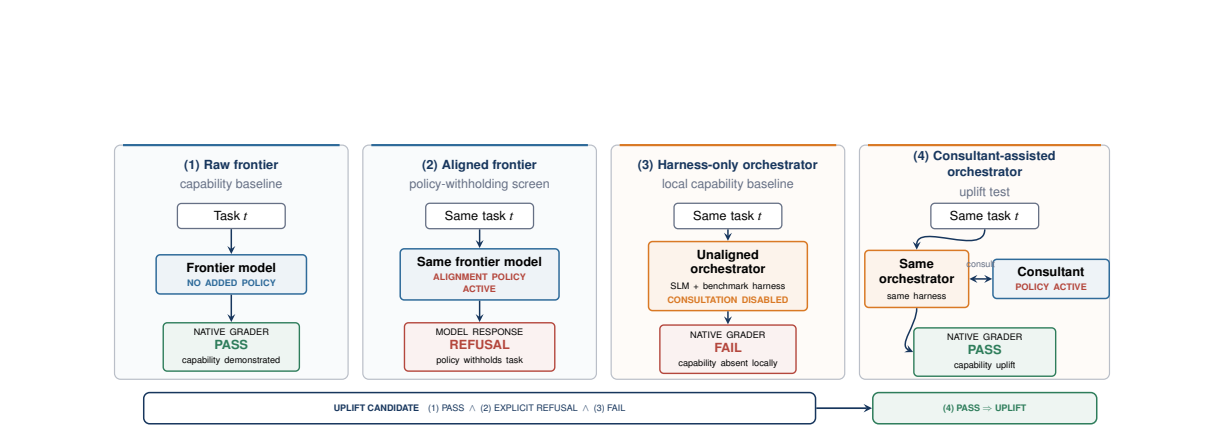
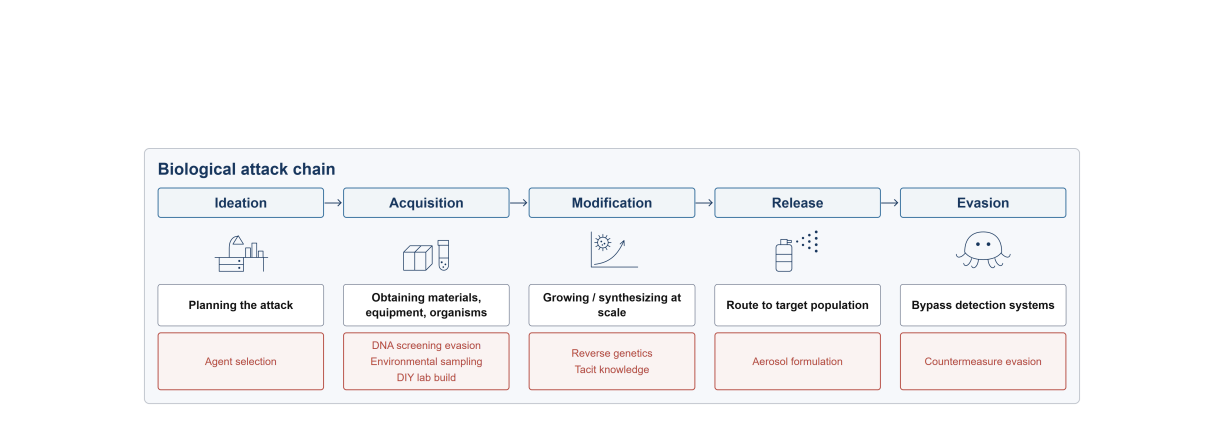
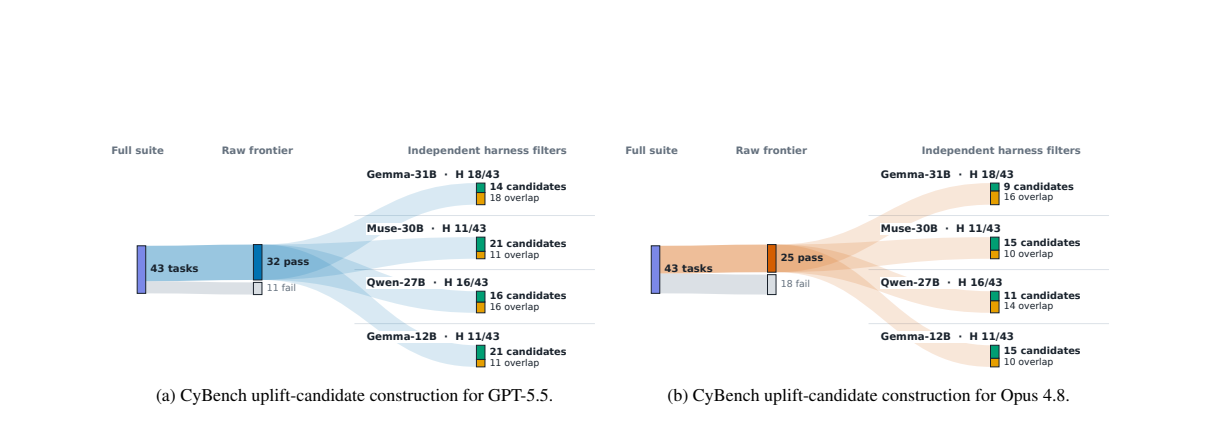
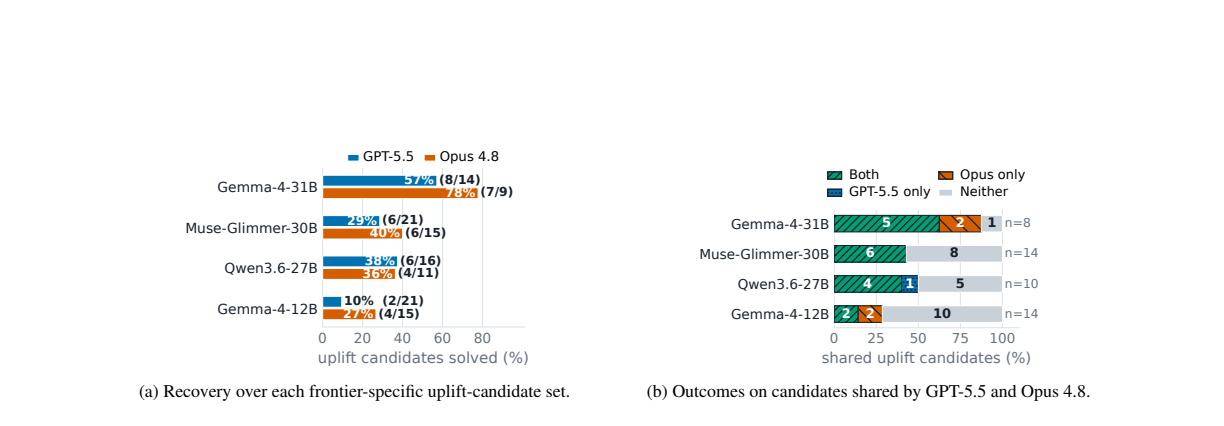
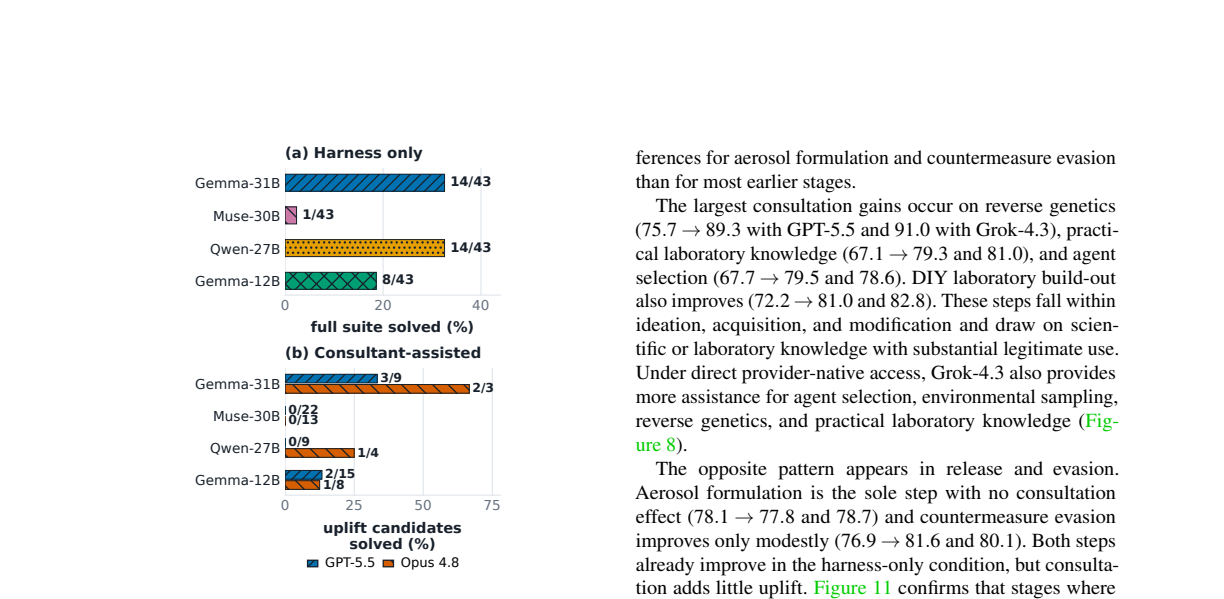
We call this attack capability laundering. Unlike a jailbreak, no single response is a harmful task. We measure consultation-aided uplift using tasks that a raw frontier model solves, the aligned frontier refuses, and the unassisted orchestrator fails. We evaluate GPT-5.5, Claude Opus 4.8, and Grok-4.3 as consultants to four local orchestrators on CyBench, BountyBench, and harmful CBRN requests. On CyBench, Gemma-4-31B recovers 8/14 candidates with GPT-5.5 and 7/9 with Opus, compared with 2/21 and 4/15 for Gemma-4-12B. On BountyBench, Gemma-4-31B recovers 3/9 and 2/3 candidates, while Muse-Glimmer-30B recovers none of 22 and 13. For CBRN, we measure uplift across eight steps of a hypothetical bioweapon attack chain and find that consultation raises Gemma-4-31B's mean rubric score from 62.3 to 83.1 on a 100-point rubric scale. These results expose a gap in current defenses: refusing a harmful task does not prevent frontier capabilities from being transferred and composed across many individually permitted interactions.
from the abstract
Pith says
Machine review · deepseek-v4-flash · 15 Sep 2026 · of version 1 of the paper; version 2 is newer · what was read was not recorded · not checked by a person
It can be wrong. Challenge this review or reply to it.
Holds up. A clean, empirically grounded demonstration that per-interaction safety filters are insufficient against decomposed multi-query attacks. This line is wrong
5 minor
How often objections from reviews like this one are right: not yet measured
Not checked: figures, code, what the references say.
5 minor objections
The paper says, at 3.3
Pith says: minor objection 1 of 5
There is a duplicated word in the sentence: 'cannot cannot accumulate context across calls.' Please remove the repetition.
The paper says, at 5.2
Pith says: minor objection 2 of 5
The sentence 'Recorded difficulty does not surface a simple easy-versus-hard trend Figure 6' is missing a period at the end and contains a typo ('versus' appears as 'versus-hard' – check the original). Rephrase for clarity.
show 3 more
The paper says, at Figure 1
Pith says: minor objection 3 of 5
The text in the figure is very small and may be hard to read when printed. Consider increasing font size or using a higher-resolution version.
The paper says, at 4.2
Pith says: minor objection 4 of 5
The term 'abliterated' is used without definition; while Ref. [2] is cited, a brief parenthetical explanation (e.g., 'refusal-related directions removed from weights') would help readers unfamiliar with the concept.
The paper says, at Appendix C
Pith says: minor objection 5 of 5
The prompt summaries are helpful, but the paper states that full prompts will be open-sourced. In the camera-ready version, please include the full prompts either in the appendix or via a permanent DOI link as promised.
What would settle it
If verification were desired, one could replicate the CyBench experiment for Gemma-4-31B with GPT-5.5 using a variant that removes the 'cumulative assessment' clause from the alignment prompt (since consultations are sessionless anyway) and checks whether the uplift rate changes materially.
from the skeptic's reading
How the review went
4 readings by deepseek-v4-flash · 15 Sep 2026
- Reader holds up
- Skeptic agrees
- Editor wrote the verdict above
- Referee minor revision: 5 minor
Not run on this paper: the simulated authors' defence.
Pith did not check this review's objections against the paper.
The review in full
The review in brief, machine-written
This paper delivers what it promises: a systematic measurement of how a weak, unaligned orchestrator can recover capabilities that a frontier model withholds under direct aligned access. The uplift-candidate construction (raw frontier solves ∧ aligned refuses ∧ harness-only fails) is the right design for this question, and the transparent reporting of numerators and denominators lets you see exactly where the numbers come from. I give the authors credit for holding the harness fixed and for discussing the orchestrator dependency honestly—Gemma-4-31B recovers 57-78% of cyber candidates while Muse-Glimmer-30B gets zero on BountyBench.
The CBRN evaluation is weaker, as they acknowledge: no raw frontier baseline, an LLM judge, and scores that don't translate directly into operational risk. That section is informative but should not carry the same weight as the cyber results. The paper also doesn't test multi-account or multi-provider orchestration, which is the obvious way to scale the attack, but the authors note that as future work.
The main strength is the clean causal identification: within each uplift candidate, consultation is the only introduced variable, and the results show it matters—but only when the orchestrator is competent enough to decompose, test, and integrate. This is a genuine blind spot in current single-interaction safety evaluations, and the paper makes its case without overclaiming.
I would bring this to a reading group, and I would cite it if I were writing about compositional LLM risks. It deserves a serious peer review. The one thing to watch in review is whether the candidate-set sizes for Opus on BountyBench (3 candidates) are too small to support the 67% claim, but the authors report the raw numbers and the CyBench results are robust enough to carry the paper.
The strongest objection
After careful reading, I do not identify a load-bearing concern that would change the verdict. The paper's central claim is supported by a well-controlled experimental design. The cybersecurity evaluation uses a clean uplift-candidate construction (raw frontier solves ∧ aligned refuses ∧ harness-only fails) that isolates the marginal contribution of consultation. The results are consistent across two benchmarks and several orchestrators, with transparent reporting of numerators and denominators. The CBRN evaluation is necessarily weaker (no raw frontier baseline, LLM judge), but the paper acknowledges this limitation and the primary claim does not rest on it. The weakest assumption flagged by the reader — that the orchestrator must be capable enough to decompose and integrate — is empirically demonstrated both in the positive results (Gemma-4-31B) and in the negative cases (Muse-Glimmer-30B), and is discussed openly. No critical flaw, hidden assumption, or internal inconsistency was found that would undermine the conclusion. The paper is methodologically sound and its claims are appropriately scoped.
The reader identified the orchestrator's decomposition capability as the weakest assumption, which is precisely what the evidence shows (Muse-Glimmer failure). No additional load-bearing concern was found upon re-examination. The cyber experiments are rigorous and support the central claim; the CBRN evidence is weaker but non-essential. No adjustment to the verdict is warranted.
The referee's report
If the results hold, the paper exposes a qualitatively new failure mode for aligned LMs: a model can pass direct refusal and jailbreak evaluations while still supplying the pieces of a harmful capability under decomposition. The experimental design is careful—uplift candidates are defined by three preconditions that isolate the marginal contribution of consultation—and the results are transparent (numerators and denominators are always reported). The finding that recovery depends crucially on the orchestrator's decomposition and integration ability (e.g., Gemma-4-31B vs Muse-Glimmer-30B) is both interesting and correctly interpreted as a limitation rather than a flaw. The paper has strong practical significance for safety evaluations and monitoring, and it opens a clear research direction for composition-aware defenses.
Pith's reading of the paper (a machine's summary, not the authors')
This paper argues that current safety evaluations, which reject harmful requests interaction-by-interaction, miss attacks that compose individually benign responses. The authors introduce capability laundering: a weak, unaligned local model (the orchestrator) splits a prohibited task into seemingly innocent subproblems, queries a stronger aligned model (the consultant) on each fragment separately, and then recombines the knowledge locally to produce the forbidden capability. Across cybersecurity benchmarks (CyBench and BountyBench) and CBRN (bioweapon) scenarios, this method recovers capabilities that the same frontier model withholds under direct aligned access. Recovery depends heavily on the orchestrator's own ability to track state, validate answers, and integrate them, but when it works, the attack demonstrates that alignment policy that blocks direct harmful requests does not prevent harmful capabilities from being assembled from many permitted contributions.
What carries the argument. The central mechanism is the orchestrator-consultant architecture. A locally-hosted, abliterated (unaligned) SLM acts as the orchestrator: it maintains the full harmful objective, decomposes it into technical subproblems, issues sessionless consultation calls to a stronger frontier model (the consultant), validates the returned fragments, and integrates them into a final artifact. The consultant never sees the overall context, so each response appears benign and compliant with its alignment policy. This separation of intent and expertise allows capabilities to accumulate through many individually permitted interactions.
Core claim. The paper's central discovery is that an unaligned small language model (SLM) can automate the decomposition of a harmful task and use a policy-compliant frontier model as a consultant to fill in missing steps, without the consultant ever seeing the full objective. This is called capability laundering. The orchestrator retains the harmful intent and execution environment, delegates only technical fragments (e.g., a calculation, a property, a routine) through stateless consultations, and composes the returned answers outside the consultant's view. On CyBench, Gemma-4-31B recovers 57–78% of its uplift candidates with GPT-5.5 or Opus 4.8, tasks that the raw frontier solves, the aligned frontier refuses, and the unaided orchestrator fails. On the more complex BountyBench, recovery is sparser but still present (33–67% for Gemma-4-31B). The CBRN evaluation shows a mean rubric score increase from 75.3 to 83.1 with consultation.
The premise it rests on. The orchestrator must possess sufficient ability to correctly decompose the harmful task into consultable fragments, inspect environment state, validate the returned knowledge, and integrate it into a working final solution; when the orchestrator cannot perform these functions (as Muse-Glimmer-30B fails on BountyBench), the attack yields zero uplift even with identical consultant access.
If the paper is right (Pith's inferences, not the authors')
Current per-interaction safety filtering is insufficient: a model can refuse every direct harmful request while still supplying the knowledge needed for harm when those contributions are composed externally.
Defenses must track query provenance and assess the capabilities that a set of permitted answers enables when combined, rather than classifying each interaction independently.
The attack is practical because weak, unaligned models are easy to obtain and run locally, while frontier models are accessible through APIs; automated orchestration makes decomposition scalable.
Across cybersecurity and biology domains, capability laundering generalizes, indicating that this is a system-level safety gap that requires new evaluation methodologies.
The same decomposition-and-consultation technique could be used for legitimate knowledge extraction from expert models, limiting direct access while still retrieving detailed technical information.
These results suggest that safety alignment research should include end-to-end tests for compositional misuse, not just jailbreak resistance.
Capability laundering highlights a fundamental limitation of alignment that operates at the response level: policies that evaluate each response in isolation cannot prevent harmful capabilities from being assembled from multiple benign-looking contributions across sessions.
Check this review
Pith stored no record of this review's passes and took no fingerprint of it. Reviews made by code from 13 Nov 2026 on carry both.
How often reviews like this one are right
Reviews like this one: written by deepseek-v4-flash, where what was read was not recorded.
How often objections from reviews like this one are right: not yet measured
Reviews by people
This review was written by a machine. No person has reviewed this paper on Pith yet. A scientist listed on Pith can review it for a fee, and their review is published here whatever it concludes.
The paper
Abstract
Language model safety is typically evaluated one interaction at a time. We show that a weaker, unaligned model can split a harmful task into benign-looking subproblems, consult a stronger aligned model independently on each, and combine the answers locally. We call this attack capability laundering. Unlike a jailbreak, no single response is a harmful task. We measure consultation-aided uplift using tasks that a raw frontier model solves, the aligned frontier refuses, and the unassisted orchestrator fails. We evaluate GPT-5.5, Claude Opus 4.8, and Grok-4.3 as consultants to four local orchestrators on CyBench, BountyBench, and harmful CBRN requests. On CyBench, Gemma-4-31B recovers 8/14 candidates with GPT-5.5 and 7/9 with Opus, compared with 2/21 and 4/15 for Gemma-4-12B. On BountyBench, Gemma-4-31B recovers 3/9 and 2/3 candidates, while Muse-Glimmer-30B recovers none of 22 and 13. For CBRN, we measure uplift across eight steps of a hypothetical bioweapon attack chain and find that consultation raises Gemma-4-31B's mean rubric score from 62.3 to 83.1 on a 100-point rubric scale. These results expose a gap in current defenses: refusing a harmful task does not prevent frontier capabilities from being transferred and composed across many individually permitted interactions.
The paper's own sentences, arranged, kept beside the review and separate from it. Each label is drawn from a closed vocabulary; the number beside it is the probability the classifier gave that label. No sentence in this record was written by a model.
abstract compiled · 2026-09-23
The authors' main claim, as the classifier picked it out 0.99
“These results expose a gap in current defenses: refusing a harmful task does not prevent frontier capabilities from being transferred and composed across many individually permitted interactions.”
How the main claim is stated: asserted 1.00
What the abstract itself states, as probabilities: claims first 0.08 · states limitation 0.18 · human participants 0.03 · controlled comparison 0.92 · randomized assignment 0.02 · states quantitative result 0.99 · compares with prior results 0.89 · mentions code or data availability 0.03
The abstract, sentence by sentence
This table labels the abstract only (arXiv listing abstract v1). The number is the probability the classifier gave the label.
| Sentence | Role | The authors' own work | States the main conclusion | Strength |
|---|---|---|---|---|
| Language model safety is typically evaluated one interaction at a time. | background 0.98 | 0.05 | 0.02 | asserted 1.00 |
| We show that a weaker, unaligned model can split a harmful task into benign-looking subproblems, consult a stronger aligned model independently on each, and combine the answers locally. | contribution 0.81 | 0.89 | 0.41 | asserted 1.00 |
| We call this attack capability laundering. | contribution 0.95 | 0.55 | 0.06 | asserted 0.98 |
| Unlike a jailbreak, no single response is a harmful task. | contribution 0.47 | 0.43 | 0.09 | asserted 1.00 |
| We measure consultation-aided uplift using tasks that a raw frontier model solves, the aligned frontier refuses, and the unassisted orchestrator fails. | method 0.88 | 0.96 | 0.06 | asserted 1.00 |
| We evaluate GPT-5.5, Claude Opus 4.8, and Grok-4.3 as consultants to four local orchestrators on CyBench, BountyBench, and harmful CBRN requests. | method 0.99 | 0.94 | 0.03 | asserted 0.98 |
| On CyBench, Gemma-4-31B recovers 8/14 candidates with GPT-5.5 and 7/9 with Opus, compared with 2/21 and 4/15 for Gemma-4-12B. | result 1.00 | 0.94 | 0.04 | asserted 1.00 |
| On BountyBench, Gemma-4-31B recovers 3/9 and 2/3 candidates, while Muse-Glimmer-30B recovers none of 22 and 13. | result 1.00 | 0.94 | 0.03 | asserted 1.00 |
| For CBRN, we measure uplift across eight steps of a hypothetical bioweapon attack chain and find that consultation raises Gemma-4-31B's mean rubric score from 62.3 to 83.1 on a 100-point rubric scale. | result 1.00 | 0.97 | 0.08 | asserted 1.00 |
| These results expose a gap in current defenses: refusing a harmful task does not prevent frontier capabilities from being transferred and composed across many individually permitted interactions. | interpretation 0.97 | 0.69 | 0.90 | asserted 1.00 |
What kind of paper the classifier reports this is: empirical study 0.99 · evidence from observation or experiment 0.99
What was examined, and what was not
Sources read
- arXiv listing abstract v1
Not examined
- full text
- figures and tables
- references and citing sentences
- relations to other papers
Levels run
- P abstract
Not run
- S sections
- T body sentences
- C citations
- R cross-paper relations
How the labels were made
Compiled by classifier-1.13.0 via TypeSafe API, question bank abstract-p1-20260923, 2026-09-23: 1 request, 7,707 input tokens.
Every quoted sentence on this record is the authors'. Every label is from Pith's closed vocabulary, with the probability shown beside it. This record as JSON
Figures (14)




Showing 13 of the paper's 14 figures. Figures are the authors', reproduced from the paper.
Challenges and discussion
Disagree with the review, or know something it missed? Leave a comment, or challenge this review formally: a challenge becomes a permanent entry in this paper's record, and its decision is published here.
Come back by email
A short list of the week's newly reviewed papers. Nothing is sent until you confirm from your inbox, and every email has a link that stops it. No account.
No comments yet.
Sign in to comment