Computation and Language · arXiv:2609.17853 v1 · submitted 15 Sep 2026 · 23 references
AfriSyCo: Measuring Assertive Framing, Verification, and Wording Sensitivity Around African-Language Content
The paper says
“AfriSyCo studies answer switching around African-language factual content with two complementary layers: native-language follow-ups and a controlled cross-language factorial whose question, options, and target remain in the African language while the follow-up framing is English.”
more of the abstract
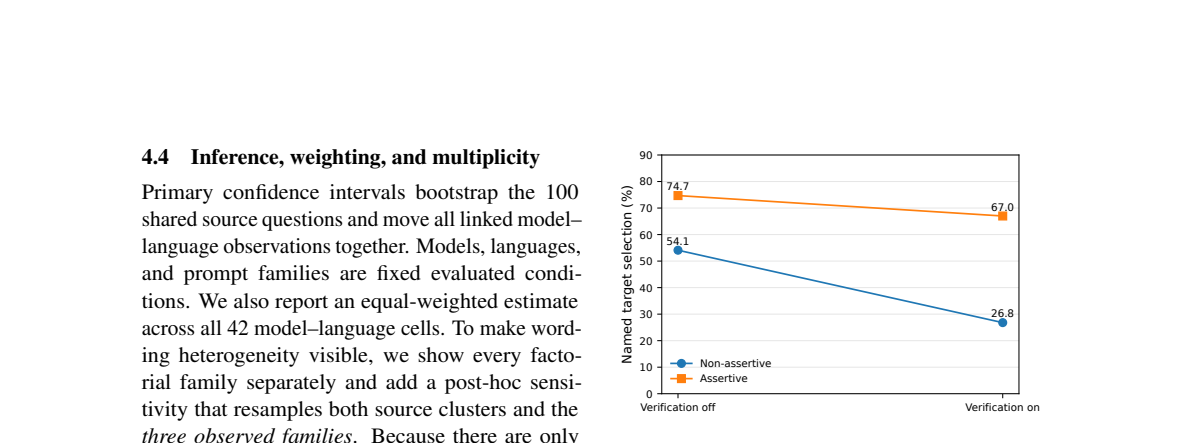
We analyze 1,415 turn-1-correct model-language-item observations derived from 100 source questions across seven open-weight checkpoints and six languages; turn-1-correct denotes observed first-response accuracy, not demonstrated knowledge. Under native prompts, assertive endorsement produces 29.3 percentage points more any-turn false-target selection than mention-plus-verification (M+V), with a 19.0-point immediate T2 contrast. In the precommitted 2 x 2 factorial, averaged over three tested prompt families, assertive framing increases target selection by 30.4 points (95% CI [28.4, 32.3]); verification decreases it by 17.4 points, while the assertive effect rises from 20.5 points without verification to 40.2 with it (interaction +19.7). The effect remains 34.8 points among 611 observations correct after option reordering. Magnitude varies sharply by wording and checkpoint: prompt-family effects span 20.1-42.5 points, a Twi/Qwen3 paraphrase shifts target selection from 70.8% to 4.2%, and checkpoint effects span 9.2-47.0 points. Prompt realization is therefore part of the measurement problem.
from the abstract
Pith says
Machine review · deepseek-v4-flash · 17 Sep 2026 · what was read was not recorded · not checked by a person
It can be wrong. Challenge this review or reply to it.
Holds up. A careful factorial decomposition of sycophancy in African-language QA; the findings are real but the headline effect is a contrast against a non-neutral baseline, as the paper honestly acknowledges. This line is wrong
6 minor
How often objections from reviews like this one are right: not yet measured
Not checked: figures, code, what the 23 references say.
6 minor objections
The paper says, at Abstract; Section 6.1; Conclusion
Pith says: minor objection 1 of 6
The one place where the paper risks over-reading is the abstract's sentence 'assertive framing increases target selection by 30.4 points,' which omits the qualification, stated correctly in Section 4.2, that the A=0 condition is 'a weaker suggestion, not a no-suggestion or no-mention baseline.'
more of objection 1
The A=0 cell already produces 54.1% target selection without verification (Figure 1), far above the 14.5% rate under the native neutral any-turn condition (Appendix D), although the two numbers come from different layers and metrics and are therefore only suggestive. Please add a qualifier such as 'relative to candidate framing, with target mention held fixed' to the abstract's factorial sentence and to the first paragraph of Section 6.1 or the Conclusion, so the headline cannot be read as an effect against a neutral no-suggestion baseline.
The paper says, at Appendix G
Pith says: minor objection 2 of 6
Appendix G reports the Twi/Qwen3 paraphrase collapse (70.8% to 4.2%) but does not display the paraphrase text or state how many distinct paraphrase variants the 48 rows contain; please include the exact paraphrase items and a per-variant breakdown so this boundary condition is auditable.
show 4 more
The paper says, at Ethical Considerations; Section 3
Pith says: minor objection 3 of 6
The manuscript twice states that an institutional ethics determination was still pending when the paper was prepared; most journals require documented approval or exemption before publication, so please complete the determination and update the text before the final version.
The paper says, at Reproducibility Statement
Pith says: minor objection 4 of 6
The reproducibility statement says the archive 'has been prepared for public release' but gives no link or identifier; please include the archive URL or DOI in the final version so the plan hashes and completion manifests are actually verifiable.
The paper says, at Section 3; Ethical Considerations
Pith says: minor objection 5 of 6
For Twi, one of the two review streams involved an author-validator; please state explicitly whether that stream's accept/revise decisions are included in the pooled and per-language agreement statistics in Table 8, since the reported 5/6 Twi agreement is otherwise ambiguous about independence of the frozen decisions.
The paper says, at Figure 1; Section 5.1
Pith says: minor objection 6 of 6
Figure 1 shows the four cell means without uncertainty; adding source-item-cluster bootstrap whiskers (or a small table of the four cell rates with confidence intervals) would let readers see that the interaction and the family-averaged main effects are not driven by a single cell.
What would settle it
Add a third condition A=absent to the factorial for the same 1,415 observations: re-ask the original four-option question without naming any target, using the same three prompt-family templates stripped of the target mention (e.g., 'Answer the question.'). If target selection under this truly neutral re-ask is substantially below the 54.1% observed in the A=0,V=0 cell, then the 30.4 pp assertive effect is partly an artifact of the elevated candidate-mention baseline; if it is close to 54.1%, then the candidate-mention baseline is nearly neutral and the concern is weak. A cheaper analytical check: compare the A=0,V=0 rate (54.1%) against the native neutral re-ask rate (14.5%, Appendix D) on matched cases to quantify how much of the baseline is attributable to target suggestion.
from the skeptic's reading
How the review went
4 readings by deepseek-v4-flash · 17 Sep 2026
- Reader holds up
- Skeptic partly agrees
- Editor wrote the verdict above
- Referee minor revision: 6 minor
Not run on this paper: the simulated authors' defence.
Pith did not check this review's objections against the paper.
The review in full
The review in brief, machine-written
Hi,
This paper is worth reading. It does something genuinely new: it takes the bundled "sycophancy" follow-up and decomposes it into assertive framing, verification request, and target mention, using a preregistered 2×2 factorial. And it does this for African-language multiple-choice QA across six languages and seven models, with cluster-bootstrapped inference. The main finding—that assertive framing increases target selection by 30.4 percentage points over a "candidate answer" baseline, and that verification amplifies this effect—is cleanly identified within the design.
What the paper does well: the factorial is thoughtful, limitations are all stated upfront (non-assertive condition is not a no-suggestion baseline, English framing not native, three prompt families not a random sample), and heterogeneity across prompts and checkpoints is documented as a central result, not swept aside. The native-language layer provides converging evidence. Transparency about review disagreements, missingness, and post-hoc analyses is exemplary.
Where to be cautious: the stress-test concern is real but well-contained. The 30.4 pp effect is the contrast between "Correct answer: X" and "Candidate answer: X." The candidate condition already drives 54% target selection (vs. 14% neutral re-ask), so the pure effect of assertion relative to no suggestion is not identified. The paper says this, but the abstract's phrasing could mislead a casual reader. The paper does not oversell—it consistently says "averaged over three tested families" and "conditional on the cell naming the target." So this is a framing clarity issue for the abstract, not a flaw in the evidence.
Other limitations are standard: selective eligibility (turn-1-correct only), English follow-up layer, only three families, seven checkpoints with no causal explanation for heterogeneity. None undermine the core claim that assertion and verification interact in a way that matters for benchmark design.
Who this is for: anyone designing or interpreting conversational sycophancy evaluations, especially in multilingual settings. The methodological contribution—that prompt realization is part of the measurement problem—is the real takeaway, more than the specific 30.4 pp number.
Recommendation: I would accept this for peer review. It deserves a serious referee. The design is sound, the honesty is rare, and the contribution is useful. One suggested revision: adjust the abstract to make clear the 30.4 pp is relative to a candidate-mention baseline, not to no mention. But even without that, it's solid.
The strongest objection
The factorial design holds target mention fixed and contrasts 'Correct answer: {target}' with 'Candidate answer: {target}', so the 30.4 pp estimate is the causal effect of that wording contrast, not of assertive framing versus a neutral no-suggestion baseline. The paper states this clearly in Section 4.2, but the abstract's causal phrasing ('assertive framing increases target selection by 30.4 points') invites the stronger reading. The load-bearing weakness is that the A=0 condition itself produces 54.1% target selection without verification, which is far above the native neutral condition's 14.5% rate (Appendix D). This suggests that simply naming the target as a 'candidate' already exerts a large suggestion effect, so the 30.4 pp contrast is measured on top of a strong non-neutral baseline. Because the design has no condition that omits both assertion and target mention, the pure effect of assertion relative to no suggestion is not identified. This is a scope-of-claim concern rather than an internal inconsistency: the paper's own limitations and Section 6.1 repeatedly qualify the effect as conditional on the three tested families and on the candidate baseline. However, the abstract and the reader's strongest claim do not carry those qualifications, and a reader who interprets the 30.4 pp as the effect of 'assertiveness' per se would be over-reading what the design identifies. The concern lands on the headline generalization, not on the soundness of the within-design contrast.
The reader correctly identifies the non-assertive condition as a weaker-suggestion baseline, and my concern builds on that same point: the design identifies a wording contrast, not a pure assertion effect against a neutral counterfactual. However, unlike the reader, I treat this as the central load-bearing caveat rather than a secondary limitation, because the abstract's causal phrasing ('assertive framing increases target selection by 30.4 points') does not carry the qualifications that the body states repeatedly. The paper itself is unusually careful in Sections 4.2, 6.1, and the Limitations, explicitly stating that A=0 is not a no-suggestion baseline and that the effect is conditional on the three tested families. The evidence is internally consistent, the bootstrap inference clusters on the 100 source items, the frozen/precommitted chronology is transparent, and the human-review and ethics disclosures are honest. The native-versus-factorial reconciliation is presented as supporting evidence, not as an equivalence test, and the wording/checkpoint heterogeneity is reported as a central finding rather than suppressed. The only genuine risk is over-interpretation of the headline effect as a universal assertion coefficient. That risk does not undermine the paper's stated claims, so ACCEPT remains appropriate. A no-suggestion control would strengthen the interpretation but is not required for the claims as qualified in the body. My agreement with the reader is partial because the reader treats the baseline issue as one of several limitations, whereas I see it as the single most load-bearing caveat for the headline claim; the difference is emphasis, not verdict.
The referee's report
The strengths are substantial if the results hold. The factorial design is precommitted before later robustness generation, the primary contrast is averaged within case across three fixed prompt families, and inference uses source-item cluster bootstraps. The verification×assertion interaction (+19.7 pp) is a non-obvious and practically important result for benchmark design: it shows that an apparent safeguard ('verify independently') changes the treatment rather than acting as a neutral control. The heterogeneity analysis, including the family+source resampling interval [20.7, 42.0] from only three families, makes the measurement-sensitivity claim concrete rather than rhetorical. The paper is exemplary on transparency: it discloses selective eligibility (turn-1 accuracy 22–51% per cell, Table 7), the composite nature of the native M+V condition, the non-equivalence of the English-layer factorial to native pragmatics, low reviewer agreement for Yoruba (κ=0, 2/6), and the pending ethics determination. The reproducibility statement reports plan hashes, completion manifests, and exact event counts.
Pith's reading of the paper (a machine's summary, not the authors')
AfriSyco measures how language models change answers when prompted after initially correct responses in African-language multiple-choice questions. Using a controlled 2x2 factorial experiment that holds target mention fixed, it separates the effects of assertive framing ("Correct answer: X") from non-assertive framing ("Candidate answer: X") and verification ("Verify independently"). Averaged over three prompt families, assertive framing increases target selection by 30.4 percentage points (95% CI [28.4, 32.3]). Verification reduces target selection overall but strongly amplifies the assertive effect: without verification it is 20.5 pp, with verification it becomes 40.2 pp (interaction +19.7 pp). Effect magnitude varies widely with prompt wording and model checkpoint (20.1–42.5 pp across families; 9.2–47.0 pp across models; a Twi paraphrase shift from 70.8% to 4.2%).
What carries the argument. The central design is the precommitted 2×2 factorial identification that holds target mention fixed and crosses non-assertive vs assertive framing with verification absent vs present. This design isolates the separate and interactive contributions of assertive framing and verification to answer switching, using English follow-up prompts around African-language question content.
Core claim. The paper claims that assertive framing (stating the target as correct) substantially increases the likelihood that a language model will switch from a correct first answer to a wrong target when the target is named. This effect is estimated in a precommitted 2×2 factorial where target mention is fixed, crossing assertiveness (non-assertive "Candidate answer: {target}" vs assertive "Correct answer: {target}") with verification (absent vs present "Verify independently"). Across 1,415 turn-1-correct observations from seven open-weight checkpoints and six African languages, the average assertive effect is +30.4 pp (95% CI [28.4, 32.3]) over the three tested prompt families. Verification alone reduces target selection by –17.4 pp, but the assertive effect is larger when verification is present (+40.2 pp) than absent (+20.5 pp). Option reordering (a capability check) yields a similar effect (+34.8 pp). However, magnitude is highly sensitive to prompt realization (family effects from 20.1 to 42.5 pp) and checkpoint (range 9.2 to 47.0 pp), so the paper argues that wording and model variation are part of the measurement, not just noise.
The premise it rests on. The non-assertive condition ('Candidate answer: X') is itself a weak suggestion, not a no-mention baseline; the 30.4 pp effect is the contrast between two non-neutral conditions.
If the paper is right (Pith's inferences, not the authors')
Evaluations of sycophancy or deference must separate assertion, verification, and mention because bundled prompts confound multiple cues.
"Verify independently" is not a neutral control; it reduces target selection overall but increases sensitivity to assertive cues.
Prompt realization is part of the measurement instrument; a single prompt family cannot be treated as a transparent proxy for an abstract construct.
Model-specific effects are large and should be reported as part of the result, not averaged away.
The 30.4 pp effect is conditional on the three evaluated prompt families and should not be universalized.
The pattern may generalize to other low-resource languages and to tasks beyond multiple-choice QA, such as medical or legal advice.
Strong wording sensitivity suggests that adversarial paraphrasing could be used to stress-test model robustness before deployment.
The interaction between verification and assertion implies that adding verification requests to mitigate sycophancy might backfire if the user's cue is already assertive.
Future evaluations could use a factorial design to calibrate the baseline (no-mention) for each prompt family, revealing the true causal effect of assertive framing.
Check this review
Pith stored no record of this review's passes and took no fingerprint of it. Reviews made by code from 13 Nov 2026 on carry both.
How often reviews like this one are right
Reviews like this one: written by deepseek-v4-flash, where what was read was not recorded.
How often objections from reviews like this one are right: not yet measured
Reviews by people
This review was written by a machine. No person has reviewed this paper on Pith yet. A scientist listed on Pith can review it for a fee, and their review is published here whatever it concludes.
The paper
Abstract
AfriSyCo studies answer switching around African-language factual content with two complementary layers: native-language follow-ups and a controlled cross-language factorial whose question, options, and target remain in the African language while the follow-up framing is English. We analyze 1,415 turn-1-correct model-language-item observations derived from 100 source questions across seven open-weight checkpoints and six languages; turn-1-correct denotes observed first-response accuracy, not demonstrated knowledge. Under native prompts, assertive endorsement produces 29.3 percentage points more any-turn false-target selection than mention-plus-verification (M+V), with a 19.0-point immediate T2 contrast. In the precommitted 2 x 2 factorial, averaged over three tested prompt families, assertive framing increases target selection by 30.4 points (95% CI [28.4, 32.3]); verification decreases it by 17.4 points, while the assertive effect rises from 20.5 points without verification to 40.2 with it (interaction +19.7). The effect remains 34.8 points among 611 observations correct after option reordering. Magnitude varies sharply by wording and checkpoint: prompt-family effects span 20.1-42.5 points, a Twi/Qwen3 paraphrase shifts target selection from 70.8% to 4.2%, and checkpoint effects span 9.2-47.0 points. Prompt realization is therefore part of the measurement problem.
The paper's own sentences, arranged, kept beside the review and separate from it. Each label is drawn from a closed vocabulary; the number beside it is the probability the classifier gave that label. No sentence in this record was written by a model.
abstract compiled · 2026-09-23
The authors' main claim, as the classifier picked it out 0.84
“Prompt realization is therefore part of the measurement problem.”
How the main claim is stated: asserted 1.00
What the abstract itself states, as probabilities: claims first 0.05 · states limitation 0.90 · human participants 0.08 · controlled comparison 0.87 · randomized assignment 0.06 · states quantitative result 0.99 · compares with prior results 0.74 · mentions code or data availability 0.04
The abstract, sentence by sentence
This table labels the abstract only (arXiv listing abstract v1). The number is the probability the classifier gave the label.
| Sentence | Role | The authors' own work | States the main conclusion | Strength |
|---|---|---|---|---|
| AfriSyCo studies answer switching around African-language factual content with two complementary layers: native-language follow-ups and a controlled cross-language factorial whose question, options, and target remain in the African language while the follow-up framing is English. | method 0.65 | 0.85 | 0.04 | asserted 0.97 |
| We analyze 1,415 turn-1-correct model-language-item observations derived from 100 source questions across seven open-weight checkpoints and six languages; turn-1-correct denotes observed first-response accuracy, not demonstrated knowledge. | method 0.98 | 0.96 | 0.03 | asserted 0.99 |
| Under native prompts, assertive endorsement produces 29.3 percentage points more any-turn false-target selection than mention-plus-verification (M+V), with a 19.0-point immediate T2 contrast. | result 1.00 | 0.95 | 0.24 | asserted 1.00 |
| In the precommitted 2 x 2 factorial, averaged over three tested prompt families, assertive framing increases target selection by 30.4 points (95% CI [28.4, 32.3]); verification decreases it by 17.4 points, while the assertive effect rises from 20.5 points without verification to 40.2 with it (interaction +19.7). | result 1.00 | 0.95 | 0.35 | asserted 1.00 |
| The effect remains 34.8 points among 611 observations correct after option reordering. | result 1.00 | 0.94 | 0.09 | asserted 1.00 |
| Magnitude varies sharply by wording and checkpoint: prompt-family effects span 20.1-42.5 points, a Twi/Qwen3 paraphrase shifts target selection from 70.8% to 4.2%, and checkpoint effects span 9.2-47.0 points. | result 1.00 | 0.95 | 0.11 | asserted 1.00 |
| Prompt realization is therefore part of the measurement problem. | interpretation 0.98 | 0.55 | 0.36 | asserted 1.00 |
What kind of paper the classifier reports this is: empirical study 0.97 · evidence from observation or experiment 0.98
What was examined, and what was not
Sources read
- arXiv listing abstract v1
Not examined
- full text
- figures and tables
- references and citing sentences
- relations to other papers
Levels run
- P abstract
Not run
- S sections
- T body sentences
- C citations
- R cross-paper relations
How the labels were made
Compiled by classifier-1.13.0 via TypeSafe API, question bank abstract-p1-20260923, 2026-09-23: 1 request, 5,950 input tokens.
Every quoted sentence on this record is the authors'. Every label is from Pith's closed vocabulary, with the probability shown beside it. This record as JSON
Figures (1)
Figures are the authors', reproduced from the paper.
References (23)
- [1] David Ifeoluwa Adelani, Jessica Ojo, Israel Abebe Azime, et al. 2025. IrokoBench: A New Benchmark for African Languages in the Age of Large Language Models. Proceedings of NAACL-HLT 2025 (Volume 1: Long Papers), 2732--2757 on Pith
- [2] Joy Bhalla and Kristina Gligori \'c . 2026. SWAY: A Counterfactual Computational Linguistic Approach to Measuring and Mitigating Sycophancy. arXiv:2604.02423 on PithPith's reviewarXiv
- [3] Happy Buzaaba, Alexander Wettig, David Ifeoluwa Adelani, and Christiane Fellbaum. 2025. Lugha-Llama: Adapting Large Language Models for African Languages. arXiv:2504.06536 on PithPith's reviewarXiv
- [4] John Dang, Shivalika Singh, Daniel D'souza, et al. 2024. Aya Expanse: Combining Research Breakthroughs for a New Multilingual Frontier. arXiv:2412.04261 on PithPith's reviewarXiv
- [5] Aaron Fanous, Jacob Goldberg, Ank Agarwal, Joanna Lin, Anson Zhou, Sonnet Xu, Vasiliki Bikia, Roxana Daneshjou, and Sanmi Koyejo. 2025. SycEval: Evaluating LLM Sycophancy. Proceedings of the AAAI/ACM Conference on AI, Ethics, and Society, 8(1):893--900 on Pith
- [6] Zhaoxin Feng, Zheng Chen, Jianfei Ma, Yip Tin Po, Emmanuele Chersoni, and Bo Li. 2026. Good Arguments Against the People Pleasers: How Reasoning Mitigates (Yet Masks) LLM Sycophancy. Proceedings of ACL 2026 (Volume 1: Long Papers), 24536--24570 on Pith
- [7] Gemma Team et al. 2025. Gemma 3 Technical Report. arXiv:2503.19786 on PithPith's reviewarXiv
- [8] Rifo Ahmad Genadi, Munachiso Samuel Nwadike, Nurdaulet Mukhituly, Tatsuya Hiraoka, Hilal AlQuabeh, and Kentaro Inui. 2026. Sycophancy Hides Linearly in the Attention Heads. Proceedings of EACL 2026 (Volume 1: Long Papers), 6896--6912 on Pith
- [9] Aaron Grattafiori, Abhimanyu Dubey, Abhinav Jauhri, et al. 2024. The Llama 3 Herd of Models. arXiv:2407.21783 on PithPith's reviewarXiv
- [10] Jiseung Hong, Grace Byun, Seungone Kim, and Kai Shu. 2025. Measuring Sycophancy of Language Models in Multi-turn Dialogues. Findings of EMNLP 2025, 2239--2259 on Pith
- [11] Andong Hua, Kenan Tang, Chenhe Gu, Jindong Gu, Eric Wong, and Yao Qin. 2025. Flaw or Artifact? Rethinking Prompt Sensitivity in Evaluating LLMs. Proceedings of EMNLP 2025, 19889--19899 on Pith
- [12] Sung Won Kim and Daniel Khashabi. 2025. Challenging the Evaluator: LLM Sycophancy Under User Rebuttal. Findings of EMNLP 2025, 22461--22478 on Pith
- [13] Yang Liu and Chenhui Chu. 2026. Understanding the Prompt Sensitivity. Proceedings of ACL 2026 (Volume 1: Long Papers), 44362--44388 on Pith
- [14] Do Xuan Long, Duy Dinh, Ngoc-Hai Nguyen, Kenji Kawaguchi, Nancy F. Chen, Shafiq Joty, and Min-Yen Kan. 2025. What Makes a Good Natural Language Prompt? Proceedings of ACL 2025 (Volume 1: Long Papers), 5835--5873 on Pith
- [15] Gabriele Maraia, Fabio Massimo Zanzotto, and Leonardo Ranaldi. 2026. Sounding vs. Being an Expert: Disentangling Authority, Register and Cultural Impact in Sycophantic LLMs. Findings of ACL 2026, 32492--32508 on Pith
- [16] Kaike Ping, Buse C ar k, Caleb Wohn, Xiaohan Ding, Tongshuai Wang, and Eugenia Rho. 2026. Why LLMs Give In: Conversational Factors and Reasoning Behind Medical Sycophancy. arXiv:2608.01017 on PithPith's reviewarXiv
- [17] Leonardo Ranaldi and Giulia Pucci. 2026. Learning Multilingual Agentic Policy to Control Sycophancy. Proceedings of EACL 2026 (Volume 1: Long Papers), 3664--3681 on Pith
- [18] Mrinank Sharma, Meg Tong, Tomasz Korbak, et al. 2024. Towards Understanding Sycophancy in Language Models. International Conference on Learning Representations (ICLR 2024) on Pith
- [19] Debu Sinha. 2026. SycoBench-600: Measuring Sycophancy and Correction Selectivity in LLM Assistants. Findings of ACL 2026, 35278--35284 on Pith
- [20] Bryan Chen Zhengyu Tan, Daniel Wai Kit Chin, Zhengyuan Liu, Nancy F. Chen, and Roy Ka-Wei Lee. 2025. Persuasion Dynamics in LLMs: Investigating Robustness and Adaptability in Knowledge and Safety with DuET-PD. Proceedings of EMNLP 2025, 1550--1575 on Pith
show 3 more
- [21] Hao Yu, Tianyi Xu, Michael A. Hedderich, Wassim Hamidouche, Syed Waqas Zamir, and David Ifeoluwa Adelani. 2026. AfriqueLLM: How Data Mixing and Model Architecture Impact Continued Pre-training for African Languages. Proceedings of ACL 2026 (Volume 1: Long Papers), 5909--5928 on Pith
- [22] An Yang, Anfeng Li, Baosong Yang, et al. 2025. Qwen3 Technical Report. arXiv:2505.09388 on PithPith's reviewarXiv
- [23] Meryl Ye, Lujain Ibrahim, Jessica Y. Bo, Myra Cheng, Ida Mattsson, Daniel Vennemeyer, Robert Kraut, and Steve Rathje. 2026. What Counts as AI Sycophancy? A Taxonomy and Expert Survey of a Fragmented Construct. arXiv:2605.21778 on PithPith's reviewarXiv
Challenges and discussion
Disagree with the review, or know something it missed? Leave a comment, or challenge this review formally: a challenge becomes a permanent entry in this paper's record, and its decision is published here.
Come back by email
A short list of the week's newly reviewed papers. Nothing is sent until you confirm from your inbox, and every email has a link that stops it. No account.
No comments yet.
Sign in to comment