Statistics Theory · arXiv:2609.19599 v2 · submitted 17 Sep 2026
Human-Anchored Inference for Ranking New Models with Large Language Model Judges
The paper says
“Human pairwise comparisons provide a reference for evaluating large language models (LLMs), but collecting sufficient judgments for each new release is costly and time-consuming.”
more of the abstract
LLM judges offer a scalable alternative, although their comparisons may differ systematically from human preferences and across judges. We study the ranking of a new model that has received LLM-judge comparisons but no human comparisons. We propose ANCHOR (ANchored Comparisons for Human-reference inference with Orthogonal Riesz correction), which uses historical human and LLM comparisons to learn judge-specific sensitivities to human score differences and feature-dependent judge biases. These estimates are then used to infer the new model's human-reference score from its judge comparisons. The framework allows the feature distribution to change between historical and new-model comparisons. For inference, we construct a Neyman-orthogonal estimator through a joint Riesz correction that removes the first-order effects of estimating the historical human scores, judge sensitivities, and bias functions. We establish identification, convergence rates, and asymptotic normality with consistently estimable variance, and show that ANCHOR attains the semiparametric efficiency bound. Simulations demonstrate gains in score estimation and ranking accuracy. On Chatbot Arena, ANCHOR achieves the lowest score RMSE and insertion MAE among competing methods, with narrower score intervals on average.
from the abstract
Pith says
Machine review · deepseek-v4-flash · 18 Sep 2026 · of version 1 of the paper; version 2 is newer · what was read was not recorded · not checked by a person
It can be wrong. Challenge this review or reply to it.
The passes disagreed. Reader: holds up. Skeptic: holds up only with conditions. Referee: major revision.
This paper makes a genuine theoretical contribution to a practical problem—ranking a new model on a human scale without human data—but its identification rests on a strong functional-form assumption that could use robustness work. This line is wrong
3 major objections · 5 minor
How often objections from reviews like this one are right: not yet measured
Not checked: figures, code, what the references say.
The paper says, at Section 2.2, Theorem 2.1
The review did not quote this passage.
Pith says: Objection 1 of 3 · major
The assumption that judge bias is exactly of the form hm(x,x') = ψ_m(x) - ψ_m(x') excludes any pairwise interaction effects. This assumption is load-bearing for identification (Theorem 2.1) and for the consistency of the estimator. The paper acknowledges the restriction but provides no sensitivity analysis or robustness guarantees against misspecification of this form.
more of objection 1
Since the true bias structure of LLM judges is unknown and could contain interactions, the paper should discuss the plausibility of this assumption in practice and ideally include simulations where the true bias contains an interaction term (e.g., ψ_m(x) - ψ_m(x') + φ(x)φ(x')) to assess the impact on identification and finite-sample performance.
The paper says, at Assumption 2.3
The review did not quote this passage.
Pith says: Objection 2 of 3 · major
Assumption 2.3 requires absolute continuity of the new-model feature distribution with respect to the historical distribution, with a bounded density ratio. This is a strong and untestable condition, especially when the new model's responses may explore regions of feature space not well covered historically.
more of objection 2
The paper should discuss how one might check or bound this ratio in practice (e.g., via estimated importance weights) and whether the empirical applications satisfy it approximately. Without such discussion, the practical scope of the method is unclear.
The paper says, at Section 6 and Supplementary Section A
The review did not quote this passage.
Pith says: Objection 3 of 3 · major
The empirical implementation on Chatbot Arena uses linear functions for both the bias hm and the Riesz weights (Section 6), while the theory (Section 4) permits general DNN classes with smoothness assumptions. The paper should clarify when linear approximations are sufficient and whether the theoretical guarantees (e.g., efficiency, rate conditions) continue to hold under linear misspecification. If linearity is an additional assumption, its justification and potential impact on inference should be discussed.
5 minor objections
The paper says, at Section 2.2, line 195
Pith says: minor objection 1 of 5
Typo: 'restricthm' should be 'restrict hm'.
The paper says, at Figure 2
Pith says: minor objection 2 of 5
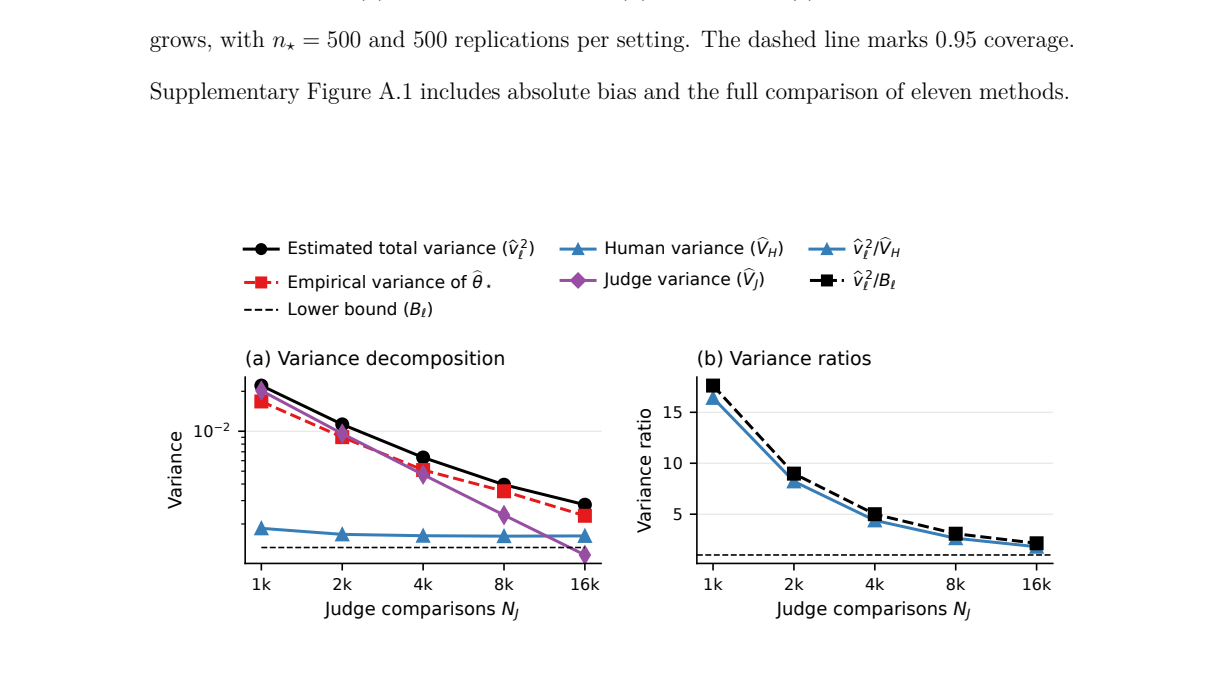
The y-axis label 'Variance' is ambiguous; consider clarifying that it is the estimated or empirical variance of the score estimator. Also, the legends could be more self-contained.
show 3 more
The paper says, at Equation (15) and surrounding text
Pith says: minor objection 3 of 5
The notation J for total information is overloaded with the judge index; consider using a different symbol to avoid confusion.
The paper says, at Theorem 4.2 and condition (14)
Pith says: minor objection 4 of 5
The condition Δℓ,n→0 is stated in terms of nH, NJ, and other rates. It would help to give a brief interpretation of when this condition holds in terms of sample sizes and smoothness, beyond the examples. The current text provides some special cases; a short summary in the main text would improve readability.
The paper says, at Algorithm description, Section 3.2
Pith says: minor objection 5 of 5
The description of cross-fitting and the Riesz criterion minimisation is dense; a pseudocode or an explicit reference to Algorithm 2 (in supplement) should be placed earlier to improve flow. The reader must jump to the supplement for the algorithm details, which is acceptable but a brief summary in the main text would help.
What would settle it
Simulate data under a judge model where hm(x,x') = ψ_m(x) - ψ_m(x') + η * φ1(x) * φ2(x') with η ≠ 0, where φ1 and φ2 are continuous nonlinear functions (e.g., cos and exp). Select η from {0, 0.2, 0.5, 1}. Apply ANCHOR using only the assumed difference form for estimation. Compute bias and 95% coverage of θ⋆ for each η across 500 replications. If coverage degrades significantly (e.g., below 0.90) when η ≠ 0, the assumption is critical and the central claim of identification is fragile.
from the skeptic's reading
How the review went
4 readings by deepseek-v4-flash · 18 Sep 2026
- Reader holds up
- Skeptic partly agrees: says it holds up only with conditions The representation of judge bias as a difference of single-response functions excludes pairwise interactions; if the true bias contains interactions, the new model score may be unidentified and ANCHOR could be inconsistent.
- Editor wrote the verdict above
- Referee major revision: 3 major objections, 5 minor
Not run on this paper: the simulated authors' defence.
Pith did not check this review's objections against the paper.
The review in full
The review in brief, machine-written
The core idea is good and well executed. The problem—ranking a new LLM on a human-reference scale using only LLM judge comparisons, with no human data for the new model—is timely and methodologically under-explored. The identification theorem (2.1) and the semiparametric efficiency result (4.3) are real contributions. The Neyman-orthogonal correction for nuisance estimation is carefully derived, and the simulations and Chatbot Arena experiment show the method works in practice.
The main soft spot, which the stress test flags correctly, is the additive difference form for judge bias: hm(x,x') = ψm(x) – ψm(x'). This excludes pairwise interactions. The paper acknowledges the assumption (Section 2.2) but does not provide sensitivity analysis or robustness checks. If the true bias contains interactions not representable as a difference, identification of θ* could break, and the efficiency bound becomes irrelevant. This is a load-bearing assumption. The paper would be stronger with a simulation study that misspecifies the bias form and shows how ANCHOR degrades, or with a theoretical discussion of conditions under which the difference form is plausible (e.g., additive separability of features in judge bias).
Other concerns are standard for this type of work: absolute continuity (Assumption 2.3) is strong but typical for covariate shift; the empirical analysis does not release code or data, which hurts reproducibility. The reliance on neural network classes with smoothness assumptions is also standard but not trivial.
Overall this is a serious piece of work. It belongs in a good journal after the authors add robustness analysis for the bias-form assumption and ideally release their code. I would accept this for peer review with major revisions.
The strongest objection
The central claim that ANCHOR attains the semiparametric efficiency bound rests on identification, which in turn requires the judge bias hm to take the difference form hm(x,x') = ψ_m(x) - ψ_m(x'). This form excludes any pairwise interaction effects that cannot be decomposed into a difference of single-response functions. If a judge's bias includes an additive interaction term φ(x) * φ(x') (or any symmetric but non-difference function), then the model used for identification and estimation is misspecified. Theorem 2.1 would no longer guarantee that θ⋆ is identified from the observed data: the historical fit could absorb the interaction into the estimated ψ, but the new-mdel comparisons might not share the same pairwise pattern because the new model's responses come from a different feature distribution. The paper acknowledges this 'excludes pairwise interaction effects' but does not provide sensitivity analysis or robustness guarantees. Without such guarantees, the methodological contribution is conditional on a strong functional form that is not empirically verifyable. This is a load-bearing concern because a failure of this assumption would break identification, and consequently the efficiency bound is irrelevant.
The reader correctly identifies the difference-form assumption as load-bearing but still recommends ACCEPT at high confidence. I view this as a more critical concern because the entire identification and efficiency chain collapses under misspecification, and the paper offers no robustness check or relaxation. The proposed test directly evaluates the consequences of violating this assumption. Until such robustness is demonstrated, a conditional acceptance requiring additional sensitivity analysis is more appropriate.
The referee's report
If the assumptions hold, ANCHOR provides a principled and efficient way to rank new LLMs without requiring human comparisons for each new model, which is highly relevant given the rapid pace of model releases. The theoretical contribution is substantial: identification under covariate shift, orthogonal inference that attains the efficiency bound, and a clear decomposition of information from human and LLM comparisons. The empirical results on Chatbot Arena are compelling and suggest practical utility.
Pith's reading of the paper (a machine's summary, not the authors')
Large language models (LLMs) are frequently evaluated by other LLMs (judges), but these judges can be biased while human evaluations are costly and slow. This paper proposes ANCHOR, a method that uses historical human and LLM judge comparisons to estimate a new model's human-reference score, even when the new model has never been evaluated by humans. ANCHOR builds a statistical model linking human and judge preferences, corrects for estimation errors using a Neyman-orthogonal estimator, and achieves the best possible asymptotic variance among all regular estimators. Under its assumptions, no method can estimate the new model's score more precisely than ANCHOR.
What carries the argument. The key machinery is a Neyman-orthogonal estimator built by joint Riesz correction. The estimator combines weighted residuals from human comparisons, historical judge comparisons, and new-model judge comparisons. The weights are chosen to cancel the first-order bias from estimating the historical scores, judge sensitivities, and bias functions, yielding a debiased estimator whose asymptotic variance matches the semiparametric efficiency bound.
Core claim. ANCHOR establishes that the new model's human-reference score is identified from historical human and LLM-judge comparisons plus new-model LLM comparisons alone, without any human comparisons involving the new model, even when the feature distribution shifts between historical and new-model comparisons. It further constructs an estimator that attains the semiparametric efficiency bound, meaning that among regular and asymptotically linear estimators, no estimator has a smaller asymptotic variance for the target parameter.
The premise it rests on. The new model's evaluation features must follow a distribution that is absolutely continuous with respect to the historical feature distribution, with a bounded density ratio, which is untestable and strong.
If the paper is right (Pith's inferences, not the authors')
New LLMs can be reliably ranked on a human-reference scale without waiting for human evaluations, enabling faster and cheaper model comparison.
The efficiency bound shows that statistical precision is ultimately limited by the number of human comparisons when the new model's score is not scale-invariant, providing a guideline for resource allocation.
The method produces confidence intervals and rank sets for the new model with guaranteed asymptotic coverage.
The framework allows the feature distribution of judge comparisons to change, accommodating realistic shifts in prompts or response features.
The debiasing technique can be extended to other settings where multiple data sources are fused with nuisance parameters.
The reliance on a bounded density ratio assumption (Assumption 2.3) limits applicability when the new model's evaluation features are very different from historical ones; in such cases, the estimator may have large variance or bias, suggesting the need for adaptive or robust methods.
The assumption that judge bias is of the difference form $h_m(x,x') = \psi_m(x) - \psi_m(x')$ excludes interactions that cannot be represented as a single-response difference; future work could consider more flexible bias models.
The efficiency bound reveals a fundamental trade-off: human comparisons are needed to fix the scale, so even with infinite LLM comparisons, the variance of scale-sensitive targets cannot shrink unless human comparisons also grow.
Check this review
Pith stored no record of this review's passes and took no fingerprint of it. Reviews made by code from 13 Nov 2026 on carry both.
How often reviews like this one are right
Reviews like this one: written by deepseek-v4-flash, where what was read was not recorded.
How often objections from reviews like this one are right: not yet measured
Reviews by people
This review was written by a machine. No person has reviewed this paper on Pith yet. A scientist listed on Pith can review it for a fee, and their review is published here whatever it concludes.
The paper
Abstract
Human pairwise comparisons provide a reference for evaluating large language models (LLMs), but collecting sufficient judgments for each new release is costly and time-consuming. LLM judges offer a scalable alternative, although their comparisons may differ systematically from human preferences and across judges. We study the ranking of a new model that has received LLM-judge comparisons but no human comparisons. We propose ANCHOR (ANchored Comparisons for Human-reference inference with Orthogonal Riesz correction), which uses historical human and LLM comparisons to learn judge-specific sensitivities to human score differences and feature-dependent judge biases. These estimates are then used to infer the new model's human-reference score from its judge comparisons. The framework allows the feature distribution to change between historical and new-model comparisons. For inference, we construct a Neyman-orthogonal estimator through a joint Riesz correction that removes the first-order effects of estimating the historical human scores, judge sensitivities, and bias functions. We establish identification, convergence rates, and asymptotic normality with consistently estimable variance, and show that ANCHOR attains the semiparametric efficiency bound. Simulations demonstrate gains in score estimation and ranking accuracy. On Chatbot Arena, ANCHOR achieves the lowest score RMSE and insertion MAE among competing methods, with narrower score intervals on average.
The paper's own sentences, arranged, kept beside the review and separate from it. Each label is drawn from a closed vocabulary; the number beside it is the probability the classifier gave that label. No sentence in this record was written by a model.
abstract compiled · 2026-09-23
The authors' main claim, as the classifier picked it out 0.95
“On Chatbot Arena, ANCHOR achieves the lowest score RMSE and insertion MAE among competing methods, with narrower score intervals on average.”
How the main claim is stated: asserted 1.00
What the abstract itself states, as probabilities: claims first 0.04 · states limitation 0.13 · human participants 0.36 · controlled comparison 0.39 · randomized assignment 0.02 · states quantitative result 0.46 · compares with prior results 0.94 · mentions code or data availability 0.02
The abstract, sentence by sentence
This table labels the abstract only (arXiv listing abstract v1). The number is the probability the classifier gave the label.
| Sentence | Role | The authors' own work | States the main conclusion | Strength |
|---|---|---|---|---|
| Human pairwise comparisons provide a reference for evaluating large language models (LLMs), but collecting sufficient judgments for each new release is costly and time-consuming. | background 0.97 | 0.07 | 0.02 | asserted 1.00 |
| LLM judges offer a scalable alternative, although their comparisons may differ systematically from human preferences and across judges. | background 0.97 | 0.07 | 0.02 | hedged possibility 0.94 |
| We study the ranking of a new model that has received LLM-judge comparisons but no human comparisons. | contribution 0.48 | 0.31 | 0.03 | asserted 0.92 |
| We propose ANCHOR (ANchored Comparisons for Human-reference inference with Orthogonal Riesz correction), which uses historical human and LLM comparisons to learn judge-specific sensitivities to human score differences and feature-dependent judge biases. | method 0.71 | 0.88 | 0.12 | asserted 1.00 |
| These estimates are then used to infer the new model's human-reference score from its judge comparisons. | method 0.99 | 0.75 | 0.09 | asserted 1.00 |
| The framework allows the feature distribution to change between historical and new-model comparisons. | method 0.66 | 0.59 | 0.03 | asserted 0.97 |
| For inference, we construct a Neyman-orthogonal estimator through a joint Riesz correction that removes the first-order effects of estimating the historical human scores, judge sensitivities, and bias functions. | method 0.99 | 0.94 | 0.05 | asserted 1.00 |
| We establish identification, convergence rates, and asymptotic normality with consistently estimable variance, and show that ANCHOR attains the semiparametric efficiency bound. | contribution 0.68 | 0.95 | 0.19 | asserted 1.00 |
| Simulations demonstrate gains in score estimation and ranking accuracy. | result 1.00 | 0.94 | 0.17 | asserted 1.00 |
| On Chatbot Arena, ANCHOR achieves the lowest score RMSE and insertion MAE among competing methods, with narrower score intervals on average. | result 1.00 | 0.96 | 0.46 | asserted 1.00 |
What kind of paper the classifier reports this is: method or tool 1.00 · evidence from simulation or computation 0.41
What was examined, and what was not
Sources read
- arXiv listing abstract v1
Not examined
- full text
- figures and tables
- references and citing sentences
- relations to other papers
Levels run
- P abstract
Not run
- S sections
- T body sentences
- C citations
- R cross-paper relations
How the labels were made
Compiled by classifier-1.13.0 via TypeSafe API, question bank abstract-p1-20260923, 2026-09-23: 1 request, 7,495 input tokens.
Every quoted sentence on this record is the authors'. Every label is from Pith's closed vocabulary, with the probability shown beside it. This record as JSON
Figures (6)



Figures are the authors', reproduced from the paper.
Challenges and discussion
Disagree with the review, or know something it missed? Leave a comment, or challenge this review formally: a challenge becomes a permanent entry in this paper's record, and its decision is published here.
Come back by email
A short list of the week's newly reviewed papers. Nothing is sent until you confirm from your inbox, and every email has a link that stops it. No account.
No comments yet.
Sign in to comment