Solar and Stellar Astrophysics · arXiv:2609.22072 v1 · submitted 18 Sep 2026 · 44 references
Multi-Epoch Stability in the Rotational Modulation of the Planetary-Mass Companion Ross 458C
The paper says
“Spectroscopic variability is detected in brown dwarfs across all spectral types, suggesting atmospheric patchiness in brown dwarf atmospheres. We present JWST/NIRSpec time series observations of the T8.0 planetary-mass companion Ross 458C.”
more of the abstract
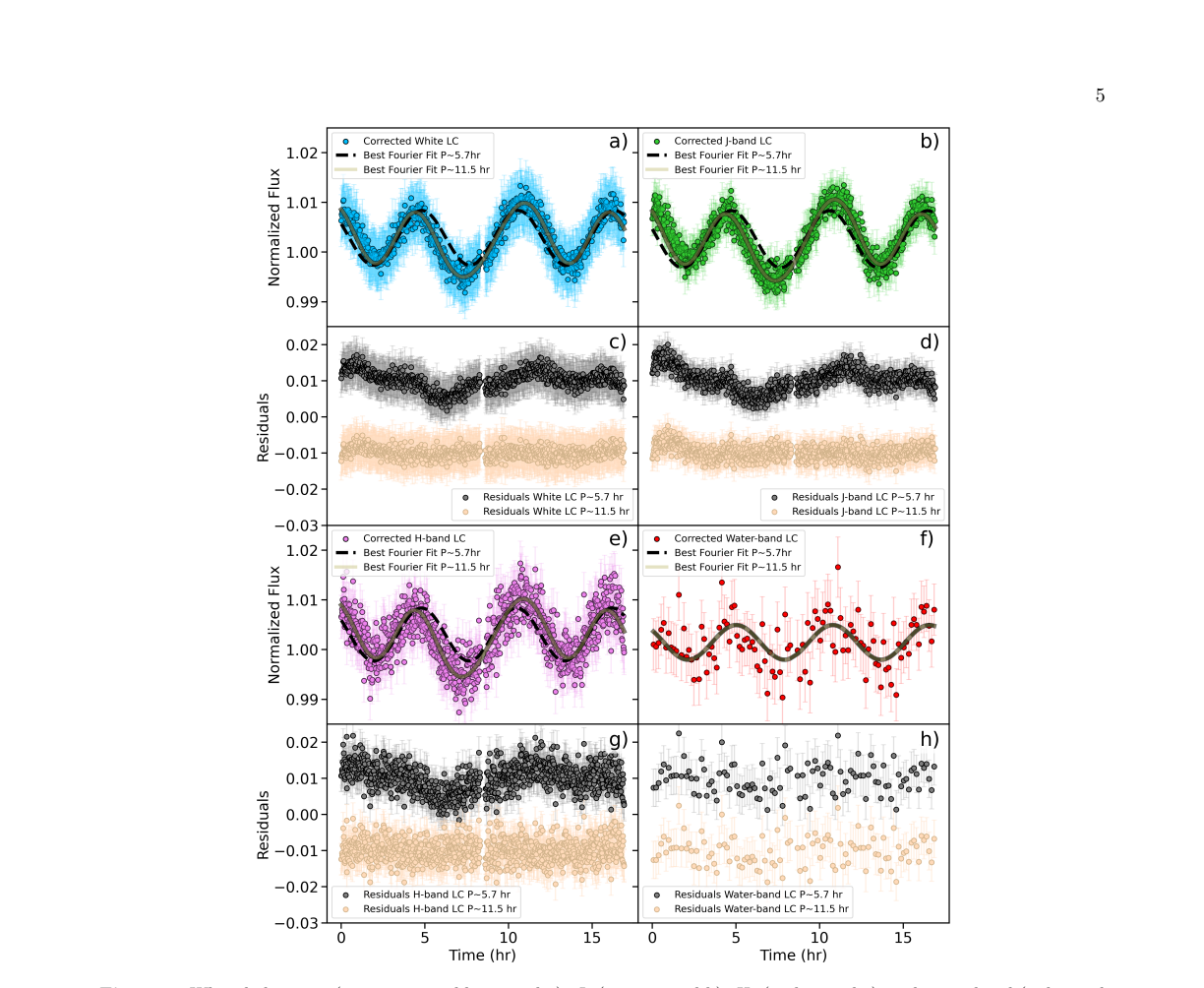
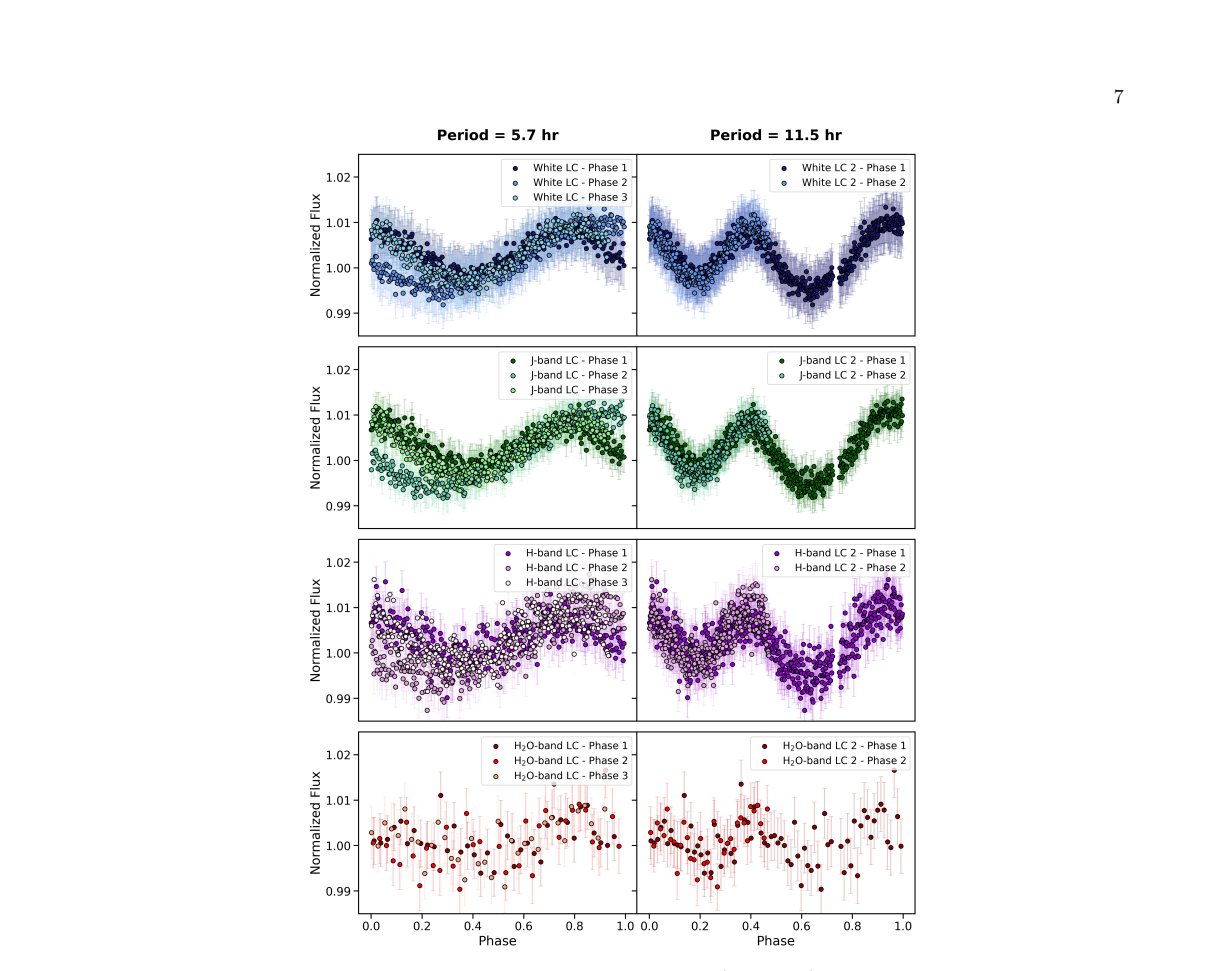
We compared our derived spectral variability and light curve to those obtained using HST/WFC3 observations more than 7.5 yr before and published by Manjavacas et al. (2019). We found that the light curve of Ross 458C is remarkably similar in the two epochs in terms of shape and variability amplitude potentially created by stable weather patterns. We measured a rotational period of 11.57+\-0.09 hr, demonstrating that the previously reported HST/WFC3 period of 6.75+\-1.58 hr is most likely a second-order harmonic produced by an unresolved double-peaked rotational modulation, likely due to the higher uncertainties of the HST/WFC3 light curve and the short time baseline of those observations. We measured the variability amplitude in the white light curve created using only the wavelength range covered by HST/WFC3 (1.10-1.63 micron), obtaining a value of 1.47+\-0.18%, which is consistent with that measured in the HST/WFC3 light curve.
from the abstract
Pith says
Machine review · deepseek-v4-flash · 21 Sep 2026 · what was read was not recorded · not checked by a person
It can be wrong. Challenge this review or reply to it.
The passes disagreed. Reader: holds up. Skeptic: agrees with the reader. Referee: major revision.
Solid JWST data for Ross 458C, period revision is convincing, but the stability claim over HST is weaker than the paper lets on. This line is wrong
1 major objection · 4 minor
How often objections from reviews like this one are right: not yet measured
Not checked: figures, code, what the 44 references say.
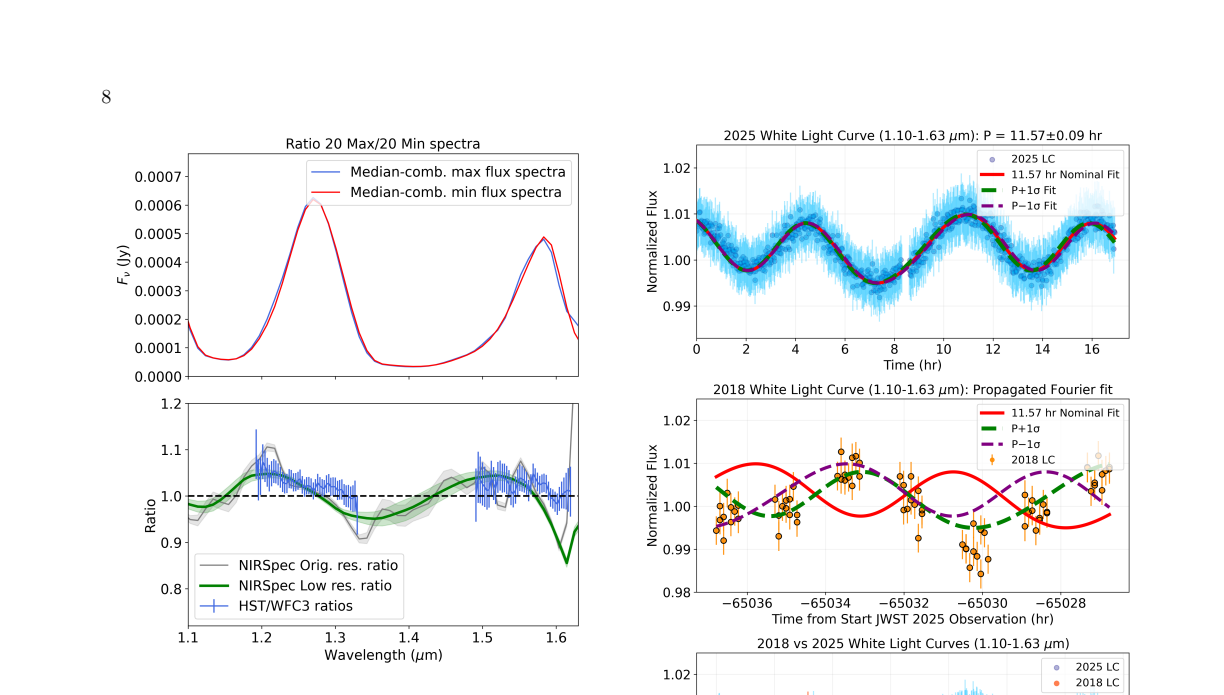
The paper says, at §6.1, Fig. 4
The review did not quote this passage.
Pith says: Objection 1 of 1 · major
The central claim of long-term light-curve shape stability rests on the agreement between the JWST-derived double-peaked Fourier model and the 2018 HST/WFC3 data. However, the HST data cover only 10.1 hr, i.e., about 87% of one 11.57 hr rotation, and do not sample the second peak (expected in the final approximately 1.5 hr).
more of objection 1
Figure 4 shows the JWST model overplotted on the HST data, but this test is not sufficiently discriminative: a simpler model (e.g., a single sinusoid at 5.78 hr) might fit the partial HST data equally well within the uncertainties. The authors should quantitatively compare the goodness-of-fit (BIC, chi-squared, or residuals) of the double-peaked JWST model versus a single-sinusoid model to the HST data alone. Without such a comparison, the evidence that the double-peaked structure existed in 2018 is weak, and the stability claim should be tempered or strengthened with additional analysis.
4 minor objections
The paper says, at §5.1.1, Eq. (1)
Pith says: minor objection 1 of 4
The Fourier series formula (1) writes the sum from i=0 to 4, but the best-fitting model for P approximately 11.5 hr uses only i=1,2,3 (three terms). The absence of an i=0 constant term is unclear because the model includes a separate systematics constant term; this could be clarified in the text.
The paper says, at Table 1
Pith says: minor objection 2 of 4
The headers 'n', 'BIC', and 'f1' could be defined in the caption. Currently 'n' appears without explanation (likely the number of Fourier terms beyond the constant). The standard deviation of residuals is given, but an uncertainty on that value would be helpful.
show 2 more
The paper says, at Fig. 4
Pith says: minor objection 3 of 4
The HST light-curve points (orange) in the middle panel appear to have no error bars; adding them would allow visual assessment of the fit quality. If the error bars are smaller than the symbol size, that should be stated in the caption.
The paper says, at §6.2
Pith says: minor objection 4 of 4
The discussion of magnetospheric versus weather-driven stability is brief. A reference to the radio detection of 2M2228–4310 and the missing radio data for Ross 458C is appropriate, but the observational uncertainties on any future radio search could be mentioned.
What would settle it
For the HST light curve, fit both a single-peak sinusoid (period fixed to 5.78 hr, free amplitude and phase) and a double-peak Fourier series (period fixed to 11.57 hr, three harmonics) using a Bayesian framework with realistic noise. Compute the Bayes factor. If the double-peak model is not strongly favored (Bayes factor > 10) by the HST data alone, then the HST data are insufficient to confirm the double-peaked rotational modulation, and the claim of epoch-to-epoch consistency is only weakly supported.
from the skeptic's reading
How the review went
4 readings by deepseek-v4-flash · 21 Sep 2026
- Reader holds up
- Skeptic partly agrees
- Editor wrote the verdict above
- Referee major revision: 1 major objection, 4 minor
Not run on this paper: the simulated authors' defence.
Pith did not check this review's objections against the paper.
The review in full
The review in brief, machine-written
The paper does two things well. First, the JWST/NIRSpec light curve is clean and the analysis is thorough—multiple period-finding methods, BIC model selection, careful handling of the offset second visit. The revision of the rotation period from 6.75 hr to 11.57 hr is persuasive: the GP bimodality, the lower residuals and BIC for the longer period, and the cleaner phase-folded light curves all point in the same direction. Second, the amplitude and spectral ratio comparison between 2018 and 2025 is genuinely interesting, and the consistency they find in those quantities is a real addition to the small sample of multi-epoch brown dwarf variability studies.
The soft spot is the stress-test concern, and it's real. The HST light curve covers only about 87% of one 11.57-hr rotation. That means the second peak of the double-peaked modulation is never directly observed in the 2018 data. The paper overlays the JWST-derived Fourier model on the HST points and calls it consistent, but the HST data alone cannot validate the double-peaked structure. A single-peaked sinusoid at half the period (or a harmonic) would also fit the available HST data within the error bars, because the data simply don't span the full phase. The authors note this coverage limitation in passing, but they don't fully reckon with what it means for the central claim of light-curve stability. The claim effectively rests on the assumption that the unobserved part of the HST light curve matches the JWST model—which is plausible, but not demonstrated.
That said, this is not a fatal flaw. The amplitude consistency and the period revision are solid on their own. The stability claim is stated with appropriate caution ('we cannot exclude evolution'), and the paper's value does not collapse without it. The paper is a useful, well-executed addition to the literature on late-T dwarf variability.
For peer review: yes, send it. A referee should press on the HST coverage issue and ask for a clearer statement of what can and cannot be concluded from the partial phase coverage. The paper will get a revision, but it's worth engaging with.
The strongest objection
The central claim—long-term light-curve stability—depends on the JWST-derived double-peaked rotational modulation being the same shape in the 2018 HST data. However, the HST light curve (Fig. 4, middle) spans only 10.1 hr, which is 87% of the revised 11.57-hr period. The HST observations do not cover the full rotational cycle. The paper overlays the JWST fitted model on the HST data and asserts consistency, but the HST data themselves cannot validate the existence or shape of the second peak of the modulation because that peak is predicted to occur in the unobserved phase range (the final ~1.5 hr). Without independent evidence from HST that the double-peaked structure existed in 2018, the apparent stability could be a coincidence or could mask evolution in the unseen portion. The authors note that the HST periodogram gave a 6.75-hr period consistent with a harmonic of 11.57 hr, but that does not prove the double-peaked shape—a single-peaked sinusoid at 5.78 hr fit to the HST data alone would also explain the observations within uncertainties because the data are too short to distinguish a half-cycle beat pattern from a fundamental. Therefore the strongest evidence for stability is the projection of the JWST model onto the partial HST data, which is not a rigorous test.
The paper's evidence for multi-epoch stability is still convincing despite the partial HST phase coverage. The JWST light curve itself clearly shows a double-peaked structure (Fig. 2, right) with distinct peak heights, and the periodogram and GP analysis robustly identify the 11.57-hr period. The HST light curve, even though partial, matches the JWST model well in the overlapping phase range (Fig. 4), and the harmonic explanation is parsimonious. The reader's weakest_assumption—that the HST data were correctly reduced and the 6.75-hr period was a harmonic—is partially aligned with our concern, but we focus on the specific limit of partial phase coverage rather than data reduction. The paper acknowledges the HST baseline limitation, and the match is still good enough to support the stability claim. Hence verdict remains UNCHANGED: the central argument holds up under scrutiny, but the concern is a worthwhile caveat.
The referee's report
If substantiated, the result is important. Stable rotational modulation over a 7.5 yr baseline is rare among brown dwarfs—only one other late-T dwarf (2M2228–4310) has shown similar behaviour. The period revision from 6.75 hr to 11.57 hr, based on four independent period-finding methods and BIC model selection, is convincingly supported by the JWST data. The paper also demonstrates the value of JWST/NIRSpec for high-precision time-series photometry of faint substellar companions and provides a practical observing strategy lesson for multi-visit BOTS observations (recommending WATA at every visit). The consistency in spectral ratio between the two instruments further strengthens the case for stability in atmospheric properties.
Pith's reading of the paper (a machine's summary, not the authors')
This paper aims to establish that the rotational modulation of the T8.0 planetary-mass companion Ross 458C has remained stable over a 7.5-year baseline, spanning more than 5600 rotations. By comparing a new JWST/NIRSpec time series with an earlier HST/WFC3 light curve, the authors find the same double-peaked shape and similar variability amplitude (1.47%). They also resolve a previous ambiguity about the rotation period, showing that the 6.75-hour period reported earlier is a second harmonic of the true 11.57-hour period. If correct, this demonstrates that the patchy atmospheric features responsible for the variability are long-lived and do not evolve rapidly, in contrast to many earlier-type brown dwarfs.
What carries the argument. The analysis uses four complementary period-finding methods—truncated Fourier series with systematic corrections, Lomb-Scargle periodogram, Bayesian generalized Lomb-Scargle periodogram, and Gaussian process regression with the celerite2 RotationTerm kernel. These are applied to the JWST/NIRSpec light curves at white, J-, H-, and water-band wavelengths. The key machinery also includes cross-correlating the two-epoch light curves to align and compare them, and a Bayesian Information Criterion to choose the optimal Fourier model order.
Core claim. The authors discover that the light curve of Ross 458C has not evolved appreciably over 7.5 years: the shape, the amplitude (1.47%), and the rotation period (11.57 ± 0.09 hr) are all consistent between the two epochs. This implies that the atmospheric cloud structures or other modulators driving the variability are stable on timescales of thousands of rotations.
The premise it rests on. The 2018 HST/WFC3 light curve was correctly reduced and calibrated, and its measured 6.75-hour period was truly a second harmonic of an unresolved double-peaked profile rather than actual atmospheric evolution or an instrumental artifact.
If the paper is right (Pith's inferences, not the authors')
Ross 458C becomes only the second late-T dwarf (after 2M2228-4310) shown to have a stable rotational modulation over years, suggesting that such stability may be characteristic of the coldest brown dwarfs.
The firmly measured 11.57-hour rotation period allows precise studies of spin evolution, obliquity, and long-term monitoring of potential orbital motion if the object is part of a binary system.
The stability places strong constraints on atmospheric models: any clouds or thermal patches must be long-lived or regenerated in a phase-locked pattern to maintain the same light curve shape over 5600 rotations.
The revised period (rather than the harmonic) reconciles the HST and JWST datasets and shows that a single double-peaked light curve can be misinterpreted when time coverage is limited.
If late-T dwarfs consistently show stable light curves, while L/T transition objects evolve rapidly, then the change in cloud chemistry (from silicate to sulfide or cloud-free atmospheres) must suppress whatever weather drives evolution in warmer brown dwarfs.
The stable light curve could be exploited to measure very subtle effects such as spin-down due to magnetic braking or tidal locking if the companion is close to its host binary, provided observations are repeated over decades.
The detection of only one stable double-peaked shape argues against stochastic cloud formation: the pattern must be anchored to a persistent feature, such as a stationary vortex, a magnetic spot, or a permanent temperature asymmetry.
Check this review
Pith stored no record of this review's passes and took no fingerprint of it. Reviews made by code from 13 Nov 2026 on carry both.
How often reviews like this one are right
Reviews like this one: written by deepseek-v4-flash, where what was read was not recorded.
How often objections from reviews like this one are right: not yet measured
Reviews by people
This review was written by a machine. No person has reviewed this paper on Pith yet. A scientist listed on Pith can review it for a fee, and their review is published here whatever it concludes.
The paper
Abstract
Spectroscopic variability is detected in brown dwarfs across all spectral types, suggesting atmospheric patchiness in brown dwarf atmospheres. We present JWST/NIRSpec time series observations of the T8.0 planetary-mass companion Ross 458C. We compared our derived spectral variability and light curve to those obtained using HST/WFC3 observations more than 7.5 yr before and published by Manjavacas et al. (2019). We found that the light curve of Ross 458C is remarkably similar in the two epochs in terms of shape and variability amplitude potentially created by stable weather patterns. We measured a rotational period of 11.57+\-0.09 hr, demonstrating that the previously reported HST/WFC3 period of 6.75+\-1.58 hr is most likely a second-order harmonic produced by an unresolved double-peaked rotational modulation, likely due to the higher uncertainties of the HST/WFC3 light curve and the short time baseline of those observations. We measured the variability amplitude in the white light curve created using only the wavelength range covered by HST/WFC3 (1.10-1.63 micron), obtaining a value of 1.47+\-0.18%, which is consistent with that measured in the HST/WFC3 light curve.
The paper's own sentences, arranged, kept beside the review and separate from it. Each label is drawn from a closed vocabulary; the number beside it is the probability the classifier gave that label. No sentence in this record was written by a model.
abstract compiled · 2026-09-23
The authors' main claim, as the classifier picked it out 0.93
“We found that the light curve of Ross 458C is remarkably similar in the two epochs in terms of shape and variability amplitude potentially created by stable weather patterns.”
How the main claim is stated: asserted 0.58
What the abstract itself states, as probabilities: claims first 0.04 · states limitation 0.21 · human participants 0.01 · controlled comparison 0.28 · randomized assignment 0.01 · states quantitative result 0.99 · compares with prior results 0.98 · mentions code or data availability 0.02
The abstract, sentence by sentence
This table labels the abstract only (arXiv listing abstract v1). The number is the probability the classifier gave the label.
| Sentence | Role | The authors' own work | States the main conclusion | Strength |
|---|---|---|---|---|
| Spectroscopic variability is detected in brown dwarfs across all spectral types, suggesting atmospheric patchiness in brown dwarf atmospheres. | background 1.00 | 0.07 | 0.03 | hedged possibility 0.92 |
| We present JWST/NIRSpec time series observations of the T8.0 planetary-mass companion Ross 458C. | contribution 0.81 | 0.92 | 0.03 | asserted 0.93 |
| We compared our derived spectral variability and light curve to those obtained using HST/WFC3 observations more than 7.5 yr before and published by Manjavacas et al. (2019). | method 0.90 | 0.80 | 0.03 | asserted 0.98 |
| We found that the light curve of Ross 458C is remarkably similar in the two epochs in terms of shape and variability amplitude potentially created by stable weather patterns. | result 0.81 | 0.95 | 0.59 | asserted 0.58 |
| We measured a rotational period of 11.57+\-0.09 hr, demonstrating that the previously reported HST/WFC3 period of 6.75+\-1.58 hr is most likely a second-order harmonic produced by an unresolved double-peaked rotational modulation, likely due to the higher uncertainties of the HST/WFC3 light curve and the short time baseline of those observations. | result 0.90 | 0.96 | 0.40 | asserted 0.54 |
| We measured the variability amplitude in the white light curve created using only the wavelength range covered by HST/WFC3 (1.10-1.63 micron), obtaining a value of 1.47+\-0.18%, which is consistent with that measured in the HST/WFC3 light curve. | result 0.99 | 0.97 | 0.07 | asserted 0.89 |
What kind of paper the classifier reports this is: empirical study 1.00 · evidence from observation or experiment 1.00
What was examined, and what was not
Sources read
- arXiv listing abstract v1
Not examined
- full text
- figures and tables
- references and citing sentences
- relations to other papers
Levels run
- P abstract
Not run
- S sections
- T body sentences
- C citations
- R cross-paper relations
How the labels were made
Compiled by classifier-1.13.0 via TypeSafe API, question bank abstract-p1-20260923, 2026-09-23: 1 request, 5,221 input tokens.
Every quoted sentence on this record is the authors'. Every label is from Pith's closed vocabulary, with the probability shown beside it. This record as JSON
Figures (4)
Showing 3 of the paper's 4 figures. Figures are the authors', reproduced from the paper.
References (44)
- [1] Alam, M. K., Gao, P., Adams Redai, J., et al. 2025, AJ, 169, 15, doi: 10.3847/1538-3881/ad8eb5 on Pithdoi:10.3847/1538-3881/ad8eb5
- [2] Apai, D., Radigan, J., Buenzli, E., et al. 2013, ApJ, 768, 121, doi: 10.1088/0004-637X/768/2/121 10 on Pithdoi:10.1088/0004-637x/768/2/121
- [3] Apai, D., Karalidi, T., Marley, M. S., et al. 2017, Science, 357, 683, doi: 10.1126/science.aam9848 Artigau, ´E., Bouchard, S., Doyon, R., & Lafreni` ere, D. 2009, ApJ, 701, 1534, doi: 10.1088/0004-637X/701/2/1534 Astropy Collaboration, Robitaille, T. P., Tollerud, E. J., et a... on Pithdoi:10.1126/science.aam9848
- [4] Baluev, R. V. 2008, MNRAS, 385, 1279, doi: 10.1111/j.1365-2966.2008.12689.x on PitharXiv
- [5] Baraffe, I., Chabrier, G., Allard, F., & Hauschildt, P. H. 2002, A&A, 382, 563, doi: 10.1051/0004-6361:20011638 on Pithdoi:10.1051/0004-6361:20011638
- [6] Biller, B. A., Vos, J., Buenzli, E., et al. 2018, AJ, 155, 95, doi: 10.3847/1538-3881/aaa5a6 on Pithdoi:10.3847/1538-3881/aaa5a6
- [7] Biller, B. A., Vos, J. M., Zhou, Y., et al. 2024, MNRAS, 532, 2207, doi: 10.1093/mnras/stae1602 B¨ oker, T., Beck, T. L., Birkmann, S. M., et al. 2023, PASP, 135, 038001, doi: 10.1088/1538-3873/acb846 on Pithdoi:10.1093/mnras/stae1602
- [8] Buenzli, E., Apai, D., Morley, C. V., et al. 2012, ApJL, 760, L31, doi: 10.1088/2041-8205/760/2/L31 on Pithdoi:10.1088/2041-8205/760/2/l31
- [9] Burgasser, A. J., Cruz, K. L., Cushing, M., et al. 2010a, ApJ, 710, 1142, doi: 10.1088/0004-637X/710/2/1142 on Pithdoi:10.1088/0004-637x/710/2/1142
- [10] Burgasser, A. J., Simcoe, R. A., Bochanski, J. J., et al. 2010b, ApJ, 725, 1405, doi: 10.1088/0004-637X/725/2/1405 on Pithdoi:10.1088/0004-637x/725/2/1405
- [11] Burningham, B., Leggett, S. K., Homeier, D., et al. 2011, MNRAS, 414, 3590, doi: 10.1111/j.1365-2966.2011.18664.x on PitharXiv
- [12] Bushouse, H., Eisenhamer, J., Dencheva, N., et al. 2025, JWST Calibration Pipeline, 1.18.0, Zenodo, doi: 10.5281/zenodo.15178003 on Pithdoi:10.5281/zenodo.15178003
- [13] Chabrier, G., Baraffe, I., Allard, F., & Hauschildt, P. 2000, ApJ, 542, 464, doi: 10.1086/309513 on Pithdoi:10.1086/309513
- [14] Chabrier, G., Baraffe, I., & Plez, B. 1996, ApJL, 459, L91, doi: 10.1086/309951 on Pithdoi:10.1086/309951
- [15] Chen, X., Biller, B. A., Tan, X., et al. 2025, MNRAS, 539, 3758, doi: 10.1093/mnras/staf737 on Pithdoi:10.1093/mnras/staf737
- [16] Cushing, M. C., Marley, M. S., Saumon, D., et al. 2008, ApJ, 678, 1372, doi: 10.1086/526489 on Pithdoi:10.1086/526489
- [17] Foreman-Mackey, D. 2018, Research Notes of the American Astronomical Society, 2, 31, doi: 10.3847/2515-5172/aaaf6c on Pithdoi:10.3847/2515-5172/aaaf6c
- [18] Fuda, N., Apai, D., Nardiello, D., et al. 2024, ApJ, 965, 182, doi: 10.3847/1538-4357/ad2c84 on Pithdoi:10.3847/1538-4357/ad2c84
- [19] Gaarn, J., Burningham, B., Faherty, J. K., et al. 2023, MNRAS, 521, 5761, doi: 10.1093/mnras/stad753 on Pithdoi:10.1093/mnras/stad753
- [20] Gardner, J. P., Mather, J. C., Clampin, M., et al. 2006, in Society of Photo-Optical Instrumentation Engineers (SPIE) Conference Series, Vol. 6265, Space Telescopes and Instrumentation I: Optical, Infrared, and Millimeter, ed. J. C. Mather, H. A. MacEwen, & M. W. M. de Graauw,... on Pithdoi:10.1117/12.670492
show 24 more
- [21] Gardner, J. P., Mather, J. C., Abbott, R., et al. 2023, arXiv e-prints, arXiv:2304.04869, doi: 10.48550/arXiv.2304.04869 on Pithdoi:10.48550/arxiv.2304.04869
- [22] Greiner, J. 2010, MNRAS, 405, 1140, doi: 10.1111/j.1365-2966.2010.16524.x on PitharXiv
- [23] Horne, J. H., & Baliunas, S. L. 1986, ApJ, 302, 757, doi: 10.1086/164037 on Pithdoi:10.1086/164037
- [24] Jakobsen, P., Ferruit, P., Alves de Oliveira, C., et al. 2022, A&A, 661, A80, doi: 10.1051/0004-6361/202142663 on PithPith's reviewdoi:10.1051/0004-6361/202142663
- [25] Kass, R. E., & Raftery, A. E. 1995, Journal of the American Statistical Association, 90, 773, doi: 10.1080/01621459.1995.10476572 on PitharXiv
- [26] Magazzu, A., Martin, E. L., & Rebolo, R. 1993, ApJL, 404, L17, doi: 10.1086/186733 on Pithdoi:10.1086/186733
- [27] Manjavacas, E., Apai, D., Lew, B. W. P., et al. 2019, ApJL, 875, L15, doi: 10.3847/2041-8213/ab13b9 on PithPith's reviewdoi:10.3847/2041-8213/ab13b9
- [28] Marley, M. S., & Ackerman, A. S. 2001, ArXiv Astrophysics e-prints on Pith
- [29] McCarthy, A. M., Muirhead, P. S., Tamburo, P., et al. 2024, ApJ, 965, 83, doi: 10.3847/1538-4357/ad2c76 on Pithdoi:10.3847/1538-4357/ad2c76
- [30] Metchev, S. A., Heinze, A., Apai, D., et al. 2015, ApJ, 799, 154, doi: 10.1088/0004-637X/799/2/154 on Pithdoi:10.1088/0004-637x/799/2/154
- [31] Meynardie, W. W., Meyer, M. R., MacDonald, R. J., et al. 2025, ApJ, 994, 237, doi: 10.3847/1538-4357/ae0ad0 Miles-P´ aez, P. A., Metchev, S., Zapatero Osorio, M. R., & Mart´ ın-Carrero, D. 2025, A&A, 697, L10, doi: 10.1051/0004-6361/202555074 on Pithdoi:10.3847/1538-4357/ae0ad0
- [32] Morley, C. V., Fortney, J. J., Marley, M. S., et al. 2012, ApJ, 756, 172, doi: 10.1088/0004-637X/756/2/172 on Pithdoi:10.1088/0004-637x/756/2/172
- [33] Santos, N. C. 2015, A&A, 573, A101, doi: 10.1051/0004-6361/201424908 on PithPith's reviewdoi:10.1051/0004-6361/201424908
- [34] Oliveros-Gomez, N., Manjavacas, E., Karalidi, T., et al. 2026, ApJ, 997, 136, doi: 10.3847/1538-4357/ae21d9 on Pithdoi:10.3847/1538-4357/ae21d9
- [35] Radigan, J., Jayawardhana, R., Lafreni` ere, D., et al. 2012, ApJ, 750, 105, doi: 10.1088/0004-637X/750/2/105 on Pithdoi:10.1088/0004-637x/750/2/105
- [36] Rigby, J., Perrin, M., McElwain, M., et al. 2023, PASP, 135, 048001, doi: 10.1088/1538-3873/acb293 on Pithdoi:10.1088/1538-3873/acb293
- [37] Rustamkulov, Z., Sing, D. K., Liu, R., & Wang, A. 2022, ApJL, 928, L7, doi: 10.3847/2041-8213/ac5b6f on Pithdoi:10.3847/2041-8213/ac5b6f
- [38] Vos, J. M., Biller, B. A., Allers, K. N., et al. 2020, AJ, 160, 38, doi: 10.3847/1538-3881/ab9642 11 on Pithdoi:10.3847/1538-3881/ab9642
- [39] Wandia, K., Garrett, M. A., Golden, A., et al. 2026, MNRAS, 546, stag085, doi: 10.1093/mnras/stag085 on Pithdoi:10.1093/mnras/stag085
- [40] West, A. A., Hawley, S. L., Bochanski, J. J., et al. 2008, AJ, 135, 785, doi: 10.1088/0004-6256/135/3/785 on Pithdoi:10.1088/0004-6256/135/3/785
- [41] Wright, G. S., Rieke, G. H., Glasse, A., et al. 2023, PASP, 135, 048003, doi: 10.1088/1538-3873/acbe66 on Pithdoi:10.1088/1538-3873/acbe66
- [42] Yang, H., Apai, D., Marley, M. S., et al. 2016, ApJ, 826, 8, doi: 10.3847/0004-637X/826/1/8 on Pithdoi:10.3847/0004-637x/826/1/8
- [43] Zhang, Z., Liu, M. C., Marley, M. S., Line, M. R., & Best, W. M. J. 2021, ApJ, 916, 53, doi: 10.3847/1538-4357/abf8b2 on Pithdoi:10.3847/1538-4357/abf8b2
- [44] Zhou, Y., Bowler, B. P., Apai, D., et al. 2022, AJ, 164, 239, doi: 10.3847/1538-3881/ac9905 on Pithdoi:10.3847/1538-3881/ac9905
Cited by 1 Pith paper
Reviewed papers on Pith that cite this one. The full citation record
- Beyond the Fast Rotators: A JWST Multi-Cycle Treasury Survey of Substellar Weather astro-ph.IM · Nov 2026
Challenges and discussion
Disagree with the review, or know something it missed? Leave a comment, or challenge this review formally: a challenge becomes a permanent entry in this paper's record, and its decision is published here.
Come back by email
A short list of the week's newly reviewed papers. Nothing is sent until you confirm from your inbox, and every email has a link that stops it. No account.
No comments yet.
Sign in to comment