Instrumentation and Methods for Astrophysics · arXiv:2611.13260 v1 · submitted 9 Nov 2026 · 45 references
Beyond the Fast Rotators: A JWST Multi-Cycle Treasury Survey of Substellar Weather
The paper says
“Atmospheric variability provides a unique window into the three-dimensional structure, dynamics, and evolution of brown dwarf and giant exoplanet atmospheres.”
more of the abstract
Recent JWST time-resolved spectroscopic observations have revealed complex wavelength-dependent variability, offering unprecedented insights into cloud structures, thermal perturbations, and atmospheric chemistry. However, existing programs have focused primarily on individual benchmarks and specific scientific questions, resulting in heterogeneous spectral and temporal coverage and leaving important regions of the substellar population underexplored, particularly across a broad range of rotation periods, spectral types, and viewing geometries. A JWST Multi-Cycle Treasury program could systematically investigate substellar weather across a diverse, well-characterized population. By combining broad infrared spectroscopic coverage with observations spanning multiple rotations and strategically selected epochs, this program would constrain the contributions of different physical mechanisms while investigating how atmospheric structures depend on rotation, viewing geometry, and fundamental physical properties. Extended monitoring would also improve rotational-period determinations and reveal how atmospheric features evolve from rotation to rotation and over longer timescales. This coordinated effort would provide a consistently designed and uniformly processed dataset of time-resolved spectra and variability diagnostics, enabling population-level comparisons, testing predictions from three-dimensional circulation models, and establishing a framework for interpreting the atmospheric diversity and evolution of brown dwarfs and directly imaged giant exoplanets.
from the abstract
Pith says
Machine review · deepseek-v4-flash · 11 Nov 2026 · what was read was not recorded · not checked by a person
It can be wrong. Challenge this review or reply to it.
No verdict was given on this paper.
3 major objections · 4 minor
How often objections from reviews like this one are right: not yet measured
Not checked: figures, code, what the 45 references say.
The paper says, at Section 4
The review did not quote this passage.
Pith says: Objection 1 of 3 · major
The 1,500-hour envelope is linearly tied to the assumed mean rotation period, and the paper provides no sensitivity analysis. The NIRSpec/PRISM time is 30×<P>×2 + 15×<P>×2×2 = 120<P> hours. At <P> = 9 h this is 1,080 h and, with 60–250 h of MIRI, leaves roughly 170–360 h for overheads.
more of objection 1
At <P> = 12 h, a plausible value for a stratified sample spanning 2–22 h with comparable coverage of fast, intermediate, and slow rotators, NIRSpec alone becomes 1,440 h, and the total exceeds 1,500 h before overheads are included. The text acknowledges that the estimate is preliminary and that the final request would depend on the period distribution, but an explicit caveat is not a sensitivity analysis. Please add a table or curve showing the total time as a function of <P>, or against a realistic period histogram for the proposed selection, and state the maximum mean period for which the 1,500-h envelope remains feasible.
The paper says, at Section 4
The review did not quote this passage.
Pith says: Objection 2 of 3 · major
The NIRSpec/PRISM allocation is computed from rotation coverage alone and does not demonstrate that the targets can be observed at the signal-to-noise needed to detect the claimed wavelength-dependent variability. The paper cites variability amplitudes in benchmark objects but does not state a detection threshold, a target brightness distribution, or exposure-time-calculator-based integration times.
more of objection 2
The phrase 'durations depending on target brightness' appears only for the MIRI observations, and the 60–250 h MIRI range is not derived. For faint late-T and Y dwarfs, the integrations required to reach a few-percent variability amplitude could exceed the rotation-based allocation. Please provide representative signal-to-noise estimates for NIRSpec/PRISM and MIRI, with assumed variability amplitudes and target magnitudes, and fold the resulting exposure times into the 1,500-hour budget.
The paper says, at Sections 2.3 and 4
The review did not quote this passage.
Pith says: Objection 3 of 3 · major
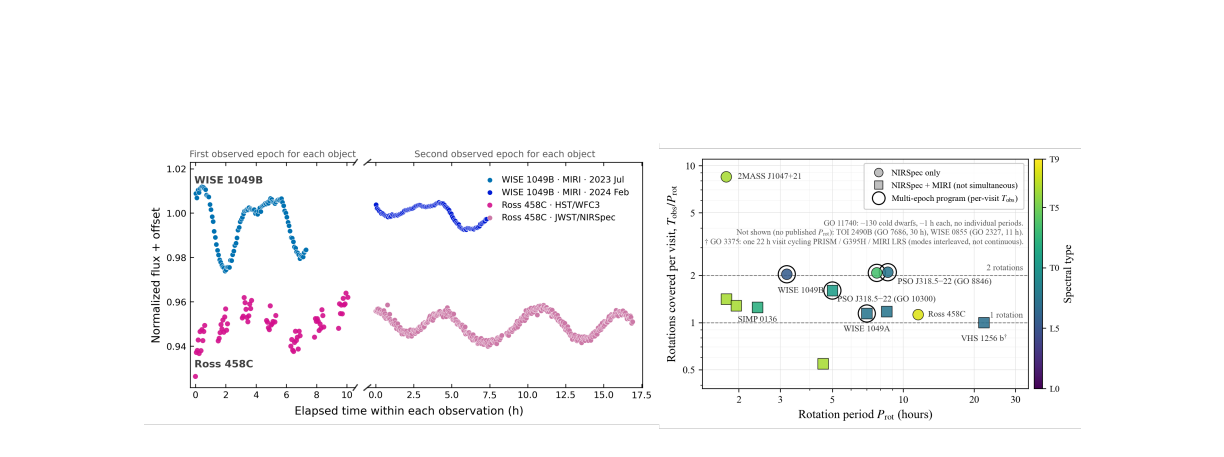
The observing strategy implicitly assumes that rotation periods are known well enough to schedule a full two-rotation visit. The paper itself notes revised periods for Ross 458C [24] and 2MASS J1721+33 [31], demonstrating that period determinations for such objects are not always secure.
more of objection 3
For targets without secure periods, the promised 'two consecutive rotations per visit' characterization cannot be guaranteed, and the time budget does not include a fallback strategy for period revisions or for scheduling failures. Please specify how the sample will be filtered for known periods, what minimum period precision is required, and how revised periods would be accommodated within a fixed 1,500-hour envelope.
4 minor objections
The paper says, at Section 4
Pith says: minor objection 1 of 4
Typo: 'spaning 2-20 hr' should be 'spanning 2-20 hr'.
The paper says, at References
Pith says: minor objection 2 of 4
Reference [4] is cited as a 2017 arXiv preprint; if a peer-reviewed version exists, it should be cited instead.
show 2 more
The paper says, at Section 3
Pith says: minor objection 3 of 4
The survey labeled 'GO 11740' is mentioned without a reference or description of its target sample; a brief description or citation would help the reader judge the claimed coverage gap.
The paper says, at Section 4
Pith says: minor objection 4 of 4
A compact table breaking the 1,500-hour estimate into NIRSpec initial visits, NIRSpec repeat epochs, MIRI observations, and overheads would make the arithmetic easier to verify and would clarify the role of each assumption.
What would settle it
Recompute the Section 4 budget for a concrete 30-target candidate list drawn from [40] and later L/T/Y rotation-period surveys, enforcing the paper's stated stratification by spectral type, rotation period, and inclination subset. For each target, charge 2×P_i for the initial visit and an additional 4×P_i for each of the 15 targets receiving two repeat epochs; add ETC-based MIRI/LRS or MRS times and realistic operational overheads. Accept only epochs schedulable as continuous two-rotation blocks. If the resulting total exceeds about 1500 h, or if fewer than 30 targets have known periods sufficient to guarantee those blocks, the order-1500-h claim and the population-comparison dataset it is used to promise do not follow from the stated assumptions.
from the skeptic's reading
How the review went
4 readings by deepseek-v4-flash · 11 Nov 2026
- Reader no verdict given
- Skeptic agrees
- Editor wrote the review in brief
- Referee major revision: 3 major objections, 4 minor
Not run on this paper: the simulated authors' defence.
Pith did not check this review's objections against the paper.
The review in full
The review in brief, machine-written
Quick take: this is a white paper arguing for a ~1500 hr JWST Multi-Cycle Treasury program on substellar weather, not a paper with new measurements. The scientific case is well assembled and the arithmetic inside the hour budget is consistent. The soft spot that matters is the time estimate: the budget scales linearly with the assumed 9 hr mean rotation period, and the paper both promises a stratified 2–22 hr sample and does not show the total survives a plausible sample mean of 12 hr.
What is actually new is the proposal itself. The motivations are drawn from recent JWST results the authors cite, which is appropriate for a proposal, and the paper does a service by collating the heterogeneous coverage in Fig. 2 and showing where the gaps are. The recommendation for standardized NIRSpec/PRISM plus MIRI coverage across L/T/Y, with multi-epoch repeats, is reasonable and would indeed create a legacy dataset. The authors know the literature; the reference list is current and mostly on point. The share of self-citations reflects that these authors are the ones producing much of the relevant data, so I do not see that as a flaw.
Weak spots, in order. First, as the stress-test note says, the 1500 hr total is tied to a 9 hr mean period. For 30 targets, two rotations per visit, and two extra epochs for half the sample, NIRSpec time is 120×<P> hr. If a stratified selection of fast, intermediate, and slow rotators has a mean of 12 hr, NIRSpec alone is 1440 hr, leaving almost nothing for the 60–250 hr of MIRI and overheads. The paper explicitly says the final request depends on the period distribution, so the authors are not hiding the issue, but a caveat is not a sensitivity analysis. A sample-construction table or a short break-even statement would settle it. Second, and related, the strategy assumes rotation periods are known well enough to schedule two full rotations. The paper itself notes revised periods for Ross 458C and 2MASS J1721+33, so a fallback for uncertain periods is worth addressing. Third, there are no sensitivity estimates showing that NIRSpec/PRISM and MIRI detect the expected variability across the full sample; that is a normal omission at white-paper stage but should appear in the full version.
Verdict: this is not a research result, so "unverified" is the right category. Who gets value: JWST time-allocation reviewers and anyone planning or comparing variability surveys. I would not cite it as a result, but I would use it as a reference point for survey design. If it arrives as a journal research article, I would desk reject it because there is no result to evaluate; if it is a white paper for a treasury call, send it for expert review. A referee should ask for the time-budget sensitivity analysis.
The strongest objection
Section 4's feasibility estimate is not robust to the one parameter that sets the whole time budget. For 30 targets, two rotations per visit, and two additional epochs for half the sample, the NIRSpec/PRISM time is 120×<P> hours: the initial observations are 30×<P>×2 = 60<P> hours, and the repeats are 15×<P>×2×2 = 60<P> hours. The paper asserts <P> = 9 h from [40] but simultaneously promises a stratified sample spanning 2-22 h with meaningful coverage of fast, intermediate, and slow rotators. If a plausible stratified selection has <P> = 12 h (for example, equal thirds with means near 4, 12, and 20 h), NIRSpec alone becomes 1440 h, leaving fewer than 60 h of the 1500-h envelope for the planned MIRI/LRS-MRS observations and no margin for operational overheads; the quoted total is exceeded before overheads are added. The same arithmetic exposes the dependence on rotation periods being known in advance: for targets without secure periods, and the paper itself notes revised periods for Ross 458C and 2MASS J1721+33 [24,31], a guaranteed two-rotation visit cannot be scheduled, so the promised 'two consecutive rotations per visit' characterization is not delivered. The text does acknowledge that the estimate is preliminary and that the final request depends on the period distribution, but an explicit caveat is not a sensitivity analysis. Since the legacy-dataset claim is conditional on completing full multi-rotation coverage, this unexamined distribution assumption is load-bearing.
Read in good faith, this is a white paper rather than an empirical study, and its scientific motivation is well supported by cited published JWST results on benchmark objects. The Section 4 arithmetic is internally consistent at <P> = 9 h. The load-bearing vulnerability is that the entire time budget is a linear function of the assumed mean rotation period, while the design simultaneously requires a stratified sample spanning 2-22 h. The paper never specifies the period distribution of its 30-target sample and provides no robustness calculation. Because total NIRSpec time is 120×<P> hours, moving from <P> = 9 h to <P> = 12 h consumes 1440 h before MIRI observations or overheads, which breaks the 1500-h envelope. The same assumption underlies the promise that every visit covers two full rotations, which requires knowing P_i in advance; the paper's own examples of revised periods show this is not guaranteed. The reader's weakest_assumption already identified the mean-period dependence, so I agree with that identification; my contribution is to make the linear sensitivity quantitative and to tie it to the stated stratification goal. Because the paper is a proposal with no verifiable measured result, the appropriate verdict remains UNVERDICTED rather than ACCEPT or REJECT; the concern should be read as a requirement for a concrete target list and a sensitivity calculation before the feasibility claim is accepted.
The referee's report
The scientific motivation is timely and well grounded in the recent JWST variability literature, and the Figure 2 assessment of rotational coverage across Cycles 1–5 is a useful synthesis. The time estimate is transparent arithmetic built from explicitly stated assumptions, with no fitted parameters or circular claims, which is to the paper's credit. If the program were executed as proposed, it would plausibly address a real gap: current samples are dominated by individual benchmarks with heterogeneous strategies. The central weakness is that the feasibility claim rests on a single point estimate of the mean rotation period, on unspecified signal-to-noise and exposure-time requirements, and on the assumption that periods are known well enough to schedule two-rotation visits. These issues are load-bearing for the headline 1,500-hour allocation and need to be addressed before the proposal's central claim is robust.
Pith's reading of the paper (a machine's summary, not the authors')
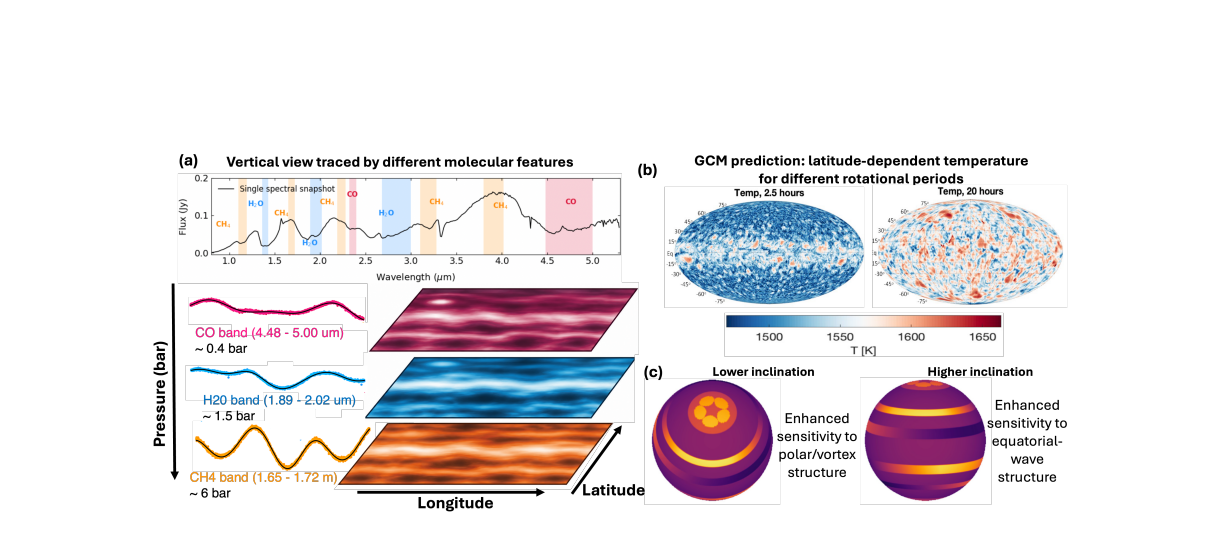
JWST time-resolved spectroscopy has shown that brown dwarf atmospheres vary in complex, wavelength-dependent ways — in WISE 1049A, carbon monoxide and methane vary more than water at comparable pressures — but the observations come from scattered programs with heterogeneous coverage that mostly target individual benchmark objects. This paper makes the case for replacing that patchwork with a single, coordinated JWST Multi-Cycle Treasury program of roughly 1,500 hours: about 30 brown dwarfs spanning spectral types L, T, and Y, rotation periods from 2 to 22 hours, and viewing geometries from pole-on to equator-on, each observed over two full rotations with NIRSpec/PRISM and MIRI, and about half revisited at three epochs spread over more than a year. The intended payoff is a uniformly designed and processed dataset of time-resolved spectra and variability diagnostics that would, for the first time, allow population-level comparisons, tests of three-dimensional circulation model predictions, and a framework for interpreting variability in both brown dwarfs and directly imaged giant exoplanets. The paper is a survey concept rather than a reported discovery, and it states that the time budget rests on preliminary assumptions about rotation periods, sensitivity, and scheduling.
What carries the argument. The load-bearing mechanism is the observing design itself: a stratified sample of roughly 30 brown dwarfs with a mean rotation period of 9 hours, each target visited for two consecutive rotations with NIRSpec/PRISM, complemented by MIRI mid-infrared spectroscopy at each epoch, and about half the sample revisited at a total of three epochs spread over more than a year. Two full rotations per visit is the unit that resolves the ambiguity between rotational modulation and slower atmospheric evolution and pins down periods, while the three-epoch structure separates short-term weather from longer-term climate. The arithmetic that carries the feasibility claim is explicit: 30 objects times 9 hours times 2 rotations gives about 540 hours per epoch; two additional epochs for half the sample adds another 540 hours; MIRI observations add 60–250 hours; and with overheads the total lands near 1,500 hours. The paper acknowledges that the final request would depend on the rotation-period distribution, sensitivity requirements, and observing feasibility.
Core claim. The paper's central claim is that the bottleneck in substellar weather science is no longer a single instrument or a single object but the absence of a deliberate, stratified sample. It argues that a JWST Multi-Cycle Treasury program of order 1,500 hours, built on NIRSpec/PRISM time-series spectroscopy as the core diagnostic with MIRI/LRS or MRS at each epoch to probe cloud-sensitive mid-infrared opacities, would deliver the dataset the field lacks. The design covers the L/T/Y spectral sequence, fast, intermediate, and slow rotators within the 2–22 hour observed period range, and a subset of targets with independently constrained inclinations spanning pole-on to equator-on views. Each visit would cover two consecutive rotations, and about half the sample would be observed at three epochs separated by months to more than a year, resolving period ambiguities and separating rotation-to-rotation weather from longer-term climate. The authors intend to establish that this coordinated design — roughly 540 hours for initial epochs, 540 more for follow-up epochs, and 60–250 hours of mid-infrared observations, about 1,500 hours with overheads — would produce a consistently designed and uniformly processed legacy dataset that independent GO programs could not assemble, enabling direct tests of how rotation, viewing geometry, and atmospheric regime shape observed variability.
The premise it rests on. The time budget and the ability to characterize variability assume a mean rotation period of 9 hours across the sample and assume that two consecutive rotations in one visit capture each target's variability at that epoch; if rotation periods turn out to be systematically longer, if scheduling cannot deliver two full rotations per visit, or if NIRSpec/PRISM and MIRI cannot detect the predicted variability amplitudes in the faintest Y dwarfs, the 1,500-hour estimate and the program's scientific goals would both fail.
If the paper is right (Pith's inferences, not the authors')
Population-level comparisons of variability amplitude, wavelength dependence, and light-curve morphology across L, T, and Y dwarfs would replace the current patchwork of single-object studies.
Predictions from three-dimensional circulation models — zonal jets, vortices, atmospheric waves, and their dependence on rotation and temperature — could be tested directly against observed light-curve morphologies across a range of rotational regimes.
Repeated two-rotation visits and multi-epoch monitoring would resolve rotational-period ambiguities of the kind that forced revisions for Ross 458c and 2MASS J1721+33, and would reveal how atmospheric features evolve from rotation to rotation and across years.
The inclination-constrained subset would test whether equator-on objects show larger variability amplitudes, redder colors, and stronger silicate absorption than pole-on objects, as current small samples suggest.
Uniformly reduced time-resolved spectra, spectroscopic light curves, and standardized variability measurements would become a community benchmark for retrieval and model-validation methods extending to directly imaged exoplanets and future facilities.
The two-rotation-per-epoch premise could be stress-tested now with existing longer-baseline JWST time series: if variability diagnostics keep changing beyond two rotations, single visits would not characterize an epoch, and the survey would need longer visits per target.
The most direct next step is a concrete, ranked target list with measured rotation periods and brightnesses; compiling it would immediately test whether the 9-hour mean and the 1,500-hour envelope survive contact with the actual field population.
If the predicted population trends hold (inclination-dependent amplitudes, rotation-regime-dependent morphology), the resulting dataset could serve as an empirical prior for interpreting single-epoch spectra of directly imaged exoplanets, where variability cannot be time-resolved.
A small pilot program covering the design's extremes — a fast and a slow rotator, an L and a Y dwarf, a pole-on and an equator-on target — would de-risk the full treasury investment before 1,500 hours are committed.
Check this review
Pith stored no record of this review's passes and took no fingerprint of it. Reviews made by code from 13 Nov 2026 on carry both.
How often reviews like this one are right
Reviews like this one: written by deepseek-v4-flash, where what was read was not recorded.
How often objections from reviews like this one are right: not yet measured
Reviews by people
This review was written by a machine. No person has reviewed this paper on Pith yet. A scientist listed on Pith can review it for a fee, and their review is published here whatever it concludes.
The paper
Abstract
Atmospheric variability provides a unique window into the three-dimensional structure, dynamics, and evolution of brown dwarf and giant exoplanet atmospheres. Recent JWST time-resolved spectroscopic observations have revealed complex wavelength-dependent variability, offering unprecedented insights into cloud structures, thermal perturbations, and atmospheric chemistry. However, existing programs have focused primarily on individual benchmarks and specific scientific questions, resulting in heterogeneous spectral and temporal coverage and leaving important regions of the substellar population underexplored, particularly across a broad range of rotation periods, spectral types, and viewing geometries. A JWST Multi-Cycle Treasury program could systematically investigate substellar weather across a diverse, well-characterized population. By combining broad infrared spectroscopic coverage with observations spanning multiple rotations and strategically selected epochs, this program would constrain the contributions of different physical mechanisms while investigating how atmospheric structures depend on rotation, viewing geometry, and fundamental physical properties. Extended monitoring would also improve rotational-period determinations and reveal how atmospheric features evolve from rotation to rotation and over longer timescales. This coordinated effort would provide a consistently designed and uniformly processed dataset of time-resolved spectra and variability diagnostics, enabling population-level comparisons, testing predictions from three-dimensional circulation models, and establishing a framework for interpreting the atmospheric diversity and evolution of brown dwarfs and directly imaged giant exoplanets.
The paper's own sentences, arranged, kept beside the review and separate from it. Each label is drawn from a closed vocabulary; the number beside it is the probability the classifier gave that label. No sentence in this record was written by a model.
abstract compiled · 2026-11-11
The authors' main claim, as the classifier picked it out 0.91
“This coordinated effort would provide a consistently designed and uniformly processed dataset of time-resolved spectra and variability diagnostics, enabling population-level comparisons, testing predictions from three-dimensional circulation models, and establishing a framework for interpreting the atmospheric diversity and evolution of brown dwarfs and directly imaged giant exoplanets.”
How the main claim is stated: asserted 0.68
What the abstract itself states, as probabilities: claims first 0.09 · states limitation 0.10 · human participants 0.02 · controlled comparison 0.04 · randomized assignment 0.01 · states quantitative result 0.03 · compares with prior results 0.40 · mentions code or data availability 0.03
The abstract, sentence by sentence
This table labels the abstract only (arXiv listing abstract v1). The number is the probability the classifier gave the label.
| Sentence | Role | The authors' own work | States the main conclusion | Strength |
|---|---|---|---|---|
| Atmospheric variability provides a unique window into the three-dimensional structure, dynamics, and evolution of brown dwarf and giant exoplanet atmospheres. | background 1.00 | 0.04 | 0.05 | asserted 0.98 |
| Recent JWST time-resolved spectroscopic observations have revealed complex wavelength-dependent variability, offering unprecedented insights into cloud structures, thermal perturbations, and atmospheric chemistry. | background 0.98 | 0.08 | 0.04 | asserted 1.00 |
| However, existing programs have focused primarily on individual benchmarks and specific scientific questions, resulting in heterogeneous spectral and temporal coverage and leaving important regions of the substellar population underexplored, particularly across a broad range of rotation periods, spectral types, and viewing geometries. | gap 0.99 | 0.06 | 0.05 | asserted 1.00 |
| A JWST Multi-Cycle Treasury program could systematically investigate substellar weather across a diverse, well-characterized population. | contribution 0.51 | 0.05 | 0.26 | hedged possibility 1.00 |
| By combining broad infrared spectroscopic coverage with observations spanning multiple rotations and strategically selected epochs, this program would constrain the contributions of different physical mechanisms while investigating how atmospheric structures depend on rotation, viewing geometry, and fundamental physical properties. | method 0.70 | 0.06 | 0.15 | hedged possibility 0.83 |
| Extended monitoring would also improve rotational-period determinations and reveal how atmospheric features evolve from rotation to rotation and over longer timescales. | contribution 0.66 | 0.06 | 0.06 | asserted 0.58 |
| This coordinated effort would provide a consistently designed and uniformly processed dataset of time-resolved spectra and variability diagnostics, enabling population-level comparisons, testing predictions from three-dimensional circulation models, and establishing a framework for interpreting the atmospheric diversity and evolution of brown dwarfs and directly imaged giant exoplanets. | contribution 0.45 | 0.06 | 0.44 | asserted 0.68 |
What kind of paper the classifier reports this is: position or commentary 1.00 · evidence from argument 0.84
What was examined, and what was not
Sources read
- arXiv listing abstract v1
Not examined
- full text
- figures and tables
- references and citing sentences
- relations to other papers
Levels run
- P abstract
Not run
- S sections
- T body sentences
- C citations
- R cross-paper relations
How the labels were made
Compiled by classifier-1.13.0 via TypeSafe API, question bank abstract-p1-20260923, 2026-11-11: 1 request, 5,734 input tokens.
Every quoted sentence on this record is the authors'. Every label is from Pith's closed vocabulary, with the probability shown beside it. This record as JSON
Figures (2)
Figures are the authors', reproduced from the paper.
References (45)
- [24] —. 2026, arXiv preprint arXiv:2609.22072 on PithPith's reviewarXiv
- [31] O’Toole, C., et al. 2026, A&A, 710, A22 on Pith
- [1] Akhmetshyn, R., et al. 2025, The Astrophysical Journal, 993, 237 6 on Pith
- [2] Akın, C., et al. 2026, Astronomy & Astrophysics, 708, A110 on Pith
- [3] Apai, D., et al. 2013, ApJ, 768, 121 on Pith
- [4] Apai, D., et al. 2017, arXiv e-prints, arXiv:1708.02821 on PithPith's reviewarXiv
- [5] Artigau, É., et al. 2009, ApJ, 701, 1534 on Pith
- [6] Biller, B. A., et al. 2013, ApJ, 778, L10 on Pith
- [7] —. 2024, MNRAS, 532, 2207 on Pith
- [8] Buenzli, E., et al. 2014, ApJ, 782, 77 on Pith
- [9] Burningham, B., et al. 2021, MNRAS, 506, 1944 on Pith
- [10] Chen, X., et al. 2024, MNRAS, 533, 3114 on Pith
- [11] —. 2025, MNRAS, 539, 3758 on Pith
- [12] Faherty, J. K., et al. 2026, ARA&A, 64, 409 on Pith
- [13] Fuda, N., et al. 2024, The Astrophysical Journal Letters, 975, L32 on Pith
- [14] —. 2024, ApJ, 965, 182 on Pith
- [15] Hammond, M., et al. 2023, Monthly Notices of the Royal Astronomical Society, 525, 150 on Pith
- [16] Kaspi, Y., et al. 2023, Nature Astronomy, 7, 1463 on Pith
- [17] Koen, C. 2013, MNRAS, 428, 2824 on Pith
- [18] Kothari, H., et al. 2026, ApJ, 1008, 131 on Pith
show 25 more
- [19] Kühnle, H., et al. 2025, A&A, 695, A224 on Pith
- [20] Lam, M., et al. 2026, Astronomy & Astrophysics, 709, A56 on Pith
- [21] Lee, E. K., et al. 2023, MNRAS, 523, 4477 on Pith
- [22] Luna, J. L., et al. 2021, ApJ, 920, 146 on Pith
- [23] Manjavacas, E., et al. 2019, AJ, 157, 101 on Pith
- [25] Marley, M. S., et al. 2010, ApJ, 723, L117 on Pith
- [26] McCarthy, A. M., et al. 2025, ApJ, 981, L22 on Pith
- [27] Metchev, S. A., et al. 2015, ApJ, 799, 154 on Pith
- [28] Miles, B. E., et al. 2026, arXiv e-prints, arXiv:2609.20664 on PithPith's reviewarXiv
- [29] Nasedkin, E., et al. 2025, A&A, 702, A1 on Pith
- [30] Oliveros-Gomez, N., et al. 2026, ApJ, 997, 136 7 on Pith
- [32] Plummer, M. K., et al. 2026, The Astronomical Journal, 171, 195 on Pith
- [33] Radigan, J. 2014, ApJ, 797, 120 on Pith
- [34] Rodríguez-Ovalle, P., et al. 2025, Astronomy & Astrophysics, 696, A173 on Pith
- [35] Schrader, M. A., et al. 2026, A&A, 713, A192 on Pith
- [36] Showman, A. P., et al. 2019, The Astrophysical Journal, 883, 4 on Pith
- [37] Simon, A. A., et al. 2016, The Astrophysical Journal, 817, 162 on Pith
- [38] Suárez, G., et al. 2023, ApJ, 954, L6 on Pith
- [39] Tan, X., et al. 2021, MNRAS, 502, 678 on Pith
- [40] Tannock, M. E., et al. 2021, AJ, 161, 224 on Pith
- [41] Tremblin, P., et al. 2015, ApJ, 804, L17 on Pith
- [42] Vos, J. M., et al. 2017, ApJ, 842, 78 on Pith
- [43] Vos, J. M., et al. 2020, AJ, 160, 38 on Pith
- [44] Whiteford, N., et al. 2026, arXiv e-prints, arXiv:2608.06583 on PithPith's reviewarXiv
- [45] Zhou, Y., et al. 2022, The Astronomical Journal, 163, 17 8 on Pith
Challenges and discussion
Disagree with the review, or know something it missed? Leave a comment, or challenge this review formally: a challenge becomes a permanent entry in this paper's record, and its decision is published here.
Come back by email
A short list of the week's newly reviewed papers. Nothing is sent until you confirm from your inbox, and every email has a link that stops it. No account.
No comments yet.
Sign in to comment