Artificial Intelligence · arXiv:2609.31430 v1 · submitted 25 Sep 2026 · 24 references
Compress What You See, Not What You Say: Anchored Context Distillation for Latent-Observation Software Engineering Agents
The paper says
“Tool observations dominate the context of software-engineering agents, making long interaction histories costly to maintain. Existing context compression methods can discard information needed by later actions, while adapting agents to soft-token representations can compromise their original behavior.”
more of the abstract
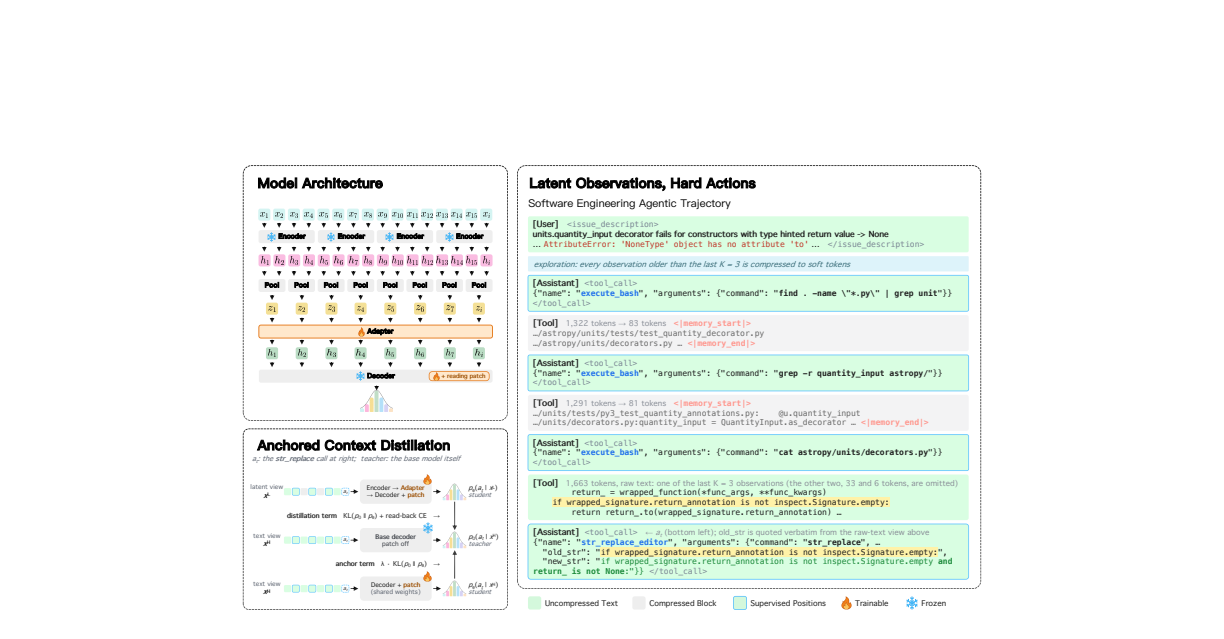
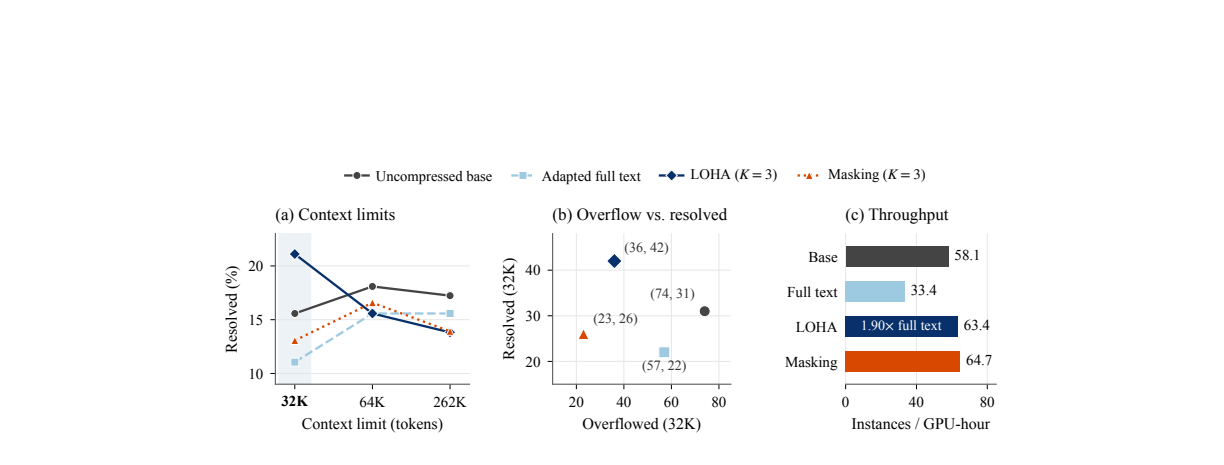
To reduce context while preserving action-critical information and agent behavior, we combine Latent Observations, Hard Actions (LOHA), a context layout that separates compressed history from text needed for exact reference, with Anchored Context Distillation (ACD), a training method that enables latent reading while constraining behavioral drift. LOHA compresses older tool observations into soft tokens while retaining the agent's own turns and the last K observations in text, providing compact access to historical information and exact access to recent content. To enable the agent to use this representation, ACD distills the base model's full-text predictions into the latent view while anchoring its behavior on plain-text inputs to the same base model. On SWE-bench Verified, K=3 reduces context per call by 43% for Qwen3-4B and 57% for SWE-Master-4B-RL, with resolve rates of 12.1% and 21.8% versus 14.5% and 27.5% for their uncompressed bases. A single-run recency sweep reaches 14.4% and 23.0% at K=8, with larger windows generally favoring task performance over compression. Under a 32K-token limit, Qwen3 with K=3 resolves 21.1% of a 199-instance subset versus 11.1% for the same adapted agent using full text. In concurrent single-GPU serving, it achieves 1.9 times that full-text agent's instance throughput.
from the abstract
Pith says
Machine review · deepseek-v4-flash · 28 Sep 2026 · what was read was not recorded · not checked by a person
It can be wrong. Challenge this review or reply to it.
Holds up, with conditions. Solid compression engineering with honest reporting, but the claim that latent history beats plain masking is thinner than the headline suggests and rests on single-run and SWE-Master-only cells. This line is wrong
3 major objections · 5 minor
How often objections from reviews like this one are right: not yet measured
Not checked: figures, code, what the 24 references say.
The paper says, at §3.1, Table 1, Appendix B.1
The review did not quote this passage.
Pith says: Objection 1 of 3 · major
The paper's headline differentiator — retaining a compressed latent history rather than deleting it — is not supported by the flagship Qwen3 comparison. Hard-Last-3 resolves 60.5±0.7 versus masking's 61.0±5.3, a statistical tie within one standard deviation, while using 24.8K versus 20.1K tokens per call.
more of objection 1
The sentence 'retaining a latent history therefore preserves more task performance on this base' (SWE-Master paragraph of Section 3.1) rests entirely on the SWE-Master arm (109.0±7.1 versus 88.0±1.0), yet the direct LOHA-versus-masking paired test is not reported for either family; Appendix B.1 gives McNemar tests only against the base agent. Please report the direct paired comparisons (at minimum for the SWE-Master per-seed counts 114/104 versus 88/87/89 in Table 9) or reframe the contribution so that latent retention is presented as setting-specific rather than generally superior to masking; as written, the abstract and Section 3.1 overstate the evidence for the masking advantage.
The paper says, at §3.2, Table 4
The review did not quote this passage.
Pith says: Objection 2 of 3 · major
The 32K context-limit result that carries the Qwen3 latent-beats-masking claim (42 versus 26, p=0.0025) is a single run per condition, and the paper's own numbers show the gap sits inside the stochasticity band. On the same 199-instance subset at 262K (Table 4), Hard-Last-3 and masking are tied at 27.5 versus 27.7; the same Hard-Last-3 agent moves from a 27.5 mean …
more of objection 2
… at 262K to 42 in the 32K single run; and the single-run recency sweep (Table 3a) varies Qwen3's resolved count by 8 instances across K=3/4/8. With temperature-0.7 decoding, single-run differences of 16 instances are not self-certifying. Please add at least two further seeds to the 32K comparison, or explicitly downgrade the claim in Section 3.2 and the abstract to a single-run result. The distinction matters because this cell is the only Qwen3 evidence that latent history outperforms masking anywhere short of the full window.
The paper says, at §2.2, Appendix E.6, Table 3a
The review did not quote this passage.
Pith says: Objection 3 of 3 · major
The design premise that recency is a reliable proxy for which observations later tool calls will quote verbatim is load-bearing but never directly tested. The paper's own probe (Appendix E.6) yields only 20.4%, 15.6%, and 15.1% exact recitation at 4x, 8x, and 16x compression, so any quoted literal that falls outside the Hard-Last-K window is effectively unrecoverable from latent history; …
more of objection 3
… the K=0 collapse to 37/499 (Qwen3) and 51/499 (SWE-Master) in Table 3a quantifies this failure mode, and Section 2.2 acknowledges that compression does not guarantee verbatim reconstruction. The only evidence for recency reliability is the K-sweep, which is single-run and non-monotonic (Qwen3: 68/76/72 at K=3/4/8). A direct measurement of the age distribution of quoted old_str literals in the CoderForge trajectories — the fraction that fall within a K-observation recency window — would confirm or bound the premise and should be reported. As it stands, the Hard-Last-K policy is plausible but unvalidated on its central assumption.
5 minor objections
The paper says, at Table 1, Appendix B.1
Pith says: minor objection 1 of 5
The masking standard deviation (5.3) is about seven times LOHA's (0.7), and B.1 notes masking's large seed-to-seed variation (99 versus 43 cap terminations on average). The masking mean is therefore the least stable number in the main table; a third LOHA seed (and ideally a fourth masking seed) would make the tie-or-favor comparison in the first major comment interpretable rather than variance-dominated.
The paper says, at §3.4, Appendix B.5, abstract
Pith says: minor objection 2 of 5
The 1.9x throughput figure depends on the current server re-encoding every observation at each call (encoder estimate 1.64 PF versus 0.02 PF with per-observation caching, B.5) and on the 84th-completion cutoff. The paper discloses both, but with caching the total estimate (2.12 PF) is above the base's 1.82 PF, so the abstract's '1.9x instance throughput' should carry a pointer to these conditions to avoid implying an end-to-end compute win.
show 3 more
The paper says, at Table 3b, Table 7, Appendix D.4
Pith says: minor objection 3 of 5
In Table 3b, the reference row uses top-16 cached teacher targets while all other teacher variants use top-64, and the cached-coarsening argument (D.4) depends on M. State explicitly whether this target-width difference could confound the teacher comparison, or re-run the reference row with top-64 targets.
The paper says, at Appendix A.3
Pith says: minor objection 4 of 5
The scaffold's editor has a bounded edit-distance fallback that can rescue non-matching old_str arguments. The fallback is shared across conditions, but its usage is only logged and never reported. A sentence reporting fallback frequency per condition would let the reader judge how much of the resolve gap is absorbed by the fallback rather than by the compressed or text history.
The paper says, at Figure 2 caption
Pith says: minor objection 5 of 5
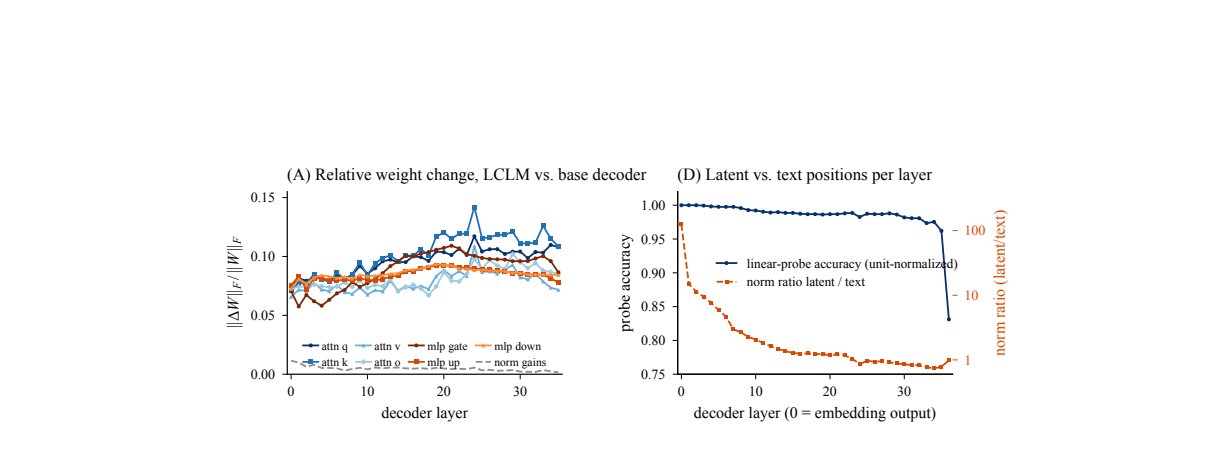
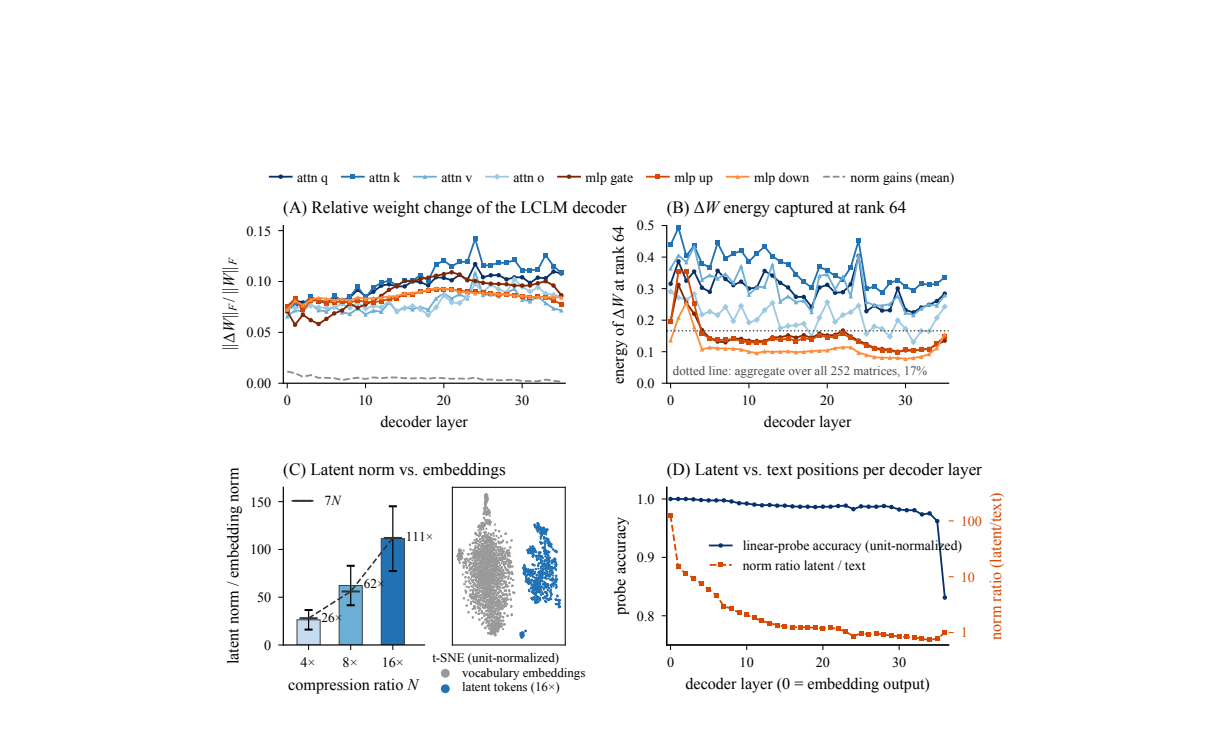
In panel (A), 'norm gains' is plotted with layer 0 labeled as the embedding output; clarify whether that point refers to the embedding normalization or to a separate quantity, since the embedding layer has no transformer normalization gain.
What would settle it
Replicate the 32K-token context-limit comparison (LOHA Hard-Last-3 vs masking vs adapted full-text on the same 199-instance subset) with three seeds per condition, reporting per-seed resolved counts and the paired McNemar p-value for LOHA vs masking (Section 3.2 currently reports one run, gap 16, p=0.0025). If the mean paired gap falls below about 8 instances or p>0.05 across seeds, the latent component's added value over deletion is unverified on Qwen3, and masking becomes the better default at that setting.
from the skeptic's reading
How the review went
4 readings by deepseek-v4-flash · 28 Sep 2026
- Reader holds up, with conditions
- Skeptic partly agrees
- Editor wrote the verdict above
- Referee major revision: 3 major objections, 5 minor
Not run on this paper: the simulated authors' defence.
Pith did not check this review's objections against the paper.
The review in full
The review in brief, machine-written
Two things to know. First, the core compression claim is real and externally verified: on SWE-bench Verified, LOHA+ACD cuts context per call by 43–57% at a moderate resolve cost, and under a 32K limit the compressed layout clearly beats the adapted full-text agent (21.1% vs 11.1%, paired McNemar). That is a genuine, useful result for coding-agent serving. Second, the actual differentiator over trivial masking — retaining latent history rather than deleting old observations — is the thinnest part, and the paper is only partly candid about how thin.
The design is sensible: recency-window verbatim text for exact tool arguments, soft-token latent history for everything older, and self-anchored distillation to teach latent reading without destroying the base policy. The low-rank patch initialized from the LCLM weight delta is a neat trick, and the read-back-vs-behavior dissociation (rank-256 reads better but acts worse) is worth knowing. The main claims are multi-seeded on both families, the per-call vs per-trajectory discrepancy for Qwen3 is disclosed plainly, and the self-anchoring is a design choice, not circularity — the outcomes are benchmarked resolve rates.
Now the soft spots, in proportion. On Qwen3 at full window, LOHA Hard-Last-3 resolves 12.1% vs masking's 12.2% while using more context (24.8K vs 20.1K per call). That is not a latent advantage; masking is the better default there. The latent-better-than-masking case rests on SWE-Master (multi-seed, 21.8 vs 17.6) and the Qwen3 32K cell, which is a single run whose 42-resolve count sits against the same agent's 27.5-seed-mean on the 199-subset at 262K — a big enough swing that the single-run gap is not self-certifying. The recency sweep is single-run and non-monotonic. I also can't reproduce any of this: no code, no checkpoints.
I'd push back gently on the reviewer instinct that recency-reliability is the load-bearing flaw. It's a real generalizability risk, but the paper prices it with the K-sweep, and the fuzzy-match editor fallback plus tool re-retrieval absorb the misses. The K=0 collapse (37/499 Qwen3, 51/499 SWE-Master) actually confirms their own thesis that latent history alone can't carry exact tool arguments. The robustness of the masking-vs-latent differentiation is the sharper concern.
This deserves a real referee. The compression claim is solid engineering, the 32K result is the most valuable externally measured thing in it, and the honesty about seed counts and caveats is above the field's average. I'd ask the authors to multi-seed the 32K cell and either report a direct LOHA-vs-masking paired test on SWE-Master or soften the claiming. Send it out.
The strongest objection
Two claims anchor the paper: (1) LOHA+ACD cuts context per call 43%/57% with a modest resolve cost, and (2) retaining compressed latent history is better than deleting it (masking). Claim 1 is solid and multi-seeded. Claim 2, the actual differentiator over trivial masking, is where support is thinnest. On Qwen3 at the full 262K window (Table 1), LOHA Hard-Last-3 resolves 60.5±0.7 (12.1%) vs masking 61.0±5.3 (12.2%), while using more context (24.8K vs 20.1K in/call): the latent component buys nothing measurable on the flagship comparison. Its advantage appears only on SWE-Master (21.8 vs 17.6; per-seed 114/104 vs 88/87/89, with LOHA-vs-masking significance not directly reported) and on the Qwen3 32K cell (42 vs 26, p=0.0025), which is a single run. The same Qwen3 Hard-Last-3 agent resolves a 199-subset mean of 27.5 at 262K but 42 in the 32K single run, a ~50% swing, showing per-run stochasticity (temperature 0.7) is large enough that single-run gaps of this magnitude are not self-certifying. The recency sweep (Table 3a) is also single-run and non-monotonic (Qwen3: 68/76/72 at K=3/4/8), a spread of 8 instances within plausible noise. Paired McNemar handles instance-pairing but not between-condition seed luck. If the 32K latent-better-than-masking advantage does not replicate across seeds, the honest conclusion is that on Qwen3 masking is the better default and the latent contribution is setting-specific. The reader's recency-reliability concern is real but partly mitigated: the paper's own K-sweep prices recency failure, and the fuzzy-match editor fallback (Section A.3) plus tool re-retrieval absorb misses; that concern is a generalizability risk, less load-bearing than the robustness of the differentiating claim.
The reader's weakest_assumption (recency reliability) is a real mechanism risk but is largely price-tested by the paper itself: the Hard-Last-K sweep measures resolve across K in {0,1,2,3,4,8}, the fuzzy-match editor fallback (Section A.3) and tool re-retrieval absorb some recency misses, and the low exact-recitation figures of Appendix E.6 are openly reported. That makes recency a generalizability concern rather than a direct threat to the measured numbers. The load-bearing issue I find instead is the robustness of the latent-history component's marginal value over the trivial masking baseline, which is the paper's differentiator: at Qwen3 full window (Table 1), LOHA and masking are statistically indistinguishable on resolve (12.1 vs 12.2) with LOHA using more context (24.8K vs 20.1K); the advantage appears only on multi-seed SWE-Master and in a single-run 32K cell, where the same agent's 199-subset counts swing from 27.5 (262K mean) to 42 (32K run), indicating large per-run stochasticity. The concrete check, multi-seed replication of the 32K LOHA-vs-masking comparison with paired McNemar, would settle whether the central contribution holds or reduces to a setting-specific effect. The principal multi-seed claims (resolve rates, per-call context reduction, serving throughput) are well supported, and the paper openly discloses the single-run and subset-bias caveats the reader flagged (e.g., [b441] on encoder caching and the 20-instance diagnostic), so the CONDITIONAL verdict stands; my stress-test tightens the rationale rather than changing it.
The referee's report
If the results hold, the paper makes a useful contribution: a principled context layout for soft-token compression of agent observations, an honest separation of adaptation effects (K=infinity arm) from compression effects (K=3), multi-seed main comparisons with paired McNemar tests, a self-anchoring design choice validated by externally benchmarked resolve rates (which keeps the per-call savings claim from being circular), early-stop grading under context caps, and a genuinely informative negative result that better literal read-back does not imply better agent behavior (Table 6, Appendix B.4). The paper also discloses load-bearing caveats: per-call savings outrun per-trajectory savings for Qwen3, the serving server re-encodes observations on every call, and cached-distribution KL estimates are validated. The experimental design is a fair template for evaluating latent-history compression in coding agents. Its significance is limited by the fragility of the latent-better-than-masking claim, which currently rests on one multi-seed family and one single-run cell.
Pith's reading of the paper (a machine's summary, not the authors')
Software-engineering agents accumulate long contexts because every file view, search, and test log piles into the prompt. This paper claims you can shrink that history by compressing only the tool observations — the things the agent sees — while leaving the agent's own turns and the most recent observations in plain text, and that a training method called Anchored Context Distillation lets the agent read the compressed history without drifting from its original behavior. On SWE-bench Verified, keeping the last 3 observations verbatim cuts context per call by 43% (Qwen3-4B) and 57% (SWE-Master-4B-RL), with resolve rates dropping from 14.5% to 12.1% and from 27.5% to 21.8%. The payoff sharpens under tight memory: at a 32K-token cap the compressed agent resolves 21.1% of a 199-instance subset versus 11.1% for the same adapted agent using full text. The paper's point is that the right representation for an agent history is not all-latent or all-text but a deliberate split, reserving exact text for whatever a future tool call will quote.
What carries the argument. The load-bearing object is the Hard-Last-$K$ recency policy inside LOHA: each observation enters as text, and once it slips past the window of the $K$ most recent observations it is re-rendered as soft tokens by a frozen long-document compressor's encoder–adapter (roughly one embedding per 16 text tokens), while the agent's own turns and anything shorter than 128 characters stay verbatim. Because exact recitation from latent history is poor — the paper's own probe measures 20.4%, 15.6%, and 15.1% exact recall of later-quoted literals at 4x, 8x, and 16x compression — the verbatim window is what lets string-replacement tools keep working. On top sits ACD, a two-term objective: a distillation term (forward KL from the base model's full-text predictions, plus read-back cross-entropy on substrings of the compressed observations) teaches latent reading, and an anchor term (KL on full-text inputs) regularizes against behavioral drift, both computed from cached top-64 teacher distributions. The student decoder is the base model plus a rank-64 low-rank patch initialized from the truncated SVD of the difference between the compressor decoder's weights and the base decoder's weights; only the patch, the adapter, and normalization gains are trained.
Core claim. The central claim is that exact text and semantic access make different demands on a compressed history, and an agent context layout should separate the two. LOHA (Latent Observations, Hard Actions) keeps the system prompt, issue description, and all assistant turns in ordinary text while encoding older tool-observation bodies as soft tokens at roughly one-sixteenth of their length, retaining the last $K$ observations ($K=3$ by default) verbatim so tool arguments that must match source text exactly still have their reference. ACD (Anchored Context Distillation) then trains the agent to read the latent view by matching its base model's full-text predictions with a distillation term — plus a small read-back term that directly supervises literal recovery — while an anchor term constrains predictions on plain-text inputs to stay close to the same base model. The paper argues this joint design preserves action-critical information at low cost: the recency window covers the common pattern where an edit follows a file view, and self-anchoring keeps the adapted agent behaving like the original. The evaluation shows the trade-off: roughly 43–57% fewer context tokens per call at the full window with a 2–6 point resolve-rate cost, and a decisive win over deletion-based compression when the context window is the binding constraint.
The premise it rests on. Recency is assumed to be a reliable stand-in for 'which old text a future tool call will quote verbatim', so anything that leaves the last-$K$ window is compressed without predicting whether a later edit will need its exact string.
If the paper is right (Pith's inferences, not the authors')
At the full context window, $K=3$ buys a 43–57% per-call context reduction at a resolve-rate cost of roughly 2–6 points on SWE-bench Verified, and larger windows ($K=8$) recover most of the lost performance at higher compute.
Retaining a compressed latent history beats deleting old observations: under a 32K-token cap LOHA resolves 21.1% of a 199-instance subset versus 11.1% for the adapted full-text agent and 13% for masking, with a paired McNemar p-value of 0.0002 against full text.
The fully latent policy ($K=0$) collapses because exact tool arguments cannot be recited from soft tokens, so a verbatim recent window is the component that preserves action fidelity.
Self-anchoring — the base model serving as both distillation teacher and behavioral anchor — preserves tool-use behavior where external teachers induce loop terminations and fewer patches, and better literal recall alone does not improve task performance.
The same 'keep verbatim whatever an action will quote, make everything else latent' split should transfer to other tool-using agents — web automation, database clients, terminal shells — because the failure mode the paper documents (15–20% exact recitation from compressed history) is general, not specific to code editing.
The strongest practical case is not the full-window throughput gain but staying under a hard memory ceiling: the 21.1% versus 11.1% gap at 32K suggests the method's value compounds exactly where contexts overflow, which is also where per-token serving cost is highest.
A testable extension the paper gestures toward but does not build: replace the fixed recency window with a learned policy that predicts which observations a later tool call will quote verbatim and keeps those as text while compressing the rest — the ablation data ($K=4$ beating $K=8$ on Qwen3) shows window choice is not monotonic, so there is headroom for such allocation.
Check this review
Pith stored no record of this review's passes and took no fingerprint of it. Reviews made by code from 13 Nov 2026 on carry both.
How often reviews like this one are right
Reviews like this one: written by deepseek-v4-flash, where what was read was not recorded.
How often objections from reviews like this one are right: not yet measured
Reviews by people
This review was written by a machine. No person has reviewed this paper on Pith yet. A scientist listed on Pith can review it for a fee, and their review is published here whatever it concludes.
The paper
Abstract
Tool observations dominate the context of software-engineering agents, making long interaction histories costly to maintain. Existing context compression methods can discard information needed by later actions, while adapting agents to soft-token representations can compromise their original behavior. To reduce context while preserving action-critical information and agent behavior, we combine Latent Observations, Hard Actions (LOHA), a context layout that separates compressed history from text needed for exact reference, with Anchored Context Distillation (ACD), a training method that enables latent reading while constraining behavioral drift. LOHA compresses older tool observations into soft tokens while retaining the agent's own turns and the last K observations in text, providing compact access to historical information and exact access to recent content. To enable the agent to use this representation, ACD distills the base model's full-text predictions into the latent view while anchoring its behavior on plain-text inputs to the same base model. On SWE-bench Verified, K=3 reduces context per call by 43% for Qwen3-4B and 57% for SWE-Master-4B-RL, with resolve rates of 12.1% and 21.8% versus 14.5% and 27.5% for their uncompressed bases. A single-run recency sweep reaches 14.4% and 23.0% at K=8, with larger windows generally favoring task performance over compression. Under a 32K-token limit, Qwen3 with K=3 resolves 21.1% of a 199-instance subset versus 11.1% for the same adapted agent using full text. In concurrent single-GPU serving, it achieves 1.9 times that full-text agent's instance throughput.
The paper's own sentences, arranged, kept beside the review and separate from it. Each label is drawn from a closed vocabulary; the number beside it is the probability the classifier gave that label. No sentence in this record was written by a model.
abstract compiled · 2026-09-28
The authors' main claim, as the classifier picked it out 0.48
“Under a 32K-token limit, Qwen3 with K=3 resolves 21.1% of a 199-instance subset versus 11.1% for the same adapted agent using full text.”
How the main claim is stated: asserted 1.00
What the abstract itself states, as probabilities: claims first 0.05 · states limitation 0.75 · human participants 0.03 · controlled comparison 0.96 · randomized assignment 0.02 · states quantitative result 0.99 · compares with prior results 0.96 · mentions code or data availability 0.03
The abstract, sentence by sentence
This table labels the abstract only (arXiv listing abstract v1). The number is the probability the classifier gave the label.
| Sentence | Role | The authors' own work | States the main conclusion | Strength |
|---|---|---|---|---|
| Tool observations dominate the context of software-engineering agents, making long interaction histories costly to maintain. | background 1.00 | 0.10 | 0.02 | asserted 1.00 |
| Existing context compression methods can discard information needed by later actions, while adapting agents to soft-token representations can compromise their original behavior. | gap 0.74 | 0.06 | 0.03 | asserted 0.83 |
| To reduce context while preserving action-critical information and agent behavior, we combine Latent Observations, Hard Actions (LOHA), a context layout that separates compressed history from text needed for exact reference, with Anchored Context Distillation (ACD), a training method that enables latent reading while constraining behavioral drift. | contribution 0.77 | 0.86 | 0.29 | asserted 0.99 |
| LOHA compresses older tool observations into soft tokens while retaining the agent's own turns and the last K observations in text, providing compact access to historical information and exact access to recent content. | method 0.98 | 0.76 | 0.07 | asserted 1.00 |
| To enable the agent to use this representation, ACD distills the base model's full-text predictions into the latent view while anchoring its behavior on plain-text inputs to the same base model. | method 0.98 | 0.79 | 0.06 | asserted 1.00 |
| On SWE-bench Verified, K=3 reduces context per call by 43% for Qwen3-4B and 57% for SWE-Master-4B-RL, with resolve rates of 12.1% and 21.8% versus 14.5% and 27.5% for their uncompressed bases. | result 1.00 | 0.95 | 0.22 | asserted 1.00 |
| A single-run recency sweep reaches 14.4% and 23.0% at K=8, with larger windows generally favoring task performance over compression. | result 0.97 | 0.93 | 0.07 | asserted 0.95 |
| Under a 32K-token limit, Qwen3 with K=3 resolves 21.1% of a 199-instance subset versus 11.1% for the same adapted agent using full text. | result 1.00 | 0.94 | 0.14 | asserted 1.00 |
| In concurrent single-GPU serving, it achieves 1.9 times that full-text agent's instance throughput. | result 1.00 | 0.92 | 0.08 | asserted 1.00 |
What kind of paper the classifier reports this is: method or tool 1.00 · evidence from observation or experiment 0.98
What was examined, and what was not
Sources read
- arXiv listing abstract v1
Not examined
- full text
- figures and tables
- references and citing sentences
- relations to other papers
Levels run
- P abstract
Not run
- S sections
- T body sentences
- C citations
- R cross-paper relations
How the labels were made
Compiled by classifier-1.13.0 via TypeSafe API, question bank abstract-p1-20260923, 2026-09-28: 1 request, 7,215 input tokens.
Every quoted sentence on this record is the authors'. Every label is from Pith's closed vocabulary, with the probability shown beside it. This record as JSON
Figures (4)
Figures are the authors', reproduced from the paper.
References (24)
- [4] Geoffrey Hinton, Oriol Vinyals, and Jeff Dean. Distilling the knowledge in a neural network. arXiv preprint arXiv:1503.02531, on PithPith's reviewarXiv
- [8] Qwen Team. Qwen3 technical report. arXiv preprint arXiv:2505.09388, on PithPith's reviewarXiv
- [9] Jincheng Ren, Siwei Wu, Yizhi Li, Kang Zhu, Shu Xu, Boyu Feng, Ruibin Yuan, Wei Zhang, Riza Batista-Navarro, Jian Yang, and Chenghua Lin. A self-evolving framework for efficient terminal agents via observational context compression. arXiv preprint arXiv:2604.19572, on PithPith's reviewarXiv
- [10] Charlie Snell, Dan Klein, and Ruiqi Zhong. Learning by distilling context. arXiv preprint arXiv:2209.15189, on PithPith's reviewarXiv
- [11] Weiwei Sun, Miao Lu, Zhan Ling, Kang Liu, Xuesong Yao, Yiming Yang, and Jiecao Chen. Scaling long-horizon LLM agent via context-folding. arXiv preprint arXiv:2510.11967, on PitharXiv
- [12] doi: 10.1145/3643753. Yuhang Wang, Yuling Shi, Mo Yang, Rongrui Zhang, Shilin He, Heng Lian, Yuting Chen, Siyu Ye, Kai Cai, and Xiaodong Gu. SWE-Pruner: Self-adaptive context pruning for coding agents. arXiv preprint arXiv:2601.16746, 2026a. Yuhang Wang, Yuling Shi, Shaoqiu Zh... on PithPith's reviewarXiv
- [13] doi: 10.1145/3715754. John Yang, Carlos E. Jimenez, Alexander Wettig, Kilian Lieret, Shunyu Yao, Karthik Narasimhan, and Ofir Press. SWE-agent: Agent-computer interfaces enable automated software engineering. In Advances in Neural Information Processing Systems, 2024a. John Ya... on Pithdoi:10.1145/3715754
- [14] Zhaorui Yang, Tianyu Pang, Haozhe Feng, Han Wang, Wei Chen, Minfeng Zhu, and Qian Liu. Self-distillation bridges distribution gap in language model fine-tuning. InProceedings of the Annual Meeting of the Association for Computational Linguistics, 2024b. Rui Ye, Zhongwang Zhang... on PitharXiv
- [15] Guibin Zhang, Muxin Fu, and Shuicheng Yan. MemGen: Weaving generative latent memory for self-evolving agents. arXiv preprint arXiv:2509.24704, on PitharXiv
- [16] Guibin Zhang, Yaohui Ling, Fanci Meng, Kun Wang, and Shuicheng Yan. Mem-W: Latent memory- native GUI agents. arXiv preprint arXiv:2605.09317, on PithPith's reviewarXiv
- [17] Daniel M. Ziegler, Nisan Stiennon, Jeffrey Wu, Tom B. Brown, Alec Radford, Dario Amodei, Paul Christiano, and Geoffrey Irving. Fine-tuning language models from human preferences. arXiv preprint arXiv:1909.08593, on PithPith's reviewarXiv
- [20] The default recipe uses forward KL for both objectives. Approximation accuracy is measured in Appendix E.5. D.5 READ-BACKSUPERVISION Latent-view trajectories include read-back questions at a density of one question per four observations. Questions are generated by tool type an... on Pith
- [22] provide trajectories for training coding agents. Our work retains the tool interaction pattern and changes the representation of accumulated observations and the training needed to use it. F.2 CONTEXTMANAGEMENT ANDPRUNING Observation masking can substantially reduce cost while... on Pith
- [23] establish the interface between compressed embeddings and a language-model decoder. LCLM scales this approach with a 0.6B encoder and 4B decoder trained on 350B tokens (Li et al., 2026). We use that substrate for a multi-turn agent whose observations include code, search resul... on Pith
- [30] Panel D uses five-fold cross-validated 21 logistic regression to distinguish 512 latent positions from 1,152 text positions in unit-normalized residual-stream vectors at the embedding output and all 36 decoder layers. E.2 WEIGHTCHANGES ANDREADINGINITIALIZATION Projection matri... on Pith
- [256] • Observation masking(Lindenbauer et al., 2025). The last three observations remain in text, and older observations are removed. This shares LOHA’s recent text window and tests the value of retaining a latent history. • SWE-Pruner(Wang et al., 2026a). A 0.6B reranker selects o... on Pith
- [2017] Ang Li, Sean McLeish, Haozhe Chen, Nimit Kalra, Zaiqian Chen, Artem Gazizov, Venkata Anoop Suhas Kumar Morisetty, Bhavya Kailkhura, Harshitha Menon, Zhuang Liu, et al. End-to-end context compression at scale. arXiv preprint arXiv:2606.09659, on PithPith's reviewarXiv
- [2018] motivates examining the reference model explicitly. Reverse-KL and on-policy distillation offer alternative objectives (Gu et al., 2024; Agarwal et al., 2024). The full-text anchor is related to Learning without Forgetting (Li & Hoiem, 2018), self-distillation fine-tuning (Yan... on Pith
- [2019] 12 A EXPERIMENTALPROTOCOL The main comparison evaluates LOHA + ACD and the same compression baselines on Qwen3-4B- Instruct-2507 and SWE-Master-4B-RL. This section specifies the common scaffold, each model family’s protocol, and the reported metrics. Additional results are in ... on Pith
- [2021] Haorui Chen, Yuancheng Zhu, Yitong Zhang, and Jia Li. CoACT: Action-preserving observation compression for coding agents. arXiv preprint arXiv:2607.02911, on PithPith's reviewarXiv
show 4 more
- [2022] Charles Packer, Sarah Wooders, Kevin Lin, Vivian Fang, Shishir G. Patil, Ion Stoica, and Joseph E. Gonzalez. MemGPT: Towards LLMs as operating systems. arXiv preprint arXiv:2310.08560, on PithPith's reviewarXiv
- [2024] Muxin Fu, Xiangyuan Xue, Yafu Li, Zefeng He, Siyuan Huang, Xiaoye Qu, Yu Cheng, and Yang Yang. LatentMem: Customizing latent memory for multi-agent systems. arXiv preprint arXiv:2602.03036, on PitharXiv
- [2025] Tobias Lindenbauer, Igor Slinko, Ludwig Felder, Egor Bogomolov, and Yaroslav Zharov. The complexity trap: Simple observation masking is as efficient as LLM summarization for agent context management. arXiv preprint arXiv:2508.21433, on PitharXiv
- [2026] Amanda Askell, Yuntao Bai, Anna Chen, Dawn Drain, Deep Ganguli, Tom Henighan, Andy Jones, Nicholas Joseph, Ben Mann, Nova DasSarma, et al. A general language assistant as a laboratory for alignment. arXiv preprint arXiv:2112.00861, on PithPith's reviewarXiv
Challenges and discussion
Disagree with the review, or know something it missed? Leave a comment, or challenge this review formally: a challenge becomes a permanent entry in this paper's record, and its decision is published here.
Come back by email
A short list of the week's newly reviewed papers. Nothing is sent until you confirm from your inbox, and every email has a link that stops it. No account.
No comments yet.
Sign in to comment