Computer Vision and Pattern Recognition · arXiv:2609.34587 v1 · submitted 28 Sep 2026 · 67 references
Reinforcement Learning from Intermediate Renders for Image-to-Code Generation
The paper says
“Reinforcement learning is increasingly used to post-train vision-language models for image-to-code generation, such as generating SVG code from a reference image, by optimizing rewards computed from the final rendered output.”
more of the abstract
However, relying on a single terminal reward provides sparse feedback that is poorly aligned with the contribution of individual tokens. A generated program may contain operations that accurately reproduce some parts of the target image alongside others that introduce errors, yet all tokens are trained from the same final outcome. We observe that many intermediate code prefixes are not only executable, but already produce meaningful partial renders that reflect progress toward the target. This property provides a natural source of denser supervision during generation. Based on this observation, we introduce IR4RL, an RL framework with a token-level render-progress reward that turns changes between intermediate renders into localized feedback for the generated sequence. We evaluate our approach on Image-to-SVG and Image-to-TikZ generation. Across both tasks, our method improves over supervised fine-tuning and standard GRPO, yielding new state-of-the-art open-source models. This shows that intermediate rendering provides a simple and effective source of process supervision for RL post-training of image-to-code models.
from the abstract
Pith says
Machine review · deepseek-v4-flash · 29 Sep 2026 · what was read was not recorded · not checked by a person
It can be wrong. Challenge this review or reply to it.
Holds up, with conditions. Novel token-level render-progress reward that re-allocates outcome credit; raw gains across SVG and TikZ look real, but the closure-fidelity confound and missing error bars keep the mechanism story from being fully closed. This line is wrong
2 major objections · 3 minor
How often objections from reviews like this one are right: not yet measured
Not checked: figures, code, what the 67 references say.
The paper says, at Sec. 5.3, App. A.2, Eq. (4)
The review did not quote this passage.
Pith says: Objection 1 of 2 · major
The central attribution claim in Sec. 5.3, that the token-level render-progress reward rather than some confound drives the Table 1 gains, rests entirely on Δ_j = F_j − F_{j−1} (Eq. 4) faithfully isolating the visual contribution of segment j. By App.
more of objection 1
A.2, for SVG the closure operator C renders every prefix as a single accumulating path wrapped in standard boilerplate and closed back to its starting point with a default black color; the paper states this explicitly ('it can be closed back to its starting point with a default black color'). Two systematic biases follow and are never quantified. First, closing the currently open subpath re-fits the entire accumulated shape, so part of Δ_j is a global re-render of prior segments that gets credited to segment j's tokens. Second, the prefix renders are stylistically different from the final program (forced black fill, single path), so the trajectory S(R(P_j), x) can reward closure artifacts rather than progress toward the final colored, possibly multi-element render. The persistence premise stated in Sec. 1, that 'generated elements persist as the program evolves' and that under this condition changes between successive renders directly reflect the contribution of newly generated code, is asserted rather than verified per segment, and in a single-path accumulation earlier segments do not persist as independent elements. I recommend adding a validation experiment that compares Δ_j against a per-segment contribution measured by ablating segment j from the finished program and re-scoring, together with a quantification of the gap between S(R(C(y_{1:bj})), x) and the score of the same prefix rendered in the final program's actual styling (colors and path structure). Without such evidence, the mechanism-level claim in the abstract and in Sec. 5.3 is not established, even though the empirical gains may survive it.
The paper says, at Tables 1 and 3, App. A.3
The review did not quote this passage.
Pith says: Objection 2 of 2 · major
The headline comparisons in Tables 1 and 3, and the ablations in Fig. 6, are reported from a single training run per configuration with no variance or significance information. Given that the SVG results come from only 700 training samples and 300 optimizer steps on a single GPU, and that RL post-training at this scale is known to be run-to-run …
more of objection 2
… noisy, the claim that the method 'consistently improves' over outcome-only RL and RAFT needs at least a few independent seeds for the main comparisons, or error bars on the primary metrics (DINO, LPIPS, MSE). This matters concretely because the TikZ reward-composition ablation in Table B.1, at 30% of the training schedule, shows much smaller process-vs-outcome margins (DreamSim 81.1 vs 80.9, SigLIP 91.3 vs 90.6) than the SVG table, so the stability of the effect across runs is not evident from the present evidence.
3 minor objections
The paper says, at Sec. 5.2, Table 3
Pith says: minor objection 1 of 3
In Table 3, C-BLEU drops from 7.4 (outcome RL) to 3.1 (ours), and TED also worsens slightly (53.3 to 53.9); describing this as a 'small decline in code-similarity metrics' understates a roughly 58% drop in C-BLEU, and the sentence should be reworded to reflect the magnitude honestly while noting the expected tradeoff.
The paper says, at Fig. 6
Pith says: minor objection 2 of 3
The caption of Fig. 6 labels the panels '(a) Outcome only (b) Disabled (c) Sparse rewards', which does not match the text's description of varying α, λ, and N; the panel labels should be aligned with what each panel actually varies.
show 1 more
The paper says, at Sec. 5.1, Table 2
Pith says: minor objection 3 of 3
The user study aggregates 50 prompts and roughly six judgments each, and the aggregated win rates span a wide range across baselines (92.7% vs OmniSVG-4B, 74.9% vs RAFT, 74.0% vs outcome RL); no confidence intervals or per-prompt variance are reported, so the preference claims should be stated with appropriate caution.
What would settle it
On ~200 rollouts from the trained OmniSVG-4B + Ours model, compute the closed-prefix delta series {Delta_j} (Eq. 4 under C of App. A.2). For the same rollouts, compute each segment's true end-state contribution c_j = S(R(y), x) - S(R(y_{-j}), x): the drop in visual score of the final rendered program when segment j is removed and the remainder closed normally. Then compute per-rollout sign agreement and Spearman rank correlation between {Delta_j} and {c_j}. If median sign agreement is below roughly 75% or median rank correlation is near zero, the render-progress reward does not isolate segment contributions; the Fig. 6a process-vs-outcome advantage would then need re-attribution (e.g., to program shortening) rather than to credit assignment, and the Sec. 5.3 mechanism claims would be unsupported. If agreement is high, the closure bias is not load-bearing.
from the skeptic's reading
How the review went
4 readings by deepseek-v4-flash · 29 Sep 2026
- Reader holds up, with conditions
- Skeptic agrees
- Editor wrote the verdict above
- Referee major revision: 2 major objections, 3 minor
Not run on this paper: the simulated authors' defence.
Pith did not check this review's objections against the paper.
The review in full
The review in brief, machine-written
Short version: this is a solid, novel empirical paper. The render-progress reward is a credit-allocation device, not an external signal source — the per-segment deltas telescope to the outcome score by construction (Eq. 4), so the process reward adds no information beyond the final render. It just decides which tokens get blamed or credited. That's not circularity; it's the entire point of the method, and the reader's worry about it is misplaced. The paper is also honest that process-only carries most of the weight.
On the raw numbers I think the paper probably holds: consistent wins over SFT and outcome-only GRPO on both SVG and TikZ, across all metrics, with substantially shorter programs and a human-preference check that agrees with the metric story. The ablations (process-only beats outcome-only, N=1 beats coarser renders, lambda=0.9 optimal) are internally coherent and support the interpretation on offer.
The stress-test concern is directionally real but overstated. The SVG closure (App. A.2) renders each prefix as a single black-filled path re-closed to its start, so each delta mixes segment j's new geometry with a global re-fit of the closing edge, and the deltas are computed on stylistically different renders than the final program. That is a genuine confound for the "process reward accounts for most of the gain" attribution, and it's never quantified. But calling the global re-fit "substantial" is asserted, not measured. The shortening story cuts both ways: outcome-only RL also shortens programs (11.3k to 5.7k tokens), just less than ours (2.5k), so "it's all just shortening" doesn't cleanly explain the gap. A single validation experiment — checking whether deltas correlate with leave-one-out marginal contributions on a random subset — would settle this, and the paper should have run it.
Real soft spots, in order: no error bars anywhere; headline tables are single-run point estimates. Alpha, lambda, and N are tuned on the test reward. The closure artifacts are described but unmeasured. Minor: code and weights are promised but not shipped, and the DeTikZify-v2.5 citation is a verification gap.
This deserves a serious referee. People doing SVG/TikZ post-training will cite it, and people building process rewards elsewhere should read the telescoping point carefully — it buys credit allocation, not new signal. I'd send it to review with a request for error bars, per-segment delta validation, and hyperparameter sensitivity.
The strongest objection
Sec. 5.3's central attribution — that the token-level render-progress reward, and not some confound, drives the Table 1 gains — rests entirely on Delta_j = F_j - F_{j-1} (Eq. 4) being a faithful measure of segment j's visual contribution. By App. A.2, for SVG the closure operator C renders each prefix as a single accumulating path wrapped in boilerplate and closed back to its start point with a default black fill. Two consequences follow, and neither is quantified. First, appending a segment does not just add new geometry; the close re-encloses the entire accumulated shape, looping over all prior segments. A substantial part of Delta_j is therefore a global re-fit of the whole prefix that gets credited to segment j's tokens. Second, the prefix renders are stylistically different from the final program (forced black fill, single path), so the score trajectory S(R(P_j), x) can reward closure artifacts rather than progress toward the final colored, possibly multi-element render. The persistence premise from Sec. 1 ('generated elements persist as the program evolves') is asserted, not verified per segment, and in a single-path accumulation the premise is weak: earlier segments do not persist as independent elements; their apparent contribution is recomputed at every closure. The paper describes the closure (Fig. A.2a, 'default black color') but never measures how faithful these deltas are. If the deltas are weakly or adversarially correlated with true segment contributions, then the Fig. 6a-c ablations and the 'process reward accounts for most of the gain' conclusion would be explained by a correlated artifact — most plausibly program shortening (Table 1 tokens drop from 11.3k to 2.5k) — rather than by sound per-token credit assignment. This attack targets the mechanism attribution, which is the paper's stated contribution; it does not by itself overturn the raw empirical comparisons.
The reader's weakest_assumption — that Delta_j requires the closure operator to yield faithful partial renders — is exactly the soft spot I would stress. Both the novelty and the Sec. 5.3 attribution ('process reward alone substantially outperforms outcome-only and recovers most of the gain') depend on the deltas isolating segment-level visual contribution. For SVG, App. A.2 shows closure is a forced black-filled re-closure of a single accumulating path, which (i) assigns global re-enclosure effects to the newest segment's tokens and (ii) evaluates progress under styling that differs from the final program. Both effects are real, described in the paper but never measured. I considered whether the more load-bearing concern is empirical instead — single-run point estimates with alpha, lambda, and N selected on the test reward (Sec. 5.3). That is a genuine reproducibility weakness, and it is part of why the verdict is CONDITIONAL, but it does not single out the central mechanism; it would be settled by reruns with error bars, which the authors can plausibly provide. The closure-fidelity concern is deeper: if the deltas are biased, then even replicated runs would support the empirical tables while the claimed credit-assignment mechanism — the paper's contribution — fails. I therefore converge on the reader's pick. Countervailing evidence I weighed: the telescoping property (sum of deltas equals F_M - F_0) is exact and holds regardless of closure quality; the process vs outcome ablation is directionally consistent on TikZ (Tab. B.1) and survives a human-preference check (Table 2); and the default black fill may actually match the monochrome fill OmniSVG programs use, softening the color-mismatch part of the bias. These are real, and they are why I do not escalate past CONDITIONAL: the concern is genuine but unquantified, and the proposed leave-one-out oracle test can settle it without retraining. If that test shows high sign agreement, the objection closes; if it fails, the mechanism claims should be downgraded and the gains re-attributed. My read does not change the reader's verdict, so verdict_should_be is UNCHANGED with CONDITIONAL preserved. No ad hominem is intended; the critique targets the delta construction and its unverified fidelity, not the authors' conduct.
The referee's report
If the deltas are faithful per-segment contribution measures, IR4RL provides a genuinely annotation-free source of process supervision for image-to-code RL, which would be a useful and transferable contribution. The paper's delivery is strong in several respects: the formulation is simple and internally consistent (the deltas telescope by construction to F_M − F_0, making the process signal a transparent credit-assignment device rather than an external oracle); the ablation design is the right one, with a process-only vs outcome-only comparison reported on both tasks (Table 1 and Table B.1); and the campaigns over α, λ, N, base-model size, and test-time scaling, plus human and VLM preference studies, are thorough. The main weakness is that the fidelity of Δ_j as a per-segment visual contribution is asserted rather than validated, which leaves the central mechanism-level interpretation open even though the empirical gains may be real.
Pith's reading of the paper (a machine's summary, not the authors')
The paper claims that for image-to-code models, the rendering pipeline itself can act as a free process oracle: render a code prefix partway through generation, measure how much closer the partial picture is to the target, and credit the tokens written since the last render with that visual gain or loss. This per-token render-progress reward, propagated backward with exponential decay and combined with the usual final-image advantage, outperforms outcome-only GRPO, RAFT, and supervised fine-tuning on both Image-to-SVG and Image-to-TikZ, at smaller program lengths. The broader claim is that dense, annotation-free process supervision for this class of generative tasks does not require learned verifiers or human step labels, because executable intermediate program states already expose progress. If the mechanism is sound, any image-to-code representation whose prefixes can be rendered and persisted can inherit the same training signal.
What carries the argument. The load-bearing object is the closure operator $\mathcal{C}$ (Sec. 4.1, App. A.2/B.2), which converts a truncated code prefix into an executable program by appending whatever closing syntax is missing, and the render-progress delta $\Delta_j = F_j - F_{j-1}$ built on it. For SVG, $\mathcal{C}$ wraps the decoded path commands in standard container boilerplate and closes a path back to its start with default black fill; for TikZ it tracks still-open brace groups and environments and inserts their closers. The delta does the credit assignment, the exponential backward sum (Eq. 5, in the spirit of generalized advantage estimation) spreads segment reward to tokens, and the combination with the outcome advantage (Eq. 6) guards against the failure mode where a rollout accumulates positive deltas but stops short of the target.
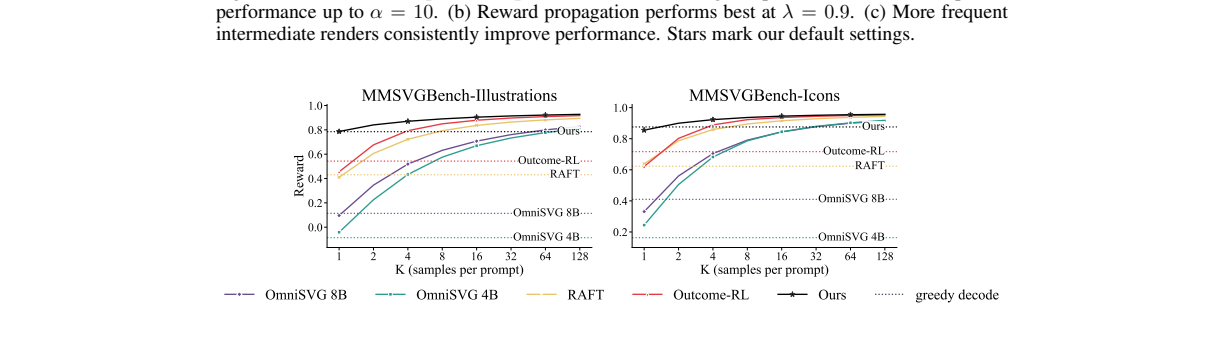
Core claim. On the paper's own terms, the central claim is that the delta score $\Delta_j = F_j - F_{j-1}$ (Eq. 4), where $F_j = S(\mathcal{R}(P_j), x)$ is the visual-similarity score of the $j$-th closed intermediate render against the target, isolates the marginal visual contribution of the newly generated segment, and therefore supplies a trustworthy token-level credit signal. These segment deltas are propagated back to tokens with exponential decay, $A^{\text{Process}}_t = \sum_{j \in \mathcal{F}(t)} \lambda^{d(t,j)} \Delta_j$ (Eq. 5), and combined with the group-relative outcome advantage as $A_{i,t} = A^{\text{Outcome}}_i + \alpha A^{\text{Process}}_{i,t}$ (Eq. 6). The reported evidence is that the combined objective beats supervised fine-tuning and outcome-only GRPO on MMSVGBench and DaTikZ-v3 (Tables 1 and 3), that the process term alone recovers most of the gain with the combination performing best, that granularity matters (every-command rendering, $N=1$, wins), and that propagation peaks at $\lambda = 0.9$ rather than full undiscounted credit.
The premise it rests on. Everything rests on the premise that $\Delta_j = F_j - F_{j-1}$, the visual-score change between two closed intermediate prefix renders, isolates the visual contribution of the newly generated segment, which requires the closure operator $\mathcal{C}$ to yield faithful partial renders and previously drawn elements to persist unchanged. The paper supplies closure recipes but does not verify per segment that deltas are clean of closure artifacts.
If the paper is right (Pith's inferences, not the authors')
Any image-to-code representation whose prefixes can be rendered and compared with the target inherits an annotation-free process reward, so the method transfers by construction to incrementally rendered formats such as Lottie animations, HTML interfaces, and 3D scene programs.
Because the process term alone accounts for most of the gain, the combination weight and even the outcome arm can be tuned independently, suggesting process-only training is a viable regime when final-image rewards are noisy or expensive.
The consistent shortening of generated programs at equal or better visual fidelity indicates the local credit signal suppresses redundant or counterproductive drawing operations, a token-efficiency effect that directly lowers downstream rendering and editing cost.
Best-of-$K$ results showing the largest margins at small $K$ imply the method concentrates probability mass on high-quality generations, so the practical benefit appears even under light test-time sampling budgets.
The fine-grained boundary choice ($N=1$, after every completed drawing command) being optimal sets a design rule for future applications: render as often as the representation allows, not at coarse checkpoints.
The mechanism is not obviously limited to vector graphics: any structured-output task where intermediate states are executable and self-similarity is measurable, such as code or LaTeX generation with a compiler or renderer in the loop, could plausibly reuse the same delta-plus-propagation recipe, though the closure-fidelity requirement would need re-establishing per domain.
The weakest point not resolved by the paper is whether the delta genuinely isolates the new segment's effect: for SVG the closure's default black fill and for TikZ the reconstructed closers can inject visual content of their own, so a per-segment ground-truth check would separate genuine credit assignment from closure artifacts.
The stated persistence condition (elements survive as the program evolves) is asserted rather than verified per segment; in representations where later commands overwrite earlier geometry, the delta signal would be systematically biased, and the paper's own scope caveat flags this boundary of validity.
Check this review
Pith stored no record of this review's passes and took no fingerprint of it. Reviews made by code from 13 Nov 2026 on carry both.
How often reviews like this one are right
Reviews like this one: written by deepseek-v4-flash, where what was read was not recorded.
How often objections from reviews like this one are right: not yet measured
Reviews by people
This review was written by a machine. No person has reviewed this paper on Pith yet. A scientist listed on Pith can review it for a fee, and their review is published here whatever it concludes.
The paper
Abstract
Reinforcement learning is increasingly used to post-train vision-language models for image-to-code generation, such as generating SVG code from a reference image, by optimizing rewards computed from the final rendered output. However, relying on a single terminal reward provides sparse feedback that is poorly aligned with the contribution of individual tokens. A generated program may contain operations that accurately reproduce some parts of the target image alongside others that introduce errors, yet all tokens are trained from the same final outcome. We observe that many intermediate code prefixes are not only executable, but already produce meaningful partial renders that reflect progress toward the target. This property provides a natural source of denser supervision during generation. Based on this observation, we introduce IR4RL, an RL framework with a token-level render-progress reward that turns changes between intermediate renders into localized feedback for the generated sequence. We evaluate our approach on Image-to-SVG and Image-to-TikZ generation. Across both tasks, our method improves over supervised fine-tuning and standard GRPO, yielding new state-of-the-art open-source models. This shows that intermediate rendering provides a simple and effective source of process supervision for RL post-training of image-to-code models.
The paper's own sentences, arranged, kept beside the review and separate from it. Each label is drawn from a closed vocabulary; the number beside it is the probability the classifier gave that label. No sentence in this record was written by a model.
abstract compiled · 2026-09-29
The authors' main claim, as the classifier picked it out 1.00
“This shows that intermediate rendering provides a simple and effective source of process supervision for RL post-training of image-to-code models.”
How the main claim is stated: asserted 1.00
What the abstract itself states, as probabilities: claims first 0.06 · states limitation 0.10 · human participants 0.03 · controlled comparison 0.93 · randomized assignment 0.02 · states quantitative result 0.05 · compares with prior results 0.97 · mentions code or data availability 0.06
The abstract, sentence by sentence
This table labels the abstract only (arXiv listing abstract v1). The number is the probability the classifier gave the label.
| Sentence | Role | The authors' own work | States the main conclusion | Strength |
|---|---|---|---|---|
| Reinforcement learning is increasingly used to post-train vision-language models for image-to-code generation, such as generating SVG code from a reference image, by optimizing rewards computed from the final rendered output. | background 1.00 | 0.05 | 0.03 | asserted 0.99 |
| However, relying on a single terminal reward provides sparse feedback that is poorly aligned with the contribution of individual tokens. | gap 0.67 | 0.11 | 0.03 | asserted 1.00 |
| A generated program may contain operations that accurately reproduce some parts of the target image alongside others that introduce errors, yet all tokens are trained from the same final outcome. | background 0.60 | 0.14 | 0.03 | hedged possibility 0.84 |
| We observe that many intermediate code prefixes are not only executable, but already produce meaningful partial renders that reflect progress toward the target. | result 0.88 | 0.90 | 0.06 | asserted 0.98 |
| This property provides a natural source of denser supervision during generation. | interpretation 0.94 | 0.46 | 0.06 | asserted 0.87 |
| Based on this observation, we introduce IR4RL, an RL framework with a token-level render-progress reward that turns changes between intermediate renders into localized feedback for the generated sequence. | contribution 0.65 | 0.94 | 0.13 | asserted 1.00 |
| We evaluate our approach on Image-to-SVG and Image-to-TikZ generation. | method 0.82 | 0.90 | 0.03 | asserted 0.75 |
| Across both tasks, our method improves over supervised fine-tuning and standard GRPO, yielding new state-of-the-art open-source models. | result 1.00 | 0.95 | 0.23 | asserted 1.00 |
| This shows that intermediate rendering provides a simple and effective source of process supervision for RL post-training of image-to-code models. | interpretation 0.99 | 0.88 | 0.89 | asserted 1.00 |
What kind of paper the classifier reports this is: method or tool 1.00 · evidence from observation or experiment 0.99
What was examined, and what was not
Sources read
- arXiv listing abstract v1
Not examined
- full text
- figures and tables
- references and citing sentences
- relations to other papers
Levels run
- P abstract
Not run
- S sections
- T body sentences
- C citations
- R cross-paper relations
How the labels were made
Compiled by classifier-1.13.0 via TypeSafe API, question bank abstract-p1-20260923, 2026-09-29: 1 request, 6,811 input tokens.
Every quoted sentence on this record is the authors'. Every label is from Pith's closed vocabulary, with the probability shown beside it. This record as JSON
Figures (7)


Figures are the authors', reproduced from the paper.
References (67)
- [1] FirstName LastName , title = on Pith
- [2] FirstName Alpher , title = on Pith
- [3] FirstName Alpher and FirstName Fotheringham-Smythe , title =. Journal of Foo , volume = 13, number = 1, pages = on Pith
- [4] FirstName Alpher and FirstName Fotheringham-Smythe and FirstName Gamow , title =. Journal of Foo , volume = 14, number = 1, pages = on Pith
- [5] FirstName Alpher and FirstName Gamow , title = on Pith
- [6] OmniSVG: A Unified Scalable Vector Graphics Generation Model , author=. Advances in Neural Information Processing Systems , volume=. 2025 , doi= on Pith
- [7] Jonas Belouadi and Simone Paolo Ponzetto and Steffen Eger , booktitle=. 2024 , url= on Pith
- [8] Vincicoder: Unifying multimodal code generation via coarse-to-fine visual reinforcement learning , author=. arXiv preprint arXiv:2511.00391 , year= on PithPith's reviewarXiv
- [9] OmniLottie: Generating Vector Animations via Parameterized Lottie Tokens , author=. arXiv preprint arxiv:2603.02138 , year= on PitharXiv
- [10] Chen, Junhao and Gao, Kejun and Cui, Yuehan and Sun, Mingze and Chen, Mingjin and Wang, Shaohui and Long, Xiaoxiao and Ma, Fei and Tian, Qi and Zhao, Hao and Huang, Ruqi , title =. Proceedings of the IEEE/CVF Conference on Computer Vision and Pattern Recognition (CVPR) , month... on Pith
- [11] Cadcrafter: Generating computer-aided design models from unconstrained images , author=. 2025 IEEE/CVF Conference on Computer Vision and Pattern Recognition (CVPR) , pages=. 2025 , organization= on Pith
- [12] Rendering-aware reinforcement learning for vector graphics generation , author=. Advances in Neural Information Processing Systems , volume= on Pith
- [13] Shao, Zhihong and Wang, Peiyi and Zhu, Qihao and Xu, Runxin and Song, Junxiao and Bi, Xiao and Zhang, Haowei and Zhang, Mingchuan and Li, Y. K. and Wu, Y. and Guo, Daya , title =. 2024 , eprint = on Pith
- [14] High-dimensional continuous control using generalized advantage estimation , author=. arXiv preprint arXiv:1506.02438 , year= on PithPith's reviewarXiv
- [15] Juan A. Rodriguez and Abhay Puri and Shubham Agarwal and Issam H. Laradji and Pau Rodriguez and Sai Rajeswar and David Vazquez and Christopher Pal and Marco Pedersoli , booktitle=. 2025 , pages= on Pith
- [16] Hanze Dong and Wei Xiong and Deepanshu Goyal and Yihan Zhang and Winnie Chow and Rui Pan and Shizhe Diao and Jipeng Zhang and KaShun SHUM and Tong Zhang , journal=. 2023 , url= on Pith
- [17] InternSVG: Towards Unified SVG Tasks with Multimodal Large Language Models , author=. International Conference on Learning Representations , year=. 2510.11341 , archivePrefix= on PitharXiv
- [18] Differentiable Vector Graphics Rasterization for Editing and Learning , author =. ACM Trans. Graph. (Proc. SIGGRAPH Asia) , volume = on Pith
- [19] Towards Layer-wise Image Vectorization , author=. Proceedings of the IEEE conference on computer vision and pattern recognition , year= on Pith
- [20] Qwen3-VL Technical Report , author=. arXiv preprint arXiv:2511.21631 , year= on PithPith's reviewarXiv
show 47 more
- [21] Gemini 3 Flash , author=. 2025 , month= on Pith
- [22] Claude Sonnet 5 System Card , author=. 2026 , month= on Pith
- [23] GPT-5.2 System Card , author=. 2025 , month= on Pith
- [24] Belouadi, Jonas and Ilg, Eddy and Keuper, Margret and Tanaka, Hideki and Utiyama, Masao and Dabre, Raj and Eger, Steffen and Ponzetto, Simone Paolo , year=. 2503.11509 , archivePrefix= on PithPith's reviewarXiv
- [25] Yun, Sukmin and Lin, Haokun and Thushara, Rusiru and Bhat, Mohammad Qazim and Wang, Yongxin and Jiang, Zutao and Deng, Mingkai and Wang, Jinhong and Tao, Tianhua and Li, Junbo and Li, Haonan and Nakov, Preslav and Baldwin, Timothy and Liu, Zhengzhong and Xing, Eric P. and Lian... on Pith
- [26] Si, Chenglei and Zhang, Yanzhe and Li, Ryan and Yang, Zhengyuan and Liu, Ruibo and Yang, Diyi. D esign2 C ode: Benchmarking Multimodal Code Generation for Automated Front-End Engineering. Proceedings of the 2025 Conference of the Nations of the Americas Chapter of the Associat... on Pithdoi:10.18653/v1/2025.naacl-long.199
- [27] Chen, Tianrun and Yu, Chunan and Hu, Yuanqi and Li, Jing and Xu, Tao and Cao, Runlong and Zhu, Lanyun and Zang, Ying and Zhang, Yong and Li, Zejian and Sun, Lingyun , journal = on Pith
- [28] Sun, Qiushi and Gong, Jingyang and Liu, Yang and Chen, Qiaosheng and Li, Lei and Chen, Kai and Guo, Qipeng and Kao, Ben and Yuan, Fei , booktitle =. 2026 , eprint = on Pith
- [29] Zhao, Xuanle and Sun, Qiushi and Xiao, Jingyu and Liu, Xuexin and Yang, Haoyue and Chen, Qiaosheng and Luo, Xianzhen and Huang, Jing and Zhong, Yufeng and Chen, Lei and Fu, Shuai and Wei, Zhenlin and Bi, Jinhe and Jiang, Lei and Qiu, Haibo and Yang, Siqi and Shi, Peng and Hu, ... on Pith
- [30] Tan, Wentao and Cao, Qiong and Xue, Chao and Zhan, Yibing and Ding, Changxing and He, Xiaodong , year =. 2508.17608 , archivePrefix = on PitharXiv
- [31] Ling, Jun and Qi, Yao and Huang, Tao and Zhou, Shibo and Huang, Yanqin and Yang, Jiang and Song, Ziqi and Zhou, Ying and Yang, Yang and Shen, Heng Tao and Wang, Peng , booktitle = on Pith
- [32] Saito, Itsumi and Yoshida, Haruto and Sakaguchi, Keisuke , booktitle = on Pith
- [33] Wang, Haomin and Wei, Qi and Ma, Qianli and Ding, Shengyuan and Yin, Jinhui and Chen, Kai and Zhang, Hongjie , year =. Reliable Reasoning in. 2603.16189 , archivePrefix = on PitharXiv
- [34] Zeng, Xingchen and Su, Zhewei and Zhang, Hengming and Jiang, Juyong and Xia, Jiazhi and Zeng, Wei , booktitle = on Pith
- [35] Render-in-the-Loop: Vector Graphics Generation via Visual Self-Feedback , author =. 2026 , eprint = on Pith
- [36] Deng, Jie and Yao, Kaichun and Zhang, Libo , year =. 2602.05998 , archivePrefix = on PitharXiv
- [37] Yang, Zhen and Hong, Wenyi and Xu, Mingde and Fan, Xinyue and Wang, Weihan and Cheng, Jiale and Gu, Xiaotao and Tang, Jie , booktitle =. 2026 , eprint = on Pith
- [38] Liu, Ziyu and Ding, Shengyuan and Fang, Xinyu and Dai, Xuanlang and Yang, Penghui and Liang, Jianze and Wang, Jiaqi and Chen, Kai and Lin, Dahua and Zang, Yuhang , year =. Visual-. 2603.13224 , archivePrefix = on PithPith's reviewarXiv
- [39] Prolific , title =. 2024 , howpublished = on Pith
- [40] Tuning Large Neural Networks via Zero-Shot Hyperparameter Transfer , author =. Advances in Neural Information Processing Systems , year = on Pith
- [41] Training Verifiers to Solve Math Word Problems , author=. 2021 , eprint= on Pith
- [42] Solving Math Word Problems With Process- and Outcome-Based Feedback , author = on Pith
- [43] Let's verify step by step , author=. International Conference on Learning Representations , volume= on Pith
- [44] Math-shepherd: Verify and reinforce llms step-by-step without human annotations , author=. Proceedings of the 62nd Annual Meeting of the Association for Computational Linguistics (Volume 1: Long Papers) , pages= on Pith
- [45] Rewarding progress: Scaling automated process verifiers for llm reasoning , author=. International Conference on Learning Representations , volume= on Pith
- [46] Process-verified reinforcement learning for theorem proving via Lean , author=. arXiv preprint arXiv:2606.20068 , year= on PithPith's reviewarXiv
- [47] The lessons of developing process reward models in mathematical reasoning , author=. Findings of the Association for Computational Linguistics: ACL 2025 , pages= on Pith
- [48] Stepcoder: improving code generation with reinforcement learning from compiler feedback , author=. Proceedings of the 62nd Annual Meeting of the Association for Computational Linguistics (Volume 1: Long Papers) , pages= on Pith
- [49] Process-supervised reinforcement learning for code generation , author=. Proceedings of the 2025 Conference on Empirical Methods in Natural Language Processing , pages= on Pith
- [50] Rlhf-v: Towards trustworthy mllms via behavior alignment from fine-grained correctional human feedback , author=. Proceedings of the IEEE/CVF Conference on Computer Vision and Pattern Recognition , pages= on Pith
- [51] Does Reinforcement Learning Really Incentivize Reasoning Capacity in LLMs Beyond the Base Model? , author=. arXiv preprint arXiv:2504.13837 , year= on PithPith's reviewarXiv
- [52] Oquab, Maxime and Darcet, Timoth. Transactions on Machine Learning Research , year = on Pith
- [53] Image Quality Assessment: From Error Visibility to Structural Similarity , author =. IEEE Transactions on Image Processing , volume =. 2004 , doi = on Pith
- [54] The Unreasonable Effectiveness of Deep Features as a Perceptual Metric , author =. Proceedings of the IEEE Conference on Computer Vision and Pattern Recognition (CVPR) , pages = on Pith
- [55] Learning Transferable Visual Models From Natural Language Supervision , author =. Proceedings of the 38th International Conference on Machine Learning (ICML) , series = on Pith
- [56] Human Preference Score: Better Aligning Text-to-Image Models with Human Preference , author =. Proceedings of the IEEE/CVF International Conference on Computer Vision (ICCV) , pages = on Pith
- [57] Edward J Hu and Yelong Shen and Phillip Wallis and Zeyuan Allen-Zhu and Yuanzhi Li and Shean Wang and Lu Wang and Weizhu Chen , booktitle=. Lo. 2022 , url= on Pith
- [58] Reinforcement Learning for Reasoning in Large Language Models with One Training Example , author=. arXiv preprint arXiv:2504.20571 , year= on PithPith's reviewarXiv
- [59] Stanchev, Peter and Wang, Weiyue and Ney, Hermann. EED : Extended Edit Distance Measure for Machine Translation. Proceedings of the Fourth Conference on Machine Translation (Volume 2: Shared Task Papers, Day 1). 2019. doi:10.18653/v1/W19-5359 on Pithdoi:10.18653/v1/w19-5359
- [60] Eghbali, Aryaz and Pradel, Michael. CrystalBLEU : Precisely and Efficiently Measuring the Similarity of Code. Proceedings of the 37th IEEE/ACM International Conference on Automated Software Engineering. 2022. doi:10.1145/3551349.3556903 on PitharXiv
- [61] Sigmoid Loss for Language Image Pre-Training , author =. Proceedings of the IEEE/CVF International Conference on Computer Vision (ICCV) , pages = on Pith
- [62] DreamSim: Learning New Dimensions of Human Visual Similarity using Synthetic Data , author =. Advances in Neural Information Processing Systems (NeurIPS) , year = on Pith
- [63] High-resolution image synthesis with latent diffusion models , author=. 2022 IEEE/CVF conference on computer vision and pattern recognition (CVPR) , pages=. 2022 , organization= on Pith
- [64] Scaling rectified flow transformers for high-resolution image synthesis , author=. Forty-first international conference on machine learning , year= on Pith
- [65] Human Preference Score v2: A Solid Benchmark for Evaluating Human Preferences of Text-to-Image Synthesis , author=. arXiv preprint arXiv:2306.09341 , year= on PithPith's reviewarXiv
- [66] Policy invariance under reward transformations: Theory and application to reward shaping , author=. Proceedings of the Sixteenth International Conference on Machine Learning (ICML) , pages= on Pith
- [67] Dense Reward for Free in Reinforcement Learning from Human Feedback , author=. International Conference on Machine Learning , year= on Pith
Cited by 1 Pith paper
Reviewed papers on Pith that cite this one. The full citation record
- Lang-SVG: Hierarchical Image Vectorization with Language Priors cs.CV · Nov 2026
Challenges and discussion
Disagree with the review, or know something it missed? Leave a comment, or challenge this review formally: a challenge becomes a permanent entry in this paper's record, and its decision is published here.
Come back by email
A short list of the week's newly reviewed papers. Nothing is sent until you confirm from your inbox, and every email has a link that stops it. No account.
No comments yet.
Sign in to comment