Artificial Intelligence · arXiv:2609.35117 v1 · submitted 28 Sep 2026 · 41 references
Tool Mediation Alters Refusal Mechanisms in Large Language Models
The paper says
“Large language models (LLMs) are increasingly deployed with access to external tools, yet harmful tool-mediated interactions are less likely to be refused when compared to regular conversational ones.”
more of the abstract
As this change in refusal behavior remains underexplored, we investigate its underlying mechanisms across a diverse set of open-weight language models. We find that information about the harmfulness of a request remains strongly encoded in the model's representations and transfers across conversational and tool-mediated inputs. Evidence from representation geometry and neuron-level analysis further indicates that the two interaction modes systematically distribute harm-related computation differently. Crucially, while conversational inputs can be refused at relatively low levels of perceived harmfulness, tool-mediated inputs remain permissive until harmfulness crosses a substantially higher effective refusal threshold. Moreover, tool-mediated refusal is also more brittle: progressively weakening the refusal computation disrupts tool-mediated refusal at lower intervention strengths than conversational refusal, even when benign capabilities remain intact. Together, our findings indicate that tool mediation does not simply reduce the internal perception of harm, but instead impacts its conversion into refusal. Overall, this suggests tool-mediated environments may intrinsically reduce robustness of models to harmful requests, and that conventional safety evaluations may not fully transfer to LLM agents.
from the abstract
Pith says
Machine review · deepseek-v4-flash · 29 Sep 2026 · what was read was not recorded · not checked by a person
It can be wrong. Challenge this review or reply to it.
Holds up, with conditions. Solid, honest mechanistic study of the tool-refusal gap; the behavioral finding is known, but the five-condition decomposition and careful controls are the real contribution, and the 'conversion' claim needs a behavior-level validation. This line is wrong
3 major objections · 5 minor
How often objections from reviews like this one are right: not yet measured
Not checked: figures, code, what the 41 references say.
The paper says, at Figure 2 / Section 5.1, Table 2
The review did not quote this passage.
Pith says: Objection 1 of 3 · major
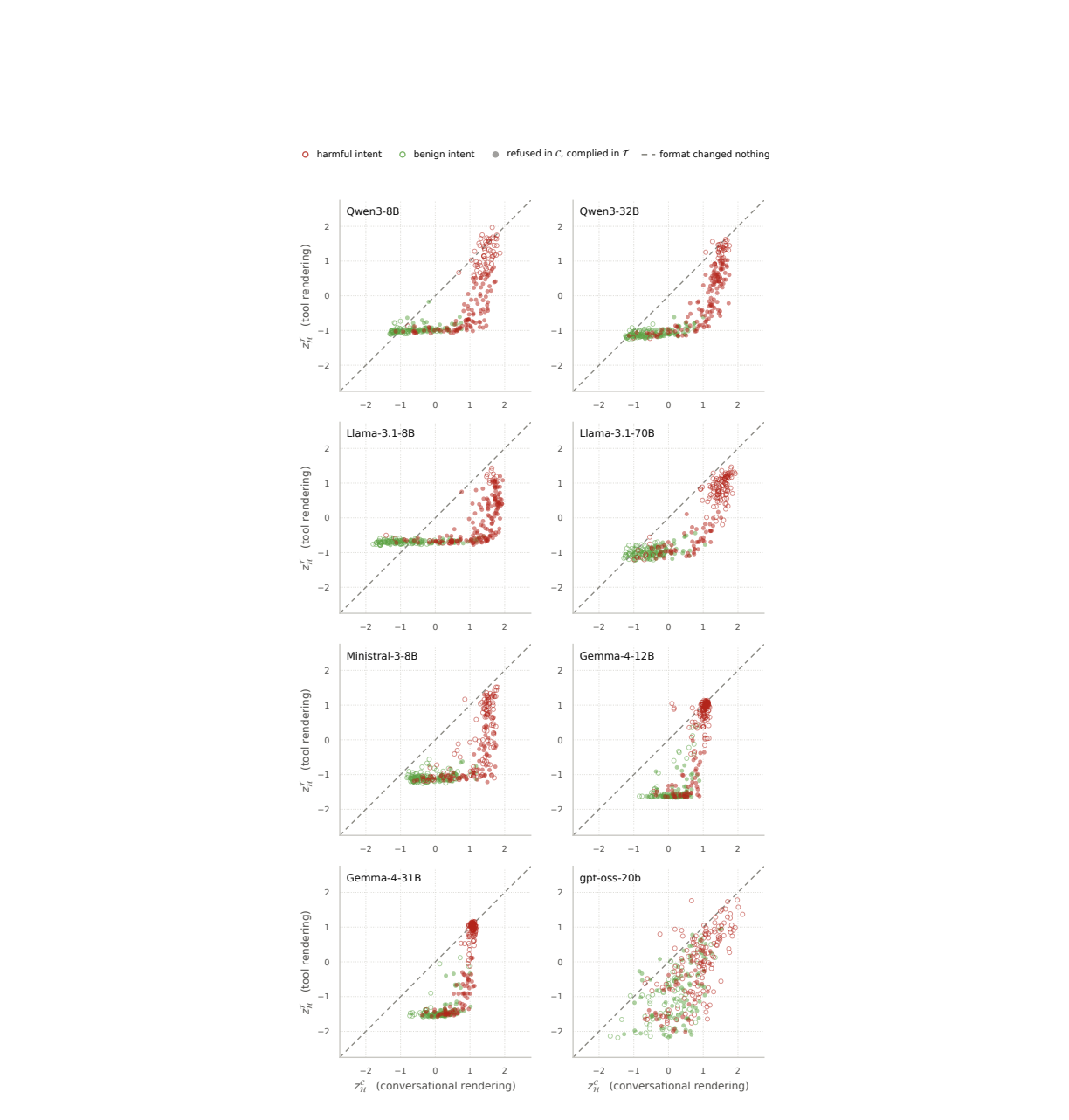
The claim that tool-mediated inputs require a substantially higher effective refusal threshold (b4) is not established within the observed data range. Conversational reference refusal is near-saturated (0.892-0.998, Table 2), and in five of eight models the conversational P(refuse)=0.5 crossing lies below the observed harmful-intent projection range, so the conversational threshold is an extrapolation from flat, saturated data.
more of objection 1
The tool-vs-conversational threshold gap at matched harm readouts therefore partly restates the baseline refusal-rate gap. Please restrict the threshold comparison to the overlap region of the two projection distributions, or fit a smooth curve with uncertainty, before concluding that the tool channel applies a higher threshold at comparable harm readouts.
The paper says, at Appendix C.6, Table 15
The review did not quote this passage.
A classifier read this sentence of the paper as acknowledging the concern (probability 0.60):
“We therefore interpret the harm–refusal correspondence as an approximate, rather than exact, one-dimensional structure, given some degree of separation is present, consistent with prior work decoupling the directions (Zhao et al., 2025b).”
Pith says: Objection 2 of 3 · major
The neuron-level channel dissociation is measured as the change in the final-layer harm projection after ablation, never as a change in observable refusal. The statements in b32-b33 (causally distinct neuronal contributions to the harm representation) and the conversion claim in b6 therefore go beyond what the measurement supports.
more of objection 2
The authors acknowledge that the harm axis is only an approximate proxy for the refusal machinery (b452-b453, with harm-refusal cosine 0.76-0.97 of ceiling), but the causal claim needs a behavior-level test: ablating the tool-selective set S_T should measurably reduce tool-channel refusal behavior, not only its harm projection. Note also that tool-side effects are non-significant at small K in some models (e.g., Qwen3-8B K=200: d_z=0.06 [-0.09, 0.20], Table 15), so the dissociation evidence is concentrated at large K.
The paper says, at Appendix C.5, Table 14
The review did not quote this passage.
Pith says: Objection 3 of 3 · major
The C.5 displacement analysis reports that the conversational-to-tool shift lies at the 26th-60th percentile of the random-direction null in every model, i.e., the channel divergence is not preferentially aligned with the harm axis. This is consistent with the conversion-change story only if the decision mapping is shown to change at matched harm readouts, which depends on the threshold analysis flagged above.
more of objection 3
Please reconcile the abstract's harm-specific conversion framing (b6) with this null result, either by showing that the threshold shift is harm-axis-specific relative to random directions, or by softening the claim to 'tool mediation changes the harm-to-refusal mapping' as one of several possible loci of the divergence.
5 minor objections
The paper says, at Section 2
Pith says: minor objection 1 of 5
The refusal direction definition contains a typo: r(c),ℓ_R = u(µ(c),ℓ_R − µ(c),ℓ_R) is written with two identical terms; the contrast should be between refused and complied responses.
The paper says, at Figure 2
Pith says: minor objection 2 of 5
The panel axis labels render as 'zneutral_H (C, T mean)' and the delta annotations are hard to parse; please clean up the axis labels and caption text.
show 3 more
The paper says, at Table 4
Pith says: minor objection 3 of 5
The conversational median-steps entries '40+' are right-censored at the GCG budget; state explicitly in the table or caption that the conversational comparison is censored, so the tool-versus-conversational gap is a lower bound.
The paper says, at Appendix C.6, Tables 15-16
Pith says: minor objection 4 of 5
K is a free parameter and effect magnitudes vary strongly with K; since a fixed K corresponds to different fractions of the available neurons across models, a robustness note or a justification for the chosen K values would help readers interpret the cross-model comparison.
The paper says, at Section 5.2, Table 4
Pith says: minor objection 5 of 5
gpt-oss-20b is excluded from the GCG experiment; the reason is given in Appendix B.4, but the main-text table does not indicate the exclusion, which could mislead readers comparing across the eight models.
What would settle it
Run a behavior-level causal test of the neuron dissociation: select the K>=800 tool-selective and conversation-selective sets with the same two-fold cross-fit by intent as C.6, mean-ablate each set, and measure observable refusal/compliance (tool-call parsing in the tool channel, the Qwen3Guard judge in the conversational channel) on held-out harmful intents in both channels. If ablating a channel's own selective set flips that channel's observable refusal to compliance significantly more than the other channel's set or the matched-random set, the dissociation is behaviorally real. If ablations move the harm projection but do not change observable refusal, the harm projection is not the refusal machinery and the 'changed conversion' mechanism claim fails.
from the skeptic's reading
How the review went
4 readings by deepseek-v4-flash · 29 Sep 2026
- Reader holds up, with conditions
- Skeptic partly agrees
- Editor wrote the verdict above
- Referee major revision: 3 major objections, 5 minor
Not run on this paper: the simulated authors' defence.
Pith did not check this review's objections against the paper.
The review in full
The review in brief, machine-written
Worth your time. The behavioral gap itself is not new—Kumar, Cartagena and Teixeira, and Yu already showed tool-calling refusal is weaker. What this paper adds is the decomposition: two tool-exposure conditions that separate mere schema exposure from the execution directive, isolating where the drop comes from (mostly exposure, before any instruction to act). That is a genuinely useful design, and it holds across eight models with paired bootstrap intervals. I also give them real credit for the negative results: the attention-head dissociation fails in multiple arms, gpt-oss is excluded rather than forced through the dense analysis, and they report the MoE boundary case honestly. The harm-signal preservation and the neuron-level channel dissociation are careful, with cross-fitting by intent and matched-random controls.
Now the soft spots, and they are the ones you flagged. The strongest claim (b6) is that tool mediation changes harm-to-refusal conversion rather than harm perception. That rests on the final-layer harm projection as a proxy for refusal, and the neuron ablations are measured as changes in that projection, not as changes in observed refusal. The authors acknowledge the proxy is approximate (b452–b453) and that interventions differ in specificity (b155), but they never supply a behavior-level causal test of the neuron result. Second, the matched-harm threshold comparison is partly extrapolated: conversational refusal is near-saturated in five of eight models, so the lower conversational threshold is read off a flat region, and the harm-axis displacement itself sits in the middle of the random-direction null (Table 14). The GCG comparison uses channel-specific targets on top of a near-saturated baseline—they admit it is not a direction-independent test. None of this kills the paper. The behavioral fragility result is robust and the 'conversion' story is plausible, just not fully nailed.
Who should read it: anyone evaluating safety of LLM agents, and people doing refusal interpretability. It is a solid contribution that deserves a serious referee. My recommendation: send it to review, and push for a behavior-level ablation test and a less saturated conversational setup before the mechanistic conclusion is treated as established. I would cite it for the decomposition and the survival of the harm signal.
The strongest objection
The strongest claim (abstract, b6) is that tool mediation changes harm-to-refusal conversion, not harm perception. That conversion story is established through two analyses sharing one unvalidated readout: the final-layer harm projection. First, the 'matched harm readout' threshold comparison (Figure 2, §5.1): conversational reference refusal is near-saturated (0.89–1.00, Table 2), and in five of eight models the conversational P(refuse)=0.5 crossing lies below the observed harmful-intent projection range. The lower conversational threshold is therefore an extrapolation from flat, saturated data, and the tool-vs-conversational threshold gap at 'matched' readouts is largely a restatement of the baseline refusal-rate gap. At the same time, the paper shows (C.5) that the conversational-to-tool displacement is NOT preferentially aligned with harm (r_H sits at the 26th–60th percentile of the random-direction null), so the harm-axis coordinate is not where the channel divergence specifically lives. Second, the neuron-level 'channel dissociation' (C.6) is measured as the change in final-layer harm projection after ablation, never as a change in observable refusal. The harm and refusal axes are only approximately collinear (0.76–0.97 of ceiling; authors call this approximate, b452–b453, and Llama-3.1-8B departs nonlinearly); tool-side effects are non-significant at small K (e.g., Qwen3-8B K=200: d_z=0.06 [-0.09,0.20]). The authors acknowledge the proxy is approximate (b452) and that targeted interventions differ across channels (b155), but no behavior-level test validates that the harm projection is a faithful, cross-channel-comparable measure of the computation producing refusal. Since the channels differ in overall activation (hence the centering required for neutral directions, Appendix A), an intent's harm projection is not shown commensurable across channels.
I read the paper in good faith and find the qualitative behavioral claims strong: the refusal drop across conditions (Table 2), GCG fragility asymmetry (Table 4), and cross-channel decodability of harm (Table 3) are consistent, carefully controlled, and largely independent of the interpretability proxy. Those support 'tool mediation erodes refusal without erasing the harm signal.' The load-bearing weakness is the mechanism-level 'conversion' interpretation, exactly where the reader places it: everything mechanistic flows through the final-layer harm projection. My partial disagreement with the reader is one of emphasis and scope: the reader flags the proxy chiefly at the neuron-ablation step (C.6), but I find the more consequential exposure is Figure 2 / Section 5.1, where the top-line conversion claim is read off a threshold comparison against a near-saturated conversational channel whose P(refuse)=0.5 crossing is extrapolated below the data range in five of eight models, while C.5 shows the harm-axis displacement is not channel-specific. The saturation issue inflates the apparent 'conversion' gap and makes the matched-readout claim partly circular with the baseline refusal-rate gap. Both concerns share one root, so this is the same load-bearing assumption rather than a distinct one. The authors' own limitations cover wording/compliance differences (b171) and approximate collinearity (b452–b453), but no passage supplies the missing behavior-level calibration of the harm-projection readout; that gap is what a single ablation-to-behavior experiment would settle. Because the central qualitative safety finding survives independently of the proxy, CONDITIONAL remains the right verdict and the reader's high confidence in the behavioral phenomenon is warranted; only the stronger mechanistic gloss is at risk.
The referee's report
The behavioral asymmetry—tool exposure alone eroding refusal across all eight models, with paired per-behavior bootstrap confidence intervals (Appendix C.1)—is robust, novel in its decomposition of the transition, and directly relevant to safety evaluation of LLM agents; this contribution stands even independently of the mechanistic interpretation. The paper is methodologically careful: cross-fitting of directions by intent (five-fold and two-fold), matched-random neuron controls, bootstrap intervals, an honest negative result at attention-head granularity (C.6), a null result for harm-aligned displacement (C.5), a multi-turn validity check (B.3), and a replication on privacy-sensitive scenarios (C.8). If the conversion-change claim survives the proxy-validation concerns below, the paper would be a strong and consequential result for agent safety.
Pith's reading of the paper (a machine's summary, not the authors')
This paper asks why language models refuse harmful requests far less reliably when the request arrives through a tool-calling interface rather than as ordinary conversation. It claims the answer is not a loss of harm information: harmfulness remains strongly decodable in both channels, and a harm direction fitted on one channel transfers to the other. Instead, tool mediation changes the conversion of harm into refusal — at matched harm readouts the tool channel applies a substantially higher effective refusal threshold, and the refusal it does produce breaks more easily under both internal ablation and input-space adversarial attack. Much of the drop already appears upon mere tool exposure, before any instruction to act. If correct, conversational safety evaluations do not automatically transfer to agents that can execute actions.
What carries the argument. The analysis reads and intervenes along activation-space directions estimated by the difference-of-means procedure at the decision position: a harm direction contrasting harmful versus benign intents and a refusal direction contrasting refused versus complied responses. Because conversational compliance is too rare to estimate a refusal direction in most models, harm serves as a proxy, justified by harm–refusal cosine similarities of 0.76–0.97 of ceiling. The effective refusal threshold is read from curves of $P( ext{refuse})$ against the harm projection across matched conversational and tool-mediated renderings. Channel specificity is tested by ranking late-MLP neurons by their harmful–benign contribution along a shared harm direction, selecting top- and bottom-$K$ sets per channel, mean-ablating them to the channel's benign mean, and measuring the change in that channel's final-layer harm projection against the other channel's set and a magnitude-matched random set. Robustness is measured by graded directional ablation and, in a direction-free comparison, GCG token-level optimization with matched search budgets in both channels.
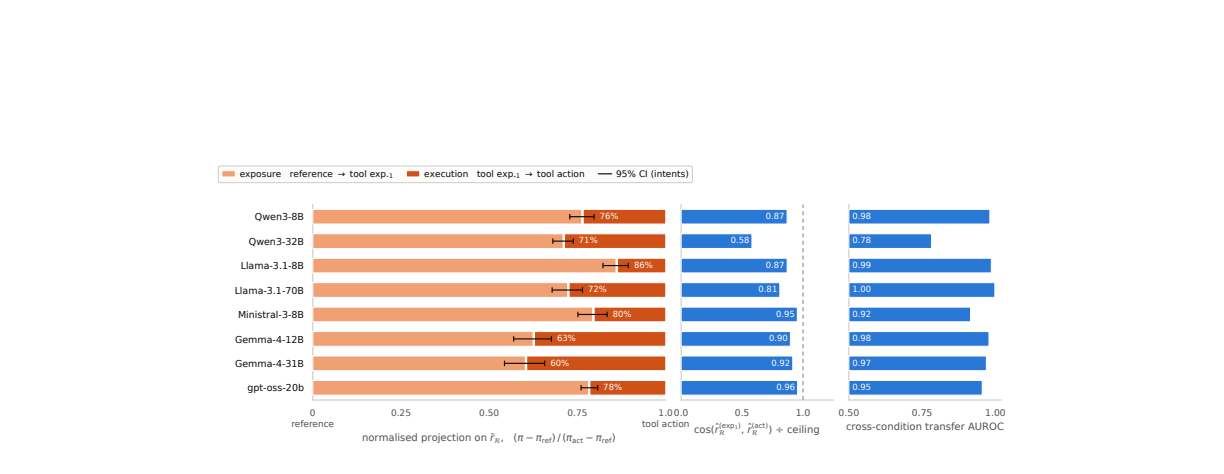
Core claim. Tool mediation does not simply lower how harmful a request looks internally; it raises the effective threshold at which perceived harm is converted into a refusal, and it makes the resulting refusal more brittle. Eight open-weight models support this with three linked findings. First, harm remains highly decodable in both conversational and tool-mediated residual streams (AUROC roughly 0.73–0.94, with strong cross-channel transfer), so tool mediation does not remove the information needed to identify a harmful request. Second, the two channels distribute harm-related computation over partially distinct late-MLP neuron populations: in all seven dense models, ablating a channel's own selected neurons reduces that channel's final-layer harm projection more than ablating the other channel's set or a magnitude-matched random set. Third, at matched harm readouts the tool channel's refusal threshold falls inside the observed harmful-intent range in all eight models, whereas the conversational threshold often falls below it, and tool-mediated refusal is broken at lower intervention doses and in fewer GCG optimization steps. The authors conclude that the refusal gap reflects a changed harm-to-refusal mapping, largely established already when tools are merely exposed.
The premise it rests on. The mechanistic claims treat the final-layer harm projection as a faithful stand-in for the computation that turns harm into refusal, even though harm and refusal directions are only approximately collinear (0.76–0.97 of ceiling) and the channel-dissociation ablations are measured on that projection rather than on observable refusal behavior; the authors acknowledge the proxy is approximate.
If the paper is right (Pith's inferences, not the authors')
Conversational safety measurements carry little information about deployments where the model can act: models indistinguishable under conversational evaluation differ substantially in tool-mediated refusal.
Placing a model in a tool-enabled environment is sufficient to erode refusal before any instruction to execute; tool exposure alone accounts for 23–88% of the final behavioral drop, and the refusal-direction representation already shifts upon exposure.
Refusal robustness must be tested through the interfaces in which models actually run, since the tool-side refusal breaks at lower directional-ablation doses and in fewer GCG steps than the conversational side.
Because the gap is a decision-mapping problem rather than an information-loss problem, mitigation should target the harm-to-refusal conversion in tool contexts rather than restoring harm detection.
Because mere tool exposure (with no execution directive) already shifts both behavior and the refusal-direction representation, the most plausible origin is a decision boundary learned during tool-use or agentic training; this is testable by comparing harm-to-refusal threshold curves across checkpoints taken before and after tool-use training.
The higher effective threshold in the tool channel is consistent with the model treating an emitted tool call as a lower-cost action than producing harmful prose; a testable corollary is that the threshold gap should shrink for tools carrying higher perceived irreversibility or auditability.
The neuron-level dissociation failing to appear at attention-head granularity suggests the channel split concentrates in late-MLP layers, pointing to circuit-level interventions on those layers as a candidate place to restore tool-channel refusal without degrading benign capability.
Check this review
Pith stored no record of this review's passes and took no fingerprint of it. Reviews made by code from 13 Nov 2026 on carry both.
How often reviews like this one are right
Reviews like this one: written by deepseek-v4-flash, where what was read was not recorded.
How often objections from reviews like this one are right: not yet measured
Reviews by people
This review was written by a machine. No person has reviewed this paper on Pith yet. A scientist listed on Pith can review it for a fee, and their review is published here whatever it concludes.
The paper
Abstract
Large language models (LLMs) are increasingly deployed with access to external tools, yet harmful tool-mediated interactions are less likely to be refused when compared to regular conversational ones. As this change in refusal behavior remains underexplored, we investigate its underlying mechanisms across a diverse set of open-weight language models. We find that information about the harmfulness of a request remains strongly encoded in the model's representations and transfers across conversational and tool-mediated inputs. Evidence from representation geometry and neuron-level analysis further indicates that the two interaction modes systematically distribute harm-related computation differently. Crucially, while conversational inputs can be refused at relatively low levels of perceived harmfulness, tool-mediated inputs remain permissive until harmfulness crosses a substantially higher effective refusal threshold. Moreover, tool-mediated refusal is also more brittle: progressively weakening the refusal computation disrupts tool-mediated refusal at lower intervention strengths than conversational refusal, even when benign capabilities remain intact. Together, our findings indicate that tool mediation does not simply reduce the internal perception of harm, but instead impacts its conversion into refusal. Overall, this suggests tool-mediated environments may intrinsically reduce robustness of models to harmful requests, and that conventional safety evaluations may not fully transfer to LLM agents.
The paper's own sentences, arranged, kept beside the review and separate from it. Each label is drawn from a closed vocabulary; the number beside it is the probability the classifier gave that label. No sentence in this record was written by a model.
abstract compiled · 2026-09-29
The authors' main claim, as the classifier picked it out 0.61
“Overall, this suggests tool-mediated environments may intrinsically reduce robustness of models to harmful requests, and that conventional safety evaluations may not fully transfer to LLM agents.”
How the main claim is stated: hedged possibility 1.00
What the abstract itself states, as probabilities: claims first 0.07 · states limitation 0.38 · human participants 0.04 · controlled comparison 0.82 · randomized assignment 0.02 · states quantitative result 0.06 · compares with prior results 0.61 · mentions code or data availability 0.03
The abstract, sentence by sentence
This table labels the abstract only (arXiv listing abstract v1). The number is the probability the classifier gave the label.
| Sentence | Role | The authors' own work | States the main conclusion | Strength |
|---|---|---|---|---|
| Large language models (LLMs) are increasingly deployed with access to external tools, yet harmful tool-mediated interactions are less likely to be refused when compared to regular conversational ones. | background 0.89 | 0.17 | 0.28 | asserted 0.94 |
| As this change in refusal behavior remains underexplored, we investigate its underlying mechanisms across a diverse set of open-weight language models. | gap 0.53 | 0.15 | 0.02 | asserted 0.95 |
| We find that information about the harmfulness of a request remains strongly encoded in the model's representations and transfers across conversational and tool-mediated inputs. | result 1.00 | 0.96 | 0.10 | asserted 1.00 |
| Evidence from representation geometry and neuron-level analysis further indicates that the two interaction modes systematically distribute harm-related computation differently. | result 0.93 | 0.91 | 0.06 | asserted 0.55 |
| Crucially, while conversational inputs can be refused at relatively low levels of perceived harmfulness, tool-mediated inputs remain permissive until harmfulness crosses a substantially higher effective refusal threshold. | result 1.00 | 0.91 | 0.35 | asserted 1.00 |
| Moreover, tool-mediated refusal is also more brittle: progressively weakening the refusal computation disrupts tool-mediated refusal at lower intervention strengths than conversational refusal, even when benign capabilities remain intact. | result 1.00 | 0.93 | 0.10 | asserted 1.00 |
| Together, our findings indicate that tool mediation does not simply reduce the internal perception of harm, but instead impacts its conversion into refusal. | interpretation 0.98 | 0.91 | 0.72 | asserted 0.52 |
| Overall, this suggests tool-mediated environments may intrinsically reduce robustness of models to harmful requests, and that conventional safety evaluations may not fully transfer to LLM agents. | interpretation 1.00 | 0.44 | 0.71 | hedged possibility 1.00 |
What kind of paper the classifier reports this is: empirical study 1.00 · evidence from observation or experiment 0.98
What was examined, and what was not
Sources read
- arXiv listing abstract v1
Not examined
- full text
- figures and tables
- references and citing sentences
- relations to other papers
Levels run
- P abstract
Not run
- S sections
- T body sentences
- C citations
- R cross-paper relations
How the labels were made
Compiled by classifier-1.13.0 via TypeSafe API, question bank abstract-p1-20260923, 2026-09-29: 1 request, 6,304 input tokens.
Every quoted sentence on this record is the authors'. Every label is from Pith's closed vocabulary, with the probability shown beside it. This record as JSON
Figures (7)





Figures are the authors', reproduced from the paper.
References (41)
- [1] Maksym Andriushchenko, Alexandra Souly, Mateusz Dziemian, Derek Duenas, Maxwell Lin, Justin Wang, Dan Hendrycks, Andy Zou, Zico Kolter, Matt Fredrikson, et al. Agentharm: A benchmark for measuring harmfulness of llm agents. In International Conference on Learning Representatio... on Pith
- [2] Andy Arditi, Oscar Obeso, Aaquib Syed, Daniel Paleka, Nina Panickssery, Wes Gurnee, and Neel Nanda. Refusal in language models is mediated by a single direction. Advances in Neural Information Processing Systems, 37: 0 136037--136083, 2024 on Pith
- [3] Arnold Cartagena and Ariane Teixeira. Mind the gap: Text safety does not transfer to tool-call safety in llm agents. arXiv preprint arXiv:2602.16943, 2026 on PitharXiv
- [4] Patrick Chao, Alexander Robey, Edgar Dobriban, Hamed Hassani, George J Pappas, and Eric Wong. Jailbreaking black box large language models in twenty queries. In 2025 IEEE Conference on Secure and Trustworthy Machine Learning (SaTML), pp.\ 23--42. IEEE, 2025 on Pith
- [5] Jianhui Chen, Xiaozhi Wang, Zijun Yao, Yushi Bai, Lei Hou, and Juanzi Li. Towards understanding safety alignment: A mechanistic perspective from safety neurons. In The Thirty-ninth Annual Conference on Neural Information Processing Systems, 2025. URL https://openreview.net/for... on Pith
- [6] Jacob Cohen. A coefficient of agreement for nominal scales. Educational and psychological measurement, 20 0 (1): 0 37--46, 1960 on Pith
- [7] Damai Dai, Li Dong, Yaru Hao, Zhifang Sui, Baobao Chang, and Furu Wei. Knowledge neurons in pretrained transformers. In Smaranda Muresan, Preslav Nakov, and Aline Villavicencio (eds.), Proceedings of the 60th Annual Meeting of the Association for Computational Linguistics (Vol... on Pithdoi:10.18653/v1/2022.acl-long.581
- [8] Gemma. Gemma 4 technical report, 2026. URL https://arxiv.org/abs/2607.02770 on PithPith's reviewarXiv
- [9] Kilem Li Gwet. Computing inter-rater reliability and its variance in the presence of high agreement. British Journal of Mathematical and Statistical Psychology, 61 0 (1): 0 29--48, 2008 on Pith
- [10] Faaiz Joad, Majd Hawasly, Sabri Boughorbel, Nadir Durrani, and Husrev Taha Sencar. There is more to refusal in large language models than a single direction. arXiv preprint arXiv:2602.02132, 2026 on PithPith's reviewarXiv
- [11] Priyanshu Kumar, Elaine Lau, Saranya Vijayakumar, Tu Trinh, Elaine T Chang, Vaughn Robinson, Shuyan Zhou, Matt Fredrikson, Sean M. Hendryx, Summer Yue, and Zifan Wang. Aligned LLM s are not aligned browser agents. In The Thirteenth International Conference on Learning Represen... on Pith
- [12] Woosuk Kwon, Zhuohan Li, Siyuan Zhuang, Ying Sheng, Lianmin Zheng, Cody Hao Yu, Joseph E. Gonzalez, Hao Zhang, and Ion Stoica. Efficient memory management for large language model serving with pagedattention. In Proceedings of the ACM SIGOPS 29th Symposium on Operating Systems... on Pith
- [13] Bruce W Lee, Inkit Padhi, Karthikeyan Natesan Ramamurthy, Erik Miehling, Pierre Dognin, Manish Nagireddy, and Amit Dhurandhar. Programming refusal with conditional activation steering. In International conference on learning representations, volume 2025, pp.\ 90960--90985, 2025 on Pith
- [14] Alexander H Liu, Kartik Khandelwal, Sandeep Subramanian, Victor Jouault, Abhinav Rastogi, Adrien Sad \'e , Alan Jeffares, Albert Jiang, Alexandre Cahill, Alexandre Gavaudan, et al. Ministral 3. arXiv preprint arXiv:2601.08584, 2026 on PithPith's reviewarXiv
- [15] Xiao Liu, Hao Yu, Hanchen Zhang, Yifan Xu, Xuanyu Lei, Hanyu Lai, Yu Gu, Hangliang Ding, Kaiwen Men, Kejuan Yang, Shudan Zhang, Xiang Deng, Aohan Zeng, Zhengxiao Du, Chenhui Zhang, Sheng Shen, Tianjun Zhang, Yu Su, Huan Sun, Minlie Huang, Yuxiao Dong, and Jie Tang. Agentbench:... on Pith
- [16] Samuel Marks and Max Tegmark. The geometry of truth: Emergent linear structure in large language model representations of true/false datasets. In First Conference on Language Modeling, 2024. URL https://openreview.net/forum?id=aajyHYjjsk on Pith
- [17] Thomas McGrath, Matthew Rahtz, Janos Kramar, Vladimir Mikulik, and Shane Legg. The hydra effect: Emergent self-repair in language model computations. arXiv preprint arXiv:2307.15771, 2023 on PithPith's reviewarXiv
- [18] Anay Mehrotra, Manolis Zampetakis, Paul Kassianik, Blaine Nelson, Hyrum Anderson, Yaron Singer, and Amin Karbasi. Tree of attacks: Jailbreaking black-box llms automatically. Advances in Neural Information Processing Systems, 37: 0 61065--61105, 2024 on Pith
- [19] Meta. Llama 3.1 model card, 2024. URL https://github.com/meta-llama/llama-models on Pith
- [20] OpenAI. gpt-oss-120b & gpt-oss-20b model card, 2025. URL https://arxiv.org/abs/2508.10925 on PithPith's reviewarXiv
show 21 more
- [21] Wenbo Pan, Zhichao Liu, Qiguang Chen, Xiangyang Zhou, Yu Haining, and Xiaohua Jia. The hidden dimensions of LLM alignment: A multi-dimensional analysis of orthogonal safety directions. In Forty-second International Conference on Machine Learning, 2025. URL https://openreview.n... on Pith
- [22] Yujia Qin, Shihao Liang, Yining Ye, Kunlun Zhu, Lan Yan, Yaxi Lu, Yankai Lin, Xin Cong, Xiangru Tang, Bill Qian, Sihan Zhao, Lauren Hong, Runchu Tian, Ruobing Xie, Jie Zhou, Mark Gerstein, dahai li, Zhiyuan Liu, and Maosong Sun. Tool LLM : Facilitating large language models to... on Pith
- [23] Qwen. Qwen3 technical report, 2025. URL https://arxiv.org/abs/2505.09388 on PithPith's reviewarXiv
- [24] Nina Rimsky, Nick Gabrieli, Julian Schulz, Meg Tong, Evan Hubinger, and Alexander Turner. Steering llama 2 via contrastive activation addition. In Proceedings of the 62nd Annual Meeting of the Association for Computational Linguistics (Volume 1: Long Papers), pp.\ 15504--15522, 2024 on Pith
- [25] Yangjun Ruan, Honghua Dong, Andrew Wang, Silviu Pitis, Yongchao Zhou, Jimmy Ba, Yann Dubois, Chris J. Maddison, and Tatsunori Hashimoto. Identifying the risks of LM agents with an LM -emulated sandbox. In The Twelfth International Conference on Learning Representations, 2024. ... on Pith
- [26] Yijia Shao, Tianshi Li, Weiyan Shi, Yanchen Liu, and Diyi Yang. Privacylens: Evaluating privacy norm awareness of language models in action. Advances in Neural Information Processing Systems, 37: 0 89373--89407, 2024 on Pith
- [27] Tianyi Tang, Wenyang Luo, Haoyang Huang, Dongdong Zhang, Xiaolei Wang, Xin Zhao, Furu Wei, and Ji-Rong Wen. Language-specific neurons: The key to multilingual capabilities in large language models. In Lun-Wei Ku, Andre Martins, and Vivek Srikumar (eds.), Proceedings of the 62n... on Pithdoi:10.18653/v1/2024.acl-long.309
- [28] Kevin Ro Wang, Alexandre Variengien, Arthur Conmy, Buck Shlegeris, and Jacob Steinhardt. Interpretability in the wild: a circuit for indirect object identification in GPT -2 small. In The Eleventh International Conference on Learning Representations, 2023. URL https://openrevi... on Pith
- [29] Xinpeng Wang, Mingyang Wang, Yihong Liu, Hinrich Sch \"u tze, and Barbara Plank. Refusal direction is universal across safety-aligned languages. Advances in Neural Information Processing Systems, 38: 0 32380--32423, 2025 on Pith
- [30] Boyi Wei, Kaixuan Huang, Yangsibo Huang, Tinghao Xie, Xiangyu Qi, Mengzhou Xia, Prateek Mittal, Mengdi Wang, and Peter Henderson. Assessing the brittleness of safety alignment via pruning and low-rank modifications. In Proceedings of the 41st International Conference on Machin... on Pith
- [31] Tom Wollschl \"a ger, Jannes Elstner, Simon Geisler, Vincent Cohen-Addad, Stephan G \"u nnemann, and Johannes Gasteiger. The geometry of refusal in large language models: Concept cones and representational independence. In Forty-second International Conference on Machine Learn... on Pith
- [32] Shasha Yu, Fiona Carroll, and Barry L. Bentley. The causal impact of tool affordance on safety alignment in llm agents. In 2026 6th International Conference on Electrical, Computer and Energy Technologies (ICECET), pp.\ 1–6. IEEE, July 2026. doi:10.1109/icecet65726.2026.116327... on PitharXiv
- [33] Fred Zhang and Neel Nanda. Towards best practices of activation patching in language models: Metrics and methods. In International Conference on Learning Representations, volume 2024, pp.\ 1651--1678, 2024 on Pith
- [34] Haiquan Zhao, Chenhan Yuan, Fei Huang, Xiaomeng Hu, Yichang Zhang, An Yang, Bowen Yu, Dayiheng Liu, Jingren Zhou, Junyang Lin, et al. Qwen3guard technical report. arXiv preprint arXiv:2510.14276, 2025 a on PithPith's reviewarXiv
- [35] Jiachen Zhao, Jing Huang, Zhengxuan Wu, David Bau, and Weiyan Shi. LLM s encode harmfulness and refusal separately. In The Thirty-ninth Annual Conference on Neural Information Processing Systems, 2025 b . URL https://openreview.net/forum?id=zLkpt30ngy on Pith
- [36] Yiran Zhao, Wenxuan Zhang, Yuxi Xie, Anirudh Goyal, Kenji Kawaguchi, and Michael Shieh. Understanding and enhancing safety mechanisms of LLM s via safety-specific neuron. In The Thirteenth International Conference on Learning Representations, 2025 c . URL https://openreview.ne... on Pith
- [37] Zhenhong Zhou, Haiyang Yu, Xinghua Zhang, Rongwu Xu, Fei Huang, Kun Wang, Yang Liu, Junfeng Fang, and Yongbin Li. On the role of attention heads in large language model safety. In International Conference on Learning Representations, volume 2025, pp.\ 84042--84071, 2025 on Pith
- [38] Andy Zou, Zifan Wang, J. Zico Kolter, and Matt Fredrikson. Universal and transferable adversarial attacks on aligned language models, 2023 on Pith
- [39] Bengio, Yoshua and LeCun, Yann , booktitle =. Scaling Learning Algorithms Towards on Pith
- [40] Hinton, Geoffrey E. and Osindero, Simon and Teh, Yee Whye , journal =. A Fast Learning Algorithm for Deep Belief Nets , volume = on Pith
- [41] Deep learning , author=. 2016 , publisher= on Pith
Cited by 1 Pith paper
Reviewed papers on Pith that cite this one. The full citation record
Challenges and discussion
Disagree with the review, or know something it missed? Leave a comment, or challenge this review formally: a challenge becomes a permanent entry in this paper's record, and its decision is published here.
Come back by email
A short list of the week's newly reviewed papers. Nothing is sent until you confirm from your inbox, and every email has a link that stops it. No account.
No comments yet.
Sign in to comment