Robotics · arXiv:2609.37334 v1 · submitted 29 Sep 2026 · 56 references
Taming VLAs under Robot Execution Errors: Self-Compensation and Stress Testing
The paper says
“Vision-language-action (VLA) policies often fail when a robot's executed motion deviates from their commanded action. Such execution errors arise from the robot's mechanics and operating conditions, such as wear and payload changes.”
more of the abstract
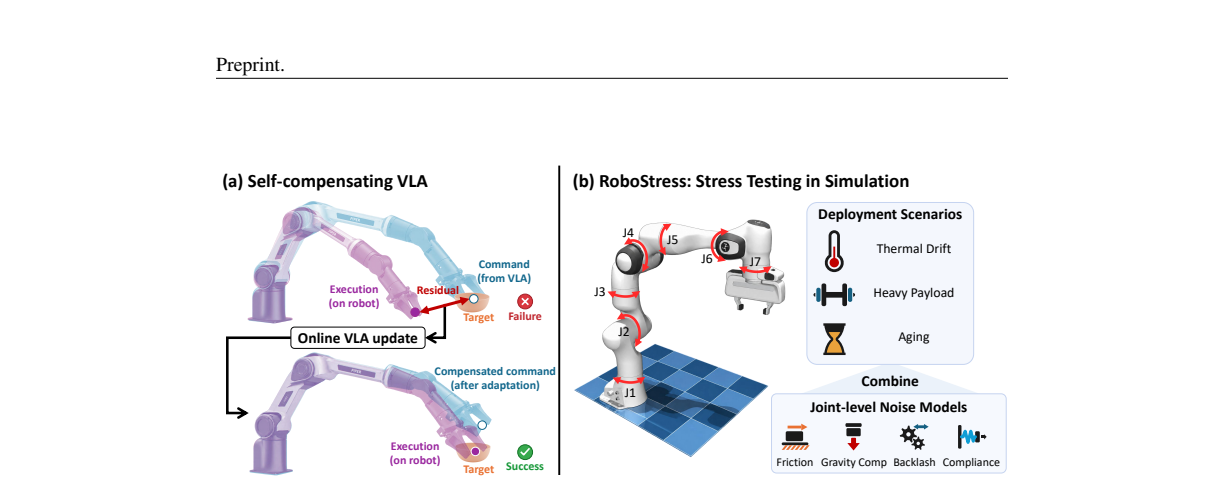
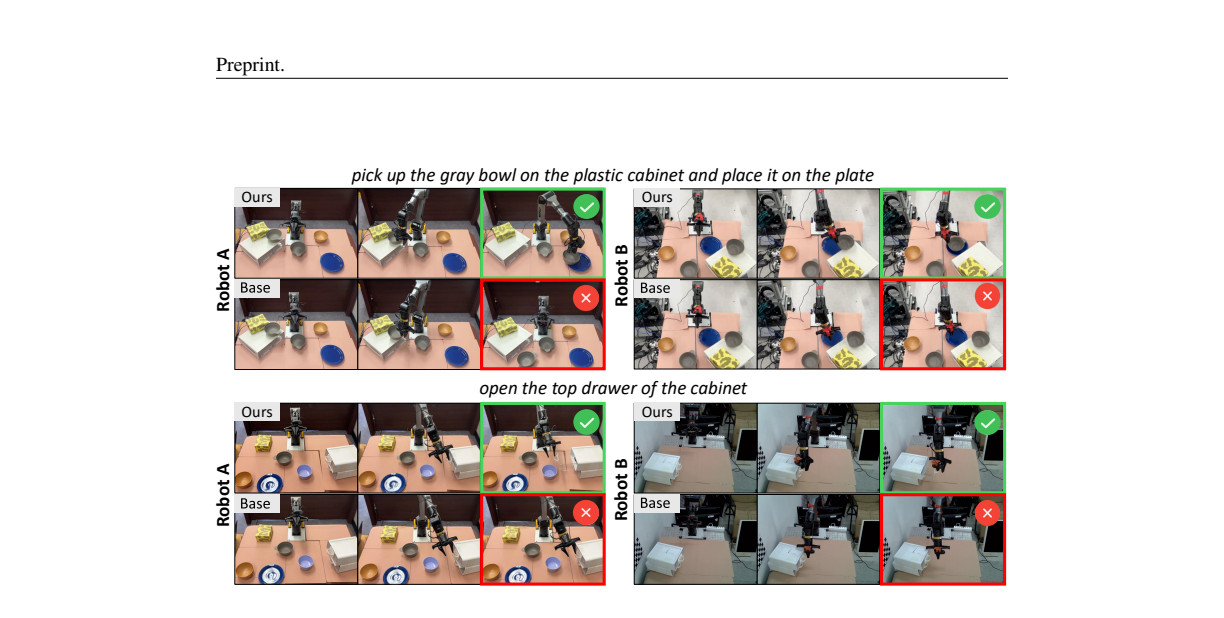
We propose self-compensating VLA, a deployment-time adaptation method that enables a VLA policy to pre-compensate for the robot's execution errors when generating commands. Without task rewards or labels, it updates the policy online using the residual between the action commanded by a VLA and the motion executed by the robot. To stress-test VLA robustness across execution conditions that are impractical to cover with physical robots alone, we introduce RoboStress, a controlled simulation benchmark. It combines established joint-level models of friction, backlash, compliance, and gravity-compensation error into seven deployment scenarios whose execution errors depend on the robot's state and motion history. On RoboStress, self-compensating VLA achieves higher average task success than both the base policies and methods that build in robustness during training. On two physical robot arms with different usage histories, it raises the average task success rate by more than 30 percentage points on each arm, and the gains extend to objects not seen in the task demonstrations.
from the abstract
Pith says
Machine review · deepseek-v4-flash · 30 Sep 2026 · what was read was not recorded · not checked by a person
It can be wrong. Challenge this review or reply to it.
Holds up, with conditions. A solid, well-specified answer to a real deployment gap, with a benchmark worth keeping; the +30pp real-robot headline needs a within-task learning curve before I'd take it at face value. This line is wrong
4 major objections · 5 minor
How often objections from reviews like this one are right: not yet measured
Not checked: figures, code, what the 56 references say.
The paper says, at §5.3, Appendix B.6; §5.2, Appendix B.2
The review did not quote this passage.
Pith says: Objection 1 of 4 · major
The evaluation protocol conflates adaptation with measurement. Appendix B.6 states that 'No episodes are reserved solely for adaptation: the reported evaluation episodes also populate the feedback buffer, and online updates begin once the buffer is full,' and with a 32-chunk FIFO and updates every 8 chunks, the first several of each task's 25 real-robot episodes run under the unadapted or only partially adapted policy.
more of objection 1
The Table 6 averages therefore blend base-policy, transiently perturbed, and steady-state rollouts, so the abstract's claim of raising average task success by more than 30 percentage points cannot be attributed to the compensated steady-state policy. I ask for a success-rate-versus-episode-index curve (or an adaptation burn-in protocol) for the real-robot tasks, which would show how many episodes adaptation requires and whether early episodes transiently degrade. The simulation protocol in B.2 has the same structure: the LoRA parameters and Adam state are carried across all episodes of a suite and re-initialized only per suite and scenario, so the Table 2 averages also pool tasks with differing accumulated adaptation; per-task or per-episode-block results would clarify this.
The paper says, at §5.1, Tables 2 and 6
The review did not quote this passage.
Pith says: Objection 2 of 4 · major
No confidence intervals or significance tests are reported anywhere. With 20 episodes per task and three seeds in simulation and 25 episodes per task on the real robots, several reported margins are plausibly within noise: for π0, Table 2's Aged Joint-Uniform row is 24.0 vs 23.0 and the overall RoboStress gain is only 2.5 points on average (41.7 vs 44.2), …
more of objection 2
… yet Section 5.2 states the method outperforms base and training-time baselines across all seven scenarios without interval estimates; the real-robot per-task numbers at 25 episodes carry binomial standard errors on the order of 10 points. The headline claims need confidence intervals and, ideally, a per-seed or per-task breakdown before the quantitative statements ('more than 30 percentage points', 'all seven scenarios') can be accepted as stated.
The paper says, at §3.2, Eq. (2); §5.2 Table 2; Appendix C
The review did not quote this passage.
Pith says: Objection 3 of 4 · major
The pseudo-target a_target = a_policy − eta_obs is defined entirely from the policy's own command and the achieved motion; there is no external task signal, so the method can compensate tracking-style execution error but cannot detect or correct task-level error, and a_target inherits any suboptimality of the base policy.
more of objection 3
The risk is visible in data the paper already reports: in the Clean setting, π0.5 with Ours (95.8) is below the base policy (97.0), and Appendix C reports a 23.4% residual even in Clean, which the authors attribute to nominal tracking mismatch (acknowledged in the text). Because that residual exists in the fine-tuning demonstrations as well as at deployment, part of the compensation signal is not deployment-induced error, and the anchor loss bounds parameter drift but does not bound early-episode behavior. The paper should quantify the Clean-condition effect of adaptation (does the method systematically degrade the nominal setting?) and qualify the 'raises task success' claim to the error-compensation regime.
The paper says, at §5.2, Table 4
The review did not quote this passage.
Pith says: Objection 4 of 4 · major
The 'Direct' ablation — the same residual signal applied as an open-loop chunk-level correction while keeping the policy fixed — collapses to 23.6%, far below both the base policy and Ours. Since the residual is the method's only ground-truth signal, this large gap is the load-bearing evidence that policy adaptation (observation-conditioned compensation) is what matters, but the mechanism is asserted in a single sentence.
more of objection 4
A diagnostic comparing the adapted policy's outputs with the base policy's outputs on the same observations, or a closed-loop direct-correction baseline, would substantiate the claim that the benefit comes from conditioning on state rather than from the correction structure itself; without it, the result also leaves open whether the pseudo-target of Eq. (2) is reliably usable in general or only when filtered through a heavily regularized LoRA update.
5 minor objections
The paper says, at Table 6
Pith says: minor objection 1 of 5
The typesetting of Table 6 is garbled: numeric values are concatenated without column separators, and the average row is unreadable as printed; the table should be reformatted with explicit column boundaries.
The paper says, at Table A1
Pith says: minor objection 2 of 5
Table A1 contains a broken cross-reference: the gravity-compensation residual fraction β_j,0 is tied to 'Eq. (??)', which should point to the defining equation in Section 4.1.
show 3 more
The paper says, at §3.1, Eq. (1)
Pith says: minor objection 3 of 5
The exclusion of the gripper dimension from the residual is only stated in Appendix B.3; it should be mentioned in the main text near Eq. (1), since the gripper term otherwise appears in the action vector.
The paper says, at §5.3, Table 5
Pith says: minor objection 4 of 5
The DOB comparison shows Ours alone (84%) slightly above DOB+Ours (80%); at 25 episodes these are within noise, and the text's ranking of the combined variant should be softened or accompanied by intervals.
The paper says, at §5.2, Table 3
Pith says: minor objection 5 of 5
The per-component rows of Table 3 are single-component settings that isolate each model; the text should state this explicitly and note that in this regime the average gain is nearly flat (50.0 vs 51.5), which is in tension with the large gains claimed in the combined scenarios.
What would settle it
Re-run the real-robot Task 1 evaluation on Robot A (π0 and π0.5) while logging success per episode index across the 25 episodes, with the LoRA/Adam/buffer state initialized at episode 0 and retained as in Table 6. If success in the first N episodes (up to, say, 8) is statistically no worse than the full 25-episode average, adaptation is fast and the conflated protocol is benign; if early episodes are clearly lower (e.g., >10pp below the average), then the headline gain overcounts partially adapted rollouts and should instead be reported as a matched early-vs-late comparison.
from the skeptic's reading
How the review went
4 readings by deepseek-v4-flash · 30 Sep 2026
- Reader holds up, with conditions
- Skeptic partly agrees
- Editor wrote the verdict above
- Referee major revision: 4 major objections, 5 minor
Not run on this paper: the simulated authors' defence.
Pith did not check this review's objections against the paper.
The review in full
The review in brief, machine-written
Two things to know. First, this paper targets a real gap — VLA policies drifting because the robot's executed motion doesn't match the commanded action (wear, payload, temperature) — and prior robustness work mostly covered visual corruptions or synthetic action noise. Second, the headline real-world result, more than +30pp on two Piper arms, is plausible but not fully pinned down, because the evaluation episodes also feed the adaptation and no learning curve is shown.
What's new: the compensation signal. Equations 1-2 use the proprioceptive residual between commanded and executed motion as a self-supervisory target, and LoRA updates on that target pre-compensate later commands. That's distinct from EVOLVE-VLA and TT-VLA (task-progress feedback) and from the synthetic-perturbation work. RoboStress is the other real contribution: friction, backlash, compliance, and gravity-error models injected at the right stage of the control pipeline, giving seven scenarios with state- and history-dependent errors. The Table 4 ablation earns its place — direct chunk-level correction gets 23.6% while policy adaptation gets 44.2%, genuine evidence that what matters is observation-conditioned compensation, not the raw correction. The authors are honest: they flag that the gains are not safety guarantees and that simulation and real residuals are not on a common scale.
The soft spot is the real-robot protocol. Appendix B.6 says plainly that no episodes are reserved for adaptation; the 25 evaluation episodes populate the buffer and updates start once it fills. So the 71-84% averages in Table 6 mix pre-adaptation, partially adapted, and adapted rollouts. That doesn't kill the method — for deployment you arguably care about the average across the run — but the headline claim needs a success-by-episode-index curve to show how fast adaptation converges, and there is none. The stress-test note is right about this. With 25 episodes per task, individual cells have intervals on the order of ±10pp, so a few entries aren't cleanly separated; the overall gap (base 43-50, ours 76-84) is well outside that noise.
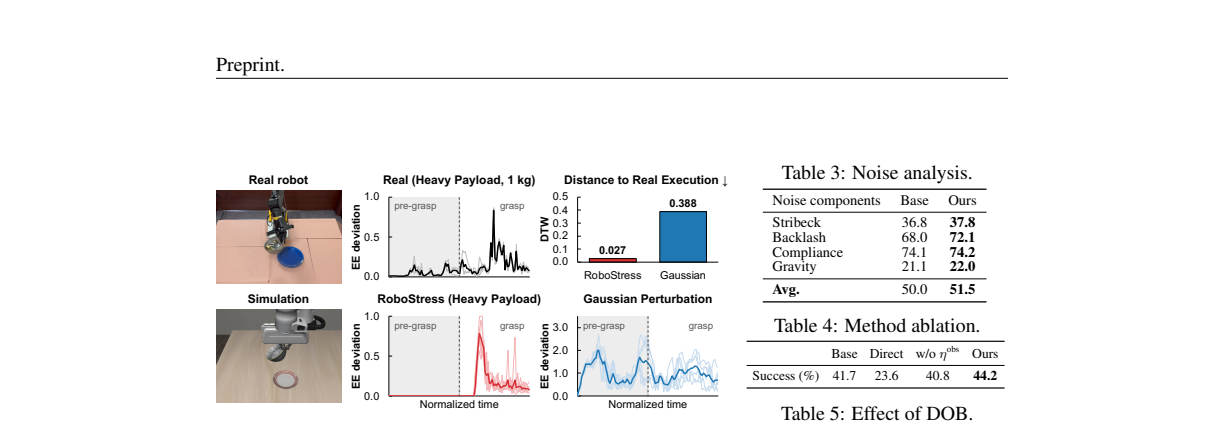
Two smaller points. The Heavy Payload calibration in Figure 4 fits parameters to match real deviations and then compares against a Gaussian baseline — that's a post-fit sanity check, not independent validation; the paper is transparent that the parameters were adjusted, but it shouldn't be read as confirmation. And Equation 1 assumes a clean additive residual; sampling noise and tracking dynamics contaminate it. The anchor loss limits drift and the no-residual ablation supports the signal's informativeness, but the residual is never checked against ground-truth injected error.
On the reader's circularity concern, I'd downgrade it. Validation is against external task success, which closes the loop; a self-referential target is fine when the outcome check is external.
Who it's for: anyone doing deployment-time VLA adaptation or needing a controlled execution-error benchmark. It deserves a serious referee. I'd ask for learning curves and confidence intervals before accept, and I'd cite RoboStress in my own work.
The strongest objection
The strongest claim—>30pp success gains on two physical Piper arms—rests on Table 6, where the paper's own Section B.6 states that no episodes are reserved solely for adaptation: the reported evaluation episodes also populate the feedback buffer, and online updates begin once the buffer is full. This is unavoidable for a deployment-time adaptation method evaluated by a single run of episodes, but it means the success rates are measured on a mix of pre-adaptation and partially adapted rollouts. If adaptation needs several episodes (e.g., a FIFO of 32 chunks plus the update lag) before it stops degrading or starts improving performance, the early episodes in each task's 25 could be dominated by the base policy or by transiently perturbed LoRA updates. The aggregated 71–84% averages in Table 6 therefore do not cleanly measure either the base-policy performance or the fully-adapted policy's steady-state performance, yet the abstract states these gains as the method's outcome. The anchor loss limits drift, but does not bound early-episode behavior, and there is no reported curve showing success as a function of episode index, even though such a curve would directly show how many episodes adaptation needs. The same confound weakens the DOB comparison in Table 5, where the 'Ours' column presumably also mixes initial and adapted episodes. The reader identified this conflation, and Section B.6 confirms it explicitly: 'No episodes are reserved solely for adaptation.' The load-bearing condition is that adaptation is roughly monotonic and fast relative to 25 episodes; the paper provides no within-task learning curve to verify it.
The reader's weakest assumption is about the residual being a clean additive error signal. I read that assumption, checked the paper's own Ablation B.6, and found a more concrete load-bearing issue: the evaluation protocol itself conflates adaptation and evaluation episodes. The paper explicitly says no episodes are reserved for adaptation. That is a stated protocol choice, not an unstated assumption, and it directly affects the central 30pp real-world claim. The residual quality assumption is real but partially mitigated by the anchor loss and by the internal consistency of the results (adaptation helps across synthetic and real settings). The episode-conflation concern is testable with a per-episode curve, which the paper could easily have provided but did not. I keep the verdict at CONDITIONAL rather than moving to ACCEPT; the fix is to report success as a function of episode index. This partially agrees with the reader because both point at the same weakest spot (the adaptation signal and its measurement), but I emphasize the protocol rather than the signal noise.
The referee's report
If the headline numbers held as stated, the contribution would be significant: a label-free, model-free compensation scheme deployable beside an existing low-level controller, plus a physically motivated and reusable stress-test benchmark. The benchmark design is a genuine asset — its errors depend on joint state and motion history, and the authors validate the Heavy Payload scenario against a real heavy-payload replay via DTW. The paper is also commendably transparent about the evaluation protocol in Appendix B.6. However, the magnitude of the central claims is not currently supported as stated: the reported success rates mix unadapted and partially adapted rollouts, no confidence intervals or per-episode analysis are given, and the real-robot and simulation evaluations are not described at matched protocol fidelity. These issues are fixable with additional analysis rather than new experiments on a different scale.
Pith's reading of the paper (a machine's summary, not the authors')
This paper argues that the gap between what a vision-language-action (VLA) policy commands and what the robot actually executes, measured through proprioception, can be turned into a self-supervisory signal that lets the policy pre-compensate for its own execution errors during deployment, with no task rewards or labels. Execution errors from wear, payload, temperature, and gear backlash are common in physical robots, while existing robustness methods handle them only by injecting synthetic noise during training. The authors' self-compensating VLA instead derives a residual $\eta^{\mathrm{obs}}_{t,i}=\Delta x_{t,i}-a^{\mathrm{policy}}_{t,i}$ from the commanded and executed motion and updates only small LoRA adapters on a frozen policy, online. To cover execution conditions impractical on physical hardware, they build RoboStress, a simulation benchmark combining four established joint-level error models (Stribeck friction, gravity-compensation error, backlash, and dynamic compliance) into seven deployment scenarios. The method outperforms the base policies and training-time robustness methods on all seven scenarios and raises real-world average task success by more than 30 percentage points on two physical arms, including for objects never seen in the demonstrations.
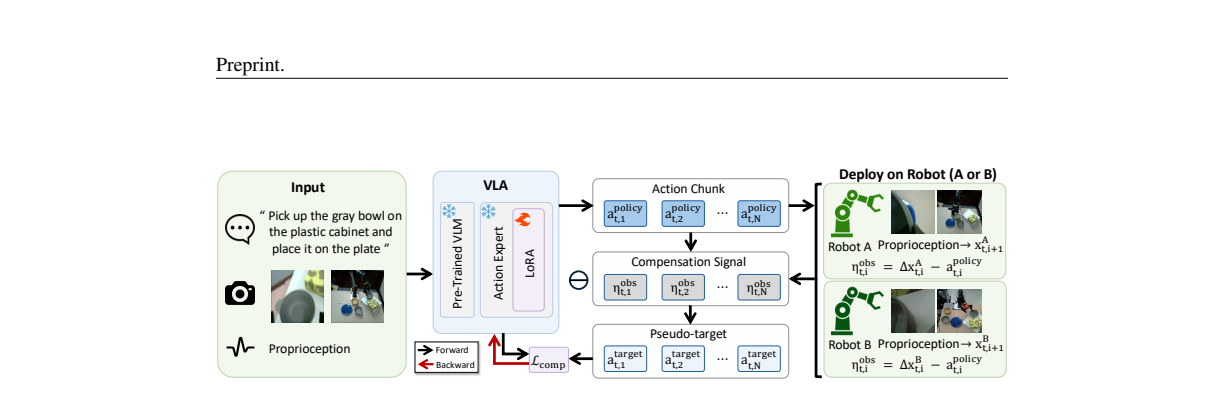
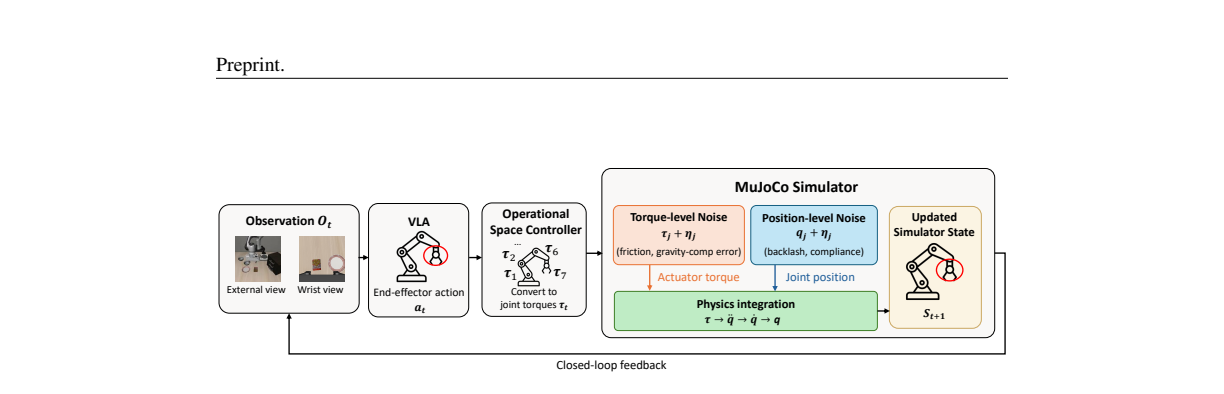
What carries the argument. The load-bearing object is the compensation signal: the proprioceptive residual $\eta^{\mathrm{obs}}_{t,i}=\Delta x_{t,i}-a^{\mathrm{policy}}_{t,i}$ (Eq. 1), the difference between the motion a VLA commands and the motion the robot actually executes, rescaled into the policy's normalized action space. From it the method constructs the compensated pseudo-target $a^{\mathrm{target}}_{t,i}=a^{\mathrm{policy}}_{t,i}-\eta^{\mathrm{obs}}_{t,i}$ (Eq. 2) and regresses the policy toward it using the flow-matching loss of Eq. (3), which combines a velocity-field objective with an anchor term $\lambda_{\mathrm{anc}}\lVert\phi-\phi_0\rVert_2^2$ that keeps the trainable LoRA parameters near their initialization. Only rank-4 LoRA adapters on the action expert are updated online while the base policy stays frozen and the robot's low-level controller is unchanged. The companion RoboStress benchmark supplies the four joint-level error models, injected at the torque stage (friction, gravity-compensation error) and position stage (backlash, compliance) of the control pipeline and combined into seven deployment scenarios with state- and motion-history-dependent severity.
Core claim. On the paper's own terms, the central claim is that a VLA policy can be adapted at deployment time purely from the proprioceptive residual between its commanded action and the motion actually executed, and that this adaptation yields subsequent commands that pre-compensate for mechanical execution errors. The residual $\eta^{\mathrm{obs}}_{t,i}=\Delta x_{t,i}-a^{\mathrm{policy}}_{t,i}$ (Eq. 1) is computed from the achieved end-effector pose change, rescaled into the policy's normalized action units using the SO(3) logarithm map; subtracting it from the command gives the compensated pseudo-target $a^{\mathrm{target}}_{t,i}=a^{\mathrm{policy}}_{t,i}-\eta^{\mathrm{obs}}_{t,i}$ (Eq. 2), which the policy regresses toward with a flow-matching objective while an anchor term penalizes drift of the LoRA parameters. Because the residual is observed only after execution, the update affects subsequent chunks, not the current one. The authors report that this raises average success from 49.1% to 56.6% on $\pi_{0.5}$ and from 41.7% to 44.2% on $\pi_0$ across RoboStress, outperforms both base policies and training-time robustness methods in all seven scenarios, and, on two physical Piper arms with different usage histories, raises average task success by more than 30 percentage points on each arm, with the gains extending to objects absent from the fine-tuning demonstrations.
The premise it rests on. The load-bearing premise is that the proprioceptive residual between commanded and executed motion is a clean, approximately additive estimate of execution error, so that subtracting it from the policy command yields a valid supervised target; if measurement noise or policy sampling noise contaminates the residual, or compensation pushes commands off the manifold of task-consistent actions, the online updates could degrade rather than improve performance.
If the paper is right (Pith's inferences, not the authors')
On a deployed robot subject to wear, payload, or thermal drift, a frozen VLA can be kept competitive through online residual feedback instead of retraining or assembling a diverse physical fleet, since the method needs no rewards, labels, or knowledge of the error source.
The gains are observation-conditioned: policy adaptation beats both the frozen base policy and a fixed chunk-level residual correction in the ablation, so the benefit comes from the policy learning to generate corrected commands from its inputs rather than subtracting a constant offset.
The adaptation composes with control-level correction: on a real arm, a disturbance observer alone raised success from 48% to 56%, and adding self-compensating VLA raised it further to 80%, indicating the residual feedback absorbs the error the observer leaves uncancelled.
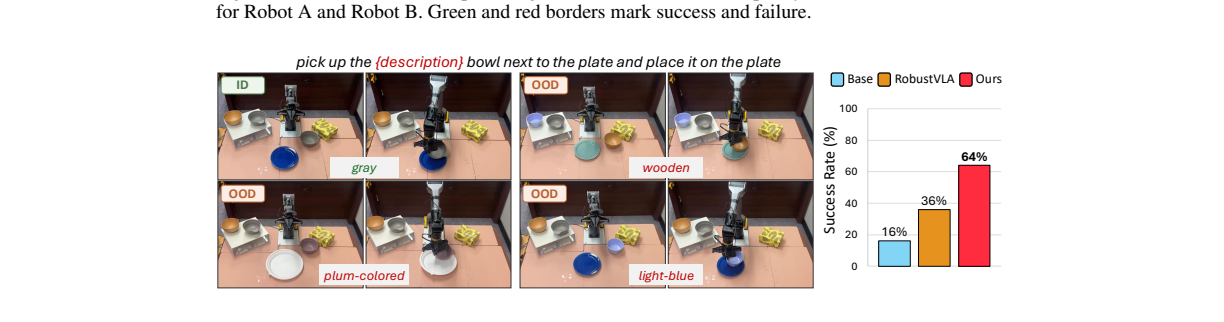
Because the improvements transfer to objects never seen in fine-tuning (64% versus 16% for the base policy on unseen variants), the online adaptation does not overfit to the demonstration objects and can act as a cheap deployment-time robustness patch.
An anchor loss weighting near the initialization is needed: ablation shows removing it lowers the average success, so the regularization against parameter drift is part of what makes online adaptation stable in the reported settings.
A natural extension is to test whether the same residual feedback remains stable over much longer deployments than the reported 25-episode windows; the anchor loss limits but does not eliminate parameter drift, and the paper offers no long-horizon bound on accumulation.
The residual is only as clean as the proprioceptive measurement, so on contact-rich or high-measurement-noise tasks the pseudo-target could corrupt rather than correct; the paper names only the anchor loss as the safeguard for this risk.
Because the simulation and real-robot residuals are measured in different scales and at different rates (end-effector units at 20 Hz versus joint radians at 30 Hz), the two groups of numbers are not on a common scale; transferring RoboStress severity settings to a specific robot would require recalibrating the scenario parameters.
The compensation is representation-agnostic, formulated in normalized end-effector space in simulation and joint space on the real arms, so one could test it on higher-rate, closed-loop policies where the residual is computed per control tick instead of per action chunk.
Check this review
Pith stored no record of this review's passes and took no fingerprint of it. Reviews made by code from 13 Nov 2026 on carry both.
How often reviews like this one are right
Reviews like this one: written by deepseek-v4-flash, where what was read was not recorded.
How often objections from reviews like this one are right: not yet measured
Reviews by people
This review was written by a machine. No person has reviewed this paper on Pith yet. A scientist listed on Pith can review it for a fee, and their review is published here whatever it concludes.
The paper
Abstract
Vision-language-action (VLA) policies often fail when a robot's executed motion deviates from their commanded action. Such execution errors arise from the robot's mechanics and operating conditions, such as wear and payload changes. We propose self-compensating VLA, a deployment-time adaptation method that enables a VLA policy to pre-compensate for the robot's execution errors when generating commands. Without task rewards or labels, it updates the policy online using the residual between the action commanded by a VLA and the motion executed by the robot. To stress-test VLA robustness across execution conditions that are impractical to cover with physical robots alone, we introduce RoboStress, a controlled simulation benchmark. It combines established joint-level models of friction, backlash, compliance, and gravity-compensation error into seven deployment scenarios whose execution errors depend on the robot's state and motion history. On RoboStress, self-compensating VLA achieves higher average task success than both the base policies and methods that build in robustness during training. On two physical robot arms with different usage histories, it raises the average task success rate by more than 30 percentage points on each arm, and the gains extend to objects not seen in the task demonstrations.
The paper's own sentences, arranged, kept beside the review and separate from it. Each label is drawn from a closed vocabulary; the number beside it is the probability the classifier gave that label. No sentence in this record was written by a model.
abstract compiled · 2026-09-30
The authors' main claim, as the classifier picked it out 0.49
“On RoboStress, self-compensating VLA achieves higher average task success than both the base policies and methods that build in robustness during training.”
How the main claim is stated: asserted 1.00
What the abstract itself states, as probabilities: claims first 0.06 · states limitation 0.19 · human participants 0.02 · controlled comparison 0.93 · randomized assignment 0.02 · states quantitative result 0.98 · compares with prior results 0.97 · mentions code or data availability 0.04
The abstract, sentence by sentence
This table labels the abstract only (arXiv listing abstract v1). The number is the probability the classifier gave the label.
| Sentence | Role | The authors' own work | States the main conclusion | Strength |
|---|---|---|---|---|
| Vision-language-action (VLA) policies often fail when a robot's executed motion deviates from their commanded action. | background 0.99 | 0.11 | 0.03 | asserted 0.91 |
| Such execution errors arise from the robot's mechanics and operating conditions, such as wear and payload changes. | background 1.00 | 0.08 | 0.02 | asserted 0.99 |
| We propose self-compensating VLA, a deployment-time adaptation method that enables a VLA policy to pre-compensate for the robot's execution errors when generating commands. | contribution 0.86 | 0.82 | 0.17 | asserted 1.00 |
| Without task rewards or labels, it updates the policy online using the residual between the action commanded by a VLA and the motion executed by the robot. | method 0.99 | 0.85 | 0.04 | asserted 0.99 |
| To stress-test VLA robustness across execution conditions that are impractical to cover with physical robots alone, we introduce RoboStress, a controlled simulation benchmark. | contribution 0.83 | 0.93 | 0.04 | asserted 0.99 |
| It combines established joint-level models of friction, backlash, compliance, and gravity-compensation error into seven deployment scenarios whose execution errors depend on the robot's state and motion history. | method 0.98 | 0.81 | 0.03 | asserted 1.00 |
| On RoboStress, self-compensating VLA achieves higher average task success than both the base policies and methods that build in robustness during training. | result 1.00 | 0.95 | 0.46 | asserted 1.00 |
| On two physical robot arms with different usage histories, it raises the average task success rate by more than 30 percentage points on each arm, and the gains extend to objects not seen in the task demonstrations. | result 1.00 | 0.95 | 0.50 | asserted 1.00 |
What kind of paper the classifier reports this is: method or tool 1.00 · evidence from observation or experiment 0.94
What was examined, and what was not
Sources read
- arXiv listing abstract v1
Not examined
- full text
- figures and tables
- references and citing sentences
- relations to other papers
Levels run
- P abstract
Not run
- S sections
- T body sentences
- C citations
- R cross-paper relations
How the labels were made
Compiled by classifier-1.13.0 via TypeSafe API, question bank abstract-p1-20260923, 2026-09-30: 1 request, 6,281 input tokens.
Every quoted sentence on this record is the authors'. Every label is from Pith's closed vocabulary, with the probability shown beside it. This record as JSON
Figures (6)
Figures are the authors', reproduced from the paper.
References (56)
- [1] Retrieve-then-Steer: Online Success Memory for Test-Time Adaptation of Generative VLAs , author=. arXiv preprint arXiv:2605.10094 , year= on PithPith's reviewarXiv
- [2] LIBERO-Plus: A Progressive Robustness Benchmark for Visual-Language-Action Models , author= on Pith
- [3] Eva-VLA: Evaluating Vision-Language-Action Models' Robustness Under Real-World Physical Variations , author=. arXiv preprint arXiv:2509.18953 , year= on PitharXiv
- [4] Run-time observation interventions make vision-language-action models more visually robust , author= on Pith
- [5] Hongyin Zhang and Pengxiang Ding and Shangke Lyu and Ying Peng and Donglin Wang , booktitle=ICLR, year= on Pith
- [6] On Robustness of Vision-Language-Action Model against Multi-Modal Perturbations , author= on Pith
- [7] Zhang, Hongyin and Zhang, Shuo and Jin, Junxi and Zeng, Qixin and Li, Runze and Wang, Donglin , journal=. Robust on Pith
- [8] Spong, M. W. , title =. Journal of Dynamic Systems, Measurement, and Control , year = on Pith
- [9] Modelling and identification of industrial robots including drive and joint flexibilities , author= on Pith
- [10] Canudas de Wit, C. and Olsson, H. and Astrom, K.J. and Lischinsky, P. , journal=. A new model for control of systems with friction , year= on Pith
- [11] A generalized Maxwell-slip friction model appropriate for control purposes , author=. 2003 IEEE International Workshop on Workload Characterization (IEEE Cat. No. 03EX775) , volume=. 2003 , organization= on Pith
- [12] Tuttle, T.D. and Seering, W.P. , journal=. A nonlinear model of a harmonic drive gear transmission , year= on Pith
- [13] Adaptive control of systems with backlash , journal =. 1993 , author = on Pith
- [14] Effects of temperature and mounting configuration on the dynamic parameters identification of industrial robots , author=. Robotics , year= on Pith
- [15] Modeling and experiment design for identification of wear in a robot joint under load and temperature uncertainties based on friction data , author=. IEEE/ASME Transactions on Mechatronics , year= on Pith
- [16] Comprehensive modeling and identification of nonlinear joint dynamics for collaborative industrial robot manipulators , author=. Control Engineering Practice , year= on Pith
- [17] Dynamic identification of the franka emika panda robot with retrieval of feasible parameters using penalty-based optimization , author=. IEEE Robotics and Automation Letters , year= on Pith
- [18] Modeling and calibration of high-order joint-dependent kinematic errors for industrial robots , author=. Robotics and Computer-Integrated Manufacturing , year= on Pith
- [19] Self-Supervised Policy Adaptation during Deployment , author= on Pith
- [20] Ashish Kumar and Zipeng Fu and Deepak Pathak and Jitendra Malik , editor = on Pith
show 36 more
- [21] Bo Liu and Yifeng Zhu and Chongkai Gao and Yihao Feng and Qiang Liu and Yuke Zhu and Peter Stone , editor = on Pith
- [22] EVOLVE-VLA: Test-Time Training from Environment Feedback for Vision-Language-Action Models , author=. arXiv preprint arXiv:2512.14666 , year= on PitharXiv
- [23] Liu, Changyu and Liu, Yiyang and Wang, Taowen and Zhuang, Qiao and Liang, James Chenhao and Yang, Wenhao and Xu, Renjing and Wang, Qifan and Liu, Dongfang and Han, Cheng , booktitle=. On-the-Fly on Pith
- [24] _0 : A Vision-Language-Action Flow Model for General Robot Control , AUTHOR= on Pith
- [25] Edward J Hu and Yelong Shen and Phillip Wallis and Zeyuan Allen-Zhu and Yuanzhi Li and Shean Wang and Lu Wang and Weizhu Chen , booktitle=ICLR, year=. Lo on Pith
- [26] Domain randomization for transferring deep neural networks from simulation to the real world , author=. 2017 , organization= on Pith
- [27] Sim-to-real transfer of robotic control with dynamics randomization , author=. 2018 , organization= on Pith
- [28] Active domain randomization , author=. 2020 , organization= on Pith
- [29] Anusha Nagabandi and Ignasi Clavera and Simin Liu and Ronald S. Fearing and Pieter Abbeel and Sergey Levine and Chelsea Finn , title=. 2019 , booktitle=ICLR, crossref= on Pith
- [30] On the adaptive control of robot manipulators , author=. The International Journal of Robotics Research , year= on Pith
- [31] Adaptive control of robot manipulators with flexible joints , author=. IEEE Transactions on Automatic Control , year= on Pith
- [32] Wenhao Yu and Jie Tan and C. Karen Liu and Greg Turk , editor =. Preparing for the Unknown: Learning a Universal Policy with Online System Identification , booktitle = RSS, year = on Pith
- [33] Closing the sim-to-real loop: Adapting simulation randomization with real world experience , author=. 2019 , organization= on Pith
- [34] Iterative residual tuning for system identification and sim-to-real robot learning , author=. Autonomous Robots , year= on Pith
- [35] Rt-2: Vision-language-action models transfer web knowledge to robotic control , author=. 2023 , organization= on Pith
- [36] Moo Jin Kim and Karl Pertsch and Siddharth Karamcheti and Ted Xiao and Ashwin Balakrishna and Suraj Nair and Rafael Rafailov and Ethan Foster and Grace Lam and Pannag Sanketi and Quan Vuong and Thomas Kollar and Benjamin Burchfiel and Russ Tedrake and Dorsa Sadigh and Sergey L... on Pith
- [37] Anthony Brohan and Noah Brown and Justice Carbajal and Yevgen Chebotar and Joseph Dabis and Chelsea Finn and Keerthana Gopalakrishnan and Karol Hausman and Alexander Herzog and Jasmine Hsu and Julian Ibarz and Brian Ichter and Alex Irpan and Tomas Jackson and Sally Jesmonth an... on Pith
- [38] Octo: An Open-Source Generalist Robot Policy , author =. Proceedings of Robotics: Science and Systems , address = on Pith
- [39] Identifying mass parameters for gravity compensation and automatic torque sensor calibration , author=. 1996 , organization= on Pith
- [40] Method for robot manipulator joint wear reduction by finding the optimal robot placement in a robotic cell , author=. Applied Sciences , year= on Pith
- [41] A unified approach for motion and force control of robot manipulators: The operational space formulation , author=. IEEE Journal on Robotics and Automation , year= on Pith
- [42] Modeling and compensation of backlash and harmonic drive-induced errors in robotic manipulators , author=. Proc. International Manufacturing Science and Engineering Conference , year= on Pith
- [43] Towards deep learning models resistant to adversarial attacks , author= on Pith
- [44] Adam: A method for stochastic optimization , author= on Pith
- [45] Pertsch, Karl and Stachowicz, Kyle and Ichter, Brian and Driess, Danny and Nair, Suraj and Vuong, Quan and Mees, Oier and Finn, Chelsea and Levine, Sergey , booktitle=RSS, year= on Pith
- [46] Gr00t n1: An open foundation model for generalist humanoid robots , author=. arXiv preprint arXiv:2503.14734 , year= on PithPith's reviewarXiv
- [47] Black, Kevin and Brown, Noah and Darpinian, James and Dhabalia, Karan and Driess, Danny and Esmail, Adnan and Equi, Michael Robert and Finn, Chelsea and Fusai, Niccolo and Galliker, Manuel Y and others , booktitle=CoRL, year= on Pith
- [48] Gr-2: A generative video-language-action model with web-scale knowledge for robot manipulation , author=. arXiv preprint arXiv:2410.06158 , year= on PithPith's reviewarXiv
- [49] Tinyvla: Towards fast, data-efficient vision-language-action models for robotic manipulation , author=. IEEE Robotics and Automation Letters , year= on Pith
- [50] A mathematical introduction to robotic manipulation , author=. 2017 , publisher= on Pith
- [51] Payload estimation based on identified coefficients of robot dynamics—With an application to collision detection , author=. 2017 , organization= on Pith
- [52] Disturbance-observer-based control and related methods—An overview , author=. IEEE Transactions on Industrial Electronics , volume=. 2016 , publisher= on Pith
- [53] Diffusion Policy: Visuomotor Policy Learning via Action Diffusion , author=. Proceedings of Robotics: Science and Systems (RSS) , year= on Pith
- [54] Neural network control for a closed-loop system using feedback-error-learning , author=. Neural Networks , volume=. 1993 , publisher= on Pith
- [55] Residual reinforcement learning for robot control , author=. 2019 , organization= on Pith
- [56] Flow matching for generative modeling , author= on Pith
Cited by 1 Pith paper
Reviewed papers on Pith that cite this one. The full citation record
Challenges and discussion
Disagree with the review, or know something it missed? Leave a comment, or challenge this review formally: a challenge becomes a permanent entry in this paper's record, and its decision is published here.
Come back by email
A short list of the week's newly reviewed papers. Nothing is sent until you confirm from your inbox, and every email has a link that stops it. No account.
No comments yet.
Sign in to comment