Robotics · arXiv:2610.05719 v1 · submitted 5 Oct 2026 · 41 references
When to Switch: Reliable Action-Chunk Extension for Vision-Language-Action Models
The paper says
“Vision-Language-Action (VLA) models serve as unified policies for robotic manipulation, yet their expensive inference forces robots to pause between policy calls, resulting in stop-and-go execution that interrupts smooth motion and prolongs task completion.”
more of the abstract
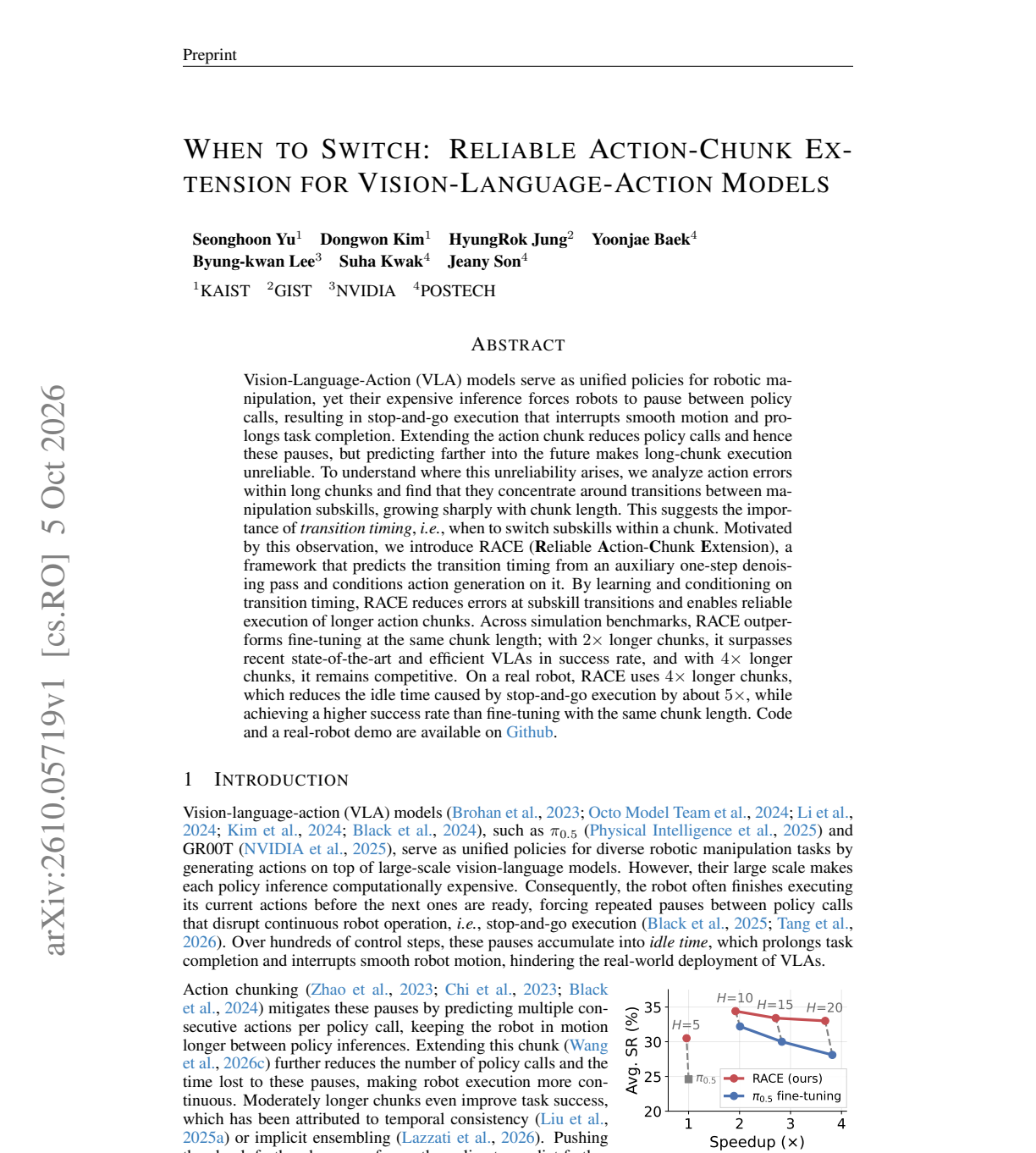
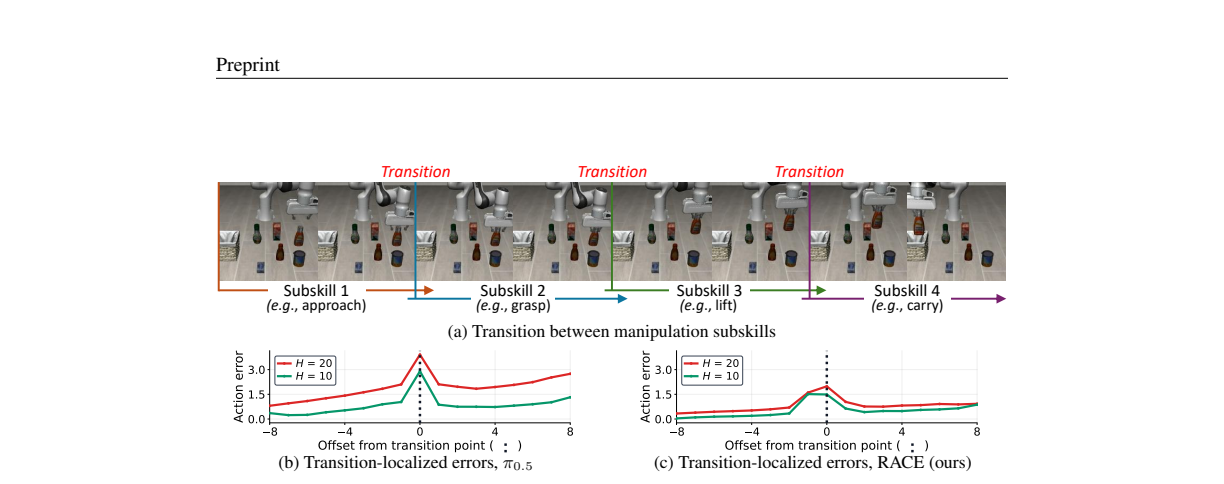
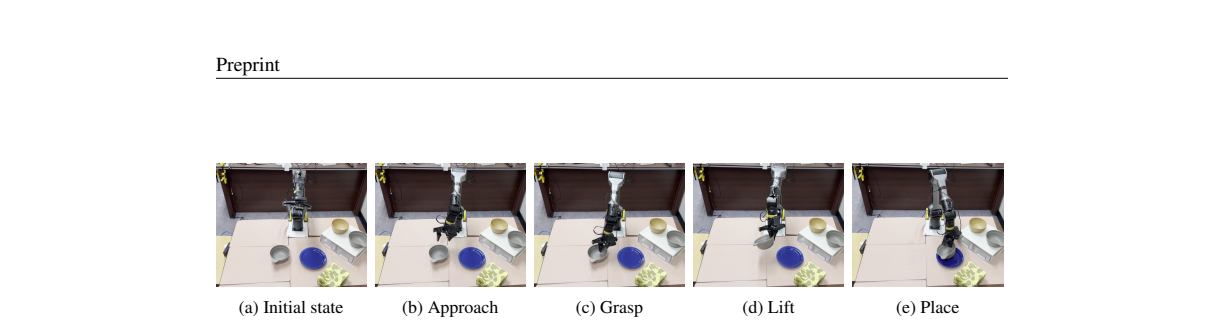
Extending the action chunk reduces policy calls and hence these pauses, but predicting farther into the future makes long-chunk execution unreliable. To understand where this unreliability arises, we analyze action errors within long chunks and find that they concentrate around transitions between manipulation subskills, growing sharply with chunk length. This suggests the importance of transition timing, i.e., when to switch subskills within a chunk. Motivated by this observation, we introduce RACE (Reliable Action-Chunk Extension), a framework that predicts the transition timing from an auxiliary one-step denoising pass and conditions action generation on it. By learning and conditioning on transition timing, RACE reduces errors at subskill transitions and enables reliable execution of longer action chunks. Across simulation benchmarks, RACE outperforms fine-tuning at the same chunk length; with 2x longer chunks, it surpasses recent state-of-the-art and efficient VLAs in success rate, and with 4x longer chunks, it remains competitive. On a real robot, RACE uses 4x longer chunks, which reduces the idle time caused by stop-and-go execution by about 5x, while achieving a higher success rate than fine-tuning with the same chunk length. Code and a real-robot demo are available at https://github.com/Seonghoon-Yu/RACE-VLA
from the abstract
Pith says
Machine review · deepseek-v4-flash · 7 Oct 2026 · what was read was not recorded · not checked by a person
It can be wrong. Challenge this review or reply to it.
Holds up, with conditions. Careful empirical work on a real failure mode; the mechanism is plausible but the transition-error claim is measured on demonstration states, so accept conditionally. This line is wrong
2 major objections · 5 minor
How often objections from reviews like this one are right: not yet measured
Not checked: figures, code, what the 41 references say.
The paper says, at Sec. 4.4 and Appendix E.4
The review did not quote this passage.
Pith says: Objection 1 of 2 · major
The mechanistic claims are measured only on demonstration states. Appendix E.4 states that ground-truth actions exist only for demonstration states, and Fig. 2, Fig. 4, and Tab. 31 use training demonstrations. On training demonstrations, part of RACE's transition-error reduction is built in by construction: L_timing back-propagates into the action expert (Sec. 3.2) and explicitly reshapes its features to predict PELT positions on exactly those demonstrations.
more of objection 1
The out-of-sample support is partial: Tab. 27 shows the exact-step gripper gain on held-out demonstrations is +3.2 pp with a 95% CI of [-1.2, 7.6], and Tab. 23 shows the head recalls only 50-58 percent of transitions within ±1 step on held-out demonstrations at H >= 10. To support the narrative 'RACE reduces transition errors, hence raises the chunk ceiling', the paper should either add rollout-state evidence (e.g., flag predicted transition steps in the policy's own rollouts and compare deviation from a replanned or demonstrated reference) or explicitly reframe the Sec. 4.4 claims as demonstration-state measurements that support, but do not establish, the causal story.
The paper says, at Appendix A.5 and Tab. 23
The review did not quote this passage.
Pith says: Objection 2 of 2 · major
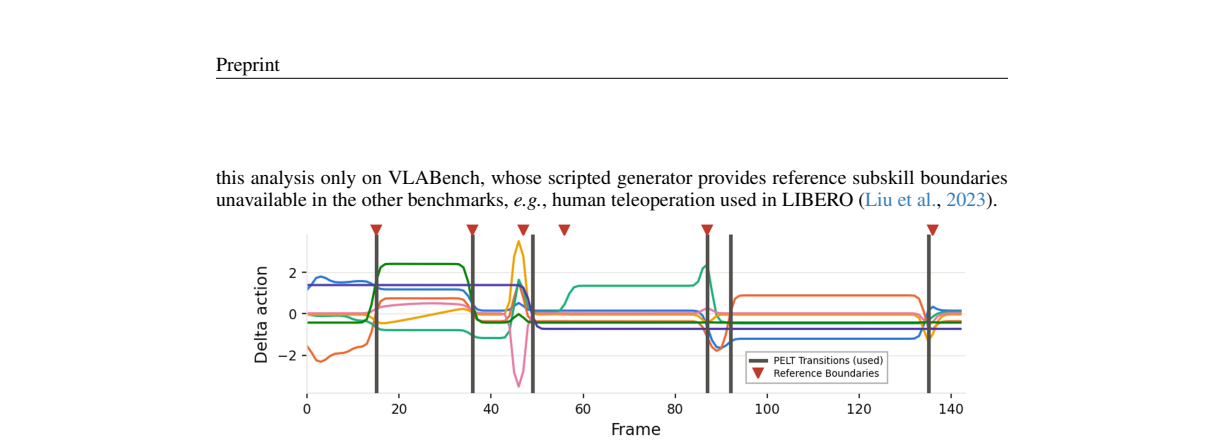
The timing-supervision stack rests on PELT pseudo-labels that agree with the VLABench generator's reference boundaries at 0.82 precision and 0.70 recall (Tab. 8), so roughly a third of reference transitions are unlabeled. The paper defends robustness to the penalty beta (Tab. 19) and to the label source (Tab. 4a), which is fair, but the residual risk is systematic rather than …
more of objection 2
… random: if PELT consistently misses a particular transition type, the prior is biased and the head's held-out recall of 50-58 percent at ±1 step for H >= 10 (Tab. 23) will not be uniform across subskill types. A concrete and cheap test is to report per-reference-boundary recall broken down by skill duration or action-change magnitude; this would show whether missed transitions are a random subset or a biased one, and whether the timing-conditioning benefit survives on chunks where the reference boundary is captured.
5 minor objections
The paper says, at Sec. 4.4 and Tab. 27
Pith says: minor objection 1 of 5
The sentence 'RACE switches within one step of the correct step more often' should be qualified, because on held-out demonstrations the exact-step gain is +3.2 pp with a 95% CI of [-1.2, 7.6] (not significant), while the ±1-step and missed-switch differences are significant; the current wording overstates the exact-timing benefit.
The paper says, at Tab. 6 and Appendix E.1
Pith says: minor objection 2 of 5
The real-robot success rates (36, 48, and 66 percent) lack confidence intervals and seed information; a binomial 95% CI on 50 trials would align this section with the paper's otherwise high statistical standard.
show 3 more
The paper says, at Tables 1 and 2
Pith says: minor objection 3 of 5
Spd is defined over episodes that both the model and the pi 0.5 baseline complete successfully and excludes simulator execution time (Appendix E.2); this conditioning is not flagged in the main text, and Tab. 29 shows non-trivial task-level variation, so a footnote would prevent misreading.
The paper says, at Table 4a
Pith says: minor objection 4 of 5
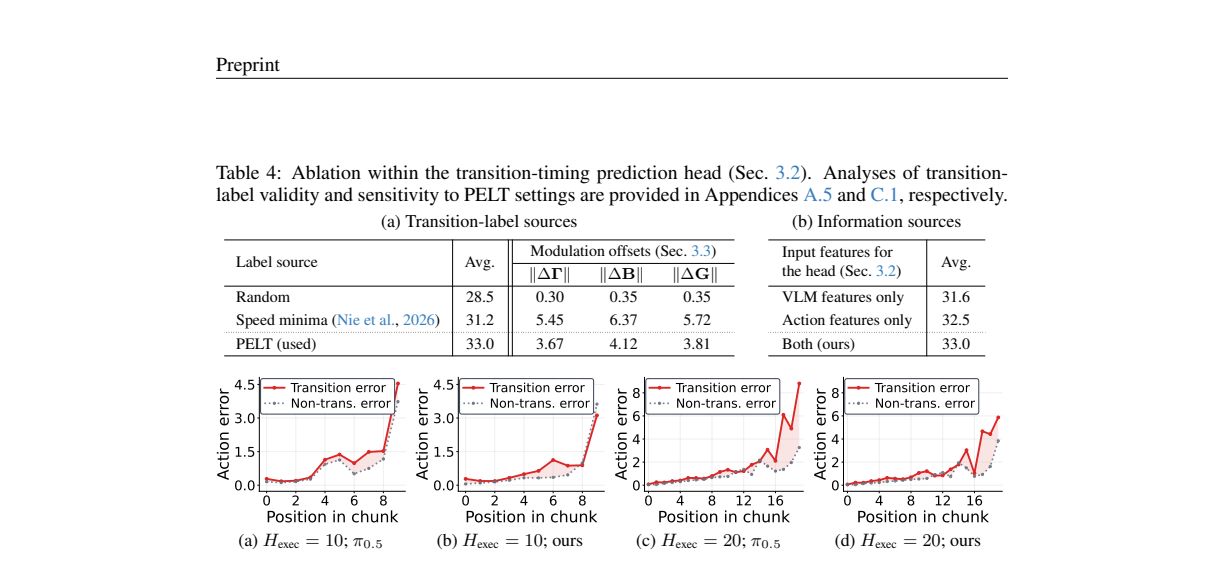
The 'Modulation offsets' columns report the learned RMSNorm offset magnitudes but no units or norm are specified; please state that these are, e.g., mean L2 norms over the offset tensors.
The paper says, at Sec. 4.4 and Appendix D.1
Pith says: minor objection 5 of 5
The prior-accuracy numbers (Tab. 23) are PELT-agreement scores on demonstration states; the main text should state this at the point of use in Sec. 4.4, since the current phrasing could be read as rollout-level transition accuracy.
What would settle it
Collect rollout-state measurements on VLABench at H_exec=20: run RACE and fine-tuned π0.5 over 300 held-out episodes, recording the actual observation at each policy call together with the predicted prior p̂_t and the subsequently executed chunk. Recompute the error analysis of Fig. 4 and Tab. 31 on these rollout states, defining transition steps from the executed action trace via the same PELT procedure (or the generator reference boundaries), and measure the head's ±3-step localization accuracy against both label sets. If localization accuracy on rollout states falls well below the held-out-demonstration value of 65.1% (Tab.
from the skeptic's reading
How the review went
4 readings by deepseek-v4-flash · 7 Oct 2026
- Reader holds up, with conditions
- Skeptic partly agrees
- Editor wrote the verdict above
- Referee major revision: 2 major objections, 5 minor
Not run on this paper: the simulated authors' defence.
Pith did not check this review's objections against the paper.
The review in full
The review in brief, machine-written
What's actually new here: the diagnosis that long-chunk errors concentrate at subskill transitions and grow with chunk length, plus a mechanism (RACE) that predicts transition timing from an auxiliary one-step denoising pass and conditions every denoising step on it. That conditioning mechanism is not in the cited prior work, which either shortens execution around transitions (PACE), extends chunks via RL (PolicyTrim), or injects subskill structure as goals or auxiliary outputs. The paper clearly identifies a real failure mode of chunk extension and attacks it directly.
The empirical scaffolding is unusually solid for a robotics paper: PELT penalty sensitivity, validation of the labels against the VLABench generator's reference boundaries (0.82 precision / 0.70 recall), a matched local-action-variation control, bootstrap CIs on gripper-switch timing, and three-seed statistics on the headline number. They also show the prior matters: shifting it one step drops success below the zero-prior setting, and it moves the generated gripper switch. That is good, honest work.
Soft spots, in proportion. The biggest is that every mechanistic measurement of the transition-error reduction is made on demonstration states, not rollout states (Appendix E.4). The authors acknowledge this directly, but it means the central claim—"RACE reduces transition errors"—is demonstrated on states the policy never visits. They partially compensate with the inference-time shift experiments, which show the prior affects rollouts, but the transition-error reduction itself on true rollout states is unmeasured. Second, the labels are PELT pseudo-labels with no human annotation; against the generator they miss about a third of reference transitions. The authors do sensitivity analysis, and label noise alone isn't decisive, but the whole timing-supervision stack rests on them. Third, the real-robot result is a single pick-and-place task, 50 trials, no CIs, and only successful-trial means. Fourth, code and weights are promised, not shipped.
Is the paper partly circular? The model is trained to minimize errors exactly where it claims to reduce them, so the reduction is partly by construction. But the held-out gripper-switch gain (+4.6 pp within ±1 step, CI excluding zero) and the success-rate gains at 2x and 4x chunks are not circular, and they hold up.
In short: a solid, deployable improvement for action-chunking and efficient-VLA researchers. The paper deserves serious refreeing. I'd send it to peer review with a request for conditional acceptance: address the demo-state measurement limitation (at least by reporting rollout-state transition errors on a subset), strengthen the real-robot statistics, and ship the code.
Regards.
The strongest objection
The central claim has two parts: (1) long-chunk errors concentrate at subskill transitions, and (2) RACE's transition-timing conditioning reduces those errors and thereby raises the chunk-extension ceiling. Part (1) defines transitions via PELT change points, which agree with the VLABench generator's reference boundaries at only 0.82 precision and 0.70 recall (Appendix A.5), so roughly a third of reference transitions are unlabeled. The paper partially defends label quality (sensitivity to PELT penalty in Appendix C.1, label-source ablation in Table 4a), so label noise alone is not the decisive gap. The load-bearing gap is that every mechanistic measurement of the claimed effect is made on demonstration states, not rollout states (Appendix E.4). Moreover, the error-diagnosis figures (Fig. 2, Fig. 4) and the matched-variation comparison behind them (Tab. 31) use training demonstrations: on training demos, RACE's transition-error reduction is partly by construction, since L_timing back-propagates into the action expert and explicitly reshapes its features to predict PELT positions on exactly these demos. Held-out support is thinner: Tab. 27's exact gripper-switch gain on held-out demos is +3.2 pp with a 95% CI of [-1.2, 7.6]. The transition-timing prior's accuracy is validated only against PELT labels on demonstration states (Tab. 23); on the states the policy actually visits after open-loop drift, neither prior accuracy nor transition-error reduction is measured. This matters because the model is sensitive to prior placement: Tab. 5 shows a one-step shift drops success rate from 33.0 to 30.2, below the 31.8 zero-prior setting. If the one-step auxiliary pass cannot recover reliable transition signal on true rollout observations, the mechanism collapses even if end-to-end success rates remain elevated for other reasons (e.g., the auxiliary L_timing objective alone contributes about +4.9 pp over fine-tuning, per Tab.
The paper has genuine independent support: three-seed statistics on the headline VLABench number (Tab. 18: 33.3±0.5), held-out validation of PELT labels against generator boundaries (Appendix A.5), sensitivity analyses over PELT penalty (C.1), inference-time perturbation tests (Tab. 5, D.2, D.3), and matched-control ablations (Tab. 3). The empirical claim that RACE improves success rates at longer chunks therefore appears solid, and the reader's CONDITIONAL verdict is appropriate. My stress-test refines the reader's weakest assumption rather than replacing it. The PELT-label imperfection is largely mitigated by the paper's own ablations and sensitivity checks, and the authors explicitly acknowledge imperfect transition timing (F.1). What remains unresolved is sharper: the central mechanistic claim, that errors concentrate at subskill transitions and that conditioning on predicted transition timing reduces them, is only measured on demonstration states. The paper itself states in Appendix E.4 that errors are measured on demonstration states because ground truth is unavailable on rollout states, and Tab. 31 uses 500 training demonstrations for the matched-variation test. On training demos, RACE's transition-error reduction is partly by construction because L_timing optimizes the action expert's features to predict PELT positions on exactly those demos. The only held-out mechanistic evidence, Tab. 27's gripper-switch timing, shows a non-significant exact-match gain on held-out demos but a significant ±1-step gain. Since the model is brittle to one-step prior shifts (Tab. 5), the prior's accuracy on rollout states is the condition that would determine whether the mechanism actually explains the success-rate gains. This is a genuine soft spot in the argument: the end-to-end success rates are strong, but the explanation of why the method works is not validated on the distribution where the policy operates. Verdict remains CONDITIONAL: accept that longer chunks become more reliable, but with conditions on releasing code/weights and on verifying the transition-timing mechanism on rollout states.
The referee's report
If the results hold, RACE provides a cheap post-training route to a higher reliable chunk-extension ceiling (about 1.3x fine-tuning training cost, 4% per-call latency overhead, Tabs. 15-17) with a clean mechanism, which is directly relevant to stop-and-go VLA deployment. The empirical practice is a genuine strength: three-seed statistics (Tab. 18), bootstrap confidence intervals (Tab. 27), PELT-penalty sensitivity (Tab. 19), validation against the generator's reference boundaries (Tab. 8), a matched local-variation control (Tab. 31), and careful latency and training-cost decompositions (Tabs. 15-17, 28). The headline rollout-level result (RACE beats same-chunk fine-tuning on three benchmarks and a real robot) is solid and, because the error-concentration diagnosis is established on fine-tuned pi 0.5 without any timing objective, that half is not circular. The weaker half is the RACE-specific mechanism: its error measurements are demonstration-state only, and the held-out exact-timing gain is not significant, so the causal narrative is supported but not established.
Pith's reading of the paper (a machine's summary, not the authors')
The paper asks why longer action chunks in vision-language-action (VLA) robot policies become unreliable, and identifies a specific culprit: action errors concentrate at the steps where one manipulation subskill switches to the next (approach to grasp to lift, say), and these transition errors grow sharply with chunk length. It introduces RACE, which predicts the timing of these subskill switches from a cheap auxiliary one-step denoising pass and conditions every denoising step of the action expert on that prediction. If the claim is right, the reliability ceiling on chunk extension is substantially raised: RACE outperforms ordinary fine-tuning at every tested chunk length, beats recent state-of-the-art and efficient VLAs in success rate at twice the chunk length, stays competitive at four times, and on a real robot cuts stop-and-go idle time by about fivefold while exceeding the same-chunk fine-tuning success rate.
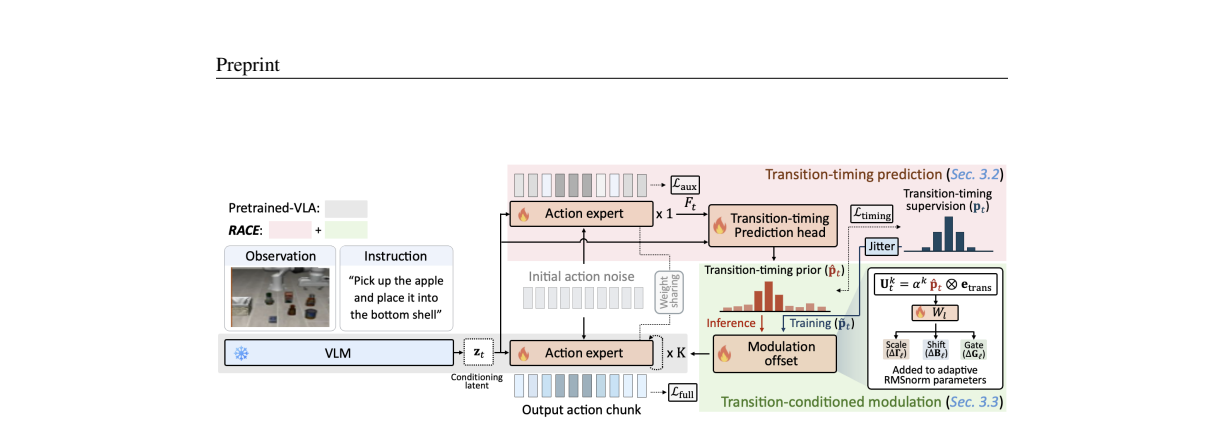
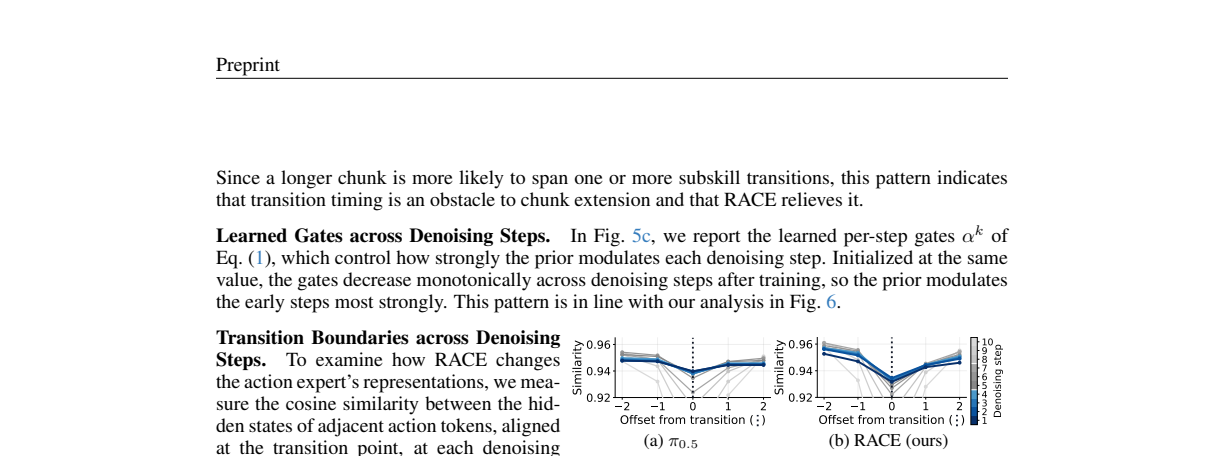
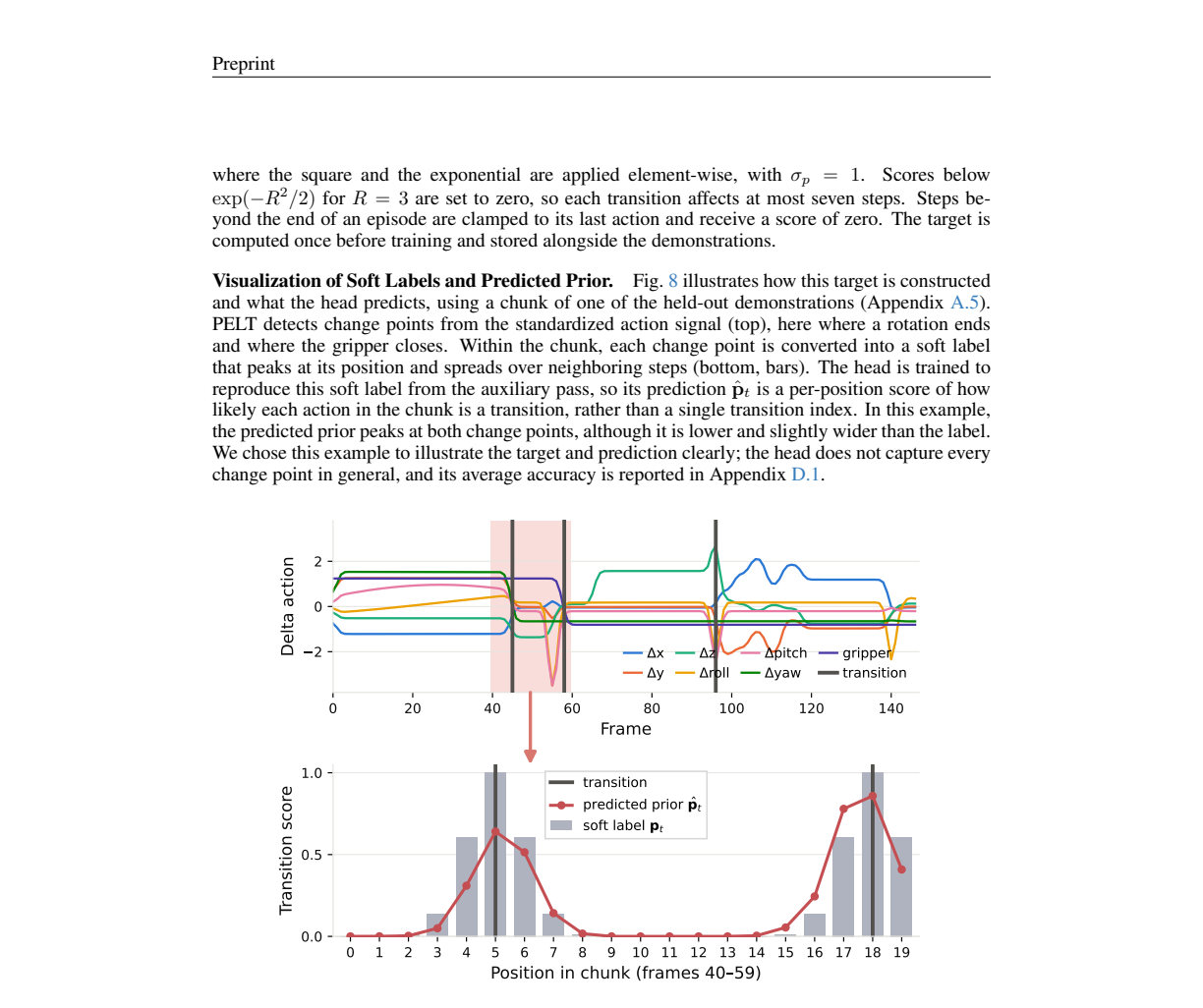
What carries the argument. The central object is the transition-timing prior $\hat{p}_t$, a score in $[0,1]^H$ for each action in a chunk indicating how close it is to a subskill switch. It is produced by (1) an auxiliary one-step denoising pass, which yields the action expert's final-layer hidden states $F_t$ at the cost of about 4 percent of a policy call; (2) a prediction head combining those features with cached VLM features via cross-attention, self-attention, and a sigmoid; and (3) a supervision signal from PELT change-point detection on demonstration action traces, converted into Gaussian soft labels so each transition affects roughly seven steps. Conditioning injects the prior into every denoising step by adding token-wise offsets to the scale, shift, and gate parameters of the adaptive RMSNorm layers, gated per step by learnable $\alpha_k$, which after training decrease monotonically so the prior modulates the early denoising steps most strongly. The mechanism is that the prior tells the denoiser where boundaries will appear, and the learned gates align that injection with the steps where the action expert's representation of adjacent actions is most separable.
Core claim. Action errors in long chunks do not merely grow smoothly with prediction horizon; they spike at subskill transitions, and the spikes grow sharply with chunk length. RACE treats 'when to switch' as a learnable quantity: an auxiliary one-step denoising pass extracts the action expert's final-layer hidden states, a prediction head converts these together with cached VLM features into a per-position transition-timing prior $\hat{p}_t \in [0,1]^H$, and that prior modulates every denoising step through token-wise offsets into the action expert's adaptive RMSNorm layers, with per-step learnable gates $\alpha_k$. Timing supervision also back-propagates into the action expert through the head, making its representations transition-aware even before conditioning is applied. On VLABench, RoboCasa-H50, and LIBERO, RACE beats fine-tuning at the same chunk length; at $2\times$ longer chunks it surpasses recent state-of-the-art and efficient VLAs in success rate; at $4\times$ it stays competitive; and on a real robot a $4\times$-longer chunk reduces idle time about $5\times$ while exceeding same-chunk fine-tuning success.
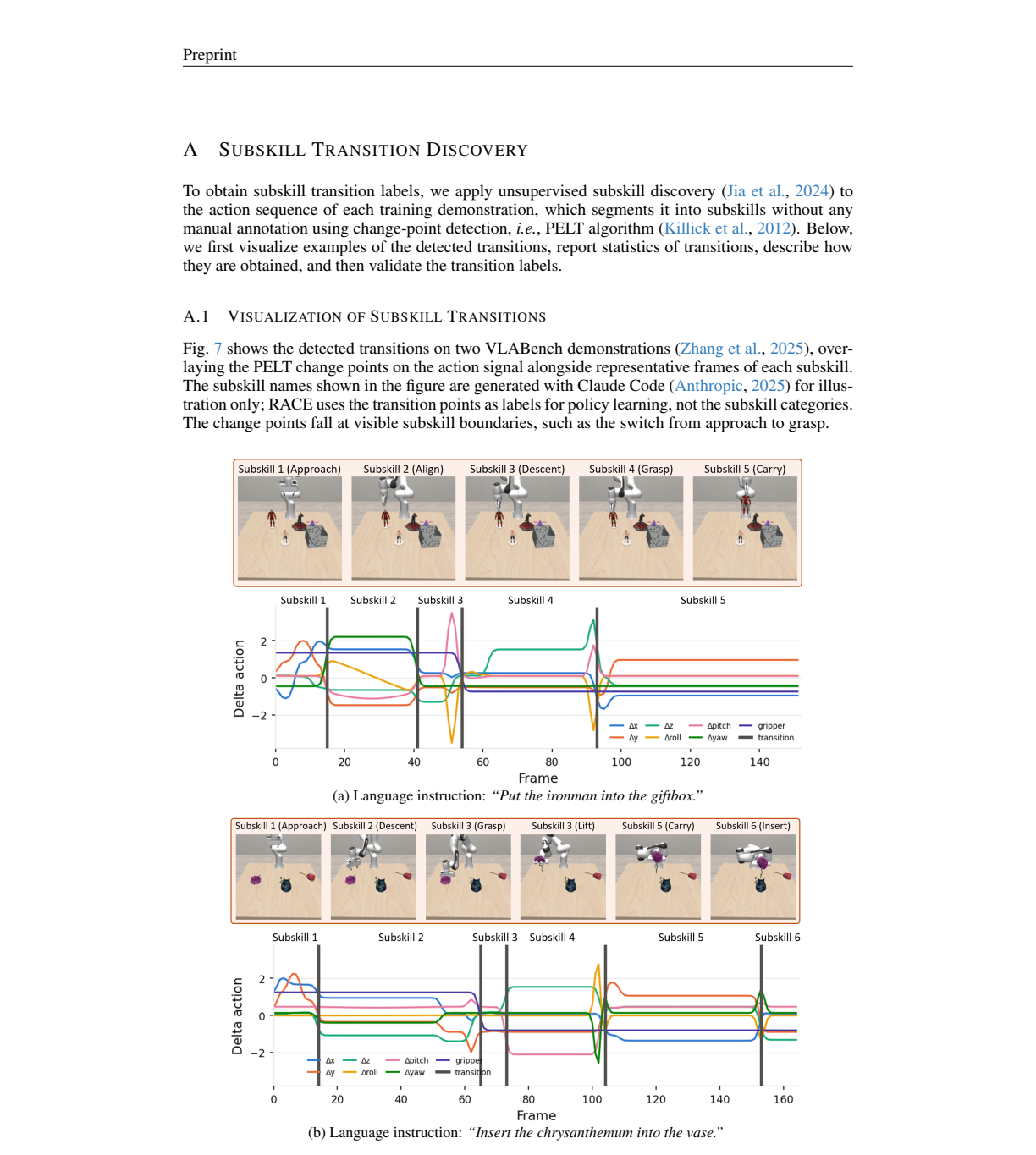
The premise it rests on. The whole method rests on PELT change-point detection on demonstration action traces as a stand-in for true subskill boundaries, and those pseudo-labels carry no human annotation, reaching only 0.82 precision and 0.70 recall against the VLABench generator's reference boundaries.
If the paper is right (Pith's inferences, not the authors')
RACE beats fine-tuning at every tested chunk length on all three benchmarks, so the transition-timing signal helps not only very long chunks but every chunk length.
At $2\times$ longer chunks it exceeds recent state-of-the-art and efficient VLAs in success rate, and at $4\times$ it remains competitive, establishing a higher reliability ceiling for chunk extension.
The gain comes with light post-training - a moderate overhead over fine-tuning (roughly 17-36 hours across benchmarks on four GPUs), far below RL-based chunk extension.
On real hardware with asynchronous execution, a $4\times$-longer chunk removes nearly all idle time after startup while improving success over same-length fine-tuning.
Gains grow with chunk length and with the number of subskill transitions per task, consistent with the proposed mechanism that transition timing is what degrades in long chunks.
The observation that errors concentrate at subskill boundaries, and that boundary timing degrades with horizon, plausibly transfers beyond flow-matching VLAs to any sequence predictor over structured skills - autoregressive or diffusion models in video generation or long-horizon planning - where boundary prediction is cheap relative to the sequence. That is an editorial extrapolation, not the pape
A testable extension the authors leave implicit: combine RACE's predicted transition timing with adaptive chunking, truncating execution exactly at the predicted next transition, which could recover both reliability and latency that pure extension loses at the longest chunks.
The transition head misses roughly one to 1.6 transitions per episode on held-out demonstrations (Appendix D.1); recovering the missed ones - via a second pass or by exploiting gripper and velocity signals - may close part of the remaining gap at $H_{exec}=40$, where RACE falls below the baseline.
The learned gates and the adjacent-action-token similarity dip suggest that a sparsity or schedule prior concentrating the timing signal on the earliest denoising steps could sharpen transition separation further; this is measurable with the paper's own Fig. 6 setup.
Check this review
Pith stored no record of this review's passes and took no fingerprint of it. Reviews made by code from 13 Nov 2026 on carry both.
How often reviews like this one are right
Reviews like this one: written by deepseek-v4-flash, where what was read was not recorded.
How often objections from reviews like this one are right: not yet measured
Reviews by people
This review was written by a machine. No person has reviewed this paper on Pith yet. A scientist listed on Pith can review it for a fee, and their review is published here whatever it concludes.
The paper
Abstract
Vision-Language-Action (VLA) models serve as unified policies for robotic manipulation, yet their expensive inference forces robots to pause between policy calls, resulting in stop-and-go execution that interrupts smooth motion and prolongs task completion. Extending the action chunk reduces policy calls and hence these pauses, but predicting farther into the future makes long-chunk execution unreliable. To understand where this unreliability arises, we analyze action errors within long chunks and find that they concentrate around transitions between manipulation subskills, growing sharply with chunk length. This suggests the importance of transition timing, i.e., when to switch subskills within a chunk. Motivated by this observation, we introduce RACE (Reliable Action-Chunk Extension), a framework that predicts the transition timing from an auxiliary one-step denoising pass and conditions action generation on it. By learning and conditioning on transition timing, RACE reduces errors at subskill transitions and enables reliable execution of longer action chunks. Across simulation benchmarks, RACE outperforms fine-tuning at the same chunk length; with 2x longer chunks, it surpasses recent state-of-the-art and efficient VLAs in success rate, and with 4x longer chunks, it remains competitive. On a real robot, RACE uses 4x longer chunks, which reduces the idle time caused by stop-and-go execution by about 5x, while achieving a higher success rate than fine-tuning with the same chunk length. Code and a real-robot demo are available at https://github.com/Seonghoon-Yu/RACE-VLA
The paper's own sentences, arranged, kept beside the review and separate from it. Each label is drawn from a closed vocabulary; the number beside it is the probability the classifier gave that label. No sentence in this record was written by a model.
abstract compiled · 2026-10-06
The authors' main claim, as the classifier picked it out 0.91
“By learning and conditioning on transition timing, RACE reduces errors at subskill transitions and enables reliable execution of longer action chunks.”
How the main claim is stated: asserted 1.00
What the abstract itself states, as probabilities: claims first 0.05 · states limitation 0.23 · human participants 0.03 · controlled comparison 0.95 · randomized assignment 0.02 · states quantitative result 0.98 · compares with prior results 0.98 · mentions code or data availability 0.99
The abstract, sentence by sentence
This table labels the abstract only (arXiv listing abstract v1). The number is the probability the classifier gave the label.
| Sentence | Role | The authors' own work | States the main conclusion | Strength |
|---|---|---|---|---|
| Vision-Language-Action (VLA) models serve as unified policies for robotic manipulation, yet their expensive inference forces robots to pause between policy calls, resulting in stop-and-go execution that interrupts smooth motion and prolongs task completion. | background 1.00 | 0.09 | 0.03 | asserted 1.00 |
| Extending the action chunk reduces policy calls and hence these pauses, but predicting farther into the future makes long-chunk execution unreliable. | background 0.80 | 0.15 | 0.04 | asserted 1.00 |
| To understand where this unreliability arises, we analyze action errors within long chunks and find that they concentrate around transitions between manipulation subskills, growing sharply with chunk length. | result 0.94 | 0.95 | 0.08 | asserted 1.00 |
| This suggests the importance of transition timing, i.e., when to switch subskills within a chunk. | interpretation 1.00 | 0.65 | 0.11 | hedged possibility 0.98 |
| Motivated by this observation, we introduce RACE (Reliable Action-Chunk Extension), a framework that predicts the transition timing from an auxiliary one-step denoising pass and conditions action generation on it. | contribution 0.60 | 0.92 | 0.13 | asserted 1.00 |
| By learning and conditioning on transition timing, RACE reduces errors at subskill transitions and enables reliable execution of longer action chunks. | result 0.77 | 0.88 | 0.64 | asserted 1.00 |
| Across simulation benchmarks, RACE outperforms fine-tuning at the same chunk length; with 2x longer chunks, it surpasses recent state-of-the-art and efficient VLAs in success rate, and with 4x longer chunks, it remains competitive. | result 1.00 | 0.94 | 0.31 | asserted 1.00 |
| On a real robot, RACE uses 4x longer chunks, which reduces the idle time caused by stop-and-go execution by about 5x, while achieving a higher success rate than fine-tuning with the same chunk length. | result 1.00 | 0.95 | 0.28 | asserted 1.00 |
| Code and a real-robot demo are available at https://github.com/Seonghoon-Yu/RACE-VLA | contribution 0.76 | 0.70 | 0.03 | asserted 0.96 |
What kind of paper the classifier reports this is: method or tool 1.00 · evidence from observation or experiment 0.92
What was examined, and what was not
Sources read
- arXiv listing abstract v1
Not examined
- full text
- figures and tables
- references and citing sentences
- relations to other papers
Levels run
- P abstract
Not run
- S sections
- T body sentences
- C citations
- R cross-paper relations
How the labels were made
Compiled by classifier-1.13.0 via TypeSafe API, question bank abstract-p1-20260923, 2026-10-06: 1 request, 7,089 input tokens.
Every quoted sentence on this record is the authors'. Every label is from Pith's closed vocabulary, with the probability shown beside it. This record as JSON
Figures (10)

Figures are the authors', reproduced from the paper.
References (41)
- [1] Anthropic . Claude code. https://claude.com/claude-code, 2025. Accessed: 2026-09 on Pith
- [2] Kevin Black, Noah Brown, Danny Driess, Adnan Esmail, Michael Equi, Chelsea Finn, Niccolo Fusai, Lachy Groom, Karol Hausman, Brian Ichter, Szymon Jakubczak, Tim Jones, Liyiming Ke, Sergey Levine, Adrian Li-Bell, Mohith Mothukuri, Suraj Nair, Karl Pertsch, Lucy Xiaoyang Shi, Jam... on PithPith's reviewarXiv
- [3] Kevin Black, Manuel Y. Galliker, and Sergey Levine. Real-time execution of action chunking flow policies. In Advances in Neural Information Processing Systems (NeurIPS), 2025 on Pith
- [4] Anthony Brohan, Noah Brown, Justice Carbajal, Yevgen Chebotar, Xi Chen, Krzysztof Choromanski, Tianli Ding, Danny Driess, Avinava Dubey, Chelsea Finn, Pete Florence, Chuyuan Fu, Montse Gonzalez Arenas, Keerthana Gopalakrishnan, Kehang Han, Karol Hausman, Alexander Herzog, Jasm... on Pith
- [5] Thanpimon Buamanee, Masato Kobayashi, and Yuki Uranishi. Bi-HIL : Bilateral control-based multimodal hierarchical imitation learning via subtask-level progress rate and keyframe memory for long-horizon contact-rich robotic manipulation. In IEEE/RSJ International Conference on ... on Pith
- [6] Cheng Chi, Siyuan Feng, Yilun Du, Zhenjia Xu, Eric Cousineau, Benjamin Burchfiel, and Shuran Song. Diffusion policy: Visuomotor policy learning via action diffusion. In Proceedings of Robotics: Science and Systems (RSS), 2023 on Pith
- [7] Xiangdong Feng, Yuxuan Cheng, Chen Shi, Boyao Han, Yuxuan Yan, Yitong Hong, Zhuotao Tian, and Li Jiang. Denoising tells when to replan: Denoising-variance adaptive chunking for flow-based robot policies. arXiv preprint arXiv:2606.03847, 2026 a on PithPith's reviewarXiv
- [8] Yixu Feng, Zinan Zhao, Yanxiang Ma, Chenghao Xia, Chengbin Du, Yunke Wang, and Chang Xu. See what matters: Differentiable grid sample pruning for generalizable vision-language-action model. In Proceedings of the 43rd International Conference on Machine Learning (ICML), 2026 b on Pith
- [9] Zhiwei Jia, Vineet Thumuluri, Fangchen Liu, Linghao Chen, Zhiao Huang, and Hao Su. Chain-of-thought predictive control. In International Conference on Machine Learning (ICML), 2024 on Pith
- [10] Rebecca Killick, Paul Fearnhead, and Idris A. Eckley. Optimal detection of changepoints with a linear computational cost. Journal of the American Statistical Association, 107 0 (500): 0 1590--1598, 2012 on Pith
- [11] Moo Jin Kim, Karl Pertsch, Siddharth Karamcheti, Ted Xiao, Ashwin Balakrishna, Suraj Nair, Rafael Rafailov, Ethan Foster, Pannag Sanketi, Quan Vuong, Thomas Kollar, Benjamin Burchfiel, Russ Tedrake, Dorsa Sadigh, Sergey Levine, Percy Liang, and Chelsea Finn. OpenVLA : An open-... on Pith
- [12] Moo Jin Kim, Chelsea Finn, and Percy Liang. Fine-tuning vision-language-action models: Optimizing speed and success. In Proceedings of Robotics: Science and Systems (RSS), 2025 on Pith
- [13] Filippo Lazzati, Kyle Stachowicz, William Chen, Alberto Maria Metelli, Andrew Wagenmaker, and Sergey Levine. Why does action chunking improve behavioral cloning performance in robotic control? In Conference on Robot Learning (CoRL), 2026 on Pith
- [14] Sohyun Lee, Yoonjae Baek, Jaesang Won, Jinnyeong Kim, Kang Hyunwoo, Seung-Hwan Baek, Ivan Laptev, and Suha Kwak. Taming VLAs under robot execution errors: Self-compensation and stress testing. arXiv preprint arXiv:2609.37334, 2026 on PithPith's reviewarXiv
- [15] Xinghang Li, Minghuan Liu, Hanbo Zhang, Cunjun Yu, Jie Xu, Hongtao Wu, Chilam Cheang, Ya Jing, Weinan Zhang, Huaping Liu, Hang Li, and Tao Kong. Vision-language foundation models as effective robot imitators. In International Conference on Learning Representations (ICLR), 2024 on Pith
- [16] Yuanchang Liang, Xiaobo Wang, Kai Wang, Shuo Wang, Xiaojiang Peng, Haoyu Chen, David Kim Huat Chua, and Prahlad Vadakkepat. Adaptive action chunking at inference-time for vision-language-action models. In Proceedings of the IEEE/CVF Conference on Computer Vision and Pattern Re... on Pith
- [17] Yaron Lipman, Ricky T. Q. Chen, Heli Ben-Hamu, Maximilian Nickel, and Matt Le. Flow matching for generative modeling. In International Conference on Learning Representations (ICLR), 2023 on Pith
- [18] Bo Liu, Yifeng Zhu, Chongkai Gao, Yihao Feng, Qiang Liu, Yuke Zhu, and Peter Stone. LIBERO : Benchmarking knowledge transfer for lifelong robot learning. In Advances in Neural Information Processing Systems (NeurIPS), 2023 on Pith
- [19] Yuanzhe Liu, Jingyuan Zhu, Yuchen Mo, Gen Li, Xu Cao, Jin Jin, Yifan Shen, Zhengyuan Li, Tianjiao Yu, Wenzhen Yuan, Fangqiang Ding, and Ismini Lourentzou. PALM : Progress-aware policy learning via affordance reasoning for long-horizon robotic manipulation. In Proceedings of th... on Pith
- [20] Yudong Liu, Yuan Li, Zijia Tang, Yuxi Zheng, Yueqian Lin, Qinsi Wang, Yi Li, Shuangjun Liu, Shuai Zhang, Taotao Jing, Dashan Gao, Ning Bi, Jingwei Sun, Yiran Chen, and Hai Li. Latent bridge: Feature delta prediction for efficient dual-system vision-language-action model infere... on PithPith's reviewarXiv
show 21 more
- [21] Yuejiang Liu, Jubayer Ibn Hamid, Annie Xie, Yoonho Lee, Maximilian Du, and Chelsea Finn. Bidirectional decoding: Improving action chunking via guided test-time sampling. In International Conference on Learning Representations (ICLR), 2025 a on Pith
- [22] Zhe Liu, Jinghua Hou, Yuxiang Lu, Zhenya Yang, Xianzhe Fan, Junwei Luo, Junyi Li, Ruihua Han, Zhi Hou, and Hengshuang Zhao. StreamPI : Streaming multimodal temporal modeling for vision-language-action models. arXiv preprint arXiv:2608.26067, 2026 c on PithPith's reviewarXiv
- [23] Ziyan Liu, Yeqiu Chen, Hongyi Cai, Tao Lin, Shuo Yang, Zheng Liu, and Bo Zhao. Bridging the semantic-action gap in visual token pruning for efficient VLA inference. arXiv preprint arXiv:2511.16449, 2025 b on PithPith's reviewarXiv
- [24] Shilin Ma, Chubin Zhang, Changyuan Wang, Yuji Wang, Yue Wu, Zixuan Wang, Jingqi Tian, Zheng Zhu, and Yansong Tang. SAFE-Pruner : Semantic attention-guided future-aware token pruning for efficient vision-language-action manipulation. In Proceedings of the European Conference on... on Pith
- [25] Soroush Nasiriany, Abhiram Maddukuri, Lance Zhang, Adeet Parikh, Aaron Lo, Abhishek Joshi, Ajay Mandlekar, and Yuke Zhu. RoboCasa : Large-scale simulation of everyday tasks for generalist robots. In Proceedings of Robotics: Science and Systems (RSS), 2024 on Pith
- [26] Junnan Nie, Jiayi Li, Jiachen Zhang, Junyi Lao, Chenghao Liu, Tianle Zhang, Liang Lin, and Songfang Huang. PACE : Phase-aware chunk execution for robot policies with action chunking. arXiv preprint arXiv:2606.00537, 2026 on PithPith's reviewarXiv
- [27] NVIDIA , Johan Bjorck, Fernando Casta \ n eda, Nikita Cherniadev, Xingye Da, Runyu Ding, Linxi "Jim" Fan, Yu Fang, Dieter Fox, Fengyuan Hu, Spencer Huang, Joel Jang, Zhenyu Jiang, Jan Kautz, Kaushil Kundalia, Lawrence Lao, Zhiqi Li, Zongyu Lin, Kevin Lin, Guilin Liu, Edith Llo... on PithPith's reviewarXiv
- [28] Octo Model Team , Dibya Ghosh, Homer Walke, Karl Pertsch, Kevin Black, Oier Mees, Sudeep Dasari, Joey Hejna, Tobias Kreiman, Charles Xu, Jianlan Luo, You Liang Tan, Lawrence Yunliang Chen, Pannag Sanketi, Quan Vuong, Ted Xiao, Dorsa Sadigh, Chelsea Finn, and Sergey Levine. Oct... on Pith
- [29] William Peebles and Saining Xie. Scalable diffusion models with transformers. In IEEE/CVF International Conference on Computer Vision (ICCV), 2023 on Pith
- [30] Physical Intelligence , Kevin Black, Noah Brown, James Darpinian, Karan Dhabalia, Danny Driess, Adnan Esmail, Michael Equi, Chelsea Finn, Niccolo Fusai, Manuel Y. Galliker, Dibya Ghosh, Lachy Groom, Karol Hausman, Brian Ichter, Szymon Jakubczak, Tim Jones, Liyiming Ke, Devin L... on PithPith's reviewarXiv
- [31] Jiaming Tang, Yufei Sun, Yilong Zhao, Shang Yang, Yujun Lin, Zhuoyang Zhang, James Hou, Yao Lu, Zhijian Liu, and Song Han. VLASH : Real-time VLA s via future-state-aware asynchronous inference. In IEEE/RSJ International Conference on Intelligent Robots and Systems (IROS), 2026 on Pith
- [32] Haoxuan Wang, Gengyu Zhang, Yan Yan, Ramana Rao Kompella, and Gaowen Liu. VLA knows its limits: Adaptive execution horizons for robot policies. In Proceedings of the European Conference on Computer Vision (ECCV), 2026 a on Pith
- [33] Haoxuan Wang, Gengyu Zhang, Yan Yan, Yuzhang Shang, Ramana Rao Kompella, and Gaowen Liu. Real-time robot execution with masked action chunking. In International Conference on Learning Representations (ICLR), 2026 b on Pith
- [34] Ruiqi Wang, Dezhong Zhao, Ziqin Yuan, Tianyu Shao, Guohua Chen, Dominic Kao, Sungeun Hong, and Byung-Cheol Min. PRIMT : Preference-based reinforcement learning with multimodal feedback and trajectory synthesis from foundation models. In Advances in Neural Information Processin... on Pith
- [35] Xianghui Wang, Feng Chen, Wenbo Zhang, Hua Yan, Zixuan Wang, Changsheng Li, and Yinjie Lei. PolicyTrim : Boosting intrinsic policy efficiency of vision-language-action models. In Proceedings of the European Conference on Computer Vision (ECCV), 2026 c on Pith
- [36] Yuqi Wang, Xinghang Li, Wenxuan Wang, Junbo Zhang, Yingyan Li, Yuntao Chen, Xinlong Wang, and Zhaoxiang Zhang. Unified vision-language-action model. In International Conference on Learning Representations (ICLR), 2026 d on Pith
- [37] BinXu Wu, TengFei Zhang, Chen Yang, JiaHao Wen, HaoCheng Li, JingTian Ma, Zhen Chen, and JingYuan Wang. SAGE : State-aware guided end-to-end policy for multi-stage sequential tasks via hidden Markov decision process. arXiv preprint arXiv:2509.19853, 2025 on PitharXiv
- [38] Siyu Xu, Yunke Wang, Chenghao Xia, Dihao Zhu, Tao Huang, and Chang Xu. VLA-Cache : Efficient vision-language-action manipulation via adaptive token caching. In Advances in Neural Information Processing Systems (NeurIPS), 2025 on Pith
- [39] Shiduo Zhang, Zhe Xu, Peiju Liu, Xiaopeng Yu, Yuan Li, Qinghui Gao, Zhaoye Fei, Zhangyue Yin, Zuxuan Wu, Yu-Gang Jiang, and Xipeng Qiu. VLABench : A large-scale benchmark for language-conditioned robotics manipulation with long-horizon reasoning tasks. In IEEE/CVF Internationa... on Pith
- [40] Tony Z. Zhao, Vikash Kumar, Sergey Levine, and Chelsea Finn. Learning fine-grained bimanual manipulation with low-cost hardware. In Proceedings of Robotics: Science and Systems (RSS), 2023 on Pith
- [41] Linqing Zhong, Yi Liu, Yifei Wei, Ziyu Xiong, Si Liu, and Guanghui Ren. ACoT-VLA : Action chain-of-thought for vision-language-action models. In Proceedings of the IEEE/CVF Conference on Computer Vision and Pattern Recognition (CVPR), 2026 on Pith
Cited by 1 Pith paper
Reviewed papers on Pith that cite this one. The full citation record
Challenges and discussion
Disagree with the review, or know something it missed? Leave a comment, or challenge this review formally: a challenge becomes a permanent entry in this paper's record, and its decision is published here.
Come back by email
A short list of the week's newly reviewed papers. Nothing is sent until you confirm from your inbox, and every email has a link that stops it. No account.
No comments yet.
Sign in to comment