Computer Vision and Pattern Recognition · arXiv:2608.26067 v1 · submitted 26 Aug 2026 · 56 references
StreamPI: Streaming Multimodal Temporal Modeling for Vision-Language-Action Models
The paper says
“Vision-Language-Action (VLA) models have demonstrated effectiveness in robot manipulation, yet state-of-the-art models such as pi0.5 operate under a single-frame paradigm, limiting their ability to retain past observations and develop precise spatial perception.”
more of the abstract
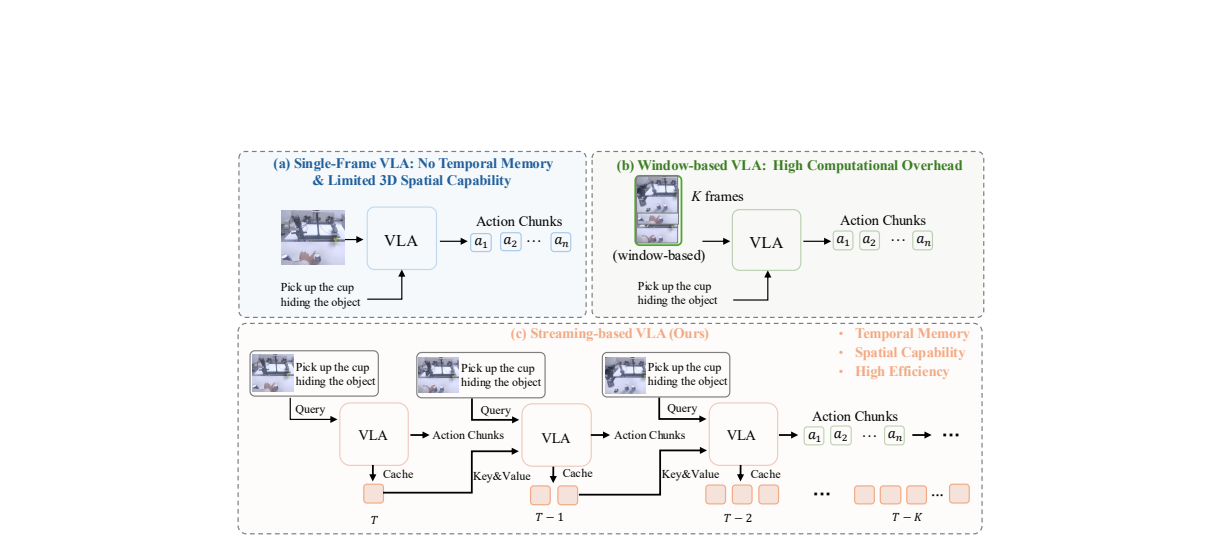
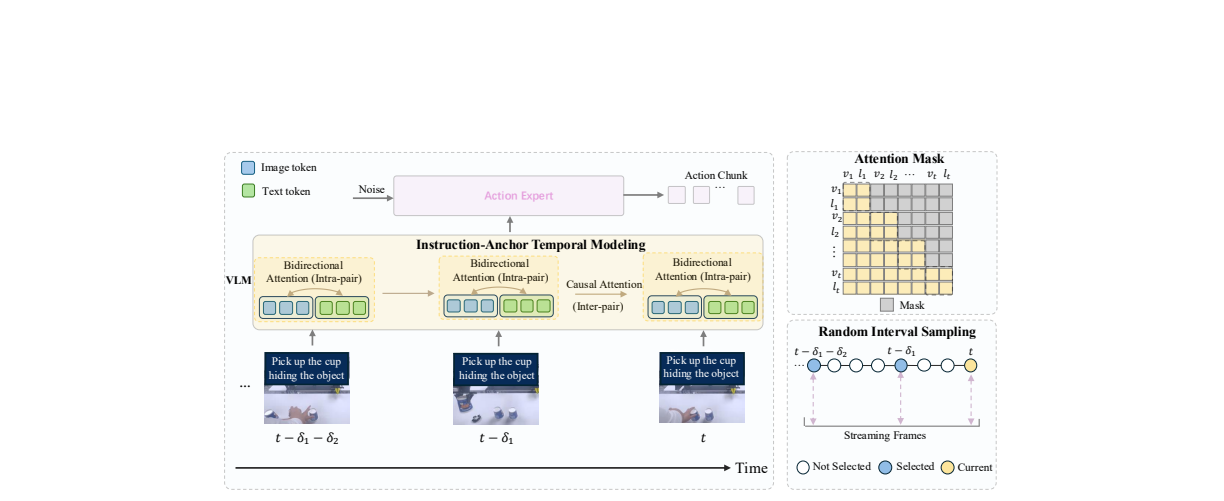
In this paper, we propose StreamPI, a streaming multimodal temporal modeling framework that equips single-frame VLA with temporal reasoning capability without introducing any additional parameters. One core design is instruction-anchored temporal modeling. It treats each (visual observation, language instruction) pair as an atomic temporal unit: bidirectional attention within each pair enables cross-modal fusion, while causal attention across pairs preserves autoregressive streaming inference. This ensures the language instruction serves as a persistent semantic anchor throughout task execution. To bridge the gap between synchronous training and asynchronous real-robot deployment, we introduce a andom-interval streaming training strategy: a proper inter-frame interval (e.g., every 3 frames) enables faster and smoother action execution. Beyond this, randomizing the interval further improves robustness to frame-timing perturbations, supporting asynchronous deployment in practice. Furthermore, by leveraging the length extrapolation capability of the LLM backbone, StreamPI seamlessly inherits pretrained single-frame weights and supports flexible single-frame and multi-frame inference. Experiments on real-robot tasks spanning memory-dependent and precise perception scenarios, as well as the simulation benchmark LIBERO, demonstrate that StreamPI outperforms pi0.5 across diverse tasks.
from the abstract
Pith says
Machine review · deepseek-v4-flash · 27 Aug 2026 · what was read was not recorded · not checked by a person
It can be wrong. Challenge this review or reply to it.
Holds up, with conditions. StreamPI is a clean, no-new-parameters temporal extension of pi0.5 with consistent gains, but the paper's length-extrapolation claim is never actually tested beyond the training horizon. This line is wrong
3 major objections · 6 minor
How often objections from reviews like this one are right: not yet measured
Not checked: figures, code, what the 56 references say.
The paper says, at Sec. 3.2; Tables 5 and 6
The review did not quote this passage.
Pith says: Objection 1 of 3 · major
The paper's 'Parameter-free Temporal Extension' claim relies on the LLM backbone's length extrapolation to handle extended token sequences with repeated instruction tokens, but no success-based evaluation tests sequence lengths longer than the training lengths. Table 5 evaluates a T=5-trained model at T=1 and T=3 (shorter, not longer), and Table 6 reports only latencies for T=8 and T=10 with no task success.
more of objection 1
Repeating the instruction at every frame is a distributional shift relative to pi0.5's single-instruction pretraining, so length extrapolation is not automatic. Please add an experiment that fine-tunes at T=3 (or T=5) and evaluates at T=8 or T=10 with success rates, or otherwise directly tests the longer-than-training regime, to support the flexible multi-frame inference and seamless weight-inheritance claims.
The paper says, at Sec. 4.2; Tables 7-10
The review did not quote this passage.
Pith says: Objection 2 of 3 · major
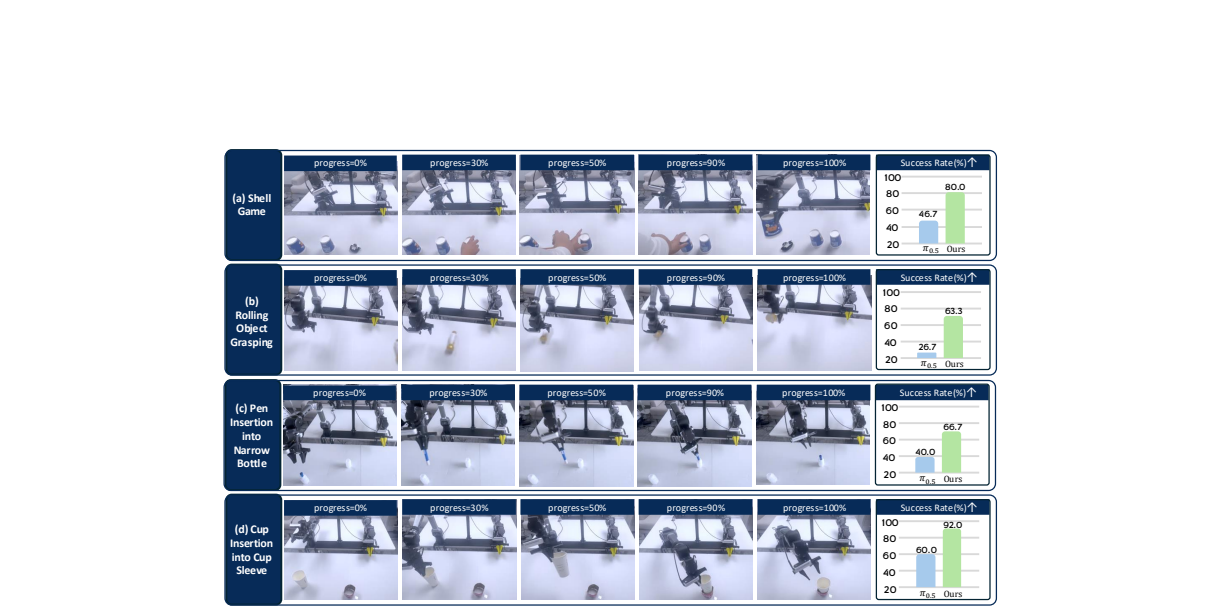
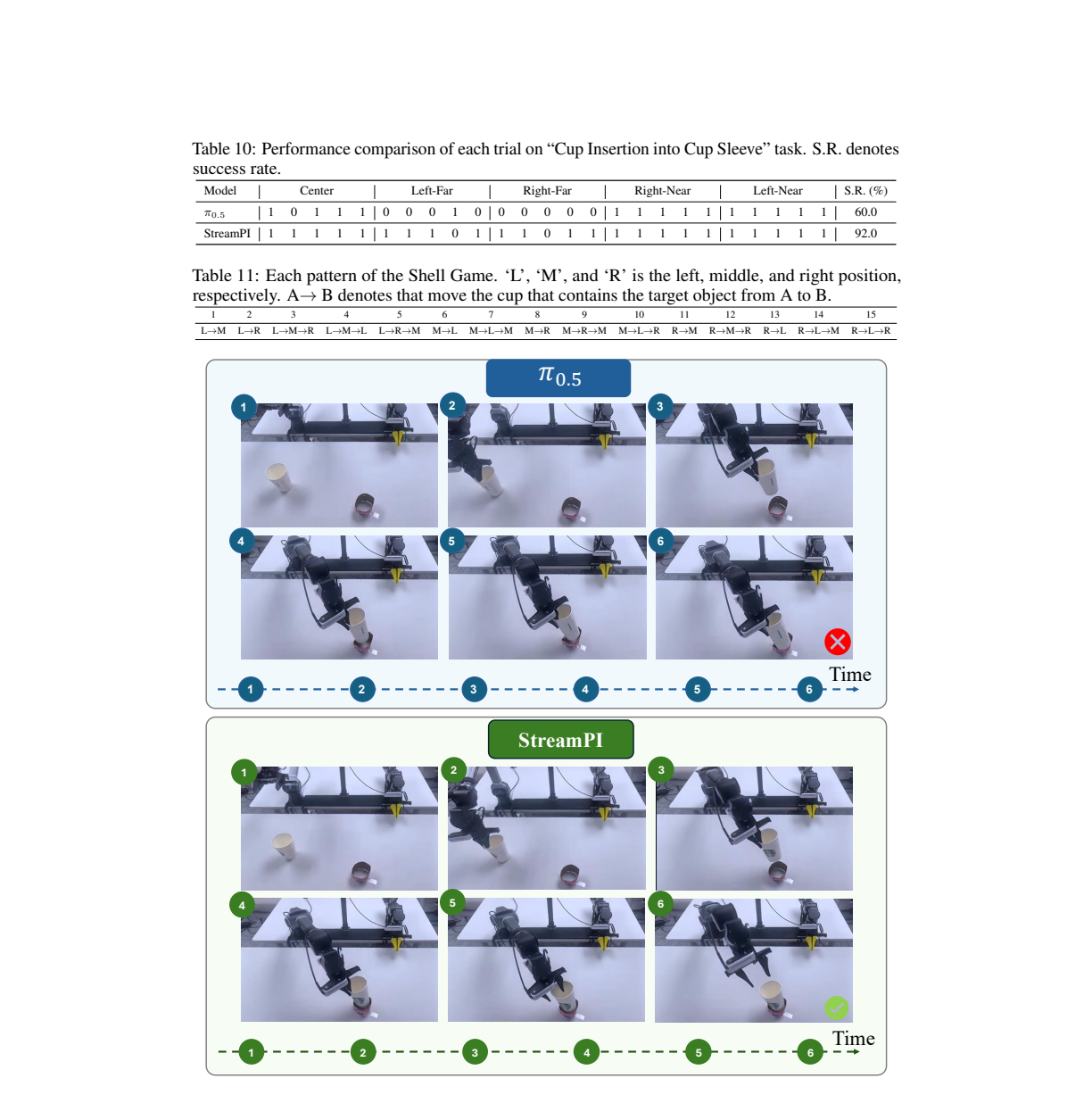
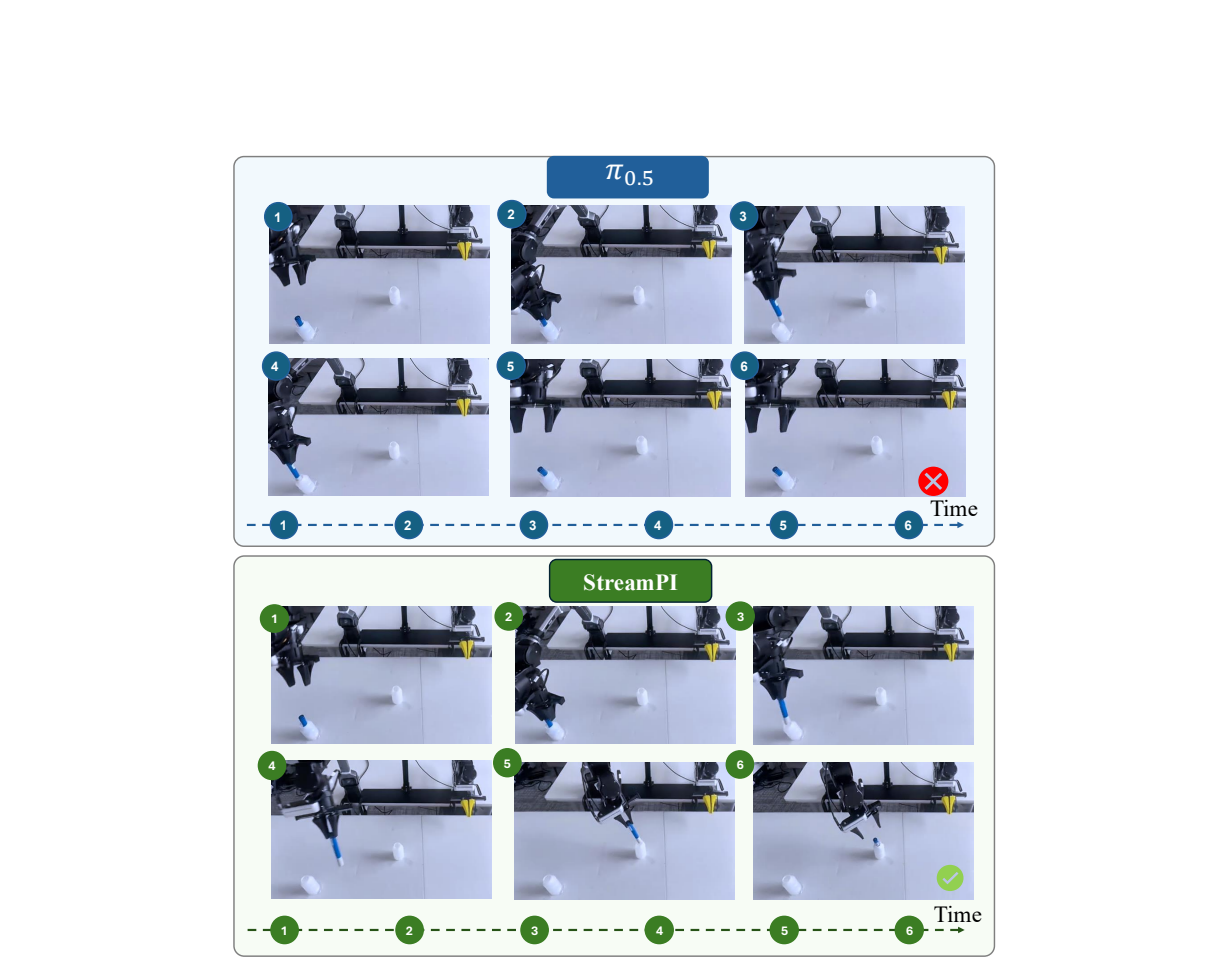
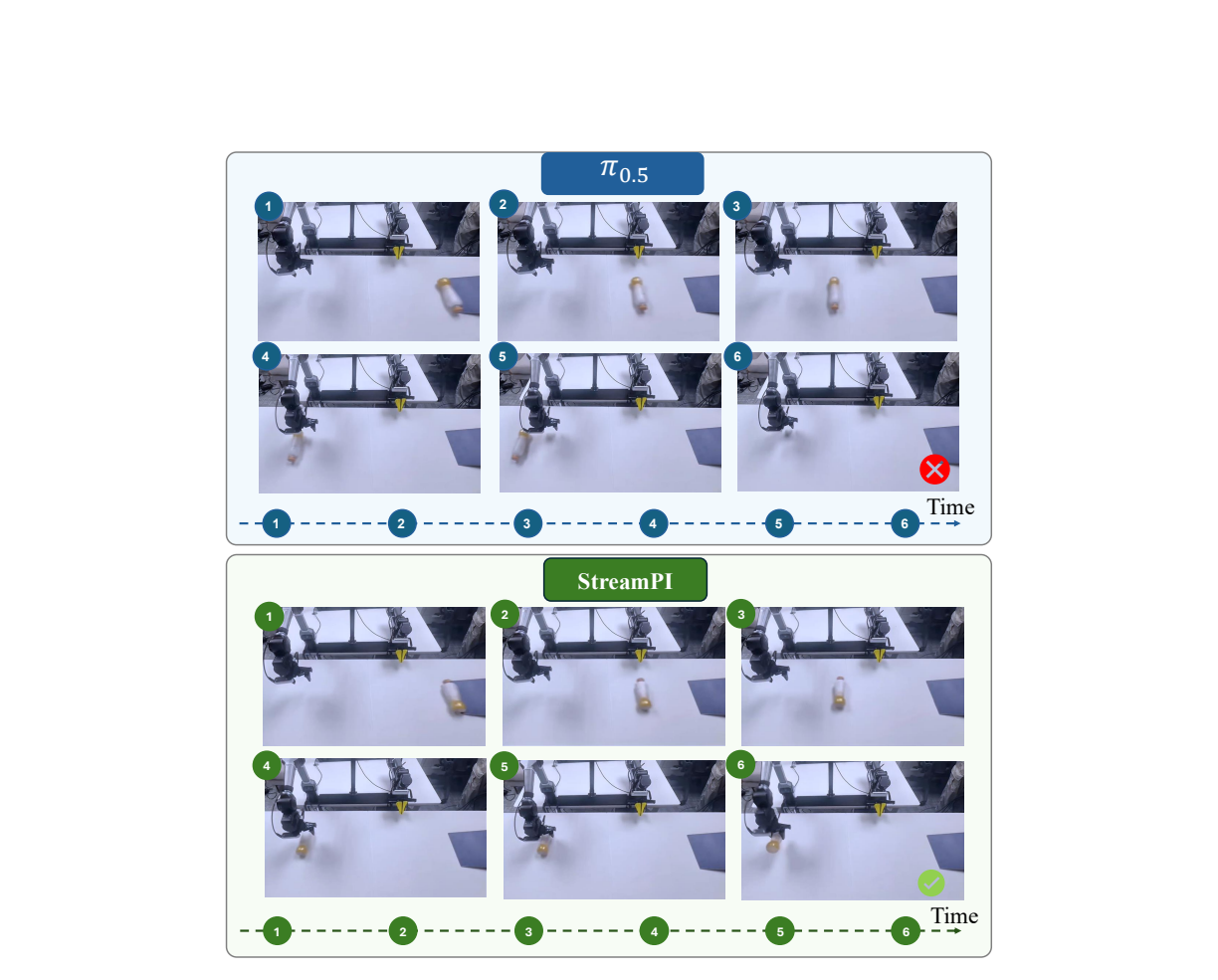
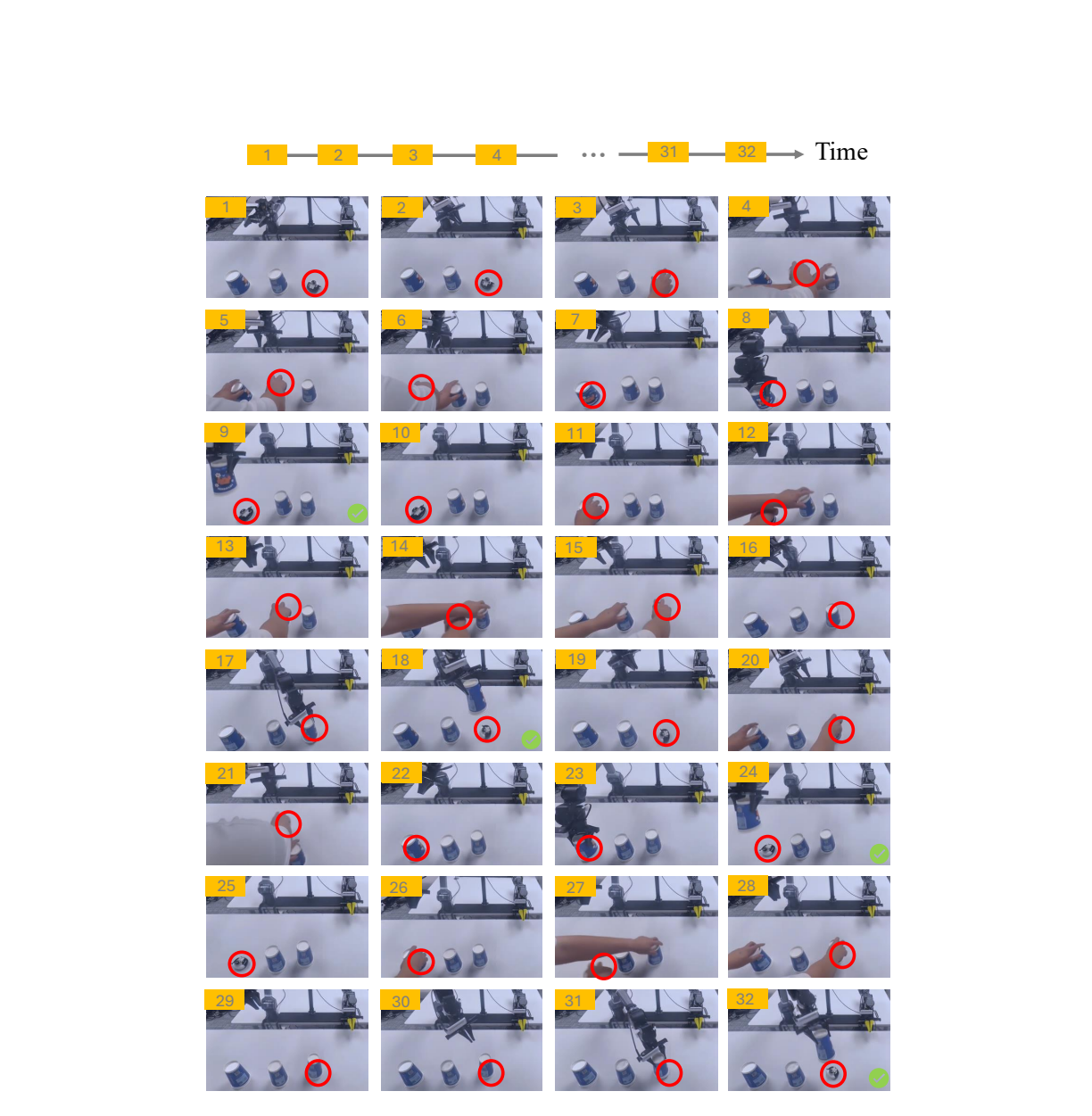
The real-robot results are based on 15 to 30 trials per task with no confidence intervals or statistical tests. For example, the Shell Game improvement is 7/15 vs. 12/15 (Table 7) and the Rolling Object Grasping improvement is 8/30 vs. 19/30 (Table 8); these differences may be within binomial noise.
more of objection 2
Please report exact binomial confidence intervals or a paired statistical test (e.g., McNemar or Fisher exact per task) and, where feasible, multiple rollouts or task variants, so that the claimed real-robot gains of 26.7-36.6 percentage points are supported.
The paper says, at Sec. 4.5, Table 4
The review did not quote this passage.
Pith says: Objection 3 of 3 · major
The ablation comparing fixed-interval and random-interval training is confounded: the fixed baseline uses δ=1, while the random condition uses δ~U[3,7] with mean 5. The observed improvement could therefore be due to the larger average inter-frame interval rather than to randomization. Please add a fixed-interval baseline at δ=5 (or match the mean interval) to isolate the effect of randomization, or reinterpret the claim accordingly.
6 minor objections
The paper says, at Sec. 4.5, Table 5
Pith says: minor objection 1 of 6
The caption says 'Results are average success rates (%) on LIBERO-Long', but the table reports all four suites and the average; the text also says the model is trained with T=5, while the table includes T=3 rows. Please correct the caption and clarify the training configurations.
The paper says, at Abstract and Sec. 4.2
Pith says: minor objection 2 of 6
The abstract contains a typo ('andom-interval'), and Sec. 4.2 refers to '+33.3% on Cup Hiding and Retrieval' although the corresponding task is called 'Shell Game' in the task list; please unify the naming.
show 4 more
The paper says, at Sec. 3.3
Pith says: minor objection 3 of 6
The random-interval sampling is described with general δ̄, Δ, δmin, δmax, but the experiments use δ~U[3,7]; please state the correspondence (e.g., δ̄=5, Δ=2) and report the clipping values explicitly.
The paper says, at Table 1
Pith says: minor objection 4 of 6
The symbol π0-FAST* has an asterisk without a footnote; clarify what the asterisk indicates (e.g., reproduced result or different training scale).
The paper says, at Appendix B.2
Pith says: minor objection 5 of 6
The text uses 'trails' instead of 'trials' in several places (e.g., '30 trails', '10 trails'). Please correct these typos.
The paper says, at Fig. 2 and Algorithm 1
Pith says: minor objection 6 of 6
The streaming inference description says only the new frame is encoded and attends to cached representations, but the attention mask in Fig. 2 is schematic; consider adding a step-by-step diagram of the KV-cache update to make the constant-inference-cost claim easier to verify.
What would settle it
Take the T=5-trained StreamPI model and evaluate it on LIBERO-Long and CALVIN at T=8 and T=10, holding the sampling interval and all other settings fixed. If success rates remain close to the T=5 result (within about 1-2 points), the length-extrapolation assumption is supported. If success drops substantially or the model cannot run due to position/token limits, the flexible multi-frame claim is falsified. A complementary check: train a separate model with T=8 and compare its success at T=8 to the T=5-trained model evaluated at T=8; a large gap would confirm that performance is tied to training length rather than to backbone length extrapolation.
from the skeptic's reading
How the review went
4 readings by deepseek-v4-flash · 27 Aug 2026
- Reader holds up, with conditions
- Skeptic agrees
- Editor wrote the verdict above
- Referee major revision: 3 major objections, 6 minor
Not run on this paper: the simulated authors' defence.
Pith did not check this review's objections against the paper.
The review in full
The review in brief, machine-written
StreamPI is worth a look if you work on VLA temporal modeling. The core design—pairing each observation with the repeated language instruction, then using bidirectional attention within the pair and causal attention across pairs via a block-wise mask—is a neat way to give a single-frame model temporal memory without adding parameters. The random-interval training for asynchronous deployment is also sensible, and the ablations genuinely support the design choices: bidirectional intra-pair attention beats causal, and random intervals beat fixed intervals.
The comparisons against pi0.5 are internally consistent: +1.4 average success on LIBERO at T=5, +0.234 average sequence length on CALVIN, and positive gains on all four real-robot tasks. The LIBERO gains are believable even in a saturated regime, with the biggest jump on LIBERO-Long. This is the paper's solid core.
The soft spots are real but not fatal. The stress-test note is correct: the paper claims LLM length extrapolation enables flexible multi-frame inference, but every success-based evaluation uses T at or below the training T. The cross-stream generalization table only tests T=1 and T=3 from a T=5 model, and the latency table at T=8 and T=10 reports no success rates. So the "arbitrary multi-frame" claim is an untested projection, not an established result. The authors should either test success at T=8/10 or soften the claim.
Second, the real-robot results rest on 15-30 trials per task with no significance testing and no variance across seeds. The gains are large and consistent, so I'd trust the direction, but the precise percentages are fragile. Third, no code or data is released, which limits reproducibility. Minor wording issue: "constant inference cost" is contradicted by their own latency table; the latency does grow with T. What they mean is that the KV cache avoids full recomputation over the whole history, which is true.
The paper's central contribution—instruction-anchored temporal modeling at fixed T—is supported by the evidence. The extrapolation claim is an accessory that needs either evidence or qualification.
Who is this for? Anyone building on pi0.5 or designing streaming VLA inference will get value here. It deserves a serious referee; the right outcome is probably acceptance after the extrapolation claim is tested or moderated and the real-robot stats are tightened.
The strongest objection
The central claim depends on the assertion in Sec. 3.2, 'Parameter-free Temporal Extension,' that the pretrained pi0.5 backbone's length extrapolation can handle an extended token sequence in which the same language instruction is repeated once per frame. If this assumption is false, the proposed 'seamless inheritance' of pretrained single-frame weights and the ability to support flexible multi-frame inference collapse. The paper's empirical sections do not actually test this assumption. All success-based evaluations use T=3 or T=5 during training and the same T at inference (Tables 1 and 4). Table 5, titled 'Cross-stream generalization,' evaluates a T=5-trained model at T=1 and T=3, which are shorter than the training length, not longer. Table 6 reports latencies at T=8 and T=10 but no success rates. Thus there is no evidence that the model can extrapolate to longer token sequences than it was fine-tuned on, despite this being the stated mechanism for avoiding new parameters and supporting arbitrary multi-frame inference. Moreover, repeating the instruction tokens at every time step is a distributional shift relative to pi0.5's single-instruction pretraining, so length extrapolation is not guaranteed even if the backbone generally handles long contexts. If extrapolation fails for T>5, the parameter-free transfer and flexible-inference claims are unsupported, and the observed gains at T=5 could be a narrow finite-window effect rather than evidence of a general streaming temporal capability.
The reader's weakest assumption correctly identifies the reliance on pi0.5's length extrapolation as the load-bearing condition for the parameter-free temporal extension. My stress-test sharpens this: the paper never evaluates success at sequence lengths beyond the training length, so the assumption is not merely risky but actually untested in the reported experiments. This does not change the conditional verdict, because the reader already conditioned acceptance on this concern and on the need for stronger evidence. I do not see grounds for rejection: the architecture, ablations, and benchmark results are coherent, and the T=1 row matching the pi0.5 baseline suggests the comparison is not obviously confounded. The missing extrapolation test is the most direct way to decide whether the mechanism generalizes as claimed. Other issues, such as the latency table contradicting the 'constant inference cost' wording and the small real-robot trial counts, are real but secondary to the central temporal-modeling claim.
The referee's report
If the claims hold, StreamPI is a simple and elegant recipe for extending strong single-frame VLA models with temporal context at no parameter cost, with clearly demonstrated wins on memory- and perception-dependent tasks. The instruction-anchored design is well motivated, and the streaming KV-cache approach keeps inference overhead modest. The paper provides detailed per-trial real-robot data in the appendix and a clean ablation of the attention structure. However, the central mechanism of 'parameter-free temporal extension' via LLM length extrapolation is not directly tested at sequence lengths beyond those seen in training, and the empirical evidence on real robots and on the near-saturated LIBERO benchmark lacks statistical treatment. These gaps currently limit the strength of the advertised flexible multi-frame inference claim.
Pith's reading of the paper (a machine's summary, not the authors')
StreamPI sets out to show that a single-frame vision-language-action model such as π0.5 can be given temporal memory and sharper spatial perception without adding any parameters. The recipe is to pair every observation with the language instruction as an atomic unit, run bidirectional attention inside each pair, and let causal attention across pairs stream past context into the current decision. Against the single-frame baseline, the paper reports 98.3% versus 96.9% average success on the LIBERO simulation benchmark, 4.547 versus 4.313 average sequence length on CALVIN, and real-robot gains of 26.7 to 36.6 percentage points across four tasks. The gains concentrate in settings where one frame is genuinely blind: remembering an earlier event, tracking a moving object, or judging depth from motion. Appendix D limits the claim to moderate horizons and moderate frame jitter, since training cost grows with every loaded frame and extreme asynchrony is not fully solved.
What carries the argument. The load-bearing object is the instruction-anchored atomic temporal unit, a (visual observation, language instruction) pair treated as indivisible. Bidirectional attention inside each unit fuses image and text; a block causal attention mask across units enforces autoregressive streaming order and prevents future frames from leaking into the past. Because the whole change lives in the attention mask over the existing transformer, no new parameters are introduced and pretrained weights transfer unchanged. Random-interval sampling of frame gaps (e.g. $\delta\sim U[3,7]$) during training is the auxiliary mechanism that keeps the mask-based model robust to asynchronous deployment frame times.
Core claim. On the paper's own terms, the central discovery is that temporal reasoning can be added to a pretrained VLA by restructuring the attention mask rather than by adding parameters or a video encoder. Each (visual observation, language instruction) pair forms an atomic temporal unit; tokens within the pair attend bidirectionally, while units attend to all earlier units causally. A KV cache stores past fused representations, so per-step inference cost stays roughly constant as the horizon grows. Because the LLM backbone is assumed to extrapolate beyond its training sequence length, StreamPI reuses all pretrained π0.5 weights unchanged and supports both single-frame and multi-frame inference from one checkpoint. The reported evidence is 98.3% versus 96.9% average success on LIBERO, 4.547 versus 4.313 average sequence length on CALVIN, and real-robot gains between 26.7 and 36.6 percentage points.
The premise it rests on. The zero-parameter transfer rests on the pretrained LLM backbone's ability to keep working when the same language instruction is repeated once per frame over a token sequence longer than the one seen during pretraining; if that length extrapolation fails, the mask-only extension and flexible multi-frame inference stop working.
If the paper is right (Pith's inferences, not the authors')
Any single-frame VLA with the same causal transformer backbone could receive the same temporal upgrade by copying the mask pattern, without training a new video encoder.
Streaming inference with a KV cache keeps latency nearly flat: the appendix reports 94.4 ms for one frame versus 103.6 ms for five frames on an RTX 4090.
A checkpoint trained with five streaming frames can be evaluated with three frames or even one frame at only a small loss, letting one deployment trade context for speed at runtime.
Random-interval training outperforms fixed-interval training at equal frame counts, indicating the model learns temporal structure rather than memorizing a fixed frame spacing.
An extension left implicit is that the mask-only recipe should transfer to any causal-LLM VLA, with the expected benefit growing in proportion to how badly the base model suffers from single-frame blindness.
The paper does not run the decisive control of holding the number of visual frames fixed while toggling instruction repetition; if instruction anchoring is the active ingredient, that control should favor the repeated-instruction condition regardless of frame count.
Random-interval training can be read as a general regularizer against timing overfitting, so it may help other streaming-control settings with dropped or jittery frames, not just robot manipulation.
The appendix's cost limitation suggests a testable ceiling: as the horizon grows, the accuracy gain from more frames will eventually be outweighed by the cost of loading them, which is the regime where adaptive KV-cache pruning would matter.
Check this review
Pith stored no record of this review's passes and took no fingerprint of it. Reviews made by code from 13 Nov 2026 on carry both.
How often reviews like this one are right
Reviews like this one: written by deepseek-v4-flash, where what was read was not recorded.
How often objections from reviews like this one are right: not yet measured
Reviews by people
This review was written by a machine. No person has reviewed this paper on Pith yet. A scientist listed on Pith can review it for a fee, and their review is published here whatever it concludes.
The paper
Abstract
Vision-Language-Action (VLA) models have demonstrated effectiveness in robot manipulation, yet state-of-the-art models such as pi0.5 operate under a single-frame paradigm, limiting their ability to retain past observations and develop precise spatial perception. In this paper, we propose StreamPI, a streaming multimodal temporal modeling framework that equips single-frame VLA with temporal reasoning capability without introducing any additional parameters. One core design is instruction-anchored temporal modeling. It treats each (visual observation, language instruction) pair as an atomic temporal unit: bidirectional attention within each pair enables cross-modal fusion, while causal attention across pairs preserves autoregressive streaming inference. This ensures the language instruction serves as a persistent semantic anchor throughout task execution. To bridge the gap between synchronous training and asynchronous real-robot deployment, we introduce a andom-interval streaming training strategy: a proper inter-frame interval (e.g., every 3 frames) enables faster and smoother action execution. Beyond this, randomizing the interval further improves robustness to frame-timing perturbations, supporting asynchronous deployment in practice. Furthermore, by leveraging the length extrapolation capability of the LLM backbone, StreamPI seamlessly inherits pretrained single-frame weights and supports flexible single-frame and multi-frame inference. Experiments on real-robot tasks spanning memory-dependent and precise perception scenarios, as well as the simulation benchmark LIBERO, demonstrate that StreamPI outperforms pi0.5 across diverse tasks.
The paper's own sentences, arranged, kept beside the review and separate from it. Each label is drawn from a closed vocabulary; the number beside it is the probability the classifier gave that label. No sentence in this record was written by a model.
abstract compiled · 2026-09-23
The authors' main claim, as the classifier picked it out 1.00
“Experiments on real-robot tasks spanning memory-dependent and precise perception scenarios, as well as the simulation benchmark LIBERO, demonstrate that StreamPI outperforms pi0.5 across diverse tasks.”
How the main claim is stated: asserted 1.00
What the abstract itself states, as probabilities: claims first 0.06 · states limitation 0.13 · human participants 0.04 · controlled comparison 0.88 · randomized assignment 0.09 · states quantitative result 0.28 · compares with prior results 0.98 · mentions code or data availability 0.03
The abstract, sentence by sentence
This table labels the abstract only (arXiv listing abstract v1). The number is the probability the classifier gave the label.
| Sentence | Role | The authors' own work | States the main conclusion | Strength |
|---|---|---|---|---|
| Vision-Language-Action (VLA) models have demonstrated effectiveness in robot manipulation, yet state-of-the-art models such as pi0.5 operate under a single-frame paradigm, limiting their ability to retain past observations and develop precise spatial perception. | background 0.80 | 0.06 | 0.04 | asserted 1.00 |
| In this paper, we propose StreamPI, a streaming multimodal temporal modeling framework that equips single-frame VLA with temporal reasoning capability without introducing any additional parameters. | contribution 0.99 | 0.84 | 0.16 | asserted 0.99 |
| One core design is instruction-anchored temporal modeling. | method 0.76 | 0.75 | 0.03 | asserted 0.99 |
| It treats each (visual observation, language instruction) pair as an atomic temporal unit: bidirectional attention within each pair enables cross-modal fusion, while causal attention across pairs preserves autoregressive streaming inference. | method 0.99 | 0.76 | 0.04 | asserted 1.00 |
| This ensures the language instruction serves as a persistent semantic anchor throughout task execution. | method 0.50 | 0.51 | 0.03 | asserted 1.00 |
| To bridge the gap between synchronous training and asynchronous real-robot deployment, we introduce a andom-interval streaming training strategy: a proper inter-frame interval (e.g., every 3 frames) enables faster and smoother action execution. | method 0.79 | 0.85 | 0.04 | asserted 0.89 |
| Beyond this, randomizing the interval further improves robustness to frame-timing perturbations, supporting asynchronous deployment in practice. | method 0.49 | 0.80 | 0.04 | asserted 0.98 |
| Furthermore, by leveraging the length extrapolation capability of the LLM backbone, StreamPI seamlessly inherits pretrained single-frame weights and supports flexible single-frame and multi-frame inference. | method 0.71 | 0.69 | 0.05 | asserted 1.00 |
| Experiments on real-robot tasks spanning memory-dependent and precise perception scenarios, as well as the simulation benchmark LIBERO, demonstrate that StreamPI outperforms pi0.5 across diverse tasks. | result 1.00 | 0.96 | 0.90 | asserted 1.00 |
What kind of paper the classifier reports this is: method or tool 1.00 · evidence from observation or experiment 1.00
What was examined, and what was not
Sources read
- arXiv listing abstract v1
Not examined
- full text
- figures and tables
- references and citing sentences
- relations to other papers
Levels run
- P abstract
Not run
- S sections
- T body sentences
- C citations
- R cross-paper relations
How the labels were made
Compiled by classifier-1.13.0 via TypeSafe API, question bank abstract-p1-20260923, 2026-09-23: 1 request, 7,016 input tokens.
Every quoted sentence on this record is the authors'. Every label is from Pith's closed vocabulary, with the probability shown beside it. This record as JSON
Figures (8)
Figures are the authors', reproduced from the paper.
References (56)
- [1] Hongzhe Bi, Hengkai Tan, Shenghao Xie, Zeyuan Wang, Shuhe Huang, Haitian Liu, Ruowen Zhao, Yao Feng, Chendong Xiang, Yinze Rong, et al. Motus: A unified latent action world model.arXiv preprint arXiv:2512.13030, 2025 on PithPith's reviewarXiv
- [2] Johan Bjorck, Fernando Castañeda, Nikita Cherniadev, Xingye Da, Runyu Ding, Linxi Fan, Yu Fang, Dieter Fox, Fengyuan Hu, Spencer Huang, et al. GR00T N1: an open foundation model for generalist humanoid robots.arXiv preprint arXiv:2503.14734, 2025 on PithPith's reviewarXiv
- [3] Kevin Black, Noah Brown, Danny Driess, Adnan Esmail, Michael Equi, Chelsea Finn, Niccolo Fusai, Lachy Groom, Karol Hausman, Brian Ichter, et al.π0: A vision-language-action flow model for general robot control. InRSS, 2025 on Pith
- [4] Qingwen Bu, Yanting Yang, Jisong Cai, Shenyuan Gao, Guanghui Ren, Maoqing Yao, Ping Luo, and Hongyang Li. UniVLA: Learning to act anywhere with task-centric latent actions. 2025 on Pith
- [5] Jun Cen, Siteng Huang, Yuqian Yuan, Kehan Li, Hangjie Yuan, Chaohui Yu, Yuming Jiang, Jiayan Guo, Xin Li, Hao Luo, et al. Rynnvla-002: A unified vision-language-action and world model.arXiv preprint arXiv:2511.17502, 2025 on PithPith's reviewarXiv
- [6] Jiahong Chen, Jing Wang, Long Chen, Chuwei Cai, and Jinghui Lu. Nanovla: Routing decoupled vision- language understanding for nano-sized generalist robotic policies.arXiv preprint arXiv:2510.25122, 2025 on PitharXiv
- [7] Yukang Chen, Shengju Qian, Haotian Tang, Xin Lai, Zhijian Liu, Song Han, and Jiaya Jia. Longlora: Efficient fine-tuning of long-context large language models.arXiv preprint arXiv:2309.12307, 2023. 10 on PithPith's reviewarXiv
- [8] Cheng Chi, Zhenjia Xu, Siyuan Feng, Eric Cousineau, Yilun Du, Benjamin Burchfiel, Russ Tedrake, and Shuran Song. Diffusion policy: Visuomotor policy learning via action diffusion.The International Journal of Robotics Research, 44(10-11):1684–1704, 2025 on Pith
- [9] Yufei Duan, Hang Yin, and Danica Kragic. Real-time iteration scheme for diffusion policy. InIROS, 2025 on Pith
- [10] Pascale Fung, Yoram Bachrach, Asli Celikyilmaz, Kamalika Chaudhuri, Delong Chen, Willy Chung, Emmanuel Dupoux, Hongyu Gong, Hervé Jégou, Alessandro Lazaric, et al. Embodied ai agents: Modeling the world.arXiv preprint arXiv:2506.22355, 2025 on PithPith's reviewarXiv
- [11] Shenyuan Gao, William Liang, Kaiyuan Zheng, Ayaan Malik, Seonghyeon Ye, Sihyun Yu, Wei-Cheng Tseng, Yuzhu Dong, Kaichun Mo, Chen-Hsuan Lin, et al. Dreamdojo: A generalist robot world model from large-scale human videos.arXiv preprint arXiv:2602.06949, 2026 on PithPith's reviewarXiv
- [12] Dibya Ghosh, Homer Walke, Karl Pertsch, Kevin Black, Oier Mees, Sudeep Dasari, Joey Hejna, Tobias Kreiman, Charles Xu, et al. Octo: An open-source generalist robot policy. InRSS, 2024 on Pith
- [13] Ziyang Gong, Zehang Luo, Anke Tang, Zhe Liu, Shi Fu, Zhi Hou, Ganlin Yang, Weiyun Wang, Xiaofeng Wang, Jianbo Liu, et al. Ace-brain-0: Spatial intelligence as a shared scaffold for universal embodiments. arXiv preprint arXiv:2603.03198, 2026 on PitharXiv
- [14] Jinghua Hou, Tong Wang, Xiaoqing Ye, Zhe Liu, Shi Gong, Xiao Tan, Errui Ding, Jingdong Wang, and Xiang Bai. Open: Object-wise position embedding for multi-view 3d object detection. InECCV, 2024 on Pith
- [15] Junjie Huang and Guan Huang. Bevdet4d: Exploit temporal cues in multi-camera 3d object detection. arXiv preprint arXiv:2203.17054, 2022 on PithPith's reviewarXiv
- [16] Physical Intelligence, Kevin Black, Noah Brown, James Darpinian, Karan Dhabalia, Danny Driess, Adnan Esmail, Michael Equi, Chelsea Finn, Niccolo Fusai, et al. π0.5: a vision-language-action model with open-world generalization.arXiv preprint arXiv:2504.16054, 2025 on PithPith's reviewarXiv
- [17] Huiwon Jang, Sihyun Yu, Heeseung Kwon, Hojin Jeon, Younggyo Seo, and Jinwoo Shin. Contextvla: Vision-language-action model with amortized multi-frame context.arXiv preprint arXiv:2510.04246, 2025 on PitharXiv
- [18] Moo Jin Kim, Karl Pertsch, Siddharth Karamcheti, Ted Xiao, Ashwin Balakrishna, Suraj Nair, Rafael Rafailov, Ethan Foster, Grace Lam, Pannag Sanketi, et al. OpenVLA: An open-source vision-language- action model. InCoRL, 2024 on Pith
- [19] Hang Li, Fengyi Shen, Dong Chen, Liudi Yang, Xudong Wang, Jinkui Shi, Zhenshan Bing, Ziyuan Liu, and Alois Knoll. Remem-vla: Empowering vision-language-action model with memory via dual-level recurrent queries.arXiv preprint arXiv:2603.12942, 2026 on PitharXiv
- [20] Hao Li, Shuai Yang, Yilun Chen, Xinyi Chen, Xiaoda Yang, Yang Tian, Hanqing Wang, Tai Wang, Dahua Lin, Feng Zhao, et al. Towards efficient and robust manipulation via multi-frame vision-language-action modeling. InAAAI, 2026 on Pith
show 36 more
- [21] Qixiu Li, Yaobo Liang, Zeyu Wang, Lin Luo, Xi Chen, Mozheng Liao, Fangyun Wei, Yu Deng, Sicheng Xu, Yizhong Zhang, et al. Cogact: A foundational vision-language-action model for synergizing cognition and action in robotic manipulation.arXiv preprint arXiv:2411.19650, 2024 on PithPith's reviewarXiv
- [22] Xinqing Li, Xin He, Le Zhang, Min Wu, Xiaoli Li, and Yun Liu. A comprehensive survey on world models for embodied ai.arXiv preprint arXiv:2510.16732, 2025 on PithPith's reviewarXiv
- [23] Zhiqi Li, Wenhai Wang, Hongyang Li, Enze Xie, Chonghao Sima, Tong Lu, Qiao Yu, and Jifeng Dai. Bevformer: learning bird’s-eye-view representation from lidar-camera via spatiotemporal transformers. 2024 on Pith
- [24] Bo Liu, Yifeng Zhu, Chongkai Gao, Yihao Feng, Qiang Liu, Yuke Zhu, and Peter Stone. Libero: Benchmarking knowledge transfer for lifelong robot learning. InNeurIPS, pages 44776–44791, 2023 on Pith
- [25] Zhe Liu, Runhui Huang, Rui Yang, Siming Yan, Zining Wang, Lu Hou, Di Lin, Xiang Bai, and Hengshuang Zhao. Drivepi: Spatial-aware 4d mllm for unified autonomous driving understanding, perception, prediction and planning. InProceedings of the IEEE/CVF Conference on Computer Visi... on Pith
- [26] Zhenyang Liu, Yongchong Gu, Sixiao Zheng, Yanwei Fu, Xiangyang Xue, and Yu-Gang Jiang. Trivla: A triple-system-based unified vision-language-action model with episodic world modeling for general robot control.arXiv preprint arXiv:2507.01424, 2025. 11 on PitharXiv
- [27] Yuxiang Lu, Zhe Liu, Xianzhe Fan, Zhenya Yang, Jinghua Hou, Junyi Li, Kaixin Ding, and Hengshuang Zhao. Faster: Rethinking real-time flow vlas.arXiv preprint arXiv:2603.19199, 2026 on PithPith's reviewarXiv
- [28] Chuanhao Ma, Hanyu Zhou, Shihan Peng, Yan Li, Tao Gu, and Luxin Yan. St-π: Structured spatiotemporal vla for robotic manipulation.arXiv preprint arXiv:2604.17880, 2026 on PithPith's reviewarXiv
- [29] Oier Mees, Lukas Hermann, Erick Rosete-Beas, and Wolfram Burgard. CALVIN: A benchmark for language-conditioned policy learning for long-horizon robot manipulation tasks.RAL, 2022 on Pith
- [30] Chaojun Ni, Cheng Chen, Xiaofeng Wang, Zheng Zhu, Wenzhao Zheng, Boyuan Wang, Tianrun Chen, Guosheng Zhao, Haoyun Li, Zhehao Dong, et al. Swiftvla: Unlocking spatiotemporal dynamics for lightweight vla models at minimal overhead.arXiv preprint arXiv:2512.00903, 2025 on PitharXiv
- [31] Karl Pertsch, Kyle Stachowicz, Brian Ichter, Danny Driess, Suraj Nair, Quan Vuong, Oier Mees, Chelsea Finn, and Sergey Levine. Fast: Efficient action tokenization for vision-language-action models.arXiv preprint arXiv:2501.09747, 2025 on PithPith's reviewarXiv
- [32] Delin Qu, Haoming Song, Qizhi Chen, Yuanqi Yao, Xinyi Ye, Yan Ding, Zhigang Wang, JiaYuan Gu, Bin Zhao, Dong Wang, et al. Spatialvla: Exploring spatial representations for visual-language-action model. arXiv preprint arXiv:2501.15830, 2025 on PithPith's reviewarXiv
- [33] Moritz Reuss, Hongyi Zhou, Marcel Rühle, Ömer Erdinç Ya˘gmurlu, Fabian Otto, and Rudolf Lioutikov. Flower: Democratizing generalist robot policies with efficient vision-language-action flow policies. In CoRL, 2025 on Pith
- [34] Hao Shi, Bin Xie, Yingfei Liu, Lin Sun, Fengrong Liu, Tiancai Wang, Erjin Zhou, Haoqiang Fan, Xiangyu Zhang, and Gao Huang. Memoryvla: Perceptual-cognitive memory in vision-language-action models for robotic manipulation.arXiv preprint arXiv:2508.19236, 2025 on PithPith's reviewarXiv
- [35] Yiran Shi, Dongqi Guo, Tianchen Zhao, Feng Gao, Liangzhi Shi, Chao Yu, ZhiJian Mo, Qihua Xiao, XiaoShuai Peng, Qingmin Liao, et al. Streamingvla: Streaming vision-language-action model with action flow matching and adaptive early observation.arXiv preprint arXiv:2603.28565, 2026 on PitharXiv
- [36] Mustafa Shukor, Dana Aubakirova, Francesco Capuano, Pepijn Kooijmans, Steven Palma, Adil Zouitine, Michel Aractingi, Caroline Pascal, Martino Russi, Andres Marafioti, et al. Smolvla: A vision-language- action model for affordable and efficient robotics.arXiv preprint arXiv:250... on PithPith's reviewarXiv
- [37] Wenxuan Song, Jiayi Chen, Shuai Chen, Jingbo Wang, Pengxiang Ding, Han Zhao, Yikai Qin, Xinhu Zheng, Donglin Wang, Yan Wang, et al. Fast-dvla: Accelerating discrete diffusion vla to real-time performance.arXiv preprint arXiv:2603.25661, 2026 on PithPith's reviewarXiv
- [38] Brain Team, Ziyang Gong, Haoming Gu, Zehang Luo, Tianyi Zhang, Tao Tao, Yixiao Chi, Zhe Liu, Lingsi Zhu, Jingyuan Liu, et al. Ace-brain-0.5: A unified embodied foundational model for physical agentic ai. arXiv preprint arXiv:2607.04426, 2026 on PithPith's reviewarXiv
- [39] Marcel Torne, Karl Pertsch, Homer Walke, Kyle Vedder, Suraj Nair, Brian Ichter, Allen Z Ren, Haohuan Wang, Jiaming Tang, Kyle Stachowicz, et al. Mem: Multi-scale embodied memory for vision language action models.arXiv preprint arXiv:2603.03596, 2026 on PitharXiv
- [40] Haoxuan Wang, Gengyu Zhang, Yan Yan, Yuzhang Shang, Ramana Rao Kompella, and Gaowen Liu. Real-time robot execution with masked action chunking.arXiv preprint arXiv:2601.20130, 2026 on PitharXiv
- [41] Jianyuan Wang, Minghao Chen, Nikita Karaev, Andrea Vedaldi, Christian Rupprecht, and David Novotny. Vggt: Visual geometry grounded transformer. InCVPR, pages 5294–5306, 2025 on Pith
- [42] Shihao Wang, Yingfei Liu, Tiancai Wang, Ying Li, and Xiangyu Zhang. Exploring object-centric temporal modeling for efficient multi-view 3d object detection. InCVPR, pages 3621–3631, 2023 on Pith
- [43] Yihao Wang, Pengxiang Ding, Lingxiao Li, Can Cui, Zirui Ge, Xinyang Tong, Wenxuan Song, Han Zhao, Wei Zhao, Pengxu Hou, et al. Vla-adapter: An effective paradigm for tiny-scale vision-language-action model. InAAAI, 2025 on Pith
- [44] Junjie Wen, Yichen Zhu, Jinming Li, Minjie Zhu, Zhibin Tang, Kun Wu, Zhiyuan Xu, Ning Liu, Ran Cheng, Chaomin Shen, et al. TinyVLA: Towards fast, data-efficient vision-language-action models for robotic manipulation.RAL, 2025 on Pith
- [45] Wei Wu, Fan Lu, Yunnan Wang, Shuai Yang, Shi Liu, Fangjing Wang, Qian Zhu, He Sun, Yong Wang, Shuailei Ma, et al. A pragmatic vla foundation model.arXiv preprint arXiv:2601.18692, 2026. 12 on PithPith's reviewarXiv
- [46] Guangxuan Xiao, Yuandong Tian, Beidi Chen, Song Han, and Mike Lewis. Efficient streaming language models with attention sinks.arXiv preprint arXiv:2309.17453, 2023 on PithPith's reviewarXiv
- [47] Haozhe Xie, Beichen Wen, Jiarui Zheng, Zhaoxi Chen, Fangzhou Hong, Haiwen Diao, and Ziwei Liu. Dynamicvla: A vision-language-action model for dynamic object manipulation.arXiv preprint arXiv:2601.22153, 2026 on PithPith's reviewarXiv
- [48] Tianyuan Yuan, Zibin Dong, Yicheng Liu, and Hang Zhao. Fast-wam: Do world action models need test-time future imagination?arXiv preprint arXiv:2603.16666, 2026 on PithPith's reviewarXiv
- [49] Jiahui Zhang, Yurui Chen, Yueming Xu, Ze Huang, Yanpeng Zhou, Yu-Jie Yuan, Xinyue Cai, Guowei Huang, Xingyue Quan, Hang Xu, et al. 4d-vla: Spatiotemporal vision-language-action pretraining with cross-scene calibration.arXiv preprint arXiv:2506.22242, 2025 on PitharXiv
- [50] Wenyao Zhang, Hongsi Liu, Zekun Qi, Yunnan Wang, Xinqiang Yu, Jiazhao Zhang, Runpei Dong, Jiawei He, Fan Lu, He Wang, et al. Dreamvla: a vision-language-action model dreamed with comprehensive world knowledge.arXiv preprint arXiv:2507.04447, 2025 on PithPith's reviewarXiv
- [51] Qingqing Zhao, Yao Lu, Moo Jin Kim, Zipeng Fu, Zhuoyang Zhang, Yecheng Wu, Zhaoshuo Li, Qianli Ma, Song Han, Chelsea Finn, et al. Cot-vla: Visual chain-of-thought reasoning for vision-language-action models. InCVPR, 2025 on Pith
- [52] Tony Z Zhao, Vikash Kumar, Sergey Levine, and Chelsea Finn. Learning fine-grained bimanual manipula- tion with low-cost hardware. InRSS, 2023 on Pith
- [53] Jinliang Zheng, Jianxiong Li, Zhihao Wang, Dongxiu Liu, Xirui Kang, Yuchun Feng, Yinan Zheng, Jiayin Zou, Yilun Chen, Jia Zeng, et al. X-VLA: Soft-prompted transformer as scalable cross-embodiment vision-language-action model. InICLR, 2026 on Pith
- [54] Ruijie Zheng, Yongyuan Liang, Shuaiyi Huang, Jianfeng Gao, Hal Daumé III, Andrey Kolobov, Furong Huang, and Jianwei Yang. Tracevla: Visual trace prompting enhances spatial-temporal awareness for generalist robotic policies. InICLR, 2024 on Pith
- [55] Dong Zhuo, Wenzhao Zheng, Jiahe Guo, Yuqi Wu, Jie Zhou, and Jiwen Lu. Streaming 4d visual geometry transformer.arXiv preprint arXiv:2507.11539, 2025 on PithPith's reviewarXiv
- [56] Brianna Zitkovich, Tianhe Yu, Sichun Xu, Peng Xu, Ted Xiao, Fei Xia, Jialin Wu, Paul Wohlhart, Stefan Welker, Ayzaan Wahid, et al. Rt-2: Vision-language-action models transfer web knowledge to robotic control. InCoRL, pages 2165–2183, 2023. 13 A Technical Appendices The append... on Pith
Cited by 3 Pith papers
Reviewed papers on Pith that cite this one. The full citation record
- When to Switch: Reliable Action-Chunk Extension for Vision-Language-Action Models cs.RO · Oct 2026
- Neuro Inspired Robotics: What Robot Learning Can Borrow from the Sensorimotor Brain cs.RO · Nov 2026
- VeriVLA: Adaptive Test-Time Verification for Flow-Based VLAs with Latent World Models cs.RO · Oct 2026
How the literature uses it
What this paper does with the arXiv papers it cites
What it cites · 13 sentences without a confident label
Uses the method or tool of 1 paper
-
Training & Inference. is built on a pre-trained Vision-Language-Action model $π_0.5$ [ref] , and keep the same settings including learning rate and optimizer.
$\pi_{0.5}$: a Vision-Language-Action Model with Open-World Generalization · Experimental Details · 0.91
Compares with 1 paper
-
As shown in Table [ref], ($T=5$) achieves an average sequence length of 4.547, substantially outperforming both the single-frame $π_0.5$ baseline (4.313) and MemoryVLA [ref] (4.090).
MemoryVLA: Perceptual-Cognitive Memory in Vision-Language-Action Models for Robotic Manipulation · CALVIN Benchmark · 0.98
Cites as background 17 papers
-
More recently, $π_0$ [ref] introduced a flow-matching action head decoupled from the VLM backbone, achieving high-frequency dexterous control while preserving the semantic reasoning capabilities of the language model. $π_0.5$ [ref] further scales this approach with improved data diversity and task generalization.
$\pi_{0.5}$: a Vision-Language-Action Model with Open-World Generalization · Related Work · 0.83
-
Recent work [ref] has explored multi-frame modeling within VLA frameworks.
2506.22242 · Related Work · 0.81
-
Recent work [ref] has explored multi-frame modeling within VLA frameworks.
ST-$\pi$: Structured SpatioTemporal VLA for Robotic Manipulation · Related Work · 0.81
Challenges and discussion
Disagree with the review, or know something it missed? Leave a comment, or challenge this review formally: a challenge becomes a permanent entry in this paper's record, and its decision is published here.
Come back by email
A short list of the week's newly reviewed papers. Nothing is sent until you confirm from your inbox, and every email has a link that stops it. No account.
No comments yet.
Sign in to comment