Robotics · arXiv:2611.02510 v1 · submitted 2 Nov 2026 · 300 references
Neuro Inspired Robotics: What Robot Learning Can Borrow from the Sensorimotor Brain
The paper says
“Robot policies still fail at everyday manipulation: an unfamiliar task, an object never held before, a scene that changes mid-motion, a skill that should improve with use.”
more of the abstract
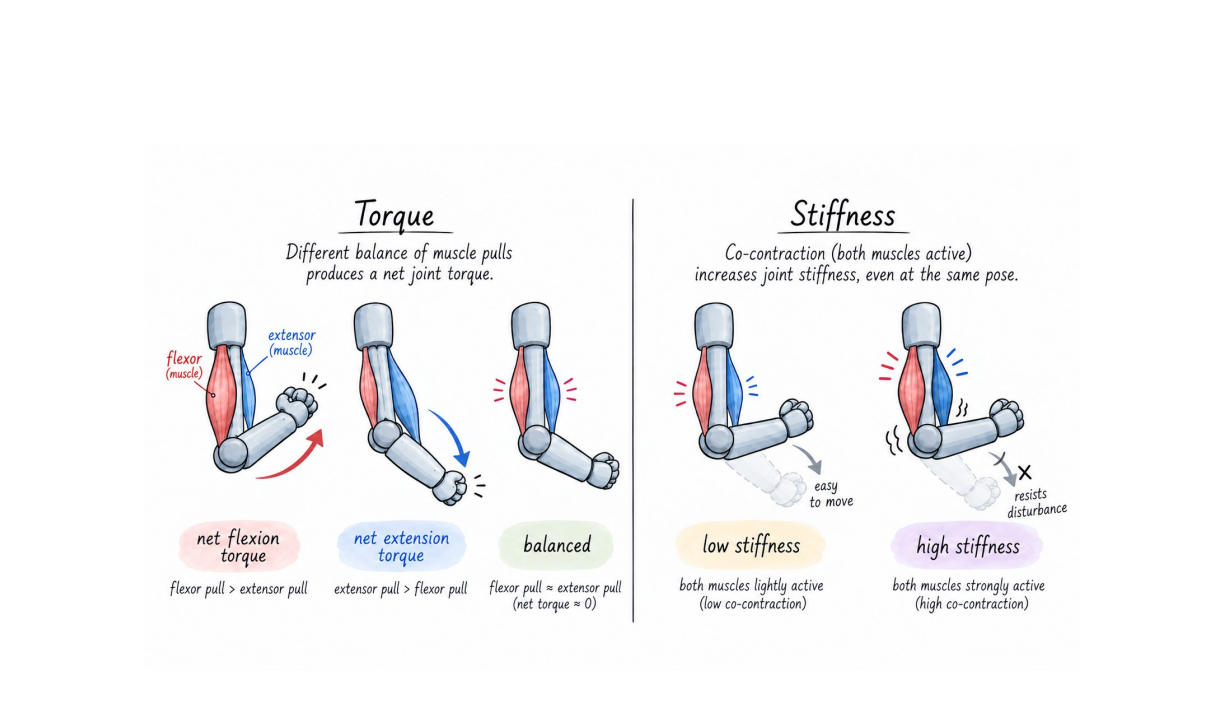
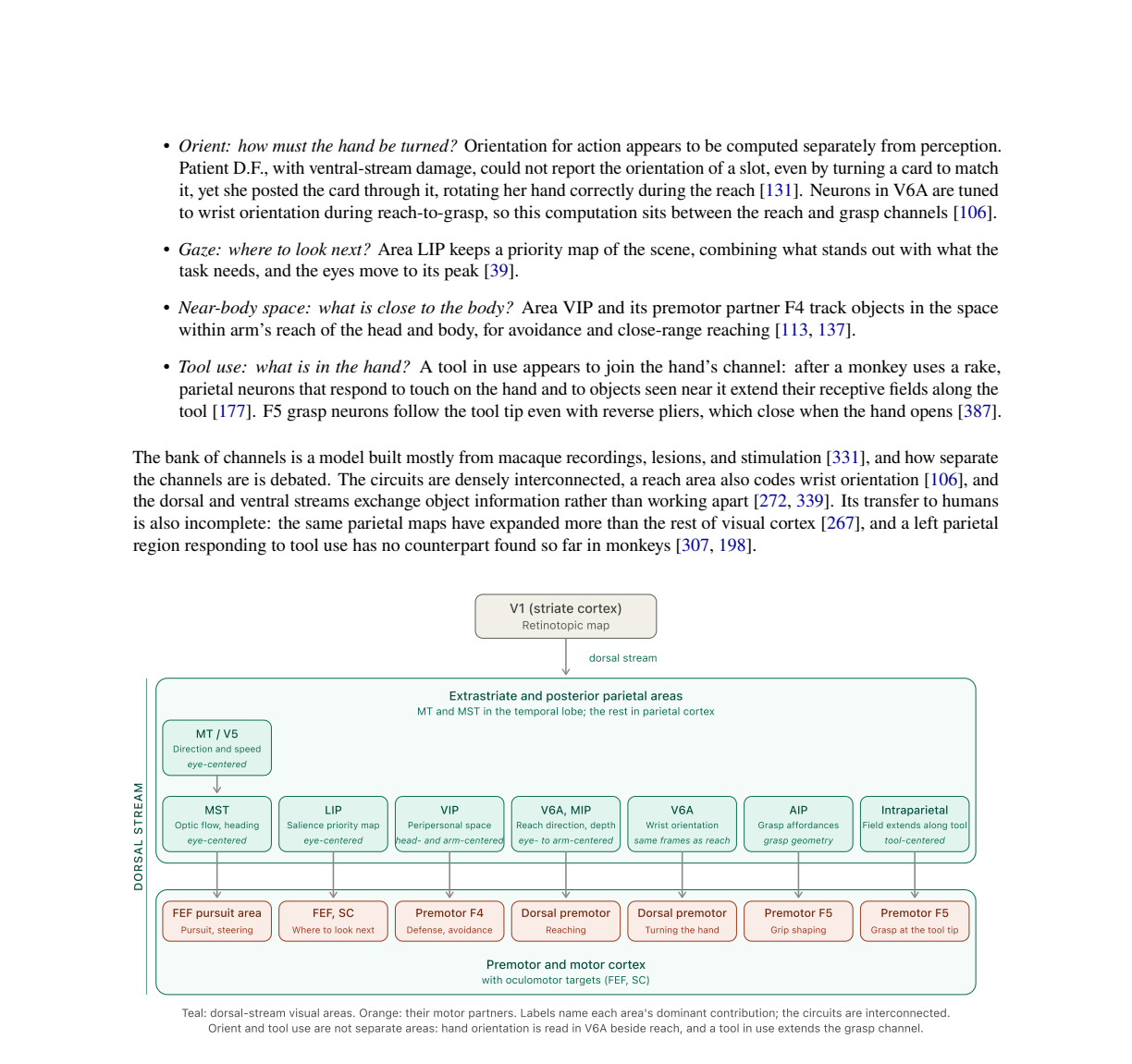
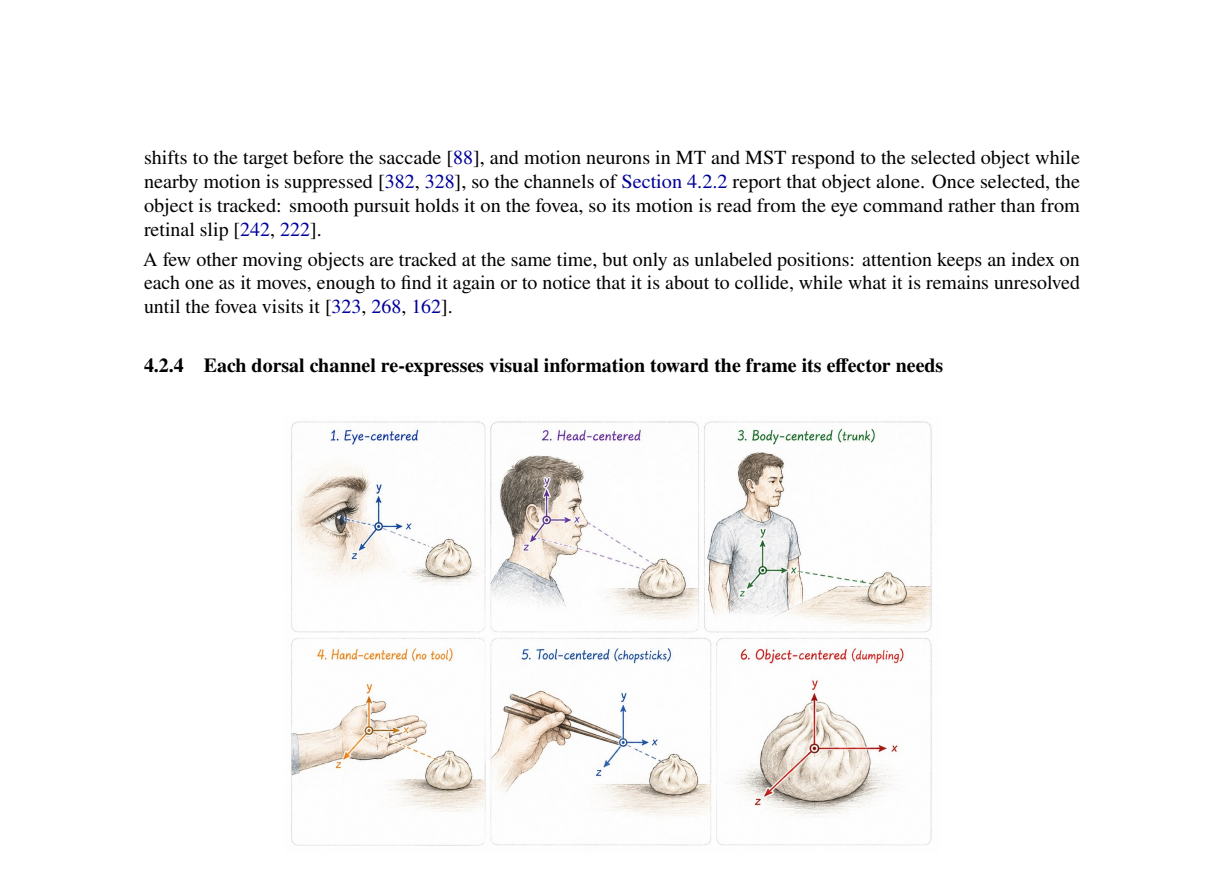
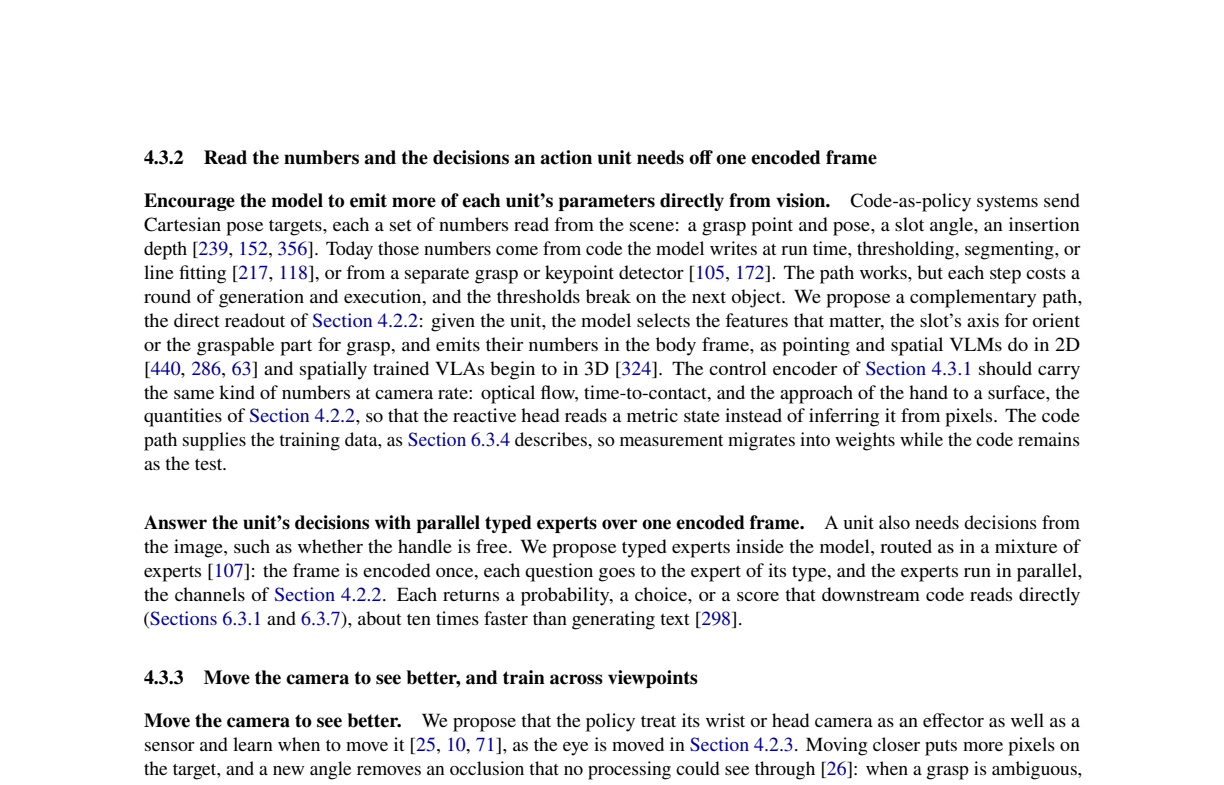
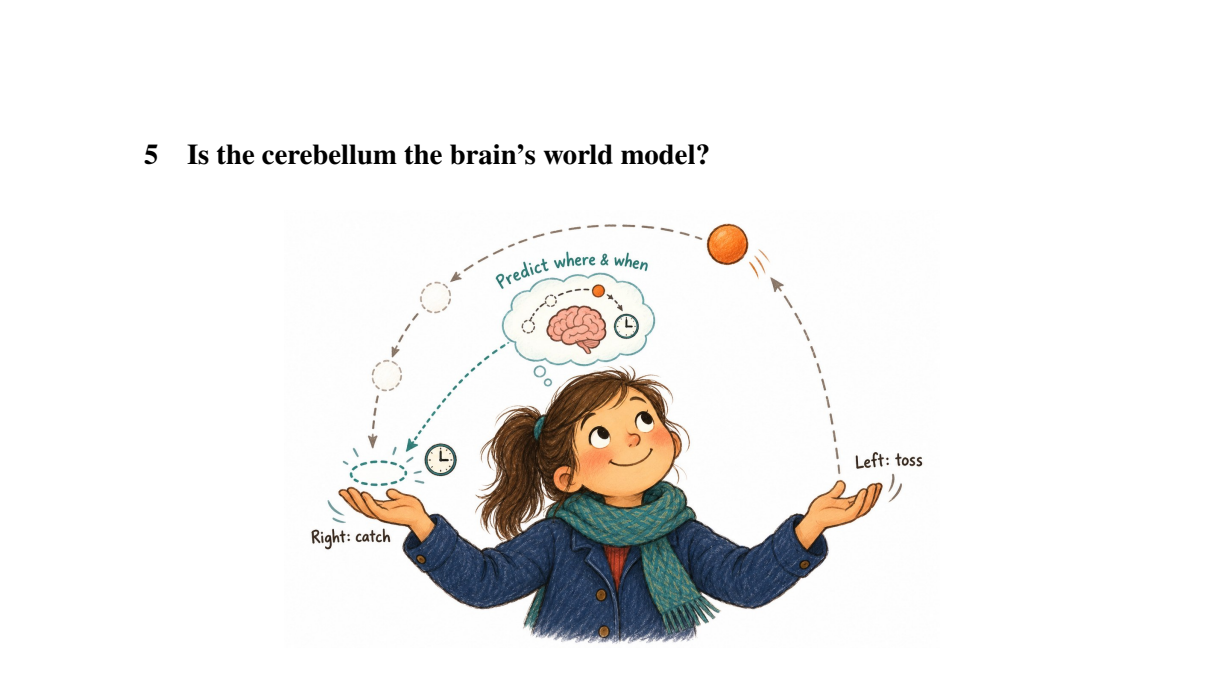
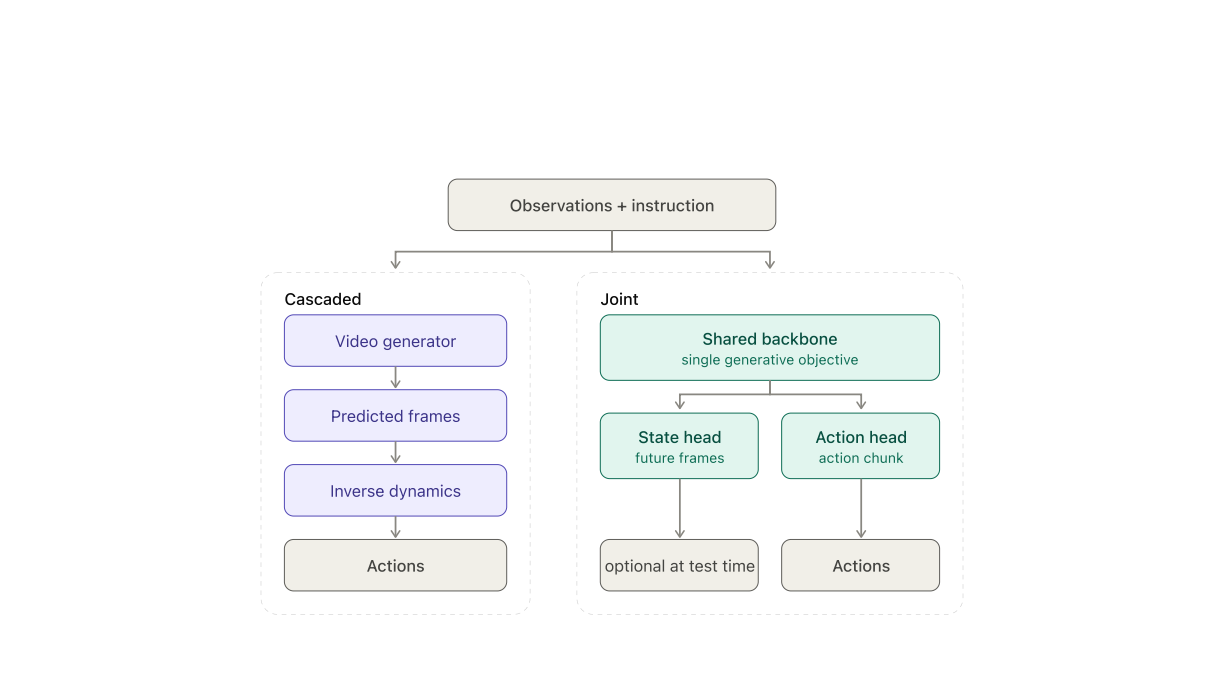
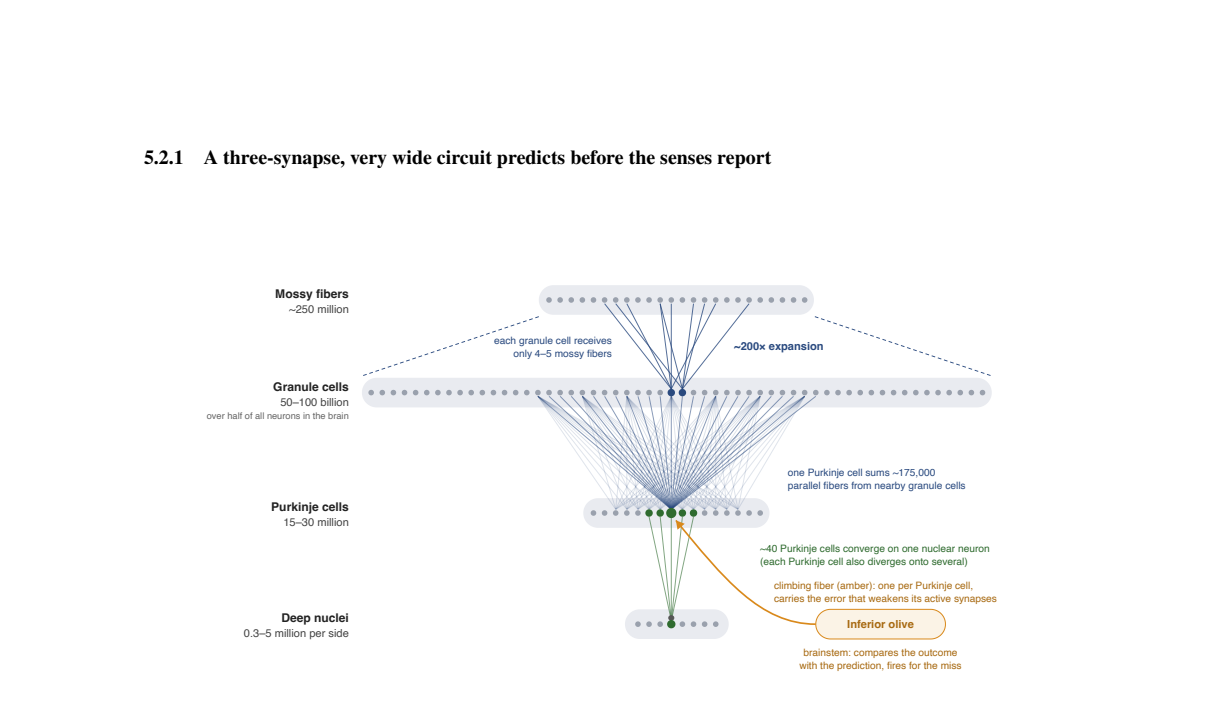
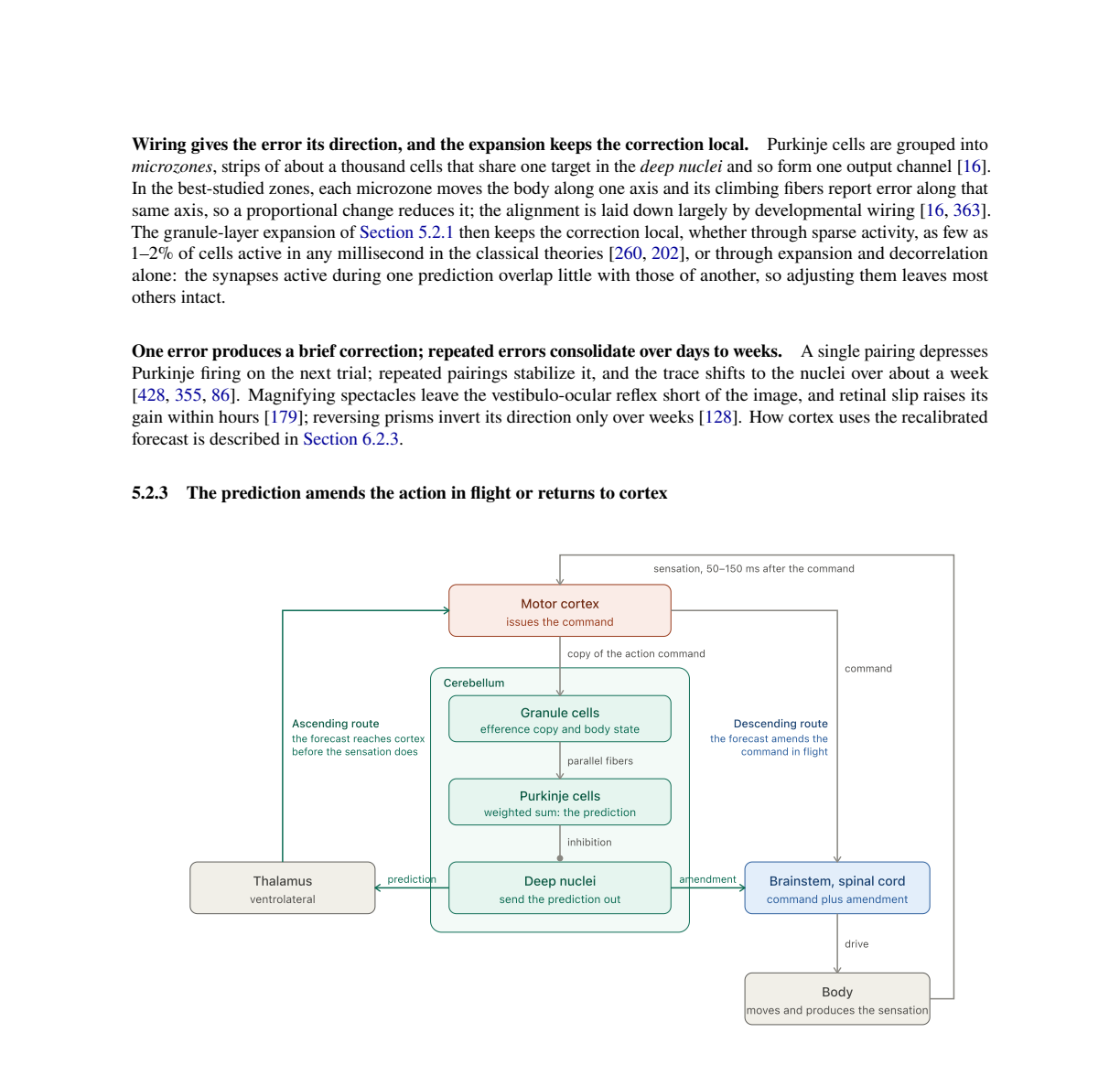
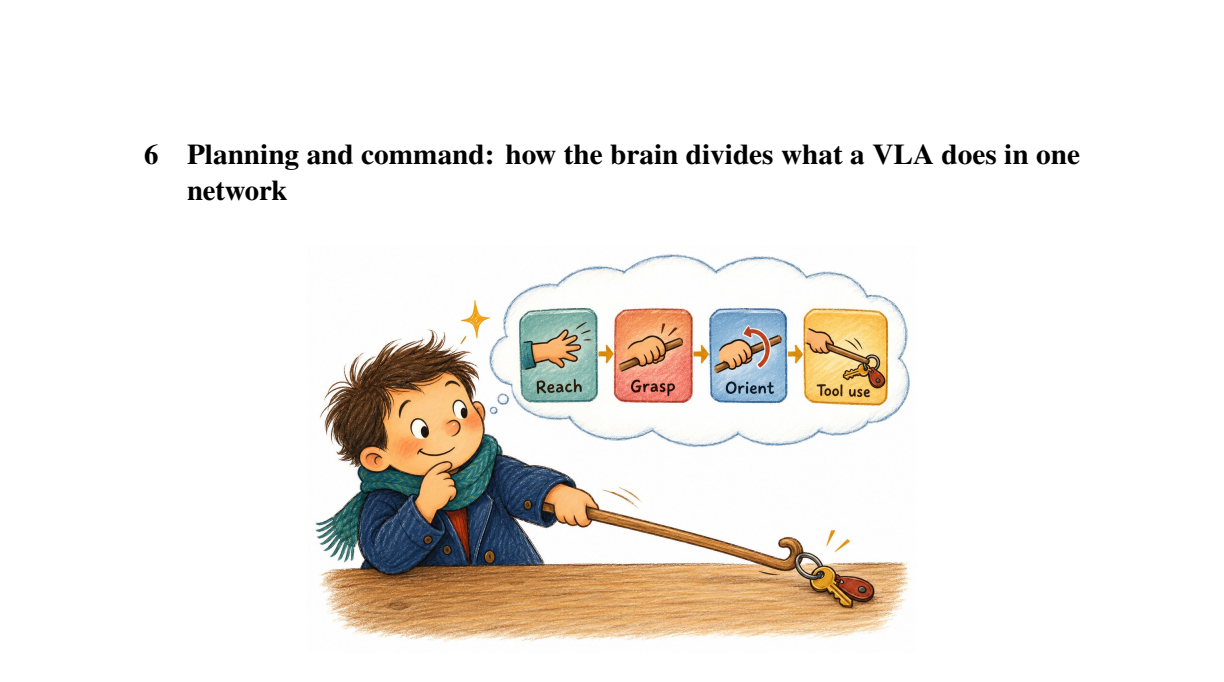
They fail despite pretraining on over a million trajectories, pooled from dozens of robots at great expense, while a child acquires all of these abilities within a few years of learning from a single body. This survey argues that the gap is one of design, and proposes designs for the next generation of robot models, drawn from how the nervous system solves the same problems. From the body we take compliance: the policy commands stiffness alongside position, so the controller yields where the task allows and presses where it must, which greatly lowers the demand for precise position output. From the visual system, where a fast pathway for action runs in parallel with the slow pathway for recognition, we take a dedicated fast vision system for motor behavior: it precomputes the quantities the policy needs and drives a reactive policy at camera rate. From the cerebellum we take a predictor beside the policy that forecasts the consequence of each command and recalibrates from its own error. From motor cortex we take a single model that composes action units from primitives, verifies each at a sensory boundary, practices the weakest unit with a hypothesis in mind, and reasons each attempt closer to the goal. Proven primitives are then consolidated from code into weights, so they run fluently and respond quickly the next time. Together these describe a robot that acts on its own initiative, the basis of deployment and recursive self-improvement, and we offer each proposal as a hypothesis to be tested.
from the abstract
Pith says
Machine review · deepseek-v4-flash · 3 Nov 2026 · what was read was not recorded · not checked by a person
It can be wrong. Challenge this review or reply to it.
Holds up, with conditions. A serious, honestly framed position paper whose self-improvement leg rests on a judge problem the authors name but do not solve. This line is wrong
2 major objections · 5 minor
How often objections from reviews like this one are right: not yet measured
Not checked: figures, code, what the 300 references say.
The paper says, at Abstract; §6.3.7
The review did not quote this passage.
A classifier read this sentence of the paper as acknowledging the concern (probability 0.69):
“Automating the loop is the open part.The three routes are automated unevenly: agents already judge their own outcomes and write skills back, while choosing what to attempt next, deciding when a weight update is warranted, and verifying that an update is a real gain still fall to people.”
Pith says: Objection 1 of 2 · major
The abstract's third advertised capability, "keep improving after deployment", is not entailed by the proposed components. The practice agent (Section 6.3.6) and the consolidation agent (Section 6.3.4) both depend on a graded judgment, "which of two outcomes lies closer to the goal" (Section 6.3.7), but the paper supplies no training objective, architecture detail, or data source for that judge beyond the typed experts of Section 4.3.2, and the Conclusion only proposes to "strengthen that judgment".
more of objection 1
The paper itself states in Section 6.1.5 (b402) that "deciding when a weight update is warranted, and verifying that an update is a real gain still fall to people", and Section 6.3.1 concedes that current multimodal models "rarely manage this diagnosis". Because the judge is a prerequisite for both the weakest-unit selection and the update-acceptance decision, this leg does not follow from the compliant arm, fast encoder, and self-labeling predictor, and a system built exactly as proposed could fail it. The attribution half of the loop is reasonably specified by the three observable signs in Section 6.3.6, and the boundary tests of Section 6.3.1 provide binary pass/fail signals, but no graded goal-distance signal is identified. I recommend either specifying a concrete learning signal for the judge (for example, bootstrapping from boundary-test outcomes and forecast-versus-outcome discrepancies as described in Sections 3.3.2 and 5.3.1, or from the success-scored rollouts reviewed in Section 6.1.2) or explicitly demoting the self-improvement claim from the abstract's central triad to the paper's most speculative proposal.
The paper says, at Abstract; §5.3.3
The review did not quote this passage.
Pith says: Objection 2 of 2 · major
The central claim is stated as a joint consequence of the assembled design, but the paper never states which component is necessary for which of the three advertised capabilities. The camera-rate leg depends on the streaming encoder of Section 4.3.1 together with the reactive head of Section 6.3.3; the unfamiliar-task leg depends on the primitive library and code path of Section 6.3.1; and the self-improvement leg depends on the judge (major comment above).
more of objection 2
The paper also contains components it explicitly labels as open ("The exact design ... is to be determined", Section 5.3.3; "drawn with wide imagination", Section 6.3.5; "No model today infers fast enough for this", Section 5.3.2), so the reader cannot tell which parts of the tripartite claim are load-bearing. Since the paper's own standard is falsifiability (b576), I recommend adding per-proposal decisive comparisons, for example the same policy family with and without the streaming encoder at equal total compute for the camera-rate claim, and forecast-error decay over episodes with frozen policy weights for the single-attempt recalibration claim (b561), so that the central design thesis becomes testable as a whole rather than only module by module.
5 minor objections
The paper says, at §4.2.1
Pith says: minor objection 1 of 5
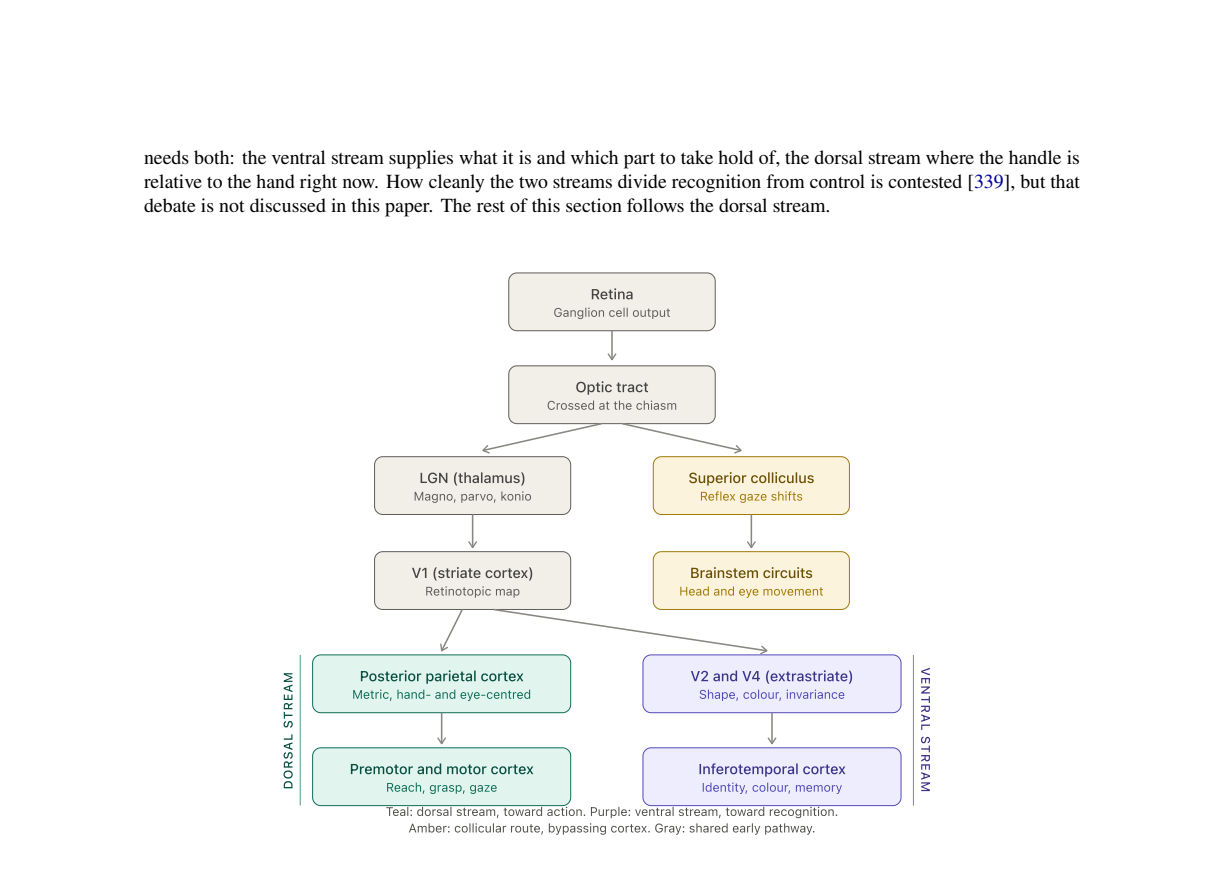
The sentence "How cleanly the two streams divide recognition from control is contested [339], but that debate is not discussed in this paper" is inconsistent with the text that follows: Section 4.2.2 does discuss the debate ("how separate the channels are is debated") and notes that the streams "exchange object information rather than working apart". The sentence reads like a leftover editorial note and should be removed or replaced with a pointer to the Section 4.2.2 caveat.
The paper says, at §7 (Conclusion)
Pith says: minor objection 2 of 5
The Conclusion's claim that the self-labeling predictor's link "is causal" is too strong as stated: a map from command to outcome learned from the robot's own rollouts is causally interpretable only if the predictor conditions on all confounders of action and outcome, and state-dependent action selection can bias self-labeled data otherwise. A formulation such as "predictive under the robot's own policy" would be safer, or the conditioning assumption should be stated.
show 3 more
The paper says, at Abstract; §7
Pith says: minor objection 3 of 5
The term "recursive self-improvement" is used in the Abstract and again in the Conclusion but never defined; a one-sentence definition (for example, improvement that compounds without human intervention) would clarify the scope of the claim, especially since Section 6.1.5 limits today's systems to partial automation.
The paper says, at References
Pith says: minor objection 4 of 5
Several claims that carry weight in the argument rest on non-archival or vendor sources: [109] (Figure AI Helix company report), [101] (Dyna-2 technical blog), and [62] (project page), alongside many 2026-dated preprints. This is understandable for a survey of a fast-moving area, but the text or reference list should mark vendor and preprint sources so that readers can weigh claims such as the 22% zero-shot success figure (b396).
The paper says, at §6.3.7; §5.3.1
Pith says: minor objection 5 of 5
The correction search of Section 6.3.7 scores candidate corrections with the predictor (Section 5.3.1), but the paper does not discuss the early-deployment regime in which that predictor is still badly miscalibrated, where the search would follow the wrong direction; a brief discussion of this bootstrap problem (for example, using boundary-test outcomes as ground truth until the forecast error decays) would close the loop.
What would settle it
Re-run the paper's own worked example of Figure 27 as a pass/fail benchmark: give a frontier multimodal model (e.g., GPT-6 Astra) the seven-episode boundary-test transcripts for the lock task, including forecast-versus-outcome mismatches and model-call counts, and require it to (1) name orient.angle as the error-prone unit and (2) output the corrective halving interval that terminates at 37 degrees, without human labels. If the model cannot do both, the autonomous judge on which the 'keep improving after deployment' leg rests is not established.
from the skeptic's reading
How the review went
4 readings by deepseek-v4-flash · 3 Nov 2026
- Reader holds up, with conditions
- Skeptic partly agrees
- Editor wrote the verdict above
- Referee major revision: 2 major objections, 5 minor
Not run on this paper: the simulated authors' defence.
Pith did not check this review's objections against the paper.
The review in full
The review in brief, machine-written
The short version: this is a serious position paper, and the stress-test concern about the judge is right but not disqualifying. The paper's actual contribution is a concrete blueprint—command stiffness alongside position, a dedicated streaming encoder for control next to the recognition encoder, a self-labeling predictor beside the policy, primitives verified at sensory boundaries, and practice/consolidation agents that move skills from code into weights. The combination is new even though the parts are borrowed, and the authors are unusually disciplined about labeling what is contested in the neuroscience and what is their interpretation. It reads like a survey that knows the difference between a result and a proposal.
The main soft spot is the third leg of the thesis: keeping improving after deployment. That leg requires an autonomous judge: attribution of failures to the right unit, scoring which outcome is closer to the goal, and verifying that a weight update is a real gain. The paper says in Section 6.1.5 that these judgments still fall to people, and Section 6.3.1 concedes that current models rarely diagnose contact failures. The practice and consolidation agents do not supply the missing capability; they restate it as a job description. The stress-test note lands. It is a genuine gap in the proposal, though an honestly acknowledged one, and the authors offer the whole design as hypotheses to be tested rather than as demonstrated results.
Smaller issues: the conclusion at b561 reads like a result ("the result is a robot that recalibrates...") for something no one has built. That wording should be toned down. I would not make much of the preprint-heavy citation base; the quantitative claims are attributed to specific sources, and the paper flags the figures it treats as order-of-magnitude. The reference list is extensive and mostly appropriate, though I could not check completeness beyond the truncation point.
Who gets value: anyone designing VLA architectures, compliant manipulation, tactile policies, or continual learning for robots. The survey maps the design space well, and each proposal is falsifiable by construction. It is not a results paper and should not be read as one. It deserves a serious referee; the right request is to keep the honest framing, tighten the conclusion, and state the judge problem as an explicit open problem with candidate mechanisms rather than naming an agent that assumes it.
Recommendation: send to peer review. If I were the editor, I would let it through and ask for revision rather than desk-rejecting it.
The strongest objection
The third leg of the central claim (b2) is that the proposed robot 'keep[s] improving after deployment.' That leg depends on an autonomous evaluation loop: the practice agent selects the weakest unit by attributing failures across units, the judge scores boundary outcomes, and the consolidation agent verifies that a proposed update is a real gain and decides what to write to the weights (Sections 6.3.4, 6.3.6, 6.3.7). The paper itself identifies the core of this loop as open: Section 6.1.5 states that 'choosing what to attempt next, deciding when a weight update is warranted, and verifying that an update is a real gain still fall to people' (b402), and Section 6.3.1 acknowledges that current multimodal models 'rarely manage this diagnosis, least of all where forces interact out of the camera's view.' The proposals do not supply a mechanism for these judgments. Section 6.3.7 says correction 'rests on one judgment: which of two outcomes lies closer to the goal,' and the conclusion proposes to 'strengthen that judgment,' but no training objective, architecture, or data source for the judge is specified beyond typed experts (Section 4.3.2). A system with compliance, a fast control encoder, and a self-labeling predictor could be built exactly as proposed and still not improve after deployment if the judge cannot attribute blame and score progress. The paper offers this as a hypothesis to be tested (b576), which is honest, but the central claim's self-improvement leg therefore has no demonstrated mechanism; the practice and consolidation agents restate the requirement rather than satisfy it.
The reader's verdict is CONDITIONAL, and my read does not move it. The paper is a self-described position paper (b575-b576), labels its neuroscience readings, and offers each module as a hypothesis; I found no fabrication, circular derivation, or unsupported quoted theorem. The load-bearing weak point is the third of the three abilities the abstract and Section 1 center on: 'keep improving.' Unlike compliance, the fast vision stream, and the predictor, whose engineering counterparts are concrete (admittance/impedance, a second small encoder, a world model), the self-improvement loop is specified only by naming agents—practice, judge, consolidation—and assigning them duties. The hardest duty, autonomous diagnosis of which primitive failed and which correction moves closer to success, is precisely what the paper says current models 'rarely manage' (Section 6.3.1) and what Section 6.1.5 says still falls to people (b402). So the central claim's most ambitious clause rests on a capability that is asserted, not designed. This supports CONDITIONAL rather than ACCEPT. It does not justify REJECT: the proposals are concrete enough to be built and measured, and the paper's own Figure 27 specifies a testable instance of the judge's task. My concrete_test uses that instance. I agree with the reader's weakest_assumption in part: the same frontier-model capability sits underneath my concern, but my emphasis is narrower—not whether the analogy transfers, but whether the autonomous judge exists at all. Hence agreement_with_reader: partial.
The referee's report
If the design thesis holds, the paper makes a useful contribution to the active debate among VLA, world-model, and code-as-policy architectures: it offers a coherent alternative with clean module boundaries, and several modules are concrete enough to build or falsify today, including the force-field touch representation (Section 3.3.1), the streaming control encoder (Section 4.3.1), body-part embeddings (Section 5.3.4), and the code-to-weights consolidation path (Sections 6.3.2 and 6.3.4). The survey reporting is careful: contested neuroscience is flagged (the dorsal/ventral division in Sections 4.2.1 and 4.2.2; the forward-model reading of the cerebellum in Section 5.2), quantitative claims are cited to sources (for example, OmniTacTune results on contact-rich tasks in Section 2.3.2 and GPT-6 Astra zero-shot success in Section 6.1.4), and the paper separates its own proposals from established results. The explicit limitation statements (b575-b576) strengthen trust in the survey portions, and the module-level proposals are genuinely falsifiable predictions.
Pith's reading of the paper (a machine's summary, not the authors')
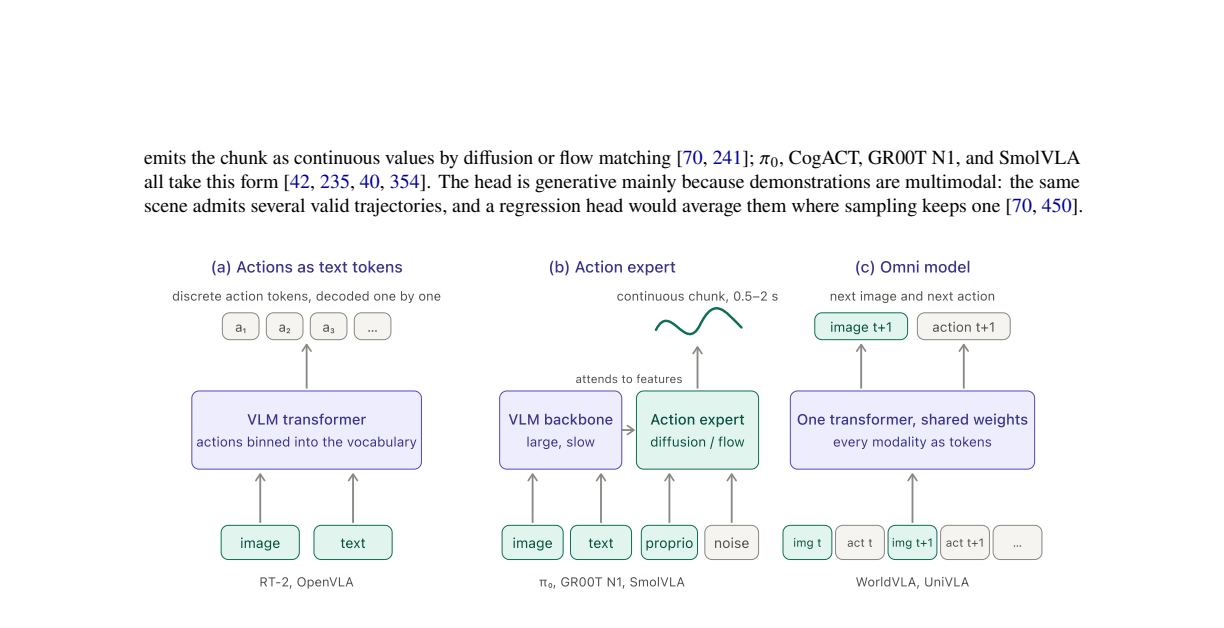
The paper argues that robot policies keep failing at everyday manipulation not because they lack data but because they are built the wrong way: one slow, recognition-shaped network reads a stale frame and emits precise positions into a fixed servo stack, is trained once, and never learns again after deployment. It proposes a next-generation robot model organized like the sensorimotor nervous system: compliance beneath position output, a dedicated fast vision encoder for control beside the slow recognition encoder, a self-labeling predictor beside the policy, action units composed from reusable primitives and verified at sensory boundaries, and practice and consolidation agents that gradually move proven skills from explicit code into network weights. If the design is right, a robot with this organization would solve unfamiliar tasks on first contact, react at camera rate to a moving world, and keep improving after deployment, using data it generates itself. The authors offer each proposal as a hypothesis to be tested rather than a demonstrated result.
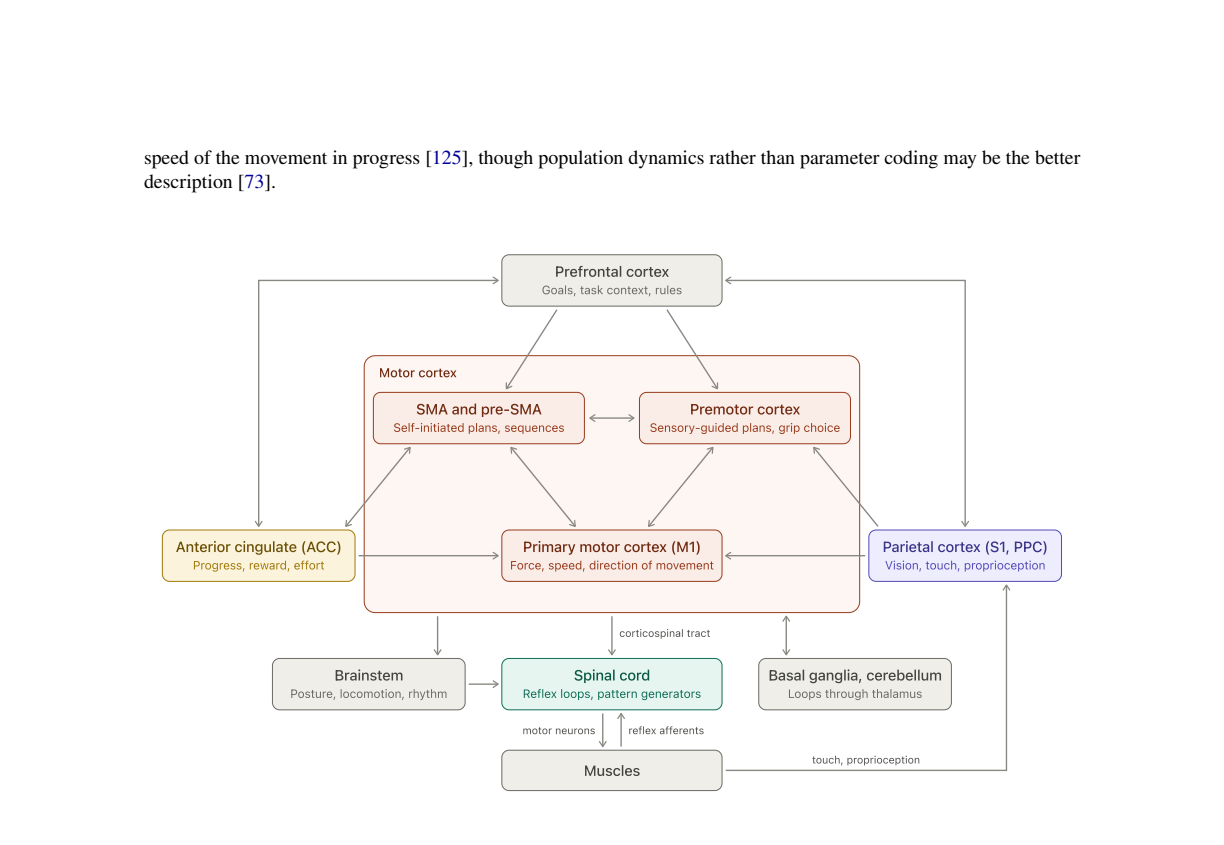
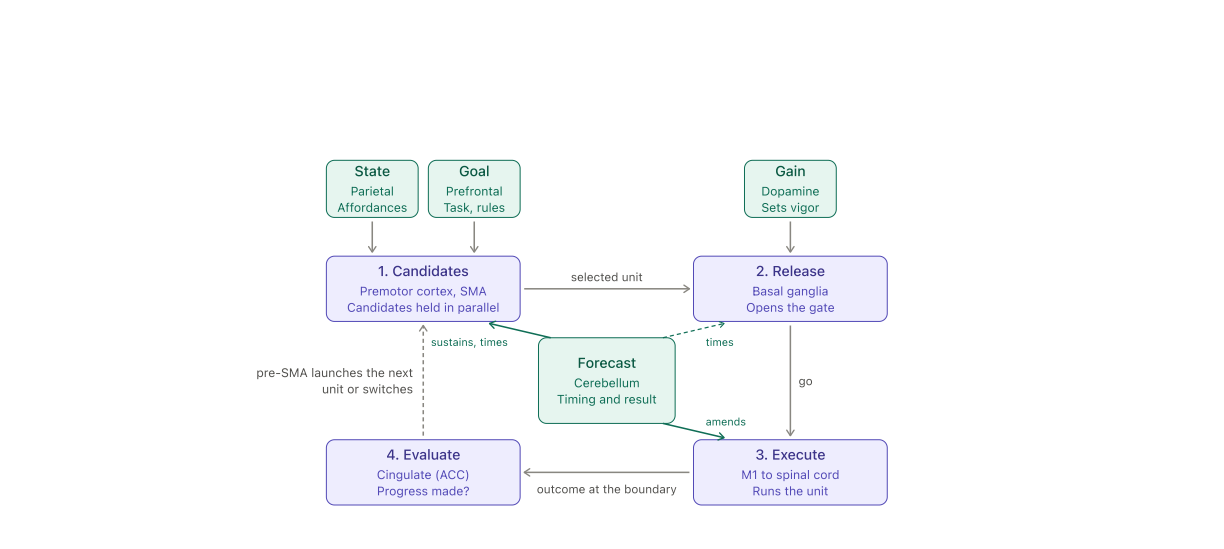
What carries the argument. The carrying mechanism is an architectural analogy, staked on a specific reading of what the sensorimotor brain does, in which each functional division maps to a concrete engineering component. Opposing muscle pairs set torque and stiffness independently, so the policy emits stiffness alongside position, realized by impedance or admittance control beneath the policy. Two visual streams motivate a streaming control encoder that precomputes motion, flow, and time-to-contact for a reactive head, separate from the recognition encoder. The cerebellum, read as a forward model, motivates a predictor beside the policy that is shallow, wide, and sparse, so an error-scaled test-time step corrects only the forecast that was wrong and leaves all others intact. Motor cortex and the prefrontal-to-motor hierarchy motivate primitive composition with verifiable goal tests at each action-unit boundary, plus practice and consolidation agents that move primitives from code into weights; body-part embeddings tie the modules together so the sensorimotor map transfers across embodiments. What this machinery does is replace one monolithic policy with a set of cooperating loops, each tuned to a different timescale, so that speed, generalization, and learning are handled by different components rather than by one network.
Core claim. The central claim, stated on the paper's own terms, is that the gap between a seven-year-old and a policy pretrained on over a million trajectories is a design gap: the brain's motor system solves speed, generalization, and lifelong improvement by dividing labor, and robotics has not yet copied those divisions. The blueprint has six moving parts. The policy should command stiffness alongside position, with touch as a force field telling the controller where to yield and how hard to press, so the world supplies much of the trajectory. A second, fast vision encoder, fed by motion-oriented signals distilled from video models, should drive a reactive policy head at camera rate while the slow encoder keeps recognition. A shallow, wide, sparse predictor beside the policy should forecast the sensory consequence of each command and recalibrate from its own error within a single episode. One model should compose action units from parameterized primitives, verify each at a sensory boundary, and mature each primitive from measuring code to typed function to end-to-end weights, guided by a practice agent that rehearses the weakest unit and a consolidation agent that graduates what works. The authors claim that together these features yield a robot that acts on its own initiative, which they call the basis of deployment and recursive self-improvement, and they state plainly that the neuroscience behind the analogy is partly hypothesis and that each transfer must be tested on real robots.
The premise it rests on. The blueprint stands on the premise that the organizational features it exports from the brain — separate fast vision for action, a predictive cerebellum, motor-cortex primitives with boundary checks, and offline consolidation — are the load-bearing causes of human speed, generalization, and self-improvement rather than biological side effects, and that they survive transplantation into an engineered robot; the paper acknowledges both the debate in neuroscience and that the premise is testable only on real hardware, and it additionally relies on frontier multimodal models becoming able to write correct measuring code and diagnose contact failures, a capability it concedes current models rarely have.
If the paper is right (Pith's inferences, not the authors')
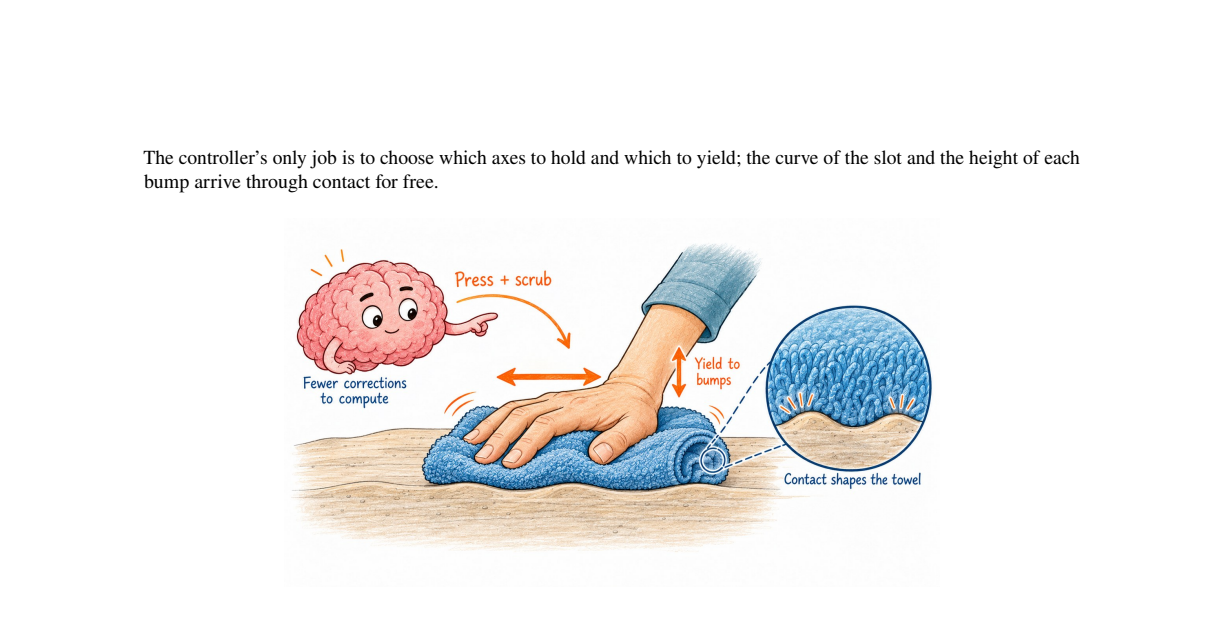
A policy that commands stiffness alongside a position target would let contact-rich skills run on the position-controlled arms most robots use, because touch rather than precise trajectory computation would decide where to yield and how hard to press.
A camera-rate control encoder would remove the blindness inside action chunks: a robot could correct a slipping grasp or a moved target mid-motion instead of committing to an executed sequence it cannot see.
A self-labeling predictor that recalibrates from its own error would let a robot adapt to a stiffer lock or a heavier payload within a single attempt while leaving the policy's weights untouched, avoiding the catastrophic forgetting that naive fine-tuning risks.
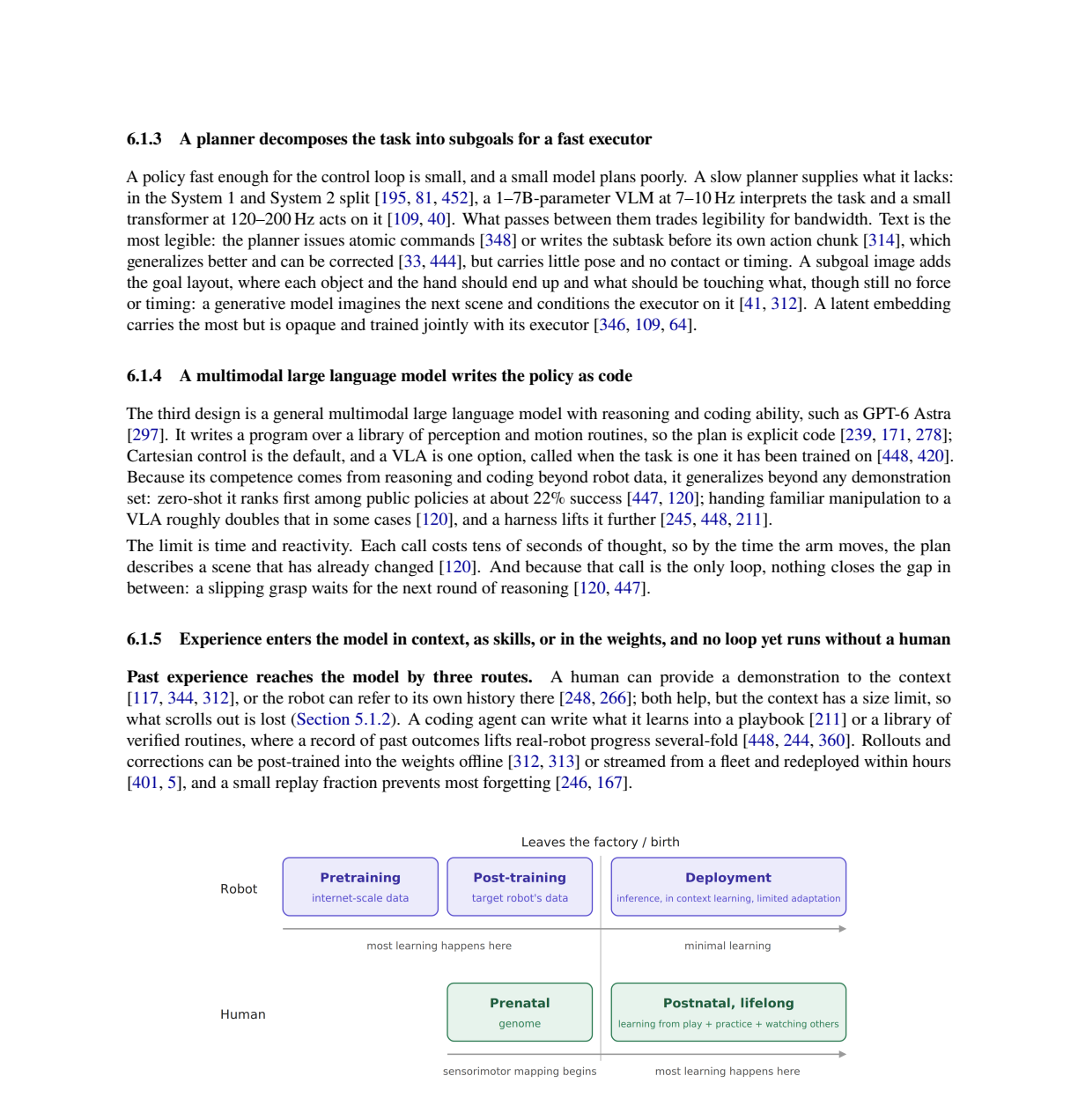
Composing new tasks from verified primitives would let a robot face an unfamiliar task on the first try, and the practice-plus-consolidation loop would let it keep improving after deployment rather than freezing at the factory door.
Because every executed action labels its own outcome a moment later, most of the training signal this design needs — tactile consequences, forecast errors, boundary-test verdicts — is available in ordinary deployment data with no human annotation.
If the design-gap thesis is right, it yields a measurable systems-level prediction: beyond some data budget, these architectural changes should buy larger gains per unit of data than adding more pooled trajectories, a comparison that could be run on any standard manipulation benchmark.
The code-to-weights path inverts today's data economy: code-writing frontier models become the teachers that generate the measured parameters and correction records used to train fast reactive heads, so the paper's own concession that current models rarely write correct measuring code or diagnose contact failures is the true gating bottleneck of the whole agenda.
The two-stream vision proposal suggests a concrete distillation recipe worth testing: distill the control encoder to predict velocity, optical flow, and time-to-contact rather than to reconstruct appearance, then compare reaction speed and contact-rich success at equal compute against a recognition-pretrained encoder.
If consolidation works as described, the durable asset of a robot fleet becomes the shared primitive library rather than per-robot weights, implying that cross-embodiment transfer and skill reuse should be organized around the library's growth — an economic argument the paper does not make.
Check this review
Pith stored no record of this review's passes and took no fingerprint of it. Reviews made by code from 13 Nov 2026 on carry both.
How often reviews like this one are right
Reviews like this one: written by deepseek-v4-flash, where what was read was not recorded.
How often objections from reviews like this one are right: not yet measured
Reviews by people
This review was written by a machine. No person has reviewed this paper on Pith yet. A scientist listed on Pith can review it for a fee, and their review is published here whatever it concludes.
The paper
Abstract
Robot policies still fail at everyday manipulation: an unfamiliar task, an object never held before, a scene that changes mid-motion, a skill that should improve with use. They fail despite pretraining on over a million trajectories, pooled from dozens of robots at great expense, while a child acquires all of these abilities within a few years of learning from a single body. This survey argues that the gap is one of design, and proposes designs for the next generation of robot models, drawn from how the nervous system solves the same problems. From the body we take compliance: the policy commands stiffness alongside position, so the controller yields where the task allows and presses where it must, which greatly lowers the demand for precise position output. From the visual system, where a fast pathway for action runs in parallel with the slow pathway for recognition, we take a dedicated fast vision system for motor behavior: it precomputes the quantities the policy needs and drives a reactive policy at camera rate. From the cerebellum we take a predictor beside the policy that forecasts the consequence of each command and recalibrates from its own error. From motor cortex we take a single model that composes action units from primitives, verifies each at a sensory boundary, practices the weakest unit with a hypothesis in mind, and reasons each attempt closer to the goal. Proven primitives are then consolidated from code into weights, so they run fluently and respond quickly the next time. Together these describe a robot that acts on its own initiative, the basis of deployment and recursive self-improvement, and we offer each proposal as a hypothesis to be tested.
The paper's own sentences, arranged, kept beside the review and separate from it. Each label is drawn from a closed vocabulary; the number beside it is the probability the classifier gave that label. No sentence in this record was written by a model.
abstract compiled · 2026-11-03
The authors' main claim, as the classifier picked it out 0.98
“This survey argues that the gap is one of design, and proposes designs for the next generation of robot models, drawn from how the nervous system solves the same problems.”
How the main claim is stated: asserted 0.86
What the abstract itself states, as probabilities: claims first 0.04 · states limitation 0.85 · human participants 0.05 · controlled comparison 0.11 · randomized assignment 0.01 · states quantitative result 0.26 · compares with prior results 0.39 · mentions code or data availability 0.03
The abstract, sentence by sentence
This table labels the abstract only (arXiv listing abstract v1). The number is the probability the classifier gave the label.
| Sentence | Role | The authors' own work | States the main conclusion | Strength |
|---|---|---|---|---|
| Robot policies still fail at everyday manipulation: an unfamiliar task, an object never held before, a scene that changes mid-motion, a skill that should improve with use. | background 0.92 | 0.12 | 0.03 | asserted 1.00 |
| They fail despite pretraining on over a million trajectories, pooled from dozens of robots at great expense, while a child acquires all of these abilities within a few years of learning from a single body. | background 0.87 | 0.11 | 0.05 | asserted 1.00 |
| This survey argues that the gap is one of design, and proposes designs for the next generation of robot models, drawn from how the nervous system solves the same problems. | contribution 0.98 | 0.32 | 0.80 | asserted 0.86 |
| From the body we take compliance: the policy commands stiffness alongside position, so the controller yields where the task allows and presses where it must, which greatly lowers the demand for precise position output. | method 0.65 | 0.17 | 0.06 | asserted 0.99 |
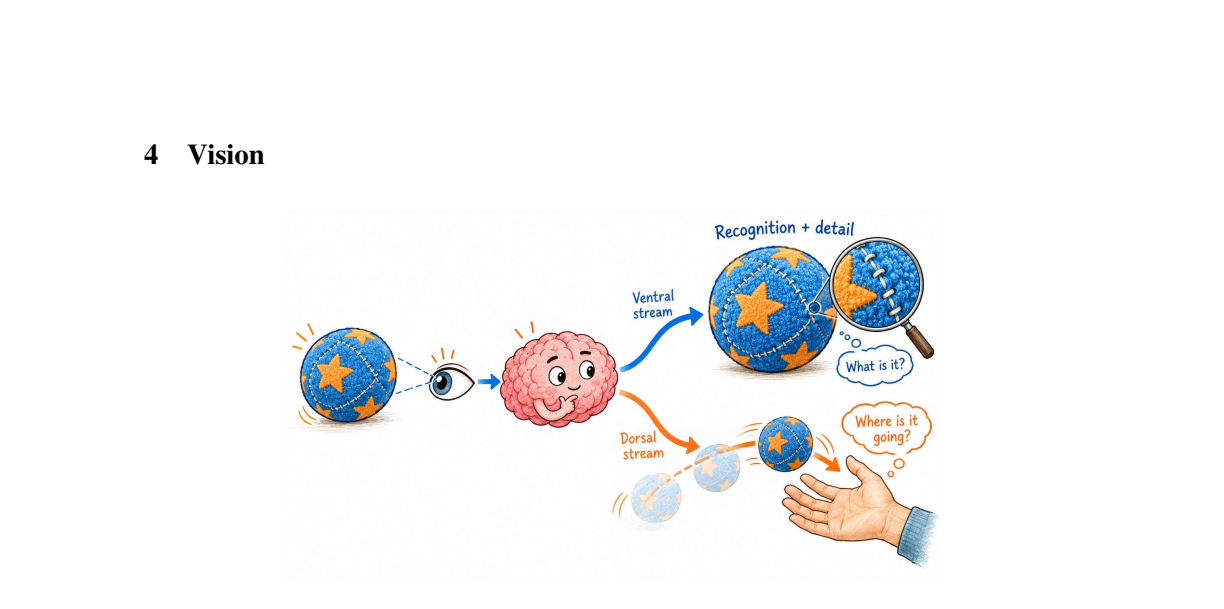
| From the visual system, where a fast pathway for action runs in parallel with the slow pathway for recognition, we take a dedicated fast vision system for motor behavior: it precomputes the quantities the policy needs and drives a reactive policy at camera rate. | contribution 0.58 | 0.11 | 0.06 | asserted 0.96 |
| From the cerebellum we take a predictor beside the policy that forecasts the consequence of each command and recalibrates from its own error. | method 0.54 | 0.08 | 0.05 | asserted 0.95 |
| From motor cortex we take a single model that composes action units from primitives, verifies each at a sensory boundary, practices the weakest unit with a hypothesis in mind, and reasons each attempt closer to the goal. | method 0.63 | 0.10 | 0.08 | asserted 0.94 |
| Proven primitives are then consolidated from code into weights, so they run fluently and respond quickly the next time. | method 0.90 | 0.12 | 0.06 | asserted 0.98 |
| Together these describe a robot that acts on its own initiative, the basis of deployment and recursive self-improvement, and we offer each proposal as a hypothesis to be tested. | future work 0.54 | 0.26 | 0.37 | asserted 0.44 |
What kind of paper the classifier reports this is: position or commentary 0.91 · evidence from argument 0.93
What was examined, and what was not
Sources read
- arXiv listing abstract v1
Not examined
- full text
- figures and tables
- references and citing sentences
- relations to other papers
Levels run
- P abstract
Not run
- S sections
- T body sentences
- C citations
- R cross-paper relations
How the labels were made
Compiled by classifier-1.13.0 via TypeSafe API, question bank abstract-p1-20260923, 2026-11-03: 1 request, 7,079 input tokens.
Every quoted sentence on this record is the authors'. Every label is from Pith's closed vocabulary, with the probability shown beside it. This record as JSON
Figures (27)
Figures are the authors', reproduced from the paper.
References (300)
- [1] Ignacio Abadía, Francisco Naveros, Eduardo Ros, Richard R. Carrillo, and Niceto R. Luque. A cerebellar-based solution to the nondeterministic time delay problem in robotic control.Science Robotics, 6(58), September 2021. ISSN 2470-9476. doi: 10.1126/scirobotics.abf2756. URL ht... on Pithdoi:10.1126/scirobotics.abf2756
- [2] Victoria E. Abraira and David D. Ginty. The sensory neurons of touch.Neuron, 79(4):618–639, 2013. doi: 10.1016/j.neuron.2013.07.051 on Pithdoi:10.1016/j.neuron.2013.07.051
- [3] E. D. Adrian and Y. Zotterman. The impulses produced by sensory nerve-endings: Part II. The response of a single end-organ.The Journal of Physiology, 61(2):151–171, 1926. doi: 10.1113/jphysiol.1926.sp002281 on Pithdoi:10.1113/jphysiol.1926.sp002281
- [4] Christopher Agia, Rohan Sinha, Jingyun Yang, Zi-ang Cao, Rika Antonova, Marco Pavone, and Jeannette Bohg. Unpacking failure modes of generative policies: Runtime monitoring of consistency and progress.arXiv preprint arXiv:2410.04640, 2024 on PithPith's reviewarXiv
- [5] AgiBot. SOP: A scalable online post-training system for vision-language-action models.arXiv preprint arXiv:2601.03044, 2026 on PitharXiv
- [6] AgiBot-World-Contributors, Qingwen Bu, Jisong Cai, Li Chen, Xiuqi Cui, Yan Ding, Siyuan Feng, Shenyuan Gao, Xindong He, Xuan Hu, Xu Huang, Shu Jiang, Yuxin Jiang, Cheng Jing, Hongyang Li, Jialu Li, Chiming Liu, Yi Liu, Yuxiang Lu, Jianlan Luo, Ping Luo, Yao Mu, Yuehan Niu, Yix... on PithPith's reviewarXiv
- [7] Michael Ahn, Debidatta Dwibedi, Chelsea Finn, Montse Gonzalez Arenas, Keerthana Gopalakrishnan, Karol Hausman, Brian Ichter, Alex Irpan, Nikhil Joshi, Ryan Julian, Sean Kirmani, Isabel Leal, Edward Lee, Sergey Levine, Yao Lu, Isabel Leal, Sharath Maddineni, Kanishka Rao, Dorsa... on PitharXiv
- [8] Alin Albu-Schäffer, Sami Haddadin, Christian Ott, Andreas Stemmer, Thomas Wimböck, and Gerd Hirzinger. The DLR lightweight robot: Design and control concepts for robots in human environments.Industrial Robot: An International Journal, 34(5):376–385, 2007. doi: 10.1108/01439910... on Pithdoi:10.1108/01439910710774386
- [9] James S. Albus. A theory of cerebellar function.Mathematical Biosciences, 10(1–2):25–61, 1971 on Pith
- [10] John Aloimonos, Isaac Weiss, and Amit Bandyopadhyay. Active vision.International Journal of Computer Vision, 1(4):333–356, 1988. doi: 10.1007/BF00133571 on Pithdoi:10.1007/bf00133571
- [11] Amir Amedi, Rafael Malach, Talma Hendler, Sharon Peled, and Ehud Zohary. Visuo-haptic object-related activation in the ventral visual pathway.Nature Neuroscience, 4(3):324–330, 2001. doi: 10.1038/85201 on Pithdoi:10.1038/85201
- [12] Birgitte Bo Andersen, Lise Korbo, and Bente Pakkenberg. A quantitative study of the human cerebellum with unbiased stereological techniques.Journal of Comparative Neurology, 326(4):549–560, 1992. doi: 10.1002/cne.903260405 on Pithdoi:10.1002/cne.903260405
- [13] Richard A. Andersen and Christopher A. Buneo. Intentional maps in posterior parietal cortex.Annual Review of Neuroscience, 25:189–220, 2002 on Pith
- [14] Richard A. Andersen, Greg K. Essick, and Ralph M. Siegel. Encoding of spatial location by posterior parietal neurons.Science, 230:456–458, 1985. 46 on Pith
- [15] Lars Ankile, Anthony Simeonov, Idan Shenfeld, Marcel Torne, and Pulkit Agrawal. From imitation to refinement - residual RL for precise assembly. In2025 IEEE International Conference on Robotics and Automation (ICRA), pages 1–8. IEEE, May 2025. doi: 10.1109/icra55743.2025.11127... on Pithdoi:10.1109/icra55743.2025.11127442
- [16] Richard Apps and Martin Garwicz. Anatomical and physiological foundations of cerebellar information processing.Nature Reviews Neuroscience, 6:297–311, 2005. doi: 10.1038/nrn1646 on Pithdoi:10.1038/nrn1646
- [17] Mahmoud Assran, Quentin Duval, Ishan Misra, Piotr Bojanowski, Pascal Vincent, Michael Rabbat, Yann LeCun, and Nicolas Ballas. Self-supervised learning from images with a joint-embedding predictive architecture. In IEEE Conference on Computer Vision and Pattern Recognition (CVP... on Pith
- [18] Mahmoud Assran et al. V-JEPA 2: Self-supervised video models enable understanding, prediction, and planning. Technical report, arXiv, 2025 on Pith
- [19] Karl Johan Åström and Björn Wittenmark.Adaptive Control. Addison-Wesley, 2nd edition, 1995 on Pith
- [20] David Attwell and Simon B. Laughlin. An energy budget for signaling in the grey matter of the brain.Journal of Cerebral Blood Flow & Metabolism, 21(10):1133–1145, 2001. doi: 10.1097/00004647-200110000-00001 on Pithdoi:10.1097/00004647-200110000-00001
show 80 more
- [21] A.-S. Augurelle, A. M. Smith, T. Lejeune, and J.-L. Thonnard. Importance of cutaneous feedback in maintaining a secure grip during manipulation of hand-held objects.Journal of Neurophysiology, 89(2):665–671, 2003. doi: 10.1152/jn.00249.2002 on Pithdoi:10.1152/jn.00249.2002
- [22] Marie Avillac, Sophie Denève, Etienne Olivier, Alexandre Pouget, and Jean-René Duhamel. Reference frames for representing visual and tactile locations in parietal cortex.Nature Neuroscience, 8(7):941–949, 2005. doi: 10.1038/nn1480 on Pithdoi:10.1038/nn1480
- [23] ShuaiBai,KeqinChen,XuejingLiu, etal. Qwen2.5-VLtechnicalreport. arXivpreprintarXiv:2502.13923, 2025 on PithPith's reviewarXiv
- [24] Shuanghao Bai, Meng Li, Xinyuan Lv, Jiawei Wang, Xinhua Wang, Fei Liao, Chengkai Hou, Langzhe Gu, Wanqi Zhou, Kun Wu, Ziluo Ding, Zhiyuan Xu, Lei Sun, Shanghang Zhang, Zhengping Che, Jian Tang, and Badong Chen. HEX: Humanoid-aligned experts for cross-embodiment whole-body mani... on PithPith's reviewarXiv
- [25] Ruzena Bajcsy. Active perception.Proceedings of the IEEE, 76(8):966–1005, 1988. doi: 10.1109/5.5968 on Pithdoi:10.1109/5.5968
- [26] Ruzena Bajcsy, Yiannis Aloimonos, and John K. Tsotsos. Revisiting active perception.Autonomous Robots, 42 (2):177–196, 2018. doi: 10.1007/s10514-017-9615-3 on Pithdoi:10.1007/s10514-017-9615-3
- [27] Hangbo Bao, Li Dong, Songhao Piao, and Furu Wei. BEiT: BERT pre-training of image transformers. In International Conference on Learning Representations (ICLR), 2022 on Pith
- [28] AdrienBardes,QuentinGarrido,JeanPonce,etal. Revisitingfeaturepredictionforlearningvisualrepresentations from video (V-JEPA).arXiv preprint arXiv:2404.08471, 2024 on PithPith's reviewarXiv
- [29] Amy J. Bastian. Learning to predict the future: The cerebellum adapts feedforward movement control.Current Opinion in Neurobiology, 16(6):645–649, 2006. doi: 10.1016/j.conb.2006.08.016 on Pithdoi:10.1016/j.conb.2006.08.016
- [30] Aaron P. Batista, Christopher A. Buneo, Lawrence H. Snyder, and Richard A. Andersen. Reach plans in eye-centered coordinates.Science, 285(5425):257–260, 1999 on Pith
- [31] Matthew I. Becker and Abigail L. Person. Cerebellar control of reach kinematics for endpoint precision.Neuron, 103(2):335–348, 2019. doi: 10.1016/j.neuron.2019.05.007 on Pithdoi:10.1016/j.neuron.2019.05.007
- [32] Suneel Belkhale, Yuchen Cui, and Dorsa Sadigh. Data quality in imitation learning. InAdvances in Neural Information Processing Systems 36, NeurIPS 2023, page 80375–80395. Neural Information Processing Systems Foundation, Inc. (NeurIPS), 2023. doi: 10.52202/075280-3524. URL htt... on Pithdoi:10.52202/075280-3524
- [33] Suneel Belkhale, Tianli Ding, Ted Xiao, Pierre Sermanet, Quon Vuong, Jonathan Tompson, Yevgen Chebotar, Debidatta Dwibedi, and Dorsa Sadigh. RT-H: Action hierarchies using language. InRobotics: Science and Systems, 2024 on Pith
- [34] Pierre-MichelBernierandScottT.Grafton. Humanposteriorparietalcortexflexiblydeterminesreferenceframes for reaching based on sensory context.Neuron, 68(4):776–788, 2010. doi: 10.1016/j.neuron.2010.11.002 on Pithdoi:10.1016/j.neuron.2010.11.002
- [35] Michael J. Berry, Iman H. Brivanlou, Thomas A. Jordan, and Markus Meister. Anticipation of moving stimuli by the retina.Nature, 398(6725):334–338, 1999. doi: 10.1038/18678 on Pithdoi:10.1038/18678
- [36] Homanga Bharadhwaj, Roozbeh Mottaghi, Abhinav Gupta, and Shubham Tulsiani. Track2Act: Predicting point tracks from internet videos enables generalizable robot manipulation. InEuropean Conference on Computer Vision (ECCV), 2024 on Pith
- [37] Raunaq Bhirangi, Tess Hellebrekers, Carmel Majidi, and Abhinav Gupta. ReSkin: Versatile, replaceable, lasting tactile skins. InProceedings of the 5th Conference on Robot Learning (CoRL), 2021 on Pith
- [38] Hongzhe Bi, Hengkai Tan, Shenghao Xie, Zeyuan Wang, Shuhe Huang, Haitian Liu, Ruowen Zhao, Yao Feng, Chendong Xiang, Yinze Rong, Hongyan Zhao, Hanyu Liu, Zhizhong Su, Lei Ma, Hang Su, and Jun Zhu. Motus: A unified latent action world model. arXiv preprint arXiv:2512.13030, 2025 on PithPith's reviewarXiv
- [39] James W. Bisley and Michael E. Goldberg. Attention, intention, and priority in the parietal lobe.Annual Review of Neuroscience, 33:1–21, 2010. doi: 10.1146/annurev-neuro-060909-152823 on Pithdoi:10.1146/annurev-neuro-060909-152823
- [40] Johan Bjorck et al. GR00T n1: An open foundation model for generalist humanoid robots. Technical report, NVIDIA, 2025 on Pith
- [41] KevinBlack,MitsuhikoNakamoto,PranavAtreya,HomerWalke,ChelseaFinn,AviralKumar,andSergeyLevine. Zero-shotroboticmanipulationwithpretrainedimage-editingdiffusionmodels.arXivpreprintarXiv:2310.10639, 2023 on PithPith's reviewarXiv
- [42] Kevin Black, Noah Brown, Danny Driess, et al.𝜋0: A vision-language-action flow model for general robot control.arXiv preprint arXiv:2410.24164, 2024 on PithPith's reviewarXiv
- [43] Kevin Black, Manuel Y. Galliker, and Sergey Levine. Real-time execution of action chunking flow policies. In Advances in Neural Information Processing Systems (NeurIPS), 2025 on Pith
- [44] Sarah-Jayne Blakemore, Daniel M. Wolpert, and Chris D. Frith. Central cancellation of self-produced tickle sensation.Nature Neuroscience, 1(7):635–640, 1998. doi: 10.1038/2870 on Pithdoi:10.1038/2870
- [45] Jeannette Bohg, Karol Hausman, Bharath Sankaran, Oliver Brock, Danica Kragic, Stefan Schaal, and Gaurav S. Sukhatme. Interactive perception: Leveraging action in perception and perception in action.IEEE Transactions on Robotics, 33(6):1273–1291, 2017. doi: 10.1109/TRO.2017.2721939 on Pithdoi:10.1109/tro.2017.2721939
- [46] RichardT.BornandDavidC.Bradley. StructureandfunctionofvisualareaMT.AnnualReviewofNeuroscience, 28:157–189, 2005. doi: 10.1146/annurev.neuro.26.041002.131052 on Pithdoi:10.1146/annurev.neuro.26.041002.131052
- [47] Andreea C. Bostan and Peter L. Strick. The basal ganglia and the cerebellum: Nodes in an integrated network. Nature Reviews Neuroscience, 19(6):338–350, 2018 on Pith
- [48] Anthony Brohan, Noah Brown, Justice Carbajal, Yevgen Chebotar, Joseph Dabis, Chelsea Finn, Keerthana Gopalakrishnan, Karol Hausman, Alex Herzog, Jasmine Hsu, et al. RT-1: Robotics transformer for real-world control at scale.arXiv preprint arXiv:2212.06817, 2022 on PithPith's reviewarXiv
- [49] Anthony Brohan, Noah Brown, Justice Carbajal, et al. RT-2: Vision-language-action models transfer web knowledge to robotic control.arXiv preprint arXiv:2307.15818, 2023 on PithPith's reviewarXiv
- [50] Antonia Bronars, Younghyo Park, and Pulkit Agrawal. Tune to learn: How controller gains shape robot policy learning. arXiv preprint arXiv:2604.02523, 2026. 48 on PithPith's reviewarXiv
- [51] Spencer T. Brown, Mauricio Medina-Pizarro, Meghana Holla, Christopher E. Vaaga, and Indira M. Raman. Simple spike patterns and synaptic mechanisms encoding sensory and motor signals in Purkinje cells and the cerebellar nuclei.Neuron, 112(11):1848–1861, 2024. doi: 10.1016/j.neu... on Pithdoi:10.1016/j.neuron.2024.02.014
- [52] Jake Bruce et al. Genie: Generative interactive environments. Technical report, arXiv, 2024 on Pith
- [53] Etienne Burdet, Rieko Osu, David W. Franklin, Theodore E. Milner, and Mitsuo Kawato. The central nervous system stabilizes unstable dynamics by learning optimal impedance.Nature, 414(6862):446–449, 2001. doi: 10.1038/35106566 on Pithdoi:10.1038/35106566
- [54] Alejandra Harris Caceres, Deborah A. Barany, Neil M. Dundon, Jolinda Smith, and Michelle Marneweck. Neural encoding of direction and distance across reference frames in visually guided reaching.eNeuro, 11(12): ENEURO.0405–24.2024, 2024. doi: 10.1523/ENEURO.0405-24.2024 on Pithdoi:10.1523/eneuro.0405-24.2024
- [55] Mathilde Caron, Hugo Touvron, Ishan Misra, Hervé Jégou, Julien Mairal, Piotr Bojanowski, and Armand Joulin. Emerging properties in self-supervised vision transformers. InProceedings of the IEEE/CVF International Conference on Computer Vision (ICCV), pages 9650–9660, 2021 on Pith
- [56] Ilaria Carta, Christopher H. Chen, Amanda L. Schott, Schnaude Dorizan, and Kamran Khodakhah. Cerebellar modulation of the reward circuitry and social behavior.Science, 363(6424), January 2019. ISSN 1095-9203. doi: 10.1126/science.aav0581. URLhttp://dx.doi.org/10.1126/science.aav0581 on Pithdoi:10.1126/science.aav0581
- [57] N. Alex Cayco-Gajic and R. Angus Silver. Re-evaluating circuit mechanisms underlying pattern separation. Neuron, 101(4):584–602, 2019 on Pith
- [58] Jun Cen, Chaohui Yu, Hangjie Yuan, Yuming Jiang, Siteng Huang, Jiayan Guo, Xin Li, Yibing Song, Hao Luo, Fan Wang, Deli Zhao, and Hao Chen. WorldVLA: Towards autoregressive action world model. arXiv preprint arXiv:2506.21539, 2025 on PithPith's reviewarXiv
- [59] Nadia L. Cerminara, Richard Apps, and Dilwyn E. Marple-Horvat. An internal model of a moving visual target in the lateral cerebellum.The Journal of Physiology, 587(2):429–442, 2009. doi: 10.1113/jphysiol.2008.163337 on Pithdoi:10.1113/jphysiol.2008.163337
- [60] Francois P. Chabrol, Antonin Blot, and Thomas D. Mrsic-Flogel. Cerebellar contribution to preparatory activity in motor neocortex.Neuron, 103(3):506–519, 2019. doi: 10.1016/j.neuron.2019.05.022 on Pithdoi:10.1016/j.neuron.2019.05.022
- [61] C. Elaine Chapman. Active versus passive touch: Factors influencing the transmission of somatosensory signals to primary somatosensory cortex.Canadian Journal of Physiology and Pharmacology, 72(5):558–570, 1994. doi: 10.1139/y94-080 on Pithdoi:10.1139/y94-080
- [62] Bingao Chen, Haoquan Fang, and C. Karen Liu. Astra on RoboMME: A three-tier planner, executor, and completion monitor.https://bingaochen.github.io/Astra-on-RoboMME/, 2026. Project page and code; accessed 3 October 2026 on Pith
- [63] Boyuan Chen, Zhuo Xu, Sean Kirmani, Brian Ichter, Dorsa Sadigh, Leonidas Guibas, and Fei Xia. SpatialVLM: Endowing vision-language models with spatial reasoning capabilities. InIEEE/CVF Conference on Computer Vision and Pattern Recognition (CVPR), 2024. arXiv:2401.12168 on PithPith's reviewarXiv
- [64] Hao Chen, Jiaming Liu, Chenyang Gu, Zhuoyang Liu, Renrui Zhang, Xiaoqi Li, Xiao He, Yandong Guo, Chi-Wing Fu, Shanghang Zhang, and Pheng-Ann Heng. Fast-in-slow: A dual-system VLA model unifying fast manipulation within slow reasoning. InAdvances in Neural Information Processin... on Pith
- [65] Jiaxin Chen, Hao Fang, Chen Wang, Shuo Wang, and Cewu Lu. History-aware visuomotor policy learning via point tracking.arXiv preprint arXiv:2509.17141, 2025 on PitharXiv
- [66] Kaiyuan Chen, Shuangyu Xie, Letian Fu, Justin Yu, William Pacini, Sandeep Bajamahal, Hudson Kim, Jaimyn Drake, Daehwa Kim, Haoru Xue, Jonathan Francis, Christian Juette, Peter Schaldenbrand, Muhammet Yunus Seker,RuwanWickramarachchi,UksangYoo,GuanzhiWang,AdithyavairavanMurali,... on PithPith's reviewarXiv
- [67] Shuxiao Chen, Bike Zhang, Mark W. Mueller, Akshara Rai, and Koushil Sreenath. Learning torque control for quadrupedal locomotion. InIEEE-RAS International Conference on Humanoid Robots (Humanoids), 2023 on Pith
- [68] Yuhui Chen, Shuai Tian, Shugao Liu, Yingting Zhou, Haoran Li, and Dongbin Zhao. ConRFT: A reinforced fine-tuning method for VLA models via consistency policy.Robotics: Science and Systems XXI, 2025. doi: 10.15607/RSS.2025.XXI.019 on Pithdoi:10.15607/rss.2025.xxi.019
- [69] Yuxuan Chen, Wanruo Zhang, and Xiao Li. Reflex: Enabling fast and predictive vision-language-action models for reaction-critical manipulation.arXiv preprint arXiv:2608.14379, 2026 on PithPith's reviewarXiv
- [70] ChengChi,SiyuanFeng,YilunDu,ZhenjiaXu,EricCousineau,BenjaminBurchfiel,andShuranSong. Diffusion policy: Visuomotor policy learning via action diffusion. InRobotics: Science and Systems, 2023 on Pith
- [71] Ian Chuang, Andrew Lee, Dechen Gao, and Iman Soltani. Active Vision Might Be All You Need: Exploring Active Vision in Bimanual Robotic Manipulation, 2024. arXiv:2409.17435 on PithPith's reviewarXiv
- [72] Mark M. Churchland and Krishna V. Shenoy. Preparatory activity and the expansive null-space.Nature Reviews Neuroscience, 25:213–236, 2024 on Pith
- [73] Mark M. Churchland, John P. Cunningham, Matthew T. Kaufman, Justin D. Foster, Paul Nuyujukian, Stephen I. Ryu, and Krishna V. Shenoy. Neural population dynamics during reaching.Nature, 487(7405):51–56, 2012. doi: 10.1038/nature11129 on Pithdoi:10.1038/nature11129
- [74] Paul Cisek and John F. Kalaska. Neural correlates of reaching decisions in dorsal premotor cortex: Specification of multiple direction choices and final selection of action.Neuron, 45(5):801–814, 2005 on Pith
- [75] Paul Cisek and John F. Kalaska. Neural mechanisms for interacting with a world full of action choices.Annual Review of Neuroscience, 33:269–298, 2010 on Pith
- [76] William T. Clower and Garrett E. Alexander. Movement sequence-related activity reflecting numerical order of componentsinsupplementaryandpresupplementarymotorareas.JournalofNeurophysiology,80(3):1562–1566, 1998 on Pith
- [77] Carol L. Colby and Michael E. Goldberg. Space and attention in parietal cortex.Annual Review of Neuroscience, 22:319–349, 1999 on Pith
- [78] G. Corniani and H. P. Saal. Tactile innervation densities across the whole body.Journal of Neurophysiology, 124 (4):1229–1240, 2020. doi: 10.1152/jn.00313.2020 on Pithdoi:10.1152/jn.00313.2020
- [79] Thomas M. Cover. Geometrical and statistical properties of systems of linear inequalities with applications in pattern recognition.IEEE Transactions on Electronic Computers, EC-14(3):326–334, 1965. doi: 10.1109/PGEC. 1965.264137 on Pithdoi:10.1109/pgec
- [80] J. Douglas Crawford, Denise Y. P. Henriques, and W. Pieter Medendorp. Three-dimensional transformations for goal-directed action.Annual Review of Neuroscience, 34:309–331, 2011 on Pith
- [81] Can Cui, Pengxiang Ding, Wenxuan Song, et al. OpenHelix: A short survey, empirical analysis, and open-source dual-system VLA model for robotic manipulation.arXiv preprint arXiv:2505.03912, 2025 on PithPith's reviewarXiv
- [82] ChristineA.CurcioandKimberlyA.Allen. Topographyofganglioncellsinhumanretina.JournalofComparative Neurology, 300(1):5–25, 1990. doi: 10.1002/cne.903000103 on Pithdoi:10.1002/cne.903000103
- [83] Christine A. Curcio, Kenneth R. Sloan, Robert E. Kalina, and Anita E. Hendrickson. Human photoreceptor topography.Journal of Comparative Neurology, 292(4):497–523, 1990 on Pith
- [84] Joshua Dacre, Matt Colligan, Thomas Clarke, Julian J. Ammer, Julia Schiemann, Victor Chamosa-Pino, Federico Claudi, J. Alex Harston, Constantinos Eleftheriou, Janelle M. P. Pakan, Cheng-Chiu Huang, Adam W. Hantman, NathalieL.Rochefort,andIanDuguid. Acerebellar-thalamocorticalp... on Pithdoi:10.1016/j.neuron.2021.05.016
- [85] Ravinder S. Dahiya, Giorgio Metta, Maurizio Valle, and Giulio Sandini. Tactile sensing—from humans to humanoids.IEEE Transactions on Robotics, 26(1):1–20, 2010 on Pith
- [86] Chris I. De Zeeuw. Bidirectional learning in upbound and downbound microzones of the cerebellum.Nature Reviews Neuroscience, 22(2):92–110, November 2021. ISSN 1471-0048. doi: 10.1038/s41583-020-00392-x. URLhttp://dx.doi.org/10.1038/s41583-020-00392-x on Pithdoi:10.1038/s41583-020-00392-x
- [87] Michel Desmurget and Scott T. Grafton. Forward modeling allows feedback control for fast reaching movements. Trends in Cognitive Sciences, 4(11):423–431, 2000. doi: 10.1016/S1364-6613(00)01537-0 on Pithdoi:10.1016/s1364-6613(00)01537-0
- [88] HeinerDeubelandWernerX.Schneider. Saccadetargetselectionandobjectrecognition: Evidenceforacommon attentional mechanism.Vision Research, 36(12):1827–1837, 1996. doi: 10.1016/0042-6989(95)00294-4 on Pithdoi:10.1016/0042-6989(95)00294-4
- [89] Ashesh K. Dhawale, Maurice A. Smith, and Bence P. Ölveczky. The role of variability in motor learning.Annual Review of Neuroscience, 40:479–498, 2017. doi: 10.1146/annurev-neuro-072116-031548 on Pithdoi:10.1146/annurev-neuro-072116-031548
- [90] Ashesh K. Dhawale, Yohsuke R. Miyamoto, Maurice A. Smith, and Bence P. Ölveczky. Adaptive regulation of motor variability.Current Biology, 29(21):3551–3562, 2019 on Pith
- [91] Ashesh K. Dhawale, Steffen B. E. Wolff, Raymond Ko, and Bence P. Ölveczky. The basal ganglia control the detailed kinematics of learned motor skills.Nature Neuroscience, 24(9):1256–1269, July 2021. ISSN 1546-1726. doi: 10.1038/s41593-021-00889-3. URLhttp://dx.doi.org/10.1038/s... on Pithdoi:10.1038/s41593-021-00889-3
- [92] Vaggelis Dorovatas, Malte Schwerin, Andrew D. Bagdanov, Lucas Caccia, Antonio Carta, Laurent Charlin, Barbara Hammer, Tyler L. Hayes, Timm Hess, Christopher Kanan, Dhireesha Kudithipudi, Xialei Liu, Vincenzo Lomonaco, Jorge Mendez-Mendez, Darshan Patil, Ameya Prabhu, Elisa Ric... on PithPith's reviewarXiv
- [93] Ria Doshi, Homer Walke, Oier Mees, Sudeep Dasari, and Sergey Levine. Scaling cross-embodied learning: One policy for manipulation, navigation, locomotion and aviation. InConference on Robot Learning (CoRL), 2024 on Pith
- [94] Alexey Dosovitskiy, Lucas Beyer, Alexander Kolesnikov, Dirk Weissenborn, Xiaohua Zhai, Thomas Unterthiner, Mostafa Dehghani, Matthias Minderer, Georg Heigold, Sylvain Gelly, Jakob Uszkoreit, and Neil Houlsby. An image is worth 16x16 words: Transformers for image recognition at... on Pith
- [95] Julien Doyon, Virginia Penhune, and Leslie G. Ungerleider. Distinct contribution of the cortico-striatal and cortico-cerebellar systems to motor skill learning.Neuropsychologia, 41(3):252–262, 2003. doi: 10.1016/ S0028-3932(02)00158-6 on Pith
- [96] Yilun Du, Mengjiao Yang, Pete Florence, Fei Xia, Ayzaan Wahid, Brian Ichter, Pierre Sermanet, Tianhe Yu, Pieter Abbeel, Joshua B. Tenenbaum, Leslie Kaelbling, Andy Zeng, and Jonathan Tompson. Learning universal policies via text-guided video generation. InAdvances in Neural In... on Pith
- [97] Charles J. Duffy and Robert H. Wurtz. Sensitivity of MST neurons to optic flow stimuli. I. a continuum of response selectivity to large-field stimuli.Journal of Neurophysiology, 65(6):1329–1345, 1991. doi: 10.1152/jn.1991.65.6.1329 on Pithdoi:10.1152/jn.1991.65.6.1329
- [98] Jean-René Duhamel, Carol L. Colby, and Michael E. Goldberg. The updating of the representation of visual space in parietal cortex by intended eye movements.Science, 255:90–92, 1992 on Pith
- [99] Jean-René Duhamel, Frank Bremmer, Suliann Ben Hamed, and Werner Graf. Spatial invariance of visual receptive fields in parietal cortex neurons.Nature, 389:845–848, 1997. doi: 10.1038/39865 on Pithdoi:10.1038/39865
- [100] Richard P. Dum and Peter L. Strick. The origin of corticospinal projections from the premotor areas in the frontal lobe.Journal of Neuroscience, 11(3):667–689, 1991. 51 on Pith
The first 100 of 300 references are listed here. All of them are in this paper's citation record.
Challenges and discussion
Disagree with the review, or know something it missed? Leave a comment, or challenge this review formally: a challenge becomes a permanent entry in this paper's record, and its decision is published here.
Come back by email
A short list of the week's newly reviewed papers. Nothing is sent until you confirm from your inbox, and every email has a link that stops it. No account.
No comments yet.
Sign in to comment