Robotics · arXiv:2610.21985 v1 · submitted 15 Oct 2026 · 56 references
VeriVLA: Adaptive Test-Time Verification for Flow-Based VLAs with Latent World Models
The paper says
“Flow-based Vision-Language-Action (VLA) policies are inherently stochastic: different noise seeds can produce action chunks of varying quality from the same observation. At test time, however, the policy typically commits to a single sample without an explicit estimate of its quality.”
more of the abstract
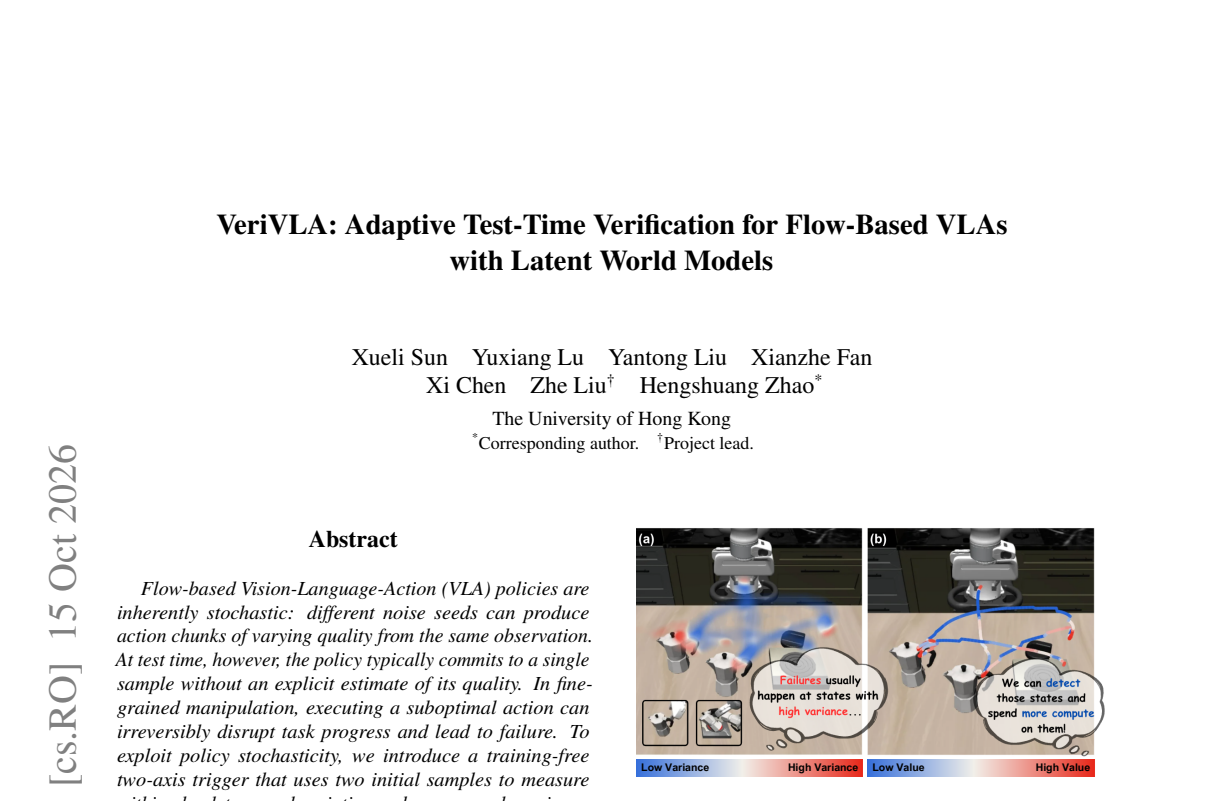
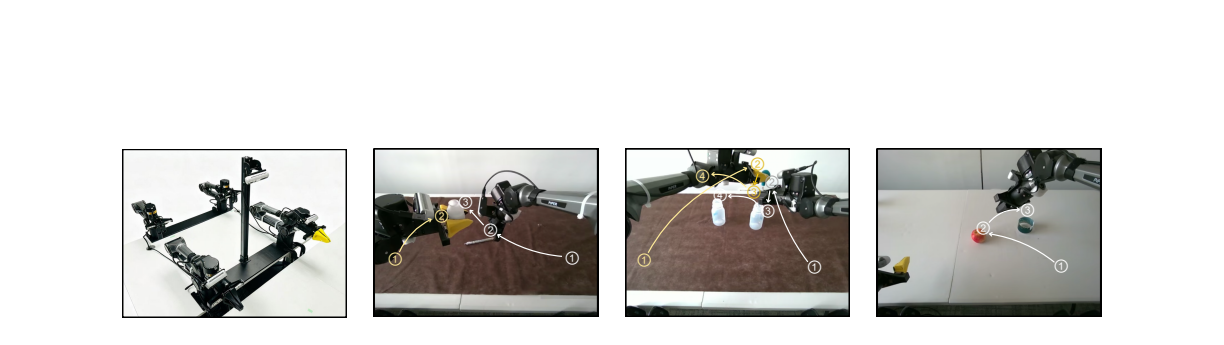
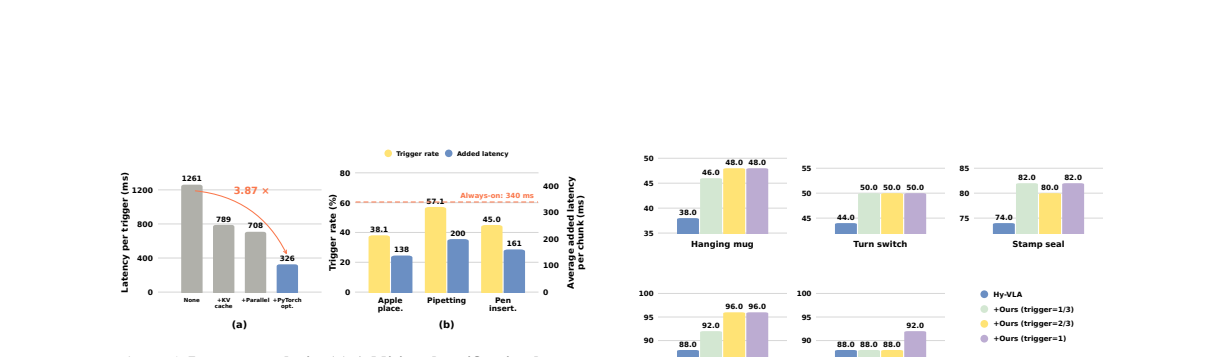
In fine-grained manipulation, executing a suboptimal action can irreversibly disrupt task progress and lead to failure. To exploit policy stochasticity, we introduce a training-free two-axis trigger that uses two initial samples to measure within-chunk temporal variation and cross-sample variance, detecting the critical states. Once triggered, a JEPA-based latent world model ranks candidate action chunks by predicting action-conditioned future latent states and the corresponding changes in task progress. By operating in latent space, the verifier avoids pixel reconstruction and enables efficient and more accurate ranking. Across three real-world tasks, i.e., pen insertion, pipetting, and apple placement), our method raises the average completion score from 50.8% to 65.5%, while adding 326 ms for sampling and verification per triggered decision on a single RTX 4090. Consistent gains are also observed in simulation, where the average success rate rises from 66.4% to 73.6% in the clean setting of RoboTwin 2.0, from 62.8% to 69.6% in its randomized setting, and from 96.9% to 97.6% on LIBERO.
from the abstract
Pith says
Machine review · deepseek-v4-flash · 16 Oct 2026 · what was read was not recorded · not checked by a person
It can be wrong. Challenge this review or reply to it.
Holds up, with conditions. A genuinely new one-stage latent verifier with consistent closed-loop gains across four settings — but the gains are 50-trial point estimates and the training signal is an unvalidated pseudolabel; deserves review, not blind trust. This line is wrong
3 major objections · 3 minor
How often objections from reviews like this one are right: not yet measured
Not checked: figures, code, what the 56 references say.
The paper says, at Sec. 4.1, Tables 1-3
The review did not quote this passage.
Pith says: Objection 1 of 3 · major
All headline results are 50-trial point estimates with no error bars, confidence intervals, or significance tests. Rough two-proportion z-statistics from the reported numbers are about 2.6 for the pooled real-world gain (n=150 per method), 1.8 for RoboTwin clean (n=250), 1.6 for Clean2Random (n=250), and 1.4 for LIBERO (n=2000); the individual real-world task cells (e.g., pen insertion 45 to 60, pipetting …
more of objection 1
… 52.5 to 63.5) are weaker still, and the pooled differences against the RoboMonkey and GPC-RANK baselines range from z about 1.7 to 2.3. Because the central claims concern the size of the gains (+14.7 points real-world, +6.8 in Clean2Random) and their consistency, the absence of any variability measure is load-bearing for the paper's headline conclusions. Please report per-task trial counts, confidence intervals (Wilson or bootstrap intervals clustered by episode/task), and either a pooled analysis across the three real-world tasks or an explicit justification for why pooling is inappropriate.
The paper says, at Sec. 3.4, Eq. (8); Sec. 4.1
The review did not quote this passage.
Pith says: Objection 2 of 3 · major
The verifier's only training signal is Robometer's autonomous delta-progress estimate, and the validation metrics used throughout (rank loss 1.09, Huber loss 0.25 in Table 1; the ablation metrics in Table 4) are computed against those same pseudolabels. They therefore certify fit to the pseudolabels, not label fidelity, and the manuscript provides no evidence that Robometer's progress estimates are faithful on …
more of objection 2
… the fine-grained contact transitions (grasp, pen insertion, aspiration) that dominate these tasks; the Limitations section does not mention label quality either. Since the mechanistic claim — that selection quality derives from jointly predicting latent dynamics and delta progress — presupposes that delta progress is a valid ranking target, please add a label-quality analysis, e.g., correlation of Robometer delta-progress with terminal completion scores or with the stage-level criteria of Table 8 on the collected rollouts, or a human-annotated subset comparison. Alternatively, the paper should explicitly state that the closed-loop gains do not discriminate between accurate and proxy-driven progress labels.
The paper says, at Sec. 3.4, Eq. (8)
The review did not quote this passage.
Pith says: Objection 3 of 3 · major
The pairwise ranking loss in Eq. (8) is trained on pairs of (state, executed chunk, realized delta) samples drawn from different states and different episodes, because each of the 50 rollouts supplies only the one chunk that was actually executed at each state.
more of objection 3
At inference, however, the verifier ranks K candidates from a single state. Nothing in the loss prevents the model from attributing delta-progress differences to state difficulty rather than to action quality, and no same-state pairwise supervision exists to enforce the intended within-state ranking behavior. The closed-loop gains suggest the ranking transfers in practice, but the manuscript does not acknowledge this train/test mismatch or provide evidence for it, such as same-state ranking accuracy on held-out states with multiple samples, or a discussion of why cross-state supervision suffices for a utility model of the form f(s,a). Please add such an analysis or an explicit caveat.
3 minor objections
The paper says, at Sec. 4.1
Pith says: minor objection 1 of 3
Please report the numerical trigger thresholds tau0 used in the real-world, RoboTwin, and LIBERO experiments and the protocol by which they were chosen. The sentence 'we set the trigger threshold to a certain value, where verification is turned on during contact-rich phases' is ambiguous about whether knowledge of the critical phases informed the selection; the RoboTwin threshold sweep in Figure 6 mitigates this concern in simulation, but the real-world numbers would benefit from the same transparency.
The paper says, at Figure 5 caption
Pith says: minor objection 2 of 3
The caption of Figure 5 mixes units: 'Trigger rate (%)' on the left axis and 'Average added latency per chunk (ms)' on the right, while the text and Table 9 phrase the same quantity as latency per triggered decision. Please align the terminology and state explicitly that the right-axis values are per-decision latency multiplied by the trigger rate.
show 1 more
The paper says, at Abstract
Pith says: minor objection 3 of 3
The abstract contains a stray unmatched closing parenthesis after 'apple placement' in the phrase 'Across three real-world tasks (i.e., pen insertion, pipetting, and apple placement),'. Please correct the punctuation.
What would settle it
Validate Robometer's delta-progress labels before trusting any downstream number. Take a held-out subset of the 50 real-world training rollouts per task and obtain ground-truth per-sub-chunk progress from the staged completion criteria (Table 8) via human annotation; compute the per-sub-chunk Spearman correlation between Robometer delta progress and ground truth, stratified by contact-transition phases (around grasp onset and insertion/aspiration). Then recompute Table 1's rank loss (1.09) and Huber loss (0.25) against ground truth instead of Robometer labels and compare. If the contact-phase correlation is below roughly 0.5, or if the ground-truth rank loss is far worse than 1.09, the training signal is unfit and the closed-loop gains must be re-examined. As a secondary check, report 95% confidence intervals (e.g., Wilson intervals) for the 50-trial scores in Tables 1–3 and Figure 6.
from the skeptic's reading
How the review went
4 readings by deepseek-v4-flash · 16 Oct 2026
- Reader holds up, with conditions
- Skeptic agrees
- Editor wrote the verdict above
- Referee major revision: 3 major objections, 3 minor
Not run on this paper: the simulated authors' defence.
Pith did not check this review's objections against the paper.
The review in full
The review in brief, machine-written
What you should know first: this is a real systems contribution, not a repackaging. The genuinely new piece is the one-stage latent verifier — a JEPA-style model that predicts action-conditioned future latents and delta task progress in a single latent space, with an attention mask on the task query so task semantics don't leak into the dynamics head. DreamAvoid and GPC-RANK both synthesize pixels first and score in a second stage; doing the scoring in one pass in latent space is not in the cited work. The engineering is also concrete: KV-cache reuse and parallel sampling get verification to 326 ms per triggered decision on one 4090, with a 14 ms trigger overhead.
The experiments are better than average for this area. Gains appear in four settings (three real tasks, RoboTwin clean and randomized, LIBERO) across three base policies. The world-modeling ablation (65.5 vs 55.2 without the latent prediction objective) supports the mechanism, and Clean2Random is the right generalization test. The trigger analysis is fair: the Status AUC uses simulator-based contact labels that are independent of the trigger's inputs.
Soft spots, in proportion. Every headline number is a 50-trial point estimate with no error bars. Back-of-envelope, the pooled real gain is about 2.6 SE, RoboTwin clean about 1.8, Clean2Random about 1.6, LIBERO about 1.4, and no individual task cell clears 2. I'd push back on treating any single cell as the unit of evidence — the consistent across-task direction is the evidence — but the magnitudes are loose and the paper should say so. More load-bearing: the verifier is trained on Robometer's autonomous progress labels with no fidelity check on these tasks, and the rank/Huber losses are computed against the same labels, so they validate fit, not fidelity. The closed-loop gains are the only independent check. The authors acknowledge proposal diversity and the frozen encoder in Sec. 5 but not label fidelity, which is the assumption the mechanism story rides on. Two smaller points: the pairwise ranking loss is trained on cross-state pairs (one executed chunk per state), so ranking K same-state candidates at a triggered step is a mild extrapolation, softened by the regression loss; and tau0 is calibrated per environment and swept in RoboTwin. No code or data, and Robometer, DreamAvoid, and V-JEPA 2-AC are unreleased preprints — that caps reproducibility without killing it, since the training objective is fully specified.
Bottom line: this deserves a serious referee. I'd send it out and ask for per-task error bars or a significance statement, and a sanity check of Robometer labels against a few hand-scored rollouts. If the label check is clean, it's a solid accept; if not, the gains may survive but the mechanism claim weakens. Anyone working on test-time verification for VLAs should read it.
The strongest objection
The verifier's only supervision is delta-progress labels from Robometer (Sec. 3.4: "The absolute progress is labeled autonomously with Robometer"; Sec. 4.1: 50 rollouts per task), and no evidence is reported that those labels are faithful on fine-grained contact transitions (grasp, insertion, aspiration). The metrics that look like validation — rank loss 1.09, Huber loss 0.25 (Table 1), and the ablation losses (Table 4) — are computed against the same Robometer labels, so they only show the model fits the pseudolabels; they cannot establish label fidelity. The only independent check of the training signal is the closed-loop completion scores, and those are 50-trial point estimates: back-of-envelope two-proportion z ≈ 2.6 for the pooled real-world gain (150 trials/method), but only ≈ 1.8 (RoboTwin clean, n=250), ≈ 1.6 (Clean2Random, n=250), and ≈ 1.4 (LIBERO, n=2000), with no individual task cell significant. The indirect validation of the label signal is therefore statistically fragile. If Robometer systematically over-credits a proxy (e.g., goal-directed motion) during contact transitions, the verifier learns that proxy; the gains would then be real but would not support the mechanism claim that ranking comes from jointly predicting latent dynamics and delta progress, and the Clean2Random generalization claim would rest on proxy transfer rather than world-model understanding. A further structural point: training pairs are (state, executed chunk, realized delta) with one chunk per state, so the pairwise ranking loss in Eq. 8 compares across states, and same-state ranking of K candidates at triggered states is an extrapolation. The paper acknowledges related limitations (proposal diversity, frozen encoder, Sec. 5) but not label fidelity, which is the load-bearing assumption.
I read the central claim as: a JEPA latent verifier trained on Robometer-labeled delta progress ranks candidate action chunks better than VLM or pixel-world-model verifiers, and this consistently improves closed-loop success. For that claim to hold, the delta-progress targets must be a faithful ranking signal. I considered three candidate concerns and ranked them. (1) Trigger threshold fitting: real, but mitigated — RoboTwin gains hold with always-on verification (Table 2), and Figure 6 shows trigger=1/3 retains most of the gain, so the mechanism does not depend on the threshold choice. (2) Statistical fragility: real — pooling cells, only the real-world gain approaches significance, and per-task cells are all within ~1–2 SE. This degrades confidence in the magnitude, but the sign pattern (3/3 real-world tasks, 10/10 RoboTwin cells, 4/4 LIBERO suites positive) is evidence that some effect exists; statistics alone would not destroy the mechanism. (3) Robometer label fidelity: this is the most load-bearing because it is upstream of everything else. The paper's internal validation metrics (Tables 1 and 4) are computed against the same Robometer pseudolabels, so they are circular with respect to label quality; the only non-circular evidence is the closed-loop suite, which is precisely the evidence that is statistically fragile. If the labels are biased on contact transitions, the verifier learns the bias, the mechanism claim about latent world modeling is no longer supported, and the Clean2Random generalization is re-attributed to proxy transfer. In good faith, I note the concern is not a demonstrated failure: the closed-loop gains do provide partial indirect evidence that the labels carry signal, the ablation design cleanly isolates world modeling and pretraining, and the trigger diagnostics (Status AUC 0.727 against privileged-simulator contact labels, Variance Correlation 0.887) are independent and reasonable. I also checked the headline arithmetic (50.8→65.5, 66.4→73.6, 62.8→69.6, 96.9→97.6, 326 ms) and found it internally consistent. The honest disposition is CONDITIONAL, matching the reader: release error bars on the closed-loop results, validate the Robometer labels (or retrain with an independent label source), and the paper's mechanism claim would be substantially secured. My concern sharpens the reader's weakest assumption rather than changing the verdict, so I recommend UNCHANGED.
The referee's report
The contribution is a practical one with a clean conceptual point: if the results hold, a latent world model can serve as a one-stage verifier that ranks flow-VLA samples by jointly predicting dynamics and delta progress, avoiding the pixel-synthesis bottleneck of GPC-RANK/DreamAvoid and the goal-image dependence of DINO-WM-style planners. The reported evidence has genuine strengths. Gains are directionally positive in every setting — real robot, two RoboTwin variants, and LIBERO with both pi0.5 and StarVLA-GR00T — which is the right shape of evidence for a general mechanism. The world-modeling ablation (Sec. 4.3.1, -10.3 points) directly tests the mechanistic claim rather than only the pipeline. The trigger is validated against externally defined criteria (privileged contact labels and a K-sample variance reference, Table 5), the latency engineering is reported at per-component granularity (Table 9), supporting the deployment claim, and the hyperparameters and simulation evaluation details are disclosed for reproducibility.
Pith's reading of the paper (a machine's summary, not the authors')
This paper argues that the randomness of flow-based Vision-Language-Action policies is a resource to exploit, not a hazard to suppress. Rather than committing to a single sampled action chunk, the robot should briefly sample more candidates when it reaches a risky decision state, and pick the candidate most likely to advance the task. The paper proposes a training-free two-sample trigger to detect those states and a latent-space world model to rank candidates by predicted change in task progress, avoiding both pixel reconstruction and goal-image dependence. The central empirical claim is that this selection consistently beats the frozen base policy, raising the average real-world completion score from 50.8% to 65.5% across pen insertion, pipetting, and apple placement with 326 ms of added latency per triggered decision, with consistent gains in simulation and across two base policies. If correct, the result is a practical recipe for improving a deployed VLA policy without touching its weights.
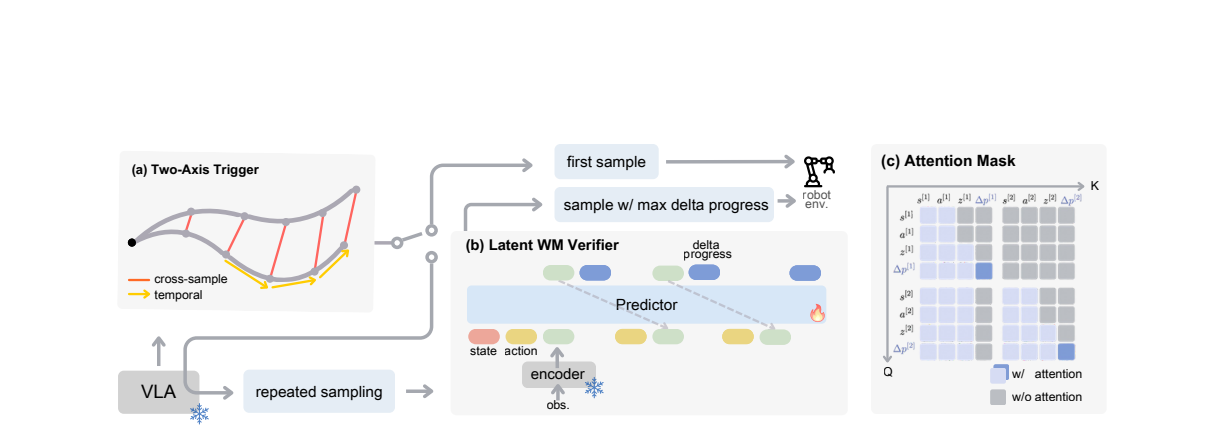
What carries the argument. Two mechanisms carry the argument. The two-axis trigger takes $k=2$ normalized action chunks from the base policy and computes a temporal score (mean squared change between consecutive actions inside a chunk, which rises near contact-rich motion) and a cross-sample score (variance between the two samples' actions, which rises where the policy disagrees with itself). Both are converted to percentiles against per-environment reference distributions gathered from a few rollouts, and the trigger fires when either percentile exceeds one threshold $ au_0$; the OR rule means the trigger needs no training. The verifier is a JEPA-style latent world model: a frozen pretrained visual encoder plus an action-conditioned autoregressive predictor that divides each action chunk into $M$ sub-chunks, rolls out the future latent state per sub-chunk, and predicts a delta-progress increment $ar{\Delta}\hat{p}^{(i)}$ per sub-chunk. Training combines a Huber regression loss with a pairwise ranking loss on delta progress (labeled by an autonomous progress estimator) and an $\ell^1$ visual-prediction loss, and an attention mask prevents the task query token from shortcutting the dynamics model. At inference the chunk whose cumulative predicted delta progress is largest is executed.
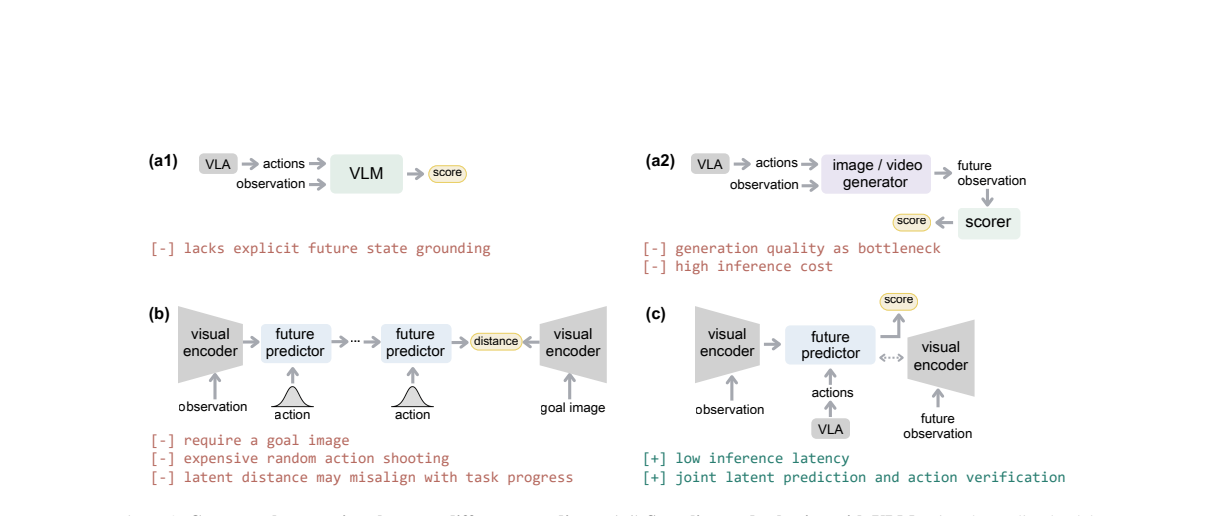
Core claim. The paper's central claim is that the right place to verify a sampled action chunk is a compact latent space, not pixels and not a vision-language model's own judgment. The verifier, built on a frozen pretrained visual encoder and an action-conditioned autoregressive predictor, imagines the latent states that would follow each candidate action sub-chunk and reads off a delta-progress estimate for each sub-chunk in the same pass. A task-specific query token conditions progress estimation, and an attention mask keeps that task information from leaking into the dynamics predictor, so world modeling stays task-agnostic. Across real-world pen insertion, pipetting, and apple placement, executing the chunk with the largest cumulative predicted progress raises the average completion score from 50.8% to 65.5%, and the same recipe improves success in RoboTwin 2.0 (66.4% to 73.6% clean, 62.8% to 69.6% randomized) and LIBERO (96.9% to 97.6%).
The premise it rests on. The ranking quality of the whole system rests on the autonomous progress estimator's delta-progress labels being accurate enough on the 50 rollout episodes per task to teach the verifier which action chunks truly advance the task, and on those episodes covering the candidate chunks that appear at triggered states; the paper does not report validation of the labeler's accuracy.
If the paper is right (Pith's inferences, not the authors')
A frozen, flow-based VLA policy can gain several percentage points of task success at deployment just by re-ranking its own samples, with no policy retraining.
Because verification runs only when the two-axis trigger fires, the average added latency per decision is a fraction of the 326 ms per-triggered-decision cost, keeping the scheme compatible with real-time control.
The delta-progress verifier trained on clean data also improves success in randomized environments never seen in training, indicating that latent dynamics knowledge transfers across visual variation.
One verifier trained for all tasks in an environment serves as many as 40 LIBERO tasks per base policy, so the extra test-time machinery is task-agnostic apart from the query-token conditioning.
The comparison with pixel-level and vision-language verifiers suggests that scoring directly on predicted latents is both faster and more accurate than generating images before estimating progress.
Because the verifier's only training signal is the autonomous progress estimator's delta-progress labels over 50 episodes per task, its ranking accuracy on fine contact transitions is bounded by that labeler's fidelity; a natural check is to compare verifier rankings with privileged simulator progress on the same candidate pools.
The environment-specific trigger threshold is calibrated from a few base-policy rollouts; one could instead calibrate the trigger online from the policy's own sampling variance, eliminating the calibration phase.
The paper fixes the candidate pool at whatever the frozen policy happens to sample; a natural extension is to pair this verifier with samplers that deliberately diversify proposals at triggered states, which the paper itself identifies as the main ceiling on its gains.
Check this review
Pith stored no record of this review's passes and took no fingerprint of it. Reviews made by code from 13 Nov 2026 on carry both.
How often reviews like this one are right
Reviews like this one: written by deepseek-v4-flash, where what was read was not recorded.
How often objections from reviews like this one are right: not yet measured
Reviews by people
This review was written by a machine. No person has reviewed this paper on Pith yet. A scientist listed on Pith can review it for a fee, and their review is published here whatever it concludes.
The paper
Abstract
Flow-based Vision-Language-Action (VLA) policies are inherently stochastic: different noise seeds can produce action chunks of varying quality from the same observation. At test time, however, the policy typically commits to a single sample without an explicit estimate of its quality. In fine-grained manipulation, executing a suboptimal action can irreversibly disrupt task progress and lead to failure. To exploit policy stochasticity, we introduce a training-free two-axis trigger that uses two initial samples to measure within-chunk temporal variation and cross-sample variance, detecting the critical states. Once triggered, a JEPA-based latent world model ranks candidate action chunks by predicting action-conditioned future latent states and the corresponding changes in task progress. By operating in latent space, the verifier avoids pixel reconstruction and enables efficient and more accurate ranking. Across three real-world tasks, i.e., pen insertion, pipetting, and apple placement), our method raises the average completion score from 50.8% to 65.5%, while adding 326 ms for sampling and verification per triggered decision on a single RTX 4090. Consistent gains are also observed in simulation, where the average success rate rises from 66.4% to 73.6% in the clean setting of RoboTwin 2.0, from 62.8% to 69.6% in its randomized setting, and from 96.9% to 97.6% on LIBERO.
The paper's own sentences, arranged, kept beside the review and separate from it. Each label is drawn from a closed vocabulary; the number beside it is the probability the classifier gave that label. No sentence in this record was written by a model.
abstract compiled · 2026-10-16
The authors' main claim, as the classifier picked it out 0.98
“Across three real-world tasks, $\textit{i.e.,}$ pen insertion, pipetting, and apple placement), our method raises the average completion score from 50.8% to 65.5%, while adding 326 ms for sampling and verification per triggered decision on a single RTX 4090.”
How the main claim is stated: asserted 1.00
What the abstract itself states, as probabilities: claims first 0.05 · states limitation 0.81 · human participants 0.04 · controlled comparison 0.86 · randomized assignment 0.06 · states quantitative result 0.99 · compares with prior results 0.79 · mentions code or data availability 0.03
The abstract, sentence by sentence
This table labels the abstract only (arXiv listing abstract v1). The number is the probability the classifier gave the label.
| Sentence | Role | The authors' own work | States the main conclusion | Strength |
|---|---|---|---|---|
| Flow-based Vision-Language-Action (VLA) policies are inherently stochastic: different noise seeds can produce action chunks of varying quality from the same observation. | background 1.00 | 0.15 | 0.02 | asserted 1.00 |
| At test time, however, the policy typically commits to a single sample without an explicit estimate of its quality. | gap 0.75 | 0.11 | 0.02 | asserted 1.00 |
| In fine-grained manipulation, executing a suboptimal action can irreversibly disrupt task progress and lead to failure. | background 0.97 | 0.05 | 0.02 | asserted 0.72 |
| To exploit policy stochasticity, we introduce a training-free two-axis trigger that uses two initial samples to measure within-chunk temporal variation and cross-sample variance, detecting the critical states. | method 0.71 | 0.93 | 0.08 | asserted 1.00 |
| Once triggered, a JEPA-based latent world model ranks candidate action chunks by predicting action-conditioned future latent states and the corresponding changes in task progress. | method 0.99 | 0.89 | 0.08 | asserted 1.00 |
| By operating in latent space, the verifier avoids pixel reconstruction and enables efficient and more accurate ranking. | method 0.86 | 0.69 | 0.05 | asserted 1.00 |
| Across three real-world tasks, $\textit{i.e.,}$ pen insertion, pipetting, and apple placement), our method raises the average completion score from 50.8% to 65.5%, while adding 326 ms for sampling and verification per triggered decision on a single RTX 4090. | result 1.00 | 0.96 | 0.48 | asserted 1.00 |
| Consistent gains are also observed in simulation, where the average success rate rises from 66.4% to 73.6% in the clean setting of RoboTwin 2.0, from 62.8% to 69.6% in its randomized setting, and from 96.9% to 97.6% on LIBERO. | result 1.00 | 0.94 | 0.23 | asserted 0.98 |
What kind of paper the classifier reports this is: method or tool 1.00 · evidence from observation or experiment 0.97
What was examined, and what was not
Sources read
- arXiv listing abstract v1
Not examined
- full text
- figures and tables
- references and citing sentences
- relations to other papers
Levels run
- P abstract
Not run
- S sections
- T body sentences
- C citations
- R cross-paper relations
How the labels were made
Compiled by classifier-1.13.0 via TypeSafe API, question bank abstract-p1-20260923, 2026-10-16: 1 request, 6,481 input tokens.
Every quoted sentence on this record is the authors'. Every label is from Pith's closed vocabulary, with the probability shown beside it. This record as JSON
Figures (8)
Showing 7 of the paper's 8 figures. Figures are the authors', reproduced from the paper.
References (56)
- [1] Christopher Agia, Rohan Sinha, Jingyun Yang, et al. Unpacking failure modes of generative policies: Run- time monitoring of consistency and progress. InCoRL, on Pith
- [2] Mido Assran, Adrien Bardes, David Fan, et al. V-jepa 2: Self-supervised video models enable understanding, prediction and planning, 2025 on Pith
- [3] Zechen Bai, Chen Gao, and Mike Zheng Shou. Evolve- vla: Test-time training from environment feedback for vision-language-action models, 2025 on Pith
- [4] Kevin Black, Noah Brown, Danny Driess, et al. π0: A vision-language-action flow model for general robot control. InRSS, 2025 on Pith
- [5] Kevin Black, Manuel Y . Galliker, and Sergey Levine. Real-time execution of action chunking flow policies. InNeurIPS, 2025. arXiv:2506.07339 on PithPith's reviewarXiv
- [6] Anthony Brohan, Noah Brown, Justice Carbajal, et al. RT-1: Robotics Transformer for Real-World Control at Scale. InProceedings of Robotics: Science and Systems, 2023 on Pith
- [7] Jialei Chen, Kai Wang, Kang Chen, et al. Lawam: La- tent world action models for efficient dynamics-aware robot policies, 2026 on Pith
- [8] Siyao Chen, Jiakang Yuan, Jiaxin Wang, and Tao Chen. Trust your instincts: Confidence-driven test-time rl for vision-language-action models, 2026 on Pith
- [9] Tianxing Chen, Zanxin Chen, Baijun Chen, et al. Robotwin 2.0: A scalable data generator and bench- mark with strong domain randomization for robust bi- manual robotic manipulation, 2025 on Pith
- [10] Cheng Chi, Siyuan Feng, Yilun Du, et al. Diffusion Policy: Visuomotor policy learning via action diffusion. InRSS, 2023 on Pith
- [11] Xianzhe Fan, Yuxiang Lu, Shenyuan Gao, et al. Drea- mavoid: Critical-phase test-time dreaming to avoid failures in vla policies, 2026 on Pith
- [12] Senyu Fei, Siyin Wang, Junhao Shi, et al. Libero-plus: In-depth robustness analysis of vision-language-action models, 2025 on Pith
- [13] Xiangdong Feng, Yuxuan Cheng, Chen Shi, et al. De- noising tells when to replan: Denoising-variance adap- tive chunking for flow-based robot policies.arXiv preprint arXiv:2606.03847, 2026 on PithPith's reviewarXiv
- [14] Zexin Feng, Yixu Feng, Lingyu Xiao, et al. Copper- policy: Focus on the representation for robust robot manipulation, 2026 on Pith
- [15] Qiao Gu, Yuanliang Ju, Shengxiang Sun, et al. Safe: Multitask failure detection for vision-language-action models.Advances in Neural Information Processing Systems, 38:40041–40076, 2025 on Pith
- [16] Xixi Hu, Bo Liu, Xingchao Liu, and Qiang Liu. Adaflow: Imitation learning with variance-adaptive flow-based policies.NeurIPS, 2024 on Pith
- [17] Xun Huang, Zhengqi Li, Guande He, Mingyuan Zhou, and Eli Shechtman. Self Forcing: Bridging the train- test gap in autoregressive video diffusion. InNeurIPS, 2025 on Pith
- [18] Peter J. Huber. Robust estimation of a location pa- rameter.The Annals of Mathematical Statistics, 35(1): 73–101, 1964 on Pith
- [19] Physical Intelligence, Kevin Black, Noah Brown, et al. π0.5: a vision-language-action model with open-world generalization, 2025 on Pith
- [20] Suhyeok Jang, Dongyoung Kim, Changyeon Kim, Youngsuk Kim, and Jinwoo Shin. Verifier-free test- time sampling for vision-language-action models. In ICLR, 2026. arXiv:2510.05681 on PithPith's reviewarXiv
show 36 more
- [21] Alexander Khazatsky, Karl Pertsch, Suraj Nair, et al. Droid: A large-scale in-the-wild robot manipulation dataset.arXiv preprint arXiv:2403.12945, 2024 on PithPith's reviewarXiv
- [22] Moo Jin Kim, Karl Pertsch, Siddharth Karamcheti, et al. OpenVLA: An open-source vision-language- action model. InCoRL, 2024 on Pith
- [23] Jacky Kwok, Christopher Agia, Rohan Sinha, et al. Robomonkey: Scaling test-time sampling and verifi- cation for vision-language-action models. InCoRL, 2025 on Pith
- [24] Jacky Kwok, Xilun Zhang, Mengdi Xu, et al. Scaling verification can be more effective than scaling policy learning for vision-language-action alignment.arXiv preprint arXiv:2602.12281, 2026 on PitharXiv
- [25] Anthony Liang, Yigit Korkmaz, Jiahui Zhang, et al. Robometer: Scaling general-purpose robotic reward models via trajectory comparisons, 2026 on Pith
- [26] Yuanchang Liang, Xiaobo Wang, Kai Wang, et al. Adaptive action chunking at inference-time for vision- language-action models, 2026 on Pith
- [27] Bo Liu, Yifeng Zhu, Chongkai Gao, et al. Libero: Benchmarking knowledge transfer for lifelong robot learning. InNeurIPS, 2023 on Pith
- [28] Changyu Liu, Yiyang Liu, Taowen Wang, et al. On-the- fly vla adaptation via test-time reinforcement learning, 2026 on Pith
- [29] Yuejiang Liu, Jubayer Ibn Hamid, Annie Xie, Yoonho Lee, Max Du, and Chelsea Finn. Bidirectional decod- ing: Improving action chunking via guided test-time sampling. InICLR, 2025. arXiv:2408.17355 on PithPith's reviewarXiv
- [30] Zhe Liu, Jinghua Hou, Yuxiang Lu, et al. Streampi: Streaming multimodal temporal modeling for vision-language-action models.arXiv preprint arXiv:2608.26067, 2026. 9 on PithPith's reviewarXiv
- [31] Yuxiang Lu, Zhe Liu, Xianzhe Fan, et al. Faster: Rethinking real-time flow vlas.arXiv preprint arXiv:2603.19199, 2026 on PithPith's reviewarXiv
- [32] Hao Luo, Wanpeng Zhang, Yicheng Feng, et al. Being- h0.7: A latent world-action model from egocentric videos, 2026 on Pith
- [33] Lucas Maes, Quentin Le Lidec, Damien Scieur, Yann LeCun, and Randall Balestriero. Leworldmodel: Sta- ble end-to-end joint-embedding predictive architecture from pixels, 2026 on Pith
- [34] Lorenzo Mur-Labadia, Matthew Muckley, Amir Bar, et al. V-jepa 2.1: Unlocking dense features in video self-supervised learning, 2026 on Pith
- [35] Mitsuhiko Nakamoto, Oier Mees, Aviral Kumar, and Sergey Levine. Steering your generalists: Improving robotic foundation models via value guidance. In8th Annual Conference on Robot Learning, 2024 on Pith
- [36] NVIDIA, Johan Bjorck, Fernando Casta ˜neda, et al. Gr00t n1: An open foundation model for generalist humanoid robots, 2025 on Pith
- [37] Tao Pang, H. J. Terry Suh, Lujie Yang, and Russ Tedrake. Global planning for contact-rich manipulation via local smoothing of quasi-dynamic contact models, 2023 on Pith
- [38] Karl Pertsch, Kyle Stachowicz, Brian Ichter, et al. Fast: Efficient action tokenization for vision-language-action models, 2025 on Pith
- [39] Han Qi, Haocheng Yin, Aris Zhu, Yilun Du, and Heng Yang. Inference-time enhancement of generative robot policies via predictive world modeling.IEEE Robotics and Automation Letters, 2026 on Pith
- [40] Stephane Ross, Geoffrey J. Gordon, and J. Andrew Bagnell. A reduction of imitation learning and struc- tured prediction to no-regret online learning, 2011 on Pith
- [41] Florian Seligmann, Emiliyan Gospodinov, Enes Ulas Dincer, and Gerhard Neumann. Vla-fail: Efficient task failure detection for finetuned vision-language-action models.arXiv preprint arXiv:2606.21386, 2026 on PithPith's reviewarXiv
- [42] Uladzislau Sobal, Wancong Zhang, Kyunghyun Cho, Randall Balestriero, Tim GJ Rudner, and Yann LeCun. Learning from reward-free offline data: A case for planning with latent dynamics models. InAdvances in Neural Information Processing Systems, 2025 on Pith
- [43] StarVLA Community. Starvla: A lego-like codebase for vision-language-action model developing, 2026 on Pith
- [44] Jingwen Sun, Wenyao Zhang, Zekun Qi, et al. Vla- jepa: Enhancing vision-language-action model with latent world model, 2026 on Pith
- [45] Yilin Wu, Ran Tian, Gokul Swamy, and Andrea Bajcsy. From foresight to forethought: VLM-in-the-loop policy steering via latent alignment. InRobotics: Science and Systems (RSS), 2025. arXiv:2502.01828 on PithPith's reviewarXiv
- [46] Changhua Xu, En Yu, Junyu Xuan, and Jie Lu. Vgas: Value-guided action-chunk selection for few- shot vision-language-action adaptation, 2026 on Pith
- [47] Liuhaichen Yang, Zhuang Jiang, Chenchao Sheng, and Zezhi Tang. Guided action flow: Q-guided infer- ence for flow-matching vision-language-action policies, 2026 on Pith
- [48] Haoran Zhang, Yifu Lu, Boyang Wang, et al. Foresight: Failure detection for long-horizon robotic manipulation with action-conditioned world model latents.arXiv preprint arXiv:2606.23085, 2026 on PithPith's reviewarXiv
- [49] He Zhang, Lingzhu Xiang, Haitao Lin, et al. Hy- embodied-0.5-vla: From vision-language-action mod- els to a real-world robot learning stack, 2026 on Pith
- [50] Wancong Zhang, Basile Terver, Michael Rabbat, Yann LeCun, and Randall Balestriero. H-jepa: End-to-end learning of hierarchical world models for visual plan- ning, 2026 on Pith
- [51] Wancong Zhang, Basile Terver, Artem Zholus, et al. Hierarchical planning with latent world models, 2026 on Pith
- [52] Chen Zhao, Zhuoran Wang, Haoyang Li, et al. Action draft and verify: A self-verifying framework for vision- language-action model, 2026 on Pith
- [53] Gaoyue Zhou, Hengkai Pan, Yann Lecun, and Lerrel Pinto. DINO-WM: World models on pre-trained visual features enable zero-shot planning. InICML, 2025 on Pith
- [54] Brianna Zitkovich, Tianhe Yu, Sichun Xu, et al. Rt- 2: Vision-language-action models transfer web knowl- edge to robotic control. InCoRL, pages 2165–2183, 2023. 10 Appendix A. Extended Related Work In this section, we provide an extended review of prior work. A.1. Test-time Ve... on Pith
- [55] fine-tunes a 7B VLM on synthetic action preferences, CoVer [24] argues that scaling such verifiers beats scaling policy learning, and V-GPS [35] re-ranks samples with an offline-RL value function.Model-freemethods instead read the signal off the policy itself, via masked-condi... on Pith
- [56] derives intrinsic rewards from the policy’s own confidence to enable self-supervised adaptation. These methods update policy parameters and therefore require reward access, gradient computation, and tolerance for transient regression during adaptation. Adaptive action chunking... on Pith
Challenges and discussion
Disagree with the review, or know something it missed? Leave a comment, or challenge this review formally: a challenge becomes a permanent entry in this paper's record, and its decision is published here.
Come back by email
A short list of the week's newly reviewed papers. Nothing is sent until you confirm from your inbox, and every email has a link that stops it. No account.
No comments yet.
Sign in to comment