Robotics · arXiv:2610.40401 v1 · submitted 29 Oct 2026 · 34 references
Continuous-Action World Models: Learning Cross-Embodiment Spatiotemporal Dynamics Priors
The paper says
“We introduce Continuous-Action World Models (CoAWM), a framework for learning cross-embodiment spatiotemporal dynamics priors that support robot action generation across embodiments and execution frequencies.”
more of the abstract
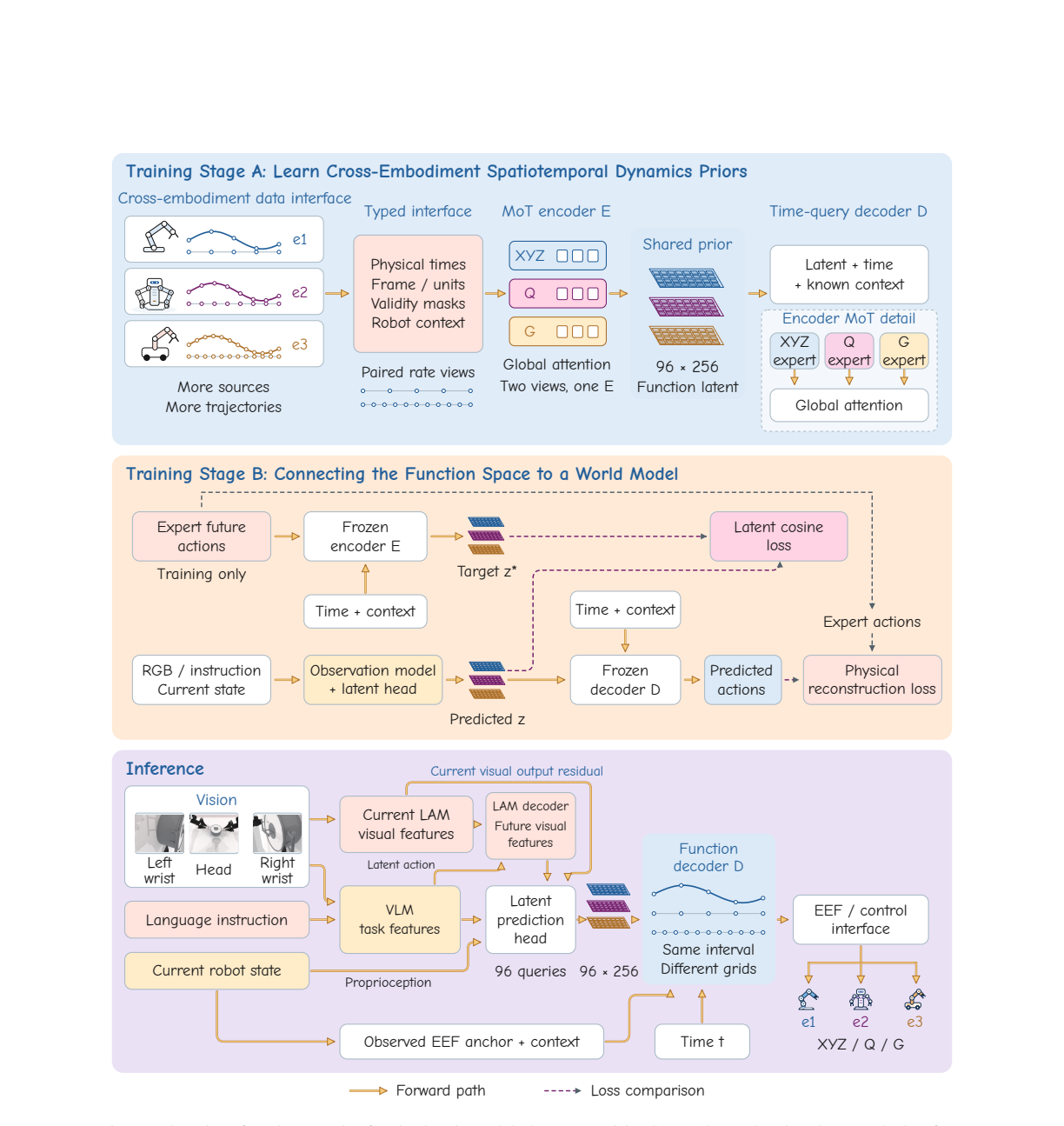
At its core is a shared latent function space that captures the spatial and temporal structure of robot actions. We learn this space through two stages. First, function pretraining brings trajectories from different embodiments and sampling frequencies into a common representation, learning shared dynamics priors through action reconstruction and consistency across temporal sampling views. By accommodating heterogeneous robot trajectories, this stage broadens the range of data sources available for pretraining and facilitates scaling to larger and more diverse datasets. Second, we connect the pretrained function space to a world-model backbone, enabling observations, language instructions, and the current robot state to condition the prediction of a latent action function. A single decoder takes any query time and returns the corresponding end-effector action. By separating shared dynamics priors from task-conditioned action selection and temporal sampling, our approach provides a unified foundation for transferring robot experience across embodiments and control frequencies.
from the abstract
Pith says
Machine review · deepseek-v4-flash · 30 Oct 2026 · what was read was not recorded · not checked by a person
It can be wrong. Challenge this review or reply to it.
Holds up, with conditions. Coherent two-stage function-space action representation with real pilot gains, but the cross-embodiment headline is untested and the work estimate has a timing confound. This line is wrong
4 major objections · 5 minor
How often objections from reviews like this one are right: not yet measured
Not checked: figures, code, what the 34 references say.
The paper says, at Sec. 3.3, Eqs. (5)-(7)
The review did not quote this passage.
Pith says: Objection 1 of 4 · major
The central 'cross-embodiment' claim is unsupported by both the objective and the evidence, and this is the load-bearing gap of the paper. The two-view loss is reconstruction of each trajectory plus 0.1*MSE(Z(1), Z(2)) between two sampling views of the same underlying motion; there is no term that aligns trajectories from different robot bodies, and because the decoder receives the context …
more of objection 1
… c (Eq. 1), the objective can be satisfied with the embodiment role carried by c rather than by a shared function space. Empirically, every experiment in Sec. 4 uses a single bimanual platform, the pretraining corpus composition (embodiments, tasks, frequencies) is never specified, and the Discussion states that 'we will introduce action trajectories from more embodiments,' confirming that the current Stage A data does not yet span embodiments. The abstract's claim of a 'unified foundation for transferring robot experience across embodiments' therefore outruns the evidence. The revision must either add a genuine multi-embodiment pretraining and evaluation experiment, or reframe the title, abstract, and Sec. 3.3 to claim only a continuous action-function representation with a potential cross-embodiment interface.
The paper says, at Sec. 4.2, Eqs. (3)-(4)
The review did not quote this passage.
Pith says: Objection 2 of 4 · major
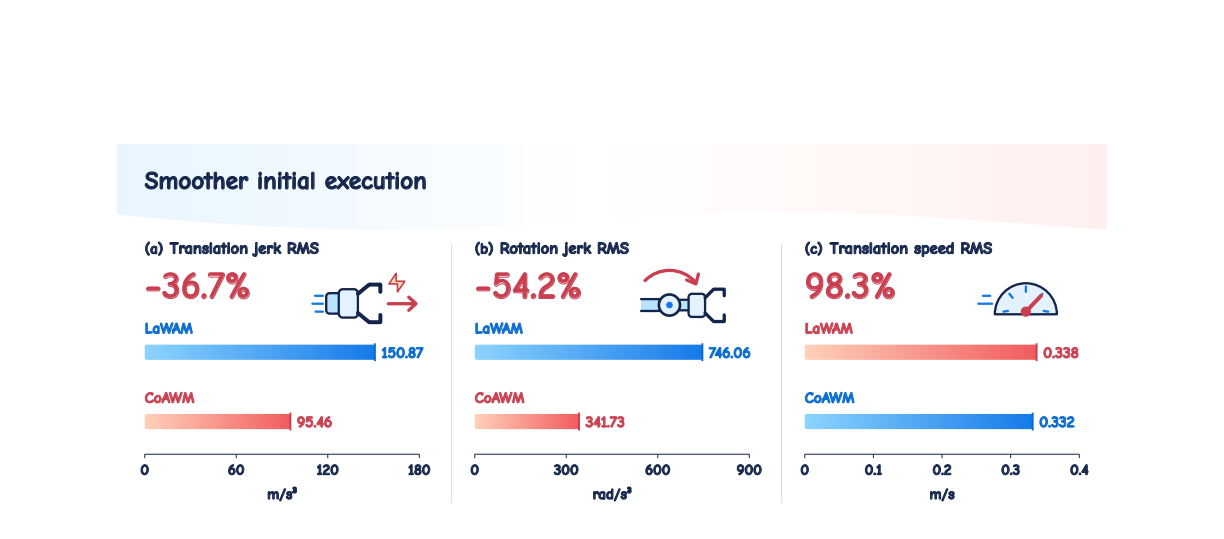
The reported jerk reductions are confounded by the hard pose anchor. The anchored readout forces the predicted pose to equal the observed pose at tau = 0, removing precisely the replan-boundary discontinuity between the previously executed trajectory and the newly predicted one, which is a dominant source of initial jerk in chunked policies.
more of objection 2
The velocity match (0.338 vs 0.332 m/s) rules out a speed confound, but the 36.7% and 54.2% reductions could in principle be entirely due to the anchor, which is orthogonal to learning a function-space prior. The text's own observation that 'substantial jerk tails remain over longer execution windows' is consistent with this reading. The paper needs an ablation that separates the anchor contribution from the representation contribution, for example LaWAM with the same anchored readout and CoAWM without anchoring, ideally alongside a different continuous-action baseline (e.g., a B-spline or implicit-field policy). Without such an attribution, the Sec. 4.2 claim that 'continuous action functions reduce abrupt changes' is not established.
The paper says, at Sec. 4.3, Eq. (15)
The review did not quote this passage.
Pith says: Objection 3 of 4 · major
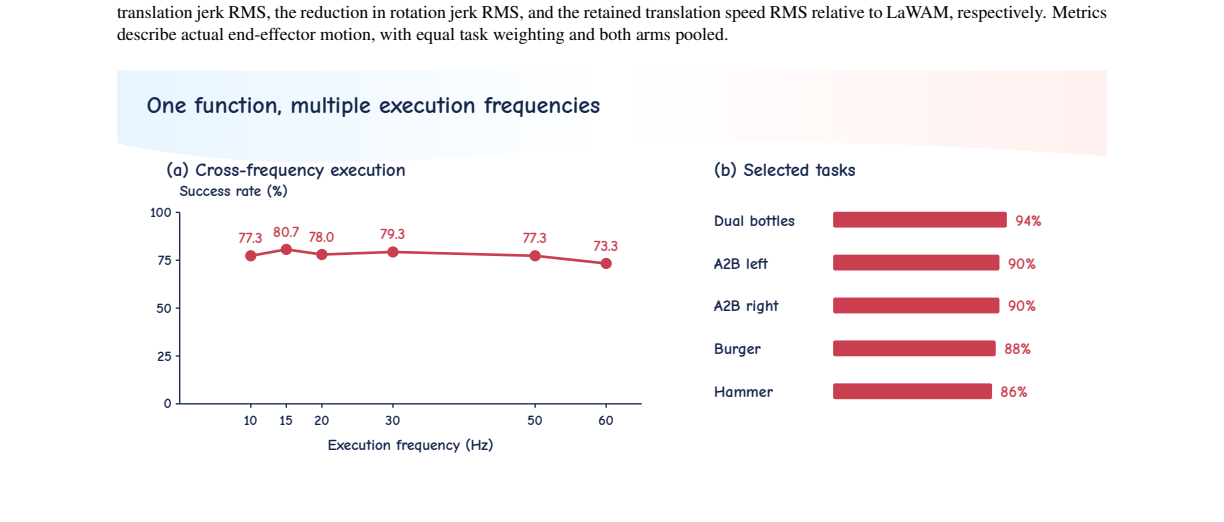
The cross-frequency execution results are largely by construction and do not carry the weight the paper assigns to them. Since the decoder is defined for arbitrary query times, querying the same latent at 10-60 Hz always yields an action sequence; the flat 73-81% success rates demonstrate that the latent and decoder remain well-behaved off the trained query grid, which is a useful sanity check, but they do not test the shared-function-space or cross-embodiment hypotheses.
more of objection 3
The section heading and the sentence 'These results demonstrate cross-frequency execution within a fixed physical-time window' should be scaled back, and the experimental value proposition (behavior off the training grid, closed-loop stability) stated explicitly.
The paper says, at Secs. 4.2-4.4, Fig. 6
The review did not quote this passage.
Pith says: Objection 4 of 4 · major
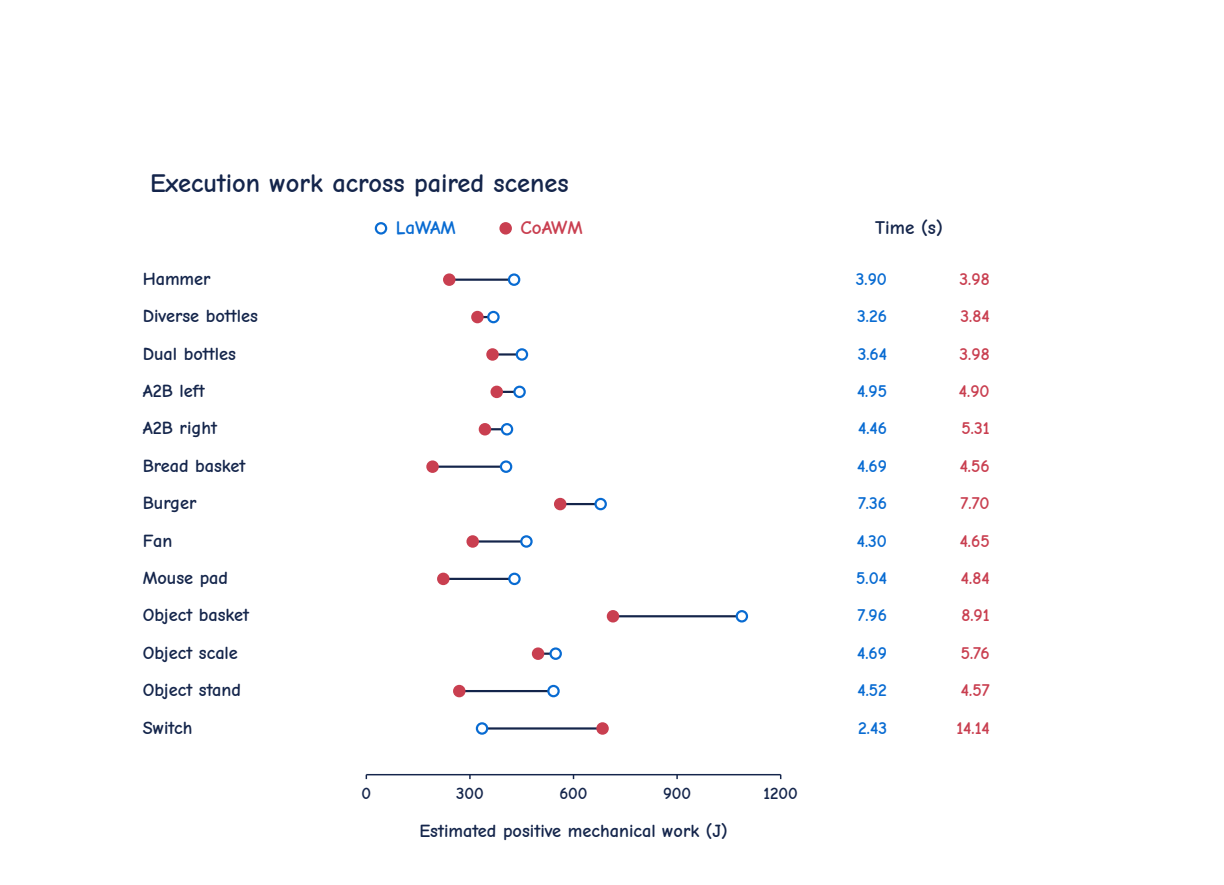
The quantitative claims rest on point estimates without variance, significance, or full protocol details. The jerk, energy, and success metrics are reported as single numbers; with 800 paired trials a paired test or confidence interval is expected, and the 22.6% work reduction across 13 scenarios (12 of 13 lower) should be accompanied by a paired analysis.
more of objection 4
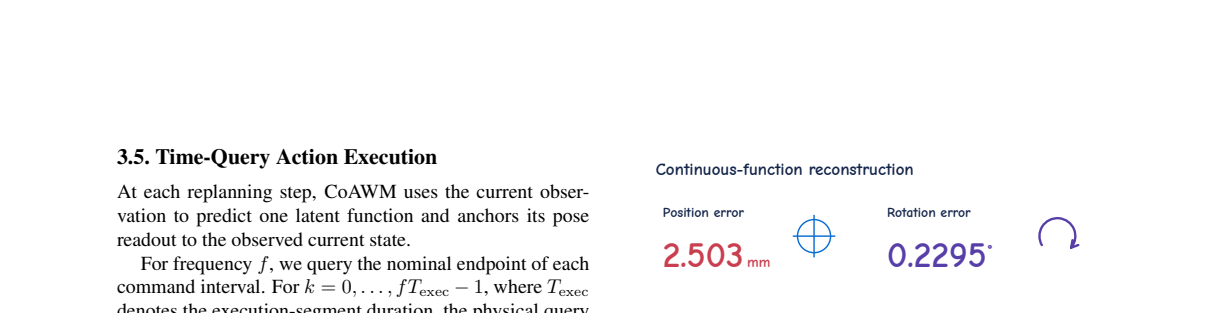
The energy comparison is additionally confounded by large execution-time differences (Fig. 6 lists 2.43 s vs 14.14 s for the Switch scenario) and by selection on jointly successful trials. The paper never states whether experiments are in simulation or on hardware, and it omits dataset composition, task lists, model scale, and hyperparameters for Stages A and B, which prevents independent verification. Finally, Sec. 4.1 describes the 8,192 windows as 'held-out evaluation windows used for model selection'; if the same windows are used both to select and to score the model, the 2.503 mm / 0.2295 degree figures are optimistically biased, and the reporting protocol should be clarified.
5 minor objections
The paper says, at Abstract / Sec. 1 / Sec. 5
Pith says: minor objection 1 of 5
The Abstract and Conclusion present cross-embodiment transfer as an achieved capability, while the Discussion flags the introduction of additional-embodiment trajectories as future work; the claims in the Abstract, Section 1, and Section 3.3 should be aligned with the evidence actually presented.
The paper says, at Sec. 4.2
Pith says: minor objection 2 of 5
LaWAM's success rate in the matched evaluation is not reported; without it, selection effects on the smoothness comparison (e.g., if success rates differ substantially across methods) cannot be assessed.
show 3 more
The paper says, at Sec. 4.4
Pith says: minor objection 3 of 5
The positive mechanical work metric should be defined more precisely, including the PD gains and model used for torque estimates, and the paper should state whether work is normalized by trial duration, given that the two methods often have quite different execution times in Fig. 6.
The paper says, at Fig. 5
Pith says: minor objection 4 of 5
The caption correctly notes that panels (a) and (b) use different evaluation cohorts and denominators; the main text should also clarify that the 30 Hz native-rate cohort is distinct from the 75.1% success figure reported in Sec. 4.2.
The paper says, at Throughout
Pith says: minor objection 5 of 5
The compiled text contains minor typographical and formatting inconsistencies, including 'LaW AM' versus 'LaWAM' in Section 2.3 and the interleaving of Figure 3's caption text into the Section 4.2 sentence; these should be cleaned up before resubmission.
What would settle it
Freeze the Stage A encoder and decoder; encode held-out trajectories from an unseen robot body with different kinematics, arm count, or action units through the typed MoT interface; measure the 73-point, 60 Hz grid reconstruction error against the reported 2.503 mm and 0.2295 degrees baseline, and publish the pretraining corpus composition listing embodiment identities, per-source trajectory counts, and sampling rates. If unseen-embodiment error stays near baseline, the function space is genuinely cross-embodiment; if it degrades by about an order of magnitude, or if the corpus is disclosed to be single-embodiment, the headline claim is unsupported and the Sec. 4.2 and Sec. 4.4 gains must be re-attributed to the anchored readout (Eqs. 3-4) and decoder interpolation.
from the skeptic's reading
How the review went
4 readings by deepseek-v4-flash · 30 Oct 2026
- Reader holds up, with conditions
- Skeptic agrees
- Editor wrote the verdict above
- Referee major revision: 4 major objections, 5 minor
Not run on this paper: the simulated authors' defence.
Pith did not check this review's objections against the paper.
The review in full
The review in brief, machine-written
Quick take: CoAWM is a clean two-stage construction — a typed MoT action-function autoencoder pretrained with two-view consistency, then a frozen latent space attached to a LaWAM-style world model with latent and physical supervision. The equations are coherent, the losses are clearly written out, and the reported pilot numbers are specific. If you need one thing to know: every experiment runs on one bimanual platform, and the abstract's cross-embodiment claim has no experiment behind it. The paper itself flags the rapid-validation scale and the jerk tails, and those are real but acknowledged.
What is actually new is the combination. Each ingredient exists in the cited literature: time-queryable continuous action functions (CAT, NIAF, FLASH, DMP/ProDMP), cross-embodiment latent actions (LAC-WM, LAPA), and world-model action generation (LaWAM already supports mixed-frequency training). What I have not seen before is the specific two-stage integration — typed XYZ/Q/G encoding into a frozen function space that a world-model head addresses via latent cosine plus decoded-action supervision. The concrete measurements (2.503 mm reconstruction error; 36.7% and 54.2% initial jerk reductions at matched speed) are new on a real platform.
The design has real engineering sense. Separating the latent action function from the query grid is a clean interface; the anchored readouts (Eqs. 3-4) are a principled way to avoid replan-boundary discontinuities; and the two-stage losses (Eqs. 7, 12-14) are explicit enough to reproduce. The authors also deserve credit for stating their rapid-validation scope and the remaining jerk tails up front, and the cross-frequency execution result (73-81% success across 10-60 Hz, 150 trials per frequency) is a genuine behavioral demonstration of the query-decoder design, even if it follows largely by construction.
The central weakness is that the headline capability, cross-embodiment spatiotemporal dynamics priors, is untested. Stage A's objective (Eqs. 5-7) has no term that aligns different robot bodies: reconstruction is per-trajectory, and the consistency term on two views of the same motion aligns sampling rates, not embodiments. Since the decoder receives robot context c, the encoder could satisfy the objective with latent identity plus c determining the output. The shared function space asserted in Sec. 3.3 is an architectural conjecture, not a consequence of the training loss. No experiment changes the embodiment. Relatedly, the Sec. 4.2 jerk gains are confounded: the anchored readouts force predicted pose to the observed pose at tau = 0, removing the replan-boundary discontinuity that generates jerk spikes, so the reductions could come entirely from the readout design rather than from a pretrained shared prior. An ablation isolating Stage A pretraining and the consistency loss is needed to attribute the gains.
A smaller but concrete issue: the Sec. 4.4 work claim pools the Switch scene, where CoAWM takes 14.14 s versus LaWAM's 2.43 s, so the 22.6% work reduction is not speed-matched over that scenario. The success and energy metrics are also point estimates without variance or significance tests, and the pretraining corpus composition is never specified, which matters for any claim that Stage A actually saw heterogeneous trajectories.
Who is this for: researchers building on continuous action representations and world-model action generation. It is a sensible pilot with a testable architecture, but the evidence does not yet support the cross-embodiment framing. I would send it to a serious referee — the open questions are empirical, not internal contradictions. The referee should ask for a cross-embodiment experiment or a headline that does not claim untested transfer, ablations, statistical support for the quality metrics, and a full specification of the pretraining data. I would not cite it in my own work yet, but I would bring it to the reading group.
The strongest objection
The central claim, a pretrained shared function space that transfers across embodiments, is unsupported at both the mechanism and evidence level. Mechanically, Stage A's objective (Eqs. 5-7) contains only per-trajectory terms: reconstruction at each view's source timestamps plus a shared 73-point grid, plus 0.1 * MSE(Z1, Z2) between two sampling views of the same underlying motion. The consistency term aligns sampling rates, not robot bodies. Because the decoder receives context c (Eq. 1), the encoder can satisfy the objective with no cross-embodiment alignment: latent identity plus c fully determines the decoded trajectory. The shared function space asserted in Sec. 3.3 is an architectural conjecture, not a consequence of the training signal. Empirically, no experiment varies the embodiment; every Sec. 4 result uses one bimanual platform. The pretraining corpus composition and embodiment identities are never specified, and Sec. 5 promises future introduction of trajectories from more embodiments, indicating the current Stage A data does not yet span embodiments. The stated Sec. 4.1 rapid-validation limitation covers scale and fine-tuning, not this gap. Cross-frequency execution (Sec. 4.3) follows from the query-decoder design (Eq. 15) and does not test transfer. The Sec. 4.2 jerk reductions are also confounded by construction: the anchored readouts (Eqs. 3-4) force predicted pose to equal observed pose at tau = 0, removing the replan-boundary discontinuity that generates jerk spikes, and decoder outputs are Lipschitz in tau. Without an ablation removing Stage A pretraining, the 36.7% and 54.2% gains cannot be attributed to a cross-embodiment prior. A secondary anomaly weakens the work claim: in Sec. 4.4, the Switch scene completes in 14.14 s versus LaWAM's 2.43 s yet is pooled as a joint success, so the 22.6% work reduction is not speed-matched.
The reader's weakest_assumption identifies the same load-bearing concern: the only claim distinguishing CoAWM from prior continuous-action and world-model work is cross-embodiment pretraining, and that claim has neither an experiment nor, I argue, an objective term that could produce it. I agree with the reader and add two pieces of evidence. First, Eqs. 5-7 are per-trajectory: reconstruction and two-view consistency operate on the same motion, and the context channel c gives the encoder a free path to avoid cross-embodiment alignment, so the function space is shared across sampling rates by construction and across embodiments only by assertion. Second, Sec. 5's future-tense promise to introduce trajectories from more embodiments implies the current Stage A corpus does not span embodiments, making the abstract's cross-embodiment framing unsupported even as a claim about the training data. In the paper's favor, the method is internally coherent: Eqs. 1-15 are arithmetically consistent, the anchoring readouts provably recover the observed pose at tau = 0, the cross-frequency result follows from the independent time-query decoder and is demonstrated, and the authors state their own scale and stability limitations (Secs. 4.1 and 4.3). Those stated limitations were weighted in the paper's favor. What remains unresolved is attribution: the jerk and work gains could come entirely from the hard anchor plus decoder interpolation, with the pretrained prior contributing nothing, and the Switch scene's completion-time imbalance shows the work comparison is not speed-matched. These are precisely the conditions the abstract's unified cross-embodiment foundation would need, so the conditional verdict stands: require the cross-embodiment decode test, a Stage A ablation, variance or significance reporting, and corpus and code release before ACCEPT.
The referee's report
If the claims held, the framework would be a useful step toward decoupling robot action representation from control frequency and, potentially, from embodiment, and the paper has real strengths to credit: the formulation is explicit and internally consistent (Eqs. 1-15); the Stage B design with a frozen function space and dual latent/physical supervision is clean; the jerk comparison is matched in movement speed (0.338 vs 0.332 m/s), ruling out the trivial 'slower is smoother' explanation; and the multi-frequency closed-loop evaluation with 150 trials per frequency is a genuine empirical effort. The authors also state plainly that the experiments are a rapid validation and that long-horizon jerk tails remain. The difficulty is that the central claim outruns the evidence: no experiment varies the embodiment, the Stage A objective contains no cross-embodiment alignment term, and the headline jerk and energy gains are confounded with the anchored readout and with missing statistics. The significance is therefore conditional on substantial additional evidence, but the framework itself is coherent and worth testing.
Pith's reading of the paper (a machine's summary, not the authors')
This paper's central claim is that a robot motion should be represented as a continuous latent function of physical time rather than as a list of sampled commands. CoAWM learns this function space in two stages: pretraining a Mixture-of-Transformers encoder and a time-query decoder on raw timestamped trajectories (position, orientation, gripper, validity masks) with a cross-frequency consistency loss, then attaching the frozen space to a world-model backbone that predicts a latent from vision, language, and proprioception. The reported payoff is that one predicted latent executes at any control rate from 10 to 60 Hz, and on a bimanual platform it cuts initial-execution position jerk by 36.7%, rotation jerk by 54.2%, and estimated positive mechanical work by 22.6% versus the LaWAM baseline at matched speed. If the paper is right, trajectory data from many robots and sampling rates can be pooled into shared dynamics priors, with each embodiment's action interface handled at decode time instead of by retraining.
What carries the argument. The central object is the latent action function: a fixed-size latent $Z$ plus a time-query decoder $D_\psi(Z, \tau, c)$ that returns an end-effector command for any physical time $\tau$, given known execution context $c$. The Mixture-of-Transformers encoder keeps position (XYZ), orientation (Q), and gripper (G) streams with separate parameters and joint attention, so heterogeneous trajectories enter through one typed interface; the view-consistency term (latent MSE between two sampling-rate views of one motion) is what forces the space to be frequency-invariant. The anchored readouts, $p(\tau) = p_0 + \tilde{e}_p(\tau) - \tilde{e}_p(0)$ for position and a quaternion-normalized analog for orientation, are what make the decoded motion relative to the observed pose and recover that pose at time zero, letting one frozen decoder emit commands for a new body or clock.
Core claim. The paper's central claim is that sampled action commands are the wrong unit of representation for cross-embodiment learning; the right unit is a latent function of physical time. CoAWM encodes a timestamped trajectory into a fixed-size latent $Z = E_\phi(A, c)$ and decodes any query time into a command $a(\tau) = D_\psi(Z, \tau, c)$, where $c$ is the known execution context (observed pose anchor, validity masks, robot interface). Stage A pretrains this encoder-decoder on raw trajectories with two supervisions per view: reconstruction at source and 60 Hz grid timestamps, plus a consistency loss between two differently sampled views of the same motion, so the space is shared across sampling frequencies and, by design, across bodies that speak the typed XYZ/Q/G interface. Stage B freezes that space, attaches it to a world-model backbone, and trains a head that predicts a latent from VLM features, predicted future visual tokens, and proprioception, with the frozen decoder then emitting executable commands. The reported consequences are a 2.503 mm and 0.2295 degree reconstruction accuracy on 8,192 held-out windows, matched-speed execution with 36.7% lower position jerk and 54.2% lower rotation jerk than the LaWAM baseline, and a 22.6% reduction in estimated positive mechanical work on 13 jointly successful scenarios.
The premise it rests on. The load-bearing premise is that the typed action interface (XYZ/Q/G streams, validity masks, and robot context) places trajectories from different robot bodies into one shared function space, so a frozen decoder trained in Stage A produces valid actions for a new embodiment — a premise the paper never tests, since all experiments use a single bimanual platform.
If the paper is right (Pith's inferences, not the authors')
One latent per replanning step, queried at any desired rate, produced successful closed-loop execution at 10, 15, 20, 30, 50, and 60 Hz with the execution segment and replanning period fixed at 1.2 s (Sec. 4.3).
Trajectory-only pretraining becomes a scaling path: any timestamped end-effector trajectory with validity masks and execution context can contribute to dynamics-prior learning without paired language or camera data (Sec. 3.3).
Action quality becomes a first-class evaluation target: jerk and mechanical-work reductions are reported as direct consequences of the function representation, not side effects of task success.
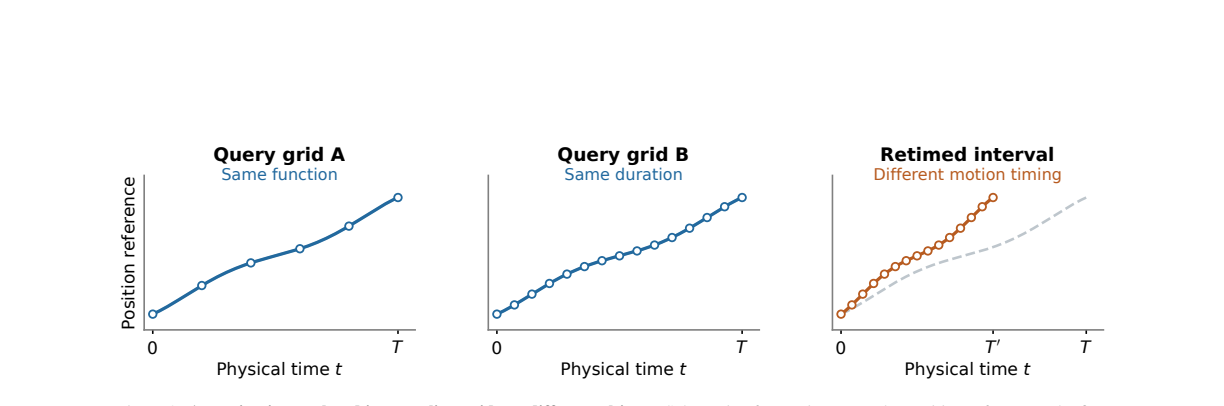
Because query time is separated from physical motion timing, control frequency and motion speed decouple, which is what enables cross-frequency execution without retiming the represented motion.
My inference: the decisive test the paper leaves open is a true embodiment swap — pretraining the function space on one or more robot bodies and decoding for a held-out body through the same typed interface; every experiment uses one bimanual platform, and the paper itself labels the evaluation a rapid validation without full fine-tuning, so the cross-embodiment mechanism is asserted rather than d
My inference: the jerk and energy gains could come entirely from the anchored continuous readout and decoder interpolation rather than from the shared prior; an ablation that removes Stage A (random initialization or no view-consistency term) would separate the two explanations, and the paper reports no such ablation.
My inference: if the function-space framing holds, discrete action-chunk sizes become redundant as a design choice — any chunk becomes a query count — and replanning research could shift from chunk boundaries to query grids and timing offsets, which connects naturally to the sustained-execution jerk tails and replanning stability the authors acknowledge as open.
My inference: the scaling premise is directly testable by pretraining Stage A on heterogeneous multi-robot trajectory corpora at multiple native rates and measuring downstream transfer; success would justify the claim that broader and more diverse data sources become usable for dynamics learning.
Check this review
Pith stored no record of this review's passes and took no fingerprint of it. Reviews made by code from 13 Nov 2026 on carry both.
How often reviews like this one are right
Reviews like this one: written by deepseek-v4-flash, where what was read was not recorded.
How often objections from reviews like this one are right: not yet measured
Reviews by people
This review was written by a machine. No person has reviewed this paper on Pith yet. A scientist listed on Pith can review it for a fee, and their review is published here whatever it concludes.
The paper
Abstract
We introduce Continuous-Action World Models (CoAWM), a framework for learning cross-embodiment spatiotemporal dynamics priors that support robot action generation across embodiments and execution frequencies. At its core is a shared latent function space that captures the spatial and temporal structure of robot actions. We learn this space through two stages. First, function pretraining brings trajectories from different embodiments and sampling frequencies into a common representation, learning shared dynamics priors through action reconstruction and consistency across temporal sampling views. By accommodating heterogeneous robot trajectories, this stage broadens the range of data sources available for pretraining and facilitates scaling to larger and more diverse datasets. Second, we connect the pretrained function space to a world-model backbone, enabling observations, language instructions, and the current robot state to condition the prediction of a latent action function. A single decoder takes any query time and returns the corresponding end-effector action. By separating shared dynamics priors from task-conditioned action selection and temporal sampling, our approach provides a unified foundation for transferring robot experience across embodiments and control frequencies.
The paper's own sentences, arranged, kept beside the review and separate from it. Each label is drawn from a closed vocabulary; the number beside it is the probability the classifier gave that label. No sentence in this record was written by a model.
abstract compiled · 2026-10-30
The authors' main claim, as the classifier picked it out 0.96
“By separating shared dynamics priors from task-conditioned action selection and temporal sampling, our approach provides a unified foundation for transferring robot experience across embodiments and control frequencies.”
How the main claim is stated: asserted 0.99
What the abstract itself states, as probabilities: claims first 0.08 · states limitation 0.05 · human participants 0.03 · controlled comparison 0.03 · randomized assignment 0.01 · states quantitative result 0.02 · compares with prior results 0.04 · mentions code or data availability 0.03
The abstract, sentence by sentence
This table labels the abstract only (arXiv listing abstract v1). The number is the probability the classifier gave the label.
| Sentence | Role | The authors' own work | States the main conclusion | Strength |
|---|---|---|---|---|
| We introduce Continuous-Action World Models (CoAWM), a framework for learning cross-embodiment spatiotemporal dynamics priors that support robot action generation across embodiments and execution frequencies. | contribution 1.00 | 0.88 | 0.27 | asserted 1.00 |
| At its core is a shared latent function space that captures the spatial and temporal structure of robot actions. | method 0.80 | 0.48 | 0.07 | asserted 1.00 |
| We learn this space through two stages. | method 0.98 | 0.82 | 0.02 | asserted 0.95 |
| First, function pretraining brings trajectories from different embodiments and sampling frequencies into a common representation, learning shared dynamics priors through action reconstruction and consistency across temporal sampling views. | method 1.00 | 0.90 | 0.07 | asserted 1.00 |
| By accommodating heterogeneous robot trajectories, this stage broadens the range of data sources available for pretraining and facilitates scaling to larger and more diverse datasets. | interpretation 0.84 | 0.48 | 0.06 | asserted 0.91 |
| Second, we connect the pretrained function space to a world-model backbone, enabling observations, language instructions, and the current robot state to condition the prediction of a latent action function. | method 0.99 | 0.90 | 0.09 | asserted 1.00 |
| A single decoder takes any query time and returns the corresponding end-effector action. | method 0.99 | 0.83 | 0.06 | asserted 1.00 |
| By separating shared dynamics priors from task-conditioned action selection and temporal sampling, our approach provides a unified foundation for transferring robot experience across embodiments and control frequencies. | interpretation 0.90 | 0.78 | 0.72 | asserted 0.99 |
What kind of paper the classifier reports this is: method or tool 1.00 · evidence from simulation or computation 0.43
What was examined, and what was not
Sources read
- arXiv listing abstract v1
Not examined
- full text
- figures and tables
- references and citing sentences
- relations to other papers
Levels run
- P abstract
Not run
- S sections
- T body sentences
- C citations
- R cross-paper relations
How the labels were made
Compiled by classifier-1.13.0 via TypeSafe API, question bank abstract-p1-20260923, 2026-10-30: 1 request, 6,192 input tokens.
Every quoted sentence on this record is the authors'. Every label is from Pith's closed vocabulary, with the probability shown beside it. This record as JSON
Figures (6)
Figures are the authors', reproduced from the paper.
References (34)
- [1] Mido Assran, Adrien Bardes, David Fan, Quentin Garrido, Russell Howes, Mojtaba Komeili, Matthew Muckley, Am- mar Rizvi, Claire Roberts, Koustuv Sinha, Artem Zholus, Sergio Arnaud, Abha Gejji, Ada Martin, Francois Robert Hogan, Daniel Dugas, Piotr Bojanowski, Vasil Khalidov, Pa... on PithPith's reviewarXiv
- [2] Jiaqi Bai, Jindou Jia, Yuxuan Hu, Gen Li, Xiangyu Chen, Tuo An, Kuangji Zuo, and Jianfei Yang. FLASH: Effi- cient Visuomotor Policy via Sparse Sampling. arXiv preprint arXiv:2605.15492, 2026. 3 on PithPith's reviewarXiv
- [3] Kevin Black, Noah Brown, Danny Driess, Adnan Esmail, Michael Equi, Chelsea Finn, Niccolo Fusai, Lachy Groom, Karol Hausman, Brian Ichter, Szymon Jakubczak, Tim Jones, Liyiming Ke, Sergey Levine, Adrian Li-Bell, Mo- hith Mothukuri, Suraj Nair, Karl Pertsch, Lucy Xiaoyang Shi, J... on PithPith's reviewarXiv
- [4] Kevin Black, Manuel Y . Galliker, and Sergey Levine. Real- Time Execution of Action Chunking Flow Policies. arXiv preprint arXiv:2506.07339, 2025. Version 2. 4 on PithPith's reviewarXiv
- [5] Qingwen Bu, Yanting Yang, Jisong Cai, Shenyuan Gao, Guanghui Ren, Maoqing Yao, Ping Luo, and Hongyang Li. Learning to Act Anywhere with Task-centric Latent Actions. InProceedings of Robotics: Science and Systems, 2025. 3 on Pith
- [6] Jisong Cai, Long Ling, Shiwei Chu, Zhongshan Liu, Ji- ayue Kang, Zhixuan Liang, Wenjie Xu, Yinan Mao, Weinan Zhang, Xiaokang Yang, Ru Ying, Ran Zheng, and Yao Mu. AHA-W AM:Asynchronous Horizon-Adaptive World- Action Modeling with Observation-Guided Context Routing. arXiv prepr... on PithPith's reviewarXiv
- [7] Zinuo Chang, Yipu Chen, Byoungwoo Park, Hongzhe Yu, and Yongxin Chen. Function-Space Diffusion for Motion Planning. arXiv preprint arXiv:2607.02977, 2026. 3 on PithPith's reviewarXiv
- [8] Jialei Chen, Kai Wang, Kang Chen, Shuaihang Chen, Feng Gao, Wenhao Tang, Zhiyuan Li, Weilin Liu, Zhuyu Yao, Boxun Li, Yuanbo Xu, and Chao Yu. LaW AM: Latent World Action Models for Efficient Dynamics-Aware Robot Poli- cies. arXiv preprint arXiv:2606.15768, 2026. 3 on PithPith's reviewarXiv
- [9] Xiaoyu Chen, Hangxing Wei, Pushi Zhang, Chuheng Zhang, Kaixin Wang, Yanjiang Guo, Rushuai Yang, Yucen Wang, Xinquan Xiao, Li Zhao, Jianyu Chen, and Jiang Bian. villa- X: Enhancing Latent Action Modeling in Vision-Language- Action Models.arXiv preprint arXiv:2507.23682, 2025. 3 on PithPith's reviewarXiv
- [10] Cheng Chi, Siyuan Feng, Yilun Du, Zhenjia Xu, Eric Cousineau, Benjamin CM Burchfiel, and Shuran Song. Dif- fusion Policy: Visuomotor Policy Learning via Action Dif- fusion. InRobotics: Science and Systems XIX, 2023. 3 on Pith
- [11] Xiangdong Feng, Yuxuan Cheng, Chen Shi, Boyao Han, Yuxuan Yan, Yitong Hong, Zhuotao Tian, and Li Jiang. De- noising Tells When to Replan: Denoising-Variance Adap- tive Chunking for Flow-Based Robot Policies. arXiv preprint arXiv:2606.03847, 2026. Version 1. 4 on PithPith's reviewarXiv
- [12] Quentin Garrido, Tushar Nagarajan, Basile Terver, Nicolas Ballas, Yann LeCun, and Michael Rabbat. Learning La- tent Action World Models In The Wild.arXiv preprint arXiv:2601.05230, 2026. 3 on PitharXiv
- [13] Dibya Ghosh, Homer Rich Walke, Karl Pertsch, Kevin Black, Oier Mees, Sudeep Dasari, Joey Hejna, Tobias Kreiman, Charles Xu, Jianlan Luo, You Liang Tan, Lawrence Yunliang Chen, Quan Vuong, Ted Xiao, Pannag R Sanketi, Dorsa Sadigh, Chelsea Finn, and Sergey Levine. Octo: An open-... on Pith
- [14] Xiaoshen Han, Haoyu Xiong, Haonan Chen, Chaoqi Liu, Antonio Torralba, Yuke Zhu, and Yilun Du. B-spline Pol- icy: Accelerating Manipulation Policies via B-spline Action Representations. arXiv preprint arXiv:2607.09648, 2026. 3 on PithPith's reviewarXiv
- [15] Huang Huang, Sriram Yenamandra, Arjun Majumdar, Elie Aljalbout, Tushar Nagarajan, Tsung-Yen Yang, Akshara Rai, Michael Rabbat, Li Fei-Fei, Jiajun Wu, Tingfan Wu, and Franziska Meier. Cross-Embodiment Robot Foundation World Models with Latent Actions. InProceedings of the 43rd ... on Pith
- [16] Auke Jan Ijspeert, Jun Nakanishi, Heiko Hoffmann, Peter Pastor, and Stefan Schaal. Dynamical Movement Primitives: Learning Attractor Models for Motor Behaviors.Neural Computation, 25:328–373, 2013. 3 on Pith
- [17] Dong Jing, Gang Wang, Jiaqi Liu, Weiliang Tang, Zelong Sun, Yunchao Yao, Zhenyu Wei, Yunhui Liu, Zhiwu Lu, and Mingyu Ding. Mixture of Horizons in Action Chunking. arXiv preprint arXiv:2511.19433, 2025. Version 2. 4 on PithPith's reviewarXiv
- [18] Sunwoo Kim, Jeongjun Kim, and Joseph J. Lim. Time Opti- mal Execution of Action Chunk Policies Beyond Demonstra- tion Speed. InInternational Conference on Learning Repre- sentations, 2026. 4 on Pith
- [19] Ge Li, Zeqi Jin, Michael V olpp, Fabian Otto, Rudolf Li- outikov, and Gerhard Neumann. ProDMPs: A Unified Per- spective on Dynamic and Probabilistic Movement Primi- tives.arXiv preprint arXiv:2210.01531, 2022. 3 on PithPith's reviewarXiv
- [20] Haoyun Liu, Jianzhuang Zhao, Xinyuan Chang, Tianle Shi, Chuanzhang Meng, Jiayuan Tan, Feng Xiong, Tong Lin, Dongjie Huo, Mu Xu, SongLin Dong, Zhiheng Ma, Yihong Gong, and Sheng Zhong. Neural Implicit Ac- tion Fields: From Discrete Waypoints to Continuous Func- tions for Vision... on PithPith's reviewarXiv
show 14 more
- [21] Yufeng Liu, Hang Yu, Juntu Zhao, Bocheng Li, Di Zhang, Mingzhu Li, Wenxuan Wu, Yingdong Hu, Junyuan Xie, Jun- liang Guo, Dequan Wang, and Yang Gao. Learning Na- tive Continuation for Action Chunking Flow Policies. arXiv preprint arXiv:2602.12978, 2026. Version 2. 4 on PithPith's reviewarXiv
- [22] Zhuoyang Liu, Dantong Niu, Botong Zhang, Boning Shao, Jing Wang, Ruijie Zheng, Yuvan Sharma, Runyu Lu, Jiaming Liu, Renrui Zhang, Roei Herzig, Yutong Bai, Ken Gold- berg, Danfei Xu, Yuke Zhu, Guanzhi Wang, Linxi Jim Fan, 10 and Trevor Darrell. Agentic World Action Models. arXi... on PithPith's reviewarXiv
- [23] Junnan Nie, Jiayi Li, Chenghao Liu, Junyi Lao, Jiachen Zhang, Tianle Zhang, Liang Lin, and Songfang Huang. PACE: Phase-Aware Chunk Execution for Robot Policies with Action Chunking. arXiv preprint arXiv:2606.00537, on PithPith's reviewarXiv
- [24] Open X-Embodiment Collaboration, Abby O’Neill, Abdul Rehman, Abhinav Gupta, Abhiram Maddukuri, Abhishek Gupta, Abhishek Padalkar, Abraham Lee, Acorn Pooley, Agrim Gupta, Ajay Mandlekar, Ajinkya Jain, Albert Tung, Alex Bewley, Alex Herzog, Alex Irpan, Alexander Khaz- atsky, Ana... on PithPith's reviewarXiv
- [25] Alexandros Paraschos, Christian Daniel, Jan R Peters, and Gerhard Neumann. Probabilistic Movement Primitives. In Advances in Neural Information Processing Systems, 2013. 3 on Pith
- [26] Karl Pertsch, Kyle Stachowicz, Brian Ichter, Danny Driess, Suraj Nair, Quan Vuong, Oier Mees, Chelsea Finn, and Sergey Levine. FAST: Efficient Action Tokeniza- tion for Vision-Language-Action Models.arXiv preprint arXiv:2501.09747, 2025. 3 on PithPith's reviewarXiv
- [27] Vincent Sitzmann, Julien N. P. Martel, Alexander W. Bergman, David B. Lindell, and Gordon Wetzstein. Implicit Neural Representations with Periodic Activation Functions. arXiv preprint arXiv:2006.09661, 2020. 3 on PithPith's reviewarXiv
- [28] Bahey Tharwat, Yara Nasser, Ali Abouzeid, and Ian Reid. Latent Action Pretraining Through World Modeling.arXiv preprint arXiv:2509.18428, 2025. 3 on PitharXiv
- [29] Haoxuan Wang, Gengyu Zhang, Yan Yan, Yuzhang Shang, Ramana Rao Kompella, and Gaowen Liu. Real-Time Robot Execution with Masked Action Chunking. arXiv preprint arXiv:2601.20130, 2026. Version 1. 4 on PitharXiv
- [30] Sifan Wang, Zehao Dou, Siming Shan, Tong-Rui Liu, and Lu Lu. FunDiff: diffusion models over function spaces for physics-informed generative modeling.Nature Communica- tions, 17:5749, 2026. 3 on Pith
- [31] Tong Yang, Jingkai Jia, Yuecheng Xu, Xueyao Chen, Chi Zhang, and Wenqiang Zhang. Trajectory-Level Continu- ous Action Representation for Robotic Manipulation. arXiv preprint arXiv:2608.24111, 2026. 3 11 on PithPith's reviewarXiv
- [32] Seonghyeon Ye, Joel Jang, Byeongguk Jeon, Sejune Joo, Jianwei Yang, Baolin Peng, Ajay Mandlekar, Reuben Tan, Yu-Wei Chao, Bill Yuchen Lin, Lars Liden, Kimin Lee, Jianfeng Gao, Luke Zettlemoyer, Dieter Fox, and Minjoon Seo. Latent Action Pretraining from Videos.arXiv preprint a... on PithPith's reviewarXiv
- [33] Seonghoon Yu, Dongwon Kim, HyungRok Jung, Yoonjae Baek, Byung-kwan Lee, Suha Kwak, and Jeany Son. When to Switch: Reliable Action-Chunk Extension for Vision- Language-Action Models. arXiv preprint arXiv:2610.05719, on PithPith's reviewarXiv
- [34] Tony Z. Zhao, Vikash Kumar, Sergey Levine, and Chelsea Finn. Learning Fine-Grained Bimanual Manipulation with Low-Cost Hardware. InRobotics: Science and Systems XIX, on Pith
Challenges and discussion
Disagree with the review, or know something it missed? Leave a comment, or challenge this review formally: a challenge becomes a permanent entry in this paper's record, and its decision is published here.
Come back by email
A short list of the week's newly reviewed papers. Nothing is sent until you confirm from your inbox, and every email has a link that stops it. No account.
No comments yet.
Sign in to comment