Robotics · arXiv:2610.30136 v1 · submitted 21 Oct 2026 · 15 references
Agentic World Action Models
The paper says
“Recent world action models provide visual foresight and future prediction for robot manipulation, but lack explicit mechanisms for compositional skill reuse. Agentic robotics combines code-based planning and reasoning with reusable skills, but often lacks predictive grounding in physical dynamics.”
more of the abstract
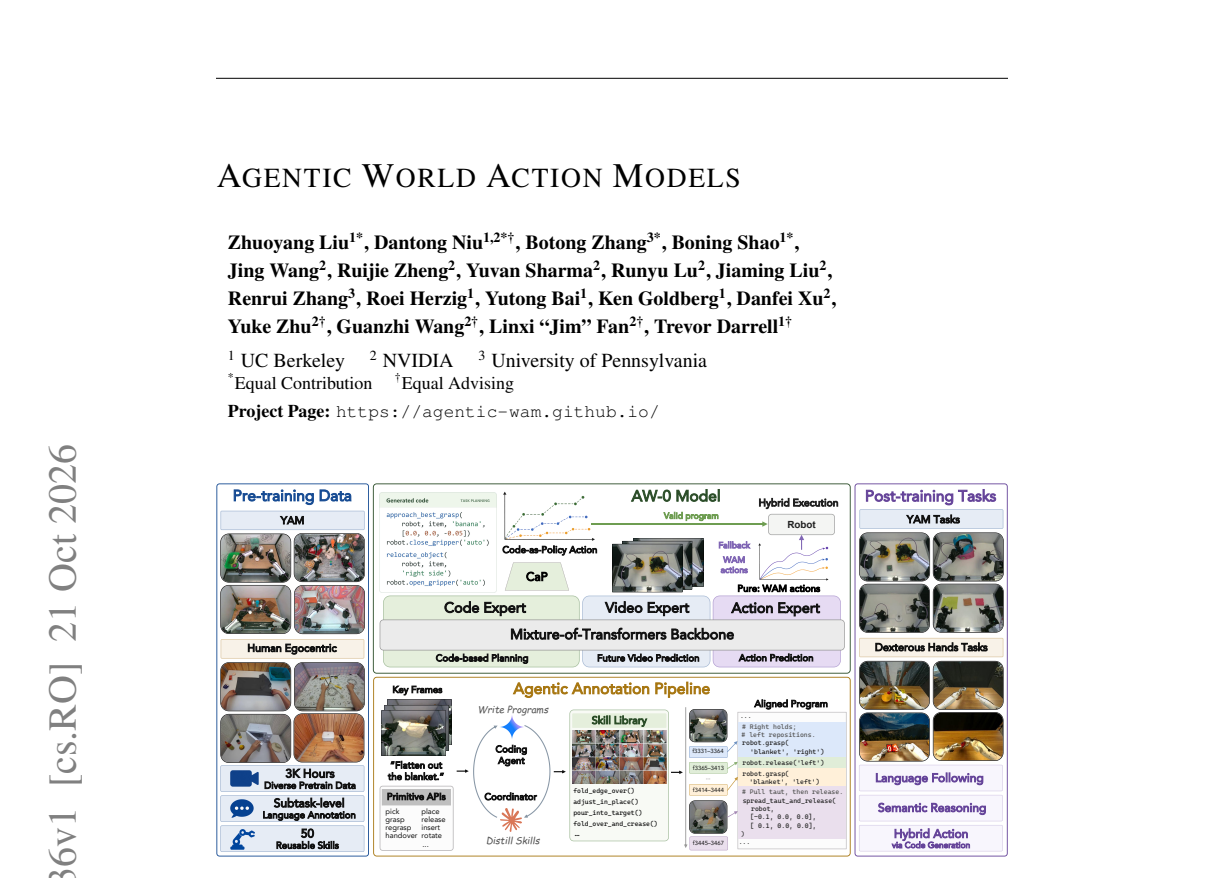
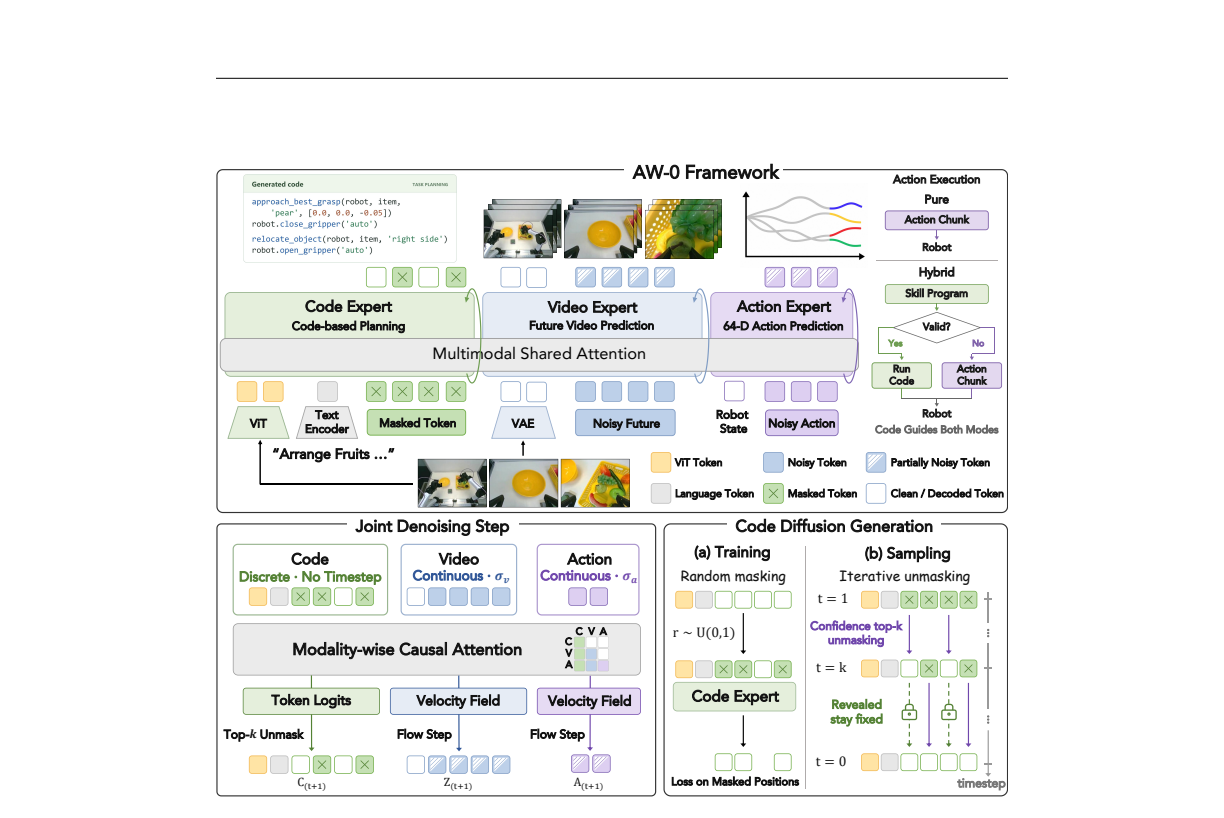
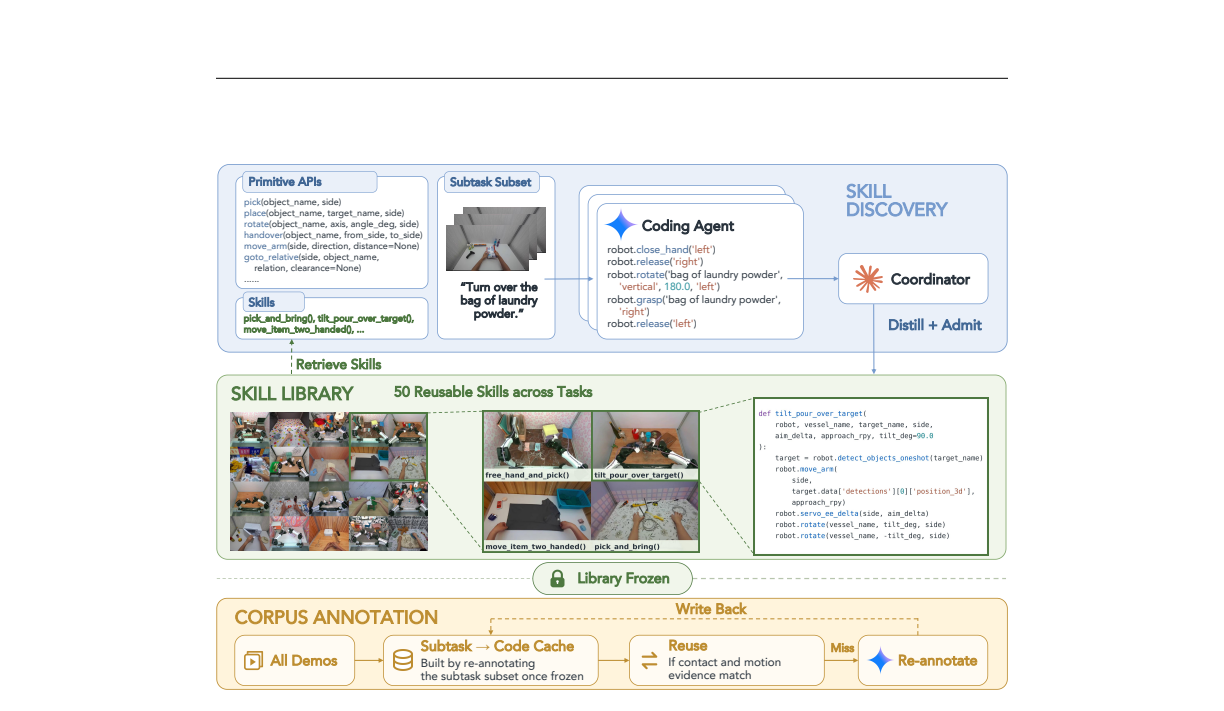
We introduce AW-0, an agentic world action model framework that integrates code-based planning with joint video and action prediction. We jointly model code, future video, and robot actions as three coupled generative streams within a unified mixture-of-transformers architecture. Within this architecture a code expert generates parameterized skill routines and control logic while video and action experts generate future visual states and low-level motor commands. Code serves two complementary roles: it structures multi-step prediction and control within the world model and represents skills as reusable programs for subsequent agentic execution. We further introduce an automated curation pipeline that labels robot and human video trajectories with aligned programs and consolidates recurring routines into reusable skill libraries. Evaluations on RoboTwin 2.0 and physical bimanual manipulation tasks show improved task performance over VLA and WAM baselines, alongside gains in language following, semantic reasoning and robustness, demonstrating that agentic code enables connection between planning, prediction and execution within WAMs.
from the abstract
Pith says
Machine review · deepseek-v4-flash · 22 Oct 2026 · what was read was not recorded · not checked by a person
It can be wrong. Challenge this review or reply to it.
Holds up, with conditions. The joint code-video-action denoising is genuinely new against the cited WAM literature and the ablations are unusually honest, but the causal claim that code semantics drive the gains stays conditional because label fidelity is measured, reported as modest, and never experimentally isolated. This line is wrong
2 major objections · 7 minor
How often objections from reviews like this one are right: not yet measured
Not checked: figures, code, what the 15 references say.
The paper says, at §2.3, §3.3, Eq. (2)
The review did not quote this passage.
A classifier read this sentence of the paper as acknowledging the concern (probability 0.78):
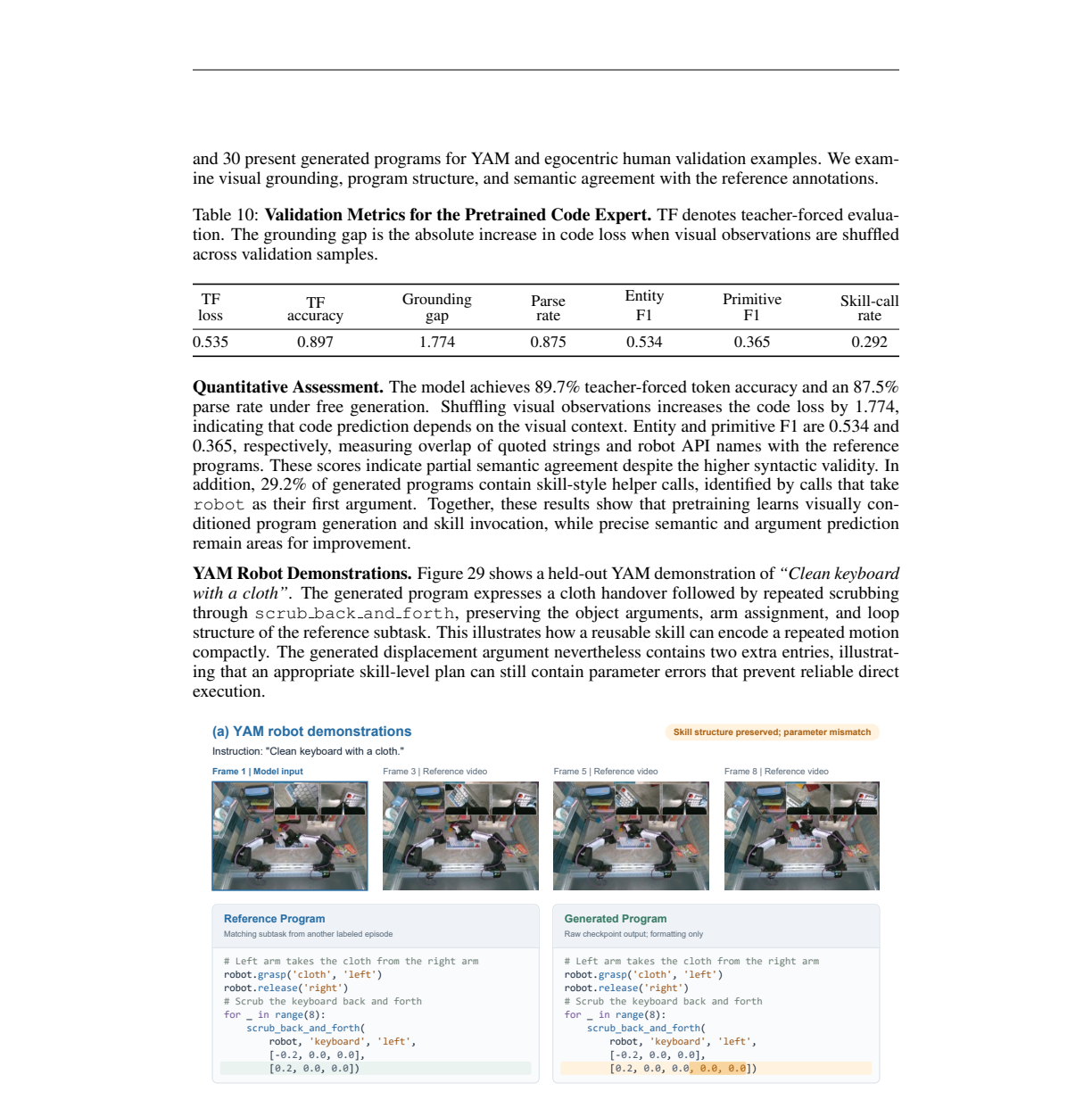
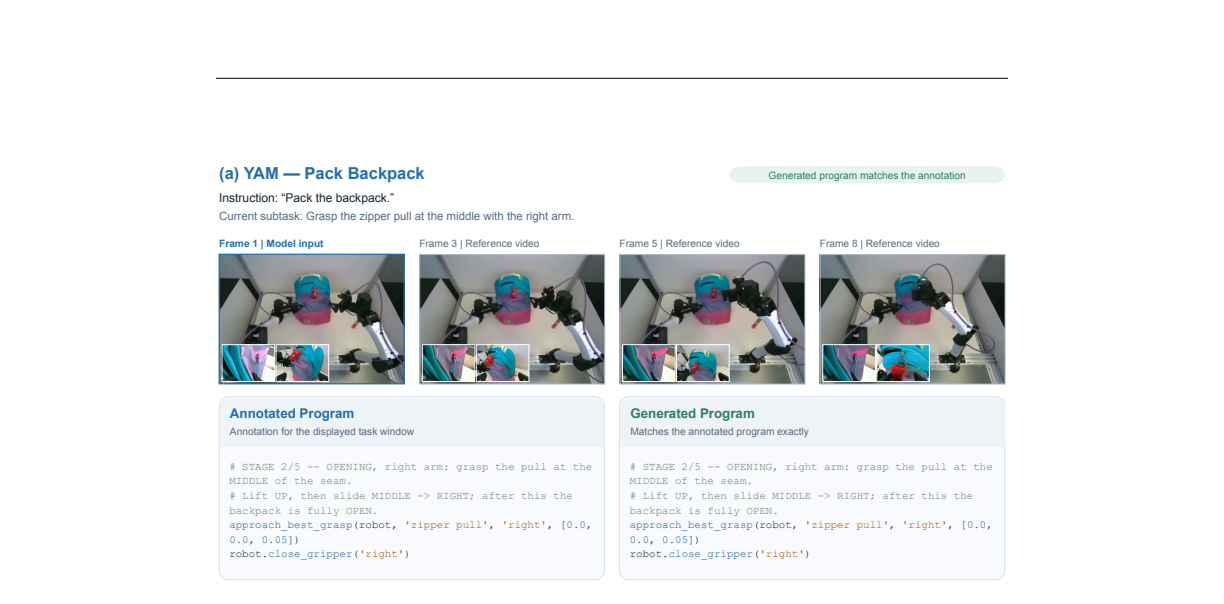
“Generated programs can select an appropriate skill yet contain incorrect arguments, as illustrated in Appendix F.1; syntactic validity therefore does not ensure correct exe- cution.”
Pith says: Objection 1 of 2 · major
The central claim (Section 1: 'our primary contribution is the conceptualization and realization of agentic robotic skills within a world action model framework, showing that code generation improves action prediction') is causal: code improves action prediction because it supplies grounded semantic plans.
more of objection 1
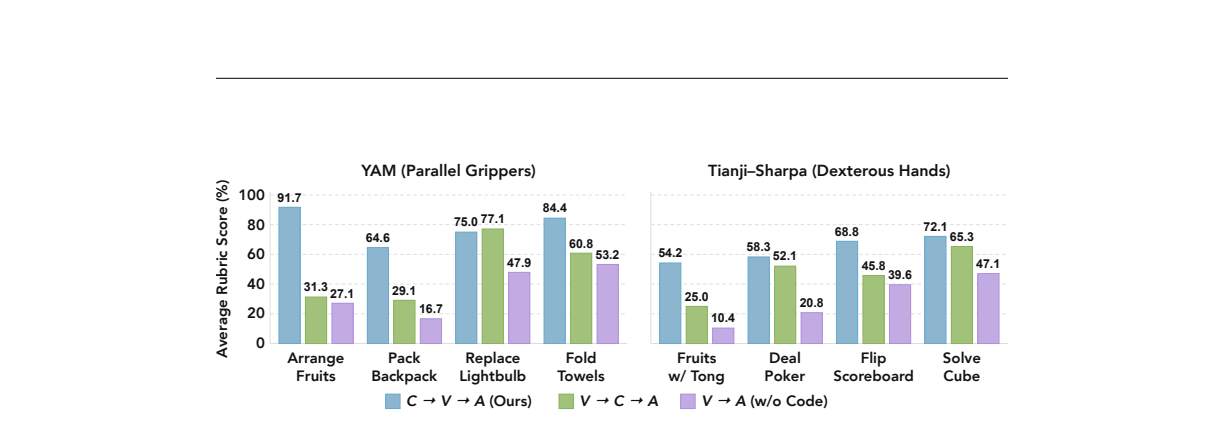
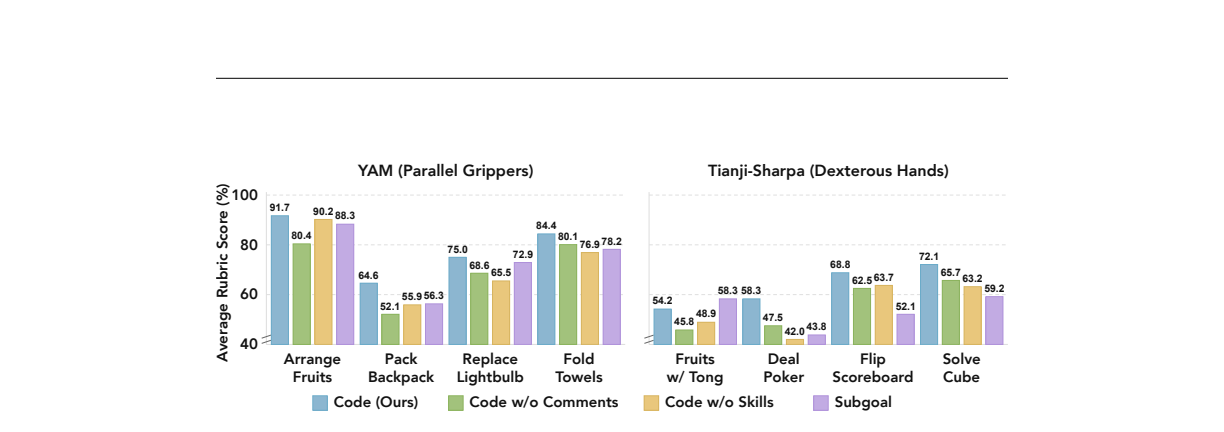
The Q1 ablations control for parameter count and attention placement—the V→C→A variant retains the full code expert with identical data, budget, and settings and still underperforms C→V→A (Figure 5)—and the Q2 ablations show that comments and skill calls matter (Figure 7). What is not controlled is the fidelity of the code labels themselves: Appendix K.2 reports that validation is static (syntax, function existence, argument binding, vocabulary) and never checks physical correctness against the video, and Table 10 reports modest agreement (Entity F1 0.534, Primitive F1 0.365). The authors acknowledge the consequence in Appendix L ('syntactic validity therefore does not ensure correct execution'), but no experiment separates 'a code stream whose content is semantically correct' from 'a code stream of the same form whose labels are arbitrarily assigned.' I recommend a scrambled-label variant: train with the same code stream, canvas length, and budget, but with program labels shuffled across episodes of the same task (or with argument values corrupted), and compare against the full model; a human audit of, say, 100 sampled labels per dataset for physical correctness would also quantify label quality. The YAM constraint that programs must reproduce the sensor-derived gripper-event list (Appendix K.2) partially grounds the contact structure of the YAM labels, but object names, motion arguments, and the entire egocentric-human half of the corpus are ungrounded; the mitigation should cover both datasets.
The paper says, at Tables 1, 2, 4; Figures 5–7
The review did not quote this passage.
Pith says: Objection 2 of 2 · major
None of the quantitative tables reports variance, confidence intervals, or significance tests. The headline comparisons—50.7% vs 41.3% on RoboTwin 2.0 and 71.1% vs 46.0% on the real-world tasks—are averages over 50 rollouts per simulated task and 3 seeds × 16 rollouts per real-world task.
more of objection 2
With binomial sampling, a per-task real-world gap of 5–10 points (e.g., Replace Lightbulb 75.0 vs 67.4 in Table 2) is plausibly within noise, and the RoboTwin per-task table shows wide dispersion with many near-zero entries. The 29.2% vs 27.7% hybrid gain in the random setting is a 1.5-point margin and should be treated with particular care. I ask for seed-level spreads or binomial confidence intervals on the headline averages and a paired (per-task) or permutation test for the main AW-0-versus-best-baseline differences, so the reader can assess whether the claimed gains are statistically distinguishable.
7 minor objections
The paper says, at Table 11
Pith says: minor objection 1 of 7
The per-task RoboTwin results in Table 11 appear misaligned in the manuscript text, with entries running together (several rows read as single long numbers); please verify the table rendering in the camera-ready version.
The paper says, at §3.3, Figure 7
Pith says: minor objection 2 of 7
The 'Subgoal' variant in Figure 7 is not fully specified: please state whether the natural-language subgoals use the same tokenizer, canvas length, masking procedure, and loss as the code stream, so that the comparison is controlled.
show 5 more
The paper says, at §3.1, Appendix J.2
Pith says: minor objection 3 of 7
The hybrid-versus-default comparison is confounded with the switch to CaP-collected demonstrations, since the two configurations differ in both data collection and execution mode; the authors disclose this in Appendix J.2, but the main text should state the confound explicitly next to the robustness claim based on Table 1.
The paper says, at Appendix G.1, G.2
Pith says: minor objection 4 of 7
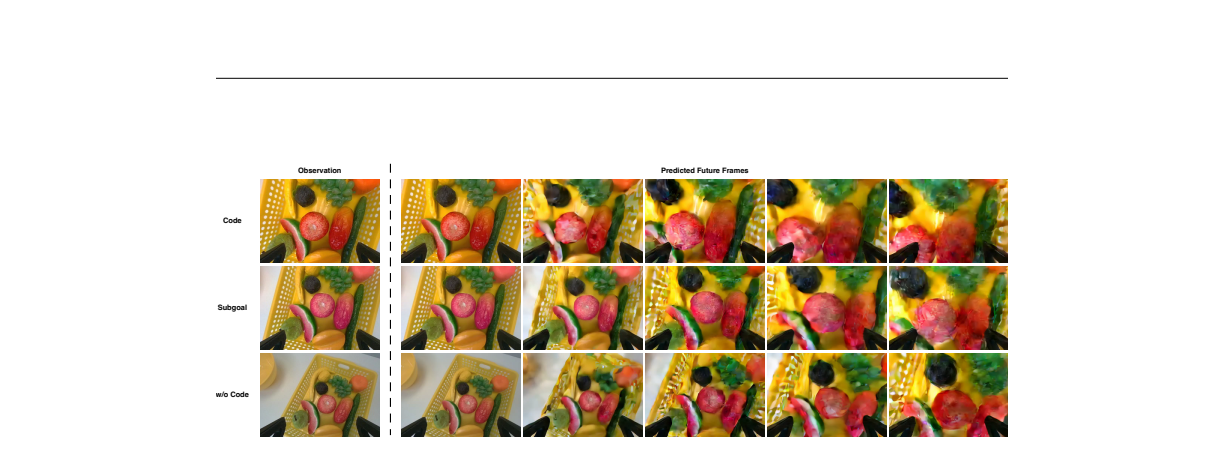
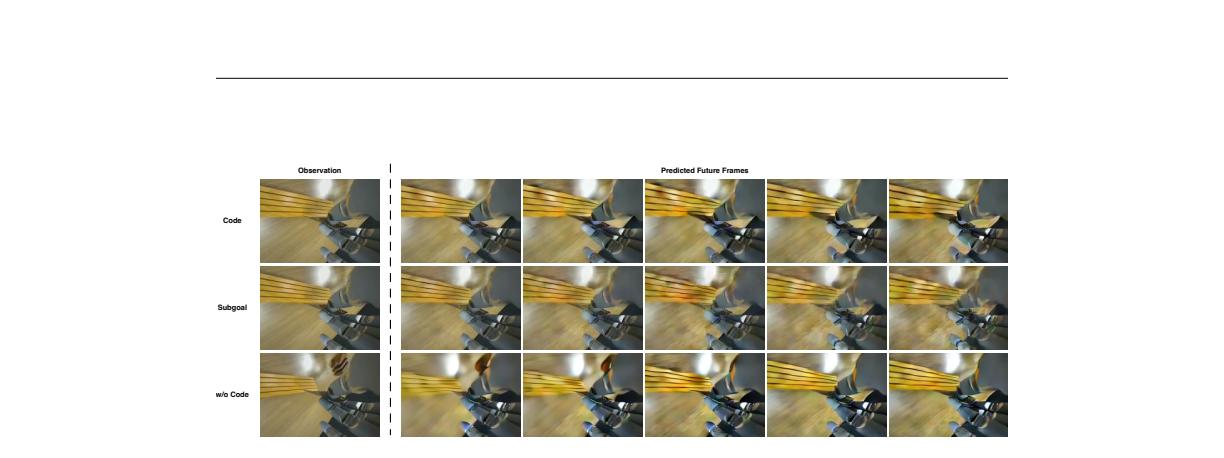
The qualitative video-prediction comparisons (Figures 33–34) use non-identical initial observations from separate rollouts; a controlled comparison with matched initial states, or a small quantitative video metric, would strengthen the language-following and skill-robustness discussion.
The paper says, at §2.2, Eq. (6)
Pith says: minor objection 5 of 7
The generation hyperparameters α=0.5, γ_v=γ_a=5, and the loss weights (1, 0.5, 1) are presented as fixed choices without a sensitivity analysis; please report at least one sensitivity run or state explicitly that these values were fixed a priori.
The paper says, at Appendix I, F.2
Pith says: minor objection 6 of 7
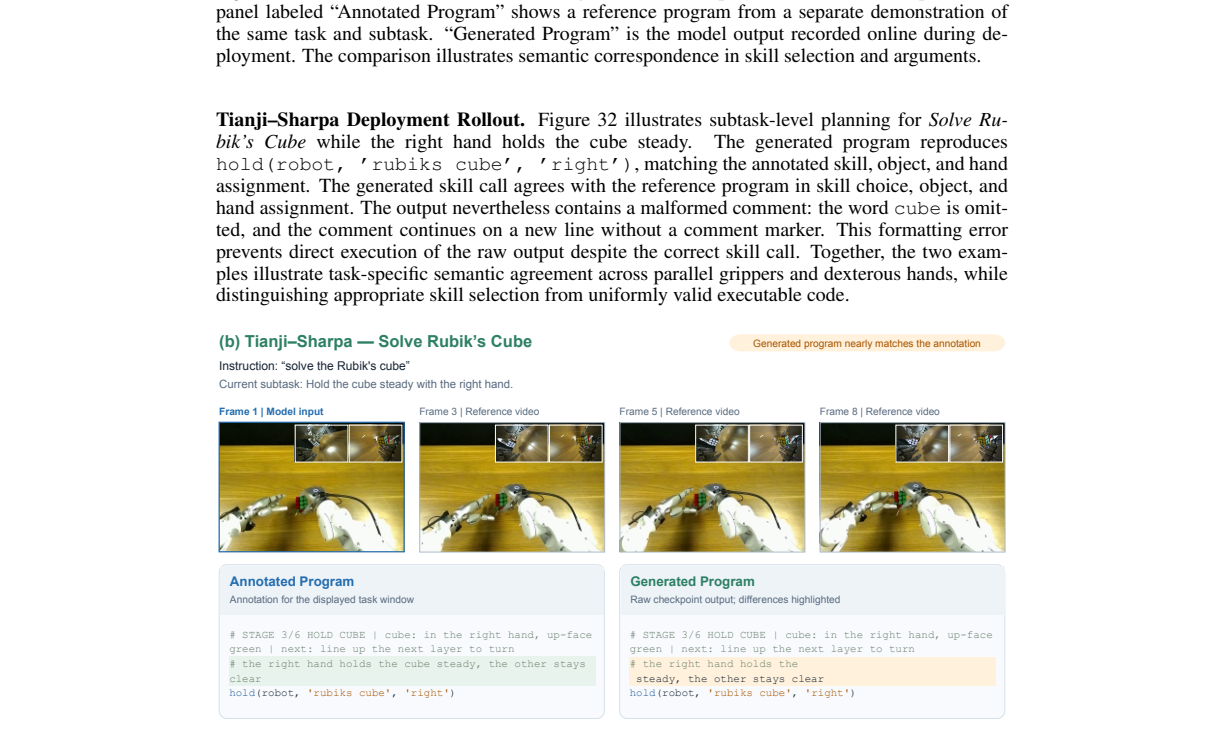
Because the hybrid arbiter accepts slices on validity alone, it would be informative to report the fraction of generated slices that pass the arbiter's gates during deployment; the malformed-comment example in F.2 shows this pass rate can be below 100%, which is directly relevant to the agentic-reuse claim.
The paper says, at References
Pith says: minor objection 7 of 7
There are several typographical errors in the reference list (e.g., 'Huan ang Gao' in the RoboTwin 2.0 entry) and inconsistent spacing around some baseline names in the main text; please copy-edit.
What would settle it
Run a matched-budget post-training comparison on the eight real-world tasks (or a RoboTwin subset) among: (A) standard annotated code; (B) scrambled-semantics code, where skill names and object arguments within each task's program slices are permuted across demonstrations while keeping syntax and token statistics fixed; and (C) the existing V→A w/o-code baseline, using the same C→V→A mixture-of-transformers architecture wherever a code stream is present. If (B) retains most of the (A) vs (C) gap, the code stream's benefit is not semantic planning and the central claim needs to be narrowed; if (B) collapses toward (C) while (A) keeps its gain, label content is causal and the claim survives this test.
from the skeptic's reading
How the review went
4 readings by deepseek-v4-flash · 22 Oct 2026
- Reader holds up, with conditions
- Skeptic agrees
- Editor wrote the verdict above
- Referee major revision: 2 major objections, 7 minor
Not run on this paper: the simulated authors' defence.
Pith did not check this review's objections against the paper.
The review in full
The review in brief, machine-written
Two things to know. First, AW-0's core move is genuinely new relative to the cited literature: no prior WAM jointly denoises a discrete code stream with video and action under blockwise-causal C-to-V-to-A attention. WLA generates text subtasks autoregressively, DreamZero and Cosmos-Policy do video and action without a code stream, and CaP/ASPIRE execute code outside a trained policy. Second, hold the causal claim from Section 1 at arm's length: the paper asserts that code generation improves action prediction and that the code is reusable agentically. The ablations support the first half, but the one experiment that would settle it is missing.
What I credit. The ablation suite is the strongest part. The w/o-code and attention-order variants share pretraining data, budget, and optimization settings, and the content ablations (no comments, no skills, subgoal text instead of code) degrade performance across all 8 shared real-world tasks. Removing comments or skills changes label content while keeping the code stream present, so the crude "any code-shaped token stream helps" hypothesis is partly ruled out. The paper is also transparent on its weak spots: it admits the simulation hybrid comparison is confounded with a separate CaP-based data-collection pipeline (J.2), that syntactic validity does not ensure correct execution (Appendix L; the malformed-comment and bad-argument examples in F.1 and F.2), and that the random-setting RoboTwin result (20.6%) sits below pi0.5 (27.7%). That honesty is real and not routine.
The soft spots, in proportion. Reporting is the minor one: no variance or confidence intervals anywhere, despite 3 seeds times 16 rollouts per real task being claimed. Fixable, but it should be there. Mechanism is the real one: the annotation pipeline validates syntax, vocabulary, and argument binding only (K.2), never physical correctness against the video, and the pretrained code expert's agreement with reference programs is modest (Entity F1 0.534, Primitive F1 0.365). The authors flag the label-quality limitation explicitly, so this is not a concealed flaw; what is unresolved is whether the measured gains come from the planning semantics or from the added structure and reduced task ambiguity. A scrambled-label or corrupted-label ablation with the same budget would close that gap, and its absence is the load-bearing weakness given the headline claim is causal.
Who this is for: anyone working on world action models, VLA-planning integration, or programmatic skill discovery from video. It deserves a serious referee, not a desk reject. The architecture is worth engaging with, the ablations are well designed, and the failure analysis is instructive. A revision adding the label-fidelity control and per-cell variance would let the empirical and causal claims line up.
The strongest objection
The paper's central claim (Section 1) is causal: code generated inside the world model improves action prediction and can be reused agentically. The training signal for that code stream is the annotation pipeline of Section 2.3, and the paper's own appendices show the labels are validated syntactically, not physically: static checks cover syntax, function existence, argument binding, and vocabulary (Appendix K.2), while the model's agreement with the reference programs is modest (Entity F1 0.534, Primitive F1 0.365, 87.5% parse rate), and even strong generations can contain wrong argument counts or malformed comments (Appendices F.1, F.2). The ablations in Figure 7 and Table 4 show that code, comments, and skills matter relative to a model with no code stream, but they do not control for label fidelity: a code expert trained on plausible-but-physically-wrong programs could still help through extra parameters, reduced task ambiguity, or the C→V→A attention ordering, without encoding the reusable skills the paper claims. The second half of the primary claim is exposed too, because agentic reuse requires executability, and the paper's own deployment examples include raw output that would not run as generated (F.2). The authors are transparent about these limitations in Appendix L, but the causal attribution in the headline claim has not yet been separated from annotation quality.
I read AW-0 in good faith. The framework is genuinely novel: jointly denoising code, video, and actions with a code expert is not present in the cited WAM or agentic literatures, the ablation suite is extensive, the real-world gains are large, and the paper is unusually transparent about its failure cases and confounds (Appendix J.2). The reader's conditional verdict is well calibrated. The remaining soft spot is not that the labels are imperfect—the paper says so—but that the central causal claim has not been separated from label fidelity. The reader's weakest assumption identifies exactly this issue, and I agree with it. Existing ablations compare code vs. no code, and full code vs. degraded code content, but no variant holds the code stream fixed while breaking the semantic link between labels and demonstrated motion. Without that control, the measured gains could in principle come from a code-shaped conditioning stream rather than from accurate skill-level planning. This is a real concern, but it is not a demonstrated failure: the code-content ablations (comments, skills, subgoals) lean in the paper's favor, and the authors explicitly acknowledge that syntactic validity does not imply executability. The paper should therefore remain CONDITIONAL rather than being rejected or marked unverdictable, and the reader's verdict does not need to change. A scrambled-label control is the single experiment that would decide whether the central claim should be re-expressed from 'code improves action prediction' to 'a code-shaped stream improves action prediction.'
The referee's report
AW-0 is a well-engineered integration of two active lines of work—world action models and code-based agentic policies—and, if the mechanism holds, provides a useful template for inserting structured planning into predictive world-action models. The evaluation is externally grounded: RoboTwin success rates and additive real-world rubrics are measured against baselines rather than against quantities the model was fit to reproduce. The ablations are a genuine strength: the w/o-code and V→C→A variants in Figure 5 share pretraining data, training budget, and optimization settings with the full model, ruling out the crudest 'added parameters' explanation, and the content ablations in Figure 7 show that comments and skill calls contribute beyond raw program structure. The paper is also unusually transparent: Appendix K.2 states that label validation is static, Appendices F.1 and F.2 show generated programs with wrong argument counts and non-parsing output, Appendix J.2 discloses the CaP-collection confound in the hybrid comparison, and Appendix L acknowledges that syntactic validity does not ensure correct execution.
Pith's reading of the paper (a machine's summary, not the authors')
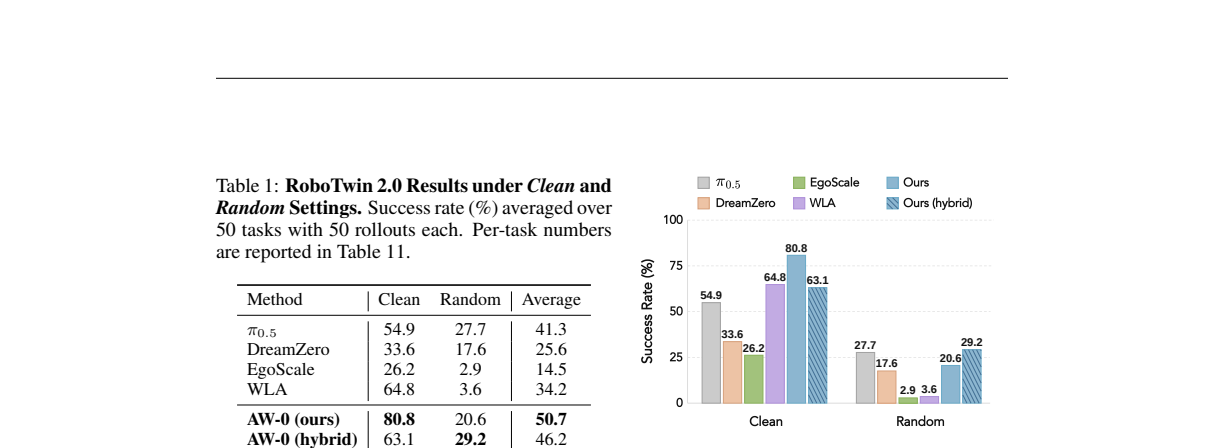
AW-0 sets out to give robot world models an explicit planning layer. The central claim is that adding a code-generation stream to a world action model — so that skill programs, future video, and motor commands are generated together, with the program conditioning the video and the video conditioning the actions — improves task success over both vision-language-action and world-action baselines. On RoboTwin 2.0 the model averages 50.7% success across clean and randomized settings (80.8% clean), and on eight real bimanual and dexterous-hand tasks it averages 71.1% rubric score versus 46.0% for the strongest baseline. The paper further shows the generated code can be executed directly as a policy, with a hybrid controller that improves robustness under visual randomization. If the claim holds, writing reusable skill programs inside the model rather than outside it is a practical way to connect planning, prediction, and control.
What carries the argument. The load-bearing object is the mixture-of-transformers backbone with three experts — code, video, and action — that communicate through masked joint attention with a blockwise causal order of code before video before action ($C \to V \to A$). The code expert runs discrete absorbing-mask diffusion over program tokens while the video and action experts run continuous flow matching, and all three streams are denoised in the same loop (Eq. 2), so a partially decoded program conditions future-frame prediction, which in turn conditions action generation. Two supporting mechanisms carry the rest: an automated curation pipeline that annotates roughly 2,900 hours of robot and human demonstrations with aligned programs and distills a frozen library of 50 reusable skills, and a hybrid execution controller that arbitrates between executing the decoded program and playing the predicted action chunk.
Core claim. The paper claims that agentic code belongs inside a world action model, not outside it. Concretely, AW-0 is a mixture-of-transformers with three coupled generative streams — a code expert that writes parameterized skill routines, a video expert that predicts future frames, and an action expert that emits motor commands — denoised jointly, with blockwise causal attention in the order code → video → action ($C \to V \to A$) so the program shapes both future prediction and control. Trained on about 2,900 hours of robot and human demonstrations labeled by an automated pipeline with temporally aligned program slices, the model reaches 50.7% average success on RoboTwin 2.0 and 71.1% average rubric score across eight real-world tasks, and its ablations attribute the gains to the code stream, to its $C \to V \to A$ placement, and to the skill calls inside the programs. A hybrid execution mode that runs the decoded program when it passes validity gates improves robustness under distribution shift (29.2% vs 20.6% under randomization) at a cost in the clean setting (63.1% vs 80.8%). The authors report that generated code is only partially grounded — teacher-forced token accuracy is high but Entity F1 is 0.534 and Primitive F1 is 0.365 — so the claim concerns planning as a conditioning structure as much as executable output.
The premise it rests on. The load-bearing premise is that the automatically written programs and the frozen 50-skill library genuinely describe the motions in the demonstrations, since the labels are checked only for syntax, vocabulary, and argument binding and never for physical correctness against the video.
If the paper is right (Pith's inferences, not the authors')
Code generation inside the world model improves action prediction: the $C \to V \to A$ ordering outperforms both the no-code and $V \to C \to A$ variants on all eight real-world tasks, so task plans written as programs are a workable conditioning signal for future video and control.
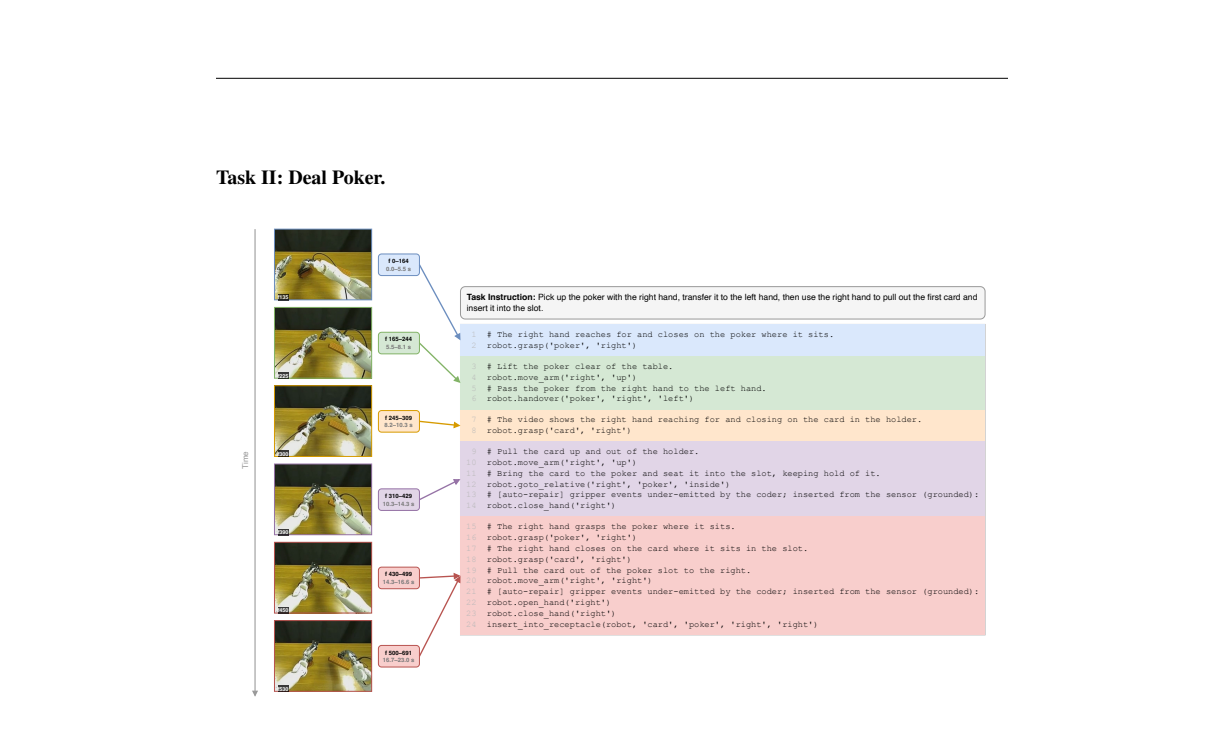
The 50-skill libraries extracted from roughly 2,900 hours of robot and human demonstrations give pretraining a shareable planning vocabulary: removing skill calls from programs drops performance on all eight tasks, most sharply where skills matter (Deal Poker, 58.3% vs 42.0%).
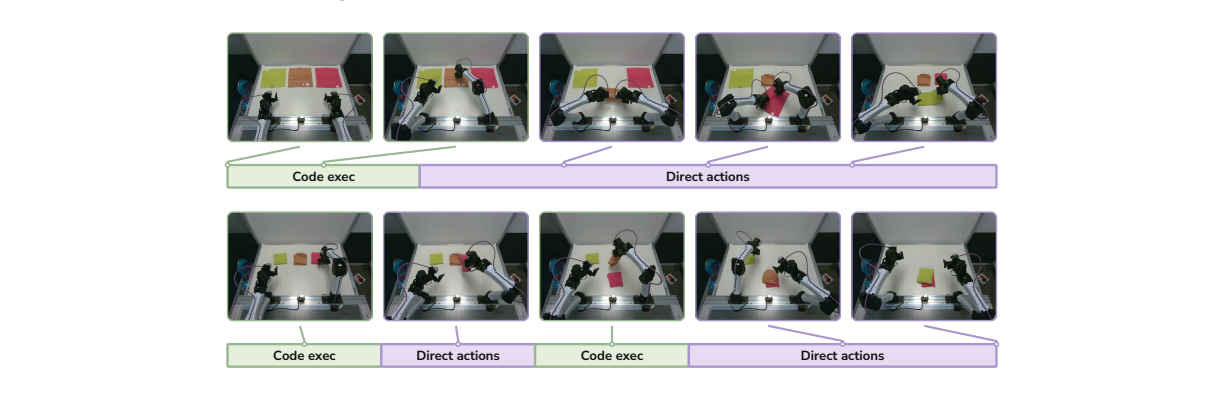
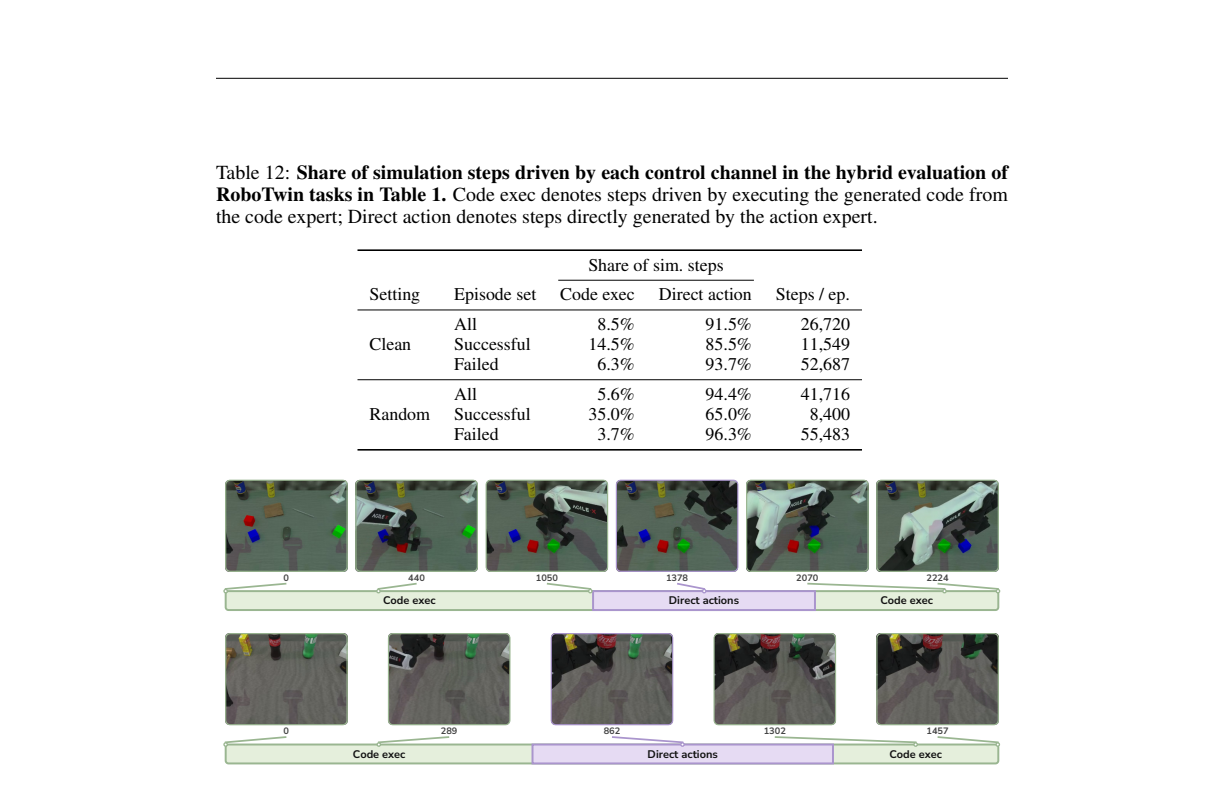
Generated code is reusable at execution time: hybrid arbitration between decoded programs and direct action chunks improves robustness under visual distribution shift (29.2% vs 20.6% on RoboTwin random) while retaining 46% of clean-setting success versus 25% without code execution.
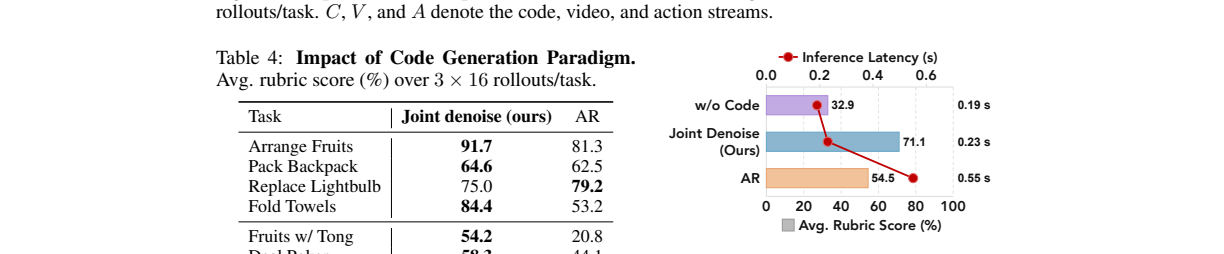
Joint denoising is both more accurate and cheaper than autoregressive program generation (0.23 s vs 0.55 s inference, better on 7 of 8 tasks), so planning can be folded into the generative loop instead of serialized before it.
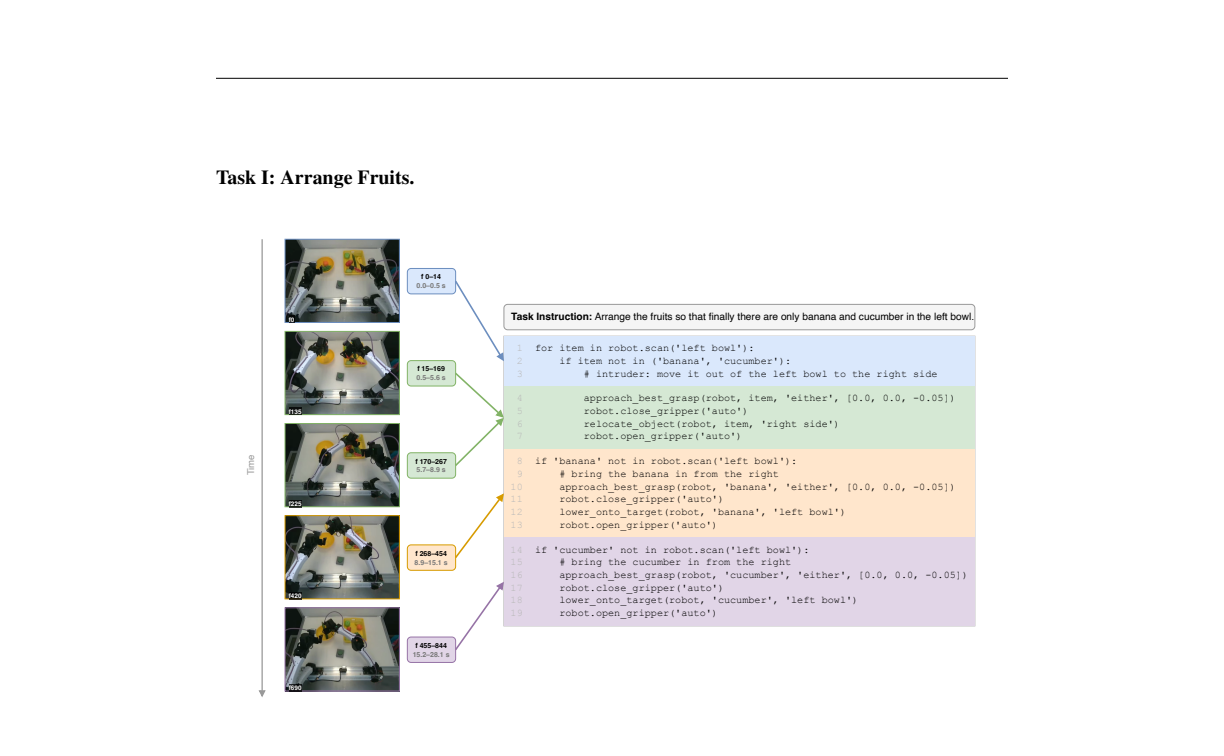
Language following and semantic reasoning in world models improve when semantic plans shape video prediction, with gains concentrating on instruction-sensitive tasks such as Arrange Fruits and Flip Scoreboard.
If the code stream is the genuine driver, then physically grounding the program labels should raise the ceiling further: the paper's own appendix reports Entity F1 of 0.534 and Primitive F1 of 0.365 for generated code, so correcting argument-level errors against the video is a direct, testable next step.
A learned arbiter that predicts whether code execution will beat the action chunk could resolve the clean/random trade-off, since the current controller admits code on validity checks alone and concedes 17.7 points in the clean setting.
The skill-library framing suggests a scaling claim worth testing: because the 50 skills recur across 606 pretraining tasks, success on a new task should track whether its motions are covered by the frozen library, and adding skills should transfer to new tasks without retraining.
Check this review
Pith stored no record of this review's passes and took no fingerprint of it. Reviews made by code from 13 Nov 2026 on carry both.
How often reviews like this one are right
Reviews like this one: written by deepseek-v4-flash, where what was read was not recorded.
How often objections from reviews like this one are right: not yet measured
Reviews by people
This review was written by a machine. No person has reviewed this paper on Pith yet. A scientist listed on Pith can review it for a fee, and their review is published here whatever it concludes.
The paper
Abstract
Recent world action models provide visual foresight and future prediction for robot manipulation, but lack explicit mechanisms for compositional skill reuse. Agentic robotics combines code-based planning and reasoning with reusable skills, but often lacks predictive grounding in physical dynamics. We introduce AW-0, an agentic world action model framework that integrates code-based planning with joint video and action prediction. We jointly model code, future video, and robot actions as three coupled generative streams within a unified mixture-of-transformers architecture. Within this architecture a code expert generates parameterized skill routines and control logic while video and action experts generate future visual states and low-level motor commands. Code serves two complementary roles: it structures multi-step prediction and control within the world model and represents skills as reusable programs for subsequent agentic execution. We further introduce an automated curation pipeline that labels robot and human video trajectories with aligned programs and consolidates recurring routines into reusable skill libraries. Evaluations on RoboTwin 2.0 and physical bimanual manipulation tasks show improved task performance over VLA and WAM baselines, alongside gains in language following, semantic reasoning and robustness, demonstrating that agentic code enables connection between planning, prediction and execution within WAMs.
The paper's own sentences, arranged, kept beside the review and separate from it. Each label is drawn from a closed vocabulary; the number beside it is the probability the classifier gave that label. No sentence in this record was written by a model.
abstract compiled · 2026-10-22
The authors' main claim, as the classifier picked it out 1.00
“Evaluations on RoboTwin 2.0 and physical bimanual manipulation tasks show improved task performance over VLA and WAM baselines, alongside gains in language following, semantic reasoning and robustness, demonstrating that agentic code enables connection between planning, prediction and execution within WAMs.”
How the main claim is stated: asserted 1.00
What the abstract itself states, as probabilities: claims first 0.09 · states limitation 0.09 · human participants 0.35 · controlled comparison 0.92 · randomized assignment 0.01 · states quantitative result 0.06 · compares with prior results 0.97 · mentions code or data availability 0.05
The abstract, sentence by sentence
This table labels the abstract only (arXiv listing abstract v1). The number is the probability the classifier gave the label.
| Sentence | Role | The authors' own work | States the main conclusion | Strength |
|---|---|---|---|---|
| Recent world action models provide visual foresight and future prediction for robot manipulation, but lack explicit mechanisms for compositional skill reuse. | gap 0.75 | 0.05 | 0.02 | asserted 1.00 |
| Agentic robotics combines code-based planning and reasoning with reusable skills, but often lacks predictive grounding in physical dynamics. | background 0.52 | 0.04 | 0.02 | asserted 0.95 |
| We introduce AW-0, an agentic world action model framework that integrates code-based planning with joint video and action prediction. | contribution 1.00 | 0.93 | 0.08 | asserted 1.00 |
| We jointly model code, future video, and robot actions as three coupled generative streams within a unified mixture-of-transformers architecture. | method 0.96 | 0.89 | 0.04 | asserted 0.99 |
| Within this architecture a code expert generates parameterized skill routines and control logic while video and action experts generate future visual states and low-level motor commands. | method 0.99 | 0.75 | 0.04 | asserted 1.00 |
| Code serves two complementary roles: it structures multi-step prediction and control within the world model and represents skills as reusable programs for subsequent agentic execution. | method 0.87 | 0.65 | 0.15 | asserted 1.00 |
| We further introduce an automated curation pipeline that labels robot and human video trajectories with aligned programs and consolidates recurring routines into reusable skill libraries. | method 0.75 | 0.95 | 0.04 | asserted 1.00 |
| Evaluations on RoboTwin 2.0 and physical bimanual manipulation tasks show improved task performance over VLA and WAM baselines, alongside gains in language following, semantic reasoning and robustness, demonstrating that agentic code enables connection between planning, prediction and execution within WAMs. | result 0.97 | 0.96 | 0.90 | asserted 1.00 |
What kind of paper the classifier reports this is: method or tool 1.00 · evidence from observation or experiment 0.93
What was examined, and what was not
Sources read
- arXiv listing abstract v1
Not examined
- full text
- figures and tables
- references and citing sentences
- relations to other papers
Levels run
- P abstract
Not run
- S sections
- T body sentences
- C citations
- R cross-paper relations
How the labels were made
Compiled by classifier-1.13.0 via TypeSafe API, question bank abstract-p1-20260923, 2026-10-22: 1 request, 6,258 input tokens.
Every quoted sentence on this record is the authors'. Every label is from Pith's closed vocabulary, with the probability shown beside it. This record as JSON
Figures (38)


Figures are the authors', reproduced from the paper.
References (15)
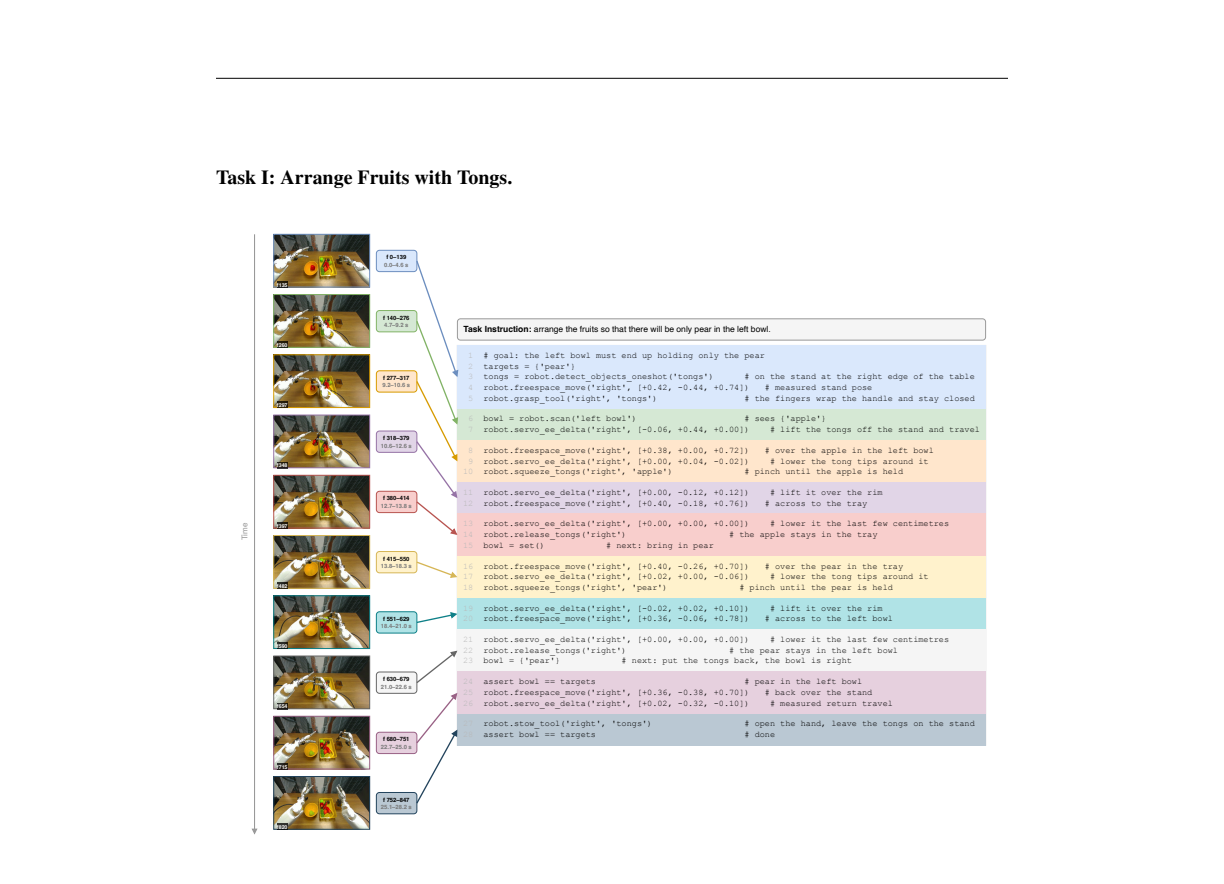
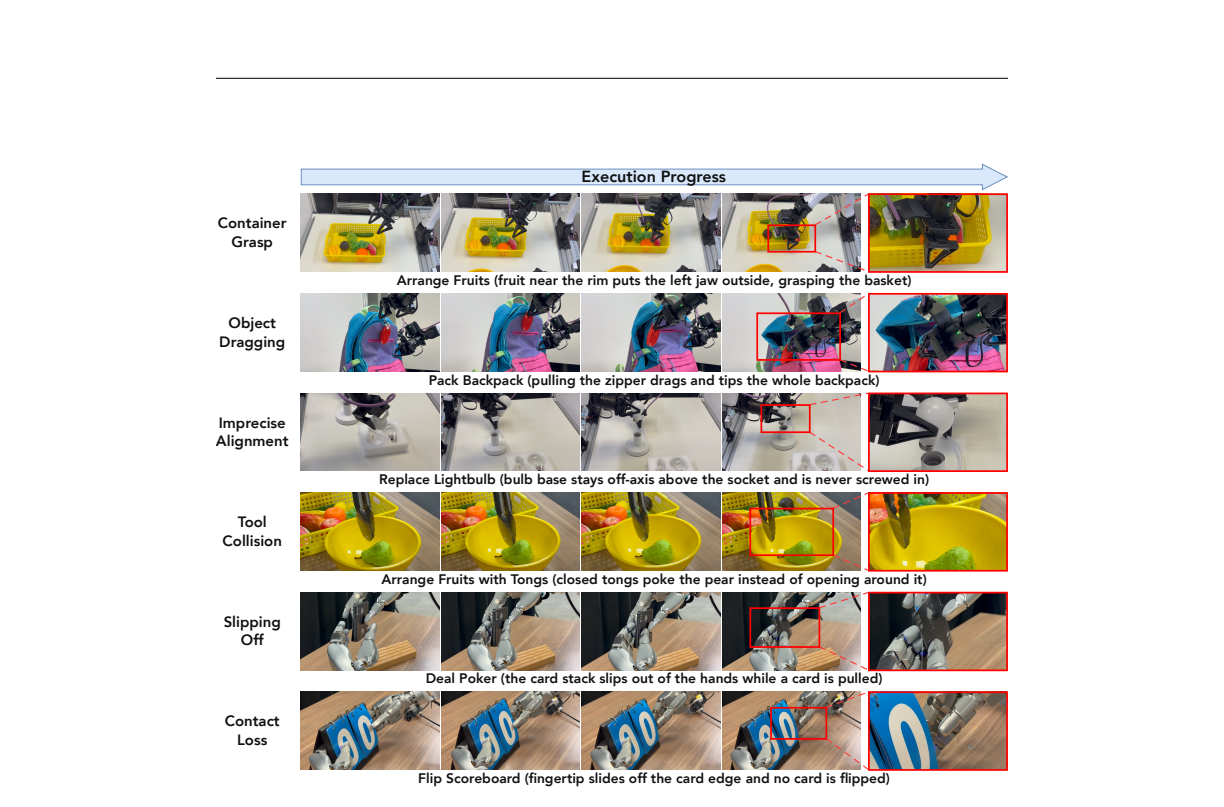
- [1] Container Grasp.InArrange Fruitsin the first row, the target fruit lies close to the basket rim. As the gripper approaches, its left jaw moves outside the basket, causing the closing motion to grasp the basket wall rather than only the fruit. This case highlights the need to a... on Pith
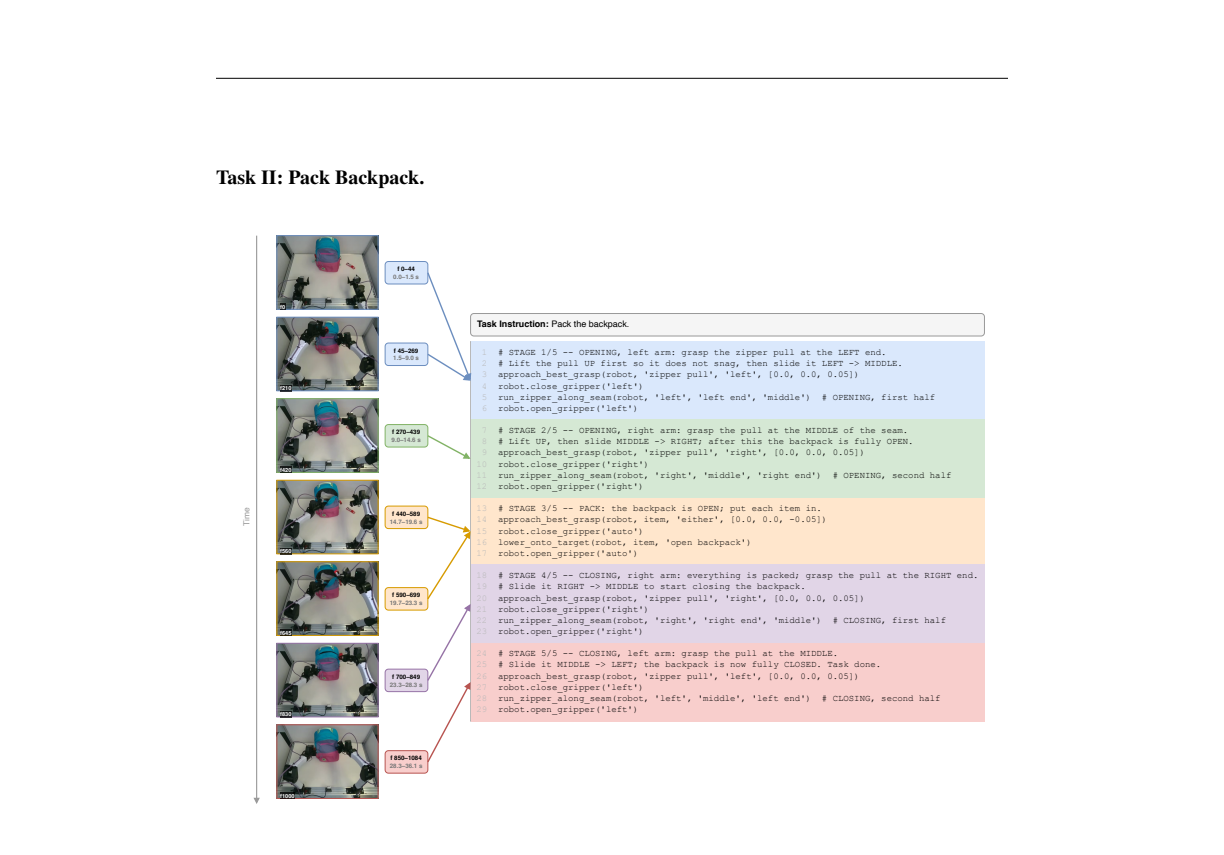
- [2] Object Dragging.InPack Backpackin the second row, when the robot pulls the zipper, the backpack moves and tips over rather than remaining stable. The visible failure suggests insufficient stabilization of the deformable object during manipulation. A potential improvement is to... on Pith
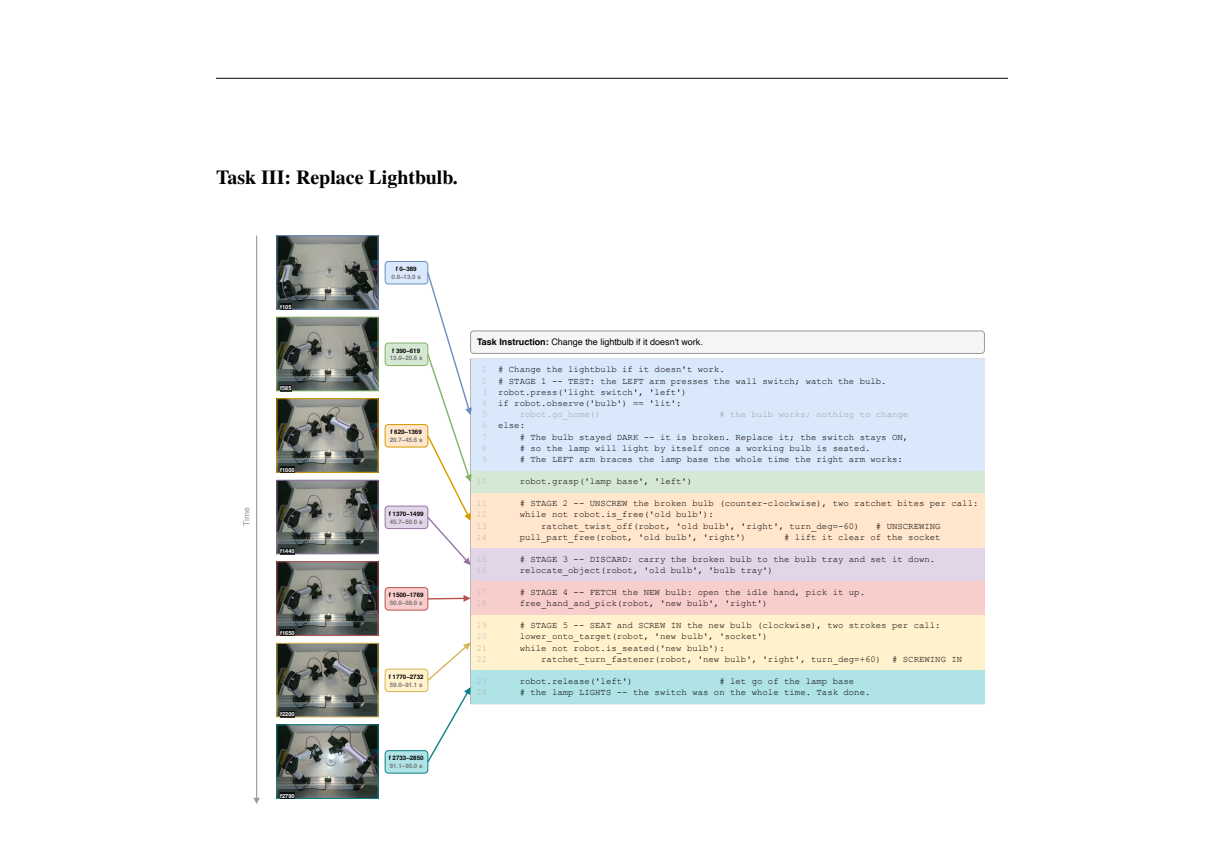
- [3] Imprecise Alignment.InReplace Lightbulbin the third row, the robot grasps the bulb and brings it above the socket, but the bulb base remains misaligned with the socket opening and is not screwed in. Completing this step requires both positional and angular alignment before the... on Pith
- [4] Tool Collision.InArrange Fruits with Tongsin the fourth row, the tongs approach the pear with their tips closed and poke it rather than opening around it to establish a grasp. Successful tool use requires coordinating the tool’s opening with its approach trajectory, in additio... on Pith
- [5] arXiv:2502.19417. 13 Ishika Singh, Valts Blukis, Arsalan Mousavian, Ankit Goyal, Danfei Xu, Jonathan Tremblay, Dieter Fox, Jesse Thomason, and Animesh Garg. ProgPrompt: Generating situated robot task plans using large language models. InICRA, 2023. Martin Sundermeyer, Arsalan ... on PithPith's reviewarXiv
- [6] URLhttps://arxiv.org/abs/2503.20314. Xingyao Wang, Yangyi Chen, Lifan Yuan, Yizhe Peng, Hao Li, Hao Peng, and Heng Ji. Executable code actions elicit better LLM agents. InInternational Conference on Machine Learning, 2024. arXiv:2402.01030. Wenli Xiao, Jia Xie, Tonghe Zhang, H... on PithPith's reviewarXiv
- [7] URLhttps://arxiv.org/abs/2602.15922. Tianyuan Yuan et al. Fast-W AM: Do world action models need test-time future imagination?, 2026. URLhttps://arxiv.org/abs/2603.16666. 14 Junyi Zhang, Jiaxin Ge, Hanjun Yoo, Letian Fu, Zihan Yang, Yaowei Liu, Raj Saravanan, Shaofeng Yin, Jus... on PithPith's reviewarXiv
- [8] URLhttps://arxiv.org/abs/2602.16710. Chuning Zhu, Raymond Yu, Siyuan Feng, Benjamin Burchfiel, Paarth Shah, and Abhishek Gupta. Unified world models: Coupling video and action diffusion for pretraining on large robotic datasets, 2025. URLhttps://arxiv.org/abs/2504.02792. Brian... on PitharXiv
- [14] Slipping Off.InDeal Pokerin the fifth row, the left hand fails to secure the card stack during handover from the right hand, causing the cards to slip. A successful handover requires the receiving hand to establish a stable grasp before the giving hand releases the stack. This... on Pith
- [15] Contact Loss.InFlip Scoreboardin the sixth row, the fingertip reaches the edge of a score card but slides off before turning it over, leaving the displayed score unchanged. Unlike a brief touch, a successful flip requires sustained contact along the card’s rotation about the b... on Pith
- [40] PMLR, 2025. URLhttps://proceedings.mlr.press/v305/black25a.html. Junhao Cai, Zetao Cai, Jiafei Cao, Yilun Chen, Zeyu He, Lei Jiang, Hang Li, Hengjie Li, Yang Li, Yufei Liu, Yanan Lu, Qi Lv, Haoxiang Ma, Jiangmiao Pang, Yu Qiao, Zherui Qiu, Yanqing Shen, Xu Shi, Yang Tian, Bolu... on PitharXiv
- [256] We use a peak learning rate of5×10 −5 with cosine decay to5×10 −6 and 2,000 warmup steps. DreamZero(Ye et al., 2026) is a world-action model that jointly generates future video and actions using a pretrained video diffusion backbone. We follow the official implementation 3 and... on Pith
- [2024] URLhttps://arxiv.org/abs/2406.11815. Dantong Niu, Yuvan Sharma, Haoru Xue, Giscard Biamby, Junyi Zhang, Ziteng Ji, Trevor Darrell, and Roei Herzig. Pre-training auto-regressive robotic models with 4d representations. InForty- second International Conference on Machine Learning... on PithPith's reviewarXiv
- [2025] URLhttps://arxiv.org/abs/2505.12705. Moo Jin Kim, Karl Pertsch, Siddharth Karamcheti, Ted Xiao, Ashwin Balakrishna, Suraj Nair, Rafael Rafailov, Ethan Foster, Grace Lam, Pannag Sanketi, Quan Vuong, Thomas Kollar, Ben- jamin Burchfiel, Russ Tedrake, Dorsa Sadigh, Sergey Levine,... on PithPith's reviewarXiv
- [2026] URLhttps://arxiv.org/abs/2601.16163. Sergey Levine, Chelsea Finn, Trevor Darrell, and Pieter Abbeel. End-to-end training of deep visuo- motor policies, 2016. URLhttps://arxiv.org/abs/1504.00702. Ruiying Li, Yunlang Zhou, YuYao Zhu, Kylin Chen, Jingyuan Wang, Sukai Wang, Kongta... on PithPith's reviewarXiv
Cited by 2 Pith papers
Reviewed papers on Pith that cite this one. The full citation record
Challenges and discussion
Disagree with the review, or know something it missed? Leave a comment, or challenge this review formally: a challenge becomes a permanent entry in this paper's record, and its decision is published here.
Come back by email
A short list of the week's newly reviewed papers. Nothing is sent until you confirm from your inbox, and every email has a link that stops it. No account.
No comments yet.
Sign in to comment