Computation and Language · arXiv:2609.37577 v3 · submitted 29 Sep 2026
Pair Difficulty Matters: Rethinking Pairwise LLM-as-a-Judge Evaluation and Consistency
The paper says
“Large Language Model judges are widely used to rank texts and text-generating systems through pairwise comparison, and their reliability is typically assessed via three proxies: position bias, transitivity, and pairwise agreement (self- or human-labeled).”
more of the abstract
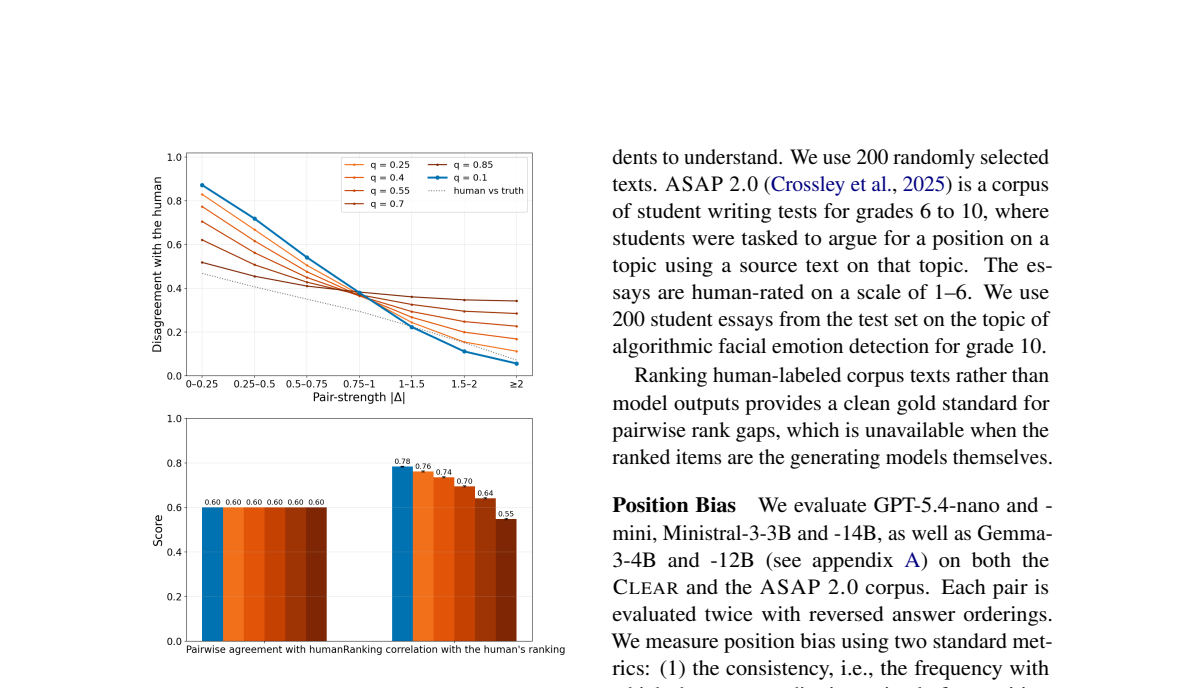
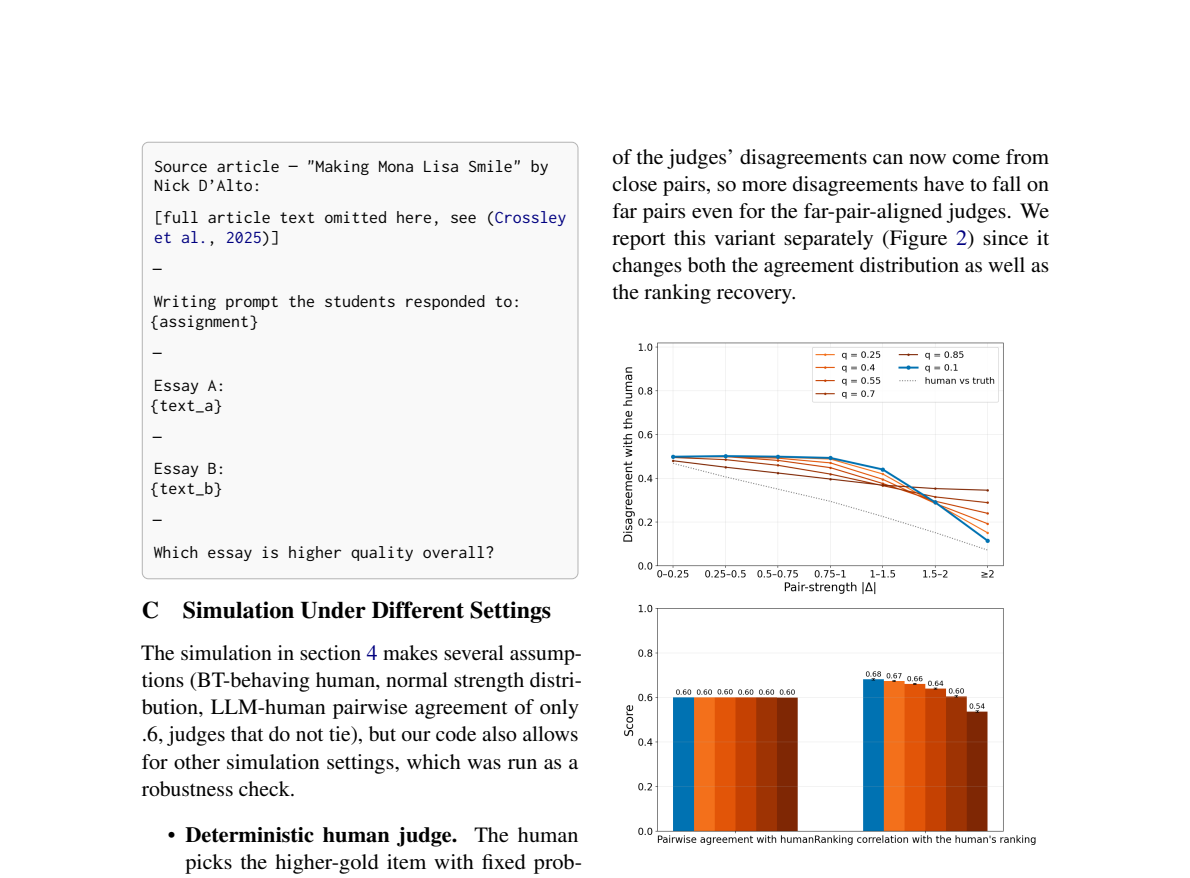
Because these proxies drive judge selection and benchmarking, a substantial literature reporting that judges perform poorly on them risks steering practitioners away from otherwise capable evaluators. We argue this assessment is misleading. Under the Bradley–Terry geometry underlying pairwise aggregation, each proxy is dominated by close-rank-gap pairs, where inconsistency is expected and errors cost little aggregate ranking accuracy; far-gap pairs determine the ranking accuracy but barely move the proxies. We formalize this argument and validate it in a controlled simulation and on two human-rated corpora: the proxies correlate only weakly with ranking accuracy against gold, and their predictive component concentrates in the far-gap regime. Judges should therefore be assessed on rank-gap-conditional metrics, ideally against human rankings. Code at https://github.com/brunobrocai/PairDifficulty
from the abstract
Pith says
Machine review · deepseek-v4-flash · 30 Sep 2026 · of version 1 of the paper; version 3 is newer · what was read was not recorded · not checked by a person
It can be wrong. Challenge this review or reply to it.
Holds up, with conditions. Correct BT math and a genuinely useful practical point, but the measured 'consistency' proxy measures ties, not the decisive wrong verdicts the theory prices, so the justification and measurement don't align. This line is wrong
2 major objections · 3 minor
How often objections from reviews like this one are right: not yet measured
Not checked: figures, code, what the references say.
The paper says, at Section 3 and Table 1 (flip cost vs. tie)
The review did not quote this passage.
Pith says: Objection 1 of 2 · major
Section 3 prices a 'flipped verdict' as an outcome inconsistent with the latent ordering, with log-likelihood cost |Δ|, and concludes that far-pair self-inconsistency 'pulls the MLE toward revising' the strengths. But the empirical consistency metric in Table 1 is the frequency of retaining the same verdict after position reversal, and the paper itself states in the Position Bias paragraph that 'a flipped verdict amounts to a tie under balanced aggregation.'
more of objection 1
A tie contributes zero log-likelihood to the BT fit; it withholds evidence for that pair rather than forcing θ̂ to absorb a |Δ| penalty. The Section 4 simulation does not resolve this: its judges pick the human's winner with probability 0.6, so 40% of outcomes are explicit decisive disagreements, not ties, and the simulation therefore validates only the wrong-verdict reading. The coinflip variant in Appendix C is the relevant one for the measured quantity, and the authors report a smaller separation there. The authors should either (i) derive the cost of ties/dropped pairs under balanced aggregation and show that far-pair dominance survives in that model, (ii) re-measure the proxy so it matches the theory (e.g., far-pair wrong-verdict rates against gold rather than flip rates), or (iii) explicitly reframe the self-consistency result as 'decisive far-pair judgments are informative' without the |Δ| mechanism. As written, the theory and the measurement address different error types.
The paper says, at Table 2 (N=12 far-consistency correlation)
The review did not quote this passage.
Pith says: Objection 2 of 2 · major
The paper's single significant proxy result is Spearman(consistency-far, ranking ρ) = .897, p = .001 over N=12 judge-corpus points. The two Gemma-3-4B points are jointly the lowest far-consistency values (.46 and .53 versus .84–.97 for the other ten points) and the two lowest ranking correlations (.676 and .668), and the relationship among the remaining points is visibly non-monotonic (e.g., CLEAR far-consistency .97 maps to ρ .788 while .96 maps to ρ .825/.830).
more of objection 2
The abstract claim that the predictive component 'concentrates in the far-gap regime' rests on this one number, so a leave-one-model-out or exclude-Gemma-3-4B robustness check is required; without it, the far-gap concentration conclusion is not established by the reported data. The acknowledged N=12 power limitation (b76) concerns moderate effects, but the actual risk here is that the significant effect is driven by a single atypical model.
3 minor objections
The paper says, at Section 3 (untested prediction)
Pith says: minor objection 1 of 3
The |Δ|-weighting argument is cleanest for judge-versus-human disagreement, but no gap-conditional judge-gold pair-agreement statistic is reported; only self-consistency, IPP, and transitivity are measured. Reporting judge-gold pair agreement by quartile would directly test the theory's cleanest prediction and would not require the tie-vs-wrong-verdict resolution.
The paper says, at Appendix D and Limitations
Pith says: minor objection 2 of 3
The ASAP gold-tie exclusion analysis is commendable and the conclusion (consistency stays close < far; Spearman far-consistency .897 unchanged) is reassuring. The remaining concern is that both corpora are educational-domain; the authors disclose this (b96, b98), and the generalization to QA/leaderboard settings is appropriately flagged as unverified rather than asserted.
show 1 more
The paper says, at Tables 1 and 2
Pith says: minor objection 3 of 3
The claim that 'consistency, IPP, and rank correlation do not track each other' (b56) rests on a small number of pairwise model comparisons within each corpus; this is honest but worth stating explicitly as a qualitative observation pending the larger-scale study the authors recommend.
What would settle it
Extend the Section 4 simulation to vary the type of far-pair error while holding overall pairwise agreement fixed: (i) wrong-verdict errors on far pairs, where the judge actively selects the non-gold item, versus (ii) coin-flip/ties on far pairs, where the judge abandons the pair. Compare ranking correlation with gold under both. Then re-measure Table 1's proxy as the far-gap wrong-verdict rate — the fraction of decisive judge verdicts that disagree with human gold — instead of the self-consistency tie rate, and recompute the Table 2 correlation. If far-pair ties are nearly harmless while wrong verdicts are costly, the current metric conflates the two and the reported +.897 correlation is not evidence for the claimed expensive far-pair flip mechanism.
from the skeptic's reading
How the review went
4 readings by deepseek-v4-flash · 30 Sep 2026
- Reader holds up, with conditions
- Skeptic partly agrees
- Editor wrote the verdict above
- Referee major revision: 2 major objections, 3 minor
Not run on this paper: the simulated authors' defence.
Pith did not check this review's objections against the paper.
The review in full
The review in brief, machine-written
Worth reading. The core practical claim is right: aggregate consistency metrics overweight close-pair behavior where errors are cheap, so a judge indecisive on close pairs but accurate on informative ones can beat a more consistent judge in recovering human rankings. The simulation is clean and the paper is honest about its limitations — ASAP strength proxy noise, educational-domain scope, N=12 power, open-weights determinism.
The soft spot the stress-test flags is real. Section 3 prices a wrong verdict: a decisive flip against the latent ordering costs |Δ| in log-likelihood, so far-pair wrong votes are expensive. But Table 1's consistency is the frequency of retaining the same verdict after position reversal — that is, never flipping. A flip becomes a tie under balanced aggregation, contributing zero log-likelihood; it drops the pair rather than forcing the MLE to absorb a |Δ| penalty. So the BT argument does not directly apply to the measured proxy. The simulation avoids this by using judges that pick the human's winner 60% of the time — 40% are explicit disagreements, not ties. The appendix coinflip variant is closer to the empirical setup, and there the authors concede the effect shrinks. The strong far-pair correlation (Spearman .897) may therefore only show that judges who tie less on far pairs provide more informative comparisons — a weaker claim than 'far-pair flips are the expensive error class.' The practical recommendation survives, but needs reframing from 'BT says far-pair flips are costly' to 'far-pair indecision costs you informative comparisons.'
Secondary: one significant proxy out of five at N=12 supports the headline; the abstract states it more strongly than the data supports. Mild tautology in defining close-pair flips as cheap — fine, but worth making explicit.
For anyone working on LLM-as-a-judge evaluation or benchmark design. It deserves a serious referee; the theory-proxy mismatch needs resolution in revision. I'd bring it to reading group — it's a good argument to argue with.
The strongest objection
The load-bearing soft spot is not the acknowledged ASAP gap noise but a mismatch between the quantity the BT theory prices and the quantity Table 1 measures. Section 3 defines a 'flipped verdict' as the outcome inconsistent with the latent ordering, whose log-likelihood cost is |Δ|; on far pairs this is claimed to 'pull the MLE toward revising' the strengths. But Table 1's 'consistency' is the frequency of retaining the same verdict after swapping positions, and the paper itself says 'a flipped verdict amounts to a tie under balanced aggregation' and later interprets it as indecision. A far-pair tie is not a wrong verdict: after balanced aggregation it contributes zero log-likelihood and simply drops that pair, losing at most some evidence rather than forcing the MLE to absorb a |Δ| penalty. Thus the formal statement that far-pair self-inconsistency is expensive does not apply to the empirical proxy. The Section 4 simulation validates the theory only under the wrong-verdict reading: simulated judges pick the human's winner 60% of the time, so 40% are explicit disagreements, not ties. Consequently the strong far-pair correlation in Table 2 (Spearman .897) may only show that judges who tie less on far pairs provide more informative comparisons. That is a weaker and different claim than 'far-pair flips are the expensive error class.' The practical recommendation can survive, but the BT-geometry justification as written conflates two distinct error types: a decisive wrong vote versus an abstaining tie.
The reader identified the assumption that judge inconsistency is Bradley-Terry-compatible, but the more specific and load-bearing issue is that the empirical 'flip' is a tie, not a wrong verdict. The theory's |Δ| cost argument applies to the latter, while Table 1 measures the former; the Section 4 simulation also models wrong verdicts rather than ties. This does not overturn the empirical observation that aggregate proxies correlate weakly, nor the practical recommendation to use rank-gap-conditional metrics against human rankings, because the information-loss interpretation still supports the broad conclusion and the code and simulation are independently inspectable. It does, however, mean that the theoretical mechanism as stated does not directly justify the far-pair consistency correlation, which should be re-examined under an explicit tie-versus-wrong-verdict decomposition. The verdict therefore remains CONDITIONAL: the claim is plausible and well-motivated, but the central theoretical justification for the empirical proxy needs this distinction resolved before the reframing is adopted as general judge-selection guidance.
The referee's report
The practical recommendation—evaluate judges on gap-conditional metrics against human gold rather than aggregate consistency—is valuable and actionable, and the empirical pattern (flips concentrate on close pairs; consistency does not track ranking correlation) is real, reproducible, and worth publishing. The core BT observation (log σ(Δ) − log σ(−Δ) = |Δ|) is correct, parameter-free, and cleanly stated; the simulation is well controlled; the ASAP gold-tie robustness check in Appendix D is good practice; and the Limitations honestly disclose the proxy noise (b93–b94) and domain scope (b96). However, the headline formal claim is applied to a measured quantity it does not price: Section 3's |Δ| cost is for a wrong decisive verdict, while the consistency metric counts flips that the paper itself treats as ties under balanced aggregation (b54). That conflation, together with the fragility of the single significant far-gap correlation in Table 2, means the central justification needs rework before the claims as stated can be accepted.
Pith's reading of the paper (a machine's summary, not the authors')
The paper argues that the standard metrics used to judge LLM judges — position bias, transitivity, and pairwise agreement — systematically misreport how good a judge actually is. Under the Bradley–Terry geometry used to aggregate pairwise verdicts, all three proxies are dominated by close-rank-gap pairs, where a flipped verdict costs almost no ranking information, while the far-gap pairs that carry the ranking signal barely move the proxies. The paper formalizes this with a likelihood argument and validates it in a controlled simulation and on two human-rated corpora, where the proxies correlate only weakly with ranking accuracy against gold and their predictive power concentrates in the far-gap regime. The conclusion is that a judge who is indecisive on close pairs but accurate on far pairs can recover human rankings better than a more consistent judge, so practitioners should evaluate judges on rank-gap-conditional metrics against human rankings rather than on aggregate consistency.
What carries the argument. The central object is the Bradley–Terry log-likelihood gap: with latent strengths θi, the probability that item i is preferred over j is σ(θi − θj), and the two outcomes' log-likelihoods differ by exactly the magnitude |Δ| = |θi − θj|. This single identity carries the whole argument: it makes close pairs informationally cheap (a flip shifts the aggregate ranking almost not at all) and far pairs informationally expensive (a flip forces the estimator to move). The paper uses it to show that pair-equal weighting of any reliability proxy systematically overweights the regime that contributes least to ranking distance from gold.
Core claim. Under the Bradley–Terry model, the two outcomes of a pair with latent strength gap Δ = θi − θj differ in log-likelihood by exactly the magnitude |Δ|. Close pairs are near-coinflips: both verdicts are nearly equally consistent with the model, so flipping one costs almost nothing and barely moves the recovered strengths. Far pairs are lopsided, so a flip is strong evidence and forces the maximum-likelihood estimate to revise. All three reliability proxies — position-bias consistency, transitivity, and pairwise agreement — weight every pair equally and therefore report mostly the close-pair noise that matters least for ranking recovery. On CLEAR and ASAP 2.0, consistency, inconsistent-pair primacy, and non-transitivity correlate only weakly (and often nonsignificantly) with rank correlation against human gold, while far-pair consistency correlates strongly (Spearman 0.897). The limiting case is Gemma-3-4B: almost entirely indecisive on close pairs, yet its far-pair verdicts recover a ranking comparable to far more consistent judges.
The premise it rests on. The argument stands on the gold rank gaps being accurate enough to split pairs into close and far regimes; on ASAP 2.0 the gaps come from coarse 1-to-6 pointwise ratings that the authors acknowledge are a noisier estimate of human strength, and if the gaps mis-rank items the close–far segmentation that the empirics depend on distorts.
If the paper is right (Pith's inferences, not the authors')
Practitioners should compute reliability metrics conditioned on the gold rank gap (or on item-pair difficulty) rather than averaging over all pairs, since the aggregate number reports mostly close-pair noise.
A judge that is indecisive on close pairs but accurate on far pairs is a better ranking instrument than a more consistent judge whose errors land on far pairs, so consistency alone should not disqualify a judge.
Benchmark design should aim for response spread rather than difficulty: item pools producing uniformly strong or uniformly weak responses compress the gap and rob the judge of ranking signal.
Position bias and non-transitivity are largely re-expressions of close-pair indecision, so chasing lower bias and higher pairwise agreement targets the regime where ranking signal is cheapest.
The direct evaluation criterion should be agreement between human and LLM rankings, with imperfect local consistency treated as non-disqualifying.
The argument suggests a reinterpretation of widely reported judge failures: a model that flip-flops on ties but ranks well-separated outputs correctly is behaving like an ideal Bayesian judge, and the same gap-weighting logic would extend to preference-aggregation settings beyond text.
If correct, the theory implies that close-pair disagreement between human raters is irreducible noise, so judge–human close-pair agreement should be measured against a floor set by human–human agreement rather than compared to perfect agreement.
The claim predicts a testable extension into leaderboard settings: models that look inconsistent in head-to-head arena data may still recover the correct ordering of well-separated systems, so rank-gap-conditional metrics should be inspected before discounting such a judge.
A concrete extension the paper leaves open: measuring whether annotator disagreement genuinely tracks the rank gap — which the authors note has not been systematically studied — would give a calibration-free proxy for pair difficulty usable where gold strengths are unavailable.
Check this review
Pith stored no record of this review's passes and took no fingerprint of it. Reviews made by code from 13 Nov 2026 on carry both.
How often reviews like this one are right
Reviews like this one: written by deepseek-v4-flash, where what was read was not recorded.
How often objections from reviews like this one are right: not yet measured
Reviews by people
This review was written by a machine. No person has reviewed this paper on Pith yet. A scientist listed on Pith can review it for a fee, and their review is published here whatever it concludes.
The paper
Abstract
Large Language Model judges are widely used to rank texts and text-generating systems through pairwise comparison, and their reliability is typically assessed via three proxies: position bias, transitivity, and pairwise agreement (self- or human-labeled). Because these proxies drive judge selection and benchmarking, a substantial literature reporting that judges perform poorly on them risks steering practitioners away from otherwise capable evaluators. We argue this assessment is misleading. Under the Bradley–Terry geometry underlying pairwise aggregation, each proxy is dominated by close-rank-gap pairs, where inconsistency is expected and errors cost little aggregate ranking accuracy; far-gap pairs determine the ranking accuracy but barely move the proxies. We formalize this argument and validate it in a controlled simulation and on two human-rated corpora: the proxies correlate only weakly with ranking accuracy against gold, and their predictive component concentrates in the far-gap regime. Judges should therefore be assessed on rank-gap-conditional metrics, ideally against human rankings. Code at https://github.com/brunobrocai/PairDifficulty
The paper's own sentences, arranged, kept beside the review and separate from it. Each label is drawn from a closed vocabulary; the number beside it is the probability the classifier gave that label. No sentence in this record was written by a model.
abstract compiled · 2026-09-30
The authors' main claim, as the classifier picked it out 0.90
“Judges should therefore be assessed on rank-gap-conditional metrics, ideally against human rankings.”
How the main claim is stated: asserted 0.64
What the abstract itself states, as probabilities: claims first 0.05 · states limitation 0.16 · human participants 0.40 · controlled comparison 0.18 · randomized assignment 0.03 · states quantitative result 0.11 · compares with prior results 0.47 · mentions code or data availability 0.98
The abstract, sentence by sentence
This table labels the abstract only (arXiv listing abstract v1). The number is the probability the classifier gave the label.
| Sentence | Role | The authors' own work | States the main conclusion | Strength |
|---|---|---|---|---|
| Large Language Model judges are widely used to rank texts and text-generating systems through pairwise comparison, and their reliability is typically assessed via three proxies: position bias, transitivity, and pairwise agreement (self- or human-labeled). | background 1.00 | 0.05 | 0.02 | asserted 1.00 |
| Because these proxies drive judge selection and benchmarking, a substantial literature reporting that judges perform poorly on them risks steering practitioners away from otherwise capable evaluators. | background 0.88 | 0.05 | 0.03 | hedged possibility 0.65 |
| We argue this assessment is misleading. | contribution 0.36 | 0.10 | 0.17 | asserted 1.00 |
| Under the Bradley--Terry geometry underlying pairwise aggregation, each proxy is dominated by close-rank-gap pairs, where inconsistency is information-theoretically expected and individual verdicts contribute little to the aggregate ranking; far-gap pairs carry the ranking signal but barely move the proxies. | interpretation 0.56 | 0.47 | 0.31 | asserted 1.00 |
| We formalize this argument and validate it in a controlled simulation and on two human-rated corpora: the proxies correlate only weakly with ranking accuracy against gold, and their predictive component concentrates in the far-gap regime. | result 0.90 | 0.96 | 0.19 | asserted 1.00 |
| Judges should therefore be assessed on rank-gap-conditional metrics, ideally against human rankings. | future work 0.83 | 0.15 | 0.83 | asserted 0.64 |
| Code at https://github.com/brunobrocai/PairDifficulty. | contribution 0.82 | 0.34 | 0.02 | unclear 0.95 |
What kind of paper the classifier reports this is: position or commentary 0.45 · evidence from simulation or computation 0.45
What was examined, and what was not
Sources read
- arXiv listing abstract v1
Not examined
- full text
- figures and tables
- references and citing sentences
- relations to other papers
Levels run
- P abstract
Not run
- S sections
- T body sentences
- C citations
- R cross-paper relations
How the labels were made
Compiled by classifier-1.13.0 via TypeSafe API, question bank abstract-p1-20260923, 2026-09-30: 1 request, 5,647 input tokens.
Every quoted sentence on this record is the authors'. Every label is from Pith's closed vocabulary, with the probability shown beside it. This record as JSON
Figures (2)
Figures are the authors', reproduced from the paper.
Cited by 1 Pith paper
Reviewed papers on Pith that cite this one. The full citation record
Challenges and discussion
Disagree with the review, or know something it missed? Leave a comment, or challenge this review formally: a challenge becomes a permanent entry in this paper's record, and its decision is published here.
Come back by email
A short list of the week's newly reviewed papers. Nothing is sent until you confirm from your inbox, and every email has a link that stops it. No account.
No comments yet.
Sign in to comment