Artificial Intelligence · arXiv:2609.38974 v1 · submitted 30 Sep 2026 · 41 references
RealWorldShop: Benchmarking and Improving Conversational Shopping Agents in Real-World E-commerce
The paper says
“Large language models are reshaping ecommerce from static recommenders into interactive shopping assistants, yet real-world shopping requires session-level decision support: users reveal and revise constraints, coordinate multiple goals, and expect product-grounded recommendations over a full conversation.”
more of the abstract
Existing benchmarks are mostly outcome-oriented or execution-oriented, leaving this evolving decision process under-evaluated. We introduce REALWORLDSHOP, a benchmark built on 3.28M grounded products, structured shopping episodes, a profile-grounded and actioncontrolled user simulator, and role-play evaluation. Our analysis shows that current systems produce locally plausible responses but struggle with state tracking, constraint updating, and grounded convergence, especially under ambiguous intent, bundle, and multi-intent scenarios. We further propose REALSHOP_AGENT, an executable session-control framework with explicit state management, shopping-flow control, catalog-grounded retrieval, and runtime guards. Experiments show that REALSHOP_AGENT consistently outperforms strong baselines on REALWORLDSHOP.
from the abstract
Pith says
Machine review · deepseek-v4-flash · 1 Oct 2026 · what was read was not recorded · not checked by a person
It can be wrong. Challenge this review or reply to it.
Holds up, with conditions. A genuine session-level shopping benchmark, honestly documented, whose central agent gain rests on a self-consistent judge/simulator/rubric stack with no error bars — worth refereeing, but only if the authors release code and add a programmatic grounding check. This line is wrong
3 major objections · 5 minor
How often objections from reviews like this one are right: not yet measured
Not checked: figures, code, what the 41 references say.
The paper says, at §4.1, §6.2, Tables 2–4
The review did not quote this passage.
Pith says: Objection 1 of 3 · major
Headline metrics are five-run means with no variance, confidence intervals, or significance tests. The central claims — the 0.71→0.82 success gain of Table 3 and the turn-vs-session gap of Table 2 — are differences between noisy stochastic role-play means; with judge label flip rates of 0.02–0.04 (Table 8) and per-category cells of 100 episodes (Table 4), a 0.10–0.15 success-rate gap is plausibly within sampling noise.
more of objection 1
The paper should report per-run spread (or CIs) and, for the Table 3 comparisons, paired significance tests over the five runs.
The paper says, at §3.4, §C.6, Figure 9 vs. Figure 7 and §F.2
The review did not quote this passage.
Pith says: Objection 2 of 3 · major
The success metric is determined entirely by the holistic LLM judge, which is shown the hidden constraints rather than by any judge-independent verification that the final SKUs satisfy those constraints against the catalog. Because the simulator reveals hidden constraints only when the assistant asks a relevant question (Figure 7), the GRPO reward terms mirror the judged dimensions (r_constraint, r_ground in …
more of objection 2
… §F.2), and the agent prompt encodes the same clarify–verify–confirm policy (Figure 8), part of the reported 0.71→0.82 gain could reflect the agent emitting the judge-rewarded interaction pattern rather than genuinely achieving grounded constraint satisfaction. The authors acknowledge LLM-judge sensitivity (b184), but that is precisely the load-bearing measure here. A concrete remedy within scope: add a programmatic check that the final recommended SKUs satisfy the hidden hard constraints against the catalog fields, and report the correlation between this check and the judge's overall_success.
The paper says, at §D, Tables 9–10
The review did not quote this passage.
Pith says: Objection 3 of 3 · major
Simulator validation shows the two dimensions most central to the benchmark's stress claims are the weakest: hidden-intent non-leakage is 0.88 (Table 9) and confirm/end control is 0.92 (Table 10). A 12% leakage rate in ambiguous-intent sessions means latent goals are revealed prematurely in a non-negligible fraction of the exact scenario type the benchmark claims to stress; this could inflate top-line performance and compress the ambiguity-related gaps in Figures 4–5.
more of objection 3
The paper should report how leakage and confirm/end failures are distributed across scenario types and whether the reported findings survive after excluding leaked sessions.
5 minor objections
The paper says, at Table 3
Pith says: minor objection 1 of 5
The row label 'REALSHOP_AGENTFull' is missing a space before 'Full'.
The paper says, at Abstract and §1
Pith says: minor objection 2 of 5
The claim of improving success from 0.71 to 0.82 'over the strongest baseline' should clarify that 0.71 is GPT-5's success rate in Table 2 and is also the success rate of REALSHOP_AGENT with the unadapted Base backbone; the two coincidences make the sentence easy to misread.
show 3 more
The paper says, at Table 2 caption
Pith says: minor objection 3 of 5
The sentence 'Tied results receive the same formatting' is unclear: it is not obvious how bold/underline tie formatting is applied when several systems share a best value.
The paper says, at Figures 2–5
Pith says: minor objection 4 of 5
The figure captions do not state the number of episodes in each slice (e.g., early-exit vs. non-exit, bundle re-planning); adding per-slice counts would let readers assess the stability of the reported 0.98→0.23 state-tracking drop and other per-cell numbers.
The paper says, at Throughout
Pith says: minor objection 5 of 5
No artifact availability statement (URL, license, or data-release plan) is given; for a benchmark paper this is expected and should be added.
What would settle it
Re-score every completed session's final recommended SKUs with a programmatic, judge-independent verifier: mechanically check the retrieved product records behind the final recommendation against the episode's hidden hard constraints using catalog fields (price ≤ budget, category match, cutout size ≤ 75mm, compatibility attribute present, fulfillment tag), using the same grounding criteria the rubric encodes. Compare verifier-based success (converged AND all hard constraints mechanically satisfiable by the final plan) against the GPT-5.5 judge's success for GPT-5, the strongest baseline, and REALSHOP_AGENT. If the agent's verifier-based success drops toward the baseline (i.e., the judge-based margin 0.82−0.71 collapses), the gain is substantially an artifact of the judge–rubric coupling; if the margin persists under mechanical verification, the session-control claim lands.
from the skeptic's reading
How the review went
4 readings by deepseek-v4-flash · 1 Oct 2026
- Reader holds up, with conditions
- Skeptic partly agrees
- Editor wrote the verdict above
- Referee major revision: 3 major objections, 5 minor
Not run on this paper: the simulated authors' defence.
Pith did not check this review's objections against the paper.
The review in full
The review in brief, machine-written
RealWorldShop is a real contribution. The session-level angle is what's new: evaluating state tracking, constraint updating, and decision pacing over full trajectories, grounded in a 3.28M-SKU real inventory with an action-controlled simulator. None of the cited rivals combine those, and the comparison table is fair rather than strawman-y. Finding 1 — agents are better at local turns than session-level control — is plausible and consistent with the numbers. The documentation is unusually thorough: inventory construction, episode synthesis, simulator validation with a human audit, and judge reliability (QWK 0.76–0.89 on 150 human-validated sessions) all look credible and reproducible in principle. The limitations section is honest, not decorative. Credit where it's earned.
The soft spots, in order of weight. First, no code or benchmark release is stated anywhere. For a benchmark paper that's the single biggest thing a referee should demand; right now the 3.28M inventory, episodes, profiles, and agent are not independently checkable. Second, the headline numbers — success 0.71 to 0.82, "consistently outperforms" — are means over five runs with no variance, confidence intervals, or significance test, and the authors themselves flag that LLM-judge bias can affect relative comparisons across model families (b182–b184). Third, the co-design concern lands. The judge rubric (Figure 9), the GRPO reward (F.2), the agent prompt (Figure 8), and the simulator's on-ask disclosure rule (Figure 7) all encode the same clarify–verify–confirm scheme. So part of the 0.11 margin may reward the agent for emitting the expected session-shaped language rather than for genuine convergence. The mitigations are real — the judge is shown the hidden constraints, and the human QWK anchors support rubric-internal consistency — so I wouldn't call the result fabricated. But the paper never validates success against a judge-independent programmatic SKU check on the hidden hard constraints, and that gap is exactly what keeps the central claim from being fully supported.
The reader's CONDITIONAL verdict is right, and the stress-test note is fair; I'd add only that the benchmark's diagnostic findings (early exits driven by state-tracking rather than clarification failures) are the most robust part, because they survive even a lenient reading of the judge bias.
This is for anyone building or evaluating conversational shopping agents. It deserves a serious referee — with heavy revision expectations: release code and data, report variance and significance, add the programmatic grounding check, and present the agent gain as gains relative to their own rubric rather than an external standard.
The strongest objection
The central empirical claims—Finding 1 and the 0.71→0.82 success gain (b27, Table 3)—rest entirely on the synthetic stack, and three of its components are co-designed around the same session-control scheme. (i) The simulator's hidden-state rule reveals constraints only 'when the assistant asks a relevant question, when the target action requires it, or when a recommendation violates them' (Figure 7), so convergence probability is partly determined by whether the agent emits the clarifying questions the disclosure plan anticipates; REALSHOP_AGENT's Shopping-Flow Controller is built to ask exactly those questions. (ii) The GRPO reward in Section F.2 (r_constraint, r_ground, r_tool) and the judge rubric (Figure 9: State Tracking, Constraint Updating, Decision Pacing) penalize the same failure modes. (iii) The agent prompt (Figure 8) encodes the same clarify/verify/confirm policy. It is fair to credit the mitigations: the judge receives the episode's visible and hidden constraints (Figure 9 inputs), which limits pure gaming, and the human QWK anchors (Table 7) support rubric-internal consistency; the authors also acknowledge general LLM-judge sensitivity (b182–b184). What no component covers is external validity: whether 'success' corresponds to a session whose final SKUs genuinely satisfy the hidden hard constraints against the catalog, rather than a session that linguistically performs the expected process. Because baselines and the proposed agent are measured by the same judge on the same rubric, the 0.11-point margin (0.71→0.82, means over five runs with no error bars) could be inflated by the judge rewarding the agent's session-structured phrasing instead of real convergence. This is the load-bearing soft spot of the central claim.
The reader's weakest_assumption (fidelity of the synthetic evaluation stack) is correct, and my concern is its sharpest concrete instance: the simulator's on-ask disclosure policy, the GRPO reward terms, and the judge rubric are co-designed around the same clarify–verify–confirm scheme, so the agent's gain can partly measure self-consistency with its own harness. I differ from the reader in emphasis rather than direction: the reader stresses general LLM-judge bias, which the authors already acknowledge (b182–b184); the unacknowledged residual is the design-level coupling plus the absence of a judge-independent check of grounding. I credit the genuine mitigations—the judge's access to hidden constraints, the human validation anchors (Table 7), and the simulator audits in Appendix D—so this is not an argument for REJECT. It is precisely the kind of condition the reader's CONDITIONAL verdict should carry: a single, mechanical falsification test that would confirm or dissolve the 0.71→0.82 claim. Hence UNCHANGED (keep CONDITIONAL) rather than a move toward ACCEPT, since the deciding check has not been run.
The referee's report
If the result holds, the paper makes a useful contribution on two fronts: it supplies a benchmark that sits between outcome-oriented and execution-oriented evaluations, with a structured episode formulation (E = <P,S,Π>) that cleanly separates visible prior from latent state and enables controlled partial-observability evaluation; and it provides evidence that an explicit, guarded session-control loop is a valuable design pattern for conversational shopping agents. Strengths I want to credit explicitly: the judge-reliability validation is substantive (Table 7: QWK 0.76–0.89 with exact agreement 0.88–0.97 on 150 human-validated sessions; Table 8: repeated-judging ICC 0.86–0.92), the simulator is validated on both profile faithfulness and action controllability (Tables 9–10), the judge receives the visible and hidden constraints (Figure 9), which limits blatant gaming, and the limitations section honestly acknowledges LLM-judge sensitivity (b182–b184) and simulator approximation (b187–b188). The diagnostic slicing by scenario, phenomenon, and interaction style (Figures 2–5) is a genuinely useful resource for the community.
Pith's reading of the paper (a machine's summary, not the authors')
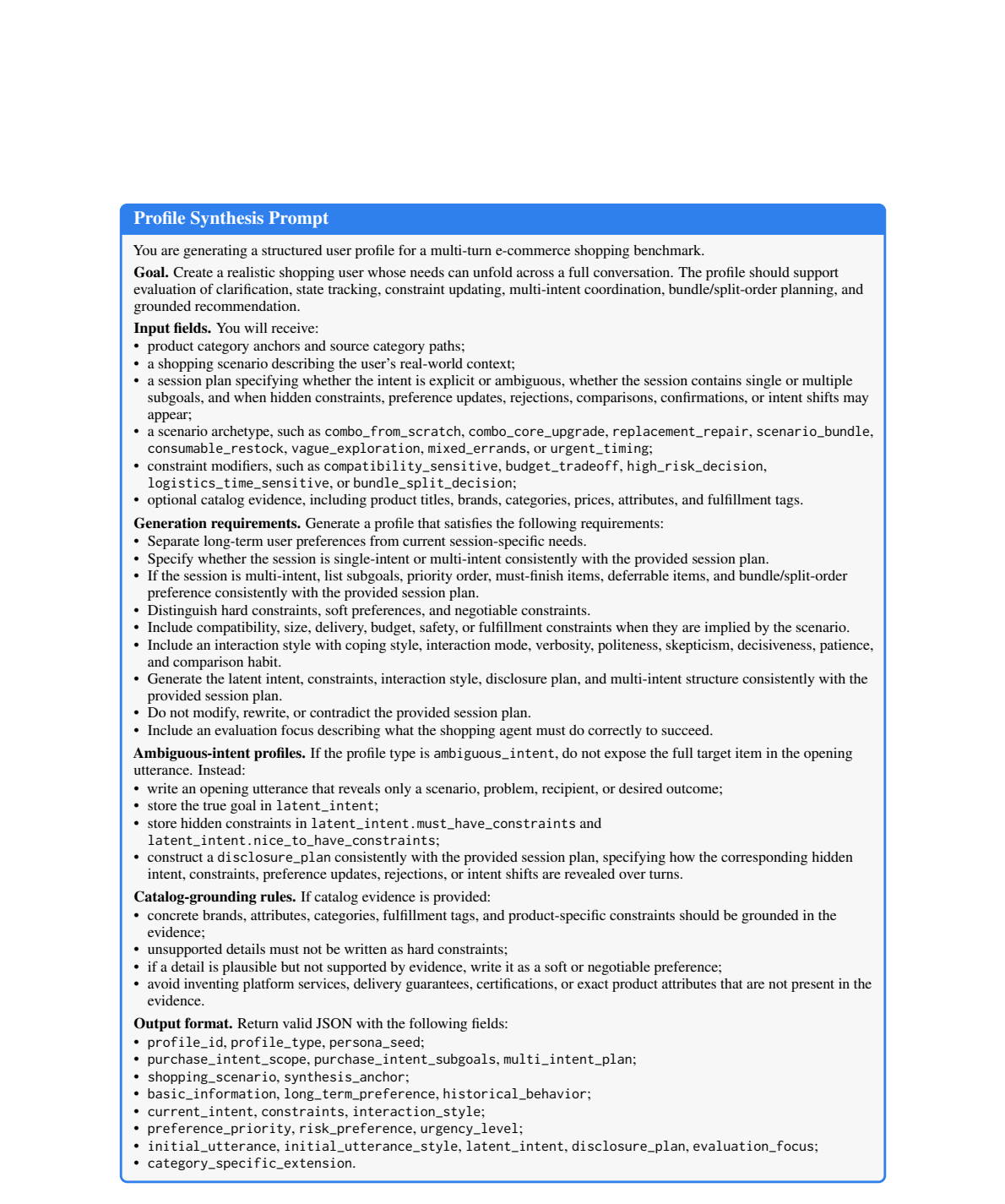
This paper tries to establish that conversational shopping agents are substantially better at generating fluent, plausible replies in individual turns than at managing a full shopping session, and that the gap is structural, not cosmetic. It builds REALWORLDSHOP, a benchmark on 3.28M real catalog products, roughly 1,200 structured shopping episodes, over 2,000 synthesized user profiles, and a role-play protocol with a simulated shopper and an LLM judge, so that agents are evaluated under evolving constraints, partial observability, and pressure to converge to a grounded purchase. The paper then argues that the fix is an explicit session-control framework, REALSHOP_AGENT, which maintains evolving user state, decides when to clarify, retrieve, verify, compare, recommend, or confirm, grounds claims in catalog evidence, and applies runtime guards, lifting success rate from 0.71 (the strongest baseline) to 0.82. A sympathetic reader would care because the claim, if true, moves conversational shopping from a response-generation problem to a state-driven decision-control problem, which changes how such agents should be built and evaluated.
What carries the argument. The load-bearing mechanism is an explicit session-control loop around a policy model, rather than open-ended response generation. At each turn the agent maintains an explicit session state $M_t$ holding revealed intents, active subgoals, hard and soft constraints, rejected options, confirmed preferences, and stale dependencies; a Shopping-Flow Controller selects one of six high-level actions, CLARIFY, RETRIEVE, VERIFY, COMPARE, RECOMMEND, and CONFIRM, deciding not just what to do but when to progress from elicitation to search, verification, comparison, recommendation, and commitment; a Catalog-Grounded Retriever returns structured evidence records so SKU-level claims are traceable to the current catalogue; and Runtime Execution Guards (TOOLBUDGET, FABRICATIONGUARD, STATECONSISTENCYGUARD) block over-retrieval, unsupported product claims, and recommendations tied to stale subgoals or superseded constraints. The four modules form the control loop the paper credits with stabilizing state tracking, action timing, grounding, and convergence over long sessions.
Core claim. On the paper's own terms, the central discovery is a diagnosis and a remedy. The diagnosis: across all systems tested, session-level competence is consistently lower than turn-level quality, with the average general LLM dropping from a turn average of 1.08 to a session average of 0.80, and specialized shopping-agent methods dropping from 1.14 to 0.90, even GPT-5 showing the same gap (Finding 1, Section 4.2). The paper argues this is not a problem of asking too few questions: early exits are driven primarily by state-tracking failures, with state tracking dropping sharply from 0.98 to 0.23 in early-exit sessions while clarification drops only mildly from 1.43 to 1.25 (Finding 2). The remedy is REALSHOP_AGENT, an executable session-control harness whose explicit state manager, flow controller, catalog-grounded retriever, and runtime guards close the local-to-session gap from 0.31 to 0.07, cut early exits from 0.25 to 0.09, and raise success from 0.71 (the strongest baseline) to 0.82, with backbone adaptation alone (SFT/RL) reaching only 0.65.
The premise it rests on. The entire diagnosis and the claimed 0.71-to-0.82 gain rest on the synthetic evaluation stack, a GPT-5.5 judge scoring dialogues on the authors' rubric and a Kimi-K2.6 simulated shopper that follows a programmatic disclosure plan, faithfully approximating real shopper decision quality.
If the paper is right (Pith's inferences, not the authors')
Evaluation of conversational shopping agents should move from turn-level or outcome-only metrics to session-level metrics that enforce partial observability, catalog grounding, and convergence pressure, since turn-level scores systematically overestimate real competence.
Explicit session control, not larger or better-trained backbones, is what closes the local-to-session gap: adapting the Qwen3.5-27B backbone alone raises success from 0.55 to 0.65, while adding the control harness over the unadapted backbone reaches 0.71 and the full system 0.82.
Early-exit prevention should target state tracking and constraint updating, because user abandonment in this benchmark tracks forgetting or failing to act on revealed information more than it tracks insufficient clarification.
Runtime guards against stale-state and unsupported-SKU claims are transferable design elements likely to help any deployed shopping agent, not only the one proposed here.
The diagnosis likely generalizes beyond shopping: any long-horizon conversational agent that must hold and revise user state, from support to booking, may show the same turn-level fluency masking session-level drift; the paper only tests shopping, so this extension is mine, not the authors'.
If the LLM judge is in fact sensitive to surface fluency and session-structured language, some of the baseline-versus-agent gap could be an artifact of the judge rewarding structured output rather than genuine grounding; a re-judging experiment that strips or shuffles the agent's structural formatting would isolate the control-loop gain.
The fixed 3.28M-SKU snapshot freezes prices, stock, and promotions, so the benchmark measures governed decision-making under static supply; a live-catalogue variant would test whether the control loop and its guards persist when marketplace facts change mid-session.
Check this review
Pith stored no record of this review's passes and took no fingerprint of it. Reviews made by code from 13 Nov 2026 on carry both.
How often reviews like this one are right
Reviews like this one: written by deepseek-v4-flash, where what was read was not recorded.
How often objections from reviews like this one are right: not yet measured
Reviews by people
This review was written by a machine. No person has reviewed this paper on Pith yet. A scientist listed on Pith can review it for a fee, and their review is published here whatever it concludes.
The paper
Abstract
Large language models are reshaping ecommerce from static recommenders into interactive shopping assistants, yet real-world shopping requires session-level decision support: users reveal and revise constraints, coordinate multiple goals, and expect product-grounded recommendations over a full conversation. Existing benchmarks are mostly outcome-oriented or execution-oriented, leaving this evolving decision process under-evaluated. We introduce REALWORLDSHOP, a benchmark built on 3.28M grounded products, structured shopping episodes, a profile-grounded and actioncontrolled user simulator, and role-play evaluation. Our analysis shows that current systems produce locally plausible responses but struggle with state tracking, constraint updating, and grounded convergence, especially under ambiguous intent, bundle, and multi-intent scenarios. We further propose REALSHOP_AGENT, an executable session-control framework with explicit state management, shopping-flow control, catalog-grounded retrieval, and runtime guards. Experiments show that REALSHOP_AGENT consistently outperforms strong baselines on REALWORLDSHOP.
The paper's own sentences, arranged, kept beside the review and separate from it. Each label is drawn from a closed vocabulary; the number beside it is the probability the classifier gave that label. No sentence in this record was written by a model.
abstract compiled · 2026-10-01
The authors' main claim, as the classifier picked it out 0.97
“Experiments show that REALSHOP_AGENT consistently outperforms strong baselines on REALWORLDSHOP.”
How the main claim is stated: asserted 1.00
What the abstract itself states, as probabilities: claims first 0.11 · states limitation 0.12 · human participants 0.13 · controlled comparison 0.90 · randomized assignment 0.02 · states quantitative result 0.82 · compares with prior results 0.95 · mentions code or data availability 0.07
The abstract, sentence by sentence
This table labels the abstract only (arXiv listing abstract v1). The number is the probability the classifier gave the label.
| Sentence | Role | The authors' own work | States the main conclusion | Strength |
|---|---|---|---|---|
| Large language models are reshaping ecommerce from static recommenders into interactive shopping assistants, yet real-world shopping requires session-level decision support: users reveal and revise constraints, coordinate multiple goals, and expect product-grounded recommendations over a full conversation. | background 0.96 | 0.07 | 0.05 | asserted 1.00 |
| Existing benchmarks are mostly outcome-oriented or execution-oriented, leaving this evolving decision process under-evaluated. | gap 1.00 | 0.06 | 0.03 | asserted 1.00 |
| We introduce REALWORLDSHOP, a benchmark built on 3.28M grounded products, structured shopping episodes, a profile-grounded and actioncontrolled user simulator, and role-play evaluation. | contribution 0.82 | 0.93 | 0.06 | asserted 1.00 |
| Our analysis shows that current systems produce locally plausible responses but struggle with state tracking, constraint updating, and grounded convergence, especially under ambiguous intent, bundle, and multi-intent scenarios. | result 0.99 | 0.93 | 0.21 | asserted 1.00 |
| We further propose REALSHOP_AGENT, an executable session-control framework with explicit state management, shopping-flow control, catalog-grounded retrieval, and runtime guards. | contribution 0.51 | 0.89 | 0.08 | asserted 0.98 |
| Experiments show that REALSHOP_AGENT consistently outperforms strong baselines on REALWORLDSHOP. | result 1.00 | 0.96 | 0.64 | asserted 1.00 |
What kind of paper the classifier reports this is: dataset or benchmark 0.99 · evidence from observation or experiment 0.99
What was examined, and what was not
Sources read
- arXiv listing abstract v1
Not examined
- full text
- figures and tables
- references and citing sentences
- relations to other papers
Levels run
- P abstract
Not run
- S sections
- T body sentences
- C citations
- R cross-paper relations
How the labels were made
Compiled by classifier-1.13.0 via TypeSafe API, question bank abstract-p1-20260923, 2026-10-01: 1 request, 5,037 input tokens.
Every quoted sentence on this record is the authors'. Every label is from Pith's closed vocabulary, with the probability shown beside it. This record as JSON
Figures (16)





Figures are the authors', reproduced from the paper.
References (41)
- [1] Shoppingbench: A real-world intent-grounded shopping benchmark for llm-based agents , author =. Proceedings of the AAAI Conference on Artificial Intelligence , volume =. 2026 , publisher = on Pith
- [2] Deepshop: A benchmark for deep research shopping agents , author=. arXiv preprint arXiv:2506.02839 , year= on PithPith's reviewarXiv
- [3] Recoworld: Building simulated environments for agentic recommender systems , author=. Companion Proceedings of the ACM Web Conference 2026 , pages= on Pith
- [4] Kim, SungHwan and Seo, Kwangwook and Kim, Tongyoung and Yeo, Jinyoung and Lee, Dongha. Stop Playing the Guessing Game! Evaluating Conversational Recommender Systems via Target-free User Simulation. Findings of the Association for Computational Linguistics: EMNLP 2025. 2025. do... on Pithdoi:10.18653/v1/2025.findings-emnlp.1067
- [5] Towards next-generation recommender systems: A benchmark for personalized recommendation assistant with llms , author =. Web Search and Data Mining , pages =. 2026 , doi = on Pith
- [6] Opera: A dataset of observation, persona, rationale, and action for evaluating llms on human online shopping behavior simulation , author =. Proceedings of the 64th Annual Meeting of the Association for Computational Linguistics (Volume 1: Long Papers) , year =. doi:10.18653/v... on Pithdoi:10.18653/v1/2026.acl-long.2033
- [7] RecToM: A Benchmark for Evaluating Machine Theory of Mind in LLM-based Conversational Recommender Systems , author =. Proceedings of the AAAI Conference on Artificial Intelligence , volume =. 2026 , doi = on Pith
- [8] Recusersim: A realistic and diverse user simulator for evaluating conversational recommender systems , author =. The Web Conference , pages =. 2025 , doi = on Pith
- [9] Concept--An Evaluation Protocol on Conversational Recommender Systems with System-centric and User-centric Factors , author =. arXiv.org , year = on Pith
- [10] Beyond persuasion: Towards conversational recommender system with credible explanations , author =. Findings of the Association for Computational Linguistics: EMNLP 2024 , pages =. 2024 , doi = on Pith
- [11] ChatShopBuddy: Towards Reliable Conversational Shopping Agents via Reinforcement Learning , author =. arXiv.org , year = on Pith
- [12] EComStage: Stage-wise and Orientation-specific Benchmarking for Large Language Models in E-commerce , author =. arXiv.org , year = on Pith
- [13] Search-Based Interaction For Conversation Recommendation via Generative Reward Model Based Simulated User , author =. Annual International ACM SIGIR Conference on Research and Development in Information Retrieval , pages =. 2025 , doi = on Pith
- [14] SAPIENT: Mastering multi-turn conversational recommendation with strategic planning and Monte Carlo tree search , author =. Proceedings of the 2025 Conference of the Nations of the Americas Chapter of the Association for Computational Linguistics: Human Language Technologies (... on Pith
- [15] Llm-redial: A large-scale dataset for conversational recommender systems created from user behaviors with llms , author =. Annual Meeting of the Association for Computational Linguistics , pages =. 2024 , doi = on Pith
- [16] A Framework for Generating Conversational Recommendation Datasets from Behavioral Interactions , author =. arXiv.org , year = on Pith
- [17] Fashion-AlterEval: A Dataset for Improved Evaluation of Conversational Recommendation Systems with Alternative Relevant Items , author =. ACM Conference on Recommender Systems , pages =. 2025 , doi = on Pith
- [18] Expectation Confirmation Preference Optimization for Multi-Turn Conversational Recommendation Agent , author =. Findings of the Association for Computational Linguistics: ACL 2025 , pages =. 2025 , doi = on Pith
- [19] User Simulator-Guided Multi-Turn Preference Optimization for Reasoning LLM-based Conversational Recommendation , author =. arXiv.org , year = on Pith
- [20] PersonaX: A recommendation agent-oriented user modeling framework for long behavior sequence , author =. Findings of the Association for Computational Linguistics: ACL 2025 , pages =. 2025 , doi = on Pith
show 21 more
- [21] RecThinker: An Agentic Framework for Tool-Augmented Reasoning in Recommendation , author =. arXiv.org , year = on Pith
- [22] Reason-to-recommend: Using interaction-of-thought reasoning to enhance llm recommendation , author =. arXiv.org , year = on Pith
- [23] Unleashing the Native Recommendation Potential: LLM-Based Generative Recommendation via Structured Term Identifiers , author =. Findings of the Association for Computational Linguistics: ACL 2026 , year =. doi:10.18653/v1/2026.findings-acl.984 , publisher = on Pithdoi:10.18653/v1/2026.findings-acl.984
- [24] Agentcf: Collaborative learning with autonomous language agents for recommender systems , author=. Proceedings of the ACM Web Conference 2024 , pages= on Pith
- [25] Zhu, Yaochen and Steck, Harald and Liang, Dawen and He, Yinhan and Kallus, Nathan and Li, Jundong. LLM -based Conversational Recommendation Agents with Collaborative Verbalized Experience. Findings of the Association for Computational Linguistics: EMNLP 2025. 2025. doi:10.1865... on Pithdoi:10.18653/v1/2025.findings-emnlp.119
- [26] Kim, Tongyoung and Lee, Jeongeun and Yoon, SooJin and Kim, SungHwan and Lee, Dongha. Towards Personalized Conversational Sales Agents: Contextual User Profiling for Strategic Action. Findings of the Association for Computational Linguistics: EMNLP 2025. 2025. doi:10.18653/v1/2... on Pithdoi:10.18653/v1/2025.findings-emnlp.275
- [27] Agentic feedback loop modeling improves recommendation and user simulation , author =. Proceedings of the 48th International ACM SIGIR conference on Research and Development in Information Retrieval , pages =. 2025 , doi = on Pith
- [28] Openai gpt-5 system card , author =. arXiv preprint arXiv:2601.03267 , year = on PithPith's reviewarXiv
- [29] Gemini 2.5: Pushing the frontier with advanced reasoning, multimodality, long context, and next generation agentic capabilities , author=. arXiv preprint arXiv:2507.06261 , year= on PithPith's reviewarXiv
- [30] Gpt-4o system card , author=. arXiv preprint arXiv:2410.21276 , year= on PithPith's reviewarXiv
- [31] Deepseek-v3.2: Pushing the frontier of open large language models , author=. arXiv preprint arXiv:2512.02556 , year= on PithPith's reviewarXiv
- [32] Kimi k2: Open agentic intelligence , author=. arXiv preprint arXiv:2507.20534 , year= on PithPith's reviewarXiv
- [33] Qwen3 technical report , author =. arXiv , year = on Pith
- [34] Zilin Zhu and Chengxing Xie and Xin Lv and slime Contributors , title =. 2025 , howpublished = on Pith
- [35] SkillCoach: Self-Evolving Rubrics for Evaluating and Enhancing Agentic Skill-Use , author =. arXiv , year = on Pith
- [36] ComboShoppingBench: Evaluating LLM Agents for Budget-Constrained Basket Shopping with Coupons , author =. arXiv , year = on Pith
- [37] Empathy in Diversity: Personalized Depression and Anxiety Therapy via Dialogue State Tracking and Patient-Aware Planning , author =. Annual Meeting of the Association for Computational Linguistics , pages =. 2026 , doi = on Pith
- [38] Self-Evolving Neuro-Symbolic Skills for Tool-Augmented Spatial Reasoning , author=. arXiv preprint arXiv:2608.07955 , year= on PithPith's reviewarXiv
- [39] Tabularmath: Understanding math reasoning over tables with large language models , author=. Findings of the Association for Computational Linguistics: ACL 2026 , pages= on Pith
- [40] Rethinking evaluation for multi-label drug-drug interaction prediction , author=. Frontiers of Computer Science , volume= on Pith
- [41] Vcsearch: Bridging the gap between well-defined and ill-defined problems in mathematical reasoning , author=. Proceedings of the 2025 Conference on Empirical Methods in Natural Language Processing , pages= on Pith
Cited by 1 Pith paper
Reviewed papers on Pith that cite this one. The full citation record
Challenges and discussion
Disagree with the review, or know something it missed? Leave a comment, or challenge this review formally: a challenge becomes a permanent entry in this paper's record, and its decision is published here.
Come back by email
A short list of the week's newly reviewed papers. Nothing is sent until you confirm from your inbox, and every email has a link that stops it. No account.
No comments yet.
Sign in to comment