Quantum Physics · arXiv:2609.39522 v2 · submitted 30 Sep 2026
Layer codes as quantum memories: syndrome extraction, thresholds and idle robustness
The paper says
“Layer codes are three-dimensional local CSS codes of check weight at most six, obtained by quasi-concatenating a CSS input code with unrotated surface code patches. What is established about them describes the code, not the circuit that measures it.”
more of the abstract
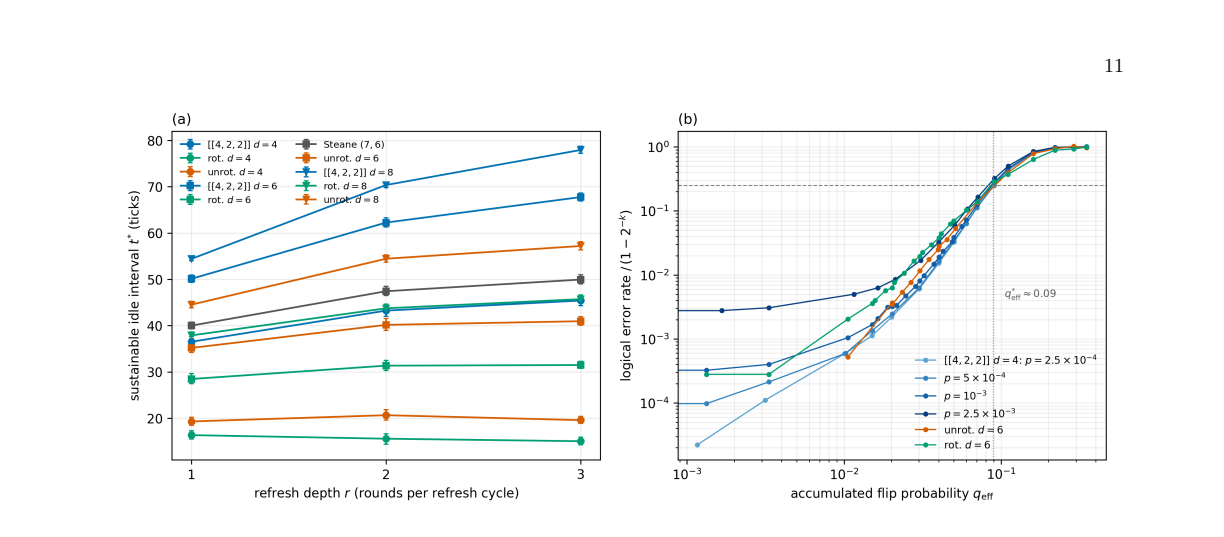
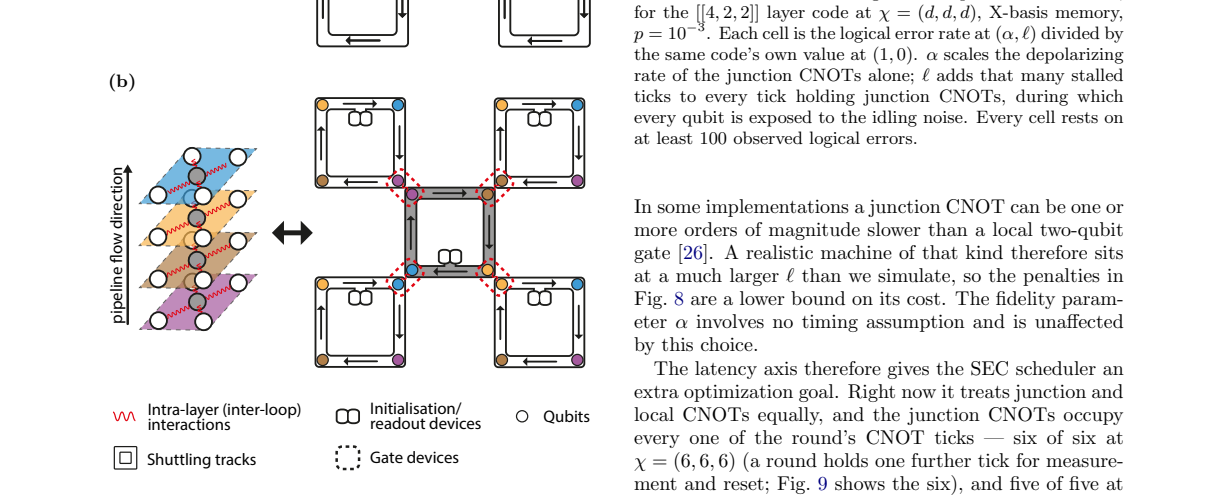
In this work, we evaluate them as active memories under circuit-level noise. Doing so first requires a syndrome extraction circuit, and the junction stabilizers that couple the patches rule out borrowing a surface code patch's CNOT schedule. We present a decoder-free scheduler that constrains hook propagation first and compresses depth afterwards, generate circuits for eighteen layer codes across four input codes, and compare them with surface codes of the same distance, simulated and decoded in the same way. The circuits lose no distance to hook errors on [[4,2,2]]-input codes wherever a circuit-distance proof is affordable, and reach a lower logical error rate than those of a general-purpose scheduler for CSS codes at roughly half its CNOT depth per round. Our primary family built from a [[4,2,2]] input code reaches a circuit-level threshold of 5.06(7) × 10−3. The layer code outperforms the surface code in terms of idle robustness: at the same distance it tolerates an interval between syndrome extraction rounds 1.7-3.0 times longer than the rotated surface code. This comes at the cost of 1.7-5.0 times more operations per unit time and approximately five times more physical qubits, both per logical qubit. Finally, we model the cost of the beyond-2D cross-plane CNOTs that the construction demands, and find that their speed matters far more than their fidelity.
from the abstract
Pith says
Machine review · deepseek-v4-flash · 1 Oct 2026 · of version 1 of the paper; version 2 is newer · what was read was not recorded · not checked by a person
It can be wrong. Challenge this review or reply to it.
Holds up, with conditions. First circuit-level treatment of layer codes; the scheduler work is durable and the measurement practice is honest, but the idle-robustness headline reverses under the windowed decoders a real-time memory needs — disclosed, yet load-bearing. This line is wrong
2 major objections · 5 minor
How often objections from reviews like this one are right: not yet measured
Not checked: figures, code, what the references say.
The paper says, at Abstract; Sec. IV B (b248, Table II)
The review did not quote this passage.
Pith says: Objection 1 of 2 · major
The abstract's statement that 'the layer code outperforms the surface code in terms of idle robustness' with a '1.7-3.0 times longer' interval, and the concluding sentence b266 ('needs fewer correction rounds per unit storage time'), are presented without the decode-mode condition that the paper's own analysis establishes.
more of objection 1
Sec. IV B shows the margin holds only under one offline global decode of the whole run: under the forward sliding-window real-time decoders tested (W=2-4, c=1-2) at d=6, r=2, the layer code retains only 0.18-0.30 of its offline t* versus 0.46-0.84 for the surface codes, reversing the ordering. Since a memory that must supply corrections during storage requires real-time decoding, the abstract's decoder-independent phrasing overstates what is measured. The body disclosure (b248) is commendable, but the abstract and the conclusion should state the batch-readout/offline-decode condition explicitly, and the 'fewer correction rounds' phrasing should carry the same condition. As written, the paper's headline invites a reading that its own Table II contradicts.
The paper says, at Sec. IV B, Table II
The review did not quote this passage.
Pith says: Objection 2 of 2 · major
The windowed-decode evidence is itself narrow, and the paper should present both the advantage and its reversal as protocol-specific rather than letting either inherit a general reading. Table II covers W=2-4 refresh cycles, commit widths c=1-2, and a single operating point (d=6, r=2, p=10^-3, X memory), and the text notes that a longer commit width already shrinks the penalty by about 1.6x on the layer code.
more of objection 2
Neither the offline-global advantage nor its reversal is therefore established for realistic real-time window sizes, which would span many more refresh cycles and admit overlapping recovery. The honest position is that the advantage is measured in batch-decode mode and that its behaviour under real-time decoding remains unresolved; this should be the framing in the abstract as well as in the body.
5 minor objections
The paper says, at Table I
Pith says: minor objection 1 of 5
The r=1 columns for the layer codes rest on refresh cycles that are non-stationary by the paper's own N=2-versus-N=16 criterion (a factor of 5.1 for the d=8 layer code at r=1). The text explains this and correctly quotes the headline at r=3, but flagging the non-stationary cells in the table itself would prevent readers from comparing raw r=1 entries on equal footing with the r>=2 values.
The paper says, at Sec. V, Fig. 8
Pith says: minor objection 2 of 5
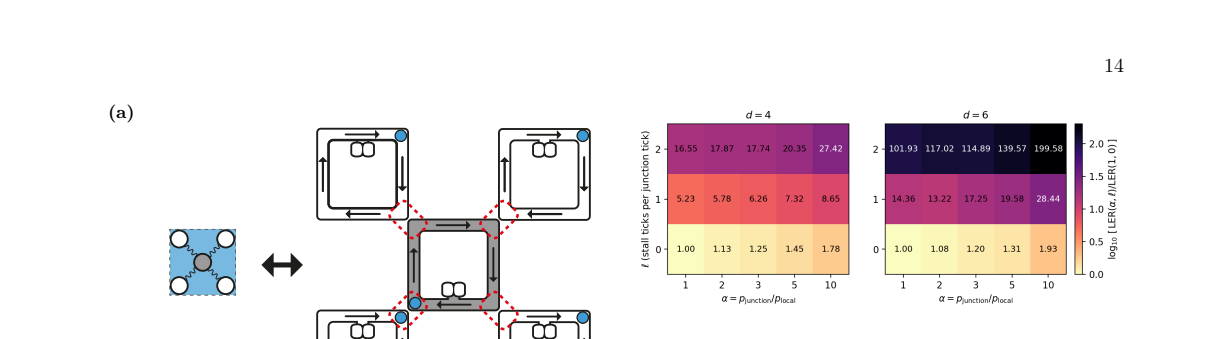
The latency-dominance conclusion (penalties of 5.2-14x at l=1 and 17-102x at l=2, and the junction-concentration gains of 3.3-15.2x) rests on the synchronous-stall model that the paper itself calls 'a qualitative approximation' (b314). The overcounting direction is quantified (at most 7-12% of the register), which is helpful, but given the magnitude of the penalties, a robustness check under a partial-idle or asynchronous schedule would materially strengthen the architectural recommendation that speed matters far more than fidelity.
show 3 more
The paper says, at Sec. IV B, Table I
Pith says: minor objection 3 of 5
The headline margins are quoted at a fixed refresh depth r=3 for all codes, while the surface codes' t* is flat or declining in r (the rotated d=4 interval decreases from 16.3 to 15.0 between r=1 and r=3) and the layer codes' t* rises with r. The convention is stated, but reporting each memory's optimal-r t* as a cross-check would confirm that the margin is not partly a consequence of the shared-r convention.
The paper says, at Code and data availability
Pith says: minor objection 4 of 5
The code, circuits and sampled data are promised only 'on publication'. Since the scheduler's provable-optimality claims and the windowed-decode re-analysis both depend on the specific generated circuits, releasing the artifacts prior to acceptance would allow independent verification.
The paper says, at Conclusion (b266)
Pith says: minor objection 5 of 5
The 'fewer correction rounds per unit storage time' claim is established for X memory at p=10^-3; Z-memory coverage is limited to r=1 at d=6 (within 5% of X values) and the low-p trend is traced at r=1 only. The conclusion should note this basis and rate coverage rather than stating the claim unconditionally.
What would settle it
Extend the windowed-decoder re-analysis of Sec. IV B to the d=8 operating point of Table I (r=3, the depth at which the layer code is stationary) and sweep commit width c=1..4 and window length W=3..8, computing the absolute windowed interval t*_win for the [[4,2,2]] layer code and both surface codes at p=10^-3. If the layer code's t*_win stays below the surface codes' for every (c,W) configuration, the erosion is a robust property and the headline claim should be qualified as applying to offline-decode-only storage. If some configuration (e.g., c>=3 or overlapping recovery) restores the layer lead, the reversal in Table II would be a decoder-parameter artifact rather than a structural limit, and the practical reach of the claim would widen.
from the skeptic's reading
How the review went
4 readings by deepseek-v4-flash · 1 Oct 2026
- Reader holds up, with conditions
- Skeptic agrees
- Editor wrote the verdict above
- Referee major revision: 2 major objections, 5 minor
Not run on this paper: the simulated authors' defence.
Pith did not check this review's objections against the paper.
The review in full
The review in brief, machine-written
Quick read on Sun-Cai, arXiv:2609.39522.
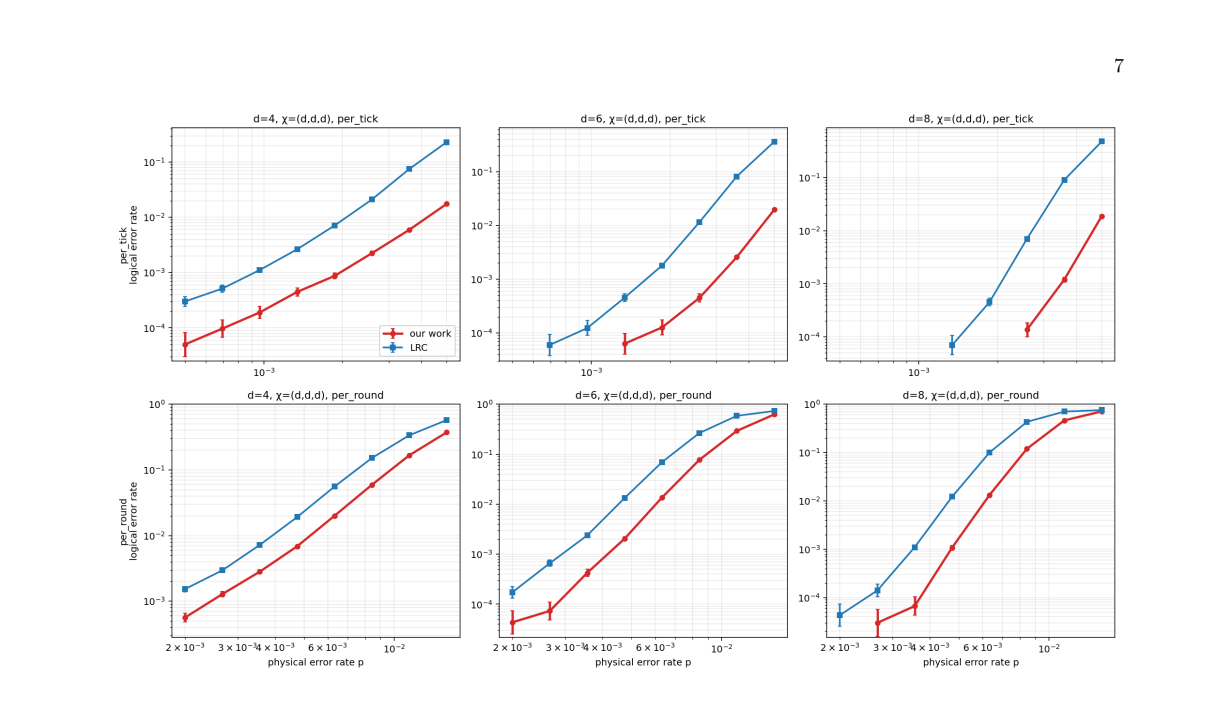
The genuinely new thing is that someone finally ran layer codes as active memories under circuit-level noise. That requires a syndrome extraction circuit, and the junction stabilizers rule out borrowing a surface-code schedule. Their decoder-free scheduler — hook-constrained order rule first, depth compression second — is a real contribution on its own: roughly half the CNOT depth of the general-purpose LRC scheduler at lower logical error rate, and on the [[4,2,2]] family they prove d_circ = d wherever the proof closes. That part is solid and durable, and the latency-over-fidelity finding on junction CNOTs is the most defensible secondary result.
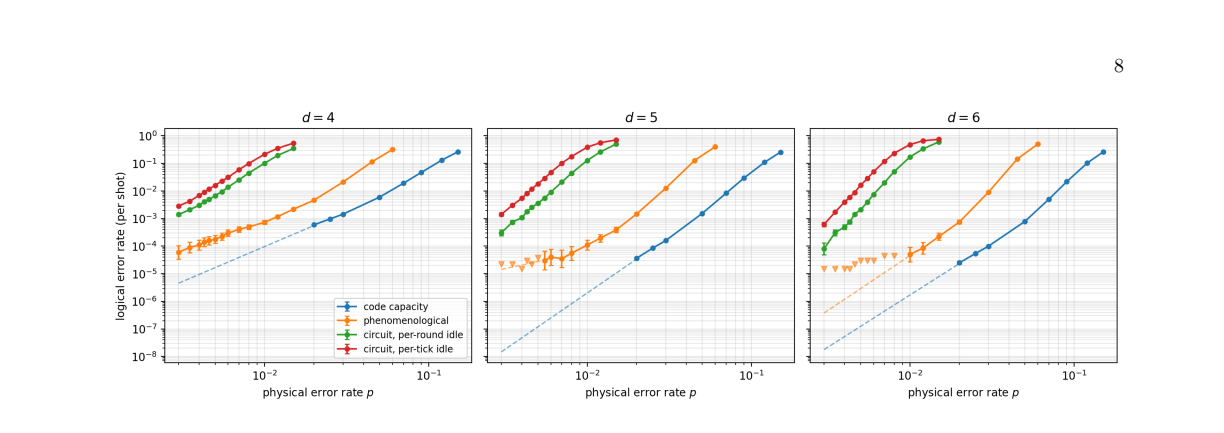
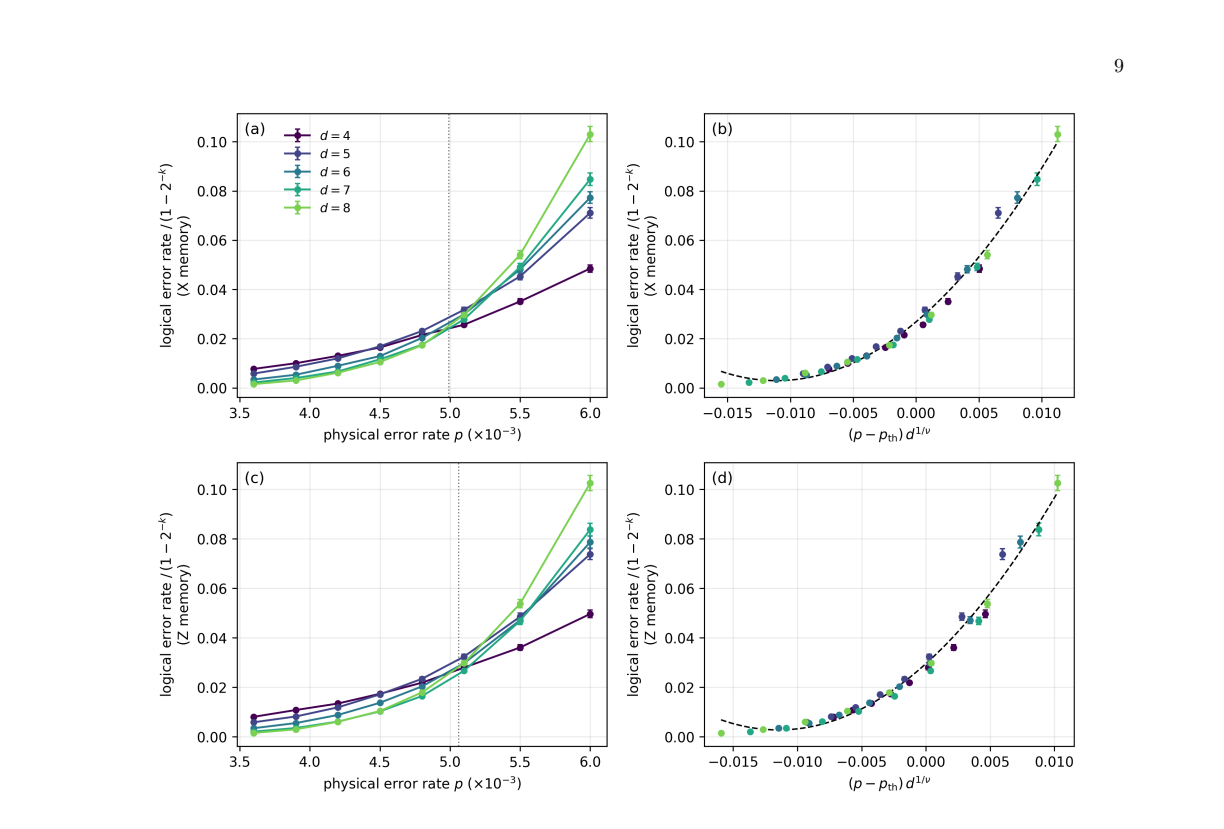
The threshold work is careful: standard scaling collapse, Wilson intervals, McNemar and z-tests, decoder cross-checks, and honest disclosure that BP+LSD is pessimistic on layer circuits, that the quoted uncertainties are fit-covariance only, and that the exponents carry no universality claim. The ~5e-3 circuit-level threshold, about 1.5x below rotated surface code at equal distance, is honestly scoped: they show the gap is dominated by extraction depth, not hook quality.
Now the headline — idle robustness, 1.7–3.0x longer sustainable idle interval than rotated surface code. It's measured and self-consistent, but only under one offline global decode of the whole run (Eq. 3, Sec. IV B). That is a legitimate pure-storage mode. But once corrections are committed in the sliding window a real-time decoder requires, the ordering reverses: at d=6 the layer code retains only 0.18–0.30 of its offline interval versus 0.46–0.84 for the surface codes (Table II). The authors disclose this up front and say persistence to fault-tolerant distances is untested, so it is not a hidden flaw — but it is the single load-bearing premise of the central claim, and their own table quantifies the reversal. Two smaller gaps remain: the windowed erosion is swept only at d=6 (d=8 appears in prose with no window/commit sweep), and the strong commit-width dependence (0.19 at c=1 vs 0.30 at c=2) leaves an un-swept region. Reproducibility is also deferred: code, circuits, and data are promised only on publication, and the scheduler's phase two is an anytime multi-threaded search that is not run-to-run reproducible.
Verdict: this deserves a serious referee. The scheduling contribution and the careful, unusually honest measurement practice are worth engaging with regardless of what happens to the idle-robustness claim. I'd send it out and ask the referee to press on whether the windowed-decode erosion is adequately swept, and to weigh how much of the case rests on the offline-global decode mode.
The strongest objection
The central claim (b266) is that a layer code memory tolerates a longer idle interval than a same-distance surface code at a fixed failure budget per refresh cycle and needs fewer correction rounds per unit storage time. The experiment (Eq. 3, Sec. IV B) supports this only when the whole run is decoded once, globally, at the end. That is a legitimate mode for pure storage with batch readout, and in that mode the 1.7-3.0x margins at r=3 are measured and self-consistent. The load-bearing premise is that the same margin survives when corrections must be committed as the run proceeds, because an operational memory that must supply logical information during storage, or that cannot hold an unbounded syndrome history, needs real-time decoding. The paper itself quantifies the failure: at d=6, r=2 the layer code keeps 0.18-0.30 of its offline interval under window length W=2-4 and commit width c=1-2, while the unrotated surface code keeps 0.46-0.66 and the rotated one 0.69-0.84 (Table II). Converting to absolute intervals at p=10^-3, the layer code's windowed t*_win is about 11 ticks versus 18-22 for the surface codes: the ordering does not merely narrow, it reverses, so the 'fewer correction rounds per unit storage time' statement fails under the decoders a real machine would use. The authors disclose this as the first caveat (b248) and state persistence to fault-tolerant distances is untested, so it is not a hidden flaw; it is nonetheless the single load-bearing assumption of the headline result. Two gaps remain in the disclosure itself: the windowed erosion is tabulated only at d=6 (d=8 appears in prose as 0.18/0.29 but with no window/commit sweep), and the strong commit-width dependence (0.19 at c=1 vs 0.30 at c=2 for the layer code) leaves an un-swept parameter region in which the reversal might or might not be robust.
The reader's weakest assumption identifies exactly the premise I find most load-bearing: the idle-robustness claim is measured under one offline global decode, and the paper's own windowed-decoder experiments (Table II) show the layer code retaining only 0.18-0.30 of its offline interval versus 0.46-0.84 for the surface codes, which reverses the ordering when converted to absolute ticks. This concern is disclosed by the authors as the first caveat of Sec. IV B, so it is not a hidden flaw, but it is precisely the condition on which the practical version of the headline claim (fewer correction rounds per unit storage time in a real memory) depends. I agree with the reader rather than partially because I found no additional load-bearing issue of comparable weight: the threshold comparison is fair (both codes sub-threshold at p=10^-3; the layer code is closer to its own threshold, so the choice does not favor it), the decoder pessimism runs against the layer code, the per-cycle independence assumption is checked and the paper quotes intervals only where stationarity holds, and the surface code's per-basis threshold split is controlled by the schedule-swap experiment. The remaining gaps are secondary and already noted by the reader: reproducibility depends on the promised repository release, and the scheduler's phase two is not run-to-run reproducible (Appendix A), both of which condition independent confirmation rather than the internal argument. Verdict UNCHANGED: CONDITIONAL is the right level, conditional on the release of the code and on an assessment of whether the idle-robustness advantage survives real-time windowed decoding at practical distances, as the reader concluded.
The referee's report
If the results hold, the scheduler is a substantial, well-verified contribution: it is decoder-free, reaches provably minimal depth on every tested circuit, and carries circuit-distance certification where affordable. The threshold measurement is careful and honest, with quantified BP+LSD pessimism (Appendix C), controlled schedule and decoder swaps, and explicit caveats that quoted uncertainties are fit-covariance only and that the exponents carry no universality claim. The idle-robustness experiment is methodologically thorough: the refresh-cycle independence assumption is checked via an N=2 versus N=16 stationarity comparison, two per-cycle error models are cross-checked, a BP+OSD re-analysis shifts intervals by about 2%, and the q_eff collapse correctly isolates the accumulated-noise axis. The paper is also commendably transparent about negative results (per-plane matching decoder failure, storage-efficiency prescreen, unbounded quantum-Tanner distances).
Pith's reading of the paper (a machine's summary, not the authors')
This paper asks whether layer codes — three-dimensional local codes built by quasi-concatenating a CSS code with unrotated surface code patches — can serve as active quantum memories when their syndrome is extracted by a noisy circuit, something that had never been tested. It supplies the missing syndrome-extraction circuit via a decoder-free scheduler, then benchmarks eighteen layer codes against surface codes of the same distance under identical noise, decoding, and analysis. The verdict is mixed: the [[4,2,2]] layer-code family reaches a circuit-level threshold near $5.06(7)\times 10^{-3}$, about 1.5× below a rotated surface code, but it tolerates a 1.7–3.0× longer idle interval between correction rounds at the same distance, so it needs fewer refresh rounds per unit storage time. That advantage costs 1.7–5.0× more operations and about five times more physical qubits per logical qubit, narrows from 3.0× to 1.7× as distance grows from 4 to 8, and reverses under the windowed decoders a real-time processor would actually use.
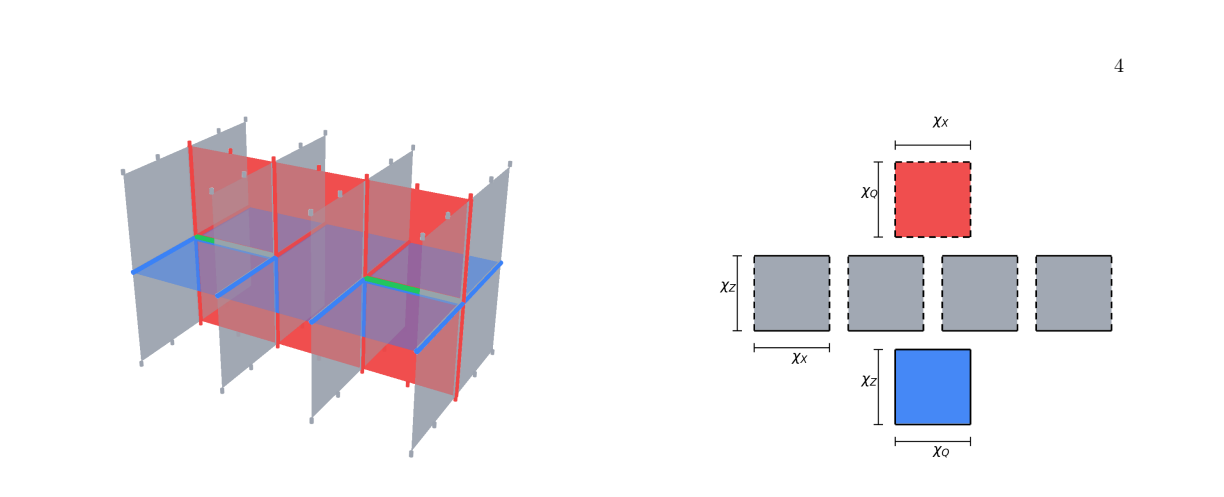
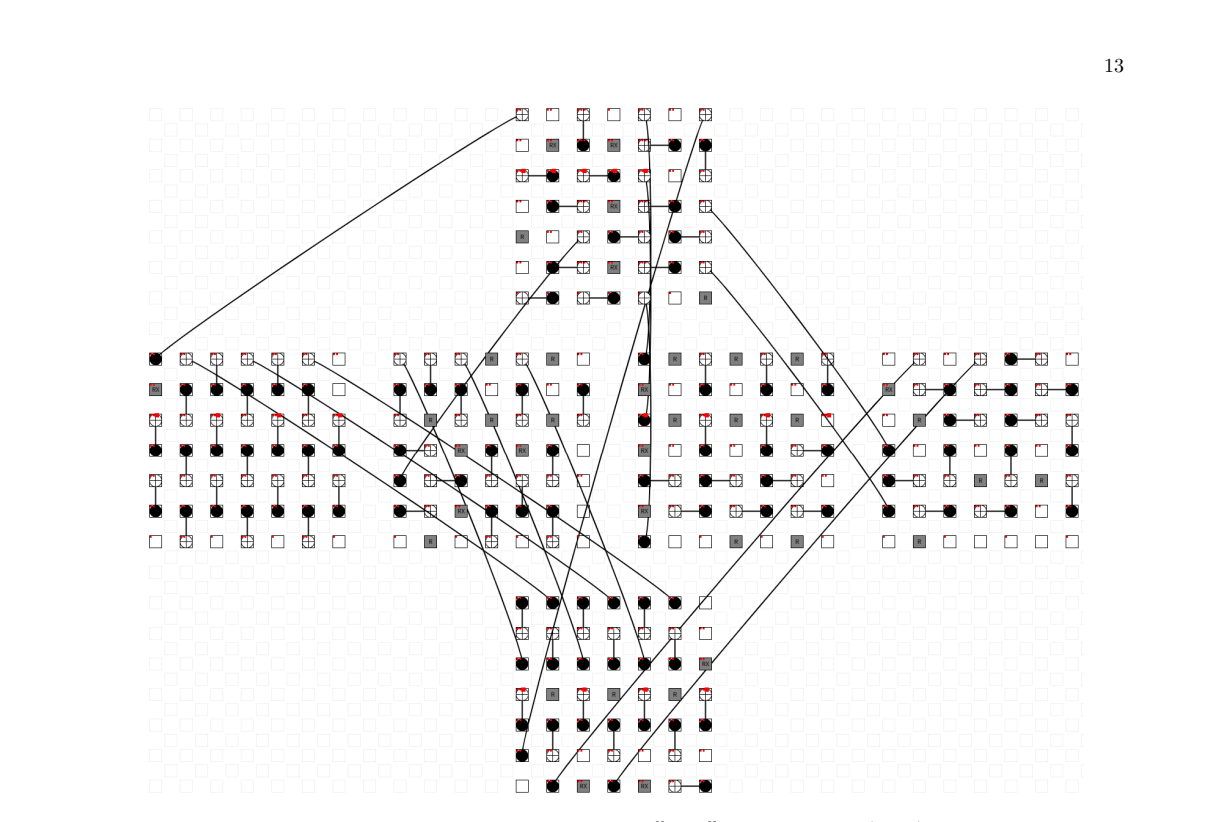
What carries the argument. The load-bearing contribution is a decoder-free syndrome-extraction scheduler built for layer codes, in two phases. Phase one constrains each stabilizer's CNOT order with a geometric rule: the last CNOT must act on a data qubit farthest, in lattice distance, from the least-weight logical representative of the same type, so mid-schedule ancilla faults leave residual errors that are least likely to complete into a logical operator. Phase two is a constraint program that assigns every CNOT a tick while choosing each stabilizer's order from the allowed set, reaching provably minimal depth and then minimizing ancilla idle exposure, with an optional third objective that concentrates the cross-plane junction CNOTs into as few ticks as possible. On [[4,2,2]]-input codes the resulting circuits provably achieve circuit distance equal to code distance, losing nothing to hook errors, and beat a general-purpose CSS-code scheduler at roughly half its CNOT depth per round. The idle-robustness comparison then rests on a sustained-memory circuit in which each idle window composes into a known accumulated flip probability $q_{\mathrm{eff}}$, so the sustainable interval is read off a single crossing of a fixed failure budget.
Core claim. The central claim is that the quasi-concatenated geometry of a layer code buys circuit-level idle robustness rather than a higher threshold. At the same code distance, with a fixed failure budget of 1% per refresh cycle, a layer code sustains an idle interval between syndrome-extraction rounds 1.7–3.0 times longer than a rotated surface code and 1.4–2.3 times longer than an unrotated one, across distances $d=4$ to 8. The mechanism is that the same geometry that produces a growing energy barrier under finite-temperature dynamics also yields a stronger error-correction response to accumulated noise: the layer code tolerates a higher accumulated flip probability per refresh cycle before crossing budget. The paper states its own scope plainly: the advantage is measured under one offline global decode of the whole run, it narrows as distance grows, and persistence to fault-tolerant distances is untested, because under windowed decoders the layer code retains only 0.18–0.30 of its offline interval versus 0.46–0.84 for the surface codes.
The premise it rests on. The idle-robustness advantage is established under one offline global decode of the whole run; under the windowed decoders a real-time processor would run, the ordering reverses, and the paper confirms that persistence of the advantage to fault-tolerant distances is untested.
If the paper is right (Pith's inferences, not the authors')
Layer codes can be operated as active memories: on [[4,2,2]] inputs the scheduler's circuits prove circuit distance equal to code distance, so no distance is lost to hook errors.
At equal distance the layer code's circuit-level threshold near $5.06(7)\times 10^{-3}$ sits about 1.5× below the rotated and 1.6× below the unrotated surface code, with the gap dominated by the deeper extraction round rather than hook quality.
At a 1% failure budget per refresh cycle a layer code needs fewer correction rounds per unit storage time, sustaining idle intervals 1.7–3.0× longer than a rotated surface code at equal distance.
The advantage is bought with 1.7–5.0× more operations and about five times more physical qubits per logical qubit, so it is about when correction is applied, not what it costs.
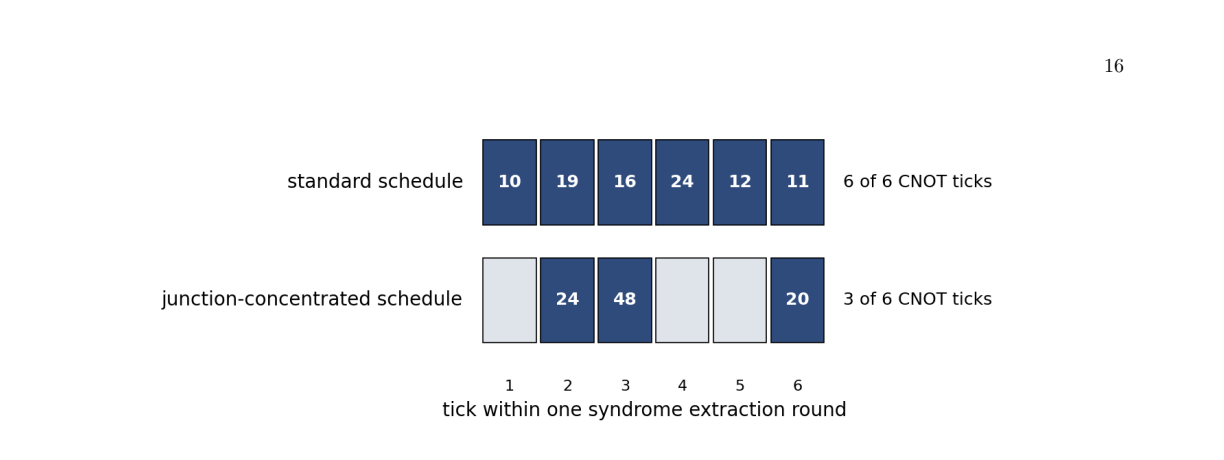
For hardware with slow cross-plane CNOTs their speed matters far more than their fidelity: ten times noisier junction gates cost about a factor of two in logical error rate, while twice-as-slow gates cost five- to seventeenfold, and concentrating junction gates into fewer ticks recovers much of the loss.
The 3.0× interval gain versus the roughly five-fold qubit overhead implies a breakeven question the paper does not take: whether a memory that refreshes up to three times less often amortises five times the qubits depends entirely on the relative cost of control operations versus qubit footprint.
The windowed-decoder erosion suggests the advantage lives in the decoder's ability to pool time-like redundancy across refresh cycles, not in the code geometry alone; a decoder with overlapping recovery or longer commit windows is the natural next experiment.
Because the threshold gap is dominated by extraction depth rather than hook structure, any reduction in round depth — for example more parallelism in the junction region — should close much of the gap to the surface-code threshold without changing the code.
The even-distance caveat means the honest qubit-efficiency comparison must run along each family's odd-distance frontier; an even-$d$ layer code is no better protected than its odd-$d$ predecessor while spending more qubits, so the quoted advantage may understate the true per-qubit cost.
Check this review
Pith stored no record of this review's passes and took no fingerprint of it. Reviews made by code from 13 Nov 2026 on carry both.
How often reviews like this one are right
Reviews like this one: written by deepseek-v4-flash, where what was read was not recorded.
How often objections from reviews like this one are right: not yet measured
Reviews by people
This review was written by a machine. No person has reviewed this paper on Pith yet. A scientist listed on Pith can review it for a fee, and their review is published here whatever it concludes.
The paper
Abstract
Layer codes are three-dimensional local CSS codes of check weight at most six, obtained by quasi-concatenating a CSS input code with unrotated surface code patches. What is established about them describes the code, not the circuit that measures it. In this work, we evaluate them as active memories under circuit-level noise. Doing so first requires a syndrome extraction circuit, and the junction stabilizers that couple the patches rule out borrowing a surface code patch's CNOT schedule. We present a decoder-free scheduler that constrains hook propagation first and compresses depth afterwards, generate circuits for eighteen layer codes across four input codes, and compare them with surface codes of the same distance, simulated and decoded in the same way. The circuits lose no distance to hook errors on [[4,2,2]]-input codes wherever a circuit-distance proof is affordable, and reach a lower logical error rate than those of a general-purpose scheduler for CSS codes at roughly half its CNOT depth per round. Our primary family built from a [[4,2,2]] input code reaches a circuit-level threshold of 5.06(7) × 10−3. The layer code outperforms the surface code in terms of idle robustness: at the same distance it tolerates an interval between syndrome extraction rounds 1.7-3.0 times longer than the rotated surface code. This comes at the cost of 1.7-5.0 times more operations per unit time and approximately five times more physical qubits, both per logical qubit. Finally, we model the cost of the beyond-2D cross-plane CNOTs that the construction demands, and find that their speed matters far more than their fidelity.
The paper's own sentences, arranged, kept beside the review and separate from it. Each label is drawn from a closed vocabulary; the number beside it is the probability the classifier gave that label. No sentence in this record was written by a model.
abstract compiled · 2026-10-01
The authors' main claim, as the classifier picked it out 0.87
“The layer code outperforms the surface code in terms of idle robustness: at the same distance it tolerates an interval between syndrome extraction rounds 1.7-3.0 times longer than the rotated surface code.”
How the main claim is stated: asserted 1.00
What the abstract itself states, as probabilities: claims first 0.11 · states limitation 0.94 · human participants 0.01 · controlled comparison 0.95 · randomized assignment 0.01 · states quantitative result 0.99 · compares with prior results 0.97 · mentions code or data availability 0.05
The abstract, sentence by sentence
This table labels the abstract only (arXiv listing abstract v1). The number is the probability the classifier gave the label.
| Sentence | Role | The authors' own work | States the main conclusion | Strength |
|---|---|---|---|---|
| Layer codes are three-dimensional local CSS codes of check weight at most six, obtained by quasi-concatenating a CSS input code with unrotated surface code patches. | background 1.00 | 0.13 | 0.03 | asserted 1.00 |
| What is established about them describes the code, not the circuit that measures it. | gap 0.86 | 0.07 | 0.03 | asserted 0.99 |
| In this work, we evaluate them as active memories under circuit-level noise. | contribution 0.94 | 0.82 | 0.05 | asserted 0.94 |
| Doing so first requires a syndrome extraction circuit, and the junction stabilizers that couple the patches rule out borrowing a surface code patch's CNOT schedule. | method 0.56 | 0.30 | 0.03 | asserted 1.00 |
| We present a decoder-free scheduler that constrains hook propagation first and compresses depth afterwards, generate circuits for eighteen layer codes across four input codes, and compare them with surface codes of the same distance, simulated and decoded in the same way. | method 0.75 | 0.97 | 0.06 | asserted 0.99 |
| The circuits lose no distance to hook errors on [[4,2,2]]-input codes wherever a circuit-distance proof is affordable, and reach a lower logical error rate than those of a general-purpose scheduler for CSS codes at roughly half its CNOT depth per round. | result 1.00 | 0.95 | 0.16 | asserted 1.00 |
| Our primary family built from a [[4,2,2]] input code reaches a circuit-level threshold of $5.06(7)\times 10^{-3}$. | result 1.00 | 0.96 | 0.21 | asserted 1.00 |
| The layer code outperforms the surface code in terms of idle robustness: at the same distance it tolerates an interval between syndrome extraction rounds 1.7-3.0 times longer than the rotated surface code. | result 1.00 | 0.93 | 0.26 | asserted 1.00 |
| This comes at the cost of 1.7-5.0 times more operations per unit time and approximately five times more physical qubits, both per logical qubit. | limitation 0.53 | 0.92 | 0.13 | asserted 1.00 |
| Finally, we model the cost of the beyond-2D cross-plane CNOTs that the construction demands, and find that their speed matters far more than their fidelity. | result 0.92 | 0.96 | 0.11 | asserted 1.00 |
What kind of paper the classifier reports this is: simulation study 0.89 · evidence from simulation or computation 1.00
What was examined, and what was not
Sources read
- arXiv listing abstract v1
Not examined
- full text
- figures and tables
- references and citing sentences
- relations to other papers
Levels run
- P abstract
Not run
- S sections
- T body sentences
- C citations
- R cross-paper relations
How the labels were made
Compiled by classifier-1.13.0 via TypeSafe API, question bank abstract-p1-20260923, 2026-10-01: 1 request, 7,725 input tokens.
Every quoted sentence on this record is the authors'. Every label is from Pith's closed vocabulary, with the probability shown beside it. This record as JSON
Figures (9)
Figures are the authors', reproduced from the paper.
Cited by 1 Pith paper
Reviewed papers on Pith that cite this one. The full citation record
Challenges and discussion
Disagree with the review, or know something it missed? Leave a comment, or challenge this review formally: a challenge becomes a permanent entry in this paper's record, and its decision is published here.
Come back by email
A short list of the week's newly reviewed papers. Nothing is sent until you confirm from your inbox, and every email has a link that stops it. No account.
No comments yet.
Sign in to comment