Computer Vision and Pattern Recognition · arXiv:2610.00576 v2 · submitted 30 Sep 2026
Gestalt: Large Multimodal Interplay Model
The paper says
“In this paper, we propose Gestalt, a new paradigm of large multimodal model built around multimodal interplay.”
more of the abstract
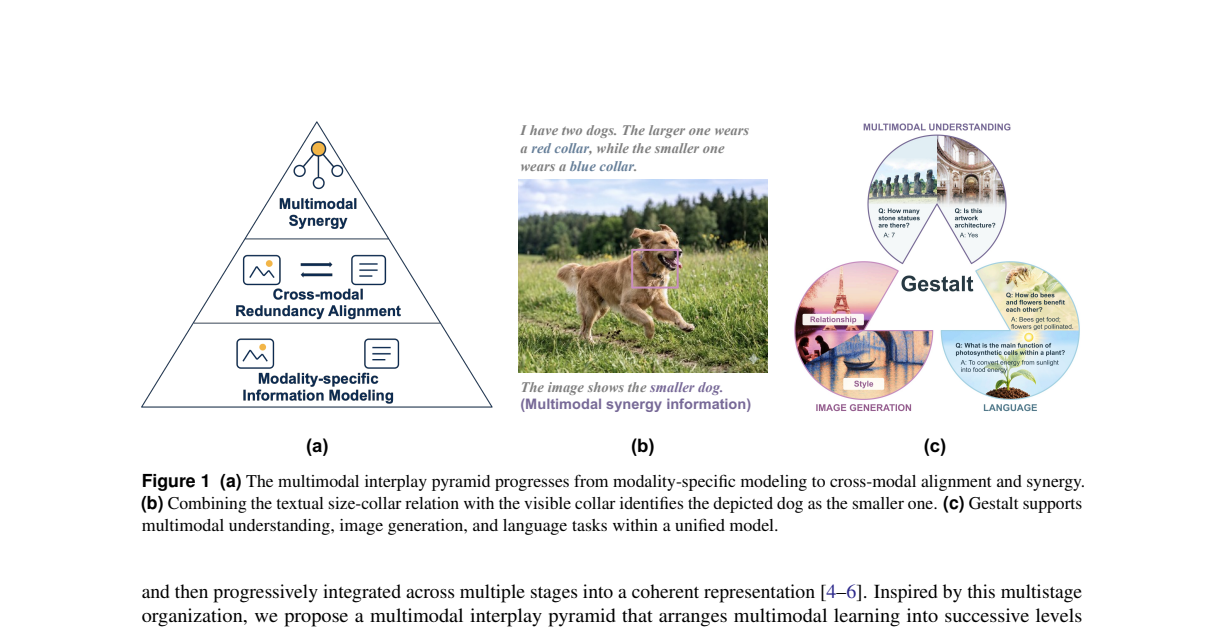
Despite rapid advances, large multimodal models are reaching a bottleneck: existing approaches focus primarily on accommodating additional modalities while overlooking the distinct characteristics of each modality and the relations among them. Motivated by the multistage property of human multisensory perception, we propose a multimodal interplay pyramid that organizes multimodal modeling as a progression from modality-specific processing, through cross-modal alignment, to deeper multimodal integration. Guided by this pyramid, Gestalt adopts a unified discrete diffusion framework and an interplay-partitioned architecture, with learnable interplay tokens mediating cross-modal exchange and integration. The pyramid also structures its data organization and training strategy. Strong performance across image generation, multimodal understanding, and text-only evaluation shows that Gestalt significantly improves cross-modal integration while preserving modality-specific information, effectively harnessing the strengths of diffusion-based multimodal models and offering a promising path toward unified multimodal intelligence. Project page: https://GeWu-Lab.github.io/Gestalt.
from the abstract
Pith says
Machine review · deepseek-v4-flash · 3 Oct 2026 · of version 1 of the paper; version 2 is newer · what was read was not recorded · not checked by a person
It can be wrong. Challenge this review or reply to it.
Holds up, with conditions. The system and its benchmark results are credible and the architecture is genuinely new, but the paper's central claim that the bottleneck-then-integrate design drives the gains is never tested by an ablation, and the one controlled study it does report shows mixed results. This line is wrong
5 major objections · 4 minor
How often objections from reviews like this one are right: not yet measured
Not checked: figures, code, what the references say.
The paper says, at §2.1, §3.1, Figure 2
The review did not quote this passage.
Pith says: Objection 1 of 5 · major
The central causal claim — that the bottleneck-then-full two-zone design, mediated by 32 interplay tokens, is what preserves modality-specific information and enables synergy — is never isolated. There is no ablation variant with Zone I attention replaced by full attention while holding everything else fixed, no variant with the interplay tokens removed, and no variant with Zone I depth varied.
more of objection 1
The paper instead relies on cross-model comparisons against baselines that differ in training budget, data mixture, and initialization (all parameters are trainable across 78M pretrain, 8M CPT, and 13.7M SFT examples, §3.1). This leaves the measured scores potentially supportable but the architectural attribution unsupported. The authors should add at least an all-full-attention variant and an interplay-token-removal variant under a matched training budget, or explicitly reframe the paper's claims away from causal attribution of the architecture.
The paper says, at Appendix B.1, Table 8
The review did not quote this passage.
Pith says: Objection 2 of 5 · major
The only controlled study in the paper is the curriculum comparison on 10% of the SFT data, and its results are mixed: curriculum loses to uniform mixing on MMVP in Phase 2 (-6.67), on MME-P in Phase 3 (-37.9), on MMStar-P in Phase 1 (-4.44), and on CVBench-2D in Phases 1 and 2 (-0.56, -0.90).
more of objection 2
The narrative in B.1 interprets these as a capability shift, but the data equally support the reading that the curriculum provides no net benefit at matched data scale. Because this is the only controlled evidence for the training-side pillar of the interplay pyramid, the authors should either report final-stage aggregate differences with statistical significance, or temper the claim that the curriculum is beneficial.
The paper says, at Tables 1–3, 5, 6
The review did not quote this passage.
Pith says: Objection 3 of 5 · major
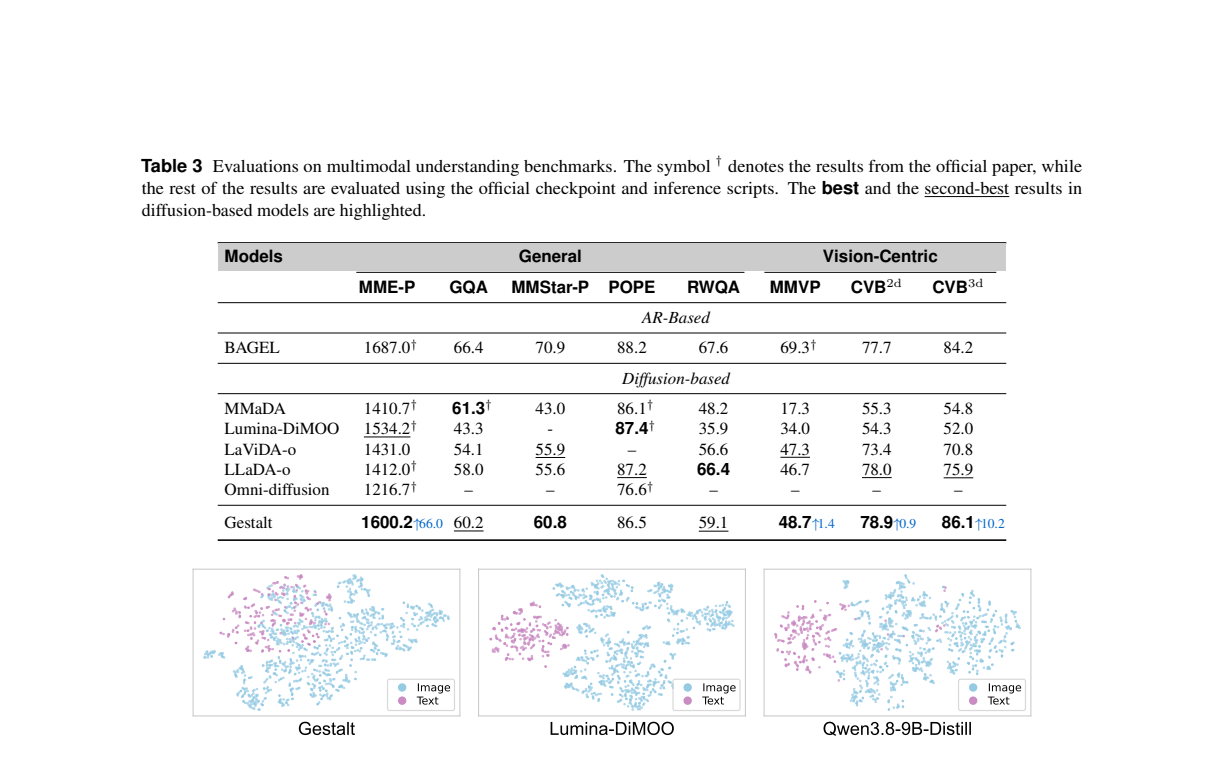
All benchmark tables report single point estimates with no error bars, variance, or significance tests. Several headline margins are small relative to what such evaluations typically allow: UniGenBench overall 73.30 vs. Lumina-DiMOO 71.81 (Table 1), CV-Bench-2D 78.9 vs. BAGEL 77.7 and CV-Bench-3D 86.1 vs. 84.2 (Table 3), and MME-P 1600.2 vs.
more of objection 3
BAGEL 1687.0 (Table 3, where Gestalt is actually lower than BAGEL). Without repeated evaluation runs or a statistical test, the reader cannot tell whether the claimed 'leading' results are separable from the nearest baselines. This is particularly important because the strongest architectural claim rests on these margins.
The paper says, at Appendix A.2, Table 7
The review did not quote this passage.
Pith says: Objection 4 of 5 · major
The organization of all 13.7M SFT examples into redundant/text-unique/visual-unique/synergistic categories is derived from a 100-example random sample per sub-task, combined with heuristics and model-assisted verification. This is a thin basis for a load-bearing training-design claim: if the sub-task labels are noisy, the curriculum described in §2.3 and Figure 3 is effectively unverified. The authors should report annotation agreement or at least the per-sub-dataset distribution of assigned types, and acknowledge the sensitivity of the curriculum to this categorization.
The paper says, at Table 3
The review did not quote this passage.
Pith says: Objection 5 of 5 · major
Baseline coverage in the multimodal understanding table is partial: several cells are missing (Lumina-DiMOO on MMStar-P, LaViDA-o on POPE, Omni-diffusion on GQA/MMStar-P/MMVP/CV-Bench), and the paper does not state which models could not be evaluated and why. This makes the 'top two on seven of eight benchmarks' claim difficult to verify, since the comparison set is incomplete. The authors should fill the missing cells where checkpoints exist, or explicitly mark and justify each unavailable entry.
4 minor objections
The paper says, at §3.4, Table 6, Ref [37]
Pith says: minor objection 1 of 4
The visual-specific benchmark MIB-V is built by the authors' own group (MIBench, reference [37], with author overlap). This is acknowledged only implicitly through the citation. Since one of the paper's claims is that Gestalt handles modality-unique interplay well, the authors should note the self-evaluation risk and ideally corroborate with an external visual-perception benchmark beyond CV-Bench and MMVP.
The paper says, at Throughout
Pith says: minor objection 2 of 4
Several table entries appear with inconsistent formatting (e.g., Table 1 has values like '81.65' for Gestalt's World column where baseline style suggests a two-decimal format, and Table 3 uses a dash '-' for missing values without a legend). A consistent notation for missing values and a note on digit precision would improve readability.
show 2 more
The paper says, at §3.3, Figure 5
Pith says: minor objection 3 of 4
The t-SNE comparison in Figure 5 uses Qwen3.8-9B-Distill, an unofficial distilled variant (footnote 2), because no official 9B checkpoint is public. The authors should state whether the distillation process affects the representation-space comparison, since a distilled checkpoint may not be representative of the model family.
The paper says, at §2.1
Pith says: minor objection 4 of 4
The sentence 'These visual tokens are then combined with textual tokens in a shared sequence' would benefit from an explicit note on how 2D spatial positions are preserved (mentioned later as 'interleaved MRoPE' in §3.1 but not defined). A one-sentence explanation in §2.1 would let the reader understand the architecture without cross-referencing the experimental section.
What would settle it
Run a single controlled ablation: starting from the same CPT checkpoint and using the same 13.7M SFT mixture and three-phase curriculum, replace Zone I's restricted attention with full multimodal self-attention and a shared feed-forward network while keeping the 32 learnable interplay tokens and all other hyperparameters identical. Evaluate this all-full-attention variant on UniGenBench, TIIF-Bench, CV-Bench, and MME-P using multiple seeds for error bars. If the variant matches Gestalt within noise on UniGenBench and CV-Bench, the bottleneck architecture is not the driver of the headline gains; if it drops substantially, the preserve-then-integrate claim gains direct support. A second arm removing the interplay tokens entirely would further separate the bottleneck effect from the token effect.
from the skeptic's reading
How the review went
4 readings by deepseek-v4-flash · 3 Oct 2026
- Reader holds up, with conditions
- Skeptic agrees
- Editor wrote the verdict above
- Referee major revision: 5 major objections, 4 minor
Not run on this paper: the simulated authors' defence.
Pith did not check this review's objections against the paper.
The review in full
The review in brief, machine-written
Quick read on Gestalt (arXiv:2610.00576). The system is real, the headline results are plausible, and the architecture is genuinely new. The problem is that the paper's central causal claim about that architecture is never tested, and the authors' own controlled study shows mixed results.
What's actually new: the two-zone design—Zone I with restricted bottleneck attention mediated by 32 learnable interplay tokens and modality-specific FFNs, then Zone II full attention—plus the four-category (redundant, visual-unique, text-unique, synergistic) data organization and three-phase curriculum. None of that appears in LLaDA, MMaDA, Lumina-DiMOO, or BAGEL. The numbers on external benchmarks are strong: 73.30 on UniGenBench, 74.57/78.86 on TIIF-Bench, beating both generation-only and unified models, and beating the autoregressive BAGEL on both CV-Bench tracks. The data curation is careful—they filter with Qwen3-VL and explicitly verify that the VQ tokenizer hasn't destroyed the evidence needed to answer, and the tokenization loss itself is acknowledged in the appendix (b231).
Now the soft spots, in proportion. The load-bearing claim is that "preserve-then-integrate" produces the gains. That is never isolated. There is no all-full-attention variant, no interplay-token removal, no zone-depth sweep, no same-pipeline-without-the-bottleneck run. The only controlled study is the curriculum comparison on 10% of SFT data (Table 8), and it's genuinely mixed: curriculum wins big on MME-P in Phase 1 (+113.8) but loses in Phase 3 (-37.9), and loses on MMVP in Phase 2 (-6.67). That study supports the curriculum, not the architecture. Since all parameters are trainable across 78M+8M+13.7M examples while baselines use different budgets and mixtures, the headline narrative rests on cross-model comparison. The stress-test note has this right; I don't think it overstates.
The benchmark tables carry no error bars, so we can't tell whether 73.30 vs 71.81 or CV-Bench 86.1 vs 84.2 are separable. Minor: Table 3 has missing cells and some results are lifted from official papers, and MIB-V is the team's own benchmark—mild self-reference, not a real flaw. The representation analyses in Figures 5–6 are qualitative and shouldn't carry much weight.
None of this means the numbers are wrong. The empirical claims likely stand; a reviewer should push for the bottleneck ablation because the model, code, and data are released and the check is feasible. The paper deserves one careful referee pass, with the architecture ablation as a real requirement, not a courtesy request. Whoever reads it for the unified-diffusion design will get value from it.
Best,
[signature]
The strongest objection
The paper's strongest claim is not merely that Gestalt scores well, but that its specific preserve-then-integrate design—Zone I bottleneck attention mediated by 32 learnable interplay tokens followed by Zone II full attention—is what produces those scores (Section 2.1, Figure 2). This causal attribution is the load-bearing step, and it is never isolated. No ablation replaces Zone I restricted attention with full attention while keeping everything else fixed; no ablation removes or reduces the interplay tokens; no ablation uses the same training pipeline with the bottleneck removed. The only controlled study the paper reports is the curriculum comparison in Appendix B.1 using 10% of the SFT data (Table 8), and those results are mixed: curriculum beats uniform on MME-P in Phase 1 (+113.8) but loses in Phase 3 (-37.9), and loses on MMVP in Phase 2 (-6.67). That study addresses the curriculum, not the architecture. Meanwhile, all parameters are trainable across 78M pretraining, 8M CPT, and 13.7M SFT examples, and baselines use different training budgets, data mixtures, and initializations. The benchmark tables lack error bars, so we do not know whether the reported margins (e.g., UniGenBench 73.30 vs. 71.81, CV-Bench 86.1 vs. 84.2) are statistically separable. None of this means the benchmark numbers are wrong; it means the paper's central architectural narrative—that bottleneck-then-full interplay is what preserves modality-specific information and enables synergy—is supported only by cross-model comparison, not by a controlled test of the design. The acknowledged VQ-VAE tokenization loss is a real limitation for fine-grained perception, but it is orthogonal to this concern and is already stated by the authors.
The reader's weakest_assumption identifies the same load-bearing concern: the paper never ablates the two-zone architecture, and the only controlled study is the curriculum comparison on 10% of SFT data with mixed and sometimes negative differences. My reading of the full text and appendix confirms this. The architecture is described in Section 2.1 and Figure 2, and the training recipe is given in Section 3.1, but no variant with all-full attention or without interplay tokens is reported. Table 8 is explicitly a curriculum study, not an architecture study; its mixed results do not establish the causal role of the bottleneck. The paper does offer real supporting evidence elsewhere: external benchmarks, self-consistent tables, disclosed data curation, and a genuine curriculum ablation. Those support the empirical claim that Gestalt performs well. They do not support the specific attribution to preserve-then-integrate, which is the distinctive contribution claimed in the abstract and introduction. Because the reader's verdict is already CONDITIONAL and explicitly conditioned on missing ablations and error bars, my analysis does not move the verdict. The concern is important enough to keep the conditional status: acceptance should wait for the architecture ablation and completed baseline runs.
The referee's report
If the causal attribution holds, the contribution is substantial: Gestalt would demonstrate that a discrete-diffusion unified model can combine generation, understanding, and language capability, and that organizing cross-modal exchange as bottleneck-then-full integration preserves modality-specific information while enabling synergy. The paper is unusual in shipping released code, model weights, and a project page, and in organizing 13.7M SFT examples by a principled interplay taxonomy rather than by task alone. The evaluation is broad and mostly against external third-party benchmarks, so the headline numbers are not circular. However, the paper's own strongest architectural narrative — that the two-zone bottleneck with interplay tokens drives the gains — is not tested by any controlled ablation, and the only controlled study reported (curriculum comparison, Table 8) shows mixed or negative effects on several metrics. The significance of the measured results is therefore contingent on evidence the manuscript does not currently provide.
Pith's reading of the paper (a machine's summary, not the authors')
This paper argues that a large multimodal model can be built around the explicit management of information interplay—what is unique to each modality, what is shared, and what only emerges from their combination—rather than merely bringing modalities into one network. It proposes Gestalt, a model that instantiates this as a progressive interplay pyramid in the architecture, the training data, and the schedule: modality-specific processing first, then controlled cross-modal exchange through learnable intermediary tokens, then full unrestricted integration. The payoff claim is concrete: on fine-grained text-to-image generation Gestalt reaches 73.30 on UniGenBench and 74.57/78.86 on TIIF-Bench short/long settings, ahead of both generation-only specialists and unified baselines; it also beats the autoregressive unified model BAGEL on both CV-Bench tracks, and it retains the strongest text-only scores among diffusion-based unified models. If true, this supports the thesis that a discrete-diffusion unified model can combine generation, understanding, and language capability by preserving modality-unique information before integrating it.
What carries the argument. The load-bearing mechanism is the two-zone interplay architecture carried by 32 learnable interplay tokens, dedicated tokens that act as a shared interface between the visual and textual streams. In Interplay Zone I, a bottleneck restricts attention so image and text tokens never attend to each other directly, forcing all cross-modal exchange through the interplay tokens while each modality keeps its own feed-forward network. In Interplay Zone II the restriction lifts, and image, text, and interplay tokens share full multimodal self-attention and a common feed-forward network. Around this core sits a unified masked-diffusion objective that treats both modalities as discrete tokens predicted by bidirectional masked reconstruction rather than autoregressive next-token generation, plus a three-phase curriculum over the four interplay categories of the instruction corpus. A fixed VQ-VAE tokenizer with a 16,384-entry codebook maps images into the same discrete token space as text.
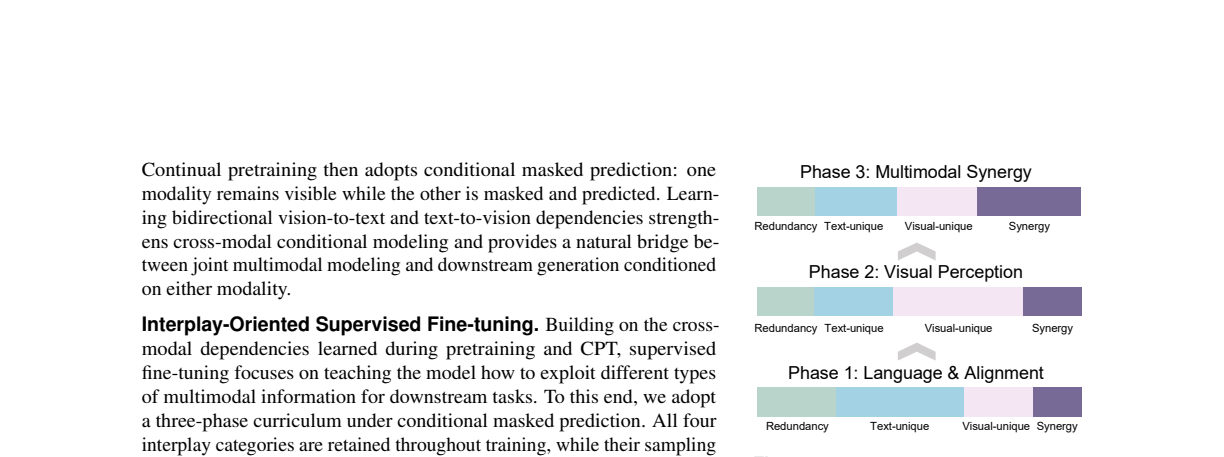
Core claim. The central claim is that a preserve-then-integrate pathway lets one discrete-diffusion model serve image generation, multimodal understanding, and text-only language tasks simultaneously without the usual trade-offs. Architecturally, the Transformer is split into Interplay Zone I, where image and text tokens cannot attend to each other directly and exchange information only through 32 learnable interplay tokens, and Interplay Zone II, where full multimodal self-attention and a shared feed-forward network take over. The same pyramid organizes the 13.7M-instruction fine-tuning corpus into redundant, text-unique, visual-unique, and synergistic categories and schedules a three-phase curriculum that shifts emphasis from alignment to visual perception to synergy. The empirical case rests on leading scores among the evaluated diffusion-based models on fine-grained generation, on vision-centric understanding where Gestalt scores 78.9 and 86.1 on CV-Bench against BAGEL's 77.7 and 84.2, and on representation analyses showing an interleaved vision-language space that still preserves the pretrained language model's geometry, with cosine similarity 0.9968 and CKA 0.9949 against the LLaDA backbone.
The premise it rests on. The load-bearing premise is that the two-zone bottleneck architecture—interplay tokens mediating restricted exchange before full attention, together with the curriculum—is what produces the measured gains, but the paper never tests a version without the bottleneck or without the interplay tokens, so the benchmark scores could stand even if the architectural mechanism contributes little.
If the paper is right (Pith's inferences, not the authors')
If the preserve-then-integrate pathway is the source of the gains, unified multimodal models do not need to share all computation from the first layer; modality-specific processing followed by controlled exchange becomes a viable design axiom for other architectures.
Diffusion-based unified models can be competitive with or beat autoregressive ones on fine-grained tasks, since Gestalt surpasses the autoregressive BAGEL on both CV-Bench tracks, weakening the assumption that next-token prediction is required for strong multimodal understanding.
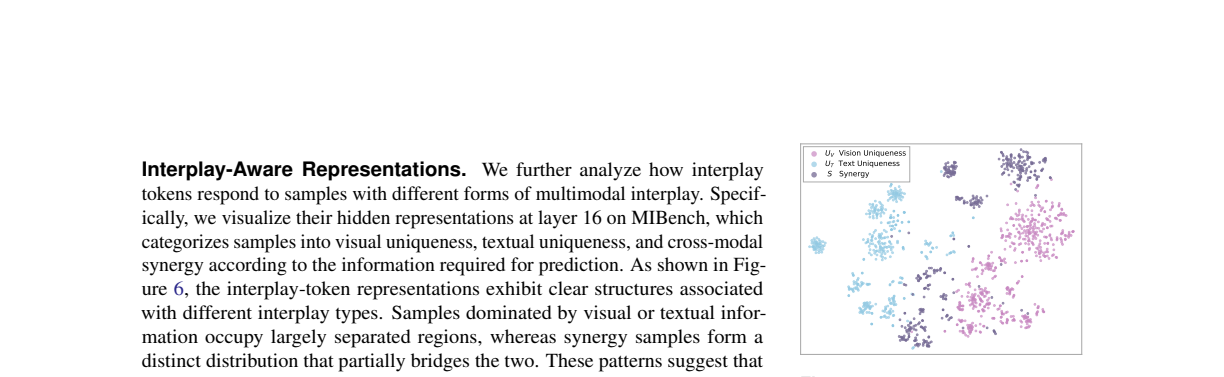
Interplay tokens may serve as a diagnostic interface: their hidden representations separate according to whether a sample demands visual-unique, text-unique, or synergistic information, offering a lever for inspecting what is being fused.
Because generation, understanding, and language tasks share one discrete objective and one set of parameters, image generation ability is not purchased at the cost of text-only capability, as Gestalt leads diffusion-based unified models on five of six text-only benchmarks.
The remote-sensing adaptation with only 50K domain samples reaching 79.34 on FGRS suggests the interplay organization transfers to new visual domains with little data, though the mechanism behind that efficiency is not isolated.
A natural next test is whether the number of interplay tokens and the depth split between the two zones trade off, or whether the bottleneck could be relaxed gradually with layer depth instead of in two discrete zones.
The paper's own controlled comparison of curriculum versus uniform mixing on 10% of the SFT data shows mixed stage-wise differences, including an MMVP drop of 6.67 in Phase 2 and an MME-P drop of 37.9 in Phase 3, which leaves open whether the ordering itself or simply more total exposure to visual-unique and synergistic data drives the final scores.
Because all parameters are trainable across stages while the baselines use different training budgets and data mixtures, a controlled replication that fixes data and compute would settle whether the two-zone design or the cross-model comparison explains the advantage over autoregressive and generation-only baselines.
If the bottleneck genuinely redirects information flow, probing interplay-token attention on deliberately contradictory image-text pairs should reveal conflict resolution rather than simple copying, a prediction that does not follow from the benchmark results alone.
Check this review
Pith stored no record of this review's passes and took no fingerprint of it. Reviews made by code from 13 Nov 2026 on carry both.
How often reviews like this one are right
Reviews like this one: written by deepseek-v4-flash, where what was read was not recorded.
How often objections from reviews like this one are right: not yet measured
Reviews by people
This review was written by a machine. No person has reviewed this paper on Pith yet. A scientist listed on Pith can review it for a fee, and their review is published here whatever it concludes.
The paper
Abstract
In this paper, we propose Gestalt, a new paradigm of large multimodal model built around multimodal interplay. Despite rapid advances, large multimodal models are reaching a bottleneck: existing approaches focus primarily on accommodating additional modalities while overlooking the distinct characteristics of each modality and the relations among them. Motivated by the multistage property of human multisensory perception, we propose a multimodal interplay pyramid that organizes multimodal modeling as a progression from modality-specific processing, through cross-modal alignment, to deeper multimodal integration. Guided by this pyramid, Gestalt adopts a unified discrete diffusion framework and an interplay-partitioned architecture, with learnable interplay tokens mediating cross-modal exchange and integration. The pyramid also structures its data organization and training strategy. Strong performance across image generation, multimodal understanding, and text-only evaluation shows that Gestalt significantly improves cross-modal integration while preserving modality-specific information, effectively harnessing the strengths of diffusion-based multimodal models and offering a promising path toward unified multimodal intelligence. Project page: https://GeWu-Lab.github.io/Gestalt.
The paper's own sentences, arranged, kept beside the review and separate from it. Each label is drawn from a closed vocabulary; the number beside it is the probability the classifier gave that label. No sentence in this record was written by a model.
abstract compiled · 2026-10-02
The authors' main claim, as the classifier picked it out 1.00
“Strong performance across image generation, multimodal understanding, and text-only evaluation shows that Gestalt significantly improves cross-modal integration while preserving modality-specific information, effectively harnessing the strengths of diffusion-based multimodal models and offering a promising path toward unified multimodal intelligence.”
How the main claim is stated: asserted 0.99
What the abstract itself states, as probabilities: claims first 0.10 · states limitation 0.08 · human participants 0.04 · controlled comparison 0.07 · randomized assignment 0.01 · states quantitative result 0.04 · compares with prior results 0.24 · mentions code or data availability 0.02
The abstract, sentence by sentence
This table labels the abstract only (arXiv listing abstract v1). The number is the probability the classifier gave the label.
| Sentence | Role | The authors' own work | States the main conclusion | Strength |
|---|---|---|---|---|
| In this paper, we propose Gestalt, a new paradigm of large multimodal model built around multimodal interplay. | contribution 1.00 | 0.83 | 0.04 | asserted 0.98 |
| Despite rapid advances, large multimodal models are reaching a bottleneck: existing approaches focus primarily on accommodating additional modalities while overlooking the distinct characteristics of each modality and the relations among them. | gap 0.85 | 0.08 | 0.02 | asserted 1.00 |
| Motivated by the multistage property of human multisensory perception, we propose a multimodal interplay pyramid that organizes multimodal modeling as a progression from modality-specific processing, through cross-modal alignment, to deeper multimodal integration. | contribution 0.66 | 0.72 | 0.05 | asserted 0.93 |
| Guided by this pyramid, Gestalt adopts a unified discrete diffusion framework and an interplay-partitioned architecture, with learnable interplay tokens mediating cross-modal exchange and integration. | method 0.98 | 0.89 | 0.04 | asserted 0.99 |
| The pyramid also structures its data organization and training strategy. | method 0.94 | 0.70 | 0.02 | asserted 0.98 |
| Strong performance across image generation, multimodal understanding, and text-only evaluation shows that Gestalt significantly improves cross-modal integration while preserving modality-specific information, effectively harnessing the strengths of diffusion-based multimodal models and offering a promising path toward unified multimodal intelligence. | result 0.76 | 0.91 | 0.94 | asserted 0.99 |
What kind of paper the classifier reports this is: method or tool 1.00 · evidence from observation or experiment 0.67
What was examined, and what was not
Sources read
- arXiv listing abstract v1
Not examined
- full text
- figures and tables
- references and citing sentences
- relations to other papers
Levels run
- P abstract
Not run
- S sections
- T body sentences
- C citations
- R cross-paper relations
How the labels were made
Compiled by classifier-1.13.0 via TypeSafe API, question bank abstract-p1-20260923, 2026-10-02: 1 request, 5,044 input tokens.
Every quoted sentence on this record is the authors'. Every label is from Pith's closed vocabulary, with the probability shown beside it. This record as JSON
Figures (7)
Showing 6 of the paper's 7 figures. Figures are the authors', reproduced from the paper.
Challenges and discussion
Disagree with the review, or know something it missed? Leave a comment, or challenge this review formally: a challenge becomes a permanent entry in this paper's record, and its decision is published here.
Come back by email
A short list of the week's newly reviewed papers. Nothing is sent until you confirm from your inbox, and every email has a link that stops it. No account.
No comments yet.
Sign in to comment