Machine Learning · arXiv:2610.00728 v2 · submitted 30 Sep 2026
Benchmarking Generative Models for Near-Surface Data Assimilation on Real Station Observations
The paper says
“Weather reanalysis products rely on computationally intensive numerical weather predictions followed by data assimilation that corrects the forecast toward observations.”
more of the abstract
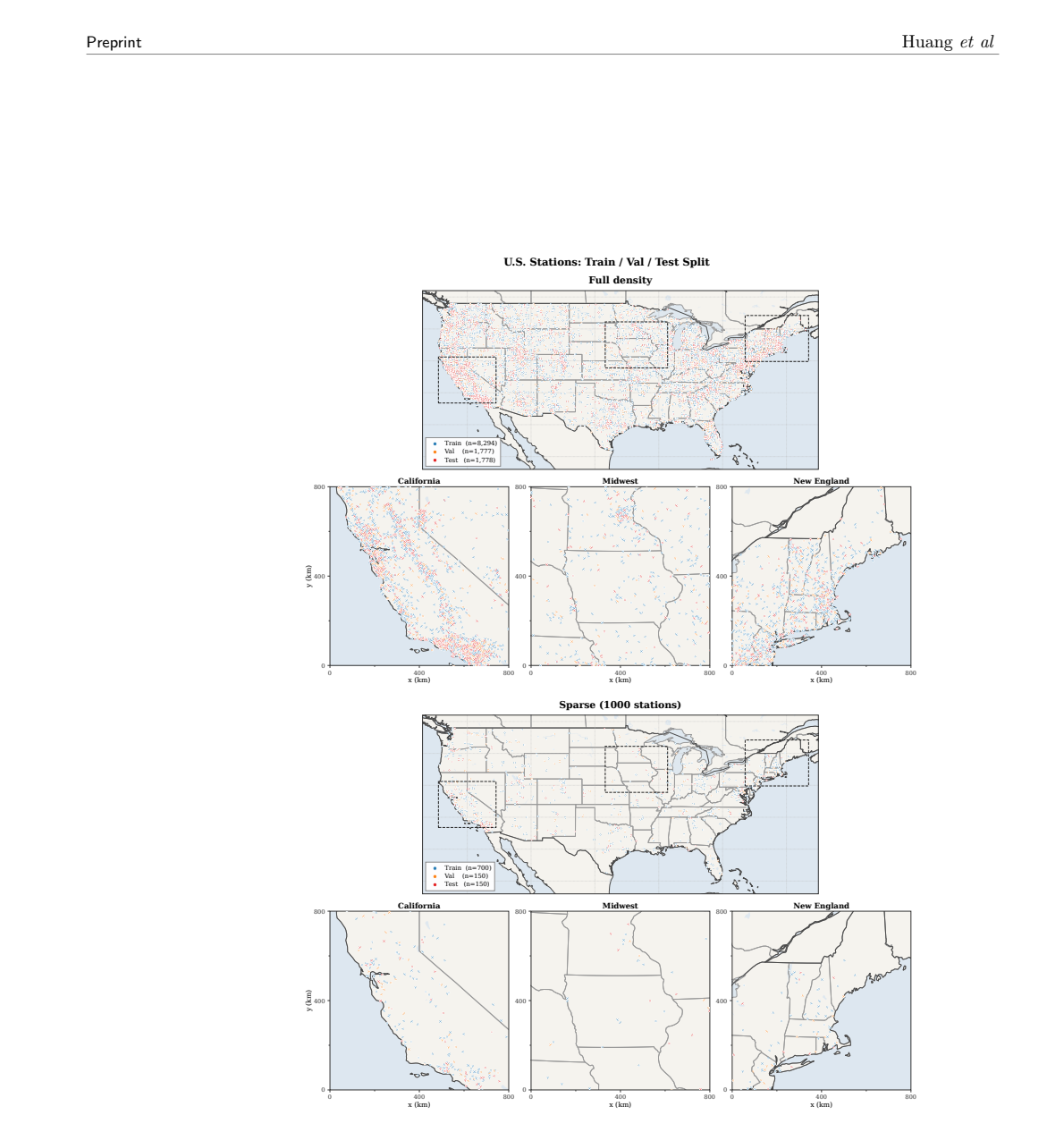
Recent advances in deep generative models offer a cheaper alternative that shifts much of this cost from inference to offline training. However, existing generative approaches have been evaluated on synthetic observations or under different datasets and evaluation schemes, making it unclear which design choices improve real-world data assimilation. We present the first controlled benchmark of generative data assimilation for single-time near-surface analysis from real weather station observations. Using 11,849 NOAA MADIS stations across the contiguous United States and four near-surface variables, we hold the dataset, observation operator, and deep learning architecture fixed, and measure spatial generalization at held-out stations. The benchmark compares the major design choices proposed for generative data assimilation, including diffusion versus flow matching, pixel versus latent-space formulations, and multiple inference-time conditioning strategies, against a classical 3D-Var baseline. The benchmark reveals three conclusions. First, the best generative methods outperform 3D-Var (35.7% vs. 33.3% RMSE improvement over ERA5), although 3D-Var receives the ERA5 field at the analysis time as its background and the generative methods receive none. Second, full-gradient guidance consistently outperforms stop-gradient and initial-noise optimization. Third, other choices provide little measurable benefit: diffusion and flow matching perform nearly identically under matched conditions, and latent-space variable mixing does not help. Both advantages widen when stations are sparse. Together, these results identify which components of generative data assimilation improve spatial generalization in near-surface analysis.
from the abstract
Pith says
Machine review · deepseek-v4-flash · 2 Oct 2026 · of version 1 of the paper; version 2 is newer · what was read was not recorded · not checked by a person
It can be wrong. Challenge this review or reply to it.
Holds up, with conditions. Careful, honest controlled benchmark with real findings, but the headline 2.4pp margin rests on a self-admittedly simple 3D-Var baseline, so the generic conclusion needs scoping before the paper's main claim holds as stated. This line is wrong
3 major objections · 4 minor
How often objections from reviews like this one are right: not yet measured
Not checked: figures, code, what the references say.
The paper says, at Section 3.1, Table 3, Conclusion [b8]
The review did not quote this passage.
Pith says: Objection 1 of 3 · major
The paper says, at Section 4.1.2, Section C.1 Eq. (30)
The review did not quote this passage.
Pith says: Objection 2 of 3 · major
The paper says, at Section 5.1, Section F.4, Tables 3 and 4
The review did not quote this passage.
Pith says: Objection 3 of 3 · major
4 minor objections
The paper says, at Section 4.2, Tables 3 and 4
Pith says: minor objection 1 of 4
The paper says, at Figure 9 caption, Section 5.1
Pith says: minor objection 2 of 4
show 2 more
The paper says, at Table 3, '3D-Var (w/o ERA5 loss)' row
Pith says: minor objection 3 of 4
The paper says, at Section 5.4, Figures 5 and 6
Pith says: minor objection 4 of 4
What would settle it
Implement a second classical baseline for the dense benchmark: 3D-Var with the same ERA5 background and R = I, but with B replaced by a multivariate background-error covariance estimated from 2017-2022 ERA5 24-hour incremental fields (sample covariance with cross-variable u10-v10-T2-Td2 blocks and a localization radius of a few hundred km), fully retuned on the validation split. If this stronger classical baseline reaches or exceeds roughly 35% test RMSE improvement (i.e., the margin shrinks below ~1pp), the 2.4pp headline is an artifact of the simplified B and conclusion one should be re-scoped to 'beats a diagonal-B 3D-Var'; if test improvement stays near 33%, the claim is robust to the baseline concern.
from the skeptic's reading
How the review went
4 readings by deepseek-v4-flash · 2 Oct 2026
- Reader holds up, with conditions
- Skeptic agrees
- Editor wrote the verdict above
- Referee major revision: 3 major objections, 4 minor
Not run on this paper: the simulated authors' defence.
Pith did not check this review's objections against the paper.
The review in full
The review in brief, machine-written
What you should know: this is the first controlled benchmark of generative DA on real, off-grid station observations, with the dataset, observation operator, and a 3.8M-parameter U-Net held fixed across methods. That alone is a real contribution — prior work mixed protocols or used synthetic masks. The three findings are new and mostly convincing: full-gradient guidance consistently beats stop-gradient guidance and initial-noise optimization, diffusion and flow matching reach parity under matched solvers, and latent-space variable mixing buys nothing. The ablations are genuinely informative, especially the guidance-schedule study (late-stage guidance matters most; constant schedule best) and the Section D.1 perturbation analysis explaining why the Langevin corrector helps diffusion more than flow. The paper is also careful in the right ways: fixed seed-42 station splits, 360 snapshots verified representative against a full-year re-run within 0.1pp, an M=1 control showing D-Flow's failure isn't an ensemble-size artifact, and a candid five-item limitations list. This is honest, well-executed engineering.
Soft spots, in proportion. The main one is the one the stress-test flags: the dense-benchmark 2.4pp margin is measured against a 3D-Var with a univariate isotropic B = I + l2 L and R = I, which the authors themselves call "far simpler than operational covariances." The abstract and conclusion state the result generically ("learned generative priors outperform the Gaussian prior of 3D-Var"), which overreaches. A stronger classical baseline — multivariate B, or an operational analysis like RTMA/URMA — could plausibly shrink or reverse the dense margin. The sparse margin (7.9pp) is more robust, so the finding is not hollow; it's that the headline claim needs to be scoped to this 3D-Var implementation. Second, no significance test is reported on the 2.4pp margin; the full-year re-run rules out time-sampling noise but isn't a formal test. Minor. Third, code and weights are promised only upon acceptance, which is weak for a paper that claims to establish a standardized benchmark — it should have shipped. The scalar observation-error covariance is an acknowledged approximation, so I don't count that against them.
Who's this for: DA practitioners deciding which conditioning strategy to build on, and the MLWP community wanting a fair comparison protocol. It deserves a serious referee. My recommendation: send it to peer review, conditional on revision — scope the conclusion to the implemented 3D-Var, add either a stronger classical comparator or a sensitivity analysis of B, and release code and weights.
The strongest objection
The paper's first quantitative conclusion — learned generative priors outperform the Gaussian prior of 3D-Var, 35.7% vs 33.3% RMSE reduction (Table 3) — is framed generically, but the comparator is a deliberately weak instance of the classical family. Section 3.1 sets B^{-1} = I + l^2 L, a univariate, isotropic, diagonal-plus-Laplacian background covariance with R = I on standardized variables, tuned through just two scalars (l, w_b) on validation, which the authors themselves call 'far simpler than operational covariances.' The abstract and conclusion state the result generically ('learned generative priors outperform the Gaussian prior of 3D-Var'), and limitation five ([b296]) concedes that no operational analysis (RTMA/URMA, HRRR) is evaluated. The Section F.4 full-year rerun (n=8,664 snapshot paths matching the 360-snapshot averages within 0.1pp) convincingly rules out time-sampling noise as the source of the margin, but it says nothing about the bias introduced by the simplified B. Because 3D-Var is anchored to an ERA5 background while the generative methods receive no background, and the dense-benchmark margin is only 2.4pp, a multivariate B with cross-variable blocks or a sample-/ensemble-based climatological covariance from ERA5 increments could plausibly recover 1-3pp on held-out stations and erase or reverse the headline advantage. The sparse-benchmark margin (7.9pp) is less exposed, but conclusion one is stated from the dense benchmark.
The reader's weakest_assumption is the representativeness of the 3D-Var baseline, and my analysis converges on the same point as the single most load-bearing concern. I considered alternatives and set them aside on evidence inside the paper. (1) Statistical significance of the 2.4pp margin: the Section F.4 full-year rerun matches the 360-snapshot averages within 0.1pp, which strongly indicates the mean difference is not time-sampling noise, and evaluation over ~1,778 test stations x 360 snapshots gives a tiny standard error on the mean; significance of the point estimate is largely settled, so I do not press this. (2) The scalar observation-error covariance (Section C.1), which the reader also flagged: it applies symmetrically to all methods sharing H and y*, so it is second-order for the between-method comparison. (3) D-Flow's cost or tuning: a secondary finding. That leaves the classical baseline as the load-bearing element for conclusion one. The paper is otherwise strong on controlled design: fixed dataset, fixed H (bicubic), fixed 3.8M-parameter U-Net, fixed 70/15/15 splits, and systematic ablations; the velocity-denoiser relations and guidance math follow published work, so I found no internal inconsistency. The concern is real but is already acknowledged by the authors (Section 3.1's 'far simpler than operational covariances' and limitation five on RTMA/URMA/HRRR), and the reader's CONDITIONAL verdict already requires exactly the stronger-baseline comparison I propose. My read therefore does not move the verdict; it stays CONDITIONAL, and I mark agreement_with_reader = agree because the reader identified the same primary load-bearing assumption.
The referee's report
If the conclusions hold, this is a valuable community asset: it is the first controlled comparison of generative and classical data assimilation on real station observations, and its methodological hygiene is unusually careful. Fixed station splits (seed 42), a shared observation operator, the M=1 ensemble-size control for D-Flow (Section F.3), the full-year 8,664-snapshot representativeness check agreeing to within 0.1pp, and the comprehensive one-at-a-time ablations (Appendix C) all lend strong internal validity. The design conclusions — full-gradient guidance beats stop-gradient and noise-space optimization, diffusion and flow matching are at parity, and latent variable-mixing is not needed — are directly actionable and reported with honest limitations. The principal caveat is external: the headline magnitude of conclusion one is measured against a deliberately simplified 3D-Var, so the benchmark's internal comparison is sound but its reach as a general statement about 'classical DA' depends on how representative that baseline is.
Pith's reading of the paper (a machine's summary, not the authors')
This paper builds the first controlled benchmark of generative weather data assimilation on real, off-grid station observations, holding the dataset, the observation operator, and the neural architecture fixed across every method. Its central claim is that ERA5-trained generative priors beat the Gaussian prior of a tuned 3D-Var at held-out stations — 35.7% versus 33.3% RMSE reduction over the ERA5 baseline — despite receiving no ERA5 background field at inference. A second claim is that how observations enter sampling matters more than which generative family is used: full-gradient guidance consistently outperforms stop-gradient guidance and initial-noise optimization, especially when observations are sparse. The benchmark also reports null results — diffusion and flow matching reach parity under matched conditions, and neither latent-space compression nor variable mixing helps — which identify commonly adopted design choices that do not pay off. The exercise matters because data assimilation dominates the inference cost of machine-learning weather pipelines, and most such models still start from an operational 4D-Var analysis that generative assimilation could replace.
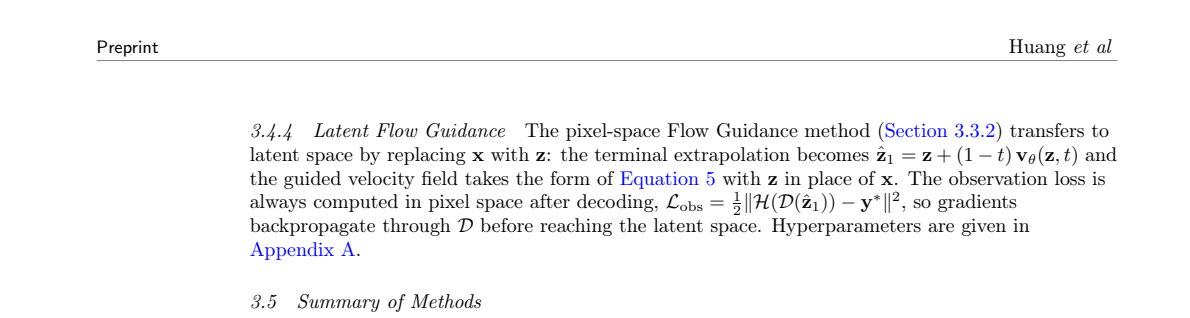
What carries the argument. The carrying object is the guided velocity field built on the terminal extrapolation x̂₁ = x + (1−t)v_θ(x,t), which estimates the clean field at each sampling step so its observation-space discrepancy can be differentiated to steer generation. The load-bearing element is the network Jacobian ∂v_θ/∂x that full-gradient guidance retains: the paper identifies it as the direct analogue of the background-error covariance B in 3D-Var, spreading each station residual to surrounding grid cells through correlations the prior learned from ERA5. Stop-gradient guidance drops this Jacobian, leaving only the observation-operator adjoint, and the paper shows the learned spatial coupling is what preserves accuracy away from stations. A second load-bearing element is the Gaussian likelihood approximation p(y*|x_t) ≈ N(H(x̂₁), (σ_o² + γσ²)I) shared by all per-step conditioning methods, whose scalar covariance the paper concedes treats observation error as equal across variables and stations.
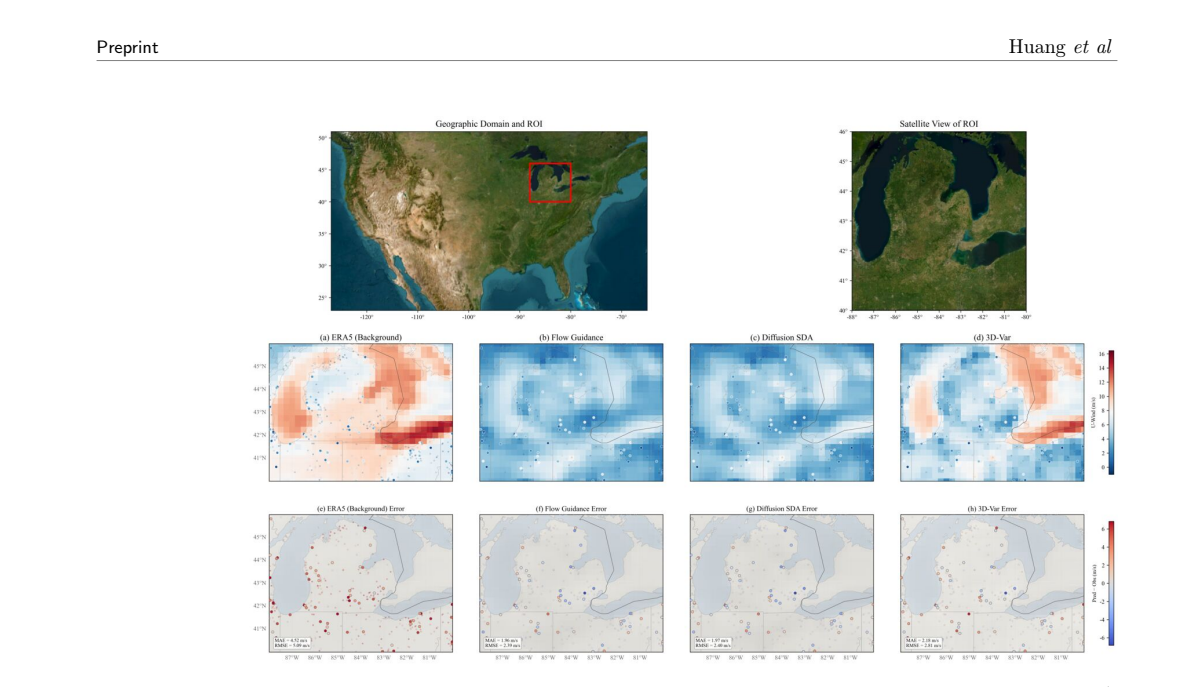
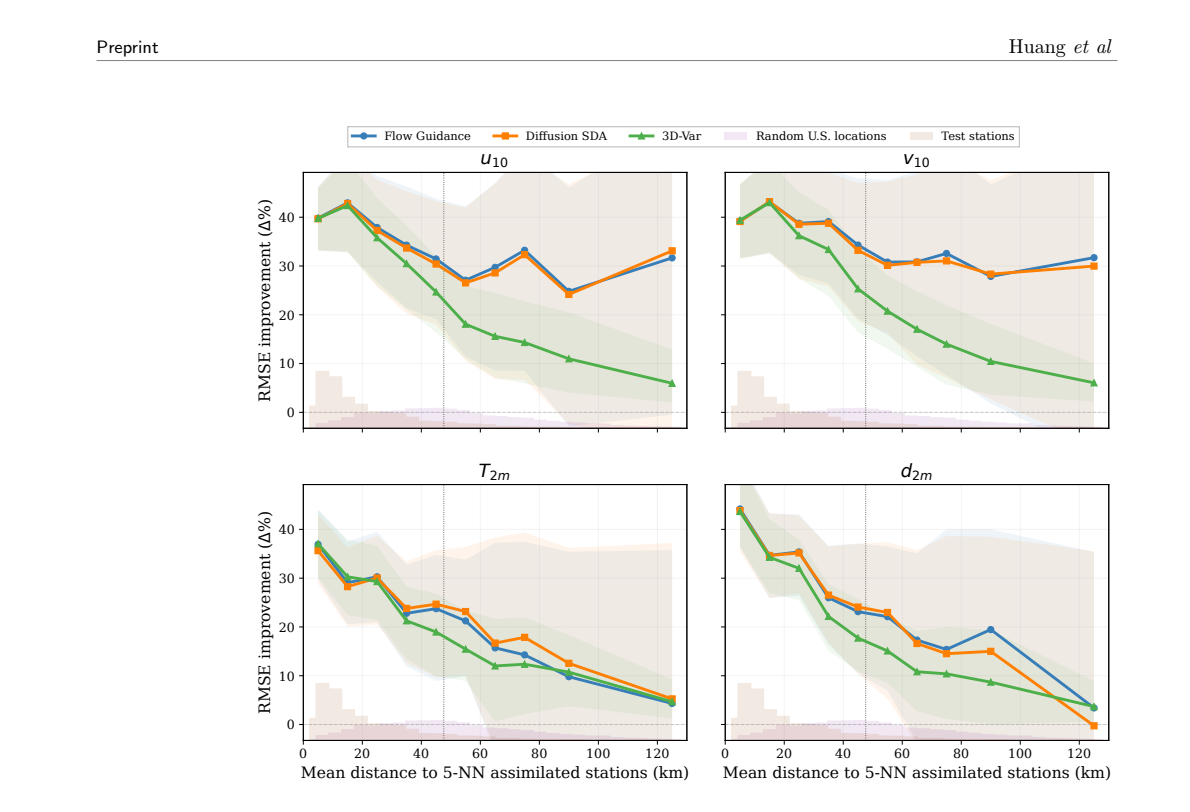
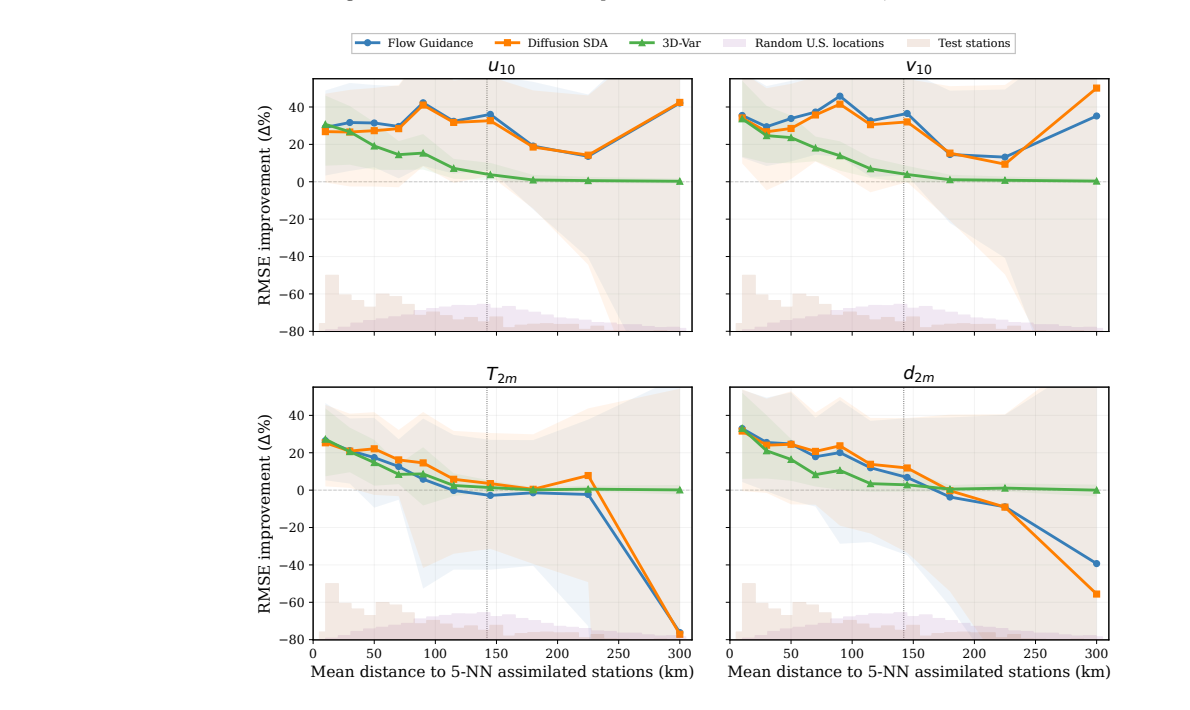
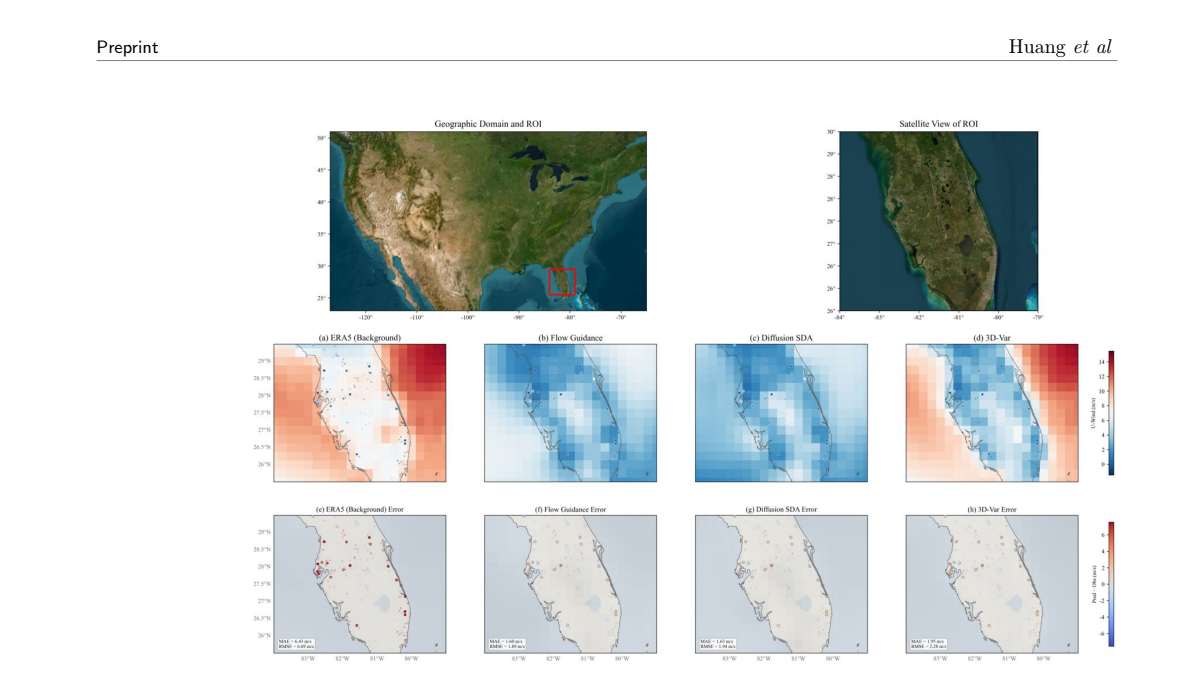
Core claim. The headline discovery is the controlled comparison on the dense 11,849-station benchmark: Flow Guidance reaches 35.7% test RMSE improvement over ERA5, Diffusion-SDA 35.4%, and 3D-Var 33.3%, with the margin widening from 2.4 percentage points on the dense benchmark to 7.9 points when stations fall to 1,000. The paper attributes the generative advantage to the learned prior replacing the ERA5-centered Gaussian background: the network Jacobian carried by full-gradient guidance spreads each station residual to surrounding grid points through correlations the prior learned from ERA5, playing the role that the background-error covariance B plays in 3D-Var. The sparsity stress test sharpens the distinction — full-gradient guidance retains 21.7–22.4% improvement while stop-gradient guidance collapses to 7.6% and D-Flow to 12.6%, with stop-gradient fitting assimilated stations so tightly that temperature and dewpoint go negative at test stations. The paper further reports three findings that constrain future designs: diffusion and flow matching perform nearly identically under matched conditions; a Langevin corrector helps diffusion much more than flow matching (diffusion recovers accuracy through corrective updates, flow through its more accurate predictor, landing at parity); and neither a learned latent space nor inter-variable mixing in the autoencoder improves accuracy over pixel space, with latent space matching pixel accuracy only under sparsity at lower memory cost.
The premise it rests on. The headline comparison rests on the tuned 3D-Var baseline faithfully representing classical data assimilation — its background covariance B = I + ℓ²L is univariate and isotropic with R = I, far simpler than operational covariances, and the paper does not compare against operational regional analyses such as RTMA/URMA or HRRR, so a classical method with a full flow-dependent background could close or reverse the 2.4pp dense margin.
If the paper is right (Pith's inferences, not the authors')
If correct, generative data assimilation can produce gridded analyses matching or beating a tuned variational method at a fraction of the cost, with no ERA5 background field at inference, supporting fully data-driven machine-learning weather pipelines.
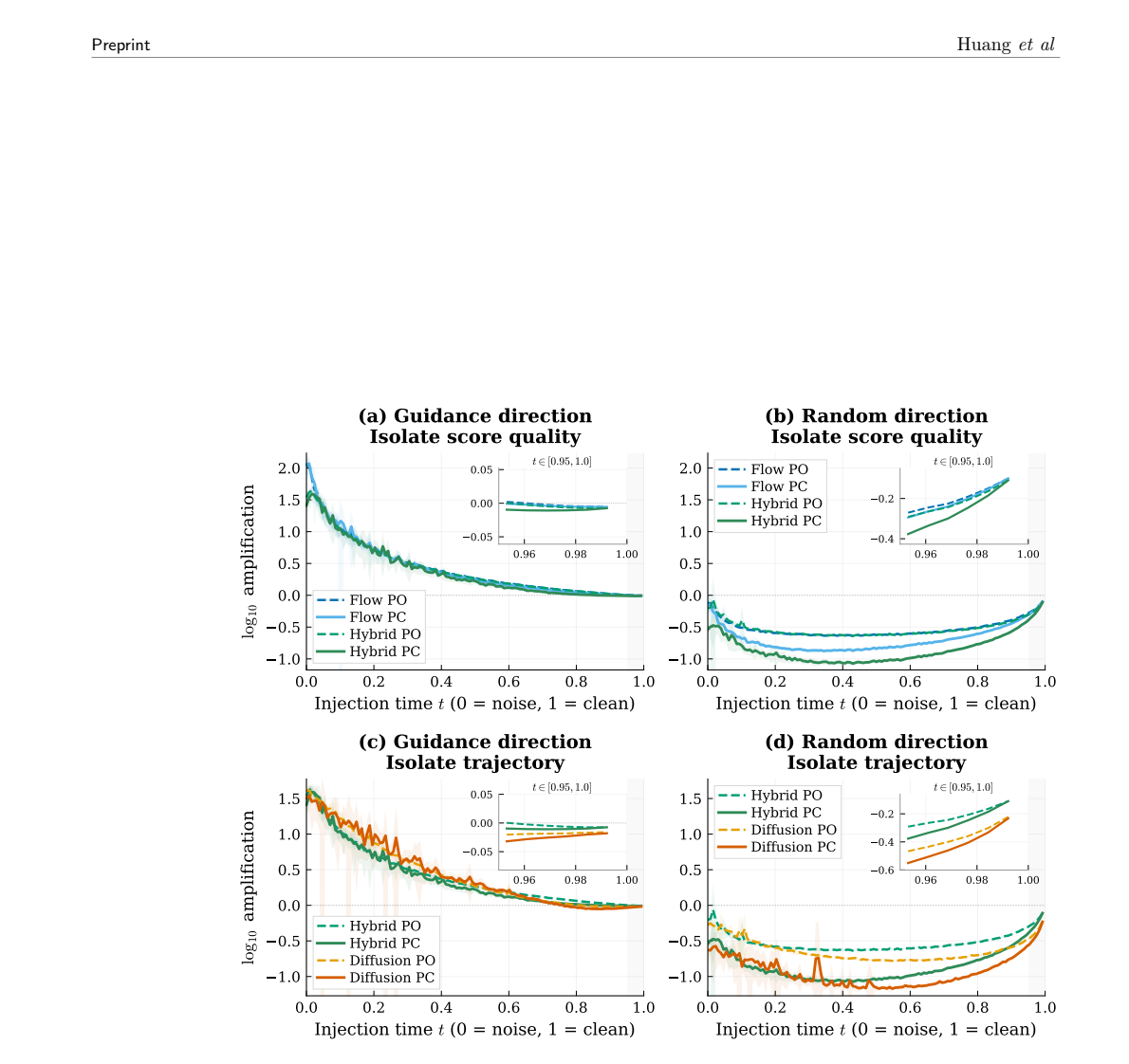
The overfitting pattern — stop-gradient guidance and D-Flow fit assimilated stations more tightly yet generalize worse, an effect amplified under sparsity — indicates that preserving the learned spatial coupling in the gradient is the mechanism worth keeping in any generative DA design.
Diffusion–flow parity means practitioners can choose the cheaper or simpler framework — the paper's Flow Guidance needs one tuning parameter and half the peak memory of Diffusion-SDA — without an accuracy penalty.
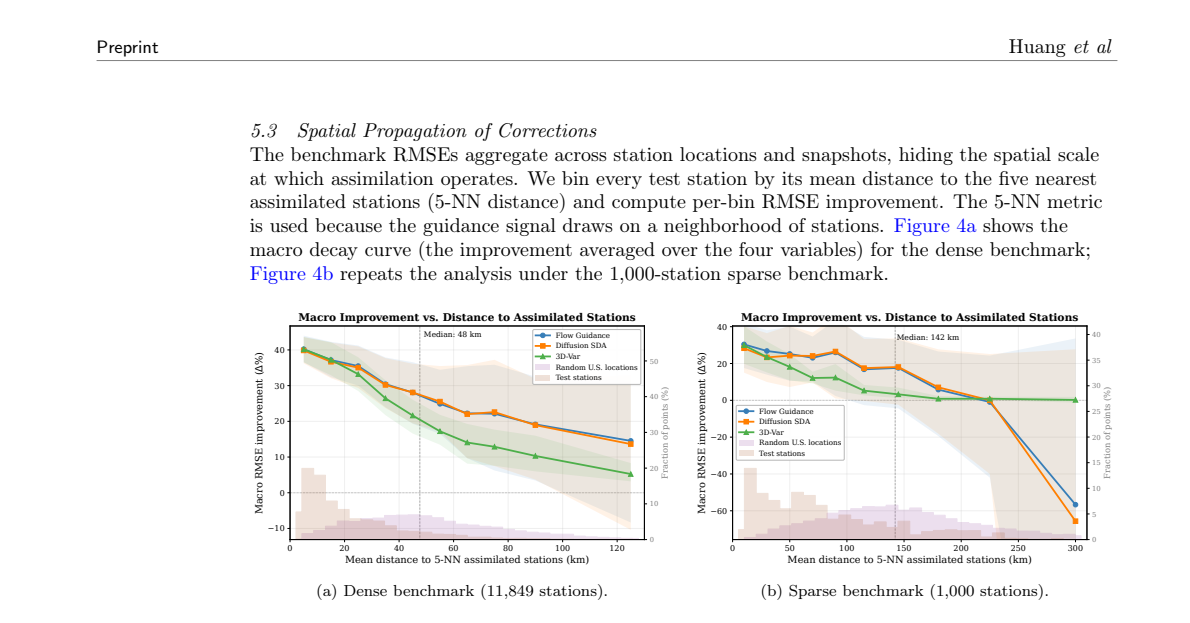
Corrections propagate roughly 120 km from stations, about four ERA5 grid spacings, with wind corrections reaching farther than temperature and dewpoint, so learned priors extend the influence of observations well beyond a single grid cell.
The dense 2.4pp margin is small enough to be plausibly explained by the simplified 3D-Var background covariance, so a conservative reader should treat the sparse benchmark's 7.9pp gain as the stronger evidence for the generative-prior claim.
Because generative methods go negative far from sparse stations where 3D-Var's background keeps it near zero, the natural deployment path is a hybrid — a learned prior conditioned on ERA5 as a soft constraint — which combines the fallback the paper concedes it lacks with the flexibility the learned prior provides.
The identification of the denoiser Jacobian as the analogue of B generalizes: any inference-time conditioning that preserves the full network Jacobian should inherit the spatial-propagation advantage, making the conditioning mechanism, rather than the specific models benchmarked, the transferable finding.
Check this review
Pith stored no record of this review's passes and took no fingerprint of it. Reviews made by code from 13 Nov 2026 on carry both.
How often reviews like this one are right
Reviews like this one: written by deepseek-v4-flash, where what was read was not recorded.
How often objections from reviews like this one are right: not yet measured
Reviews by people
This review was written by a machine. No person has reviewed this paper on Pith yet. A scientist listed on Pith can review it for a fee, and their review is published here whatever it concludes.
The paper
Abstract
Weather reanalysis products rely on computationally intensive numerical weather predictions followed by data assimilation that corrects the forecast toward observations. Recent advances in deep generative models offer a cheaper alternative that shifts much of this cost from inference to offline training. However, existing generative approaches have been evaluated on synthetic observations or under different datasets and evaluation schemes, making it unclear which design choices improve real-world data assimilation. We present the first controlled benchmark of generative data assimilation for single-time near-surface analysis from real weather station observations. Using 11,849 NOAA MADIS stations across the contiguous United States and four near-surface variables, we hold the dataset, observation operator, and deep learning architecture fixed, and measure spatial generalization at held-out stations. The benchmark compares the major design choices proposed for generative data assimilation, including diffusion versus flow matching, pixel versus latent-space formulations, and multiple inference-time conditioning strategies, against a classical 3D-Var baseline. The benchmark reveals three conclusions. First, the best generative methods outperform 3D-Var (35.7% vs. 33.3% RMSE improvement over ERA5), although 3D-Var receives the ERA5 field at the analysis time as its background and the generative methods receive none. Second, full-gradient guidance consistently outperforms stop-gradient and initial-noise optimization. Third, other choices provide little measurable benefit: diffusion and flow matching perform nearly identically under matched conditions, and latent-space variable mixing does not help. Both advantages widen when stations are sparse. Together, these results identify which components of generative data assimilation improve spatial generalization in near-surface analysis.
The paper's own sentences, arranged, kept beside the review and separate from it. Each label is drawn from a closed vocabulary; the number beside it is the probability the classifier gave that label. No sentence in this record was written by a model.
abstract compiled · 2026-10-02
The authors' main claim, as the classifier picked it out 0.94
“Together, these results identify which components of generative weather data assimilation improve performance on real station observations and establish a standardized benchmark for future work.”
How the main claim is stated: asserted 1.00
What the abstract itself states, as probabilities: claims first 0.96 · states limitation 0.22 · human participants 0.02 · controlled comparison 0.98 · randomized assignment 0.02 · states quantitative result 0.99 · compares with prior results 0.97 · mentions code or data availability 0.03
The abstract, sentence by sentence
This table labels the abstract only (arXiv listing abstract v1). The number is the probability the classifier gave the label.
| Sentence | Role | The authors' own work | States the main conclusion | Strength |
|---|---|---|---|---|
| Weather reanalysis products rely on computationally intensive numerical weather predictions followed by data assimilation that corrects the forecast toward observations. | background 1.00 | 0.04 | 0.01 | asserted 1.00 |
| Deep generative models offer a cheaper alternative that shifts much of this cost from inference to offline training. | background 1.00 | 0.05 | 0.02 | asserted 0.94 |
| However, existing generative approaches have been evaluated on synthetic observations or under different datasets and evaluation schemes, making it unclear which design choices actually improve real-world data assimilation. | gap 1.00 | 0.05 | 0.02 | asserted 0.90 |
| We present the first controlled benchmark of generative weather data assimilation on real weather station observations. | contribution 1.00 | 0.96 | 0.05 | asserted 1.00 |
| Using 11,849 NOAA MADIS stations across the contiguous United States and four weather variables, we evaluate methods while holding the dataset, observation operator, and deep learning architecture fixed. | method 0.97 | 0.96 | 0.02 | asserted 1.00 |
| The benchmark compares the major design choices, including diffusion versus flow matching, pixel versus latent-space formulations, and multiple inference-time conditioning strategies, against a classical 3D-Var baseline. | method 0.76 | 0.92 | 0.04 | asserted 0.96 |
| The benchmark reveals three clear conclusions. | result 0.77 | 0.80 | 0.06 | asserted 0.93 |
| First, learned generative priors outperform the Gaussian prior of 3D-Var (35.7% vs. 33.3% RMSE reduction over ERA5) despite using no ERA5 background field at inference. | result 1.00 | 0.96 | 0.32 | asserted 1.00 |
| Second, full-gradient guidance consistently outperforms stop-gradient and initial-noise optimization. | result 1.00 | 0.94 | 0.15 | asserted 1.00 |
| Third, other choices provide little measurable benefit: diffusion and flow matching perform nearly identically under matched conditions, and latent-space variable mixing does not help. | result 0.99 | 0.96 | 0.18 | asserted 1.00 |
| We further evaluate both dense and sparse station settings and find advantages from generative AI and full-gradient guidance more pronounced under sparsity. | result 1.00 | 0.98 | 0.08 | asserted 1.00 |
| Together, these results identify which components of generative weather data assimilation improve performance on real station observations and establish a standardized benchmark for future work. | interpretation 0.73 | 0.90 | 0.50 | asserted 1.00 |
What kind of paper the classifier reports this is: dataset or benchmark 0.93 · evidence from simulation or computation 0.57
What was examined, and what was not
Sources read
- arXiv listing abstract v1
Not examined
- full text
- figures and tables
- references and citing sentences
- relations to other papers
Levels run
- P abstract
Not run
- S sections
- T body sentences
- C citations
- R cross-paper relations
How the labels were made
Compiled by classifier-1.13.0 via TypeSafe API, question bank abstract-p1-20260923, 2026-10-02: 1 request, 8,864 input tokens.
Every quoted sentence on this record is the authors'. Every label is from Pith's closed vocabulary, with the probability shown beside it. This record as JSON
Figures (13)
Showing 12 of the paper's 13 figures. Figures are the authors', reproduced from the paper.
Challenges and discussion
Disagree with the review, or know something it missed? Leave a comment, or challenge this review formally: a challenge becomes a permanent entry in this paper's record, and its decision is published here.
Come back by email
A short list of the week's newly reviewed papers. Nothing is sent until you confirm from your inbox, and every email has a link that stops it. No account.
No comments yet.
Sign in to comment