Quantum Physics · arXiv:2610.01446 v1 · submitted 1 Oct 2026 · 29 references
Unflattening by Flattening – How Input Distributions Shape Output Variance in Angle-Encoded Circuits
The paper says
“Barren plateaus hinder training of parameterized quantum circuits by making loss gradients exponentially small in the number of qubits.”
more of the abstract
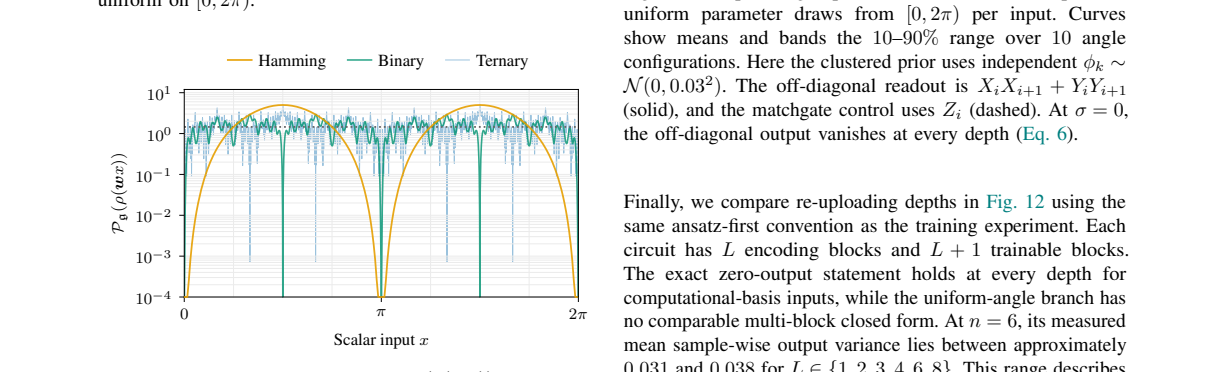
For angle-encoded product states, we show how the input distribution affects output variation through algebraic input purity, i.e. the input's overlap with the circuit's dynamical Lie algebra. With the specified readouts and Haar or exact group 2-design sampling, matchgate circuits on n qubits retain output variance of order 1/n for every pure product input. The off-diagonal family instead has zero output on computational-basis inputs at any depth and for every parameter choice. Independent uniform angles yield mean variance of the same order as matchgates. A count of diagonal Pauli strings identifies these zero-output endpoints. For any fixed dataset of nonzero inputs with at least 2n coordinates, we construct a classical preprocessing certificate. A shared random rotation is accepted only when the dataset's mean purity passes a computable threshold. This certifies mean output variance of order 1/n for the off-diagonal family before circuit execution, with a constant expected number of trials. Binary and ternary weighted encodings also recover the independent-angle mean purity from one uniform scalar input. Numerical experiments examine training behavior and extensions to larger algebras. The guarantee concerns output variance averaged over inputs, while successful learning also depends on the task and information preserved by the encoding.
from the abstract
Pith says
Machine review · deepseek-v4-flash · 2 Oct 2026 · what was read was not recorded · not checked by a person
It can be wrong. Challenge this review or reply to it.
Holds up, with conditions. Analytic core is sound and the zero-output identity is genuinely unconditional, but every Theta(1/n) variance and certificate claim hangs on the Haar/2-design ensemble premise the paper acknowledges and leaves unresolved. This line is wrong
1 major objection · 4 minor
How often objections from reviews like this one are right: not yet measured
Not checked: figures, code, what the 29 references say.
The paper says, at Sec. IIIc and Appendix C (Eqs. 7-9); cf. b233, b236
The review did not quote this passage.
A classifier read this sentence of the paper as acknowledging the concern (probability 0.93):
“It also presumes Haar or exact 2-design sampling, or an approximation accurate enough to preserve the scaling.”
Pith says: Objection 1 of 1 · major
The certificate's operational guarantee is conditional on an unverified ensemble premise, and this is load-bearing for the paper's headline practical claim. Every accepted rotation certifies mean sample-wise variance Θ(1/n) 'for the specified readout and circuit ensemble', but that ensemble is the Haar or exact 2-design over the dynamical Lie group, and no finite-depth brickwork schedule that reproduces those second moments for the baseline off-diagonal or matchgate circuits is supplied.
more of objection 1
The authors acknowledge this directly (b233: 'It also presumes Haar or exact 2-design sampling'; b236: 'We therefore leave the mixing depth of the gate schedules studied here unresolved'), and the consistency evidence at finite depth is real but incomplete: the doped-chain ratios (1.06/1.05/0.91, n=6) and Fig. 12 do not establish convergence of Var_θ[f_θ] to the Eq.-1 prediction for the certificate's own schedule. Indeed, Fig. 12's uniform-branch multi-block variance at n=6 (0.031-0.038) lies below the single-block Haar prediction of roughly 0.096 from Eq. 1 with μ_6 = 14/9 and dim g_od = 30, so even the deepest probed schedule sits measurably short of its ensemble limit. As written, a user who runs the depth-L circuit actually at hand gets a certificate whose Θ(1/n) promise governs an idealized object unless the schedule happens to form a good 2-design. I recommend the authors either (i) supply a mixing-depth argument or explicit depth-convergence evidence for the certificate scenario, or (ii) rescope the claim in the abstract and conclusion—the sentence 'This certifies mean output variance of order 1/n for the off-diagonal family before circuit execution' currently carries no ensemble qualifier—so that the guarantee is stated as holding for the Haar/2-design ensemble, with a sentence explaining the practical status of the mixing-depth question.
4 minor objections
The paper says, at Abstract
Pith says: minor objection 1 of 4
The certificate sentence omits the ensemble condition that the body attaches to every such claim. Since the whole chain is conditional on 'Haar or exact group 2-design sampling', consider carrying that qualifier into the certificate sentence for consistency with the body's scoping.
The paper says, at Fig. 5 caption / Sec. IIId
Pith says: minor objection 2 of 4
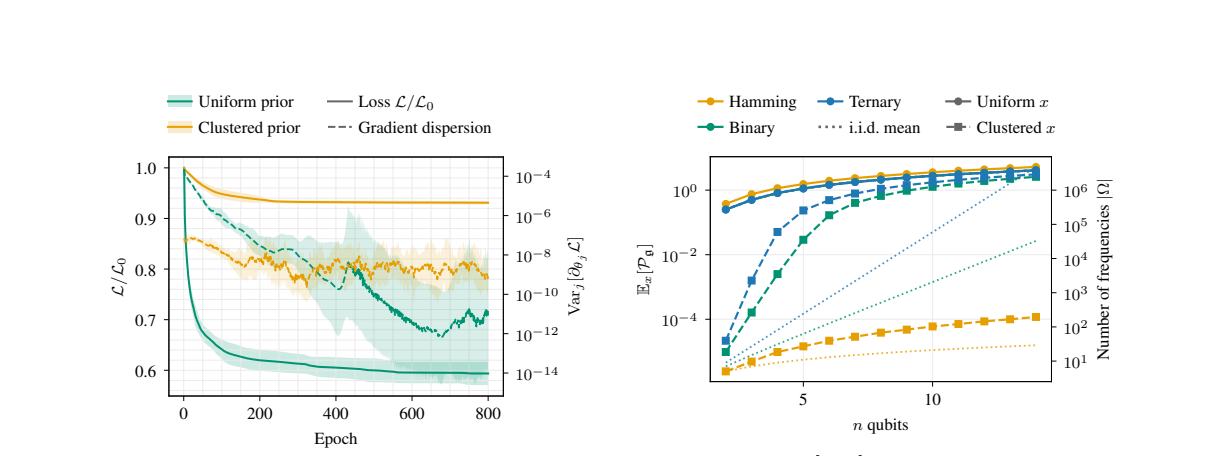
The caption should state explicitly that the two runs use differently labeled datasets (the text already notes this); as printed, the caption alone invites a reading in which the loss gap is attributed solely to the angle prior.
show 2 more
The paper says, at Fig. 12 discussion
Pith says: minor objection 3 of 4
The sentence 'This range describes stability relative to the observed L=1 circuit and is not an equality with the single-block Haar prediction' is important for honest interpretation and deserves a place in the figure caption as well as the body text, so the measured 0.031-0.038 range is not misread as evidence of convergence to the Eq.-1 value.
The paper says, at Conclusion (exponential families)
Pith says: minor objection 4 of 4
The conclusion states that for the exponential graph families 'input choice cannot remove the O(2^{-n}) variance cap' without the qualifier attached in Table II. Since the relevant simple-component structure for the doped chain is numerically verified only (and conjectured beyond n=9), consider adding the 'conditional on the conjectured component structure' phrase to the conclusion sentence for consistency with Table II's daggered entries.
What would settle it
On the off-diagonal ansatz ({XkXk+1, YkYk+1}) at n=8, fix one input at a generic angle (e.g., φk=π/4) and one at i.i.d. uniform angles; for depth L in {1,2,4,8,16,32}, draw S=10^4 independent uniform parameter vectors and compute the empirical Var_θ[fθ] for O = X1X2 + Y1Y2, then compare against the Eq.-1 prediction 2·Pgod(ρ(φ))/dimgod. The family is classically simulable, so S is cheap. If the empirical variance does not converge to within ~50% of the prediction by L=32, then the certificate (Eqs. 7–9) certifies only the Haar-ensemble variance, not the depth-L circuit's, and the operational claim needs explicit qualification.
from the skeptic's reading
How the review went
4 readings by deepseek-v4-flash · 2 Oct 2026
- Reader holds up, with conditions
- Skeptic agrees
- Editor wrote the verdict above
- Referee major revision: 1 major objection, 4 minor
Not run on this paper: the simulated authors' defence.
Pith did not check this review's objections against the paper.
The review in full
The review in brief, machine-written
Dave —
Read Strobl et al. on how angle-encoded input distributions shape output variance. Bottom line: the analytic core is sound, mostly new, and checked against brute force; the paper is unusually candid about its own limits; and the one real gap — the Haar/2-design ensemble premise behind every Theta(1/n) claim — is stated plainly but left open. Conditional, in the sense that the algebra holds and the operational promise outruns the proven ground.
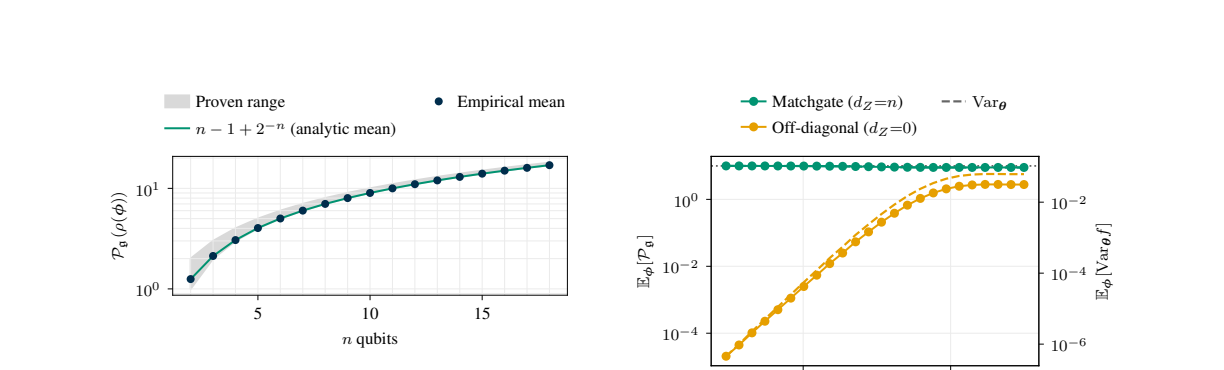
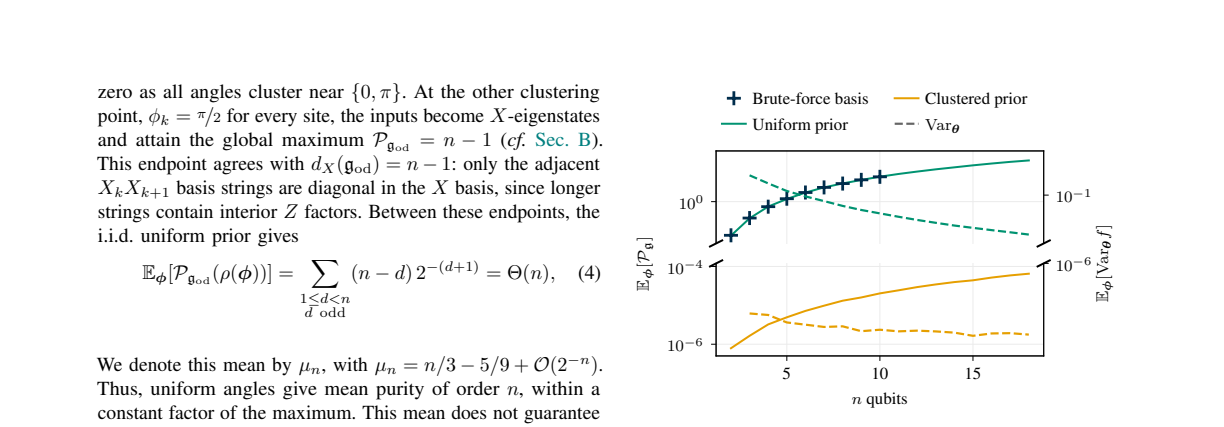
The genuinely new pieces: the matchgate purity band [n-1, n] for every pure product input (Eq. 2), which gives per-input Theta(1/n) variance with the Zi readout, no averaging over inputs needed. The zero-output identity (Eq. 6): for the off-diagonal family, in-algebra output vanishes at computational-basis inputs for every circuit realization and every parameter choice — unconditionally, no design assumption. I checked the reasoning; it holds, because any string containing X or Y dies on computational-basis states under adjoint invariance. And the preprocessing certificate: shared SO(D) rotation, mean-purity threshold mu_n/2, Markov bound giving acceptance probability approaching 1/5 with constant expected trials. I re-derived the telescoping for Eq. 2 and the closed form mu_n = n/3 - 5/9; both check out. The brute-force sums over the full Pauli basis at small n and the shipped code are real evidence, not fits.
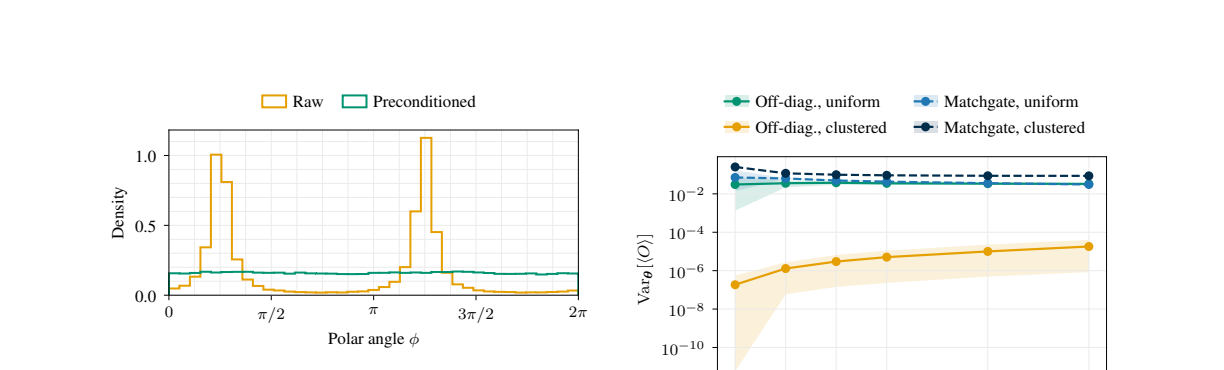
The soft spot, in proportion: the whole variance-and-certificate chain rests on Eq. 1 from Ragone et al., which presumes Haar or exact group 2-design sampling of the trainable parameters. The authors say exactly this (b233, b236) and leave the mixing depth of the gate schedules unresolved. So an accepted rotation certifies Theta(1/n) under the idealized ensemble, not under the depth-L circuit a user actually runs. The finite-depth probes do not close the gap: the re-uploading measurements in Fig. 12 sit in a range rather than at the ensemble prediction, and the doped-chain ratios (1.06, 1.05, 0.91 at n=6) represent a handful of draws. This is a premise about the sampling ensemble, not a flaw in the variance calculation itself — but it does make the paper's operational claim conditional on a design question left unanswered.
Everything else is minor and mostly self-acknowledged: the training run does not establish BP scaling, the pooled histogram gives no per-site uniformity, and the exponential-family counts are purely numerical through n=8-9. None of these is an internal inconsistency.
Who it's for: the barren-plateau and QML-preprocessing crowd. The certificate is a clean, classically-checkable diagnostic even with the ensemble caveat, and the zero-output identity will be useful on its own. It deserves a serious referee. Send it out.
The strongest objection
The single load-bearing link is the ensemble premise behind Eq. 1: every Θ(1/n) statement — the matchgate per-input band, the off-diagonal uniform-prior mean via Eq. 4, and the certificate's accepted-rotation guarantee (Eqs. 7–9) — assumes the trainable-parameter ensemble reproduces Haar (or exact 2-design) second moments on the dynamical Lie group. Eq. 6 is unconditional and gives only the zero endpoint; all nonzero-width variance claims are variances of the idealized ensemble, not of any concrete depth-L circuit. The paper states the premise and leaves the mixing depth unresolved (b233, b236), and its finite-depth probes (Fig. 12 re-uploading means; doped-chain empirical-to-Haar ratios 1.06/1.05/0.91 at n=6) do not establish convergence of Var_θ[fθ] to the Eq.-1 prediction for the baseline off-diagonal or matchgate schedules. Because the certificate's practical value is precisely to certify variance before circuit execution, this gap transfers directly to the paper's operational claim: an accepted rotation (Eq. 9) certifies Θ(1/n) under the 2-design ensemble, not under the depth-L circuit the user actually runs. All other potential concerns — per-input vs. mean purity (b154), pooled histogram non-uniformity (b363), non-BP-scaling training run (b275), numerically-verified-only exponential families — are stated by the authors and are not internal inconsistencies; they do not threaten the analytic content, which checks out. The 2-design premise is the hinge, it is acknowledged, and it is unresolved.
I read the paper as a self-contained, algebraically sound analysis of how angle-encoded input distributions affect sample-wise output variance for two polynomial-DLA families, plus numerically explored exponential-DLA extensions. The reader's verdict (CONDITIONAL, moderate confidence) is correct, and I agree on the weakest assumption: the entire variance-and-certificate chain is gated on the trainable-parameter ensemble matching Haar or exact 2-design second moments on the relevant Lie group (Eq. 1 from Ragone et al.), with no finite-depth schedule shown to achieve it. I verified the core algebra independently: the matchgate telescoping purity band [n-1,n] (Eq. 2) and resulting Θ(1/n) variance for Zi readout; the off-diagonal closed form Eq. 3 (only sin²φj sin²φk terms survive under Ry encoding, odd separations per the cited algebra structure); the uniform mean μn = n/3 - 5/9 (Eq. 4); the extremal maximum n-1 at X-eigenstates matching dX = n-1; and the fully unconditional zero-output identity Eq. 6 (every algebra string contains an X or Y factor, whose expectation vanishes on computational-basis states). The Markov acceptance bound (Eq. 8) tending to 1/5 and the certificate's lower bound μn/dimgod = Θ(1/n) on mean variance are correct conditional on Eq. 7, i.e., on the per-input uniform angle law, which holds for D≥2n disjoint planes. The paper is notably candid: it flags the 2-design dependence (b233), the unresolved mixing depth (b236), the mean-not-per-input nature of the guarantee (b154), the pooled histogram's non-uniformity (b363), the training run's failure to establish BP scaling (b275), and the numerical-only verification of exponential-family structure. Because of this transparency and because the analytic content is internally consistent, the concern I identify does not move the verdict: it reinforces CONDITIONAL rather than changing it. The honest position is that the certificate's deliverable is proven for the idealized ensemble, and the paper's own unresolved mixing-depth caveat is precisely the condition under which that guarantee is realized; a depth-convergence check would settle whether the operational claim holds.
The referee's report
If the results stand, they provide a clean, parameter-free characterization of how input distributions govern output variation in Lie-algebra-supported ansatzes, with several concrete strengths. The closed forms (Eqs. 2, 3, 4) are analytic and verified against brute-force Pauli-basis summation; the zero-output identity (Eq. 6) is unconditional and holds for every circuit realization at the clustered endpoint; the acceptance test in Appendix C is classically computable in O(mn) time with a derived constant expected trial count; and the code is released for reproduction. The paper is also unusually scrupulous about its own scope, flagging that the certificate controls dataset-mean, not per-input, variance (b154, b361) and that the exponential-family statements are numerically verified only at small sizes (Table II daggers). The single load-bearing assumption is the Haar/2-design premise behind Eq. 1; every nonzero-width variance statement, including the certificate's guarantee, is a variance of that idealized ensemble rather than of any concrete depth-L circuit.
Pith's reading of the paper (a machine's summary, not the authors')
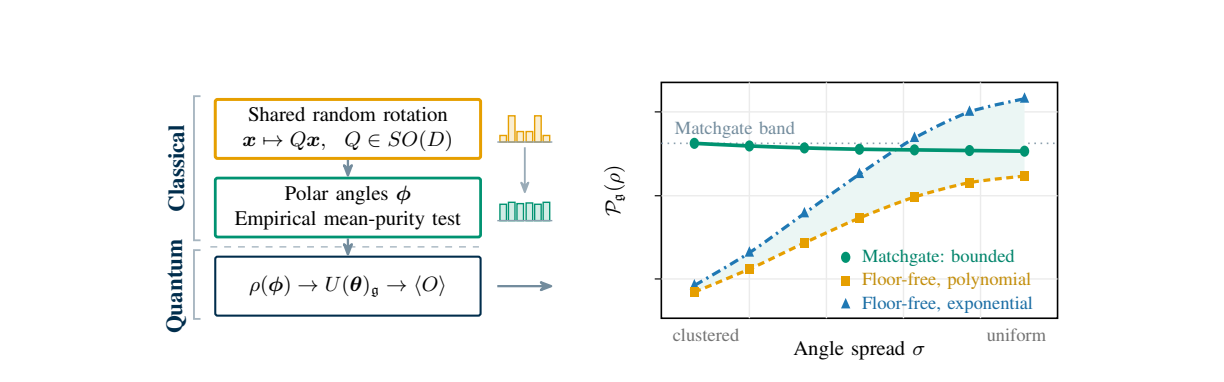
The paper aims to explain why some angle-encoded parameterized quantum circuits show an output landscape that depends sharply on how classical data is encoded, and to turn that dependence into a usable preprocessing guarantee. Its central object is algebraic input purity: the squared overlap between the encoded state and the basis of the circuit's dynamical Lie algebra, which the circuit can neither create nor destroy. For the matchgate family (DLA so(2n)), this purity stays in the narrow band [n−1, n] for every pure product input, so with readout Zi the output variance is Θ(1/n) for all such inputs. For the off-diagonal family (DLA so(n)⊕so(n)), purity vanishes exactly at computational-basis inputs—zero output for every parameter value at any depth—while independent uniform angles restore mean variance Θ(1/n). The paper closes the loop with a fully classical certificate: a shared random rotation and polar-angle extraction pass a computable purity threshold with a constant expected number of trials, certifying mean variance Θ(1/n) before the quantum circuit is run.
What carries the argument. The central object is algebraic input purity, Pg(ρ) = Σ_{P∈Bg} ⟨P⟩²_ρ, the sum of squared expectations of the Pauli-string basis of the dynamical Lie algebra g on the encoded state—the input's overlap with the operators the circuit can generate. It is carried by three pieces: the Lie-algebraic variance formula (Eq. 1, from Ragone et al. [21]), which gives Varθ[fθ] = Σ_j $P^{{HS}}$_{gj}(ρ)$P^{{HS}}$_{gj}(O)/dim gj for Haar or exact group 2-design sampling and shows a component contributes to variance only if both input and readout project onto it; the diagonal-Pauli-string count dA(g), which counts how many basis strings of ig survive on an eigenstate of the clustering observable A and equals the purity exactly at the clustered endpoint (dZ(god) = 0 marks the zero-output floor-free case); and the closed-form off-diagonal purity Eq. 3, a telescoping sum over odd-distance XX strings whose uniform-prior mean µn = n/3 − 5/9 (Eq. 4) is the target of the acceptance test. The acceptance test (Eqs. 7–9) uses linearity of expectation under the shared rotation together with Markov's inequality to bound the probability that the empirical mean purity passes µn/2, giving a classical O(mn) certificate check before any quantum circuit runs.
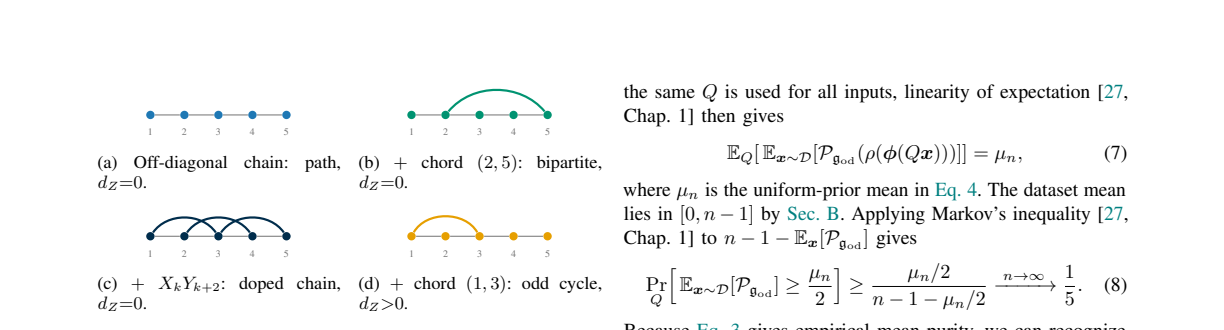
Core claim. On the paper's own terms, the discovery is that in angle-encoded product-state circuits the input distribution controls output variance through the input's overlap with the circuit's dynamical Lie algebra, and this control can flip the landscape between two extremes. For the matchgate ansatz (g ≅ so(2n)), the purity formula Pg(ρ) = (n−1) + ∏k ⟨Zk⟩² confines purity to [n−1, n] for every pure product input, giving output variance Θ(1/n) with readout Zi under Haar or exact group 2-design sampling. For the off-diagonal ansatz (god ≅ so(n)⊕so(n)), the diagonal-Pauli-string count dZ(god) = 0 identifies the computational-basis endpoint where ⟨a|U†OU|a⟩ = 0 for every circuit parameter realization at any depth (Eq. 6); the closed form Eq. 3 for Pgod and its uniform-prior mean µn = n/3 − 5/9 (Eq. 4) then give mean sample-wise variance Θ(1/n) under independent uniform angles. The supporting result is a classical preprocessing certificate: for any fixed dataset of nonzero inputs with at least 2n coordinates, a shared Haar rotation Q ∈ SO(D) followed by polar-angle extraction has dataset-mean purity whose Q-average is µn (Eq. 7), and accepting a rotation when the empirical mean passes µn/2 succeeds with probability approaching 1/5, so rejection sampling needs a constant expected number of trials (Eq. 8). Every accepted rotation certifies empirical mean sample-wise output variance Θ(1/n) for the specified readout and circuit ensemble before execution.
The premise it rests on. The entire Θ(1/n) variance chain and the preprocessing certificate assume the trainable parameters are sampled so the circuit matches Haar second moments or forms an exact group 2-design on its dynamical Lie algebra—a premise the paper states but does not supply a finite-depth schedule to realize, as it leaves mixing depths unresolved.
If the paper is right (Pith's inferences, not the authors')
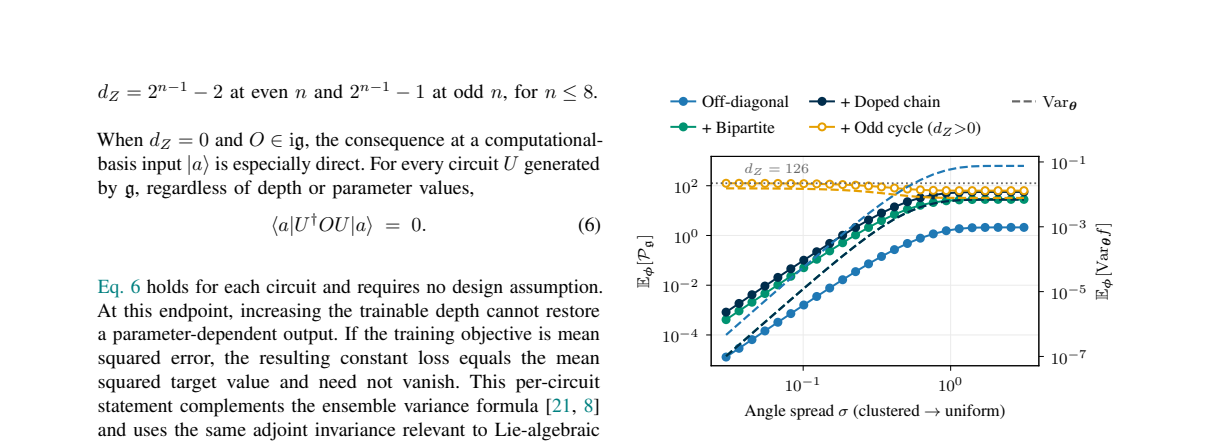
Any circuit family whose diagonal count dZ = 0 has exactly zero in-algebra output on computational-basis inputs at any depth and for every parameter choice, so training such a model on basis-aligned data starts from a constant loss equal to the mean squared target.
For the off-diagonal family under independent uniform angles, mean sample-wise output variance is Θ(1/n), so a data-encoding choice alone—not a circuit redesign—suffices to remove an exponentially small variance.
The matchgate family (DLA so(2n)) is provably protected: every pure product input keeps purity in [n−1, n], so no input-dependent preconditioning is needed for the Θ(1/n) scaling with readout Zi.
The certificate lets a practitioner verify classically, before running any quantum circuit, that an encoded dataset will produce inverse-polynomial mean output variance, complementing loss-based barren-plateau diagnostics.
Dissociated binary and ternary scalar encodings inherit the independent-angle mean purity exactly for uniform scalar inputs (Eq. 5), extending the protected scaling to single-parameter encodings.
Because the zero-output statement (Eq. 6) holds per-circuit without any design assumption, that half of the paper is the more robust: any depth-L schedule on the off-diagonal ansatz must show exactly zero expectation on computational-basis inputs, independent of the unresolved mixing-depth question.
The acceptance-test structure is derived only for the off-diagonal chain, where a closed purity form and uniform-prior mean exist; extending the certificate to other floor-free algebras would require an analytic purity formula for each new family, which currently limits the method's reach.
A direct test of the design premise would simulate a depth-L brickwork off-diagonal circuit at moderate n under uniform angles and compare empirical output variance to the Θ(1/n) prediction; systematic deviation with depth would pinpoint where the certificate stops applying.
The learning-level implication is cautionary: the certificate guarantees mean sample-wise variance, not trainability—a dataset passing the test could still have zero per-input variance or label-mismatched outputs, so the method is a landscape diagnostic, not a performance predictor.
Check this review
Pith stored no record of this review's passes and took no fingerprint of it. Reviews made by code from 13 Nov 2026 on carry both.
How often reviews like this one are right
Reviews like this one: written by deepseek-v4-flash, where what was read was not recorded.
How often objections from reviews like this one are right: not yet measured
Reviews by people
This review was written by a machine. No person has reviewed this paper on Pith yet. A scientist listed on Pith can review it for a fee, and their review is published here whatever it concludes.
The paper
Abstract
Barren plateaus hinder training of parameterized quantum circuits by making loss gradients exponentially small in the number of qubits. For angle-encoded product states, we show how the input distribution affects output variation through algebraic input purity, i.e. the input's overlap with the circuit's dynamical Lie algebra. With the specified readouts and Haar or exact group 2-design sampling, matchgate circuits on n qubits retain output variance of order 1/n for every pure product input. The off-diagonal family instead has zero output on computational-basis inputs at any depth and for every parameter choice. Independent uniform angles yield mean variance of the same order as matchgates. A count of diagonal Pauli strings identifies these zero-output endpoints. For any fixed dataset of nonzero inputs with at least 2n coordinates, we construct a classical preprocessing certificate. A shared random rotation is accepted only when the dataset's mean purity passes a computable threshold. This certifies mean output variance of order 1/n for the off-diagonal family before circuit execution, with a constant expected number of trials. Binary and ternary weighted encodings also recover the independent-angle mean purity from one uniform scalar input. Numerical experiments examine training behavior and extensions to larger algebras. The guarantee concerns output variance averaged over inputs, while successful learning also depends on the task and information preserved by the encoding.
The paper's own sentences, arranged, kept beside the review and separate from it. Each label is drawn from a closed vocabulary; the number beside it is the probability the classifier gave that label. No sentence in this record was written by a model.
abstract compiled · 2026-10-02
The authors' main claim, as the classifier picked it out 0.86
“For angle-encoded product states, we show how the input distribution affects output variation through algebraic input purity, i.e. the input's overlap with the circuit's dynamical Lie algebra.”
How the main claim is stated: asserted 1.00
What the abstract itself states, as probabilities: claims first 0.04 · states limitation 0.95 · human participants 0.02 · controlled comparison 0.30 · randomized assignment 0.06 · states quantitative result 0.97 · compares with prior results 0.68 · mentions code or data availability 0.02
The abstract, sentence by sentence
This table labels the abstract only (arXiv listing abstract v1). The number is the probability the classifier gave the label.
| Sentence | Role | The authors' own work | States the main conclusion | Strength |
|---|---|---|---|---|
| Barren plateaus hinder training of parameterized quantum circuits by making loss gradients exponentially small in the number of qubits. | background 1.00 | 0.05 | 0.04 | asserted 1.00 |
| For angle-encoded product states, we show how the input distribution affects output variation through algebraic input purity, i.e. the input's overlap with the circuit's dynamical Lie algebra. | contribution 0.96 | 0.92 | 0.38 | asserted 1.00 |
| With the specified readouts and Haar or exact group 2-design sampling, matchgate circuits on $n$ qubits retain output variance of order $1/n$ for every pure product input. | result 0.99 | 0.81 | 0.26 | asserted 1.00 |
| The off-diagonal family instead has zero output on computational-basis inputs at any depth and for every parameter choice. | result 1.00 | 0.81 | 0.08 | asserted 1.00 |
| Independent uniform angles yield mean variance of the same order as matchgates. | result 1.00 | 0.82 | 0.09 | asserted 1.00 |
| A count of diagonal Pauli strings identifies these zero-output endpoints. | method 0.76 | 0.81 | 0.04 | asserted 1.00 |
| For any fixed dataset of nonzero inputs with at least $2n$ coordinates, we construct a classical preprocessing certificate. | method 0.48 | 0.89 | 0.07 | asserted 1.00 |
| A shared random rotation is accepted only when the dataset's mean purity passes a computable threshold. | method 0.89 | 0.78 | 0.08 | asserted 0.98 |
| This certifies mean output variance of order $1/n$ for the off-diagonal family before circuit execution, with a constant expected number of trials. | result 0.81 | 0.89 | 0.23 | asserted 1.00 |
| Binary and ternary weighted encodings also recover the independent-angle mean purity from one uniform scalar input. | result 0.92 | 0.81 | 0.06 | asserted 1.00 |
| Numerical experiments examine training behavior and extensions to larger algebras. | method 0.71 | 0.89 | 0.04 | asserted 0.72 |
| The guarantee concerns output variance averaged over inputs, while successful learning also depends on the task and information preserved by the encoding. | limitation 0.91 | 0.41 | 0.17 | asserted 0.95 |
What kind of paper the classifier reports this is: theoretical result 0.99 · evidence from proof or derivation 1.00
What was examined, and what was not
Sources read
- arXiv listing abstract v1
Not examined
- full text
- figures and tables
- references and citing sentences
- relations to other papers
Levels run
- P abstract
Not run
- S sections
- T body sentences
- C citations
- R cross-paper relations
How the labels were made
Compiled by classifier-1.13.0 via TypeSafe API, question bank abstract-p1-20260923, 2026-10-02: 1 request, 8,721 input tokens.
Every quoted sentence on this record is the authors'. Every label is from Pith's closed vocabulary, with the probability shown beside it. This record as JSON
Figures (12)
Showing 9 of the paper's 12 figures. Figures are the authors', reproduced from the paper.
References (29)
- [1] Andrew Arrasmith, Zoë Holmes, M. Cerezo, et al. “Equivalence of Quantum Barren Plateaus to Cost Con- centration and Narrow Gorges”. In:Quantum Science and Technology7.4 (2022), p. 045015.DOI: 10.1088/ 2058-9565/ac7d06 on Pith
- [2] Howard Barnum, Emanuel Knill, Gerardo Ortiz, et al. “Generalizations of Entanglement Based on Coherent States and Convex Sets”. In:Physical Review A68.3 (2003), p. 032308.DOI: 10.1103/PhysRevA.68.032308 on Pithdoi:10.1103/physreva.68.032308
- [3] Alice Barthe and Adrián Pérez-Salinas. “Gradients and Frequency Profiles of Quantum Re-Uploading Models”. In:Quantum8 (2024), p. 1523.DOI: 10.22331/q-2024- 11-14-1523 on Pithdoi:10.22331/q-2024-
- [4] Fernando G. S. L. Brandão, Aram W. Harrow, and Michał Horodecki. “Local Random Quantum Circuits Are Approximate Polynomial-Designs”. In:Communica- tions in Mathematical Physics346.2 (2016), pp. 397–434. DOI: 10.1007/s00220-016-2706-8 on Pithdoi:10.1007/s00220-016-2706-8
- [5] Daniel J. Brod and Andrew M. Childs. “The Compu- tational Power of Matchgates and the XY Interaction on Arbitrary Graphs”. In:Quantum Information and Computation14.11–12 (2014), pp. 901–916.DOI: 10. 26421/QIC14.11-12-1 on Pith
- [6] M. Cerezo, Martin Larocca, Diego García-Martín, et al. “Does Provable Absence of Barren Plateaus Imply Classical Simulability?” In:Nature Communications16 (2025), p. 7907.DOI: 10.1038/s41467-025-63099-6 on Pithdoi:10.1038/s41467-025-63099-6
- [7] M. Cerezo, Akira Sone, Tyler V olkoff, et al. “Cost Func- tion Dependent Barren Plateaus in Shallow Parametrized Quantum Circuits”. In:Nature Communications12.1 (2021), p. 1791.DOI: 10.1038/s41467-021-21728-w on Pithdoi:10.1038/s41467-021-21728-w
- [8] Enrico Fontana, Dylan Herman, Shouvanik Chakrabarti, et al. “Characterizing barren plateaus in quantum ansätze with the adjoint representation”. In:Nature Communica- tions15.1 (Aug. 2024), p. 7171.DOI: 10.1038/s41467- 024-49910-w on Pithdoi:10.1038/s41467-
- [9] Maja Franz, Melvin Strobl, Jonathan Hunz, et al. “ Software Between Quantum and Machine Learning - and Down to Pulses ”. In:2026 IEEE International Conference on Quantum Software (QSW). Los Alamitos, CA, USA: IEEE Computer Society, July 2026, pp. 66–78. DOI: 10.1109/QSW72780.2... on Pithdoi:10.1109/qsw72780.2026.00017
- [10] Matthew L. Goh, Martin Larocca, Lukasz Cincio, et al. “Lie-Algebraic Classical Simulations for Quantum Computing”. In:Physical Review Research7 (2025), p. 033266.DOI: 10.1103/3y65-f5w6 on Pithdoi:10.1103/3y65-f5w6
- [11] Richard Jozsa and Akimasa Miyake. “Matchgates and Classical Simulation of Quantum Circuits”. In:Pro- ceedings of the Royal Society A464.2100 (2008), pp. 3089–3106.DOI: 10.1098/rspa.2008.0189 on Pithdoi:10.1098/rspa.2008.0189
- [12] Efekan Kökcü, Roeland Wiersema, Alexander F. Kemper, et al. “Classification of Dynamical Lie Algebras Gen- erated by Spin Interactions on Undirected Graphs”. In: Journal of Mathematical Physics67.5 (2026), p. 052205. DOI: 10.1063/5.0283277 on Pithdoi:10.1063/5.0283277
- [13] Ankit Kulshrestha, Ricard Puig, Diego García-Martín, et al.Exponentially Many Initializations to Avoid Barren Plateaus. June 2026.DOI: 10.48550/arXiv.2606.18515 on PithPith's reviewarXivdoi:10.48550/arxiv.2606.18515
- [14] Martin Larocca, Piotr Czarnik, Kunal Sharma, et al. “Diagnosing Barren Plateaus with Tools from Quantum Optimal Control”. In:Quantum6 (2022), p. 824.DOI: 10.22331/q-2022-09-29-824 on Pithdoi:10.22331/q-2022-09-29-824
- [15] Yann A. LeCun, Léon Bottou, Genevieve B. Orr, et al. “Efficient BackProp”. In:Neural Networks: Tricks of the Trade. V ol. 7700. Lecture Notes in Computer Science. Springer, 2012, pp. 9–48.DOI: 10.1007/978- 3- 642- 35289-8_3 on Pithdoi:10.1007/978-
- [16] Jarrod R. McClean, Sergio Boixo, Vadim N. Smelyan- skiy, et al. “Barren Plateaus in Quantum Neural Network Training Landscapes”. In:Nature Communications9.1 (2018), p. 4812.DOI: 10.1038/s41467-018-07090-4 on Pithdoi:10.1038/s41467-018-07090-4
- [17] Elizabeth S. Meckes.The Random Matrix Theory of the Classical Compact Groups. V ol. 218. Cambridge Tracts in Mathematics. Cambridge University Press, 2019.DOI: 10.1017/9781108303453 on Pithdoi:10.1017/9781108303453
- [18] Hela Mhiri, Léo Monbroussou, Mario Herrero-González, et al. “Constrained and Vanishing Expressivity of Quan- tum Fourier Models”. In:Quantum9 (2025), p. 1847. DOI: 10.22331/q-2025-09-03-1847 on Pithdoi:10.22331/q-2025-09-03-1847
- [19] Hiroshi Ohno.Observable-Guided Generator Selection for Improving Trainability in Quantum Machine Learn- ing with a g-Purity Interpretation under Restricted Settings. 2026.DOI: 10.48550/arXiv.2604.15693 on PithPith's reviewarXivdoi:10.48550/arxiv.2604.15693
- [20] Evan Peters and Maria Schuld. “Generalization despite overfitting in quantum machine learning models”. In: Quantum7 (Dec. 2023), p. 1210.DOI: 10.22331/q-2023- 12-20-1210 on Pithdoi:10.22331/q-2023-
show 9 more
- [21] Michael Ragone, Bojko N. Bakalov, Frédéric Sauvage, et al. “A Lie Algebraic Theory of Barren Plateaus for Deep Parameterized Quantum Circuits”. In:Nature Communications15.1 (Aug. 2024), p. 7172.DOI: 10. 1038/s41467-024-49909-3 on Pith
- [22] Maria Schuld, Ryan Sweke, and Johannes Jakob Meyer. “Effect of Data Encoding on the Expressive Power of Variational Quantum-Machine-Learning Models”. In: Physical Review A103.3 (Mar. 2021), p. 032430.DOI: 10.1103/PhysRevA.103.032430 on PithPith's reviewdoi:10.1103/physreva.103.032430
- [23] S. Shin, Y . S. Teo, and H. Jeong. “Exponential Data En- coding for Quantum Supervised Learning”. In:Physical Review A107.1 (Jan. 2023), p. 012422.DOI: 10.1103/ PhysRevA.107.012422 on Pith
- [24] Rolando D. Somma.Quantum Computation, Complexity, and Many-Body Physics. PhD thesis. 2005.DOI: 10. 48550/arXiv.quant-ph/0512209 on PithPith's reviewarXivdoi:10.48550/arxiv.quant-ph/0512209
- [25] Melvin Strobl, Maja Franz, Eileen Kuehn, et al. “QML- Essentials – A Framework for Working with Quantum Fourier Models”. In:2025 IEEE International Confer- ence on Quantum Software (QSW). 2025, pp. 238–243. DOI: 10.1109/QSW67625.2025.00035 on Pithdoi:10.1109/qsw67625.2025.00035
- [26] Melvin Strobl, M Emre Sahin, Lucas van der Horst, et al. “Fourier fingerprints of ansatzes in quantum machine learning”. In:Quantum Science and Technology11.4 (Aug. 2026), p. 045008.DOI: 10 . 1088 / 2058 - 9565 / ae8df8 on Pith
- [27] Terence Tao and Van H. Vu.Additive Combinatorics. V ol. 105. Cambridge Studies in Advanced Mathematics. Cambridge: Cambridge University Press, 2006.DOI: 10.1017/CBO9780511755149 on Pithdoi:10.1017/cbo9780511755149
- [28] Supanut Thanasilp, Samson Wang, Nhat A. Nghiem, et al. “Subtleties in the Trainability of Quantum Machine Learning Models”. In:Quantum Machine Intelligence 5.1 (2023), p. 21.DOI: 10.1007/s42484-023-00103-6 on Pithdoi:10.1007/s42484-023-00103-6
- [29] Roeland Wiersema, Efekan Kökcü, Alexander F. Kemper, et al. “Classification of Dynamical Lie Algebras of 2-Local Spin Systems on Linear, Circular and Fully Connected Topologies”. In:npj Quantum Information 10.1 (2024), p. 110.DOI: 10.1038/s41534-024-00900-2. APPENDIXA CIRCUITA... on Pithdoi:10.1038/s41534-024-00900-2
Challenges and discussion
Disagree with the review, or know something it missed? Leave a comment, or challenge this review formally: a challenge becomes a permanent entry in this paper's record, and its decision is published here.
Come back by email
A short list of the week's newly reviewed papers. Nothing is sent until you confirm from your inbox, and every email has a link that stops it. No account.
No comments yet.
Sign in to comment