Quantum Physics · arXiv:2610.01683 v1 · submitted 1 Oct 2026 · 94 references
A Code-Agnostic Graph Neural Network Decoder from the Detection Error Model
The paper says
“We present POLYMECHANON, a graph neural network (GNN) decoder for quantum error correction whose only input is the detection error model (DEM) of a quantum code under a given noise model.”
more of the abstract
We represent the DEM as a tripartite graph of detectors, error mechanisms and logical observables, where every input feature is computed by using the quantum code as data rather than design choice. In this way, the same architecture decodes in principle any stabiliser code, under any noise model that can be expressed as a detection error model, once trained on the DEM. We test this approach along four directions. Firstly, on the rotated surface code the decoder outperforms correlated MWPM under both phenomenological and circuit-level noise, with up to 25% fewer logical failures. Secondly, on a family of high-rate qLDPC codes it matches BP+OSD on the smaller codes and surpasses it on the larger ones, with up to 16% fewer logical failures on [[130,4,6]]. Thirdly, its decoding time does not depend on the physical error rate, whereas that of BP+OSD grows with it: on [[130,4,6]] its effective cost per shot is of the order of a few ms on a single GPU against a few tens of milliseconds for BP+OSD on a single CPU core, and its fixed computational graph makes it a candidate for real-time decoding on neutral-atom processors. Finally, a single model trained across codes of different families outperforms uncorrelated MWPM on the graph-like codes seen during training and stays within 10% of BP+OSD on the others, while it tends to fail to generalize to unseen codes, particularly larger ones. Its probabilistic output enables confidence-based post-selection, lowering the logical error rate by more than an order of magnitude on the surface code while keeping more than 90% of the shots. Since only the DEM changes, new codes and noise models can be decoded without redesigning the decoder.
from the abstract
Pith says
Machine review · deepseek-v4-flash · 2 Oct 2026 · what was read was not recorded · not checked by a person
It can be wrong. Challenge this review or reply to it.
Holds up, with conditions. The real novelty is the tripartite DEM graph input — detectors, error mechanisms, logical observables, priors on the mechanism nodes — and the per-code results on surface and LaCross k=2 are honestly reported and hold up; the 'any code' claim is real only per training run, and the paper largely says so itself. This line is wrong
2 major objections · 5 minor
How often objections from reviews like this one are right: not yet measured
Not checked: figures, code, what the 94 references say.
The paper says, at Abstract; Sec. III opening; Sec. IVC; Table V
The review did not quote this passage.
A classifier read this sentence of the paper as acknowledging the concern (probability 0.74):
“We emphasize that, while we claim that any code ad- mitting a DEM can, in principle, be decoded by train- ing this network on the code without any architectural redesign, a separate question is whether a single set of weights can decode multiple code distances or even dif- ferent families of quantum codes, regardless of whether those codes were included in the training set.”
Pith says: Objection 1 of 2 · major
The central advance, stated in Sec. III and in b42, that 'the same architecture reaches or exceeds the strongest classical baselines … without any code-specific inductive bias — no lattice, no translation symmetry, no assumption on the stabiliser weight' overstates what is demonstrated.
more of objection 1
First, Table III's features include surface-code-derived normalizations (the |N(d)|/4 neighbour count, detector-coordinate parity, bounding-box scaling), which the authors themselves acknowledge in Sec. IIIA act as 'generic connectivity and parity data' only outside the surface code; so 'no assumption on the stabiliser weight' and the claim that every feature is computed 'by using the quantum code as data rather than design choice' are not literally true at the feature level. Second, the abstract's statement that 'the same architecture decodes in principle any stabiliser code … once trained on the DEM' sits uneasily with the k=3 result: with a dedicated training run on a DEM-expressible code ([[65,9,4]]), the architecture falls below BP+OSD (Lambda = 0.959 +/- 0.006, Table V), so 'decodes' must be read as 'is applicable' rather than 'reaches or exceeds the baseline'. The body is careful — b144 separates per-code training from generalization, b233 reports the k=3 failure, and b250 documents the size- and noise-range dependence of the feature recipe (including complete failure of phenomenological-to-circuit-level transfer) — but the abstract and title do not carry this qualification. I recommend that the abstract state the per-code demonstration as two families with k=3 as a reported exception, and qualify the fixed-recipe features as validated only within the tested graph-size and noise ranges.
The paper says, at Sec. IIIC; Sec. IVC; Table V
The review did not quote this passage.
Pith says: Objection 2 of 2 · major
The statistical methodology for the central quantitative claims is under-specified. Sec. IIIC describes streaming training and validation 'on the same shots' against the baseline, and Sec. IVC reports Lambda values such as 1.014+/-0.006 (2.3 sigma), 1.042+/-0.006 (6.6 sigma), and 1.186+/-0.016 on [[130,4,6]], but the manuscript nowhere states the number of Monte Carlo shots per (code, p) point, nor how the error bars in Table V were computed (shot-count statistics, bootstrap over sub-threshold p points, or run-to-run variation).
more of objection 2
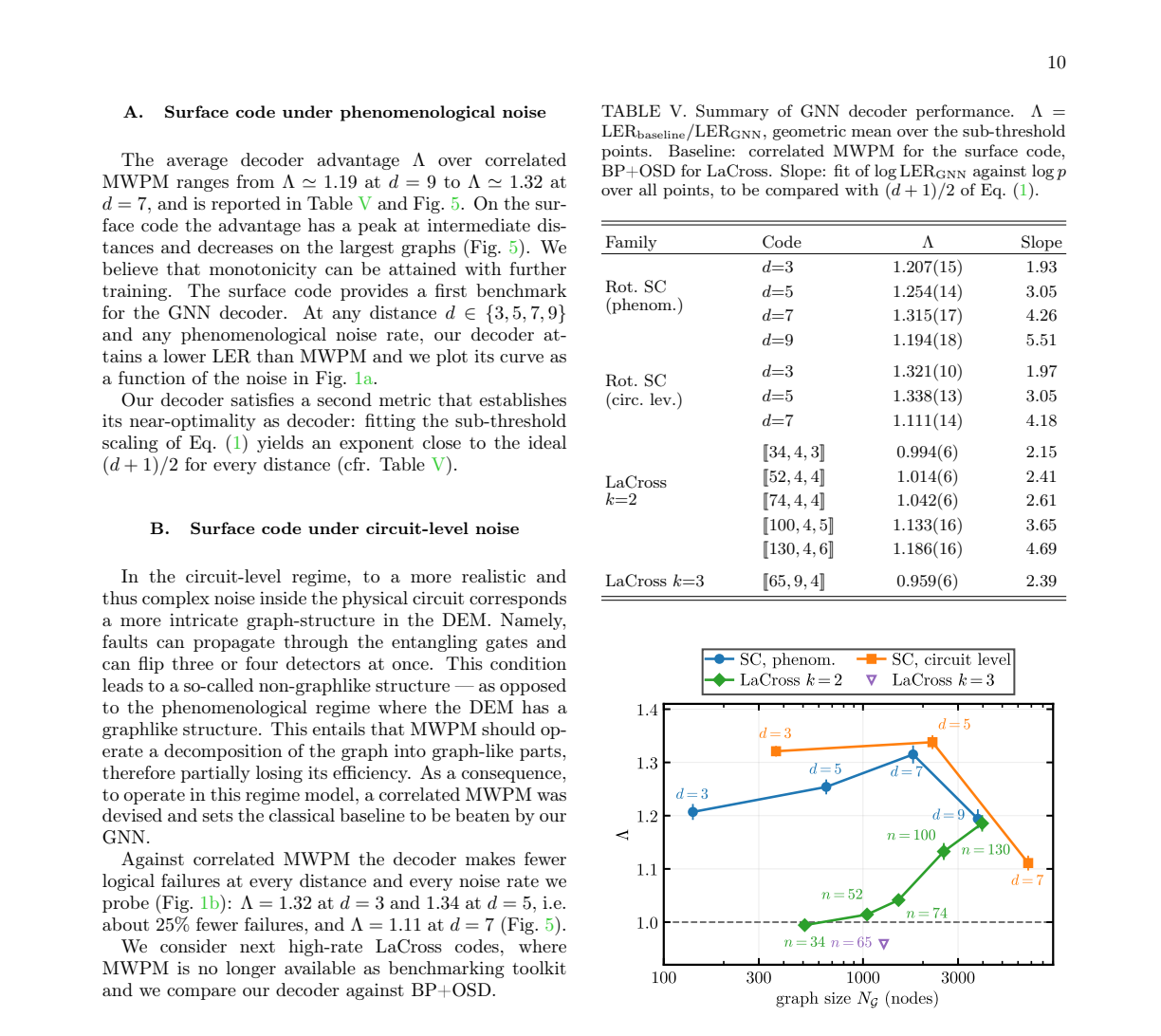
Because the central empirical claims — the 16% advantage over BP+OSD and the 'matches or beats BP+OSD' statement — rest on these Lambda values, the paper should report shots per point and the error-bar procedure. In addition, the Table V caption says the slope is a 'fit of log LER_GNN against log p over all points' without specifying the sub-threshold cut; the fitting range should be stated, since the LaCross slopes deviate from the ideal more than the surface slopes do (e.g., 4.69 versus ideal 3.5 for [[130,4,6]]).
5 minor objections
The paper says, at Abstract; Sec. IVF; Fig. 8
Pith says: minor objection 1 of 5
The abstract claims post-selection keeps 'more than 90% of the shots', but Fig. 8 reports only 67% acceptance at d=3 for tau=0.99; 'more than 90%' holds only for d>=5. The abstract should be qualified accordingly.
The paper says, at Code and Data Availability
Pith says: minor objection 2 of 5
The code and data are 'available from the authors upon reasonable request'. For a machine-learning decoder paper whose training is a streaming protocol with no fixed dataset, a public repository would materially support reproducibility and is increasingly expected in this field.
show 3 more
The paper says, at Sec. IVA; Sec. IVB; Fig. 5
Pith says: minor objection 3 of 5
The advantage Lambda drops at the largest tested sizes (1.194 at d=9 phenomenological, 1.111 at d=7 circuit-level versus 1.32-1.34 at the smaller circuit-level distances), which breaks the 'advantage grows with size' narrative within the surface-code panels. The statement in b210 that 'monotonicity can be attained with further training' is speculative; please state what evidence (e.g., training-time curves or validation trends) supports it.
The paper says, at Fig. 5
Pith says: minor objection 4 of 5
The LaCross k=3 point (Lambda = 0.959) is plotted on a figure whose narrative is the advantage growing with graph size; the caption should explicitly flag it as a negative exception so that readers do not misread the trend.
The paper says, at Sec. IVE
Pith says: minor objection 5 of 5
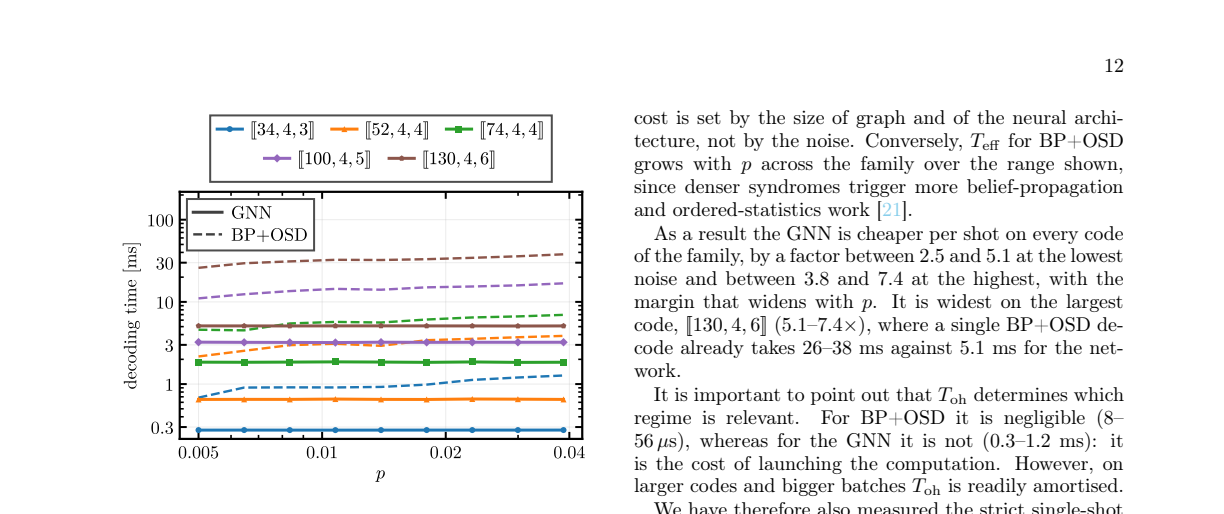
The latency comparison uses different hardware (single H200 GPU versus a single CPU core), which the authors acknowledge. A brief note on the expected magnitude of the GPU-vs-CPU adjustment would help readers gauge the fairness of the 'cheaper per shot' claim, which otherwise rests on the platform-independent observation that the GNN cost is flat in p.
What would settle it
Run the fixed recipe from Table III with the Sec. IIIC per-code training pipeline on a held-out third family never benchmarked in the paper (e.g., a bivariate-bicycle code such as [[72,12,6]] or a colour code) under phenomenological noise with r=d rounds, and compare on identical shots against BP+OSD, reporting Lambda and the sub-threshold slope. If Lambda >= 1 with a slope near (d+1)/2 on that held-out family, the code-agnostic claim survives; if Lambda < 1, the scope must be narrowed to the demonstrated families. As a secondary check, retrain the LaCross k=3 model [[65,9,4]] with the [[130,4,6]] settings (F=150, 60k-step schedule, Table IV) to test whether the 0.959 deficit is capacity- or architecture-limited; a persisting Lambda < 1 would falsify 'reaches or exceeds baselines' for codes with many logical observables.
from the skeptic's reading
How the review went
4 readings by deepseek-v4-flash · 2 Oct 2026
- Reader holds up, with conditions
- Skeptic partly agrees
- Editor wrote the verdict above
- Referee minor revision: 2 major objections, 5 minor
Not run on this paper: the simulated authors' defence.
Pith did not check this review's objections against the paper.
The review in full
The review in brief, machine-written
The real novelty is the input: building the decoder's graph directly from the DEM as a tripartite graph with detector, error-mechanism, and logical-observable nodes, priors carried on the mechanism nodes. That is a genuine departure from detector-graph (Lange) and Tanner-graph (Astra, GraphQEC) inputs, and it is the reason one architecture runs on two structurally different code families without redesign. The per-code results are solid. It beats correlated MWPM on the surface code under both phenomenological and circuit-level noise, matches or beats BP+OSD on LaCross k=2 with the advantage growing from parity at [[34,4,3]] to roughly 16% fewer failures at [[130,4,6]], and the sub-threshold slopes (1.93, 3.05, 4.26, 5.51 against the ideal 2, 3, 4, 5) are independent corroboration of near-optimal scaling. Baselines are external tools, LERs are measured rather than fitted to the story, and the failures are reported as failures: k=3 stays below BP+OSD (Lambda = 0.959), generalization drops on larger unseen codes, cross-noise transfer fails at d=3. This is honest work, and I see no forced results. Three soft spots, in weight order. First, the code and trained models are not shipped — 'upon reasonable request' — which blocks reproduction of the central benchmarks. For a neural-decoder paper in 2026 that is the main thing I would want before leaning on the numbers. Second, the latency comparison runs the GNN on an H200 GPU against BP+OSD on a single CPU core; the authors disclose the hardware mix themselves, and the flat-in-noise property is genuinely platform-independent, but 'an order of magnitude cheaper' is not a like-for-like figure. Third, the abstract's 'more than 90% of shots' for post-selection is true only for d>=5; at d=3 the acceptance is 67% at tau = 0.99. Minor, but the abstract should match Fig. 8. On scope, the stress-test worry is fair but bounded. 'Any DEM-expressible code, once trained' is indeed untested outside the surface code and LaCross k=2, and k=3 already undermines 'reaches or exceeds baselines' as a universal statement. But the authors qualify the claim as 'in principle' and explicitly say the decoder is trained per code, so this is a scoping gap rather than a hidden flaw. The generalist model runs over seven code families, which is more cross-family evidence than the headline two suggests. I would send this to referees. The per-code story is demonstrated, the negative results are stated openly, and the flaws are fixable. Verdict: revise, release code and models, fix the abstract, and report latency on matched hardware or stop headlining the absolute ratio.
The strongest objection
The central claim (b42) is that the fixed nine-feature recipe and architecture reach or exceed classical baselines on two code families and two noise models, and that 'in principle' any DEM-expressible stabilizer code can be decoded this way once trained. The demonstrated support is real: per-code trained models beat correlated MWPM on the surface code (phenomenological and circuit-level, Lambda = 1.19-1.34) and match/beat BP+OSD on LaCross k=2 (Lambda up to 1.186), with sub-threshold slopes close to (d+1)/2 (Table V) as independent near-optimality evidence, and the error bars are reported. The load-bearing gap is the scope extension from these two families to 'any code.' Two results in the paper itself constrain that scope. First, LaCross k=3 [[65,9,4]] with nine logical observables stays below BP+OSD even with a dedicated training run (Lambda = 0.959 +/- 0.006, b233), so 'reaches or exceeds baselines' already fails on the third member of the family tested. Second, Sec. IVD shows the generalist transfers to unseen graphlike codes only at comparable sizes, fails on the four largest unseen codes, and fails completely on cross-noise transfer even at d=3 (b250), with the authors attributing this to target/largest-training-graph ratio and to feature ranges (prior logits falling outside the trained range). This means the fixed feature recipe is not a universal, scale-invariant encoding of DEM structure: its fidelity is code- and scale-dependent. The authors acknowledge both limitations (b144, b233, b250), so there is no internal inconsistency; the concern is that the claim 'same recipe, any code, once trained' is (a) untested on any family outside surface/LaCross-k=2 and (b) partially contradicted by the k=3 deficit. Secondary issues (hardware-mismatched latency, b266; abstract posting >90% acceptance vs the 67% at d=3 in Fig. 8; code/models only 'upon reasonable request') affect interpretation and verifiability but not the demonstrated decoding advantage itself.
The reader's weakest_assumption (feature-recipe transfer fragility) and mine overlap, but the emphasis differs. The reader frames the problem as 'the premise only holds if each new code gets its own training run,' which undercuts the headline. I think that framing slightly overstates the issue: the headline claim (b42, b71) is explicitly 'once trained on the DEM,' so per-code training is consistent with the claim as stated, and the paper honestly scopes it (b144). The genuine, unresolved soft spot is narrower and sharper: the claim that the fixed recipe yields a strong decoder on 'any' code has been demonstrated on exactly two families, and the one additional family actually tried (LaCross k=3) falls below BP+OSD even with per-code training. Combined with the generalist failures on larger unseen graphs and on noise-model transfer (b250), the empirical base is two families plus a series of honest negative results. That is exactly why the decisive test is a per-code run on a third, structurally different family (e.g., bivariate-bicycle or colour code): it tests the 'any code once trained' claim directly without depending on cross-code weight transfer, which the paper already concedes is open (b45, b48). The sub-threshold slopes near (d+1)/2 in Table V are genuine independent support and I credit them, as does the reader; they do not, however, constrain what happens with nine logical observables or on a new family. I also considered whether the anomalously steep LaCross [[130,4,6]] slope (4.69 vs ideal 3.5) undercuts the near-optimality claim; it likely reflects fit-range curvature near threshold and does not threaten the same-shots comparison against BP+OSD, so I do not count it as load-bearing. On the secondary points, the latency comparison's hardware mismatch is disclosed by the authors themselves (b266) and the flat-in-p property is sound; the abstract's 'more than 90% of the shots' conflicts with the 67% figure at d=3 in Fig. 8, a real but minor overstatement; and the absence of released code/models is a verifiability concern that the CONDITIONAL verdict already encodes. Since none of my findings contradict the reader's assessment and the deciding experiment simply has not been published, the verdict should remain UNCHANGED (CONDITIONAL, moderate confidence).
The referee's report
The per-code claims are well supported: the baselines (correlated MWPM, BP+OSD) are external tools, error bars on Lambda are reported, the sub-threshold slopes (1.93/3.05/4.26/5.51 against ideal 2/3/4/5 on the surface code) are genuine independent evidence of near-optimal scaling, and the negative results are stated plainly rather than hidden. If the per-code results hold, the work is a meaningful step toward a single fixed decoding architecture that can be trained on any DEM-expressible code, and the flat-in-p per-shot cost is practically relevant for real-time decoding. The methodology is a strength: streaming training avoids dataset overfitting, and validation is done on the same shots against the baseline. The main caveat is the scope of the 'code-agnostic / any code' framing: the demonstrated evidence spans two families (with the k=3 member of the second family failing to reach the baseline), and the fixed feature recipe is validated only within the tested graph-size and noise ranges. The body scopes these claims correctly; the abstract and title push somewhat beyond the evidence.
Pith's reading of the paper (a machine's summary, not the authors')
The paper presents POLYMECHANON, a graph neural network decoder whose only input is the detection error model of a quantum code under a given noise model. Its central claim is that this single input is sufficient: with one fixed recipe for building a tripartite graph and computing node features — no lattice, no translation symmetry, no assumption on the stabiliser weight — the same architecture matches or beats the strongest classical decoders on two structurally different code families. On the rotated surface code it beats correlated minimum-weight perfect matching with up to 25% fewer logical failures, and on high-rate LaCross codes it matches BP+OSD on the small codes and beats it by up to 16% on the largest tested code, [[130,4,6]]. The decoder's per-shot cost is independent of the physical error rate, unlike BP+OSD, and its probabilistic output supports confidence-based post-selection that lowers the accepted logical error rate by more than an order of magnitude. A single shared model works on codes seen during training but fails to generalise to larger unseen codes, a limitation the authors acknowledge and leave open.
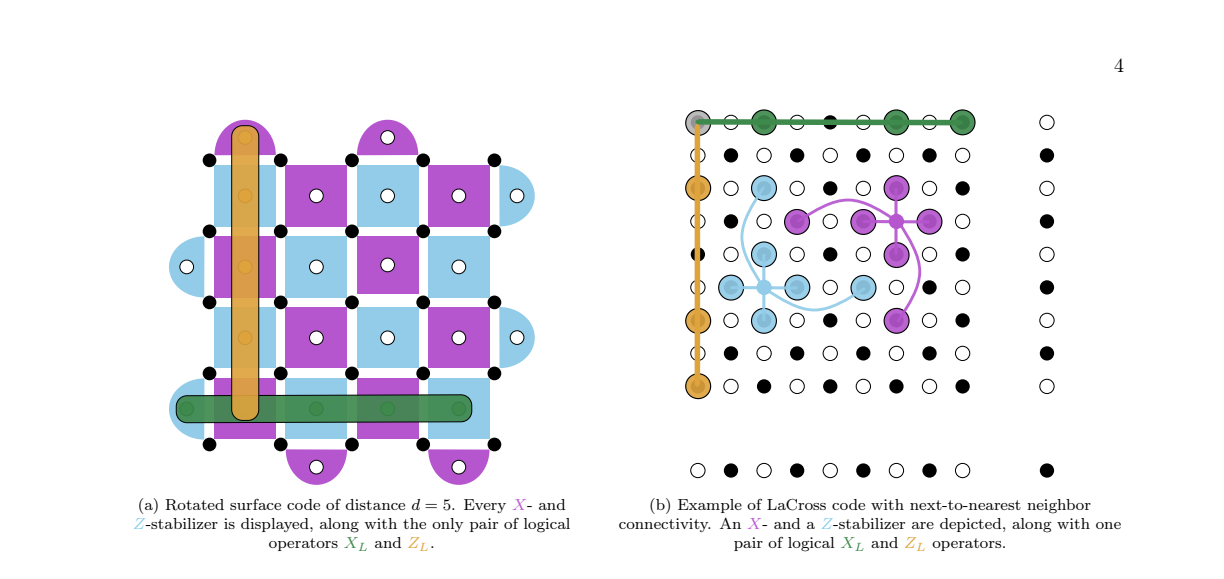
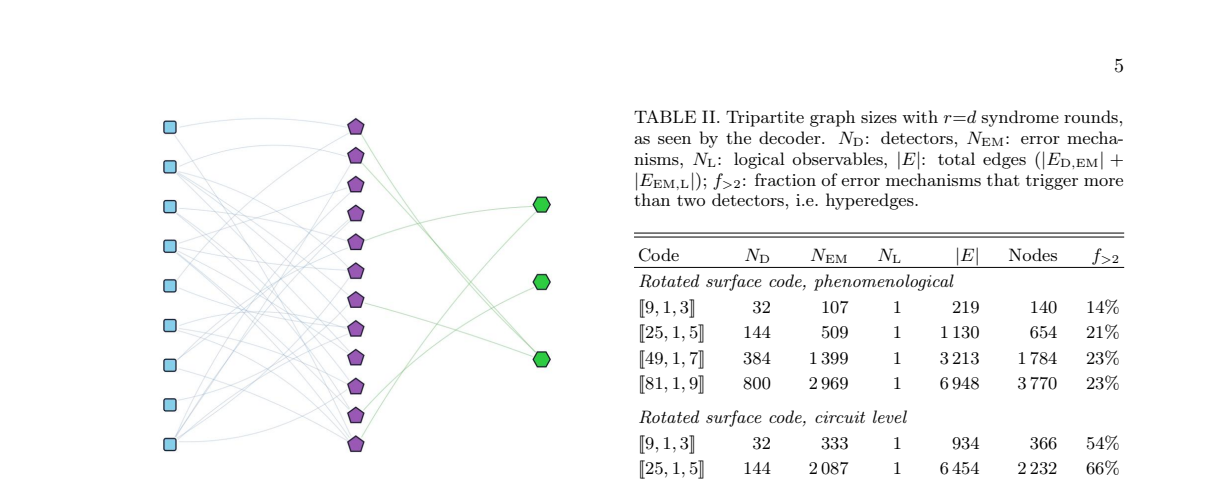
What carries the argument. The central object is the tripartite DEM graph: one node per detector, one per error mechanism carrying the logit of its prior probability, and one per logical observable, with edges encoding the binary matrices $H$ and $L$. Each node carries a nine-dimensional feature vector computed from the DEM alone — syndrome bits, prior logits, coordinate parity, temporal role, neighbour counts, and bounding-box-normalised positions — by one fixed recipe identical for every code and noise model. The network refines these features over $T$ iterations of residual message passing with GRU updates and FiLM conditioning, reads a logical-error probability from the logical-observable nodes, and is trained on a streaming pipeline of freshly regenerated shots with no fixed dataset, so there is no overfitting to a training set.
Core claim. The detection error model alone is sufficient input for a neural decoder. The authors compile the DEM into a tripartite graph of detector nodes, error-mechanism nodes carrying the logit of their prior probabilities, and logical-observable nodes, with edges encoding which mechanisms trigger which detectors and flip which logicals. Every input feature is computed from the DEM by a fixed recipe, so the noise model enters as input rather than as architecture, and faults that trigger more than two detectors are represented as they are rather than decomposed. Against correlated MWPM the same network makes fewer logical failures at every distance and noise rate probed on the surface code, with advantage $\Lambda = 1.32$ at $d=3$ and $1.34$ at $d=5$ under circuit-level noise; against BP+OSD the advantage on the LaCross $k=2$ family grows with code size, from parity on [[34,4,3]] to $\Lambda = 1.186$ on [[130,4,6]], i.e. 16% fewer failures. The decoder's cost per shot is flat in the error rate while BP+OSD's grows, and the probabilistic output enables confidence-based post-selection that concentrates rejection on high-weight error events.
The premise it rests on. The claim rests on the premise that the fixed nine-dimensional feature recipe — whose normalisations were chosen on the surface code, such as dividing neighbour counts by four and using detector-coordinate parity — encodes generic connectivity and parity statistics meaningful for any stabilizer code, so that no code-specific inductive bias leaks into the architecture.
If the paper is right (Pith's inferences, not the authors')
Any stabilizer code that compiles to a detection error model can in principle be decoded by the same architecture after a fresh training run, requiring no redesign of the graph or the features.
Per-shot decoding cost is independent of the physical error rate, and on the largest LaCross code it is about five to seven times cheaper than BP+OSD in the tested range, supporting real-time decoding on fixed-hardware implementations.
Confidence-based post-selection lowers the accepted logical error rate by a factor of 14 to 40 on the surface code at threshold 0.99 while retaining at least 67% of shots, and over 93% for $d \ge 5$.
The advantage over BP+OSD grows monotonically with code size within the LaCross $k=2$ family, from parity on [[34,4,3]] to 16% fewer failures on [[130,4,6]].
A single model shared across fifteen codes outperforms uncorrelated MWPM on the graph-like codes it saw and stays within about 10% of BP+OSD on the others, but a code- and distance-specific dedicated model remains the reliable route in practice.
The headline code-agnosticism is conditional on a dedicated training run for each new code; the generalist results imply that genuine zero-shot decoding across families is not yet achieved, and the size-based degradation suggests that the practical way to reuse a model is initialisation from a close code, not extrapolation to a larger one.
Several features — coordinate parity, bounding-box scaling, neighbour count divided by four — were calibrated on the surface code's spatial lattice; a code family whose detectors lack a natural spatial embedding would separate genuinely generic connectivity features from lattice-specific ones.
If the flat latency is realised on dedicated hardware, the fixed computational graph also enables windowed streaming decoding, since the DEM of a syndrome window is itself a DEM the same network can consume unchanged.
The post-selection results imply a practical protocol for platforms where re-preparation is cheap: flag low-confidence shots for re-measurement rather than discarding them, converting the network's confidence margin into an effective error-rate reduction.
Check this review
Pith stored no record of this review's passes and took no fingerprint of it. Reviews made by code from 13 Nov 2026 on carry both.
How often reviews like this one are right
Reviews like this one: written by deepseek-v4-flash, where what was read was not recorded.
How often objections from reviews like this one are right: not yet measured
Reviews by people
This review was written by a machine. No person has reviewed this paper on Pith yet. A scientist listed on Pith can review it for a fee, and their review is published here whatever it concludes.
The paper
Abstract
We present POLYMECHANON, a graph neural network (GNN) decoder for quantum error correction whose only input is the detection error model (DEM) of a quantum code under a given noise model. We represent the DEM as a tripartite graph of detectors, error mechanisms and logical observables, where every input feature is computed by using the quantum code as data rather than design choice. In this way, the same architecture decodes in principle any stabiliser code, under any noise model that can be expressed as a detection error model, once trained on the DEM. We test this approach along four directions. Firstly, on the rotated surface code the decoder outperforms correlated MWPM under both phenomenological and circuit-level noise, with up to 25% fewer logical failures. Secondly, on a family of high-rate qLDPC codes it matches BP+OSD on the smaller codes and surpasses it on the larger ones, with up to 16% fewer logical failures on [[130,4,6]]. Thirdly, its decoding time does not depend on the physical error rate, whereas that of BP+OSD grows with it: on [[130,4,6]] its effective cost per shot is of the order of a few ms on a single GPU against a few tens of milliseconds for BP+OSD on a single CPU core, and its fixed computational graph makes it a candidate for real-time decoding on neutral-atom processors. Finally, a single model trained across codes of different families outperforms uncorrelated MWPM on the graph-like codes seen during training and stays within 10% of BP+OSD on the others, while it tends to fail to generalize to unseen codes, particularly larger ones. Its probabilistic output enables confidence-based post-selection, lowering the logical error rate by more than an order of magnitude on the surface code while keeping more than 90% of the shots. Since only the DEM changes, new codes and noise models can be decoded without redesigning the decoder.
The paper's own sentences, arranged, kept beside the review and separate from it. Each label is drawn from a closed vocabulary; the number beside it is the probability the classifier gave that label. No sentence in this record was written by a model.
abstract compiled · 2026-10-02
The authors' main claim, as the classifier picked it out 0.58
“In this way, the same architecture decodes in principle any stabiliser code, under any noise model that can be expressed as a detection error model, once trained on the DEM.”
How the main claim is stated: hedged possibility 0.64
What the abstract itself states, as probabilities: claims first 0.05 · states limitation 0.97 · human participants 0.01 · controlled comparison 0.92 · randomized assignment 0.01 · states quantitative result 0.99 · compares with prior results 0.98 · mentions code or data availability 0.03
The abstract, sentence by sentence
This table labels the abstract only (arXiv listing abstract v1). The number is the probability the classifier gave the label.
| Sentence | Role | The authors' own work | States the main conclusion | Strength |
|---|---|---|---|---|
| We present POLYMECHANON, a graph neural network (GNN) decoder for quantum error correction whose only input is the detection error model (DEM) of a quantum code under a given noise model. | contribution 0.99 | 0.92 | 0.18 | asserted 1.00 |
| We represent the DEM as a tripartite graph of detectors, error mechanisms and logical observables, where every input feature is computed by using the quantum code as data rather than design choice. | method 0.99 | 0.90 | 0.08 | asserted 1.00 |
| In this way, the same architecture decodes in principle any stabiliser code, under any noise model that can be expressed as a detection error model, once trained on the DEM. | contribution 0.45 | 0.36 | 0.45 | hedged possibility 0.64 |
| We test this approach along four directions. | contribution 0.48 | 0.77 | 0.02 | unclear 0.56 |
| Firstly, on the rotated surface code the decoder outperforms correlated MWPM under both phenomenological and circuit-level noise, with up to $25\%$ fewer logical failures. | result 1.00 | 0.95 | 0.12 | asserted 1.00 |
| Secondly, on a family of high-rate qLDPC codes it matches BP+OSD on the smaller codes and surpasses it on the larger ones, with up to $16\%$ fewer logical failures on $[\![130,4,6]\!]$. | result 1.00 | 0.95 | 0.10 | asserted 1.00 |
| Thirdly, its decoding time does not depend on the physical error rate, whereas that of BP+OSD grows with it: on $[\![130,4,6]\!]$ its effective cost per shot is of the order of a few ms on a single GPU against a few tens of milliseconds for BP+OSD on a single CPU core, and its fixed computational graph makes it a candidate for real-time decoding on neutral-atom processors. | result 0.98 | 0.95 | 0.10 | asserted 0.91 |
| Finally, a single model trained across codes of different families outperforms uncorrelated MWPM on the graph-like codes seen during training and stays within $10\%$ of BP+OSD on the others, while it tends to fail to generalize to unseen codes, particularly larger ones. | result 0.79 | 0.95 | 0.12 | asserted 0.98 |
| Its probabilistic output enables confidence-based post-selection, lowering the logical error rate by more than an order of magnitude on the surface code while keeping more than $90\%$ of the shots. | result 1.00 | 0.95 | 0.11 | asserted 1.00 |
| Since only the DEM changes, new codes and noise models can be decoded without redesigning the decoder. | interpretation 0.86 | 0.52 | 0.32 | asserted 0.88 |
What kind of paper the classifier reports this is: method or tool 1.00 · evidence from simulation or computation 0.99
What was examined, and what was not
Sources read
- arXiv listing abstract v1
Not examined
- full text
- figures and tables
- references and citing sentences
- relations to other papers
Levels run
- P abstract
Not run
- S sections
- T body sentences
- C citations
- R cross-paper relations
How the labels were made
Compiled by classifier-1.13.0 via TypeSafe API, question bank abstract-p1-20260923, 2026-10-02: 1 request, 7,978 input tokens.
Every quoted sentence on this record is the authors'. Every label is from Pith's closed vocabulary, with the probability shown beside it. This record as JSON
Figures (8)




Figures are the authors', reproduced from the paper.
References (94)
- [1] D. Gottesman, An introduction to quantum error correc- tion and fault-tolerant quantum computation, inQuan- tum information science and its contributions to mathe- matics, Proceedings of symposia in applied mathematics, Vol. 68 (American Mathematical Society, 2010) pp. 13– 58,... on PithPith's reviewarXiv
- [2] M. A. Nielsen and I. L. Chuang,Quantum Computation and Quantum Information: 10th Anniversary Edition (Cambridge University Press, 2010) on Pith
- [3] E. Knill, R. Laflamme, and W. H. Zurek, Resilient Quan- tum Computation: Error Models and Thresholds, Pro- ceedings of the Royal Society of London. Series A: Math- ematical, Physical and Engineering Sciences454, 365 (1998), arXiv:quant-ph/9702058 on PithPith's reviewarXiv
- [4] P. W. Shor, Scheme for reducing decoherence in quantum computer memory, Physical Review A52, R2493 (1995) on Pith
- [5] D. Gottesman, Stabilizer Codes and Quantum Error Cor- rection (1997), arXiv:quant-ph/9705052 on PithPith's reviewarXiv
- [6] E. Knill and R. Laflamme, Theory of quantum error- correcting codes, Physical Review A55, 900 (1997) on Pith
- [7] J. Preskill, Fault-tolerant quantum computation, in Introduction to Quantum Computation and Informa- tion(World Scientific, 1998) pp. 213–269, arXiv:quant- ph/9712048 on Pith
- [8] A. M. Steane, Efficient fault-tolerant quantum comput- ing, Nature399, 124 (1999) on Pith
- [9] A. Y. Kitaev, Quantum computations: algorithms and error correction, Russian Mathematical Surveys52, 1191 (1997) on Pith
- [10] A. G. Fowler, M. Mariantoni, J. M. Martinis, and A. N. Cleland, Surface codes: Towards practical large-scale quantum computation, Physical Review A86, 032324 (2012) on Pith
- [11] E. Dennis, A. Kitaev, A. Landahl, and J. Preskill, Topological quantum memory, Journal of Mathematical Physics43, 4452 (2002), arXiv:quant-ph/0110143 on PithPith's reviewarXiv
- [12] L. Pecorari, S. Jandura, G. K. Brennen, and G. Pupillo, High-rate quantum LDPC codes for long- range-connected neutral atom registers, Nature Commu- nications16, 1111 (2025) on Pith
- [13] O. Higgott, PyMatching: a python package for decoding quantum codes with minimum-weight perfect matching, ACM Transactions on Quantum Computing3, 1 (2022), arXiv:2105.13082 on PithPith's reviewarXiv
- [14] O. Higgott and C. Gidney, Sparse Blossom: correcting a million errors per core second with minimum-weight matching, Quantum9, 1600 (2025) on Pith
- [15] A. G. Fowler, Optimal complexity correction of corre- lated errors in the surface code (2013), arXiv:1310.0863 [quant-ph] on PithPith's reviewarXiv
- [16] S. Bravyi, A. W. Cross, J. M. Gambetta, D. Maslov, P. Rall, and T. J. Yoder, High-threshold and low- overhead fault-tolerant quantum memory, Nature627, 778 (2024) on Pith
- [17] Google Quantum AI and Collaborators, Quantum error correction below the surface code threshold, Nature638, 920 (2025) on Pith
- [18] T. Müller, T. Alexander, M. E. Beverland, M. Bühler, B. R. Johnson, T. Maurer, and D. Vandeth, Improved belief propagation is sufficient for real-time decoding of 16 quantum memory (2025), arXiv:2506.01779 [quant-ph] on PithPith's reviewarXiv
- [19] L. Aghababaie Beni, O. Higgott, and N. Shutty, Tesser- act: A search-based decoder for quantum error correction (2025), arXiv:2503.10988 [quant-ph] on PithPith's reviewarXiv
- [20] Y. Wu, B. Li, K. Chang, S. Puri, and L. Zhong, Minimum-weight parity factor decoder for quantum error correction (2025), arXiv:2508.04969 [quant-ph] on PitharXiv
show 74 more
- [21] J. Roffe, D. R. White, S. Burton, and E. Campbell, De- coding across the quantum low-density parity-check code landscape, Physical Review Research2, 043423 (2020) on Pith
- [22] P. Panteleev and G. Kalachev, Degenerate quantum LDPC codes with good finite length performance, Quan- tum5, 585 (2021) on Pith
- [23] G. Torlaiand R.G.Melko,Neuraldecoderfortopological codes, Physical Review Letters119, 030501 (2017) on Pith
- [24] S. Krastanov and L. Jiang, Deep neural network proba- bilistic decoder for stabilizer codes, Scientific Reports7, 11003 (2017), arXiv:1705.09334 [quant-ph] on PithPith's reviewarXiv
- [25] S. Varsamopoulos, B. Criger, and K. Bertels, Decoding small surface codes with feedforward neural networks, Quantum Science and Technology3, 015004 (2018), arXiv:1705.00857 [quant-ph] on PithPith's reviewarXiv
- [26] C. Chamberland and P. Ronagh, Deep neural decoders for near term fault-tolerant experiments, Quantum Sci- ence and Technology3, 044002 (2018), arXiv:1802.06441 [quant-ph] on PithPith's reviewarXiv
- [27] P. Baireuther, T. E. O’Brien, B. Tarasinski, and C. W. J. Beenakker, Machine-learning-assisted correction of corre- lated qubit errors in a topological code, Quantum2, 48 (2018), arXiv:1705.07855 [quant-ph] on PithPith's reviewarXiv
- [28] P.Baireuther, M.D.Caio, B.Criger, C.W.J.Beenakker, and T. E. O’Brien, Neural network decoder for topolog- ical color codes with circuit level noise, New Journal of Physics21, 013003 (2019), arXiv:1804.02926 [quant-ph] on PithPith's reviewarXiv
- [29] X. Ni, Neural network decoders for large-distance 2D toric codes, Quantum4, 310 (2020), arXiv:1809.06640 [quant-ph] on PithPith's reviewarXiv
- [30] P. Andreasson, J. Johansson, S. Liljestrand, and M. Granath, Quantum error correction for the toric code using deep reinforcement learning, Quantum3, 183 (2019), arXiv:1811.12338 [quant-ph] on PithPith's reviewarXiv
- [31] R. Sweke, M. S. Kesselring, E. P. L. van Nieuwenburg, and J. Eisert, Reinforcement learning decoders for fault- tolerant quantum computation, Machine Learning: Sci- ence and Technology2, 025005 (2021), arXiv:1810.07207 [quant-ph] on PithPith's reviewarXiv
- [32] K. Meinerz, C.-Y. Park, and S. Trebst, Scalable neural decoder for topological surface codes, Physical Review Letters128, 080505 (2022) on Pith
- [33] S. Gicev, L. C. L. Hollenberg, and M. Usman, A scalable and fast artificial neural network syndrome decoder for surfacecodes,Quantum7,1058(2023),arXiv:2110.05854 [quant-ph] on PithPith's reviewarXiv
- [34] C. Lee, T. Hur, J. Jae, and D. K. Park, Machine learning approaches to decoding topological quantum codes (2026), to appear as a chapter inQuantum Er- ror Decoding, SpringerQuantumScienceandTechnology, arXiv:2608.15760 [quant-ph] on PithPith's reviewarXiv
- [35] J. Bausch, A. W. Senior, F. J. H. Heras, T. Edlich, A. Davies, M. Newman, C. Jones, K. Satzinger, M. Y. Niu, S. Blackwell, G. Holland, D. Kafri, J. Atalaya, C. Gidney, D. Hassabis, S. Boixo, H. Neven, and P. Kohli, Learning high-accuracy error decoding for quantum pro- cessors... on Pith
- [36] A. W. Senior, T. Edlich, F. J. H. Heras, L. M. Zhang, O. Higgott, J. S. Spencer, T. Applebaum, S. Blackwell, J. Ledford, A. Žemgulyt˙ e, A. Žídek, N. Shutty, A. Cowie, Y. Li, G. Holland, P. Brooks, C. Beattie, M. New- man, A. Davies, C. Jones, S. Boixo, H. Neven, P. Kohli, and... on PitharXiv
- [37] M. Lange, P. Havström, B. Srivastava, I. Bengtsson, V. Bergentall, K. Hammar, O. Heuts, E. van Nieuwen- burg, and M. Granath, Data-driven decoding of quantum error correcting codes using graph neural networks, Phys- icalReviewResearch7,023181(2025),arXiv:2307.01241 on PithPith's reviewarXiv
- [38] A. Cicero, L. Altamura, M. Lange, M. Granath, and P. Trancoso, Low latency GNN accelerator for quantum error correction (2026), arXiv:2603.22149 [quant-ph] on PithPith's reviewarXiv
- [39] D. Seip, L. Colmenarez, M. Schmitt, and M. Müller, Ma- chine learning optimal quantum error correction thresh- olds (2026), arXiv:2606.22194 [quant-ph] on PithPith's reviewarXiv
- [40] G. Yan, S. Li, and Y. Du, Rethink the role of neural decoders in quantum error correction (2026), accepted to ICML 2026, arXiv:2605.12046 [quant-ph] on PithPith's reviewarXiv
- [41] Y.-H. Liu and D. Poulin, Neural Belief-Propagation De- coders for Quantum Error-Correcting Codes, Physical Review Letters122, 200501 (2019) on Pith
- [42] A. Gong, S. Cammerer, and J. M. Renes, Graph neu- ral networks for enhanced decoding of quantum LDPC codes, in2024 IEEE International Symposium on Infor- mation Theory (ISIT)(2024) arXiv:2310.17758 [quant- ph] on PithPith's reviewarXiv
- [43] V. Ninkovic, O. Kundacina, D. Vukobratovic, C. Häger, and A. Graell i Amat, Decoding quantum LDPC codes using graph neural networks, inGLOBECOM 2024 - 2024 IEEE Global Communications Conference(2024) pp. 3479–3484, arXiv:2408.05170 [quant-ph] on PithPith's reviewarXiv
- [44] A. S. Bhave, N. Choudhury, and K. Basu, HyperNQ: A hypergraph neural network decoder for quantum LDPC codes (2025), arXiv:2511.01741 [quant-ph] on PitharXiv
- [45] X. Mi and F. Mueller, Toward uncertainty-aware and generalizable neural decoding for quantum LDPC codes (2025), arXiv:2510.06257 [quant-ph] on PithPith's reviewarXiv
- [46] A. S. Maan and A. Paler, Machine learning message- passing for the scalable decoding of QLDPC codes, npj Quantum Information11, 78 (2025), arXiv:2408.07038 [quant-ph] on PithPith's reviewarXiv
- [47] J. Blue, H. Avlani, Z. He, L. Ziyin, and I. L. Chuang, Machine learning decoding of circuit-level noise for bivariate bicycle codes, Quantum10, 2149 (2026), arXiv:2504.13043 [quant-ph] on PithPith's reviewarXiv
- [48] G. Hu, W. Ouyang, C.-Y. Lu, C. Lin, and H.-S. Zhong, Efficient and universal neural-network decoder for stabilizer-based quantum error correction (2025), arXiv:2502.19971 [quant-ph] on PithPith's reviewarXiv
- [49] A.Gu, J.P.BonillaAtaides, M.D.Lukin,andS.F.Yelin, Scalableneuraldecodersforpracticalfault-tolerantquan- tum computation (2026), arXiv:2604.08358 [quant-ph] on PithPith's reviewarXiv
- [50] H.Cao, F.Pan, D.Feng, Y.Wang,andP.Zhang,Genera- tive decoding for quantum error-correcting codes (2025), arXiv:2503.21374 [quant-ph] on PithPith's reviewarXiv
- [51] Z. Liu, A. Gong, and B. K. Clark, Decoding quantum low density parity check codes with diffusion (2025), arXiv:2509.22347 [quant-ph] on PitharXiv
- [52] G. Yan, S. Li, S. Xiao, P. Ma, H. Cao, F. Pan, and Y. Du, Efficient foundation decoders for fault-tolerant quantum 17 computing (2026), arXiv:2606.27119 [quant-ph] on PithPith's reviewarXiv
- [53] T. Haug, A. Canabarro, and L. Aolita, Machine-learned syndrome post-selection for reliable quantum error cor- rection (2026), arXiv:2607.19563 [quant-ph] on PithPith's reviewarXiv
- [54] D. Dentelski, Neural network decoder confidence as a learned proxy for the logical gap (2026), arXiv:2606.08758 [quant-ph] on PithPith's reviewarXiv
- [55] F. Battistel, C. Chamberland, K. Johar, R. W. J. Over- water, F. Sebastiano, L. Skoric, Y. Ueno, and M. Usman, Real-time decoding for fault-tolerant quantum comput- ing: Progress, challenges and outlook, Nano Futures7, 032003 (2023), arXiv:2303.00054 [quant-ph] on PithPith's reviewarXiv
- [56] C.Gidney,Stim: afaststabilizercircuitsimulator,Quan- tum5, 497 (2021) on Pith
- [57] D. S. Wang, A. G. Fowler, A. M. Stephens, and L. C. L. Hollenberg, Threshold error rates for the toric and pla- nar codes, Quantum Information & Computation10, 456 (2010), arXiv:0905.0531 on PithPith's reviewarXiv
- [58] L. H. English, H. Luo, Y. Wang, B. Srivastava, S. D. Bartlett, and D. J. Williamson, Duality constrains op- timal thresholds in quantum error correction (2026), arXiv:2607.21160 on PithPith's reviewarXiv
- [59] F. J. MacWilliams and N. J. A. Sloane,The Theory of Error-correcting Codes(Elsevier, 1977) on Pith
- [60] A. R. Calderbank and P. W. Shor, Good Quantum Error- Correcting Codes Exist, Physical Review A54, 1098 (1996), arXiv:quant-ph/9512032 on PithPith's reviewarXiv
- [61] A. M. Steane, Error Correcting Codes in Quantum The- ory, Physical Review Letters77, 793 (1996) on Pith
- [62] J.-P. Tillich and G. Zémor, Quantum LDPC Codes With Positive Rate and Minimum Distance Proportional to the Square Root of the Blocklength, IEEE Transactions on Information Theory60, 1193 (2014) on Pith
- [63] D. Horsman, A. G. Fowler, S. Devitt, and R. Van Meter, Surface code quantum computing by lattice surgery, New Journal of Physics14, 123011 (2012) on Pith
- [64] H.BombinandM.A.Martin-Delgado,Optimalresources for topological two-dimensional stabilizer codes: Com- parative study, Physical Review A76, 012305 (2007) on Pith
- [65] L. Pecorari, F. P. Guerci, H. Perrin, and G. Pupillo, Ad- dressable gate-based logical computation with quantum LDPC codes (2025), arXiv:2511.06124 on PithPith's reviewarXiv
- [66] L. Pecorari and G. Pupillo, Quantum low-density parity- check codes for erasure-biased atomic quantum proces- sors, Physical Review A112, 052417 (2025) on Pith
- [67] M. Bergonzoni, L. Pecorari, S. Norrell, C. Poole, G. Pupillo, and M. Saffman, Fault-tolerant quan- tum computation with static atomic buses (2026), arXiv:2607.02804 on PithPith's reviewarXiv
- [68] A. M. Stephens, Fault-tolerant thresholds for quantum error correction with the surface code, Physical Review A89, 022321 (2014) on Pith
- [69] A.deMartiiOlius, P.Fuentes, R.Orús, P.M.Crespo,and J. Etxezarreta Martinez, Decoding algorithms for surface codes, Quantum8, 1498 (2024), arXiv:2307.14989 on PithPith's reviewarXiv
- [70] C. Wang, J. Harrington, and J. Preskill, Confinement- Higgs transition in a disordered gauge theory and the ac- curacy threshold for quantum memory, Annals of Physics 303, 31 (2003) on Pith
- [71] D. Poulin and Y. Chung, On the iterative decoding of sparse quantum codes, Quantum Information and Com- putation8, 987 (2008), arXiv:0801.1241 on PithPith's reviewarXiv
- [72] J. Old and M. Rispler, Generalized belief propagation algorithms for decoding of surface codes, Quantum7, 1037 (2023) on Pith
- [73] J. L. Ba, J. R. Kiros, and G. E. Hinton, Layer Normal- ization (2016), arXiv:1607.06450 on PithPith's reviewarXiv
- [74] V. Nair and G. E. Hinton, Rectified linear units improve restrictedBoltzmannmachines,inProceedings of the 27th International Conference on Machine Learning (ICML) (2010) pp. 807–814 on Pith
- [75] E. Perez, F. Strub, H. de Vries, V. Dumoulin, and A. Courville, FiLM: Visual reasoning with a gen- eral conditioning layer, inProceedings of the AAAI Conference on Artificial Intelligence, Vol. 32 (2018) arXiv:1709.07871 on PithPith's reviewarXiv
- [76] B. T. Polyak and A. B. Juditsky, Acceleration of stochas- tic approximation by averaging, SIAM Journal on Con- trol and Optimization30, 838 (1992) on Pith
- [77] P. Micikevicius, S. Narang, J. Alben, G. Diamos, E. Elsen, D. Garcia, B. Ginsburg, M. Houston, O. Kuchaiev, G. Venkatesh, and H. Wu, Mixed preci- sion training, inInternational Conference on Learning Representations(2018) arXiv:1710.03740 on PithPith's reviewarXiv
- [78] D. Kalamkar, D. Mudigere, N. Mellempudi, D. Das, K. Banerjee, S. Avancha, D. T. Vooturi, N. Jam- malamadaka, J. Huang, H. Yuen, J. Yang, J. Park, A. Heinecke, E. Georganas, S. Srinivasan, A. Kundu, M. Smelyanskiy, B. Kaul, and P. Dubey, A study of BFLOAT16 for deep learning tr... on PithPith's reviewarXiv
- [79] Y. Bengio, J. Louradour, R. Collobert, and J. Weston, Curriculum learning, inProceedings of the 26th Annual International Conference on Machine Learning(2009) pp. 41–48 on Pith
- [80] J. Roffe, LDPC: Python tools for low density parity check codes,https://pypi.org/project/ldpc/(2022) on Pith
- [81] B. M. Terhal, Quantum error correction for quantum memories, Reviews of Modern Physics87, 307 (2015), arXiv:1302.3428 on PithPith's reviewarXiv
- [82] D. Bluvstein, S. J. Evered, A. A. Geim, S. H. Li, H. Zhou, T. Manovitz, S. Ebadi, M. Cain, M. Kali- nowski, D. Hangleiter, J. P. Bonilla Ataides, N. Maskara, I. Cong, X. Gao, P. Sales Rodriguez, T. Karolyshyn, G. Semeghini, M. J. Gullans, M. Greiner, V. Vuletić, and M. D. Luki... on PithPith's reviewarXiv
- [83] L. Skoric, D. E. Browne, K. M. Barnes, N. I. Gille- spie, and E. T. Campbell, Parallel window decoding en- ables scalable fault tolerant quantum computation, Na- ture Communications14, 7040 (2023), arXiv:2209.08552 on PithPith's reviewarXiv
- [84] X. Tan, F. Zhang, R. Chao, Y. Shi, and J. Chen, Scalable surface-code decoders with parallelization in time, PRX Quantum4, 040344 (2023), arXiv:2209.09219 on PithPith's reviewarXiv
- [85] H. Perrin, S. Jandura, and G. Pupillo, Quantum Error Correction resilient against Atom Loss, Quantum9, 1884 (2025) on Pith
- [86] H. Perrin, G. Roger, and G. Pupillo, Correlated atom loss as a resource for quantum error correction (2026), arXiv:2603.24237 on PithPith's reviewarXiv
- [87] Y. Wu, S. Kolkowitz, S. Puri, and J. D. Thompson, Era- sure conversion for fault-tolerant quantum computing in alkaline earth Rydberg atom arrays, Nature Communi- cations13, 4657 (2022) on Pith
- [88] J.P.BonillaAtaides, A.Gu, S.F.Yelin,andM.D.Lukin, Neural decoders for universal quantum algorithms, PRX Intelligence1, 013008 (2026), arXiv:2509.11370 [quant- 18 ph] on PithPith's reviewarXiv
- [89] I. Goodfellow, Y. Bengio, and A. Courville,Deep Learn- ing(MIT Press, 2016) on Pith
- [90] A. Vaswani, N. Shazeer, N. Parmar, J. Uszkoreit, L. Jones, A. N. Gomez, Ł. Kaiser, and I. Polosukhin, At- tentionisallyouneed,inAdvances in Neural Information Processing Systems, Vol. 30 (2017) arXiv:1706.03762 on PithPith's reviewarXiv
- [91] D. E. Rumelhart, G. E. Hinton, and R. J. Williams, Learningrepresentationsbyback-propagatingerrors,Na- ture323, 533 (1986) on Pith
- [92] D. P. Kingma and J. Ba, Adam: A method for stochastic optimization, in3rd International Conference on Learn- ing Representations (ICLR)(2015) arXiv:1412.6980 on PithPith's reviewarXiv
- [93] I. Loshchilov and F. Hutter, Decoupled weight decay reg- ularization, in7th International Conference on Learning Representations (ICLR)(2019) arXiv:1711.05101 on PithPith's reviewarXiv
- [94] R. Girshick, Fast R-CNN, inProceedings of the IEEE International Conference on Computer Vision(2015) pp. 1440–1448. 19 0.6 0.8 1.0 τ 10 3 10 2 10 1 100 acceptance d = 3 0 2 4 error weight 0.0 0.4 0.8P(reject) 10 4 10 3 10 2 0.6 0.8 1.0 τ 10 3 10 2 10 1 100 d = 5 0 3 6 9 error ... on Pith
Cited by 1 Pith paper
Reviewed papers on Pith that cite this one. The full citation record
- Machine-learning decoders for fusion-based quantum computing in real time quant-ph · Nov 2026
Challenges and discussion
Disagree with the review, or know something it missed? Leave a comment, or challenge this review formally: a challenge becomes a permanent entry in this paper's record, and its decision is published here.
Come back by email
A short list of the week's newly reviewed papers. Nothing is sent until you confirm from your inbox, and every email has a link that stops it. No account.
No comments yet.
Sign in to comment