Artificial Intelligence · arXiv:2610.01780 v3 · submitted 1 Oct 2026
RealCompanion: Benchmarking Human Understanding from Reasoning over Longitudinal Real-World Conversations
The paper says
“An AI companion that talks with someone for months should come to understand them. It should know who they are, remember what they said, and recognize when something from the past matters now.”
more of the abstract
Testing this needs real conversations, but real conversations are private, so existing benchmarks use invented people and invented questions. We release RealCompanion, ten real relationships between people and an AI companion, with 27,218 messages over up to 120 days. For each person, we release the full conversation, a profile, a persona, chat test items, and question test items. Every label points to the messages that support it, and every chat label comes with the reasoning that produced it. The real data shows three things. First, people rarely refer back. Only 3.4% of their messages depend on something said earlier, and when one does, the earlier message is usually far away (a median of 2,157 messages back). Averages hide this. Looking at the most recent messages finds the needed one 95.9% of the time overall, but only 2.2% of the time when it is far back. Second, AI systems cannot tell when the past matters. The detectors we tested barely beat chance on real messages, and when the same earlier messages are labeled "memories" instead of "earlier messages", models bring up the past 10 to 14 percentage points more often, even when nothing from the past is needed. Third, AI systems read more into a person than the person revealed. Three agent systems rebuild each persona equally well (F1 0.71). They see the person, and then imagine more. Understanding a person depends on knowing when their past matters and where what they shared ends, and only real conversations can test it.
from the abstract
Pith says
Machine review · deepseek-v4-flash · 2 Oct 2026 · of version 1 of the paper; version 3 is newer · what was read was not recorded · not checked by a person
It can be wrong. Challenge this review or reply to it.
Holds up, with conditions. The most honest benchmark paper in this area I have reviewed: real verbatim longitudinal data, a sound parameter-free critique of pooled ablations, and genuine magnitudes whose upper/lower bound direction is conservative but whose recall term stays unmeasured. This line is wrong
3 major objections · 5 minor
How often objections from reviews like this one are right: not yet measured
Not checked: figures, code, what the references say.
The paper says, at Sec. 6 (b209); App. A.3; App. F.1
The review did not quote this passage.
A classifier read this sentence of the paper as acknowledging the concern (probability 0.77):
“It does not rule out stage A failing to see a genuine referent.”
Pith says: Objection 1 of 3 · major
The headline magnitude — 3.4% [2.5, 4.6], and the conclusion's 'the past is rarely needed' — is a lower bound whose distance from the true rate is governed by the unmeasured recall r of the stage A resolver. Proposition 1 states pi = pi_o·r + (1−pi_o)·epsilon, and the paper explicitly concedes 'It does not rule out stage A failing to see a genuine referent' (b468); my concern is the missing evidence about r, which the paper does not supply.
more of objection 1
The three procedures that agree (stratum 3.4%, census 3.2%, re-read 1.73%) all route detection through stage A, so their agreement bounds sampling error and threshold sensitivity, not r. The residual sweep of Appendix F.1 (921 proposed, 2 survived) is run by the same widened resolver family and cannot detect a systematic miss — for example implicit callbacks without explicit pointing phrases, which is precisely the failure class the paper's own audit suggests stage A reasons about least reliably (395/1,533 rationales judged wrong in D.6). Since the abstract and conclusion quote 3.4% without the lower-bound qualifier, the quantitative headline exceeds the support. The qualitative claim that real traffic demands far less than the pi = 1 generated corpora survives any moderate r, but the specific percentage and the derived 96% split do not. Requested: (i) report the implied range of the true rate under stated assumptions on r (e.g., r = 0.9, 0.7, 0.5); (ii) add an independent recall check, such as a hand-read sample of unflagged turns using the D.6 miss-rate protocol; (iii) qualify the abstract and conclusion accordingly.
The paper says, at Sec. 6 (b213–b215); App. F.1
The review did not quote this passage.
Pith says: Objection 2 of 3 · major
The 'far away' claim — furthest required message a median of 2,157 back, nearest a median of 450 — is computed on the detected memory-bearing set, and the direction of detection bias is unchecked. If stage A's detection probability increases with distance (plausible, since the resolver hunts for explicit pointing expressions while nearby referents are more often signaled implicitly), the surviving set is skewed long and both medians are inflated.
more of objection 2
The strict reading of Appendix D.4 removes only on-screen rows and moves the medians upward, so it cannot test this. The release records enough information for a distance-stratified analysis of stage A's proposals and verifications, but none is reported. Requested: a distance-stratified breakdown of the census and residual sweep, or an explicit statement that the distance claim is conditional on detection sensitivity and biased in this direction.
The paper says, at Sec. 6 (b232 and b249); App. E.1
The review did not quote this passage.
A classifier read this sentence of the paper as acknowledging the concern (probability 0.91):
“C2 and C1 in Table 5 also carry different headings, so their contrasts include whatever the heading adds, which we do not separate.”
Pith says: Objection 3 of 3 · major
The 96% figure is arithmetic on the proportional-stratum C2 minus C1 split, but its gamma_0 component (+0.107) comes from a contrast in which C2 and C1 differ not only in content but also in heading ('RELEVANT MEMORIES' vs 'RECENT CONVERSATION'), and the paper says it does not separate the heading (b249).
more of objection 3
Section 6 and Table 37 show that labels alone move memory use by 10–14 points, so the decomposition — and therefore the headline '96% of the gain comes from messages that need none' — mixes content with framing. The direction of the contamination is not pinned (a misleading heading could also depress content match by inducing misapplication), but the abstract states the number without the caveat. Since the matched-pair machinery already exists (C3m/C4m, Table 28), please add a matched-heading version of C2 and report the split under it, or re-state the 96% figure as including the label component.
5 minor objections
The paper says, at Abstract and Conclusion
Pith says: minor objection 1 of 5
The abstract and conclusion state 3.4% and the 2,157-message median without the lower-bound and detection-conditional qualifications that the body (b209, b468) and Appendix F.1 provide; a one-clause qualification in both places would prevent over-reading.
The paper says, at Sec. 3; Ethics Statement
Pith says: minor objection 2 of 5
The released source is itself model-rewritten for anonymization ('the words change'), and all rate measurements run on the rewritten text; the paper does not report any check that rewording preserves the anaphoric and implicit-callback structure that the rarity claim counts. Please state this scope condition where the 3.4% figure is first reported.
show 3 more
The paper says, at Table 6; App. G.1 and G.4
Pith says: minor objection 3 of 5
Reconstruction F1 parity is measured against a model-generated, hand-reviewed persona and profile file, and the three systems agree with each other (0.86–0.88) more than with that file (0.69–0.70); the cost-parity finding should state explicitly that it is relative to the released ground truth, whose own generation process is part of what the systems are being compared with.
The paper says, at Sec. 6; App. A.4 (V7)
Pith says: minor objection 4 of 5
When the 3.4% rate is quoted, the body does not carry forward Appendix A.4's V7 finding that 7.1% of non-companion-locus memory-bearing rows rest on evidence the participant did not produce; the rate is a demand-for-anything-outside-the-thread rate, and the V7 qualifier should sit beside it.
The paper says, at Sec. 6; App. D.8
Pith says: minor objection 5 of 5
The claim that authored questions share more words with their evidence than real messages do is measured on QA items that were in part deliberately reworded toward the cited turns; Appendix D.8 reports BM25 recall@5 rising from 0.356 to 0.480 because of that repair. The Section 6 AUROC comparison should carry this context.
What would settle it
Estimate r with an instrument that shares no resolver with stage A. Take a random sample of roughly 200 proportional-stratum probes currently labeled as needing no distant referent (1,129 of the 1,169 scoreable); have two independent human annotators (reporting agreement) — or, failing that, a model from a different family prompted adversarially to find any dependence on a message beyond the recent window, without reference to stage A's procedure — judge each against the full history. First, compare the recovered demand rate to the recorded 3.4% [2.5, 4.6]: if the independent rate falls inside the Wilson interval, r is adequate and the rarity claim holds; if it exceeds about 6%, the true π materially exceeds the measured lower bound.
from the skeptic's reading
How the review went
4 readings by deepseek-v4-flash · 2 Oct 2026
- Reader holds up, with conditions
- Skeptic agrees
- Editor wrote the verdict above
- Referee major revision: 3 major objections, 5 minor
Not run on this paper: the simulated authors' defence.
Pith did not check this review's objections against the paper.
The review in full
The review in brief, machine-written
Worth your time. This is a genuinely useful benchmark paper built on ten real longitudinal companion conversations: 27,218 verbatim messages, every probe a real user turn, every label carrying a stage-by-stage reasoning trace, and every citation resolving to a released message. That alone is a first. The paper's main methodological contribution is Proposition 2: at a low demand rate, a pooled context-supply ablation cannot identify a memory effect, because the gain splits into pi*gamma_1 + (1-pi)*gamma_0. It is parameter-free and correct, and it bites — 96% of the measured gain here lands on probes that need no memory. That result should change how the field reports retrieval gains.
What I respect most is the honesty. They report their own defects: the question track's residual 28.8% content-defect rate, stage A's 25.8% rationale failure rate, a single-reader on-screen judgment with no agreement figure. They run three procedures for the demand rate (3.4%, 3.2%, 1.73%) and state the error direction: verification only demotes, so the measured rate cannot be inflated by over-labeling.
The soft spot is real and the stress-test note gets it right. Proposition 1 gives pi = pi_o * r + (1-pi_o) * epsilon, so the measured 3.4% is a valid lower bound, but the magnitude claim — "the past is rarely needed" — and especially the median 2,157 messages back, rest entirely on r, the stage A resolver's recall of genuine distant referents. The three procedures all route detection through the same resolver family, so their agreement does not bound r. If the detector systematically misses nearby referents, the distance distribution is skewed long. The paper concedes exactly this at b468; the residual sweep shares the detector's widening, so it partially closes but does not close the gap. The qualitative direction is safe — demand is orders of magnitude rarer than generated benchmarks imply, where pi=1 by construction — but the magnitudes need the caveat stated.
Minor: duplicate reference entries for LUNAR and the Chen et al. behavior-simulation work (same arXiv IDs under 2026a and 2026b), and the authors' cited-result usage is clean.
This deserves a serious referee. The single most important revision would be a measured r — a second reader or an independent detector — plus a second reader on the V2 on-screen judgment. Send it out; the reviewer should push on exactly that, and nothing else is load-bearing.
The strongest objection
Proposition 1 (Appendix A.3) states π = π_o·r + (1−π_o)·ε. Verification's one-sidedness (V6) makes ε small, so the measured 3.4% is a valid lower bound; but 'the past is rarely needed' as a magnitude claim — true π close to 3.4% — rests entirely on r, the probability that stage A proposes and stage B verifies a genuine distant referent. The paper concedes this: 'It does not rule out stage A failing to see a genuine referent' (b468). The three procedures converge (stratum 3.4%, census 3.2%, sweep re-read 1.73%), yet all three route detection through stage A, so their agreement does not bound r; a detector blind spot yields a low rate under every procedure built on it. The designated check — the residual sweep (921 proposed, 2 survived) — is run by the same widened resolver, so a systematic miss (a class of referent the detector's criterion never treats as pointing language) survives widening. The reader correctly identifies this as the weakest link.
The concern is if anything larger, because the distance claim carries the same load. The median of 2,157 messages back (b214) is computed on the detected memory-bearing set. If stage A preferentially misses nearby referents — those a few turns back, arguably the easiest to miss because the detector hunts for explicit pointing expressions — the surviving set is skewed long and the median is inflated. The strict on-screen reading cannot rescue this: it only removes rows, and removing detected on-screen referents pushes the median up, so the recorded figure is conservative only under the assumption that nothing was missed. The 96% split (πγ1 = 0.004 vs (1−π)γ0 = 0.104) also shifts if π is higher, and γ1 is then estimated on a biased subset. Proposition 2's qualitative point survives regardless — it is parameter-free — but the paper's quantitative headline depends on r.
The reader's weakest assumption — recall r of the stage A resolver — is exactly the load-bearing point. Proposition 1's direction-of-error bound protects the lower-bound status of 3.4% but not its magnitude; the convergence of the three rate estimates (stratum, census, sweep re-read) is not independent evidence, because all three pass detection through stage A, and the residual sweep uses the widened version of the same resolver, so a systematic miss survives. I extend the reader's concern to the 'far away' claim: the median of 2,157 messages back is computed on the detected set, and stage A is most likely to miss nearby referents (those a few turns back), which would skew the survivor set long; the strict on-screen reading cannot correct in this direction because it only removes rows. The proposed test — independent human re-annotation of the no-memory population in the proportional stratum, with distances recorded — estimates r directly and reveals any distance-dependent miss bias. This does not refute the central claim: every available signal is consistent with r being high (two survivors in the widened sweep, a tight cluster of estimates across procedures, and strong independent audit agreement on the shipped labels, which bounds ε but not 1−r), and Proposition 2 is parameter-free and unaffected. The concern is therefore about magnitude and confidence, which is precisely why CONDITIONAL is the right verdict; my read leaves it unchanged.
The referee's report
If the measurements hold, this is the first benchmark to estimate memory demand at its natural rate on genuinely longitudinal, human-authored companion traffic, and its central contrast is stark: generated conversational-memory corpora have pi = 1 by construction, while real traffic yields a measured demand of 3.4% (1.3% strict). The paper ships unusual assurance: 26 release gates and five mechanical check families over all rows; an independent auditor that graded all 1,533 chat items (7/1,533 reference replies failed re-verification); three retrieval controls including a broken oracle; a matched-pair design that separates retrieval content from labeling; per-item reasoning traces with recorded stage failures; and a published stylometric re-identification measurement. Proposition 2 is an analytic, field-level contribution: it shows that any benchmark demonstrating memory value by supplying context reports pi·gamma_1 + (1−pi)·gamma_0, and that the no-memory component is misattributed whenever pi is small — a condition that holds in real traffic and is invisible in authored corpora. Proposition 1 ensures that the rarity finding cannot be an artifact of over-labeling.
Pith's reading of the paper (a machine's summary, not the authors')
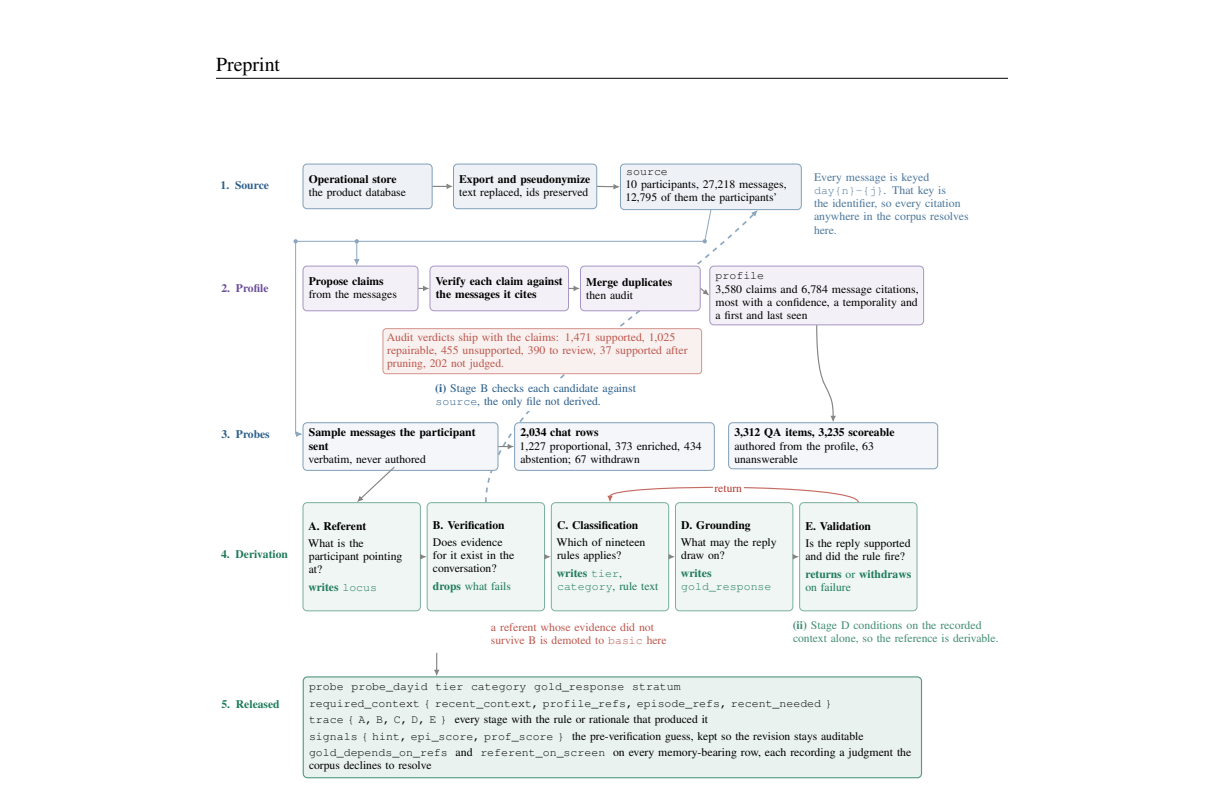
The paper releases ten real, month-scale conversations between people and an AI companion — 27,218 messages, up to 120 days — with the conversation and four derived files: a profile, a persona, a chat ground truth and a question set, every label tracing to the messages behind it. On these records it argues that the past is rarely needed and far away: on the natural-rate stratum only 3.4% of sampled messages, or 1.3% under a strict reading that removes on-screen referents, carry a verified memory demand, and when one exists the required material sits a median of 2,157 messages back. It shows that the field's standard pooled ablation — supply retrieved context, measure the gain — credits memory for gains that come almost entirely from probes that need none (96% at the natural rate), and formalizes this as Proposition 2. Finally, no detector it tried tells on real messages whether memory is needed (AUROC 0.530 at the natural rate) while the same detectors reach 0.802 on authored questions over the same histories, and three agent systems reconstruct the persona with the same F1 at a thirtyfold cost difference.
What carries the argument. The load-bearing arrangement is a stratified sample plus a monotone annotation pipeline. The proportional stratum — a random sample of user turns drawn without reference to memory demand — is the only part of the corpus that supports population rates, because a sweep for interesting probes has no denominator (validity condition V3). Over it runs a five-stage derivation — A resolves the referent, B verifies candidate records against the raw conversation, C assigns tier and category by fixed rules, D writes the reference reply grounded only in the recorded context, E validates — whose central property is monotonicity: verification can remove a reference but never add one. Monotonicity yields Proposition 1, π = π_o r + (1 − π_o)ε, which makes the measured 3.4% a lower bound on the true demand rate only to the extent the resolver's recall r is high. From the small π comes Proposition 2, Δ = πγ1 + (1−π)γ0, showing that the pooled ablation used across the field cannot identify a memory effect unless γ0 is zero or π is near one.
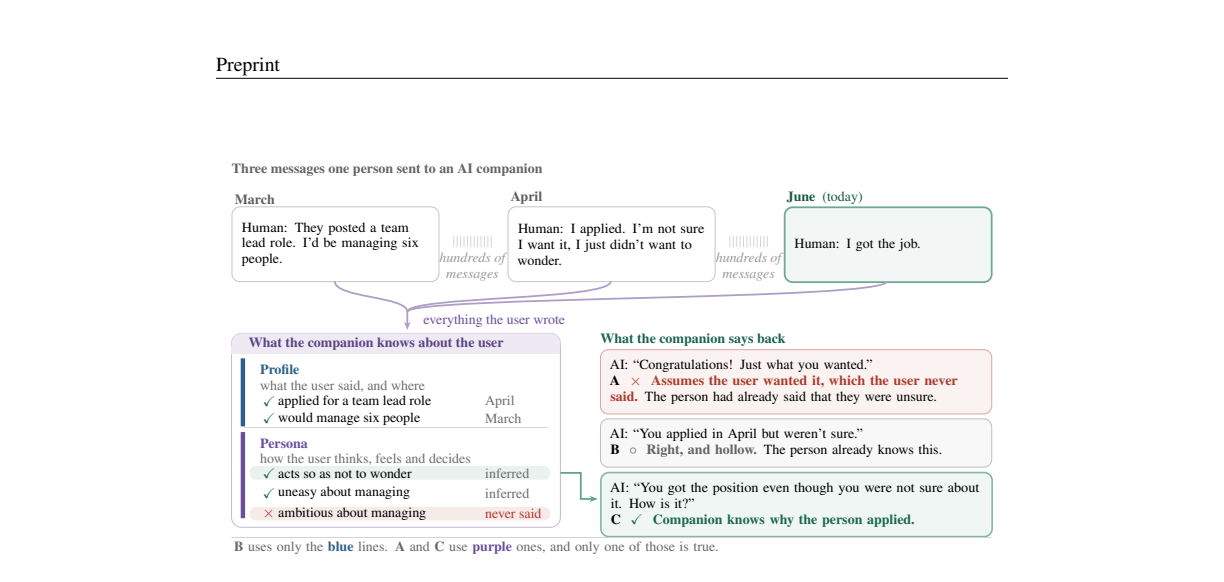
Core claim. On the paper's own terms the discovery is a pair of measured facts that contradict how generated memory benchmarks are constructed, plus a structural argument about why the numbers differ. The measured facts: real companion traffic is almost never require-the-past — 3.4% of sampled user messages on the natural-rate stratum, 1.3% under the strict reading that drops probes whose referent is already on screen — and when the past is needed it is far back, a median of 2,157 messages to the furthest required message and 450 to the nearest. The structural argument is Proposition 2: a pooled ablation difference Δ between supplying recorded evidence and withholding it decomposes as Δ = πγ1 + (1−π)γ0, so at small π the measured gain is dominated by probes needing no memory — here 96% of the gain lands on such probes — and no pooled contrast identifies a memory effect. A second pair of findings separates real from authored probes: no detector the paper tried separates memory-bearing from ordinary real messages at the natural rate (AUROC 0.530), while the same detectors reach 0.802 on authored questions over the same histories, and labeling otherwise identical turns as memories rather than earlier turns moves the decision to consult memory by ten to fourteen points.
The premise it rests on. The recall r of the stage A resolver: the measured 3.4% (or 1.3%) demand rate is only a lower bound on the true rate, and if the resolver systematically fails to see genuine distant referents then the past-is-rarely-needed conclusion collapses. The paper acknowledges this — "It does not rule out stage A failing to see a genuine referent" — and the residual sweep that checks for missed referents is run by the same widened resolver, so the recollection check is partly self-confirming.
If the paper is right (Pith's inferences, not the authors')
Generated-memory benchmarks operate at π = 1 by construction, a regime real companion traffic almost never enters, so their difficulty figures and tuned memory layers say little about a deployed companion's actual load.
Because most real messages need nothing from the past, restraint is the dominant error budget: the failure that matters is reaching for the past when nothing requires it, not missing a required message, and the misfire rate is scored on the 1,129 probes with an empty reference set.
A pooled retrieval score reports corpus composition, not capability: a recency window finds a required message for 95.9% of all probes but only 2.2% of those that need memory, so any benchmark claiming a memory effect must report the proportional split of the gain, not just the pooled contrast.
Supplying the recorded evidence is worth +0.455 only on the 167 items whose reference reply actually depends on it; on the population as a whole 96% of the measured gain comes from messages that need no memory, because the supplied context also carries the recent turns the reply used.
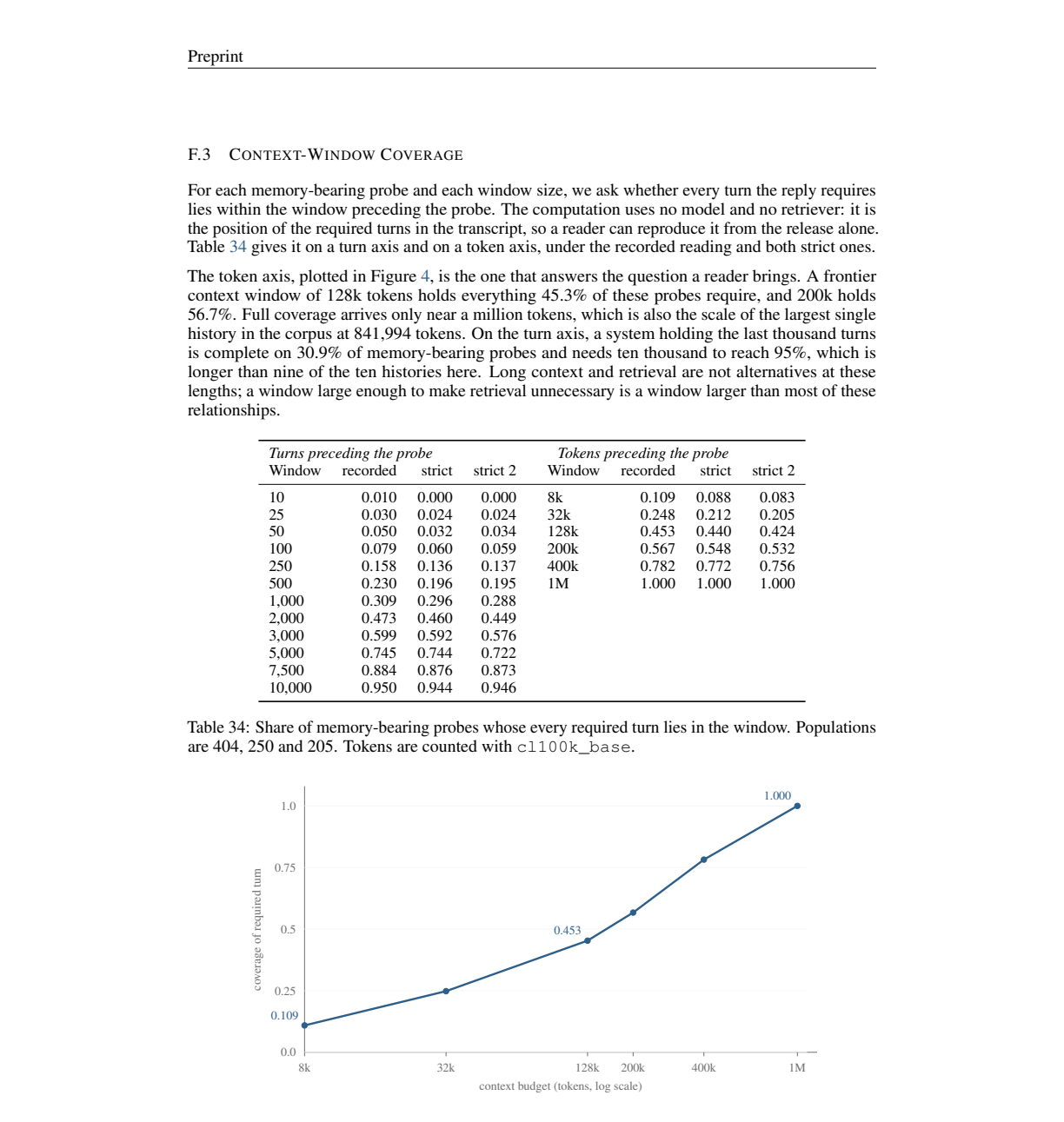
The far reach and low frequency of genuine demand mean a context window large enough to make retrieval unnecessary is larger than most of these histories — full coverage of required turns arrives only near a million tokens — so long-context and retrieval are not alternatives at these lengths.
If the 3.4% rate is close to true, the efficient companion architecture is a selective deep-retrieval trigger — decide whether to look, then search far back — rather than always-on retrieval or a sliding window, since both the rarity and the distance point the same way; the trigger is the hard subproblem.
The ten-to-fourteen-point framing effect implies that any comparison of memory systems that does not hold the prompt label fixed measures the interface, not the memory layer; a neutral, matched label is a requirement for comparability.
The gap between macro and pooled figures in this paper (for example BM25 hit@5 at 0.424 macro versus 0.248 pooled) shows that a single number averaged over relationships of very unequal length can describe no single relationship; per-participant reporting is the honest unit, not a cosmetic choice.
Ten relationships, one product, at most 120 days, with demand concentrated in the two longest relationships: the rare-and-far finding may be a property of this product's use patterns and observation window rather than of companion traffic generally, and testing it against a second operator or longer histories is the natural next check.
Check this review
Pith stored no record of this review's passes and took no fingerprint of it. Reviews made by code from 13 Nov 2026 on carry both.
How often reviews like this one are right
Reviews like this one: written by deepseek-v4-flash, where what was read was not recorded.
How often objections from reviews like this one are right: not yet measured
Reviews by people
This review was written by a machine. No person has reviewed this paper on Pith yet. A scientist listed on Pith can review it for a fee, and their review is published here whatever it concludes.
The paper
Abstract
An AI companion that talks with someone for months should come to understand them. It should know who they are, remember what they said, and recognize when something from the past matters now. Testing this needs real conversations, but real conversations are private, so existing benchmarks use invented people and invented questions. We release RealCompanion, ten real relationships between people and an AI companion, with 27,218 messages over up to 120 days. For each person, we release the full conversation, a profile, a persona, chat test items, and question test items. Every label points to the messages that support it, and every chat label comes with the reasoning that produced it. The real data shows three things. First, people rarely refer back. Only 3.4% of their messages depend on something said earlier, and when one does, the earlier message is usually far away (a median of 2,157 messages back). Averages hide this. Looking at the most recent messages finds the needed one 95.9% of the time overall, but only 2.2% of the time when it is far back. Second, AI systems cannot tell when the past matters. The detectors we tested barely beat chance on real messages, and when the same earlier messages are labeled "memories" instead of "earlier messages", models bring up the past 10 to 14 percentage points more often, even when nothing from the past is needed. Third, AI systems read more into a person than the person revealed. Three agent systems rebuild each persona equally well (F1 0.71). They see the person, and then imagine more. Understanding a person depends on knowing when their past matters and where what they shared ends, and only real conversations can test it.
The paper's own sentences, arranged, kept beside the review and separate from it. Each label is drawn from a closed vocabulary; the number beside it is the probability the classifier gave that label. No sentence in this record was written by a model.
abstract compiled · 2026-10-02
The authors' main claim, as the classifier picked it out 0.95
“First, the past is rarely needed and far away.”
How the main claim is stated: asserted 1.00
What the abstract itself states, as probabilities: claims first 0.08 · states limitation 0.73 · human participants 0.80 · controlled comparison 0.40 · randomized assignment 0.02 · states quantitative result 0.99 · compares with prior results 0.75 · mentions code or data availability 0.92
The abstract, sentence by sentence
This table labels the abstract only (arXiv listing abstract v1). The number is the probability the classifier gave the label.
| Sentence | Role | The authors' own work | States the main conclusion | Strength |
|---|---|---|---|---|
| A companion that talks with a person for months should come to understand them. | background 1.00 | 0.04 | 0.04 | asserted 0.63 |
| It should remember what they said, infer who they are, and know when the past bears on the message in front of it. | background 1.00 | 0.05 | 0.04 | asserted 0.77 |
| Testing this requires a real person's record, and such records are private, so benchmarks generate the person and the questions and settle in advance what matters. | background 0.65 | 0.10 | 0.04 | asserted 1.00 |
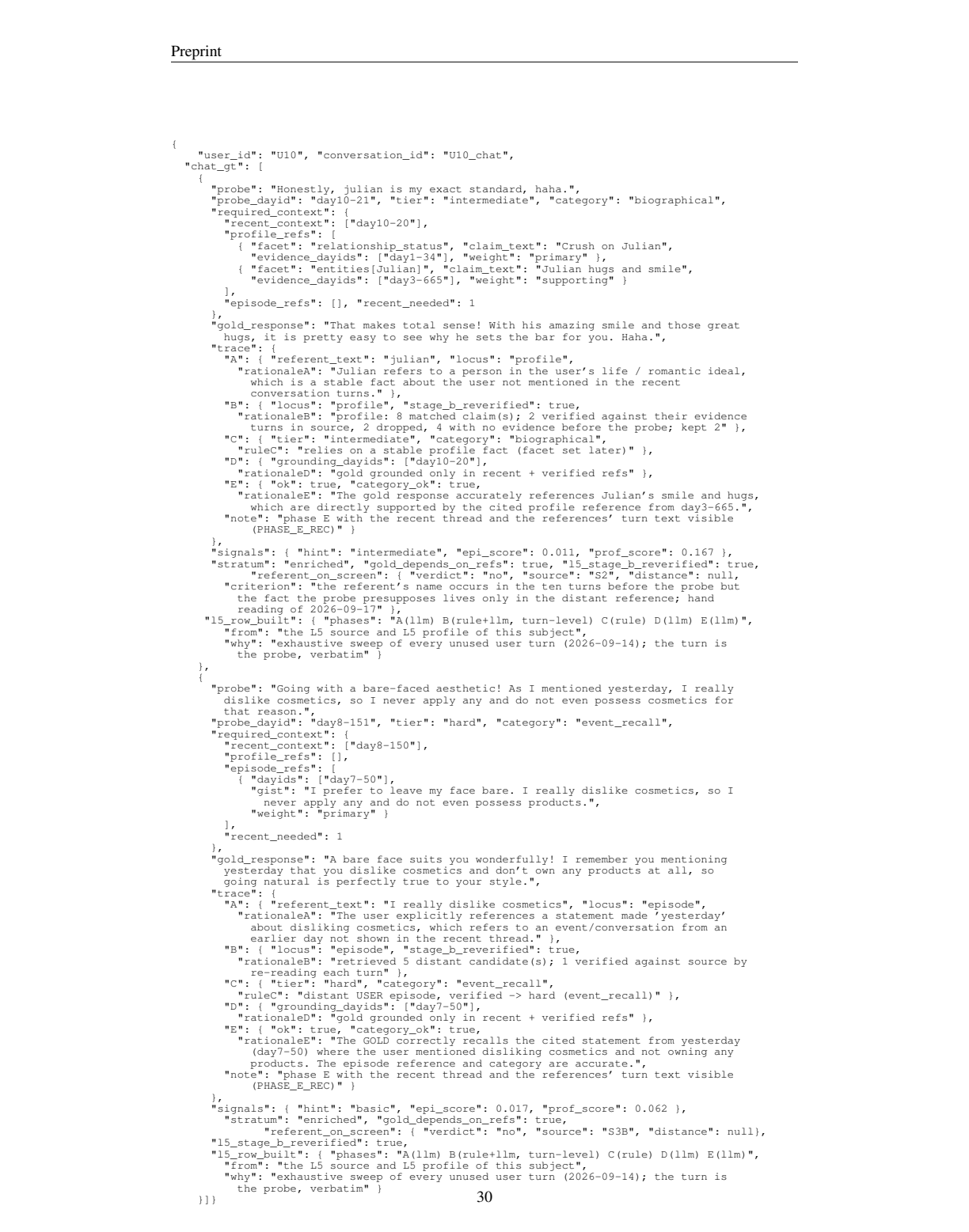
| We release \bench, ten real relationships with an AI companion: 27,218 messages over up to 120 days, released as the conversation and four files derived from it, a profile, a persona, a chat ground truth and a question set, each citing the messages it rests on. | contribution 0.86 | 0.96 | 0.05 | asserted 1.00 |
| Every chat label carries the reasoning trace that produced it, checked stage by stage against the conversation. Three findings follow. | method 0.85 | 0.93 | 0.05 | asserted 0.99 |
| First, the past is rarely needed and far away. | result 0.98 | 0.90 | 0.46 | asserted 1.00 |
| Pooled measures mislead: a recency window finds the required message for 95.9\% of probes and 2.2\% of those that need memory, and at the natural rate 96\% of the gain from supplying recorded evidence comes from messages that need none. | result 1.00 | 0.93 | 0.27 | asserted 1.00 |
| Second, no detector we tried can tell when memory is needed on real messages, authored questions over the same histories leak the cue, and labeling the same messages as memories raises their use by ten to fourteen points. | result 1.00 | 0.94 | 0.13 | asserted 1.00 |
| Third, three agent systems reconstruct the persona with the same F1 at a 31-fold difference in cost. | result 1.00 | 0.91 | 0.10 | asserted 1.00 |
What kind of paper the classifier reports this is: dataset or benchmark 1.00 · evidence from observation or experiment 0.80
What was examined, and what was not
Sources read
- arXiv listing abstract v1
Not examined
- full text
- figures and tables
- references and citing sentences
- relations to other papers
Levels run
- P abstract
Not run
- S sections
- T body sentences
- C citations
- R cross-paper relations
How the labels were made
Compiled by classifier-1.13.0 via TypeSafe API, question bank abstract-p1-20260923, 2026-10-02: 1 request, 6,995 input tokens.
Every quoted sentence on this record is the authors'. Every label is from Pith's closed vocabulary, with the probability shown beside it. This record as JSON
Figures (5)
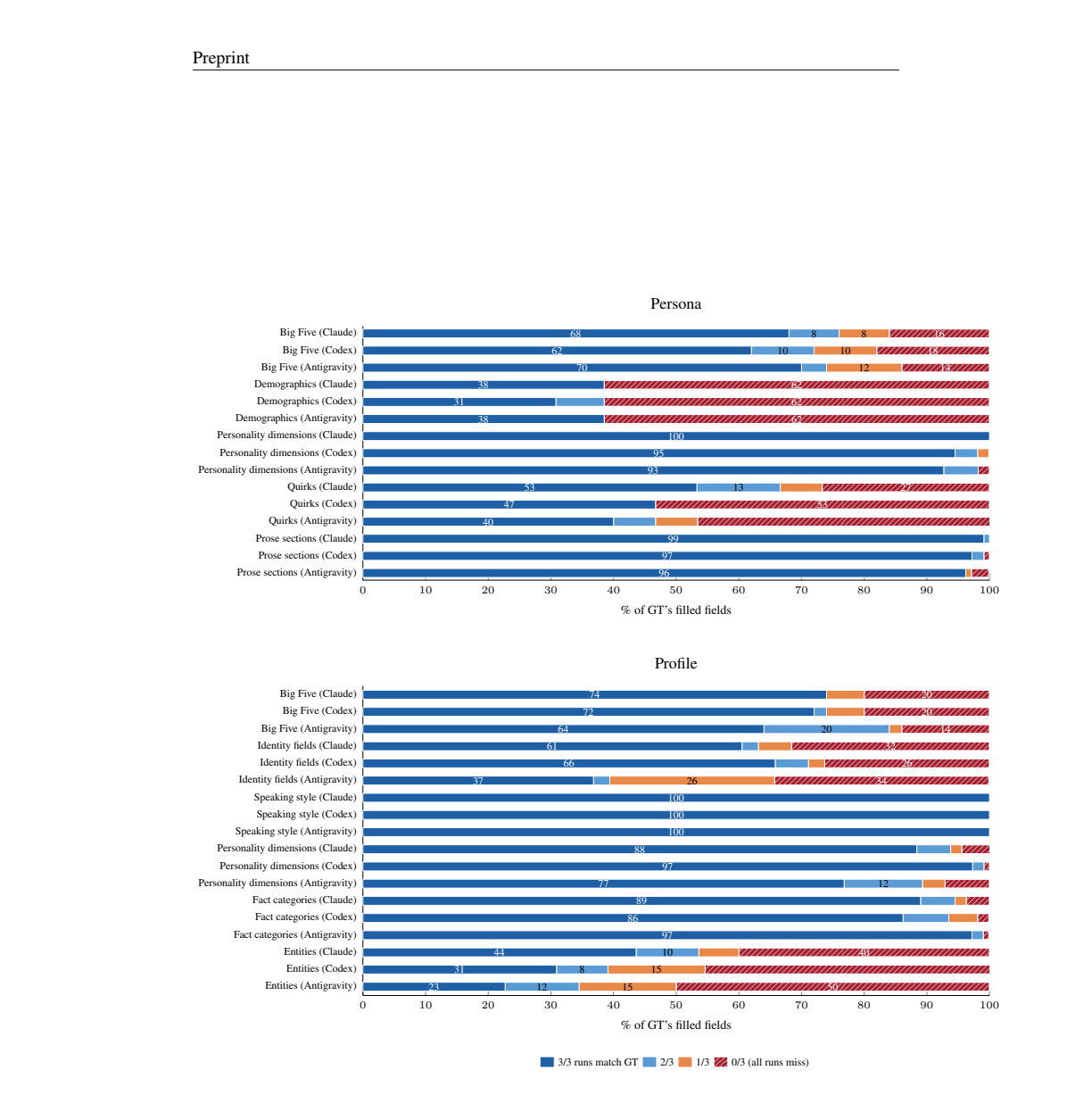
Figures are the authors', reproduced from the paper.
Challenges and discussion
Disagree with the review, or know something it missed? Leave a comment, or challenge this review formally: a challenge becomes a permanent entry in this paper's record, and its decision is published here.
Come back by email
A short list of the week's newly reviewed papers. Nothing is sent until you confirm from your inbox, and every email has a link that stops it. No account.
No comments yet.
Sign in to comment