Machine Learning · arXiv:2610.01821 v1 · submitted 1 Oct 2026 · 45 references
Beyond Linear Concepts: Discovering and Aligning Non-Linear Concept Manifolds in Large Language Models
The paper says
“Understanding information processing in large language models (LLMs) requires dissecting the geometric organization of their internal token representations.”
more of the abstract
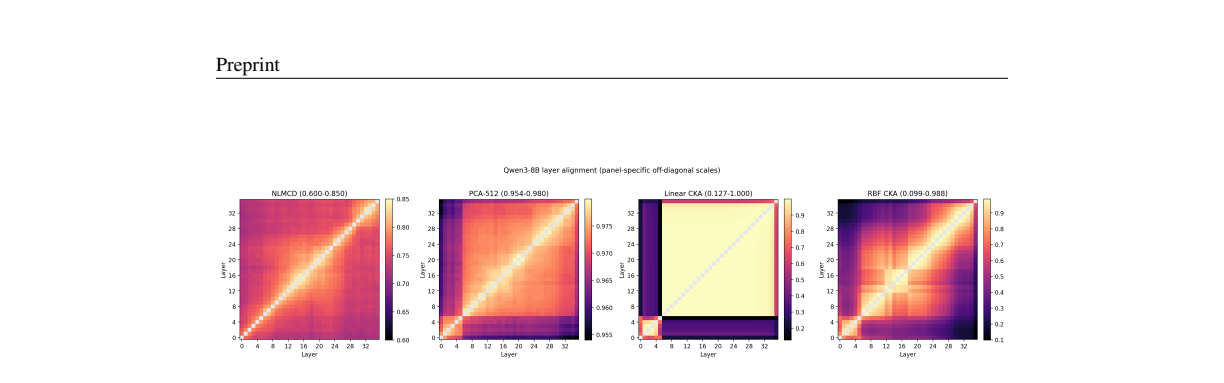
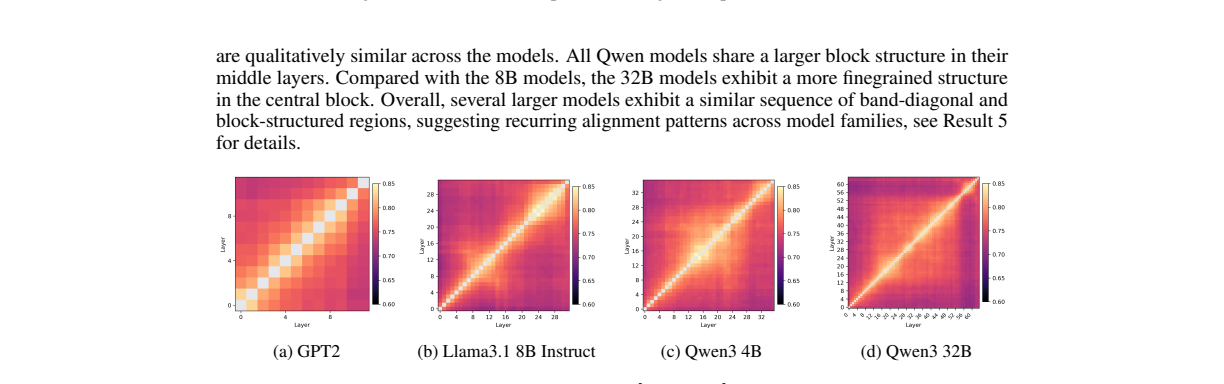
While existing mechanistic interpretability (MI) methods seek to extract concepts, they are constrained by a strong linearity assumption challenged by evidence of non-linear feature manifolds. We move beyond linear concepts by adapting Non-Linear Multi-Dimensional Concept Discovery (NLMCD) from computer vision to token-level LLM activations, modeling concepts as low-dimensional manifolds. To compare concept manifolds across layers and models, we introduce a concept-based alignment (CBA) score, a generalized Rand index that measures geometric proximity without explicit feature matching. Our analysis yields six key findings: (i) a neighboring-layer sanity check shows CBA is more sensitive than PCA- or CKA-based linear baselines; (ii) layer-by-layer alignment matrices reveal two block structures in intermediate and late layers, consistent across models and obscured by linear metrics; (iii) concept composition remains syntax-dominated through most of the network before giving way to increasingly mixed syntactic-semantic concepts in later layers, with increasing output-orientation toward the final layers; (iv) multilingual concept sharing between English and Mandarin is training-dependent rather than universal, strongest in Qwen, weaker in Llama, and absent in GPT-2; (v) inter-model alignment mirrors this structure, with strong correspondence between same-family Qwen models of different scale but weak alignment across model families; and (vi) across Tulu-3 training stages, alignment is highest between adjacent stages, with the largest shift between the base model and SFT, while subsequent preference-alignment stages (DPO, RLVR) leave early layers largely unchanged and RLVR mostly preserves DPO's concepts in late layers.
from the abstract
Pith says
Machine review · deepseek-v4-flash · 2 Oct 2026 · what was read was not recorded · not checked by a person
It can be wrong. Challenge this review or reply to it.
Holds up, with conditions. Honest adaptation of a published vision alignment method to LLM concept geometry, with six genuinely interesting findings that outrun what the method currently supports: cross-layer comparability is untested, and the load-bearing pattern claims sit exactly in the depth range where the paper's own diagnostics show the worst embedding distortion. This line is wrong
5 major objections · 5 minor
How often objections from reviews like this one are right: not yet measured
Not checked: figures, code, what the 45 references say.
The paper says, at Sec. 2, Eq. (1); R0; App. A.2
The review did not quote this passage.
Pith says: Objection 1 of 5 · major
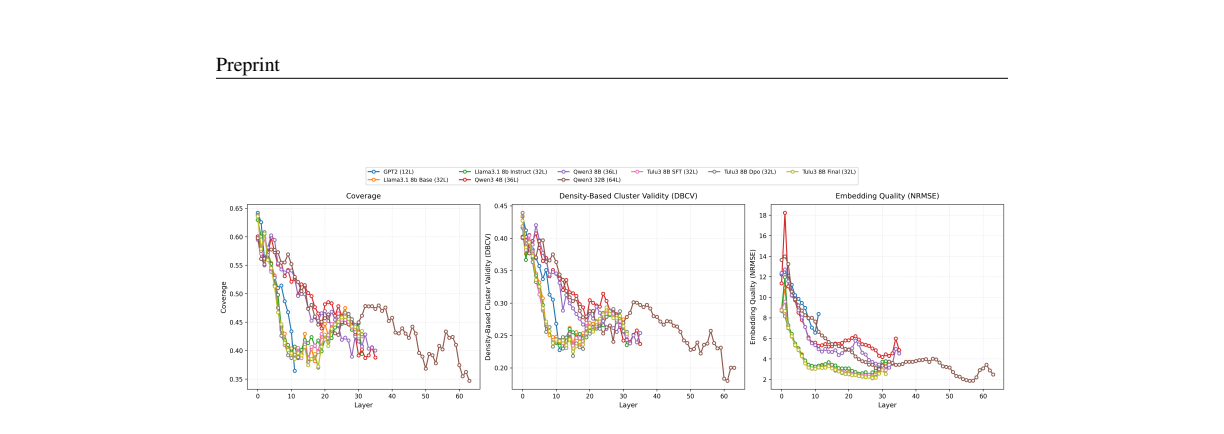
The cross-layer comparability that R2, R3, and R4 depend on is not established because d_cross in Eq. (1) is not coverage-normalized. Membership rows are explicitly allowed not to sum to one (missing mass is HDBSCAN noise), and the paper's own R0 results show coverage declining from about 0.65 to about 0.4 with depth (b79) while embedding fidelity NRMSE varies roughly threefold (10-12 early vs 3-4 late, Fig. 2 and App.
more of objection 1
A.2 Eq. 3). Under these conditions early- and late-layer rows carry systematically different mass budgets, so absolute CBA values at different depths are not on a common scale, and the magnitude of |dms - dms'| is inflated or deflated by depth in a way that is not controlled. Because R2's band-diagonal/blocks, R3's early-layer syntactic dominance, and R4's peak layers (7, 8, 10) sit exactly in the distorted regime, I ask for either a coverage-normalized variant of d_cross or a demonstration (e.g., restricting to layer pairs with matched coverage bands) that the block structures and multilingual peaks survive such normalization.
The paper says, at Sec. 2, Sec. 4 (R0); Fig. 2
The review did not quote this passage.
Pith says: Objection 2 of 5 · major
Concept discovery is run once per layer with a fixed profile (UMAP 50 dims, 30 neighbors, min_dist 0.01, seed 42; HDBSCAN min_cluster_size/min_samples 50) and no stability estimate. Since the paper's own NRMSE diagnostic (App. A.2, Eq. 3) shows the reduced embedding distorts early-layer geometry severely, and since several headline margins are small (e.g., R4 mean excess 0.0430 vs 0.0392 for …
more of objection 2
… Qwen3-8B vs 32B; R2's fine-grained central block distinction in Fig. 4d), a single seed provides no way to test whether the two block structures, the R4 peak layers, or the R5 same-family bands are artifacts of the particular UMAP/HDBSCAN run. I request seed and neighbor-count variation (at least 5-10 repetitions) on a representative subset, e.g., Qwen3-8B for R2/R4 and one Tulu pair for R6, with CBA intervals or a bootstrap over discovery runs.
The paper says, at Result 3; App. A.3.1
The review did not quote this passage.
Pith says: Objection 3 of 5 · major
The R3 output-orientation trend is confounded by the labeling prompt. App. A.3.1 instructs the labeler, as a function of depth, that in early layers predicted next tokens 'may not align closely... use them as a secondary signal' and in late layers 'weight them heavily when labelling' — this is a depth-dependent instruction, and the authors themselves note it is 'part of the labeling prompt, not a measured property of the layer.'
more of objection 3
The finding that concepts annotated as having both input and output evidence increase toward later layers (Fig. 5b, Fig. 10b) is therefore at least partially manufactured by the prompt design, since the labeler is told to weight output evidence more heavily in late layers. The R3 claim of 'increasing output-orientation toward the final layers' needs to be re-tested with a depth-blind prompt, or explicitly reported as a consequence of the annotation protocol rather than as an empirical property of the models.
The paper says, at Result 1, Tab. 1 and Tab. 4
The review did not quote this passage.
Pith says: Objection 4 of 5 · major
The abstract's claim that CBA is 'more sensitive' than the linear baselines is stronger than Tab. 1 supports. All four methods achieve near-perfect NN Alignment scores (PCA 0.983, linear CKA 0.978, RBF CKA 1.000, CBA 0.997), and on that primary statistic CBA is actually below RBF CKA; the claimed advantage rests entirely on the Neighbor z score (2.515 for CBA …
more of objection 4
… vs 1.714 for RBF CKA), which is a non-standard, z-standardized summary whose significance and stability (across layers, sample sizes) is not reported. I ask the authors to either temper the abstract/claims to the 'more fine-grained' framing already used in the text, or provide error bars and a significance test for the Neighbor z differences.
The paper says, at Result 6, Fig. 8 and Fig. 13
The review did not quote this passage.
Pith says: Objection 5 of 5 · major
Two issues affect R6. First, using the adjacent-stage ordering as a 'validation' of CBA is close to circular: R1 already assumes adjacent layers/stages align best as a sanity check, so R6's finding that alignment is highest between adjacent training stages confirms the assumption rather than independently validating the metric.
more of objection 5
Second, the layer-14-to-15 interpretation (weaker diagonal, more unmatched concepts in both directions) depends on the Hungarian match-acceptance threshold set to 0.0025, a free parameter for which no robustness analysis is given; varying this threshold would change the unmatched counts in App. Tab. 6 and hence the claim that layer 15 'changes concepts rather than uniformly reducing similarity.' Please report sensitivity of the unmatched counts and the layer-14/15 conclusion to the threshold.
5 minor objections
The paper says, at Sec. 2, Eq. (2)
Pith says: minor objection 1 of 5
The definition of the cluster-pair distance d_cross(P_alpha, Q_beta) is written with the same symbol d_cross as the global cross-distance in Eq. (1); please use distinct notation or explicitly state the relation, since the normalization factors differ (2/N(N-1) vs 1/N(N-1)).
The paper says, at Result 4, Tab. 2
Pith says: minor objection 2 of 5
The peak-excess layers (7, 8, 10 for the Qwen models) and the near-zero GPT-2 excess are reported without confidence intervals; given the shuffled-pair baseline has 200 permutations, reporting a standard deviation of the excess across permutations per layer would help assess whether the Qwen ordering (4B > 8B > 32B in mean excess) is meaningful.
show 3 more
The paper says, at Result 5, Sec. 2
Pith says: minor objection 3 of 5
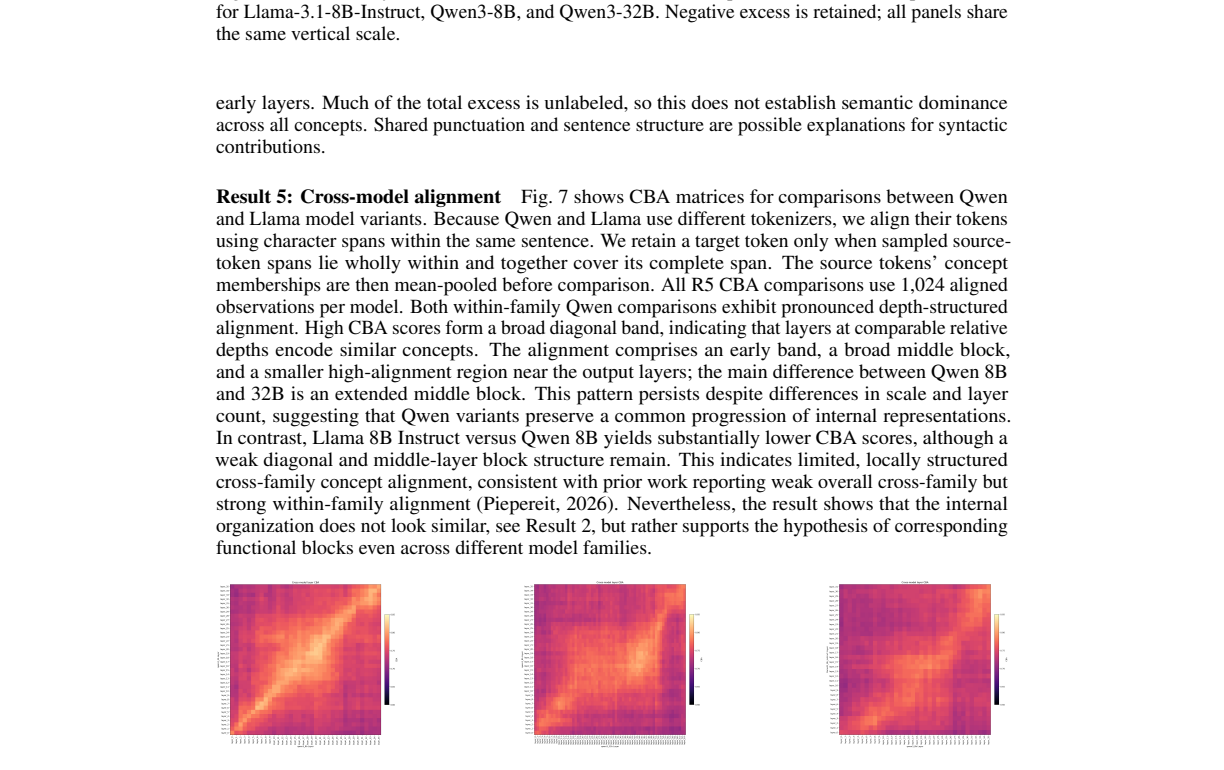
The R5 comparisons use only 1,024 aligned observations per model after span-based token pooling, whereas R1/R2 use 5,000 rows; the effect of this reduced sample size on CBA variance is not discussed, and the sentence says the R5 alignment is 'weak' partly on qualitative inspection of Fig. 7, so a quantitative summary (e.g., mean CBA per depth band) would strengthen the claim.
The paper says, at App. A.3
Pith says: minor objection 4 of 5
The R3 and R4 concept annotations are produced by a single labeler (Mistral-Small-24B-Instruct-2501) with greedy decoding; no agreement measure or labeler-alternative check is reported, and the R3 syntactic/semantic percentages (e.g., 45.7% vs 45.1% for Llama) are close enough that labeler noise could plausibly flip the ranking.
The paper says, at Throughout
Pith says: minor objection 5 of 5
Several presentational issues: the header 'BEYONDLINEARCONCEPTS' and 'F eaturevectors' contain missing spaces; the 'Neighbor z' definition is terse and appears before its per-model table without a formal formula; and the reference list contains duplicated author blocks (e.g., multiple 'Shaun Lindsay' entries in the Llama-3.1 citation).
What would settle it
Re-run UMAP-HDBSCAN on Qwen3-8B, Llama-3.1-8B-Instruct, and GPT-2 with at least 5 seeds (e.g., 0, 7, 42, 123, 2024) at every layer, keeping the profile otherwise fixed, and recompute from the perturbed memberships: (a) the R2 layer×layer CBA matrices — verify the band-diagonal plus two-block pattern in intermediate/late layers and the 32B finer central block survive; (b) the R4 mean excess and peak layer — verify the ordering Qwen3-4B 0.049 > Qwen3-8B 0.043 > Qwen3-32B 0.039 > Llama 0.024 > GPT-2 0.0009 (Tab. 2) is preserved with non-overlapping seed ranges; (c) the R6 base>SFT>DPO/RLVR stage ordering. Additionally compute per-layer cluster stability (ARI between seeds) at a high-NRMSE early layer, e.g., layer 2 of Qwen3-8B: if early-layer clusters are unstable across seeds, R3's early syntax-dominance and R4's early peaks lose their foundation.
from the skeptic's reading
How the review went
4 readings by deepseek-v4-flash · 2 Oct 2026
- Reader holds up, with conditions
- Skeptic agrees
- Editor wrote the verdict above
- Referee major revision: 5 major objections, 5 minor
Not run on this paper: the simulated authors' defence.
Pith did not check this review's objections against the paper.
The review in full
The review in brief, machine-written
I read this one through. My take: it's a competent, honest adaptation of a published vision method — NLMCD plus the fuzzy Rand index, from Vielhaben et al. 2026 and Hüllermeier et al. 2012 — to token-level LLM activations, and the findings are genuinely worth chasing. But the headline claims run ahead of what the method can currently support, because the thing every pattern depends on, comparable concept manifolds across layers, is never actually tested.
Credit first. The authors are straight about provenance: the metric is not their invention, and they say they follow the vision recipe "even including hyperparameter settings." That fixed profile is a real virtue; it removes the per-layer tuning confound. The shuffled-pair baseline in R4 is the right control. They release code. And the limitations section is unusually candid — they concede much of the multilingual excess is unlabeled, punctuation is a plausible driver (b157, b158), coverage falls from ~0.65 to ~0.4 with depth (b79), and NRMSE is roughly 3x worse in early layers than late (Fig. 2, App. A.2).
The stress-test concern survives contact with the text, and it is the core issue. R3's syntactic-dominance-in-early-layers, R4's peaks at layers 2–10, and R2's early band region all sit exactly in the depth range where their own diagnostic shows the geometry most distorted (NRMSE 10–12 early vs 3–4 late). Concept discovery is a single run per layer, one seed, one UMAP profile — no stability estimate whatsoever. And since d_cross is not coverage-normalized and membership rows don't sum to one, absolute CBA values across depths are not on a common scale. The shuffled-pair control removes sentence-pair coupling but not depth-dependent noise, so the block structures and the small multilingual margins could be depth artifacts rather than concept geometry. The authors note the NRMSE trend but never bound its effect on any of the six results.
Smaller items. R1's "more sensitive" claim rests on a single z-score — all four methods already hit 0.98–1.00 NN alignment, which the paper itself admits discriminates little. R6 validates CBA using the adjacency prior it already assumes, a mild circularity, and the layer-14/15 transition leans on a hand-set Hungarian threshold (0.0025). None of this is fatal; the framework is plausible.
Who it's for: mechanistic-interpretability people comparing concept geometry across tokenizers, scales, languages, and training stages. It deserves a serious referee — the findings justify the effort if they survive. My recommendation is peer review with major revision: seed and neighbor-count stability sweeps, coverage-normalized or noise-bounded comparisons, and significance or permutation tests on the block structures and the multilingual ranking.
The strongest objection
The central claim is that CBA(P,Q)=1−d_cross (Eq. 1) exposes genuine non-linear concept geometry: R2's two block structures, R3's early-layer syntax dominance, R4's Qwen>Llama>GPT-2 multilingual excess, and R6's stage-wise ordering all rest on fuzzy memberships being stable and comparable across layers, models, and languages. That comparability is untested. Concept discovery is a single run per layer (UMAP, 50 dims, 30 neighbors, min_dist 0.01, seed 42; HDBSCAN min_cluster_size/min_samples 50, Section 2) with no seed, neighbor-count, or min_dist variation. The paper's own NRMSE diagnostic (Fig. 2, App. A.2, Eq. 3) shows embedding fidelity varies roughly 3x with depth: NRMSE 10–12 in early layers versus 3–4 late. Yet the load-bearing pattern claims sit exactly in the distorted regime: R3's 'syntactic dominance in early layers,' R4's peak excess at layers 2–10 (Qwen3-4B peak layer 7, Qwen3-8B layer 8, Qwen3-32B layer 10), and R2's early band-diagonal region. Because membership rows need not sum to one (missing mass is HDBSCAN noise) and coverage itself drops from ~0.65 to ~0.4 with depth (b79), d_cross (Eq. 1) has no coverage normalization: early and late layers carry systematically different mass budgets and hence different baseline magnitudes of |dms−dms'|, so absolute CBA values across depths are not on a common scale. The shuffled-pair control in R4 recomputes the same distorted early-layer geometry, so it removes sentence-pair coupling but not depth-dependent noise, leaving R4's ranking and peak layers, R2's blocks, and R3's depth trend potentially driven by seed and depth artifacts rather than concept geometry. The authors acknowledge the depth-dependent NRMSE but do not bound its effect on any of the six results.
The reader's weakest_assumption — that the single-run, fixed-profile UMAP+HDBSCAN procedure yields stable, cross-layer-comparable concept manifolds — is exactly the load-bearing point. I agree with that diagnosis and sharpen it in two ways. First, the depth-varying embedding fidelity is not merely a quality footnote: NRMSE 10–12 in early layers versus 3–4 in late layers (Fig. 2, App. A.2) means the early-layer embeddings are approximately an order of magnitude noisier in relative distance error, and several of the headline patterns (R3 syntax-dominance, R4 peak excess at layers 2–10, R2's early band) sit precisely there. Second, the coverage drop (0.65 to 0.4, b79) combined with non-normalized membership rows means the raw scale of d_cross in Eq. 1 differs systematically by depth, so absolute CBA values across layers are not commensurable; the shuffled-pair control in R4 reuses the same distorted geometry and cannot correct for this. These are internal-consistency risks, not disagreements with consensus: the paper's own diagnostics raise them, and the paper does not bound their effect on any single result. In good faith, the method is plausible, the code is released, and the R4/R6 analyses include controls (shuffled pairs, adjacent-stage comparisons), which is why this is a condition to verify rather than a rejection. The proposed test is cheap given released code and directly settles whether the block structures, the multilingual ordering, and the stage ordering are seed-stable and robust to the depth-dependent distortion. If the test passes, the CONDITIONAL verdict can be upgraded; if it fails, the claims must be restated with stability bounds. I therefore recommend keeping the reader's CONDITIONAL verdict unchanged, with the concrete stability test as the condition.
The referee's report
If the findings survive scrutiny, the paper delivers a useful tool: a concept-level, non-linear alignment score that does not require shared tokenizers or a common coordinate system, applied to a reasonably broad model suite (GPT-2, Llama-3.1-8B, Qwen3-4B/8B/32B, Tulu-3 stages). The design has real strengths: the fixed UMAP/HDBSCAN hyperparameter profile avoids per-layer tuning as a confound; the multilingual analysis in Result 4 uses a proper shuffled-pair control (200 permutations); and CBA is not fitted to optimize any target, so the main statistic is not derived from the results. The paper also acknowledges several relevant limitations itself (b137, b157, b158, b195-b201). However, the headline claims outpace the evidence in specific, load-bearing ways: d_cross has no coverage normalization despite membership rows not summing to one; concept discovery is a single run per layer with one seed; and the R3 annotation prompt instructs the labeler to weight next-token evidence by depth, which can manufacture the reported output-orientation trend. The reader's conditional verdict and the skeptic's depth-comparability concern are, in my reading, justified and untested.
Pith's reading of the paper (a machine's summary, not the authors')
This paper argues that the right unit for comparing what large language models know is the non-linear concept manifold, not the linear direction, and that switching units changes what representational structure is visible. It adapts a computer-vision concept-discovery pipeline — UMAP embedding plus HDBSCAN clustering of token activations into fuzzy concept memberships — and pairs it with a new concept-based alignment score, CBA, a fuzzy generalization of the Rand index that needs no explicit feature matching across models or tokenizers. Running this over nine checkpoints from four model families, the paper reports six findings: a neighbor-layer sanity check where CBA is the most informative of four metrics; two consistent block structures in layer-by-layer alignment matrices that linear CKA misses; a shift from syntax-dominated to mixed syntactic-semantic concepts with depth; English-Mandarin concept sharing that is strong in Qwen, weaker in Llama, and absent in GPT-2; strong same-family Qwen alignment with weak cross-family alignment; and a finetuning shift concentrated at the base-to-SFT step with DPO/RLVR preserving early layers. If correct, these patterns are genuine properties of non-linear concept geometry rather than artifacts of one alignment metric.
What carries the argument. The pipeline fixes one UMAP profile (50 dimensions, 30 neighbors, minimum distance 0.01, seed 42) and one HDBSCAN profile (minimum cluster size and minimum samples both 50, leaf cluster selection, explicit noise assignments) applied independently per layer, producing a fuzzy membership matrix $P \in [0,1]^{N \times C}$ whose rows need not sum to one, with missing mass representing noise or uncertainty. Alignment between two such spaces is $\mathrm{CBA}(P,Q) = 1 - d_{\mathrm{cross}}(P,Q)$, where $d_{\mathrm{cross}}$ averages, over token pairs, the absolute difference between the pairwise membership similarities induced by $P$ and $Q$; this equals the H\"ullermeier Rand index for crisp assignments and requires no shared coordinate system or tokenizer. Concept-level attribution uses partial Hungarian matching of pairwise concept distances with an unmatched-penalty threshold of 0.0025, letting concepts stay unmatched when no real assignment is close. This machinery converts the question 'how similar are two layers or two models' into a question about matched and unmatched concept manifolds.
Core claim. The central claim is that a concept-based alignment score, $\mathrm{CBA}(P,Q) = 1 - d_{\mathrm{cross}}(P,Q)$, computed on fuzzy token-to-concept memberships, is more sensitive than linear metrics such as CKA and PCA-512, and that this sensitivity reveals internal structure those metrics hide. The load-bearing observations are the layer-by-layer alignment matrices, which the paper reads as two block structures in intermediate and late layers; the depth-resolved concept composition, which shifts from syntax-dominated early in the network to mixed syntactic-semantic concepts later; the multilingual result, where shared English-Mandarin concept mass above shuffled-pair controls scales with training; and the Tulu-3 stage study, where the largest alignment shift sits between the base model and SFT while DPO and RLVR leave early layers largely intact. The paper states its own scope: discovered concepts could also support mechanistic interpretability, but the work confines itself entirely to their use for alignment.
The premise it rests on. The whole analysis depends on a single UMAP-plus-HDBSCAN run with one fixed hyperparameter profile recovering stable, meaningful concept manifolds at every layer, with fuzzy memberships comparable across layers, models, and languages — even though the paper's own NRMSE diagnostic shows embedding quality varies sharply with depth (near $10$-$12$ in early layers versus $3$-$4$ late) and no repeated-run stability estimate is reported.
If the paper is right (Pith's inferences, not the authors')
CBA can serve as a fine-grained alignment diagnostic where linear CKA and PCA-512 saturate, locating precisely which layers and which concepts diverge.
Multilingual concept sharing is a trained, not universal, property: Qwen's strong excess over shuffled-pair controls and GPT-2's absence counters the Platonic Representation Hypothesis for typologically distant languages.
Post-training reorganizes concepts at the base-to-SFT step; DPO and RLVR refine rather than rewire, so preference alignment largely inherits the concept geometry established by SFT.
The systematic layer-14-to-15 alignment drop across the Tulu-3 suite identifies a transition layer that post-training specifically adapts, distinct from the global finetuning shift.
A single seeded run at each layer gives no stability estimate; rerunning the discovery profile across seeds and hyperparameter settings would test whether the two-block structure and small multilingual excess margins survive clustering noise.
The paper's own NRMSE diagnostic shows embedding distortion is worst in early layers (roughly $10$-$12$ versus $3$-$4$ late), so the early-layer claims — syntax dominance and the placement of the first block — rest on the least reliable geometry, and correcting for this distortion could shift the reported depth profile.
Because CBA needs no feature correspondence, it could transfer to other no-shared-coordinate settings, such as cross-modal or cross-architecture comparisons with differing tokenizers, where the fuzzy-Rand formulation is one of the few matching-free options.
The substantial unlabeled excess in the multilingual study leaves the semantic-versus-syntactic split of shared concepts open; directly probing matched concepts across languages could settle whether the sharing reflects genuine linguistic structure or surface-form overlap.
Check this review
Pith stored no record of this review's passes and took no fingerprint of it. Reviews made by code from 13 Nov 2026 on carry both.
How often reviews like this one are right
Reviews like this one: written by deepseek-v4-flash, where what was read was not recorded.
How often objections from reviews like this one are right: not yet measured
Reviews by people
This review was written by a machine. No person has reviewed this paper on Pith yet. A scientist listed on Pith can review it for a fee, and their review is published here whatever it concludes.
The paper
Abstract
Understanding information processing in large language models (LLMs) requires dissecting the geometric organization of their internal token representations. While existing mechanistic interpretability (MI) methods seek to extract concepts, they are constrained by a strong linearity assumption challenged by evidence of non-linear feature manifolds. We move beyond linear concepts by adapting Non-Linear Multi-Dimensional Concept Discovery (NLMCD) from computer vision to token-level LLM activations, modeling concepts as low-dimensional manifolds. To compare concept manifolds across layers and models, we introduce a concept-based alignment (CBA) score, a generalized Rand index that measures geometric proximity without explicit feature matching. Our analysis yields six key findings: (i) a neighboring-layer sanity check shows CBA is more sensitive than PCA- or CKA-based linear baselines; (ii) layer-by-layer alignment matrices reveal two block structures in intermediate and late layers, consistent across models and obscured by linear metrics; (iii) concept composition remains syntax-dominated through most of the network before giving way to increasingly mixed syntactic-semantic concepts in later layers, with increasing output-orientation toward the final layers; (iv) multilingual concept sharing between English and Mandarin is training-dependent rather than universal, strongest in Qwen, weaker in Llama, and absent in GPT-2; (v) inter-model alignment mirrors this structure, with strong correspondence between same-family Qwen models of different scale but weak alignment across model families; and (vi) across Tulu-3 training stages, alignment is highest between adjacent stages, with the largest shift between the base model and SFT, while subsequent preference-alignment stages (DPO, RLVR) leave early layers largely unchanged and RLVR mostly preserves DPO's concepts in late layers.
The paper's own sentences, arranged, kept beside the review and separate from it. Each label is drawn from a closed vocabulary; the number beside it is the probability the classifier gave that label. No sentence in this record was written by a model.
abstract compiled · 2026-10-02
The authors' main claim, as the classifier picked it out 0.92
“Our analysis yields six key findings: (i) a neighboring-layer sanity check shows CBA is more sensitive than PCA- or CKA-based linear baselines; (ii) layer-by-layer alignment matrices reveal two block structures in intermediate and late layers, consistent across models and obscured by linear metrics; (iii) concept composition remains syntax-dominated through most of the network before giving way to increasingly mixed syntactic-semantic concepts in later layers, with increasing output-orientation toward the final layers; (iv) multilingual concept sharing between English and Mandarin is training-dependent rather than universal, strongest in Qwen, weaker in Llama, and absent in GPT-2; (v) inter-model alignment mirrors this structure, with strong correspondence between same-family Qwen models of different scale but weak alignment across model families; and (vi) across Tulu-3 training stages, alignment is highest between adjacent stages, with the largest shift between the base model and SFT, while subsequent preference-alignment stages (DPO, RLVR) leave early layers largely unchanged and RLVR mostly preserves DPO's concepts in late layers.”
How the main claim is stated: asserted 1.00
What the abstract itself states, as probabilities: claims first 0.08 · states limitation 0.21 · human participants 0.03 · controlled comparison 0.69 · randomized assignment 0.01 · states quantitative result 0.47 · compares with prior results 0.95 · mentions code or data availability 0.02
The abstract, sentence by sentence
This table labels the abstract only (arXiv listing abstract v1). The number is the probability the classifier gave the label.
| Sentence | Role | The authors' own work | States the main conclusion | Strength |
|---|---|---|---|---|
| Understanding information processing in large language models (LLMs) requires dissecting the geometric organization of their internal token representations. | background 1.00 | 0.06 | 0.02 | asserted 1.00 |
| While existing mechanistic interpretability (MI) methods seek to extract concepts, they are constrained by a strong linearity assumption challenged by evidence of non-linear feature manifolds. | gap 0.61 | 0.05 | 0.05 | asserted 0.98 |
| We move beyond linear concepts by adapting Non-Linear Multi-Dimensional Concept Discovery (NLMCD) from computer vision to token-level LLM activations, modeling concepts as low-dimensional manifolds. | method 0.51 | 0.89 | 0.11 | asserted 0.99 |
| To compare concept manifolds across layers and models, we introduce a concept-based alignment (CBA) score, a generalized Rand index that measures geometric proximity without explicit feature matching. | method 0.76 | 0.94 | 0.07 | asserted 1.00 |
| Our analysis yields six key findings: (i) a neighboring-layer sanity check shows CBA is more sensitive than PCA- or CKA-based linear baselines; (ii) layer-by-layer alignment matrices reveal two block structures in intermediate and late layers, consistent across models and obscured by linear metrics; (iii) concept composition remains syntax-dominated through most of the network before giving way to increasingly mixed syntactic-semantic concepts in later layers, with increasing output-orientation toward the final layers; (iv) multilingual concept sharing between English and Mandarin is training-dependent rather than universal, strongest in Qwen, weaker in Llama, and absent in GPT-2; (v) inter-model alignment mirrors this structure, with strong correspondence between same-family Qwen models of different scale but weak alignment across model families; and (vi) across Tulu-3 training stages, alignment is highest between adjacent stages, with the largest shift between the base model and SFT, while subsequent preference-alignment stages (DPO, RLVR) leave early layers largely unchanged and RLVR mostly preserves DPO's concepts in late layers. | result 1.00 | 0.97 | 0.61 | asserted 1.00 |
What kind of paper the classifier reports this is: method or tool 0.91 · evidence from observation or experiment 0.82
What was examined, and what was not
Sources read
- arXiv listing abstract v1
Not examined
- full text
- figures and tables
- references and citing sentences
- relations to other papers
Levels run
- P abstract
Not run
- S sections
- T body sentences
- C citations
- R cross-paper relations
How the labels were made
Compiled by classifier-1.13.0 via TypeSafe API, question bank abstract-p1-20260923, 2026-10-02: 1 request, 4,577 input tokens.
Every quoted sentence on this record is the authors'. Every label is from Pith's closed vocabulary, with the probability shown beside it. This record as JSON
Figures (13)





Figures are the authors', reproduced from the paper.
References (45)
- [1] Language models encode numbers using digit representations in base 10 , author=. Proceedings of the 2025 Conference of the Nations of the Americas Chapter of the Association for Computational Linguistics: Human Language Technologies (Volume 2: Short Papers) , pages= on Pith
- [2] Measuring statistical dependence with Hilbert-Schmidt norms , author=. International conference on algorithmic learning theory , pages=. 2005 , organization= on Pith
- [3] Awm: Accurate weight-matrix fingerprint for large language models , author=. International Conference on Learning Representations , volume= on Pith
- [4] Zhang, Jie and Liu, Dongrui and Qian, Chen and Zhang, Linfeng and Liu, Yong and Qiao, Yu and Shao, Jing , booktitle =. REEF: Representation Encoding Fingerprints for Large Language Models , url = on Pith
- [5] Similarity of neural network models: A survey of functional and representational measures , author=. ACM Computing Surveys , volume=. 2025 , publisher= on Pith
- [6] Getting aligned on representational alignment , author=. Transactions on Machine Learning Research , issn=. 2025 , url= on Pith
- [7] Beyond scalars: Concept-based alignment analysis in vision transformers , author=. Advances in Neural Information Processing Systems , volume= on Pith
- [8] Not All Language Model Features Are One-Dimensionally Linear , author=. International Conference on Learning Representations , year=. 2405.14860 , archivePrefix= on PithPith's reviewarXiv
- [9] Towards Monosemanticity: Decomposing Language Models With Dictionary Learning , author=. 2023 , url= on Pith
- [10] Scaling and evaluating sparse autoencoders , author=. 2024 , eprint= on Pith
- [11] Efficient and Effective Vocabulary Expansion Towards Multilingual Large Language Models , author=. 2024 , eprint= on Pith
- [12] Vitter, Jeffrey S. , title =. ACM Trans. Math. Softw. , month = mar, pages =. 1985 , issue_date =. doi:10.1145/3147.3165 , abstract = on Pithdoi:10.1145/3147.3165
- [13] Mistral 7B , author=. 2023 , eprint= on Pith
- [14] McInnes, Leland and Healy, John and Melville, James , journal=. 2018 , url= on Pith
- [15] Relative representations enable zero-shot latent space communication , author=. The Eleventh International Conference on Learning Representations , year= on Pith
- [16] Gromov-Wasserstein alignment of word embedding spaces , author=. Proceedings of the 2018 conference on empirical methods in natural language processing , pages= on Pith
- [17] Campello, Ricardo J. G. B. and Moulavi, Davoud and Sander, Joerg. Density-Based Clustering Based on Hierarchical Density Estimates. Advances in Knowledge Discovery and Data Mining. 2013 on Pith
- [18] Brinkmann, Jannik and Wendler, Chris and Bartelt, Christian and Mueller, Aaron. Large Language Models Share Representations of Latent Grammatical Concepts Across Typologically Diverse Languages. Proceedings of the 2025 Conference of the Nations of the Americas Chapter of the A... on Pithdoi:10.18653/v1/2025.naacl-long.312
- [19] H\"ullermeier, Eyke and Rifqi, Maria and Henzgen, Sascha and Senge, Robin , journal=. Comparing Fuzzy Partitions: A Generalization of the Rand Index and Related Measures , year= on Pith
- [20] Language models can explain neurons in language models , author =. 2023 , howpublished = on Pith
show 25 more
- [21] Tatoeba: Collection of Sentences and Translations , year = on Pith
- [22] East Frisian Wikipedia Incubator , year = on Pith
- [23] Moulavi, Davoud and Jaskowiak, Pablo A. and Campello, Ricardo J. G. B. and Zimek, Arthur and Sander, J. Density-Based Clustering Validation , booktitle =. 2014 , publisher =. doi:10.1137/1.9781611973440.96 , URL =. https://epubs.siam.org/doi/pdf/10.1137/1.9781611973440.96 , abstract = on Pithdoi:10.1137/1.9781611973440.96
- [24] Pointer Sentinel Mixture Models , author=. International Conference on Learning Representations , year=. 1609.07843 , archivePrefix= on PithPith's reviewarXiv
- [25] Interpretability Beyond Feature Attribution: Quantitative Testing with Concept Activation Vectors (TCAV) , author=. 2018 , eprint= on Pith
- [26] Toy Models of Superposition , author=. Transformer Circuits Thread , year= on Pith
- [27] Vielhaben, Johanna and Bl. Multi-dimensional concept discovery (. Transactions on Machine Learning Research , issn=. 2023 , eprint= on Pith
- [28] Similarity of Neural Network Representations Revisited , author=. Proceedings of the 36th International Conference on Machine Learning , series=. 2019 , publisher= on Pith
- [29] Edward J. Hu and Yelong Shen and Phillip Wallis and Zeyuan Allen-Zhu and Yuanzhi Li and Shean Wang and Lu Wang and Weizhu Chen , year=. 2106.09685 , archivePrefix= on PithPith's reviewarXiv
- [30] Jun Zhao and Zhihao Zhang and Luhui Gao and Qi Zhang and Tao Gui and Xuanjing Huang , year=. 2401.01055 , archivePrefix= on PithPith's reviewarXiv
- [31] Levy, Amit Arnold and Geva, Mor , title =. arXiv preprint , year = on Pith
- [32] Geiger, Atticus and Lubana, Ekdeep Singh and Fel, Thomas and Merullo, Jack and Byun, Michael and Lewis, Owen and McGrath, Thomas , title =. Goodfire Research , year = on Pith
- [33] Wurgaft, Daniel and Rager, Can and Kowal, Matthew and Shyam, Vasudev and Feucht, Sheridan and Bhalla, Usha and Haklay, Tal and Bigelow, Eric and Sarfati, Raphael and McGrath, Thomas and Lewis, Owen and Merullo, Jack and Goodman, Noah and Fel, Thomas and Geiger, Atticus and Lub... on PithPith's reviewarXiv
- [34] Wurgaft, Daniel and others , title =. arXiv preprint 2602.02315 , year = on PithPith's reviewarXiv
- [35] Architecture-Dependent Causal Transfer of Activation States Across Large Language Models , author=. arXiv preprint arXiv:2608.16347 , year= on PithPith's reviewarXiv
- [36] Representational Similarity and Model Behavior in Multi-Agent Interaction , author=. Forty-third International Conference on Machine Learning , year= on Pith
- [37] Objective drives the consistency of representational similarity across datasets , author =. Proceedings of the 42nd International Conference on Machine Learning , pages =. 2025 , editor = on Pith
- [38] Efficient Reasoning with Hidden Thinking , author=. Forty-third International Conference on Machine Learning , year= on Pith
- [39] Language models are unsupervised multitask learners , author=. OpenAI blog , volume= on Pith
- [40] The Llama 3 Herd of Models , author=. arXiv preprint 2407.21783 , year=. 2407.21783 , archivePrefix= on PithPith's reviewarXiv
- [41] Qwen3 Technical Report , author=. arXiv preprint 2505.09388 , year=. 2505.09388 , archivePrefix= on PithPith's reviewarXiv
- [42] Tulu 3: Pushing Frontiers in Open Language Model Post-Training , author=. 2025 , journal=. 2411.15124 , archivePrefix= on PithPith's reviewarXiv
- [43] The Platonic Representation Hypothesis , author=. arXiv preprint 2405.07987 , archivePrefix=. 2024 , eprint= on PithPith's reviewarXiv
- [44] BERT Rediscovers the Classical NLP Pipeline , author=. 2019 , eprint= on Pith
- [45] Reinforcement Learning Finetunes Small Subnetworks in Large Language Models , author=. 2025 , eprint= on Pith
Challenges and discussion
Disagree with the review, or know something it missed? Leave a comment, or challenge this review formally: a challenge becomes a permanent entry in this paper's record, and its decision is published here.
Come back by email
A short list of the week's newly reviewed papers. Nothing is sent until you confirm from your inbox, and every email has a link that stops it. No account.
No comments yet.
Sign in to comment