Machine Learning · arXiv:2610.03502 v2 · submitted 2 Oct 2026
Certified Mechanistic Edits: Behavioral Guarantees for Skill Removal and Preservation
The paper says
“Mechanistic edits (ablations, weight edits, activation steering) are the standard tools for unlearning a harmful capability from a neural network while preserving useful ones.”
more of the abstract
Current approaches validate their effects only by testing, which can never cover an entire continuous region of inputs. Prior work at the interpretability-verification boundary certifies descriptions of a model: what a circuit computes, or whether it faithfully explains the whole. We instead certify the behavioral effect of an edit: that disabling a circuit removes one skill and provably preserves another, for every input in a region; a feature non-interference guarantee in the information-flow-security sense. We demonstrate such certified edits from toy ReLU networks up to a standard softmax + LayerNorm transformer, proving removal and preservation over continuous embedding-space regions and reaching roughly 9x the input-perturbation dimension an exact solver can handle by switching to sound bound propagation. Furthermore, we prove that no finite deterministic black-box test can certify removal, exhibiting an edit that passes exhaustive testing yet provably fails on a survivor pocket that can be made arbitrarily small. Guarantees hold on small, standard-architecture networks and, like any removal claim, presuppose that the target skill admits a decidable specification, a property which real-world harms may not have.
from the abstract
Pith says
Machine review · deepseek-v4-flash · 5 Oct 2026 · of version 1 of the paper; version 2 is newer · what was read was not recorded · not checked by a person
It can be wrong. Challenge this review or reply to it.
Holds up, with conditions. A serious, honest paper that proves a clean impossibility result (P3) and gives a working certified-edit framework, but the flagship transformer claim over-reads its own certificates and the code is promised, not shipped. This line is wrong
2 major objections · 5 minor
How often objections from reviews like this one are right: not yet measured
Not checked: figures, code, what the references say.
The paper says, at §V-A (sentence b148); Def. 2
The review did not quote this passage.
Pith says: Objection 1 of 2 · major
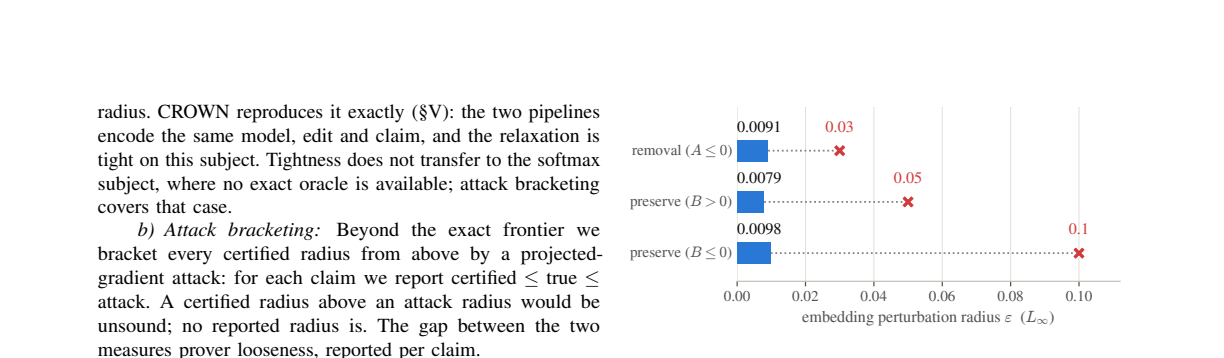
The flagship softmax+LayerNorm certificate is the pair of per-head inequalities g_A ≤ 0 (removal, radius 0.0091) and g_B > 0 (preservation, 0.0079/0.0098) over the embedding ball. These certify a per-head logit sign statement in the sense of Def. 2, and the paper's own definition makes that the certified object.
more of objection 1
The sentence 'removes skill A (accuracy drops to chance) and preserves skill B (accuracy 100%)' does not follow from those inequalities: chance-level accuracy additionally requires the region's skill-A base rate to be ≈1/2, and 100% accuracy requires B to be the argmax over the full logit vector (g_B > g_h for every other head h), which a single positive-B inequality does not establish. LayerNorm rescaling also means the sign of one head's normalized logit does not by itself control that head's softmax probability. The machinery is sound — the certificates prove exactly the Def. 2 claims — but the headline behavioral reading on the main proof-of-concept result is an inference the certified inequalities alone do not support. I recommend either (i) certifying the full logit ordering (g_A ≤ 0 and g_B > g_h for all h ≠ B) and reporting accuracy statements only under an explicitly stated regional base-rate assumption, or (ii) restating the claim as the certified per-head property 'never fires head A, always fires head B over the ball.' The same caveat should be reflected in the abstract's phrasing.
The paper says, at Abstract and §V-F
The review did not quote this passage.
Pith says: Objection 2 of 2 · major
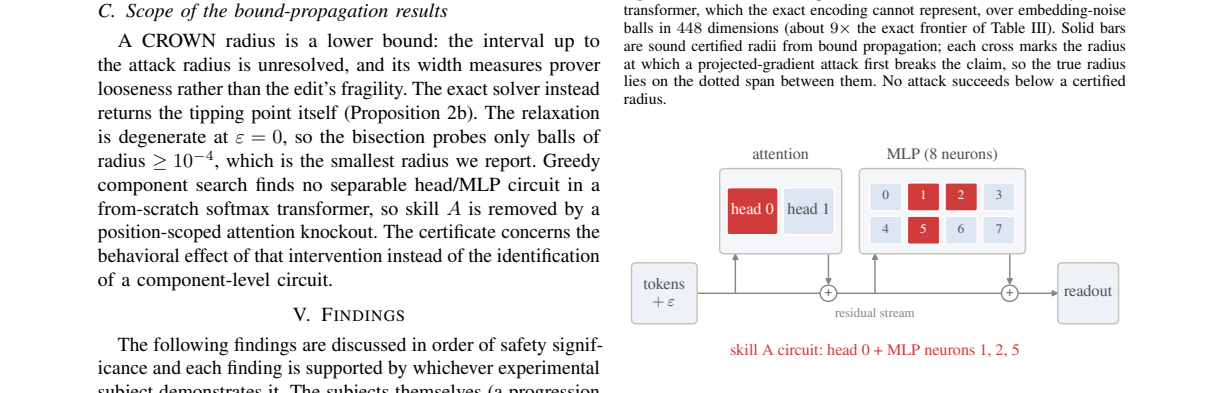
The 'roughly 9× the input-perturbation dimension an exact solver can handle' claim compares 448 CROWN dimensions on a two-layer, 64-wide softmax transformer against 48 dimensions on the single-block, 8-wide threshold-gate subject of Table II (the bold row of Table III), i.e., it mixes a change of prover with a change of architecture and model scale.
more of objection 2
The frontier ladder in Table III does support a claim about the exact solver's practical limit (roughly 48–72 variables), so the number is defensible as stated, but the comparison should be qualified as holding across different subjects, or reported as a ratio within a single fixed model, to avoid implying an apples-to-apples 9× speedup of the same certification problem.
5 minor objections
The paper says, at §I, second paragraph
Pith says: minor objection 1 of 5
The sentence 'This method of testing answers the question only at the inputs tested.' is printed twice in succession; one copy should be removed.
The paper says, at Throughout
Pith says: minor objection 2 of 5
Several words are run together in the supplied text ('forallinputs,' 'thebehavioral effect of an edit,' 'cheaplycomputable,' 'musterode'). If these are PDF-extraction artifacts rather than the source, please ensure the camera-ready text on arXiv reads cleanly; some are in the abstract and in b4/b5, where clarity matters most.
show 3 more
The paper says, at Fig. 1(c) caption and §V-B (sentence b165)
Pith says: minor objection 3 of 5
The 1.5×10⁻⁶ figure is a 95% Clopper–Pearson ceiling from zero hits in 2×10⁶ uniform darts, i.e., a statistical bound, not a certified bound. The text does say 'ceiling,' but the caption phrase 'their survivor regions lie below 1.5×10⁻⁶ of the domain' could be misread as a proven bound; rephrasing as 'with 95% confidence' would prevent that misreading.
The paper says, at Table II, footnote a
Pith says: minor objection 4 of 5
The '≥0.6' and '≥0.05' removal radii are probe-ceiling saturations rather than attained tipping points. The footnote states this, but the main text (§V) should flag it again where the toy removal radii are first cited, since readers may otherwise take them as exact radii comparable to the transformer entries.
The paper says, at §IV-B(a), M0
Pith says: minor objection 5 of 5
The M0 check that CROWN equals the exact radius on the toy MLP is a welcome validation, but the sentence 'Tightness does not transfer to the softmax subject' is immediately followed by the attack-bracketing discussion; consider making the status of the softmax radii (sound lower bounds, not tight) explicit in the §V-A paragraph as well, since the 3× certified-to-attack gap (0.0091 vs 0.03) is easy to misinterpret.
What would settle it
Certify a sound bound on the actual class-A softmax probability p_A (not just the logit g_A) over the reported removal ball of radius 0.0091 on the same softmax+LayerNorm subject — e.g. run CROWN on the full output vector including the softmax, or bound p_A using z_A ≤ 0 and z_B > 0 together with LayerNorm's coupling. Then check whether the bound yields accuracy-at-chance (≈50% on a balanced region) or a deterministic not-A (p_A bounded well below 1/2, i.e. 0% accuracy on A-positive inputs). If p_A is bounded below ≈1/2, reword b148 and Table II's 'removes skill A (accuracy drops to chance)' to 'the skill-A readout is provably nonpositive over the region,' which the existing certificates do support.
from the skeptic's reading
How the review went
4 readings by deepseek-v4-flash · 5 Oct 2026
- Reader holds up, with conditions
- Skeptic partly agrees
- Editor wrote the verdict above
- Referee major revision: 2 major objections, 5 minor
Not run on this paper: the simulated authors' defence.
Pith did not check this review's objections against the paper.
The review in full
The review in brief, machine-written
Read it. This is a genuine contribution, not a repackaging. The new thing is Proposition 3: no finite deterministic black-box test, adaptive included, can certify skill removal, with a constructive survivor-pocket witness. The tent construction is clean and the proof is correct. That result alone is worth the paper. The framing around certified mechanistic edits over continuous regions is also well done: P1-P2 are straightforward but the radius semantics are handled carefully, and P4 gives a first exact one-hidden-layer account of surgery versus steering collateral. The paper is unusually honest about scope - it states the decidable-oracle assumption, the deterministic-only reach of P3, the float-gap slack, and the fact that bound propagation is sound but incomplete. The Appendix A proofs look right to me.
Two soft spots, in proportion. First, the headline reading on the softmax + LayerNorm transformer overstates what is certified. The certificate is a pair of per-head logit inequalities (gA <= 0, gB > 0) over a ball. The paper reads that as "accuracy drops to chance." It does not. It implies a deterministic not-A answer, not chance-level accuracy, which would require additional base-rate and full-logit assumptions. This is a description problem, not an unsoundness - the removal claim as defined (gA <= 0 on the region) is exactly what is proved. But the abstract and Section V-A should be tightened. Second, the Open Science section says code will be released with the final version, so none of the radii, the M0 equality check, or the machine-checked witnesses are currently runnable. That is a real reproducibility gap for a paper whose whole pitch is that claims are provable, not sampled.
The decidable-oracle limitation is acknowledged and genuine; I am not counting it against them. The practical significance is gated by it, and they say so.
This paper deserves a serious referee. The central framework and P3 are solid as stated on the toy and known-formula subjects. I would condition acceptance on releasing the code and fixing the "drops to chance" wording. For my own work, the P3 construction is citable.
The strongest objection
The framework itself is internally sound: Def. 2 claims are per-head sign statements over boxes, the App. A proofs of P1–P4 are coherent, Prop. 3's tent construction correctly leaves a survivor slab of relative volume w/(u0−l0)<δ, and the QF-LRA exactness (Prop. 2c) with slack re-proofs (App. B) is legitimate. The load-bearing gap is where the certified object meets the flagship behavior claim. On the softmax + LayerNorm transformer (§V-A, b148) the certificate is the pair of per-head inequalities g_A ≤ 0 (removal, radius 0.0091) and g_B > 0 (preservation, 0.0079/0.0098), attack-bracketed. The paper reads this as 'accuracy drops to chance.' But behavioral accuracy for a softmax/LayerNorm model is argmax over the full logit vector; g_A ≤ 0 and g_B > 0 imply only that the A-logit never fires while the B-logit does, i.e. a deterministic not-A answer. 'Chance' additionally requires the region's A-positive base rate to be ≈1/2 and that no other logit carries the A skill — neither is stated, and LayerNorm rescaling means z_A ≤ 0 does not control the softmax probability p_A. So the headline behavioral reading on the main proof-of-concept result is an inference the certified inequalities alone do not support. What is NOT at stake: the removal property as Def. 2 defines it (g_A ≤ 0 everywhere on the region) is exactly what the certificates prove, and the certified≤true≤attack brackets (0.0091≤0.03, etc.) show no unsoundness. The issue is description, not machinery. Separately, the Open Science section promises code only for the final version, so every radius in Table II, the M0 exact-equality check, and the App. E 'machine-checked witnesses' are not independently runnable today.
The paper's central framework is supported as stated: P1–P4 are proven in App. A with constructive arguments (Prop. 3's tent-to-slab construction and Corollary 1's transcript replay are sound; P4(d)'s pattern-stable linearity is correct), the QF-LRA encoding is exact for the ReLU class (Prop. 2c), slack re-proofs address the float gap (App. B), and every CROWN result is attack-bracketed. These give real independent support even before code ships. The reader's CONDITIONAL verdict is fair and I do not move it. My deviation from the reader's weakest_assumption: the load-bearing gap is not primarily the decidable-oracle limitation — the authors bracket that fully and honestly (b221–b225), and it only gates transfer to real harms — but the in-scope link from the certified per-head inequalities to the behavioral reading attached to the flagship softmax result, 'accuracy drops to chance' (b148). That reading adds argmax semantics and a base-rate condition that g_A ≤ 0 / g_B > 0 do not certify; LayerNorm rescaling means the logit inequality does not bound the softmax probability. The certificate remains valid for the Def. 2 removal property, so this is a precision issue, not an unsoundness. The secondary mechanical barrier — code promised but not shipped — makes Table II's radii, the M0 exact-equality check, and App. E's machine-checked witnesses unverifiable now, which reinforces CONDITIONAL (release artifacts and tighten wording before reliance). I found no internally inconsistent step in P1–P4 and no unsound certificate.
The referee's report
If the claims stand, this is a coherent and useful package: it is, to my knowledge, a first systematic attempt to certify the behavioral effect of a mechanistic edit rather than a description of an unedited model, and it pairs exact SMT certification with sound bound propagation and a clean negative result. Strengths worth naming explicitly: the Appendix A proofs of P1–P4 appear correct, with the P3 tent construction and the P2(b) attainment argument (coordinate clipping plus continuity) particularly clean; every certificate is either exact (QF-LRA) or a sound lower bound bracketed from above by a projected-gradient attack; P2–P4 carry machine-checked witnesses and all reported numbers are regenerable from committed code; and the limitations are stated without hedging (decidable-oracle assumption b221–b223, prover looseness b210, exactness frontier b193). The central gap is in the description of the flagship softmax+LayerNorm result, discussed in Major Comment 1: the certificate is a per-head logit sign statement, and the prose reading of it as an accuracy claim is broader than the certified object. That is a fixable description issue, not a defect in the machinery.
Pith's reading of the paper (a machine's summary, not the authors')
This paper tries to establish that a mechanistic edit's behavioral effect can be certified by formal proof rather than validated by testing: that after an edit, a specified skill is absent and another is preserved, for every input in a continuous region of the model's input space. The authors build a framework where removal and preservation are crisp claims over boxes, prove that certified radii compose and are computable by SMT bisection, and demonstrate the certificates on small ReLU networks, a threshold-gate transformer, and a standard softmax + LayerNorm transformer. The central negative result is that no finite deterministic black-box test, adaptive queries included, can certify removal: a constructed edit passes exhaustive grids yet leaves the skill alive in a survivor pocket that can be made arbitrarily small. The guarantees are stated honestly as holding on small standard architectures and presupposing that the target skill admits a decidable ground-truth specification, which the authors acknowledge real harmful capabilities lack.
What carries the argument. The load-bearing objects are the claim-certificate pair and the certified radius: a claim is a triple (h, R, ▷) asserting a head's output satisfies a sign condition over a box, and a certificate is a proof of unsatisfiability of its negation. The impossibility result rests on a three-neuron 'tent' gadget, tentβ(x0) = β[ρ(x0−(c−w)) − 2ρ(x0−c) + ρ(x0+(c+w))], a hat that vanishes at every test point yet exceeds any hurdle in a slab of width w whose relative volume can be made arbitrarily small, so a bias adjustment makes the edited model report 'removed' everywhere on the test set while the skill survives in a positive-measure pocket. Exact certification uses rational SMT with a hull relaxation that replaces discrete token choices by continuous mixture weights over the embedding simplex, a strict superset that still certifies the discrete claim; bound propagation extends soundly past that frontier to softmax and LayerNorm by computing linear lower and upper bounds over input balls.
Core claim. The central claim is that the behavioral effect of a mechanistic edit—ablation, weight edit, activation steering—can be certified, by formal proof, as a feature non-interference property in the information-flow-security sense: disabling a circuit removes one skill and provably preserves another, for every input in a closed box of the input domain. The framework defines a claim as a statement about one output head's sign over a region, proves that certified regions are downward closed and closed under unions, and shows the certified radius is well-defined and found by bisecting satisfiability queries in quantifier-free linear real arithmetic. Exact-rational SMT encoding certifies removal and preservation over all token sequences times a continuous embedding ball on piecewise-linear models up to a threshold-gate transformer; bound propagation (CROWN) extends the same kind of certificate to a softmax + LayerNorm transformer where exact encoding fails, reaching roughly 9x the input-perturbation dimension, with every radius sound and bracketed above by attack. The paper also proves no finite deterministic black-box test can certify removal, exhibiting an edit that passes a 40,401-point grid with preservation proved, yet refuted by the solver with a surviving input; ordinary training produces three such 'intervention illusions' in 160 four- and five-input models, with survivor pockets below 1.5e-6 of the domain (a 95% Clopper-Pearson ceiling).
The premise it rests on. The whole framework presupposes that the target skill admits a decidable ground-truth specification—a computable function such as 'contains more « than »' or (a+b) mod p—so that 'removed' and 'preserved' are crisp, checkable claims; the authors state plainly that real harmful capabilities in frontier models have no such oracle and that the assumption does not transfer to real harms for free.
If the paper is right (Pith's inferences, not the authors')
A certificate replaces the test set as the evidence that a safety edit did what it was intended to do: within the stated scale bound, removal and preservation hold for every input in a region instead of only at sampled prompts.
Passing an exhaustive test suite is not evidence of removal; ordinary training produces edits that pass grids, random inputs, and preservation checks while the skill survives in a vanishing-but-nonzero pocket, and the implied ceiling of 1.5e-6 of the domain bounds how small such pockets can be at this scale.
The choice of edit is itself certifiable for one-hidden-layer networks: surgical edits (ablation, weight edit, targeted suppression) certify removal with provably zero collateral when the circuit is disjoint from the preserved head, whereas diff-of-means steering erodes the preserved skill's margin linearly in dose until it breaks outright.
Skill removal and preservation are provable over a region as robustness to input perturbation, with certified edges stopping at the model's own decision boundary rather than at prover slack, down to within 0.0039 of the decision rule on the toy subjects.
A certified feature non-interference guarantee—influence exactly zero—is reachable on the threshold-gate transformer, meaning the readout provably ignores the forbidden input feature everywhere, out to a larger radius than removal itself.
The framework's own impossibility proof suggests that test-based unlearning evaluation at any scale is structurally inadequate, and that the only alternatives are white-box verification of the kind demonstrated here or a probabilistic guarantee with an explicit mishap bound, since i.i.d. uniform testing misses the survivor pocket with probability at least (1−δ)^m.
Because the decidable-oracle assumption is acknowledged not to transfer to real harms, the open prerequisite the paper itself names—a deterministic or probabilistic oracle deciding whether an output exhibits a target capability—is the actual bottleneck between toy certificates and frontier safety claims.
The certified radius is continuous embedding-space noise, and a single token swap moves the embedding roughly 324 times the certified ball, so the continuous guarantee and discrete-prompt robustness are different objects; a discrete edit-distance certificate would be needed before these numbers transfer to prompt-level attacks.
Corollary 1 deliberately excludes randomized adaptive testers, leaving a probabilistic testing gap that could in principle still be closed by statistical anytime-valid protocols rather than exact proofs, a complementary direction the paper says it does not cover.
Check this review
Pith stored no record of this review's passes and took no fingerprint of it. Reviews made by code from 13 Nov 2026 on carry both.
How often reviews like this one are right
Reviews like this one: written by deepseek-v4-flash, where what was read was not recorded.
How often objections from reviews like this one are right: not yet measured
Reviews by people
This review was written by a machine. No person has reviewed this paper on Pith yet. A scientist listed on Pith can review it for a fee, and their review is published here whatever it concludes.
The paper
Abstract
Mechanistic edits (ablations, weight edits, activation steering) are the standard tools for unlearning a harmful capability from a neural network while preserving useful ones. Current approaches validate their effects only by testing, which can never cover an entire continuous region of inputs. Prior work at the interpretability-verification boundary certifies descriptions of a model: what a circuit computes, or whether it faithfully explains the whole. We instead certify the behavioral effect of an edit: that disabling a circuit removes one skill and provably preserves another, for every input in a region; a feature non-interference guarantee in the information-flow-security sense. We demonstrate such certified edits from toy ReLU networks up to a standard softmax + LayerNorm transformer, proving removal and preservation over continuous embedding-space regions and reaching roughly 9x the input-perturbation dimension an exact solver can handle by switching to sound bound propagation. Furthermore, we prove that no finite deterministic black-box test can certify removal, exhibiting an edit that passes exhaustive testing yet provably fails on a survivor pocket that can be made arbitrarily small. Guarantees hold on small, standard-architecture networks and, like any removal claim, presuppose that the target skill admits a decidable specification, a property which real-world harms may not have.
The paper's own sentences, arranged, kept beside the review and separate from it. Each label is drawn from a closed vocabulary; the number beside it is the probability the classifier gave that label. No sentence in this record was written by a model.
abstract compiled · 2026-10-05
The authors' main claim, as the classifier picked it out 0.84
“We instead certify the behavioral effect of an edit: that disabling a circuit removes one skill and provably preserves another, for every input in a region; a feature non-interference guarantee in the information-flow-security sense.”
How the main claim is stated: asserted 1.00
What the abstract itself states, as probabilities: claims first 0.24 · states limitation 0.97 · human participants 0.03 · controlled comparison 0.13 · randomized assignment 0.01 · states quantitative result 0.97 · compares with prior results 0.92 · mentions code or data availability 0.04
The abstract, sentence by sentence
This table labels the abstract only (arXiv listing abstract v1). The number is the probability the classifier gave the label.
| Sentence | Role | The authors' own work | States the main conclusion | Strength |
|---|---|---|---|---|
| Mechanistic edits (ablations, weight edits, activation steering) are the standard tools for unlearning a harmful capability from a neural network while preserving useful ones. | background 1.00 | 0.05 | 0.03 | asserted 1.00 |
| Current approaches validate their effects only by testing, which can never cover an entire continuous region of inputs. | gap 0.88 | 0.08 | 0.03 | asserted 0.99 |
| Prior work at the interpretability-verification boundary certifies descriptions of a model: what a circuit computes, or whether it faithfully explains the whole. | background 0.98 | 0.04 | 0.03 | asserted 1.00 |
| We instead certify the behavioral effect of an edit: that disabling a circuit removes one skill and provably preserves another, for every input in a region; a feature non-interference guarantee in the information-flow-security sense. | contribution 1.00 | 0.94 | 0.82 | asserted 1.00 |
| We demonstrate such certified edits from toy ReLU networks up to a standard softmax + LayerNorm transformer, proving removal and preservation over continuous embedding-space regions and reaching roughly 9x the input-perturbation dimension an exact solver can handle by switching to sound bound propagation. | result 0.74 | 0.97 | 0.27 | asserted 1.00 |
| Furthermore, we prove that no finite deterministic black-box test can certify removal, exhibiting an edit that passes exhaustive testing yet provably fails on a survivor pocket that can be made arbitrarily small. | result 0.83 | 0.92 | 0.16 | asserted 1.00 |
| Guarantees hold on small, standard-architecture networks and, like any removal claim, presuppose that the target skill admits a decidable specification, a property which real-world harms may not have. | limitation 1.00 | 0.55 | 0.06 | asserted 0.78 |
What kind of paper the classifier reports this is: method or tool 0.71 · evidence from proof or derivation 0.97
What was examined, and what was not
Sources read
- arXiv listing abstract v1
Not examined
- full text
- figures and tables
- references and citing sentences
- relations to other papers
Levels run
- P abstract
Not run
- S sections
- T body sentences
- C citations
- R cross-paper relations
How the labels were made
Compiled by classifier-1.13.0 via TypeSafe API, question bank abstract-p1-20260923, 2026-10-05: 1 request, 5,776 input tokens.
Every quoted sentence on this record is the authors'. Every label is from Pith's closed vocabulary, with the probability shown beside it. This record as JSON
Figures (6)



Showing 5 of the paper's 6 figures. Figures are the authors', reproduced from the paper.
Challenges and discussion
Disagree with the review, or know something it missed? Leave a comment, or challenge this review formally: a challenge becomes a permanent entry in this paper's record, and its decision is published here.
Come back by email
A short list of the week's newly reviewed papers. Nothing is sent until you confirm from your inbox, and every email has a link that stops it. No account.
No comments yet.
Sign in to comment