Artificial Intelligence · arXiv:2610.05782 v1 · submitted 5 Oct 2026 · 48 references
Agentic-ZTA: A Multi-Agent Architecture for Autonomous Zero Trust Enforcement
The paper says
“Agentic AI is emerging as a promising paradigm for automating complex cybersecurity decisions, yet its use in enforcing zero trust introduces significant challenges in safety, reliability, and policy compliance.”
more of the abstract
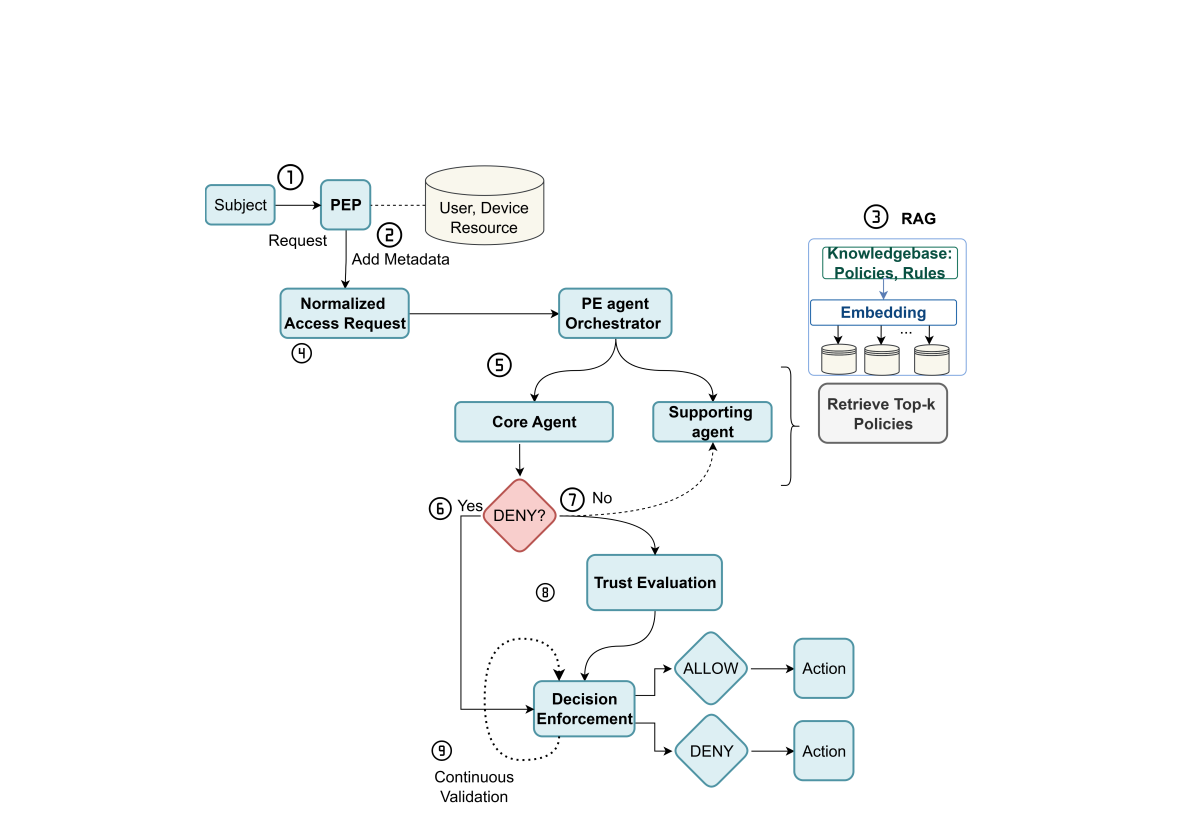
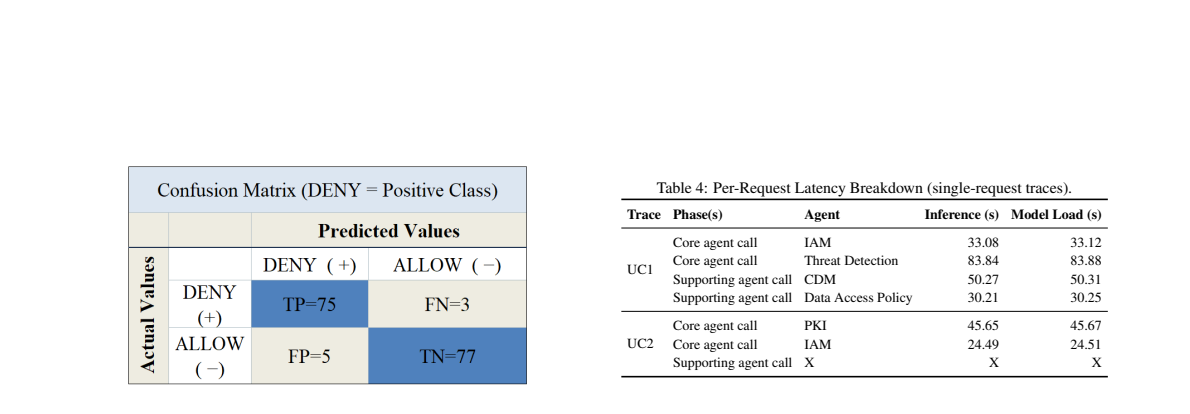
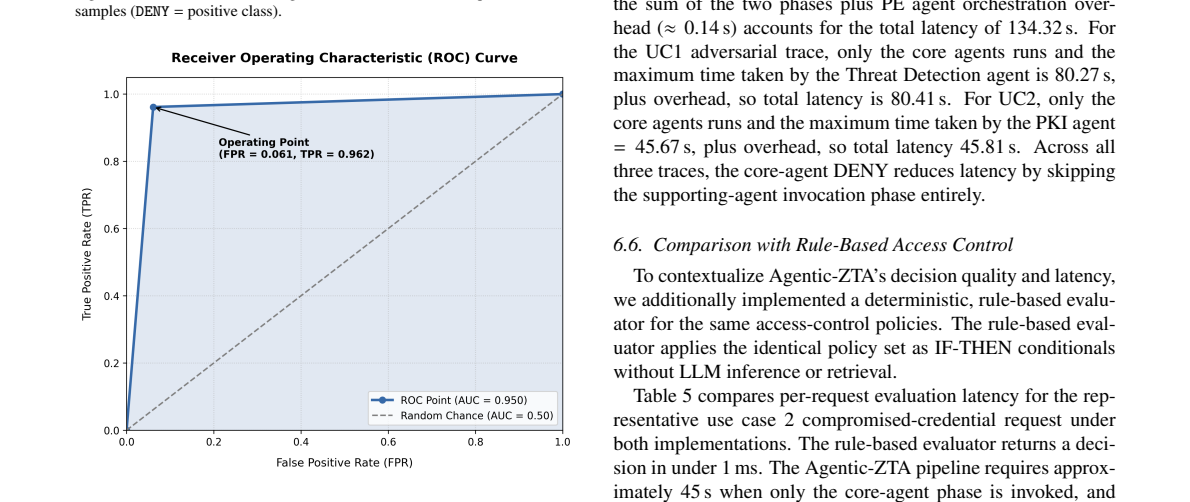
This paper presents Agentic AI based zero trust architecture (Agentic-ZTA) that operationalizes the NIST SP 800-207 ZTA architecture control loop through coordinated multi- agent decision pipeline. In the proposed framework, policy knowledge is embedded into a retrieval-augmented generation pipeline and retrieved at inference time as top-k relevant policies. Access requests are intercepted by the Policy Enforcement Point (PEP), enriched with contextual metadata. The request context is routed to a policy engine agent which invokes domain-specialized core agents first followed by supporting agents, if further evaluation needed. AI agents reason over access context, policy constraints and determine trust. The retrieved policies are embedded into agent prompt during inference time and agentic trust scores are aggregated and evaluated by a trust-algorithm, producing the final access decision for enforcement under continuous verification. We implement Agentic-ZTA in a testbed and evaluate it on representative access-control use cases scenarios. Our Agentic-ZTA framework achieves 95.0% accuracy, 93.9% precision, and 96.3% recall, and demonstrate the feasibility of enforcing zero trust using AI agents.
from the abstract
Pith says
Machine review · deepseek-v4-flash · 6 Oct 2026 · what was read was not recorded · not checked by a person
It can be wrong. Challenge this review or reply to it.
Holds up, with conditions. A genuine systems prototype with new multi-agent integration, but the 95% headline is a closed-loop self-consistency score and the paper's own rule baseline (100%, 0.7ms) undercuts the claimed edge. This line is wrong
4 major objections · 5 minor
How often objections from reviews like this one are right: not yet measured
Not checked: figures, code, what the 48 references say.
The paper says, at 6.3, 6.4, Appendix A.3
The review did not quote this passage.
Pith says: Objection 1 of 4 · major
The ground-truth labels of the 160-request evaluation set are constructed from the same conditions that define the seven-rule RAG corpus the agents are given. The 80 compliant requests carry exactly the attributes allowed by UC2-RULE-003 (valid certificate, Secret clearance, verified MFA, single concurrent session, healthy posture), and the 80 deniable requests exhibit conditions covered by UC2-RULE-001/004/005/006/007.
more of objection 1
Consequently the reported 95.0% accuracy, 93.9% precision, and 96.3% recall (b435) measure how consistently the LLM pipeline reproduces the rule engine it was handed, not how well it decides against independent authorization ground truth. The authors acknowledge the synthetic scope (b519) but not this label-policy dependence. The evaluation should be redone with labels from an independent source (e.g., a separately authored policy set, real authorization logs, or human expert adjudication), and should include requests that fall outside the seven-rule corpus if the claimed advantage over static rules for novel or composite attacks is to be tested.
The paper says, at 6.8
The review did not quote this passage.
A classifier read this sentence of the paper as acknowledging the concern (probability 0.73):
“How- 15 ever, further testing needed to determine whether the retriever performs well in real-world situations. 7.”
Pith says: Objection 2 of 4 · major
The retrieval evaluation is closed-loop in the same way as the decision evaluation: each of the seven queries is a paraphrase of one of the seven rules, and the relevance judgment is that rule's identifier. Precision@k, Recall@k, MRR@k, and nDCG@k therefore measure paraphrase matching, not retrieval under realistic ambiguity or compound requests.
more of objection 2
The authors themselves say 'further testing needed to determine whether the retriever performs well in real-world situations' (b499), but the conclusion in Section 8 relies on retrieval-grounded reasoning as a core support. Add a retrieval test set with natural-language request descriptions that are not rule paraphrases, distractors, and requests requiring composition of multiple rules.
The paper says, at 8 vs. 6
The review did not quote this passage.
Pith says: Objection 3 of 4 · major
Section 8 asserts as an empirical result that 'when releasability policy changed in the retrieved knowledge base, the corresponding access decision changed without retraining or redeployment.' No experiment in Section 6 reports a policy-change test; the reported evaluations are static.
more of objection 3
This is load-bearing for the runtime policy-adaptation claim and for the contrast with rule-based systems. Either add a reproducible pre-change/post-change experiment with the same request and document the decision flip, or remove this claim from the conclusion and frame policy adaptation as a design property rather than a demonstrated result.
The paper says, at 6.5, 6.6, 8
The review did not quote this passage.
A classifier read this sentence of the paper as acknowledging the concern (probability 0.61):
“Adversarial robustness.This study does not evaluate di- rect or indirect prompt injection, jailbreaking, task drift, mem- ory poisoning, or other adversarial-input attacks.”
Pith says: Objection 4 of 4 · major
The central conclusion (b529) that multi-agent LLM orchestration 'provides a practical and transparent mechanism for Zero Trust enforcement in highly dynamic and adversarial settings' is not supported by the reported measurements. The measured latency is 45.67-134.32 s per request versus 0.7 ms for the deterministic baseline, throughput is below 1 req/min at all tested concurrency levels, Section 7.1 concedes the prototype 'does not support real-time enforcement,' and adversarial robustness is explicitly unevaluated (b513).
more of objection 4
The conclusion should be qualified to a proof-of-concept feasibility claim, with 'practical' and 'adversarial' either removed or supported by GPU-based latency measurements and dedicated adversarial testing.
5 minor objections
The paper says, at 5.3, Table 3, Appendix A.6
Pith says: minor objection 1 of 5
The text says the PKI Agent detects the duplicated certificate and issues a DENY, but Table 3 and Listing 6 report PKI as ALLOW (d_i=0) and IAM as the denying agent. The narrative and the table should agree on which core agent denies.
The paper says, at 6.7
Pith says: minor objection 2 of 5
The text says 'All 90 requests across the four batches completed with status ok,' but the four batch sizes sum to 85 (5+10+20+50). Correct the count or the batch sizes.
show 3 more
The paper says, at 6.5
Pith says: minor objection 3 of 5
The paragraph reports an 'UC1 adversarial trace' with 80.41 s total latency, while the corresponding trace appears to be Use Case 2; the trace labels in Table 4 and the text should be consistent.
The paper says, at 1, 6.2, 6.6
Pith says: minor objection 4 of 5
Minor language issues: 'Lake of Autonomous Action' should be 'Lack of Autonomous Action,' 'Agentc-ZTA' appears in the rule-based comparison paragraph, and the abstract's 'demonstrate' should agree with the singular subject. Also, Section 6.2 says 'All eight agents use one shared local LLM' while the paper elsewhere describes nine agents (PE plus eight evaluators); align the count.
The paper says, at 6.3
Pith says: minor objection 5 of 5
The dataset description says the first two groups are 'equally sized' and both contain 40 fully compliant requests, but the text then says these two groups 'provide 80 samples and expected ALLOW requests' without explaining why two identically constructed groups are needed; clarify the intended distinction or merge them.
What would settle it
Construct roughly 100 new access requests whose ground-truth labels are assigned by an independent security engineer who has not seen the seven policies, deliberately including composite attacks spanning multiple rules, out-of-scope destinations, and a mid-run probe that adds one rule to and then removes it from the RAG corpus for identical requests. Run the Agentic-ZTA pipeline unchanged and recompute accuracy, precision, and recall; separately re-run the Section 6.8 retrieval evaluation using PEP-normalized request text instead of rule paraphrases. If the metrics fall materially below 95.0/93.9/96.3, or if decisions do not flip when the corpus rule changes, the closed-loop concern lands and the headline numbers must be re-scoped as an instruction-following check rather than an access-decision-quality result.
from the skeptic's reading
How the review went
4 readings by deepseek-v4-flash · 6 Oct 2026
- Reader holds up, with conditions
- Skeptic agrees
- Editor wrote the verdict above
- Referee major revision: 4 major objections, 5 minor
Not run on this paper: the simulated authors' defence.
Pith did not check this review's objections against the paper.
The review in full
The review in brief, machine-written
Worth a read if you care about agentic LLM architectures for access control. The specific integration is new: tiered core/supporting agents with a core-agent DENY override, per-agent RAG grounding, autonomous PEP tool actions, and a working deployed testbed. The prompts and trust algorithm (confidence-weighted fusion, fail-safe default) are fully specified, and the Table 1 comparison against LACE, the Mistral unified layer, and Rubio-Medrano is fair. The authors also report honestly: they show the rule-based baseline at 100% accuracy and 0.7 ms, admit latency is 45–134 s per request with throughput below 1 req/min, and list the missing pieces (adversarial testing, GPU inference, repeated-run variance, live network) in Section 7.2. That candor is real and deserves credit.
The load-bearing problem is the evaluation's closed loop. The 160 ground-truth labels in Section 6.3 are generated from the same seven-rule policy set in Appendix A.3 that RAG retrieves and the agents apply. So the 95% accuracy, 93.9% precision, 96.3% recall measure self-consistency between the LLM pipeline and a policy set it is handed, not decision quality against independent ground truth. The retrieval evaluation in 6.8 is equally closed: each query paraphrases one rule and the relevance label is that rule's identifier, so it measures paraphrase matching against realistic ambiguity. And the authors' own rule evaluator reaching 100% on that set shows the fixed seven-rule regime is already solved deterministically. The claimed advantage over rules — autonomous handling of novel or composite attacks — is never tested because no request leaves the seven-rule scope. The authors acknowledge the synthetic scope but never address the label-policy dependence.
Two further issues, smaller but real. Section 8 asserts as empirical that a releasability-policy change in the knowledge base flipped a decision without retraining; no experiment in Section 6 reports this, so runtime policy adaptation is argued, not demonstrated. And Use Case 2 contradicts itself: the prose (Section 5.3) has the PKI agent issue the DENY on cloned credentials, but Table 3 and Appendix A.6 assign the DENY to IAM with PKI allowing. Same final outcome, but the provenance record that RQ2 depends on is muddled.
Bottom line: this is an honest, clearly described prototype demonstration that does not yet support its central feasibility claim as an empirical result. For the systems audience working on agentic zero-trust PDPs, the architecture and the disclosed gaps are useful. It deserves a serious referee; my recommendation is conditional acceptance pending independent evaluation data, error bars, and resolution of the PKI/IAM inconsistency. I would not build on the headline numbers, but I would read the next revision.
The strongest objection
The central claim (Section 8, sentence b529) is carried by the 95.0% accuracy, 93.9% precision, and 96.3% recall numbers (Abstract b8; Section 6.4 b435). Those numbers measure self-consistency, not decision quality. The 160 ground-truth ALLOW/DENY labels (Section 6.3) are generated from the same conditions that define the seven-rule RAG corpus (Appendix A.3): compliant requests carry exactly the attributes UC2-RULE-003 allows, and deniable requests exhibit the conditions UC2-RULE-001/004/005/006/007 deny. Section 6.8's retrieval evaluation is equally closed-loop: each query paraphrases one rule and its relevance label is that rule's identifier, so Precision@k/Recall@k measure paraphrase matching, not retrieval under realistic ambiguity. The authors' own control - a rule-based evaluator at 100% accuracy and 0.7 ms (b459, b453) - shows the fixed seven-rule regime is already solved deterministically, so the evaluation establishes only that the LLM pipeline can approximately reproduce a rule engine it was handed. The claimed edge over rules, autonomous handling of novel or composite attacks, is untested because no request leaves the seven-rule scope. The authors disclose the synthetic scope (b519) and the perfect rule baseline, but they do not address the label-policy dependence. Additionally, Section 8 asserts as an empirical result that a releasability-policy change in the knowledge base flipped a decision without retraining; no experiment in Section 6 reports this, so runtime policy adaptation is argued rather than demonstrated. Secondary but objective: Section 5.3 first has the PKI agent issue the Use Case 2 DENY, then assigns the DENY to IAM (Table 3; Appendix A.6 'denying_agent: IAM'), an internal inconsistency in the provenance mechanism on which RQ2 relies.
I agree with the reader's weakest-assumption identification: the evaluation's closed-loop structure is the single most load-bearing weakness of the central claim. The conclusion (b529) is broader than what the evidence supports: the headline accuracy (b8, b435) is produced on a set whose labels encode the same seven conditions that form the RAG corpus (Appendix A.3), and whose retrieval queries paraphrase those same rules (Section 6.8). With the rule-based baseline at 100% accuracy on the same set (b459), the accuracy evidence cannot differentiate agentic reasoning from rule-following, and the claimed advantage on novel or composite attacks is structurally untestable within this dataset. The authors are honest about the synthetic scope (b519) and about the perfect rule baseline, but that honesty does not repair the gap between the evidence and the 'practical and transparent mechanism for Zero Trust enforcement in highly dynamic and adversarial settings' conclusion.
Two additional findings strengthen rather than replace the primary concern. First, Section 8 states as an observed outcome that a releasability-policy change in the knowledge base flipped an access decision without retraining; Section 6 reports no such experiment, so the runtime policy-adaptation component of the central claim is currently unsupported as written. Second, Section 5.3 begins by having the PKI agent issue the Use Case 2 DENY and then assigns the DENY to the IAM agent (Table 3; Appendix A.6), an internal inconsistency in exactly the per-request provenance story the paper offers for RQ2. Neither is fatal: the architecture is plausible, the prompts and trust algorithm (Algorithm 1, Eq. 1) are fully specified, the pipeline demonstrably runs end to end and calls enforcement tools, and the latency, reproducibility, and adversarial-robustness limits are disclosed in Section 7.2. The manuscript is best read as an honest proof-of-concept whose quantitative claims are not yet settled.
The reader's CONDITIONAL verdict already reflects the primary concern; my pass adds precision and one newly flagged unsupported claim but does not move the verdict. Independent ground-truth evaluation, error bars over repeated runs, a reported policy-flip experiment, and resolution of the PKI/IAM contradiction would satisfy the stated condition.
The referee's report
If the evaluation were independent of the policy corpus, the paper would make a useful contribution: it is one of the few works that closes the PDP-to-PEP loop with autonomous agent actions, provides concrete prompt logic for all nine agents, specifies a deterministic trust-fusion algorithm with auditable provenance records, and explicitly compares against a rule-based baseline rather than only reporting LLM accuracy. The authors also deserve credit for candidly listing limitations: simulated testbed, CPU-only latency, no repeated-run variance, and no adversarial robustness testing (b505, b513, b516, b519). As it stands, however, the reported accuracy numbers are self-consistency measurements between the LLM and the seven-rule policy set it is handed, not measurements of independent decision quality, and the runtime policy-adaptation claim in Section 8 is not backed by any experiment in Section 6. The significance of the paper therefore depends on replacing or supplementing the closed-loop evaluation with an independent one.
Pith's reading of the paper (a machine's summary, not the authors')
Agentic-ZTA claims that the NIST SP 800-207 zero-trust control loop can be run by a coordinated team of specialized LLM agents, each retrieving policy evidence from its own RAG-grounded knowledge base at inference time. The architecture splits authority so that identity, credential, and threat-checking agents can veto any request, while compliance and telemetry agents contribute confidence-weighted scores that a deterministic algorithm fuses against a zone-specific trust threshold. On a 160-request synthetic evaluation built from a seven-rule policy set, it reports 95.0% accuracy, 93.9% precision, and 96.3% recall, and the authors are explicit that a rule-based evaluator on the same policies reaches 100% accuracy — the claimed value is autonomous, auditable decision-making, not raw accuracy. If the approach works as claimed, access decisions adopt in-mission policy changes at runtime without retraining, carry per-request provenance, and cannot be unilaterally overridden by a compromised agent.
What carries the argument. The two-tier agent authority structure combined with a confidence-weighted trust fusion equation. Core agents (IAM, PKI, Threat Detection) return a triple $\langle d_i, s_i, c_i \rangle$ of recommended action, trust score, and confidence, and any DENY terminates evaluation immediately; supporting agents feed scores into $T = \frac{\sum_i c_i s_i}{\sum_i c_i}$, which is compared against the destination zone's threshold $\tau_z$ to yield the final decision. Paired with a fail-safe default (no core agent answering yields DENY) and fixed top-k vector retrieval with greedy decoding, this provides a deterministic, auditable fusion step that produces a provenance record listing the trust score and agent rationales.
Core claim. The paper claims that the NIST SP 800-207 policy decision point can be operationalized as a pipeline of specialized LLM agents, each grounded in retrieval-augmented policy knowledge, with authority split across two tiers: core agents (identity, credential, threat) that can veto a request unilaterally, and supporting agents whose confidence-weighted trust scores are fused by a deterministic algorithm. The asserted safety property is that this division preserves the zero-trust principle that no single compromised component can grant access — a core-agent DENY is enforced immediately through the PEP, and an ALLOW requires fused agreement above a zone-specific threshold $\tau_z$. On the 160-request synthetic evaluation the framework reports 95.0% accuracy, 93.9% precision, and 96.3% recall, and the authors state clearly that a deterministic rule-based evaluator on the same policy set reaches perfect accuracy, so the contribution they claim is autonomous, provenance-bearing enforcement rather than higher decision quality.
The premise it rests on. The evaluation's ground-truth labels are authored from the same seven-rule policy set that the RAG retriever hands the agents, so the reported figures measure how consistently the model applies its own retrieved rules, not whether those decisions stand against an independent standard.
If the paper is right (Pith's inferences, not the authors')
An agentic PDP can issue ALLOW/DENY decisions with a provenance record — agent rationales, retrieved rule identifiers, and the fused trust score — satisfying the auditability requirement of zero trust.
Because a DENY from any core agent (IAM, PKI, Threat Detection) is enforced immediately, the architecture guarantees that a compromised agent can at worst deny service; it can never unilaterally grant access.
Policy changes propagate to running decisions simply by updating the RAG knowledge base, without retraining or redeploying the orchestrator, which the paper demonstrates with a releasability-policy change.
Continuous verification re-runs the evaluation on active sessions and revokes access on detected drift, converting a one-time allow into an ongoing check.
The two-tier authority split is the transferable design idea: it cleanly separates 'who may block' from 'who contributes evidence,' a pattern that could port to enterprise and cloud zero-trust deployments beyond IoBT, and one that a single-model or rule-based evaluator does not offer.
Because the synthetic labels and the retrieved rules share the same author and rule set, the 95% figure is bounded by model-policy self-consistency; the advertised edge on novel or composite attacks remains untested until ground truth is independently authored.
At roughly one request per minute on CPU-only hardware, the framework is not yet a real-time PDP; its practical near-term value may lie in offline or batch re-evaluation and audit trails, or in roles where seconds of deliberation are tolerable.
A natural stress test is retrieval poisoning and prompt injection: the paper names these as open questions, and since RAG grounding is the stated defense, adversarial manipulation of the policy store is the most direct way to probe the core-veto guarantee.
Check this review
Pith stored no record of this review's passes and took no fingerprint of it. Reviews made by code from 13 Nov 2026 on carry both.
How often reviews like this one are right
Reviews like this one: written by deepseek-v4-flash, where what was read was not recorded.
How often objections from reviews like this one are right: not yet measured
Reviews by people
This review was written by a machine. No person has reviewed this paper on Pith yet. A scientist listed on Pith can review it for a fee, and their review is published here whatever it concludes.
The paper
Abstract
Agentic AI is emerging as a promising paradigm for automating complex cybersecurity decisions, yet its use in enforcing zero trust introduces significant challenges in safety, reliability, and policy compliance. This paper presents Agentic AI based zero trust architecture (Agentic-ZTA) that operationalizes the NIST SP 800-207 ZTA architecture control loop through coordinated multi- agent decision pipeline. In the proposed framework, policy knowledge is embedded into a retrieval-augmented generation pipeline and retrieved at inference time as top-k relevant policies. Access requests are intercepted by the Policy Enforcement Point (PEP), enriched with contextual metadata. The request context is routed to a policy engine agent which invokes domain-specialized core agents first followed by supporting agents, if further evaluation needed. AI agents reason over access context, policy constraints and determine trust. The retrieved policies are embedded into agent prompt during inference time and agentic trust scores are aggregated and evaluated by a trust-algorithm, producing the final access decision for enforcement under continuous verification. We implement Agentic-ZTA in a testbed and evaluate it on representative access-control use cases scenarios. Our Agentic-ZTA framework achieves 95.0% accuracy, 93.9% precision, and 96.3% recall, and demonstrate the feasibility of enforcing zero trust using AI agents.
The paper's own sentences, arranged, kept beside the review and separate from it. Each label is drawn from a closed vocabulary; the number beside it is the probability the classifier gave that label. No sentence in this record was written by a model.
abstract compiled · 2026-10-06
The authors' main claim, as the classifier picked it out 1.00
“Our Agentic-ZTA framework achieves 95.0% accuracy, 93.9% precision, and 96.3% recall, and demonstrate the feasibility of enforcing zero trust using AI agents.”
How the main claim is stated: asserted 1.00
What the abstract itself states, as probabilities: claims first 0.05 · states limitation 0.18 · human participants 0.04 · controlled comparison 0.05 · randomized assignment 0.01 · states quantitative result 0.99 · compares with prior results 0.06 · mentions code or data availability 0.04
The abstract, sentence by sentence
This table labels the abstract only (arXiv listing abstract v1). The number is the probability the classifier gave the label.
| Sentence | Role | The authors' own work | States the main conclusion | Strength |
|---|---|---|---|---|
| Agentic AI is emerging as a promising paradigm for automating complex cybersecurity decisions, yet its use in enforcing zero trust introduces significant challenges in safety, reliability, and policy compliance. | background 0.96 | 0.06 | 0.03 | asserted 0.80 |
| This paper presents Agentic AI based zero trust architecture (Agentic-ZTA) that operationalizes the NIST SP 800-207 ZTA architecture control loop through coordinated multi- agent decision pipeline. | contribution 0.99 | 0.85 | 0.07 | asserted 1.00 |
| In the proposed framework, policy knowledge is embedded into a retrieval-augmented generation pipeline and retrieved at inference time as top-k relevant policies. | method 0.99 | 0.75 | 0.03 | asserted 1.00 |
| Access requests are intercepted by the Policy Enforcement Point (PEP), enriched with contextual metadata. | method 1.00 | 0.40 | 0.02 | asserted 0.99 |
| The request context is routed to a policy engine agent which invokes domain-specialized core agents first followed by supporting agents, if further evaluation needed. | method 1.00 | 0.50 | 0.02 | asserted 0.99 |
| AI agents reason over access context, policy constraints and determine trust. | method 1.00 | 0.35 | 0.04 | asserted 1.00 |
| The retrieved policies are embedded into agent prompt during inference time and agentic trust scores are aggregated and evaluated by a trust-algorithm, producing the final access decision for enforcement under continuous verification. | method 1.00 | 0.72 | 0.10 | asserted 0.99 |
| We implement Agentic-ZTA in a testbed and evaluate it on representative access-control use cases scenarios. | method 0.72 | 0.96 | 0.03 | asserted 0.98 |
| Our Agentic-ZTA framework achieves 95.0% accuracy, 93.9% precision, and 96.3% recall, and demonstrate the feasibility of enforcing zero trust using AI agents. | result 1.00 | 0.98 | 0.82 | asserted 1.00 |
What kind of paper the classifier reports this is: method or tool 1.00 · evidence from observation or experiment 0.97
What was examined, and what was not
Sources read
- arXiv listing abstract v1
Not examined
- full text
- figures and tables
- references and citing sentences
- relations to other papers
Levels run
- P abstract
Not run
- S sections
- T body sentences
- C citations
- R cross-paper relations
How the labels were made
Compiled by classifier-1.13.0 via TypeSafe API, question bank abstract-p1-20260923, 2026-10-06: 1 request, 6,917 input tokens.
Every quoted sentence on this record is the authors'. Every label is from Pith's closed vocabulary, with the probability shown beside it. This record as JSON
Figures (6)



Figures are the authors', reproduced from the paper.
References (48)
- [2] S. Ameer, L. Praharaj, R. Sandhu, S. Bhatt, M. Gupta, Zta- iot: A novel architecture for zero-trust in iot systems and an ensuing usage control model, ACM Trans. Priv. Secur. 27 (3) (Aug. 2024).doi:10.1145/3671147. URLhttps://doi.org/10.1145/3671147 on Pithdoi:10.1145/3671147
- [3] S. Ameer, M. Gupta, S. Bhatt, R. Sandhu, Bluesky: To- wards convergence of zero trust principles and score- based authorization for iot enabled smart systems, in: Pro- ceedings of the 27th ACM on Symposium on Access Con- trol Models and Technologies, SACMAT ’22, Association fo... on Pithdoi:10.1145/3532105.3535020
- [4] C. Katsis, E. Bertino, Zt-sdn: an ml-powered zero-trust architecture for software-defined networks, ACM Trans- actions on Privacy and Security 28 (2) (2025) 1–35 on Pith
- [5] C. Katsis, E. Bertino, Zt-xpn: An end-to-end zero-trust architecture for next generation programmable networks, in: 2025 IEEE 11th International Conference on Network Softwarization (NetSoft), 2025, pp. 528–536.doi:10.1 109/NetSoft64993.2025.11080569 on Pith
- [6] R. Chandramouli, Z. Butcher, A zero trust architecture model for access control in cloud-native applications in multi-location environments, Tech. rep., National Insti- tute of Standards and Technology, nIST Internal Report (2023) on Pith
- [7] O. Borchert, G. Howell, A. Kerman, S. Rose, M. Soup- paya, et al., Implementing a zero trust architecture: High- level document, Tech. Rep. NIST Special Publication 1800-35, National Institute of Standards and Technology, Gaithersburg, MD, USA (Jun. 2025).doi:10.6028/NI ST.SP.1800-35 on Pithdoi:10.6028/ni
- [8] G. Apruzzese, P. Laskov, E. Montes de Oca, W. Mallouli, L. Brdalo Rapa, A. V . Grammatopoulos, F. Di Franco, The role of machine learning in cybersecurity, Digital Threats: Research and Practice 4 (1) (2023) 1–38 on Pith
- [9] H. Manthena, J. C. Kimmel, M. Abdelsalam, M. Gupta, Analyzing and explaining black-box models for online malware detection, IEEE Access 11 (2023) 25237–25252 on Pith
- [10] L. Praharaj, D. Gupta, M. Gupta, Efficient federated trans- fer learning-based network anomaly detection for coop- erative smart farming infrastructure, Smart Agricultural Technology 10 (2025) 100727.doi:https://doi.or g/10.1016/j.atech.2024.100727. URLhttps://www.sciencedirec... on Pithdoi:10.1016/j.atech.2024.100727
- [11] C.-C. Chang, et al., An access control system with time- constraint using support vector machines, in: International Journal of Network Security, 2006 on Pith
- [12] A. Liu, X. Du, N. Wang, Efficient access control permis- sion decision engine based on machine learning, Security and Communication Networks (2021) on Pith
- [13] P. M. Khilar, V . Chaudhari, R. R. Swain, Trust-based ac- cess control in cloud computing using machine learning, in: Cloud Computing for Geospatial Big Data Analytics, Springer, 2019 on Pith
- [14] M. N. Nobi, et al., Toward deep learning based access con- trol, in: ACM CODASPY , 2022, p. N/A on Pith
- [15] M. N. Nobi, M. Gupta, R. Krishnan, M. S. Rana, L. Pra- haraj, M. Abdelsalam, Machine learning in access con- trol: a taxonomy [systematization of knowledge paper], in: Proceedings of the 30th ACM Symposium on Access Control Models and Technologies, 2025, pp. 145–156 on Pith
- [16] C. E. Rubio-Medrano, A. Kotak, W. Wang, K. Sohr, Pair- ing human and artificial intelligence: Enforcing access control policies with LLMs and formal specifications, in: Proceedings of the 29th ACM Symposium on Access Control Models and Technologies, 2024, pp. 105–116. doi:10.1... on Pithdoi:10.1145/3649158.3657032
- [17] Y . Cheng, M. Xu, Y . Zhang, K. Li, H. Wu, Y . Zhang, S. Guo, W. Qiu, D. Yu, X. Cheng, Say what you mean: Natural language access control with large language mod- els for internet of things, arXiv preprint arXiv:2505.23835 (2025) on PithPith's reviewarXiv
- [18] S. N. Zisad, R. Hasan, Llmac: A global and explainable access control framework with large language model, in: 2026 IEEE 23rd Consumer Communications & Network- ing Conference (CCNC), IEEE, 2026, pp. 1–6. 17 on Pith
- [19] A. Szymanski, N. Ziems, H. A. Eicher-Miller, T. J.-J. Li, M. Jiang, R. A. Metoyer, Limitations of the llm-as-a-judge approach for evaluating llm outputs in expert knowledge tasks, in: Proceedings of the 30th International Confer- ence on Intelligent User Interfaces, 2025, pp. 952–966 on Pith
- [20] D. Bhusal, M. T. Alam, L. Nguyen, A. Mahara, Z. Light- cap, R. Frazier, R. Fieblinger, G. L. Torales, B. A. Blakely, N. Rastogi, SECURE: Benchmarking large lan- guage models for cybersecurity, in: Proc. Annual Com- puter Security Applications Conference (ACSAC), IEEE, 2024, pp. 15–30 on Pith
- [21] D. B. Acharya, K. Kuppan, B. Divya, Agentic ai: Au- tonomous intelligence for complex goals—a comprehen- sive survey, IEEE Access 13 (2025) 18912–18936.doi: 10.1109/ACCESS.2025.3532853 on Pithdoi:10.1109/access.2025.3532853
show 28 more
- [22] N. Kshetri, Transforming cybersecurity with agentic ai to combat emerging cyber threats, Telecommunications Pol- icy (2025) 102976 on Pith
- [23] Beyond automation: Agentic AI and scaling fragmented financial markets (2024). URLhttps://www.spglobal.com/en/research-i nsights/special-reports/look-forward/futur e-of-capital-markets/agentic-ai-scaling-fra gmented-financial-markets on Pith
- [24] H.-H. S. Lee, Rise of the agentic ai workforce, IEEE Mi- cro 45 (1) (2025) 4–5 on Pith
- [25] T. Abdelzaher, et al., Toward an internet of battlefield things: A resilience perspective, Computer 51 (11) (2018) 24–36.doi:10.1109/MC.2018.2876048 on Pithdoi:10.1109/mc.2018.2876048
- [26] P. Lewis, et al., Retrieval-augmented generation for knowledge-intensive NLP tasks, in: Advances in Neu- ral Information Processing Systems (NeurIPS), V ol. 33, 2020, pp. 9459–9474. URLhttps://arxiv.org/abs/2005.11401 on PithPith's reviewarXiv
- [27] R. C. Cardoso, A. Ferrando, A review of agent-based programming for multi-agent systems, Computers 10 (2) (2021) 16.doi:10.3390/computers10020016 on Pithdoi:10.3390/computers10020016
- [28] Z. Deng, Y . Guo, C. Han, W. Ma, J. Xiong, S. Wen, Y . Xi- ang, AI agents under threat: A survey of key security challenges and future pathways, ACM Computing Sur- veys 57 (7) (2025) 1–36.doi:10.1145/3716628 on Pithdoi:10.1145/3716628
- [29] K. Hammar, R. Stadler, Learning near-optimal intrusion responses against dynamic attackers, IEEE Transactions on Network and Service Management 21 (1) (2024) 1158– 1177.doi:10.1109/TNSM.2023.3293413 on Pithdoi:10.1109/tnsm.2023.3293413
- [30] National Security Agency (NSA), Embracing a zero trust security model, Cybersecurity information sheet, National Security Agency, Fort Meade, MD, USA (Feb. 2021). URLhttps://media.defense.gov/2021/Feb/25/ 2002588479/-1/-1/0/CSI_EMBRACING_ZT_SECURI TY_MODEL_UOO115131-21.PDF on Pith
- [31] R. Ward, B. Beyer, BeyondCorp: A new approach to en- terprise security, USENIX ;login: 39 (6) (2014) 6–11. URLhttps://www.usenix.org/publications/lo gin/dec14/ward on Pith
- [32] A. Outchakoucht, E. Hamza, J. P. Leroy, Dynamic access control policy based on blockchain and machine learn- ing for the internet of things, International Journal of Ad- vanced Computer Science and Applications (2017) on Pith
- [33] L. Cappelletti, S. Valtolina, G. Valentini, M. Mesiti, E. Bertino, On the quality of classification models for in- ferring abac policies from access logs, in: IEEE Interna- tional Conference on Big Data, 2019 on Pith
- [34] K. Srivastava, et al., Machine learning based risk-adaptive access control system to identify genuineness of the re- quester, in: Modern Approaches in Machine Learning and Cognitive Science: A Walkthrough, Springer, 2020, pp. 123–134 on Pith
- [35] L. Karimi, et al., Adaptive abac policy learning: A reinforcement learning approach, arXiv preprint arXiv:2105.08587 (2021) on PithPith's reviewarXiv
- [36] Y . Yao, et al., A survey on large language model (LLM) security and privacy: The good, the bad, and the ugly, High-Confidence Computing 4 (2) (2024) 100211.doi: 10.1016/j.hcc.2024.100211 on Pithdoi:10.1016/j.hcc.2024.100211
- [37] T. Zhang, Y . Wang, Z. Wei, Multi-agent deep reinforce- ment learning for collaborative intrusion detection in het- erogeneous networks, in: Proc. IEEE International Con- ference on Communications (ICC), 2023.doi:10.110 9/ICC45041.2023.10279415 on Pith
- [38] G. Apruzzese, P. Laskov, E. M. de Oca, W. Mallouli, L. B. Rapa, A. V . Grammatopoulos, F. D. Franco, The role of machine learning in cybersecurity, Digital Threats: Re- search and Practice 4 (1) (2023) 1–38.doi:10.1145/35 45574 on Pithdoi:10.1145/35
- [39] D. Arp, E. Quiring, F. Pendlebury, A. Warnecke, F. Pier- azzi, C. Wressnegger, L. Cavallaro, K. Rieck, Lessons learned on machine learning for computer security, IEEE Security & Privacy 21 (5) (2023) 72–77.doi:10.1109/ MSEC.2023.3286966 on Pith
- [40] R. T. Simon, M. E. Zurko, Separation of duty in role-based environments, in: Proceedings of the 10th IEEE Computer Security Foundations Workshop (CSFW’97), IEEE, 1997, pp. 183–194.doi:10.5555/794197.795068 on Pithdoi:10.5555/794197.795068
- [41] R. A. Botha, J. H. P. Eloff, Separation of duties for access control enforcement in workflow environments, IBM Sys- tems Journal 40 (3) (2001) 666–682.doi:10.1147/sj .403.0666 on Pithdoi:10.1147/sj
- [42] Joint Task Force, Security and privacy controls for in- formation systems and organizations, Tech. Rep. Spe- cial Publication 800-53, Revision 5, National Institute of 18 Standards and Technology, Gaithersburg, MD, USA (Sep. 2020).doi:10.6028/NIST.SP.800-53r5 on Pithdoi:10.6028/nist.sp.800-53r5
- [43] Department of Defense, Risk management framework (RMF) for DoD information technology (IT), Tech. Rep. DoD Instruction 8510.01, Department of Defense, incor- porating Change 3, 26 January 2022 (Mar. 2014). URLhttps://www.esd.whs.mil/Portals/54/Doc uments/DD/issuances/dodi/851001p.pdf on Pith
- [44] J. H. Saltzer, M. D. Schroeder, The protection of informa- tion in computer systems, Proceedings of the IEEE 63 (9) (1975) 1278–1308.doi:10.1109/PROC.1975.9939 on Pithdoi:10.1109/proc.1975.9939
- [45] A. Kott, A. Swami, B. J. West, The internet of battlefield things, Computer 49 (12) (2016) 70–75.doi:10.1109/ MC.2016.355 on Pith
- [46] S. Chatzimiltis, M. Shojafar, M. Boloursaz Mashhadi, R. Tafazolli, Interpretable anomaly-based DDoS detec- tion in AI-RAN with XAI and LLMs, 2025.arXiv: 2507.21193 on PithPith's reviewarXiv
- [47] R. Wang, C. Li, K. Zhang, B. Tu, Zero-trust based dy- namic access control for cloud computing, Cybersecurity 8 (1) (2025) 12.doi:10.1186/s42400-024-00320-x on Pithdoi:10.1186/s42400-024-00320-x
- [48] Sentence-Transformers, all-MiniLM-L6-v2,https://hu ggingface.co/sentence-transformers/all-Min iLM-L6-v2, hugging Face model repository. Accessed: 2026-09-15 (2021) on Pith
- [49] N. Reimers, I. Gurevych, Sentence-bert: Sentence embed- dings using siamese bert-networks, in: Proceedings of the 2019 Conference on Empirical Methods in Natural Lan- guage Processing and the 9th International Joint Confer- ence on Natural Language Processing (EMNLP-IJCNLP), A... on Pithdoi:10.18653/v1/d19-1
Challenges and discussion
Disagree with the review, or know something it missed? Leave a comment, or challenge this review formally: a challenge becomes a permanent entry in this paper's record, and its decision is published here.
Come back by email
A short list of the week's newly reviewed papers. Nothing is sent until you confirm from your inbox, and every email has a link that stops it. No account.
No comments yet.
Sign in to comment