Artificial Intelligence · arXiv:2610.12313 v1 · submitted 8 Oct 2026 · 21 references
Verdict Without the Rule: Diagnosing and Auditing Regulatory Rule Sensitivity in LLM Compliance Systems
The paper says
“Large language model compliance systems are deployed on the assumption that a verdict depends on the regulatory rule it is given.”
more of the abstract
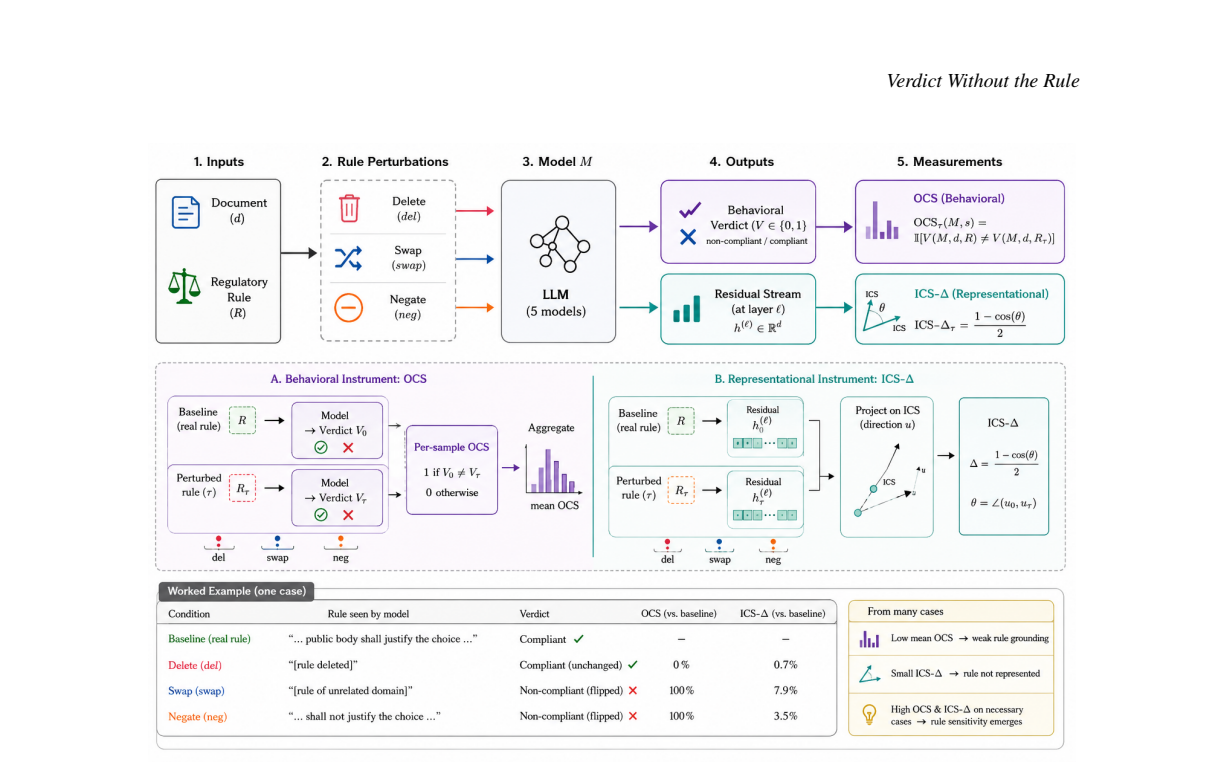
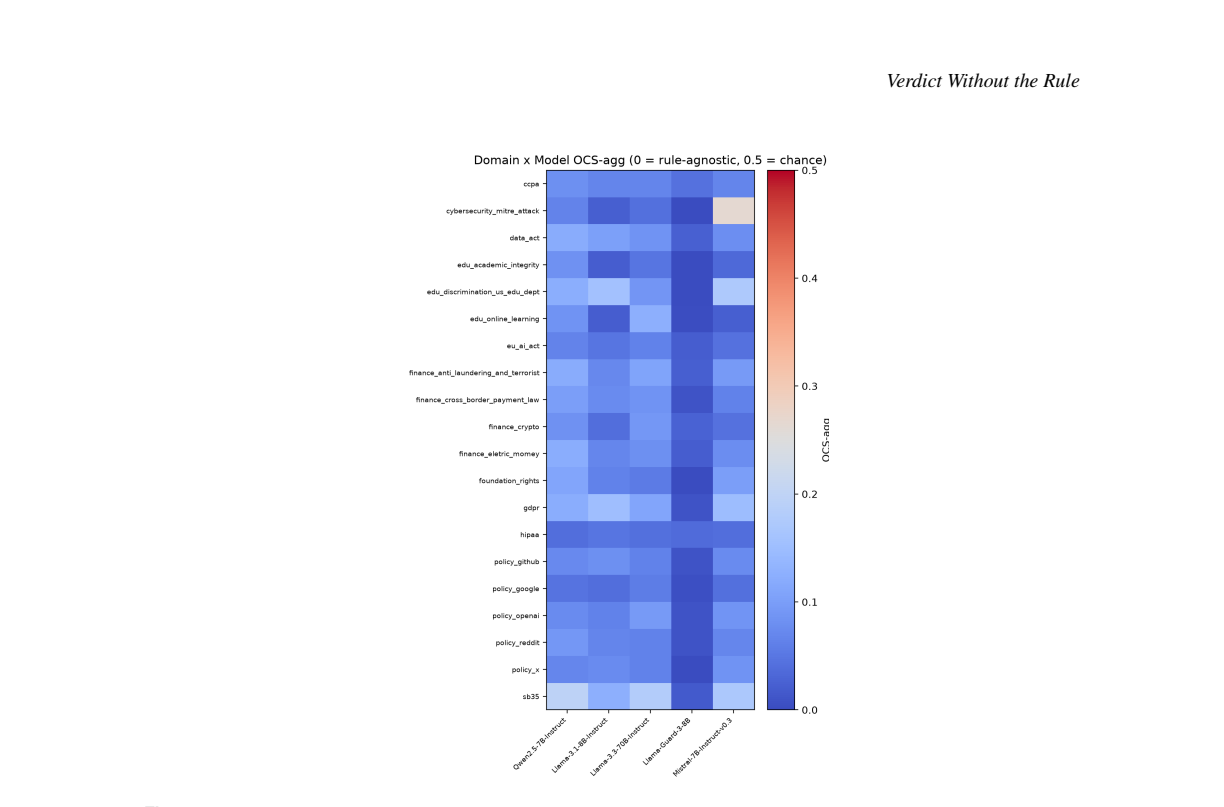
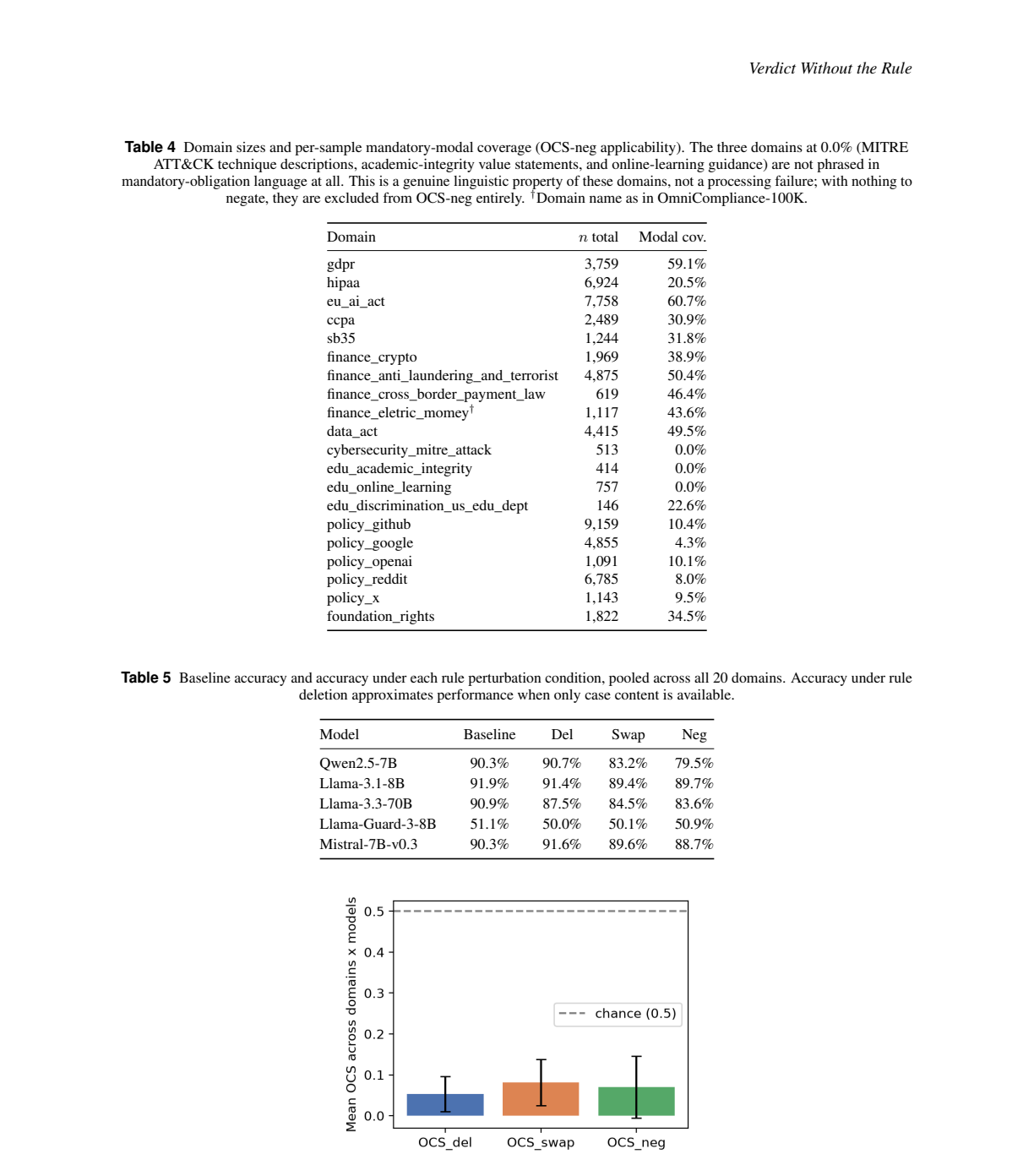
We test this directly across five models and 20 regulatory and platform-policy domains: delete, swap, or negate the governing rule while holding the case fixed, and check whether the verdict changes (OCS) or the model's internal representation of compliance shifts at all (ICS-delta). Neither moves much: models' verdicts are often invariant to substantial perturbations of the supplied rule, and the guard model, evaluated here under a custom-rule adaptation of its native taxonomy, is the least rule-sensitive and least accurate of the five, barely above chance (51%, versus 90-92% for general-purpose models). This reflects easy cases more than blanket neglect: on cases where deleting the rule changes a previously correct model prediction, models do track it closely. Neither better prompting nor direct intervention on the model's internal representations closes this gap. Accuracy alone does not establish that a compliance verdict is grounded in the supplied rule.
from the abstract
Pith says
Machine review · deepseek-v4-flash · 9 Oct 2026 · what was read was not recorded · not checked by a person
It can be wrong. Challenge this review or reply to it.
Holds up, with conditions. A well-built empirical audit of rule grounding in LLM compliance systems; the headline OCS magnitudes are conditional on the paper's 300-character rule truncation, which the authors acknowledge but never quantify, but the design and statistics are strong enough to deserve serious review. This line is wrong
2 major objections · 5 minor
How often objections from reviews like this one are right: not yet measured
Not checked: figures, code, what the 21 references say.
The paper says, at §3.1.1, Appendix C, Limitations
The review did not quote this passage.
A classifier read this sentence of the paper as acknowledging the concern (probability 0.86):
“This design means our results characterize rule sensitivity under the evaluated prompt format, not necessarily sensitivity to complete regulatory texts: when an operative clause falls beyond the 300-character window, low OCS can reflect unavailable rule information rather than failure to use available information.”
Pith says: Objection 1 of 2 · major
All three perturbations act on a rule field that the standard prompt (Appendix C) truncates at 300 characters, while Table 4's mandatory-modal coverage (up to 60.7%) is computed on full per-example rule texts; the paper never reports the in-window modal coverage or the position distribution of the first mandatory modal.
more of objection 1
Consequently, any sample whose first mandatory modal lies beyond character 300 has a perturbed prompt identical to the baseline from the model's perspective and contributes a guaranteed non-flip to OCS-neg by construction. The authors acknowledge the format-dependence (b143, b146) but never quantify it. The manuscript needs, at minimum: per-domain rule-length distributions; the distribution of the first mandatory-modal position (and, more generally, of outcome-relevant clause positions) relative to the 300-character window; the fraction of OCS-neg samples that are unchanged by construction; and a full-rule OCS run that removes only the truncation while holding the verdict prompt fixed, with Tables 1, 2, and the LOW-OCS partition recomputed. Without these, the headline 'often invariant to substantial perturbations of the supplied rule' is a claim about the truncated prompt format, not about complete regulatory rules.
This objection may describe the copy Pith gave the reviewer, not the paper.
The paper says, at §5.4, §7, Limitations
The review did not quote this passage.
A classifier read this sentence of the paper as acknowledging the concern (probability 0.83):
“This design means our results characterize rule sensitivity under the evaluated prompt format, not necessarily sensitivity to complete regulatory texts: when an operative clause falls beyond the 300-character window, low OCS can reflect unavailable rule information rather than failure to use available information.”
Pith says: Objection 2 of 2 · major
The rule-necessity subset, the LOW-OCS/HIGH-OCS partitions, and both intervention conclusions are defined inside the same truncated-prompt regime. A case whose operative clause falls beyond character 300 can never enter the Section 5.4 rule-necessary subset, because deleting a window that does not contain the operative content cannot flip a correct verdict; the two-regime interpretation ('easy cases' versus 'rule-necessary') therefore inherits the confound quantified in my first comment.
more of objection 2
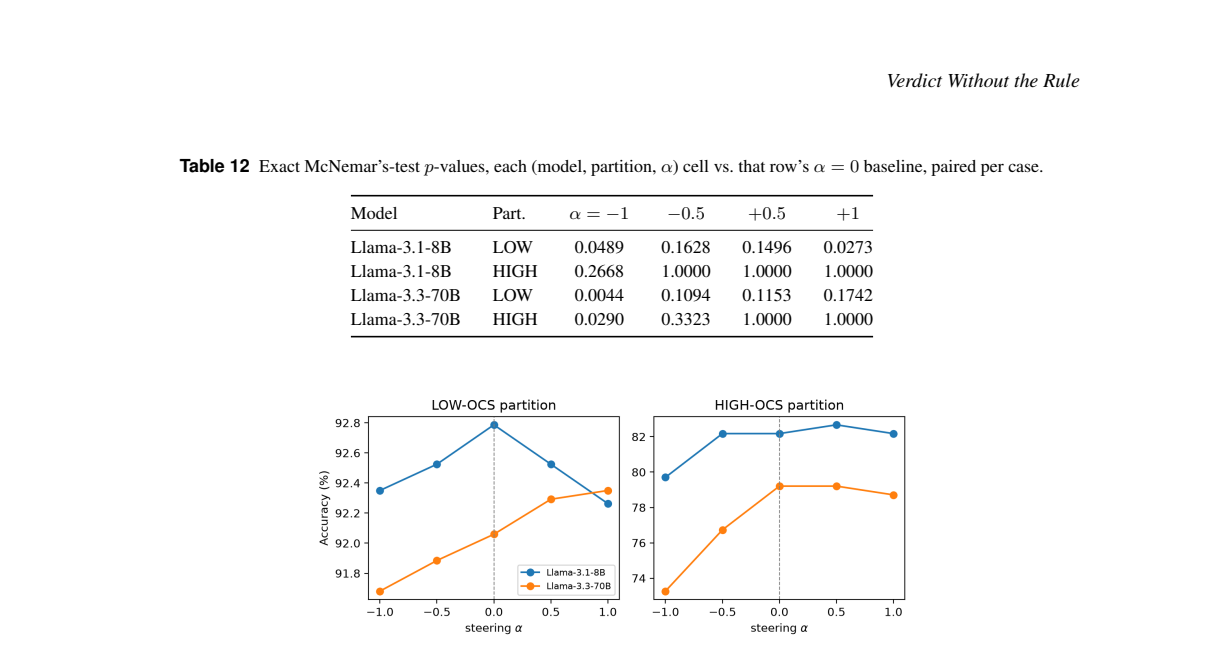
Likewise, the null result for rule-grounded prompting in Section 7.1 changes two variables at once (full rule plus explicit-quoting instruction), which the authors acknowledge (b144), and the partition transferred across models is itself truncation- and primary-model-dependent (b149). The requested additions from the first comment should be extended to: the size and composition of the rule-necessary subset under full-rule deletion; a Section 7.1 control that uses the full rule in the standard instruction template (or the truncated rule in the rule-grounded template); and a restatement of the Abstract's 'neither better prompting nor direct intervention closes this gap' that respects the lack of a controlled test.
This objection may describe the copy Pith gave the reviewer, not the paper.
5 minor objections
The paper says, at §7.1, Table 11
Pith says: minor objection 1 of 5
Table 11's caption reports McNemar's exact p for the LOW partition but, unlike Table 3's caption, does not state whether the ten cells are nominal and uncorrected; the headline 'one of ten cells reaches significance' should state explicitly that the extreme p<0.0001 for Qwen2.5-7B is the only cell that would survive a multiple-testing correction, or report the corrected values.
The paper says, at §5.1 vs. §5.3
Pith says: minor objection 2 of 5
Section 5.1's statement that OCS-agg is 'well below the ≈0.5 independence reference for every model' is in tension with Section 5.3's bias-corrected null of 0.019 for Llama-Guard-3-8B; the naive 0.5 reference is misleading for that model, and the sentence in Section 5.1 should be flagged as superseded by the model-specific nulls introduced two subsections later.
show 3 more
The paper says, at §3.1.1, §4.2
Pith says: minor objection 3 of 5
OCS-swap is defined via a uniformly sampled other-domain canonical rule, but the manuscript does not state whether the swap target is fixed per sample and seeded like the case sampling (seed 42); specifying this is needed for exact reproduction of the Table 1 numbers.
The paper says, at §5.4, Table 9
Pith says: minor objection 4 of 5
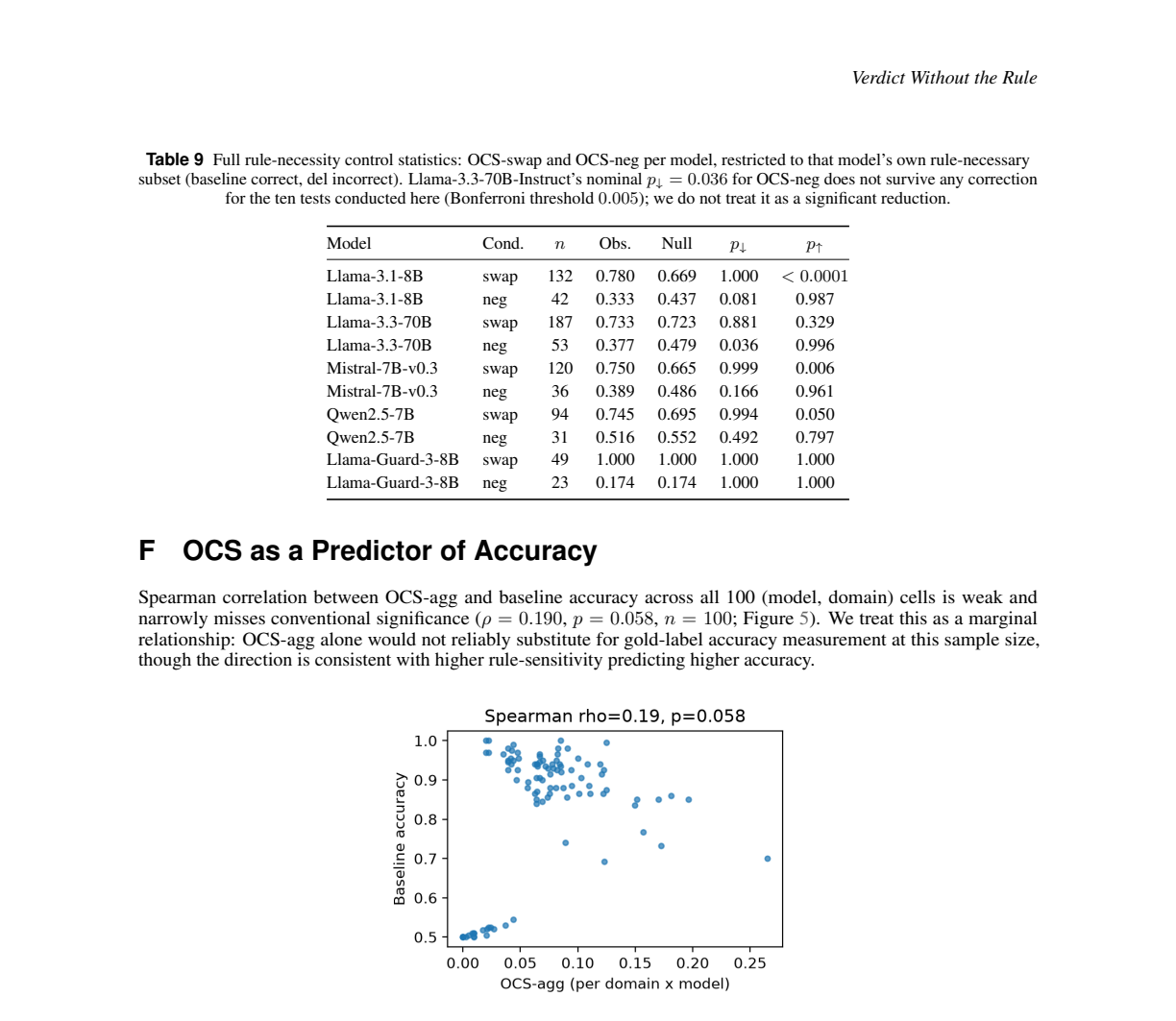
The 'opposite of a confound' framing in Section 5.4 should carry the subset-specific null comparison more prominently: for the primary model Llama-3.3-70B, the elevated OCS-swap (0.733) is not above its own bias-corrected null (p↑=0.329), and only one of four general-purpose models is significant after Bonferroni; the descriptive two-regime story is still plausible, but the body's opening sentence overstates its statistical support.
The paper says, at Limitations, Practical implication
Pith says: minor objection 5 of 5
Given the paper's practical recommendation that OCS can run as a cheap pre-deployment check, releasing the perturbation pipeline, parsing code, and a runnable artifact would materially strengthen the deployment claim; no code link appears in the manuscript.
What would settle it
A single controlled check settles it: rerun the Appendix C standard prompt on the same stratified sample (seed 42, 200 cases/domain) with the full untruncated rule text for Llama-3.3-70B-Instruct (and ideally all five models), recomputing OCS-del, OCS-swap, OCS-neg, OCS-agg, and the LOW-OCS partition size; also report the fraction of rules longer than 300 characters and the position of the first mandatory modal per domain. If full-rule OCS-agg is within about 0.02 of Table 1, the truncation confound is falsified for these data; if it rises materially, the headline must be restricted to the evaluated prompt format and the rule-necessary subset should be recomputed.
from the skeptic's reading
How the review went
4 readings by deepseek-v4-flash · 9 Oct 2026
- Reader holds up, with conditions
- Skeptic agrees
- Editor wrote the verdict above
- Referee major revision: 2 major objections, 5 minor
Not run on this paper: the simulated authors' defence.
Pith did not check this review's objections against the paper.
The review in full
The review in brief, machine-written
What you should know: this is a genuinely useful empirical paper, not hype. It asks whether LLM compliance verdicts depend on the supplied regulatory rule by deleting, swapping, or negating the rule and checking both the output (OCS) and a compliance-predictive activation direction (ICS-delta). The core finding, that verdicts are largely invariant to these perturbations, is well supported under the paper's stated prompt format, and the paper is honest that accuracy alone does not show rule grounding.
The new pieces are real: the per-sample OCS formulation with LOW/HIGH partitions, the ICS-delta representational shift measure, and the 20-domain cross-model audit. The statistical scaffolding is unusually careful: permutation nulls built from each model's own marginals, Benjamini-Hochberg correction on the linguistic regression, McNemar tests for the interventions, and a rule-necessity control that shows models do become rule-sensitive on the cases where deleting the rule flips a correct verdict. The external benchmarks (LegalBench, ContractNLI) and the finding that OCS is 3-4x higher there strengthen the claim that the low OCS is not a universal model property. The MDD correlation is a nice, testable result.
The main soft spot is the 300-character rule truncation, and it is a genuine one. The authors state it clearly in the Limitations (b143, b144) and call for controlling it separately, but they never report rule-length distributions, the location of the first operative clause or modal, or an OCS run with full rule text under the standard prompt. So the headline magnitudes are conditional on prompt format, and the paper's own abstract overstates slightly by saying verdicts are "often invariant" without that qualifier. This is a limitation, not a fatal flaw: the paper is explicit that it characterizes rule sensitivity under the evaluated prompt format. Still, I'd want the truncation effect quantified before accepting the strongest version of the claim.
Two smaller concerns. The LOW/HIGH partition is defined on Llama-3.3-70B and transferred to other models with the assumption of cross-architecture consistency untested; the authors acknowledge this. And the Llama-Guard-3-8B result depends on a custom-rule adaptation of its taxonomy, which the paper flags as a task-format mismatch, so its "least rule-sensitive" finding should be read narrowly. No code or data is shipped, which is a real barrier for an audit metric others are meant to adopt.
Who is this for: anyone building or evaluating compliance systems, repurposed safety classifiers, and researchers working on faithfulness or input sensitivity. It deserves a serious referee, with the main revision request being to quantify the truncation confound and release the data/code. I would not desk-reject this.
The strongest objection
The central empirical claim—verdicts are 'often invariant to substantial perturbations of the supplied rule'—rests on OCS computed from a prompt whose Rule field is truncated to the first 300 characters (Appendix C). All three perturbations act only on that truncated field. If a rule's operative clauses or mandatory modals fall beyond character 300, deleting, swapping, or negating the field changes or removes text the model never saw; low OCS then records missing input, not a failure to use available input. This is a live possibility: Table 4's mandatory-modal coverage is reported per full rule text and reaches 60.7% in some domains, yet OCS-neg is applied to the truncated field, so any first modal beyond the window is never negated and the sample is unchanged by construction. The authors state this limitation (b143, b144) and call for controlling truncation separately (b146), but they do not report rule-length distributions, the location of the first modal or operative clause, or an OCS run with the full rule under the standard prompt. The rule-necessity control (Section 5.4) only finds deletion-critical cases that are visible inside 300 characters; the Section 7 rule-grounded prompt does use the full rule but simultaneously changes the instruction, so it is not a controlled test. Section 6's external benchmarks share the same truncated prompt. Because the LOW-OCS partitions and all headline OCS magnitudes are built on this window, 'often invariant' is not yet established for complete regulatory texts.
I agree with the reader that the 300-character truncation is the load-bearing assumption. The paper's contribution is not the logical point that accuracy and grounding are distinct—that is definitional—but the empirical magnitude of rule invariance, and every magnitude in Tables 1, 5, and the LOW-OCS partitions is measured under a prompt that may not contain the operative rule. The authors' own limitation paragraph is the strongest evidence that the concern is real; my criticism is only that they stop at acknowledgement. The rule-necessity control is genuinely good support for the claim that when the rule visibly matters, models track it, and I would credit it; but it cannot quantify what is hidden by truncation. The generalization check on LegalBench and ContractNLI uses the same truncated prompt, so it does not resolve the issue either. The requested full-rule OCS run is cheap and would either confirm the headline or bound it to the evaluated prompt format. Since the paper already frames its conclusion as applying under that format, the conditional verdict remains appropriate and I would not change it.
The referee's report
If the empirical magnitude claim held for complete rule texts, the practical stakes would be clear: deployed compliance systems could be accurate for the wrong reasons, and a cheap, gold-label-free diagnostic like OCS could flag the gap. The paper's methodological packaging is a genuine strength: empirical permutation nulls built from each model's own marginals, per-sample OCS with LOW/HIGH-OCS partitions, the rule-necessity control that separates easy-case invariance from rule neglect, Bonferroni-corrected subset tests, and honest external benchmarking that reports OCS values 3-4x higher on LegalBench and ContractNLI rather than asserting a universal magnitude. The abstract's logical conclusion, that accuracy alone does not establish rule grounding, stands regardless of any empirical magnitude. The experimental detail is unusually complete (prompts in Appendix C; per-cell statistics in Appendices E-H; seed-42 sampling), though no code or data artifact is linked. What remains to be established is the magnitude of the headline invariance under complete rule texts, and that is exactly where the main unresolved confound sits.
Pith's reading of the paper (a machine's summary, not the authors')
Large language models now issue compliance verdicts — whether a document or interaction satisfies a stated regulation — on the assumption that the verdict depends on the rule they are given. This paper tests that assumption by deleting the rule, swapping in a different domain's rule, or negating its mandatory obligations while holding the case fixed, then checking whether the verdict changes and whether the model's internal compliance signal shifts. Across five models and 20 regulatory and platform-policy domains, verdicts barely move: the flip rate (OCS-agg) ranges from 0.013 to 0.094 with a mean of 0.069, far below the $\approx 0.5$ rate expected if verdicts were independent of the rule, and below each model's bias-corrected null. A rule-necessity control shows the low average reflects easy cases, not blanket neglect: on the cases where deleting the rule demonstrably turns a correct verdict wrong, models track rule swaps closely (0.73–1.00). The practical conclusion is that a high accuracy score on a labeled benchmark does not establish that a compliance verdict is grounded in the supplied rule.
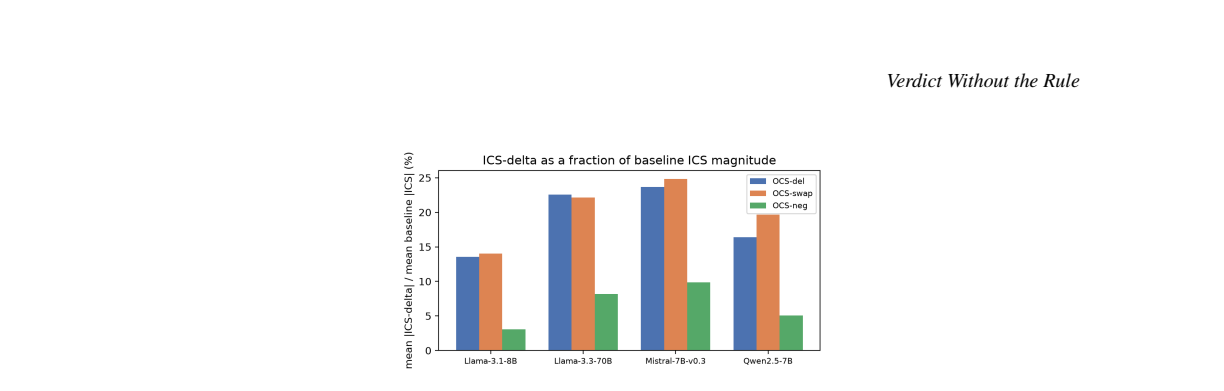
What carries the argument. The argument is carried by two instruments plus a control. OCS (Output Compliance Sensitivity) is a reference-free, black-box behavioral metric: for each (document, rule) case it records whether the verdict flips when the rule is deleted, swapped for the canonical rule text of a randomly sampled different domain, or has its mandatory modals 'must'/'shall' negated; per-sample scoring lets the paper partition cases into LOW-OCS (unchanged under every perturbation) and HIGH-OCS (changed under at least two). ICS-delta is a representational counterpart built on the ICS probe, the projection of the last-token residual-stream activation onto a training-free compliant-versus-noncompliant direction: it measures how much that projection moves under the same three perturbations, reported as a fraction of each model's baseline magnitude. The rule-necessity control then selects, per model, the cases whose verdict is correct with the real rule but wrong with the rule deleted, and shows that on exactly those cases OCS-swap rises to 0.73–1.00. That control is what turns the low aggregate numbers into evidence that low sensitivity marks easy cases rather than blanket neglect of the rule.
Core claim. The paper's central claim is that LLM compliance verdicts are often invariant to substantial perturbations of the supplied regulatory rule, and that this invariance coexists with high benchmark accuracy. Behaviorally, OCS records whether the verdict flips when the rule is deleted, replaced with a different domain's canonical rule, or has its mandatory modals negated; pooled across 20 domains, OCS-agg ranges from 0.013 for the guard model to 0.094 for Qwen2.5-7B with a mean of 0.069 across model–domain cells, far below the $\approx 0.5$ independence reference. Representationally, ICS-delta measures how much the projection of the last-token activation onto a compliance-predictive direction moves under the same perturbations and finds only 12.8–22.9% of baseline magnitude, with no significant convergence between the two instruments. The rule-necessity control resolves the natural objection: restricted to the per-model cases (94–187) where deletion turns a correct verdict into an incorrect one, OCS-swap jumps to 0.73–1.00, while on the majority of cases the scenario content alone suffices and the rule is decision-irrelevant. Neither rule-grounded prompting nor activation steering reliably recovers accuracy on the low-sensitivity cases, one prompting variant significantly harms it, and the repurposed guard model is simultaneously the least rule-sensitive and least accurate (51% versus 90–92%). The conclusion the paper draws is that accuracy alone does not establish that a compliance verdict is grounded in the supplied rule.
The premise it rests on. The load-bearing premise is that the shortened (300-character) rule text the models are given is a faithful probe of rule sensitivity; the paper itself warns that when an operative clause falls beyond that window, low sensitivity can mean the model never saw the clause, not that it ignored it.
If the paper is right (Pith's inferences, not the authors')
A compliance system can score above 90% on an accuracy benchmark while its verdicts are largely invariant to the rule it is given, so OCS can run as a cheap, label-free pre-deployment audit independent of a vendor's accuracy claims.
The low average hides two regimes — easy cases where scenario content determines the verdict, and rule-necessary cases where models do track the rule — and a labeled benchmark alone cannot tell which regime produced a given correct answer.
Repurposed safety guard models warrant particular caution: under the custom-rule adaptation, the guard model showed the lowest rule sensitivity and the lowest accuracy, so its accuracy numbers are not evidence of grounded compliance reasoning.
The tested inference-time fixes — explicit rule-quoting prompts and activation steering — do not reliably recover accuracy on the low-sensitivity cases, and one prompting variant significantly harmed accuracy, so the gap is not trivially closed.
Rule sensitivity is not a fixed property of a model: OCS ran roughly 3–4 times higher on LegalBench and ContractNLI than on the primary dataset, so practitioners should recompute OCS on their own deployment distribution.
My reading of the truncation caveat: the 300-character rule window means the audit measures sensitivity under the evaluated prompt format, and quantifying how many sampled rules carry operative clauses beyond the window would tell whether low OCS understates rule use in deployments that feed full rule texts.
I would run the same counterfactual logic in reverse — perturbing the case text while holding the rule fixed — to measure case-content dependence, the complementary failure mode the paper names but does not execute.
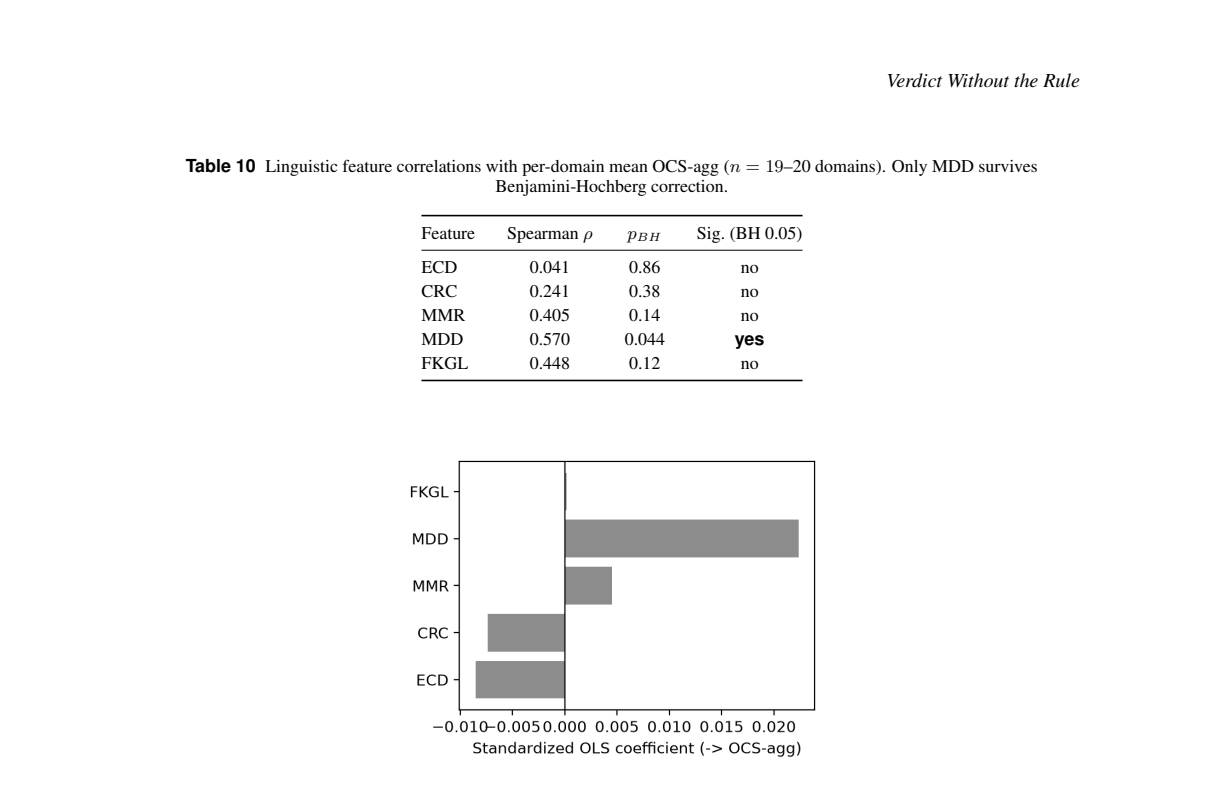
Because domain-level sensitivity correlates most strongly with dependency-tree depth, a testable follow-up is whether plain-language rewrites of regulatory rules raise OCS.
The negative intervention results leave open architectures that surface the specific operative clause, such as clause-selection or retrieval-based pipelines, as a more direct route to rule-grounded verdicts than the prompting and steering fixes tested here.
Check this review
Pith stored no record of this review's passes and took no fingerprint of it. Reviews made by code from 13 Nov 2026 on carry both.
How often reviews like this one are right
Reviews like this one: written by deepseek-v4-flash, where what was read was not recorded.
How often objections from reviews like this one are right: not yet measured
Reviews by people
This review was written by a machine. No person has reviewed this paper on Pith yet. A scientist listed on Pith can review it for a fee, and their review is published here whatever it concludes.
The paper
Abstract
Large language model compliance systems are deployed on the assumption that a verdict depends on the regulatory rule it is given. We test this directly across five models and 20 regulatory and platform-policy domains: delete, swap, or negate the governing rule while holding the case fixed, and check whether the verdict changes (OCS) or the model's internal representation of compliance shifts at all (ICS-delta). Neither moves much: models' verdicts are often invariant to substantial perturbations of the supplied rule, and the guard model, evaluated here under a custom-rule adaptation of its native taxonomy, is the least rule-sensitive and least accurate of the five, barely above chance (51%, versus 90-92% for general-purpose models). This reflects easy cases more than blanket neglect: on cases where deleting the rule changes a previously correct model prediction, models do track it closely. Neither better prompting nor direct intervention on the model's internal representations closes this gap. Accuracy alone does not establish that a compliance verdict is grounded in the supplied rule.
The paper's own sentences, arranged, kept beside the review and separate from it. Each label is drawn from a closed vocabulary; the number beside it is the probability the classifier gave that label. No sentence in this record was written by a model.
abstract compiled · 2026-10-09
The authors' main claim, as the classifier picked it out 0.76
“Accuracy alone does not establish that a compliance verdict is grounded in the supplied rule.”
How the main claim is stated: asserted 1.00
What the abstract itself states, as probabilities: claims first 0.05 · states limitation 0.73 · human participants 0.04 · controlled comparison 0.66 · randomized assignment 0.02 · states quantitative result 0.98 · compares with prior results 0.77 · mentions code or data availability 0.03
The abstract, sentence by sentence
This table labels the abstract only (arXiv listing abstract v1). The number is the probability the classifier gave the label.
| Sentence | Role | The authors' own work | States the main conclusion | Strength |
|---|---|---|---|---|
| Large language model compliance systems are deployed on the assumption that a verdict depends on the regulatory rule it is given. | background 1.00 | 0.05 | 0.04 | asserted 0.99 |
| We test this directly across five models and 20 regulatory and platform-policy domains: delete, swap, or negate the governing rule while holding the case fixed, and check whether the verdict changes (OCS) or the model's internal representation of compliance shifts at all (ICS-delta). | method 0.95 | 0.95 | 0.05 | asserted 0.93 |
| Neither moves much: models' verdicts are often invariant to substantial perturbations of the supplied rule, and the guard model, evaluated here under a custom-rule adaptation of its native taxonomy, is the least rule-sensitive and least accurate of the five, barely above chance (51%, versus 90-92% for general-purpose models). | result 1.00 | 0.95 | 0.46 | asserted 0.98 |
| This reflects easy cases more than blanket neglect: on cases where deleting the rule changes a previously correct model prediction, models do track it closely. | interpretation 0.85 | 0.89 | 0.10 | asserted 0.82 |
| Neither better prompting nor direct intervention on the model's internal representations closes this gap. | result 0.98 | 0.87 | 0.12 | asserted 1.00 |
| Accuracy alone does not establish that a compliance verdict is grounded in the supplied rule. | interpretation 0.99 | 0.54 | 0.80 | asserted 1.00 |
What kind of paper the classifier reports this is: empirical study 1.00 · evidence from observation or experiment 0.99
What was examined, and what was not
Sources read
- arXiv listing abstract v1
Not examined
- full text
- figures and tables
- references and citing sentences
- relations to other papers
Levels run
- P abstract
Not run
- S sections
- T body sentences
- C citations
- R cross-paper relations
How the labels were made
Compiled by classifier-1.13.0 via TypeSafe API, question bank abstract-p1-20260923, 2026-10-09: 1 request, 5,007 input tokens.
Every quoted sentence on this record is the authors'. Every label is from Pith's closed vocabulary, with the probability shown beside it. This record as JSON
Figures (7)
Figures are the authors', reproduced from the paper.
References (21)
- [6] URL https://openreview.net/forum?id=gc8Ylt0lbm. Wenbin Hu, Huihao Jing, Haochen Shi, Changxuan Fan, Haoran Li, and Yangqiu Song. OmniCompliance-100K: A multi-domain, rule-grounded, real-world safety compliance dataset. InFindings of the Association for Com- 10 Verdict Without ... on Pith
- [7] doi: 10.18653/v1/2026.findings-acl.115. URL https://aclanthology.org/2026.findings-acl.115/. Hakan Inan, Kartikeya Upasani, Jianfeng Chi, Rashi Rungta, Krithika Iyer, Yuning Mao, Michael Tontchev, Qing Hu, Brian Fuller, Davide Testuggine, and Madian Khabsa. Llama guard: LLM-ba... on Pithdoi:10.18653/v1/2026.findings-acl.115
- [8] URLhttps://arxiv.org/abs/2312.06674. Alon Jacovi and Yoav Goldberg. Towards faithfully interpretable NLP systems: How should we define and evaluate faithfulness? In Dan Jurafsky, Joyce Chai, Natalie Schluter, and Joel Tetreault, editors,Proceedings of the 58th Annual Meeting o... on PithPith's reviewarXiv
- [10] URLhttps://arxiv.org/abs/2605.29742. Yuta Koreeda and Christopher D Manning. ContractNLI: A dataset for document-level natural language inference for contracts. InFindings of the Association for Computational Linguistics: EMNLP 2021, pages 1907–1919, on PithPith's reviewarXiv
- [12] Nanxi Li, Zhengyue Zhao, and Chaowei Xiao. LPG: Balancing efficiency and policy reasoning in latent policy guardrails.arXiv preprint arXiv:2605.17329, on PithPith's reviewarXiv
- [13] Zhifeng Lu, Dianyuan Wang, Yuhu Shang, and Zhenbo Xu. RuleSafe-VL: Evaluating rule-conditioned decision reasoning in vision-language content moderation.arXiv preprint arXiv:2605.07760, on PithPith's reviewarXiv
- [15] doi: 10.52202/085713-4249. Aman Mehta. The refusal residue: When probes catch alignment faking and when they don’t.arXiv preprint arXiv:2607.13346, on PithPith's reviewarXiv
- [16] Abhishek Purushothama, Junghyun Min, Brandon Waldon, and Nathan Schneider. Not ready for the bench: LLM legal interpretation is unstable and uncalibrated to human judgments. In Nikolaos Aletras, Ilias Chalkidis, Leslie Barrett, C˘at˘alina Goant, ˘a, Daniel Preot,iuc-Pietro, an... on Pith
- [17] Association for Computational Linguistics. ISBN 979-8-89176-338-8. doi: 10.18653/v1/2025.nllp-1.22. URL https://aclanthology.org/ 2025.nllp-1.22/. Oren Rachmil, Avishag Shapira, Roy Betser, Omer Hofman, Itay Gershon, Asaf Shabtai, Yuval Elovici, and Roman Vainshtein. Training-... on Pithdoi:10.18653/v1/2025.nllp-1.22
- [18] URL https: //arxiv.org/abs/2512.03994. Shir Rozenfeld, Rahul Pankajakshan, Itay Zloczower, Eyal Lenga, Gilad Gressel, and Yisroel Mirsky. GA VEL: Towards rule-based safety through activation monitoring. InThe Fourteenth International Conference on Learning Representations, on PithPith's reviewarXiv
- [19] URLhttps://openreview.net/forum?id=duntROHZ5R. Saisab Sadhu, Dwaipayan Roy, and Tanmay Basu. When RAG disagrees: Detecting latent epistemic conflict via logit interactions. InProceedings of the 49th International ACM SIGIR Conference on Research and Development in Information ... on PithPith's reviewarXiv
- [20] doi: 10.1609/aaai.v40i46.41298. 11 Verdict Without the Rule Haiquan Zhao, Chenhan Yuan, Fei Huang, Xiaomeng Hu, Yichang Zhang, An Yang, Bowen Yu, Dayiheng Liu, Jingren Zhou, Junyang Lin, et al. Qwen3Guard technical report.arXiv preprint arXiv:2510.14276, on PithPith's reviewarXiv
- [21] Linkai Zhu, Lu Yang, Chaofan Li, Shanwen Hu, Lu Liu, and Bin Yin. LegiLM: A fine-tuned legal language model for data compliance.arXiv preprint arXiv:2409.13721, on PithPith's reviewarXiv
- [2019] Association for Computational Linguistics. doi: 10.18653/v1/P19-1334. URLhttps://aclanthology.org/P19-1334/. Alex McKenzie, Urja Pawar, Phil Blandfort, William Bankes, David Krueger, Ekdeep Singh Lubana, and Dmitrii Krasheninnikov. Detecting high-stakes interactions with activ... on Pithdoi:10.18653/v1/p19-1334
- [2020] Association for Computational Linguistics. doi: 10.18653/v1/2020.acl-main.386. URL https://aclanthology.org/2020. acl-main.386/. Yeong-Joon Ju and Seong-Whan Lee. Citation-closure retrieval and per-rule attribution for real-world regulatory compliance question answering, on Pithdoi:10.18653/v1/2020.acl-main.386
- [2021] Tamera Lanham, Anna Chen, Ansh Radhakrishnan, Benoit Steiner, Carson Denison, Danny Hernandez, Dustin Li, Esin Durmus, Evan Hubinger, Jackson Kernion, et al. Measuring faithfulness in chain-of-thought reasoning.arXiv preprint arXiv:2307.13702, on PithPith's reviewarXiv
- [2022] Manan Roy Choudhury, Adithya Chandramouli, Mannan Anand, and Vivek Gupta. Better call CLAUSE: A discrepancy benchmark for auditing LLMs legal reasoning capabilities. InFindings of the Association for Computational Linguistics: EACL 2026, pages 5776–5818, on Pith
- [2023] doi: 10.52202/075280-1915. URL https://proceedings.neurips.cc/paper_files/paper/2023/ file/89e44582fd28ddfea1ea4dcb0ebbf4b0-Paper-Datasets_and_Benchmarks.pdf. Dongxin Guo, Jikun Wu, and Siu Ming Yiu. ComplianceNLP: Knowledge-graph-augmented RAG for multi-framework regulatory g... on PithPith's reviewarXiv
- [2024] doi: 10.52202/079017-0261. Monte Hoover, Vatsal Baherwani, Neel Jain, Khalid Saifullah, Joseph Vincent, Chirag Jain, Melissa Kazemi Rad, C. Bayan Bruss, Ashwinee Panda, and Tom Goldstein. DynaGuard: A dynamic guardian model with user-defined policies. InThe Fourteenth Internat... on Pithdoi:10.52202/079017-0261
- [2025] Huaixia Dou, Jie Zhu, Minghao Wu, Shuo Jiang, Junhui Li, Lifan Guo, Feng Chen, and Chi Zhang. FinGuard: Detecting financial regulatory non-compliance in LLM interactions.arXiv preprint arXiv:2605.29427, on PithPith's reviewarXiv
show 1 more
- [2026] Jiseong Chung, Ronny Ko, Wonchul Yoo, Makoto Onizuka, Sungmok Kim, Tae-Wan Kim, and Won-Yong Shin. GraphCompliance: Aligning policy and context graphs for LLM-based regulatory compliance.arXiv preprint arXiv:2510.26309, on PithPith's reviewarXiv
Challenges and discussion
Disagree with the review, or know something it missed? Leave a comment, or challenge this review formally: a challenge becomes a permanent entry in this paper's record, and its decision is published here.
Come back by email
A short list of the week's newly reviewed papers. Nothing is sent until you confirm from your inbox, and every email has a link that stops it. No account.
No comments yet.
Sign in to comment