Artificial Intelligence · arXiv:2610.13092 v1 · submitted 9 Oct 2026 · 35 references
When Faster Decisions Do Not Make Better Agents: An Empirical Study of Jev in Agent Workflows
The paper says
“AI agents depend on repeated decisions to accomplish tasks, with large language models (LLMs) commonly serving as their core decision makers. The recent emergence of Jev offers an opportunity to make these decisions faster and at lower cost.”
more of the abstract
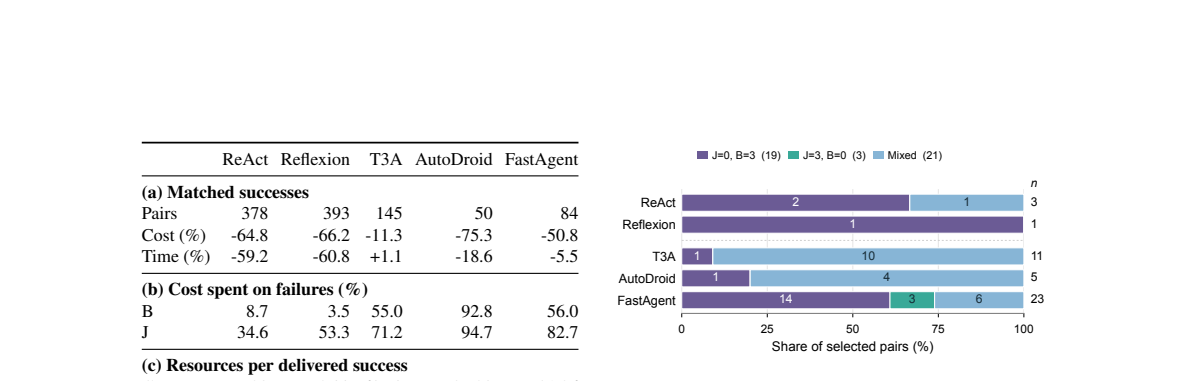
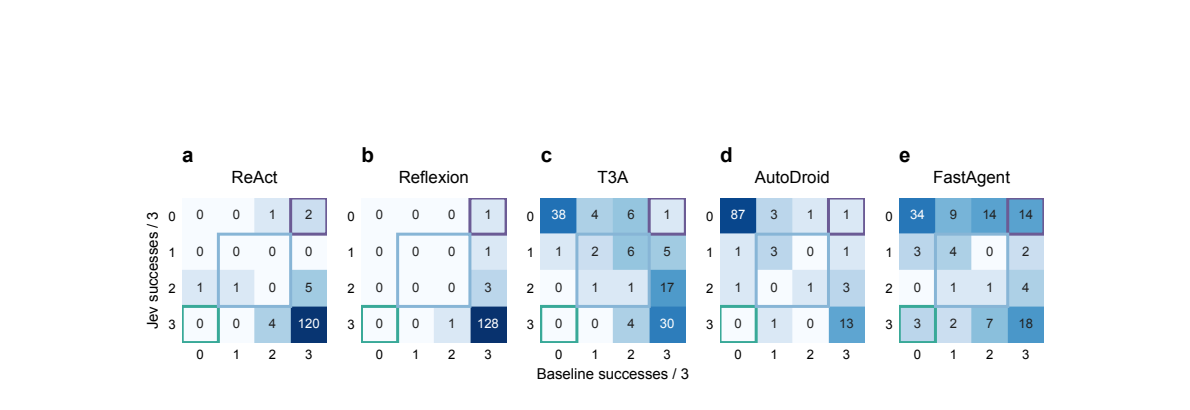
However, it remains unclear whether such local savings can be translated into efficient and reliable task completion. In this paper, we investigate this efficiency transfer across five agents in two representative application settings, embodied tasks in ALFWorld and mobile app use in AndroidWorld. Across 4,500 task executions, we jointly evaluate task effectiveness, decision-level and task-level resource use, and execution behavior. Experimental results show that Jev integration substantially reduces decision cost and latency across all five agents, with task-level gains varying by workflow. Task success remains close to baseline levels on ALFWorld and declines more substantially in two mobile agents. Auxiliary reasoning and additional interactions absorb decision savings, while failed recovery and premature completion limit successful delivery. Mean cost per successful outcome increases in one agent even as spending per attempt falls. These findings highlight the importance of preserving progress, supporting recovery, and verifying completion when integrating efficient decision models into agent workflows. Their practical value should be assessed through successful task delivery, recovery behavior, and resources per delivered outcome.
from the abstract
Pith says
Machine review · deepseek-v4-flash · 12 Oct 2026 · what was read was not recorded · not checked by a person
It can be wrong. Challenge this review or reply to it.
The passes disagreed. Reader: holds up. Skeptic: agrees with the reader. Referee: major revision.
Solid empirical study of Jev in agent workflows; main result is the nuanced finding that local decision savings do not reliably transfer to task efficiency, with caveat that AndroidWorld comparisons lack controls to isolate the decision-model effect. This line is wrong
2 major objections · 3 minor
How often objections from reviews like this one are right: not yet measured
Not checked: figures, code, what the 35 references say.
The paper says, at §4.2, §5.1, §6
The review did not quote this passage.
A classifier read this sentence of the paper as acknowledging the concern (probability 0.79):
“The ALFWorld LLM-Choice control helps distinguish decision-model effects under a shared candidate interface, but this control does not cover every integration.”
Pith says: Objection 1 of 2 · major
The paper's main result—that Jev integration causes success declines of 13.22 pp (T3A) and 18.10 pp (FastAgent)—rests on system-level comparisons that lack an LLM-Choice control on AndroidWorld. For ALFWorld, the LLM-Choice control isolates the decision-model effect, but no such control is provided for any AndroidWorld agent (§6, Limitations).
more of objection 1
For FastAgent, there is an additional confound: the J variant executes one tool per step while the baseline emits multiple tool calls per step (§4.2). This alone increases decision count and interaction length, which the paper reports (+44.1% more decisions for FastAgent-J). The paper acknowledges the limitation ('comparisons are system-level [...] without attributing every observed difference to Jev alone', Limitations), yet in the Discussion (§6) it interprets the success declines as consequences of Jev's 'errors in target interpretation, correction, and termination'. Without an LLM-Choice control on AndroidWorld, the attribution of the observed deficits to Jev's decision model rather than to workflow or interface changes is not supported. This is a load-bearing gap for claims about RQ1, RQ2, and RQ3 regarding mobile agents.
The paper says, at §4.2, §5.2
The review did not quote this passage.
A classifier read this sentence of the paper as acknowledging the concern (probability 0.68):
“Comparisons across families also reflect differences in interac- tion budgets and workflow design.”
Pith says: Objection 2 of 2 · major
For FastAgent, the efficiency comparisons (task time, cost per task) are also confounded by the single-tool-per-step interface change. The paper notes that FastAgent-J makes 44.1% more decisions, which is at least partly due to this change rather than the decision model itself. This undermines the conclusion about efficiency transfer for that agent, because the observed cost and time differences cannot be cleanly decomposed into effects of Jev's speed versus effects of a different execution protocol.
3 minor objections
The paper says, at §4.2
Pith says: minor objection 1 of 3
The paper states that each configuration runs three times with seed 0. The use of a single seed does not capture variability due to stochastic model outputs or environment randomness. While the paper acknowledges this limitation, a brief explanation of whether model responses are deterministic given the seed would help contextualize the standard deviations reported.
The paper says, at Table 1, §4.2
Pith says: minor objection 2 of 3
The description of Jev integration for AndroidWorld agents could be clearer: for T3A, Jev selects 'UI actions and targets'; for FastAgent, it selects 'tools with associated arguments'. Are the candidates pre-specified by the workflow or dynamically generated? Clarifying this would help assess the breadth of Jev's role.
show 1 more
The paper says, at §5.1, Figure 2
Pith says: minor objection 3 of 3
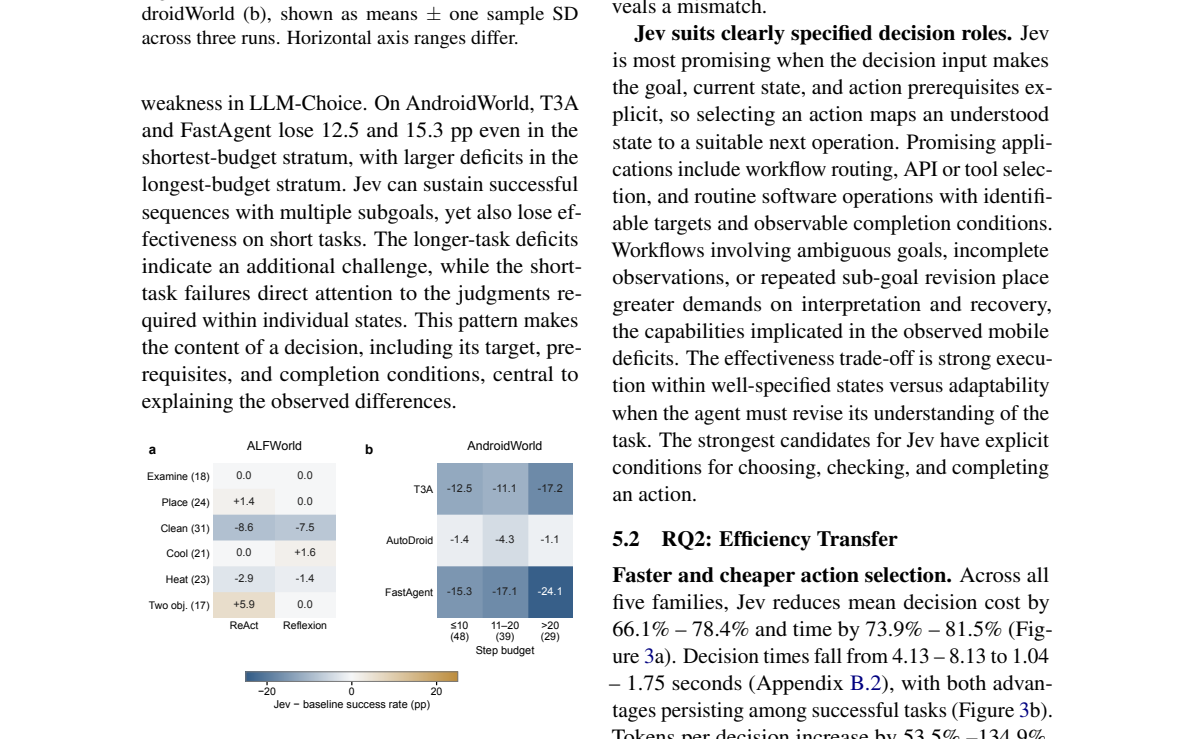
Figure 2 shows Jev–baseline success differences by step budget for AndroidWorld. Since the step budget is defined per task and is part of the workflow, it would be helpful to note whether budgets are matched exactly between variants within a family (as stated in §4.2). The large deficits in the shortest budget stratum for T3A and FastAgent (-12.5 and -15.3 pp) are interesting but may be affected by the confounds discussed above.
What would settle it
Implement an LLM-Choice variant for T3A and FastAgent: replace Jev with gpt-5.6-luna as the action selector, using the exact same candidate list and selection instructions as the J variant. Keep all workflow changes (single-tool steps for FastAgent, same auxiliary calls). Evaluate all 116 AndroidWorld tasks × 3 runs. If LLM-Choice success rates are close to B (within 3 pp), then Jev's selection is the primary cause of the decline; if they are close to J (within 3 pp), then the workflow change or candidate interface is responsible. Report paired 95% bootstrap intervals as in Table 10.
from the skeptic's reading
How the review went
4 readings by deepseek-v4-flash · 12 Oct 2026
- Reader holds up
- Skeptic agrees
- Editor wrote the verdict above
- Referee major revision: 2 major objections, 3 minor
Not run on this paper: the simulated authors' defence.
Pith did not check this review's objections against the paper.
The review in full
The review in brief, machine-written
This is a well-executed empirical study that does exactly what it says on the tin: measures whether a fast, cheap decision model (Jev) actually improves end-to-end agent performance. The headline result—that decision-level savings of 66–78% cost and 74–82% latency don't reliably translate to task-level gains—is non-obvious and worth publishing. The paper is unusually thorough: 4,500 executions across five agents, trace coding with 0.87 Cohen's κ, bootstrap intervals, and an LLM-Choice control on ALFWorld.
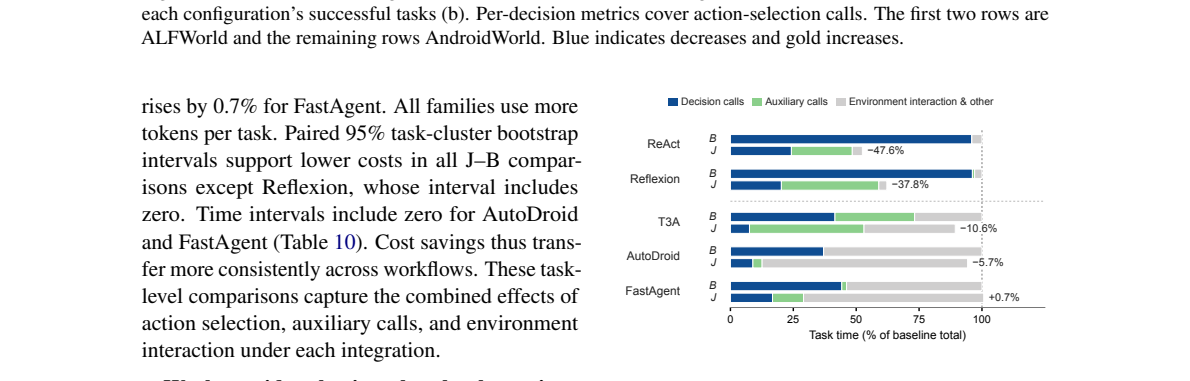
The key new thing is the "efficiency transfer" analysis. Showing that mean cost per successful outcome can rise even as per-attempt cost falls (T3A +7.7%, table 2c) is exactly the kind of nuanced result that challenges naive substitution thinking. The time-component decomposition (Fig 4) is clean and explanatory: Auxiliary reasoning and extra interactions absorb savings, and external operations limit speed gains.
The soft spot is the one flagged by the sterss-test. On AndroidWorld there is no LLM-Choice control, and FastAgent-J uses single-tool steps while FastAgent-B emits multiple calls per step. The paper openly acknowledges this ($6, .[b238]−[b241]), so it's not being hidden. But the main claims about success-rate drops of 13.2 pp (T3A) and 18.1 pp (FastAgent) rely on attributing those drops to Jev's decision quality. The 44.1% more decisions in FastAgent-J (Fig 4) could easily be a chain-length artifact, not a reflection of Jev's bounded judgments. The ALFWorld results (with the C control) show negligible success loss, which strengthens that the model itself may be fine under controlled conditions. For AndroidWorld, we simply cannot tell how much of the decline is the model versus the workflow change.
Minor: three repetitions per configuration gives noisy success-rate estimates, as the authors note. For the central claims about T3A/FastAgent, those 13–18 pp differences are large enough to survive noise, so it's not a dealbreaker.
Bottom line: the paper is serious, methodologically sound, and honest. It will be most valuable to anyone building LLM-based agent systems who naively assumes that cheaper decisions automatically improve the bottom line. The AndroidWorld confound is real but the ALFWorld controlled results and the trace analysis provide enough support for the core narrative that the paper deserves a serious referee. For my own work, I'd likely cite the matched-success cost analysis (table 2) as a cautionary example.
Recommendation: send to peer review with a note that reviewers should probe the AndroidWorld controls, but the work is important enough and well-done enough to pass.
The strongest objection
The paper's main result—that Jev integration causes substantial success drops in two mobile agents (T3A −13.22 pp, FastAgent −18.10 pp, §5.1)—rest on system-level comparisons that lack an LLM-Choice control on AndroidWorld. The ALFWorld LLM-Choice control isolates the decision-model effect, but no such control exists for any AndroidWorld family (§6, line [b238]). For FastAgent, the interface change is explicit: B emits multiple tool calls per step while J executes one tool per step (§4.2). This alone can increase interaction count and decision frequency, which the paper reports as +44.1% more decisions and absorbs task-time savings (§5.2, Figure 4). For T3A, the candidate interface is unchanged, but the paper does not describe any LLM-Choice baseline to rule out that the 13.22 pp drop stems from the decision model rather than from subtle differences in candidate construction or execution granularity. Because the central claims about 'failure and recovery' (RQ3) and 'efficiency transfer' (RQ2) for AndroidWorld agents depend on attributing the success decline to Jev's selection quality, the absence of this control is a load-bearing gap. The authors acknowledge the limitation ('comparisons are system-level [...] without attributing every observed difference to Jev alone', [b241]), but the paper still interprets the deficits as consequences of Jev's bounded judgments (e.g., 'target interpretation, correction, and termination' in §6). Without the control, one cannot exclude the possibility that the deficits are entirely due to the one-tool-per-step constraint (FastAgent) or other workflow differences (T3A).
The reader identified the same weakest assumption: the absence of an LLM-Choice control in AndroidWorld and the FastAgent one-tool-per-step confound. My stress-test agrees that this is the most load-bearing methodological weakness. However, the paper explicitly acknowledges this limitation (§6) and still draws measured conclusions that are supported by the ALFWorld controls, the matched-success and per-success analyses, and the trace coding. The main contributions—documenting that decision savings do not reliably translate to task efficiency and that recovery and verification matter—are qualitatively robust even if the exact magnitude of the AndroidWorld deficits is partly confounded. The reader's verdict of ACCEPT with high confidence is therefore appropriate; my analysis does not identify a flaw that would change the outcome. I recommend UNCHANGED.
The referee's report
If the central claims are valid, the paper makes a valuable contribution by demonstrating that faster and cheaper action selection does not automatically improve overall agent performance, and it provides a detailed empirical analysis of where savings are lost (auxiliary reasoning, extra interactions, failed recovery, premature completion). The systematic trace coding with high inter-rater agreement and the use of bootstrap uncertainty estimation are strengths. The findings offer practical guidance for integrating efficient decision models into agent workflows.
Pith's reading of the paper (a machine's summary, not the authors')
This paper tests whether replacing the action-selection component of LLM-based agents with Jev, a fast and inexpensive structured-decision model, improves overall task outcomes. Over 4,500 executions across five agent families and two benchmarks, Jev cuts decision-level cost and latency by 66–78% and 74–82% respectively. However, task-level gains are mixed: success rates remain near baseline on ALFWorld but drop significantly in two AndroidWorld agents (T3A by 13.2 percentage points, FastAgent by 18.1 points). Auxiliary reasoning, extra interactions, failed recovery, and premature completion absorb the local savings, and one agent's mean cost per successful outcome actually rises despite lower spending per attempt. The paper argues that efficient decision models must be evaluated through successful delivery, recovery, and resources per delivered outcome, not just per-decision metrics.
What carries the argument. Jev's choice interface, which accepts candidate descriptions and instructions and returns probabilities over the supplied options, replaces the LLM-based action selection step in agent workflows. The paper traces how the local savings from this faster selection are absorbed or offset by the surrounding workflow components: auxiliary LLM calls for reasoning and reflection, increased interaction steps, failed recovery attempts, and premature termination. The agent's overall efficiency depends on the share of time spent on selection versus other components, the number of decisions made, and the rate of successful task completion.
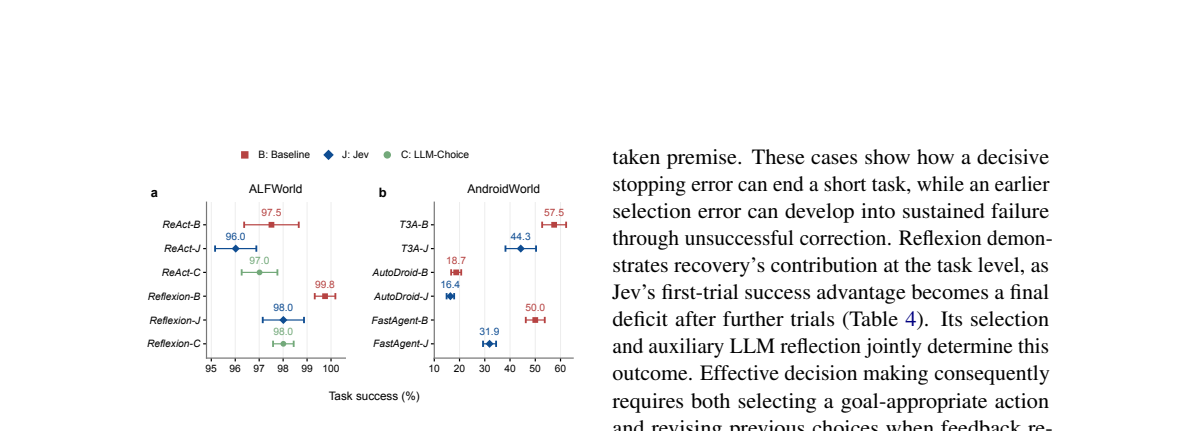
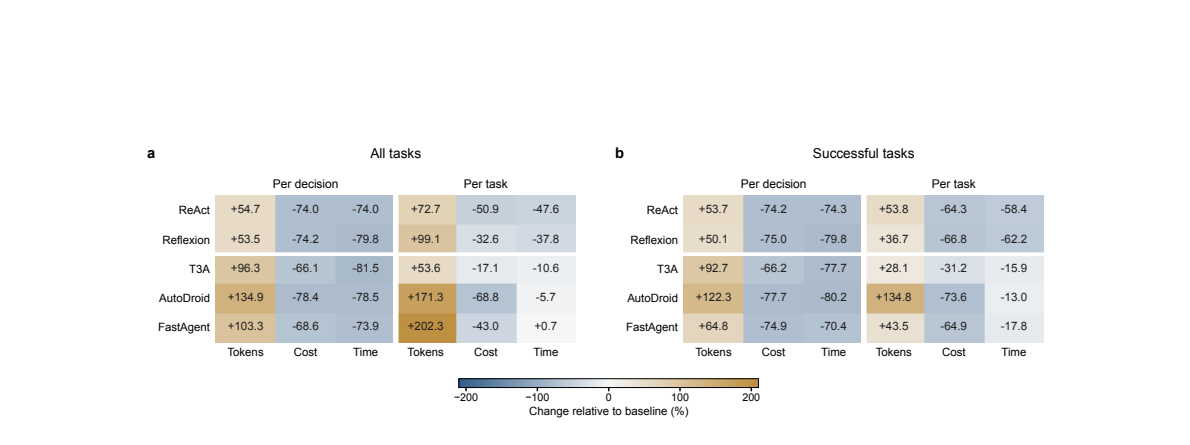
Core claim. The central empirical claim is that integrating Jev into LLM-based agents substantially reduces per-decision cost and latency across all five tested agent families, but these local savings do not reliably translate to task-level efficiency or maintain task success. Specifically, (i) success rates remain close to baseline on ALFWorld but decline significantly in two AndroidWorld agents (T3A by 13.2 pp, FastAgent by 18.1 pp); (ii) mean task costs fall across all agents but time savings vary and are null or negative for some; (iii) auxiliary reasoning, extra interactions, failed recovery, and premature completion absorb the decision savings; and (iv) mean cost per successful outcome rises for T3A by 7.7% despite lower per-attempt spending.
The premise it rests on. The observed differences between Jev and baseline configurations in AndroidWorld are attributed primarily to the decision-model change, even though not all integrations have an LLM-choice control and some involve small interface differences (e.g., FastAgent-J executes one tool per step while the baseline can emit multiple calls).
If the paper is right (Pith's inferences, not the authors')
Agent designers should not assume that faster, cheaper per-decision models automatically improve overall task throughput; the workflow's bottleneck may shift from selection to auxiliary reasoning, environment interaction, or recovery.
Evaluations of efficient decision models should include metrics such as cost and time per successful outcome, not just per-attempt averages, because failures can negate local savings.
Jev or similar models are most promising in workflows where selection dominates resource use, auxiliary generation is minimal, and task success is preserved, such as tool routing or routine software operations.
The findings suggest that verification and recovery mechanisms should be built around decisions that risk premature completion or persistent errors, as these patterns limit the value of faster selection.
When comparing model variants, workflow-level differences (e.g., one tool per step vs. multiple) must be disentangled from decision-model effects to avoid confounding.
The paper's results imply that any efficient decision model that lacks awareness of goal progress, prerequisite conditions, and completion criteria will likely exhibit the same patterns: local savings absorbed by workflow overhead and degraded task success. This generalizes beyond Jev to other 'system-1' models used for action selection.
A testable consequence is that agents with explicit progress monitoring and recovery policies (e.g., backtracking after repeated failure) would recover more of the decision-level savings than agents without such mechanisms. This could be evaluated by comparing Jev-integrated agents with and without a verification step.
The one-tool-per-step constraint in FastAgent-J, a workflow-level difference, may have amplified the drop in success by forcing sequential execution. Disentangling this confound would require a configuration where Jev can emit multiple tool calls per step, matching the baseline's capability.
The observed increase in cost per successful outcome for T3A suggests that even a small drop in success rate can outweigh large per-decision savings; a back-of-envelope calculation shows that if success falls by 13 pp from 57% to 44%, the per-success cost rises even if total cost per attempt drops by 17%, because the denominator shrinks faster.
Check this review
Pith stored no record of this review's passes and took no fingerprint of it. Reviews made by code from 13 Nov 2026 on carry both.
How often reviews like this one are right
Reviews like this one: written by deepseek-v4-flash, where what was read was not recorded.
How often objections from reviews like this one are right: not yet measured
Reviews by people
This review was written by a machine. No person has reviewed this paper on Pith yet. A scientist listed on Pith can review it for a fee, and their review is published here whatever it concludes.
The paper
Abstract
AI agents depend on repeated decisions to accomplish tasks, with large language models (LLMs) commonly serving as their core decision makers. The recent emergence of Jev offers an opportunity to make these decisions faster and at lower cost. However, it remains unclear whether such local savings can be translated into efficient and reliable task completion. In this paper, we investigate this efficiency transfer across five agents in two representative application settings, embodied tasks in ALFWorld and mobile app use in AndroidWorld. Across 4,500 task executions, we jointly evaluate task effectiveness, decision-level and task-level resource use, and execution behavior. Experimental results show that Jev integration substantially reduces decision cost and latency across all five agents, with task-level gains varying by workflow. Task success remains close to baseline levels on ALFWorld and declines more substantially in two mobile agents. Auxiliary reasoning and additional interactions absorb decision savings, while failed recovery and premature completion limit successful delivery. Mean cost per successful outcome increases in one agent even as spending per attempt falls. These findings highlight the importance of preserving progress, supporting recovery, and verifying completion when integrating efficient decision models into agent workflows. Their practical value should be assessed through successful task delivery, recovery behavior, and resources per delivered outcome.
The paper's own sentences, arranged, kept beside the review and separate from it. Each label is drawn from a closed vocabulary; the number beside it is the probability the classifier gave that label. No sentence in this record was written by a model.
abstract compiled · 2026-10-12
The authors' main claim, as the classifier picked it out 0.92
“These findings highlight the importance of preserving progress, supporting recovery, and verifying completion when integrating efficient decision models into agent workflows.”
How the main claim is stated: asserted 0.90
What the abstract itself states, as probabilities: claims first 0.04 · states limitation 0.68 · human participants 0.05 · controlled comparison 0.92 · randomized assignment 0.02 · states quantitative result 0.96 · compares with prior results 0.89 · mentions code or data availability 0.03
The abstract, sentence by sentence
This table labels the abstract only (arXiv listing abstract v1). The number is the probability the classifier gave the label.
| Sentence | Role | The authors' own work | States the main conclusion | Strength |
|---|---|---|---|---|
| AI agents depend on repeated decisions to accomplish tasks, with large language models (LLMs) commonly serving as their core decision makers. | background 1.00 | 0.04 | 0.02 | asserted 1.00 |
| The recent emergence of Jev offers an opportunity to make these decisions faster and at lower cost. | background 0.99 | 0.04 | 0.02 | hedged possibility 0.54 |
| However, it remains unclear whether such local savings can be translated into efficient and reliable task completion. | gap 1.00 | 0.05 | 0.03 | unclear 0.64 |
| In this paper, we investigate this efficiency transfer across five agents in two representative application settings, embodied tasks in ALFWorld and mobile app use in AndroidWorld. | method 0.59 | 0.85 | 0.02 | asserted 0.89 |
| Across 4,500 task executions, we jointly evaluate task effectiveness, decision-level and task-level resource use, and execution behavior. | method 0.97 | 0.96 | 0.02 | asserted 0.89 |
| Experimental results show that Jev integration substantially reduces decision cost and latency across all five agents, with task-level gains varying by workflow. | result 1.00 | 0.96 | 0.17 | asserted 1.00 |
| Task success remains close to baseline levels on ALFWorld and declines more substantially in two mobile agents. | result 1.00 | 0.94 | 0.13 | asserted 1.00 |
| Auxiliary reasoning and additional interactions absorb decision savings, while failed recovery and premature completion limit successful delivery. | result 0.58 | 0.90 | 0.18 | asserted 1.00 |
| Mean cost per successful outcome increases in one agent even as spending per attempt falls. | result 1.00 | 0.95 | 0.09 | asserted 1.00 |
| These findings highlight the importance of preserving progress, supporting recovery, and verifying completion when integrating efficient decision models into agent workflows. | interpretation 0.99 | 0.56 | 0.83 | asserted 0.90 |
| Their practical value should be assessed through successful task delivery, recovery behavior, and resources per delivered outcome. | interpretation 0.78 | 0.19 | 0.31 | asserted 0.66 |
What kind of paper the classifier reports this is: empirical study 1.00 · evidence from observation or experiment 0.99
What was examined, and what was not
Sources read
- arXiv listing abstract v1
Not examined
- full text
- figures and tables
- references and citing sentences
- relations to other papers
Levels run
- P abstract
Not run
- S sections
- T body sentences
- C citations
- R cross-paper relations
How the labels were made
Compiled by classifier-1.13.0 via TypeSafe API, question bank abstract-p1-20260923, 2026-10-12: 1 request, 8,027 input tokens.
Every quoted sentence on this record is the authors'. Every label is from Pith's closed vocabulary, with the probability shown beside it. This record as JSON
Figures (6)
Figures are the authors', reproduced from the paper.
References (35)
- [1] Diogo Almeida , title =. 2026 , month = sep, howpublished = on Pith
- [2] Primitives (Questions) , year = on Pith
- [3] Benchmarking Zero-shot Text Classification: Datasets, Evaluation and Entailment Approach , author =. Proceedings of the 2019 Conference on Empirical Methods in Natural Language Processing and the 9th International Joint Conference on Natural Language Processing (EMNLP-IJCNLP) ... on Pithdoi:10.18653/v1/d19-1404
- [4] Stepanov, Ihor and Shtopko, Mykhailo and Vodianytskyi, Dmytro and Lukashov, Oleksandr and Yavorskyi, Alexander and Yaroshenko, Mykyta , year =. 2508.07662 , archivePrefix = on PithPith's reviewarXiv
- [5] Rafe, Amir and Das, Subasish , year =. Calibrated Decisions at Scale: Converting Police Crash Narratives into Probabilistic Crash Variables with a System One Model (. 2609.24052 , archivePrefix = on PithPith's reviewarXiv
- [6] Ling, Guoming and Xue, Muen and Ye, Zijian , year =. 2609.30216 , archivePrefix = on PithPith's reviewarXiv
- [7] Devlin, Jacob and Chang, Ming-Wei and Lee, Kenton and Toutanova, Kristina , booktitle =. 2019 , pages = on Pith
- [8] Reimers, Nils and Gurevych, Iryna , booktitle =. Sentence-. 2019 , pages = on Pith
- [9] Shunyu Yao and Jeffrey Zhao and Dian Yu and Nan Du and Izhak Shafran and Karthik Narasimhan and Yuan Cao , year =. International Conference on Learning Representations , url = on Pith
- [10] Noah Shinn and Federico Cassano and Ashwin Gopinath and Karthik Narasimhan and Shunyu Yao , year =. Advances in Neural Information Processing Systems , url = on Pith
- [11] Guanzhi Wang and Yuqi Xie and Yunfan Jiang and Ajay Mandlekar and Chaowei Xiao and Yuke Zhu and Linxi Fan and Anima Anandkumar , year =. Transactions on Machine Learning Research , url = on Pith
- [12] Hao Wen and Yuanchun Li and Guohong Liu and Shanhui Zhao and Tao Yu and Toby Jia-Jun Li and Shiqi Jiang and Yunhao Liu and Yaqin Zhang and Yunxin Liu , year =. Proceedings of the 30th Annual International Conference on Mobile Computing and Networking , url = on Pith
- [13] John Yang and Carlos E. Jimenez and Alexander Wettig and Kilian Lieret and Shunyu Yao and Karthik Narasimhan and Ofir Press , year =. Advances in Neural Information Processing Systems , url = on Pith
- [14] Bowen Yang and Kaiming Jin and Zhenyu Wu and Zhaoyang Liu and Qiushi Sun and Zehao Li and JingJing Xie and Zhoumianze Liu and Fangzhi Xu and Kanzhi Cheng and Yian Wang and Qingyun Li and Yu Qiao and Zun Wang and Zichen Ding , booktitle =. 2026 , month = jul, pages = on Pith
- [15] Mohit Shridhar and Xingdi Yuan and Marc-Alexandre C. 2021 , booktitle = on Pith
- [16] Shuyan Zhou and Frank F. Xu and Hao Zhu and Xuhui Zhou and Robert Lo and Abishek Sridhar and Xianyi Cheng and Tianyue Ou and Yonatan Bisk and Daniel Fried and Uri Alon and Graham Neubig , year =. International Conference on Learning Representations , url = on Pith
- [17] Tianbao Xie and Danyang Zhang and Jixuan Chen and Xiaochuan Li and Siheng Zhao and Ruisheng Cao and Toh Jing Hua and Zhoujun Cheng and Dongchan Shin and Fangyu Lei and Yitao Liu and Yiheng Xu and Shuyan Zhou and Silvio Savarese and Caiming Xiong and Victor Zhong and Tao Yu , y... on Pith
- [18] Christopher Rawles and Sarah Clinckemaillie and Yifan Chang and Jonathan Waltz and Gabrielle Lau and Marybeth Fair and Alice Li and William E. Bishop and Wei Li and Folawiyo Campbell-Ajala and Daniel Kenji Toyama and Robert James Berry and Divya Tyamagundlu and Timothy P. Lill... on Pith
- [19] Carlos E. Jimenez and John Yang and Alexander Wettig and Shunyu Yao and Kexin Pei and Ofir Press and Karthik Narasimhan , year =. International Conference on Learning Representations , url = on Pith
- [20] Shunyu Yao and Noah Shinn and Pedram Razavi and Karthik Narasimhan , year =. International Conference on Learning Representations , url = on Pith
show 15 more
- [21] 2026 , howpublished = on Pith
- [22] Models:. 2026 , url = on Pith
- [23] Sayash Kapoor and Benedikt Stroebl and Zachary S. Siegel and Nitya Nadgir and Arvind Narayanan , journal =. 2025 , url = on Pith
- [24] Exploring the System 1 Thinking Capability of Large Reasoning Models , author =. Proceedings of the Thirty-Fifth International Joint Conference on Artificial Intelligence , year =. doi:10.24963/ijcai.2026/676 , url = on Pithdoi:10.24963/ijcai.2026/676
- [25] Intelligent Agents: Theory and Practice , author =. The Knowledge Engineering Review , volume =. 1995 , doi = on Pith
- [26] A Reduction of Imitation Learning and Structured Prediction to No-Regret Online Learning , author =. Proceedings of the Fourteenth International Conference on Artificial Intelligence and Statistics , series =. 2011 , url = on Pith
- [27] Isaac Ong and Amjad Almahairi and Vincent Wu and Wei-Lin Chiang and Tianhao Wu and Joseph E. Gonzalez and M Waleed Kadous and Ion Stoica , booktitle =. 2025 , url = on Pith
- [28] Yuanzhe Shen and Yide Liu and Zisu Huang and Ruicheng Yin and Xiaoqing Zheng and Xuanjing Huang , booktitle =. 2025 , pages =. doi:10.18653/v1/2025.emnlp-main.531 , url = on Pithdoi:10.18653/v1/2025.emnlp-main.531
- [29] Yanwei Yue and Guibin Zhang and Boyang Liu and Guancheng Wan and Kun Wang and Dawei Cheng and Yiyan Qi , booktitle =. 2025 , pages =. doi:10.18653/v1/2025.acl-long.757 , url = on Pithdoi:10.18653/v1/2025.acl-long.757
- [30] Guibin Zhang and Haiyang Yu and Kaiming Yang and Bingli Wu and Fei Huang and Yongbin Li and Shuicheng Yan , booktitle =. 2026 , pages =. doi:10.18653/v1/2026.acl-long.1771 , url = on Pithdoi:10.18653/v1/2026.acl-long.1771
- [31] Dujian Ding and Ankur Mallick and Chi Wang and Robert Sim and Subhabrata Mukherjee and Victor R. International Conference on Learning Representations , year = on Pith
- [32] Timo Schick and Jane Dwivedi-Yu and Roberto Dess. Advances in Neural Information Processing Systems , volume =. 2023 , doi = on Pith
- [33] Language Agent Tree Search Unifies Reasoning, Acting, and Planning in Language Models , author =. Proceedings of the 41st International Conference on Machine Learning , series =. 2024 , url = on Pith
- [34] Xiao Liu and Hao Yu and Hanchen Zhang and Yifan Xu and Xuanyu Lei and Hanyu Lai and Yu Gu and Hangliang Ding and Kaiwen Men and Kejuan Yang and Shudan Zhang and Xiang Deng and Aohan Zeng and Zhengxiao Du and Chenhui Zhang and Sheng Shen and Tianjun Zhang and Yu Su and Huan Sun... on Pith
- [35] Tianyue Ou and Wanyao Guo and Apurva Gandhi and Graham Neubig and Xiang Yue , booktitle =. 2025 , pages =. doi:10.18653/v1/2025.emnlp-demos.15 , url = on Pithdoi:10.18653/v1/2025.emnlp-demos.15
Cited by 3 Pith papers
Reviewed papers on Pith that cite this one. The full citation record
Challenges and discussion
Disagree with the review, or know something it missed? Leave a comment, or challenge this review formally: a challenge becomes a permanent entry in this paper's record, and its decision is published here.
Come back by email
A short list of the week's newly reviewed papers. Nothing is sent until you confirm from your inbox, and every email has a link that stops it. No account.
No comments yet.
Sign in to comment