Machine Learning · arXiv:2610.13202 v2 · submitted 9 Oct 2026
S3R: Fast and Faithful RL Rollouts via Self-Sparse Speculative Decoding
The paper says
“Fast rollout generation for long-context reinforcement learning with verifiable rewards (RLVR) requires reducing KV-cache traffic without changing the response groups used for policy optimization. In our profiled RLVR workloads, attention accounts for 72–76% of autoregressive decoding kernel time.”
more of the abstract
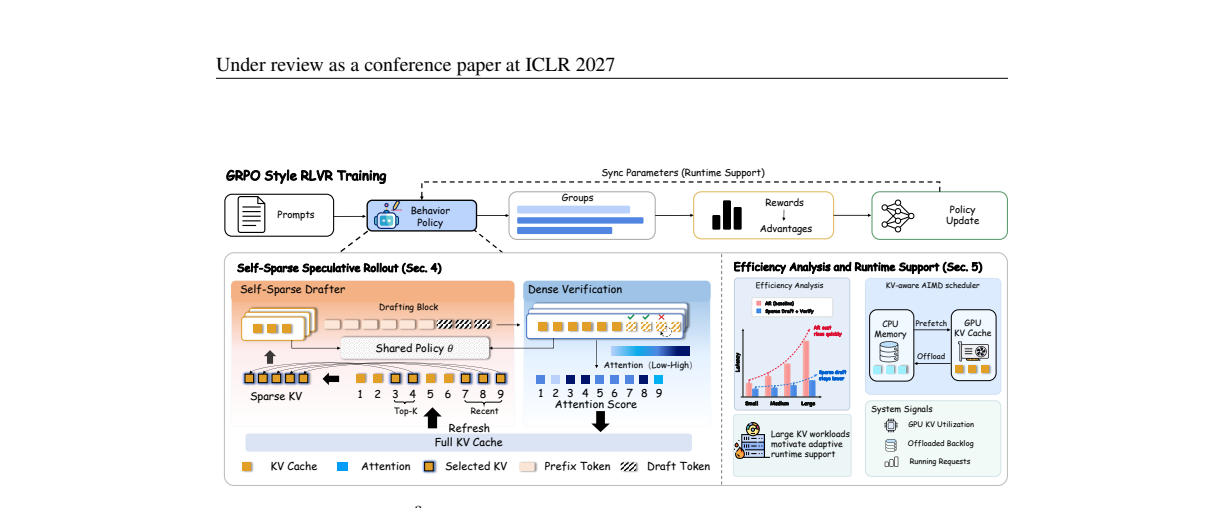
Sparse attention reduces these reads, but sampling directly from a sparse policy changes the response groups used for learning. For group-relative optimization, we show that even exact response-wise reweighting does not generally recover the expected dense-policy update because the advantage of each response depends on the rewards of other group members. We propose Self-Sparse Speculative Rollouts (S3R). It uses sparse attention to propose tokens, then generates responses through full-attention verification and exact speculative sampling. Drafting and verification share the same policy parameter, eliminating the need to train or update a separate drafter. The resulting response groups follow the dense-policy distribution. Under S3R, we characterize speedup conditions and the costs of drafting and verification. We found that dense verification still requires the complete historical KV cache. A KV-aware scheduler therefore limits KV-cache repeated offloading and restoration while maintaining rollout parallelism. % OR thrashing In a matched ablation with an aggressive sparse drafting budget, S3R maintains stable training while direct sparse sampling with training-side correction becomes unstable. On long-context mathematical reasoning, S3R achieves 1.39 × 1.35 × the end-to-end training throughput of autoregressive rollouts on Qwen3 model, with comparable task performance.
from the abstract
Pith says
Machine review · deepseek-v4-flash · 12 Oct 2026 · of version 1 of the paper; version 2 is newer · what was read was not recorded · not checked by a person
It can be wrong. Challenge this review or reply to it.
Holds up. Solid, practical paper that identifies and addresses a real bottleneck in long-context RL rollouts with clean theory and thorough experiments. This line is wrong
6 minor
How often objections from reviews like this one are right: not yet measured
Not checked: figures, code, what the references say.
6 minor objections
The paper says, at Abstract; Table 1
Pith says: minor objection 1 of 6
The throughput values in the abstract are written as '1.39x1.35x' with no separator. Insert a word like 'and' between the two values for clarity.
The paper says, at Section 3.3, paragraph 1 and Appendix A.3
Pith says: minor objection 2 of 6
Typo: 'taregt distribution' should be 'target distribution'. Please check the final version.
show 4 more
The paper says, at Table 7 and Appendix F.2.2
Pith says: minor objection 3 of 6
The staged timing analysis uses CUDA graphs for AR and drafting but eager execution for verification (line 695), which may systematically undercount verification latency. State whether this choice affects the breakeven acceptance thresholds reported in Table 7.
The paper says, at Appendix C.1 and Table 1
Pith says: minor objection 4 of 6
The AR baseline uses vLLM as the inference backend while S3R uses veRL's built-in mechanism. Clarify whether any throughput difference between vLLM and veRL for autoregressive decoding could create a systematic confound in the speedup comparision. The comparison against other speculative methods that also use veRL partially addresses this, but the speedup ratio relative to AR is the primary metric.
The paper says, at Appendix A.2, Eq. (11)
Pith says: minor objection 5 of 6
The GRPO counterexample uses three on-token responses and rewards (0,1,2). State explicitly that this is a minimal illustration; the change-of-measure proof (Eq.8) provides the general argument.
The paper says, at Figure 1 caption and Table 5
Pith says: minor objection 6 of 6
Figure 1(a) rows attention share as a percentage of 'kernel time'; Table 5 rows breakdowns including 'Other'. Add a footnote explaining what 'Other' covers (e.g., collectives, scheduling overhead) for reproducibility.
What would settle it
Perform a statistical Two-Sample Test (e.g., Maximum Mean Discrepancy) on the distributions of response groups generated by S3R versus dense AR rollouts on a held-out prompt set at a fixed step, with the same random seed. If the test rejects the null at significance α=0.01, then the practical implementation deviates from the theoretical preservation claim beyond sampling noise, warranting investigation.
from the skeptic's reading
How the review went
4 readings by deepseek-v4-flash · 12 Oct 2026
- Reader holds up
- Skeptic agrees
- Editor wrote the verdict above
- Referee minor revision: 6 minor
Not run on this paper: the simulated authors' defence.
Pith did not check this review's objections against the paper.
The review in full
The review in brief, machine-written
This paper tackles a concrete problem—KV-cache traffic dominates rollout generation in long-context GRPO training—and proposes a method that is both principled and immediately useful. The key insight is that direct sparse rollouts produce a group-level bias that response-wise correction cannot fix, because advantages depend on the full group. The authors correctly show this (Proposition 1) and then prove that speculative decoding with sparse self-drafting and full-attention verification preserves the dense response-group distribution (Proposition 2). The experimental work is thorough: two model sizes, multiple baselines, ablation studies, and diagnostics on acceptance rates, throughput, and training stability. The method achieves 1.35-1.39x end-to-end throughput gains with matched task performance, and the stability comparison against direct sparse rollouts with correction is convincing.
The paper is honest about its scope. It acknowledges that the speedup depends on the workload being attention-dominated, that drafting retains projection work even when attention savings are small, and that the KV-aware scheduler is a pragmatic addition. The limitations in low-KV regimes are clearly stated.
Soft spots: the reported speedup is solid but not transformative—1.35x on a specific workload and architecture. The scheduler and runtime support, while effective, are fairly specific to the setup. The paper could do more to characterize how the method generalizes to different model architectures (e.g., MoE) or tasks beyond mathematical reasoning, but that is future work and the authors flag it.
This is a paper I would bring to a reading group focused on efficient LLM training or RL systems. It deserves a serious peer review; the claims are well-supported and the contribution is clear. I would cite it in work on efficient RL post-training.
Recommendation: accept for peer review.
The strongest objection
The paper's central claims are well-supported: Proposition 2 provides a correct proof that S3R preserves the dense response-group distribution, and the experimental results demonstrate stable training and throughput improvements consistent with that theoretical guarantee. The primary practical limitation—that speedup depends on the workload being attention-dominated and on amortizing drafting costs—is acknowledged and quantitatively characterized in §5 and Appendix F.1. The paper does not overclaim; it reports concrete speedups on a specific workload and model family. No internal inconsistency, hidden assumption, or unreconciled empirical gap undermines the central argument. The reader's verdict and weakest assumption accurately capture the scope of the method's applicability.
The paper presents a methodologically sound approach to accelerating RL rollouts while preserving the distribution required for GRPO. The theoretical proof (Proposition 2, Appendix A.3) is correctly reasoned; the experimental evaluation covers two model sizes, multiple baselines, and ablations; and the limitations (attention-d ore regime, KV-cache management) are acknowledged and analyzed. The reader's verdict of ACCEPT with high confidence and low correctness risk is consistent with the paper's quality. I found no load-bearing concern that would justify a different verdict, so the recommendation is to keep the verdict unchanged.
The referee's report
If the results hold, the paper makes several contributions. The group-level mismatch analysis (Proposition 1) identifies a fundamental limitation of response-wise correction in GRPO that goes beyond token-level importance sampling issues. The practical separation of sparse drafting from faithful verification addresses a concrete systems bottleneck in RLVR training (attention-dominated decoding at large KV volumes). The experimental validation is thorough: two model sizes, multiple baselines, ablations on sparsity budget and KV management, and diagnostic analysis of acceptance dynamics. The method avoids separate drafter training, addressing a deployment friction in iterative RL fine-tuning. The paper is self-contained with proofs in the appendix and all claims supported by evidence.
Pith's reading of the paper (a machine's summary, not the authors')
The paper addresses the rollout generation bottleneck in reinforcement learning with verifiable rewards (RLVR), where attention accounts for 72–76% of decoding time. It proposes Self-Sparse Speculative Rollouts (S3R), which uses a sparse attention drafter to cheaply propose tokens and a full-attention verifier with exact rejection sampling to guarantee that the final tokens follow the original dense policy. This separation preserves the response-group distribution for group-relative policy optimization (GRPO), avoiding the training instability observed when sparse sampling is used directly or corrected with response-wise importance weights. The drafter shares the policy weights with the verifier, eliminating separate drafter training or updates. On long-context mathematical reasoning, S3R achieves 1.39× and 1.35× the end-to-end training throughput of autoregressive decoding on Qwen3-1.7B and Qwen3-8B, with comparable task performance and stable training throughout.
What carries the argument. Three components carry the argument: (1) sparse self-drafting, which uses the verification pass's attention scores to select a subset of the historical KV cache for cheap draft generation, reducing attention reads; (2) full-attention verification with exact rejection sampling that guarantees the output token distribution matches the dense policy; (3) a KV-aware AIMD scheduler that adaptively limits request concurrency to prevent repeated KV cache offloading and restoration, preserving the complete state needed for verification while maintaining rollout parallelism.
Core claim. The central claim is that S3R preserves the dense response-group distribution of GRPO while accelerating generation, because the sparse proposal distribution is corrected by exact speculative sampling from the same policy. This means the advantages computed within each group of responses follow the same distribution as if all tokens were generated by full attention, avoiding the instability observed when using sparse attention directly or with response-wise correction. The method demonstrates that sparsity can be confined to proposal generation without altering the training signal, and that a KV-aware scheduler can maintain the full KV cache needed for verification without thrashing.
The premise it rests on. The speedup of S3R requires that the attention computation dominates decoding cost; when the KV volume is small or the model is compute-bound, the overhead of drafting and verification can outweigh the savings, as the paper acknowledges in its latency analysis.
If the paper is right (Pith's inferences, not the authors')
Training throughput increases by up to 39% on Qwen3-1.7B and 35% on Qwen3-8B compared to autoregressive decoding, with no degradation in task performance.
The response-group distribution remains identical to that of full-attention sampling, so no sparsity-induced correction is needed in the GRPO objective, simplifying the training pipeline.
The KV-aware scheduler reduces page transfers per 1,000 generated tokens by 93% on Qwen3-1.7B compared to a fixed-concurrency offload baseline, recovering throughput lost to cache thrashing.
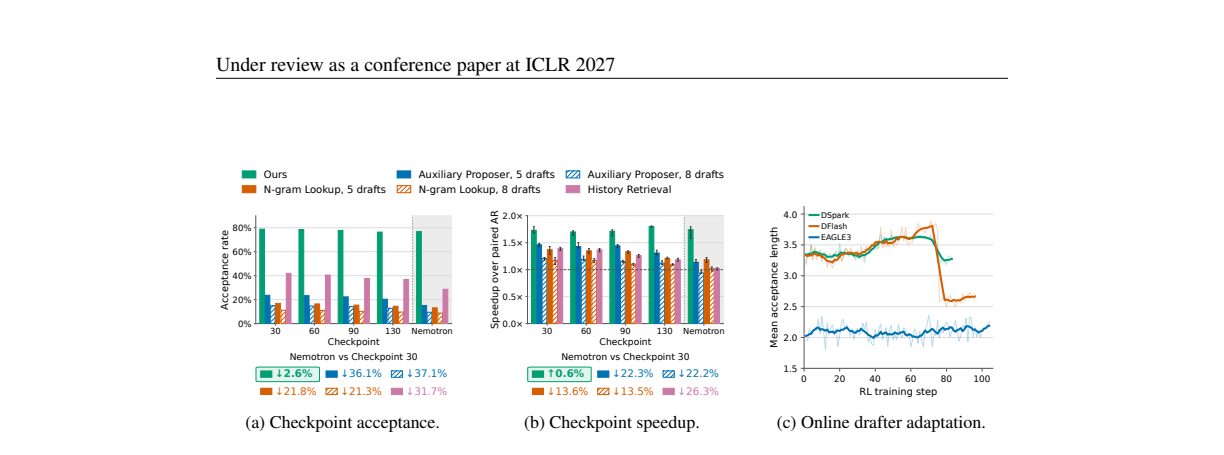
The method remains robust as the policy evolves: draft-token acceptance stays around 78% across training, unlike frozen auxiliary drafters which degrade over time.
The sparse budget can be chosen for efficiency alone without affecting the learning signal, enabling a 5% budget as a practical balance between drafting cost and accepted progress.
Because S3R's speedup hinges on attention dominance, the method could be blended with quantization or other KV compression to extend benefits to projection-dominated workloads, but that combination would need separate validation.
The analysis of response-wise weighting failure in GRPO implies that any approximation in generation that alters group reward comparisons will bias gradient estimates, not just sparsity; this may guide design of other approximate rollout methods.
S3R's checkpoint portability results suggest it could be applied to any off-the-shelf LLM checkpoint without drafter finetuning, making it practical for deployment scenarios where a matched auxiliary drafter is unavailable or costly to maintain.
The KV-aware scheduler principle is independent of S3R and could improve any speculative decoding system that relies on a full KV cache for verification under memory pressure.
Check this review
Pith stored no record of this review's passes and took no fingerprint of it. Reviews made by code from 13 Nov 2026 on carry both.
How often reviews like this one are right
Reviews like this one: written by deepseek-v4-flash, where what was read was not recorded.
How often objections from reviews like this one are right: not yet measured
Reviews by people
This review was written by a machine. No person has reviewed this paper on Pith yet. A scientist listed on Pith can review it for a fee, and their review is published here whatever it concludes.
The paper
Abstract
Fast rollout generation for long-context reinforcement learning with verifiable rewards (RLVR) requires reducing KV-cache traffic without changing the response groups used for policy optimization. In our profiled RLVR workloads, attention accounts for 72–76% of autoregressive decoding kernel time. Sparse attention reduces these reads, but sampling directly from a sparse policy changes the response groups used for learning. For group-relative optimization, we show that even exact response-wise reweighting does not generally recover the expected dense-policy update because the advantage of each response depends on the rewards of other group members. We propose Self-Sparse Speculative Rollouts (S3R). It uses sparse attention to propose tokens, then generates responses through full-attention verification and exact speculative sampling. Drafting and verification share the same policy parameter, eliminating the need to train or update a separate drafter. The resulting response groups follow the dense-policy distribution. Under S3R, we characterize speedup conditions and the costs of drafting and verification. We found that dense verification still requires the complete historical KV cache. A KV-aware scheduler therefore limits KV-cache repeated offloading and restoration while maintaining rollout parallelism. % OR thrashing In a matched ablation with an aggressive sparse drafting budget, S3R maintains stable training while direct sparse sampling with training-side correction becomes unstable. On long-context mathematical reasoning, S3R achieves 1.39 × 1.35 × the end-to-end training throughput of autoregressive rollouts on Qwen3 model, with comparable task performance.
The paper's own sentences, arranged, kept beside the review and separate from it. Each label is drawn from a closed vocabulary; the number beside it is the probability the classifier gave that label. No sentence in this record was written by a model.
abstract compiled · 2026-10-12
The authors' main claim, as the classifier picked it out 0.97
“On long-context mathematical reasoning, S$^3$R achieves $1.39\times~1.35\times$ the end-to-end training throughput of autoregressive rollouts on Qwen3 model, with comparable task performance.”
How the main claim is stated: asserted 1.00
What the abstract itself states, as probabilities: claims first 0.05 · states limitation 0.89 · human participants 0.02 · controlled comparison 0.91 · randomized assignment 0.02 · states quantitative result 0.99 · compares with prior results 0.94 · mentions code or data availability 0.03
The abstract, sentence by sentence
This table labels the abstract only (arXiv listing abstract v1). The number is the probability the classifier gave the label.
| Sentence | Role | The authors' own work | States the main conclusion | Strength |
|---|---|---|---|---|
| Fast rollout generation for long-context reinforcement learning with verifiable rewards (RLVR) requires reducing KV-cache traffic without changing the response groups used for policy optimization. | background 0.97 | 0.16 | 0.07 | asserted 0.98 |
| In our profiled RLVR workloads, attention accounts for 72--76\% of autoregressive decoding kernel time. | result 0.82 | 0.89 | 0.03 | asserted 1.00 |
| Sparse attention reduces these reads, but sampling directly from a sparse policy changes the response groups used for learning. | background 0.73 | 0.28 | 0.04 | asserted 0.99 |
| For group-relative optimization, we show that even exact response-wise reweighting does not generally recover the expected dense-policy update because the advantage of each response depends on the rewards of other group members. | result 0.65 | 0.80 | 0.09 | asserted 1.00 |
| We propose Self-Sparse Speculative Rollouts (S$^3$R). | contribution 0.93 | 0.72 | 0.09 | asserted 0.90 |
| It uses sparse attention to propose tokens, then generates responses through full-attention verification and exact speculative sampling. | method 0.98 | 0.72 | 0.12 | asserted 1.00 |
| Drafting and verification share the same policy parameter, eliminating the need to train or update a separate drafter. | method 0.97 | 0.69 | 0.06 | asserted 1.00 |
| The resulting response groups follow the dense-policy distribution. | result 0.44 | 0.76 | 0.16 | asserted 1.00 |
| Under S$^3$R, we characterize speedup conditions and the costs of drafting and verification. | contribution 0.94 | 0.91 | 0.07 | asserted 0.90 |
| We found that dense verification still requires the complete historical KV cache. | result 0.85 | 0.90 | 0.04 | asserted 1.00 |
| A KV-aware scheduler therefore limits KV-cache repeated offloading and restoration while maintaining rollout parallelism. % OR thrashing In a matched ablation with an aggressive sparse drafting budget, S$^3$R maintains stable training while direct sparse sampling with training-side correction becomes unstable. | result 0.56 | 0.86 | 0.12 | asserted 0.97 |
| On long-context mathematical reasoning, S$^3$R achieves $1.39\times~1.35\times$ the end-to-end training throughput of autoregressive rollouts on Qwen3 model, with comparable task performance. | result 1.00 | 0.95 | 0.45 | asserted 1.00 |
What kind of paper the classifier reports this is: method or tool 1.00 · evidence from observation or experiment 0.93
What was examined, and what was not
Sources read
- arXiv listing abstract v1
Not examined
- full text
- figures and tables
- references and citing sentences
- relations to other papers
Levels run
- P abstract
Not run
- S sections
- T body sentences
- C citations
- R cross-paper relations
How the labels were made
Compiled by classifier-1.13.0 via TypeSafe API, question bank abstract-p1-20260923, 2026-10-12: 1 request, 8,853 input tokens.
Every quoted sentence on this record is the authors'. Every label is from Pith's closed vocabulary, with the probability shown beside it. This record as JSON
Figures (13)





Figures are the authors', reproduced from the paper.
Challenges and discussion
Disagree with the review, or know something it missed? Leave a comment, or challenge this review formally: a challenge becomes a permanent entry in this paper's record, and its decision is published here.
Come back by email
A short list of the week's newly reviewed papers. Nothing is sent until you confirm from your inbox, and every email has a link that stops it. No account.
No comments yet.
Sign in to comment