Quantum Physics · arXiv:2610.13880 v2 · submitted 9 Oct 2026
Bicycle Race: small two-block codes on the Pareto frontier
The paper says
“Two-block group-algebra codes are among the simplest quantum LDPC codes, and many of them are translation invariant on a twisted torus, which suits neutral-atom arrays and other platforms with movable qubits.”
more of the abstract
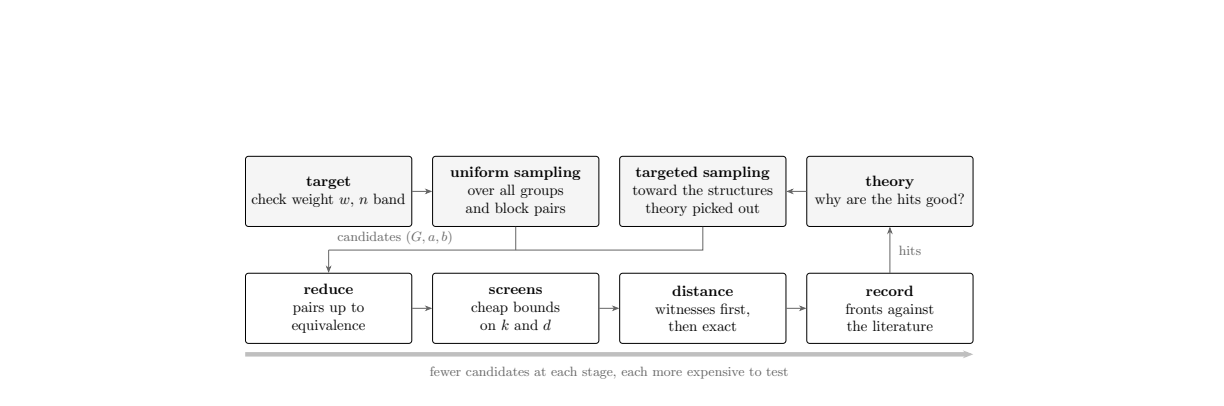
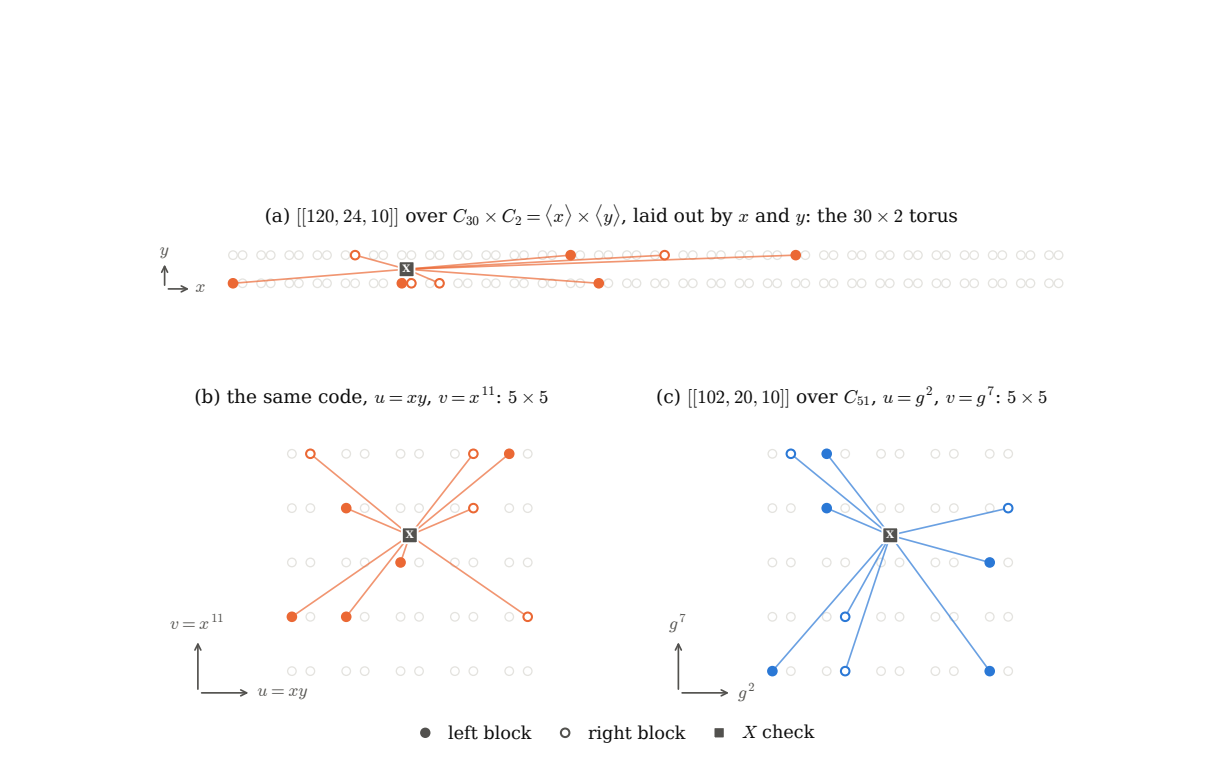
We ask how far they go at small sizes when searched systematically across all groups. We use algebraic constraints and screens to design a search pipeline capable of enumerating broad and complete swathes of two-block codes on a laptop. With it we census about 108 two-block codes with up to 320 qubits at check weights five to nine. Several of these censuses are exhaustive, and support complete statements; for instance, the Gross code is, up to equivalence, the only abelian weight-six two-block code with n ≤ 200 to reach kd2/n = 12, no weight-six two-block code with n ≤ 300 beats [[288,16,16]], and the known [[64,18,8]] is the best two-block code by kd2/n across weights five to nine with n ≤ 94. The censuses are also large enough to give insights into where good codes live - they concentrate in a handful of groups; abelian groups give the best codes at small n and non-abelian groups at large n, with the crossover appearing to move out as the check weight grows; and high quality codes become 100 to 1000 times rarer per draw from weight six to weights eight and nine. Using the group algebra and the census data to steer a statistical search finds four to fifteen times as many good codes as uniform draws in equal time. Among the codes found are [[102,20,10]] and [[120,24,10]] at check weight nine, which we simulate in noisy syndrome-extraction circuits, and [[186,20,18]], a weight-nine code with every check in a 5 × 5 window. At check weights seven to nine, our best codes exceed the best published kd2/n with exact distance at the same check weight in most length bands up to 320 qubits. All codes are available in a public database.
from the abstract
Pith says
Machine review · deepseek-v4-flash · 12 Oct 2026 · of version 1 of the paper; version 2 is newer · what was read was not recorded · not checked by a person
It can be wrong. Challenge this review or reply to it.
Holds up, with conditions. Serious computational census that likely restores small two-block codes as competitive, but the headline 'best' rankings need independent confirmation of the d>15 distances before the central claim is fully loaded. This line is wrong
2 major objections · 4 minor
How often objections from reviews like this one are right: not yet measured
Not checked: figures, code, what the references say.
The paper says, at App. C.4-C.5, Sec. 3.3, Table 2
The review did not quote this passage.
Pith says: Objection 1 of 2 · major
The central ranking claims are quadratic in the exact distance, but for every code with d>15 the lower-bound direction rests on a single unreleased numba engine. The paper's own disclosure says the independent dist-m4ri confirmation covers 'best codes with d≲15' and that beyond that they rest on the author's engine, albeit cross-checked by independent upper-bound searches for lighter logicals.
more of objection 1
A witness of weight d proves only that d is at most the reported value; the absence of a lighter logical is exactly what the unreleased engine must show, and an upper-bound search cannot prove that absence. This matters concretely: for [[288,16,16]], a true distance of 15 would change kd^2/n from 14.22 to 12.50, below the [[254,14,16]] of Liang et al.; for [[292,22,23]], d=22 would score 36.5, below the [[232,62,12]] anchor of 38.5. App. C.5's statement that chosen codes were further checked via QDistRnd and dist-m4ri is in tension with the d≲15 statement and does not say whether [[288,16,16]], [[292,22,23]], [[294,24,21]], and the other d>15 codes were covered. Please either release the engine, report independent exact-distance verification for every code that carries a 'best', 'only', or 'exceeds published' statement, or explicitly mark those claims as provisional.
The paper says, at Sec. 2.4, App. E.3, Code availability
The review did not quote this passage.
Pith says: Objection 2 of 2 · major
The exhaustive 'no code beats' direction is well designed: screens reject only with sound arguments and witnesses, and orbit-size sums check completeness of class enumeration. However, the companion 'the best code is X' direction requires an exact lower bound for the winning code, so the exhaustive statements for weight six with n>200 ([[288,16,16]]), and the corresponding weight-seven, weight-eight, and weight-nine highlights, inherit the same unverified-engine dependence as the rankings.
more of objection 2
In addition, the statement in the Code availability paragraph that the library will be released only with a forthcoming work makes it impossible for a reader to audit this single load-bearing component. I ask the revision to either include the exact-distance engine (or a frozen, versioned binary with logs) in the public repository, or provide independent lower-bound certificates for the d>15 codes that appear in exhaustive claims.
4 minor objections
The paper says, at Sec. 2.2
Pith says: minor objection 1 of 4
The word 'inspirede' near the discussion of the Pareto front is a typo and should read 'inspired'.
The paper says, at Sec. 4
Pith says: minor objection 2 of 4
The citation 'Refs. [HA W26, AGR+25]' should be formatted as '[HAW26, AGR+25]' to match the bibliography entry.
show 2 more
The paper says, at Sec. 3.1, Table 2 caption
Pith says: minor objection 3 of 4
The phrase 'All distances are exact, with a witness' would be clearer as 'exact, with a tight witness; the verification record states which tool established the lower bound', given the different verification levels for d≲15 and d>15.
The paper says, at Sec. 3.3, Table 3
Pith says: minor objection 4 of 4
The uniqueness statements use the term 'up to equivalence' while the implemented equivalence is the specific set of moves N1-N4 plus Tanner canonicalization, which the paper itself notes is not known to be complete; a pointer to App. B.2 and App. C.1 at the first use would remove ambiguity about the intended relation.
What would settle it
Independently re-verify the exact distances of the ranking-carrying d>15 codes — [[288,16,16]], [[292,22,23]], [[294,24,21]], [[294,18,20]], [[288,4,20]], [[186,20,18]], [[252,16,20]], [[288,32,18]], [[264,4,19]], [[240,4,18]] — with dist-m4ri as published (the same independent exact engine the paper uses for d≲15), which is feasible: Table 7 shows dist-m4ri already reaches d=18 in a few hours on comparable hardware. If every code returns the reported d, the engine's lower bounds are credible and the rankings stand; if any code returns a smaller d, recompute kd²/n for every statement in Secs. 3.1, 3.3, Tables 2, 9, 11, and Figs. 1, 8, 16–17, since each comparison is single-distance-sensitive. Releasing the engine (promised only with a forthcoming work) would aid auditability but would not replace this independent check.
from the skeptic's reading
How the review went
4 readings by deepseek-v4-flash · 12 Oct 2026
- Reader holds up, with conditions
- Skeptic agrees
- Editor wrote the verdict above
- Referee major revision: 2 major objections, 4 minor
Not run on this paper: the simulated authors' defence.
Pith did not check this review's objections against the paper.
The review in full
The review in brief, machine-written
Plainly: this is a serious paper and the central claim is likely true, but its headline-best statements still have one unresolved load-bearing bolt. The paper is a computational census, not a new construction: exhaustive searches over two-block group-algebra codes, orbit-size completeness checks, a public database with witnesses, fixed anchors, independent dist-m4ri checks for d≤15, and an unusually candid AI-methodology note.
Credit where due: the exhaustive censuses are the real contribution. Weight-five and weight-six up to n=300, weight-eight n≤100, weight-nine n≤94; the Gross-code uniqueness statement among abelian weight-six codes with n≤200; and [[64,18,8]] as the best across weights 5–9 for n≤94 are new, checkable claims. The database with witnesses and verification records is a genuinely useful benchmark. The four-to-fifteen-fold targeted-sampling gain is a measured result. The paper also does not overclaim in the places it can control: anchors and floors were set before results, and the rejection screens are sound by design.
Soft spots. The rankings are kd2/n, quadratic in d, and several load-bearing distances (d=16, d=23) come only from the author's unreleased numba exact-distance engine. The public witnesses prove d ≤ reported value; they do not rule out a lighter logical. The paper says d≲15 is independently confirmed and that the d>15 codes rest on the in-house engine. That boundary sits exactly under the central claim: if [[288,16,16]] has d=15, its kd2/n drops below the published [[254,14,16]], and the abstract's headline inverts. The author acknowledges the boundary honestly; it is still unresolved. The search and distance code itself is also held back for a forthcoming work, so the decisive lower-bound engine cannot be audited now, even though witnesses and database records mean the upper bounds are independently checkable. The incomplete equivalence moves are acknowledged; for uniqueness statements that matters, though not for existence of the codes. The weight-nine non-abelian search is sampled, not exhaustive, and the LER simulations are proof-of-principle with transfer noise excluded. All of that is flagged in the paper itself.
Bottom line: this deserves serious peer review, not desk rejection. The most useful path is conditional acceptance: release the exact-distance and search engine, or get independent exact confirmation for the d>15 codes, and either complete the equivalence handling or soften the uniqueness claims. The census data and the empirical landscape statements will be useful regardless of how that lands.
The strongest objection
The central claim — small two-block codes are competitive once searched hard (Sec. 5, b384) — is a ranking claim: every 'best', 'only', and 'exceeds published' statement compares kd²/n, which is quadratic in the exact distance d. The public database supplies tight witnesses, but a witness of weight exactly d proves d ≤ reported value; it cannot rule out a lighter logical. The lower direction for the codes that carry the claim is produced by the unreleased numba engine. The AI-methodology disclosure is explicit: 'the exact distances of our best codes with d≲15 are confirmed by an independent open-source engine (dist-m4ri). Beyond that they rest on our engine, albeit cross-checked by independent upper bound searches for lighter logicals.' The flagship census result, [[288,16,16]] — the best weight-six two-block code with n≤300 (abstract, Sec. 3.3, Fig. 8) — has d=16, so its lower bound sits outside that envelope, and App. C.5's remark that 'chosen codes' were further checked via QDistRnd and dist-m4ri is in tension with the d≲15 statement and does not clearly cover this code. The failure mode is concrete: the exact engine (App. C.4) owes its speed to the LOM+26 pruning bounds and symmetry roots, the classic place for soundness bugs; a branch that contained a lighter logical and was pruned would silently overstate d, and my concern is not some exotic scenario. Heuristic 'upper bound searches for lighter logicals' cannot catch this, since failing to find a logical is not a proof of absence. If d([[288,16,16]]) were 15, its kd²/n drops from 14.22 to 12.5, below the published [[254,14,16]] at 14.11, reversing the abstract's headline; if d([[292,22,23]]) were 22, it falls below [[232,62,12]] and the claim of the 'highest among weight-eight CSS codes with n≤320 and exact distance' (Sec. 3.1) fails. The author honestly acknowledges the boundary; the open question is whether the boundary is load-bearing. It is: it sits exactly under the central claim.
The reader's weakest assumption — exact distance lower bounds for codes with d>15 rest on an unreleased engine — is also, in my read, the single most load-bearing point, and I agree with it. The central claim is a comparison claim built on kd²/n, and the quadratic dependence on d means every headline statement (uniqueness of the Gross code at 12; [[288,16,16]] as best weight-six at n≤300; [[292,22,23]] at 39.9; 'exceeds the best published kd²/n with exact distance in most length bands') is a one-number function of an exact distance. The upper direction is safe: witnesses are proofs. The exhaustive-census completeness has internal orbit-count support and public coverage records. The d≤15 exactness has independent confirmation. The unresolved point is exactly the d>15 lower bounds, which the paper's own disclosure places on the unreleased engine, and the paper's verification statements in App. C.5 and the AI-methodology section do not clearly reconcile on whether the d>15 'chosen codes' were independently confirmed. The concrete failure mode is the pruning and symmetry machinery of App. C.4: an implementation bug that discards a branch containing a lighter logical would overstate d, and upper-bound cross-checks cannot detect a missed lighter logical. I weighed alternatives and set them aside: literature-set completeness is hedged ('in most length bands'), versioned, frozen, and open to corrections, and a missed code is not concretely attackable from the text; incomplete equivalence moves are acknowledged (b551) and under-merging cannot create a false 'best' claim; the crossover and rarity observations are explicitly heuristic; the LER simulations are explicitly unoptimized proof-of-principle. Credit where due: the paper is unusually well-verified in the region it claims — d≤15 independent confirmation, tight public witnesses, orbit-size completeness proofs, anchors frozen before results, and a versioned literature set with adversarial audits. The CONDITIONAL verdict is exactly right: acceptance should wait on independent exact confirmation (or engine release), which the proposed dist-m4ri re-verification of the ten ranking-carrying d>15 codes would settle. My read does not move the reader's verdict.
The referee's report
If the exact-distance and exhaustiveness claims hold, this is a substantial contribution: it replaces anecdotal comparisons with a census-supported map of small two-block codes, gives concrete evidence that the apparent small-size advantage of lifted-product constructions is at least partly a search-effort effect, and provides a public, witness-bearing database. The paper is unusually careful in fixing anchors and floors before results, checking orbit-size completeness, cross-checking d<=15 codes with dist-m4ri, and supplying witnesses. The principal risk is that the headline 'best' and 'only' statements are ranking claims quadratic in the exact distance, and for d>15 codes the lower-bound direction rests on a single unreleased engine. This is a verification gap, not a demonstrated error, and in my view it is fixable within revision.
Pith's reading of the paper (a machine's summary, not the authors')
Two-block group-algebra codes are among the oldest and simplest quantum LDPC constructions, and many of them tile a twisted torus, which suits neutral-atom and other movable-qubit platforms. The paper claims that this simplicity never cost them: an algebraically screened, partially exhaustive search over about $10^8$ codes on a laptop finds two-block codes sitting on the Pareto frontier up to $n \le 320$, with the best codes at check weights seven to nine exceeding the best published $kd^2/n$ (at exact distance) in most length bands. The censuses are complete enough for definitive statements: the Gross code ($[[144,12,12]]$) is, up to equivalence, the only abelian weight-six two-block code with $n \le 200$ to reach $kd^2/n = 12$, and the new $[[288,16,16]]$ is the best weight-six two-block code with $n \le 300$. If right, the apparent small-size advantage of lifted-product and other complex constructions is a byproduct of search effort, not an intrinsic property, and a public database of about 12,400 codes with exact distances becomes a benchmark that any competing construction must beat.
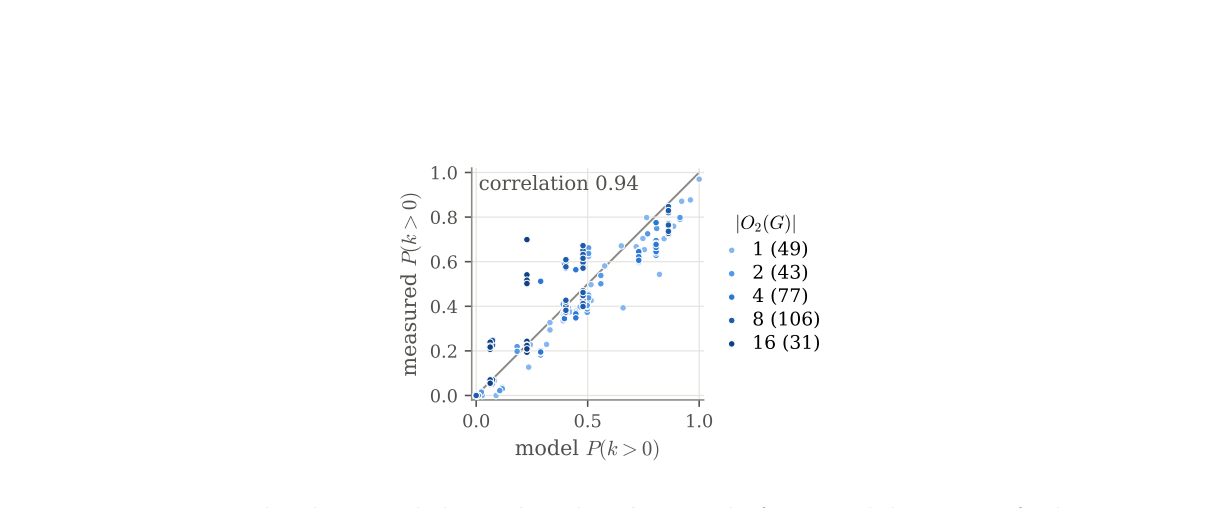
What carries the argument. The central object is the two-block group-algebra code $C(a,b)$: a finite group $G$ and two elements $a,b$ of its group algebra over $\mathbb{F}_2$ define $2|G|$ qubits, with check matrices $H_X = (L(a)\,|\,R(b))$ and $H_Z = (R(b)^T\,|\,L(a)^T)$ built from the left and right regular representations, which commute automatically. The argument is carried by a search pipeline that reduces pairs $(a,b)$ under the known equivalence moves, rejects whole classes with cheap algebraic screens (unit blocks over 2-groups, connectivity through double cosets, hypergraph-product detection, and a Wedderburn-component decomposition that forecasts when $k>0$), and then computes distances through a witness-first upper-bound ladder followed by an exact connected-cluster search with pruning and symmetry roots. Census completeness is checked by orbit-size accounting, and $kd^2/n$ is the figure of merit throughout.
Core claim. The central discovery is a census-driven map of what two-block codes can do when searched systematically rather than by hand-picked ansatz. Exhaustive censuses at check weight five ($n \le 300$), six ($n \le 300$), seven ($n \le 100$), eight ($n \le 100$) and nine ($n \le 94$) support complete claims: no weight-five or weight-six two-block code in range beats the reported values, the Gross code is the unique abelian weight-six code at $kd^2/n = 12$ up to $n = 200$, and the known $[[64,18,8]]$ has the best $kd^2/n$ of any two-block code of weights five through nine with $n \le 94$. Beyond the censuses, sampling steered by the group algebra's Wedderburn components raises the yield of good codes four to fifteen times over uniform draws and produces frontier-setting codes such as $[[288,16,16]]$ at $kd^2/n = 14.22$, the weight-eight $[[292,22,23]]$ at 39.9, and weight-nine codes whose checks fit a $5\times5$ twisted-torus window. The paper's stated conclusion is that the previous small-size gap from more elaborate constructions is not intrinsic.
The premise it rests on. Every 'best' and uniqueness claim rests on the exact distances, and for codes with $d>15$ those exact lower bounds come only from the author's unreleased distance engine (the search library is likewise withheld until a forthcoming work), cross-checked by upper-bound searches but not by an independent exact engine.
If the paper is right (Pith's inferences, not the authors')
If the exact distances hold, the small-size advantage of lifted-product, mitten, and other complex constructions is an artifact of search effort: among CSS codes, the paper's two-block codes exceed the best published $kd^2/n$ with exact distance at the same check weight in most length bands up to 320 qubits.
The exhaustive censuses upgrade several qualitative beliefs to settled statements, such as the Gross code being the unique abelian weight-six two-block code at $kd^2/n=12$ with $n\le200$ and $[[64,18,8]]$ being the best two-block code of any weight five to nine with $n\le94$, so new constructions in these ranges must beat the database, not just the literature.
Hardware-relevant output includes $[[288,16,16]]$, the best weight-six two-block code with $n\le300$, and weight-nine codes $[[102,20,10]]$ and $[[120,24,10]]$, whose checks fit a $5\times5$ twisted-torus window and which simulate at roughly $2\times10^{-6}$ and $4\times10^{-7}$ logical error per qubit per round at physical error $p=10^{-3}$.
Because $kd^2/n$ is preserved by direct sums, every code that sets a frontier step below 320 qubits also improves the frontier at every larger length that is a multiple of its size.
For future search, the census implies uniform draws are the wrong tool at high check weight, since near-best codes are 100 to 1000 times rarer per draw at weights eight and nine than at six, so effort should concentrate on the few groups the census identifies.
The paper's abelian-to-non-abelian crossover moving out as check weight grows is a trend, not a proven law: if it continues, the best two-block codes beyond $n=300$ at weights eight and nine should come predominantly from non-abelian groups, a prediction the database can test as it grows.
The empirical ceiling $d \lesssim 1.18\sqrt{n}$ for weight-five codes hints at a general $\sqrt{n}$ distance bound for two-block codes at fixed check weight; proving it would give every future search a principled stopping rule, since samples above the line would be waste.
The cheapest decisive check of the paper's headline is to re-verify the exact distances of a handful of $d>15$ codes, because the published witnesses prove upper bounds only and every 'best' and uniqueness statement sits on those exact values.
A natural extension of the pipeline is check weight ten, which the paper estimates is beyond laptop-scale exhaustion; if the concentration and rarity trends persist, weight ten should be attacked with component-based rank targeting rather than uniform sampling, and a small targeted run would settle whether the method scales.
Check this review
Pith stored no record of this review's passes and took no fingerprint of it. Reviews made by code from 13 Nov 2026 on carry both.
How often reviews like this one are right
Reviews like this one: written by deepseek-v4-flash, where what was read was not recorded.
How often objections from reviews like this one are right: not yet measured
Reviews by people
This review was written by a machine. No person has reviewed this paper on Pith yet. A scientist listed on Pith can review it for a fee, and their review is published here whatever it concludes.
The paper
Abstract
Two-block group-algebra codes are among the simplest quantum LDPC codes, and many of them are translation invariant on a twisted torus, which suits neutral-atom arrays and other platforms with movable qubits. We ask how far they go at small sizes when searched systematically across all groups. We use algebraic constraints and screens to design a search pipeline capable of enumerating broad and complete swathes of two-block codes on a laptop. With it we census about 108 two-block codes with up to 320 qubits at check weights five to nine. Several of these censuses are exhaustive, and support complete statements; for instance, the Gross code is, up to equivalence, the only abelian weight-six two-block code with n ≤ 200 to reach kd2/n = 12, no weight-six two-block code with n ≤ 300 beats [[288,16,16]], and the known [[64,18,8]] is the best two-block code by kd2/n across weights five to nine with n ≤ 94. The censuses are also large enough to give insights into where good codes live - they concentrate in a handful of groups; abelian groups give the best codes at small n and non-abelian groups at large n, with the crossover appearing to move out as the check weight grows; and high quality codes become 100 to 1000 times rarer per draw from weight six to weights eight and nine. Using the group algebra and the census data to steer a statistical search finds four to fifteen times as many good codes as uniform draws in equal time. Among the codes found are [[102,20,10]] and [[120,24,10]] at check weight nine, which we simulate in noisy syndrome-extraction circuits, and [[186,20,18]], a weight-nine code with every check in a 5 × 5 window. At check weights seven to nine, our best codes exceed the best published kd2/n with exact distance at the same check weight in most length bands up to 320 qubits. All codes are available in a public database.
The paper's own sentences, arranged, kept beside the review and separate from it. Each label is drawn from a closed vocabulary; the number beside it is the probability the classifier gave that label. No sentence in this record was written by a model.
abstract compiled · 2026-10-12
The authors' main claim, as the classifier picked it out 0.98
“At check weights seven to nine, our best codes exceed the best published $kd^2/n$ with exact distance at the same check weight in most length bands up to $320$ qubits.”
How the main claim is stated: asserted 1.00
What the abstract itself states, as probabilities: claims first 0.07 · states limitation 0.37 · human participants 0.02 · controlled comparison 0.83 · randomized assignment 0.03 · states quantitative result 0.99 · compares with prior results 0.97 · mentions code or data availability 0.98
The abstract, sentence by sentence
This table labels the abstract only (arXiv listing abstract v1). The number is the probability the classifier gave the label.
| Sentence | Role | The authors' own work | States the main conclusion | Strength |
|---|---|---|---|---|
| Two-block group-algebra codes are among the simplest quantum LDPC codes, and many of them are translation invariant on a twisted torus, which suits neutral-atom arrays and other platforms with movable qubits. | background 1.00 | 0.06 | 0.03 | asserted 0.93 |
| We ask how far they go at small sizes when searched systematically across all groups. | gap 0.70 | 0.28 | 0.03 | unclear 0.93 |
| To tackle this question, we use a series of algebraic constraints and screens to design a search pipeline capable of enumerating broad and complete swathes of two-block codes on a laptop. | method 0.99 | 0.95 | 0.03 | asserted 1.00 |
| With it we census about $10^8$ two-block codes with up to $320$ qubits at check weights five to nine. | method 0.46 | 0.97 | 0.08 | asserted 1.00 |
| Several of these censuses are exhaustive, and support complete statements; for instance, the Gross code is, up to equivalence, the only abelian weight-six two-block code with $n \le 200$ to reach $kd^2/n=12$, and the known $[[64,18,8]]$ is the best two-block code by $kd^2/n$ across weights five to nine with $n \le 94$. | result 1.00 | 0.82 | 0.15 | asserted 1.00 |
| The censuses are also large enough to give insights into where good codes live - they concentrate in a handful of groups; abelian groups give the best codes at small $n$ and non-abelian groups at large $n$, with the crossover appearing to move out as the check weight grows; and high quality codes become $100$ to $1000$ times rarer per draw from weight six to weights eight and nine. | interpretation 0.52 | 0.94 | 0.20 | asserted 0.62 |
| Using the group algebra and the census data to steer a statistical search finds four to fifteen times as many good codes as uniform draws in equal time. | result 0.94 | 0.95 | 0.17 | asserted 1.00 |
| Among the codes found are $[[102,20,10]]$ and $[[120,24,10]]$ at check weight nine, which we simulate in noisy syndrome-extraction circuits, and $[[288,16,16]]$, the best weight-six two-block code with $n \le 300$. | result 1.00 | 0.96 | 0.14 | asserted 1.00 |
| At check weights seven to nine, our best codes exceed the best published $kd^2/n$ with exact distance at the same check weight in most length bands up to $320$ qubits. | result 1.00 | 0.94 | 0.51 | asserted 1.00 |
| All codes are available in a public database. | contribution 0.90 | 0.73 | 0.03 | asserted 1.00 |
What kind of paper the classifier reports this is: method or tool 0.66 · evidence from simulation or computation 1.00
What was examined, and what was not
Sources read
- arXiv listing abstract v1
Not examined
- full text
- figures and tables
- references and citing sentences
- relations to other papers
Levels run
- P abstract
Not run
- S sections
- T body sentences
- C citations
- R cross-paper relations
How the labels were made
Compiled by classifier-1.13.0 via TypeSafe API, question bank abstract-p1-20260923, 2026-10-12: 1 request, 8,038 input tokens.
Every quoted sentence on this record is the authors'. Every label is from Pith's closed vocabulary, with the probability shown beside it. This record as JSON
Figures (17)





Figures are the authors', reproduced from the paper.
Challenges and discussion
Disagree with the review, or know something it missed? Leave a comment, or challenge this review formally: a challenge becomes a permanent entry in this paper's record, and its decision is published here.
Come back by email
A short list of the week's newly reviewed papers. Nothing is sent until you confirm from your inbox, and every email has a link that stops it. No account.
No comments yet.
Sign in to comment