Quantum Physics · arXiv:2610.16493 v1 · submitted 12 Oct 2026 · 136 references
Bell's go theorem: regaining local causality with a new notion of realism
The paper says
“Bell's theorem is popularly stated as the inconsistency of quantum theory with local realism. Realism is here formalized by the ontological models framework, where elements of reality are points of a measurable space and probabilities obey the Kolmogorov axioms.”
more of the abstract
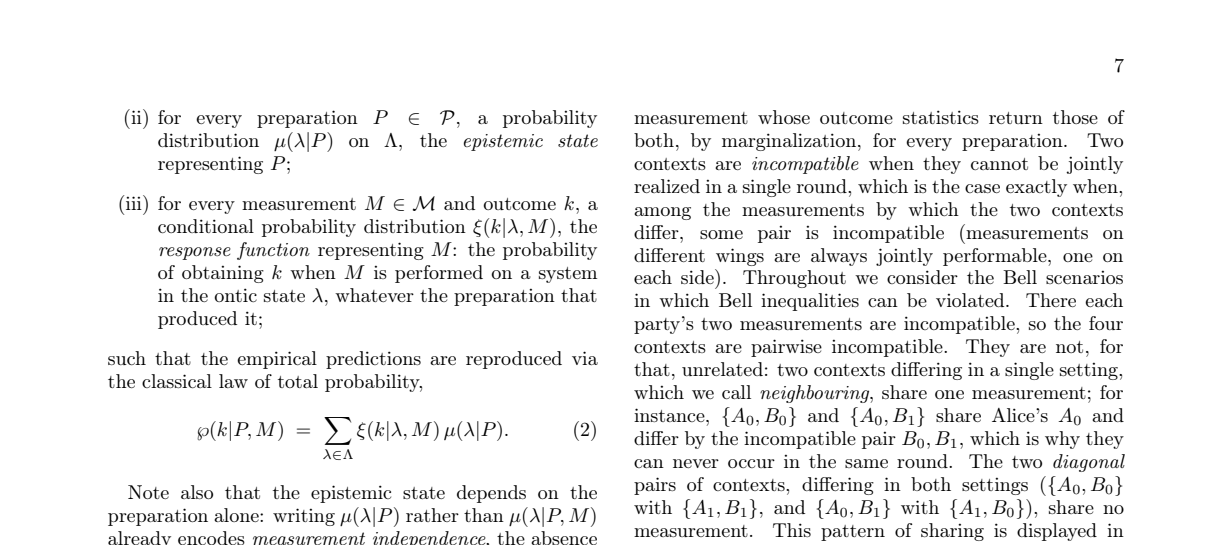
In the Bell scenario, locally causal ontological models posit a common cause supporting a global valuation, a joint assignment of outcomes to all measurements at once, across incompatible contexts. Within this notion of realism, Bell's theorem makes any realist explanation of the quantum predictions conspiratorial: any mechanism, whether superluminal, superdeterministic, or retrocausal, must be finely tuned so as never to manifest operationally. We redefine realism through a new ontological framework that generalizes the standard one. The elements of reality, which we call records, are no longer points but relational parts of a point-free generalization of a topological space (sublocales of a locale). A record shared by two incompatible contexts establishes the sameness of a measurement across them, without such pairwise identities composing into a global valuation, and the common cause is then a web of such records. Within this framework, Bell's no-go theorem becomes a go theorem: local causality, restated for records, is no longer at odds with the quantum statistics. This is possible because modularity, the inclusion-exclusion law of classical probability, fails across incompatible contexts, so that the probability theory generalizes Kolmogorov's. We exhibit explicit models reproducing several quantum strategies, including the optimal CHSH violation. More broadly, locally causal models of this kind attain every Bell-CHSH value up to the algebraic maximum. A realist explanation of the quantum predictions need not be conspiratorial; every causal influence posited by these models is reflected in the operational predictions.
from the abstract
Pith says
Machine review · deepseek-v4-flash · 14 Oct 2026 · what was read was not recorded · not checked by a person
It can be wrong. Challenge this review or reply to it.
Holds up. Localic ontological models make Bell's theorem a go theorem — mathematically rigorous and clever, but the central redefinition of realism is stipulated, not derived. This line is wrong
2 major objections · 5 minor
How often objections from reviews like this one are right: not yet measured
Not checked: figures, code, what the 136 references say.
The paper says, at §IV A, §A (Definition A.1)
The review did not quote this passage.
Pith says: Objection 1 of 2 · major
The paper claims to recover no-signalling without fine-tuning, but the locally causal models require an additional condition, marginal no-signalling (Definition A.1), to ensure that the operational statistics are no-signalling. In the standard framework, this follows from local causality together with the fact that the same ontic state space serves all contexts; here it is a separate constraint on the weight distribution.
more of objection 1
The authors note that they expect a composition rule to deliver it (Sec. V B), but as the paper stands, the 'go theorem' depends on this extra assumption. The discussion should more prominently list this as an open requirement and clarify whether marginal no-signalling is postulated on the same footing as local causality or is expected to be derived.
The paper says, at §III D (Axiom 1)
The review did not quote this passage.
Pith says: Objection 2 of 2 · major
Axiom 1 (Relationality) is the load-bearing foundation of the entire construction: it stipulates that a shared measurement must be grounded in a shared nonzero part of the locale. This is not derived from deeper principles, and the framework does not constrain models that reject it.
more of objection 2
While the paper is open about this, the significance of the go theorem is contingent on the acceptance of this axiom. The authors may wish to discuss whether this axiom can be motivated independently (e.g., from the relational notion of realism they advocate) or whether alternative frameworks without it would also allow locally causal models of the quantum predictions.
5 minor objections
The paper says, at General
Pith says: minor objection 1 of 5
The paper is very long and the mathematical preliminaries (point-free topology, frames, locales) may be unfamiliar to many physicists. A brief glossary or a more accessible summary of the key definitions (locale, sublocale, pointless part) in the main text would improve readability.
The paper says, at §III C, Eq. (16)
Pith says: minor objection 2 of 5
The notation for the weight q(L_λ|P) is introduced, but the dependence on the preparation is often omitted in later sections. It would help to explicitly restate when P is fixed, to avoid confusion.
show 3 more
The paper says, at §IV B, Fig. 4 and Fig. 5
Pith says: minor objection 3 of 5
The figures are schematic and difficult to read in black-and-white. Since the colour coding for glues is essential (e.g., which measurement is shared), a version with distinct line styles or labels for the greyscale would aid comprehension.
The paper says, at §IV C, page 27
Pith says: minor objection 4 of 5
The sentence 'The weight is thereby given in advance' (after Eq. (36)) is slightly ambiguous: it refers to the fact that the same weight q_Φ+ is used for both the optimal and the stabilizer strategies. Clarify that the weight does not change between the two strategies.
The paper says, at §V B, page 30
Pith says: minor objection 5 of 5
The speculation about a lower bound on glue weight yielding the Tsirelson bound is interesting, but the text could more clearly separate it from the rest of the discussion. Consider marking it as an explicit open question.
What would settle it
Rebuild the locale for the Bell scenario using a different class of pointless parts, such as the Boolean algebra of regular opens of a Cantor space, and verify that the records still satisfy pairwise disjointness, Eq. (23), and the axioms. Reproduce the CHSH values from Sec. IVB on this alternative locale to confirm robustness of the construction.
from the skeptic's reading
How the review went
4 readings by deepseek-v4-flash · 14 Oct 2026
- Reader holds up
- Skeptic agrees
- Editor wrote the verdict above
- Referee minor revision: 2 major objections, 5 minor
Not run on this paper: the simulated authors' defence.
Pith did not check this review's objections against the paper.
The review in full
The review in brief, machine-written
The paper's genuinely new idea is to replace the point-set ontic state space of standard ontological models with a locale and treat its sublocales (records) as the elements of reality. Within that framework the authors define local causality for records and construct explicit models that reproduce every Bell-CHSH value up to the algebraic maximum, all while satisfying local causality. The quantum-optimal strategy is explicitly represented. The mathematical construction is clean: the locale, the thirty-two records (cores and glues), the weights, and the proofs that shared records must be pointless and that modularity fails across incompatible contexts all follow from stated axioms. The paper also includes a localic Fine's theorem, showing that every no-signalling correlation admits such a model. The authors are honest about the limitations: this is a first step, no full quantum theory yet, no composition rule, no derivation of the Tsirelson bound from deeper principles. Credit where due: the framework is a genuine generalization, the existence proofs are constructive, and the paper shows real mathematical craft.
The soft spot is the one the stress-test flags. Axiom 1 (Relationality) is a stipulation: cross-contextual identity of a measurement requires a shared ontological part. The entire construction depends on it, and the paper provides no external justification — it is simply part of the definition of the new notion of realism. If you do not grant that such shared parts are necessary, the models have no constraint relating contexts, and local causality imposes no bound. The authors are upfront that this is an axiomatic choice, but it means the go theorem is only as secure as one's willingness to accept the new ontology. A second concern is that the parameters u and v governing glue weights are left free for a given CHSH value; the statistics do not fix them, so the model family is underdetermined. The authors acknowledge this and speculate that a composition rule will constrain them, but that is future work.
Who should read this? Quantum foundations researchers interested in alternatives to standard ontological models, especially those working on contextuality, fine-tuning, and the meaning of Bell's theorem. The paper deserves a serious referee: it is coherent, nontrivial, and opens a research program. The referee should push on whether Axiom 1 is doing too much work, and whether the underdetermination of glue weights is a feature or a bug.
Recommendation: peer review, with the expectation that the authors will need to address the axiomatic status of Relationality and the parameter freedom in future work.
The strongest objection
The paper defines Axiom 1 (Relationality) as a primitive commitment: cross-contextual identity of a measurement requires a shared ontological part. Without this stipulation, the models have no constraints relating contexts and local causality as defined imposes no bound. The paper's existence proofs all assume this axiom, so the go theorem is only as secure as the axiom's acceptance. The paper provides no external justification; it is a definition of the framework. While the construction shows consistency, the philosophical weight is on accepting that realism requires such shared parts.
The reader's weakest_assumption correctly identifies Axiom 1 as the key non-derived commitment. My stress-test does not reveal any new internal inconsistency; the paper's mathematics is sound. The proposed test would check robustness but does not affect the current verdict.
The referee's report
If the framework is accepted, this work represents a major conceptual shift in the foundations of quantum mechanics. It demonstrates that the incompatibility of local causality with quantum correlations is not forced by the principles of relativistic causality and common cause, but rather by the standard ontological models framework's hidden commitment to a global valuation (a point-wise ontic state answering all measurements at once). The mathematical construction is rigorous and the models are explicit. However, the framework rests on a non-derived stipulation—Axiom 1 (Relationality)—and the derivation of no-signalling from composition is left to future work, so the result is a compelling existence proof rather than a complete theory.
Pith's reading of the paper (a machine's summary, not the authors')
The paper argues that Bell's theorem, which rules out local realist explanations of quantum correlations, depends on a specific notion of realism—the standard ontological models framework, where elements of reality are points that assign outcomes to all measurements at once, across incompatible contexts. The authors replace this with a localic ontological models framework, where elements of reality are relational records (sublocales of a locale) that carry the identity of a measurement across the two incompatible contexts it appears in, without composing into a single global assignment. Within this new framework, local causality (restated for records) no longer conflicts with quantum statistics: the authors exhibit explicit locally causal models that reproduce every Bell-CHSH value from the classical bound up to the algebraic maximum, including the Tsirelson bound, without fine-tuning. The core claim is that Bell's theorem is an artifact of the underlying notion of realism, not a necessity forced by local causality itself.
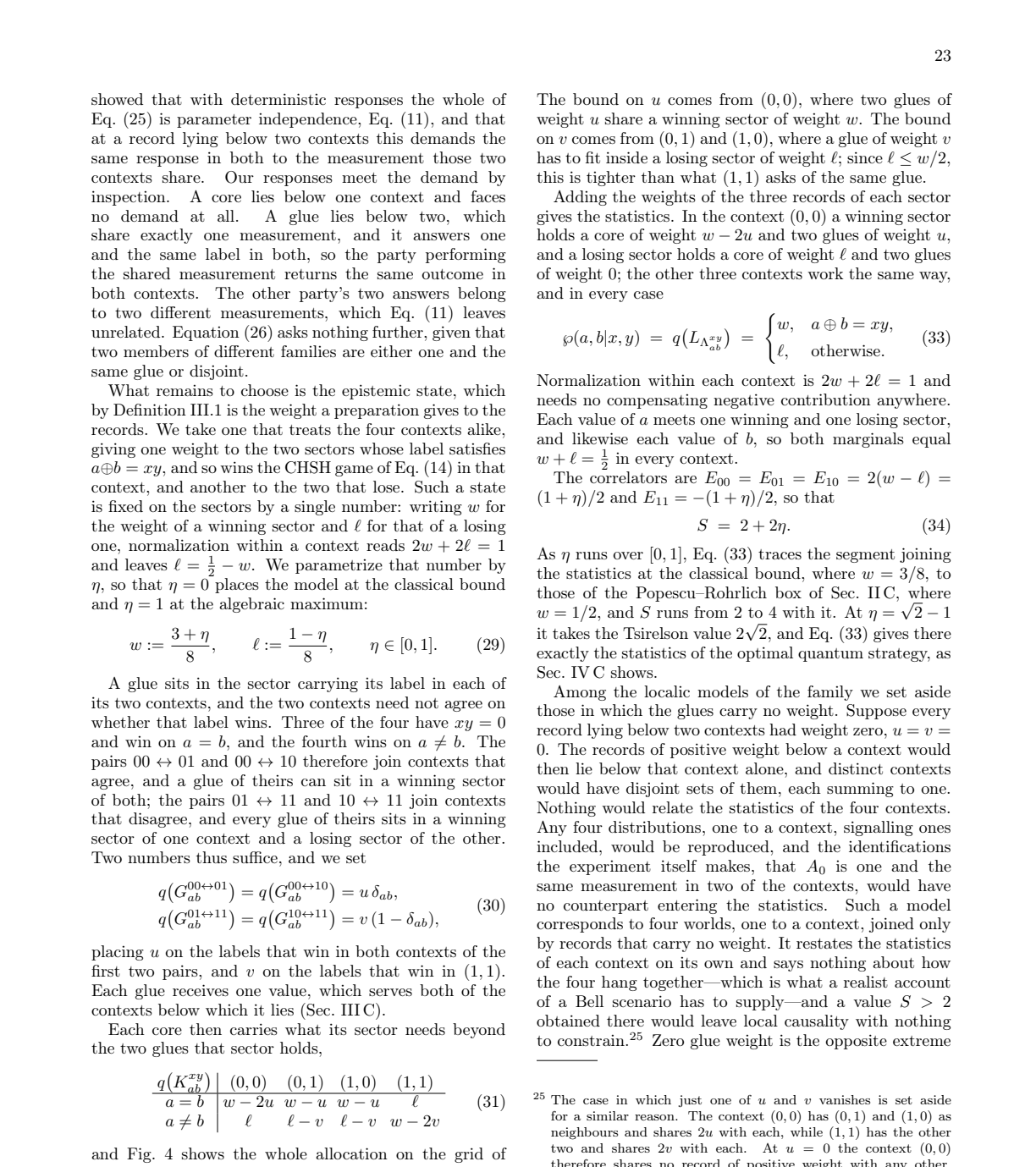
What carries the argument. The central object is the locale (a point-free generalization of a topological space) whose parts (sublocales) serve as records—relational elements of reality individuated by how they restrict the whole. The key structure is a specific locale (Eq. 24) carrying 32 records: 16 cores (spatial, belonging to a single context) and 16 glues (non-spatial and pointless, each shared by a neighbouring pair of incompatible contexts). The weight (epistemic state) is normalized within each context but not required to be modular across incompatible contexts; Theorem III.3 shows that modularity fails across contexts whose shared weight is less than 1. Three axioms (Relationality, Exclusivity, Completeness) force shared records between incompatible contexts to be pointless. The response functions for each context are deterministic and parameter-independent, satisfying local causality (Definition IV.1). A single parameter η (Eq. 29) controls the weight distribution and lets the Bell-CHSH value S = 2+2η sweep from 2 to 4.
Core claim. Bell's no-go theorem results from a hidden commitment within the standard ontological models framework—that the common cause must be a global valuation assigning outcomes to all measurements at once. Once this commitment is replaced by a web of relational records (pointless parts shared by two incompatible contexts at a time), local causality no longer forces a contradiction with quantum statistics. The paper proves this by constructing explicit locally causal localic ontological models that achieve any Bell-CHSH value up to the algebraic maximum, demonstrating that nonlocality is an artefact of the standard notion of realism rather than a necessary feature of realist explanations of Bell correlations.
The premise it rests on. Axiom 1 (Relationality): the stipulation that if two contexts share a measurement, some nonzero part of the ontology lies below both and carries the sameness of that measurement. This is not derived from any deeper principle; it is an ontological commitment that defines the framework. If one does not accept that cross-contextual identity requires a shared part of the model, the entire construction fails to constrain the records and the go theorem loses its force.
If the paper is right (Pith's inferences, not the authors')
Bell violations no longer imply a failure of local causality; the degree of violation reflects how much weight two incompatible contexts share, not a superluminal influence.
The fine-tuning problem that plagues all standard realist explanations of Bell correlations (superluminal, retrocausal, or superdeterministic) disappears: the localic models posit no causal influences that are hidden from the operational statistics.
The Tsirelson bound may arise from a lower bound on the weight that incompatible contexts must share (the glue weight), shifting the question from 'why nonlocality is limited' to 'why the shared past cannot be too thin'.
Other no-go theorems (Kochen–Specker contextuality, extended Wigner's friend arguments) are expected to admit analogous go theorems once the same relational, record-based ontology is adopted.
The paper establishes a template for converting no-go theorems into go theorems: identify the hidden ontological commitment carried by the standard framework (here, global valuations), replace it with a relational structure (records) that leaves the causal assumptions intact, and exhibit explicit models that saturate the previously forbidden region.
The failure of modularity (Theorem III.3) offers a precise mathematical locus for non-classical probability: the defect 1−g on a pair of incompatible contexts equals the weight those contexts do not share, tying the departure from Kolmogorov axioms directly to the ontology's refusal to gather incompatible contexts into a single account.
The free parameters u and v (glue weights) are not fixed by the statistics; if a principle such as a composition rule for locales or a bound on cross-contextual record capacity were to fix them, the Tsirelson bound might be derived from that principle, opening a new route to understanding why quantum correlations stop at 2√2 rather than reaching 4.
Check this review
Pith stored no record of this review's passes and took no fingerprint of it. Reviews made by code from 13 Nov 2026 on carry both.
How often reviews like this one are right
Reviews like this one: written by deepseek-v4-flash, where what was read was not recorded.
How often objections from reviews like this one are right: not yet measured
Reviews by people
This review was written by a machine. No person has reviewed this paper on Pith yet. A scientist listed on Pith can review it for a fee, and their review is published here whatever it concludes.
The paper
Abstract
Bell's theorem is popularly stated as the inconsistency of quantum theory with local realism. Realism is here formalized by the ontological models framework, where elements of reality are points of a measurable space and probabilities obey the Kolmogorov axioms. In the Bell scenario, locally causal ontological models posit a common cause supporting a global valuation, a joint assignment of outcomes to all measurements at once, across incompatible contexts. Within this notion of realism, Bell's theorem makes any realist explanation of the quantum predictions conspiratorial: any mechanism, whether superluminal, superdeterministic, or retrocausal, must be finely tuned so as never to manifest operationally. We redefine realism through a new ontological framework that generalizes the standard one. The elements of reality, which we call records, are no longer points but relational parts of a point-free generalization of a topological space (sublocales of a locale). A record shared by two incompatible contexts establishes the sameness of a measurement across them, without such pairwise identities composing into a global valuation, and the common cause is then a web of such records. Within this framework, Bell's no-go theorem becomes a go theorem: local causality, restated for records, is no longer at odds with the quantum statistics. This is possible because modularity, the inclusion-exclusion law of classical probability, fails across incompatible contexts, so that the probability theory generalizes Kolmogorov's. We exhibit explicit models reproducing several quantum strategies, including the optimal CHSH violation. More broadly, locally causal models of this kind attain every Bell-CHSH value up to the algebraic maximum. A realist explanation of the quantum predictions need not be conspiratorial; every causal influence posited by these models is reflected in the operational predictions.
The paper's own sentences, arranged, kept beside the review and separate from it. Each label is drawn from a closed vocabulary; the number beside it is the probability the classifier gave that label. No sentence in this record was written by a model.
abstract compiled · 2026-10-14
The authors' main claim, as the classifier picked it out 1.00
“Within this framework, Bell's no-go theorem becomes a go theorem: local causality, restated for records, is no longer at odds with the quantum statistics.”
How the main claim is stated: asserted 1.00
What the abstract itself states, as probabilities: claims first 0.06 · states limitation 0.14 · human participants 0.02 · controlled comparison 0.02 · randomized assignment 0.02 · states quantitative result 0.69 · compares with prior results 0.82 · mentions code or data availability 0.03
The abstract, sentence by sentence
This table labels the abstract only (arXiv listing abstract v1). The number is the probability the classifier gave the label.
| Sentence | Role | The authors' own work | States the main conclusion | Strength |
|---|---|---|---|---|
| Bell's theorem is popularly stated as the inconsistency of quantum theory with local realism. | background 1.00 | 0.03 | 0.02 | asserted 0.99 |
| Realism is here formalized by the ontological models framework, where elements of reality are points of a measurable space and probabilities obey the Kolmogorov axioms. | background 0.92 | 0.12 | 0.02 | asserted 1.00 |
| In the Bell scenario, locally causal ontological models posit a common cause supporting a global valuation, a joint assignment of outcomes to all measurements at once, across incompatible contexts. | background 0.99 | 0.08 | 0.03 | asserted 1.00 |
| Within this notion of realism, Bell's theorem makes any realist explanation of the quantum predictions conspiratorial: any mechanism, whether superluminal, superdeterministic, or retrocausal, must be finely tuned so as never to manifest operationally. | background 0.86 | 0.09 | 0.05 | asserted 1.00 |
| We redefine realism through a new ontological framework that generalizes the standard one. | contribution 0.97 | 0.91 | 0.06 | asserted 1.00 |
| The elements of reality, which we call records, are no longer points but relational parts of a point-free generalization of a topological space (sublocales of a locale). | contribution 0.65 | 0.76 | 0.06 | asserted 1.00 |
| A record shared by two incompatible contexts establishes the sameness of a measurement across them, without such pairwise identities composing into a global valuation, and the common cause is then a web of such records. | method 0.56 | 0.65 | 0.09 | asserted 1.00 |
| Within this framework, Bell's no-go theorem becomes a go theorem: local causality, restated for records, is no longer at odds with the quantum statistics. | result 0.73 | 0.79 | 0.83 | asserted 1.00 |
| This is possible because modularity, the inclusion-exclusion law of classical probability, fails across incompatible contexts, so that the probability theory generalizes Kolmogorov's. | interpretation 0.77 | 0.55 | 0.10 | asserted 1.00 |
| We exhibit explicit models reproducing several quantum strategies, including the optimal CHSH violation. | result 0.56 | 0.94 | 0.09 | asserted 1.00 |
| More broadly, locally causal models of this kind attain every Bell-CHSH value up to the algebraic maximum. | result 0.99 | 0.82 | 0.16 | asserted 0.99 |
| A realist explanation of the quantum predictions need not be conspiratorial; every causal influence posited by these models is reflected in the operational predictions. | interpretation 0.88 | 0.78 | 0.35 | asserted 0.85 |
What kind of paper the classifier reports this is: theoretical result 0.99 · evidence from proof or derivation 0.96
What was examined, and what was not
Sources read
- arXiv listing abstract v1
Not examined
- full text
- figures and tables
- references and citing sentences
- relations to other papers
Levels run
- P abstract
Not run
- S sections
- T body sentences
- C citations
- R cross-paper relations
How the labels were made
Compiled by classifier-1.13.0 via TypeSafe API, question bank abstract-p1-20260923, 2026-10-14: 1 request, 9,007 input tokens.
Every quoted sentence on this record is the authors'. Every label is from Pith's closed vocabulary, with the probability shown beside it. This record as JSON
Figures (6)
Showing 2 of the paper's 6 figures. Figures are the authors', reproduced from the paper.
References (136)
- [1] J. S. Bell, On the Einstein Podolsky Rosen paradox, Phys. Phys. Fiz.1, 195 (1964) on Pith
- [2] Since2vis the weight the context (1,1)has in common with each of its neighbours, a lower bound on it asks two incompatible contexts to keep a minimum amount in common. One may then speculate that quantum theory’s own limits on incompatibility appear in a localic model as a low... on Pith
- [3] N. Harrigan and R. W. Spekkens, Einstein, Incompleteness, and the Epistemic View of Quantum States, Found. Phys.40, 125 (2010) on Pith
- [4] L. Catani and M. Leifer, A mathematical framework for operational fine tunings, Quantum7, 948 (2023) on Pith
- [5] C. J. Wood and R. W. Spekkens, The lesson of causal discovery algorithms for quantum correlations: causal explanations of Bell-inequality violations require fine- tuning, New J. Phys.17, 033002 (2015) on Pith
- [6] M. Leifer, Is the quantum state real? An extended review ofψ-ontology theorems, Quanta3, 67 (2014) on Pith
- [7] M. F. Pusey, J. Barrett, and T. Rudolph, On the reality of the quantum state, Nat. Phys.8, 475 (2012) on Pith
- [8] S. Kochen and E. Specker, The problem of hidden variables in quantum mechanics, J. Math. Mech.17, 59 (1967) on Pith
- [9] R. W. Spekkens, Contextuality for preparations, transformations, and unsharp measurements, Phys. Rev. A71, 052108 (2005) on Pith
- [10] M. S. Leifer and O. J. E. Maroney, Maximally epistemic interpretations of the quantum state and contextuality, Phys. Rev. Lett.110, 120401 (2013) on Pith
- [11] A. Chaturvedi and D. Saha, Quantum prescriptions are more ontologically distinct than they are operationally distinguishable, Quantum4, 345 (2020) on Pith
- [12] D. Dürr and S. Teufel,Bohmian Mechanics: The Physics and Mathematics of Quantum Theory (Springer, Berlin, 2009) on Pith
- [13] D. Wallace,The Emergent Multiverse: Quantum Theory According to the Everett Interpretation(Oxford University Press, Oxford, 2012) on Pith
- [14] J. F. Clauser, M. A. Horne, A. Shimony, and R. A. Holt, Proposed experiment to test local hidden-variable theories, Phys. Rev. Lett.23, 880 (1969) on Pith
- [15] J. Picado and A. Pultr,Frames and Locales: Topology without Points, Frontiers in Mathematics (Birkhäuser, Basel, 2012) on Pith
- [16] S. Vickers,Topology via Logic, Cambridge Tracts in Theoretical Computer Science, Vol. 5 (Cambridge University Press, Cambridge, 1989) on Pith
- [17] S. Popescu and D. Rohrlich, Quantum nonlocality as an axiom, Found. Phys.24, 379 (1994) on Pith
- [18] L. Hardy, Quantum theory from five reasonable axioms, arXiv:quant-ph/0101012 (2001) on PithPith's reviewarXiv
- [19] G. Chiribella, G. M. D’Ariano, and P. Perinotti, Informational derivation of quantum theory, Phys. Rev. 33 A84, 012311 (2011) on Pith
- [20] L. Masanes and M. P. Müller, A derivation of quantum theory from physical requirements, New J. Phys.13, 063001 (2011) on Pith
show 80 more
- [21] A. Fine, Hidden variables, joint probability, and the Bell inequalities, Phys. Rev. Lett.48, 291 (1982) on Pith
- [22] A. Einstein, B. Podolsky, and N. Rosen, Can quantum- mechanical description of physical reality be considered complete?, Phys. Rev.47, 777 (1935) on Pith
- [23] J. von Neumann,Mathematical Foundations of Quantum Mechanics, new ed., edited by N. A. Wheeler (Princeton University Press, Princeton, on Pith
- [24] J. S. Bell, On the problem of hidden variables in quantum mechanics, Rev. Mod. Phys.38, 447 (1966) on Pith
- [25] E. Crull and G. Bacciagaluppi, eds.,Grete Hermann: Between Physics and Philosophy, Studies in History and Philosophy of Science, Vol. 42 (Springer, Dordrecht, 2016) on Pith
- [26] D. Bohm, A suggested interpretation of the quantum theory in terms of “hidden” variables. II, Phys. Rev.85, 180 (1952) on Pith
- [27] D. Bohm, A suggested interpretation of the quantum theory in terms of “hidden” variables. I, Phys. Rev.85, 166 (1952) on Pith
- [28] K.-W. Bong, A. Utreras-Alarcón, F. Ghafari, Y.-C. Liang, N. Tischler, E. G. Cavalcanti, G. J. Pryde, and H. M. Wiseman, A strong no-go theorem on the Wigner’s friend paradox, Nat. Phys.16, 1199 (2020) on Pith
- [29] J. S. Bell, The theory of local beables, inQuantum Mechanics, High Energy Physics and Accelerators: Selected Papers of John S. Bell(World Scientific, 1995) pp. 50–60, originallyEpistemological Letters9, 11 (1976) on Pith
- [30] J. P. Jarrett, On the physical significance of the locality conditions in the Bell arguments, Noûs18, 569 (1984) on Pith
- [31] H. Reichenbach,The Direction of Time, edited by M. Reichenbach (University of California Press, Berkeley, 1956) on Pith
- [32] J. S. Bell,Speakable and Unspeakable in Quantum Mechanics: Collected Papers on Quantum Philosophy, 2nd ed. (Cambridge University Press, Cambridge, 2004) on Pith
- [33] A. Shimony, Events and processes in the quantum world, inQuantum Concepts in Space and Time, edited byR.PenroseandC.J.Isham(OxfordUniversityPress, Oxford, 1986) pp. 182–203 on Pith
- [34] A. Fine, Joint distributions, quantum correlations, and commuting observables, J. Math. Phys.23, 1306 (1982) on Pith
- [35] H. M. Wiseman and E. G. Cavalcanti, Causarum investigatio and the two Bell’s theorems of John Bell, inQuantum [Un]Speakables II: Half a Century of Bell’s Theorem, edited by R. Bertlmann and A. Zeilinger (Springer International Publishing, Cham, 2017) pp. 119–142 on Pith
- [36] B. S. Tsirelson, Quantum generalizations of Bell’s inequality, Lett. Math. Phys.4, 93 (1980) on Pith
- [37] S. Abramsky and A. Brandenburger, The sheaf- theoretic structure of non-locality and contextuality, New J. Phys.13, 113036 (2011) on Pith
- [38] L. K. Shalmet al., Strong loophole-free test of local realism, Phys. Rev. Lett.115, 250402 (2015) on Pith
- [39] B. Hensenet al., Loophole-free Bell inequality violation using electron spins separated by 1.3 kilometres, Nature 526, 682 (2015) on Pith
- [40] P. T. Johnstone, The point of pointless topology, Bull. Amer. Math. Soc.8, 41 (1983) on Pith
- [41] M. Giustinaet al., Significant-loophole-free test of Bell’s theorem with entangled photons, Phys. Rev. Lett.115, 250401 (2015) on Pith
- [42] G. Birkhoff, Rings of sets, Duke Math. J.3, 443 (1937) on Pith
- [43] J. R. Isbell, Atomless parts of spaces, Math. Scand.31, 5 (1972) on Pith
- [44] A. Simpson, Measure, randomness and sublocales, Ann. Pure Appl. Logic163, 1642 (2012), kurt Goedel Research Prize Fellowships 2010 on Pith
- [45] D. Denneberg,Non-Additive Measure and Integral, Theory and Decision Library, Series B, Vol. 27 (Kluwer Academic Publishers, 1994) on Pith
- [46] J. Pearl,Causality: Models, Reasoning, and Inference, 2nd ed. (Cambridge University Press, Cambridge, 2009) on Pith
- [47] D. J. Foulis and M. K. Bennett, Effect algebras and unsharp quantum logics, Found. Phys.24, 1331 (1994) on Pith
- [48] D. M. Greenberger, M. A. Horne, A. Shimony, and A. Zeilinger, Bell’s theorem without inequalities, Am. J. Phys.58, 1131 (1990) on Pith
- [49] T. Maudlin, Three measurement problems, Topoi14, 7 (1995) on Pith
- [50] C. Budroni, A. Cabello, O. Gühne, M. Kleinmann, and J.-Å. Larsson, Kochen–Specker contextuality, Rev. Mod. Phys.94, 045007 (2022) on Pith
- [51] A. Cabello, J. M. Estebaranz, and G. García-Alcaine, Bell-Kochen-Specker theorem: A proof with 18 vectors, Phys. Lett. A212, 183 (1996) on Pith
- [52] L. Catani, M. Leifer, G. Scala, D. Schmid, and R. W. Spekkens, What is nonclassical about uncertainty relations?, Phys. Rev. Lett.129, 240401 (2022) on Pith
- [53] M. F. Pusey, Robust preparation noncontextuality inequalities in the simplest scenario, Phys. Rev. A98, 022112 (2018) on Pith
- [54] M. Khoshbin, L. Catani, and M. Leifer, Alternative robust ways of witnessing nonclassicality in the simplest scenario, Phys. Rev. A109, 032212 (2024) on Pith
- [55] J. H. Selby, D. Schmid, E. Wolfe, A. B. Sainz, R. Kunjwal, and R. W. Spekkens, Contextuality without incompatibility, Phys. Rev. Lett.130, 230201 (2023) on Pith
- [56] B. Coecke and A. Kissinger,Picturing Quantum Processes(Cambridge University Press, 2017) on Pith
- [57] Y.-C. Liang, R. W. Spekkens, and H. M. Wiseman, Specker’s parable of the overprotective seer: A road to contextuality, nonlocality and complementarity, Phys. Rep.506, 1 (2011) on Pith
- [58] L. Catani, R. Faleiro, P.-E. Emeriau, S. Mansfield, and A. Pappa, Connecting XOR and XOR∗ games, Phys. Rev. A109, 012427 (2024) on Pith
- [59] L. Henaut, L. Catani, D. E. Browne, S. Mansfield, and A. Pappa, Tsirelson’s bound and landauer’s principle in a single-system game, Phys. Rev. A98, 060302 (2018) on Pith
- [60] S. Abramsky, R. S. Barbosa, and S. Mansfield, Contextual Fraction as a Measure of Contextuality, Phys. Rev. Lett.119, 050504 (2017). 34 on Pith
- [61] V.J.WrightandM.Farkas,InvertiblemapbetweenBell nonlocal and contextuality scenarios, Phys. Rev. Lett. 131, 220202 (2023) on Pith
- [62] A. Acín, T. Fritz, A. Leverrier, and A. B. Sainz, A combinatorial approach to nonlocality and contextuality, Commun. Math. Phys.334, 533 (2015) on Pith
- [63] A. Cabello, S. Severini, andA. Winter, Graph-Theoretic Approach to Quantum Correlations, Phys. Rev. Lett. 112, 040401 (2014) on Pith
- [64] R. Wagner, R. S. Barbosa, and E. F. Galvão, Inequalities witnessing coherence, nonlocality, and contextuality, Phys. Rev. A109, 032220 (2024) on Pith
- [65] B. Amaral and M. Terra Cunha,On Graph Approaches to Contextuality and their Role in Quantum Theory, SpringerBriefs in Mathematics (Springer, Cham, 2018) on Pith
- [66] Č. Brukner, A no-go theorem for observer-independent facts, Entropy20, 350 (2018) on Pith
- [67] D. Frauchiger and R. Renner, Quantum theory cannot consistently describe the use of itself, Nat. Commun.9, 3711 (2018) on Pith
- [68] D. Schmid, Y. Y¯ ıng, and M. Leifer, A review and analysis of six extended Wigner’s friend arguments, arXiv:2308.16220 (2023) on PithPith's reviewarXiv
- [69] H. M. Wiseman, E. G. Cavalcanti, and E. G. Rieffel, A “thoughtful” Local Friendliness no-go theorem: a prospective experiment with new assumptions to suit, Quantum7, 1112 (2023) on Pith
- [70] L. Walleghem and L. Catani, An extended Wigner’s friend no-go theorem inspired by generalized contextuality, arXiv:2502.02461 (2025) on PithPith's reviewarXiv
- [71] Y. Y¯ ıng, M. M. Ansanelli, A. Di Biagio, E. Wolfe, D. Schmid, and E. G. Cavalcanti, Relating Wigner’s friend scenarios to nonclassical causal compatibility, monogamy relations, and fine tuning, Quantum8, 1485 (2024) on Pith
- [72] A. N. Whitehead,Process and Reality: An Essay in Cosmology(Cambridge University Press, Cambridge, on Pith
- [73] S. Abramsky and S. Vickers, Quantales, observational logic and process semantics, Math. Struct. Comput. Sci. 3, 161 (1993) on Pith
- [74] L. Catani, Why quantum physicists should read Whitehead, Talk, Perimeter Institute, PIRSA:25100175 (2025) on Pith
- [75] J. S. Bell, On the impossible pilot wave, Found. Phys. 12, 989 (1982) on Pith
- [76] J. Seibt, Process philosophy, inThe Stanford Encyclopedia of Philosophy, edited by E. N. Zalta and U. Nodelman (Metaphysics Research Lab, Stanford University, 2022)https://plato.stanford. edu/entries/process-philosophy/ on Pith
- [77] L. Catani, M. Leifer, D. Schmid, and R. W. Spekkens, Reply to "Comment on ’why interference phenomena do not capture the essence of quantum theory’ ", arXiv:2207.11791 (2022) on PithPith's reviewarXiv
- [78] R. W. Spekkens, The ontological identity of empirical indiscernibles: Leibniz’s methodological principle and itssignificanceintheworkofEinstein,arXiv:1909.04628 (2019) on PithPith's reviewarXiv
- [79] L. Catani, M. Leifer, D. Schmid, and R. W. Spekkens, Why interference phenomena do not capture the essence of quantum theory, Quantum7, 1119 (2023) on Pith
- [80] C. Rauszer, Semi-Boolean algebras and their applications to intuitionistic logic with dual operations, Fund. Math.83, 219 (1974) on Pith
- [81] I. Urbas, Dual-intuitionistic logic, Notre Dame J. Formal Logic37, 440 (1996) on Pith
- [82] G. Priest, K. Tanaka, and Z. Weber, Paraconsistent logic, inThe Stanford Encyclopedia of Philosophy, edited by E. N. Zalta and U. Nodelman (Metaphysics Research Lab, Stanford University, 2025) Spring 2025 edition on Pith
- [83] G. E. Reyes and H. Zolfaghari, Bi-Heyting algebras, toposes and modalities, J. Philos. Logic25, 25 (1996) on Pith
- [84] G. C. Ghirardi, A. Rimini, and T. Weber, Unified dynamics for microscopic and macroscopic systems, Phys. Rev. D34, 470 (1986) on Pith
- [85] F. W. Lawvere, Intrinsic co-Heyting boundaries and the Leibniz rule in certain toposes, inCategory Theory (Como 1990), Lecture Notes in Mathematics, Vol. 1488, edited by A. Carboni, M. C. Pedicchio, and G. Rosolini (Springer, 1991) pp. 279–281 on Pith
- [86] A. Valentini, Signal-locality, uncertainty, and the subquantum H-theorem. I, Phys. Lett. A156, 5 (1991) on Pith
- [87] A. Valentini, Signal-locality in hidden-variables theories, Phys. Lett. A297, 273 (2002) on Pith
- [88] A. Bassi, K. Lochan, S. Satin, T. P. Singh, and H. Ulbricht, Models of wave-function collapse, underlying theories, and experimental tests, Rev. Mod. Phys.85, 471 (2013) on Pith
- [89] H. Price and K. B. Wharton, Disentangling the quantum world, Entropy17, 7752 (2015) on Pith
- [90] K. B. Wharton and N. Argaman, Colloquium: Bell’s theorem and locally mediated reformulations of quantum mechanics, Rev. Mod. Phys.92, 021002 (2020) on Pith
- [91] L. Catani, T. D. Galley, and T. Gonda, Resource- theoretic hierarchy of contextuality for general probabilistic theories, Quantum10, 2077 (2026) on Pith
- [92] S. Hossenfelder and T. Palmer, Rethinking superdeterminism, Front. Phys.8, 139 (2020) on Pith
- [93] D. Almada, K. Ch’ng, S. Kintner, B. Morrison, and K. B. Wharton, Are retrocausal accounts of entanglement unnaturally fine-tuned?, Int. J. Quantum Found.2, 1 (2016), arXiv:1510.03706 on PithPith's reviewarXiv
- [94] G. ’t Hooft,The Cellular Automaton Interpretation of Quantum Mechanics(Springer, 2016) on Pith
- [95] E. Adlam, Two roads to retrocausality, Synthese200, 422 (2022) on Pith
- [96] E. Adlam, Contextuality, fine-tuning and teleological explanation, Found. Phys.51, 106 (2021) on Pith
- [97] M. S. Leifer and M. F. Pusey, Is a time symmetric interpretation of quantum theory possible without retrocausality?, Proc. R. Soc. A473, 20160607 (2017) on Pith
- [98] G. Bacciagaluppi, Remarks on space-time and locality in Everett’s interpretation, inNon-locality and Modality, edited by T. Placek and J. Butterfield (Kluwer Academic Publishers, Dordrecht, 2002) pp. 105–122 on Pith
- [99] H. R. Brown and C. G. Timpson, Bell on Bell’s theorem: The changing face of nonlocality, inQuantum Nonlocality and Reality: 50 Years of Bell’s Theorem, edited by M. Bell and S. Gao (Cambridge University Press, 2016) pp. 91–123, arXiv:1501.03521 on PithPith's reviewarXiv
- [100] H. Everett, “Relative state” formulation of quantum mechanics, Rev. Mod. Phys.29, 454 (1957) on Pith
The first 100 of 136 references are listed here. All of them are in this paper's citation record.
Challenges and discussion
Disagree with the review, or know something it missed? Leave a comment, or challenge this review formally: a challenge becomes a permanent entry in this paper's record, and its decision is published here.
Come back by email
A short list of the week's newly reviewed papers. Nothing is sent until you confirm from your inbox, and every email has a link that stops it. No account.
No comments yet.
Sign in to comment