Data Structures and Algorithms · arXiv:2610.16715 v1 · submitted 12 Oct 2026 · 39 references
The Online Steinitz Problem
The paper says
“Inspired by Steinitz's celebrated result (1913) and recent online vector-balancing results of Kulkarni et al.”
more of the abstract
(2024) and Aden-Ali (2026), we introduce the online Steinitz problem: T vectors in ℝd, each of ℓ2-norm at most 1 and with total sum zero, arrive one at a time and must be assigned immediately and irrevocably to unused positions of an array. The goal is to keep every prefix sum of the resulting order small. We first obtain deterministic prefix-discrepancy bounds of O(logT) for d = 1 and O(√T) for d ≥ 2. Our main contribution is a general reduction that converts deterministic and randomized online vector-balancing algorithms, which assign signs to arriving vectors, into online ordering algorithms. Combined with recent vector-balancing results, this yields a randomized algorithm with prefix discrepancy O(logT + √(dlogT)) and running time O(dTlogT). The guarantee holds with high probability against an oblivious adversary. The reduction also gives bounds for sparse vectors and extends to inputs in arbitrary compact convex bodies. Finally, we prove matching lower bounds in both the deterministic and randomized cases.
from the abstract
Pith says
Machine review · deepseek-v4-flash · 14 Oct 2026 · what was read was not recorded · not checked by a person
It can be wrong. Challenge this review or reply to it.
The passes disagreed. Reader: holds up. Skeptic: holds up only with conditions. Referee: major revision.
A new problem with a clean, mostly self-contained signing-to-ordering reduction; the efficient randomized claims lean on one unverified manuscript citation, but a published fallback keeps the core discrepancy theorem standing. This line is wrong
2 major objections · 4 minor
How often objections from reviews like this one are right: not yet measured
Not checked: figures, code, what the 39 references say.
The paper says, at Section 4.3, Corollary 4.4
The review did not quote this passage.
Pith says: Objection 1 of 2 · major
The headline randomized guarantee (1.1) and Corollary 4.1 rest on the quoted statement that Aden-Ali's signer represents the terminal signed sum of every fixed augmented unit-ball stream as G1+G2+G3 with Gj ~ N(0, I_{d+1}) ([Ade26, Theorem 1 and Equation (5)]).
more of objection 1
This is load-bearing in two places: it verifies the subgaussian hypothesis (2.2) with Sigma = 3 in Theorem 2.1(ii), and through Lemma 2.3 it supplies the conditional MGF bounds (2.7)-(2.8) used by Lemma 2.4. The reference is listed without a venue, and the paper states neither the theorem's hypotheses nor its proof, so a referee cannot verify that the augmented stream (x_i,1)/sqrt(2) (unit ball, arbitrary length m, dimension d+1, arbitrary total) is an allowed input. If Ade26's guarantee carries extra hypotheses (coordinate bounds, zero total, or only simultaneous l_infinity prefix guarantees), Corollary 4.1's bound and the O(dT log T) efficiency claim are unsupported. Please state the full quoted theorem and Equation (5) with all hypotheses, confirm the augmented stream satisfies them for every node capacity, and provide a citable venue or arXiv identifier. I note that the paper itself partially de-risks the discrepancy bound via the symmetrized KRR signer, so the unresolved part is specifically the linear-time implementation and the Sigma = 3 scale; the text should make this separation explicit.
The paper says, at Section 4.3, Corollary 4.4
The review did not quote this passage.
Pith says: Objection 2 of 2 · major
Corollary 4.4's sparse-vector bound O_eta(sqrt(kappa) log T) is quoted from [AT26, Theorem 1.1], also listed without a venue, with the hypotheses left unstated. The signer's simultaneous-prefix guarantee is applied to the un-normalized augmented vectors (x_i,1) in [-1,1]^{d+1} with sparsity kappa+1 and l2-norm up to sqrt(kappa+1), so the quoted terminal bounds ||sum_i eps_i x_i||_inf <= C_eta sqrt(kappa+1) and |sum_i eps_i| <= C_eta sqrt(kappa+1), and the failure probability p(m), must be confirmed for exactly this input class.
more of objection 2
Since this corollary is secondary to the paper's main claims, a precise statement of AT26's theorem together with a verification that (x_i,1) lies in its hypothesis set would suffice.
4 minor objections
The paper says, at Section 3.1; throughout
Pith says: minor objection 1 of 4
The arXiv rendering contains formatting corruptions that impede verification: the displayed scalar rule writes things like 'L+ 1rL' in place of the intended fractions, stray brace markers ('/bracehtipupleft /bracehtipdownright/bracehtipdownleft /bracehtipupright') appear throughout Sections 2-5, and leaked page numbers ('13 space', '15 4.1', '17 Corollary 4.3', '18 h=...', '19 Theorem 5.1') interrupt the text. Please provide a clean version; in particular the preservation case analysis for the d=1 invariant is central to Theorem 3.1 and should be readable line by line.
The paper says, at Lemma 4.2
Pith says: minor objection 2 of 4
In the proof of Lemma 4.2 the text speaks of a union bound over 'at most 2^{s-1} nontrivial interval endpoints', but the tail parameter log(2^{s+1}/delta) corresponds to about 2^s endpoints; the count should be corrected to 2^s - 1 (or 2^s) and the union bound made consistent with the stated failure probability.
show 2 more
The paper says, at Abstract; Section 1.1
Pith says: minor objection 3 of 4
The abstract's phrase 'matching lower bounds in both the deterministic and randomized cases' is stronger than what Section 1.1 states for the randomized regime: the match between Theorem 5.1 and (4.3) holds for T^{-beta} <= delta <= 1/2 with fixed beta > 0. The abstract should carry the same qualification, since the body is already careful about it.
The paper says, at References
Pith says: minor objection 4 of 4
References [Ade26] and [AT26] give no venue or arXiv identifier and should be marked as preprints with identifiers when available; [BN26] is properly labeled an unpublished manuscript and should be marked as such in the citation. The running-time discussion in Section 4.1 correctly flags [KRR24, Sections 6-7] as exponential-time, and the text should continue to make that explicit when citing the KRR-based bound.
What would settle it
Obtain [Ade26] and verify Theorem 1 together with Equation (5) exactly as quoted: for every fixed stream z_1,...,z_m in the Euclidean unit ball of any dimension D and every m, the signer's terminal signed sum is distributed as G1 + G2 + G3 with G_j ~ N(0, I_D). If the theorem holds unchanged, reproduce the Holder calculation (4.1) and the Sigma = 3 substitution; the concern is resolved. If the published statement is instead an l_infinity prefix bound, a coordinate-bounded hypothesis, a zero-sum hypothesis, or has a different constant, re-derive (2.2) from that statement; if (2.2) fails in dimension d+1, downgrade Corollary 4.1 and (1.1) to conditional on an unverified signer. This is a verification of hypotheses, not a re-proof, because [Ade26] is listed without a venue.
from the skeptic's reading
How the review went
4 readings by deepseek-v4-flash · 14 Oct 2026
- Reader holds up
- Skeptic agrees: says it holds up only with conditions The randomized O(log T + sqrt((d + log(1/delta)) log T)) guarantee hinges on an unverified, venue-less [Ade26] Gaussian-decomposition result; if that signer bound is weaker or has extra hypotheses, (2.2) with Sigma = 3 and the main randomized claim fail.
- Editor wrote the verdict above
- Referee major revision: 2 major objections, 4 minor
Not run on this paper: the simulated authors' defence.
Pith did not check this review's objections against the paper.
The review in full
The review in brief, machine-written
Two things to know up front. The paper introduces a genuine new problem — online vector ordering with irrevocable placement, controlling every output prefix — and its signing-to-ordering reduction is the right tool: tree routing with per-node signers, a quota-repair lemma connecting proposed signs to actual routing signs, and a boundary-path identity expressing each prefix as a weighted sum of local split errors. I checked the deterministic parts line by line and they hold: the O(log T) scalar bound, the O(√T) greedy-signing bound, and the lower bounds via Schmidt, Tijdeman–Wagner, and Roth are all argued in the text with the classical theorems quoted where they are actually used. The matching is also honest — for the full randomized range, the refined bound (4.3) is what matches the lower bounds, and the paper says so.
The soft spot is where the reader and the stress-test put it: the efficient randomized bound (1.1) with running time O(dT log T) goes through [Ade26, Theorem 1 and Equation (5)], a Gaussian-decomposition guarantee from a reference with no venue, whose hypotheses the paper never states and whose quoted decomposition the augmented stream (xi,1)/√2 must satisfy. If that manuscript's guarantee carries extra hypotheses, the efficient corollary breaks. But the stress-test overreaches when it says the main randomized bound is unsupported: the paper itself supplies a second route with the symmetrized KRR signer, quoting [KRR24, Lemma 11] from a published STOC paper, and that route gives the same discrepancy bound up to constants, just without the running-time guarantee. So the real exposure is narrower — the O(dT log T) efficiency claim, the Σ = 3 scale, and the sparse-vector corollary (which leans on [AT26], likewise venue-less) are single-sourced to manuscripts. That is worth insisting a referee check, and worth asking the authors to state the hypotheses of [Ade26] explicitly, but it is not a load-bearing flaw in the reduction or in the discrepancy theorem.
Minor observations: the d = 1 invariant is intricate and merits careful scrutiny; constants in Lemma 4.2 and Corollary 4.4 are absorbed into O(·) and Cη, which is normal for this genre. The disclosures — the footnote declining to verify the OpenAI Steinitz announcement, and the ChatGPT acknowledgment — are honest and do not affect the mathematics.
Who gets value: anyone in discrepancy, online algorithms, or vector balancing; the reduction is reusable and clearly presented. It deserves a serious referee. My recommendation: send it out, with the referee asked to verify the [Ade26]/[AT26] dependencies and the scalar invariant rather than the framework.
The strongest objection
Section 4.1 (proof of Corollary 4.1) is the only place where the headline randomized prefix-discrepancy bound (1.1) is connected to a concrete signer. The proof says: "Aden-Ali's signer's guarantee [Ade26, Theorem 1 and Equation (5)] represents the terminal signed sum as sum_i epsilon_i z_i = G1 + G2 + G3, where G1, G2, G3 ~ N(0, I_{d+1})... Hence (2.2) is verified with Sigma = 3." The present paper does not state the hypotheses of [Ade26], does not reproduce Theorem 1 or Equation (5), and the reference is given only as a year with no venue. This Gaussian decomposition is load-bearing in two places: it supplies the subgaussian scale (2.2) used in Theorem 2.1(ii), and the conditional MGF bounds (2.7)-(2.8) used by Lemma 2.4. If [Ade26] actually gives only simultaneous l_infinity prefix guarantees, or only for coordinate-bounded streams, or only for zero-total streams, then the augmented stream (x_i,1)/sqrt(2) may fail the hypothesis and Corollary 4.1's bound cannot be derived; the reduction itself remains valid, but the randomized upper bound (1.1) is unsupported. The deterministic O(log T)/O(sqrt T) bounds and the lower bounds are internally argued and do not share this dependency.
The reader's weakest_assumption identifies the same load-bearing concern, and I agree with that identification after checking the paper's internal arguments. The reduction in Section 2 is coherent: the one-boundary-path identity (Lemma 2.2), the quota-repair decomposition (Lemma 2.3), and the conditional composition (Lemma 2.4) all have explicit proofs, and I found no internal contradiction there. The deterministic bounds in Section 3 are argued from local invariants and appear internally sound; the lower bounds in Section 5 use published results (Schmidt, Tijdeman-Wagner, Roth) and their reductions to the online setting are spelled out. The randomized upper bound, however, is not self-contained: Corollary 4.1 obtains the subgaussian scale Sigma = 3 entirely from the quoted [Ade26] decomposition of the terminal signed sum into three Gaussian vectors. Because [Ade26] is listed without a venue and the theorem is neither stated nor proved in this paper, the main randomized guarantee rests on an external unpublished claim. If that claim is weaker or has extra hypotheses, the conditional estimates (2.7)-(2.8) fail and the randomized result (1.1) is unsupported, even though the reduction and deterministic results remain intact. This does not require rejecting the paper; it requires making the external signer guarantee auditable before the randomized upper bound is relied upon.
The referee's report
If the quoted signer guarantees hold, the paper resolves the online Steinitz problem up to constant factors in both models studied: OSdet(d,T) = Theta(log T) for d=1 and Theta(sqrt(T)) for d>=2, and OSrand(d,T,delta) = Theta(log T + sqrt(d* log(T/d*))) in the range T^{-beta} <= delta <= 1/2. The strengths are substantial: the reduction is modular and parameter-free (any signer with a terminal guarantee suffices, including sparse and normed variants); the deterministic line algorithm is a genuine invariant-based construction; the lower-bound constructions are concrete, falsifiable, and rest on classical published discrepancy theorems; and the conditional composition argument (Lemma 2.4) is self-contained. The randomized discrepancy bound is partially de-risked by the paper itself: Section 4.1 shows that the symmetrized Kulkarni-Reis-Rothvoss signer (published, STOC 2024) yields the same Theta-class of bound, so the unresolved dependence on [Ade26] is concentrated in the linear-time claim and in the sparse-vector corollary rather than in the existence of the high-probability discrepancy guarantee.
Pith's reading of the paper (a machine's summary, not the authors')
The paper defines the online Steinitz problem: T unit-norm vectors of total sum zero arrive one at a time and each must be assigned immediately and irrevocably to a free slot in an output array, with the goal of keeping every prefix sum of the final order small. It claims the problem is now resolved up to constant factors: deterministic optimal discrepancy is Θ(log T) on the line and Θ(√T) for every d ≥ 2, and randomized algorithms achieve O(log T + √((d + log(1/δ)) log T)) prefix discrepancy with probability at least 1 − δ against oblivious adversaries. The engine is a reduction that routes each vector down a balanced tree of output intervals, asking an online signer at each node to propose left or right, while the router only overrides a proposal once a child is full. If correct, the price of moving from offline rearrangement, where a constant bound suffices, to immediate irrevocable placement is exactly logarithmic in the horizon on the line and square-root in higher dimensions.
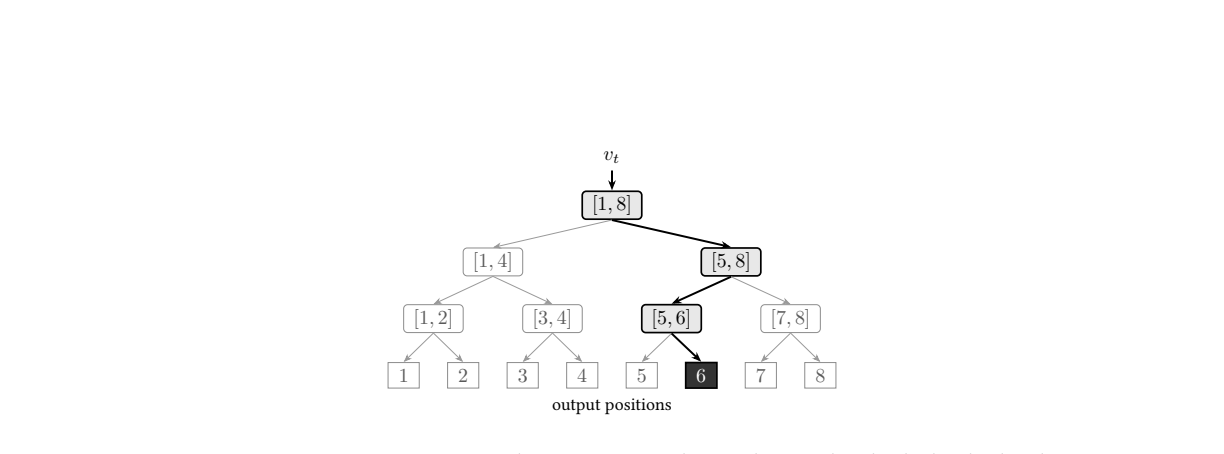
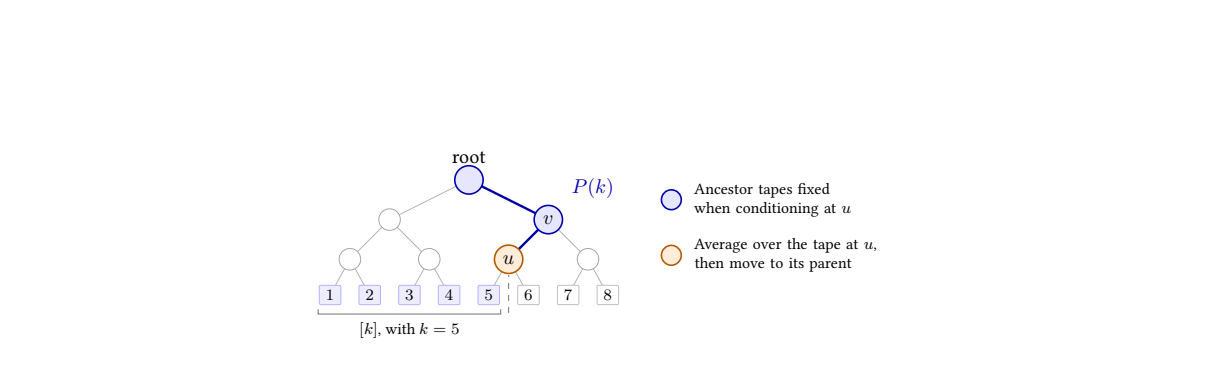
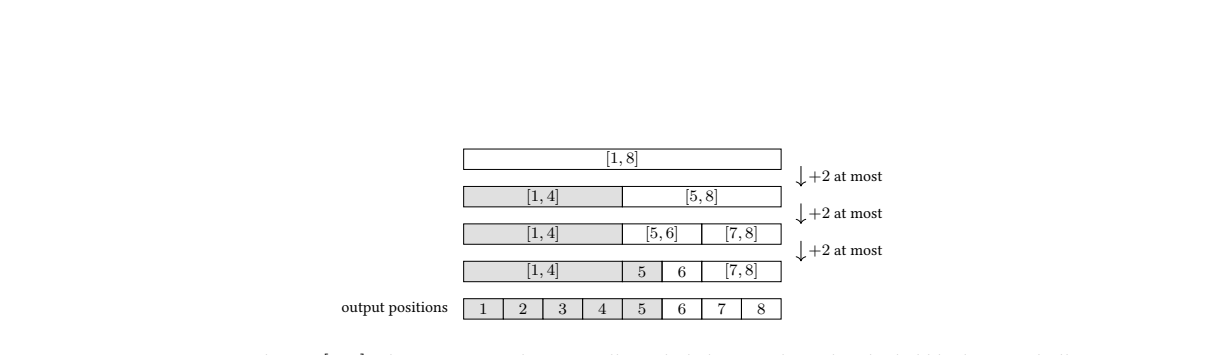
What carries the argument. The central object is the signing-to-ordering reduction (Algorithm 1) and its two supporting lemmas. The reduction builds a balanced binary tree over the output positions; each internal node runs an independent online vector-balancing signer that proposes left or right for the arriving vector, and the router follows the proposal unless the chosen child is already full, in which case it forces the other child. Lemma 2.2 (one-boundary-path identity) shows that any prefix residual is a weighted sum of the split errors on the single boundary path of nodes whose intervals straddle that prefix, with weights α_{u,k} in [0,1]. Lemma 2.3 (one-node quota repair) decomposes each split error into a centered signed sum Y plus a remainder of norm at most |q| + 1, where q is the signer's count imbalance, and the number of enforced overrides is exactly half the proposed-count gap. Lemma 2.4 then composes the subgaussian estimates along the path by conditioning from the deepest node upward, which handles the dependence between ancestor and descendant tapes.
Core claim. The paper's central claim is that a signing-to-ordering reduction settles the online Steinitz problem up to constants. At each internal node of a balanced binary tree over the T output positions, an independent online vector-balancing signer proposes which child should receive the arriving vector, and the router follows the proposal unless that child is full, in which case it forces the other child. A prefix of the output order cuts at most one node per level, and Lemma 2.2 shows the prefix residual is a weighted sum, with weights α_{u,k} in [0,1], of the local split errors along that single boundary path. Lemma 2.3 decomposes each split error into a centered signed sum plus a quota-repair remainder of norm at most |q| + 1, where q counts the signer's count imbalance. Combining these along the path, using subgaussian scale Σ = 3 inherited from the Aden-Ali signer, gives the randomized bound, while scalar and greedy signers give the deterministic O(log T) and O(√T) bounds. Matching lower bounds, valid for every 0 < δ ≤ 1/2, follow from planar rectangle discrepancy, the Tijdeman–Wagner theorem, and Roth's method, using inputs made of a short initial stream completed by identical canceling vectors.
The premise it rests on. The randomized upper bound rests on the quoted, unverified guarantee that the Aden-Ali signer's terminal signed sum on every fixed unit-ball stream decomposes as a sum of three Gaussian vectors with subgaussian scale Σ = 3, so if that decomposition is weaker or carries extra hypotheses, the constant in (1.1) fails even though the reduction itself stands.
If the paper is right (Pith's inferences, not the authors')
The line and plane bounds are optimal: every online ordering algorithm pays Ω(log T) in one dimension and Ω(√T) in a fixed plane, even though offline Steinitz ordering achieves a bound independent of T, so immediate irrevocable placement is exactly what costs the logarithmic and square-root terms.
Any future improvement in online vector-balancing signers — a smaller subgaussian scale, better sparse guarantees, or faster deterministic balancing — transfers automatically to the ordering problem through the reduction, making OSP no harder than OVB up to constants.
The reduction needs neither a known input total nor Euclidean symmetry: it delivers proportional-prefix guarantees for arbitrary compact convex bodies K via John's theorem, with residuals in a scaled difference body, and it yields coordinatewise and sparse-vector bounds without extra machinery.
Against adaptive adversaries randomness does not help, and the O(dT log T) running time means the randomized guarantee is achievable rather than merely existential.
The dependence on the failure probability through √(log(1/δ)) degrades only mildly with confidence, so the bound remains useful for small δ.
The lower bounds convert online decisions into a set of points recording arrival time and output position, then invoke classical irregularities-of-distribution results, so the online ordering problem inherits the same harmonic-analysis obstructions as uniform distribution; beating the bounds would require breaking Schmidt's, Tijdeman–Wagner's, or Roth's arguments rather than designing a better alg
The paper's constants depend on the scale of the chosen signer (Σ = 3 for Aden-Ali, Σ = √80 for the symmetrized KRR signer), so an empirical or formal tightening of either scale would directly shrink the hidden constant in (1.1), a testable extension the paper does not perform.
The sparse-vector corollary suggests a standalone statement not made in the paper: online Steinitz ordering of inputs with at most κ nonzero coordinates should cost roughly √κ log T rather than √T, and the same shape plausibly extends to norm-bounded bodies scaled by their affine dimension.
Because the reduction treats the signer as a black box needing only a terminal subgaussian guarantee, it could compose with any future signer whose only guarantee is subgaussian in expectation, opening a route toward matching the composition's scale to the signer's.
Check this review
Pith stored no record of this review's passes and took no fingerprint of it. Reviews made by code from 13 Nov 2026 on carry both.
How often reviews like this one are right
Reviews like this one: written by deepseek-v4-flash, where what was read was not recorded.
How often objections from reviews like this one are right: not yet measured
Reviews by people
This review was written by a machine. No person has reviewed this paper on Pith yet. A scientist listed on Pith can review it for a fee, and their review is published here whatever it concludes.
The paper
Abstract
Inspired by Steinitz's celebrated result (1913) and recent online vector-balancing results of Kulkarni et al. (2024) and Aden-Ali (2026), we introduce the online Steinitz problem: T vectors in ℝd, each of ℓ2-norm at most 1 and with total sum zero, arrive one at a time and must be assigned immediately and irrevocably to unused positions of an array. The goal is to keep every prefix sum of the resulting order small. We first obtain deterministic prefix-discrepancy bounds of O(logT) for d = 1 and O(√T) for d ≥ 2. Our main contribution is a general reduction that converts deterministic and randomized online vector-balancing algorithms, which assign signs to arriving vectors, into online ordering algorithms. Combined with recent vector-balancing results, this yields a randomized algorithm with prefix discrepancy O(logT + √(dlogT)) and running time O(dTlogT). The guarantee holds with high probability against an oblivious adversary. The reduction also gives bounds for sparse vectors and extends to inputs in arbitrary compact convex bodies. Finally, we prove matching lower bounds in both the deterministic and randomized cases.
The paper's own sentences, arranged, kept beside the review and separate from it. Each label is drawn from a closed vocabulary; the number beside it is the probability the classifier gave that label. No sentence in this record was written by a model.
abstract compiled · 2026-10-14
The authors' main claim, as the classifier picked it out 0.70
“Our main contribution is a general reduction that converts deterministic and randomized online vector-balancing algorithms, which assign signs to arriving vectors, into online ordering algorithms.”
How the main claim is stated: asserted 1.00
What the abstract itself states, as probabilities: claims first 0.14 · states limitation 0.72 · human participants 0.01 · controlled comparison 0.02 · randomized assignment 0.47 · states quantitative result 0.99 · compares with prior results 0.86 · mentions code or data availability 0.02
The abstract, sentence by sentence
This table labels the abstract only (arXiv listing abstract v1). The number is the probability the classifier gave the label.
| Sentence | Role | The authors' own work | States the main conclusion | Strength |
|---|---|---|---|---|
| Inspired by Steinitz's celebrated result (1913) and recent online vector-balancing results of Kulkarni et al. (2024) and Aden-Ali (2026), we introduce the online Steinitz problem: $T$ vectors in $\mathbb R^d$, each of $\ell_2$-norm at most $1$ and with total sum zero, arrive one at a time and must be assigned immediately and irrevocably to unused positions of an array. | background 0.63 | 0.31 | 0.04 | asserted 0.96 |
| The goal is to keep every prefix sum of the resulting order small. | background 0.89 | 0.16 | 0.04 | asserted 0.94 |
| We first obtain deterministic prefix-discrepancy bounds of $O(\log T)$ for $d=1$ and $O(\sqrt T)$ for $d\ge2$. | result 0.99 | 0.94 | 0.09 | asserted 1.00 |
| Our main contribution is a general reduction that converts deterministic and randomized online vector-balancing algorithms, which assign signs to arriving vectors, into online ordering algorithms. | contribution 0.91 | 0.95 | 0.67 | asserted 1.00 |
| Combined with recent vector-balancing results, this yields a randomized algorithm with prefix discrepancy $O(\log T+\sqrt{d\log T})$ and running time $O(dT\log T)$. | result 0.93 | 0.87 | 0.39 | asserted 1.00 |
| The guarantee holds with high probability against an oblivious adversary. | result 0.61 | 0.80 | 0.06 | asserted 0.99 |
| The reduction also gives bounds for sparse vectors and extends to inputs in arbitrary compact convex bodies. | contribution 0.51 | 0.92 | 0.04 | asserted 1.00 |
| Finally, we prove matching lower bounds in both the deterministic and randomized cases. | result 0.86 | 0.96 | 0.20 | asserted 1.00 |
What kind of paper the classifier reports this is: theoretical result 0.81 · evidence from proof or derivation 1.00
What was examined, and what was not
Sources read
- arXiv listing abstract v1
Not examined
- full text
- figures and tables
- references and citing sentences
- relations to other papers
Levels run
- P abstract
Not run
- S sections
- T body sentences
- C citations
- R cross-paper relations
How the labels were made
Compiled by classifier-1.13.0 via TypeSafe API, question bank abstract-p1-20260923, 2026-10-14: 1 request, 6,347 input tokens.
Every quoted sentence on this record is the authors'. Every label is from Pith's closed vocabulary, with the probability shown beside it. This record as JSON
Figures (4)

Figures are the authors', reproduced from the paper.
References (39)
- [1] Tijdeman, Robert and Wagner, Gerold , title =. Monatshefte f. 1980 , doi = on Pith
- [2] Roth, Klaus F. , title =. Mathematika , volume =. 1954 , doi = on Pith
- [3] Hal. On. Recent Progress in Analytic Number Theory, Vol. 2 , publisher = on Pith
- [4] Ishaq Aden. Optimal Online Discrepancy Minimization in Linear Time , year =. 2607.04388 , archiveprefix = on PithPith's reviewarXiv
- [5] Janardhan Kulkarni and Victor Reis and Thomas Rothvoss , title =. Proceedings of the 56th Annual ACM Symposium on Theory of Computing , pages =. 2024 , doi =. 2308.01406 , url = on PithPith's reviewarXiv
- [6] Dylan J. Altschuler and Konstantin Tikhomirov , title =. 2026 , eprint = on Pith
- [7] Wolfgang M. Schmidt , title =. Acta Arithmetica , volume =. 1972 , doi = on Pith
- [8] Sergej Chobanyan , title =. Probability in Banach Spaces, 9 , series =. 1994 , doi = on Pith
- [9] Nikhil Bansal and Aleksandar Nikolov , title =. 2026 , note =. 2608.00140 , archiveprefix = on PithPith's reviewarXiv
- [10] V. S. Grinberg and S. V. Sevastyanov , title =. Functional Analysis and Its Applications , volume =. 1980 , doi = on Pith
- [11] Friedrich Eisenbrand and Robert Weismantel , title =. ACM Transactions on Algorithms , volume =. 2020 , doi = on Pith
- [12] Steinitz, Ernst , journal =. Bedingt konvergente Reihen und konvexe Systeme. , volume = on Pith
- [13] Ryan Alweiss and Yang P. Liu and Mehtaab Sawhney , title =. 2021 , doi = on Pith
- [14] Nikhil Bansal and Haotian Jiang and Sahil Singla and Makrand Sinha , title =. 2020 , doi = on Pith
- [15] Gergely Ambrus and Rainie Heck , title =. Mathematika , volume =. 2026 , doi =. 2505.09465 , archiveprefix = on PitharXiv
- [16] Gergely Ambrus and Rainie Bozzai , title =. Mathematika , volume =. 2024 , doi =. 2302.10865 , archiveprefix = on PithPith's reviewarXiv
- [17] Timm Oertel and Joseph Paat and Robert Weismantel , title =. Mathematical Programming , volume =. 2024 , doi =. 2201.05874 , archiveprefix = on PithPith's reviewarXiv
- [18] Imre B. A matrix version of the. Journal f. 2024 , doi =. 2308.10102 , archiveprefix = on PithPith's reviewarXiv
- [19] Imre B. On some combinatorial questions in finite-dimensional spaces , journal =. 1981 , doi = on Pith
- [20] B. A Vector-Sum Theorem and Its Application to Improving Flow Shop Guarantees , journal =. 1981 , url = on Pith
show 19 more
- [21] Grinberg, V. S. and Sevast'yanov, S. V. , title =. Functional Analysis and Its Applications , volume =. 1980 , doi = on Pith
- [22] Grafstr. Distributionally Balanced Sampling Designs , journal =. 2026 , doi = on Pith
- [23] Harvey, Nick and Samadi, Samira , title =. Proceedings of the 27th Conference on Learning Theory , series =. 2014 , url = on Pith
- [24] Lu, Yucheng and Guo, Wentao and De Sa, Christopher , title =. Advances in Neural Information Processing Systems , volume =. 2022 , url = on Pith
- [25] Grafstr. Master samples with optimized panels , journal =. 2026 , url = on Pith
- [26] Robertson, Blair and Price, Chris and Reale, Marco and Davies, Philip , title =. Biometrics , volume =. 2026 , doi = on Pith
- [27] Arbour, David and Dimmery, Drew and Mai, Tung and Rao, Anup , title =. Proceedings of the 39th International Conference on Machine Learning , series =. 2022 , publisher = on Pith
- [28] Jauslin, Rapha. Sequential spatially balanced sampling , journal =. 2022 , doi = on Pith
- [29] Cooper, A. Feder and Guo, Wentao and Pham, Duc Khiem and Yuan, Tiancheng and Ruan, Charlie and Lu, Yucheng and. Coordinating Distributed Example Orders for Provably Accelerated Training , booktitle =. 2023 , publisher =. doi:10.52202/075280-2451 , url = on Pithdoi:10.52202/075280-2451
- [30] Wei, Guanghao , title =. 2023 , eprint = on Pith
- [31] Maalouf, Alaa and Jubran, Ibrahim and Feldman, Dan , title =. Advances in Neural Information Processing Systems , volume =. 2019 , publisher = on Pith
- [32] Sharing. 2026 , howpublished = on Pith
- [33] Anders Aamand and Mikkel Abrahamsen and Lorenzo Beretta and Linda Kleist , title =. Proceedings of SODA , pages =. 2023 , doi = on Pith
- [34] Mikkel Abrahamsen and Ioana O. Bercea and Lorenzo Beretta and Jonas Klausen and L. Online Sorting and Online. Proceedings of ESA , series =. 2024 , doi = on Pith
- [35] Sungjin Im and Nathaniel Kell and Janardhan Kulkarni and Debmalya Panigrahi , title =. SIAM Journal on Computing , volume =. 2019 , doi = on Pith
- [36] Christian Bertram , title = on Pith
- [37] Yossi Azar and Debmalya Panigrahi and Or Vardi , title = on Pith
- [38] Balancing games , journal =. 1977 , issn = on Pith
- [39] Spencer, Joel , title =. 1994 , doi = on Pith
Cited by 1 Pith paper
Reviewed papers on Pith that cite this one. The full citation record
- Online Discrepancy of Sparse Random Vectors over Long Horizons cs.DS · Oct 2026
Challenges and discussion
Disagree with the review, or know something it missed? Leave a comment, or challenge this review formally: a challenge becomes a permanent entry in this paper's record, and its decision is published here.
Come back by email
A short list of the week's newly reviewed papers. Nothing is sent until you confirm from your inbox, and every email has a link that stops it. No account.
No comments yet.
Sign in to comment