Computation and Language · arXiv:2610.18216 v1 · submitted 13 Oct 2026 · 28 references
TextualRL: Textual Reinforcement Learning for Context Management
The paper says
“LLM agents can adapt to task feedback by revising the textual context that guides their behavior, without changing their model parameters.”
more of the abstract
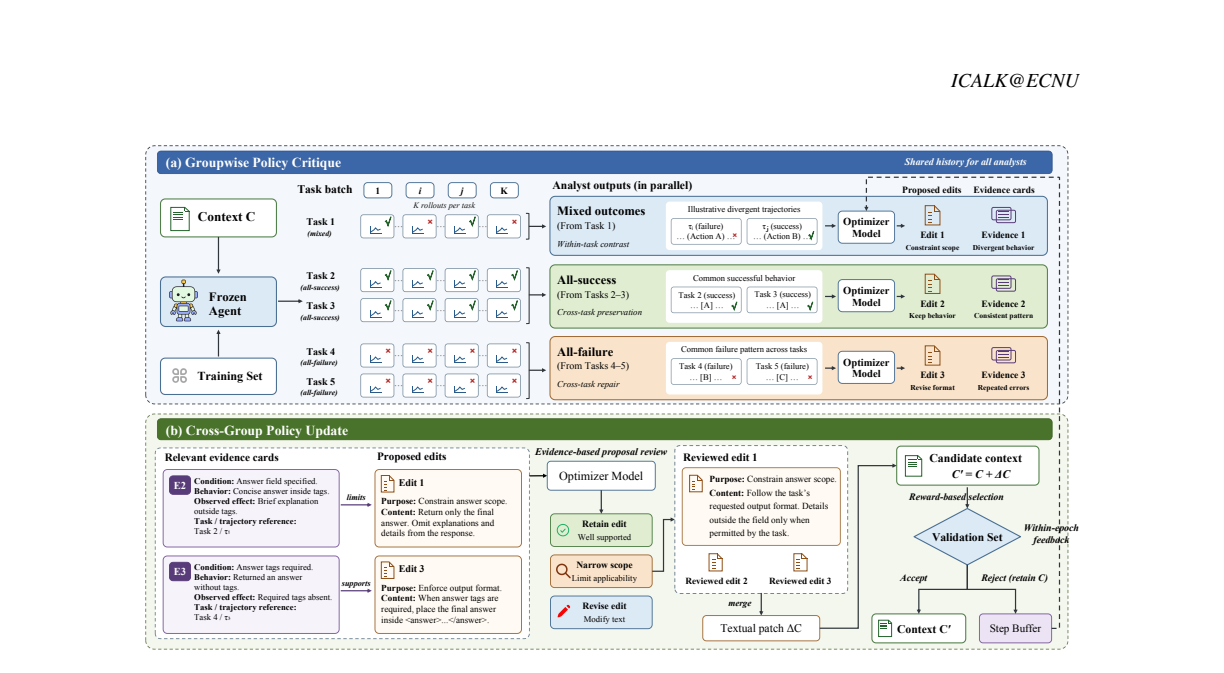
However, turning execution rewards into reusable context updates is challenging: individual trajectories offer limited comparative evidence about what to change, while task-specific fixes may overgeneralize when incorporated into a shared context. We introduce TextualRL, a gradient-free reinforcement learning framework that treats a group of rollouts from the same task under the same context, rather than an isolated trajectory, as the unit of policy critique. Groupwise Policy Critique contrasts successful and failed rollouts within a task; when outcomes are uniform, it draws on cross-task evidence to identify behaviors worth preserving or formulate repair hypotheses. Cross-Group Policy Update reviews the resulting proposals against evidence pooled across groups, including observations that yield no proposed edit, to refine their content and applicability. Reviewed proposals form a bounded textual patch, with adoption of the candidate context determined by held-out validation rewards. Together, these components establish a reward-driven policy optimization loop in which multiple attempts jointly inform reusable context updates. We evaluate TextualRL with five target agents on six benchmarks. Averaged over the six benchmarks, TextualRL improves test accuracy over the base model by 24.4 and 15.3 percentage points for GPT-5.5 and Qwen3.8-27B, respectively.
from the abstract
Pith says
Machine review · deepseek-v4-flash · 14 Oct 2026 · what was read was not recorded · not checked by a person
It can be wrong. Challenge this review or reply to it.
Holds up. Novel grouping-based RL for context optimization, but the tiny gains over SkillOpt (0.9–3.2 pp) and single-run results for 4 of 5 targets make the central claim thinner than the packaging suggests. This line is wrong
2 major objections · 6 minor
How often objections from reviews like this one are right: not yet measured
Not checked: figures, code, what the 28 references say.
The paper says, at Table 1 and §4.4 (Run stability)
The review did not quote this passage.
Pith says: Objection 1 of 2 · major
The central claim of a consistent 0.9–3.2 pp advantage over SkillOpt relies on single optimization runs for four of the five target models. Table 3 provides three-run stability only for Qwen3.8-27B, where the advantage is robust (3.18–3.36 pp). For the other four targets (GPT-5.5, GPT-5.4, Qwen3.5-4B, Qwen3.6-35B-A3B), no repeated runs are reported, leaving the variability of the narrow advantage unquantified.
more of objection 1
The authors should either provide repeated-run statistics for at least one additional target model, or explicitly discuss how seed and run variability might affect the reported advantages and hedge the generality claim accordingly.
The paper says, at Table 7 and §4.4 (Optimizer choice)
The review did not quote this passage.
Pith says: Objection 2 of 2 · major
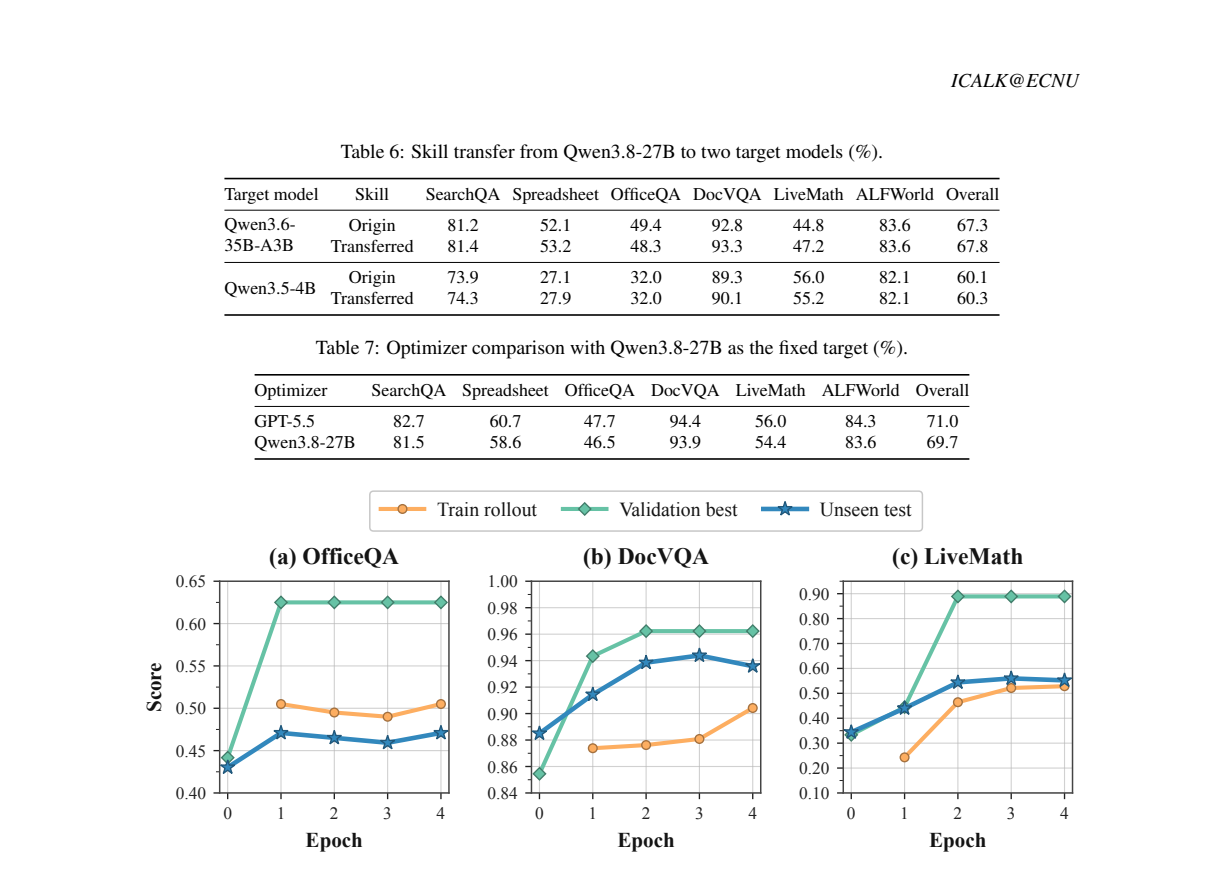
The default optimizer is GPT-5.5, and Table 7 shows that using Qwen3.8-27B as the optimizer reduces the overall score by 1.3 percentage points relative to GPT-5.5 (71.0% vs. 69.7%). While the paper notes this, it does not discuss whether the method's effectiveness is inherently tied to a strong optimizer model.
more of objection 2
Given that the optimizer performs critical inference (critique, consolidation, review), the sensitivity to optimizer strength should be characterized more explicitly. What happens with a significantly weaker optimizer (e.g., Qwen3.5-4B)? Without such analysis, the practical applicability of TextualRL when a strong proprietary optimizer is unavailable remains unclear.
6 minor objections
The paper says, at Table 1
Pith says: minor objection 1 of 6
The subscripts on TextualRL scores show percentage-point gains over the Base Model. For readability, consider also including the percentage-point gain over SkillOpt in the table or a separate column, given that SkillOpt is the strongest baseline and the main comparison.
The paper says, at §4.4 (Training dynamics, paragraph 2)
Pith says: minor objection 2 of 6
The sentence 'Further optimization does not consistently improve unseen performance' is supported by the OfficeQA and LiveMath curves. It would be helpful to explicitly report the maximum test score reached and whether the validation-based checkpoint selection could miss a better test-performing context due to the validation gap.
show 4 more
The paper says, at Algorithm 1
Pith says: minor objection 3 of 6
Line 4 references critique calls 'in parallel'. Clarify whether this parallelism is implemented within a single process (e.g., batched LLM API calls) or across multiple API endpoints, as this affects runtime and cost estimates.
The paper says, at §4.4 (Agent harnesses, Table 5)
Pith says: minor objection 4 of 6
The five-benchmark average excludes ALFWorld. For consistency with Table 1, consider reporting results on the same set of benchmarks or justifying the exclusion.
The paper says, at Appendix B.1
Pith says: minor objection 5 of 6
The note that ALFWorld uses 18 validation environments instead of the 140 described in the SkillOpt paper is important for reproducibility. The potential impact of this smaller validation set on checkpoint selection should be discussed briefly.
The paper says, at §3.2 (line below eq. 3)
Pith says: minor objection 6 of 6
'Consolidate duplicate trajectories while preserving their outcome labels, original rollout references, and multiplicities.' It is not entirely clear whether deduplication happens within the same task or across tasks. The Appendix B.2 clarifies it is within the same task, but consider moving that clarification to the main text.
What would settle it
For each of the four remaining target models (GPT-5.5, GPT-5.4, Qwen3.5-4B, Qwen3.6-35B-A3B), repeat the full TextualRL and SkillOpt optimization with at least three random seeds (varying batch composition and initial seed). If TextualRL’s six-benchmark average exceeds SkillOpt’s by at least 0.5 percentage points in every target (or if the one-sided confidence intervals exclude zero), the claim that TextualRL achieves the highest average for every target is supported. If any target shows overlapping intervals or a reversal, the central claim weakens.
from the skeptic's reading
How the review went
4 readings by deepseek-v4-flash · 14 Oct 2026
- Reader holds up
- Skeptic partly agrees
- Editor wrote the verdict above
- Referee minor revision: 2 major objections, 6 minor
Not run on this paper: the simulated authors' defence.
Pith did not check this review's objections against the paper.
The review in full
The review in brief, machine-written
TextualRL is a clean engineering contribution to the prompt-optimization subfield. The core idea—treating a group of same-task rollouts as the unit of critique, then cross-referencing evidence across groups before applying edits—is genuinely new and well-motivated. The authors back it with thorough ablations, run-stability data for one target (Qwen3.8-27B), and a transparent audit of the evidence-review step. They also ship code and acknowledge the generalization gap from validation overfitting, which I respect.
That said, the empirical case is softer than the main table suggests. The headline advantage over SkillOpt is 0.9–3.2 percentage points across targets, and for four out of five target models only a single optimization run is reported. The three-run stability study on Qwen3.8-27B shows the advantage holds there (mean 3.25 pp with non-overlapping SDs), but we have no idea whether the same is true for GPT-5.5, GPT-5.4, or the other Qwen variants. Given that the gains are narrow, this is a real weak spot. The authors do not hide it—they say the Table 1 scores are from individual runs—but the paper’s central claim (“highest six-benchmark average for every target”) rests on numbers that could shift with seed variation.
A secondary concern is that the method depends on GPT-5.5 as the optimizer. The ablations show Qwen3.8-27B as optimizer still beats the base model by 14.1 pp on average, but the advantage over SkillOpt likely shrinks further with a weaker optimizer. This is not a flaw but it limits the headline generality.
Who benefits from this paper? Researchers working on prompt/context adaptation will find the grouping and cross-group review ideas worth trying. The ablations give good signal about which components matter. The paper is clearly written and the experimental design is otherwise thorough (five targets, six benchmarks, sensible baselines).
Recommendation: send to peer review. The core algorithm is novel, the experiments are honest about limitations, and the work is reproducible. A referee should ask for repeated runs on the other four targets to quantify variance, and for discussion of what the method buys over just running SkillOpt with more rollouts. But the paper deserves a chance to revise on that point.
The strongest objection
The main results (Table 1) report a single run per target–benchmark pair. The central claim rests on a small advantage over the strongest baseline SkillOpt (0.9–3.2 percentage points). For one target (Qwen3.8-27B), a three-run stability study (Table 3) shows the advantage is consistent, with an overall mean advantage of 3.25 pp and non-overlapping standard deviations. However, for the other four target models only a single optimization is reported. Without repeated runs, it is unknown whether the observed advantage for those targets is robust or could be eliminated by seed variation. Given that the gains are narrow, this is a load-bearing concern for the generality of the central claim.
The reader's weakest_assumption highlighted the generalization gap from validation to test, which is an acknowledged limitation. I instead focus on the statistical robustness of the narrow advantage over SkillOpt across all target models. The paper's own stability analysis for one target is commendable, but it does not cover the other four targets where only single runs are reported. Since the central claim is that TextualRL achieves the highest six-benchmark average for every target, and the margins are small, verifying that the advantage is not due to random seed variation is critical. The concrete test would settle this. Despite this concern, the paper is well-executed and the evidence is strong; my recommendation is to leave the verdict unchanged pending optional follow-up.
The referee's report
If the results hold, TextualRL offers a practical and principled approach to adapting LLM agents without parameter updates, by organizing trajectory feedback into group-wise comparisons and evidence-based proposal review. The method is model-agnostic, can be applied to any frozen agent, and the ablation studies confirm that both the outcome-aware critique and cross-group review contribute meaningfully. The validation-gated selection provides a safeguard against overfitting. The paper includes thorough ablations, run stability analysis (for one target), optimizer sensitivity, skill transfer, and an evidence review audit, making the empirical contribution strong. The approach is clearly motivated by the limitations of existing trajectory-level methods and provides a coherent framework that could influence future work on context optimization.
Pith's reading of the paper (a machine's summary, not the authors')
The paper introduces TextualRL, a gradient-free reinforcement learning method that optimizes the shared textual context (instructions and procedures) of a frozen LLM agent to maximize task rewards. Instead of relying on isolated trajectory feedback, TextualRL groups multiple rollouts from the same task under the current context and uses their success–failure patterns to propose targeted edits. A groupwise critique module contrasts successful and failed rollouts within a task, or draws on cross-task evidence when outcomes are uniform, to generate edit proposals and trajectory evidence cards. A cross-group update module then reviews all proposals against the entire pool of evidence—including observations that did not trigger an edit—to refine content and applicability before assembling a bounded textual patch. The candidate context is accepted only if its validation reward exceeds a stored reference score. On five target agents and six benchmarks, TextualRL achieves the highest six-benchmark average for every target, with gains of 11.4–24.4 percentage points over the base model and 0.9–3.2 points over the strongest baseline SkillOpt. The method is significant because it enables parameter-free policy optimization through context updates, and the group-based critique addresses the challenge of turning sparse execution outcomes into reusable guidance.
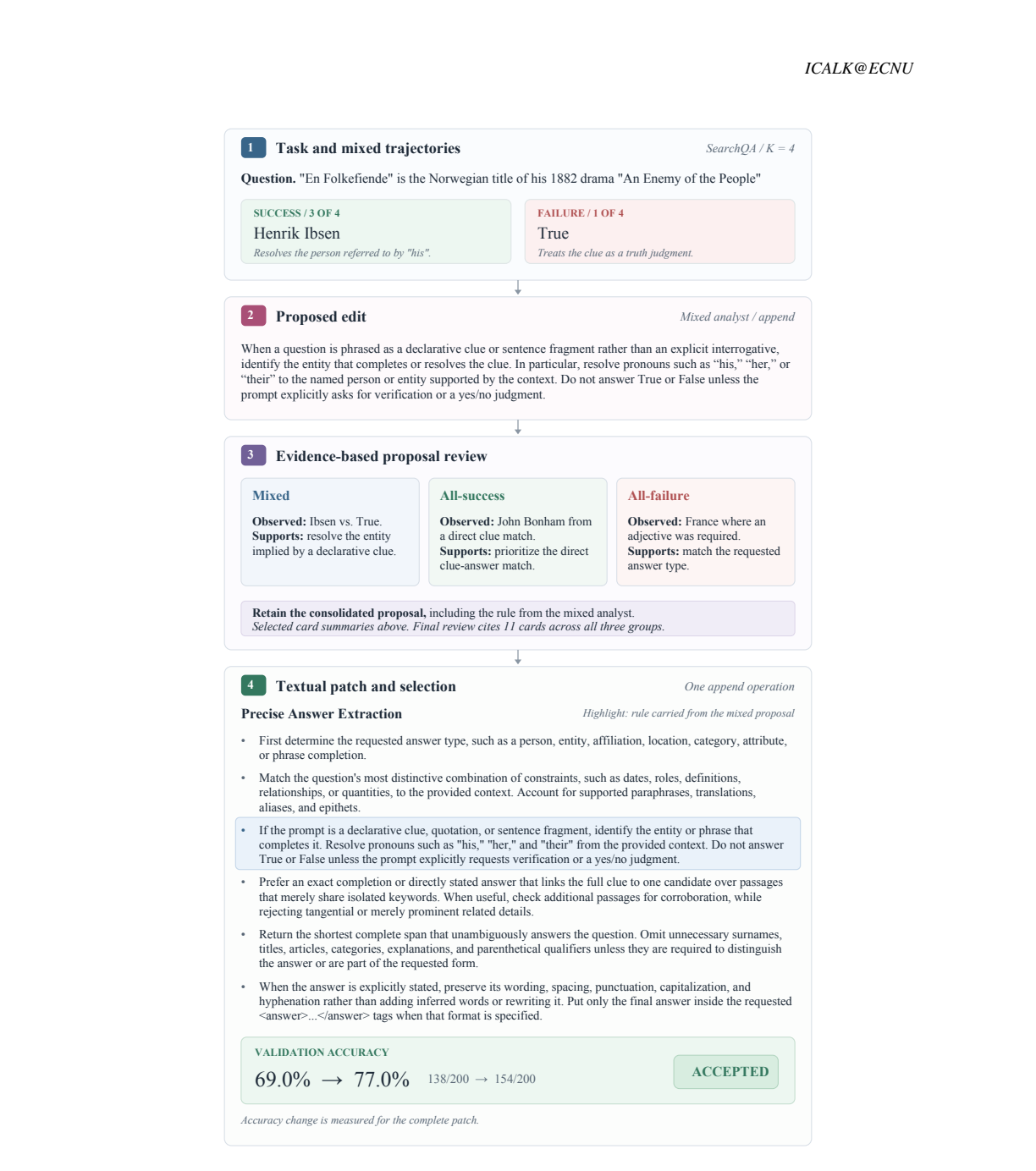
What carries the argument. The central mechanism is the pairing of Groupwise Policy Critique and Cross-Group Policy Update. Groupwise Policy Critique organizes same-task rollout groups by their reward vector (mixed, all-success, all-failure) and produces at most one atomic edit per group plus evidence cards describing observable behavior, even when no edit is proposed. Cross-Group Policy Update then reviews all proposals against the pooled evidence cards—including those from other groups—retaining, narrowing, or revising instructions based on support, limits, or contradictions. This evidence-based review is what allows the method to avoid overfitting to specific task patterns and to produce bounded textual patches that are then validated on a held-out set.
Core claim. TextualRL establishes that a group of same-task rollouts under the same context, rather than an isolated trajectory, can serve as the effective unit for policy critique in textual context optimization. By routing groups into mixed-outcome, all-success, or all-failure analysis, and by retaining trajectory evidence independently of edit proposals, the method can generate context updates that generalize better than those produced by prior methods that either analyze trajectories individually or merge proposals without cross-evidence review. Across 30 target–benchmark settings, TextualRL outperforms all baselines in 29 and ties in one, demonstrating consistent improvements.
The premise it rests on. The optimization process assumes that an LLM optimizer (GPT-5.5 by default) can produce meaningful critiques and edit proposals from grouped trajectory evidence, and that a held-out validation set reliably indicates which context updates will generalize to unseen tasks; the paper acknowledges that validation scores can improve far more than test scores, revealing a generalization gap that is only partially addressed.
If the paper is right (Pith's inferences, not the authors')
TextualRL provides a practical recipe for improving frozen LLM agents without fine-tuning, making it applicable when model parameters are inaccessible or too costly to update.
The group-based critique approach reveals that comparative evidence from multiple rollouts is more informative than isolated trajectory feedback for identifying which instructions to preserve or revise.
The method demonstrates that context optimization can substantially boost performance even on small, weak target models (e.g., Qwen3.5-4B gains 51.5 points on ALFWorld), suggesting a low-resource path to agent improvement.
The validation-gated update rule introduces a principled defense against harmful edits: only context patches that improve held-out validation accuracy are adopted, preventing reward-hacking or overfitting to training tasks.
The explicit separation of evidence cards from edit proposals is a design insight that could generalize beyond context optimization: any modular policy learning system might benefit from decoupling behavioral observations from the actions they suggest, allowing cross-source review.
The generalization gap observed (e.g., OfficeQA validation 62.5% vs test 47.1%) implies that the success of TextualRL depends critically on the quality and representativeness of the validation set; practitioners using this method should invest in diverse validation tasks to maximize transfer to unseen tasks.
Because the optimizer LLM (GPT-5.5) itself provides the critiques and reviews, the method inherits any biases or limitations of that model; future work could explore whether weaker or more specialized optimizer models yield similar improvements.
Check this review
Pith stored no record of this review's passes and took no fingerprint of it. Reviews made by code from 13 Nov 2026 on carry both.
How often reviews like this one are right
Reviews like this one: written by deepseek-v4-flash, where what was read was not recorded.
How often objections from reviews like this one are right: not yet measured
Reviews by people
This review was written by a machine. No person has reviewed this paper on Pith yet. A scientist listed on Pith can review it for a fee, and their review is published here whatever it concludes.
The paper
Abstract
LLM agents can adapt to task feedback by revising the textual context that guides their behavior, without changing their model parameters. However, turning execution rewards into reusable context updates is challenging: individual trajectories offer limited comparative evidence about what to change, while task-specific fixes may overgeneralize when incorporated into a shared context. We introduce TextualRL, a gradient-free reinforcement learning framework that treats a group of rollouts from the same task under the same context, rather than an isolated trajectory, as the unit of policy critique. Groupwise Policy Critique contrasts successful and failed rollouts within a task; when outcomes are uniform, it draws on cross-task evidence to identify behaviors worth preserving or formulate repair hypotheses. Cross-Group Policy Update reviews the resulting proposals against evidence pooled across groups, including observations that yield no proposed edit, to refine their content and applicability. Reviewed proposals form a bounded textual patch, with adoption of the candidate context determined by held-out validation rewards. Together, these components establish a reward-driven policy optimization loop in which multiple attempts jointly inform reusable context updates. We evaluate TextualRL with five target agents on six benchmarks. Averaged over the six benchmarks, TextualRL improves test accuracy over the base model by 24.4 and 15.3 percentage points for GPT-5.5 and Qwen3.8-27B, respectively.
The paper's own sentences, arranged, kept beside the review and separate from it. Each label is drawn from a closed vocabulary; the number beside it is the probability the classifier gave that label. No sentence in this record was written by a model.
abstract compiled · 2026-10-14
The authors' main claim, as the classifier picked it out 0.98
“Averaged over the six benchmarks, TextualRL improves test accuracy over the base model by 24.4 and 15.3 percentage points for GPT-5.5 and Qwen3.8-27B, respectively.”
How the main claim is stated: asserted 1.00
What the abstract itself states, as probabilities: claims first 0.05 · states limitation 0.20 · human participants 0.04 · controlled comparison 0.90 · randomized assignment 0.02 · states quantitative result 0.99 · compares with prior results 0.90 · mentions code or data availability 0.03
The abstract, sentence by sentence
This table labels the abstract only (arXiv listing abstract v1). The number is the probability the classifier gave the label.
| Sentence | Role | The authors' own work | States the main conclusion | Strength |
|---|---|---|---|---|
| LLM agents can adapt to task feedback by revising the textual context that guides their behavior, without changing their model parameters. | background 1.00 | 0.12 | 0.09 | asserted 0.79 |
| However, turning execution rewards into reusable context updates is challenging: individual trajectories offer limited comparative evidence about what to change, while task-specific fixes may overgeneralize when incorporated into a shared context. | gap 0.81 | 0.10 | 0.03 | asserted 0.98 |
| We introduce TextualRL, a gradient-free reinforcement learning framework that treats a group of rollouts from the same task under the same context, rather than an isolated trajectory, as the unit of policy critique. | contribution 0.88 | 0.85 | 0.11 | asserted 1.00 |
| Groupwise Policy Critique contrasts successful and failed rollouts within a task; when outcomes are uniform, it draws on cross-task evidence to identify behaviors worth preserving or formulate repair hypotheses. | method 0.98 | 0.74 | 0.06 | asserted 1.00 |
| Cross-Group Policy Update reviews the resulting proposals against evidence pooled across groups, including observations that yield no proposed edit, to refine their content and applicability. | method 0.99 | 0.78 | 0.04 | asserted 0.98 |
| Reviewed proposals form a bounded textual patch, with adoption of the candidate context determined by held-out validation rewards. | method 1.00 | 0.89 | 0.06 | asserted 0.99 |
| Together, these components establish a reward-driven policy optimization loop in which multiple attempts jointly inform reusable context updates. | method 0.70 | 0.74 | 0.24 | asserted 1.00 |
| We evaluate TextualRL with five target agents on six benchmarks. | method 0.71 | 0.96 | 0.03 | asserted 0.95 |
| Averaged over the six benchmarks, TextualRL improves test accuracy over the base model by 24.4 and 15.3 percentage points for GPT-5.5 and Qwen3.8-27B, respectively. | result 1.00 | 0.95 | 0.66 | asserted 1.00 |
What kind of paper the classifier reports this is: method or tool 1.00 · evidence from observation or experiment 0.97
What was examined, and what was not
Sources read
- arXiv listing abstract v1
Not examined
- full text
- figures and tables
- references and citing sentences
- relations to other papers
Levels run
- P abstract
Not run
- S sections
- T body sentences
- C citations
- R cross-paper relations
How the labels were made
Compiled by classifier-1.13.0 via TypeSafe API, question bank abstract-p1-20260923, 2026-10-14: 1 request, 6,942 input tokens.
Every quoted sentence on this record is the authors'. Every label is from Pith's closed vocabulary, with the probability shown beside it. This record as JSON
Figures (7)



Figures are the authors', reproduced from the paper.
References (28)
- [1] Leslie Pack Kaelbling, Michael L. Littman, and Andrew W. Moore. Reinforcement learning: A survey.Journal of Artificial Intelligence Research, 4:237–285, 1996. doi: 10.1613/jair.301. URL https://doi.org/10.1613/ jair.301 on Pithdoi:10.1613/jair.301
- [2] Noah Shinn, Federico Cassano, Ashwin Gopinath, Karthik Narasimhan, and Shunyu Yao. Reflexion: language agents with verbal reinforcement learning. In A. Oh, T. Naumann, A. Globerson, K. Saenko, M. Hardt, and S. Levine, editors,Advances in Neural Information Processing Systems, ... on Pithdoi:10.52202/075280-0377
- [3] Qizheng Zhang, Changran Hu, Shubhangi Upasani, Boyuan Ma, Fenglu Hong, Vamsidhar Kamanuru, Jay Rainton, Chen Wu, Mengmeng Ji, Hanchen Li, Urmish Thakker, James Y . Zou, and Kunle Olukotun. Agentic context engineering: Evolving contexts for self-improving language models. InThe... on Pith
- [4] Reid Pryzant, Dan Iter, Jerry Li, Yin Lee, Chenguang Zhu, and Michael Zeng. Automatic prompt optimization with “gradient descent” and beam search. InProceedings of the 2023 Conference on Empirical Methods in Natural Language Processing, pages 7957–7968. Association for Computa... on Pithdoi:10.18653/v1/2023.emnlp-main.494
- [5] Mert Yuksekgonul, Federico Bianchi, Joseph Boen, Sheng Liu, Pan Lu, Zhi Huang, Carlos Guestrin, and James Zou. Optimizing generative AI by backpropagating language model feedback.Nature, 639(8055):609–616, 2025. doi: 10.1038/s41586-025-08661-4. URLhttps://www.nature.com/articl... on Pithdoi:10.1038/s41586-025-08661-4
- [6] Lakshya A Agrawal, Shangyin Tan, Dilara Soylu, Noah Ziems, Rishi Khare, Krista Opsahl-Ong, Ar- nav Singhvi, Herumb Shandilya, Michael J Ryan, Meng Jiang, Christopher Potts, Koushik Sen, Alex Dimakis, Ion Stoica, Dan Klein, Matei Zaharia, and Omar Khattab. GEPA: Reflective prom... on Pith
- [7] Jingwei Ni, Yihao Liu, Xinpeng Liu, Yutao Sun, Mengyu Zhou, Pengyu Cheng, Dexin Wang, Erchao Zhao, Xiaoxi Jiang, and Guanjun Jiang. Trace2Skill: Distill trajectory-local lessons into transferable agent skills.arXiv preprint arXiv:2603.25158, 2026. URLhttps://arxiv.org/abs/2603.25158 on PithPith's reviewarXiv
- [8] Yifan Yang, Ziyang Gong, Weiquan Huang, Qihao Yang, Ziwei Zhou, Zisu Huang, Yan Li, Xuemei Gao, Qi Dai, Bei Liu, Kai Qiu, Yuqing Yang, Dongdong Chen, Xue Yang, and Chong Luo. SkillOpt: Executive strategy for self- evolving agent skills.arXiv preprint arXiv:2605.23904, 2026. UR... on PithPith's reviewarXiv
- [9] Zhihong Shao, Peiyi Wang, Qihao Zhu, Runxin Xu, Junxiao Song, Xiao Bi, Haowei Zhang, Mingchuan Zhang, Y . K. Li, Y . Wu, and Daya Guo. DeepSeekMath: Pushing the limits of mathematical reasoning in open language models.arXiv preprint arXiv:2402.03300, 2024. doi: 10.48550/arXiv.... on PithPith's reviewarXivdoi:10.48550/arxiv.2402.03300
- [10] Andrew Zhao, Daniel Huang, Quentin Xu, Matthieu Lin, Yong-Jin Liu, and Gao Huang. ExpeL: LLM agents are experiential learners. InProceedings of the AAAI Conference on Artificial Intelligence, volume 38, pages 19632–19642. AAAI Press, March 2024. doi: 10.1609/aaai.v38i17.29936.... on Pithdoi:10.1609/aaai.v38i17.29936
- [11] Siru Ouyang, Jun Yan, I-Hung Hsu, Yanfei Chen, Ke Jiang, Zifeng Wang, Rujun Han, Long Le, Samira Daruki, Xiangru Tang, Vishy Tirumalashetty, George Lee, Mahsan Rofouei, Hangfei Lin, Jiawei Han, Chen-Yu Lee, and Tomas Pfister. ReasoningBank: Scaling agent self-evolving with rea... on Pith
- [12] Taylor Shin, Yasaman Razeghi, Robert L. Logan IV , Eric Wallace, and Sameer Singh. AutoPrompt: Eliciting Knowledge from Language Models with Automatically Generated Prompts. In Bonnie Webber, Trevor Cohn, Yulan He, and Yang Liu, editors,Proceedings of the 2020 Conference on Em... on Pithdoi:10.18653/v1/2020.emnlp-main.346
- [13] Yongchao Zhou, Andrei Ioan Muresanu, Ziwen Han, Keiran Paster, Silviu Pitis, Harris Chan, and Jimmy Ba. Large language models are human-level prompt engineers. InInternational Conference on Learning Representations, on Pith
- [14] Omar Khattab, Arnav Singhvi, Paridhi Maheshwari, Zhiyuan Zhang, Keshav Santhanam, Sri Vardhamanan A, Sai- ful Haq, Ashutosh Sharma, Thomas Joshi, Hanna Moazam, Heather Miller, Matei Zaharia, and Christopher Potts. DSPy: Compiling declarative language model calls into state-of-... on Pith
- [15] Krista Opsahl-Ong, Michael J Ryan, Josh Purtell, David Broman, Christopher Potts, Matei Zaharia, and Omar Khattab. Optimizing instructions and demonstrations for multi-stage language model programs. In Yaser Al- Onaizan, Mohit Bansal, and Yun-Nung Chen, editors,Proceedings of ... on Pithdoi:10.18653/v1/2024.emnlp-main.525
- [16] Mirac Suzgun, Mert Yuksekgonul, Federico Bianchi, Dan Jurafsky, and James Zou. Dynamic Cheatsheet: Test-time learning with adaptive memory. InProceedings of the 19th Conference of the European Chapter of the Association for Computational Linguistics (Volume 1: Long Papers), pa... on Pithdoi:10.18653/v1/2026.eacl-long.333
- [17] Salaheddin Alzubi, Noah Provenzano, Jaydon Bingham, Weiyuan Chen, and Tu Vu. EvoSkill: Automated skill discovery for multi-agent systems.arXiv preprint arXiv:2603.02766, 2026. URL https://arxiv.org/abs/ 2603.02766 on PithPith's reviewarXiv
- [18] Shunyu Yao, Jeffrey Zhao, Dian Yu, Nan Du, Izhak Shafran, Karthik Narasimhan, and Yuan Cao. ReAct: Synergizing reasoning and acting in language models. InInternational Conference on Learning Representations (ICLR), 2023. URLhttps://arxiv.org/abs/2210.03629 on PithPith's reviewarXiv
- [19] Aman Madaan, Niket Tandon, Prakhar Gupta, Skyler Hallinan, Luyu Gao, Sarah Wiegreffe, Uri Alon, Nouha Dziri, Shrimai Prabhumoye, Yiming Yang, Shashank Gupta, Bodhisattwa Prasad Majumder, Katherine Her- mann, Sean Welleck, Amir Yazdanbakhsh, and Peter Clark. Self-Refine: Iterat... on Pith
- [20] Andy Zhou, Kai Yan, Michal Shlapentokh-Rothman, Haohan Wang, and Yu-Xiong Wang. Language agent tree search unifies reasoning, acting, and planning in language models. In Ruslan Salakhutdinov, Zico Kolter, Katherine Heller, Adrian Weller, Nuria Oliver, Jonathan Scarlett, and Fe... on Pith
show 8 more
- [21] Guanzhi Wang, Yuqi Xie, Yunfan Jiang, Ajay Mandlekar, Chaowei Xiao, Yuke Zhu, Linxi Fan, and Anima Anandkumar. V oyager: An open-ended embodied agent with large language models.Transactions on Machine Learning Research, 2024. ISSN 2835-8856. URLhttps://openreview.net/forum?id=... on Pith
- [22] Matthew Dunn, Levent Sagun, Mike Higgins, V . Ugur Guney, V olkan Cirik, and Kyunghyun Cho. SearchQA: A new q&a dataset augmented with context from a search engine.arXiv preprint arXiv:1704.05179, 2017. URL https://arxiv.org/abs/1704.05179. 11 ICALK@ECNU on PithPith's reviewarXiv
- [23] Zeyao Ma, Bohan Zhang, Jing Zhang, Jifan Yu, Xiaokang Zhang, Xiaohan Zhang, Sijia Luo, Xi Wang, and Jie Tang. SpreadsheetBench: Towards challenging real world spreadsheet manipulation. In A. Glober- son, L. Mackey, D. Belgrave, A. Fan, U. Paquet, J. Tomczak, and C. Zhang, edit... on Pithdoi:10.52202/079017-3007
- [24] Krista Opsahl-Ong, Arnav Singhvi, Jasmine Collins, Ivan Zhou, Cindy Wang, Ashutosh Baheti, Owen Oertell, Jacob Portes, Sam Havens, Erich Elsen, Michael Bendersky, Matei Zaharia, and Xing Chen. OfficeQA Pro: An enterprise benchmark for end-to-end grounded reasoning.arXiv prepri... on PitharXiv
- [25] Minesh Mathew, Dimosthenis Karatzas, and C.V . Jawahar. DocVQA: A dataset for VQA on document im- ages. InProceedings of the IEEE/CVF Winter Conference on Applications of Computer Vision (WACV), pages 2200–2209, January 2021. URL https://openaccess.thecvf.com/content/WACV2021/... on Pith
- [26] Linyang He, Qiyao Yu, Hanze Dong, Baohao Liao, Xinxing Xu, Micah Goldblum, Jiang Bian, and Nima Mesgarani. LiveMathematicianBench: A live benchmark for research-level mathematical reasoning with proof sketches.arXiv preprint arXiv:2604.01754, 2026. URLhttps://arxiv.org/abs/2604.01754 on PithPith's reviewarXiv
- [27] Mohit Shridhar, Xingdi Yuan, Marc-Alexandre Côté, Yonatan Bisk, Adam Trischler, and Matthew Hausknecht. ALFWorld: Aligning Text and Embodied Environments for Interactive Learning. InProceedings of the Interna- tional Conference on Learning Representations (ICLR), 2021. URLhttp... on PithPith's reviewarXiv
- [2023] URLhttps://openreview.net/forum?id=92gvk82DE- on Pith
Challenges and discussion
Disagree with the review, or know something it missed? Leave a comment, or challenge this review formally: a challenge becomes a permanent entry in this paper's record, and its decision is published here.
Come back by email
A short list of the week's newly reviewed papers. Nothing is sent until you confirm from your inbox, and every email has a link that stops it. No account.
No comments yet.
Sign in to comment