Artificial Intelligence · arXiv:2610.18813 v1 · submitted 13 Oct 2026 · 14 references
Self-Evolving Agent Harness
The paper says
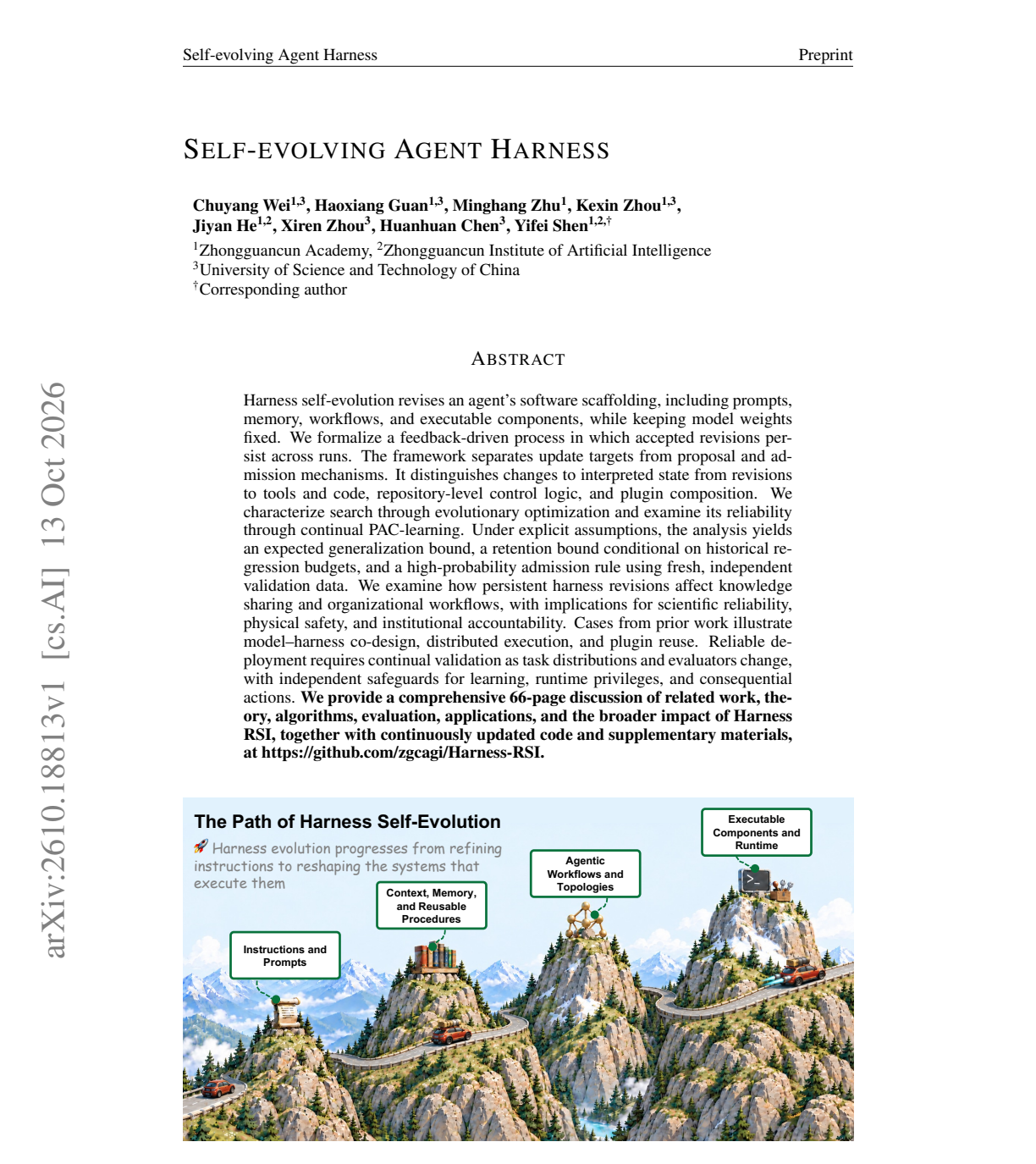
“Harness self-evolution revises an agent's software scaffolding, including prompts, memory, workflows, and executable components, while keeping model weights fixed. We formalize a feedback-driven process in which accepted revisions persist across runs.”
more of the abstract
The framework separates update targets from proposal and admission mechanisms. It distinguishes changes to interpreted state from revisions to tools and code, repository-level control logic, and plugin composition. We characterize search through evolutionary optimization and examine its reliability through continual PAC-learning. Under explicit assumptions, the analysis yields an expected generalization bound, a retention bound conditional on historical regression budgets, and a high-probability admission rule using fresh, independent validation data. We examine how persistent harness revisions affect knowledge sharing and organizational workflows, with implications for scientific reliability, physical safety, and institutional accountability. Cases from prior work illustrate model–harness co-design, distributed execution, and plugin reuse. Reliable deployment requires continual validation as task distributions and evaluators change, with independent safeguards for learning, runtime privileges, and consequential actions. We provide a comprehensive 66-page discussion of related work, theory, algorithms, evaluation, applications, and the broader impact of Harness RSI, together with continuously updated code and supplementary materials, at https://github.com/zgcagi/Harness-RSI.
from the abstract
Pith says
Machine review · deepseek-v4-flash · 14 Oct 2026 · what was read was not recorded · not checked by a person
It can be wrong. Challenge this review or reply to it.
Holds up, with conditions. Useful taxonomy and a sound admission rule; the advertised generalization bound is a definitional identity until the stability coefficient is quantified. This line is wrong
2 major objections · 8 minor
How often objections from reviews like this one are right: not yet measured
Not checked: figures, code, what the 14 references say.
The paper says, at §4.2, Eq. (5)
The review did not quote this passage.
A classifier read this sentence of the paper as acknowledging the concern (probability 0.87):
“Small code edits do not by themselves imply stability of the full update process.”
Pith says: Objection 1 of 2 · major
The expected generalization bound is definitional in an unquantified stability coefficient, and this gap is load-bearing for the paper's second listed contribution. As defined, β_{s,k} is the average replace-one sensitivity of the full update process, and Eq. (5) follows for every update operator from replace-one exchangeability; no property of the update loop restricts it, so the inequality carries no information until β_{s,k} is controlled.
more of objection 1
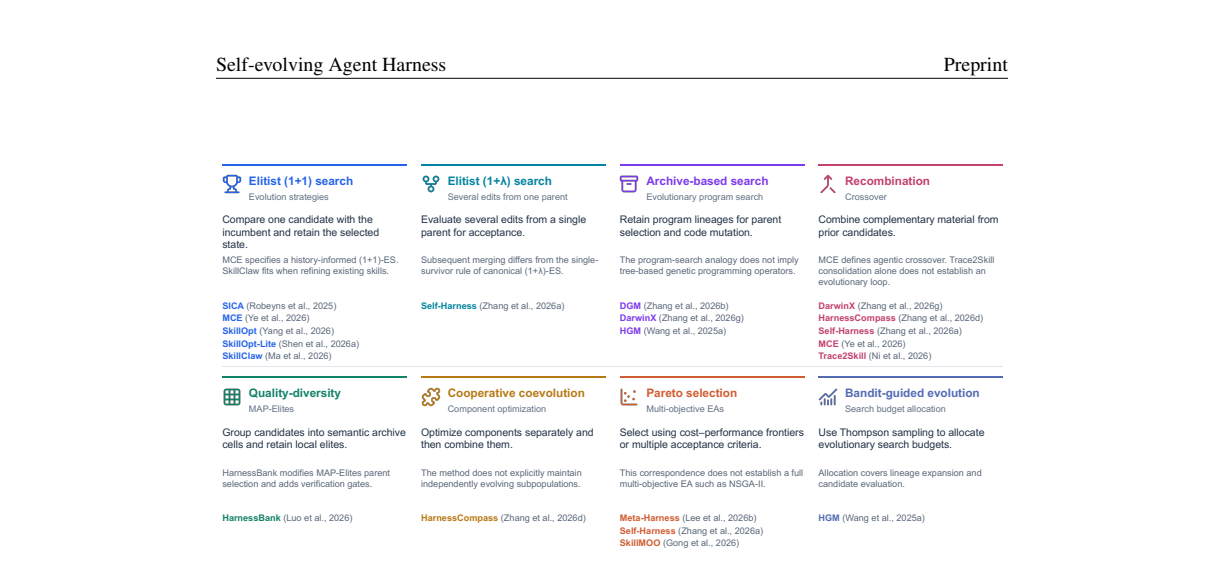
The paper acknowledges this ('Small code edits do not by themselves imply stability of the full update process'), but the acknowledged point is never resolved: no bound on β is derived for any of the concrete update mechanisms catalogued in Figure 2 or Section 3, nor for any restricted class such as elitist search with bounded edit distance, finite candidate pools, or Lipschitz losses. To give the advertised expected generalization bound non-vacuous force, the authors should either (i) derive a bound on β_{s,k} under stated conditions on the update operator, or (ii) explicitly re-frame the Section 4.2 analysis as a framework whose stability coefficient must be instantiated per system, and align the abstract and the contribution list with that re-framing.
The paper says, at §4.2, Eq. (6)
The review did not quote this passage.
A classifier read this sentence of the paper as acknowledging the concern (probability 0.61):
“For fixed regression budgets εs,u, suppose each later transition satisfiesR s(Hu)−R s(Hu−1)≤ε s,u.”
Pith says: Objection 2 of 2 · major
The retention bound inherits the unquantified β_{s,s} and stacks a second unquantified family of assumptions, so the claimed 'retention bound conditional on historical regression budgets' does not, as it stands, certify retention for any system. The constants ε_{s,u} are introduced as hypotheses rather than derived or checked, and although the paper notes that checking them 'requires groupwise uncertainty control for …
more of objection 2
… the deployed composition, including merged edits and shared routers,' no such procedure is described and no example budget is estimated for any of the systems in Section 3. Accumulated regressions are central to the reliability motivation of the paper (the irreversible-error scenarios in robotics and clinical settings), so the retention result would benefit from at least one concrete instantiation—for instance, a stated verification protocol with an explicit multiple-comparison correction, or a worked example with numerical ε values—for the result to function as more than a restatement of its assumptions.
8 minor objections
The paper says, at Table 2
Pith says: minor objection 1 of 8
Several numeric entries are concatenated ('76.5177.58', '81.1482.56', '83.6385.05', '83.6385.77'), which obscures the reported values; the columns should be separated.
The paper says, at Table 2 caption
Pith says: minor objection 2 of 8
The caption says the numbers are 'converted from proportions' in Shen et al. (2026a); it should state the conversion rule (multiply by 100) and the rounding convention.
show 6 more
The paper says, at Eqs. (7)–(8)
Pith says: minor objection 3 of 8
The validation set size m appears without a round subscript although V_k depends on k; the paper should state explicitly, as the surrounding text implies, that m is fixed across rounds.
The paper says, at §4.2, evolution-state paragraph
Pith says: minor objection 4 of 8
The notation X_k = A_k(X_{k−1}, D_k; U_k) is introduced before U_k is described; the auxiliary randomness U_k should be defined in the same passage as the update operator.
The paper says, at Figure 3
Pith says: minor objection 5 of 8
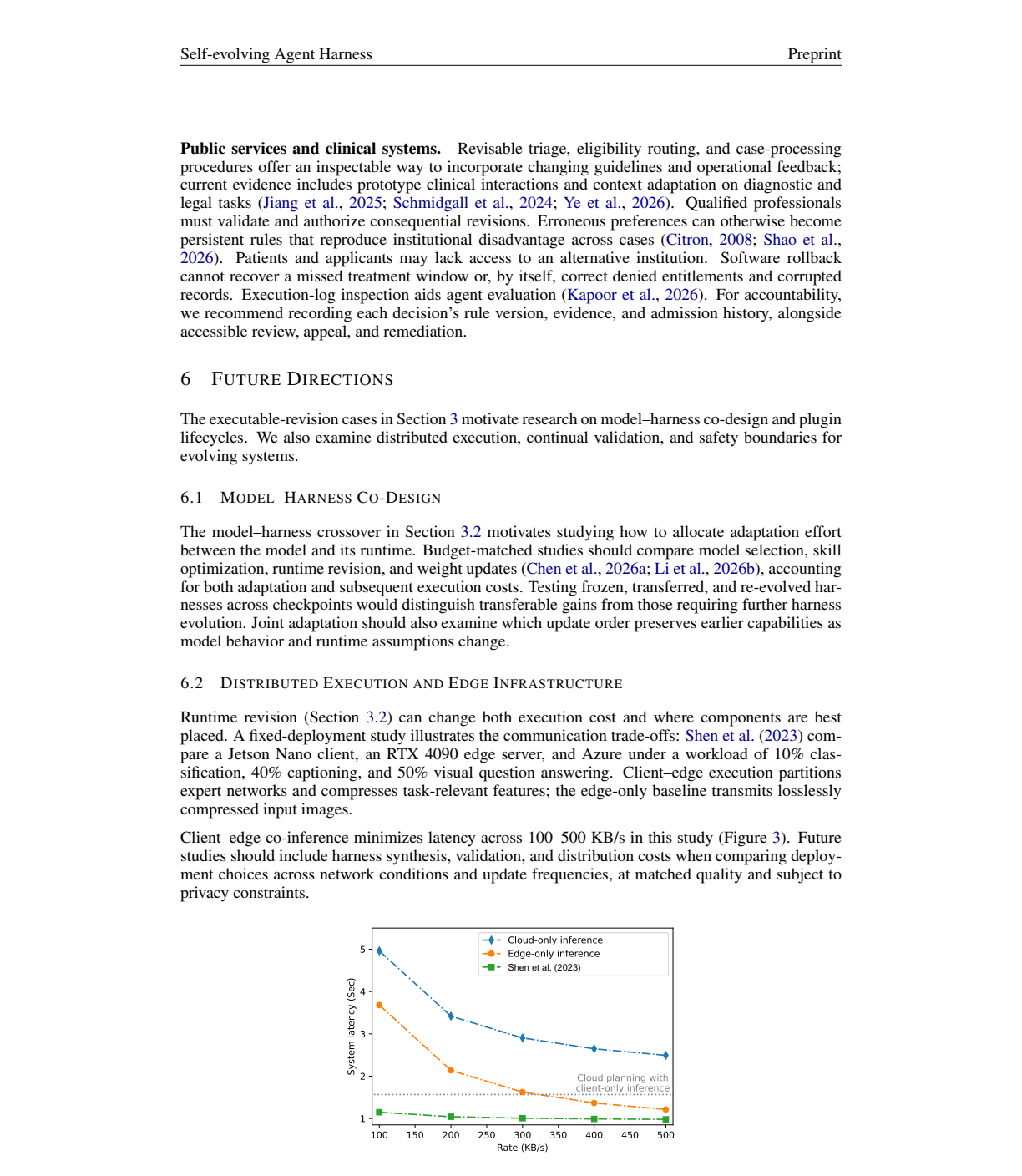
The caption refers to 'client–edge in green,' but the color coding is not visible in the text rendering; explicit series labels or a visible legend are needed.
The paper says, at §4.2, admission paragraph
Pith says: minor objection 6 of 8
The claim that the bounds hold 'simultaneously with probability at least 1−δ' relies on one-sided Hoeffding bounds; since the displayed margin matches the one-sided version, the text should say 'one-sided conditional Hoeffding bounds' to avoid a factor-of-two ambiguity.
The paper says, at References
Pith says: minor objection 7 of 8
The Fernando et al. entry lists 'PMLR, PMLR' twice, and the MLE-bench entry renders the venue inconsistently with neighboring entries; these should be normalized.
The paper says, at Appendix A
Pith says: minor objection 8 of 8
Because the companion report is said to contain the extended evaluation discussion, the main text should cite the specific companion sections when Sections 5–6 invoke evaluation practices and benchmarks.
What would settle it
Take a minimal compliant update loop (fixed proposal distribution over a one-line prompt or skill edit, admission by improvement on a separate validation batch) and a fixed benchmark distribution with n_s = 128 tasks. Estimate β_{s,s} by averaging, under coupled randomness, the leave-one-out replace-one loss differences |ℓ(H_s, z_i) − ℓ(H_s^{(i)}, z_i)| over all i and repeated runs; compare β_{s,s} with the expected empirical gain E[\hat R_s(H_s)] relative to the initial harness. If β_{s,s} is comparable to or larger than that gain, Eq. (6) is vacuous for the paper's own update class; if it is much smaller, the framework yields a usable certificate.
from the skeptic's reading
How the review went
4 readings by deepseek-v4-flash · 14 Oct 2026
- Reader holds up, with conditions
- Skeptic agrees
- Editor wrote the verdict above
- Referee major revision: 2 major objections, 8 minor
Not run on this paper: the simulated authors' defence.
Pith did not check this review's objections against the paper.
The review in full
The review in brief, machine-written
Read the harness self-evolution preprint. The useful core is the taxonomy and the admission rule, not the generalization bound. If you work on agent scaffolding, the interpreted-vs-executable distinction and the mapping of eight search structures onto existing harness methods are good organizing tools, and the paper is unusually candid about where the analogies break (Trace2Skill is not an evolutionary loop; HarnessCompass is not a full multi-objective EA). The fresh-validation admission bound (Eq. 8) is standard Hoeffding plus union bound but correctly applied, and the discussion of why search-time reuse breaks its independence is right. The safety and rollback discussion is sensible and carefully scoped.
The soft spot is where the reader and stress test put it. Eq. (5) defines beta_{s,k} as the average replace-one sensitivity and then states the expected generalization gap is at most beta. That is true but definitional; no concrete update loop is analyzed, so the headline bound has no demonstrated force. The authors acknowledge this around Eq. (5) when they say small code edits do not imply stability, but the acknowledgment does not change that the paper's main theoretical result is conditional on an unquantified quantity. Eq. (6) is a telescoping of separately assumed regression budgets, not an independent retention result. The admission bound is the piece with real teeth, and it is fine.
The empirical illustrations are the weakest part. The SpreadsheetBench numbers are converted from a non-archival preprint; the EIP numbers come from a Zhihu post and a GitHub repo. The paper itself flags the inconsistency between first-task totals and cumulative row 1 in Table 3, and the LiveBrowseComp scores have unspecified units. The caveats are honest, but the numbers are too shaky to carry weight. The authors should replace them with archival sources or cut them down to anecdotes, which is what they are.
The citation pattern looks fine: broad and relevant, no obvious padding. The use of the author's own prior work is labeled as illustration and is not hidden.
This paper deserves a serious referee. It is a framework paper, not a results paper, and that should be the standard applied. With beta bounded for a representative loop, or the generalization claim restated as the definitional identity it is, plus archival cleanup, I would be comfortable with acceptance. As is, it is a useful survey-with-theory that needs revision.
The strongest objection
The load-bearing theoretical claim is that Section 4.2 certifies generalization, retention, and admission. The admission part (Eqs. 7-9) is sound under the stated fresh-validation independence, and the paper correctly warns that reused search-time data breaks that independence. The weakness is the generalization/retention chain. Eq. (5) is exact for the β defined there, so it is a definitional identity: it says the expected gap between true and empirical round-s risk is at most the average replace-one sensitivity of the full update process. The manuscript never bounds β_{s,k} for any concrete update loop, and it concedes around Eq. (5) that small code edits do not by themselves imply stability. Since Eq. (6) inherits β_{s,s} plus the separately assumed ε budgets, the headline expected generalization bound is conditional on an unquantified quantity; if β is large, the inequality is true but vacuous, and the retention statement carries no independent force. The paper is honest about this conditionality, so this is a gap in demonstrated force rather than an internal inconsistency.
I agree with the reader's weakest-assumption identification. The admission certificate (Eq. 8) is well-grounded: conditional on fresh independent validation samples and at most K candidates per round, the Hoeffding-plus-union-bound argument is standard and correctly applied, and the paper explicitly flags the independence requirement. The unresolved point is Eqs. (5)-(6): β_{s,k} is defined, not bounded or instantiated, and the text itself acknowledges that small code edits need not imply stability. This does not contradict any theorem or data in the paper, but it means the central generalization and retention claims are conditional in a way that has not been shown satisfiable for a realistic update loop. A single concrete computation or analytical bound on β for a representative update loop would resolve whether the advertised bounds have force. Because the reader already assigned CONDITIONAL for exactly this reason, no verdict change is warranted.
The referee's report
The paper's principal contribution is conceptual. The definitional framework—the harness as update target, the self-evolution versus self-improvement distinction, the interpreted-versus-executable mutation boundaries, and the feedback-continuity and persistence requirements—offers the field a usable vocabulary for a practically important phenomenon. The admission rule is the strongest technical piece: Eq. (8) is a correct one-sided Hoeffding bound with a union bound over at most KT comparisons, and the paper is right that fresh validation is essential and that HarnessBank/Self-Harness-style reuse of search-time splits violates the stated independence. The paper also practices good epistemic hygiene: it flags a discrepancy between the two EIP cost reports, declines to claim matched-cost superiority for the HarnessOpt crossover, and treats the immutability of the final assessment J as a design constraint rather than an achieved guarantee.
Pith's reading of the paper (a machine's summary, not the authors')
Harness self-evolution is the claim that an AI agent's software scaffolding—the prompts, memory, workflows, tools, and control logic wrapped around a fixed model—can itself learn from execution feedback. This paper tries to make that process precise: at round $k$ the incumbent harness $H_{k-1}$ produces a batch of rollouts, an update operator proposes and admits revisions, and accepted revisions persist into later runs. The authors argue that this loop is analyzable rather than merely empirical: it can be viewed as evolutionary search, and under explicit assumptions its generalization, retention, and admission decisions satisfy classical stability and concentration bounds. If the framework is right, agents can accumulate capability without retraining, but only if each admission is checked against fresh, independent validation data and later regressions are budgeted. The paper's guarantees are explicitly conditional, and it does not assume that every revision helps.
What carries the argument. The load-bearing object is the update loop itself: a harness $H$ governing a fixed model $M$, with $B_k$ as the rollout batch and $H_k=\mathrm{Update}(H_{k-1},B_k)$. The framework's taxonomic move separates interpreted-state changes (instructions, memory, workflows) from executable revisions (tools, code, repository-level control logic, plugin composition), and this determines what can be mutated and what must be revalidated. On the search side, candidate generation and admission are mapped to evolutionary structures such as elitist search, archives, crossover, and Pareto selection. On the certification side, the key identities are the replace-one stability gap $|\mathbb{E}[R_s(H_k)-\hat{R}_s(H_k)]|\le \beta_{s,k}$, the telescoped retention bound, and the paired Hoeffding admission threshold. These convert an informal rewrite-yourself-and-see process into quantities that can carry generalization, retention, and admission statements.
Core claim. The central claim is that harness self-evolution is well-defined and separable from weight learning. Formally, at round $k$ the incumbent harness $H_{k-1}$ generates a batch $B_k = \{\tau_{k,i}\}_{i=1}^b$ of rollouts with $\tau_{k,i}\sim\mathrm{Run}(M, H_{k-1}, E_{k,i})$, and the next harness is $H_k = \mathrm{Update}(H_{k-1}, B_k)$, with $H_k = H_{k-1}$ if no revision is admitted. The paper's discovery is that empirical selection alone does not establish generalization or retention, but explicit conditions do: a replace-one stability coefficient $\beta_{s,k}$ bounds the expected gap between true and empirical risk, fixed per-transition regression budgets telescope into a retention bound, and fresh validation sets combined with a Hoeffding bound and union bound give a high-probability admission rule. All three results are conditional: tasks are drawn exogenously and independently, validation is fresh and independent of candidate construction, the model and evaluator are fixed, and the regression budgets are separate assumptions rather than consequences of stability.
The premise it rests on. The load-bearing premise is that a real update loop has small replace-one stability $\beta_{s,k}$ and that task draws and validation sets are independent and never reused; the paper states the bounds in terms of $\beta_{s,k}$ but does not bound it for any concrete harness, and small code edits do not by themselves give stability.
If the paper is right (Pith's inferences, not the authors')
If the formalization is correct, agent capability can improve while model weights stay fixed, so adaptation no longer requires retraining or new weight checkpoints and can work through proprietary APIs.
The generalization bound says the expected gap between empirical and true risk on a round's tasks is controlled by the update process's replace-one stability; it is an average guarantee, not a per-run one.
The retention bound turns forgetting into a budget: if each later transition is checked against a per-round regression allowance, total loss on an earlier task is bounded by the sum of those allowances, so regression testing at every admission is part of the mechanism.
The admission rule requires fresh, independent validation, and systems that reuse training tasks or held-out regression splits for candidate screening forfeit the certificate.
Because accepted revisions persist, a bad revision is inherited by all later runs, so deployment needs continual validation, versioned rollback, and independent controls over learning, runtime privileges, and consequential actions.
A concrete next experiment would measure the stability coefficient $\beta_{s,k}$ for real update loops by rerunning updates after replacing one task; comparing prompt-only edits with code edits would show which revision classes are stable enough for the bound to be non-vacuous.
The admission rule implies an operational budget problem the paper leaves open: every accepted revision consumes fresh validation tasks, so there is a trade-off between how many candidates are explored per round and how many future rounds can be certified, which could be formalized as an optimization over $m$, $K$, $T$, and $\delta$.
If harnesses are shared across teams or organizations, the framework suggests treating skills, plugins, and workflow patches as versioned artifacts with independent validation and provenance, since a locally useful revision can become a correlated error when reused elsewhere.
The paper leaves joint model–harness evolution to future work; an immediate implication is that the same replace-one stability condition would need to hold for the weight-update operator too, so combining the two kinds of learning is not automatically covered by these bounds.
Check this review
Pith stored no record of this review's passes and took no fingerprint of it. Reviews made by code from 13 Nov 2026 on carry both.
How often reviews like this one are right
Reviews like this one: written by deepseek-v4-flash, where what was read was not recorded.
How often objections from reviews like this one are right: not yet measured
Reviews by people
This review was written by a machine. No person has reviewed this paper on Pith yet. A scientist listed on Pith can review it for a fee, and their review is published here whatever it concludes.
The paper
Abstract
Harness self-evolution revises an agent's software scaffolding, including prompts, memory, workflows, and executable components, while keeping model weights fixed. We formalize a feedback-driven process in which accepted revisions persist across runs. The framework separates update targets from proposal and admission mechanisms. It distinguishes changes to interpreted state from revisions to tools and code, repository-level control logic, and plugin composition. We characterize search through evolutionary optimization and examine its reliability through continual PAC-learning. Under explicit assumptions, the analysis yields an expected generalization bound, a retention bound conditional on historical regression budgets, and a high-probability admission rule using fresh, independent validation data. We examine how persistent harness revisions affect knowledge sharing and organizational workflows, with implications for scientific reliability, physical safety, and institutional accountability. Cases from prior work illustrate model–harness co-design, distributed execution, and plugin reuse. Reliable deployment requires continual validation as task distributions and evaluators change, with independent safeguards for learning, runtime privileges, and consequential actions. We provide a comprehensive 66-page discussion of related work, theory, algorithms, evaluation, applications, and the broader impact of Harness RSI, together with continuously updated code and supplementary materials, at https://github.com/zgcagi/Harness-RSI.
The paper's own sentences, arranged, kept beside the review and separate from it. Each label is drawn from a closed vocabulary; the number beside it is the probability the classifier gave that label. No sentence in this record was written by a model.
abstract compiled · 2026-10-14
The authors' main claim, as the classifier picked it out 0.89
“Reliable deployment requires continual validation as task distributions and evaluators change, with independent safeguards for learning, runtime privileges, and consequential actions.”
How the main claim is stated: asserted 1.00
What the abstract itself states, as probabilities: claims first 0.05 · states limitation 0.71 · human participants 0.12 · controlled comparison 0.06 · randomized assignment 0.02 · states quantitative result 0.71 · compares with prior results 0.25 · mentions code or data availability 0.98
The abstract, sentence by sentence
This table labels the abstract only (arXiv listing abstract v1). The number is the probability the classifier gave the label.
| Sentence | Role | The authors' own work | States the main conclusion | Strength |
|---|---|---|---|---|
| Harness self-evolution revises an agent's software scaffolding, including prompts, memory, workflows, and executable components, while keeping model weights fixed. | contribution 0.45 | 0.33 | 0.10 | asserted 1.00 |
| We formalize a feedback-driven process in which accepted revisions persist across runs. | method 0.63 | 0.88 | 0.07 | asserted 1.00 |
| The framework separates update targets from proposal and admission mechanisms. | method 0.82 | 0.68 | 0.05 | asserted 1.00 |
| It distinguishes changes to interpreted state from revisions to tools and code, repository-level control logic, and plugin composition. | method 0.76 | 0.58 | 0.04 | asserted 1.00 |
| We characterize search through evolutionary optimization and examine its reliability through continual PAC-learning. | method 0.55 | 0.81 | 0.07 | asserted 0.97 |
| Under explicit assumptions, the analysis yields an expected generalization bound, a retention bound conditional on historical regression budgets, and a high-probability admission rule using fresh, independent validation data. | result 0.83 | 0.90 | 0.25 | asserted 0.99 |
| We examine how persistent harness revisions affect knowledge sharing and organizational workflows, with implications for scientific reliability, physical safety, and institutional accountability. | interpretation 0.87 | 0.47 | 0.20 | asserted 0.74 |
| Cases from prior work illustrate model--harness co-design, distributed execution, and plugin reuse. | background 0.83 | 0.08 | 0.03 | asserted 0.99 |
| Reliable deployment requires continual validation as task distributions and evaluators change, with independent safeguards for learning, runtime privileges, and consequential actions. | interpretation 0.76 | 0.19 | 0.28 | asserted 1.00 |
| We provide a comprehensive 66-page discussion of related work, theory, algorithms, evaluation, applications, and the broader impact of Harness RSI, together with continuously updated code and supplementary materials, at https://github.com/zgcagi/Harness-RSI. | contribution 0.98 | 0.81 | 0.04 | asserted 0.99 |
What kind of paper the classifier reports this is: method or tool 0.99 · evidence from proof or derivation 0.94
What was examined, and what was not
Sources read
- arXiv listing abstract v1
Not examined
- full text
- figures and tables
- references and citing sentences
- relations to other papers
Levels run
- P abstract
Not run
- S sections
- T body sentences
- C citations
- R cross-paper relations
How the labels were made
Compiled by classifier-1.13.0 via TypeSafe API, question bank abstract-p1-20260923, 2026-10-14: 1 request, 7,458 input tokens.
Every quoted sentence on this record is the authors'. Every label is from Pith's closed vocabulary, with the probability shown beside it. This record as JSON
Figures (3)
Figures are the authors', reproduced from the paper.
References (14)
- [2] URLhttps://proceedings.iclr.cc/paper_files/paper/2026/file/ a0928f924a344aaebbb7f6cd8d56e34c-Paper-Conference.pdf. Jon Kleinberg and Manish Raghavan. Algorithmic monoculture and social welfare.Proceedings of the National Academy of Sciences, 118(22):e2018340118, 2021. doi: 10.... on PithPith's reviewarXiv
- [3] URLhttps://proceedings.iclr.cc/paper_files/paper/2026/file/ 444a3737adaee10d86ad2ef5f74468e6-Paper-Conference.pdf. Jingwei Ni, Yihao Liu, Xinpeng Liu, Yutao Sun, Mengyu Zhou, Pengyu Cheng, Dexin Wang, Er- chao Zhao, Xiaoxi Jiang, and Guanjun Jiang. Trace2skill: Distill traject... on PithPith's reviewarXiv
- [4] Executable Update Targets 4.1 Tools and Code Patches 4.2 Repository and Runtime Logic 4.3 Everything Is a Plugin on Pith
- [5] URLhttps://proceedings.iclr.cc/paper_files/paper/2026/hash/ a24cd16bc361afa78e57d31d34f3d936-Abstract-Conference.html. Author order follows the ICLR proceedings record, which differs from the arXiv byline; originally re- leased as arXiv:2509.26354. Yifei Shen. DSH Everything: ... on PitharXiv
- [6] arXiv:2608.25512. Noah Shinn, Federico Cassano, Ashwin Gopinath, Karthik Narasimhan, and Shunyu Yao. Reflexion: Language agents with verbal reinforcement learning. InAdvances in Neural Information Process- ing Systems, volume 36, 2023. URLhttp://papers.nips.cc/paper_files/pape... on PithPith's reviewarXiv
- [7] Definition of Harness Self-Evolution on Pith
- [8] Interpreted Update Targets 3.1 From Recursive Self-Improvement to Harness Adaptation 3.2 Instructions and Prompts 3.3 Context, Memory, and Reusable Procedures 3.4 Agentic Workflows and Topologies on Pith
- [9] Future Directions 9.1 Model–Harness Co-Evolution 9.2 Optimization Algorithms for Heterogeneous Harness Search 9.3 Infrastructure for Evolving State 9.4 Dynamic Evaluation and Benchmark Refresh 9.5 Safety Boundaries for Self-Modifying Systems 9.6 Governance, Provenance, and Hum... on Pith
- [10] Theory of Harness Self-Evolution 5.1 An Evolutionary Perspective on Harness Search 5.2 Generalization and Retention from a Continual PAC-Learning Perspective on Pith
- [11] Evaluating Harness Self-Evolution 6.1 Four Claims Behind a Task Score 6.2 Current Evaluation Practices and Benchmarks 6.3 Longitudinal and Dynamic Evaluation on Pith
- [12] Applications of Harness Self-Evolution 7.1 Personal Assistance and Developer Workspaces 7.2 Enterprise Automation 7.3 Scientific Discovery 7.4 Robotics and Embodied Interaction 7.5 Public Services and Clinical Systems on Pith
- [13] Societal and Economic Implications 8.1 Productivity, Work, and Education 8.2 Economic Distribution and Market Structure 8.3 Innovation and Public-Service Capacity 8.4 Privacy, Security, and Systemic Stability 8.5 Governance and Institutional Power on Pith
- [2024] URLhttps://arxiv.org/abs/2405.07960. arXiv preprint; later in npj Digital Medicine. Jürgen Schmidhuber. Gödel machines: Self-referential universal problem solvers making provably optimal self-improvements, 2003. arXiv:cs/0309048. Shai Shalev-Shwartz, Ohad Shamir, Nathan Srebro... on PithPith's reviewarXiv
- [2026] AutoResearchEval; arXiv preprint. Chrisantha Fernando, Dylan Sunil Banarse, Henryk Michalewski, Simon Osindero, and Tim Rock- täschel. Promptbreeder: Self-referential self-improvement via prompt evolution. InPro- ceedings of the 41st International Conference on Machine Learnin... on PithPith's reviewarXiv
Challenges and discussion
Disagree with the review, or know something it missed? Leave a comment, or challenge this review formally: a challenge becomes a permanent entry in this paper's record, and its decision is published here.
Come back by email
A short list of the week's newly reviewed papers. Nothing is sent until you confirm from your inbox, and every email has a link that stops it. No account.
No comments yet.
Sign in to comment