Machine Learning · arXiv:2610.19114 v2 · submitted 13 Oct 2026
Genesis Steering: Better Activation Steering Through Training Data
The paper says
“Activation steering controls large language models at inference time, but its effectiveness depends on the choice of reference data. We introduce genesis steering, which derives a genesis vector from contrastive examples in the model's own fine-tuning data.”
more of the abstract
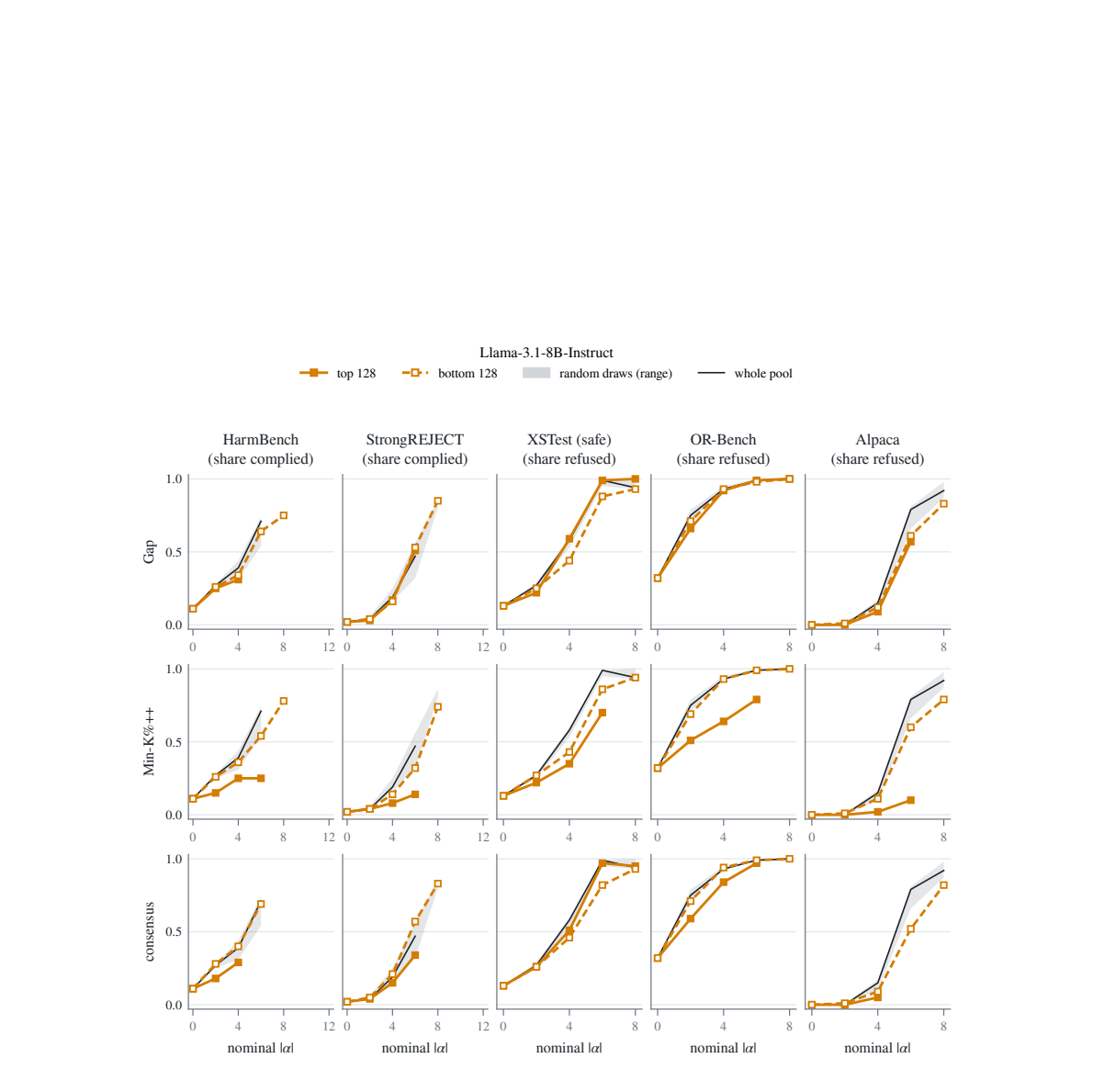
When these data are unavailable, we draw on the membership inference literature to identify likely training examples and construct a proxy dataset. We establish two theoretical results on optimal displacement to the decision boundary and reduced proxy-estimation bias. We evaluate genesis steering and membership-based proxy construction on Tülu-3-8B, whose fine-tuning data are publicly available, and Llama-3.1-8B-Instruct as a control. We find that safety data from Tülu-3-8B's training mixture yield stronger steering than external datasets on both models. On Tülu-3-8B, membership scores largely agree in identifying training examples, and vectors built from top-ranked examples achieve competitive performance against random subsets of the same size. In contrast, the results on Llama-3.1-8B-Instruct hint that a MIA method will only have a positive effect if the mean direction shift with MIA-filtered in-distribution data is much less severe than the direction shift with OoD data.
from the abstract
Pith says
Machine review · deepseek-v4-flash · 15 Oct 2026 · of version 1 of the paper; version 2 is newer · what was read was not recorded · not checked by a person
It can be wrong. Challenge this review or reply to it.
Holds up. Empirically solid paper on activation steering: the core claim that using a model's own fine-tuning data improves steering is well supported, though the theory oversells its assumptions. This line is wrong
7 minor
How often objections from reviews like this one are right: not yet measured
Not checked: figures, code, what the references say.
7 minor objections
The paper says, at Section 3.2, Assumptions 1 and 2
Pith says: minor objection 1 of 7
The paper calls these assumptions 'mild' (paragraph after Eq. 7), but elliptical densities with a Mahalanobis radial profile and principal-axis separability are strong idealizations unlikely to hold exactly for real LLM activations. The authors should add a sentence acknowledging that these are idealized conditions and that the empirical results do not depend on them.
The paper says, at Table 3, row 'first flip'
Pith says: minor objection 2 of 7
The slashes in the 'first flip' column (e.g., '5/5/3/1/5') need a brief explanation in the caption. Currently the reader must infer the order of benchmarks from the table header. Adding a footnote or clarifying in the caption would improve readability.
show 5 more
The paper says, at Appendix D, stwin definition
Pith says: minor objection 3 of 7
The twin model (stwin) is introduced late in Appendix D. Since it appears in the main text (Table 3, Figure 1), a brief definition should be given in the main paper, perhaps in Section 4 where membership methods are first listed.
The paper says, at Abstract and Section 5, concluding sentence
Pith says: minor objection 4 of 7
The final hint about MIA methods requiring 'the mean direction shift with MIA-filtered in-distribution data is much less severe than the direction shift with OoD data' is vague. Consider rephrasing to state the condition more precisely, e.g., 'when the membership-filtered pool remains close to the original training distribution.'
The paper says, at Table 1, column 'difference'
Pith says: minor objection 5 of 7
The column labelled 'difference' in Table 1 is not explained. From context it appears to be (Tulu-3-8B) minus (Llama-3.1-8B-Instruct) for each dataset, but this should be stated explicitly.
The paper says, at Appendix A, Figure 2 reference
Pith says: minor objection 6 of 7
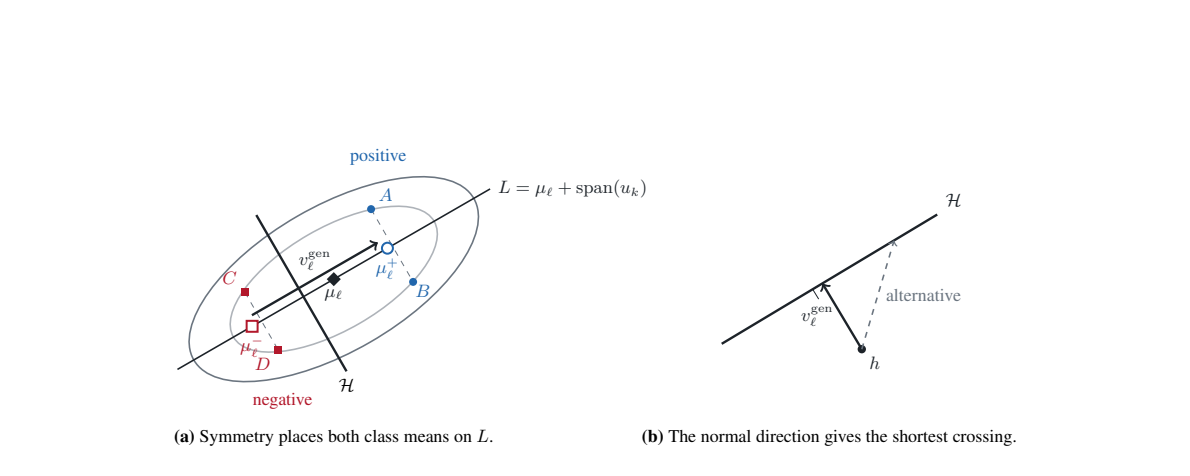
The proof text refers to points A and B and the principal axis L, but the figure is not reproduced in the main text. Ensure the figure callout is clear and that the caption explains the symbols (filled vs. hollow markers) if the figure is included.
The paper says, at General readability
Pith says: minor objection 7 of 7
Several tables (e.g., Tables 19–28) have many columns with dense numerical data. Consider grouping them or presenting selected doses in the main paper and deferring full tables to the appendix more explicitly.
What would settle it
Replicate the core steerability comparison (genesis vs. external datasets) on a non-Llama-base model, such as Gemma-2-9B or a Pythia-7B variant, using the same protocol (layer 16, 128 examples per pole, same benchmarks and judge). If the ordering of dataset steerability remains the same (genesis datasets at or near the top), the claim generalizes beyond the Llama-3.1 architecture. If the ordering changes substantially, the advantage may be architecture-specific, which would narrow but not invalidate the paper's conclusions as stated.
from the skeptic's reading
How the review went
4 readings by deepseek-v4-flash · 15 Oct 2026
- Reader holds up
- Skeptic partly agrees
- Editor wrote the verdict above
- Referee minor revision: 7 minor
Not run on this paper: the simulated authors' defence.
Pith did not check this review's objections against the paper.
The review in full
The review in brief, machine-written
This paper introduces 'genesis steering' – building steering vectors from a model's own fine-tuning data, and using membership inference to proxy that data when unavailable. The main empirical claim is clear: on Tulu-3-8B and Llama-3.1-8B-Instruct, safety datasets from Tulu-3's training mixture yield higher steerability than external datasets. That result is consistently measured across five benchmarks, with careful dose-response analysis. The authors also show that membership-based selection can recover the benefit when the candidate pool actually contains training examples, and honestly report the failure case on Llama where it doesn't.
The paper does several things well. The experimental design is thorough: two 8B models, seven datasets, multiple membership scores, and a steerability metric that averages both directions. The limitations section is unusually candid—they explicitly note the narrow architecture scope, single layer, single LLM judge, and English-only data. The theoretical optimality result (Proposition 1) is derived under strict assumptions (elliptical density, principal-axis separability), but the authors don't lean on it for the experimental conclusions.
Soft spots are real but not fatal. The theory claims its assumptions are 'mild,' but elliptical densities and exact linear separability along a principal axis are far from mild for real LLM activations. That said, the empirical work stands independently. The main soft spot is the limited architecture scope: only two Llama-3.1-8B derivatives. We don't know how the method scales to larger models or other base architectures. Also, the steering method is only difference-of-means; the paper doesn't test whether the data advantage transfers to other steering techniques like optimized vectors. Finally, the reliance on a single LLM judge (Gemma-2-27B) introduces unknown bias, though the authors do check agreement with other classifiers.
Who benefits? Researchers working on activation steering, especially those interested in the data-side of steering vector quality. Practitioners deploying safety steering might also pick up the concrete suggestion to use training-mixture data. The paper deserves a serious referee – it's a clean, honest contribution with reproducible experiments. I would accept with minor revisions requesting softening the claim about assumptions being mild, and adding a discussion of how the results might change with other steering methods.
Best
The strongest objection
The paper's central claim—that steering vectors derived from a model's own fine-tuning data yield higher steerability—is empirically well-supported across two models, five benchmarks, and multiple datasets. The theoretical optimality result (Proposition 1) relies on strong distributional assumptions (elliptical density, principal-axis separability), but the empirical findings do not depend on this theory; they stand on their own. The paper honestly reports limitations: only two 8B models of the same base, one layer, one steering method, one LLM judge, and English-only data. The mixed membership-proxy results on Llama-3.1-8B-Instruct are presented transparently, and the authors correctly note that membership-based selection helps only when the candidate pool contains actual training examples. The internal consistency is high; no contradictions or unsupported leaps are present. Given the thorough empirical evaluation and clear acknowledgment of scope, I find no load-bearing concern that undermines the central claim.
The reader's weakest_assumption pointed to the theoretical assumptions in Proposition 1 as the main risk. While those assumptions are indeed strong and unrealistic for real LLM activations, the central claim of the paper does not rest on this theory; it rests on consistent experimental evidence. The reader's verdict of ACCEPT is appropriate, and my stress-test identifies no new flaw that would change that judgement. The empirical results are robust, the limitations are clearly stated, and the paper is honest about where membership-based proxy construction works and where it does not. The concrete test I propose would further strengthen the claim by demonstrating cross-architecture generality, but it is not required to validate the current findings.
The referee's report
If the empirical result holds more broadly, genesis steering offers a principled and practical way to improve activation steering by leveraging the model's own training data or, via membership inference, a proxy thereof. The paper's honest reporting of negative results on Llama-3.1-8B-Instruct strengthens the credibility of the findings. The two theoretical results, while resting on strong distributional assumptions, provide a useful geometric intuition. The main contribution is the demonstration that the choice of reference data substantially affects steering quality, supported by careful dose-response analysis across five benchmarks and two 8B models.
Pith's reading of the paper (a machine's summary, not the authors')
This paper introduces genesis steering, a method that derives steering vectors from a model's own contrastive fine-tuning data rather than from external datasets. The central claim is that these genesis vectors are more effective, as measured by steerability scores on safety benchmarks. On Tülu-3-8B, vectors built from its three safety fine-tuning datasets achieve steerability scores of 0.924–0.990, compared with 0.730–0.977 for external datasets, and the same ordering holds on Llama-3.1-8B-Instruct. When fine-tuning data are unavailable, the paper shows that membership inference can construct proxy datasets that recover this advantage, provided the candidate pool contains the model's actual training examples.
What carries the argument. The genesis vector is the difference-of-means between positive and negative class activations, computed from the model's own fine-tuning data. The paper proves that under an elliptical representation density (Assumption 1) and principal-axis separability (Assumption 2), the population genesis direction is parallel to the normal of the linear decision boundary, making it the shortest Euclidean path to cross that boundary. A second proposition shows that membership-based selection reduces class-mean bias when the true positive rate exceeds the false positive rate.
Core claim. The paper establishes that safety data from a model's own fine-tuning mixture yield stronger steering vectors than external safety datasets do, on both the model that was trained on those data and on a different model with undisclosed fine-tuning data. On Tülu-3-8B, the three genesis datasets (WildGuardMix, WildJailbreak, CoCoNot) produce steerability scores of 0.924–0.990, while external datasets range from 0.730 to 0.977. On Llama-3.1-8B-Instruct, which was not trained on any of these datasets, the same ordering appears, with genesis datasets outperforming external ones. Membership-based selection can identify training examples and yield competitive proxies when the candidate pool contains those examples, but fails otherwise.
The premise it rests on. The theoretical optimality of the genesis direction (Proposition 1) assumes that the activation density is elliptically symmetric with a Mahalanobis-distance radial profile and that the positive and negative classes are linearly separable along a principal eigenvector of the covariance matrix; these assumptions are unlikely to hold exactly for real LLM activations at any layer.
If the paper is right (Pith's inferences, not the authors')
If fine-tuning data composition shapes steerability, dataset designers could intentionally construct mixtures that yield both strong task performance and reliable inference-time control.
Membership inference can serve as a practical tool for proxy steering vector construction when fine-tuning data are withheld, but only if the candidate pool is likely to contain actual training examples.
Comparisons among steering methods should control for the source of the steering data, because external datasets may systematically underperform relative to genesis data.
The theoretical optimality result implies that the shortest crossing direction is a natural target for steering, which may guide the design of future steering algorithms beyond difference-of-means.
The paper's results imply that the effectiveness of activation steering is less a property of the steering algorithm and more a property of how well the steering data match the model's training distribution; this reframes the problem from "which method?" to "which data?"
If genesis vectors are consistently superior, then open models with publicly released fine-tuning data offer a structural advantage for safety steering compared to closed models whose training data are secret.
The finding that Llama-3.1-8B-Instruct also benefits from Tülu-3-8B's genesis data suggests that safety fine-tuning mixtures may contain a shared geometric structure that transfers across models built on the same base architecture.
One could test the transferability hypothesis directly: train a model on a deliberately skewed safety mixture and check whether the resulting genesis vector steers an untrained sibling model better or worse than a mixture-balanced vector.
Check this review
Pith stored no record of this review's passes and took no fingerprint of it. Reviews made by code from 13 Nov 2026 on carry both.
How often reviews like this one are right
Reviews like this one: written by deepseek-v4-flash, where what was read was not recorded.
How often objections from reviews like this one are right: not yet measured
Reviews by people
This review was written by a machine. No person has reviewed this paper on Pith yet. A scientist listed on Pith can review it for a fee, and their review is published here whatever it concludes.
The paper
Abstract
Activation steering controls large language models at inference time, but its effectiveness depends on the choice of reference data. We introduce genesis steering, which derives a genesis vector from contrastive examples in the model's own fine-tuning data. When these data are unavailable, we draw on the membership inference literature to identify likely training examples and construct a proxy dataset. We establish two theoretical results on optimal displacement to the decision boundary and reduced proxy-estimation bias. We evaluate genesis steering and membership-based proxy construction on Tülu-3-8B, whose fine-tuning data are publicly available, and Llama-3.1-8B-Instruct as a control. We find that safety data from Tülu-3-8B's training mixture yield stronger steering than external datasets on both models. On Tülu-3-8B, membership scores largely agree in identifying training examples, and vectors built from top-ranked examples achieve competitive performance against random subsets of the same size. In contrast, the results on Llama-3.1-8B-Instruct hint that a MIA method will only have a positive effect if the mean direction shift with MIA-filtered in-distribution data is much less severe than the direction shift with OoD data.
The paper's own sentences, arranged, kept beside the review and separate from it. Each label is drawn from a closed vocabulary; the number beside it is the probability the classifier gave that label. No sentence in this record was written by a model.
abstract compiled · 2026-10-15
The authors' main claim, as the classifier picked it out 1.00
“We find that safety data from T\"ulu-3-8B's training mixture yield stronger steering than external datasets on both models.”
How the main claim is stated: asserted 1.00
What the abstract itself states, as probabilities: claims first 0.05 · states limitation 0.87 · human participants 0.03 · controlled comparison 0.96 · randomized assignment 0.03 · states quantitative result 0.09 · compares with prior results 0.93 · mentions code or data availability 0.06
The abstract, sentence by sentence
This table labels the abstract only (arXiv listing abstract v1). The number is the probability the classifier gave the label.
| Sentence | Role | The authors' own work | States the main conclusion | Strength |
|---|---|---|---|---|
| Activation steering controls large language models at inference time, but its effectiveness depends on the choice of reference data. | background 1.00 | 0.06 | 0.04 | asserted 1.00 |
| We introduce genesis steering, which derives a genesis vector from contrastive examples in the model's own fine-tuning data. | contribution 0.85 | 0.93 | 0.08 | asserted 1.00 |
| When these data are unavailable, we draw on the membership inference literature to identify likely training examples and construct a proxy dataset. | method 0.92 | 0.82 | 0.04 | asserted 0.96 |
| We establish two theoretical results on optimal displacement to the decision boundary and reduced proxy-estimation bias. | contribution 0.95 | 0.93 | 0.07 | asserted 1.00 |
| We evaluate genesis steering and membership-based proxy construction on T\"ulu-3-8B, whose fine-tuning data are publicly available, and Llama-3.1-8B-Instruct as a control. | method 0.91 | 0.94 | 0.04 | asserted 0.90 |
| We find that safety data from T\"ulu-3-8B's training mixture yield stronger steering than external datasets on both models. | result 1.00 | 0.96 | 0.59 | asserted 1.00 |
| On T\"ulu-3-8B, membership scores largely agree in identifying training examples, and vectors built from top-ranked examples achieve competitive performance against random subsets of the same size. | result 1.00 | 0.96 | 0.12 | asserted 0.99 |
| In contrast, the results on Llama-3.1-8B-Instruct hint that a MIA method will only have a positive effect if the mean direction shift with MIA-filtered in-distribution data is much less severe than the direction shift with OoD data. | interpretation 0.74 | 0.87 | 0.13 | hedged possibility 0.99 |
What kind of paper the classifier reports this is: method or tool 1.00 · evidence from observation or experiment 0.98
What was examined, and what was not
Sources read
- arXiv listing abstract v1
Not examined
- full text
- figures and tables
- references and citing sentences
- relations to other papers
Levels run
- P abstract
Not run
- S sections
- T body sentences
- C citations
- R cross-paper relations
How the labels were made
Compiled by classifier-1.13.0 via TypeSafe API, question bank abstract-p1-20260923, 2026-10-15: 1 request, 6,294 input tokens.
Every quoted sentence on this record is the authors'. Every label is from Pith's closed vocabulary, with the probability shown beside it. This record as JSON
Figures (8)




Figures are the authors', reproduced from the paper.
Challenges and discussion
Disagree with the review, or know something it missed? Leave a comment, or challenge this review formally: a challenge becomes a permanent entry in this paper's record, and its decision is published here.
Come back by email
A short list of the week's newly reviewed papers. Nothing is sent until you confirm from your inbox, and every email has a link that stops it. No account.
No comments yet.
Sign in to comment