Computation and Language · arXiv:2610.19792 v2 · submitted 14 Oct 2026 · 64 references
JetSpec++: Foresight Parallel Drafting with Self Refinements
The paper says
“Speculative decoding's effectiveness is governed by two quantities: the acceptance rate of drafted tokens and the cost of producing them.”
more of the abstract
We show the two objectives can be co-optimized with algorithm-system co-design, and present JetSpec++, which retains a strong learned draft model while hiding its cost almost entirely. JetSpec++ combines three components: intra-block self refinement, which trains the draft model to iteratively correct its own parallel predictions within a block of tokens; inter-block foresight drafting, which begins the next block before the current one is verified; and pipelined drafting and verification, which overlaps the two stages so drafting's marginal wall-clock cost approaches zero. In comparison with state-of-the-art speculative decoding methods, JetSpec++ attains a wall-clock speedup of up to 7.45 × over autoregressive (AR) decoding and 1.54 × over DSpark, with up to 1,361 tokens per second for a single request on GB200, and an average acceptance length of 8.94 across seven benchmarks, while preserving the target model's output distribution. Our code and models are available at https://github.com/hao-ai-lab/JetSpec.
from the abstract
Pith says
Machine review · deepseek-v4-flash · 16 Oct 2026 · what was read was not recorded · not checked by a person
It can be wrong. Challenge this review or reply to it.
Holds up, with conditions. A solid, honest speculative-decoding systems paper whose core results hold; the headline speedup over DSpark needs reframing because it is a 2-GPU versus 1-GPU comparison. This line is wrong
2 major objections · 6 minor
How often objections from reviews like this one are right: not yet measured
Not checked: figures, code, what the 64 references say.
The paper says, at Table 3, Section 5.4, abstract
The review did not quote this passage.
Pith says: Objection 1 of 2 · major
The headline speedup over DSpark is not a resource-equitable comparison. Table 3's GPU column shows JetSpec++ and SSD running their draft processes on a second GPU while DSpark, DFlash, and AR run on one; the paper discloses this in Section 5.1, so the issue is attribution rather than concealment, but the abstract's '1.54x over DSpark' and Section 5.4's 'most of the gain comes from hiding drafting latency' present the margin as an algorithmic result.
more of objection 1
Recomputing from Table 3's own numbers, if DSpark were served with the same second-GPU drafting path (for example, the DPara-style backbone precomputation cited in Section 2), its GSM8K round time would drop from 9.92 ms toward about 6.76 ms (6.16 ms verification plus roughly 0.6 ms communication), giving about 7.34/6.76 = 1.09 ktok/s rather than 744 tok/s; JetSpec++'s 7.78/6.84 = 1.14 ktok/s would then be only about 1.05x faster, and on MATH-500 the same arithmetic reduces the 1.51x margin to about 1.02x. The acceptance-length, losslessness, and per-round overhead-cut results are unaffected; what is affected is the speedup as a measure of the central co-optimization claim. Please add an equal-resource comparison (DSpark with a second-GPU drafting path, or JetSpec++ with its drafting on the verification GPU) and revise the abstract and Section 5.4 accordingly, or explicitly restate the claim as a two-GPU result.
The paper says, at Section 4.2, Eq. (5), Table 6
The review did not quote this passage.
Pith says: Objection 2 of 2 · major
The load-bearing learnability premise of Foresight Drafting is empirical rather than mechanistic: the adapter A^l must predict target hidden states for positions the target has not yet generated accurately enough that the acceptance-length loss stays small. Table 6 shows both why this matters and why it is the weak point: with stale states the draft degenerates (GSM8K, J0: 2.89 vs …
more of objection 2
… 5.56 with predicted states and 5.70 with true states), which would fall below DSpark's 7.31, and the reported 95-98% recovery is measured on benchmarks whose domains substantially overlap the Nemotron/CodeAlpaca training corpus; the Qwen3.8-27B experiment is a valuable transfer test but stays within the same target family. Because the J0 draft alone does not beat DSpark (Table 5: 5.54 vs Table 16: 7.31 on GSM8K), the entire tau and speedup advantage rests on this learned map together with the decoder proxy. I am not asking for a proof of transfer, but I would like either a stress test on a distribution clearly outside the training mix (for example, a different target family or a thinking-mode or fine-tuned target, reporting tau at J0-J3), or an explicit narrowing of the generalization claim in the abstract and conclusion to the evaluated distribution.
6 minor objections
The paper says, at Abstract
Pith says: minor objection 1 of 6
The headline numbers come from different configurations: the 8.94 average acceptance length is the Table 1 temperature-0, budget-16, J3-R3 row, while the 7.45x and 1,361 tok/s figures are from the Table 3 J1-R1 serving configuration with B=4; the abstract should state both configurations so readers do not conflate them.
The paper says, at Tables 1, 2, 5
Pith says: minor objection 2 of 6
Tables 1, 2, and 5 report no variance or significance information; since Table 4 sets the standard with paired standard errors, the J1-R1-vs-DSpark gaps in Table 1 (at least 0.49 tokens on every benchmark) would be easier to assess with confidence intervals or a paired significance test.
show 4 more
The paper says, at Section 5.1
Pith says: minor objection 3 of 6
The DSpark baseline is evaluated without its confidence-based scheduling, as disclosed; a reminder in the Table 3 caption or at the point of the 'over DSpark' claim would prevent the headline from being read as a comparison against the published DSpark system in its full configuration.
The paper says, at Figure 3
Pith says: minor objection 4 of 6
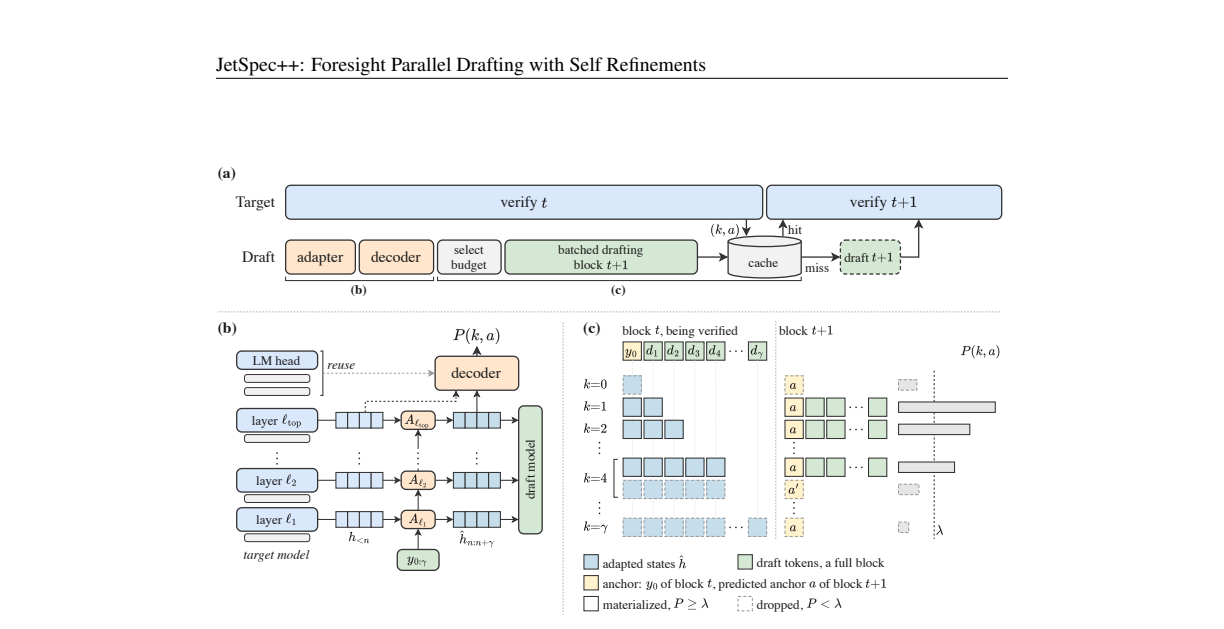
Figure 3's caption describes caching by the threshold lambda, while Section 4.2 and Appendix B.1 state that the experiments cache the B highest-scoring outcomes in every round; the figure should be reconciled with the served rule or explicitly labeled as depicting the threshold variant.
The paper says, at Section 5.6
Pith says: minor objection 5 of 6
The limitations paragraph covers only systems optimization; the hardware-attribution caveat of Table 3 and the adapter's distribution scope should also be acknowledged there, since both are disclosed in the body but absent from the limitations statement.
The paper says, at Table 3 header
Pith says: minor objection 6 of 6
As typeset, the Table 3 header appears to repeat 'tau hit' twice ('tau hit tau hit') before 'tau miss'; presumably it should read tau, tau_hit, tau_miss.
What would settle it
Run DSpark (or the DPara-pipelined variant of it cited in Section 2) under the same two-GPU CUDA-graph serving engine and cache size used for JetSpec++ in Table 3, and report GSM8K and MATH-500 tok/s with per-round exposed time. If DSpark's round time approaches verification time (about 6.2 ms for Qwen3-8B) and its throughput rises from 744/902 tok/s toward roughly 1.09/1.33 ktok/s, then the 1.54x/1.51x speedup over DSpark is largely the second GPU, and the headline should be reframed as a two-GPU latency comparison.
from the skeptic's reading
How the review went
4 readings by deepseek-v4-flash · 16 Oct 2026
- Reader holds up, with conditions
- Skeptic partly agrees
- Editor wrote the verdict above
- Referee major revision: 2 major objections, 6 minor
Not run on this paper: the simulated authors' defence.
Pith did not check this review's objections against the paper.
The review in full
The review in brief, machine-written
The core results hold, and the paper is a genuine advance for target-conditioned speculative decoding. The thing to fix before publishing is the hardware framing of the headline speedup.
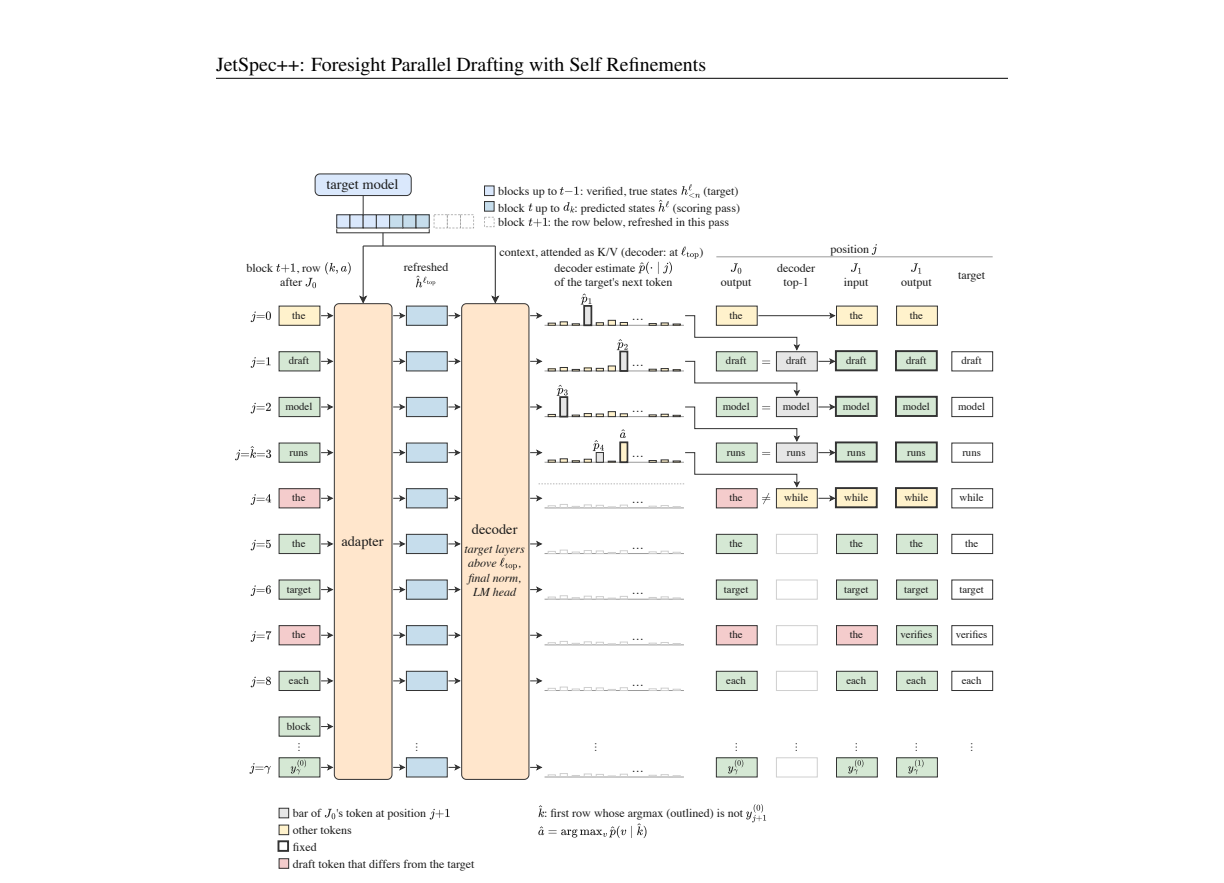
What's new: the hidden-to-hidden adapter that predicts target-model states for unverified positions is the first mechanism I know that lets a target-conditioned parallel drafter run ahead of verification. SSD sidesteps the missing states, SwiftSpec approximates them, DPara precomputes around them; here they are predicted directly. Self-refinement is also new—the draft model refines its own block through Jacobi passes, trained on clean-prefix blocks. Table 4 lands it: without clean-prefix training the model refuses to refine; with it, tau climbs from 5.70 to 6.97 on GSM8K. Ablations cleanly separate context refresh from anchor replacement.
The paper earns credit on honesty. Losslessness under point-mass proposals is proved correctly in F.3, including the warning that using the draft softmax as proposal would break the guarantee. The 2,048-token fp32 differential check and the CUDA-graph versus eager replay check are real evidence. All headline numbers reproduce from the tables: 8.94 is the J3-R3 budget-16 average; 1361.1/182.7 is 7.45; exposed time drops from 3.80 to 0.66 ms on MATH-500, a 83% cut consistent with the claimed 84%.
Soft spots, in proportion. The main one: 1.54x over DSpark is a 2-GPU versus 1-GPU comparison. The table shows it; the abstract and conclusion do not say what that means for attribution. The stress-test estimate—equal-hardware DSpark would shrink 1.54x to roughly 1.05x—is only an estimate, built on assumed communication costs, but the direction is right and the margin would narrow substantially. The exposed-time difference mostly reflects moving draft compute to a second GPU. The acceptance-length edge (7.78 vs 7.34) is real but by itself worth around 6%, not 54%.
Second: DSpark runs without its confidence-based scheduling. The disclosure is there, and it is a defensible fixed-budget choice, but it means the strongest baseline is a weakened version of itself. Third, minor: the abstract pairs an offline J3-R3 acceptance length with served speedups measured at J1-R1 on the 8B target. Different configurations stitched into one sentence.
The adapter-transfer worry is real but bounded: Table 6 shows 95-98% recovery across all seven benchmarks, including two-turn chat, which is decent distributional evidence even without a mechanistic argument. I do not see a load-bearing error, and the reader's arithmetic checks hold.
Recommendation: this deserves a serious referee. I would accept conditionally—require equal-hardware numbers or an explicit statement that part of the speedup is the second GPU, restore DSpark's scheduling or justify removing it, and align the abstract with one configuration. I'd cite it and bring it to reading group; the hardware-attribution question is worth discussing.
The strongest objection
Table 3's GPU column shows JetSpec++ uses two GPUs while DSpark, DFlash, and AR use one. Eq. 3 budgets wall-clock critical-path time, not hardware cost; JetSpec++'s 'exposed' 0.61/0.66 ms is achieved by moving all draft-side compute (1.05B draft model + 2.32B adapter) to a second GPU, while DSpark's 3.76/3.80 ms of exposure is drafting on the single verification GPU. The paper discloses this, so the issue is attribution rather than concealment: from Table 3's own numbers, if DSpark were served with the same second-GPU drafting path (for example, the DPara-style backbone precomputation cited in Section 2), its GSM8K round time would drop from 9.92 ms toward roughly 6.8 ms (6.16 ms verification + about 0.6 ms communication), giving about 7.34/6.76 = 1.09 ktok/s instead of 744 tok/s; JetSpec++'s 7.78/6.84 = 1.14 ktok/s would then be only about 1.05x faster, not 1.54x. The same arithmetic on MATH-500 (8.98/6.76 ≈ 1.33 ktok/s versus 1.36 ktok/s) reduces 1.51x to about 1.02x. The core algorithmic results — the offline acceptance-length advantage, the 8.94 average, and losslessness — are not affected; what is affected is the headline speedup as a measure of the co-optimization claim itself.
The reader's weakest assumption is the hidden-to-hidden adapter's learnability and transfer. I read Table 6 and Appendix A as giving direct empirical support on the evaluated benchmarks: predicted states retain 95-98% of true-state acceptance length at J0 through J3, and Table 7 reports cosine similarities of 0.94-0.98. A transfer failure to unmeasured prompt distributions is a real generalization caveat, but it is not a defect of the measured claims, so I do not put it first. The more load-bearing issue for the headline is the hardware asymmetry in Table 3: the central '1.54x over DSpark' and '84% drafting-cost reduction' compare a two-GPU JetSpec++ to one-GPU baselines. The paper discloses the GPU counts, and the offline tau and losslessness claims stand, but a like-for-like comparison is needed before the speedup is attributed to the algorithm. This overlaps with the reader's first fairness concern; because the reader already conditions the verdict on a like-for-like GPU comparison, the verdict stays CONDITIONAL, i.e., UNCHANGED.
The referee's report
Taken at face value, this is a consequential systems contribution: it is, to my reading, the first target-conditioned parallel draft model that drafts ahead of verification by predicting the missing target states, and the self-refinement scheme with anchor replacement is cleanly separated from the pipelining machinery by the ablations (Tables 4-5, 12-15, and the appendix tables). The paper gives credit where it is due: the outcome-selection argument builds explicitly on SSD's geometric fan-out (Proposition 2, Remark 2), and the losslessness claim is proved rather than asserted (Appendix F.3), with a 2,048-token fp32 differential check as an empirical spot check. The experimental reporting is unusually verifiable: captions state exact conditions (164 prompts, 256 tokens, true states, no context refresh), Table 4 reports paired standard errors, the code and models are released, and the second-target experiment on Qwen3.8-27B is a genuine generalization test across target size and hybrid attention architectures.
Pith's reading of the paper (a machine's summary, not the authors')
Speculative decoding is only as good as two numbers: how many drafted tokens the large model accepts per round, and how much producing the drafts costs. JetSpec++ claims the two can be optimized together, by keeping a strong learned draft model while hiding its cost almost entirely: the next block is drafted while the target model is still verifying the current one, so drafting runs inside the verification window. To draft before verification has returned, a learned adapter predicts the target's hidden states for the tokens still being checked, and a lightweight decoder scores every possible verification outcome so the most likely ones are pre-drafted in a cache. Refinement passes — Jacobi-style self-correction of the draft, with context refresh and anchor replacement — then run for free within the same window and raise the number of accepted tokens per round. On seven benchmarks the paper reports an average of 8.94 committed tokens per round against 6.89 for the strongest baseline, DSpark, and up to 7.45× the speed of autoregressive decoding, while verification provably preserves the target's output distribution.
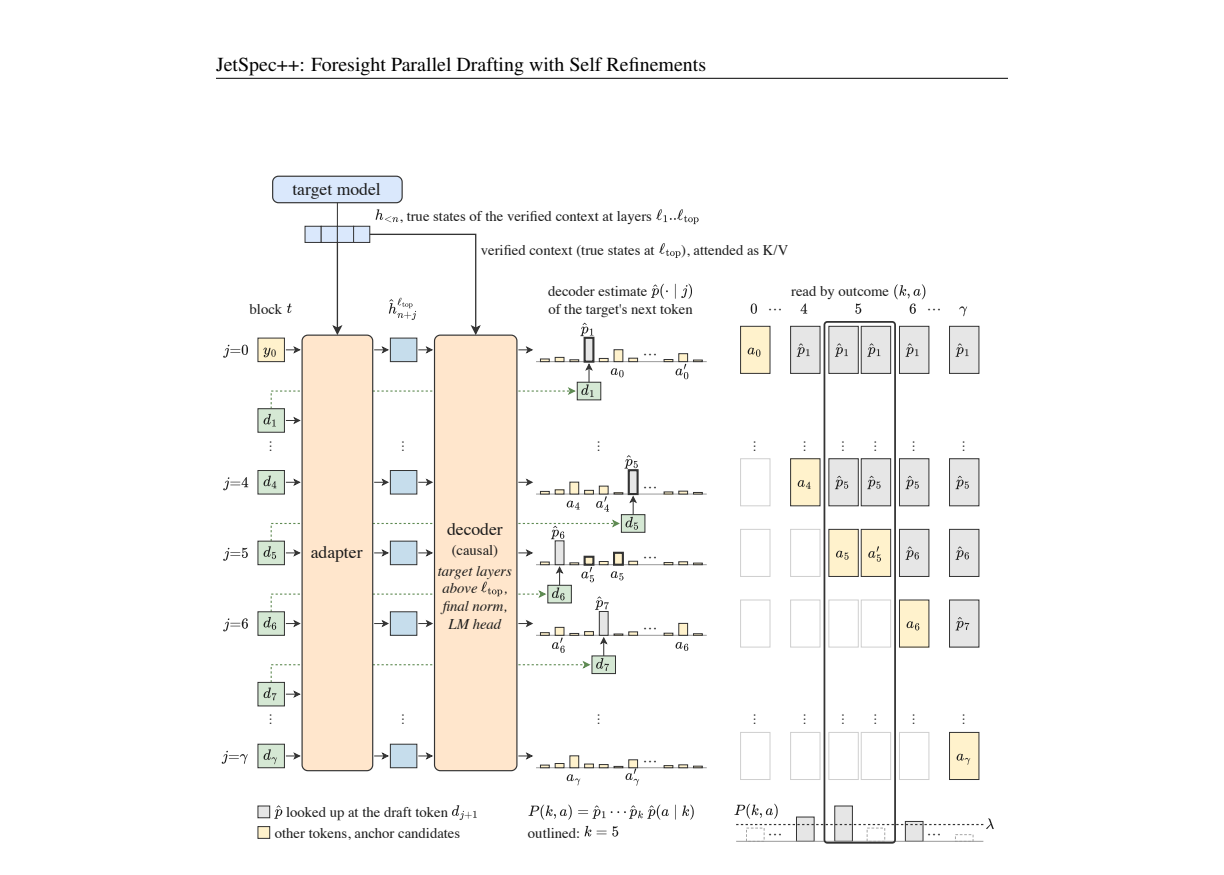
What carries the argument. The load-bearing object is the pipelined draft-verify loop, carried by three components. First, the hidden-to-hidden adapter (Eq. 5): one short stack of transformer layers per target layer the draft model reads, which predicts the target's hidden states $\hat{h}^{\ell}_{n+j}$ for positions that are still being verified, attending to the verified prefix states $h^{\ell}_{<n}$; its predicted states are the only approximation in the whole system. Second, the decoder: frozen upper target layers, final norm, and LM head that read the adapter's predictions under a causal mask and produce, in one pass, per-position next-token estimates from which every outcome probability $P(k,a)$ (Eq. 6) follows; with a perfect decoder this is the exact outcome distribution, and a split-conformal-thresholded selection rule (Eq. 7) picks the $B$ outcomes to pre-draft. Third, intra-block self-refinement: the draft model repeatedly re-predicts every position of its own block from its predecessors, a fixed-point Jacobi iteration $y^{(r+1)}_i = \arg\max_v q_\theta(v \mid x, h_x, y^{(r)}_{\le i})$ (Eq. 8), and is trained (Eq. 9) on clean-prefix/noisy-suffix blocks so that the ability to refine is learned rather than assumed; each pass is preceded by a context refresh, in which the adapter re-predicts the target states of the current draft, and an anchor replacement, in which the decoder's first disagreeing token is written in and fixed. The constraint binding them together is the timing budget of Eq. 3 — all draft-side work, including host-CPU time, must fit inside $\mathcal{T}_{\text{verify}}$ — and the throughput model of Eq. 4 states what a cache hit buys.
Core claim. The paper's central claim is that the conventional trade-off in speculative decoding — more accurate drafts cost more to produce — can be dissolved by co-designing the algorithm with the system. JetSpec++ keeps a causal parallel draft model that reads the target's hidden states, but pipelines it: block $t+1$ is drafted while block $t$ is being verified on the target. The information the draft normally waits for — how many tokens were accepted, what the bonus anchor token is, and the target's hidden states for the block under verification — is anticipated in advance. A hidden-to-hidden adapter $\mathcal{A}^{\ell}$ (Eq. 5) predicts those states from the verified prefix, and a training-free decoder that reuses the target's upper layers and LM head converts them into an outcome distribution $P(k,a)$ (Eq. 6), so the $B$ most probable outcomes are pre-drafted into a speculation cache (Eq. 7). Because all of this runs inside the verification window, additional draft-model passes cost no wall-clock time, and JetSpec++ spends them on Jacobi-style self-refinement (Eq. 8): the draft corrects its own parallel predictions, alternating with a context refresh that re-predicts target states and an anchor replacement that fixes the first disagreement the decoder finds. Verification uses a point-mass proposal, so every committed token is the target's own draw; prediction quality affects only speed, never the output distribution (Appendix F.3). The measured consequence is that at verification budget 16 the method commits more tokens per round than every baseline on all seven benchmarks at both temperatures, averaging 8.94, and in a CUDA-graph serving setup on GB200 it exposes roughly 0.6–0.8 ms of drafting per round against 3.4–4.5 ms for the baselines, giving up to 7.45× over autoregressive decoding and 1.54× over DSpark, with up to 1,361 tokens per second for a single request.
The premise it rests on. The whole speedup rests on one empirical claim: the hidden-to-hidden adapter can predict the target model's hidden states for positions the target has not yet generated accurately enough that acceptance length stays at 95–98% of the true-state value — a map the paper demonstrates in-distribution but does not argue transfers across prompt distributions.
If the paper is right (Pith's inferences, not the authors')
Drafting cost can be pushed nearly off the critical path without sacrificing a learned draft model: JetSpec++ exposes only 0.61–0.77 ms per round beyond verification against 3.42–4.52 ms for DFlash, DSpark, and Domino, a cut of up to 84%, because the draft for the next block is already cached when verification returns.
Bigger targets automatically make the method stronger: on Qwen3.8-27B the verification window of 27.4–27.8 ms fits three refinement passes with three context refreshes, and JetSpec++ still runs 1.37× and 1.31× faster than DSpark on GSM8K and MATH-500, so the speedup grows as target size grows.
Acceptance length scales with the verification budget where parallel baselines saturate: at budget 32 the method's $\tau$ rises on all seven benchmarks at both temperatures, while DFlash, DSpark, and Domino lose ground, because causal attention inside the block leaves the first 16 draft positions unchanged when 16 are added.
Correctness is robust to every guess the method makes: with point-mass verification every committed token is the target's own draw, so a wrong foresight prediction, a wrong anchor, or a wrong refinement pass can only cost speed, never change the output distribution (Appendix F.3).
Predicted states capture most of what the draft needs: at each refinement level J0–J3 the adapter's predicted hidden states keep 95–98% of the acceptance length the draft reaches from the target's true states (Table 6), so foresight drafting itself costs little acceptance length.
The adapter's transferability is the open risk the paper does not close: the 95–98% recovery of true-state $\tau$ is demonstrated on prompts in-distribution with the adapter's 800k training sequences, and no mechanism is offered that guarantees the hidden-to-hidden map generalizes; if it degrades on out-of-distribution prompts, $\tau$ collapses toward the stale-state floor (Table 6 gives 2.89–3.63
The adapter-plus-decoder trick is a general recipe the paper does not name as such: any target-conditioned draft model, including single-token EAGLE-style drafters, could use it to speculate ahead of verification, so the contribution may reduce to a reusable interface between the target has not read this yet and the draft needs its states.
The practical cost model should count the adapter: training it costs 219 GPU-hours and 2.32B parameters for the 8B target (172 GPU-hours and 4.47B for the 27B target), and any future fine-tune of the target would force retraining, so the method's economics relative to model-free drafting depend on how often the target changes.
A direct test of the claimed co-optimization: hold the verification budget fixed and sweep the cache size $B$ against the number of refinement passes $J$; the timing budget of Eq. 3 predicts a crisp trade-off curve — more cached outcomes leave fewer passes — and the served configuration (J1-R1 at $B=4$ for the 8B target) should sit on that curve, confirming the model rather than a single point est
Check this review
Pith stored no record of this review's passes and took no fingerprint of it. Reviews made by code from 13 Nov 2026 on carry both.
How often reviews like this one are right
Reviews like this one: written by deepseek-v4-flash, where what was read was not recorded.
How often objections from reviews like this one are right: not yet measured
Reviews by people
This review was written by a machine. No person has reviewed this paper on Pith yet. A scientist listed on Pith can review it for a fee, and their review is published here whatever it concludes.
How Pith checks papers · The full audit of this paper · Review history (2 versions)
The paper
Abstract
Speculative decoding's effectiveness is governed by two quantities: the acceptance rate of drafted tokens and the cost of producing them. We show the two objectives can be co-optimized with algorithm-system co-design, and present JetSpec++, which retains a strong learned draft model while hiding its cost almost entirely. JetSpec++ combines three components: intra-block self refinement, which trains the draft model to iteratively correct its own parallel predictions within a block of tokens; inter-block foresight drafting, which begins the next block before the current one is verified; and pipelined drafting and verification, which overlaps the two stages so drafting's marginal wall-clock cost approaches zero. In comparison with state-of-the-art speculative decoding methods, JetSpec++ attains a wall-clock speedup of up to 7.45 × over autoregressive (AR) decoding and 1.54 × over DSpark, with up to 1,361 tokens per second for a single request on GB200, and an average acceptance length of 8.94 across seven benchmarks, while preserving the target model's output distribution. Our code and models are available at https://github.com/hao-ai-lab/JetSpec.
The paper's own sentences, arranged, kept beside the review and separate from it. Each label is drawn from a closed vocabulary; the number beside it is the probability the classifier gave that label. No sentence in this record was written by a model.
abstract compiled · 2026-10-15
The authors' main claim, as the classifier picked it out 0.60
“In comparison with state-of-the-art speculative decoding methods, JetSpec++ attains a wall-clock speedup of up to $7.45\times$ over autoregressive (AR) decoding and $1.54\times$ over DSpark, with up to 1,361 tokens per second for a single request on GB200, and an average acceptance length of 8.94 across seven benchmarks, while preserving the target model's output distribution.”
How the main claim is stated: asserted 1.00
What the abstract itself states, as probabilities: claims first 0.05 · states limitation 0.07 · human participants 0.02 · controlled comparison 0.90 · randomized assignment 0.01 · states quantitative result 0.99 · compares with prior results 0.98 · mentions code or data availability 0.98
The abstract, sentence by sentence
This table labels the abstract only (arXiv listing abstract v1). The number is the probability the classifier gave the label.
| Sentence | Role | The authors' own work | States the main conclusion | Strength |
|---|---|---|---|---|
| Speculative decoding's effectiveness is governed by two quantities: the acceptance rate of drafted tokens and the cost of producing them. | background 1.00 | 0.10 | 0.04 | asserted 1.00 |
| We show the two objectives can be co-optimized with algorithm-system co-design, and present JetSpec++, which retains a strong learned draft model while hiding its cost almost entirely. | contribution 1.00 | 0.92 | 0.62 | asserted 1.00 |
| JetSpec++ combines three components: intra-block self refinement, which trains the draft model to iteratively correct its own parallel predictions within a block of tokens; inter-block foresight drafting, which begins the next block before the current one is verified; and pipelined drafting and verification, which overlaps the two stages so drafting's marginal wall-clock cost approaches zero. | method 0.97 | 0.86 | 0.09 | asserted 0.99 |
| In comparison with state-of-the-art speculative decoding methods, JetSpec++ attains a wall-clock speedup of up to $7.45\times$ over autoregressive (AR) decoding and $1.54\times$ over DSpark, with up to 1,361 tokens per second for a single request on GB200, and an average acceptance length of 8.94 across seven benchmarks, while preserving the target model's output distribution. | result 1.00 | 0.96 | 0.63 | asserted 1.00 |
| Our code and models are available at https://github.com/hao-ai-lab/JetSpec. | contribution 0.75 | 0.39 | 0.02 | asserted 0.94 |
What kind of paper the classifier reports this is: method or tool 1.00 · evidence from observation or experiment 0.91
What was examined, and what was not
Sources read
- arXiv listing abstract v1
Not examined
- full text
- figures and tables
- references and citing sentences
- relations to other papers
Levels run
- P abstract
Not run
- S sections
- T body sentences
- C citations
- R cross-paper relations
How the labels were made
Compiled by classifier-1.13.0 via TypeSafe API, question bank abstract-p1-20260923, 2026-10-15: 1 request, 4,514 input tokens.
Every quoted sentence on this record is the authors'. Every label is from Pith's closed vocabulary, with the probability shown beside it. This record as JSON
Figures (4)

Figures are the authors', reproduced from the paper.
References (64)
- [1] Zihao An, Taichi Liu, Ziqiong Liu, Dong Li, Ruofeng Liu, and Emad Barsoum. PARD-2 : Target-aligned parallel draft model for dual-mode speculative decoding. arXiv preprint arXiv:2605.08632, 2026. URL http://arxiv.org/abs/2605.08632v1 on PithPith's reviewarXiv
- [2] Anastasios N. Angelopoulos and Stephen Bates. Conformal prediction: A gentle introduction. Foundations and Trends® in Machine Learning, 16 0 (4): 0 494--591, 2023. doi:10.1561/2200000101 on Pithdoi:10.1561/2200000101
- [3] Marianne Arriola, Aaron Gokaslan, Justin T. Chiu, Zhihan Yang, Zhixuan Qi, Jiaqi Han, Subham Sekhar Sahoo, and Volodymyr Kuleshov. Block diffusion: Interpolating between autoregressive and diffusion language models. In The Thirteenth International Conference on Learning Repres... on Pith
- [4] Jacob Austin, Augustus Odena, Maxwell Nye, Maarten Bosma, Henryk Michalewski, David Dohan, Ellen Jiang, Carrie Cai, Michael Terry, Quoc Le, and Charles Sutton. Program synthesis with large language models. arXiv preprint arXiv:2108.07732, 2021. URL http://arxiv.org/abs/2108.07732v1 on PithPith's reviewarXiv
- [5] Mislav Balunovi \'c , Jasper Dekoninck, Ivo Petrov, Nikola Jovanovi \'c , and Martin Vechev. MathArena : Evaluating LLMs on uncontaminated math competitions. In Advances in Neural Information Processing Systems 38, Datasets and Benchmarks Track, 2025. URL https://arxiv.org/abs... on PithPith's reviewarXiv
- [6] Nikhil Bhendawade, Kumari Nishu, Arnav Kundu, Chris Bartels, Minsik Cho, and Irina Belousova. Mirror speculative decoding: Breaking the serial barrier in LLM inference. arXiv preprint arXiv:2510.13161, 2025. URL http://arxiv.org/abs/2510.13161v2 on PitharXiv
- [7] Tianle Cai, Yuhong Li, Zhengyang Geng, Hongwu Peng, Jason D. Lee, Deming Chen, and Tri Dao. Medusa: Simple LLM inference acceleration framework with multiple decoding heads. In Proceedings of the 41st International Conference on Machine Learning, volume 235 of Proceedings of M... on Pith
- [8] Sahil Chaudhary. Code alpaca: An instruction-following LLaMA model trained on code generation instructions. GitHub repository, 2023. URL https://github.com/sahil280114/codealpaca. Accessed 2026-09-22 on Pith
- [9] Charlie Chen, Sebastian Borgeaud, Geoffrey Irving, Jean-Baptiste Lespiau, Laurent Sifre, and John Jumper. Accelerating large language model decoding with speculative sampling. arXiv preprint arXiv:2302.01318, 2023. URL http://arxiv.org/abs/2302.01318v1 on PithPith's reviewarXiv
- [10] Jian Chen, Yesheng Liang, and Zhijian Liu. DFlash : Block diffusion for flash speculative decoding. In Forty-third International Conference on Machine Learning, 2026. URL https://openreview.net/forum?id=Oz335dV48X on Pith
- [11] Mark Chen, Jerry Tworek, Heewoo Jun, Qiming Yuan, Henrique Pondé de Oliveira Pinto, Jared Kaplan, Harri Edwards, Yuri Burda, Nicholas Joseph, Greg Brockman, Alex Ray, Raul Puri, Gretchen Krueger, Michael Petrov, Heidy Khlaaf, Girish Sastry, Pamela Mishkin, Brooke Chan, Scott G... on PithPith's reviewarXiv
- [12] Zhuoming Chen, Avner May, Ruslan Svirschevski, Yuhsun Huang, Max Ryabinin, Zhihao Jia, and Beidi Chen. Sequoia: Scalable and robust speculative decoding. In Advances in Neural Information Processing Systems, volume 37, pp.\ 129531--129563, 2024. doi:10.52202/079017-4116. URL h... on Pithdoi:10.52202/079017-4116
- [13] Xin Cheng, Xingkai Yu, Chenze Shao, Jiashi Li, Yunfan Xiong, Yi Qian, Jiaqi Zhu, Shirong Ma, Xiaokang Zhang, Jiasheng Ye, Qinyu Chen, Chengqi Deng, Jiping Yu, Damai Dai, Zhengyan Zhang, Yixuan Wei, Yixuan Tan, Wenkai Yang, Runxin Xu, Yu Wu, Zhean Xu, Xuanyu Wang, Muyang Chen, ... on PithPith's reviewarXiv
- [14] Karl Cobbe, Vineet Kosaraju, Mohammad Bavarian, Mark Chen, Heewoo Jun, Lukasz Kaiser, Matthias Plappert, Jerry Tworek, Jacob Hilton, Reiichiro Nakano, Christopher Hesse, and John Schulman. Training verifiers to solve math word problems. arXiv preprint arXiv:2110.14168, 2021. U... on PithPith's reviewarXiv
- [15] Ning Ding, Yulin Chen, Bokai Xu, Yujia Qin, Shengding Hu, Zhiyuan Liu, Maosong Sun, and Bowen Zhou. Enhancing chat language models by scaling high-quality instructional conversations. In Proceedings of the 2023 Conference on Empirical Methods in Natural Language Processing, pp... on Pithdoi:10.18653/v1/2023.emnlp-main.183
- [16] Yichao Fu, Peter Bailis, Ion Stoica, and Hao Zhang. Break the sequential dependency of LLM inference using lookahead decoding. In Proceedings of the 41st International Conference on Machine Learning, volume 235 of Proceedings of Machine Learning Research, pp.\ 14060--14079, 20... on Pith
- [17] Raghavv Goel, Mukul Gagrani, Wonseok Jeon, Junyoung Park, Mingu Lee, and Christopher Lott. Direct alignment of draft model for speculative decoding with chat-fine-tuned LLMs . arXiv preprint arXiv:2403.00858, 2024. URL http://arxiv.org/abs/2403.00858v4 on PithPith's reviewarXiv
- [18] Dan Hendrycks, Collin Burns, Saurav Kadavath, Akul Arora, Steven Basart, Eric Tang, Dawn Song, and Jacob Steinhardt. Measuring mathematical problem solving with the MATH dataset. In Proceedings of the Neural Information Processing Systems Track on Datasets and Benchmarks 1, Ne... on Pith
- [19] Lanxiang Hu, Zhaoxiang Feng, Yulun Wu, Haoran Yuan, Yujie Zhao, Yu-Yang Qian, Bojun Wang, Peng Zhao, Daxin Jiang, Yibo Zhu, Tajana Rosing, and Hao Zhang. JetSpec : Breaking the scaling ceiling of speculative decoding with parallel tree drafting. arXiv preprint arXiv:2606.18394... on PithPith's reviewarXiv
- [20] Lanxiang Hu, Siqi Kou, Yichao Fu, Samyam Rajbhandari, Tajana Rosing, Yuxiong He, Zhijie Deng, and Hao Zhang. Fast and accurate causal parallel decoding using Jacobi forcing. In Forty-third International Conference on Machine Learning, 2026 b . URL https://openreview.net/forum?... on Pith
show 44 more
- [21] Yuxuan Hu, Ke Wang, Xiaokang Zhang, Fanjin Zhang, Cuiping Li, Hong Chen, and Jing Zhang. SAM decoding: Speculative decoding via suffix automaton. In Proceedings of the 63rd Annual Meeting of the Association for Computational Linguistics (Volume 1: Long Papers), pp.\ 12187--122... on Pithdoi:10.18653/v1/2025.acl-long.595
- [22] Jianuo Huang, Yaojie Zhang, Qituan Zhang, Hao Lin, Hanlin Xu, and Linfeng Zhang. Domino: Decoupling causal modeling from autoregressive drafting in speculative decoding. arXiv preprint arXiv:2605.29707, 2026. URL http://arxiv.org/abs/2605.29707v1 on PithPith's reviewarXiv
- [23] Naman Jain, King Han, Alex Gu, Wen-Ding Li, Fanjia Yan, Tianjun Zhang, Sida Wang, Armando Solar-Lezama, Koushik Sen, and Ion Stoica. LiveCodeBench : Holistic and contamination free evaluation of large language models for code. In International Conference on Learning Representa... on Pith
- [24] Siqi Kou, Lanxiang Hu, Zhezhi He, Zhijie Deng, and Hao Zhang. CLLMs : Consistency large language models. In Proceedings of the 41st International Conference on Machine Learning, volume 235 of Proceedings of Machine Learning Research, pp.\ 25426--25440, 2024. URL https://openre... on Pith
- [25] Tanishq Kumar, Tri Dao, and Avner May. Speculative speculative decoding. In International Conference on Learning Representations, 2026. URL https://proceedings.iclr.cc/paper_files/paper/2026/file/1b96f01343ff10150e6719eb163e1536-Paper-Conference.pdf on Pith
- [26] Yaniv Leviathan, Matan Kalman, and Yossi Matias. Fast inference from Transformers via speculative decoding. In Proceedings of the 40th International Conference on Machine Learning, volume 202 of Proceedings of Machine Learning Research, pp.\ 19274--19286, 2023. URL https://pro... on Pith
- [27] Tianyi Li, Yaxin Luo, Xinyi Shang, and Zhiqiang Shen. DARTree : Speculative diffusion decoding with autoregressive draft trees. arXiv preprint arXiv:2608.13524, 2026. URL http://arxiv.org/abs/2608.13524v1 on PithPith's reviewarXiv
- [28] Yuhui Li, Fangyun Wei, Chao Zhang, and Hongyang Zhang. EAGLE : Speculative sampling requires rethinking feature uncertainty. In Proceedings of the 41st International Conference on Machine Learning, volume 235 of Proceedings of Machine Learning Research, pp.\ 28935--28948, 2024... on Pith
- [29] Yuhui Li, Fangyun Wei, Chao Zhang, and Hongyang Zhang. EAGLE-2 : Faster inference of language models with dynamic draft trees. In Proceedings of the 2024 Conference on Empirical Methods in Natural Language Processing, pp.\ 7421--7432, 2024 b . doi:10.18653/v1/2024.emnlp-main.4... on Pithdoi:10.18653/v1/2024.emnlp-main.422
- [30] Yuhui Li, Fangyun Wei, Chao Zhang, and Hongyang Zhang. EAGLE-3 : Scaling up inference acceleration of large language models via training-time test. In Advances in Neural Information Processing Systems 38, pp.\ 151568--151587, 2025. doi:10.52202/085713-4562 on Pithdoi:10.52202/085713-4562
- [31] Fuliang Liu, Xue Li, Kun Qian, Zhibin Wang, Wanchun Dou, Wenyuan Yu, and Chen Tian. When parallel drafter meets parallel speculative decoding. arXiv preprint arXiv:2609.27396, 2026. doi:10.48550/arxiv.2609.27396. URL https://arxiv.org/abs/2609.27396 on PithPith's reviewarXivdoi:10.48550/arxiv.2609.27396
- [32] Tianyu Liu, Yun Li, Qitan Lv, Kai Liu, Jianchen Zhu, Winston Hu, and Xiao Sun. PEARL : Parallel speculative decoding with adaptive draft length. In International Conference on Learning Representations, volume 2025, pp.\ 1085--1104, 2025. URL https://proceedings.iclr.cc/paper_f... on Pith
- [33] Xiaoxuan Liu, Lanxiang Hu, Peter Bailis, Alvin Cheung, Zhijie Deng, Ion Stoica, and Hao Zhang. Online speculative decoding. In Proceedings of the 41st International Conference on Machine Learning, volume 235 of Proceedings of Machine Learning Research, pp.\ 31131--31146, 2024.... on Pith
- [34] Bradley McDanel. AMUSD : Asynchronous multi-device speculative decoding for LLM acceleration. In 2025 IEEE International Symposium on Circuits and Systems (ISCAS), pp.\ 1--5, 2025. doi:10.1109/iscas56072.2025.11043575 on Pithdoi:10.1109/iscas56072.2025.11043575
- [35] Xupeng Miao, Gabriele Oliaro, Zhihao Zhang, Xinhao Cheng, Zeyu Wang, Zhengxin Zhang, Rae Ying Yee Wong, Alan Zhu, Lijie Yang, Xiaoxiang Shi, Chunan Shi, Zhuoming Chen, Daiyaan Arfeen, Reyna Abhyankar, and Zhihao Jia. SpecInfer : Accelerating large language model serving with t... on Pith
- [36] Shen Nie, Fengqi Zhu, Zebin You, Xiaolu Zhang, Jingyang Ou, Jun Hu, Jun Zhou, Yankai Lin, Ji-Rong Wen, and Chongxuan Li. Large language diffusion models. In Advances in Neural Information Processing Systems, volume 38, pp.\ 50608--50646, 2025. doi:10.52202/085713-1689. URL htt... on Pithdoi:10.52202/085713-1689
- [37] NVIDIA . NVIDIA Nemotron post-training dataset v2. Hugging Face dataset, 2025. URL https://huggingface.co/datasets/nvidia/Nemotron-Post-Training-Dataset-v2. Accessed 2026-09-22 on Pith
- [38] Gabriele Oliaro, Zhihao Jia, Daniel Campos, and Aurick Qiao. SuffixDecoding : Extreme speculative decoding for emerging AI applications. In Advances in Neural Information Processing Systems, volume 38, pp.\ 126326--126354, 2025. doi:10.52202/085713-4211. URL https://proceeding... on Pithdoi:10.52202/085713-4211
- [39] Yu-Yang Qian, Junda Su, Lanxiang Hu, Peiyuan Zhang, Zhijie Deng, Peng Zhao, and Hao Zhang. d3LLM : Ultra-fast diffusion LLM using pseudo-trajectory distillation. In Forty-third International Conference on Machine Learning, 2026. URL https://openreview.net/forum?id=rzBAQT2Fkg on Pith
- [40] Qwen Team . Qwen3.8-Max : A new bar for coding and cowork, August 2026. URL https://qwen.ai/blog?id=qwen3.8. Model card of Qwen3.8-27B : https://huggingface.co/Qwen/Qwen3.8-27B on Pith
- [41] Subham Sekhar Sahoo, Marianne Arriola, Yair Schiff, Aaron Gokaslan, Edgar Marroquin, Justin T Chiu, Alexander Rush, and Volodymyr Kuleshov. Simple and effective masked diffusion language models. In Advances in Neural Information Processing Systems, volume 37, pp.\ 130136--1301... on Pithdoi:10.52202/079017-4135
- [42] Andrea Santilli, Silvio Severino, Emilian Postolache, Valentino Maiorca, Michele Mancusi, Riccardo Marin, and Emanuele Rodol \`a . Accelerating transformer inference for translation via parallel decoding. In Proceedings of the 61st Annual Meeting of the Association for Computa... on Pithdoi:10.18653/v1/2023.acl-long.689
- [43] Apoorv Saxena. Prompt lookup decoding. GitHub repository, November 2023. URL https://github.com/apoorvumang/prompt-lookup-decoding. Accessed 2026-09-22 on Pith
- [44] Yuhao Shen, Junyi Shen, Quan Kong, Tianyu Liu, Yao Lu, and Cong Wang. SpecBranch : Speculative decoding via hybrid drafting and rollback-aware branch parallelism. In International Conference on Learning Representations, 2026. URL https://proceedings.iclr.cc/paper_files/paper/2... on Pith
- [45] Shwetha Somasundaram, Anirudh Phukan, and Apoorv Saxena. PLD+ : Accelerating LLM inference by leveraging language model artifacts. In Findings of the Association for Computational Linguistics: NAACL 2025, pp.\ 6090--6104, 2025. doi:10.18653/v1/2025.findings-naacl.338. URL http... on Pithdoi:10.18653/v1/2025.findings-naacl.338
- [46] Yang Song, Chenlin Meng, Renjie Liao, and Stefano Ermon. Accelerating feedforward computation via parallel nonlinear equation solving. In Proceedings of the 38th International Conference on Machine Learning, volume 139 of Proceedings of Machine Learning Research, pp.\ 9791--98... on Pith
- [47] Yeshwanth Venkatesha, Souvik Kundu, and Priyadarshini Panda. Fast and cost-effective speculative edge-cloud decoding with early exits. Transactions on Machine Learning Research, 2025. URL https://openreview.net/forum?id=PTIUjARnbc on Pith
- [48] Xu Wang, Chenkai Xu, Yijie Jin, Jiachun Jin, Hao Zhang, and Zhijie Deng. Diffusion LLMs can do Faster-Than-AR inference via discrete diffusion forcing. In International Conference on Learning Representations, 2026 a . URL https://proceedings.iclr.cc/paper_files/paper/2026/file... on Pith
- [49] Zheng Wang, Davis Wertheimer, Yu Chin Fabian Lim, Mudhakar Srivatsa, Raghu K. Ganti, Minjia Zhang, and Naigang Wang. xPress : Parallel refinement for diffusion drafters in speculative decoding. arXiv preprint arXiv:2608.02438, 2026 b . URL http://arxiv.org/abs/2608.02438v1 on PithPith's reviewarXiv
- [50] Zheng Wang, Zhifan Ye, Qi Cheng, Yonggan Fu, Ziyan Wang, Feng Zhu, Haozhe Zhao, Jan Kautz, Pavlo Molchanov, Humphrey Shi, and Minjia Zhang. PRESTO : Prefix-aligned tree drafting for diffusion speculative decoding. arXiv preprint arXiv:2607.22634, 2026 c . URL http://arxiv.org/... on PithPith's reviewarXiv
- [51] Chengyue Wu, Hao Zhang, Shuchen Xue, Shizhe Diao, Yonggan Fu, Zhijian Liu, Pavlo Molchanov, Ping Luo, Song Han, and Enze Xie. Fast-dLLM v2: Efficient block-diffusion LLM . In International Conference on Learning Representations, 2026 a . URL https://proceedings.iclr.cc/paper_f... on Pith
- [52] Chengyue Wu, Hao Zhang, Shuchen Xue, Zhijian Liu, Shizhe Diao, Ligeng Zhu, Ping Luo, Song Han, and Enze Xie. Fast-dLLM : Training-free acceleration of diffusion LLM by enabling KV cache and parallel decoding. In International Conference on Learning Representations, 2026 b . UR... on Pith
- [53] Zilin Xiao, Hongming Zhang, Tao Ge, Siru Ouyang, Vicente Ordonez, and Dong Yu. ParallelSpec : Parallel drafter for efficient speculative decoding. arXiv preprint arXiv:2410.05589, 2024. URL http://arxiv.org/abs/2410.05589v1 on PithPith's reviewarXiv
- [54] An Yang et al. Qwen3 technical report. arXiv preprint arXiv:2505.09388, 2025 a . URL http://arxiv.org/abs/2505.09388v1 on PithPith's reviewarXiv
- [55] Songlin Yang, Jan Kautz, and Ali Hatamizadeh. Gated delta networks: Improving Mamba2 with delta rule. In The Thirteenth International Conference on Learning Representations, 2025 b . URL https://proceedings.iclr.cc/paper_files/paper/2025/hash/4904fad153f6434a7bcf04465d4be2cc-A... on Pith
- [56] Jiacheng Ye, Zhihui Xie, Lin Zheng, Jiahui Gao, Zirui Wu, Xin Jiang, Zhenguo Li, and Lingpeng Kong. Dream 7B : Diffusion large language models. arXiv preprint arXiv:2508.15487, 2025. doi:10.48550/arXiv.2508.15487. URL https://arxiv.org/abs/2508.15487 on PithPith's reviewarXivdoi:10.48550/arxiv.2508.15487
- [57] Yijiong Yu, Huazheng Wang, Shuai Yuan, Ruilong Ren, and Ji Pei. Speculative pipeline decoding: Higher-accuracy drafting with hidden latency via pipeline parallelism. arXiv preprint arXiv:2605.30852, 2026. URL http://arxiv.org/abs/2605.30852v3 on PithPith's reviewarXiv
- [58] Haohui Zhang, Keyu Chen, Haocheng Sun, Weibo Gu, Ruizhi Qiao, Xing Sun, and Bo Jiang. Draft in parallel, condition through depth: Adjacent causal injection for speculative decoding. arXiv preprint arXiv:2609.36173, 2026 a . doi:10.48550/arxiv.2609.36173. URL https://arxiv.org/... on PithPith's reviewarXivdoi:10.48550/arxiv.2609.36173
- [59] Lefan Zhang, Xiaodan Wang, Yanhua Huang, and Ruiwen Xu. Learning harmonized representations for speculative sampling. In International Conference on Learning Representations, 2025. URL https://proceedings.iclr.cc/paper_files/paper/2025/file/575286a73f238b6516ce0467d67eadb2-Pap... on Pith
- [60] Liyuan Zhang, Jiarui Zhang, Jinwei Yao, Ran Yan, Yuchen Yang, Jiahao Zhang, Tongkai Yang, Yi Wu, and Binhang Yuan. D ^2 SD : Accelerating speculative decoding with dual diffusion draft models. arXiv preprint arXiv:2606.04446, 2026 b . URL http://arxiv.org/abs/2606.04446v1 on PithPith's reviewarXiv
- [61] Ziyi Zhang, Ziheng Jiang, Chengquan Jiang, Menghan Yu, Size Zheng, Haibin Lin, Xin Liu, and Henry Hoffmann. SwiftSpec : Disaggregated speculative decoding and fused kernels for low-latency LLM inference. In Proceedings of the 31st ACM International Conference on Architectural ... on Pithdoi:10.1145/3779212.3790246
- [62] Hong-Kai Zheng and Piji Li. DeLS-Spec : Decoupled long-short contexts for parallel speculative drafting. arXiv preprint arXiv:2607.07409, 2026. URL http://arxiv.org/abs/2607.07409v1 on PithPith's reviewarXiv
- [63] Lianmin Zheng, Wei-Lin Chiang, Ying Sheng, Siyuan Zhuang, Zhanghao Wu, Yonghao Zhuang, Zi Lin, Zhuohan Li, Dacheng Li, Eric Xing, Hao Zhang, Joseph Gonzalez, and Ion Stoica. Judging LLM-as-a-Judge with MT-Bench and chatbot arena. In Advances in Neural Information Processing Sy... on Pithdoi:10.52202/075280-2020
- [64] Yongchao Zhou, Kaifeng Lyu, Ankit Singh Rawat, Aditya Krishna Menon, Afshin Rostamizadeh, Sanjiv Kumar, Jean-François Kagy, and Rishabh Agarwal. DistillSpec : Improving speculative decoding via knowledge distillation. In International Conference on Learning Representations, 20... on Pith
Challenges and discussion
Disagree with the review, or know something it missed? Leave a comment, or challenge this review formally: a challenge becomes a permanent entry in this paper's record, and its decision is published here.
Come back by email
A short list of the week's newly reviewed papers. Nothing is sent until you confirm from your inbox, and every email has a link that stops it. No account.
No comments yet.
Sign in to comment