Computation and Language · arXiv:2610.19992 v2 · submitted 14 Oct 2026
SoK: Grading Open-Text Legal Answers, from Law School Exams to Trustworthy Rubric Judges
The paper says
“Law students are examined through open-text answers: case solutions, essays and memos that apply the law to a set of facts.”
more of the abstract
Such answers are expensive to grade, human graders disagree widely on them, and large language models (LLMs) now offer to grade them at scale, both in teaching and in the benchmarks that test legal AI. This paper systematizes how open-text legal answers can be evaluated. We derive eight desiderata from educational measurement and from the law that governs exams, among them reasons, credit for defensible alternative solutions, robustness to gaming and human oversight. We then compare eight evaluation paradigms against them, from unstructured human grading to LLM judges with instance-specific rubrics and pairwise comparison. Three findings stand out. A rubric written for the task is the strongest lever for agreement between an LLM judge and human graders, but studies measure that agreement against different references and rarely report how far the human graders agree with each other. The central validation gap lies where examination law is most demanding: defensible alternative solutions, follow-on errors, and the examiner's correction of model judgments. Rubric-centred grading is the most auditable family, because it makes the standard, its application and the final decision checkable. From this we derive the trustworthy rubric judge: an instance rubric that credits arguments and alternative paths, evidence checked in code, probes, repeated runs, calibration against independent human grades, logging, and an examiner who reads every script. Today the evidence supports such a judge for formative feedback and for benchmarks, and as an assistant to the examiner, not a replacement, where credit is at stake.
from the abstract
Pith says
Machine review · deepseek-v4-flash · 15 Oct 2026 · of version 1 of the paper; version 2 is newer · what was read was not recorded · not checked by a person
It can be wrong. Challenge this review or reply to it.
Holds up, with conditions. A serious, well-scoped SoK that makes a real contribution by deriving grading desiderata from examination law and systematically mapping eight paradigms, but its central claim that task-specific rubrics are the 'strongest lever' is hedged in the body and not fully established against the strongest in-domain competitor (pairwise comparison) – the paper discloses this vulnerability openly, so… This line is wrong
3 major objections · 6 minor
How often objections from reviews like this one are right: not yet measured
Not checked: figures, code, what the references say.
The paper says, at Section 1 and Section 12 (b4, b244)
The review did not quote this passage.
Pith says: Objection 1 of 3 · major
The conclusion that “a rubric written for the task is the strongest lever for agreement with human graders” is not fully reconciled with the in-domain counterevidence from JudgmentBench [145], where pairwise judgments outperformed rubric scores both for attorneys (Spearman ρ = .91 vs .15) and for the GPT-5.4 autograder (.38 vs .20).
more of objection 1
The paper’s rebuttal (Section 5, P8)—that JudgmentBench used constructed quality levels and unvalidated rubrics—is plausible but untested in this work. Within the legal domain the strongest competitor is not shown to be weaker, and the claim rests substantially on cross-domain evidence (HealthBench, ProfBench, etc.) and on within-design comparisons that do not control for answer variability. I recommend qualifying the central claim explicitly in the conclusion, e.g., “the strongest lever among designs tested on legal answers with genuine grade variability, except where pairwise comparison with validated rubrics on real answers has not been run,” or a similar conditional statement that reflects the evidentiary gap the paper itself identifies.
The paper says, at Section 11 (b241) and Table 2
The review did not quote this passage.
A classifier read this sentence of the paper as acknowledging the concern (probability 0.81):
“The ratings in Table2 are one author’s reading of uneven evidence, much of it from outside law.”
Pith says: Objection 2 of 3 · major
The paper states that the paradigm-by-desideratum ratings in Table 2 are “one author’s reading of uneven evidence, much of it from outside law, coded without a second rater or a reliability check.” Given that several comparative claims (e.g., P7 vs P8 on validity or robustness) depend on these ratings, this limitation should be referenced at the point of use, not only in the final limitations section.
more of objection 2
I suggest adding a brief hedge adjacent to Table 2 or in the paragraph that draws on it (Section 5, first paragraph after the table), e.g., “These marks are the author’s reading of the available evidence, not an inter-coder consensus; see the limitations in Section 11.”
The paper says, at Section 6, Table 3 – Cope et al. [30]
The review did not quote this passage.
Pith says: Objection 3 of 3 · major
The paper reports Cope et al.'s mean correlation of r = .87 for rubric grading versus r = .86 for pairwise comparison, describing this as a tie. However, the paper also notes that on the one question a professor regraded, the two human raters agreed more with each other than either did with the model.
more of objection 3
This pattern—where the model falls short of human–human agreement even when correlation is high—appears in several other entries (e.g., BenGER, LeMAJ, Legal Research Bench). The paper could strengthen its systematization by separately tracking, for each legal study, whether the judge–human agreement equals or falls short of the human–human agreement on the same task. Currently Table 3 reports human reliability in a separate column, but the comparison is not consistently interpreted in the text. A short paragraph in Section 6 making this cross-table comparison explicit would better support the claim that validation is often thin.
6 minor objections
The paper says, at Abstract, line 4
Pith says: minor objection 1 of 6
“systematizes” is used; consider “systematizes” is fine but note the paper is an SoK, so perhaps “systematizes” is appropriate.
The paper says, at Table 3, LeMAJ row
Pith says: minor objection 2 of 6
The “Human” column reports IAA .77 and .88 with data points. For consistency with other rows, indicate whether this is a kappa, correlation, or accuracy; the table caption can define IAA but the specific metric would help cross-comparison.
show 4 more
The paper says, at Section 5, P7 discussion of Polish committee case (Karp et al.)
Pith says: minor objection 3 of 6
The paper uses this case (lines near b122) to illustrate rubric judge failure on fundamental errors. It would strengthen the discussion to note whether the rubric used was the committee’s actual grading criteria or a reconstruction, and whether the judge had access to the committee’s scoring rules (cardinal error definitions). This is partially covered in Table 4, but the text is silent on whether the judge applied the committee’s pass/fail cutoff.
The paper says, at Section 8, S6 (Escalation to the examiner)
Pith says: minor objection 4 of 6
The paper says “the examiner should form a view before seeing the model’s grade” to avoid anchoring. This is good practice, but the implementation of this requirement in a practical workflow (e.g., blind review interface) is not discussed. A brief note on feasibility would help.
The paper says, at References
Pith says: minor objection 5 of 6
Reference [100] is listed as “in preparation”. For an SoK, citing an unpublished companion study for a methodological proposal is acceptable, but the sentence in Section 8 (“Our companion study, in preparation, builds this judge…”) could clarify that the current paper does not report empirical results from that study.
The paper says, at General
Pith says: minor objection 6 of 6
The paper is well-structured and the writing is clear. The tables (especially Table 2 and Table 3) are informative. The disclosure of self-citations and author interest in Section 11 is appropriate and thorough.
What would settle it
Test the rebuttal on real legal answers in a design where the two levers are compared fairly. Take 100+ real law-school exam answers that differ naturally in which issues they cover and which reasoning paths they take. Build (i) an expert-authored, pre-validated analytic rubric per task applied by an LLM judge (P7), and (ii) a pairwise LLM judge that orders answers directly (P8), with a blind human double-grading baseline. Measure each against expert grades (or expert quality orderings) with the same metric (QWK, or Spearman on recovered ordering), and report the human-human agreement alongside as the ceiling.
from the skeptic's reading
How the review went
4 readings by deepseek-v4-flash · 15 Oct 2026
- Reader holds up, with conditions
- Skeptic partly agrees
- Editor wrote the verdict above
- Referee minor revision: 3 major objections, 6 minor
Not run on this paper: the simulated authors' defence.
Pith did not check this review's objections against the paper.
The review in full
The review in brief, machine-written
This is a real contribution. The paper does three things that no prior survey does: it derives eight grading desiderata jointly from educational measurement and from German/EU examination law (Table 1 is genuinely new), it maps eight evaluation paradigms against them in a structured way (Table 2), and it proposes the trustworthy rubric judge – seven safeguards drawn from scattered sources. The writing is careful: the paper consistently flags when comparisons are not like-for-like, reports the human agreement baselines it can find, and cites its own work transparently (five cited, one in preparation). The section on the design space of legal rubrics (Section 7) is the best treatment I have seen of alternatives, follow-on errors, and point-to-grade mapping in the legal context.
The soft spot is the one the stress-test note identifies. The paper's headline claim – that a task-specific rubric is the 'strongest lever' for LLM–human agreement – is not established against the strongest in-domain competitor, pairwise comparison (P8). JudgmentBench (attorney pairwise ρ=.91 vs rubric .15; GPT-5.4 pairwise .38 vs rubric .20) and Cope et al. (rubric and pairwise essentially tied at mean .87 vs .86) are the only rigorous legal head-to-heads, and neither shows rubric beating pairwise. The paper's rebuttal – that JudgmentBench used constructed quality levels and rubrics not validated against real answers – is plausible but itself untested. The paper also discloses that the paradigm-by-desideratum marks in Table 2 are one author's coding without inter-rater reliability (Section 11). These are not fatal flaws in a SoK: the paper acknowledges both weaknesses openly. But they mean the comparative conclusion rests on the author's own reading of transferred evidence (non-legal rubric studies) and on a plausible-but-unproven dismissal of the strongest counter-example. A reader who wants to adopt the trustworthy rubric judge as the 'default for auditable legal assessment' needs to see that counter-evidence addressed empirically.
Who is this for? Anyone building legal LLM benchmarks or automated grading tools in the EU or US. The normative parts (German exam law, GDPR, AI Act) are a unique addition. The paper deserves serious peer review: it is a coherent synthesis with a clear argument, it self-discloses its limitations, and the open problems it lists are the right ones. I would accept a review invitation. I would not cite it for the empirical claim without qualification, but I would cite it for the desiderata framework and the rubric design analysis.
The strongest objection
The central empirical finding (Conclusion, b28/b4) is that 'a rubric written for the task is the strongest lever for agreement with human graders.' Within the legal domain this superlative is not established against the strongest competitor, pairwise comparison (P8). JudgmentBench [145] is the only rigorous legal test of the two: attorneys' pairwise judgments recovered the three quality levels at Spearman ρ=.91 versus .15 for rubric scores, and the GPT-5.4 autograder tracked attorney orderings better pairwise (.38) than with the rubric (.20). Cope et al. [30], the sole in-law head-to-head on real exams, shows rubric and pairwise essentially tied (mean .87 vs .86), and on the one question a professor regraded, the two humans agreed more with each other than either did with the model. So in-domain the rubric is not shown to beat pairwise; it ties or loses. The paper's rebuttal of JudgmentBench (Section 5, P8: quality levels 'induced by prompting' that 'moved all dimensions together'; rubrics 'not validated against graded answers'; real answers differ in issue coverage) is plausible but is itself an empirical assertion, and the paper offers no test of it and no in-domain replication where rubric grading beats pairwise on real answers with divergent coverage. The non-legal P7 support (HealthBench, ProfBench, ResearchRubrics, RocketEval) does not run the absolute-rubric-versus-pairwise condition on task-varying real answers, so it cannot rescue the superlative. Because the recommendation that rubric-centred grading 'should be the default for auditable legal assessment' (b29) is justified in part by this leverage finding, and the paper itself hedges only that no architecture is superior on every axis (b28) and that the lever is 'within limits' (b137), the load-bearing step is the un-tested dismissal of the pairwise counter-evidence.
The reader's weakest assumption concerned the single-author coding of Table 2 and the transfer of non-legal rubric evidence to legal grading. Those are real and disclosed (b241, b242, b244), but I do not think they are the most load-bearing elements. The comparative verdict of Table 2 is largely a summary; the agreement-lever claim rests on the within-domain numbers of Section 5, and the audibility claim rests on the legal/design argument, not on the smiley marks. The sharper vulnerability is that the in-domain empirical foundation of the 'strongest lever' claim is fragile in a specific, testable way: the only rigorous legal comparison (JudgmentBench) contradicts it, the only real-exam head-to-head (Cope) is a tie with a human-agreement gap the authors call non-significant, the strongest supporting row (BenGER r=.76) is the author's own to-appear work, and the paper's dismissal of JudgmentBench rests on an empirical assertion about constructed levels versus real issue-coverage differences that the paper never tests. I found no legal evidence where rubric grading beats pairwise on real answers. This makes the superlative 'strongest' load-bearing for the conclusion as stated, though not for the weaker, better-supported claims: that task-specific content raises agreement substantially over generic prompts, and that rubric-centred grading is the most auditable family by design (explicit standard, contestable application, examiner decision) with law motivating those properties. I credit the paper for disclosing its own-data and own-research-direction involvement (b244), for hedging (b28, b137), and for honestly listing what remains untested (alternatives, follow-on errors, manipulation, examiner correction; b171, b234-b238). A conditional verdict remains correct: the recommendation should not be operationalized as 'default' until the pairwise question is resolved by the proposed test and the single-author Table 2 ratings get a second rater. My concern does not push the verdict to REJECT, because the paper's design argument from examination law (L1-L7) is well constructed and its proposed safeguards (S1-S7) are each tied to a real weakness; CONDITIONAL is the right level, and the test above is the sharpest single condition to attach.
The referee's report
If the central synthesis holds, the paper provides the first structured framework that connects legal requirements (German examination law, GDPR, EU AI Act) with NLP evaluation methods for open-text legal answers. It identifies a design space and a concrete proposal (the Trustworthy Rubric Judge) that could serve as a reference for benchmark builders, automated grading system designers, and exam regulators. The compilation of evidence across law, education, and NLP is valuable even if some comparative ratings are contestable.
Pith's reading of the paper (a machine's summary, not the authors')
This paper systematizes how open-text legal answers can be evaluated, deriving eight requirements from educational measurement and from German and EU examination law. It compares eight evaluation paradigms, from unstructured human grading to LLM judges using instance-specific rubrics and pairwise comparison, and finds that a rubric written for each task is the strongest lever for agreement with human graders. However, no single architecture is superior on every axis: pairwise comparison can recover quality orderings better, and no rubric judge is yet robust to manipulation. The paper argues that rubric-centered grading should be the default for auditable legal assessment because it externalizes the standard, makes its application contestable, and leaves the final decision with the examiner. The trustworthy rubric judge is then proposed with seven safeguards tied to legal requirements, and the paper identifies the validation gaps that remain: defensible alternative solutions, follow-on errors, and examiner correction of confident model mistakes.
What carries the argument. The key machinery is the instance-specific analytic rubric: a set of atomic criteria, each with a binary or few-level scale, written by an expert for one specific legal task. The rubric breaks the expected answer into graded components, credits arguments rather than bare results, provides separate paths for defensible alternative solutions, and judges follow-on errors against the candidate's own earlier decisions rather than against the reference solution. The rubric's weights are set by the examiner, and all arithmetic is done by code because LLMs make mistakes when adding numbers. The rubric carries the argument because it externalizes the grading standard, making each criterion application contestable and the entire process auditable, in line with examination law.
Core claim. The paper's central claim is that instance-specific analytic rubrics, written by an expert for each task, are the strongest lever for achieving agreement between an LLM judge and human graders in open-text legal assessment, compared to generic criteria, reference answers, similarity metrics, or pairwise comparison. The evidence from legal benchmarks and from other domains shows that task-specific content raises agreement rates substantially, but the reported figures answer different questions and rarely come with the human agreement they must be read against. The paper further claims that rubric-centered grading is the most auditable family because it externalizes the standard, makes each criterion application contestable, and leaves the final decision with the examiner, meeting key requirements of examination law. This leads to the proposal of the trustworthy rubric judge, a design with seven safeguards: an instance rubric with atomic criteria that credit arguments, evidence checking in code, probes before use, repeated runs with variance decomposition, calibration against independent human grades, escalation to the examiner, and thorough documentation and data protection.
The premise it rests on. The ratings of each paradigm against the eight desiderata (Table 2) are one author's reading of uneven evidence, much of it from outside law, and were not checked by a second rater or tested for sensitivity—if those readings are wrong, the claim that rubric-centered grading should be the default for auditable legal assessment loses its foundation.
If the paper is right (Pith's inferences, not the authors')
Task-specific rubrics will become the default method for grading open-text answers in legal benchmarks and for formative feedback in law schools, replacing generic criteria and reference-only judges.
The trustworthy rubric judge, with its seven safeguards, can function as an auditable assistant in high-stakes exams but not as a replacement for human examiners, because examination law requires the examiner's personal evaluation and reconsideration.
Validation of LLM judges will need to include explicit tests for defensible alternative solutions, follow-on errors, and examiner correction of confidently wrong model proposals, which are currently untested.
The design space of legal rubrics (unit of credit, granularity, structure for alternative paths and follow-on errors, cardinal errors, and the point-to-grade mapping) provides a framework that any grading instrument, whether applied by human or machine, must address.
Reported agreement between LLM judges and humans must be read against the agreement among the humans themselves, and figures that answer different questions (criterion-level, script-level, pass/fail) cannot be compared directly.
The same rubric-centered design could extend beyond education to compliance checks, such as LLMs testing documentation against the AI Act or privacy policies against the GDPR, if the safeguards are adapted to that domain.
Legal challenges to automated grading will likely focus on whether the standard, its application, and the final decision are each checkable, giving rubric-centered systems a structural advantage over opaque LLM judges.
The gap on robustness to manipulation (embedded instructions, padding, fake citations) means that adversarial testing will be as important as accuracy benchmarks before any high-stakes deployment.
The paper implicitly assumes that non-legal rubric evidence transfers to legal grading; a direct within-law comparison of the same rubric types (binary vs. few-level, expert-written vs. model-generated) would test that assumption.
Check this review
Pith stored no record of this review's passes and took no fingerprint of it. Reviews made by code from 13 Nov 2026 on carry both.
How often reviews like this one are right
Reviews like this one: written by deepseek-v4-flash, where what was read was not recorded.
How often objections from reviews like this one are right: not yet measured
Reviews by people
This review was written by a machine. No person has reviewed this paper on Pith yet. A scientist listed on Pith can review it for a fee, and their review is published here whatever it concludes.
The paper
Abstract
Law students are examined through open-text answers: case solutions, essays and memos that apply the law to a set of facts. Such answers are expensive to grade, human graders disagree widely on them, and large language models (LLMs) now offer to grade them at scale, both in teaching and in the benchmarks that test legal AI. This paper systematizes how open-text legal answers can be evaluated. We derive eight desiderata from educational measurement and from the law that governs exams, among them reasons, credit for defensible alternative solutions, robustness to gaming and human oversight. We then compare eight evaluation paradigms against them, from unstructured human grading to LLM judges with instance-specific rubrics and pairwise comparison. Three findings stand out. A rubric written for the task is the strongest lever for agreement between an LLM judge and human graders, but studies measure that agreement against different references and rarely report how far the human graders agree with each other. The central validation gap lies where examination law is most demanding: defensible alternative solutions, follow-on errors, and the examiner's correction of model judgments. Rubric-centred grading is the most auditable family, because it makes the standard, its application and the final decision checkable. From this we derive the trustworthy rubric judge: an instance rubric that credits arguments and alternative paths, evidence checked in code, probes, repeated runs, calibration against independent human grades, logging, and an examiner who reads every script. Today the evidence supports such a judge for formative feedback and for benchmarks, and as an assistant to the examiner, not a replacement, where credit is at stake.
The paper's own sentences, arranged, kept beside the review and separate from it. Each label is drawn from a closed vocabulary; the number beside it is the probability the classifier gave that label. No sentence in this record was written by a model.
abstract compiled · 2026-10-15
The authors' main claim, as the classifier picked it out 0.97
“From this we derive the trustworthy rubric judge: an instance rubric that credits arguments and alternative paths,evidence checked in code, probes, repeated runs, calibration against independent human grades,logging, and an examiner who reads every script.”
How the main claim is stated: asserted 0.99
What the abstract itself states, as probabilities: claims first 0.06 · states limitation 0.80 · human participants 0.50 · controlled comparison 0.29 · randomized assignment 0.01 · states quantitative result 0.34 · compares with prior results 0.85 · mentions code or data availability 0.08
The abstract, sentence by sentence
This table labels the abstract only (arXiv listing abstract v1). The number is the probability the classifier gave the label.
| Sentence | Role | The authors' own work | States the main conclusion | Strength |
|---|---|---|---|---|
| Law students are examined through open-text answers: case solutions, essays and memos that apply the law to a set of facts. | background 1.00 | 0.04 | 0.01 | asserted 1.00 |
| Such answers are expensive to grade, human graders disagree widely on them, and large language models (LLMs) now offer to grade them at scale, both in teaching and in the benchmarks that test legal AI. | background 0.99 | 0.07 | 0.02 | asserted 0.98 |
| This paper systematizes how open-text legal answers can be evaluated. | contribution 1.00 | 0.81 | 0.03 | asserted 0.99 |
| We derive eight desiderata from educational measurement and from the law that governs exams, among them validity, reliability, reasons, credit for defensible alternative solutions, robustness to gaming and human oversight. | contribution 0.63 | 0.94 | 0.06 | asserted 1.00 |
| We then compare eight evaluation paradigms against them, from unstructured human grading to LLM judges with instance-specific rubrics and pairwise comparison. | method 0.81 | 0.87 | 0.04 | asserted 0.94 |
| Three findings stand out. | result 0.81 | 0.68 | 0.03 | asserted 0.53 |
| A rubric written for the task is the strongest lever for agreement between an LLM judge and human graders, but the reported figures answer different questions and rarely come with the human agreement they must be read against. | result 0.95 | 0.65 | 0.22 | asserted 1.00 |
| The central validation gap lies where examination law is most demanding: defensible alternative solutions, follow-on errors, and the examiner's correction of model judgments. | result 0.67 | 0.71 | 0.19 | asserted 1.00 |
| And rubric-centred grading is the most auditable family, because it makes the standard, its application and the final decision checkable. | result 0.73 | 0.78 | 0.20 | asserted 1.00 |
| From this we derive the trustworthy rubric judge: an instance rubric that credits arguments and alternative paths,evidence checked in code, probes, repeated runs, calibration against independent human grades,logging, and an examiner who reads every script. | contribution 0.84 | 0.79 | 0.64 | asserted 0.99 |
| We state what each safeguard rests on, what remains to be tested, and the uses the evidence supports today. | contribution 0.50 | 0.80 | 0.09 | asserted 0.70 |
What kind of paper the classifier reports this is: review 0.59 · evidence from argument 0.71
What was examined, and what was not
Sources read
- arXiv listing abstract v1
Not examined
- full text
- figures and tables
- references and citing sentences
- relations to other papers
Levels run
- P abstract
Not run
- S sections
- T body sentences
- C citations
- R cross-paper relations
How the labels were made
Compiled by classifier-1.13.0 via TypeSafe API, question bank abstract-p1-20260923, 2026-10-15: 1 request, 8,279 input tokens.
Every quoted sentence on this record is the authors'. Every label is from Pith's closed vocabulary, with the probability shown beside it. This record as JSON
Figures (1)
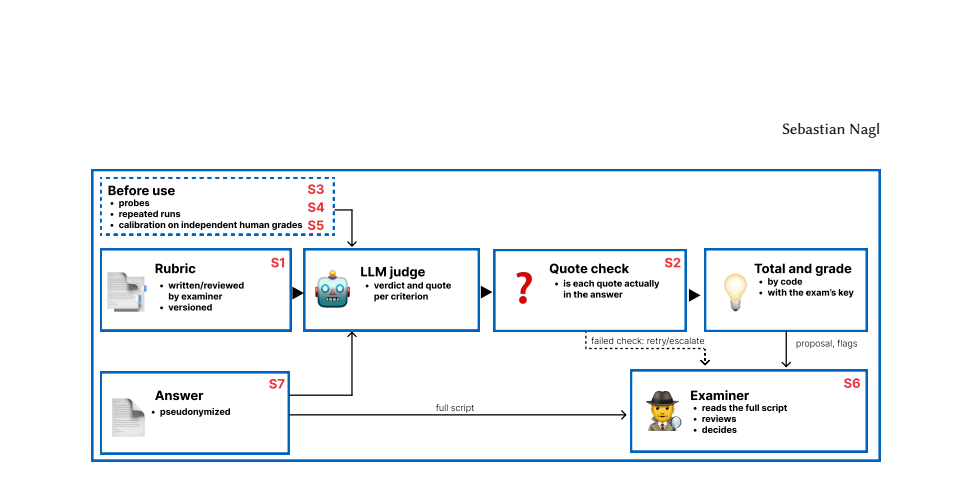
Figures are the authors', reproduced from the paper.
Challenges and discussion
Disagree with the review, or know something it missed? Leave a comment, or challenge this review formally: a challenge becomes a permanent entry in this paper's record, and its decision is published here.
Come back by email
A short list of the week's newly reviewed papers. Nothing is sent until you confirm from your inbox, and every email has a link that stops it. No account.
No comments yet.
Sign in to comment