Artificial Intelligence · arXiv:2610.22192 v3 · submitted 15 Oct 2026
Terminal-RSI: Recursive Self-Improving Terminal Agents via Recursive Self-Rewrite and Policy-Refine
The paper says
“Converting verifier outcomes into useful policy updates and partial progress into complete task resolution is crucial for terminal agents. We present Terminal-RSI, which alternates Recursive Self-Rewrite (RSR) of verified trajectories with critic-inheriting Recursive Policy-Refine (RPR).”
more of the abstract
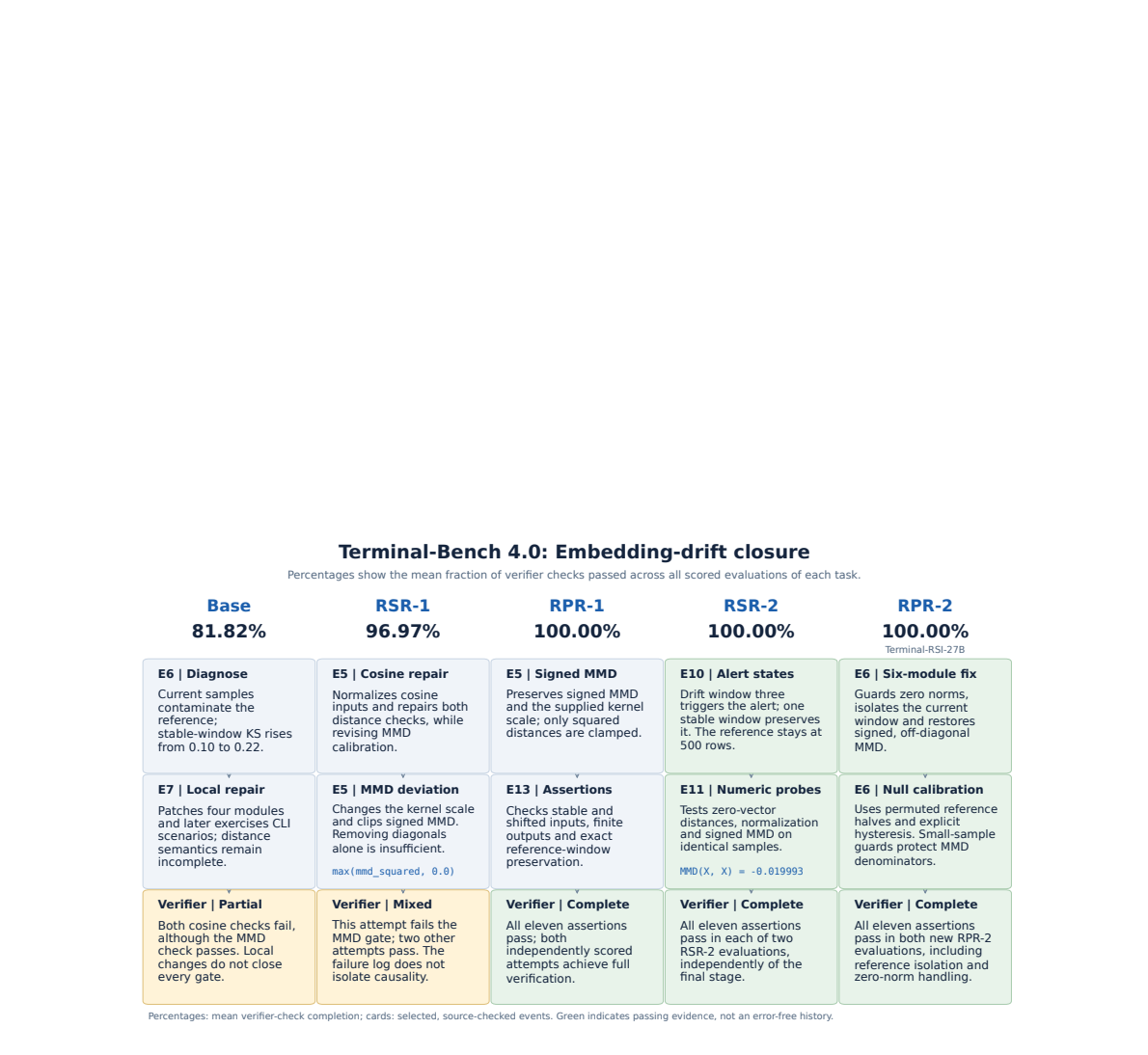
We formulate Turn-Boundary Skip-Observation GAE (TB-GAE) to retain token-specific baselines while applying decay across interaction turns. Family Dense Reward (FDR) calibrates semantic progress across task families; Success-Prioritized Reward (SPR) separates strict success from bounded partial credit. A Warm-up Critic Model, recursive critic handoff, and stage-specific learning rates coordinate the two refinement phases. The five-stage sequence from Qwen3.8-27B base model through RSR-1, RPR-1, RSR-2, and RPR-2 yields Terminal-RSI-27B: 19.84% on Terminal-Bench 4.0, 86.52% on Terminal-Bench 2.1, 16.95% on Terminal-Bench 3.0, and 79.00% on Terminal-Bench Hard. On LHTB, process reward rises from 0.21 to 0.37 and strict completion from 0/46 to 5/46; SWR100 success doubles from 3.00% to 6.00%. By recursively coupling verified trajectory rewriting with critic-inheriting policy refinement, each retained stage consolidates discovered behaviors and progressively advances the agent from partial local repairs to strict terminal verification.
from the abstract
Pith says
Machine review · deepseek-v4-flash · 16 Oct 2026 · of version 1 of the paper; version 3 is newer · what was read was not recorded · not checked by a person
It can be wrong. Challenge this review or reply to it.
Holds up, with conditions. Honest, methodologically careful systems paper with a real credit-assignment idea (TB-GAE) and genuine offline reward analysis, but the headline recursive-policy-refine gain rests on a benchmark-selected checkpoint of a nonmonotonic phase and needs seeds, error bars, and prospective selection before the causal story holds. This line is wrong
3 major objections · 6 minor
How often objections from reviews like this one are right: not yet measured
Not checked: figures, code, what the references say.
The paper says, at Section 3.3; Table 2; Appendix D
The review did not quote this passage.
A classifier read this sentence of the paper as acknowledging the concern (probability 0.63):
“Evaluation and selection.Three evaluations do not replace independent training seeds or establish statistical superiority.”
Pith says: Objection 1 of 3 · major
The decisive link in the paper's progression narrative is the final stage, RSR-2 to RPR-2 (Table 2: +2.38 on Terminal-Bench 4.0, +1.95 on Terminal-Bench 3.0, +3.00 on Terminal-Bench Hard, +0.06 on LHTB, and 4/46 to 5/46 strict completions). Section 3.3 shows that this gain resides at one selected checkpoint of a nonmonotonic phase: continuing the retained Long-Reward branch from step …
more of objection 1
… 18 to step 20 'loses 2.66, 2.38, and 3.00 points on Terminal-Bench 3.0, 4.0, and Hard', landing at 14.29/17.46/76.00, which equals or falls below RSR-2's 15.00/17.46/76.00. Because Figure 6 reports evaluations at steps 6, 10, 18, and 20, the retained step-18 checkpoint was selected using final-benchmark feedback, and the Long-Reward (SPR) branch was selected over ordinary FDR RPR-2 on the same step-18 suite scores. Appendix D acknowledges that the sequence 'records retained checkpoints rather than validating a prospective selection rule'; the acknowledgment is commendable but does not neutralize the numbers. With one training seed, Mean@3 on a shared checkpoint, and within-phase swings of roughly four points on Terminal-Bench 4.0, the RSR-2-to-RPR-2 contrast can be reproduced by stop-and-branch selection alone, and the recursive benefit of the final RPR stage is not established. A prospective, validation-based retention rule, or multiple seeds with all checkpoints reported, is needed before the abstract's claim that each retained stage 'progressively advances the agent' is supported.
The paper says, at Section 2.2; Appendix B
The review did not quote this passage.
A classifier read this sentence of the paper as acknowledging the concern (probability 0.67):
“These offline results isolate reward allocation, not policy-training outcomes (Appendix B).”
Pith says: Objection 2 of 3 · major
The SPR reward used by the retained RPR-2 branch was calibrated with lookahead into the same run whose later checkpoints constitute the final-stage evidence. Appendix B states that the fixed divisor table was produced 'using trajectories from the first nine recorded steps' of the RPR-2 phase and, separately, that 'the eight later steps were already available when the reward was designed'; the Long-Reward (SPR) branch was then preferred over the FDR branch by comparing step-18 suite scores (Section 3.3).
more of objection 2
The headline RPR-2 numbers are therefore not a clean evaluation of the reward design: both the choice of calibration rules and the branch selection have access to observations from the same nonmonotonic phase. The paper discloses this ('The offline comparisons therefore assess sensitivity ... rather than blind held-out performance'), but once disclosed, these results cannot carry the abstract's implication that success-prioritized reward is the mechanism behind the final advance. A prospective calibration, with divisors fit on earlier stages or a separate run and later checkpoints held out, would resolve the concern.
The paper says, at Section 2.4; Appendix G
The review did not quote this passage.
A classifier read this sentence of the paper as acknowledging the concern (probability 0.88):
“Scope.The documented first phase uses standard GAE withγ = λ = 1; unit-clock equivalence does not establish TB-GAE deployment or an isolated online gain.”
Pith says: Objection 3 of 3 · major
TB-GAE, one of the three named contributions, is not shown to be the estimator that produced any reported checkpoint. Section 2.4 states that the documented first phase uses standard GAE with gamma = lambda = 1, under which the consistency conditions of Appendix C make TB-GAE coincide with standard GAE at retained generated positions; Appendix G adds that 'checkpoint manifests are still needed to establish the deployed advantage estimator' for RPR-2.
more of objection 3
The derivations in Eqs. (8)-(13) are internally coherent, but contribution (ii) is presently a theory contribution without confirmed deployment or online validation. This is checkable within the paper's own release artifacts: inspect the saved RPR-2 launch configurations for gamma_turn and lambda_turn values away from unity, and run a matched comparison of TB-GAE against standard GAE on the same rollouts to substantiate the credit-assignment benefit claimed in the abstract.
6 minor objections
The paper says, at Section 3.2; Figure 4
Pith says: minor objection 1 of 6
Reference-model comparisons are presented without uncertainty on either side, yet the text states that 86.52% 'exceeds the listed 85.40% for GPT-6 Sol' and contrasts 19.84% with 19.70% for Gemini 3.8 Flash; given Mean@3 on a single checkpoint and the paper's own note that 'primary-source and protocol reconciliation remains incomplete', these margins are best characterized as parity rather than superiority, or accompanied by per-run values.
The paper says, at Section 3.2
Pith says: minor objection 2 of 6
'RSR-first outperforms direct PPO in this setting' and the 'up to +29.2%' framing rely on a control that the paper itself describes as not compute-matched and as following a separate historical protocol (Appendix E); this is fair as a comparison of update-count-aligned checkpoints, but the headline sentence in Section 3.2 should carry the unmatched-cost qualification at the point where the number appears.
show 4 more
The paper says, at Figure 6
Pith says: minor objection 3 of 6
The gray 'discarded' series are not visually distinguished from one another, and the gray Terminal-Bench 4.0 values (15.87, 17.46) do not map transparently onto the step-6/step-10 trajectory described in Section 3.3 (17.46 at step 6, 11.11 at step 10); please label each gray series (Direct PPO, RPR-1 continuation, ordinary FDR RPR-2, Long-Reward RPR-2) directly in the figure.
The paper says, at Appendix F; Figure 10
Pith says: minor objection 4 of 6
Figure 10 combines data with different provenance: the Terminal-Bench 2.1 RSR-1 stratum uses an alternative rewrite checkpoint, and the RPR-2 stratum scores 'have not been independently reconciled with the retained step-18' checkpoint (Appendix F); these caveats should migrate into the figure caption so the stratification results are not read at face value.
The paper says, at Appendix E; LHTB
Pith says: minor objection 5 of 6
Appendix E correctly cautions that the compact 5/46 entry identifies neither per-run counts nor a union of solved tasks; since LHTB strict completion is one of the two headline long-horizon numbers, please supply the run-level counts (three runs for the RSR-2 and RPR-2 stages) or state explicitly that they are unavailable.
The paper says, at Throughout
Pith says: minor objection 6 of 6
Typos and formatting: 'Terminal-RSI-27Breaches' is missing a space, 'Long-Horizon-Terminal-Bench' is hyphenated inconsistently with 'Long-Horizon Terminal-Bench' elsewhere, and the Table 2 caption phrase 'use percentage of accuracy as performance' is awkwardly worded.
What would settle it
Re-evaluate the already-trained RPR-2 checkpoints — Long-Reward branch at steps 18 and 20, ordinary FDR branch at its retained step, and RSR-2 — on Terminal-Bench 4.0, 3.0, and Hard with roughly ten repeats each under the Appendix A protocol, plus the RPR-1 step-20 and step-35 checkpoints. If the step-18 advantage over RSR-2 falls within repeat-level noise, or step 20 reproduces RSR-2's 17.46/15.00/76.00, the published terminal-stage gains are checkpoint-selection effects and the recursive-benefit interpretation fails; if the step-18 advantage is robust across repeats and the step-20 regression does not replicate, the selection concern is weakened. A complementary audit would publish the full per-step, per-branch selection ledger and a pre-registered validation rule applied to a benchmark-disjoint split.
from the skeptic's reading
How the review went
4 readings by deepseek-v4-flash · 16 Oct 2026
- Reader holds up, with conditions
- Skeptic agrees
- Editor wrote the verdict above
- Referee major revision: 3 major objections, 6 minor
Not run on this paper: the simulated authors' defence.
Pith did not check this review's objections against the paper.
The review in full
The review in brief, machine-written
Read Terminal-RSI. Short version: this is a careful, unusually honest systems paper with one genuinely new idea worth keeping, but the headline causal claim — that the recursive RSR/RPR loop consolidates gains across cycles — is not supported by the reported numbers. The reader's CONDITIONAL verdict and the stress-test both hold up on reading; I don't see a way to dispute them.
What's actually new and good. TB-GAE (turn-boundary clock with token-level baselines, exact cross-chunk continuation) is a real, small, well-motivated credit-assignment contribution; the derivations in Section 2.3 and Appendix C are the most rigorous part of the paper. The offline rescoring (FDR→SPR cutting failures' reward share from 50.09% to 28.72% on fixed trajectories) is clean, correctly scoped as reward allocation rather than training effect, and reproducible. The paper also manages its metrics honestly — Mean@3 vs pass@3, process reward vs strict completion, retained stages vs discarded branches — and shows its own nonmonotonic curves without smoothing. Appendix D's admission that the sequence "records retained checkpoints rather than validating a prospective selection rule" is above the usual disclosure bar.
Where it's soft. The decisive final-stage claim, RSR-2→RPR-2, is exactly where the evidence is thinnest. The gain is +2.38/+1.95/+3.00 on TB-4.0/3.0/Hard plus +0.06 LHTB and one more strict completion, and it lives at the step-18 Long-Reward checkpoint. The paper's own Section 3.3 says continuing to step 20 loses 2.66/2.38/3.00 points, landing back at RSR-2 levels (17.46/76.00 on TB-4.0/Hard, 14.29 on TB-3.0). Steps 6, 10, 18, and 20 were all evaluated on the final benchmarks, and the SPR branch was chosen over the FDR branch the same way, so checkpoint selection alone can produce the displayed sequence. The authors acknowledge the confound; acknowledging it doesn't re-establish the claim. Also: one training seed, three inference runs (which measure sampling noise, not training variability), reward divisors fit to early steps of the same run (Appendix B admits the later steps were already in hand), no released code or run-level logs with a commit hash, and the reference-model scores are unreconciled. The self-citation pattern is not the problem here; the headline numbers rest on external verifiers, and the authors are explicit that they extend their own T1/RSR program.
The big early gains — Base→RSR-1→RPR-1, ten to twenty points — are much less fragile; they're far above the five-to-six-point swings in Figure 6. But they're single-seed and unmatched-cost, and the LHTB 5/46-vs-4/46 difference is one task on a three-run mean; don't lean on it.
Who this is for: anyone doing RL post-training for agents. TB-GAE and the reward-evolution analysis deserve to be taken seriously; the paper is also a good cautionary case on selection confounds. I'd send it to peer review — it deserves a serious referee — with major-revision demands: independent seeds or error bars, prospective checkpoint selection on held-out validation, compute-matched alternation, and run logs. The method content survives; the causal story needs re-evidence.
The strongest objection
The central claim is causal: the alternating RSR/RPR loop progressively advances the agent, and the decisive link is the final stage, RSR-2 to RPR-2 (+2.38 TB-4.0, +1.95 TB-3.0, +3.00 Hard, +0.06 LHTB, 4/46 to 5/46). The paper's own Section 3.3 numbers show this gain lives at one selected checkpoint of a nonmonotonic phase: continuing the retained Long-Reward branch from step 18 to step 20 "loses 2.66, 2.38, and 3.00 points on Terminal-Bench 3.0, 4.0, and Hard" while preserving TB-2.1, meaning step 20 scores 14.29/17.46/76.00, essentially RSR-2's 15.00/17.46/76.00. Evaluated checkpoints at steps 6, 10, 18, and 20 all appear in the text, so step 18 was chosen from a set of final-benchmark evaluations, and the Long-Reward (SPR) branch was likewise chosen over ordinary FDR RPR-2 by comparing step-18 suite scores. Appendix B adds that the eight later steps of this run were already available when the SPR divisors were designed. The paper explicitly acknowledges the confound (Appendix D: "records retained checkpoints rather than validating a prospective selection rule"), but acknowledgment does not neutralize the numbers: with one training seed, three inference runs, step-to-step swings of five to six points on TB-4.0 (Figure 6), and multiple per-benchmark evaluations per phase, the displayed sequence can be reproduced by stop-and-branch selection alone, with no recursive benefit. The large RPR-1-over-RSR-1 gains are an unmatched-cost, single-seed comparison the paper itself does not claim is compute-matched. The reported evidence therefore does not establish that retained stages consolidate discovered behaviors, although the paper's arithmetic is internally consistent and its limitations are stated honestly.
The paper's central interpretive claim is that the alternating RSR/RPR loop caused the progressive improvements, and the reported stage sequence is offered as evidence. The reader's weakest assumption targeted the right place: attribution to the method versus selection artifacts. My pass converges on the same concern and sharpens it with the paper's own numbers. The distinguishing evidence is in Section 3.3: the retained Long-Reward RPR-2 branch, evaluated at step 18, regresses at step 20 to 14.29/17.46/76.00 on TB-3.0/4.0/Hard, essentially RSR-2's 15.00/17.46/76.00. The entire terminal-stage gain over RSR-2 therefore lives at a single intermediate checkpoint of a 20-step phase, chosen from a set of evaluated checkpoints and chosen over the ordinary FDR branch by comparing step-18 suite scores; Appendix B further notes the eight later steps of this run were available when the SPR divisors were designed, and Appendix D concedes retention was not prospective. This is not an internal inconsistency: the arithmetic checks out (the 50.58% macro-average is correctly computed), the TB-GAE and KL derivations are plausible, and the qualitative case studies are candid, including the Python-delegation caveat for the Rust-C task and the missing checker-contract details. It is a correctness and attribution risk: the same headline sequence could plausibly be produced by stop-and-branch selection on the evaluation benchmarks with one seed and three evaluation runs. I therefore agree with the reader's weakest_assumption and with the CONDITIONAL verdict: the numbers merit consideration as an engineering result, but the recursive-benefit interpretation requires prospective validation, including a pre-registered selection rule on a benchmark-disjoint split, independent training seeds, and released run-level logs. The cheapest decisive check uses checkpoints that already exist — a head-to-head re-evaluation of step-18 versus step-20 versus the FDR branch with more repeats would settle whether the final-stage gains are a policy property or a selection artifact. Credit where due: the paper states its limitations unusually explicitly (three runs, no independent seeds, unmatched compute, unproven TB-GAE deployment), provides a genuine offline rescoring analysis of reward allocation, and avoids overclaiming the Rust-C native-path result. Given that honesty and the addressable nature of the gaps, CONDITIONAL is the right verdict and my read does not change it.
The referee's report
If the reported progression were an effect of the method, this would be a notable result: verifier-verified rewriting plus critic-preserving policy refinement pushing a 27B model to frontier-comparable Terminal-Bench scores, with reward shaping that measurably suppresses high-scoring failures (Section 3.4: failure reward share from 50.09% to 28.72%). The manuscript's strengths are substantial: the method is specified at operational detail (Eqs. 1-14, Tables 1-3, Appendices A-G); the headline numbers are anchored on external verifiers rather than the method's own equations; every benchmark observation is displayed, including nonmonotonic branches; the TB-GAE and conditional-KL derivations (Appendices C-D) are internally coherent; and the authors themselves disclose the selection and calibration confounds (Appendices B and D, Section 5). Code, weights, and project pages are provided. The significance is nonetheless conditional: what remains unshown is that the recursive training loop, rather than checkpoint selection and reward calibration on a single training seed, generated the reported stage-by-stage progression.
Pith's reading of the paper (a machine's summary, not the authors')
This paper is trying to establish that a terminal agent — an AI that acts in a real command-line environment and is judged by whether a protected verifier passes — improves most when training alternates two phases: Recursive Self-Rewrite, which turns the agent's own verifier-passed successes into fresh training trajectories, and Recursive Policy-Refine, which trains the policy with a critic inherited from the previous phase and recalibrated rather than retrained. The claim is that this recursive actor-critic loop converts partial progress — passing individual checks, repairing modules — into strict, verifier-approved task completion, which is exactly what terminal agents are graded on. The supporting evidence is a 27-billion-parameter model taken through five alternating stages, reaching 50.58% mean success across four Terminal-Bench suites, raising long-horizon process reward from 0.21 to 0.37 with strict completions growing from 0/46 to 5/46, and doubling success on a held-out scientific-workflow suite. A sympathetic reader would care because the recipe — verified rewriting, carried-over critics, turn-boundary credit — is separable enough to test on other backbones and settings, and the paper states plainly that matched-budget controlled studies remain necessary.
What carries the argument. The load-bearing object is the recursive actor-critic loop itself, in which actor-only RSR stages carry the critic weights through unchanged and RPR stages recalibrate the inherited critic with four critic-only updates before joint optimization, coordinated by a warm-up critic epoch and a fivefold actor-learning-rate reduction in the second cycle. Two mechanisms carry the credit and reward side: Turn-Boundary Skip-Observation GAE (TB-GAE), which uses unit clocks inside an interaction turn and decay factors $(\gamma_{\text{turn}}, \lambda_{\text{turn}})$ only when the turn changes so that text length no longer attenuates credit; and the FDR-to-SPR reward schedule, in which Family Dense Reward divides passed checks by a frozen per-family divisor, and Success-Prioritized Reward $R_{\text{SPR}} = S + P/(P + D'_f)$ keeps every failure below the one-unit success bonus. TB-GAE also supplies exact cross-chunk continuation formulas and a critic-error decomposition in which observation bootstrap terms vanish while a local error term remains.
Core claim. On its own terms, the paper's discovery is that verified rewriting and critic-inheriting refinement reinforce each other when alternated: a supervised rewrite stage changes which actions the actor prefers, the critic is carried through that transition unchanged ($\Delta\phi|_{\text{RSR}} = 0$) so learned return structure is not discarded, and the following refinement phase recalibrates the inherited values with the actor frozen before joint PPO updates. Credit assignment is reclocked by Turn-Boundary Skip-Observation GAE, which applies decay only when the interaction crosses a turn boundary, so two executions with identical decisions and terminal outcomes receive identical credit regardless of log verbosity. The reward schedule evolves from Family Dense Reward, which normalizes partial progress by a frozen per-family divisor, to Success-Prioritized Reward, which bounds failure credit strictly below the one-unit success bonus; on 4,352 audited trajectories with unchanged outcome labels, failures' share of reward mass falls from 50.09% to 28.72%. The five retained stages end at 19.84% on Terminal-Bench 4.0, 86.52% on Terminal-Bench 2.1, 16.95% on Terminal-Bench 3.0, and 79.00% on Terminal-Bench Hard, with the paper reporting that its scores sit near or above several listed frontier reference models while noting those external scores are not fully reconciled with its own protocol.
The premise it rests on. The headline gains are attributed to the recursive training loop on the assumption that checkpoint selection and reward recalibration were not the real drivers, since the paper records the retained sequence after the fact rather than under a prospective validation rule, and its three evaluation runs on one shared checkpoint carry no statistical guarantee.
If the paper is right (Pith's inferences, not the authors')
The RSR-first schedule beats direct PPO at matched local step 20 by 29.22, 12.86, 16.67, and 30.50 percentage points on Terminal-Bench 2.1, 3.0, 4.0, and Hard, so verified rewriting acts as an exploration anchor that raw rollout filtering alone does not supply.
Subordinating partial credit to strict success removes the worst failure mode: on 4,352 fixed trajectories, failures' reward share drops from 50.09% to 28.72% and no failure scores at or above one, while long low-reward families retain additional partial credit.
Long-horizon benefit converts local progress into completion: LHTB process reward rises from 0.21 to 0.37 and strictly completed tasks from 0/46 to 5/46 across the five stages, though the paper notes the solved-task sets are not shown to be nested.
Gains are benchmark-dependent and nonmonotonic: Terminal-Bench 2.1 saturates at 86.52% after RSR-2 while other suites keep rising, and continuing the retained RPR-2 branch past step 18 loses points on three suites, so final scores depend on where training stops.
SWR100 doubles from 3.00% to 6.00% on a training-disjoint scientific-reconstruction suite and then plateaus, indicating transfer beyond the training pool without continued second-cycle gains.
The inherit-then-recalibrate critic recipe addresses a general failure mode of any supervised-then-reinforced pipeline — the updated actor generates histories its own value network was not trained on — so the alternation is a candidate solution for non-terminal agentic training, though the paper only demonstrates it on one 27-billion-parameter terminal backbone.
A pre-registered, validation-based retention rule applied to all branches (the discarded RPR-1 continuation and the ordinary-FDR RPR-2 branch included) would test whether the recursive benefit survives without final-benchmark feedback; Appendix D records the retained sequence, not such a rule, making this the cheapest decisive follow-up.
TB-GAE's turn-boundary clock is a separable hypothesis: comparing per-turn against per-token decay on any long-horizon interaction benchmark would show whether verbose-log sensitivity distorts credit beyond terminal agents.
The verifier-coverage gap the paper exposes in its own Rust–C case study — the final model passes fuzz-equivalence gates while delegating evaluation to Python behind a C-linkage smoke test — suggests strict-completion scores should be audited for the path actually executed, not just the contract tested.
Check this review
Pith stored no record of this review's passes and took no fingerprint of it. Reviews made by code from 13 Nov 2026 on carry both.
How often reviews like this one are right
Reviews like this one: written by deepseek-v4-flash, where what was read was not recorded.
How often objections from reviews like this one are right: not yet measured
Reviews by people
This review was written by a machine. No person has reviewed this paper on Pith yet. A scientist listed on Pith can review it for a fee, and their review is published here whatever it concludes.
The paper
Abstract
Converting verifier outcomes into useful policy updates and partial progress into complete task resolution is crucial for terminal agents. We present Terminal-RSI, which alternates Recursive Self-Rewrite (RSR) of verified trajectories with critic-inheriting Recursive Policy-Refine (RPR). We formulate Turn-Boundary Skip-Observation GAE (TB-GAE) to retain token-specific baselines while applying decay across interaction turns. Family Dense Reward (FDR) calibrates semantic progress across task families; Success-Prioritized Reward (SPR) separates strict success from bounded partial credit. A Warm-up Critic Model, recursive critic handoff, and stage-specific learning rates coordinate the two refinement phases. The five-stage sequence from Qwen3.8-27B base model through RSR-1, RPR-1, RSR-2, and RPR-2 yields Terminal-RSI-27B: 19.84% on Terminal-Bench 4.0, 86.52% on Terminal-Bench 2.1, 16.95% on Terminal-Bench 3.0, and 79.00% on Terminal-Bench Hard. On LHTB, process reward rises from 0.21 to 0.37 and strict completion from 0/46 to 5/46; SWR100 success doubles from 3.00% to 6.00%. By recursively coupling verified trajectory rewriting with critic-inheriting policy refinement, each retained stage consolidates discovered behaviors and progressively advances the agent from partial local repairs to strict terminal verification.
The paper's own sentences, arranged, kept beside the review and separate from it. Each label is drawn from a closed vocabulary; the number beside it is the probability the classifier gave that label. No sentence in this record was written by a model.
abstract compiled · 2026-10-16
The authors' main claim, as the classifier picked it out 0.99
“By recursively coupling verified trajectory rewriting with critic-inheriting policy refinement, each retained stage consolidates discovered behaviors and progressively advances the agent from partial local repairs to strict terminal verification.”
How the main claim is stated: asserted 1.00
What the abstract itself states, as probabilities: claims first 0.05 · states limitation 0.18 · human participants 0.03 · controlled comparison 0.58 · randomized assignment 0.02 · states quantitative result 0.99 · compares with prior results 0.76 · mentions code or data availability 0.03
The abstract, sentence by sentence
This table labels the abstract only (arXiv listing abstract v1). The number is the probability the classifier gave the label.
| Sentence | Role | The authors' own work | States the main conclusion | Strength |
|---|---|---|---|---|
| Converting verifier outcomes into useful policy updates and partial progress into complete task resolution is crucial for terminal agents. | background 0.96 | 0.08 | 0.08 | asserted 1.00 |
| We present Terminal-RSI, which alternates Recursive Self-Rewrite (RSR) of verified trajectories with critic-inheriting Recursive Policy-Refine (RPR). | contribution 0.66 | 0.91 | 0.12 | asserted 0.99 |
| We formulate Turn-Boundary Skip-Observation GAE (TB-GAE) to retain token-specific baselines while applying decay across interaction turns. | method 0.85 | 0.90 | 0.03 | asserted 0.99 |
| Family Dense Reward (FDR) calibrates semantic progress across task families; Success-Prioritized Reward (SPR) separates strict success from bounded partial credit. | method 0.94 | 0.85 | 0.04 | asserted 1.00 |
| A Warm-up Critic Model, recursive critic handoff, and stage-specific learning rates coordinate the two refinement phases. | method 0.99 | 0.84 | 0.04 | asserted 1.00 |
| The five-stage sequence from Qwen3.8-27B base model through RSR-1, RPR-1, RSR-2, and RPR-2 yields Terminal-RSI-27B: 19.84% on Terminal-Bench 4.0, 86.52% on Terminal-Bench 2.1, 16.95% on Terminal-Bench 3.0, and 79.00% on Terminal-Bench Hard. | result 0.99 | 0.95 | 0.25 | asserted 1.00 |
| On LHTB, process reward rises from 0.21 to 0.37 and strict completion from 0/46 to 5/46; SWR100 success doubles from 3.00% to 6.00%. | result 1.00 | 0.92 | 0.10 | asserted 1.00 |
| By recursively coupling verified trajectory rewriting with critic-inheriting policy refinement, each retained stage consolidates discovered behaviors and progressively advances the agent from partial local repairs to strict terminal verification. | interpretation 0.67 | 0.77 | 0.77 | asserted 1.00 |
What kind of paper the classifier reports this is: method or tool 1.00 · evidence from observation or experiment 0.90
What was examined, and what was not
Sources read
- arXiv listing abstract v1
Not examined
- full text
- figures and tables
- references and citing sentences
- relations to other papers
Levels run
- P abstract
Not run
- S sections
- T body sentences
- C citations
- R cross-paper relations
How the labels were made
Compiled by classifier-1.13.0 via TypeSafe API, question bank abstract-p1-20260923, 2026-10-16: 1 request, 6,568 input tokens.
Every quoted sentence on this record is the authors'. Every label is from Pith's closed vocabulary, with the probability shown beside it. This record as JSON
Figures (16)



Showing 14 of the paper's 16 figures. Figures are the authors', reproduced from the paper.
Cited by 3 Pith papers
Reviewed papers on Pith that cite this one. The full citation record
- Auditing the Product, Not the Recursion: The Evaluation Evidence Behind Recursive Self-Improvement Claims cs.LG · Oct 2026
- Agent Self-Improvement with Frozen Weights: The Added Value and Limits of Failure Traces cs.LG · Nov 2026
- Harness Self-Evolution for Long-Horizon Terminal Agents cs.AI · Oct 2026
Challenges and discussion
Disagree with the review, or know something it missed? Leave a comment, or challenge this review formally: a challenge becomes a permanent entry in this paper's record, and its decision is published here.
Come back by email
A short list of the week's newly reviewed papers. Nothing is sent until you confirm from your inbox, and every email has a link that stops it. No account.
No comments yet.
Sign in to comment