Machine Learning · arXiv:2610.22831 v1 · submitted 16 Oct 2026 · 25 references
Partial-Revelation Panel Forecasting: Predictive Information Gain, Allocation, and Coarsening-Consistent Operators
The paper says
“We study partial-revelation panel forecasting: given k of n annotator votes on the previous dialogue turn, predict the full count distribution of the next turn's panel. This cross-turn predictive information differs from same-item annotation value.”
more of the abstract
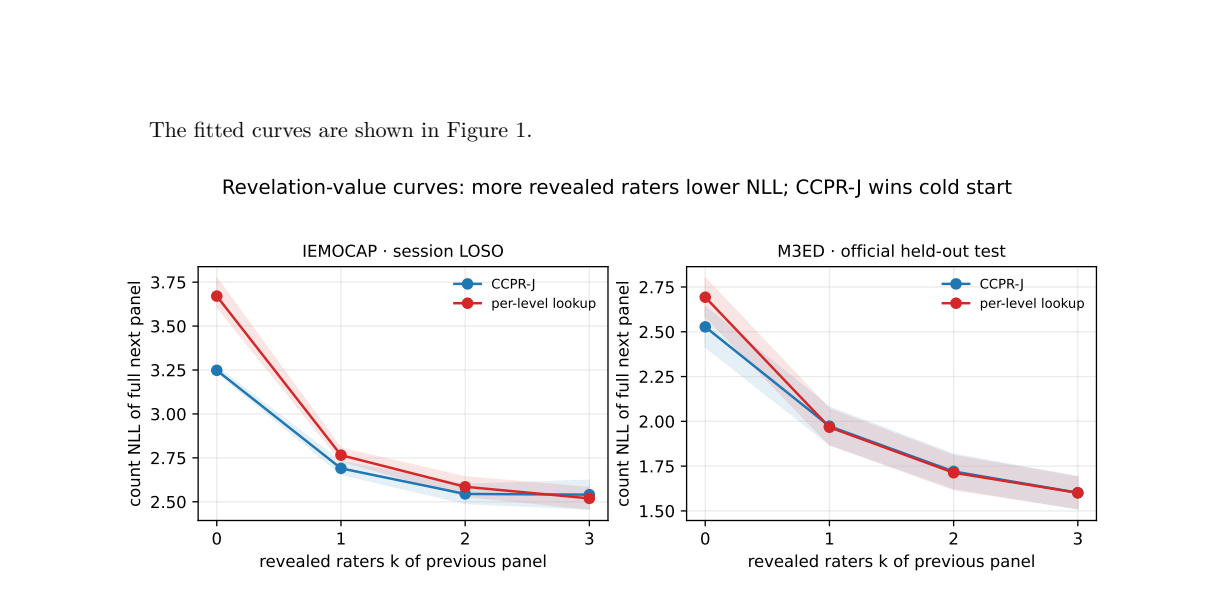
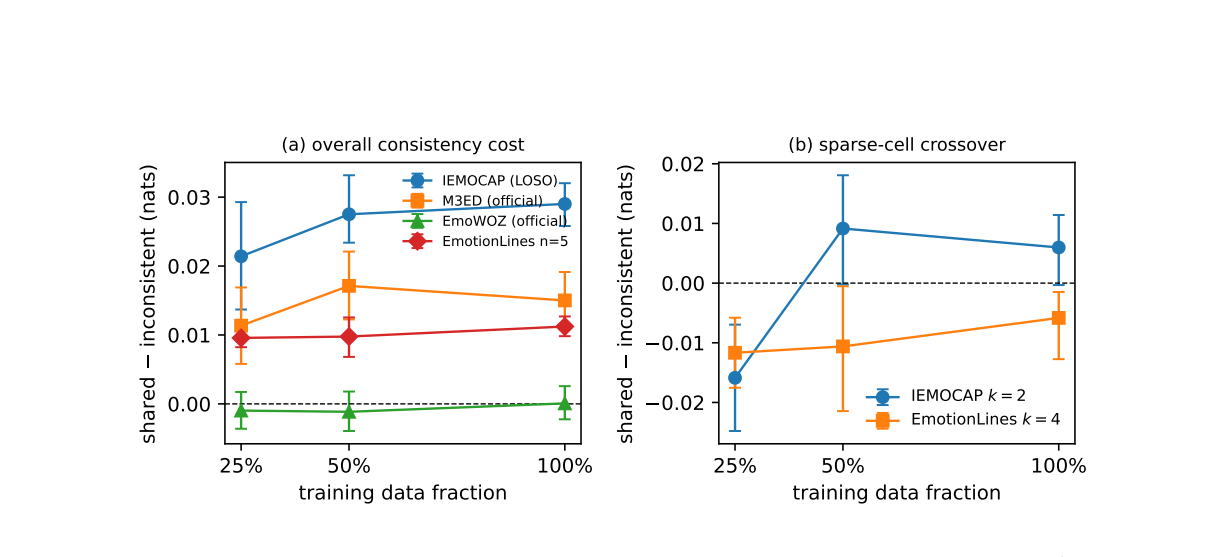
Under any nested revelation mechanism, the population decrement satisfies $V(k)-V(k+1)=I(Y;R_{k+1}\mid X_k)$; a fitted model also contributes adjacent excess-risk differences. Coarsened-completely-at-random (CCAR) masking supplies the exchangeable random-rater interpretation used in our operators. We define coarsening-consistent panel operators with a closed-form Dirichlet-multinomial realization, learned completion, and rater-count transfer. Against per-level lookup, cold-start count negative log-likelihood differences are -0.422/-0.166/-0.014 nats on IEMOCAP/M3ED/EmoWOZ. A held-out rater experiment measures same-item value: first and second additional votes reduce NLL by 0.583/0.221, 0.578/0.184, and 0.180/0.069 nats, respectively. Cross-turn and same-item gains are not interchangeable, and CCAR masks are controlled interventions rather than observed arrival processes. Consistency is auditable but does not guarantee predictive improvement; per-level marginalization can outperform a shared table. Target-free allocation beats uniform only where row-level signal is predictable: at budget one it recovers 83–93% of retrospective feature class headroom on IEMOCAP/M3ED but does not improve EmoWOZ. Gains are modest and corpus-dependent, with several small or null partial-revelation differences. Code and aggregate result artifacts accompany the preprint.
from the abstract
Pith says
Machine review · deepseek-v4-flash · 19 Oct 2026 · what was read was not recorded · not checked by a person
It can be wrong. Challenge this review or reply to it.
Holds up. A principled framework for partial-revelation forecasting, honestly assessed—the modest empirical gains are a feature, not a bug. This line is wrong
7 minor
How often objections from reviews like this one are right: not yet measured
Not checked: figures, code, what the 25 references say.
7 minor objections
The paper says, at Section 4, Proposition 1
Pith says: minor objection 1 of 7
The fitted-risk decomposition shows that the empirical decrement equals the population CMI plus ε_k - ε_{k+1}. For real data, especially neural mixture models (Section 6.11), the excess-risk difference is not directly quantified. The synthetic validation (Table 4) uses a simple composition table, so its bias envelope may not transfer to neural models.
more of objection 1
The paper could add a brief discussion of how model misspecification might affect the size of this excess-risk gap and whether the reported small gains (e.g., EmoWOZ cold-start 0.014 nats) could plausibly be dominated by ε_k - ε_{k+1} rather than true CMI.
The paper says, at Section 6.2, Table 1
Pith says: minor objection 2 of 7
The reported IEMOCAP k=3 comparison shows ccprJ is +0.021 nats worse, with the CI lower endpoint at 0.0002. The text correctly notes this but states 'four of five session-level differences positive'. To aid interpretation, specify the exact number of positive differences and whether the bootstrap distribution is symmetric around this point estimate.
show 5 more
The paper says, at Section 6.4, Table 3
Pith says: minor objection 3 of 7
The inertia controls use a single per-row random order for nested masking. Since the paper later cautions that CCAR is a controlled intervention (Section 3.4), the results in Table 3 inherit the same assumption. State explicitly that the inertia experiment also assumes exchangeable rater arrival (CCAR) within each item.
The paper says, at Section 6.5, Table 4
Pith says: minor objection 4 of 7
The synthetic bias ranges for CCAR n=3 at 3000 rows are [-0.030, -0.018]. The paper's real-data training sizes vary (e.g., IEMOCAP ~4883 rows, EmoWOZ ~11098 rows for same-item validation but cross-turn uses the official 796/100/100 split). Add a note relating the synthetic sample sizes to the real-data ones to help readers gauge the relevance of the bias estimates.
The paper says, at Section 6.7, Table 16 (Appendix H)
Pith says: minor objection 5 of 7
The CCPR-L decomposition shows that the context term decreases strictly in k on all corpora (structural zero at k=n). In the caption of Table 16, note that at k=n the completion is empty, so context is identically zero by construction (as stated in the text). This is already clear but could be highlighted for readers who glance at the table.
The paper says, at Section 6.12, Table 13
Pith says: minor objection 6 of 7
The retrospective feature class headroom uses evaluation targets and is not deployable (as stated). The table could add a footnote: 'Retrospective headroom is fit in-sample on the evaluation block; it is a diagnostic reference, not an achievable policy bound.'
The paper says, at General
Pith says: minor objection 7 of 7
The paper is well-written but would benefit from a glossary or notation table for the many acronyms (CCPR-J, CCPR-D, CCPR-N, CCPR-S, CCPR-L, CCPR-A, CCPR-P, CCAR, DM, NLL, etc.) to aid readers unfamiliar with the terminology.
What would settle it
For each real dataset, fit bootstrap models (200 iterations) per level k and compute ε_k - ε_{k+1} = (V_q(k)-V_q(k+1)) - Î(Y; R_{k+1}|X_k), where Î is a non-parametric plug-in estimate using discretized bins of the joint distribution on a held-out validation set. Then adjust the reported fitted decrements by subtracting ε_k - ε_{k+1}. If the adjusted decrements remain positive and their 95% confidence intervals exclude zero for the cold-start case on all corpora, the concern is resolved.
from the skeptic's reading
How the review went
4 readings by deepseek-v4-flash · 19 Oct 2026
- Reader holds up
- Skeptic partly agrees
- Editor wrote the verdict above
- Referee minor revision: 7 minor
Not run on this paper: the simulated authors' defence.
Pith did not check this review's objections against the paper.
The review in full
The review in brief, machine-written
This paper is a serious, well-scoped contribution. It introduces partial-revelation panel forecasting, cleanly separates cross-turn predictive information from same-item annotation value, and gives a theoretical characterization: the population decrement is a conditional mutual information. The coarsening-consistency axiom and the Dirichlet-multinomial operator family are new and the closed-form marginalization is elegant.
The empirical work is careful—proper cluster bootstrap inference, negative controls, sensitivity analyses, and transparent reporting of positive, null, and negative results. The authors include three self-corrections of earlier claims (exact-marginal training failed, the Dirichlet-vs-CE comparison was a likelihood-family artifact, and the usual allocation oracle is clairvoyant). That level of candor builds trust.
The stress-test concern about the fitted decrement conflating CMI with excess-risk differences on real data is legitimate but not a dealbreaker. The paper acknowledges this in Proposition 1 and provides synthetic bias estimates. For the smallest gains (EmoWOZ cold-start 0.014 nats), the excess-risk component is unquantified and could be a significant fraction of the observed decrement. But the paper’s main contributions—the framework, the identity, the operator design—do not rest on those small gains being precise CMI estimates. The cold-start wins on IEMOCAP and M3ED are substantial and well-supported. The authors consistently note that gains are modest and corpus-dependent.
Soft spots: (1) Empirical scope is narrow—three n=3 corpora plus one n=5, all conversational emotion. Generality to other domains or panel sizes is untested. (2) CCAR is an untestable assumption given the lack of timestamps. The paper is upfront about this, but it limits the ecological validity of the main results. (3) The fitted-risk decomposition means the cross-turn increment on real data is not a pure CMI estimate; the paper handles this honestly but the practical interpretation remains ambiguous for small differences.
Who this is for: Researchers working on annotation budgeting, label distribution learning, or subjective NLP evaluation. The theoretical contributions are new and the methodology is sound. This paper deserves a serious referee; it will likely be accepted with minor revisions, mainly to ensure the limitations are as prominent as they already are. I would cite this for the framework and the identity.
The strongest objection
Proposition 1 shows the fitted decrement V_q(k)-V_q(k+1) equals I(Y; R_{k+1}|X_k) plus the excess-risk difference ε_k - ε_{k+1}. The paper provides synthetic bias estimates (Table 4): for CCAR n=3 with 3000 training rows, bias ranges [-0.030, -0.018] and max RMSE 0.032. On real data, especially for neural mixture models (Section 6.11) where model misspecification can be larger, this excess-risk component is not quantified. The reported EmoWOZ cold-start decrement is only 0.014 nats (95% CI [-0.023, -0.003]) — within the synthetic bias envelope for simpler models. Without empirical estimates of ε_k - ε_{k+1} for each real dataset and each operator, the claim that the fitted decrement approximates conditional mutual information is unverified for the smallest gains. The paper acknowledges the decomposition but does not quantify its magnitude, leaving the empirical interpretation of small partial-revelation gains ambiguous.
The reader's weakest_assumption centered on CCAR and nestedness as controlled interventions. While important, the central theoretical claim (Theorem 2) does not depend on CCAR. The most operationally load-bearing unresolved issue is the quantification of excess-risk differences in the fitted decrements (Proposition 1). The paper provides synthetic validation but no direct real-data estimate. This does not invalidate the paper's overall contribution because the paper is transparent about the decomposition and cautious in its claims; the smaller gains (e.g., EmoWOZ) are reported with the appropriate caveats. Nevertheless, a concrete check would strengthen the empirical interpretation. The verdict remains UNCHANGED because the concern does not undermine the paper's core theoretical contribution or its primary empirical finding (significant cold-start gains on IEMOCAP and M3ED, which are well outside synthetic bias).
The referee's report
The theoretical result linking revelation decrements to conditional mutual information (Theorem 2) is novel and provides a principled foundation for studying partial revelation in panel forecasting. The coarsening-consistency axiom and its Dirichlet-multinomial realization give a clean design principle. The empirical methodology is rigorous: cluster-bootstrap confidence intervals, multiplicity corrections (Holm), synthetic validation, negative controls, and separate evaluation of cross-turn and same-item estimands. The paper's transparency about its own corrections and null findings (Sections 7 and 9) raises the credibility of the reported positive results. If the CMI identity holds under the stated assumptions, the work provides a useful measurement framework for annotation-budget decisions, though the numerical gains are modest and corpus-dependent.
Pith's reading of the paper (a machine's summary, not the authors')
This paper formalizes a forecasting problem: given $k$ of $n$ annotator votes on the previous dialogue turn, predict the full count distribution over the next turn's panel. It proves that, for any nested revelation mechanism, the population decrement $V(k)-V(k+1)$ equals the conditional mutual information $I(Y;R_{k+1}\mid X_k)$, so each incremental revelation has a precise information-theoretic value. The authors define coarsening-consistent panel operators that behave sensibly across revelation levels and give a closed-form Dirichlet-multinomial realization. On three emotion corpora, the cold-start forecast (no previous votes) improves substantially, but mid-revelation gains are modest and corpus-dependent; consistency is a coherence property, not a guarantee of predictive advantage. The paper also measures same-item annotation value directly, showing diminishing returns from additional votes, and provides allocation guidance that uniform spreading beats concentrated spending in these settings.
What carries the argument. The paper's central object is the partial-revelation panel forecasting estimand and its information-theoretic characterization. The machinery includes: (i) the nested revelation process $X_{k+1} = (X_k, R_{k+1})$ that allows the tower property and Blackwell ordering; (ii) the identity $V(k)-V(k+1)=I(Y;R_{k+1}\mid X_k)$ derived from the standard decomposition of conditional mutual information into expected Kullback-Leibler divergence; (iii) the concept of coarsening consistency, requiring that the forecast at a partially revealed panel equal the completion-marginalized full-panel forecast; and (iv) the Dirichlet-multinomial completion model that realizes this consistency in closed form via a finite mixture over the enumerable hidden completions.
Core claim. Under any nested revelation mechanism, the expected reduction in count negative log-likelihood from revealing one more annotator vote on the previous panel is exactly the conditional mutual information $I(Y;R_{k+1}\mid X_k)$ (Theorem 2). This identity holds for the true conditional distribution; for a fitted model the decrement also contains the difference in adjacent excess predictive risks (Proposition 1). The result separates the cross-turn predictive gain from same-item annotation value and supplies the population-level interpretation for revelation-value curves.
The premise it rests on. The revelation mechanism is nested and the missing votes are coarsened completely at random (CCAR), which is a controlled masking intervention rather than an empirically verified annotation-arrival process. The paper acknowledges that the corpora lack timestamps to verify CCAR and that the exchangeable random-rater interpretation depends on this assumption (Section 3.4).
If the paper is right (Pith's inferences, not the authors')
Cross-turn predictive gain and same-item annotation value are distinct estimands; they answer different operational questions and should not be conflated in annotation budgeting decisions.
Coarsening consistency is a structured regularizer and deployment property (one table serves every $k$ and $n$), but it does not guarantee improved predictive accuracy; per-level marginalization can match or outperform the consistent operator.
In budget simulations for $n=3$ corpora, uniform allocation across items consistently yields lower expected loss than concentrating all annotations on a subset for budgets $B\in[0.5,2.5]$.
Target-free learned allocation policies (CCPR-P) help only when row-level features carry predictable signal; otherwise they can harm performance (as on EmoWOZ).
Identity-aware annotator routing is an open problem because the available corpora lack stable, timestamped evaluator identifiers to support its empirical evaluation.
The mutual-information identity implies that the shape of the cross-turn revelation curve is governed by the conditional dependence structure between successive panels; datasets with stronger turn-by-turn signal will exhibit larger early gains and slower saturation.
Because the identity applies only to the true conditional distribution, any empirical revelation-value curve should be reported together with a diagnostic of adjacent excess risk (Proposition 1) to avoid misinterpreting a fitted violation as a population contradiction.
The CCAR assumption is a controlled masking intervention; real annotation arrival processes may violate exchangeability, so the results should be re-evaluated if timestamped logs become available—the nestedness condition itself is general, but the exchangeable completion posterior depends on CCAR.
The cold-start gains on IEMOCAP and M3ED suggest that even partial aggregate information about the previous panel carries substantial signal; this motivates collecting at least one vote per turn for forecasting systems even when per-item annotation budgets are tight.
Check this review
Pith stored no record of this review's passes and took no fingerprint of it. Reviews made by code from 13 Nov 2026 on carry both.
How often reviews like this one are right
Reviews like this one: written by deepseek-v4-flash, where what was read was not recorded.
How often objections from reviews like this one are right: not yet measured
Reviews by people
This review was written by a machine. No person has reviewed this paper on Pith yet. A scientist listed on Pith can review it for a fee, and their review is published here whatever it concludes.
The paper
Abstract
We study partial-revelation panel forecasting: given k of n annotator votes on the previous dialogue turn, predict the full count distribution of the next turn's panel. This cross-turn predictive information differs from same-item annotation value. Under any nested revelation mechanism, the population decrement satisfies $V(k)-V(k+1)=I(Y;R_{k+1}\mid X_k)$; a fitted model also contributes adjacent excess-risk differences. Coarsened-completely-at-random (CCAR) masking supplies the exchangeable random-rater interpretation used in our operators. We define coarsening-consistent panel operators with a closed-form Dirichlet-multinomial realization, learned completion, and rater-count transfer. Against per-level lookup, cold-start count negative log-likelihood differences are -0.422/-0.166/-0.014 nats on IEMOCAP/M3ED/EmoWOZ. A held-out rater experiment measures same-item value: first and second additional votes reduce NLL by 0.583/0.221, 0.578/0.184, and 0.180/0.069 nats, respectively. Cross-turn and same-item gains are not interchangeable, and CCAR masks are controlled interventions rather than observed arrival processes. Consistency is auditable but does not guarantee predictive improvement; per-level marginalization can outperform a shared table. Target-free allocation beats uniform only where row-level signal is predictable: at budget one it recovers 83–93% of retrospective feature class headroom on IEMOCAP/M3ED but does not improve EmoWOZ. Gains are modest and corpus-dependent, with several small or null partial-revelation differences. Code and aggregate result artifacts accompany the preprint.
The paper's own sentences, arranged, kept beside the review and separate from it. Each label is drawn from a closed vocabulary; the number beside it is the probability the classifier gave that label. No sentence in this record was written by a model.
abstract compiled · 2026-10-20
The authors' main claim, as the classifier picked it out 0.87
“Gains are modest and corpus-dependent, with several small or null partial-revelation differences.”
How the main claim is stated: asserted 1.00
What the abstract itself states, as probabilities: claims first 0.04 · states limitation 0.97 · human participants 0.46 · controlled comparison 0.90 · randomized assignment 0.55 · states quantitative result 0.99 · compares with prior results 0.92 · mentions code or data availability 0.97
The abstract, sentence by sentence
This table labels the abstract only (arXiv listing abstract v1). The number is the probability the classifier gave the label.
| Sentence | Role | The authors' own work | States the main conclusion | Strength |
|---|---|---|---|---|
| We study partial-revelation panel forecasting: given $k$ of $n$ annotator votes on the previous dialogue turn, predict the full count distribution of the next turn's panel. | contribution 0.66 | 0.43 | 0.04 | asserted 0.82 |
| This cross-turn predictive information differs from same-item annotation value. | background 0.47 | 0.38 | 0.08 | asserted 1.00 |
| Under any nested revelation mechanism, the population decrement satisfies $V(k)-V(k+1)=I(Y;R_{k+1}\mid X_k)$; a fitted model also contributes adjacent excess-risk differences. | contribution 0.53 | 0.63 | 0.09 | asserted 1.00 |
| Coarsened-completely-at-random (CCAR) masking supplies the exchangeable random-rater interpretation used in our operators. | method 0.94 | 0.50 | 0.03 | asserted 1.00 |
| We define coarsening-consistent panel operators with a closed-form Dirichlet-multinomial realization, learned completion, and rater-count transfer. | method 0.51 | 0.93 | 0.09 | asserted 1.00 |
| Against per-level lookup, cold-start count negative log-likelihood differences are -0.422/-0.166/-0.014 nats on IEMOCAP/M3ED/EmoWOZ. | result 1.00 | 0.94 | 0.09 | asserted 1.00 |
| A held-out rater experiment measures same-item value: first and second additional votes reduce NLL by 0.583/0.221, 0.578/0.184, and 0.180/0.069 nats, respectively. | result 0.99 | 0.94 | 0.05 | asserted 1.00 |
| Cross-turn and same-item gains are not interchangeable, and CCAR masks are controlled interventions rather than observed arrival processes. | interpretation 0.88 | 0.71 | 0.25 | asserted 1.00 |
| Consistency is auditable but does not guarantee predictive improvement; per-level marginalization can outperform a shared table. | limitation 0.50 | 0.78 | 0.21 | asserted 0.96 |
| Target-free allocation beats uniform only where row-level signal is predictable: at budget one it recovers 83--93% of retrospective feature class headroom on IEMOCAP/M3ED but does not improve EmoWOZ. | result 0.99 | 0.93 | 0.17 | asserted 1.00 |
| Gains are modest and corpus-dependent, with several small or null partial-revelation differences. | interpretation 0.38 | 0.91 | 0.38 | asserted 1.00 |
| Code and aggregate result artifacts accompany the preprint. | contribution 0.77 | 0.63 | 0.02 | asserted 0.99 |
What kind of paper the classifier reports this is: method or tool 0.95 · evidence from observation or experiment 0.61
What was examined, and what was not
Sources read
- arXiv listing abstract v1
Not examined
- full text
- figures and tables
- references and citing sentences
- relations to other papers
Levels run
- P abstract
Not run
- S sections
- T body sentences
- C citations
- R cross-paper relations
How the labels were made
Compiled by classifier-1.13.0 via TypeSafe API, question bank abstract-p1-20260923, 2026-10-20: 1 request, 9,029 input tokens.
Every quoted sentence on this record is the authors'. Every label is from Pith's closed vocabulary, with the probability shown beside it. This record as JSON
Figures (2)
Figures are the authors', reproduced from the paper.
References (25)
- [1] Leonardelli, E.; Casola, S.; Peng, S.; Rizzi, G.; Basile, V.; Fersini, E.; Frassinelli, D.; Jang, H.; Pavlovic, M.; Plank, B.; Poesio, M. LeWiDi-2025 at NLPerspectives: Third Edition of the Learning with Disagreements Shared Task. InProceedings of the 4th Workshop on Perspecti... on Pithdoi:10.18653/v1/2025.nlperspectives-1.16
- [2] Xu, Y.; Jurgens, D. Beyond Consensus: Perspectivist Modeling and Evaluation of Annotator Disagreement in NLP.arXiv2026, arXiv:2601.09065. 25 on PithPith's reviewarXiv
- [3] Wu, W.; Li, B.; Zhang, C.; Chiu, C.C.; Li, Q.; Bai, J.; Sainath, T.; Woodland, P. Handling Ambiguity in Emotion: From Out-of-Domain Detection to Distribution Estimation. InProceedings of the 62nd Annual Meeting of the Association for Computational Linguistics (Volume 1: Long P... on Pith
- [4] Wu, W.; Zhang, C.; Woodland, P.C. Distribution-Based Emotion Recognition in Conversation. arXiv2022, arXiv:2211.04834 on PithPith's reviewarXiv
- [5] Li, X.; Chen, S. No Regularization Is Needed: Efficient and Effective Incomplete Label Distribution Learning. InProceedings of the Thirty-Third International Joint Conference on Artificial Intelligence; International Joint Conferences on Artificial Intelligence Organization: J... on Pithdoi:10.24963/ijcai.2024/494
- [6] Zhang, L.; Lian, Z.; Liu, H.; Takebe, T.; Nakashima, Y. SimLabel: Similarity-Weighted Semi- supervision for Multi-Annotator Learning with Missing Labels. InProceedings of the AAAI Con- ference on Artificial Intelligence, AAAI Press: Singapore, 2026; Volume 40, pp. 28328–28336.... on Pithdoi:10.1609/aaai.v40i33.40061
- [7] Gheibi, M.; Ghazizadeh, G. Same Target, Different Basins: Hard vs. Soft Labels for Annotator Distributions.arXiv2026, arXiv:2605.20642 on PithPith's reviewarXiv
- [8] Kohli, G. Metric-Dependent Annotation Saturation for Learning from Label Distributions.arXiv 2026, arXiv:2605.29797 on PithPith's reviewarXiv
- [9] Sheng, V.S.; Provost, F.; Ipeirotis, P.G. Get Another Label? Improving Data Quality and Data Mining Using Multiple, Noisy Labelers. InProceedings of the 14th ACM SIGKDD International Conference on Knowledge Discovery and Data Mining; Association for Computing Machinery: Las Ve... on Pithdoi:10.1145/1401890.1401965
- [10] Hsueh, P.Y.; Melville, P.; Sindhwani, V. Data Quality from Crowdsourcing: A Study of Annotation Selection Criteria. InProceedings of the NAACL HLT 2009 Workshop on Active Learning for Natural Language Processing; Association for Computational Linguistics: Boulder, CO, USA, 200... on Pith
- [11] Yan, Y.; Rosales, R.; Fung, G.; Dy, J.G. Active Learning from Crowds. InProceedings of the 28th International Conference on Machine Learning; Omnipress: Bellevue, WA, USA, 2011 on Pith
- [12] Li, S.Y.; Jiang, Y.; Zhou, Z.H. Multi-Label Active Learning from Crowds.arXiv2015, arXiv:1508.00722 on PithPith's reviewarXiv
- [13] Wang, X.; Plank, B. ACTOR: Active Learning with Annotator-specific Classification Heads to Embrace Human Label Variation. InProceedings of the 2023 Conference on Empirical Methods in Natural Language Processing; Association for Computational Linguistics: Singapore, 2023; pp. 2... on Pithdoi:10.18653/v1/2023.emnlp-main.126
- [14] van der Meer, M.; Falk, N.; Murukannaiah, P.K.; Liscio, E. Annotator-Centric Active Learning for Subjective NLP Tasks. InProceedings of the 2024 Conference on Empirical Methods in Natural Language Processing; Association for Computational Linguistics: Miami, FL, USA, 2024; pp.... on Pithdoi:10.18653/v1/2024.emnlp-main.1031
- [15] Li, D.; Zhu, X.; Li, Y.; Wang, S.; Li, D.; Liao, J.; Zheng, J. Emotion Inference in Multi-Turn Conversations with Addressee-Aware Module and Ensemble Strategy. InProceedings of the 2021 Conference on Empirical Methods in Natural Language Processing; Association for Computation... on Pith
- [16] Koga, Y.; Kando, S.; Miyao, Y. Forecasting Implicit Emotions Elicited in Conversations. In Proceedings of the 17th International Natural Language Generation Conference; Association for Computational Linguistics: Tokyo, Japan, 2024; pp. 145–152 on Pith
- [17] Wang, H.; Mai, X.; Tao, Z.; Lin, J.; Tong, X.; Pan, I.; Yan, S.; Wang, Y.; Gao, S. Hi-EF: Benchmarking Emotion Forecasting in Human-interaction. InProceedings of the AAAI Conference on Artificial Intelligence; AAAI Press: Singapore, 2026; Volume 40, pp. 2110–2118.https://doi. ... on Pithdoi:10.1609/aaai.v40i3.37193
- [18] Noor, S.; Latif, S.; Shahzad, R.K.; Fatima, M. From Affect Prediction to Affect Forecasting: Evidence for Distinct Information Sources in Longitudinal Text.arXiv2026, arXiv:2606.16687 on PitharXiv
- [19] Inoshita, K.; Ueno, T. Bayesian Spectral Emotion Transition Discovery from Multi-Annotator Disagreement.arXiv2026, arXiv:2606.01906 on PithPith's reviewarXiv
- [20] Dickey, J.M.; Jiang, J.M.; Kadane, J.B. Bayesian Methods for Censored Categorical Data.J. Am. Stat. Assoc.1987,82, 773–781 on Pith
show 5 more
- [21] Fox, B. Discrete Optimization via Marginal Analysis.Manag. Sci.1966,13, 210–216 on Pith
- [22] Busso, C.; Bulut, M.; Lee, C.C.; Kazemzadeh, A.; Mower, E.; Kim, S.; Chang, J.N.; Lee, S.; Narayanan, S.S. IEMOCAP: Interactive Emotional Dyadic Motion Capture Database.Lang. Resour. Eval.2008,42, 335–359 on Pith
- [23] Zhao, J.; Zhang, T.; Hu, J.; Liu, Y.; Jin, Q.; Wang, X.; Li, H. M3ED: Multi-modal Multi-scene Multi- label Emotional Dialogue Database. InProceedings of the 60th Annual Meeting of the Association for Computational Linguistics (Volume 1: Long Papers); Association for Computatio... on Pith
- [24] Feng, S.; Lubis, N.; Geishauser, C.; Lin, H.C.; Heck, M.; van Niekerk, C.; Gašić, M. EmoWOZ: A Large-Scale Corpus and Labelling Scheme for Emotion Recognition in Task-Oriented Dialogue Systems. InProceedings of the Thirteenth Language Resources and Evaluation Conference; Europ... on Pith
- [25] Chen, S.Y.; Hsu, C.C.; Kuo, C.C.; Huang, T.H.; Ku, L.W. EmotionLines: An Emotion Corpus of Multi-Party Conversations. InProceedings of the Eleventh International Conference on Language Resources and Evaluation (LREC 2018); European Language Resources Association: Miyazaki, Jap... on Pith
Challenges and discussion
Disagree with the review, or know something it missed? Leave a comment, or challenge this review formally: a challenge becomes a permanent entry in this paper's record, and its decision is published here.
Come back by email
A short list of the week's newly reviewed papers. Nothing is sent until you confirm from your inbox, and every email has a link that stops it. No account.
No comments yet.
Sign in to comment