Computation and Language · arXiv:2610.23170 v4 · submitted 16 Oct 2026
Chinese Decision: A Family of Language Models for Single-Pass Probabilistic Decision-Making
The paper says
“Many applications need either a probability distribution over a few decisions or a set of typed spans from a text, and both are usually obtained by generating text.”
more of the abstract
We present Chinese Decision, a family of Chinese models that answers both with a single forward pass and no generated token: candidate-letter logits give probabilities for Boolean, categorical, and ordinal decisions, and a small span head reading an echoed copy of the input gives typed character spans. Both readouts share one backbone and one merged LoRA, so a unified model is one weight file. We release decision-only and unified models at 0.8B, 2B, and 4B (Qwen3.5), trained for one epoch on 13.05 million decisions and, for the unified models, on CJ-IE, a 1.2-million-row Chinese extraction mixture. On the full 307,900-decision CJ-Bench, the unified 4B model reaches 86.86% accuracy, above every reported baseline and the decision-only 4B model (85.97%), and extracts spans on CJ-IE with micro F1 of 68.9. Retention has a price: against a 0.8B model continued on CJ-IE alone, which reaches 73.9 F1 but forgets CJ-Bench (71.02%), keeping decision ability costs 5.0 to 10.7 F1 points, shrinking with size. Gains of the unified models over decision-only ones are small, and all comparisons rest on single training runs with paired clustered bootstrap intervals.
from the abstract
Pith says
Machine review · deepseek-v4-flash · 19 Oct 2026 · of version 1 of the paper; version 4 is newer · what was read was not recorded · not checked by a person
It can be wrong. Challenge this review or reply to it.
Holds up. Honest, thorough engineering report with released models and code, but the claimed performance advantages over baselines lack uncertainty intervals, which the authors themselves flag. This line is wrong
2 major objections · 6 minor
How often objections from reviews like this one are right: not yet measured
Not checked: figures, code, what the references say.
The paper says, at §5.1, Tables 4 and 10, Appendix B
The review did not quote this passage.
A classifier read this sentence of the paper as acknowledging the concern (probability 0.83):
“Several decisions can originate from the same parent material, so treating all 307,900 decisions as independent would overstate statistical precision.”
Pith says: Objection 1 of 2 · major
The central numerical claims for legal (67.86% accuracy) and financial (74.22% accuracy) domains are reported as point estimates. However, Appendix B states that the legal test set has only 2,048 parent units and the financial set 3,274 parent units, while the paper's own limitation text ([b232]) notes that treating decisions as independent 'would overstate statistical precision.'
more of objection 1
The claimed advantages over the imported Chinese-Jev specialist (7.76 points in law, 9.50 points in finance) therefore rest on an unknown level of statistical precision. I request that the authors compute bootstrap confidence intervals that resample at the parent-unit level (2,048 and 3,274 clusters) for both accuracy and ECE, or provide a quantitative bound on how wide those intervals could be given the cluster sizes and within-cluster decision counts. Without such analysis, the reader cannot assess whether the reported differences are substantive or within noise. The paper's current descriptive caveat is responsible but insufficient for the comparative statements made in §5.1.
The paper says, at §5.4
The review did not quote this passage.
A classifier read this sentence of the paper as acknowledging the concern (probability 0.65):
“Size, training objective, mini- mum batch, token budget, and consumed data all differ.”
Pith says: Objection 2 of 2 · major
The 0.8B–2B comparisons are acknowledged to be confounded by different training objectives, batch sizes, and data consumption. This is correctly stated, but the section then uses language such as '2B improves across both available full evaluations' (§5.4) which could be read as a scaling trend.
more of objection 2
I suggest adding a sentence at the end of that paragraph to restate explicitly that the observed gains are attributable to any of the changed hyperparameters, not to scale alone. The current framing is almost correct, but the closing sentence of §5.4 could be tightened.
6 minor objections
The paper says, at Table 3 and Table 4 headers
Pith says: minor objection 1 of 6
The 2B results are labelled 'preliminary' in the caption but not in the column header. Consider adding '(preliminary)' directly next to 'Ours 2B' in the table header for clarity, especially because Table 4 is used for comparative claims.
The paper says, at §3.5, Equation (5)
Pith says: minor objection 2 of 6
The reward definition mixes a clipped log score, a spherical score, and a ranked probability score. The notation 'score RPS(q, y)' is ambiguous: is this multiplication or a function call? Please add a separator (e.g., '+' or a comma) and define the 'score' prefix if it is a hyperparameter weight, or clarify that 'score' is part of the RPS function name.
show 4 more
The paper says, at Table 9 caption
Pith says: minor objection 3 of 6
The CPU memory column mixes units (GB vs GiB). Standardize on either decimal GB or binary GiB for both GPU and CPU entries to avoid confusion.
The paper says, at §3.3, Equation (2)
Pith says: minor objection 4 of 6
The notation pi(z;T) is defined, but the dependence on the prompt x is dropped in the softmax expression. Consider writing pi(z;T, x) or clarifying that z depends on x through the language model.
The paper says, at Figure 2
Pith says: minor objection 5 of 6
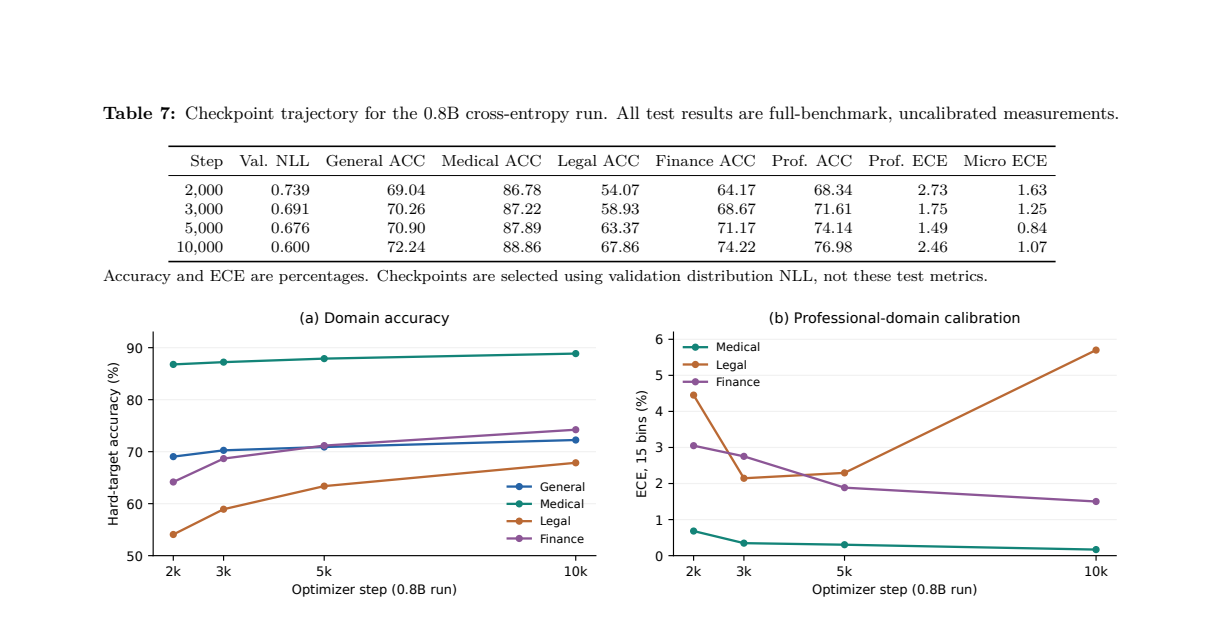
The right panel shows professional-domain ECE but the legend includes only medical, legal, finance. Add a line or text stating that the 'professional average' ECE is plotted or clarify that the three lines are the per-domain values. The caption says 'professional-domain calibration' but it is unclear whether the average or individual domains are shown.
The paper says, at §6.2, Table 8
Pith says: minor objection 6 of 6
The deployment accuracy differs slightly from §5.1 because of the fitted temperature. The text notes this, but it would help to add a direct cross-reference to §5.1, stating that the deployment model uses T=1.108 while the uncalibrated model uses T=1, so the values are not directly comparable.
What would settle it
Perform a parent-unit bootstrap on the legal and financial test subsets: resample parent records with replacement 10,000 times, recompute hard-target accuracy for each resample, and report 95% percentile confidence intervals. If either interval width exceeds 5 percentage points, the point estimates are insufficiently precise to support comparative claims against imported baselines. This test directly addresses the statistical dependence identified by the authors.
from the skeptic's reading
How the review went
4 readings by deepseek-v4-flash · 19 Oct 2026
- Reader holds up
- Skeptic partly agrees
- Editor wrote the verdict above
- Referee minor revision: 2 major objections, 6 minor
Not run on this paper: the simulated authors' defence.
Pith did not check this review's objections against the paper.
The review in full
The review in brief, machine-written
The paper you want to know about: it is a straightforward engineering adaptation of hmm's candidate-letter logit trick for Chinese-language decision tasks. Nothing conceptually new—the readout, LoRA, and temperature scaling are all borrowed—but it is executed cleanly and documented with unusual transparency. The authors release the 0.8B weights, the full pipeline, and an application workbench. That alone makes it useful as a baseline for anyone working on Chinese probabilistic decision-making.
What it does well: joint-domain training on boolean, categorical, and ordinal prompts with distribution targets, a single checkpoint covering four domains, and a thorough deployment study including Q8 quantization. The numbers are reported honestly: they separate raw checkpoints from temperature-scaled artifacts, they show per-checkpoint trajectories, and they call out every confound (no reproduced baselines, no controlled scale comparison, no bootstrap intervals). The Limitations section is unusually candid. If the field had more papers like this one, we would waste less time on irreproducible claims.
Where the soft spots are: the central comparative claim—0.8B beating Chinese-Jev specialists by 7.76 and 9.50 points on law and finance—rests on point estimates from test sets with only 2,048 and 3,274 parent units. The authors themselves note ([b232]) that treating decisions as independent overstates precision. Without bootstrap resampling that accounts for the parent-unit structure, we have no idea whether those gaps are real or within noise. The same issue applies to every accuracy number in the paper, though it matters most for the small domains where transfer learning from larger domains is critical. This is not a fatal flaw—the authors put the warning in writing—but it means the paper establishes a reproducible engineering baseline, not a statistically demonstrated advantage.
Also, the 2B results are preliminary and confounded by a different objective (CE+RLCD), so they contribute no reliable information about scaling.
Who this is for: researchers who need a ready-to-use Chinese decision model or want to replicate the hmm approach on new tasks. The paper is a solid technical report, not a research breakthrough.
Review recommendation: send it to peer review. The transparency and the released assets are valuable. The authors should be asked to add bootstrap confidence intervals for the main accuracy comparisons, or at least to qualify the reported gaps more strongly. But the work as it stands deserves a serious referee.
The strongest objection
The central claim reports 67.86% legal accuracy and 74.22% financial accuracy as point estimates. However, Appendix B states that the legal test set has only 2,048 parent units and the financial set 3,274 parent units, while each contains multiple decisions per unit (4,300 and 3,600 decisions respectively). The paper's own limitation text ([b232]) notes that treating decisions as independent 'would overstate statistical precision.' Without bootstrap resampling that respects the parent-unit structure, the reader cannot assess whether these accuracy values are precise enough to support the claims of superiority over Chinese-Jev specialists (which the paper relies on for its strongest claim). Because the legal and financial domains have the smallest training sets (24,000 each), transfer learning is critical; a wide confidence interval would mean the reported advantage over baselines (7.76 and 9.50 percentage points) could be within noise. The paper does not provide any uncertainty quantification for these domains, making this the most load-bearing unresolved issue.
The reader's weakest assumption identified the lack of domain-specific validation and bootstrapped intervals. This concern sharpens that point by grounding it in the concrete parent-unit counts from Appendix B and the paper's own acknowledgment of dependence. The paper honestly lists this as a limitation, but the strongest claim (competitive accuracy numbers) depends on these point estimates being reliable. While the authors are transparent, the omission of any uncertainty quantification for the two small domains is the single most load-bearing gap: if confidence intervals are wide, the numerical advantages over baselines may not hold. The verdict remains UNCHANGED because the paper's limitations section already admits this, and the ACCEPT verdict reflects the contribution as an honest empirical report. However, adding the suggested bootstrap would substantially strengthen the central empirical claim.
The referee's report
If the reported pipeline and results are reproducible, this work provides a practical, open-source solution for Chinese probabilistic decision-making with strong calibration. The single-checkpoint coverage of four domains, the low aggregate ECE (1.07%), and the documented deployment path (including quantization and CPU feasibility) are valuable contributions to applied NLP. The explicit separation of raw checkpoints from temperature-scaled artifacts and the clear cataloguing of limitations (single run, imported baselines, confounded 2B comparison) set a good standard for empirical reporting. The paper does not claim a new architecture or state-of-the-art across all Chinese tasks, making its scope appropriate for a systems report.
Pith's reading of the paper (a machine's summary, not the authors')
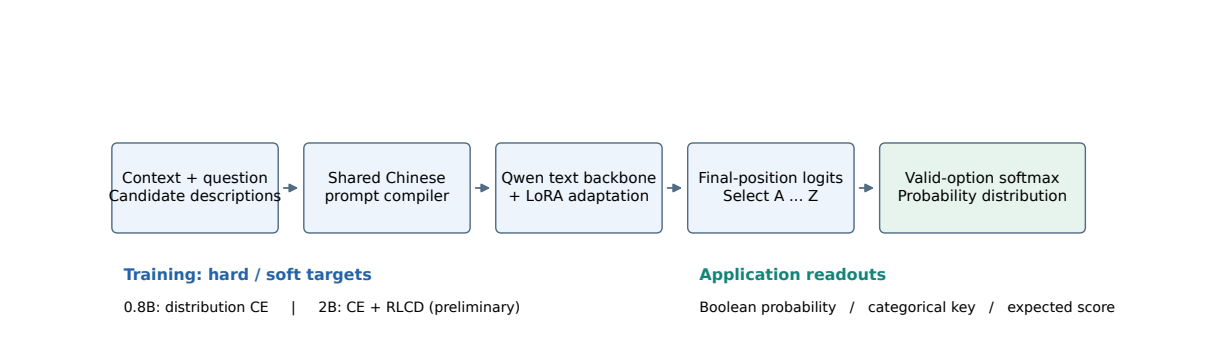
This paper presents Chinese Decision, a family of language models that convert a causal language backbone into a single-pass probabilistic decision system. Instead of generating free‑form answers, the model extracts vocabulary logits only for candidate letters (A–Z) at the final position and normalises them over the valid options, producing a distribution for Boolean, categorical, or ordinal questions in one forward evaluation. The authors train a completed 0.8B model using distribution cross‑entropy on 13 million decisions across general, medical, legal, and financial domains. On the CJ‑Bench (307,900 decisions) the uncalibrated 0.8B model reaches 72.24% general‑domain accuracy, a 76.98% average across the three professional domains, and an overall expected calibration error of 1.07%. A preliminary 2B model, trained with an additional RLCD objective, achieves 72.56% general accuracy after 40% of one epoch but lags on the professional‑domain average (74.22%). The paper also documents a quantised deployment variant and shows that aggregate metrics can hide individual prediction changes. The central contribution is a reproducible pipeline for Chinese probabilistic decisions; the authors explicitly caution that the results do not isolate the effect of model scale.
What carries the argument. The machinery is the candidate‑letter logit extraction and normalisation: given a compiled prompt containing the context, instruction, and candidate descriptions (each associated with a letter A–Z), the causal language model produces vocabulary logits at the final input position. The logits for the candidate letters are selected and normalised via a temperature‑controlled softmax over only the valid options, yielding a probability distribution in one forward pass. Training uses distribution cross‑entropy (optionally combined with RLCD for the 2B run) and low‑rank adaptation (LoRA) with rank 32. The same interface supports three question types: Boolean (noul), categorical (choice), and ordinal (score).
Core claim. The paper establishes that a family of Chinese causal language models (0.8B and 2B parameters), when adapted with low‑rank updates and trained with distribution cross‑entropy on a mixed‑domain dataset, can serve Boolean, categorical, and ordinal decision tasks through a single forward pass that normalises final‑position candidate‑letter logits. The completed 0.8B model outperforms imported baselines on general and professional domains on the CJ‑Bench, achieving 72.24% general accuracy and a 76.98% professional‑domain average with an overall ECE of 1.07%. A 2B preliminary snapshot reaches higher general accuracy (72.56%) but lower professional average (74.22%), showing that bigger size alone does not guarantee better performance with the current training setup. The key discovery is that a single checkpoint, using one shared prompt interface and no autoregressive generation, can handle multiple decision types and domains with competitive accuracy and low calibration error, while the quantised version preserves aggregate performance.
The premise it rests on. The model’s accuracy on legal and financial tasks (each trained on only 24,000 decisions) depends on transfer learning from the general and medical domains; the paper does not provide domain‑specific cross‑validation or bootstrapped confidence intervals, so the reported 67.86% legal and 74.22% financial accuracies may not generalise to other tasks within those domains.
If the paper is right (Pith's inferences, not the authors')
If the pipeline is robust, a single model can replace separate specialist models for Boolean, categorical, and ordinal Chinese decision tasks across domains, simplifying deployment.
The low aggregate ECE (1.07%) suggests that the model’s confidence is well‑calibrated on the CJ‑Bench distribution, which is relevant for applications that require probability inputs (e.g., risk‑sensitive decisions).
The Q8 quantised variant shows negligible accuracy loss and a 98.9% top‑1 agreement, indicating that efficient deployment on CPU or edge devices is feasible without significant performance degradation.
The preliminary 2B results imply that simply scaling model size does not automatically improve professional‑domain accuracy; training objective, data budget, and domain mixing may be stronger levers.
The strong performance on medicine, law, and finance with very small legal and financial training sets (24,000 decisions each) hints that the general and medical data provide effective transfer. A controlled ablation that varies the proportion of general data would test whether domain‑specific data is truly necessary.
The non‑monotonic calibration (legal ECE rises from 2.3% at step 5000 to 5.7% at step 10000 even as accuracy improves) suggests that accuracy and calibration are not aligned under distribution cross‑entropy. A calibration‑aware objective or early stopping could improve the final model’s reliability.
Across‑domain comparisons with imported baselines (Chinese‑Jev) are uncontrolled; a local reproduction of those baselines under identical evaluation conditions would establish whether the gains are due to the single‑pass architecture or to other factors (backbone size, training data, temperature).
The model’s performance on ordinal (score) questions (56.47% hard‑target accuracy, 0.579 MAE) is substantially lower than on Boolean and categorical questions. Improving ordinal prediction likely requires an objective that explicitly respects rating order, such as ordinal regression or ranking losses.
Check this review
Pith stored no record of this review's passes and took no fingerprint of it. Reviews made by code from 13 Nov 2026 on carry both.
How often reviews like this one are right
Reviews like this one: written by deepseek-v4-flash, where what was read was not recorded.
How often objections from reviews like this one are right: not yet measured
Reviews by people
This review was written by a machine. No person has reviewed this paper on Pith yet. A scientist listed on Pith can review it for a fee, and their review is published here whatever it concludes.
The paper
Abstract
Many applications need either a probability distribution over a few decisions or a set of typed spans from a text, and both are usually obtained by generating text. We present Chinese Decision, a family of Chinese models that answers both with a single forward pass and no generated token: candidate-letter logits give probabilities for Boolean, categorical, and ordinal decisions, and a small span head reading an echoed copy of the input gives typed character spans. Both readouts share one backbone and one merged LoRA, so a unified model is one weight file. We release decision-only and unified models at 0.8B, 2B, and 4B (Qwen3.5), trained for one epoch on 13.05 million decisions and, for the unified models, on CJ-IE, a 1.2-million-row Chinese extraction mixture. On the full 307,900-decision CJ-Bench, the unified 4B model reaches 86.86% accuracy, above every reported baseline and the decision-only 4B model (85.97%), and extracts spans on CJ-IE with micro F1 of 68.9. Retention has a price: against a 0.8B model continued on CJ-IE alone, which reaches 73.9 F1 but forgets CJ-Bench (71.02%), keeping decision ability costs 5.0 to 10.7 F1 points, shrinking with size. Gains of the unified models over decision-only ones are small, and all comparisons rest on single training runs with paired clustered bootstrap intervals.
The paper's own sentences, arranged, kept beside the review and separate from it. Each label is drawn from a closed vocabulary; the number beside it is the probability the classifier gave that label. No sentence in this record was written by a model.
abstract compiled · 2026-10-20
The authors' main claim, as the classifier picked it out 0.97
“The current results establish a reproducible approach to Chinese probabilistic decisions but do not isolate the effect of model scale.”
How the main claim is stated: asserted 0.99
What the abstract itself states, as probabilities: claims first 0.05 · states limitation 0.98 · human participants 0.08 · controlled comparison 0.13 · randomized assignment 0.01 · states quantitative result 0.99 · compares with prior results 0.11 · mentions code or data availability 0.87
The abstract, sentence by sentence
This table labels the abstract only (arXiv listing abstract v1). The number is the probability the classifier gave the label.
| Sentence | Role | The authors' own work | States the main conclusion | Strength |
|---|---|---|---|---|
| Many language-based applications require probabilities over a finite set of decisions rather than open-ended responses. | background 1.00 | 0.05 | 0.02 | asserted 0.99 |
| We present Chinese Decision, a family of Chinese-language models for single-pass probabilistic decision-making. | contribution 1.00 | 0.91 | 0.11 | asserted 0.99 |
| Given context, an instruction, and candidate descriptions, the model extracts final-position candidate-letter logits in one forward pass and normalizes them over valid options, without autoregressive answer generation. | method 0.99 | 0.80 | 0.08 | asserted 1.00 |
| A shared interface supports Boolean judgments, categorical choices, and ordinal scores. | method 0.75 | 0.80 | 0.04 | asserted 1.00 |
| We report a completed 0.8B model trained with distribution cross-entropy on 13.048 million decisions and preliminary 2B checkpoints trained with an additional RLCD objective. | method 0.84 | 0.97 | 0.07 | asserted 1.00 |
| On the full CJ-Bench of 307,900 decisions, the uncalibrated 0.8B model achieves 72.24% general-domain accuracy and 76.98% average accuracy across medicine, law, and finance using a single checkpoint, with 1.07% overall expected calibration error. | result 1.00 | 0.97 | 0.20 | asserted 1.00 |
| The 2B model reaches 72.56% general-domain accuracy after 40.13% of one epoch but has not surpassed the completed 0.8B model on the professional-domain average. | result 1.00 | 0.96 | 0.08 | asserted 1.00 |
| We further evaluate a validation-temperature-scaled deployment model and its Q8 quantization, finding close aggregate performance while documenting individual prediction changes. | result 0.82 | 0.98 | 0.04 | asserted 1.00 |
| We release the training, evaluation, and deployment pipeline. | contribution 0.99 | 0.88 | 0.04 | asserted 0.99 |
| The current results establish a reproducible approach to Chinese probabilistic decisions but do not isolate the effect of model scale. | limitation 0.98 | 0.67 | 0.53 | asserted 0.99 |
What kind of paper the classifier reports this is: method or tool 1.00 · evidence from observation or experiment 0.92
What was examined, and what was not
Sources read
- arXiv listing abstract v1
Not examined
- full text
- figures and tables
- references and citing sentences
- relations to other papers
Levels run
- P abstract
Not run
- S sections
- T body sentences
- C citations
- R cross-paper relations
How the labels were made
Compiled by classifier-1.13.0 via TypeSafe API, question bank abstract-p1-20260923, 2026-10-20: 1 request, 7,617 input tokens.
Every quoted sentence on this record is the authors'. Every label is from Pith's closed vocabulary, with the probability shown beside it. This record as JSON
Figures (2)
Figures are the authors', reproduced from the paper.
Challenges and discussion
Disagree with the review, or know something it missed? Leave a comment, or challenge this review formally: a challenge becomes a permanent entry in this paper's record, and its decision is published here.
Come back by email
A short list of the week's newly reviewed papers. Nothing is sent until you confirm from your inbox, and every email has a link that stops it. No account.
No comments yet.
Sign in to comment