Software Engineering · arXiv:2610.24609 v1 · submitted 17 Oct 2026 · 19 references
From Candidate Admission to Task-Level Return: Auditing LLM-Generated Code under Execution Contracts
The paper says
“Admission rules retain generated programs, whereas selection policies return one candidate per task.”
more of the abstract
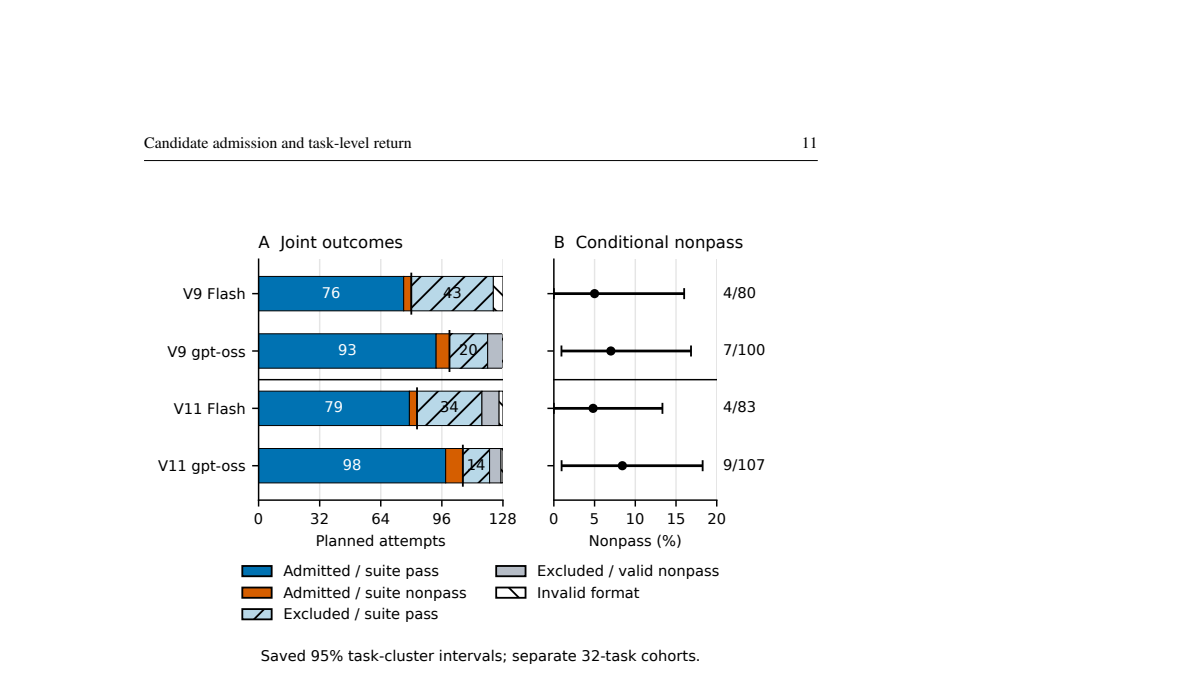
We audit how these decisions interact with execution contracts in two separately frozen, disjoint HumanEvalPlus cohorts, each comprising 32 tasks, four samples per task per profile and two served profiles. Under the inline execution contract, a structural-and-self-test screen admits 4-9 expanded-suite nonpasses per 80-107 admissions and excludes 14-43 suite passes per 128 planned attempts. A restricted module-supply condition adds 20 and 14 passing admissions for one profile in the respective cohorts, plus one follow-up nonpass, and reduces the excluded suite passes to 14-23. All fixed first-admitted outcomes and abstentions remain unchanged. In the original pool, the added passes enter already all-passing admitted pools; in the follow-up, four of 24 common sample orders lose one passed task. Selected-subset diagnostics separately address registration-sensitive completion and reference-relative assertion disagreement, accounting for input domains and comparator tolerances. In these high-pass pools, candidate retention and task-level return diverge and are reported separately. Results are conditional on the saved pools, contracts and pinned suites; downstream training effects are unmeasured.
from the abstract
Pith says
Machine review · deepseek-v4-flash · 20 Oct 2026 · what was read was not recorded · not checked by a person
It can be wrong. Challenge this review or reply to it.
Holds up. A thorough, honest audit of LLM code evaluation pipelines that cleanly separates candidate admission from task-level selection; the central claim holds, the limitations are stated, and the paper is a solid empirical contribution within its subfield. This line is wrong
3 minor
How often objections from reviews like this one are right: not yet measured
Not checked: figures, code, what the 19 references say.
3 minor objections
The paper says, at §5.4 (Table 7) and §5.6 (Table 9)
Pith says: minor objection 1 of 3
The term "uniform expected passed tasks" (U) is introduced in §5.4 and used in §5.6, but its definition as the analytic expectation k/n summed over tasks could be stated more prominently when first mentioned, to avoid confusion with an observed random draw.
The paper says, at §4 (Figure 2)
Pith says: minor objection 2 of 3
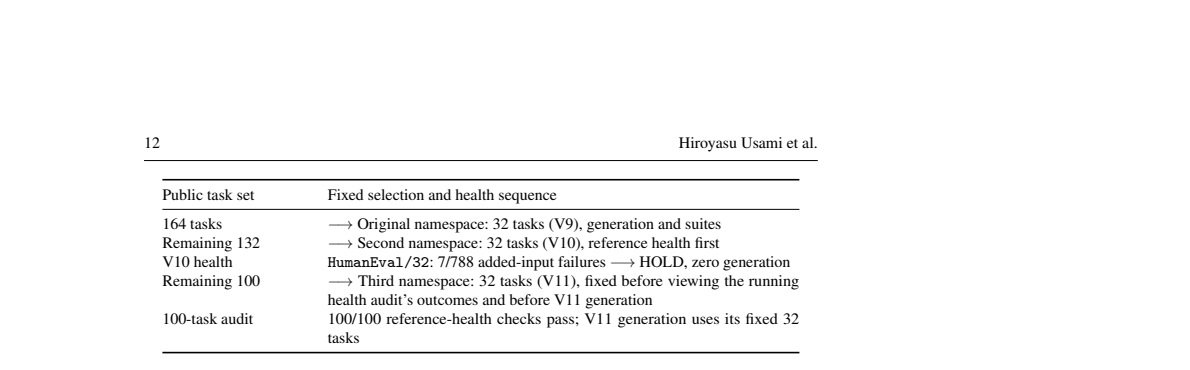
The cohort-selection diagram (Figure 2) is helpful. Adding an explicit cross-reference from the text in §4.4 to this figure would improve readability, especially for readers trying to track the V9, V10, V11 archive IDs.
show 1 more
The paper says, at §4.1 (Table 2) and §4.5 (Table 4)
Pith says: minor objection 3 of 3
Table 2 and Table 4 use overlapping predicate rows (C, E, A, Pb, P+) rather than a mutually exclusive partition. The reader's eye may initially search for row sums. Consider adding a footnote that these are overlapping conditions, or referring explicitly to the cross-tabulation in Table 15 (Appendix F) for the exclusive partition.
What would settle it
Re-run the uniform-choice expectation calculation for the original Flash inline vs. module-supply comparison using the saved admission and suite records; confirm that every added pass enters a pool with k=n, so the expected count remains unchanged. If the calculation disagrees, the saturation explanation is wrong.
from the skeptic's reading
How the review went
4 readings by deepseek-v4-flash · 20 Oct 2026
- Reader holds up
- Skeptic agrees
- Editor wrote the verdict above
- Referee minor revision: 3 minor
Not run on this paper: the simulated authors' defence.
Pith did not check this review's objections against the paper.
The review in full
The review in brief, machine-written
This paper does one thing and does it carefully: it counts how many generated programs pass their own self-tests but fail an expanded independent suite (admitted nonpasses), and how many pass the suite but are rejected by the admission screen (excluded passes). It then shows that changing the execution contract (inline vs. restricted module supply) changes admission counts without necessarily improving the task-level return of a declared selector. The contribution is genuine but incremental—a conceptual clarification backed by systematic counting, not a new algorithm or theory.
The paper's real strength is its transparency. Everything is frozen: cohorts, predicates, suites, selectors. The bootstrap intervals are descriptive, not inferential. All limitations are stated openly: small sample (64 tasks, two profiles), outcome-motivated follow-up, namespace-alias not full package loading, no downstream training evaluation, no general population claims. The diagnostics (reference substitution, same-batch registration control, assertion-local probes) are clean and well-scoped. The paper does not overclaim—it explicitly says "results are conditional on the saved pools, contracts and pinned suites."
Soft spots: (1) The novelty is moderate; the core insight (admission ≠ selection) is a measurement distinction, not a surprising discovery. (2) The sample is tiny and narrow: 32 tasks per cohort, only HumanEvalPlus, two LLM profiles, four samples per task. Transferability to other benchmarks, budgets, or more diverse code is unknown. (3) The module-supply condition is a restricted alias, not a full package environment; the authors acknowledge this, but it limits how far the contract comparison generalizes. (4) The post-hoc ablation and order-sensitivity analyses are motivated after seeing outcomes, so they are exploratory despite being frozen protocols.
Who this paper is for: researchers building or evaluating LLM code-generation pipelines who need to understand what their admission filters actually measure. It is a methodological paper for the reproducibility-and-evaluation subcommunity, not a broad-impact ML paper.
Recommendation: I would accept this for a venue like EMNLP findings, TSE, or a software engineering workshop. The paper is honest, well-constructed, and fills a genuine gap. I would cite it if writing about code evaluation methodology. It deserves peer review, even though it is narrow in scope.
The strongest objection
The paper's central claim—that a change of execution contract changes admission without necessarily improving task-level returns—is supported by thorough within-pool comparisons, diagnostic controls (same-batch registration, reference substitution, assertion-local probes), and explicit accounting of both admitted nonpasses and excluded passes. All limitations are stated; the study does not overclaim. The weakest assumption about the restricted module-supply condition, flagged by the reader, is addressed by the same-batch registration control that isolates the module registration effect from callback insertion. No additional load-bearing concern remains that would warrant adjusting the verdict.
The paper is transparent about its scope, limitations, and methods. The central claim is empirically demonstrated with concrete numbers and diagnostic controls that address potential confounds. The reader's weakest assumption is about the restricted module-supply condition; the same-batch registration control provides strong evidence that the effect is due to module registration, not side effects of the callback. No internal inconsistency or unacknowledged vulnerability is present. The verdict should remain unchanged.
The referee's report
If the result holds, it has direct implications for how researchers and practitioners evaluate generated code and construct training data. The paper demonstrates empirically that candidate retention and task-level return can diverge, and that admission counts alone are insufficient to characterize a selector's performance. The rigorous methodology—frozen cohorts, fixed predicates, bootstrap intervals, and transparent post-hoc controls—provides a template for auditing execution-based pipelines. The study does not overclaim; all limitations are stated explicitly, and the claims are properly scoped to the observed pools. This is a solid, reproducible empirical contribution that fills a gap between candidate-level admission and task-level selection.
Pith's reading of the paper (a machine's summary, not the authors')
This paper audits how LLM-generated code candidates are admitted and selected under two execution contracts: inline execution and a restricted module-supply condition. Using two separately frozen HumanEvalPlus cohorts of 32 tasks each, with four samples per task and two service profiles (Flash and gpt-oss), the authors show that changing the execution contract adds passing admissions for one profile but leaves the first-admitted suite outcomes and abstentions unchanged. Under the inline contract, 4–9 admitted candidates fail the expanded suite, while 14–43 suite-passing candidates are excluded per 128 attempts; restricted module supply reduces excluded passes to 14–23. When all 24 possible sample orders are considered, one profile loses a passed task in four of those orders. The paper contributes a complete bidirectional accounting of admission disagreements, diagnostic probes for rejection mechanisms, and a demonstration that admission gains do not automatically translate to selection improvements.
What carries the argument. The fixed structural-and-self-test screen requiring at least three distinct top-level assertions (S∧E) and the inline versus restricted module-supply execution contracts, which differ in how imported module names are resolved during self-test execution.
Core claim. The paper establishes that candidate admission and task-level return are distinct pipeline decisions that must be measured separately. Within the same saved candidate pools, switching from an inline execution contract to a restricted module-supply condition admits 20–14 additional passing candidates (for one profile) but does not change any first-admitted suite outcome or abstention under a fixed numeric-index selector. In the follow-up cohort, four of 24 common sample orders actually lose one passed task, and the expected uniform-choice pass count decreases. The paper provides a complete forensic accounting: admitted expanded-suite nonpasses (4–9 per 80–107 admissions), excluded suite passes (14–43 inline, 14–23 with restricted supply), and task-level returns with explicit abstentions. Through reference substitution, a same-batch registration control, and assertion-local probes, it isolates two sources of rejection: contract-sensitive completion (module supply) and assertion/reference disagreement, while keeping the diagnostic units distinct. The central conclusion is that a change of execution contract changes admission but need not improve selection outcomes.
The premise it rests on. The restricted module-supply condition, implemented via a callback that registers only statically referenced import aliases (solution, your_module, total_match_module), captures the effect of module availability without introducing unintended side effects on variable scoping or execution order that could confound the admission comparison.
If the paper is right (Pith's inferences, not the authors')
Researchers studying code generation pipelines should measure both admitted nonpasses and excluded passes, not just pass@k or admission counts, to capture the bidirectional disagreement with independent suites.
Practitioners constructing synthetic training data should retain an evidence vector that separates structural form, self-test completion, oracle health, and semantic conformance, using explicit labels rather than conflating completion with correctness.
The saturation effect observed in the original Flash pool—added passes entering already-all-passing admitted pools—shows that expanding admission does not guarantee improved task-level returns; selection policy and pool composition must be reported jointly.
The order-sensitivity analysis (24 common sample orders) reveals that reporting one fixed sample-index order can hide selected-pass losses; exact pairwise comparisons over all orders should be standard in pool-based evaluations.
Future work should apply the same accounting protocol to other benchmarks, execution contracts, and downstream training measurements to test the generality of the divergence between admission and selection.
The audit protocol could be automated as a continuous monitoring check for LLM-based code generation systems, flagging when admission counts rise without corresponding task-level return improvements.
The saturation phenomenon suggests diminishing returns from broadening execution contracts: once every task already has at least one passing candidate among the admitted set, further admissions cannot improve the first-choice outcome.
The order sensitivity implies that fixed-index selection may underreport the impact of contract changes; random or uniform selection would provide a more interpretable baseline for comparing contracts.
The distinction between contract-sensitive completion (ModuleNotFoundError) and assertion/reference disagreement could be used to design targeted repairs or retries, e.g., fixing module aliases separately from tuning assertion expectations.
Check this review
Pith stored no record of this review's passes and took no fingerprint of it. Reviews made by code from 13 Nov 2026 on carry both.
How often reviews like this one are right
Reviews like this one: written by deepseek-v4-flash, where what was read was not recorded.
How often objections from reviews like this one are right: not yet measured
Reviews by people
This review was written by a machine. No person has reviewed this paper on Pith yet. A scientist listed on Pith can review it for a fee, and their review is published here whatever it concludes.
The paper
Abstract
Admission rules retain generated programs, whereas selection policies return one candidate per task. We audit how these decisions interact with execution contracts in two separately frozen, disjoint HumanEvalPlus cohorts, each comprising 32 tasks, four samples per task per profile and two served profiles. Under the inline execution contract, a structural-and-self-test screen admits 4-9 expanded-suite nonpasses per 80-107 admissions and excludes 14-43 suite passes per 128 planned attempts. A restricted module-supply condition adds 20 and 14 passing admissions for one profile in the respective cohorts, plus one follow-up nonpass, and reduces the excluded suite passes to 14-23. All fixed first-admitted outcomes and abstentions remain unchanged. In the original pool, the added passes enter already all-passing admitted pools; in the follow-up, four of 24 common sample orders lose one passed task. Selected-subset diagnostics separately address registration-sensitive completion and reference-relative assertion disagreement, accounting for input domains and comparator tolerances. In these high-pass pools, candidate retention and task-level return diverge and are reported separately. Results are conditional on the saved pools, contracts and pinned suites; downstream training effects are unmeasured.
The paper's own sentences, arranged, kept beside the review and separate from it. Each label is drawn from a closed vocabulary; the number beside it is the probability the classifier gave that label. No sentence in this record was written by a model.
abstract compiled · 2026-10-20
The authors' main claim, as the classifier picked it out 0.96
“In these high-pass pools, candidate retention and task-level return diverge and are reported separately.”
How the main claim is stated: asserted 0.99
What the abstract itself states, as probabilities: claims first 0.03 · states limitation 0.96 · human participants 0.09 · controlled comparison 0.56 · randomized assignment 0.04 · states quantitative result 0.98 · compares with prior results 0.35 · mentions code or data availability 0.05
The abstract, sentence by sentence
This table labels the abstract only (arXiv listing abstract v1). The number is the probability the classifier gave the label.
| Sentence | Role | The authors' own work | States the main conclusion | Strength |
|---|---|---|---|---|
| Admission rules retain generated programs, whereas selection policies return one candidate per task. | background 0.96 | 0.16 | 0.08 | asserted 1.00 |
| We audit how these decisions interact with execution contracts in two separately frozen, disjoint HumanEvalPlus cohorts, each comprising 32 tasks, four samples per task per profile and two served profiles. | method 0.95 | 0.87 | 0.04 | asserted 0.94 |
| Under the inline execution contract, a structural-and-self-test screen admits 4-9 expanded-suite nonpasses per 80-107 admissions and excludes 14-43 suite passes per 128 planned attempts. | result 1.00 | 0.87 | 0.10 | asserted 1.00 |
| A restricted module-supply condition adds 20 and 14 passing admissions for one profile in the respective cohorts, plus one follow-up nonpass, and reduces the excluded suite passes to 14-23. | result 1.00 | 0.87 | 0.08 | asserted 1.00 |
| All fixed first-admitted outcomes and abstentions remain unchanged. | result 0.99 | 0.76 | 0.04 | asserted 1.00 |
| In the original pool, the added passes enter already all-passing admitted pools; in the follow-up, four of 24 common sample orders lose one passed task. | result 0.98 | 0.88 | 0.05 | asserted 1.00 |
| Selected-subset diagnostics separately address registration-sensitive completion and reference-relative assertion disagreement, accounting for input domains and comparator tolerances. | method 0.95 | 0.74 | 0.05 | asserted 0.97 |
| In these high-pass pools, candidate retention and task-level return diverge and are reported separately. | result 0.52 | 0.82 | 0.26 | asserted 0.99 |
| Results are conditional on the saved pools, contracts and pinned suites; downstream training effects are unmeasured. | limitation 1.00 | 0.50 | 0.07 | asserted 0.98 |
What kind of paper the classifier reports this is: empirical study 1.00 · evidence from observation or experiment 0.76
What was examined, and what was not
Sources read
- arXiv listing abstract v1
Not examined
- full text
- figures and tables
- references and citing sentences
- relations to other papers
Levels run
- P abstract
Not run
- S sections
- T body sentences
- C citations
- R cross-paper relations
How the labels were made
Compiled by classifier-1.13.0 via TypeSafe API, question bank abstract-p1-20260923, 2026-10-20: 1 request, 6,913 input tokens.
Every quoted sentence on this record is the authors'. Every label is from Pith's closed vocabulary, with the probability shown beside it. This record as JSON
Figures (2)
Figures are the authors', reproduced from the paper.
References (19)
- [1] Li, Dacheng and Cao, Shiyi and Cao, Chengkun and Li, Xiuyu and Tan, Shangyin and Keutzer, Kurt and Xing, Jiarong and Gonzalez, Joseph E. and Stoica, Ion , booktitle =. 2025 , month = nov, address =. doi:10.18653/v1/2025.findings-emnlp.865 , url = on Pithdoi:10.18653/v1/2025.findings-emnlp.865
- [2] Usami, Hiroyasu and Hara, Keisuke and Tsuboi, Ayato and Matsuda, Naohiko , year =. doi:10.48550/arXiv.2606.15610 , url =. 2606.15610 , archivePrefix = on PithPith's reviewarXivdoi:10.48550/arxiv.2606.15610
- [3] Evaluating Large Language Models Trained on Code , author =. 2021 , url =. 2107.03374 , archivePrefix= on PithPith's reviewarXiv
- [4] Program Synthesis with Large Language Models , author =. 2021 , url =. 2108.07732 , archivePrefix= on PithPith's reviewarXiv
- [5] Hendrycks, Dan and Basart, Steven and Kadavath, Saurav and Mazeika, Mantas and Arora, Akul and Guo, Ethan and Burns, Collin and Puranik, Samir and He, Horace and Song, Dawn and Steinhardt, Jacob , booktitle =. Measuring Coding Challenge Competence With. 2021 , eprint = on Pith
- [6] Li, Yujia and others , journal =. Competition-Level Code Generation with. 2022 , doi =. 2203.07814 , archivePrefix= on PithPith's reviewarXiv
- [7] Liu, Jiawei and Xia, Chunqiu Steven and Wang, Yuyao and Zhang, Lingming , booktitle =. Is Your Code Generated by. 2023 , eprint =. doi:10.52202/075280-0943 , url = on Pithdoi:10.52202/075280-0943
- [8] Chen, Bei and Zhang, Fengji and Nguyen, Anh and Zan, Daoguang and Lin, Zeqi and Lou, Jian-Guang and Chen, Weizhu , booktitle =. 2023 , eprint = on Pith
- [9] Le, Hung and Wang, Yue and Gotmare, Akhilesh Deepak and Savarese, Silvio and Hoi, Steven Chu Hong , booktitle =. 2022 , doi =. 2207.01780 , archivePrefix= on PithPith's reviewarXiv
- [10] Teaching Large Language Models to Self-Debug , author =. International Conference on Learning Representations , year =. 2304.05128 , archivePrefix= on PithPith's reviewarXiv
- [11] Barr, Earl T. and Harman, Mark and McMinn, Phil and Shahbaz, Muzammil and Yoo, Shin , title =. IEEE Transactions on Software Engineering , volume =. 2015 , doi = on Pith
- [12] Sch. An Empirical Evaluation of Using Large Language Models for Automated Unit Test Generation , journal =. 2024 , doi = on Pith
- [13] Cao, Yuhan and Chen, Zian and Quan, Kun and Zhang, Ziliang and Wang, Yu and Dong, Xiaoning and Feng, Yeqi and He, Guanzhong and Huang, Jingcheng and Li, Jianhao and Tan, Yixuan and Tang, Jiafu and Tang, Yilin and Wu, Junlei and Xiao, Qianyu and Zheng, Can and Zhou, Shouchen an... on Pith
- [14] Automated Unit Test Improvement using Large Language Models at Meta , author =. 2024 , howpublished =. 2402.09171 , archivePrefix = on PithPith's reviewarXiv
- [15] Effective Test Generation Using Pre-trained Large Language Models and Mutation Testing , author =. 2023 , howpublished =. 2308.16557 , archivePrefix = on PithPith's reviewarXiv
- [16] Xu, Zhangchen and Liu, Yang and Yin, Yueqin and Zhou, Mingyuan and Poovendran, Radha , booktitle =. 2025 , month = jul, address =. doi:10.18653/v1/2025.findings-acl.365 , eprint = on Pithdoi:10.18653/v1/2025.findings-acl.365
- [17] Language Models Can Teach Themselves to Program Better , author =. International Conference on Learning Representations , year = on Pith
- [18] Wei, Yuxiang and Cassano, Federico and Liu, Jiawei and Ding, Yifeng and Jain, Naman and Mueller, Zachary and de Vries, Harm and von Werra, Leandro and Guha, Arjun and Zhang, Lingming , booktitle =. 2024 , doi = on Pith
- [19] Guidelines for Empirical Studies in Software Engineering involving Large Language Models , author =. 2026 , howpublished = on Pith
Challenges and discussion
Disagree with the review, or know something it missed? Leave a comment, or challenge this review formally: a challenge becomes a permanent entry in this paper's record, and its decision is published here.
Come back by email
A short list of the week's newly reviewed papers. Nothing is sent until you confirm from your inbox, and every email has a link that stops it. No account.
No comments yet.
Sign in to comment